


ISO Guide 82:2014
(Main)Guidelines for addressing sustainability in standards
Guidelines for addressing sustainability in standards
ISO Guide 82:2014 provides guidance to standards writers on how to take account of sustainability in the drafting, revision and updating of ISO standards and similar deliverables. It outlines a methodology that ISO standards writers can use to develop their own approach to addressing sustainability on a subject-specific basis.
Lignes directrices pour la prise en compte de la durabilité dans les normes
L'ISO Guide 82:2014 fournit aux rédacteurs de normes des lignes directrices pour la prise en compte de la durabilité dans la rédaction, la révision et la mise à jour des normes ISO et des produits apparentés. Il décrit une méthodologie pouvant être utilisée par les rédacteurs de normes ISO pour développer leur propre méthode de prise en compte de la durabilité selon le sujet spécifique.
General Information
- Status
- Withdrawn
- Publication Date
- 23-Feb-2014
- Withdrawal Date
- 23-Feb-2014
- Technical Committee
- ISO/TMBG - Technical Management Board - groups
- Drafting Committee
- ISO/TMBG - Technical Management Board - groups
- Current Stage
- 9599 - Withdrawal of International Standard
- Start Date
- 19-Nov-2019
- Completion Date
- 12-Feb-2026
Relations
- Effective Date
- 23-Apr-2020
ISO Guide 82:2014 - Guidelines for addressing sustainability in standards
ISO Guide 82:2014 - Guidelines for addressing sustainability in standards
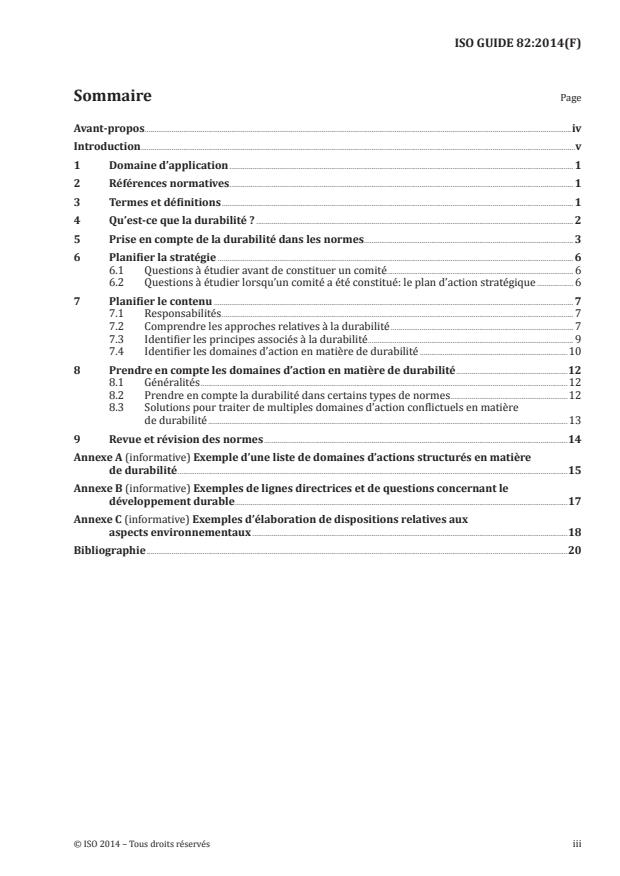
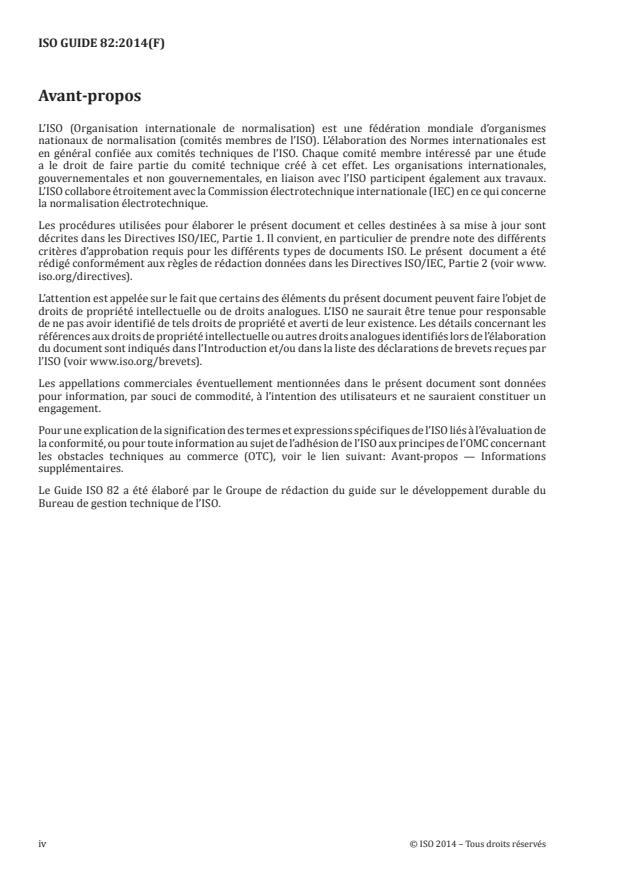
ISO Guide 82:2014 - Lignes directrices pour la prise en compte de la durabilité dans les normes
Get Certified
Connect with accredited certification bodies for this standard

BSI Group
BSI (British Standards Institution) is the business standards company that helps organizations make excellence a habit.

Bureau Veritas
Bureau Veritas is a world leader in laboratory testing, inspection and certification services.

DNV
DNV is an independent assurance and risk management provider.
Sponsored listings
Frequently Asked Questions
ISO Guide 82:2014 is a guide published by the International Organization for Standardization (ISO). Its full title is "Guidelines for addressing sustainability in standards". This standard covers: ISO Guide 82:2014 provides guidance to standards writers on how to take account of sustainability in the drafting, revision and updating of ISO standards and similar deliverables. It outlines a methodology that ISO standards writers can use to develop their own approach to addressing sustainability on a subject-specific basis.
ISO Guide 82:2014 provides guidance to standards writers on how to take account of sustainability in the drafting, revision and updating of ISO standards and similar deliverables. It outlines a methodology that ISO standards writers can use to develop their own approach to addressing sustainability on a subject-specific basis.
ISO Guide 82:2014 is classified under the following ICS (International Classification for Standards) categories: 01.120 - Standardization. General rules; 13.020.01 - Environment and environmental protection in general; 77.040.10 - Mechanical testing of metals. The ICS classification helps identify the subject area and facilitates finding related standards.
ISO Guide 82:2014 has the following relationships with other standards: It is inter standard links to ISO Guide 82:2019. Understanding these relationships helps ensure you are using the most current and applicable version of the standard.
ISO Guide 82:2014 is available in PDF format for immediate download after purchase. The document can be added to your cart and obtained through the secure checkout process. Digital delivery ensures instant access to the complete standard document.
Standards Content (Sample)
ISO Guide 82
Guidelines for
addressing
sustainability in
standards
Corrected version
2014-04-01
First edition
2014-03-01
Our vision Our process
To be the world’s leading provider of high Our standards are developed by experts
quality, globally relevant International all over the world who work on a volunteer
Standards through its members and or part-time basis. We sell International
stakeholders. Standards to recover the costs of organizing
this process and making standards widely
available.
Please respect our licensing terms and
Our mission
copyright to ensure this system remains
ISO develops high quality voluntary
independent.
International Standards that facilitate
international exchange of goods and If you would like to contribute to the
services, support sustainable and equitable development of ISO standards, please
economic growth, promote innovation and contact the ISO Member Body in your
protect health, safety and the environment. country:
w w w.iso.org/iso/home/about/iso_
members.htm
This document has been prepared by: Copyright protected document
ISO Technical Management Board All rights reserved. Unless otherwise
Sustainability Guide Drafting Group. specified, no part of this publication may
be reproduced or utilized otherwise in
any form or by any means, electronic or
mechanical, including photocopy, or posting
Committee members:
on the internet or intranet, without prior
permission. Permission can be requested
ABNT; AENOR; AFNOR; ANSI; BSI; DIN; DS;
from either ISO at the address below or
KATS; SA; SABS; SAC; SCC; SIS; COPOLCO.
ISO’s member body in the country of the
requester:
This list reflects contributing members at the
time of publication.
Cover photo credit: ISO/CS, 2014
ISO copyright office
Case postale 56 • CH-1211 Geneva 20
Tel. +41 22 749 01 11
Fax. +41 22 749 09 47
E-mail copyright@iso.org
Web www.iso.org
Executive Summary
• Sustainability is the goal of sustainable • This Guide provides guidance to
development. standards writers on how to take account
of sustainability in the drafting, revision
• It refers to any state of the global system
and updating of ISO standards and similar
in which the needs of the present are met
deliverables.
without compromising the ability of future
generations to meet their own needs. • It aims to raise awareness of sustainability
issues arising from the application of ISO
• The concept of sustainability is continually
standards.
evolving.
• Standards writers are encouraged to
consider sustainability issues in their
work at all stages in the standards
development process.
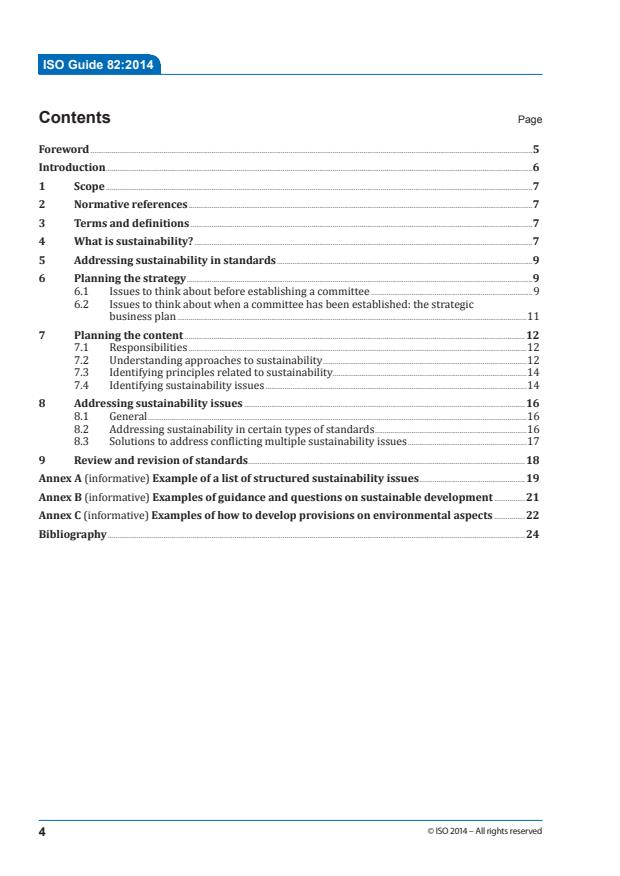
Contents Page
Foreword .5
Introduction .6
1 Scope .7
2 Normative references .7
3 Terms and definitions .7
4 What is sustainability? .7
5 Addressing sustainability in standards .9
6 Planning the strategy .9
6.1 Issues to think about before establishing a committee .9
6.2 Issues to think about when a committee has been established: the strategic
business plan .11
7 Planning the content .12
7.1 Responsibilities .12
7.2 Understanding approaches to sustainability .12
7.3 Identifying principles related to sustainability . .14
7.4 Identifying sustainability issues .14
8 Addressing sustainability issues .16
8.1 General .16
8.2 Addressing sustainability in certain types of standards .16
8.3 Solutions to address conflicting multiple sustainability issues .17
9 Review and revision of standards .18
Annex A (informative) Example of a list of structured sustainability issues .19
Annex B (informative) Examples of guidance and questions on sustainable development .21
Annex C (informative) Examples of how to develop provisions on environmental aspects .22
Bibliography .24
Foreword
ISO (the International Organization for be the subject of patent rights. ISO shall not
Standardization) is a worldwide federation be held responsible for identifying any or all
of national standards bodies (ISO member such patent rights. Details of any patent rights
bodies). The work of preparing International identified during the development of the
Standards is normally carried out through document will be in the Introduction and/or
ISO technical committees. Each member body on the ISO list of patent declarations received
interested in a subject for which a technical (see www.iso.org/patents).
committee has been established has the
Any trade name used in this document is
right to be represented on that committee.
information given for the convenience of users
International organizations, governmental
and does not constitute an endorsement.
and non-governmental, in liaison with ISO,
also take part in the work. ISO collaborates
For an explanation on the meaning of ISO
closely with the International Electrotechnical
specific terms and expressions related to
Commission (IEC) on all matters of
conformity assessment, as well as information
electrotechnical standardization.
about ISO’s adherence to the WTO principles in
the Technical Barriers to Trade (TBT) see the
The procedures used to develop this
following URL: Foreword - Supplementary
document and those intended for its further
information
maintenance are described in the ISO/IEC
Directives, Part 1. In particular the different
ISO Guide 82 was prepared by the ISO
approval criteria needed for the different
Technical Management Board Sustainability
types of ISO documents should be noted. This
Guide Drafting Group.
document was drafted in accordance with
the editorial rules of the ISO/IEC Directives,
This corrected version of ISO Guide 82:2014
Part 2 (see www.iso.org/directives).
incorporates the correction of cross-
references in Clause 5 and of the URL in
Attention is drawn to the possibility that
Annex B.
some of the elements of this document may
Introduction
b) provide standards writers with a systematic
Sustainability is the goal of sustainable
approach to addressing sustainability issues
development. It refers to any state of the
in a coherent and consistent manner, with
global system in which the needs of the
regard to both new and revised standards,
present are met without compromising the
and in a manner related to the objective and
ability of future generations to meet their
scope of the standard being developed;
own needs. The concept of sustainability
is continually evolving. Understanding and
c) promote consistency, where appropriate,
achieving a balance between environmental,
among standards that address sustainability.
social and economic systems, ideally in
This Guide makes reference to related ISO
mutually supporting ways, is considered
deliverables, as appropriate, e.g. ISO Guide 64
essential for making progress towards
(which addresses environmental issues in
achieving sustainability. The achievement of
product standards) and ISO 26000 (which
sustainability is now recognized as one of the
provides guidance on social responsibility).
most important considerations in all human
activities.
Standards writers are encouraged to consider
sustainability issues in their work at all stages
The term “sustainable development” is
in the standards development process. If
often used to describe development that
sustainability issues have not been considered,
leads to sustainability, and the term “social
this can be a valid reason to start the revision
responsibility” is often used to describe how
of a standard. In addition, the significance or
an individual organization (e.g. a company)
relevance of specific issues might have changed
can contribute to sustainable development.
since the previous edition of a standard
ISO st andards can cont ribute to t he achievement
was drafted or reviewed. Whenever a new
of sustainability, either directly (where they standard is drafted or an existing standard
specifically address sustainability issues) or is revised, all standards writers (including
indirectly (e.g. where they relate to testing, project leaders, convenors, committee chairs
products, procedures, services, terminology,
and secretaries) are encouraged to actively
management systems or auditing). However,
promote the application of this Guide, and
since sustainable developments and progress thereby involve experts knowledgeable in the
towards sustainability are heavily dependent subject.
on a multitude of variables, including social,
environmental, economic, geographic and
technical conditions, it is important that
standards writers do not reach overall
conclusions that particular activities
(including processes) or products (including
services) are “sustainable.”
NOTE In this Guide, the term “activities and
products” includes “processes and services”.
This Guide is intended for use by anyone
involved in the development of ISO standards
and similar deliverables, and aims to:
a) raise awareness of sustainability issues
arising from the application of ISO standards;
3.2
1 Scope
sustainable development
This Guide provides guidance to standards development that meets the environmental,
writers on how to take account of sustainability social and economic needs of the present
in the drafting, revision and updating of ISO without compromising the ability of future
standards and similar deliverables.
generations to meet their own needs
Note 1 to entry: Derived from the Brundtland
It outlines a methodology that ISO standards
[17]
Report .
writers can use to develop their own approach
to addressing sustainability on a subject-
3.3
specific basis.
stakeholder
individual or group that has an interest in any
decision or activity of an organization
2 Normative references
[SOURCE: ISO 26000:2010, definition 2.20]
The following documents, in whole or in part,
are normatively referenced in this document
3.4
and are indispensable for its application.
social responsibility
For dated references, only the edition cited
responsibility of an organization for the
applies. For undated references, the latest
impacts of its decisions and activities on
edition of the referenced document (including
society and the environment, through
any amendments) applies.
transparent and ethical behaviour that:
ISO/IEC Guide 2, Standardization and related
— contributes to sustainable development (3.2),
activities — General vocabulary
including the health and the welfare of
society;
ISO 14050, Environmental management —
— takes into account the expectations of
Vocabulary
stakeholders (3.3);
— is in compliance with applicable law and
3 Terms and definitions
consistent with international norms of
behaviour; and
For the purposes of this document, the terms
and definitions given in ISO/IEC Guide 2,
— is integrated throughout the organization
ISO 14050 and the following apply.
and practised in its relationships
3.1
Note 1 to entry: Activities include products, services
sustainability
and processes.
state of the global system, including
Note 2 to entry: Relationships refer to an organization’s
environmental, social and economic aspects,
activities within its sphere of influence.
in which the needs of the present are met
without compromising the ability of future
[SOURCE: ISO 26000:2010, definition 2.18]
generations to meet their own needs
3.5
Note 1 to entry: The environmental, social and
standards writer
economic aspects interact, are interdependent and
individual or group taking part in the
are often referred to as the three dimensions of
development of a standard
sustainability.
Note 2 to entry: Sustainability is the goal of sustainable
development (3.2).
4 What is sustainability?
Sustainability is the goal of sustainable if social, economic and environmental aspects
development, a widely applied concept that are addressed in an integrated manner.
gained international recognition following the
NOTE Annex C provides examples of how to
publication in 1987 of the Report of the World
develop provisions on environmental aspects.
Commission on Environment and Development,
Our Common Future (commonly referred to
As defined in 3.1, sustainability refers to a
[17]
as the Brundtland Report) . Since then, the
state of the global system, encompassing
importance of sustainability and sustainable
the environmental, social and economic
development has been reiterated in numerous
subsystems, in which the needs of the present
international forums, such as the United
are met without compromising the ability of
Nations Conference on Environment and
future generations to meet their needs. Given
Development in 1992 (the “Rio Declaration”),
the intergenerational nature of sustainability
the World Summit on Sustainable Development
(i.e. the needs of future generations cannot be
in 2002, and the United Nations Conference on
fully defined by the present generation) and
Sustainable Development in 2012 (“Rio+20”).
the constant changes in the environmental,
societal (e.g. population growth) and economic
Sustainability encompasses three dimensions
subsystems, sustainability cannot be
(economic, environmental and social) which
described purely in terms of a single fixed end
are interdependent and can be mutually
point. From this perspective, sustainability is
reinforcing. The environment sets natural
a characteristic of the planet as a whole, and
limits to the social system, which is made up
not of any particular activity or organization.
of human institutions and individuals. The
However, sustainable development addresses
economy, as one part of the social system,
the activities and products of particular
includes the consumption of resources,
organizations (or communities, nations, etc.)
employment, meeting the needs of populations
and the ability to engage in such development
(which are typically growing), income, and the
in a manner that contributes to sustainability.
distribution and use of products. Sustainability
Such development is needed to meet the needs
has been misunderstood by some as being
of both present and future generations, and is
primarily an environmental concept, including
therefore essential to sustainability.
issues such as climate change, non-sustainable
resource use or depletion, and loss of fertile
In this context, sustainability and sustainable
soil and biodiversity. However, sustainability
development issues can be viewed as concerns
also includes social and economic issues,
about changes (adverse or beneficial) to
such as social structures, standards of living,
the environmental, societal or economic
income distribution, production, distribution
subsystems as a result of development, which
and use of resources, products and services,
can affect the ability of future generations to
and employment. Sustainability relates to the
meet their own needs. Sustainability issues
interaction with, and relationship between,
can arise from a wide range of activities
these issues.
and products that interact with, or can have
an impact on, society, the economy or the
Sustainability is relevant to all levels of
environment.
human activity, from the global level to the
national, regional and community levels, as
The terms “sustainability”, “sustainable
well as to the behaviour of individuals. It is
development” and “social responsibility” are
also affected by all kinds of organizations,
used interchangeably by some stakeholders,
including governments, non-governmental
but even though there is a close relationship
organizations, companies, co-operatives,
between them, they are three different
federations and unions. Sustainability is much
concept s and are t herefore not interchangeable.
more likely to be achieved by society as a whole
Since sustainable development relates to the
economic, social and environmental goals
EXAMPLE ISO/TC 59/SC 17 has provided
common to all people, it can be used to refer
guidance on sustainability issues related to buildings
the broader expectations of society.
and civil engineering works.
Social responsibility encompasses an
However, it might sometimes be necessary
organization’s responsibility for the impact
to involve experts who are knowledgeable
of its decisions and activities on society, the
on the subjects related to sustainability,
environment and economy, and therefore the
e.g. in complex fields such as human rights,
organization’s contribution to sustainable
the environment or economics. It can also
development and sustainability. Although the
be useful to include other relevant, current
term “corporate social responsibility” (CSR)
sector-specific guidance on environmental,
might be a more familiar term than “social
social or economic provisions identified in
responsibility”, the view has recently emerged
related ISO standards.
that “social responsibility” is applicable to all
organizations, as different types of entities or
This clause (Clause 5) discusses how
groups of people and facilities, both inside and
sustainable development can be addressed
outside the business world, recognize that
at the planning stages of standards work.
they also have a responsibility to contribute to
Clauses 6 and 7 provide specific guidance
current sustainable development and future
on identifying sustainable development
sustainability.
issues (including principles and approaches).
Clause 8 discusses how those issues can be
The standards development process provides
addressed in the standards writing or revision
standards writers with the opportunity
process.
to contribute to sustainable development,
and in particular to encourage sustainable
Figure 1 illustrates a process for identifying
production and consumption.
and addressing sustainability issues.
NOTE 1 The linear depiction in Figure 1 might not
be the only valid approach.
5 Addressing sustainability in
standards
NOTE 2 The numbering in Figure 1 refers to the
clauses and subclauses in this Guide.
There are parallels between addressing
sustainability in standards and addressing
the sustainability issues of an organization, 6 Planning the strategy
even though there are some unique challenges
in standards due to the nature of standards
6.1 Issues to think about before
writing (e.g. it is largely done by volunteers
establishing a committee
from a variety of organizations who meet
only occasionally, and often disband after
NOTE In this Guide, unless otherwise stated, the
a particular project is completed). Once
term “committee” includes technical committees (TC),
the relevant principles of the work have project committees (PC) and subcommittees (SC).
been discussed, the main task is to identify
Sustainable development should be taken into
sustainability issues that are relevant and
account during the formation of committees
significant (see 7.4.2 and 7.4.3) and to address
and in subsequent phases of the writing
them by integrating specific provisions into
process of ISO standards.
standards.
This enables sustainable development to
Existing information related to sustainable
be integrated into the scope, structure and
development, including information that has
work plan of a TC from the start, as well
already been the subject of standardization,
as promoting awareness of sustainable
can be used to identify and evaluate relevant
development amongst the TC’s leadership and
issues (see Annex B).
Figure 1 — ISO Guide 82 process flow
participants, and clarifying that sustainable business plan is reviewed by the ISO Technical
development will be an integral part of the Management Board (TMB).
TC’s work. The considerations that should be
NOTE PCs and SCs are not required to prepare a
taken into account at this stage include the
strategic business plan.
following.
As outlined in this Guide, it is recommended
a) Scope: Has sustainable development been
that each strategic business plan should
taken into account in a manner appropriate
include a sustainability plan that describes
to the subject matter of the TC?
how the TC intends to address sustainable
b) Structure: How will sustainable development
development in its work. TCs currently in
be addressed through the structure of the
existence should update their strategic
TC? The options include:
business plans to include sustainable
development.
— including sustainable development as
a discrete issue to be dealt with by a
This sustainable development component
subcommittee;
of the strategic business plan should be
appropriate to the TC’s field of work, given
— creating a task force on sustainable
that sustainable development issues can
development;
be more directly implicated in some areas
— integrating sustainable development into
of standardization than in others. The
the efforts of each SC or working group
sustainability plan should include:
(WG);
— defined processes describing how sustainable
— a combination of these options.
development will be taken into account in the
selection of new work items, including the
c) Participation: Does the TC have the
setting of the scope of such work items;
appropriate participation (consistent
with and taking into account the ISO/IEC
— programmes for ensuring that TC participants
Directives and guidance on participation), in
are aware of sustainable development and
terms of both diversity of stakeholders and
how it applies to standards writing, including
expertise, to effectively address sustainable
the guidance provided in this Guide;
development issues? What measures might
be taken to address any shortcomings?
— a description of how the work of the TC will
be reviewed with respect to the identification
When a TC is created, the documentation
of relevant general sustainable development
should include a description of how each
principles and approaches, and how particular
of these questions has been addressed.
sustainability issues might emerge in the
It is recommended that existing TCs also
context of the standard being developed.
go through this process and update their
The strategic business plan should identify
scope, structure and participation processes
relevant sustainable development issues that
accordingly. These same concepts can be
can be applicable to all or most of the TC’s
applied to the formation of SCs within TCs.
work. The strategic business plan should be
updated regularly. Alternatively, relevant
6.2 Issues to think about when
sustainable development issues could be
a committee has been estab-
identified at SC or WG level, or on a document-
by-document basis, or by a combination of
lished: the strategic business
these approaches, as appropriate (e.g. a TC-
plan
wide evaluation of sustainability issues could
be fine-tuned at both SC and WG levels).
ISO requires each TC to prepare a strategic
business plan for its field of activity within
18 months of its creation. The strategic
The value of the sustainability plan is in its For example, an aspect that seems to be
implementation in the standards writing primarily related to the environmental
itself. Therefore, the processes to verify dimension of sustainability can also have an
that relevant sustainability issues are being impact within a social or economic dimension
identified and addressed in the documents of sustainability, e.g. depletion of fish stocks
being produced are central to its success. by excessive fishing has an environmental
impact, as well as a social and an economic
impact on people and communities employed
7 Planning the content
in the fishery. The potential for these multiple
impacts to occur should always be considered
when drafting provisions relating to any
7.1 Responsibilities
particular sustainability issue.
After determining the general strategy
Systemic thinking encourages the
for addressing sustainability within the
internalization of costs. Economic costs
committee work, agreement should be
are often externalized in the form of
reached on how it will be applied in the context
environmental and social impacts, for which
of a specific standardization project. Unlike
the monetary costs might not be known.
strategic planning, which is usually done at
Similarly, by including appropriate provisions
TC/PC level, this task is usually performed
directly within the text, standards writers
within the WG responsible for developing the
can also encourage the users of the standards
technical content for a particular standard.
to apply systemic thinking in the application
of the standard.
7.2 Understanding approaches
to sustainability
7.2.3 Life cycle approach
Life cycle thinking examines all stages of the
7.2.1 General
life cycle of a particular activity or product in
Before discussing and selecting the order to identify the widest range of relevant
sustainability issues to be addressed in a
sustainability issues.
standard, the WG should make itself aware
Typical stages of a product life cycle include
of the approaches that can be used to guide
material acquisition, design, production,
the technical work and identify and evaluate
use and end-of-life. For some activities or
sustainability issues. A description of some of
products, the life cycle is likely to include
the approaches that might be used is given in
different stages, e.g. design, promotion,
7.2.2 to 7.2.6. These approaches can be used
provision and termination. For other activities
individually or in any combination, depending
or products, it might not be possible to apply
on the circumstances. There might also be
life cycle thinking directly. Different stages
other approaches that are not identified here.
can also include an element of transportation,
which itself can involve a number of different
7.2.2 Systemic approach
sustainability issues.
Systemic thinking suggests that, when
From a purely environmental standpoint
considering a certain sustainability issue
(i.e. not taking into account the social and
within a given system, the related systems
economic dimensions of sustainability), an
and subsystems should also be considered,
example of the range of issues related to the life
because they are all interconnected and
cycle of manufactured equipment
...
GUIDE 82
First edition
2014-03-01
Corrected version
2014-04-01
Guidelines for addressing
sustainability in standards
Lignes directrices pour la prise en compte du développement durable
dans les normes
Reference number
©
ISO 2014
© ISO 2014
All rights reserved. Unless otherwise specified, no part of this publication may be reproduced or utilized otherwise in any form
or by any means, electronic or mechanical, including photocopying, or posting on the internet or an intranet, without prior
written permission. Permission can be requested from either ISO at the address below or ISO’s member body in the country of
the requester.
ISO copyright office
Case postale 56 • CH-1211 Geneva 20
Tel. + 41 22 749 01 11
Fax + 41 22 749 09 47
E-mail copyright@iso.org
Web www.iso.org
Published in Switzerland
ii © ISO 2014 – All rights reserved
Contents Page
Foreword .iv
Introduction .v
1 Scope . 1
2 Normative references . 1
3 Terms and definitions . 1
4 What is sustainability? . 2
5 Addressing sustainability in standards . 3
6 Planning the strategy . 5
6.1 Issues to think about before establishing a committee . 5
6.2 Issues to think about when a committee has been established: the strategic
business plan . 5
7 Planning the content . 6
7.1 Responsibilities . 6
7.2 Understanding approaches to sustainability . 6
7.3 Identifying principles related to sustainability . . 8
7.4 Identifying sustainability issues . 8
8 Addressing sustainability issues .10
8.1 General .10
8.2 Addressing sustainability in certain types of standards .11
8.3 Solutions to address conflicting multiple sustainability issues .12
9 Review and revision of standards .12
Annex A (informative) Example of a list of structured sustainability issues .14
Annex B (informative) Examples of guidance and questions on sustainable development .16
Annex C (informative) Examples of how to develop provisions on environmental aspects .17
Bibliography .19
Foreword
ISO (the International Organization for Standardization) is a worldwide federation of national standards
bodies (ISO member bodies). The work of preparing International Standards is normally carried out
through ISO technical committees. Each member body interested in a subject for which a technical
committee has been established has the right to be represented on that committee. International
organizations, governmental and non-governmental, in liaison with ISO, also take part in the work.
ISO collaborates closely with the International Electrotechnical Commission (IEC) on all matters of
electrotechnical standardization.
The procedures used to develop this document and those intended for its further maintenance are
described in the ISO/IEC Directives, Part 1. In particular the different approval criteria needed for the
different types of ISO documents should be noted. This document was drafted in accordance with the
editorial rules of the ISO/IEC Directives, Part 2 (see www.iso.org/directives).
Attention is drawn to the possibility that some of the elements of this document may be the subject of
patent rights. ISO shall not be held responsible for identifying any or all such patent rights. Details of any
patent rights identified during the development of the document will be in the Introduction and/or on
the ISO list of patent declarations received (see www.iso.org/patents).
Any trade name used in this document is information given for the convenience of users and does not
constitute an endorsement.
For an explanation on the meaning of ISO specific terms and expressions related to conformity
assessment, as well as information about ISO’s adherence to the WTO principles in the Technical Barriers
to Trade (TBT) see the following URL: Foreword - Supplementary information
ISO Guide 82 was prepared by the ISO Technical Management Board Sustainability Guide Drafting Group.
This corrected version of ISO Guide 82:2014 incorporates the correction of cross-references in Clause 5
and of the URL in Annex B.
iv © ISO 2014 – All rights reserved
Introduction
Sustainability is the goal of sustainable development. It refers to any state of the global system in which
the needs of the present are met without compromising the ability of future generations to meet their
own needs. The concept of sustainability is continually evolving. Understanding and achieving a balance
between environmental, social and economic systems, ideally in mutually supporting ways, is considered
essential for making progress towards achieving sustainability. The achievement of sustainability is
now recognized as one of the most important considerations in all human activities.
The term “sustainable development” is often used to describe development that leads to sustainability,
and the term “social responsibility” is often used to describe how an individual organization (e.g. a
company) can contribute to sustainable development.
ISO standards can contribute to the achievement of sustainability, either directly (where they specifically
address sustainability issues) or indirectly (e.g. where they relate to testing, products, procedures,
services, terminology, management systems or auditing). However, since sustainable developments
and progress towards sustainability are heavily dependent on a multitude of variables, including social,
environmental, economic, geographic and technical conditions, it is important that standards writers
do not reach overall conclusions that particular activities (including processes) or products (including
services) are “sustainable.”
NOTE In this Guide, the term “activities and products” includes “processes and services”.
This Guide is intended for use by anyone involved in the development of ISO standards and similar
deliverables, and aims to:
a) raise awareness of sustainability issues arising from the application of ISO standards;
b) provide standards writers with a systematic approach to addressing sustainability issues in a
coherent and consistent manner, with regard to both new and revised standards, and in a manner
related to the objective and scope of the standard being developed;
c) promote consistency, where appropriate, among standards that address sustainability.
This Guide makes reference to related ISO deliverables, as appropriate, e.g. ISO Guide 64 (which
addresses environmental issues in product standards) and ISO 26000 (which provides guidance on
social responsibility).
Standards writers are encouraged to consider sustainability issues in their work at all stages in the
standards development process. If sustainability issues have not been considered, this can be a valid
reason to start the revision of a standard. In addition, the significance or relevance of specific issues
might have changed since the previous edition of a standard was drafted or reviewed. Whenever a new
standard is drafted or an existing standard is revised, all standards writers (including project leaders,
convenors, committee chairs and secretaries) are encouraged to actively promote the application of this
Guide, and thereby involve experts knowledgeable in the subject.
GUIDE ISO GUIDE 82:2014(E)
Guidelines for addressing sustainability in standards
1 Scope
This Guide provides guidance to standards writers on how to take account of sustainability in the
drafting, revision and updating of ISO standards and similar deliverables.
It outlines a methodology that ISO standards writers can use to develop their own approach to addressing
sustainability on a subject-specific basis.
2 Normative references
The following documents, in whole or in part, are normatively referenced in this document and are
indispensable for its application. For dated references, only the edition cited applies. For undated
references, the latest edition of the referenced document (including any amendments) applies.
ISO/IEC Guide 2, Standardization and related activities — General vocabulary
ISO 14050, Environmental management — Vocabulary
3 Terms and definitions
For the purposes of this document, the terms and definitions given in ISO/IEC Guide 2, ISO 14050 and
the following apply.
3.1
sustainability
state of the global system, including environmental, social and economic aspects, in which the needs
of the present are met without compromising the ability of future generations to meet their own needs
Note 1 to entry: The environmental, social and economic aspects interact, are interdependent and are often
referred to as the three dimensions of sustainability.
Note 2 to entry: Sustainability is the goal of sustainable development (3.2).
3.2
sustainable development
development that meets the environmental, social and economic needs of the present without
compromising the ability of future generations to meet their own needs
[17]
Note 1 to entry: Derived from the Brundtland Report .
3.3
stakeholder
individual or group that has an interest in any decision or activity of an organization
[SOURCE: ISO 26000:2010, definition 2.20]
3.4
social responsibility
responsibility of an organization for the impacts of its decisions and activities on society and the
environment, through transparent and ethical behaviour that:
— contributes to sustainable development (3.2), including the health and the welfare of society;
— takes into account the expectations of stakeholders (3.3);
— is in compliance with applicable law and consistent with international norms of behaviour; and
— is integrated throughout the organization and practised in its relationships
Note 1 to entry: Activities include products, services and processes.
Note 2 to entry: Relationships refer to an organization’s activities within its sphere of influence.
[SOURCE: ISO 26000:2010, definition 2.18]
3.5
standards writer
individual or group taking part in the development of a standard
4 What is sustainability?
Sustainability is the goal of sustainable development, a widely applied concept that gained international
recognition following the publication in 1987 of the Report of the World Commission on Environment
[17]
and Development, Our Common Future (commonly referred to as the Brundtland Report) . Since
then, the importance of sustainability and sustainable development has been reiterated in numerous
international forums, such as the United Nations Conference on Environment and Development in 1992
(the “Rio Declaration”), the World Summit on Sustainable Development in 2002, and the United Nations
Conference on Sustainable Development in 2012 (“Rio+20”).
Sustainability encompasses three dimensions (economic, environmental and social) which are
interdependent and can be mutually reinforcing. The environment sets natural limits to the social
system, which is made up of human institutions and individuals. The economy, as one part of the
social system, includes the consumption of resources, employment, meeting the needs of populations
(which are typically growing), income, and the distribution and use of products. Sustainability has
been misunderstood by some as being primarily an environmental concept, including issues such as
climate change, non-sustainable resource use or depletion, and loss of fertile soil and biodiversity.
However, sustainability also includes social and economic issues, such as social structures, standards
of living, income distribution, production, distribution and use of resources, products and services, and
employment. Sustainability relates to the interaction with, and relationship between, these issues.
Sustainability is relevant to all levels of human activity, from the global level to the national, regional
and community levels, as well as to the behaviour of individuals. It is also affected by all kinds of
organizations, including governments, non-governmental organizations, companies, co-operatives,
federations and unions. Sustainability is much more likely to be achieved by society as a whole if social,
economic and environmental aspects are addressed in an integrated manner.
NOTE Annex C provides examples of how to develop provisions on environmental aspects.
As defined in 3.1, sustainability refers to a state of the global system, encompassing the environmental,
social and economic subsystems, in which the needs of the present are met without compromising the
ability of future generations to meet their needs. Given the intergenerational nature of sustainability
(i.e. the needs of future generations cannot be fully defined by the present generation) and the constant
changes in the environmental, societal (e.g. population growth) and economic subsystems, sustainability
cannot be described purely in terms of a single fixed end point. From this perspective, sustainability is
a characteristic of the planet as a whole, and not of any particular activity or organization. However,
sustainable development addresses the activities and products of particular organizations (or
communities, nations, etc.) and the ability to engage in such development in a manner that contributes
to sustainability. Such development is needed to meet the needs of both present and future generations,
and is therefore essential to sustainability.
In this context, sustainability and sustainable development issues can be viewed as concerns about
changes (adverse or beneficial) to the environmental, societal or economic subsystems as a result of
development, which can affect the ability of future generations to meet their own needs. Sustainability
issues can arise from a wide range of activities and products that interact with, or can have an impact
on, society, the economy or the environment.
2 © ISO 2014 – All rights reserved
The terms “sustainability”, “sustainable development” and “social responsibility” are used
interchangeably by some stakeholders, but even though there is a close relationship between them,
they are three different concepts and are therefore not interchangeable. Since sustainable development
relates to the economic, social and environmental goals common to all people, it can be used to refer the
broader expectations of society.
Social responsibility encompasses an organization’s responsibility for the impact of its decisions and
activities on society, the environment and economy, and therefore the organization’s contribution to
sustainable development and sustainability. Although the term “corporate social responsibility” (CSR)
might be a more familiar term than “social responsibility”, the view has recently emerged that “social
responsibility” is applicable to all organizations, as different types of entities or groups of people and
facilities, both inside and outside the business world, recognize that they also have a responsibility to
contribute to current sustainable development and future sustainability.
The standards development process provides standards writers with the opportunity to contribute to
sustainable development, and in particular to encourage sustainable production and consumption.
5 Addressing sustainability in standards
There are parallels between addressing sustainability in standards and addressing the sustainability
issues of an organization, even though there are some unique challenges in standards due to the nature
of standards writing (e.g. it is largely done by volunteers from a variety of organizations who meet only
occasionally, and often disband after a particular project is completed). Once the relevant principles of
the work have been discussed, the main task is to identify sustainability issues that are relevant and
significant (see 7.4.2 and 7.4.3) and to address them by integrating specific provisions into standards.
Existing information related to sustainable development, including information that has already been
the subject of standardization, can be used to identify and evaluate relevant issues (see Annex B).
EXAMPLE ISO/TC 59/SC 17 has provided guidance on sustainability issues related to buildings and civil
engineering works.
However, it might sometimes be necessary to involve experts who are knowledgeable on the subjects
related to sustainability, e.g. in complex fields such as human rights, the environment or economics. It
can also be useful to include other relevant, current sector-specific guidance on environmental, social
or economic provisions identified in related ISO standards.
This clause (Clause 5) discusses how sustainable development can be addressed at the planning stages
of standards work. Clauses 6 and 7 provide specific guidance on identifying sustainable development
issues (including principles and approaches). Clause 8 discusses how those issues can be addressed in
the standards writing or revision process.
Figure 1 illustrates a process for identifying and addressing sustainability issues.
NOTE 1 The linear depiction in Figure 1 might not be the only valid approach.
NOTE 2 The numbering in Figure 1 refers to the clauses and subclauses in this Guide.
Figure 1 — ISO Guide 82 process flow
4 © ISO 2014 – All rights reserved
6 Planning the strategy
6.1 Issues to think about before establishing a committee
NOTE In this Guide, unless otherwise stated, the term “committee” includes technical committees (TC),
project committees (PC) and subcommittees (SC).
Sustainable development should be taken into account during the formation of committees and in
subsequent phases of the writing process of ISO standards.
This enables sustainable development to be integrated into the scope, structure and work plan of a TC
from the start, as well as promoting awareness of sustainable development amongst the TC’s leadership
and participants, and clarifying that sustainable development will be an integral part of the TC’s work.
The considerations that should be taken into account at this stage include the following.
a) Scope: Has sustainable development been taken into account in a manner appropriate to the subject
matter of the TC?
b) Structure: How will sustainable development be addressed through the structure of the TC? The
options include:
— including sustainable development as a discrete issue to be dealt with by a subcommittee;
— creating a task force on sustainable development;
— integrating sustainable development into the efforts of each SC or working group (WG);
— a combination of these options.
c) Participation: Does the TC have the appropriate participation (consistent with and taking into
account the ISO/IEC Directives and guidance on participation), in terms of both diversity of
stakeholders and expertise, to effectively address sustainable development issues? What measures
might be taken to address any shortcomings?
When a TC is created, the documentation should include a description of how each of these questions
has been addressed. It is recommended that existing TCs also go through this process and update their
scope, structure and participation processes accordingly. These same concepts can be applied to the
formation of SCs within TCs.
6.2 Issues to think about when a committee has been established: the strategic busi-
ness plan
ISO requires each TC to prepare a strategic business plan for its field of activity within 18 months of its
creation. The strategic business plan is reviewed by the ISO Technical Management Board (TMB).
NOTE PCs and SCs are not required to prepare a strategic business plan.
As outlined in this Guide, it is recommended that each strategic business plan should include a
sustainability plan that describes how the TC intends to address sustainable development in its work. TCs
currently in existence should update their strategic business plans to include sustainable development.
This sustainable development component of the strategic business plan should be appropriate to the
TC’s field of work, given that sustainable development issues can be more directly implicated in some
areas of standardization than in others. The sustainability plan should include:
— defined processes describing how sustainable development will be taken into account in the
selection of new work items, including the setting of the scope of such work items;
— programmes for ensuring that TC participants are aware of sustainable development and how it
applies to standards writing, including the guidance provided in this Guide;
— a description of how the work of the TC will be reviewed with respect to the identification of relevant
general sustainable development principles and approaches, and how particular sustainability
issues might emerge in the context of the standard being developed.
The strategic business plan should identify relevant sustainable development issues that can be
applicable to all or most of the TC’s work. The strategic business plan should be updated regularly.
Alternatively, relevant sustainable development issues could be identified at SC or WG level, or on a
document-by-document basis, or by a combination of these approaches, as appropriate (e.g. a TC-wide
evaluation of sustainability issues could be fine-tuned at both SC and WG levels).
The value of the sustainability plan is in its implementation in the standards writing itself. Therefore,
the processes to verify that relevant sustainability issues are being identified and addressed in the
documents being produced are central to its success.
7 Planning the content
7.1 Responsibilities
After determining the general strategy for addressing sustainability within the committee work,
agreement should be reached on how it will be applied in the context of a specific standardization
project. Unlike strategic planning, which is usually done at TC/PC level, this task is usually performed
within the WG responsible for developing the technical content for a particular standard.
7.2 Understanding approaches to sustainability
7.2.1 General
Before discussing and selecting the sustainability issues to be addressed in a standard, the WG should
make itself aware of the approaches that can be used to guide the technical work and identify and
evaluate sustainability issues. A description of some of the approaches that might be used is given
in 7.2.2 to 7.2.6. These approaches can be used individually or in any combination, depending on the
circumstances. There might also be other approaches that are not identified here.
7.2.2 Systemic approach
Systemic thinking suggests that, when considering a certain sustainability issue within a given system,
the related systems and subsystems should also be considered, because they are all interconnected and
interdependent.
For example, an aspect that seems to be primarily related to the environmental dimension of sustainability
can also have an impact within a social or economic dimension of sustainability, e.g. depletion of fish
stocks by excessive fishing has an environmental impact, as well as a social and an economic impact
on people and communities employed in the fishery. The potential for these multiple impacts to occur
should always be considered when drafting provisions relating to any particular sustainability issue.
Systemic thinking encourages the internalization of costs. Economic costs are often externalized in the
form of environmental and social impacts, for which the monetary costs might not be known. Similarly,
by including appropriate provisions directly within the text, standards writers can also encourage the
users of the standards to apply systemic thinking in the application of the standard.
7.2.3 Life cycle approach
Life cycle thinking examines all stages of the life cycle of a particular activity or product in order to
identify the widest range of relevant sustainability issues.
Typical stages of a product life cycle include material acquisition, design, production, use and end-of-life.
For some activities or products, the life cycle is likely to include different stages, e.g. design, promotion,
provision and termination. For other activities or products, it might not be possible to apply life cycle
6 © ISO 2014 – All rights reserved
thinking directly. Different stages can also include an element of transportation, which itself can involve
a number of different sustainability issues.
From a purely environmental standpoint (i.e. not taking into account the social and economic dimensions
of sustainability), an example of the range of issues related to the life cycle of manufactured equipment
can include the material impact (e.g. resource depletion) and energy flows (e.g. greenhouse gas
emissions) resulting from the manufacturing stage, as well as the impact resulting from its distribution
and operation during the use stage of the equipment (e.g. energy use and emissions). The end-of-life
stage can involve consideration of issues related to designing for disassembly, which can impact the
ability to recover and reuse or recycle materials. The life cycle approach can also be used to address
economic and social aspects (e.g. as assessed in life cycle costing and social life cycle assessments).
When understanding sustainability aspects of the draft standard, writers should explore how the
standard could contribute to a circular
...
GUIDE 82
Première édition
2014-03-01
Lignes directrices pour la prise en
compte de la durabilité dans les
normes
Guidelines for addressing sustainability in standards
Numéro de référence
©
ISO 2014
DOCUMENT PROTÉGÉ PAR COPYRIGHT
© ISO 2014
Droits de reproduction réservés. Sauf indication contraire, aucune partie de cette publication ne peut être reproduite ni utilisée
sous quelque forme que ce soit et par aucun procédé, électronique ou mécanique, y compris la photocopie, l’affichage sur
l’internet ou sur un Intranet, sans autorisation écrite préalable. Les demandes d’autorisation peuvent être adressées à l’ISO à
l’adresse ci-après ou au comité membre de l’ISO dans le pays du demandeur.
ISO copyright office
Case postale 56 • CH-1211 Geneva 20
Tel. + 41 22 749 01 11
Fax + 41 22 749 09 47
E-mail copyright@iso.org
Web www.iso.org
Publié en Suisse
ii © ISO 2014 – Tous droits réservés
Sommaire Page
Avant-propos .iv
Introduction .v
1 Domaine d’application . 1
2 Références normatives . 1
3 Termes et définitions . 1
4 Qu’est-ce que la durabilité ? . 2
5 Prise en compte de la durabilité dans les normes . 3
6 Planifier la stratégie . 6
6.1 Questions à étudier avant de constituer un comité . 6
6.2 Questions à étudier lorsqu’un comité a été constitué: le plan d’action stratégique . 6
7 Planifier le contenu . 7
7.1 Responsabilités . 7
7.2 Comprendre les approches relatives à la durabilité . 7
7.3 Identifier les principes associés à la durabilité . 9
7.4 Identifier les domaines d’action en matière de durabilité .10
8 Prendre en compte les domaines d’action en matière de durabilité .12
8.1 Généralités .12
8.2 Prendre en compte la durabilité dans certains types de normes .12
8.3 Solutions pour traiter de multiples domaines d’action conflictuels en matière
de durabilité .13
9 Revue et révision des normes .14
Annexe A (informative) Exemple d’une liste de domaines d’actions structurés en matière
de durabilité .15
Annexe B (informative) Exemples de lignes directrices et de questions concernant le
développement durable .17
Annexe C (informative) Exemples d’élaboration de dispositions relatives aux
aspects environnementaux
....................................................................................................................................................................18
Bibliographie .20
Avant-propos
L’ISO (Organisation internationale de normalisation) est une fédération mondiale d’organismes
nationaux de normalisation (comités membres de l’ISO). L’élaboration des Normes internationales est
en général confiée aux comités techniques de l’ISO. Chaque comité membre intéressé par une étude
a le droit de faire partie du comité technique créé à cet effet. Les organisations internationales,
gouvernementales et non gouvernementales, en liaison avec l’ISO participent également aux travaux.
L’ISO collabore étroitement avec la Commission électrotechnique internationale (IEC) en ce qui concerne
la normalisation électrotechnique.
Les procédures utilisées pour élaborer le présent document et celles destinées à sa mise à jour sont
décrites dans les Directives ISO/IEC, Partie 1. Il convient, en particulier de prendre note des différents
critères d’approbation requis pour les différents types de documents ISO. Le présent document a été
rédigé conformément aux règles de rédaction données dans les Directives ISO/IEC, Partie 2 (voir www.
iso.org/directives).
L’attention est appelée sur le fait que certains des éléments du présent document peuvent faire l’objet de
droits de propriété intellectuelle ou de droits analogues. L’ISO ne saurait être tenue pour responsable
de ne pas avoir identifié de tels droits de propriété et averti de leur existence. Les détails concernant les
références aux droits de propriété intellectuelle ou autres droits analogues identifiés lors de l’élaboration
du document sont indiqués dans l’Introduction et/ou dans la liste des déclarations de brevets reçues par
l’ISO (voir www.iso.org/brevets).
Les appellations commerciales éventuellement mentionnées dans le présent document sont données
pour information, par souci de commodité, à l’intention des utilisateurs et ne sauraient constituer un
engagement.
Pour une explication de la signification des termes et expressions spécifiques de l’ISO liés à l’évaluation de
la conformité, ou pour toute information au sujet de l’adhésion de l’ISO aux principes de l’OMC concernant
les obstacles techniques au commerce (OTC), voir le lien suivant: Avant-propos — Informations
supplémentaires.
Le Guide ISO 82 a été élaboré par le Groupe de rédaction du guide sur le développement durable du
Bureau de gestion technique de l’ISO.
iv © ISO 2014 – Tous droits réservés
Introduction
La durabilité est l’objectif du développement durable. Elle se rapporte à tout état du système mondial
qui répond aux besoins du présent sans compromettre la capacité des générations futures à répondre
aux leurs. Le concept de durabilité évolue continuellement. Comprendre et parvenir à un équilibre entre
les systèmes environnemental, social et économique, idéalement de manière à ce qu’ils se soutiennent
mutuellement, est considéré comme essentiel pour progresser vers la durabilité. La réalisation de la
durabilité est à présent reconnue comme l’un des aspects les plus importants dans toutes les activités
humaines.
Le terme «développement durable» est souvent utilisé pour décrire un développement conduisant à
la durabilité, et le terme «responsabilité sociétale» est souvent utilisé pour décrire la façon dont une
organisation individuelle (par exemple une société) peut contribuer au développement durable.
Les normes ISO peuvent contribuer à la réalisation de la durabilité, soit directement (lorsqu’elles
traitent spécifiquement de domaines d’action en matière de durabilité) soit indirectement (par
exemple lorsqu’elles se rapportent à des essais, produits, procédures, services, terminologie, systèmes
de management ou audit). Toutefois, le développement durable et les progrès vers la durabilité étant
étroitement liés à une multitude de variables, notamment les conditions sociales, environnementales,
économiques, géographiques et techniques, il est important que les rédacteurs de normes ne formulent
pas de conclusions générales concernant le caractère «durable» d’activités particulières (y compris les
processus) ou de produits particuliers (y compris les services).
NOTE Dans le présent Guide, le terme «activités et produits» inclut les «processus et les services».
Le présent Guide est destiné à toute personne impliquée dans l’élaboration de normes ISO et de produits
apparentés et vise à:
a) sensibiliser aux domaines d’action en matière de durabilité découlant de l’application des normes ISO;
b) fournir aux rédacteurs de normes une approche systématique pour traiter des domaines d’action en
matière de durabilité de façon cohérente, aussi bien pour les normes nouvelles que révisées, et en
relation avec l’objectif et le domaine d’application de la norme en cours d’élaboration;
c) promouvoir, le cas échéant, la cohérence entre les normes traitant de la durabilité.
Le présent Guide fait référence, selon le cas, à des référentiels de l’ISO, par exemple le Guide ISO 64 (qui
traite des questions environnementales dans les normes de produit) et l’ISO 26000 (qui fournit des
lignes directrices relatives à la responsabilité sociétale).
Les rédacteurs de normes sont encouragés à prendre en compte les domaines d’action en matière de
durabilité dans leurs travaux à toutes les étapes du processus d’élaboration des normes. L’absence de
prise en compte des domaines d’action en matière de durabilité peut être un motif valable de révision
d’une norme. De plus, l’importance ou la pertinence de domaines d’action spécifiques peut avoir évolué
depuis la rédaction ou la révision de la précédente édition d’une norme. Chaque fois qu’une nouvelle
norme est rédigée ou qu’une norme existante est révisée, tous les rédacteurs de normes (y compris
les chefs de projet, les animateurs, les présidents et secrétaires de comités) sont invités à promouvoir
activement l’application du présent Guide et, de ce fait, faire appel à des experts connaissant bien le sujet.
GUIDE ISO GUIDE 82:2014(F)
Lignes directrices pour la prise en compte de la durabilité
dans les normes
1 Domaine d’application
Le présent Guide fournit aux rédacteurs de normes des lignes directrices pour la prise en compte de la
durabilité dans la rédaction, la révision et la mise à jour des normes ISO et des produits apparentés.
Il décrit une méthodologie pouvant être utilisée par les rédacteurs de normes ISO pour développer leur
propre méthode de prise en compte de la durabilité selon le sujet spécifique.
2 Références normatives
Les documents ci-après, dans leur intégralité ou non, sont des références normatives indispensables à
l’application du présent document. Pour les références datées, seule l’édition citée s’applique. Pour les
références non datées, la dernière édition du document de référence s’applique (y compris les éventuels
amendements).
Guide ISO/IEC 2, Normalisation et activités connexes — Vocabulaire général
ISO 14050, Management environnemental — Vocabulaire
3 Termes et définitions
Pour les besoins de présent document, les termes et définitions donnés dans le Guide ISO/IEC 2,
l’ISO 14050 ainsi qui les suivants s’appliquent.
3.1
durabilité
état du système mondial, y compris les aspects environnementaux, sociaux et économiques, qui répond
aux besoins du présent sans compromettre la capacité des générations futures à répondre aux leurs
Note 1 à l’article: Les aspects environnementaux, sociaux et économiques interagissent, sont interdépendants et
sont souvent désignés comme les trois dimensions de la durabilité.
Note 2 à l’article: La durabilité est l’objectif du développement durable (3.2).
3.2
développement durable
développement qui répond aux besoins environnementaux, sociaux et économiques du présent sans
compromettre la capacité des générations futures à répondre aux leurs
[17]
Note 1 à l’article: Issu du rapport Brundtland .
3.3
partie prenante
individu ou groupe ayant un intérêt dans les décisions ou activités d’une organisation
[SOURCE: ISO 26000:2010, définition 2.20]
3.4
responsabilité sociétale
responsabilité d’une organisation vis-à-vis des impacts de ses décisions et activités sur la société et sur
l’environnement, se traduisant par un comportement éthique et transparent qui:
— contribue au développement durable (3.2), y compris à la santé et au bien-être de la société;
— prend en compte les attentes des parties prenantes (3.3);
— respecte les lois en vigueur tout en étant en cohérence avec les normes internationales de
comportement;
— est intégré dans l’ensemble de l’organisation et mis en œuvre dans ses relations
Note 1 à l’article: Les activités comprennent des produits, des services et des processus.
Note 2 à l’article: Les relations correspondent aux activités de l’organisation au sein de sa sphère d’influence.
[SOURCE: ISO 26000:2010, définition 2.18]
3.5
rédacteur de normes
individu ou groupe prenant part à l’élaboration d’une norme
4 Qu’est-ce que la durabilité ?
La durabilité est l’objectif du développement durable, un concept largement appliqué qui a reçu une
reconnaissance internationale à la suite de la publication en 1987 du Rapport émanant de la Commission
mondiale sur l’environnement et le développement, Notre avenir à tous (couramment désigné Rapport
[17]
Brundtland) . Depuis lors, l’importance de la durabilité et du développement durable a été rappelée
dans de nombreux forums internationaux, tels que la Conférence des Nations-Unies sur l’Environnement
et le Développement en 1992 («Déclaration de Rio»), le Sommet mondial pour le Développement Durable
en 2002 et la Conférence des Nations-Unies sur le Développement Durable en 2012 («Rio+20»).
La durabilité comporte trois dimensions (économique, environnementale et sociale) qui sont
interdépendantes et peuvent se renforcer mutuellement. L’environnement impose des limites naturelles
au système social, qui est constitué d’institutions humaines et d’individus. L’économie, en tant que
partie du système social, comprend la consommation des ressources, l’emploi, la satisfaction des besoins
des populations (qui sont généralement croissantes), les revenus, et la distribution et l’utilisation des
produits. La durabilité a été mal interprétée par certains comme étant principalement un concept
environnemental, incluant des préoccupations telles que le changement climatique, l’utilisation non
durable ou l’épuisement des ressources et la perte de sol fertile et de biodiversité. Toutefois, la durabilité
inclut également des préoccupations d’ordre social et économique, telles que les structures sociales, le
niveau de vie, la répartition des revenus, la production, la distribution et l’utilisation des ressources,
des produits et des services, et l’emploi. La durabilité concerne l’interaction et la relation entre ces
préoccupations.
La durabilité s’applique à tous les niveaux de l’activité humaine, de l’échelle mondiale jusqu’aux
niveaux nationaux, régionaux et communautaires, ainsi qu’au comportement des individus. Elle est
également affectée par tous les types d’organisations, y compris gouvernements, organisations non
gouvernementales, sociétés, coopératives, fédérations et syndicats. Il est beaucoup plus probable
que la durabilité soit réalisée par la société dans son ensemble si les aspects sociaux, économiques et
environnementaux sont traités de manière combinée.
NOTE L’Annexe C donne des exemples de méthodes pour élaborer les dispositions relatives aux aspects
environnementaux.
Comme défini en 3.1, la durabilité se rapporte à l’état du système mondial, y compris les sous-systèmes
environnementaux, sociaux et économiques, qui répond aux besoins du présent sans compromettre la
capacité des générations futures à répondre aux leurs. Compte tenu de la nature intergénérationnelle
de la durabilité (c’est-à-dire que les besoins des générations futures ne peuvent pas être entièrement
définies par la génération présente) et des évolutions constantes des sous-systèmes environnementaux,
sociétaux (par exemple croissance démographique) et économiques, la durabilité ne peut pas être
simplement décrite en termes de résultat final fixe et unique. De ce point de vue, la durabilité est
une caractéristique de la planète dans son ensemble et non pas d’une activité ou d’une organisation
2 © ISO 2014 – Tous droits réservés
particulière. Néanmoins, le développement durable traite des activités et des produits d’organisations
(ou communautés, nations, etc.) particulières et de la capacité de s’engager dans un tel développement
de manière à contribuer à la durabilité. Un tel développement est nécessaire pour répondre aux besoins
des générations présentes et futures, et est donc essentiel à la durabilité.
Dans ce contexte, les questions de durabilité et de développement durable peuvent être considérées
comme des préoccupations relatives aux changements (défavorables ou bénéfiques) des sous-systèmes
environnementaux, sociétaux ou économiques résultant du développement, qui peuvent affecter la
capacité des générations futures à répondre à leurs propres besoins. Les questions de durabilité peuvent
être liées à un large éventail d’activités et de produits qui interagissent avec, ou peuvent avoir un impact
sur, la société, l’économie ou l’environnement.
Les termes «durabilité», «développement durable» et «responsabilité sociétale» sont utilisés de manière
interchangeable par certaines parties prenantes, mais, même s’il existe un rapport étroit entre eux, ce
sont trois concepts différents et ils ne sont donc pas interchangeables. Étant donné que le développement
durable se rapporte aux objectifs économiques, sociaux et environnementaux communs à tous, il peut
être utilisé pour exprimer les attentes plus larges de la société.
La responsabilité sociétale couvre la responsabilité d’une organisation vis-à-vis des impacts de
ses décisions et activités sur la société, l’environnement et l’économie, et donc la contribution de
l’organisation au développement durable et à la durabilité. Bien que le terme «responsabilité sociétale
des entreprises» (RSE) puisse être un terme plus familier que «responsabilité sociétale», le point de vue
selon lequel la responsabilité sociétale est applicable à toutes les organisations est apparu récemment
lorsque différents types d’entités ou groupes de personnes et installations, appartenant ou non au
monde des affaires, ont reconnu qu’eux aussi avaient la responsabilité de contribuer au développement
durable actuel et à la durabilité future.
Le processus d’élaboration des normes offre aux rédacteurs de normes l’opportunité de contribuer au
développement durable et, en particulier, d’encourager la production et la consommation durables.
5 Prise en compte de la durabilité dans les normes
Il existe des parallèles entre la prise en compte de la durabilité dans les normes et la prise en compte
des questions de durabilité par une organisation, même si les normes soulèvent des défis uniques en
raison de la nature de la rédaction des normes (par exemple, celle-ci est en grande partie réalisée par
des volontaires issus de différentes organisations qui ne se rencontrent qu’occasionnellement et dont
le groupe est souvent dissous une fois le projet particulier achevé). Après avoir discuté des principes
applicables aux travaux, la tâche principale est d’identifier les domaines d’action pertinents et importants
en matière de durabilité (voir 7.4.2 et 7.4.3) et de les traiter en intégrant des dispositions spécifiques
dans les normes.
Les informations existantes relatives au développement durable, y compris les informations qui ont déjà
fait l’objet d’une normalisation, peuvent être utilisées pour identifier et évaluer les domaines d’action
pertinents (voir Annexe B).
EXEMPLE L’ISO/TC 59/SC 17 a fourni des lignes directrices concernant les domaines d’action en matière de
durabilité associés aux bâtiments et ouvrages de génie civil.
Toutefois, il peut parfois être nécessaire de faire appel à des experts connaissant bien les sujets liés à la
durabilité, par exemple dans des domaines complexes tels que les droits de l’Homme, l’environnement
ou l’économie. Il peut également être utile d’inclure d’autres lignes directrices pertinentes spécifiques
au secteur considéré relatives aux dispositions environnementales, sociales ou économiques identifiées
dans des normes ISO associées.
Le présent article (Article 5) indique comment prendre en compte le développement durable aux étapes
de planification des travaux de normalisation. Les Articles 6 et 7 fournissent des lignes directrices
spécifiques concernant l’identification des domaines d’action en matière de développement durable (y
compris les principes et les approches). L’Article 8 indique comment ces domaines d’action peuvent être
pris en compte dans le processus de rédaction ou de révision de normes.
La Figure 1 illustre un processus d’identification et de prise en compte des domaines d’action en matière
de durabilité.
NOTE 1 La description linéaire de la Figure 1 peut ne pas être la seule approche valable.
NOTE 2 La numérotation dans la Figure 1 renvoie aux articles et paragraphes du présent Guide.
4 © ISO 2014 – Tous droits réservés
Figure 1 — Logigramme du Guide ISO 82
6 Planifier la stratégie
6.1 Questions à étudier avant de constituer un comité
NOTE Dans le présent Guide, sauf indication contraire, le terme « comité » inclut les comités techniques (TC),
les comités de projet (PC) et les sous-comités (SC).
Il convient de prendre en compte le développement durable lors de la constitution des comités et des
phases ultérieures du processus de rédaction des normes ISO.
Cela permet d’intégrer, dès le départ, le développement durable dans le domaine, la structure et le plan
de travail d’un TC, de sensibiliser l’animateur et les participants du TC au développement durable et
d’indiquer clairement que le développement durable fera partie intégrante des travaux du TC. A ce stade,
il convient de prendre en compte les points suivants.
a) Domaine: Le développement durable a-t’il été pris en compte de manière appropriée compte tenu de
l’objet du TC ?
b) Structure: Comment le développement durable sera-t-il pris en compte dans la structure du TC ? Les
options comprennent:
— l’inclusion du développement durable en tant que question discrète devant être traitée par un
sous-comité;
— la création d’un groupe d’étude sur le développement durable;
— l’intégration du développement durable dans les activités de chaque SC ou groupe de travail
(GT);
— une combinaison de ces options.
c) Participation: Le TC présente-t-il une participation appropriée (cohérente avec, et tenant compte
des, Directives ISO/IEC et des lignes directrices concernant la participation), en termes de diversité
des parties prenantes et d’expertise, pour traiter efficacement des domaines d’action en matière de
développement durable ? Quelles mesures peuvent être prises pour combler les lacunes ?
Lorsqu’un TC est constitué, il convient que la documentation contienne une description de la façon dont
chacune de ces questions sera traitée. Il est recommandé que les TC existants adoptent également ce
processus et mettent à jour leur domaine, structure et processus de participation en conséquence. Les
mêmes concepts peuvent être appliqués à la constitution des SC au sein des TC.
6.2 Questions à étudier lorsqu’un comité a été constitué: le plan d’action stratégique
L’ISO exige que chaque TC prépare un plan d’action stratégique relatif à son domaine d’activité dans les
18 mois qui suivent sa constitution. Le plan d’action stratégique est passé en revue par le Bureau de
gestion technique (TMB) de l’ISO.
NOTE Les PC et les SC n’ont pas à préparer de plan d’action stratégique.
Comme décrit dans le présent Guide, il est recommandé que chaque plan d’action stratégique contienne
un plan de durabilité décrivant la façon dont le TC entend prendre en compte le développement durable
dans ses travaux. Il convient que les TC existants mettent à jour leurs plans d’action stratégique pour
inclure le développement durable.
Il convient que cette composante de développement durable du plan d’action stratégique soit appropriée
pour le domaine des travaux du TC, étant donné que les domaines d’actions en matière de développement
durable peuvent être plus directement impliqués dans certains domaines de normalisation que dans
d’autres. Il convient que le plan de durabilité contienne:
— des processus définis décrivant comment le développement durable sera pris en compte dans le
choix des études nouvelles, y compris la détermination du domaine d’application de ces études;
6 © ISO 2014 – Tous droits réservés
— des programmes pour s’assurer que les participants au TC sont sensibilisés au développement
durable et à la façon dont il s’applique à la rédaction des normes, y compris les lignes directrices
fournies dans le présent Guide;
— une description de la façon dont les travaux du TC seront passés en revue en ce qui concerne
l’identification des principes généraux et approches pertinents en matière de développement
durable, et de la façon dont des domaines d’action particuliers en matière de durabilité peuvent
apparaître dans le contexte de la norme en cours d’élaboration.
Il convient que le plan d’action stratégique identifie les domaines d’action pertinents en matière
de développement durable qui peuvent s’appliquer à l’ensemble ou à la plupart des travaux du TC. Il
convient de mettre à jour régulièrement le plan d’action stratégique. En variante, les domaines d’action
pertinents en matière de développement durable peuvent être identifiés au niveau des SC ou GT, ou pour
chaque document, ou par une combinaison de ces approches, selon le cas (par exemple une évaluation
des domaines d’action en matière de durabilité à l’échelle du TC peut être affinée aux niveaux des SC et
des GT).
La valeur du plan de durabilité repose sur sa mise en œuvre dans la rédaction des normes. Par conséquent,
les processus permettant de vérifier que les domaines d’action pertinents en matière de durabilité sont
identifiés et traités dans les documents produits sont essentiels à leur succès.
7 Planifier le contenu
7.1 Responsabilités
Après avoir déterminé la stratégie générale relative à la prise en compte de la durabilité dans les travaux
du comité, il convient de parvenir à un accord en ce qui concerne la manière dont elle sera appliquée
dans le contexte d’un projet spécifique de normalisation. Contrairement à la planification stratégique,
qui est généralement réalisée au niveau du TC/PC, cette tâche est généralement effectuée au sein du GT
responsable de l’élaboration du contenu technique d’une norme particulière.
7.2 Comprendre les approches relatives à la durabilité
7.2.1 Généralités
Avant de débattre et de choisir les domaines d’action en matière de durabilité devant être traités dans
une norme, il convient que le GT ait connaissance des approches pouvant être utilisées pour guider
les travaux techniques et identifier et évaluer les domaines d’action en matière de durabilité. Une
description de certaines des approches pouvant être utilisées est donnée en 7.2.2 à 7.2.6. Ces approches
peuvent être utilisées individuellement ou combinées, selon les circonstances. Il peut également exister
d’autres approches qui ne sont pas identifiées dans le présent document.
7.2.2 Approche systémique
Lorsque l’on considère un domaine d’action donné en matière de durabilité dans un système donné,
un raisonnement systémique consiste à prendre également en compte les systèmes et sous-systèmes
associés parce qu’ils sont tous interconnectés et interdépendants.
Par exemple, un aspect qui semble essentiellement lié à la dimension environnementale de la durabilité
peut également avoir un impact sur la dimension sociale ou économique de la durabilité, par exemple
l’épuisement des stocks de poissons par une pêche excessive a un impact environnemental ainsi qu’un
impact social et économique sur les personnes et les communautés employées dans le secteur de la
pêche. Lors de la rédaction des dispositions relatives à un domaine d’action particulier en matière de
durabilité, il convient de toujours prendre en compte cette possibilité d’impacts multiples.
Un raisonnement systémique favorise l’internalisation des coûts. Les coûts économiques sont souvent
externalisés sous forme d’impacts environnementaux et sociaux dont les coûts financiers peuvent ne
pas être connus. De la même manière, en incorporant des dispositions appropriées directement dans le
texte, les rédacteurs de normes peuvent également encourager les utilisateurs des normes à adopter un
raisonnement systémique dans l’application de la norme.
7.2.3 Approche cycle de vie
Une réflexion axée sur le cycle de vie examine toutes les phases du cycle de vie d’une activité ou d’un
produit particulier afin d’identifier le plus large éventail de domaines d’action pertinents en matière de
durabilité.
Les phases types du cycle de vie d’un produit comprennent l’acquisition des matériaux, la conception, la
production, l’utilisation et la fin de vie. Pour certaines activités ou certains produits, le cycle de vie est
susceptible d’inclure des phases différentes, par exemple conception, promotion, fourniture et fin. Pour
d’autres activités ou produits, il peut s’avérer impossible d’appliquer directement une réflexion axée sur
le cycle de vie. Différentes phases peuvent également comporter un élément de transport qui lui-même
peut impliquer un certain nombre de domaines d’action différents en matière de durabilité.
D’un point de vue purement environnemental (c’est-à-dire sans tenir compte des dimensions sociale
et économique de la durabilité), un exemple de l’éventail des domaines d’action liés au cycle de vie
d’un équipement manufacturé peut comprendre l’impact des matériaux (par exemple épuisement des
ressources) et des flux énergétiques (par exemple émissions de gaz à effet de serre) résultant de la phase
de fabrication, ainsi que l’impact résultant de sa distribution et de son fonctionnement durant la phase
d’utilisation de l’équipement (par exemple usage énergétique et émissions). La phase de fin de vie peut
nécessiter la prise en compte de questions liées à la conception en vue du démontage, qui peuvent avoir
un impact sur la capacité de récupération et de réutilisation ou de recyclage des matériaux. L’approche
cycle de vie peut également être utilisée pour prendre en compte les aspects économiques et sociaux
(par exemple tels qu’évalués lors de l’estimation du coût global et l’analyse du cycle de vie social).
Pour comprendre les aspects de durabilité du projet de norme, il convient que les rédacteurs explorent
la façon dont la norme pourrait contribuer à une économie circulaire. Une économie circulaire est une
économie industrielle qui est restauratrice (par conception ou intention) et dont le but est de produire
des biens et services tout en réduisant la consommation de matières premières, d’eau et d’énergie et en
limitant les déchets. D’un point de vue environnemental, les normes pertinentes concernant l’analyse du
cycle de vie comprennent l’ISO 14040 et l’ISO 14044.
7.2.4 Principe de précaution
Le principe de précaution suggère que, lorsque des risques de dommages graves ou irréversibles pour
l’environnement ou la santé humaine ont été identifiés, l’absence de certitude scientifique absolue ne serve
pas de prétexte pour remettre à plus tard l’adoption de mesures d’un coût économiquement acceptable
visant à prévenir ou réduire la dégradation de l’environnement ou l’atteinte à la santé humaine. Bien que
l’on puisse arguer du principe de précaution pour agir en l’absence de certitude scientifique, il convient
de s’appuyer sur les informations scientifiques disponibles et de s’efforcer d’identifier et de combler les
lacunes dans les connaissances scientifiques pertinentes.
7.2.5 Approche basée sur le risque
L’approche basée sur le risque consiste à identifier les risques, à évaluer la nature et l’importance de
ces risques, puis à gérer ces risques selon les critères de durabilité et d’autres considérations jugées
applicables à la situation. Les actions de management du risque peuvent comprendre la suppression
totale du risque (par exemple en n’effectuant pas l’activité), la réduction du risque associé à l’activité
(par exemple en modifiant l’activité), l’atténuation des conséquences de l’activité, l’acceptation de tout
ou partie du risque ou une combinaison de ces approches.
NOTE Le choix d’un ou de plusieurs domaines de risque (par exemple santé humaine, groupes vulnérables,
création de revenu ou écosystèmes) dépend des informations disponibles, du sujet de la norme, du point de vue
des parties prenantes et du type d’utilisateur prévu de la norme.
EXEMPLE L’ISO 31000 établit les principes, un cadre et un processus pour le management des risques
applicables à tout type d’organisation, du secteur public ou privé. Le Guide ISO/IEC 51 fournit aux rédacteurs de
normes des lignes directrices spécifiques pour l’inclusion dans les normes des aspects liés à la sécurité.
8 © ISO 2014 – Tous droits réservés
7.2.6 Approche parties prenantes
L’approche parties prenantes considère la façon dont l’application de la norme peut avoir un impact sur
les parties prenantes en matière de durabilité. Comme d’autres types d’impact, l’impact sur les parties
prenantes peut être bénéfique ou défavorable.
Différents groupes de parties prenantes peuvent être affectés, individuellement ou collectivement, par
les domaines d’action en matière de durabilité et il convient que tout groupe susceptible d’être affecté
par l’utilisation ou l’application d’une norme soit pris en considération par les rédacteurs de normes.
Outre les consommateurs, les clients, les travailleurs, les organisations de la chaîne d’approvisionnement
et les communautés, les parties prenantes comprennent également les générations futures et le public
en général, notamment lors de la prise en compte de domaines d’action plus généraux en matière de
durabilité, tels que le changement climatique.
Il convient de prêter une attention particulière aux parties prenantes potentiellement vulnérables, telles
que les enfants ou les personnes ayant des besoins particuliers, car l’impact sur eux peut être à la fois
plus important et plus difficile à identifier que l’impact sur les intérêts d’autres parties prenantes.
EXEMPLE Les exemples de référentiels ISO existants contenant des considérations relatives aux parties
prenantes comprennent le Guide ISO/IEC 71 et l’ISO/TR 22411, qui fournissent des lignes directrices et des
exemples sur la manière dont les rédacteurs de normes peuvent répondre aux besoins des personnes âgées et de
celles ayant des incapacités, et l’ISO 21542 qui spécifie un certain nombre d’exigences et de recommandations
concernant la plupart des éléments de l’environnement bâti afin de répondre aux besoins du plus grand nombre
de personnes et de s’adapter à la diversité d’âges et de conditions humaines à un niveau minimum. Les autres
exemples comprennent l’ISO 14031 et l’ISO 26000.
7.3 Identifier les principes associés à la durabilité
7.3.1 Généralités
Outre les approches générales à prendre en compte dans le processus d’élaboration de toutes les normes,
il convient que les GT s’accordent sur certains principes associés à la durabilité qui sont particulièrement
pertinents pour le domaine d’étude spécifique. Ces principes peuvent soit rester internes au GT afin de
guider ses travaux, soit être inclus dans la norme afin de guider également l’utilisateur de la norme.
Les exemples de principes couramment utilisés dans la rédaction des normes et reflétés dans le Code
de conduite de l’ISO et le Code d’éthique de l’ISO, et ceci notamment lors de la prise en compte du
développement durable dans la rédaction des normes, comprennent la transparence, les intérêts des
parties prenantes et les considérations éthiques.
7.3.2 Transparence
Il convient que les rédacteurs de normes fassent preuve de transparence dans leurs décisions et leurs
activités. Il convient qu’ils présentent les informations de manière ouverte et compréhensible lorsqu’ils
considèrent les différents domaines d’action en matière de développement durable dans le contexte
d’une norme particulière et de ses dispositions (le cas échéant), qui sont incluses pour traiter de l’impact
potentiel d’un domaine d’action sur la société, l’économie ou l’environnement.
Dans les nouvelles normes ou les révisions, l’adhésion à ce principe peut être démontrée par l’inclusion
d’une mention indiquant si le présent Guide a été pris en considération durant leur élaboration.
7.3.3 Intérêts des parties prenantes
Il convient que les rédacteurs de normes respectent, prennent en compte et répondent aux besoins des
parties prenantes concernées et, si cela est possible et réalisable, engagent avec elles un échange d’idées
et un partage d’informations fondés sur les apports d’une base étendue et équilibrée d’expertise et de
représentation, reflétant par exemple la diversité géographique, la diversité des genres, la diversité
ethnique et la diversité des parties prenantes.
7.3.4 Considérations éthiques
Les normes ISO ayant des répercussions à l’échelle mondiale, il convient que les rédacteurs de normes
respectent le Code de conduite et le Code d’éthique de l’ISO et tiennent dûment compte de tous les
facteurs pertinents intergénérationnels, inter-régionaux et intra-sociétaux.
7.4 Identifier les domaines d’action en matière de durabilité
7.4.1 Généralités
En se référant aux principes et approches décrits en 7.2 et 7.3, il convient que les rédacteurs de normes
identifient les domaines d’action en matière de durabilité jugés pertinents et importants pour le
domaine pour lequel une norme est élaborée. De nombreuses sources d’information sur la durabilité
et le développement durable peuvent être utiles à ce processus. Ces sources comprennent les fiches
techniques des matériaux, les études sur les risques ou tendances, les exigences légales, les déclarations
relatives aux produits, les rapports sur la durabilité, les rapports d’évaluation d’impact, les études
scientifiques publiées revues par des pairs et les résultats des consultations des parties prenantes.
Les domaines d’action en matière de durabilité peuvent également être identifiés en considérant la
structure des questions centrales et des domaines d’action associés à la durabilité et au développement
durable. Voir la liste des documents de référence dans la Bibliographie.
Le développement durable est généralement abordé en termes de trois dimensions centrales: société,
environnement et économie. Les interactions entre les trois dimensions centrales sont également
importantes. Un large éventail de domaines d’action potentiels peut apparaître, comprenant sans
toutefois s’y limiter, les domaines suivants:
a) société:
— équité sociale;
— relations de travail;
— santé et sécurité;
— éducation, formation et niveau d’instruction;
— implication auprès des communautés;
— culture;
— qualité de vie;
b) environnement:
— utilisation des ressources naturelles;
— usage énergétique et changement climatique;
— pollution des sols, de l’eau ou de l’air;
— protection de la biodiversité et des habitats naturels;
c) économie:
— emploi;
— pauvreté;
— commerce;
— revenus;
10 © ISO 2014 – Tous droits réservés
— performances et développement économiques;
— technologie et innovation;
— valeur et chaîne d’approvisionnement.
Dans le contexte de la norme considérée, il convient que les rédacteurs de normes déterminent la
pertinence et l’importance de chaque domaine d’action.
EXEMPLE Dans le contexte de la responsabilité sociétale, l’ISO 26000:2010 établit sept questions centrales
qui concernent collectivement 37 domaines d’action différents identifiés par une approche basée sur les parties
prenantes. Les questions centrales et les domaines d’action de l’ISO 26000:2010 sont énumérés à l’Annexe A à titre
de référence.
7.4.2 Identifier les domaines d’action pertinents en matière de durabilité
Les domaines d’action en matière de durabilité ne sont pas tous pertinents pour tous les types de normes.
Pour identifier les domaines d’action pertinents en matière de durabilité, il convient que les rédacteurs
de normes considèrent les domaines d’action en matière de durabilité dans le contexte du sujet et du
domaine d’application de la norme, des utilisateurs prévus et des objectifs globaux de la norme.
Pour déterminer la pertinence, il convient que les rédacteurs de normes:
— comprennent et débattent du domaine d’application de la norme spécifique, et identifient les activités
et produits associés;
— identifient et, si nécessaire, impliquent les parties prenantes pertinentes;
— examinent de quelle façon la norme, selon son contenu, peut avoir un impact positif ou négatif sur la
durabilité.
Il est important de prendre en compte le moment de tout impact; ainsi, il convient que les rédacteurs de
normes identifient à la fois les domaines d’action liés à l’utilisation ou l’application quotidienne de l’activité
ou du produit et les domaines d’action n’apparaissant qu’occasionnellement dans des circonstances très
spécifiques.
7.4.3 Identifier les domaines d’action importants en matière de durabilité
Lorsque les domaines d’action pertinents en matière de durabilité ont été identifiés, il convient que les
rédacteurs de normes examinent ces domaines d’action et définissent des critères permettant de décider
si l’un quelconque d’entre eux a une importance. L’importance d’un domaine d’action qui a été identifié
comme pertinent pour le domaine d’application d’une norme est directement liée à l’amplitu
...
GUIDE 82
Первое издание
2014-03-01
Исправленная версия
2014-04-01
Руководящие указания по
рассмотрению уровня устойчивого
развития в стандартах
Guidelines for addressing sustainability in standards
Ссылочный номер
©
ISO 2014
ДОКУМЕНТ ЗАЩИЩЕН АВТОРСКИМ ПРАВОМ
© ISO 2014
Все права сохраняются. Если не указано иное, никакую часть настоящей публикации нельзя копировать или использовать в
какой-либо форме или каким-либо электронным или механическим способом, включая фотокопии и микрофильмы, без
предварительного письменного согласия ISO, которое должно быть получено после запроса о разрешении, направленного по
адресу, приведенному ниже, или в комитет-член ISO в стране запрашивающей стороны.
ISO copyright office
Case postale 56 CH-1211 Geneva 20
Tel. + 41 22 749 01 11
Fax + 41 22 749 09 47
E-mail copyright@iso.org
Web www.iso.org
Опубликовано в Швейцарии
ii © ISO 2014 – Все права сохраняются
Содержание Страница
Предисловие . iv
Введение . v
1 Область применения . 1
2 Нормативные ссылки . 1
3 Термины и определения . 1
4 Что такое устойчивость? . 2
5 Рассмотрение устойчивости в стандартах . 4
6 Планирование стратегии . 6
6.1 Вопросы для обсуждения перед учреждением комитета . 6
6.2 Вопросы, подлежащие решению после создания комитета: стратегический
бизнес-план . 6
7 Планирование содержания . 7
7.1 Области ответственности . 7
7.2 Обеспечение понимания устойчивости . 7
7.3 Определение принципов устойчивого развития . 9
7.4 Определение вопросов устойчивого развития . 10
8 Рассмотрение вопросов устойчивости . 12
8.1 Общие положения . 12
8.2 Рассмотрение устойчивости в некоторых типах стандартов . 13
8.3 Решения, связанные с конфликтом различных проблем устойчивого развития . 14
9 Анализ и пересмотр стандартов . 15
Приложение A (информативное) Пример перечня структурированных проблем устойчивости . 16
Приложение B (информативное) Примеры руководства и проблем устойчивого развития. 18
Приложение С (информативное) Примеры способов разработки условий в отношении
окружающей среды . 19
Библиография . 21
Предисловие
Международная организация по стандартизации (ISO) является всемирной федерацией национальных
организаций по стандартизации (комитетов-членов ISO). Разработка международных стандартов
обычно осуществляется техническими комитетами ISO. Каждый комитет-член, заинтересованный в
деятельности, для которой был создан технический комитет, имеет право быть представленным в этом
комитете. Международные правительственные и неправительственные организации, имеющие связи с
ISO, также принимают участие в работах. ISO работает в тесном сотрудничестве с Международной
электротехнической комиссией (IEC) по всем вопросам стандартизации в области электротехники.
Процедуры, использованные при разработке данного документа и предназначенные для его
дальнейшей поддержки описаны в Части 1 Директив ISO/IEC. В частности, должны быть учтены
различные критерии утверждения, применяемые для различных типов документов ISO. Данный
документ был разработан в соответствии с правилами редактирования Части 2 Директив ISO/IEC
(см. www.iso.org/directives).
Следует учитывать возможность того, что некоторые элементы данного документа могут быть
объектом патентных прав. ISO не должен нести ответственность за идентификацию каких-либо или
всех таких патентных прав. Подробные сведения о каких-либо патентных правах,
идентифицированных во время разработки данного документа, должны содержаться во ведении и/или
перечне ISO полученных патентных деклараций (см. www.iso.org/patents).
Все торговые наименования, использованные в данном документе, являются информацией,
предоставленной для удобства пользователя и не представляют собой подтверждение.
Объяснение значений специальных терминов и выражений ISO, относящихся к оценке соответствия, а
также информацию о приверженности ISO принципам WTO в области Технических барьеров в
торговле (TBT), см. по следующему адресу URL: Foreword - Supplementary information
ISO Guide 82 было подготовлено Редакционной группой технического руководящего бюро ISO по
устойчивому развитию.
Данная скорректированная версия Руководства ISO 82:2014 включает исправления перекрёстных
ссылок в Статье 5 и URL в Приложении B.
iv © ISO 2014 – Все права сохраняются
Введение
Поддержание устойчивости является целью устойчивого развития. Это относится к любому состоянию
глобальной системы, в котором относящиеся к текущему времени потребности удовлетворяются без
нанесения ущерба способности будущих поколений удовлетворять свои собственные потребности.
Концепция устойчивого развития непрерывно эволюционирует. Понимание целей и достижение
баланса между системами окружающей среды, социальными и экономическими системами, в
идеальном случае при взаимной поддержке, рассматривается как имеющее важное значение для
достижения целей устойчивого развития. Достижение устойчивого развития в настоящее время
рассматривается в качестве одной из наиболее важных целей всех областей деятельности человека.
Термин “устойчивое развитие” часто используется для описания развития, соответствующего
условиям устойчивости, а термин “социальная ответственность” применяется для описания способов,
с помощью которых индивидуальная организация (например, компания) может внести вклад в
устойчивое развитие.
Стандарты ISO могут содействовать достижению устойчивого развития, либо непосредственно (когда
они специально относятся к целям устойчивого развития) или косвенно (например, когда они относятся
к испытаниям, продуктам, процедурам, службам, терминологии, системам менеджмента и к аудиту).
Однако, поскольку само устойчивое развитие или пути его достижения сильно зависят от множества
параметров, включая социальные, относящиеся к окружающей среде, географические и технические
условия, важное значение имеет, чтобы разработчики стандартов не приходили к окончательным
заключениям, что конкретные виды деятельности (включая технологии) или продукты (включая услуги)
являются “устойчивыми”.
ПРИМЕЧАНИЕ В данном Руководстве термин “виды деятельности и продуктов” включают “процессы и услуги”.
Данное Руководство предназначено для использования кем-либо из участников разработки стандартов
ISO и аналогичных разработок, и предназначено для следующих целей:
a) повышения осведомлённости в области вопросов устойчивого развития возникающих при
применении стандартов ISO;
b) предоставления разработчиками стандартов систематического подхода при рассмотрении
вопросов устойчивого развития при соблюдении условий последовательного и согласованного
подхода, с учётом как новых так и пересмотренных стандартов, и способом, соответствующим
целям и области применения разрабатываемых стандартов;
c) обеспечения согласованности, когда это целесообразно, между стандартами, относящимися к
вопросам устойчивого развития.
Данное Руководство содержит ссылки на связанные с данными вопросами публикации ISO, по мере
целесообразности, например ISO Guide 64 (в котором рассматриваются вопросы окружающей среды в
производственных стандартах) и ISO 26000 (в котором содержится руководство по вопросам
социальной ответственности).
Разработчиками стандартов рекомендуется учитывать вопросы устойчивого развития в своей работе
на всех этапах процесса разработки стандарта. Если вопросы устойчивого развития не были учтены,
это может быть серьёзной причиной для начала пересмотра стандарта. Кроме того, значимость или
соответствие конкретных вопросов может измениться по сравнению со временем разработки или
пересмотра предыдущего издания данного стандарта. Когда бы ни выполнялись разработка нового
стандарта или пересмотр действующего стандарта, все разработчики стандартов (включая
руководителей проекта, ответственные лица, председателей комитетов и секретарей) должны активно
рекомендовать применение данного Руководства, и следовательно привлекать экспертов в данной
области.
РУКОВОДСТВО ISO GUIDE 82:2014(R)
Руководящие указания по рассмотрению уровня
устойчивого развития в стандартах
1 Область применения
Данное Руководство содержит руководящие указания для разработчиков стандартов о способах учёта
условий устойчивого развития при разработке, пересмотре и обновлении стандартов ISO и
аналогичной документации.
Оно содержит описание методологии, которую разработчики стандартов могут использовать для
разработки своих собственных подходов рассмотрения устойчивого развития с учётом специфики
объектов.
2 Нормативные ссылки
Следующие документы, в целом или по частям, представляют собой нормативные ссылки и
обязательны для применения в настоящем документе. В случае датированных ссылок применяются
только цитированные издания. При недатированных ссылках используется последнее издание
ссылочного документа (включая все изменения).
ISO/IEC Guide 2, Стандартизация и смежные виды деятельности. Общий словарь
ISO 14050, Экологический менеджмент. Словарь
3 Термины и определения
Для целей настоящего документа применяются термины и определения ISO/IEC Руководства 2,
ISO 14050 и приведённые ниже.
3.1
устойчивое развитие
sustainability
состояние глобальной системы, включающей окружающую среду, социальные и экономические
аспекты, при котором потребности в текущее время удовлетворяются без нанесения ущерба
способности будущих поколений удовлетворять свои собственные потребности
Примечание 1 для входа: Взаимодействие социальных, экономических и относящихся к окружающей среде
аспектов часто рассматривается как три измерения устойчивости.
Примечание 2 для входа: Устойчивость является целью устойчивого развития (3.2).
3.2
устойчивое развитие
sustainable development
развитие, удовлетворяющее потребности сохранения окружающей среды, социальные и
экономические потребности настоящего времени без нанесения ущерба способности будущих
поколений удовлетворять свои собственные потребности
[17]
Примечание 1 для входа: Получено по данным Отчёта Брунтланда (Brundtland Report) .
3.3
заинтересованная сторона
stakeholder
отдельное лицо или сторона, для которых представляет интерес какое-либо решение или вид
деятельности организации
[ИСТОЧНИК: ISO 26000:2010, определение 2.20]
3.4
социальная ответственность
social responsibility
ответственность организации за воздействие её решений и видов деятельности на общество или
окружающую среду, связанная с прозрачным и этичным поведением, которое:
— вносит вклад в устойчивое развитие (3.2), включающий поддержание здоровья и благополучия
общества;
— учитывает ожидания заинтересованных сторон (3.3);
— соответствует применяемым законам и совместимо с международными нормами поведения; и
— интегрировано в организациях и практически применяется в их взаимоотношениях
Примечание 1 для входа: Виды деятельности включают продукты, услуги и процессы.
Примечание 2 для входа: Взаимоотношения относятся к видам деятельности организаций в пределах области
влияния.
[ИСТОЧНИК: ISO 26000:2010, определение 2.18]
3.5
разработчик стандарта
standards writer
отдельное лицо или группа лиц, принимающие участие в разработке стандарта
4 Что такое устойчивость?
Устойчивость является целью устойчивого развития, что является широко применяемой концепцией,
которая приобрела международное признание после публикации в 1987 году Отчёта Мировой
Комиссии о окружающей среде и развитию, наше общее будущее (Report of the World Commission on
Environment and Development, Our Common Future) (обычно называемого Brundtland Report)[17]. После
этого важность устойчивого развития была подтверждена на многочисленных международных
форумах, например конференции ООН по окружающей среде и развитию в 1992 году
(“Декларация Rio”), Всемирном саммите по устойчивому развитию в 2002 году, и конференции ООН по
устойчивому развитию в 2012 году (“Rio+20”).
Концепция устойчивого развития охватывает три аспекта (экономический, относящийся к окружающей
среде, и социальный) которые взаимозависимы и могут оказывать взаимное влияние. Окружающая
среда устанавливает естественные пределы для социальных систем, которые включают организации и
индивидуальных лиц. Экономика, как одна из частей социальной системы, включает потребление
ресурсов, окружающей среды, удовлетворение потребностей населения (которое обычно растёт),
доход, распределение и потребление продуктов. Устойчивость была неправильно понята некоторыми
как в первую очередь условия окружающей среды, включая такие вопросы, как изменения климата,
невоспроизводимое потребление ресурсов или их истощение, а также потеря плодородности почвы и
биологического разнообразия. Однако устойчивость также включает социальные и экономические
проблемы, например связанные с социальными структурами, стандартами жизни, распределением
доходов, производством, распределением и использованием ресурсов, продуктов и услуг, а также
2 © ISO 2014 – Все права сохраняются
занятостью. Устойчивость является результатом взаимодействия и взаимосвязи указанных выше
проблем.
Представление об устойчивости связано со всеми уровнями деятельности человека, начиная от
глобального уровня до национальных, региональных и относящихся к обществу в целом уровней, а
также поведением индивидуальных членов общества. На устойчивость также оказывают влияние все
виды организаций, включая правительственные и неправительственные, компании, кооперативы,
федерации и союзы. Устойчивость с наибольшей вероятностью будет достигнута обществом в целом,
если социальные, экономические и относящиеся к окружающей среде аспекты будут рассматриваться
обществом в их взаимосвязи.
ПРИМЕЧАНИЕ Приложение C содержит примеры способов рассмотрения условий, связанных с окружающей
средой.
Согласно представлениям раздела 3.1, поддержание устойчивости относится к состоянию глобальной
системы, включающему подсистемы окружающей среды, социальные и экономические подсистемы,
при котором потребности текущего времени удовлетворяются без понижения способности будущих
поколений удовлетворять свои потребности. Учитывая относящийся к разным поколениям характер
устойчивого развития (например то, что потребности будущих поколений не могут быть полностью
определены поколением настоящего времени) и постоянные изменения в подсистемах окружающей
среды, социетальной (например рост населения) и экономической подсистемах, устойчивость не
может быть полностью описана в терминах, относящихся к одной фиксированной конечной точке.
Учитывая такую перспективу устойчивость можно считать характеристикой планеты в целом, а не
одного конкретного вида деятельности или организации. Однако устойчивое развитие относится к
видам деятельности и продуктам конкретных организаций (или сообществ, наций, и т.д.) и их
способности принимать участие в таком развитии методами, вносящими вклад устойчивость развития.
Такое развитие необходимо для удовлетворения потребностей, как настоящего, так и будущих
поколений, и, следовательно, имеет существенное значение для поддержания устойчивости.
В таком контексте проблемы устойчивости и устойчивого развития могут рассматриваться как
обеспокоенность относительно изменений (отрицательных или положительных) в окружающей среде,
социетальной или экономической подсистемах, возникающих в результате развития, которые могут
повлиять на способность будущих поколений удовлетворять свои потребности. Вопросы устойчивости
могут возникать в связи с широким диапазоном видов деятельности и продукции, которые
взаимодействуют с, или могут оказывать влияние на, общество, экономику или окружающую среду.
Термины “устойчивость”, “устойчивое развитие” и “социальная ответственность” используются
некоторыми заинтересованными сторонами как взаимозаменяемые, но даже несмотря на то, что
между ними существует тесная взаимосвязь, они являются тремя различными концепциями и,
следовательно, не являются взаимозаменяемыми. Поскольку устойчивое развитие относится к
экономическим, социальным и связанным с окружающей средой целям для всего человечества, это
понятие может быть использовано для определения наиболее широких ожиданий общества.
Социальная ответственность включает области ответственности организации, относящиеся к влиянию
её решений и деятельности на общество, окружающую среду и экономику, и, следовательно, вклад
организации в устойчивое развитие и устойчивость. Хотя термин “корпоративная социальная
ответственность” (CSR) может быть более знакомым термином чем “социальная ответственность”,
недавно возникла точка зрения, что “социальная ответственность” применима ко всем организациям,
поскольку различные типы организаций или групп людей и предприятий, как в пределах, так и вне
делового мира, признают, что они также несут ответственность за вклад в текущий период устойчивого
развития и устойчивость в будущем.
Процесс разработки стандартов предоставляет разработчикам стандартов возможность внести вклад
в устойчивое развитие, и, в частности, стимулировать устойчивое производство и потребление.
5 Рассмотрение устойчивости в стандартах
Существуют параллельные подходы при рассмотрении устойчивости в стандартах и вопросов
устойчивости в организациях, даже несмотря на то, что в стандартах существуют некоторые
уникальные проблемы, связанные с характером подготовки стандартов (например, стандарты в
основном разрабатываются представителями разнообразных организаций, которые встречаются
только для конкретных целей, и затем расходятся после завершения конкретного проекта). После
рассмотрения основных принципов работы основная задача заключается в определении проблем
устойчивости, которые являются существенными и значительными (см. 7.4.2 и 7.4.3), и учёта их путём
включения специальных условий стандарта.
Существующая информация по устойчивому развитию, включающая информацию уже
использованную в виде объектов стандартизации, может быть использована при идентификации и
оценке соответствующих проблем (см. Приложение B).
ПРИМЕР ISO/TC 59/SC 17 предоставлено руководство по вопросам устойчивости в зданиях и при
строительстве.
Однако иногда может быть необходимо, привлекать к работе экспертов, обладающих знаниями в
области устойчивого развития, например в таких сложных областях, как права человека, окружающая
среда или экономика. Может быть полезным также включение других относящихся к текущим
специальным проблемам руководств по вопросам окружающей среды, социальным и экономическим
условиям, указанных в соответствующих стандартах ISO.
Данный раздел (Раздел 5) содержит обсуждение способов учёта проблем устойчивого развития на
этапах планирования работы со стандартами. Разделы 6 и 7 предоставляют специальное руководство
по идентификации проблем устойчивого развития (включая принципы и подходы). Раздел 8 содержит
обсуждение способов рассмотрения этих вопросов в процессе написания или пересмотра стандартов.
На Рисунке 1 приведена схема процесса идентификации и рассмотрения вопросов устойчивого
развития.
ПРИМЕЧАНИЕ 1 Линейная схема на Рисунке 1 не обязательно является единственной правильной схемой.
ПРИМЕЧАНИЕ 2 Нумерация на Рисунке 1 относится к разделам и подразделам данного Руководства.
4 © ISO 2014 – Все права сохраняются
Рис.1 — Блок схема Руководства 82 ISO
6 Планирование стратегии
6.1 Вопросы для обсуждения перед учреждением комитета
ПРИМЕЧАНИЕ В данном Руководстве термин "комитет" включает технические комитеты (TC), комитеты по
разработке (PC) и подкомитеты (SC), если не обусловлено иное.
При формировании комитетов и на последующих этапах процесса написания стандартов ISO должны
быть учтены принципы устойчивого развития.
Это позволяет с самого начала включить устойчивое развитие в область применения, структуру и план
работы TC, а также стимулировать осведомлённость о принципах устойчивого развития среди
руководства и участников TC, а также пояснить, что подходы устойчивого развития должны быть
неотъемлемой частью работы TC. Принципы, которые должны быть учтены на данном этапе,
включают следующее.
a) Область применения: Учтены или нет принципы устойчивого развития способом, подходящим для
предмета рассмотрения TC?
b) Структура: Каким образом принципы устойчивого развития будут учтены в структуре TC?
Возможные варианты включают следующее:
— включение вопросов устойчивого развития в качестве отдельных вопросов рассматриваемых
подкомитетом;
— создание группы специалистов по вопросам устойчивого развития;
— включение вопросов устойчивого развития в работы каждого SC или рабочей группы (WG);
— комбинация этих вариантов.
c) Участие: Принимает или нет TC необходимое участие (соответствующее или учитывающее
Директивы и руководство ISO/IEC по участию), с точки зрения разнообразия заинтересованных
сторон и экспертизы, для эффективного рассмотрения вопросов устойчивого развития? Какие
меры могут быть предприняты для решения каких-либо проблем?
После создания TC соответствующая документация должна включать описание путей рассмотрения
каждого из этих вопросов. Рекомендуется, чтобы существующие TC также участвовали в этом
процессе и обновляли область своей деятельности, структуру и процессы участия соответственно.
Такие же принципы могут применяться при формировании SC внутри TC.
6.2 Вопросы, подлежащие решению после создания комитета: стратегический бизнес-
план
ISO требует, чтобы каждый TC подготовил стратегический бизнес план в течение 18 месяцев после
своего создания. Стратегический бизнес план рассматривается Техническим управлением ISO (TMB).
ПРИМЕЧАНИЕ PC и SC не должны подготавливать стратегический бизнес план.
Согласно описанию в данном Руководстве рекомендуется, чтобы каждый стратегический бизнес план
включал план по устойчивости, описывающий способы, которые TC намерен использовать при
рассмотрении вопросов устойчивого развития в своей работе. В процессе своей работы TC должен
непрерывно обновлять свои стратегические бизнес планы по устойчивому развитию.
Компонента устойчивого развития стратегического бизнес плана должна соответствовать области
работы TC, с учётом, что некоторые вопросы устойчивого развития могут быть более значимыми в
некоторых областях стандартизации, чем в других. План устойчивого развития должен включать
следующее:
6 © ISO 2014 – Все права сохраняются
— определённые процессы, описывающие каким образом условия устойчивого развития могут быть
учтены при выборе новых объектов работы, включая установку объёма таких объектов работы;
— программы, обеспечивающие гарантию, что участники TC осведомлены в области вопросов
устойчивого развития и путей их использования при написании стандартов, включая руководство
предоставленное в данном Руководстве;
— описание способов работы TC должно быть проанализировано с точки зрения идентификации
соответствующих общих принципов и путей устойчивого развития, а также возможности
возникновения конкретных вопросов устойчивого развития в контексте разрабатываемого
стандарта.
Стратегический бизнес план должен определить соответствующие вопросы устойчивого развития,
которые могут быть применимы в работе всех или большей части TC. Стратегический бизнес план
должен регулярно обновляться. В качестве альтернативы необходимые вопросы устойчивого развития
могут быть идентифицированы на уровне SC или WG, или на основе другого документа (document-by-
document), или путём комбинации этих подходов, по мере необходимости (например широкая оценка
вопросов устойчивого развития в TC может быть уточнена на уровнях SC и WG).
Ценность плана устойчивости состоит в его реализации при написании стандартов. Следовательно,
процессы по проверке, что соответствующие вопросы устойчивости идентифицированы и рассмотрены
в разрабатываемых стандартах, являются центральными для его успешного использования.
7 Планирование содержания
7.1 Области ответственности
После определения общей стратегии рассмотрения устойчивости в процессе работы комитета должно
быть принято соглашение о способах её применения в рамках конкретного проекта стандартизации. В
отличие от стратегического плана, который обычно разрабатывается на уровне TC/PC, эта задача
обычно решается в рамках WG, ответственной за разработку технического содержания конкретного
стандарта.
7.2 Обеспечение понимания устойчивости
7.2.1 Общие положения
Перед обсуждением и отбором проблем устойчивого развития, которые должны быть рассмотрены в
стандарте, рабочая группа (WG) должна составить представление о подходах, которые могут быть
использованы для обеспечения руководства технической работой и при идентификации и оценке
вопросов устойчивости. Описание некоторых подходов, которые могут быть использованы, приведено
в разделах 7.2.2 - 7.2.6. Эти подходы могут быть использованы отдельно или в комбинации, в
зависимости от обстоятельств. Возможно также существование других подходов, не указанных здесь.
7.2.2 Системный подход
Системное представление предполагает, что при рассмотрении определённых вопросов устойчивости
в данной системе связанные с ней системы и подсистемы также должны быть учтены, поскольку все
они взаимосвязаны и взаимозависимы.
Например, такой аспект, который кажется относящимся к связанному с окружающей средой параметру
устойчивости, может также оказывать воздействие на социальную или экономическую размерность
устойчивости, например истощение запасов рыбы вследствие интенсивной добычи рыбы оказывает
воздействие на окружающую среду, а также влияет на экономические интересы общества и сообществ
населения, занимающихся ловлей рыбы. Потенциальная возможность такого многостороннего
влияния должна всегда учитываться при планировании условий, относящихся к конкретному вопросу
устойчивости.
Системное мышление стимулирует интернализацию учёта затрат. Затраты в экономике часто
рассматриваются как внешние, имеющие форму влияния на окружающую среду и социальные условия,
для которых стоимость в денежной форме не известна. Аналогично, путём включения
соответствующих условий непосредственно в текст, разработчики стандартов также могут
стимулировать пользователей стандартов применять системное мышление при использовании
стандартов.
7.2.3 Подход жизненного цикла
Использование метода жизненного цикла позволяет исследовать все этапы жизненного цикла при
конкретном виде деятельности или для конкретного продукта в целях определения наиболее широкого
диапазона соответствующих проблем устойчивости.
Типичные этапы жизненного цикла продукта включают приобретение материалов, проектирование,
производство, использование и завершение жизненного цикла. В случае некоторых видов
деятельности и продуктов жизненный цикл должен, вероятно, включать другие этапы, например
проектирование, производство, распределение и ликвидацию. В случае некоторых других видов
деятельности или продуктов, вероятно, невозможно применять непосредственно представление о
жизненном цикле. Различные этапы жизненного цикла могут также включать элементы
транспортировки, которая сама может быть связана с различными вопросами устойчивости.
С точки зрения чистоты окружающей среды (т.е. не учитывая социальную и экономическую стороны
устойчивого состояния), пример диапазона вопросов, относящихся к жизненному циклу изготовленного
оборудования, может включать влияние проблем связанных с материалами (например истощение
ресурсов) и потоков энергии (определяющих например эмиссию парниковых газов) возникающих на
этапе производства, а также влияние, связанное с их распределением и работой в течение
использования оборудования (например, использования и эмиссии энергии). Этап завершения
использования может включать анализ вопросов, связанных с проектированием демонтажа, что может
влиять на возможность восстановления и повторного использования, или переработки материалов.
Подход жизненного цикла может также быть использован для анализа экономических и социальных
аспектов (например при оценке затрат в течение жизненного цикла и оценке цикла общественной
жизни).
При оценке аспектов устойчивости в проекте стандарта разработчики должны провести исследование,
каким образом стандарт может внести вклад в циркулярную экономику. Циркулярная экономика – это
промышленная экономика, обладающая способностью к восстановлению (по проекту или намерению)
и целью, которой является производство товаров и услуг при уменьшении расхода сырьевых
материалов, воды и энергии, а также снижении затрат. С точки зрения окружающей среды,
подходящие стандарты по оценке жизненного цикла включают стандарты ISO 14040 и ISO 14044.
7.2.4 Предохранительный подход
Предохранительный подход предполагает, что в тех случаях, когда угрозы серьёзных необратимых
повреждений окружающей среды или здоровья человека не установлены, недостаток полного научного
обоснования нельзя использовать в качестве причины для откладывания эффективных в отношении
затрат мер по поддержке предотвращения деградац
...
Questions, Comments and Discussion
Ask us and Technical Secretary will try to provide an answer. You can facilitate discussion about the standard in here.
Loading comments...