


ISO/IEC 15962:2013
(Main)Information technology — Radio frequency identification (RFID) for item management — Data protocol: data encoding rules and logical memory functions
Information technology — Radio frequency identification (RFID) for item management — Data protocol: data encoding rules and logical memory functions
The data protocol used to exchange information in a radio frequency identification (RFID) system for item management is specified in ISO/IEC 15961 and in ISO/IEC 15962:2013. Both International Standards are required for a complete understanding of the data protocol in its entirety; but each focuses on one particular interface: ISO/IEC 15961 addresses the interface with the application system. ISO/IEC 15962:2013 deals with the processing of data and its presentation to the RF tag, and the initial processing of data captured from the RF tag. ISO/IEC 15962:2013 focuses on encoding the transfer syntax, as defined in ISO/IEC 15961 according to the application commands defined in ISO/IEC 15961. The encodation is in a Logical Memory as a software analogue of the physical memory of the RFID tag being addressed by the interrogator. ISO/IEC 15962:2013 defines the encoded structure of object identifiers; specifies the data compaction rules that apply to the encoded data; specifies a Precursor for encoding syntax features efficiently; specifies formatting rules for the data, e.g. depending on whether a directory is used or not; defines how application commands, e.g. to lock data, are transferred to the Tag Driver; specifies processes associated with sensory information and the transfers to the Tag Driver; defines other communication to the application.
Technologies de l'information — Identification par radiofréquence (RFID) pour la gestion d'objets — Protocole de données: règles d'encodage des données et fonctions logiques de mémoire
General Information
- Status
- Withdrawn
- Publication Date
- 07-Mar-2013
- Technical Committee
- ISO/IEC JTC 1/SC 31 - Automatic identification and data capture techniques
- Drafting Committee
- ISO/IEC JTC 1/SC 31/WG 4 - Radio communications
- Current Stage
- 9599 - Withdrawal of International Standard
- Start Date
- 04-Jan-2022
- Completion Date
- 12-Feb-2026
Relations
- Effective Date
- 09-Feb-2026
- Effective Date
- 23-Apr-2020
- Effective Date
- 15-Apr-2008



Get Certified
Connect with accredited certification bodies for this standard

BSI Group
BSI (British Standards Institution) is the business standards company that helps organizations make excellence a habit.

NYCE
Mexican standards and certification body.
Sponsored listings
Frequently Asked Questions
ISO/IEC 15962:2013 is a standard published by the International Organization for Standardization (ISO). Its full title is "Information technology — Radio frequency identification (RFID) for item management — Data protocol: data encoding rules and logical memory functions". This standard covers: The data protocol used to exchange information in a radio frequency identification (RFID) system for item management is specified in ISO/IEC 15961 and in ISO/IEC 15962:2013. Both International Standards are required for a complete understanding of the data protocol in its entirety; but each focuses on one particular interface: ISO/IEC 15961 addresses the interface with the application system. ISO/IEC 15962:2013 deals with the processing of data and its presentation to the RF tag, and the initial processing of data captured from the RF tag. ISO/IEC 15962:2013 focuses on encoding the transfer syntax, as defined in ISO/IEC 15961 according to the application commands defined in ISO/IEC 15961. The encodation is in a Logical Memory as a software analogue of the physical memory of the RFID tag being addressed by the interrogator. ISO/IEC 15962:2013 defines the encoded structure of object identifiers; specifies the data compaction rules that apply to the encoded data; specifies a Precursor for encoding syntax features efficiently; specifies formatting rules for the data, e.g. depending on whether a directory is used or not; defines how application commands, e.g. to lock data, are transferred to the Tag Driver; specifies processes associated with sensory information and the transfers to the Tag Driver; defines other communication to the application.
The data protocol used to exchange information in a radio frequency identification (RFID) system for item management is specified in ISO/IEC 15961 and in ISO/IEC 15962:2013. Both International Standards are required for a complete understanding of the data protocol in its entirety; but each focuses on one particular interface: ISO/IEC 15961 addresses the interface with the application system. ISO/IEC 15962:2013 deals with the processing of data and its presentation to the RF tag, and the initial processing of data captured from the RF tag. ISO/IEC 15962:2013 focuses on encoding the transfer syntax, as defined in ISO/IEC 15961 according to the application commands defined in ISO/IEC 15961. The encodation is in a Logical Memory as a software analogue of the physical memory of the RFID tag being addressed by the interrogator. ISO/IEC 15962:2013 defines the encoded structure of object identifiers; specifies the data compaction rules that apply to the encoded data; specifies a Precursor for encoding syntax features efficiently; specifies formatting rules for the data, e.g. depending on whether a directory is used or not; defines how application commands, e.g. to lock data, are transferred to the Tag Driver; specifies processes associated with sensory information and the transfers to the Tag Driver; defines other communication to the application.
ISO/IEC 15962:2013 is classified under the following ICS (International Classification for Standards) categories: 35.040 - Information coding; 35.040.50 - Automatic identification and data capture techniques. The ICS classification helps identify the subject area and facilitates finding related standards.
ISO/IEC 15962:2013 has the following relationships with other standards: It is inter standard links to EN 17071:2019, ISO/IEC 15962:2022, ISO/IEC 15962:2004. Understanding these relationships helps ensure you are using the most current and applicable version of the standard.
ISO/IEC 15962:2013 is available in PDF format for immediate download after purchase. The document can be added to your cart and obtained through the secure checkout process. Digital delivery ensures instant access to the complete standard document.
Standards Content (Sample)
INTERNATIONAL ISO/IEC
STANDARD 15962
Second edition
2013-03-15
Information technology — Radio
frequency identification (RFID) for item
management — Data protocol: data
encoding rules and logical memory
functions
Technologies de l'information — Identification par radiofréquence
(RFID) pour la gestion d'ojects — Protocole de données: règles
d'encodage des données et fonctions logiques de mémoire
Reference number
©
ISO/IEC 2013
© ISO/IEC 2013
All rights reserved. Unless otherwise specified, no part of this publication may be reproduced or utilized otherwise in any form or by any
means, electronic or mechanical, including photocopying, or posting on the internet or an intranet, without prior written permission.
Permission can be requested from either ISO at the address below or ISO’s member body in the country of the requester.
ISO copyright office
Case postale 56 CH-1211 Geneva 20
Tel. + 41 22 749 01 11
Fax + 41 22 749 09 47
E-mail copyright@iso.org
Web www.iso.org
Published in Switzerland
ii © ISO/IEC 2013 – All rights reserved
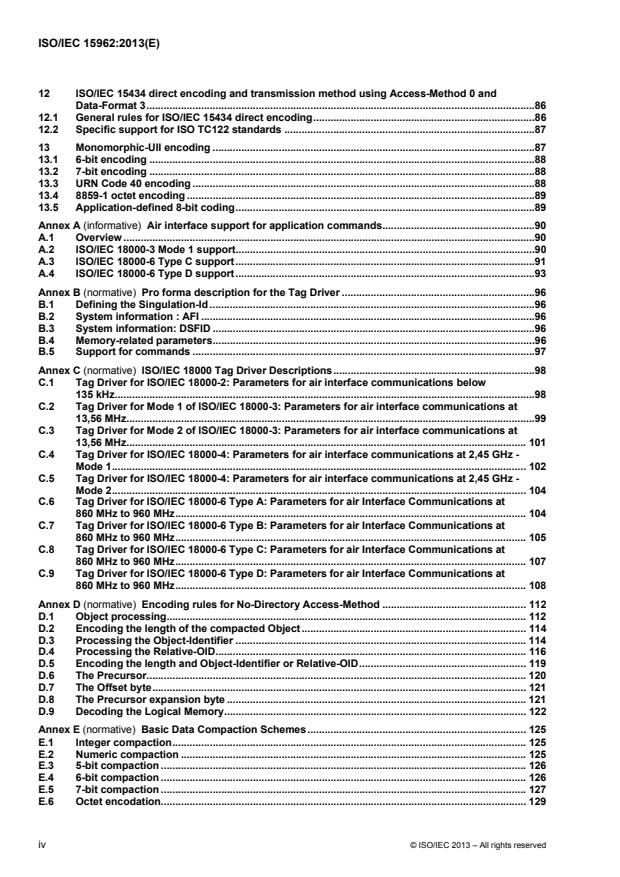
Contents Page
Foreword . vii
Introduction . viii
1 Scope . 1
2 Normative references . 1
3 Terms, definitions and conventions . 2
3.1 Terms and definitions . 2
3.2 Conventions . 2
4 Conformance . 2
4.1 Conformance with the air interface . 2
4.2 Conformance with the application interface . 2
4.3 Conformance with the Access-Method . 3
5 Protocol model . 4
5.1 Overview . 4
5.2 Layered protocol . 4
5.3 Flexible implementation configurations . 6
5.4 Functional processes – interrogator implementation . 6
5.5 ISO/IEC 15962 and the Data Processor . 9
6 Data and presentation conventions . 9
6.1 Data types in ISO/IEC 15961-1 commands and responses . 10
6.2 Extensible bit vector (EBV) . 10
6.3 Object Identifier presentation in the application interface . 10
6.4 The Object . 12
6.5 The 8-bit byte . 12
6.6 N-bit encoding . 12
7 Data Processor – high level processing . 12
8 Data Processor and the application interface . 13
8.1 Application commands – overview . 13
8.2 Application commands and responses– write . 15
8.3 Application commands and responses– read . 31
8.4 Application commands and responses– other . 40
8.5 Air interface support for application commands . 49
9 Data Processor and the air interface . 49
9.1 Air interface services . 49
9.2 Defining the system information . 50
9.3 Configuring the Logical Memory . 58
10 The Command/Response Unit: processing of command and response arguments . 58
10.1 Process arguments . 59
10.2 Completion-Codes . 71
10.3 Execution-Codes . 74
11 Access-Method . 74
11.1 No-Directory structure . 75
11.2 Directory structure . 77
11.3 Packed-Objects structure . 79
11.4 Tag Data Profile . 80
11.5 Multiple-Records . 80
© ISO/IEC 2013 – All rights reserved iii
12 ISO/IEC 15434 direct encoding and transmission method using Access-Method 0 and
Data-Format 3 .86
12.1 General rules for ISO/IEC 15434 direct encoding .86
12.2 Specific support for ISO TC122 standards .87
13 Monomorphic-UII encoding .87
13.1 6-bit encoding .88
13.2 7-bit encoding .88
13.3 URN Code 40 encoding .88
13.4 8859-1 octet encoding .89
13.5 Application-defined 8-bit coding .89
Annex A (informative) Air interface support for application commands .90
A.1 Overview .90
A.2 ISO/IEC 18000-3 Mode 1 support .90
A.3 ISO/IEC 18000-6 Type C support .91
A.4 ISO/IEC 18000-6 Type D support .93
Annex B (normative) Pro forma description for the Tag Driver .96
B.1 Defining the Singulation-Id .96
B.2 System information : AFI .96
B.3 System information: DSFID .96
B.4 Memory-related parameters .96
B.5 Support for commands .97
Annex C (normative) ISO/IEC 18000 Tag Driver Descriptions .98
C.1 Tag Driver for ISO/IEC 18000-2: Parameters for air interface communications below
135 kHz .98
C.2 Tag Driver for Mode 1 of ISO/IEC 18000-3: Parameters for air interface communications at
13,56 MHz .99
C.3 Tag Driver for Mode 2 of ISO/IEC 18000-3: Parameters for air interface communications at
13,56 MHz . 101
C.4 Tag Driver for ISO/IEC 18000-4: Parameters for air interface communications at 2,45 GHz -
Mode 1 . 102
C.5 Tag Driver for ISO/IEC 18000-4: Parameters for air interface communications at 2,45 GHz -
Mode 2 . 104
C.6 Tag Driver for ISO/IEC 18000-6 Type A: Parameters for air Interface Communications at
860 MHz to 960 MHz . 104
C.7 Tag Driver for ISO/IEC 18000-6 Type B: Parameters for air Interface Communications at
860 MHz to 960 MHz . 105
C.8 Tag Driver for ISO/IEC 18000-6 Type C: Parameters for air Interface Communications at
860 MHz to 960 MHz . 107
C.9 Tag Driver for ISO/IEC 18000-6 Type D: Parameters for air Interface Communications at
860 MHz to 960 MHz . 108
Annex D (normative) Encoding rules for No-Directory Access-Method . 112
D.1 Object processing. 112
D.2 Encoding the length of the compacted Object . 114
D.3 Processing the Object-Identifier . 114
D.4 Processing the Relative-OID . 116
D.5 Encoding the length and Object-Identifier or Relative-OID . 119
D.6 The Precursor . 120
D.7 The Offset byte . 121
D.8 The Precursor expansion byte . 121
D.9 Decoding the Logical Memory . 122
Annex E (normative) Basic Data Compaction Schemes . 125
E.1 Integer compaction . 125
E.2 Numeric compaction . 125
E.3 5-bit compaction . 126
E.4 6-bit compaction . 126
E.5 7-bit compaction . 127
E.6 Octet encodation . 129
iv © ISO/IEC 2013 – All rights reserved
Annex F (normative) ISO/IEC 646 Characters Supported by the Compaction Schemes . 130
Annex G (informative) Encoding example for No-Directory structure . 133
G.1 Starting position . 133
G.2 Encoding the Object-Identifiers . 133
G.3 The initial state of the entry for the Logical Memory . 133
G.4 The Logical Memory after data compaction . 134
G.5 The Logical Memory after formatting for a No-Directory Access-Method . 134
Annex H (informative) Encoding example for Directory structure. 136
H.1 The base data . 136
H.2 Encoding the first Directory entry . 136
H.3 Encoding the second Directory entry . 137
H.4 Encoding the remaining Directory entries . 137
H.5 Decoding the Directory and reading the target Object-Identifier . 138
Annex I (normative) Packed-Objects structure . 139
I.1 Overview . 139
I.2 Overview of associated Annexes . 139
I.3 High-level Packed-Objects format design . 139
I.4 Format Flags section . 142
I.5 Object Info section . 144
I.6 Secondary ID Bits section . 150
I.7 Aux Format section . 150
I.8 Data section . 152
I.9 ID Map and Directory encoding options . 155
Annex J (normative) Packed Objects ID Tables . 161
J.1 Packed Objects Data Format registration file structure . 161
J.2 Mandatory and Optional ID Table columns . 163
J.3 Syntax of OIDs, IDString, and FormatString columns . 166
J.4 OID input/output representation . 168
Annex K (normative) Packed Objects Encoding tables . 170
Annex L (informative) Encoding example for Packed Objects . 175
Annex M (informative) Decoding Packed Objects . 179
M.1 Overview . 179
M.2 Decoding Alphanumeric data . 180
Annex N (normative) Tag Data Profile encoding . 183
N.1 Scope . 183
N.2 The Registered Table . 183
N.3 Encoding the Tag Data Profile on the RFID tag . 184
N.4 Decoding the Tag Data Profile . 186
N.5 Modifying Data . 187
Annex O (normative) Tag Data Profile ID tables . 188
O.1 Tag-Data-Profile Data-Format registration file structure . 188
O.2 File Header section . 189
O.3 Table Header section . 189
O.4 Table Trailer section . 190
O.5 Mandatory ID Table columns . 190
Annex P (informative) Encoding example for Tag Data Profile . 192
P.1 Encoded data segment . 192
P.2 Encoding the header segment . 195
Annex Q (normative) Basic encoding rules for Multiple-Records Access-Method . 196
Q.1 Overview . 196
Q.2 Encoding the Multiple-Records header . 196
Q.3 Encoding the preamble of an individual record that is not part of a hierarchical structure . 200
Q.4 The record . 203
Q.5 The directory . 203
© ISO/IEC 2013 – All rights reserved v
Q.6 Appending a new record . 207
Q.7 Modifying an existing record . 208
Q.8 Deleting an existing record . 208
Q.9 Constructing the Object-Identifier from the MR-header, preamble and individual record . 209
Annex R (normative) Multiple-Records encoding rules for hierarchical records . 212
R.1 Overview . 212
R.2 Encoding the Multiple-Records header . 213
R.3 Encoding the preamble of hierarchical record . 214
R.4 The hierarchical record . 216
R.5 Data element list . 216
R.6 The directory . 218
R.7 Appending a new record . 218
R.8 Modifying an existing record . 218
R.9 Deleting a record . 218
Annex S (informative) Encoding example for the Multiple-Records Access-Method . 219
S.1 The heterogeneous multiple record example . 219
S.2 An encoding example of a homogeneous multiple record . 226
S.3 An encoding example of a hierarchical multiple record . 229
Annex T (normative) ISO/IEC 15434 Direct Encoding and Transmission . 232
T.1 DSFID . 232
T.2 Precursor byte . 232
T.3 Data byte-count indicator . 232
T.4 Encoding and Decoding . 233
T.5 Encoding and Decoding Example using Data Identifiers . 234
T.6 Additional Code Values and other Precursor features . 236
Annex U (informative) ISO/IEC 15434 Direct DI Encoding and Transmission for ISO TC122
Standards . 238
U.1 DSFID . 238
U.2 Precursor byte . 238
U.3 Data byte-count indicator . 238
U.4 Encoding and Decoding . 239
U.5 Encoding and Decoding Example . 241
Annex V (normative) URN Code 40 encoding . 243
V.1 Basic Character Set . 243
V.2 Extended Encoding . 244
V.3 Encoding Example . 245
V.4 Resolver Example . 245
Bibliography . 246
vi © ISO/IEC 2013 – All rights reserved
Foreword
ISO (the International Organization for Standardization) and IEC (the International Electrotechnical
Commission) form the specialized system for worldwide standardization. National bodies that are members of
ISO or IEC participate in the development of International Standards through technical committees
established by the respective organization to deal with particular fields of technical activity. ISO and IEC
technical committees collaborate in fields of mutual interest. Other international organizations, governmental
and non-governmental, in liaison with ISO and IEC, also take part in the work. In the field of information
technology, ISO and IEC have established a joint technical committee, ISO/IEC JTC 1.
International Standards are drafted in accordance with the rules given in the ISO/IEC Directives, Part 2.
The main task of the joint technical committee is to prepare International Standards. Draft International
Standards adopted by the joint technical committee are circulated to national bodies for voting. Publication as
an International Standard requires approval by at least 75 % of the national bodies casting a vote.
Attention is drawn to the possibility that some of the elements of this document may be the subject of patent
rights. ISO and IEC shall not be held responsible for identifying any or all such patent rights.
ISO/IEC 15962 was prepared by Joint Technical Committee ISO/IEC JTC 1, Information technology,
Subcommittee SC 31, Automatic identification and data capture techniques.
This second edition cancels and replaces the first edition (ISO/IEC 15962:2004), which has been technically
revised.
© ISO/IEC 2013 – All rights reserved vii
Introduction
The technology of radio frequency identification (RFID) is based on non-contact electronic communication
across an air interface. The structure of the bits stored on the memory of the RFID tag is invisible and
accessible between the RFID tag and the interrogator only by the use of an air interface protocol, as specified
in the appropriate part of ISO/IEC 18000. The result of the transfer of data between an application and an
interrogator in open systems requires data to be encoded in a consistent manner on any RFID tag that is part
of that open system. This is not only to allow equipment to be interoperable, but in the special case of data
carriers, for the data to be encoded on the RFID tag in one systems implementation for it to be read at a later
time in a completely different and unknown systems implementation. The data bits stored on each RFID tag
must be formatted in such a way as to be reliably read at the point of use if the RFID tag is to fulfil its basic
objective. This reliability is achieved through the specification of a data protocol using the application-defined
arguments defined in ISO/IEC 15961-1 and the data encoding rules of this International Standard. Additionally,
ISO/IEC 24791-1 specifies a software system infrastructure architecture that enables RFID system operations
between business applications and RFID interrogators. Specific parts of ISO/IEC 24791 address data
management requirements (ISO/IEC 24791-2) and device interface requirements (ISO/IEC 24791-5). These
support defined implementations that incorporate the encoding rules of this International Standard and the
functional rules of the commands and responses in ISO/IEC 15961-1.
Manufacturers of RFID equipment (interrogators, RFID tags, etc.) and the users of RFID technology require a
standards-based data protocol for RFID for item management. ISO/IEC 15961-1 to ISO/IEC 15961-3, this
International Standard, and ISO/IEC 24791 specify this protocol, which is layered above the air interface
standards defined in ISO/IEC 18000.
The transfer of data to and from an application, supported by appropriate application commands, is the
subject of ISO/IEC 15961-1. This International Standard specifies the overall process and the methodologies
developed to format the application data into a structure to store on the RFID tag.
viii © ISO/IEC 2013 – All rights reserved
INTERNATIONAL STANDARD ISO/IEC 15962:2013(E)
Information technology — Radio frequency identification (RFID)
for item management — Data protocol: data encoding rules and
logical memory functions
1 Scope
The data protocol used to exchange information in an RFID system for item management is specified in
ISO/IEC 15961 and in this International Standard. Both International Standards are required for a complete
understanding of the data protocol in its entirety; but each focuses on one particular interface:
ISO/IEC 15961 addresses the interface with the application system.
This International Standard deals with the processing of data and its presentation to the RF tag, and
the initial processing of data captured from the RF tag.
This International Standard focuses on encoding the transfer syntax, as defined in ISO/IEC 15961 according
to the application commands defined in ISO/IEC 15961. The encodation is in a Logical Memory as a software
analogue of the physical memory of the RFID tag being addressed by the interrogator.
This International Standard
defines the encoded structure of object identifiers;
specifies the data compaction rules that apply to the encoded data;
specifies a Precursor for encoding syntax features efficiently;
specifies formatting rules for the data, e.g. depending on whether a directory is used or not;
defines how application commands, e.g. to lock data, are transferred to the Tag Driver;
specifies processes associated with sensory information and the transfers to the Tag Driver;
defines other communication to the application.
2 Normative references
The following referenced documents are indispensable for the application of this document. For dated
references, only the edition cited applies. For undated references, the latest edition of the referenced
document (including any amendments) applies.
ISO/IEC 15961-1, Information technology — Radio frequency identification (RFID) for item management —
Data protocol — Part 1: Application interface
ISO/IEC 19762-1, Information technology — Automatic identification and data capture (AIDC) techniques —
Harmonized vocabulary — Part 1: General terms relating to AIDC
© ISO/IEC 2013 – All rights reserved 1
ISO/IEC 19762-3, Information technology — Automatic identification and data capture (AIDC) techniques —
Harmonized vocabulary — Part 3: Radio frequency identification (RFID)
3 Terms, definitions and conventions
3.1 Terms and definitions
For the purposes of this document, the terms and definitions given in ISO/IEC 19762-1, ISO/IEC 19762-3 and
the following apply.
NOTE For terms defined below and in ISO/IEC 19762-1 or ISO/IEC 19762-3, the definitions given below apply.
3.1.1
data compaction
mechanism, or algorithm, to process the original data so that it is represented efficiently in fewer bytes in a
data carrier than in the original presentation
3.1.2
Data Processor
implementation of the processes defined in this International Standard, including the Data Compactor,
Formatter, Logical Memory, and Command/Response Unit
3.1.3
Precursor
byte, sometimes a sequence of bytes, used in the Directory and No-Directory Access-Methods that acts as
metadata for the subsequent Object-Identifier and Object
3.1.4
Relative-OID
particular object identifier where a common root-OID (for the first and subsequent arcs) is implied, and
remaining arcs after the Root-OID are defined by the Relative-OID
3.2 Conventions
Conventionally in International Standards, long numbers are separated by a space character as a "thousands
separator". This convention has not been followed in this International Standard, because the arcs of an
object identifier are defined by a space separator (according to ISO/IEC 8824 and ISO/IEC 8825). As the
correct representation of these arcs is vital to this International Standard, all numeric values have no space
separators except to denote a node between two arcs of an object identifier.
4 Conformance
Conformance to this International Standard shall depend on the functional capability of the device as defined
in the following three sub-clauses.
4.1 Conformance with the air interface
A conformant implementation of this International Standard shall support one or more air interface protocols
through the tag drivers defined in Annex C. Declarations of conformance shall refer to the specific air interface
protocol(s). This applies to encoders, decoders, or more comprehensive devices.
4.2 Conformance with the application interface
The conformance requirements depend on the type of device as follows:
2 © ISO/IEC 2013 – All rights reserved
4.2.1 Encoders and the application interface
Within the constraints of the air interface protocol supported, a conformant implementation of this International
Standard on an encoder shall support the application commands defined in 8.2 and the associated process
argument, as defined in Clause 10.
A conformant RFID tag shall have its encoding in a state that can be properly decoded by a conformant
decoder (see 4.2.2).
4.2.2 Decoders and the application interface
Within the constraints of the air interface protocol supported, a conformant implementation of this International
Standard on a decoder shall support the application commands defined in 8.3 and the associated process
argument, as defined in Clause 10.
4.2.3 Comprehensive encoder/decoder devices and the application interface
Within the constraints of the air interface protocol supported, a conformant implementation of this International
Standard on an encoder/decoder shall support the application commands defined in 8.2 and 8.3 and the
associated process argument, as defined in Clause 10. In addition, the Delete-Object (see 8.4.2) and Modify-
Object (see 8.4.3) commands shall be supported. Other commands defined in 8.4 may be supported, and
each command that is supported shall be declared.
4.3 Conformance with the Access-Method
The conformance requirements depend on the type of implementation as follows:
4.3.1 Encoders and the Access-Method
A conformant implementation of this International Standard on an encoder shall support the encoding rules
and formatting rules of one or more Access-Methods as defined in Clause 11 and associated Annexes.
Declarations of conformance shall refer to the specific Access-Method(s) supported.
4.3.2 Decoders and the Access-Method
A conformant implementation of this International Standard on a decoder shall support the decoding rules and
formatting rules of all the Access-Methods as defined in Clause 11 and associated Annexes.
An interrogator is not expected to fully support the decoding functions of all the Access-Methods, and the
following shall apply to achieve conformance:
For full conformance, the decoder process on the interrogator shall output the Object-Identifier,
Object and other arguments as required in the responses to the commands.
For partial conformance, the decoder process on the interrogator shall output the byte string that
represents the encoded package (depending on the Access-Method) containing the requested
Object-Identifier. The encoded package then needs to be fully decoded by a decoder process,
external to the interrogator, that is fully compliant with the rules defined in this International Standard.
Declarations of conformance shall refer to the specific Access-Method(s) supported.
4.3.3 Comprehensive encoder/decoder devices and the Access-Method
A conformant implementation of this International Standard on an encoder/decoder shall support the encoding
rules and formatting rules of one or more Access-Methods as defined in Clause 11 and associated Annexes.
Declarations of conformance shall refer to the specific Access-Method(s) supported. The decoding function
shall be as defined in 4.3.2.
© ISO/IEC 2013 – All rights reserved 3
5 Protocol model
5.1 Overview
RFID supports bit encodation in the RFID tag memory. Unlike other data carrier standards prepared by
ISO/IEC JTC1 SC31 which require encodation schemes that are specific to the individual data carrier
technology, ISO/IEC 18000 does not specify the interpretation of bits or bytes encoded on the RFID tag
memory. However, as an RFID tag is a relay in a communication system, each tag used for open systems
item management needs to have data encoded in a consistent manner. The prime function of
ISO/IEC 15961-1 is to specify a common interface between the application programs and the RFID
interrogator. The prime function of this International Standard is to specify the common encoding rules and
logical memory functions.
RFID tags utilise electronic memory, which is typically capable of increasing data capacity as new generations
of product are introduced. Differences in data capacity of each RFID tag type, whether similar or dissimilar,
are recognised by the data protocol defined in these two International Standards.
Different application standards may have their own particular data sets or data dictionaries. Each major
application standard for item management needs to have its data treated in an unambiguous manner,
avoiding confusion with data from other applications and even with data from closed systems. The data
protocol specified in these International Standards ensures the unambiguous identification of data.
5.2 Layered protocol
The protocol layers of an implementation of RFID for item management are illustrated schematically
in Figure 1 — Schematic of protocol layers for an implementation of RFID for item management.
Figure 1 — Schematic of protocol layers for an implementation of RFID for item management
4 © ISO/IEC 2013 – All rights reserved
5.2.1 Application layer - as defined in the various parts of ISO/IEC 15961
The RFID data protocol specifies how data is presented as objects, each uniquely identified with an object
identifier, which are meaningful to the application and can be encoded on the RFID tag. ISO/IEC 15961-3
specifies the data construct rules for the AFI, DSFID, object identifier for the unique item identifier, and object
identifier structure for other item-related data. This ensures that each piece of data can be uniquely identified,
both within the scope of a particular application and between applications.
Each application needs to be registered according to the rules of ISO/IEC 15961-2 so that the data constructs
can be declared and used in an unambiguous manner.
The RFID data protocol in ISO/IEC 15961-1 defines functions and arguments used to construct application
commands and responses. This is so that application programs can specify what data to transfer to and from
the RFID tag and to append, update, selectively lock, delete data, or perform other functions on the RFID tag.
To illustrate how the functions and arguments are assembled into a structured format, a number of commands
and responses have been constructed using an abstract syntax. This is independent of the host application,
operating system, and programming language and also independent of the specific command structures
between the interrogator and tag driver. The abstr
...
Questions, Comments and Discussion
Ask us and Technical Secretary will try to provide an answer. You can facilitate discussion about the standard in here.
Loading comments...