

ISO/IEC 15962:2022
(Main)Information technology — Radio frequency identification (RFID) for item management — Data protocol: data encoding rules and logical memory functions
General Information
- Abstract
This document focuses on encoding the transfer syntax of the application commands defined in ISO/IEC 15961-1. The encodation is in a Logical Memory as a software analogue of the physical memory of the RFID tag being addressed by the interrogator. This document — defines the encoded structure of object identifiers; — specifies the data compaction rules that apply to the encoded data; — specifies a Precursor for encoding syntax features efficiently; — specifies formatting rules for the data, e.g. depending on whether a directory is used or not; — defines how application commands, e.g. to lock data, are transferred to the Tag Driver; — specifies processes associated with sensory information and the transfers to the Tag Driver; — defines other communication to the application.
- Status
- Published
- Publication Date
- 03-Jan-2022
- Technical Committee
- ISO/IEC JTC 1/SC 31 - Automatic identification and data capture techniques
- Drafting Committee
- ISO/IEC JTC 1/SC 31/WG 4 - Radio communications
- Current Stage
- 6060 - International Standard published
- Start Date
- 04-Jan-2022
- Due Date
- 14-Aug-2022
- Completion Date
- 04-Jan-2022

Overview - ISO/IEC 15962:2022 (RFID data encoding rules & logical memory)
ISO/IEC 15962:2022 defines the data protocol for RFID item management, focusing on how application commands (from the ISO/IEC 15961 series) are encoded, represented and delivered to a tag’s logical memory. The standard treats a Logical Memory as a software equivalent of the physical RFID tag memory addressed by an interrogator, and specifies rules to ensure interoperable encoding, compact storage and reliable transfer of commands and sensory data.
Key topics and technical requirements
- Encoded object identifiers
Defines the encoded structure and presentation rules for object identifiers (OID), including mappings consistent with ISO/IEC 8824-1 and URN presentation in the application interface. - Data compaction rules
Specifies compaction and N‑bit encoding methods and the use of extensible bit vectors (EBV) to reduce on‑tag memory usage and over‑the‑air payload size. - Precursor for encoding syntax
Introduces an efficient precursor mechanism to signal extended or alternate syntax features without excessive overhead. - Formatting and directory handling
Defines formatting rules depending on whether directories are used in logical memory maps, and how multiple-record headers and packed objects are represented. - Application command transfer to Tag Driver
Details how application commands (read, write, modify, delete, inventory, lock/erase, etc.) are encoded and dispatched to the Tag Driver and processed by the Data Processor. - Sensor and sensory information processes
Specifies processes and transfer formats for sensory data, including indicators for simple sensors, full-function sensors, and battery-assisted tags. - Air interface & system information elements
Addresses air-interface support, system information elements (AFI, DSFID, physical block size, memory length indicators), data CRC indicators and extended syntax flag bytes. - Conformance and protocol model
Defines conformance classes (encoder/decoder/device) and a layered protocol model for flexible implementations.
Practical applications and who uses this standard
ISO/IEC 15962:2022 is targeted at:
- RFID tag and silicon designers implementing logical memory and on‑tag data formats.
- Middleware and firmware developers building Data Processors, Tag Drivers and application interfaces that encode/decode ISO/IEC 15961 commands.
- System integrators and solution providers for retail, logistics, asset tracking, healthcare and industrial IoT who require interoperable RFID data protocols.
- Standards bodies and test labs validating conformance and interoperability.
By standardizing encoding rules and logical memory functions, ISO/IEC 15962 improves interoperability, reduces over‑the‑air bandwidth and conserves tag memory - essential for scalable RFID deployments.
Related standards
- ISO/IEC 15961-1 - Application layer commands for RFID item management (directly referenced)
- ISO/IEC 8824-1 - Object Identifier (OID) structure referenced for OID presentation
Keywords: ISO/IEC 15962:2022, RFID, data encoding rules, logical memory functions, application commands, Tag Driver, object identifiers, data compaction, RFID protocol.
Relations
- Effective Date
- 17-Jun-2026
- Effective Date
- 23-Apr-2020
Get Certified
Connect with accredited certification bodies for this standard

BSI Group
BSI (British Standards Institution) is the business standards company that helps organizations make excellence a habit.

NYCE
Mexican standards and certification body.
Sponsored listings
Frequently Asked Questions
ISO/IEC 15962:2022 is a standard published by the International Organization for Standardization (ISO). Its full title is "Information technology — Radio frequency identification (RFID) for item management — Data protocol: data encoding rules and logical memory functions". This standard covers: This document focuses on encoding the transfer syntax of the application commands defined in ISO/IEC 15961-1. The encodation is in a Logical Memory as a software analogue of the physical memory of the RFID tag being addressed by the interrogator. This document — defines the encoded structure of object identifiers; — specifies the data compaction rules that apply to the encoded data; — specifies a Precursor for encoding syntax features efficiently; — specifies formatting rules for the data, e.g. depending on whether a directory is used or not; — defines how application commands, e.g. to lock data, are transferred to the Tag Driver; — specifies processes associated with sensory information and the transfers to the Tag Driver; — defines other communication to the application.
This document focuses on encoding the transfer syntax of the application commands defined in ISO/IEC 15961-1. The encodation is in a Logical Memory as a software analogue of the physical memory of the RFID tag being addressed by the interrogator. This document — defines the encoded structure of object identifiers; — specifies the data compaction rules that apply to the encoded data; — specifies a Precursor for encoding syntax features efficiently; — specifies formatting rules for the data, e.g. depending on whether a directory is used or not; — defines how application commands, e.g. to lock data, are transferred to the Tag Driver; — specifies processes associated with sensory information and the transfers to the Tag Driver; — defines other communication to the application.
ISO/IEC 15962:2022 is classified under the following ICS (International Classification for Standards) categories: 35.040.50 - Automatic identification and data capture techniques. The ICS classification helps identify the subject area and facilitates finding related standards.
ISO/IEC 15962:2022 has the following relationships with other standards: It is inter standard links to EN 18220:2026, ISO/IEC 15962:2013. Understanding these relationships helps ensure you are using the most current and applicable version of the standard.
ISO/IEC 15962:2022 is available in PDF format for immediate download after purchase. The document can be added to your cart and obtained through the secure checkout process. Digital delivery ensures instant access to the complete standard document.
Standards Content (Sample)
INTERNATIONAL ISO/IEC
STANDARD 15962
Third edition
2022-01
Information technology — Radio
frequency identification (RFID) for
item management — Data protocol:
data encoding rules and logical
memory functions
Technologies de l'information — Identification par radiofréquence
(RFID) pour la gestion d'objets — Protocole de données: règles
d'encodage des données et fonctions logiques de mémoire
Reference number
© ISO/IEC 2022
© ISO/IEC 2022
All rights reserved. Unless otherwise specified, or required in the context of its implementation, no part of this publication may
be reproduced or utilized otherwise in any form or by any means, electronic or mechanical, including photocopying, or posting on
the internet or an intranet, without prior written permission. Permission can be requested from either ISO at the address below
or ISO’s member body in the country of the requester.
ISO copyright office
CP 401 • Ch. de Blandonnet 8
CH-1214 Vernier, Geneva
Phone: +41 22 749 01 11
Email: copyright@iso.org
Website: www.iso.org
Published in Switzerland
ii
© ISO/IEC 2022 – All rights reserved
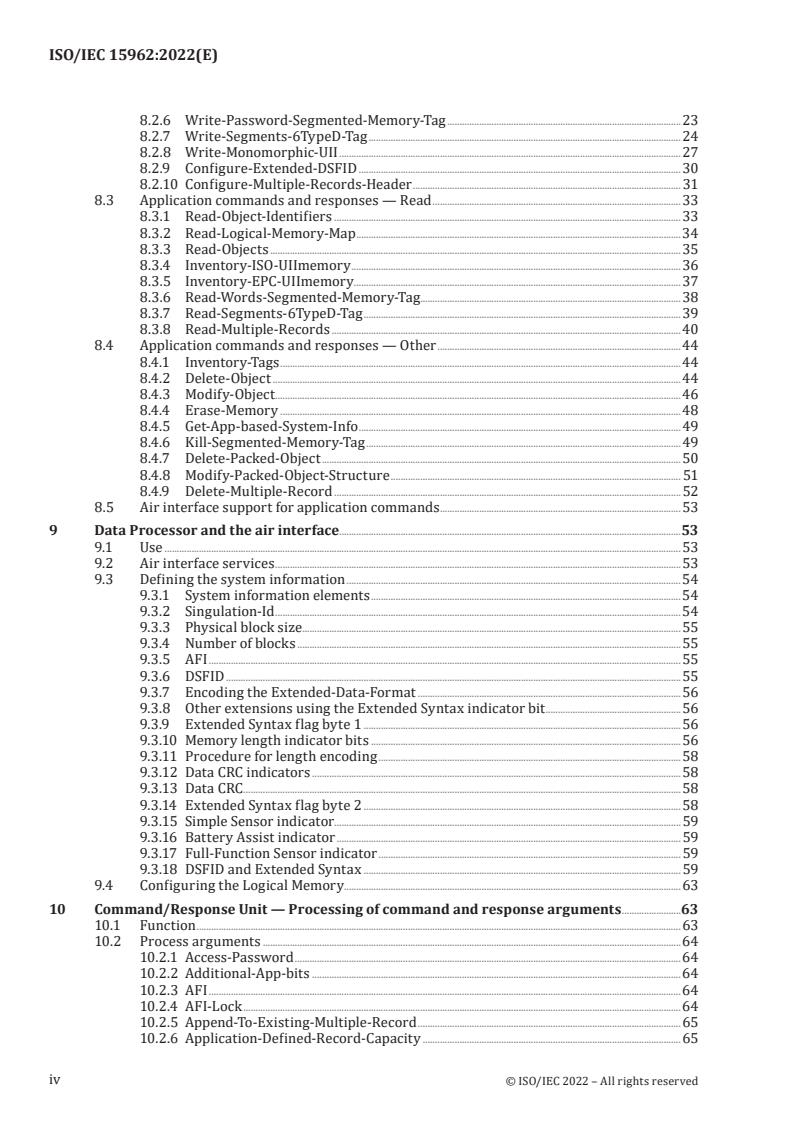
Contents Page
Foreword .ix
Introduction .x
1 Scope . 1
2 Normative references . 1
3 Terms and definitions and abbreviated terms . 1
3.1 Terms and definitions . 1
3.2 Abbreviated terms . 2
4 Conformance . 2
4.1 Conformance with the air interface . . 2
4.2 Conformance with the application interface . 2
4.2.1 Encoders and the application interface. 2
4.2.2 Decoders and the application interface . 3
4.2.3 Comprehensive encoder/decoder devices and the application interface . 3
4.3 Conformance with the Access-Method . 3
4.3.1 Encoders and the Access-Method . 3
4.3.2 Decoders and the Access-Method . 3
4.3.3 Comprehensive encoder/decoder devices and the Access-Method . 3
5 Protocol model . 3
5.1 Overview . 3
5.2 Layered protocol . 4
5.2.1 Layers . 4
5.2.2 Application layer as defined in the ISO/IEC 15961 series . 4
5.2.3 Application interface as defined in ISO/IEC 15961-1 . 5
5.2.4 Data Protocol processing . 5
5.2.5 Data Protocol interface . 5
5.3 Flexible implementation configurations . 6
5.4 Functional processes — Interrogator implementation . 6
5.4.1 Logical functions and interfaces . 6
5.4.2 Functional processes — Application interface. 7
5.4.3 Functional processes — Interrogator . 7
5.4.4 RFID tag . 8
5.5 ISO/IEC 15962 and the Data Processor . 9
6 Data and presentation conventions . 9
6.1 Data types in ISO/IEC 15961-1 commands and responses . 9
6.2 Extensible bit vector (EBV) . 9
6.3 Object Identifier presentation in the application interface . 10
6.3.1 Object identifier structure to ISO/IEC 8824-1 . 10
6.3.2 Presenting the Object-Identifier in accordance with ISO/IEC 8824-1 . 11
6.3.3 Presenting the Object-Identifier as a Uniform Resource Name (URN) . 11
6.4 The Object . 11
6.5 8-bit byte . 11
6.6 N-bit encoding . 11
7 Data Processor — High level processing .11
8 Data Processor and the application interface .12
8.1 Application commands — Overview .12
8.2 Application commands and responses — Write . 14
8.2.1 Configure-AFI . 14
8.2.2 Configure-DSFID . . 15
8.2.3 Write-Objects .15
8.2.4 Write-Objects-Segmented-Memory-Tag . 19
8.2.5 Write-EPC-UII . 22
iii
© ISO/IEC 2022 – All rights reserved
8.2.6 Write-Password-Segmented-Memory-Tag . 23
8.2.7 Write-Segments-6TypeD-Tag . 24
8.2.8 Write-Monomorphic-UII . 27
8.2.9 Configure-Extended-DSFID .30
8.2.10 Configure-Multiple-Records-Header . 31
8.3 Application commands and responses — Read . 33
8.3.1 Read-Object-Identifiers . 33
8.3.2 Read-Logical-Memory-Map .34
8.3.3 Read-Objects . 35
8.3.4 Inventory-ISO-UIImemory . 36
8.3.5 Inventory-EPC-UIImemory . 37
8.3.6 Read-Words-Segmented-Memory-Tag .38
8.3.7 Read-Segments-6TypeD-Tag . 39
8.3.8 Read-Multiple-Records .40
8.4 Application commands and responses — Other .44
8.4.1 Inventory-Tags .44
8.4.2 Delete-Object .44
8.4.3 Modify-Object .46
8.4.4 Erase-Memory .48
8.4.5 Get-App-based-System-Info .49
8.4.6 Kill-Segmented-Memory-Tag .49
8.4.7 Delete-Packed-Object . 50
8.4.8 Modify-Packed-Object-Structure . 51
8.4.9 Delete-Multiple-Record . 52
8.5 Air interface support for application commands . 53
9 Data Processor and the air interface.53
9.1 Use . 53
9.2 Air interface services .53
9.3 Defining the system information .54
9.3.1 System information elements .54
9.3.2 Singulation-Id .54
9.3.3 Physical block size . . . 55
9.3.4 Number of blocks .55
9.3.5 AFI . 55
9.3.6 DSFID .55
9.3.7 Encoding the Extended-Data-Format .56
9.3.8 Other extensions using the Extended Syntax indicator bit .56
9.3.9 Extended Syntax flag byte 1 .56
9.3.10 Memory length indicator bits .56
9.3.11 Procedure for length encoding .58
9.3.12 Data CRC indicators .58
9.3.13 Data CRC .58
9.3.14 Extended Syntax flag byte 2 .58
9.3.15 Simple Sensor indicator. 59
9.3.16 Battery Assist indicator . 59
9.3.17 Full-Function Sensor indicator . 59
9.3.18 DSFID and Extended Syntax . 59
9.4 Configuring the Logical Memory .63
10 Command/Response Unit — Processing of command and response arguments .63
10.1 Function .63
10.2 Process arguments .64
10.2.1 Access-Password .64
10.2.2 Additional-App-bits .64
10.2.3 AFI .64
10.2.4 AFI-Lock .64
10.2.5 Append-To-Existing-Multiple-Record .65
10.2.6 Application-Defined-Record-Capacity .65
iv
© ISO/IEC 2022 – All rights reserved
10.2.7 Avoid-Duplicate .65
10.2.8 Check-Duplicate .65
10.2.9 Compact-Parameter .66
10.2.10 .
Data-Length-Of-Record .66
10.2.11 .
DSFID . 67
10.2.12 .
DSFID-Lock . 67
10.2.13 .
Directory-Length-EBV8-Indicator . 67
10.2.14 .
Encoded-Memory-Capacity . 67
10.2.15 .
EPC-Code . 67
10.2.16 .
Hierarchical-Identifier-Arc . 67
10.2.17 .
Identifier-Of-My-Parent .68
10.2.18 .
Identify-Method and Number-Of-Tags .68
10.2.19 .
Instance-Of-Arc .68
10.2.20 .
Item-Related-DSFID .69
10.2.21 .
Item-Related-Segment-Map . 69
10.2.22 .
Kill-Password .69
10.2.23 .
Length-Of-Mask .69
10.2.24 .
Lock-Directory-Entry . 69
10.2.25 .
Lock-Multiple-Records-Header . 69
10.2.26 .
Lock-Record-Preamble.69
10.2.27 .
Lock-UII-Segment-Arguments . 70
10.2.28 .
Max-App-Length . 70
10.2.29 .
Memory-Bank . 70
10.2.30 .
Memory-Bank-Lock . 70
10.2.31 .
Memory-Segment . 70
10.2.32 .
Memory-Type . 70
10.2.33 .
Multiple-Records-Directory-Length . 70
10.2.34 .
Multiple-Records-Features-Indicator . 71
10.2.35 .
NSI-bits . 71
10.2.36 .
Number-In-Data-Element-List . 71
v
© ISO/IEC 2022 – All rights reserved
10.2.37 .
Number-Of-Records . 71
10.2.38 .
Object-Lock . 71
10.2.39 .
Packed-Object-Directory-Type . 71
10.2.40 .
Password .72
10.2.41 .
Password-Type .72
10.2.42 .
Pointer .72
10.2.43 .
Pointer-To-Multiple-Records-Directory .72
10.2.44 .
Read-Record-Type .73
10.2.45 .
Read-Type .73
10.2.46 .
Record-Memory-Capacity .73
10.2.47 .
Record-Type-Arc .74
10.2.48 .
Record-Type-Classification .74
10.2.49 .
Sector-Identifier .74
10.2.50 .
Segment-Read-Type.74
10.2.51 .
Simple-Sensor-Data-Block . 75
10.2.52 .
Start-Address-Of-Record . 75
10.2.53 .
Tag-Data-Profile-ID-Table . 75
10.2.54 .
Tag-Mask . 75
10.2.55 .
TID-Segment-Map . 75
10.2.56 .
UII-DSFID. 75
10.2.57 .
UII-Segment-Map . 75
10.2.58 .
Update-Multiple-Records-Directory . 75
10.2.59 .
Word-Count . 76
10.2.60 .
Word-Pointer . 76
10.3 Completion-Codes . 76
10.4 Execution-Codes . .79
11 Access-Method .80
11.1 Methods .80
11.2 No-Directory structure . 81
11.2.1 Structure . 81
11.2.2 Restrictions to air interfaces .82
11.2.3 The dataset .82
11.2.4 Encoding rules .82
11.3 Directory structure .83
vi
© ISO/IEC 2022 – All rights reserved
11.3.1 Structure .83
11.3.2 Restrictions to air interfaces .83
11.3.3 Directory structure for Data-Format = "3 …287" .84
11.3.4 Directory structure for Data-Format = 2.84
11.3.5 Encoding the address of the dataset .84
11.3.6 Encoding example .84
11.4 Packed-Objects structure .84
11.5 Tag Data Profile .85
11.5.1 Use .85
11.5.2 Restrictions to air interfaces .86
11.5.3 Defining the Tag-Data-Profile .86
11.5.4 Encoding Rules .86
11.6 Multiple-Records .86
11.6.1 Structure .86
11.6.2 Categories of multiple records .87
11.6.3 Object-Identifier structure .89
11.6.4 Sector identifier. 91
11.6.5 Restrictions to air interfaces . 91
11.6.6 Encoding rules . 91
12 ISO/IEC 15434 direct encoding and transmission method using Access-Method 0
and Data-Format 3 . .91
12.1 Use . 91
12.2 General rules for ISO/IEC 15434 direct encoding . 92
12.3 Specific support for ISO 17364, ISO 17365, ISO 17366 and ISO 17367 . 92
13 Monomorphic-UII encoding . .92
13.1 Use . 92
13.2 6-bit encoding . 93
13.3 7-bit encoding .
...