

ISO/IEC 29158:2025
(Main)Automatic identification and data capture techniques — Bar code symbol quality test specification — Direct part mark (DPM)
General Information
- Abstract
This document describes the modifications to the symbol quality methodology defined in ISO/IEC 15415 and provides a symbology specification. This document establishes alternative illumination conditions, some new terms and parameters, modifications to the measurement and subsequent grading of certain parameters, and the reporting of the grading results. This document is intended for verifier manufacturers and application specification developers.
- Status
- Published
- Publication Date
- 24-Mar-2025
- Technical Committee
- ISO/IEC JTC 1/SC 31 - Automatic identification and data capture techniques
- Current Stage
- 6060 - International Standard published
- Start Date
- 25-Mar-2025
- Due Date
- 02-Jun-2026
- Completion Date
- 25-Mar-2025

Overview
ISO/IEC 29158:2025 - Automatic identification and data capture techniques - Bar code symbol quality test specification - Direct part mark (DPM) specifies how to measure and grade the optical quality of bar code symbols that are directly marked on parts (DPM). It defines modifications to the symbol-quality methodology in ISO/IEC 15415, establishes a dedicated symbology specification for DPM, and introduces alternative illumination conditions, new terms/parameters, and modified measurement and grading procedures. The second edition (2025) replaces the 2020 edition and is intended primarily for verifier manufacturers and application specification developers.
Key topics and technical requirements
- Scope and purpose: Tailors ISO/IEC 15415 for the unique optical characteristics of direct part marks (e.g., dot peen, laser mark, ink‑jetting, electro‑chemical etch).
- Lighting and imaging: Defines alternative illumination conditions and camera setups including perpendicular coaxial (“90”), diffuse off‑axis (“D”), and directional lighting modes (Q, T, S), plus tilted coaxial lighting and procedures to evaluate a virtual 90° camera position.
- Image acquisition and calibration: Requirements for camera position, symbol placement, focus, depth of field, system response adjustment and reflectance calibration.
- Image processing steps: Procedures for initializing aperture size, creating histograms, binarization, applying a reference decode algorithm, and final image adjustments.
- Contrast & reflectance parameters: Methods to calculate cell contrast, module modulation, and minimum reflectance.
- Grading methodology: Rules for grading individual parameters (cell contrast, minimum reflectance, cell modulation), identifying fixed pattern damage, and computing the final grade. The standard also revises rounding rules (now always round down) and aligns definitions with ISO/IEC 15415.
- Reporting & communication: Guidelines for communicating grade requirements and results between verifiers and applications, including handling proprietary decodes.
- Normative and informative annexes: Threshold determination, dot‑connecting algorithm, virtual camera position evaluation, and cross‑reference material to ISO/IEC 15415.
Practical applications and users
- Verifier manufacturers: Implement the measurement and grading algorithms and imaging modes required for DPM verification hardware and software.
- Application specification developers: Define acceptance criteria, inspection plans, and verifier settings for industrial traceability programs.
- Quality/traceability teams and system integrators: Use to specify verification requirements for aerospace, automotive, medical device, electronics and other sectors where durable, on‑part marking is used.
- Marking equipment suppliers: Reference for understanding how marks will be evaluated downstream.
Related standards
- ISO/IEC 15415 - Symbol quality test specification for printed 2D symbols (basis for methodology).
- Cross‑references and comparisons to ISO/IEC 15415 are included in ISO/IEC 29158:2025 to clarify differences for DPM contexts.
Keywords: ISO/IEC 29158:2025, Direct Part Marking, DPM, bar code symbol quality, verifier manufacturers, ISO/IEC 15415, illumination conditions, grading, module modulation, cell contrast.
Relations
- Effective Date
- 17-Jun-2026
- Effective Date
- 03-Jun-2023
Get Certified
Connect with accredited certification bodies for this standard

BSI Group
BSI (British Standards Institution) is the business standards company that helps organizations make excellence a habit.

NYCE
Mexican standards and certification body.
Sponsored listings
Frequently Asked Questions
ISO/IEC 29158:2025 is a standard published by the International Organization for Standardization (ISO). Its full title is "Automatic identification and data capture techniques — Bar code symbol quality test specification — Direct part mark (DPM)". This standard covers: This document describes the modifications to the symbol quality methodology defined in ISO/IEC 15415 and provides a symbology specification. This document establishes alternative illumination conditions, some new terms and parameters, modifications to the measurement and subsequent grading of certain parameters, and the reporting of the grading results. This document is intended for verifier manufacturers and application specification developers.
This document describes the modifications to the symbol quality methodology defined in ISO/IEC 15415 and provides a symbology specification. This document establishes alternative illumination conditions, some new terms and parameters, modifications to the measurement and subsequent grading of certain parameters, and the reporting of the grading results. This document is intended for verifier manufacturers and application specification developers.
ISO/IEC 29158:2025 is classified under the following ICS (International Classification for Standards) categories: 35.040.50 - Automatic identification and data capture techniques. The ICS classification helps identify the subject area and facilitates finding related standards.
ISO/IEC 29158:2025 has the following relationships with other standards: It is inter standard links to EN 18220:2026, ISO/IEC 29158:2020. Understanding these relationships helps ensure you are using the most current and applicable version of the standard.
ISO/IEC 29158:2025 is available in PDF format for immediate download after purchase. The document can be added to your cart and obtained through the secure checkout process. Digital delivery ensures instant access to the complete standard document.
Standards Content (Sample)
International
Standard
ISO/IEC 29158
Second edition
Automatic identification and data
2025-03
capture techniques — Bar code
symbol quality test specification —
Direct part mark (DPM)
Reference number
© ISO/IEC 2025
All rights reserved. Unless otherwise specified, or required in the context of its implementation, no part of this publication may
be reproduced or utilized otherwise in any form or by any means, electronic or mechanical, including photocopying, or posting on
the internet or an intranet, without prior written permission. Permission can be requested from either ISO at the address below
or ISO’s member body in the country of the requester.
ISO copyright office
CP 401 • Ch. de Blandonnet 8
CH-1214 Vernier, Geneva
Phone: +41 22 749 01 11
Email: copyright@iso.org
Website: www.iso.org
Published in Switzerland
© ISO/IEC 2025 – All rights reserved
ii
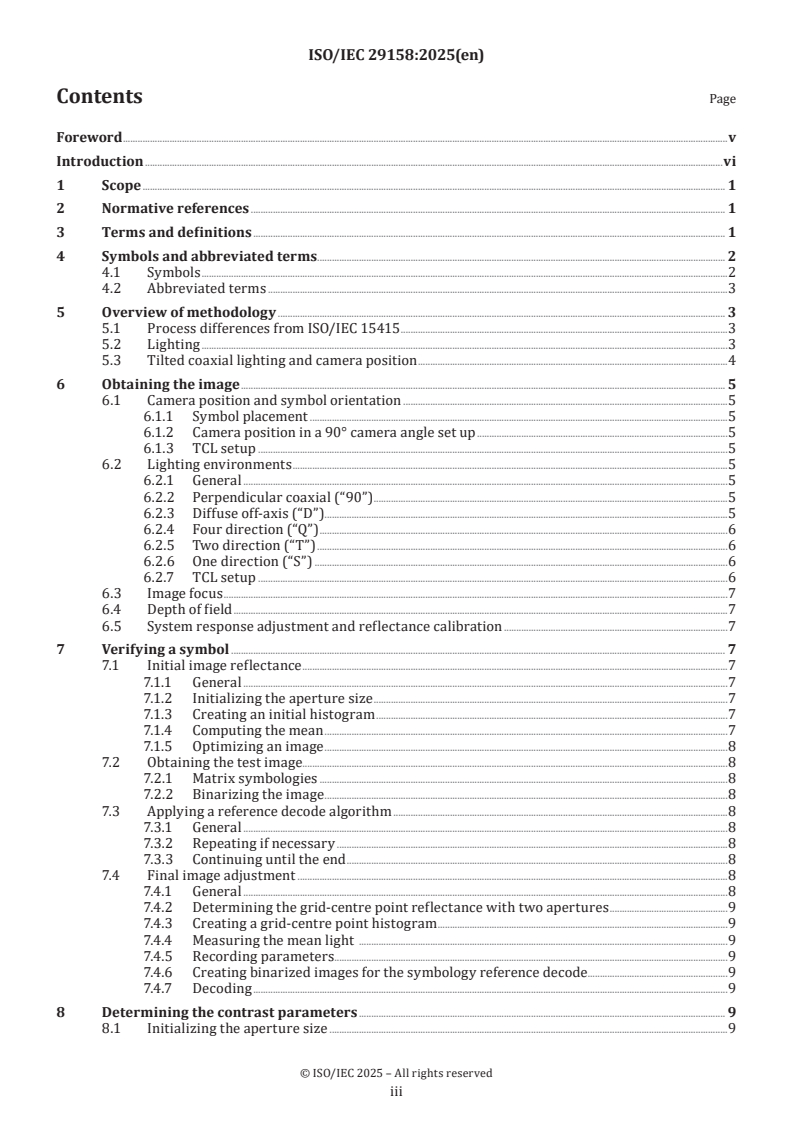
Contents Page
Foreword .v
Introduction .vi
1 Scope . 1
2 Normative references . 1
3 Terms and definitions . 1
4 Symbols and abbreviated terms. 2
4.1 Symbols .2
4.2 Abbreviated terms .3
5 Overview of methodology . 3
5.1 Process differences from ISO/IEC 15415 .3
5.2 Lighting .3
5.3 Tilted coaxial lighting and camera position .4
6 Obtaining the image . 5
6.1 Camera position and symbol orientation .5
6.1.1 Symbol placement .5
6.1.2 Camera position in a 90° camera angle set up .5
6.1.3 TCL setup .5
6.2 Lighting environments .5
6.2.1 General .5
6.2.2 Perpendicular coaxial (“90”) .5
6.2.3 Diffuse off-axis (“D”) . .5
6.2.4 Four direction (“Q”) .6
6.2.5 Two direction (“T”) .6
6.2.6 One direction (“S”) .6
6.2.7 TCL setup .6
6.3 Image focus .7
6.4 Depth of field .7
6.5 System response adjustment and reflectance calibration .7
7 Verifying a symbol . 7
7.1 Initial image reflectance .7
7.1.1 General .7
7.1.2 Initializing the aperture size .7
7.1.3 Creating an initial histogram .7
7.1.4 Computing the mean .7
7.1.5 Optimizing an image .8
7.2 Obtaining the test image.8
7.2.1 Matrix symbologies .8
7.2.2 Binarizing the image .8
7.3 Applying a reference decode algorithm .8
7.3.1 General .8
7.3.2 Repeating if necessary .8
7.3.3 Continuing until the end .8
7.4 Final image adjustment .8
7.4.1 General .8
7.4.2 Determining the grid-centre point reflectance with two apertures .9
7.4.3 Creating a grid-centre point histogram .9
7.4.4 Measuring the mean light .9
7.4.5 Recording parameters . .9
7.4.6 Creating binarized images for the symbology reference decode.9
7.4.7 Decoding .9
8 Determining the contrast parameters . 9
8.1 Initializing the aperture size .9
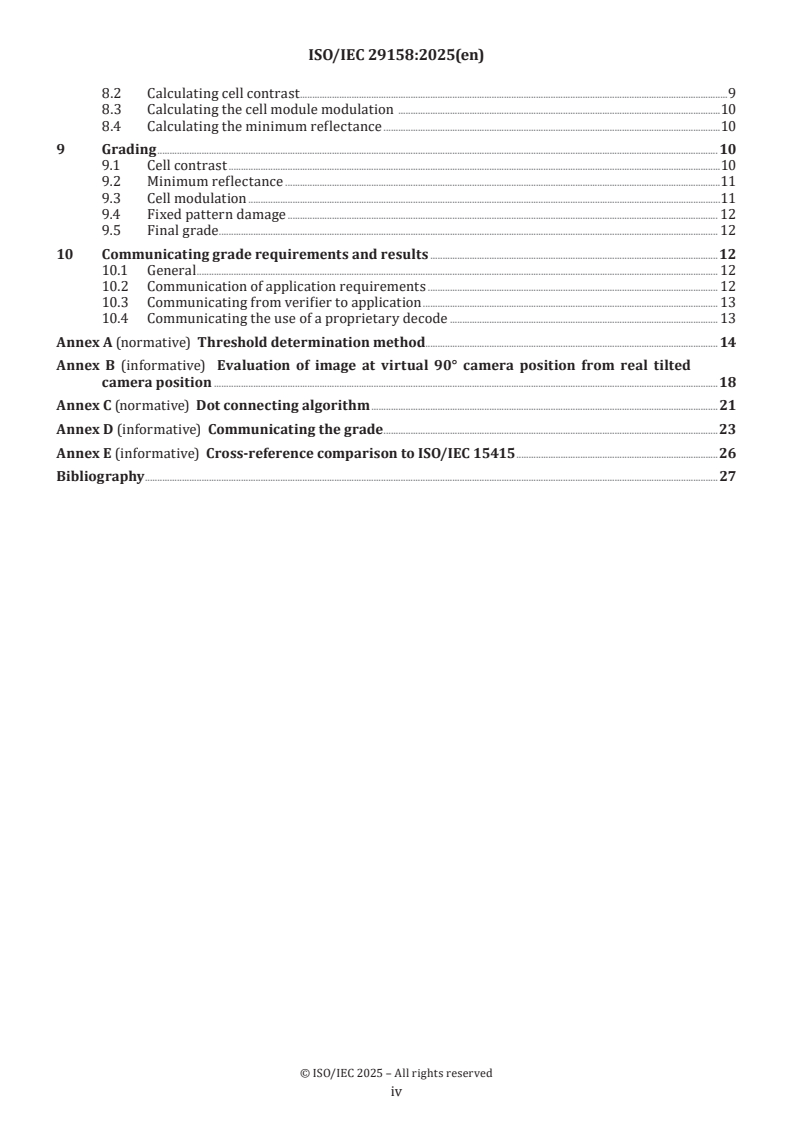
© ISO/IEC 2025 – All rights reserved
iii
8.2 Calculating cell contrast .9
8.3 Calculating the cell module modulation .10
8.4 Calculating the minimum reflectance .10
9 Grading . 10
9.1 Cell contrast .10
9.2 Minimum reflectance .11
9.3 Cell modulation .11
9.4 Fixed pattern damage . 12
9.5 Final grade . 12
10 Communicating grade requirements and results .12
10.1 General . 12
10.2 Communication of application requirements . 12
10.3 Communicating from verifier to application . 13
10.4 Communicating the use of a proprietary decode . 13
Annex A (normative) Threshold determination method. 14
Annex B (informative) Evaluation of image at virtual 90° camera position from real tilted
camera position .18
Annex C (normative) Dot connecting algorithm .21
Annex D (informative) Communicating the grade .23
Annex E (informative) Cross-reference comparison to ISO/IEC 15415 .26
Bibliography .27
© ISO/IEC 2025 – All rights reserved
iv
Foreword
ISO (the International Organization for Standardization) and IEC (the International Electrotechnical
Commission) form the specialized system for worldwide standardization. National bodies that are
members of ISO or IEC participate in the development of International Standards through technical
committees established by the respective organization to deal with particular fields of technical activity.
ISO and IEC technical committees collaborate in fields of mutual interest. Other international organizations,
governmental and non-governmental, in liaison with ISO and IEC, also take part in the work.
The procedures used to develop this document and those intended for its further maintenance are described
in the ISO/IEC Directives, Part 1. In particular, the different approval criteria needed for the different types
of document should be noted. This document was drafted in accordance with the editorial rules of the ISO/
IEC Directives, Part 2 (see www.iso.org/directives or www.iec.ch/members_experts/refdocs).
ISO and IEC draw attention to the possibility that the implementation of this document may involve the
use of (a) patent(s). ISO and IEC take no position concerning the evidence, validity or applicability of any
claimed patent rights in respect thereof. As of the date of publication of this document, ISO and IEC had not
received notice of (a) patent(s) which may be required to implement this document. However, implementers
are cautioned that this may not represent the latest information, which may be obtained from the patent
database available at www.iso.org/patents and https://patents.iec.ch. ISO and IEC shall not be held
responsible for identifying any or all such patent rights.
Any trade name used in this document is information given for the convenience of users and does not
constitute an endorsement.
For an explanation of the voluntary nature of standards, the meaning of ISO specific terms and expressions
related to conformity assessment, as well as information about ISO's adherence to the World Trade
Organization (WTO) principles in the Technical Barriers to Trade (TBT) see www.iso.org/iso/foreword.html.
In the IEC, see www.iec.ch/understanding-standards.
This document was prepared by Joint Technical Committee ISO/JTC 1, Information Technology, Subcommittee
SC 31, Automatic identification and data capture techniques.
This second edition cancels and replaces the first edition (ISO/IEC 29158:2020), which has been technically
revised.
The main changes are as follows:
— the definition of continuous grading has been deleted (it is now defined in ISO/IEC 15415);
— the rounding method has been revised to always round down.
Any feedback or questions on this document should be directed to the user’s national standards
body. A complete listing of these bodies can be found at www.iso.org/members.html and
www.iec.ch/national-committees.
© ISO/IEC 2025 – All rights reserved
v
Introduction
Direct part marking (DPM) is a technology whereby, generally, an item is physically altered to produce two
different surface conditions. This alteration can be accomplished by various means including, but not limited
to, dot peen, laser mark, ink jetting and electro-chemical etch. The area of the alteration is called "the mark."
The area that includes the mark and background as a whole, when containing a pattern defined by a bar
code symbology specification, is called "a symbol."
When light illuminates a symbol, it reflects differently depending on whether it impinges on the background
of the part or on the physical alteration. In most non-DPM bar code scanning environments, light is reflected
off a smooth surface that has been coloured to produce two different diffuse reflected states. The DPM
environment generally does not fit this model because the two different reflected states depend on at least
one of the states having material oriented to the lighting such that the angle of incidence is equal to the angle
of reflection. Sometimes, the material so oriented produces a specular (mirror like) reflectance that results
in a signal that is orders of magnitude greater than the signal from diffuse reflectance.
In addition, from the scanner point-of-view, some marking and printing methods generate dots and are not
capable of producing smooth lines. This is important for symbologies such as Data Matrix, which is specified
to contain smooth continuous lines, but can be marked with disconnected dots in DPM applications.
Current specifications for matrix symbologies and two-dimensional print quality are not exactly suited
to reading situations that have either specular reflection or unconnected dots or both. Additionally,
symbologies specified to consist of smooth continuous lines may appear with unconnected dots. This is
intended to act as a bridge between the existing specifications and the DPM environment in order to provide
a standardized image-based measurement method for DPM that is predictive of scanner performance.
As with all symbology and quality standards, it is the responsibility of the application to define the
appropriate parameters of this document for use in conjunction with a particular application.
This document was developed to assess the symbol quality of direct marked parts, where the mark is applied
directly to the surface of the item and the reading device is a two-dimensional imager.
When application specifications allow, this method is also potentially applicable to symbols produced by
other methods. This is appropriate when DPM symbols and non-DPM symbols are being scanned in the same
scanning environment. The symbol grade is reported as a DPM grade rather than as an ISO/IEC 15415 grade.
© ISO/IEC 2025 – All rights reserved
vi
International Standard ISO/IEC 29158:2025(en)
Automatic identification and data capture techniques —
Bar code symbol quality test specification — Direct part
mark (DPM)
1 Scope
This document describes the modifications to the symbol quality methodology defined in ISO/IEC 15415
and provides a symbology specification.
This document establishes alternative illumination conditions, some new terms and parameters,
modifications to the measurement and subsequent grading of certain parameters, and the reporting of the
grading results.
This document is intended for verifier manufacturers and application specification developers.
2 Normative references
The following documents are referred to in the text in such a way that some or all of their content constitutes
requirements of this document. For dated references, only the edition cited applies. For undated references,
the latest edition of the referenced document (including any amendments) applies.
ISO/IEC 15415, Information technology, Automatic identification and data capture techniques — Bar code
symbol print quality test specification — Two-dimensional symbols
ISO/IEC 19762, Information technology — Automatic identification and data capture (AIDC) techniques —
Harmonized vocabulary
3 Terms and definitions
For the purposes of this document, the terms and definitions given in ISO/IEC 15415, ISO/IEC 19762 and the
following apply.
ISO and IEC maintain terminology databases for use in standardization at the following addresses:
— ISO Online browsing platform: available at https:// www .iso .org/ obp
— IEC Electropedia: available at https:// www .electropedia .org/
3.1
reference symbol
high-contrast printed calibration card for which results are traceable back to national or international
standards and for which the supplier supplies a calibration certificate
3.2
stick
line segment comprised of image pixels that is used to connect areas of the same colour that are near to
each other
© ISO/IEC 2025 – All rights reserved
4 Symbols and abbreviated terms
4.1 Symbols
C value of cell contrast
C
C value of cell module modulation
MOD
f remaining distance fraction of the x position
x
f remaining distance fraction of the y position
y
g current threshold of the grid-centre point histogram in the calculation of the optimal threshold
according to Annex A
M mean of the grid-centre point histogram of the dark elements
D
M mean of the grid-centre point histogram of the light elements
L
M mean of the light lobe from a histogram of the calibrated standard
Lcal
M mean of the light lobe from the final grid-centre point histogram of the symbol under test
Ltarget
R measured reflectance of the cell
R reported reflectance value, R , from a calibration standard
cal max
R measured percent reflectance of the light elements of the symbol under test relative to the calibrated
target
standard
NOTE R is graded and reported as the parameter named “minimum reflectance”.
target
S system response parameters (such as exposure and/or gain) used to create an image of the calibra-
Rcal
tion standard
S system response parameters (such as exposure and/or gain) used to create an image of the symbol
Rtarget
under test
T threshold created using a histogram of the defined grey scale pixel values in a circular area 20 times
the aperture size in diameter, centred on the image centre using the algorithm given in Annex A
T threshold created using the histogram of the reference grey scale image pixel values at each inter-
section point of the grid using the method given in Annex A
T current minimum threshold in the calculation of the optimal threshold according to Annex A
min
T current maximum threshold in the calculation of the optimal threshold according to Annex A
max
V current sum of two variances according to Annex A
V current variance of the grid-centre point histogram of the dark elements according to Annex A
D
V current variance of the grid-centre point histogram of the light elements according to Annex A
L
V current minimum variance in the calculation of the optimal threshold according to Annex A
min
x x position on the camera image plane
x’ x position on the virtual camera plane
x x position of image pixel on the camera image plane
p
© ISO/IEC 2025 – All rights reserved
y y position on the camera image plane
y’ y position on the virtual camera plane
y y position of image pixel on the camera image plane
p
4.2 Abbreviated terms
CM cell modulation
CC cell contrast
CMOD cell module modulation
DFPD distributed fixed pattern damage
DPM direct part marking
FPD fixed pattern damage
TCL tilted coaxial lighting and camera position
5 Overview of methodology
5.1 Process differences from ISO/IEC 15415
All parameters in the symbology and print quality specifications apply except for:
— multi-row bar code symbols are not supported by the method described in this document;
— a different method for setting the image contrast;
— a new method for choosing the aperture size;
— an image pre-process methodology for joining disconnected modules in a symbol (where applicable);
— a different process for determining the modulation parameter which has been renamed cell
modulation (CM);
— a different process for determining the symbol contrast parameter which has been renamed cell
contrast (CC);
— a different process for computing FPD;
— a new parameter called minimum reflectance (R );
target
— print growth is not graded and not included in the final grade.
This document explains how to both specify and report quality grades in a manner complementary to, yet
distinct from, the method in ISO/IEC 15415.
NOTE Annex E gives a cross reference comparison of this document to ISO/IEC 15415.
5.2 Lighting
Lighting environments shall be reported in accordance with 6.2 and 10.2. The lighting environment(s)
shall be selected by the application specification in consideration of the properties of the mark and the
requirements of the reading equipment and environment of the application.
© ISO/IEC 2025 – All rights reserved
5.3 Tilted coaxial lighting and camera position
Tilted coaxial lighting and camera position (TCL) is useful for DPM applications that use a geometrical mark
which is peened, drilled or carved into a surface. Reading camera and unidirectional illumination are located
at a coaxial position with a known fixed tilt angle and object rotation angle and position.
To read dot-peened codes, there are multiple reading setups possible. This document defines several camera
and lighting setups in order to address various dot peen geometries.
This specific TCL environment is focussing on the system response of the mark (e.g. the image a camera
[2]
sees). SAE Standard AS9132 takes a different approach to specify the mark geometry.
Figure 1 illustrates the setup. The essential parameter is the camera reading angle. Typical camera reading
angles include 30°, 45° or 60° in relation to the plane of the mark.
NOTE 1 The camera angle is defined in a compatible way to the lighting angle of ISO/IEC 15415:2024, Figure 1.
NOTE 2 Within the dot peen industry, it is common to specify the stylus angle which is twice the camera angle
given in Figure 1.
Key
c camera and coaxial lighting
m light beam in mark is reflected to camera
o light beam outside mark is reflected away
α camera reading angle
p peened mark
M marked object
Figure 1 — Tilted coaxial lighting and camera setup
This setup is referenced by the abbreviation "TCL" in the following text.
It is not feasible to grade this setup with a camera angle of 90°. The result will not be significant for this
application, as other features of the marked object are measured.
Recognise that a general-purpose verifier device does not always cover this application, as it requires a
special construction.
© ISO/IEC 2025 – All rights reserved
6 Obtaining the image
6.1 Camera position and symbol orientation
6.1.1 Symbol placement
Camera to object position is described in this subclause. By default, the horizontal and vertical axis of the
symbol are parallel to a line formed by the edge of the image sensor within ±3° (i.e. nominally no rotation).
This symbol orientation should be maintained unless an application specification requires or allows a
different orientation. An application specification may specify a different symbol rotation. Since the symbol
rotation is determined after decoding, the actual rotation angle should be reported so that the setup can
be reproduced easily. In applications in which the rotation angle is specified, the rotation angle shall be
reported to confirm conformance to specified requirements.
The part is placed such that the symbol is in the centre of the field of view.
NOTE Placing the symbol in the centre of the field of view results in the intended angle and position of illumination
and camera and tends to achieve the most accurate results.
6.1.2 Camera position in a 90° camera angle set up
The camera is positioned such that the plane of the image sensor is parallel to the plane of the symbol area.
This is identical to a 90° camera angle.
6.1.3 TCL setup
Within the TCL setup, camera and symbol position differs in the following points.
— The camera is positioned in the camera angle defined by the application.
— The raw image is geometrically transformed to correspond to a test image with a virtual camera position
with a 90° camera angle, as described in Annex B.
— The symbol rotation angle needs to be specified by the application and shall be respected by ±5°.
6.2 Lighting environments
6.2.1 General
The lighting environment is specified by the application. This shall include a direction specifier or an angle
or both. The format is an extension of the angle specifier used in ISO/IEC 15415. Several examples are given
in the following subclauses.
6.2.2 Perpendicular coaxial (“90”)
The symbol is illuminated with diffuse light such that the specular reflection from the entire field of view is
nominally uniform.
6.2.3 Diffuse off-axis (“D”)
A diffusely reflecting dome is illuminated from below so that the reflected light falls non-directionally on
the part and does not cast defined shadows. This is commonly used for reading curved parts. The angle
specifier shall be “D”.
This lighting is also called dome lighting.
© ISO/IEC 2025 – All rights reserved
6.2.4 Four direction (“Q”)
Light is aimed at the part at the given angle ±3° from the plane of the surface of the symbol from four sides
such that the lines describing the centre of the beams from opposing pairs of lights are co-planar and the
planes at right angles to each other. One lighting plane is aligned to be parallel to the line formed by a
horizontal edge of the image sensor to within ±5°. The lighting shall illuminate the entire symbol area with
nominally uniform energy. The angle specifier shall be "Q" preceded by a number specifying the angle in
degrees.
EXAMPLE “45Q” (angle equal to 45°) or “30Q” (angle equal to 30°).
6.2.5 Two direction (“T”)
Light is aimed at the part at the given angle ±3° from two sides. The light may be incident from either of the
two possible orientations with respect to the symbol. The lighting plane is aligned to be parallel to the line
formed by one edge of the image sensor to within ±5°. The lighting shall illuminate the entire symbol area
with nominally uniform energy. The angle specifier shall be "T" preceded by a number specifying the angle
in degrees.
EXAMPLE “45T” (angle equal to 45°) or “30T” (angle equal to 30°).
Since there are two possible orientations in this setup (above and below, and left and right) the particular
orientation actually used should be reported. The reporting method may be to indicate the location of the
lights with respect to the symbol such as “north-south” when the light is incident from above and below the
natural “top” and “bottom” of a symbol. The orientation of a symbol is known after decoding and related to
the normal orientation of a symbol as specified in its symbology specification (e.g. a Data Matrix symbol’s
natural orientation has the solid borders on left and bottom, and for QR Code, the normal orientation has
finder patterns in the upper left, lower left and upper right corners but not lower right corner).
6.2.6 One direction (“S”)
Light is aimed at the part at the given angle ±3° from one side. The light may be incident from any of the four
possible orientations with respect to the symbol. The plane perpendicular to the symbol surface containing
the centre of the beam is aligned to be parallel to the line formed by one edge of the image sensor to within
±5°. The lighting shall illuminate the entire symbol area with nominally uniform energy. The angle specifier
shall be “S” preceded by a number specifying the angle in degrees.
EXAMPLE “45S” (angle equal to 45°) or “30S” (angle equal to 30°).
Since there are four possible orientations in this setup, the particular orientation of the incident illumination
should be reported based on the symbol orientation determined after decoding, with respect to the symbol’s
normal orientation (see 6.2.5). For example, if a symbol is upside down, and the illumination is incident from
below the symbol, such that the illumination is actually oriented toward the “top” of the symbol, then the
incident light should be reported as “North”.
6.2.7 TCL setup
TCL setup uses coaxial light at the camera reading angle. Light is aimed at the camera reading angle with a
tolerance of ±3°. The lighting shall illuminate the entire symbol area with nominally uniform energy.
In practice, the condition "coaxial lighting" can be implemented by an approximate setup like a high distance
ring. The light angle tolerance of ±3° shall be respected.
Typical lighting setups are 30°, 45° or 60°. The angle specifier shall be “CS" preceded by a number specifying
the angle in degrees. “CS” means coaxial “C” plus one direction “S”.
EXAMPLE “45CS” (angle equal to 45°) or “30CS” (angle equal to 30°).
NOTE A camera angle of 90° is not a TCL setup (not tilted). In consequence, a specification of "90CS" is not allowed.
© ISO/IEC 2025 – All rights reserved
6.3 Image focus
The camera is adjusted such that the symbol is in best focus.
6.4 Depth of field
Non-planar surfaces or a TCL setup can require a depth of field range. The condition given in
ISO/IEC 15415:2024, 5.6.3 should be fulfilled for the whole depth of field range.
6.5 System response adjustment and reflectance calibration
System response recording is a task performed prior to the use of an instrument. It shall be repeated in
regular intervals together with the regular adjustment of an instrument.
Capture an image of the reference symbol (test code on a calibration card, see 3.1). On such a card, a symbol
which achieves a symbol contrast (see ISO/IEC 15415) grade of 4,0 shall be used. Using an aperture size of
80 % in relation to the test code module size, sample the centre of every element in the symbol including
the quiet zone and set the system response so that the mean of the light elements is in the range of 70 % to
86 %, nominally 78 %, of the maximum grey scale, and the black level (no light) is nominally equal to zero.
The system response is the nominally linear relationship between the reflectivity of the target and the pixel
intensity values in the image as a result of several factors (e.g. shutter speed, imager sensitivity, f-stop, gain,
illumination intensity). This procedure requires the ability to adjust at least one of these factors in order to
adjust the system response.
Record the system response as the reference system response (S ) and record M .
Rcal Lcal
NOTE This procedure is not used for lighting configuration “90”.
7 Verifying a symbol
7.1 Initial image reflectance
7.1.1 General
The reference grey scale image is created by the following steps.
7.1.2 Initializing the aperture size
The minimum and maximum X-dimensions should be specified by the application specification and used
by the verifier in this and subsequent steps. Set the aperture to 0,5 of the minimum X-dimension of the
application and apply it to the image to create a reference grey scale image.
7.1.3 Creating an initial histogram
Create a histogram of the reference grey scale pixel values in a circular area 20 times the aperture size in
diameter, centred on the image centre, and find the threshold, T , using the algorithm defined in Annex A.
The threshold divides the histogram into two portions: a portion below the threshold which contains dark
pixels and a portion above the threshold which contains light pixels (called the “light lobe”).
NOTE If the circular area of 20 times of the aperture size is larger than the field of view of a real device, then the
area is limited by the field of view.
7.1.4 Computing the mean
Compute the mean of the light lobe.
© ISO/IEC 2025 – All rights reserved
7.1.5 Optimizing an image
Adjust the system response by taking new images and repeating 7.1.2 and 7.1.3 until the mean of the light
elements is 78 % reflectance of the maximum grey scale. A tolerance of ±8 % is acceptable for the mean
value of the light elements. This results in a range from 70 % to 86 % for system response.
7.2 Obtaining the test image
7.2.1 Matrix symbologies
Matrix symbologies are specified in different appearances. Some are specified to consist of separate,
unconnected dots. The reference decode of such symbologies takes care of handling these separated dots.
Other symbologies are specified to consist of continuous connected matrix cells. Some marking technologies
are not capable of producing such symbols with smooth, continuous lines. Therefore, they appear also with
unconnected dots (e.g. if marked by a dot peen process). In this specific case, the code image is pre-processed
to connect the unconnected dots; the algorithm given in Annex C shall be applied. After this pre-process, the
standard reference decode algorithm is applied.
Once the grid of the symbol is determined, the location information is transferred to the evaluation of the
reference grey scale image and subsequent processing occurs using the reference grey scale image.
7.2.2 Binarizing the image
Compute a reference grey scale image using initially the aperture size as defined in 7.1.2 or modified by 7.3.2
(depending on iteration). Using T , binarize the entire image.
7.3 Applying a reference decode algorithm
7.3.1 General
Attempt to find and process the symbol using the symbology reference decode algorithm and initially the
aperture size as defined in 7.1.2 or modified by 7.3.2 (depending on iteration).
If a symbol with disconnected dots is detected for which no dot reference decode algorithm exists, the dot
connecting algorithm in Annex C shall be applied. On a successful attempt, go to 7.4.
Where a symbology has a reference decode algorithm that operates successfully on nominally disconnected
modules (e.g. “dot” codes), the process of connecting modules is inappropriate. With these symbologies, if
the application of the reference decode algorithm fails, go to 7.3.2 (not Annex C).
7.3.2 Repeating if necessary
th
If the decode attempt fails, increase the aperture size by 1/10 of the X dimension range allowed in the
application and go to 7.2.1. Stop if the aperture size exceeds the largest X dimension.
7.3.3 Continuing until the end
Continue until the symbol is successfully decoded or all aperture sizes are tested. If the symbol is not
decoded, the symbol grade is zero.
7.4 Final image adjustment
7.4.1 General
This procedure uses only the nominal centres of modules to create a highly bi-modal histogram of the
symbol reflectance states.
© ISO/IEC 2025 – All rights reserved
7.4.2 Determining the grid-centre point reflectance with two apertures
Re-compute the reference grey scale image using two new aperture sizes equal to 0,5 and 0,8 of the measured
average grid spacing. Perform the following calculations and grading for both apertures.
7.4.3 Creating a grid-centre point histogram
Create a histogram of the reference grey scale image pixel values at each intersection point of the grid
determined from the decode and find T applying the algorithm given in Annex A.
7.4.4 Measuring the mean light
Measure the mean light (M ) of the grid-centre point histogram. If it is 78 % (reflectance) of the maximum
L
grey scale (e.g. 255 for an 8-bit image), then retain the values for mean dark (M ) and mean light. A tolerance
D
of ±8 % is acceptable for the mean light reflectance value. This results in a range from 70 % to 86 % for
mean light.
If not, adjust the system response and go to 7.4.2.
NOTE The measurement algorithm for mean light (M ) and mean dark (M ) is described in Annex A.
L D
7.4.5 Recording parameters
Set M equal to mean light (M ). Record the system response as S . Record the new T .
Ltarget L Rtarget 2
7.4.6 Creating binarized images for the symbology reference decode
If the dot connecting algorithm in Annex C is to be applied in this step, then set the stick size to the average
grid spacing and apply the dot connecting algorithm using T on the new reference grey scale image to
create the final binarized image. Otherwise, binarize using T .
7.4.7 Decoding
Decode the final binary image using the steps of 7.3 through 7.4.7 using the symbology reference decode
algorithm without applying the dot connecting algorithm.
If the dot connecting algorithm is applicable to the symbology, repeat the decode and the following steps
with dot connecting algorithm applied.
The Data Matrix reference decode algorithm contains a process of searching for clock tracks and quiet
zones using minimum and maximum values of transition counts, which thus shall be taken from these two
different binarized images separately.
Recalculate T using the grid centres of this decode.
8 Determining the contrast parameters
8.1 Initializing the aperture size
Calculate the following parameters using the T value and grid centres of 7.4.7.
8.2 Calculating cell contrast
Calculate cell contrast using Formula (1), using the algorithm given in Annex A:
C = (M – M ) / M (1)
c Ltarget D Ltarget
where C is the cell contrast value.
c
© ISO/IEC 2025 – All rights reserved
8.3 Calculating the cell module modulation
Calculate cell module modulation (CMOD) using Formula (2).
If R < T , then
C = (T – R) / (T - M )
MOD 2 2 D
Else
C = (R – T ) / (M – T ) (2)
MOD 2 Ltarget 2
where
R is the measured reflectance of the cell;
C is the cell module modulation.
MOD
8.4 Calculating the minimum reflectance
Calculate t
...