

ISO/IEC 15424:2025
(Main)Information technology — Automatic identification and data capture techniques — Data carrier identifiers (including symbology identifiers)
General Information
- Abstract
This document specifies the preamble message generated by the reader and interpretable by the receiving system, which indicates the bar code symbology or other origin of transmitted data, together with details of certain specified optional processing features associated with the data message. This document applies to automatic identification device communication conventions and standardizes the reporting of data carriers from bar code readers and other automatic identification equipment.
- Status
- Published
- Publication Date
- 25-Feb-2025
- Technical Committee
- ISO/IEC JTC 1/SC 31 - Automatic identification and data capture techniques
- Current Stage
- 6060 - International Standard published
- Start Date
- 26-Feb-2025
- Due Date
- 12-Dec-2024
- Completion Date
- 26-Feb-2025

Overview
ISO/IEC 15424:2025 - "Information technology - Automatic identification and data capture techniques - Data carrier identifiers (including symbology identifiers)" - specifies a standardized preamble message generated by automatic identification readers (for example, barcode readers) that indicates the origin or symbology of transmitted data and any optional processing applied. Published as the third edition in 2025, the standard updates the list of supported symbologies, simplifies extension methods, and modernizes registration references.
Key topics and technical requirements
- Preamble structure: The symbology identifier is an ASCII string prefixed to decoded data with the general form
]cm...where:](ASCII 93) is the flag character indicating the following characters are the symbology identifier;cis the code character identifying the symbology (e.g., Code 39, QR Code, Data Matrix, EAN/UPC, PDF417, Aztec, MaxiCode, etc.);mis the modifier character indicating optional processing or features applied to the decoded data.
- Mandatory behavior: If a reader is configured to transmit symbology identifiers, it shall prepend the identifier at the beginning of every transmitted message so hosts can reliably perform autodiscrimination.
- Symbology coverage: The document defines code characters and modifiers for a broad set of 1D and 2D symbologies (see annexes and clause listings), and includes provisions for non-barcode data carriers and system extensions.
- Optional processing indicators: The standard covers reporting of processing options (e.g., FNC1 use for GS1 application syntax) and includes normative annexes for symbology emulation and application-specific indicators.
- Normative references: ISO/IEC 19762 (AIDC harmonized vocabulary) is referenced for terminology and consistency.
Practical applications and who uses it
- Device manufacturers: Implementers of barcode scanners, imagers and RFID gateways use ISO/IEC 15424 to ensure their devices prefix a standardized identifier, enabling consistent host interpretation.
- Software developers & integrators: Point-of-sale, warehouse management, logistics and inventory systems depend on the symbology identifier to autodiscriminate incoming data and apply correct parsing or business rules.
- Systems architects & QA teams: Use the standard to validate end-to-end interoperability between readers and host applications, especially in mixed-symbology environments.
- Standards bodies and implementers of GS1/AIM application syntax: Rely on the defined modifiers and annexes to support GS1 data capture and other application-specific indicators.
Related standards
- ISO/IEC 19762 - AIDC harmonized vocabulary (normative reference)
- Individual symbology specifications (ISO/IEC, GS1, and other public or proprietary documents) for detailed encoding and decoding rules
ISO/IEC 15424:2025 is essential for achieving reliable automatic identification and data capture (AIDC) interoperability by standardizing how readers report the origin and processing of captured data.
Relations
- Effective Date
- 06-Jun-2022
Get Certified
Connect with accredited certification bodies for this standard

BSI Group
BSI (British Standards Institution) is the business standards company that helps organizations make excellence a habit.

NYCE
Mexican standards and certification body.
Sponsored listings
Frequently Asked Questions
ISO/IEC 15424:2025 is a standard published by the International Organization for Standardization (ISO). Its full title is "Information technology — Automatic identification and data capture techniques — Data carrier identifiers (including symbology identifiers)". This standard covers: This document specifies the preamble message generated by the reader and interpretable by the receiving system, which indicates the bar code symbology or other origin of transmitted data, together with details of certain specified optional processing features associated with the data message. This document applies to automatic identification device communication conventions and standardizes the reporting of data carriers from bar code readers and other automatic identification equipment.
This document specifies the preamble message generated by the reader and interpretable by the receiving system, which indicates the bar code symbology or other origin of transmitted data, together with details of certain specified optional processing features associated with the data message. This document applies to automatic identification device communication conventions and standardizes the reporting of data carriers from bar code readers and other automatic identification equipment.
ISO/IEC 15424:2025 is classified under the following ICS (International Classification for Standards) categories: 01.080.50 - Graphical symbols for use on information technology and telecommunications technical drawings and in relevant technical product documentation; 35.040.50 - Automatic identification and data capture techniques. The ICS classification helps identify the subject area and facilitates finding related standards.
ISO/IEC 15424:2025 has the following relationships with other standards: It is inter standard links to ISO/IEC 15424:2008. Understanding these relationships helps ensure you are using the most current and applicable version of the standard.
ISO/IEC 15424:2025 is available in PDF format for immediate download after purchase. The document can be added to your cart and obtained through the secure checkout process. Digital delivery ensures instant access to the complete standard document.
Standards Content (Sample)
International
Standard
ISO/IEC 15424
Third edition
Information technology —
2025-02
Automatic identification and data
capture techniques — Data carrier
identifiers (including symbology
identifiers)
Technologies de l'information — Techniques automatiques
d'identification et de capture des données — Identifiants de
porteuses de données (y compris les identifiants de symbologie)
Reference number
© ISO/IEC 2025
All rights reserved. Unless otherwise specified, or required in the context of its implementation, no part of this publication may
be reproduced or utilized otherwise in any form or by any means, electronic or mechanical, including photocopying, or posting on
the internet or an intranet, without prior written permission. Permission can be requested from either ISO at the address below
or ISO’s member body in the country of the requester.
ISO copyright office
CP 401 • Ch. de Blandonnet 8
CH-1214 Vernier, Geneva
Phone: +41 22 749 01 11
Email: copyright@iso.org
Website: www.iso.org
Published in Switzerland
© ISO/IEC 2025 – All rights reserved
ii
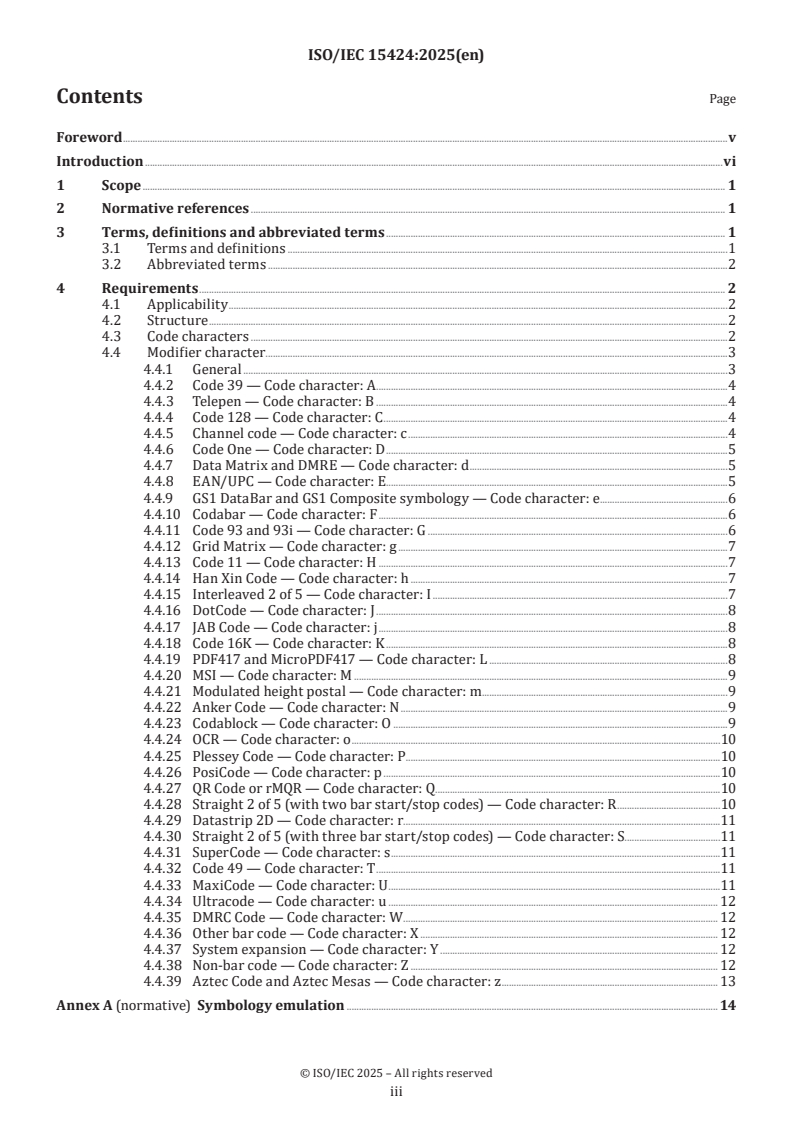
Contents Page
Foreword .v
Introduction .vi
1 Scope . 1
2 Normative references . 1
3 Terms, definitions and abbreviated terms . 1
3.1 Terms and definitions .1
3.2 Abbreviated terms .2
4 Requirements . 2
4.1 Applicability .2
4.2 Structure .2
4.3 Code characters .2
4.4 Modifier character . . .3
4.4.1 General .3
4.4.2 Code 39 — Code character: A .4
4.4.3 Telepen — Code character: B .4
4.4.4 Code 128 — Code character: C .4
4.4.5 Channel code — Code character: c .4
4.4.6 Code One — Code character: D .5
4.4.7 Data Matrix and DMRE — Code character: d .5
4.4.8 EAN/UPC — Code character: E.5
4.4.9 GS1 DataBar and GS1 Composite symbology — Code character: e .6
4.4.10 Codabar — Code character: F .6
4.4.11 Code 93 and 93i — Code character: G .6
4.4.12 Grid Matrix — Code character: g .7
4.4.13 Code 11 — Code character: H .7
4.4.14 Han Xin Code — Code character: h .7
4.4.15 Interleaved 2 of 5 — Code character: I .7
4.4.16 DotCode — Code character: J .8
4.4.17 JAB Code — Code character: j .8
4.4.18 Code 16K — Code character: K .8
4.4.19 PDF417 and MicroPDF417 — Code character: L .8
4.4.20 MSI — Code character: M .9
4.4.21 Modulated height postal — Code character: m .9
4.4.22 Anker Code — Code character: N .9
4.4.23 Codablock — Code character: O .9
4.4.24 OCR — Code character: o .10
4.4.25 Plessey Code — Code character: P . .10
4.4.26 PosiCode — Code character: p .10
4.4.27 QR Code or rMQR — Code character: Q . .10
4.4.28 Straight 2 of 5 (with two bar start/stop codes) — Code character: R .10
4.4.29 Datastrip 2D — Code character: r.11
4.4.30 Straight 2 of 5 (with three bar start/stop codes) — Code character: S.11
4.4.31 SuperCode — Code character: s .11
4.4.32 Code 49 — Code character: T .11
4.4.33 MaxiCode — Code character: U .11
4.4.34 Ultracode — Code character: u . 12
4.4.35 DMRC Code — Code character: W . 12
4.4.36 Other bar code — Code character: X . 12
4.4.37 System expansion — Code character: Y . 12
4.4.38 Non-bar code — Code character: Z . 12
4.4.39 Aztec Code and Aztec Mesas — Code character: z . 13
Annex A (normative) Symbology emulation . 14
© ISO/IEC 2025 – All rights reserved
iii
Annex B (normative) Symbology identifiers for GS1 application syntax or AIM application
specification indicators .15
Annex C (informative) Reference documents .16
Annex D (normative) AIM application specification indicators .18
Bibliography . 19
© ISO/IEC 2025 – All rights reserved
iv
Foreword
ISO (the International Organization for Standardization) and IEC (the International Electrotechnical
Commission) form the specialized system for worldwide standardization. National bodies that are
members of ISO or IEC participate in the development of International Standards through technical
committees established by the respective organization to deal with particular fields of technical activity.
ISO and IEC technical committees collaborate in fields of mutual interest. Other international organizations,
governmental and non-governmental, in liaison with ISO and IEC, also take part in the work.
The procedures used to develop this document and those intended for its further maintenance are described
in the ISO/IEC Directives, Part 1. In particular, the different approval criteria needed for the different types
of document should be noted. This document was drafted in accordance with the editorial rules of the ISO/
IEC Directives, Part 2 (see www.iso.org/directives or www.iec.ch/members_experts/refdocs).
ISO and IEC draw attention to the possibility that the implementation of this document may involve the
use of (a) patent(s). ISO and IEC take no position concerning the evidence, validity or applicability of any
claimed patent rights in respect thereof. As of the date of publication of this document, ISO and IEC had not
received notice of (a) patent(s) which may be required to implement this document. However, implementers
are cautioned that this may not represent the latest information, which may be obtained from the patent
database available at www.iso.org/patents and https://patents.iec.ch. ISO and IEC shall not be held
responsible for identifying any or all such patent rights.
Any trade name used in this document is information given for the convenience of users and does not
constitute an endorsement.
For an explanation of the voluntary nature of standards, the meaning of ISO specific terms and expressions
related to conformity assessment, as well as information about ISO's adherence to the World Trade
Organization (WTO) principles in the Technical Barriers to Trade (TBT) see www.iso.org/iso/foreword.html.
In the IEC, see www.iec.ch/understanding-standards.
This document was prepared by Joint Technical Committee ISO/IEC JTC 1, Information technology,
Subcommittee SC 31, Automatic identification and data capture techniques.
This third edition cancels and replaces the second edition (ISO/IEC 15424:2008), which has been technically
revised.
The main changes are as follows:
— several new symbologies have been added;
— references to AIM as a registration authority have been removed;
— the extension method has been simplified.
Any feedback or questions on this document should be directed to the user’s national standards
body. A complete listing of these bodies can be found at www.iso.org/members.html and
www.iec.ch/national-committees.
© ISO/IEC 2025 – All rights reserved
v
Introduction
There is a need to identify the data carrier that a reader detects in autodiscrimination environments. The
symbology identifier concept provides a standardized way for a device receiving data from a reader to
differentiate between the data carriers. This document deals mostly with bar code symbologies; the terms
symbology identifier, symbology and bar code are therefore used throughout this document although they
are intended to apply to other data carriers as well.
This identification is achieved by the addition of an optional feature to readers enabling the reader to prefix
a standard string of characters to data messages. This preamble contains information about the decoded
symbol (or other data carrier) and any processing the reader has done. The information is not encoded
or otherwise explicitly or implicitly represented in the symbol, except that the presence of some optional
features can be detected by the reading equipment, whereas others require the reader to be expressly
configured to implement them.
This document identifies symbologies for which a symbology specification
— is published in international standardization organisations, such as ISO, IEC and AIM Inc., or
— is proprietary but used in public applications.
In addition, there is a fixed number of symbologies which do not have a full standard but do have a reference
document available from AIM Inc. These symbologies are included in this document because of their
historical usage.
This document is intended to be read in conjunction with the relevant symbology specifications.
© ISO/IEC 2025 – All rights reserved
vi
International Standard ISO/IEC 15424:2025(en)
Information technology — Automatic identification and data
capture techniques — Data carrier identifiers (including
symbology identifiers)
1 Scope
This document specifies the preamble message generated by the reader and interpretable by the receiving
system, which indicates the bar code symbology or other origin of transmitted data, together with details of
certain specified optional processing features associated with the data message.
This document applies to automatic identification device communication conventions and standardizes the
reporting of data carriers from bar code readers and other automatic identification equipment.
2 Normative references
The following documents are referred to in the text in such a way that some or all of their content constitutes
requirements of this document. For dated references, only the edition cited applies. For undated references,
the latest edition of the referenced document (including any amendments) applies.
ISO/IEC 19762, Information technology — Automatic identification and data capture (AIDC) techniques —
Harmonized vocabulary
3 Terms, definitions and abbreviated terms
3.1 Terms and definitions
For the purposes of this document, the terms and definitions given in ISO/IEC 19762 and the following apply.
ISO and IEC maintain terminology databases for use in standardization at the following addresses:
— ISO Online browsing platform: available at https:// www .iso .org/ obp
— IEC Electropedia: available at https:// www .electropedia .org/
3.1.1
code character
second character in the symbology identifier string, which usually indicates to the host the bar code
symbology of the symbol which has been read
3.1.2
flag character
first character in the symbology identifier string, which indicates to the host that it and the characters
following are the symbology identifier characters
3.1.3
modifier character
character following the code character (3.1.1) in the symbology identifier string, indicating optional features
or processing applied to the symbol
© ISO/IEC 2025 – All rights reserved
3.1.4
function 1
FNC1
special function character used for specific purposes in certain symbologies
Note 1 to entry: See Annex B.
3.2 Abbreviated terms
ASCII American Standard Code for Information Interchange
DMRE data matrix rectangular extension
ECI extended channel interpretation
OCR optical character recognition
RF radio frequency
4 Requirements
4.1 Applicability
4.2 Structure
The symbology identifier shall be an ASCII character string prefixed by the reading equipment to the data
contained in a bar code symbol.
The structure of the symbology identifier string shall be as follows:
]cm.
where
] (ASCII value 93) represents the symbology identifier flag character;
c represents the code character as defined in Table 1;
m represents the single modifier character as defined for the symbology in question.
NOTE The sign ] is the character assigned to ASCII value 93 in the United States ASCII character set in according
to ISO/IEC 646.
If a reader is enabled to transmit symbology identifiers, it shall always transmit a symbology identifier at the
beginning of each message. The application must know whether or not the reader has symbology identifiers
enabled. Therefore, the symbol data may start with a ] and still be interpreted unambiguously.
4.3 Code characters
Code characters shall be drawn from the set of upper- and lower-case alphabetic letters A through Z (ASCII
values 65 through 90) and a through z (ASCII values 97 through 122). The currently assigned code characters
are listed in Table 1. These code characters are case sensitive, i.e. a capital “A” is a different code character
from a lower case “a”.
The code character Y has not been assigned to a specific symbology but is assigned to system extension in this
document. The first character following Y will be the first code character of the future symbology followed
by a one-character modifier. All code characters not given in this document are reserved for future use.
© ISO/IEC 2025 – All rights reserved
Certain symbologies emulate the data content of other symbologies, using their assigned symbology
identifier, see Annex A. For symbology description references, see Annex C.
Table 1 — Code characters
Code Code
Symbology Symbology
character character
A Code 39 a reserved
B Telepen b reserved
C Code 128 c Channel Code
D Code One d Data Matrix and DMRE
E EAN/UPC e GS1 DataBar and GS1 Composite
F Codabar f reserved
G Code 93 and 93i g Grid Matrix
H Code 11 h Han Xin Code
I Interleaved 2 of 5 i reserved
J DotCode j JAB Code
K Code 16K k reserved
L PDF417 and MicroPDF417 l reserved
M MSI m Modulated Height Postal
N Anker n reserved
O Codablock o OCR (Optical Character Recognition)
P Plessey Code p PosiCode
Q QR Code or rMQR q reserved
R Straight 2 of 5 (with two bar start/stop codes) r Datastrip 2D
S Straight 2 of 5 (with three bar start/stop codes) s SuperCode
T Code 49 t reserved
U MaxiCode u Ultracode
V reserved v reserved
W DMRC Code w reserved
X Other bar code x reserved
Y System expansion y reserved
Z Non-bar code z Aztec Code
4.4 Modifier character
4.4.1 General
Some symbologies covered by this document contain optional features which need to be indicated to the
receiving equipment to enable them to be correctly processed. This optional processing is indicated by the
modifier character.
Each symbology has a different set of optional features. These are listed in the following subclauses.
To determine the modifier character for an application, refer to the subclause corresponding to the
symbology concerned. Listed in this subclause can be one or more processing options, each of which has
an assigned option value. The precise interpretation of the option should be obtained by reference to
the relevant symbology specification. The modifier character defines the options available for the code
character. The modifier character and its meaning are defined for each of the code characters. The modifier
character shall be from the set {0 to 9, A to Z, a to z}; in some instances, the character may represent a
hexadecimal value (0 to F) corresponding to the sum of active processing options.
© ISO/IEC 2025 – All rights reserved
Where no options are indicated in the subclauses, the modifier character to be transmitted is 0. Values which
are not included in the modifier values of a subclause are reserved for future use.
Check character options listed in the subclauses below indicate the basis of calculation of the check character,
where a check character algorithm has been defined in the symbology specification or reference document.
Symbologies that support the ECI protocol have one or more modifiers to indicate that the ECI protocol is
being used. Unless otherwise stated, the default ECI interpretation for these symbologies is \000003.
4.4.2 Code 39 — Code character: A
Modifier Option
character value
0 No check character validation nor full ASCII processing; all data transmitted as decoded
1 Modulo 43 check character validated and transmitted
3 Modulo 43 check character validated but not transmitted
4 Full ASCII character conversion performed; no check character validation
5 Full ASCII character conversion performed; modulo 43 check character validated and transmitted
7 Full ASCII character conversion performed; modulo 43 check character validated but not transmitted
4.4.3 Telepen — Code character: B
Modifier Option
character value
0 Full ASCII mode
1 Double density numeric only mode
2 Double density numeric followed by full ASCII
4 Full ASCII followed by double density numeric
4.4.4 Code 128 — Code character: C
Modifier
Option
character value
0 Standard data packet; no FNC1 in first or second symbol character position after start character
1 GS1-128 data packet - FNC1 in first symbol character position after start character
2 FNC1 in second symbol character position after start character
[6]
Concatenation according to International Society for Blood Transfusion ISBT 128 specifications
has been performed; concatenated data follows
4.4.5 Channel code — Code character: c
Modifier
Option
character value
3 Channel 3 decoded
4 Channel 4 decoded
5 Channel 5 decoded
6 Channel 6 decoded
7 Channel 7 decoded
8 Channel 8 decoded
9 Composite format
© ISO/IEC 2025 – All rights reserved
4.4.6 Code One — Code character: D
Modifier
Option
character value
0 No special characters in first or second symbol character position
1 FNC1 implied in first symbol character position
2 FNC1 in second symbol character position
Pad character in first symbol character position. The first data character in the symbol will define
4 the escape character. When this character is a “\” , it indicates that the symbol contains ECI escape
sequences.
4.4.7 Data Matrix and DMRE — Code character: d
Modifier
Option
character value
0 ECC 000 to ECC 140
1 ECC 200
2 ECC 200, FNC1 in first or fifth position
3 ECC 200, FNC1 in second or sixth position
4 ECC 200, ECI protocol implemented
5 ECC 200, FNC1 in first or fifth position, ECI protocol impl
...