

ISO/IEC 15416:2025
(Main)Automatic identification and data capture techniques — Bar code print quality test specification — Linear symbols
General Information
- Abstract
This document — specifies the methodology for the measurement of specific attributes of bar code symbols, — defines a method for evaluating these measurements and deriving an overall assessment of symbol quality, and — gives information on possible causes of deviation from optimum grades to assist users in taking appropriate corrective action. This document applies to those symbologies for which a reference decode algorithm has been defined, and which are intended to be read using linear scanning methods, but its methodology can be applied partially or wholly to other symbologies.
- Status
- Published
- Publication Date
- 07-Jan-2025
- Technical Committee
- ISO/IEC JTC 1/SC 31 - Automatic identification and data capture techniques
- Current Stage
- 6060 - International Standard published
- Start Date
- 08-Jan-2025
- Due Date
- 08-May-2025
- Completion Date
- 08-Jan-2025


Overview
ISO/IEC 15416:2025 - Automatic identification and data capture techniques - Bar code print quality test specification - Linear symbols - is the third edition of the international standard that defines how to measure, evaluate and grade the print quality of linear (1D) bar code symbols. It specifies a standardized measurement methodology, assessment parameters and a grading scheme, and gives guidance on common causes of poor print quality and corrective actions. The standard applies to symbologies for which a reference decode algorithm exists and are intended for linear scanning, although its methods can be partly or wholly applied more broadly.
Key technical topics and requirements
The standard sets out both measurement procedures and grading rules. Major technical topics include:
- Measurement methodology
- Reference reflectivity measurement, measuring aperture, optical geometry and sample area
- Definition of the inspection band and the recommended number of scans
- Scan reflectance profile and its assessment parameters:
- Element determination and edge determination
- Symbol contrast and edge contrast
- Modulation (ratio of minimum edge contrast to symbol contrast)
- Defects, decodability and quiet zone checks
- Threshold calculation for edge detection (Annex B provides the algorithm description)
- Symbol grading: how individual parameter scores are combined into an overall symbol grade and expression of continuous grades
- Informative annexes offering guidance and examples:
- Decodability, substrate characteristics, interpretation of profiles, light wavelength selection, number of scans, verification report templates, process control requirements, and comparison with traditional methodologies
Notable technical edits in this edition include modified threshold calculations, adjusted Rmax/Rmin computations, and clarified continuous-grade calculations.
Practical applications and users
ISO/IEC 15416:2025 is intended for:
- Barcode and label manufacturers - for process control and quality assurance of printed symbols
- AIDC equipment manufacturers - to develop and validate verifiers and scanners
- Quality assurance engineers and production managers - to establish acceptance criteria and corrective actions
- System integrators, retailers, logistics and healthcare organizations - to ensure symbols meet scanner-readability requirements across supply chains
- Standards bodies and test laboratories - to harmonize verification and reporting practices
Practical uses include production-line verification, supplier acceptance testing, root-cause analysis for poor readability, and developing compliant verification equipment and software.
Related standards
- ISO/IEC 19762 - AIDC vocabulary (normative reference)
- ISO/IEC 15426-1 - Performance of measuring equipment (related performance requirements)
Keywords: ISO/IEC 15416:2025, bar code print quality, linear symbols, bar code grading, scan reflectance profile, symbol contrast, decodability, AIDC, barcode verification.
Relations
- Effective Date
- 06-Jun-2022
Get Certified
Connect with accredited certification bodies for this standard

BSI Group
BSI (British Standards Institution) is the business standards company that helps organizations make excellence a habit.

NYCE
Mexican standards and certification body.
Sponsored listings
Frequently Asked Questions
ISO/IEC 15416:2025 is a standard published by the International Organization for Standardization (ISO). Its full title is "Automatic identification and data capture techniques — Bar code print quality test specification — Linear symbols". This standard covers: This document — specifies the methodology for the measurement of specific attributes of bar code symbols, — defines a method for evaluating these measurements and deriving an overall assessment of symbol quality, and — gives information on possible causes of deviation from optimum grades to assist users in taking appropriate corrective action. This document applies to those symbologies for which a reference decode algorithm has been defined, and which are intended to be read using linear scanning methods, but its methodology can be applied partially or wholly to other symbologies.
This document — specifies the methodology for the measurement of specific attributes of bar code symbols, — defines a method for evaluating these measurements and deriving an overall assessment of symbol quality, and — gives information on possible causes of deviation from optimum grades to assist users in taking appropriate corrective action. This document applies to those symbologies for which a reference decode algorithm has been defined, and which are intended to be read using linear scanning methods, but its methodology can be applied partially or wholly to other symbologies.
ISO/IEC 15416:2025 is classified under the following ICS (International Classification for Standards) categories: 01.080.50 - Graphical symbols for use on information technology and telecommunications technical drawings and in relevant technical product documentation; 35.040.50 - Automatic identification and data capture techniques. The ICS classification helps identify the subject area and facilitates finding related standards.
ISO/IEC 15416:2025 has the following relationships with other standards: It is inter standard links to ISO/IEC 15416:2016. Understanding these relationships helps ensure you are using the most current and applicable version of the standard.
ISO/IEC 15416:2025 is available in PDF format for immediate download after purchase. The document can be added to your cart and obtained through the secure checkout process. Digital delivery ensures instant access to the complete standard document.
Standards Content (Sample)
International
Standard
ISO/IEC 15416
Third edition
Automatic identification and data
2025-01
capture techniques — Bar code
print quality test specification —
Linear symbols
Techniques automatiques d'identification et de capture des
données — Spécifications pour essai de qualité d'impression des
codes à barres — Symboles linéaires
Reference number
© ISO/IEC 2025
All rights reserved. Unless otherwise specified, or required in the context of its implementation, no part of this publication may
be reproduced or utilized otherwise in any form or by any means, electronic or mechanical, including photocopying, or posting on
the internet or an intranet, without prior written permission. Permission can be requested from either ISO at the address below
or ISO’s member body in the country of the requester.
ISO copyright office
CP 401 • Ch. de Blandonnet 8
CH-1214 Vernier, Geneva
Phone: +41 22 749 01 11
Email: copyright@iso.org
Website: www.iso.org
Published in Switzerland
© ISO/IEC 2025 – All rights reserved
ii
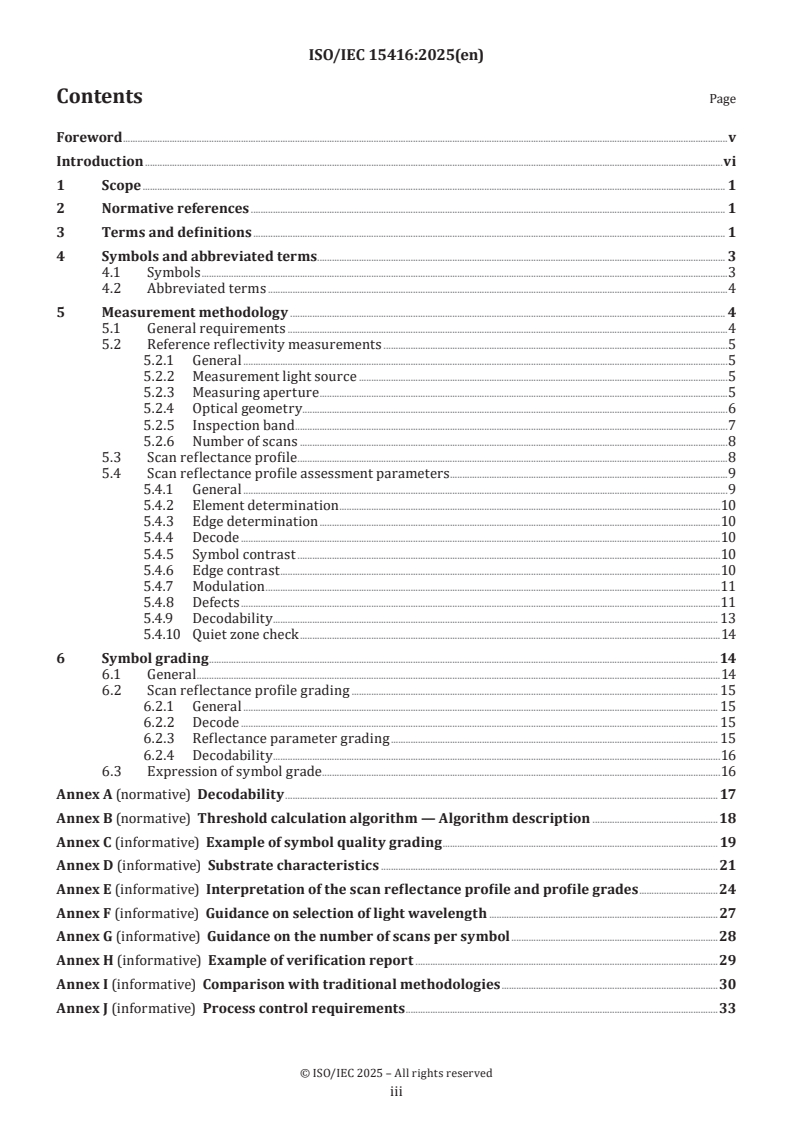
Contents Page
Foreword .v
Introduction .vi
1 Scope . 1
2 Normative references . 1
3 Terms and definitions . 1
4 Symbols and abbreviated terms. 3
4.1 Symbols .3
4.2 Abbreviated terms .4
5 Measurement methodology . 4
5.1 General requirements .4
5.2 Reference reflectivity measurements .5
5.2.1 General .5
5.2.2 Measurement light source .5
5.2.3 Measuring aperture .5
5.2.4 Optical geometry . .6
5.2.5 Inspection band .7
5.2.6 Number of scans .8
5.3 Scan reflectance profile .8
5.4 Scan reflectance profile assessment parameters .9
5.4.1 General .9
5.4.2 Element determination .10
5.4.3 Edge determination .10
5.4.4 Decode .10
5.4.5 Symbol contrast .10
5.4.6 Edge contrast .10
5.4.7 Modulation .11
5.4.8 Defects .11
5.4.9 Decodability . . 13
5.4.10 Quiet zone check .14
6 Symbol grading . 14
6.1 General .14
6.2 Scan reflectance profile grading . 15
6.2.1 General . 15
6.2.2 Decode . 15
6.2.3 Reflectance parameter grading . 15
6.2.4 Decodability . .16
6.3 Expression of symbol grade . .16
Annex A (normative) Decodability . 17
Annex B (normative) Threshold calculation algorithm — Algorithm description .18
Annex C (informative) Example of symbol quality grading . 19
Annex D (informative) Substrate characteristics .21
Annex E (informative) Interpretation of the scan reflectance profile and profile grades .24
Annex F (informative) Guidance on selection of light wavelength .27
Annex G (informative) Guidance on the number of scans per symbol .28
Annex H (informative) Example of verification report .29
Annex I (informative) Comparison with traditional methodologies .30
Annex J (informative) Process control requirements .33
© ISO/IEC 2025 – All rights reserved
iii
Annex K (informative) Description of significant changes in this edition of this document .37
Bibliography .38
© ISO/IEC 2025 – All rights reserved
iv
Foreword
ISO (the International Organization for Standardization) and IEC (the International Electrotechnical
Commission) form the specialized system for worldwide standardization. National bodies that are
members of ISO or IEC participate in the development of International Standards through technical
committees established by the respective organization to deal with particular fields of technical activity.
ISO and IEC technical committees collaborate in fields of mutual interest. Other international organizations,
governmental and non-governmental, in liaison with ISO and IEC, also take part in the work.
The procedures used to develop this document and those intended for its further maintenance are described
in the ISO/IEC Directives, Part 1. In particular, the different approval criteria needed for the different types
of document should be noted. This document was drafted in accordance with the editorial rules of the ISO/
IEC Directives, Part 2 (see www.iso.org/directives or www.iec.ch/members_experts/refdocs).
ISO and IEC draw attention to the possibility that the implementation of this document may involve the
use of (a) patent(s). ISO and IEC take no position concerning the evidence, validity or applicability of any
claimed patent rights in respect thereof. As of the date of publication of this document, ISO and IEC had not
received notice of (a) patent(s) which may be required to implement this document. However, implementers
are cautioned that this may not represent the latest information, which may be obtained from the patent
database available at www.iso.org/patents and https://patents.iec.ch. ISO and IEC shall not be held
responsible for identifying any or all such patent rights.
Any trade name used in this document is information given for the convenience of users and does not
constitute an endorsement.
For an explanation of the voluntary nature of standards, the meaning of ISO specific terms and expressions
related to conformity assessment, as well as information about ISO's adherence to the World Trade
Organization (WTO) principles in the Technical Barriers to Trade (TBT) see www.iso.org/iso/foreword.html.
In the IEC, see www.iec.ch/understanding-standards.
This document was prepared by Joint Technical Committee ISO/IEC JTC 1, Information technology,
Subcommittee SC 31, Automatic identification and data capture techniques.
This third edition cancels and replaces the second edition (ISO/IEC 15416:2016), which has been technically
revised.
The main changes are as follows:
— the calculation of threshold to find edges within a scan reflectance profile has been modified;
— the calculation of R and R has been modified;
max min
— the calculation of continuous grades has been clarified.
Any feedback or questions on this document should be directed to the user’s national standards
body. A complete listing of these bodies can be found at www.iso.org/members.html and
www.iec.ch/national-committees.
© ISO/IEC 2025 – All rights reserved
v
Introduction
The technology of bar coding is based on the recognition of patterns encoded in bars and spaces of defined
dimensions according to rules defining the translation of characters into such patterns, known as the
symbology specification.
The bar code symbol is produced in such a way as to be reliably decoded at the point of use, if it is to fulfil its
basic objective as a machine-readable data carrier.
Manufacturers of bar code equipment and the producers and users of bar code symbols therefore require
publicly available standard test specifications for the objective assessment of the quality of bar code symbols,
to which they can refer to when developing equipment and application standards or determining the quality
of the symbols. Such test specifications form the basis for the development of measuring equipment for
process control and quality assurance purposes during symbol production, as well as afterwards.
This edition of this document introduces several new methods of grading bar code symbols that will improve
the stability of results and modernize the grading method to be more in alignment with modern methods of
bar code scanning. Further details about the changes made in this edition of this document are discussed in
Annex K.
The performance of measuring equipment is covered in ISO/IEC 15426-1.
This document is intended to be read in conjunction with the symbology specification applicable to the bar
code symbol being tested. The symbology-specification provides symbology specific details. Additionally,
an application specification is required to apply this document.
This methodology provides symbol producers and their trading partners a universally standardized means
for communicating about the quality of bar code symbols after they have been printed.
© ISO/IEC 2025 – All rights reserved
vi
International Standard ISO/IEC 15416:2025(en)
Automatic identification and data capture techniques — Bar
code print quality test specification — Linear symbols
1 Scope
This document
— specifies the methodology for the measurement of specific attributes of bar code symbols,
— defines a method for evaluating these measurements and deriving an overall assessment of symbol
quality, and
— gives information on possible causes of deviation from optimum grades to assist users in taking
appropriate corrective action.
This document applies to those symbologies for which a reference decode algorithm has been defined, and
which are intended to be read using linear scanning methods, but its methodology can be applied partially
or wholly to other symbologies.
2 Normative references
The following documents are referred to in the text in such a way that some or all of their content constitutes
requirements of this document. For dated references, only the edition cited applies. For undated references,
the latest edition of the referenced document (including any amendments) applies.
ISO/IEC 19762, Information technology — Automatic identification and data capture (AIDC) techniques —
Vocabulary
3 Terms and definitions
For the purposes of this document, the terms and definitions given in ISO/IEC 19762 and the following apply.
ISO and IEC maintain terminology databases for use in standardization at the following addresses:
— ISO Online browsing platform: available at https:// www .iso .org/ obp
— IEC Electropedia: available at https:// www .electropedia .org/
3.1
bar reflectance
lowest reflectance value in the scan reflectance profile of a bar element
3.2
defect
irregularity found within elements and quiet zones
3.3
edge contrast
difference between bar reflectance (3.1) and space reflectance (3.13) of two adjacent elements
3.4
element reflectance non-uniformity
reflectance difference between the highest peak (3.9) and the lowest valley (3.15) in the scan reflectance
profile of an individual element or quiet zone
© ISO/IEC 2025 – All rights reserved
3.5
global threshold
reflectance level used for the initial identification of elements
Note 1 to entry: to entry. The global threshold is determined by the procedure in Annex B.
3.6
inspection band
band (usually from 10 % to 90 % of the height of a bar code symbol) across which measurements are taken
Note 1 to entry: For an illustration of an inspection band, see Figure 2.
3.7
measuring aperture
aperture
opening which governs the effective sample area (3.10) of the symbol, and the dimensions of which at 1:1
magnification is equal to that of the sample area
Note 1 to entry: For an illustration of a measuring aperture, see Figure 1.
3.8
modulation
ratio of the minimum edge contrast to symbol contrast
3.9
peak
point of higher reflectance in a scan reflectance profile with points of lower reflectance on either side
3.10
sample area
effective area of the symbol within the field of view of the measurement device
3.11
scan path
line along which the centre of the sample area (3.10) traverses the symbol, including quiet zones
3.12
space
light element corresponding to a region of a scan reflectance profile above the global threshold (3.5)
3.13
space reflectance
highest reflectance value in the scan reflectance profile of a space element or quiet zone
3.14
symbol contrast
difference between the maximum and minimum reflectance values in a scan reflectance profile
3.15
valley
point of lower reflectance in a scan reflectance profile with points of higher reflectance on either side
© ISO/IEC 2025 – All rights reserved
4 Symbols and abbreviated terms
4.1 Symbols
A average achieved width of element or element combinations of a particular type
c defect adjustment constant
E width of narrowest wide element
e width of widest narrow element
D defects
F
th
e i edge to similar edge measurement, counting from leading edge of symbol character
i
F factor used to soften the effect on defect grades derived from small changes peaks and valleys
within an element
K smallest absolute difference between a measurement and a reference threshold
k number of element pairs in a symbol character in a (n, k) symbology
M width of element showing greatest deviation from A
m number of modules in a symbol character
N average achieved wide to narrow ratio
N number of modules in a symbol character in a (n, k) symbology
P print contrast signal
CS
R bar reflectance
b
R dark reflectance
D
R light reflectance
L
R maximum reflectance
max
R minimum reflectance
min
R modulation
MOD
R space reflectance
s
ΔR minimum value of edge contrast
Emin
ΔR symbol contrast
SC
ΔR maximum element reflectance non-uniformity
Nmax
t Grey-scale value
D reference threshold between narrow and wide element widths for two-width symbologies
T
T reference threshold between measurements j and ( j + 1) modules wide
j
T global threshold between bars and spaces
G
© ISO/IEC 2025 – All rights reserved
S total width of a character
V decodability value for a scan
V decodability intermediate value above
V decodability intermediate value below
V decodability value for a symbol character
C
Z average achieved narrow element dimension or module size, as measured
4.2 Abbreviated terms
EC edge contrast
ERN element reflectance non-uniformity
GT global threshold
MOD modulation
PCS print contrast signal
SC symbol contrast
SRP scan reflectance profile
5 Measurement methodology
5.1 General requirements
The measurement methodology defined in this document is designed to maximize the consistency of
both reflectivity and bar and space width measurements of bar code symbols on various substrates. This
methodology is also intended to correlate with conditions encountered in bar code scanning hardware.
Measurements shall be made with a defined light source (such as a single light wavelength) and a measuring
aperture of dimensions defined by the application specification or determined in accordance with 5.2.2 and
5.2.3. A circular aperture is defined by its diameter in accordance with Table 1. Application specifications
may define other aperture diameters or shapes.
Whenever possible, measurements shall be made on the bar code symbol in its final configuration, i.e. the
configuration in which it is intended to be scanned. If this is impossible, refer to Annex D for the method to
be used for measuring reflectance for non-opaque substrates.
This document defines the method of obtaining a quality grade for individual symbols. Annex H provides
an example of a report that contains the overall grade and other measurements made by a device which
implements the method described in this document. The use of this method in high volume quality control
regimes can require sampling in order to achieve the desired results. Such sampling plans, including
required sampling rates are outside of the scope of this document.
NOTE Information on sampling plans can be found in ISO 3951-1, ISO 3951-2, ISO 3951-3, ISO 3951-5 and
ISO 28590.
© ISO/IEC 2025 – All rights reserved
5.2 Reference reflectivity measurements
5.2.1 General
The equipment for assessing the quality of bar code symbols in accordance with this document shall
comprise a means of measuring and analysing the variations in the diffuse reflectivity of a bar code symbol
on its substrate along a number of scan paths which shall traverse the full width of the symbol including
both quiet zones. The basis of this methodology is the measurement of diffuse reflectance from the symbol.
All measurements on a bar code symbol shall be made within the inspection band defined in accordance
with 5.2.5.
The measured reflectance values shall be expressed in percentage by means of calibration to a reference
reflectance standard traceable to national measurement institutes.
NOTE Maximum diffuse reflectance, traditionally comparable to barium sulphate or magnesium oxide, is taken
as 100 %.
5.2.2 Measurement light source
The light source used for measurements should be specified in the application specification to suit the
intended scanning environment. When the light source is not specified in the application specification,
measurements should be made using the light source that approximates most closely to the light source
expected to be used in the scanning process. Light sources may include narrow band or broad band
illumination. Refer to Annex F for guidance on the selection of the light source.
5.2.3 Measuring aperture
The nominal diameter of the measuring aperture should be specified by the user application specification to
suit the intended scanning environment. In an application where a range of X dimensions can be encountered,
all measurements shall be made with the aperture(s) appropriate to the application. Applications may
define an aperture appropriate to the smallest X dimension to be encountered or a variable aperture related
to X dimension of the symbol. When the measuring aperture diameter is not specified in the application
specification, Table 1 should be used as a guide. In the absence of a defined X dimension, the Z dimension
shall be substituted.
NOTE 1 The choice of aperture size is very important for symbol grades to be measured consistently. The size of
the measuring aperture affects whether voids in the symbol is “filled in” during the verification process. Therefore,
the measuring aperture that is selected with reference to the range of nominal module size and the expected scanning
environment will lead to measurements that are appropriate for the application. An aperture that is too small will
not fill in unintentional voids that would lead to low grades or undecodable symbols. On the other hand, a measuring
aperture that is too large blurs individual modules that are narrow relative to the aperture diameter, resulting in low
modulation, and sometimes can prevent the symbols with small element widths from being decoded.
NOTE 2 A practical instrument is subject to manufacturing tolerances and optical affects that affects the actual
effective measuring aperture diameter which results in deviations in measurements. The measurement tolerances
are specified in ISO/IEC 15426-1.
Depending upon the specified aperture size and the dimensions of the actual elements within a symbol, the
width of some of the narrow elements can be smaller than the measuring aperture diameter.
© ISO/IEC 2025 – All rights reserved
Table 1 — Guideline for diameter of measuring aperture
X dimension Aperture diameter Reference number
mm mm
0,100 ≤ X < 0,180 0,075 03
0,180 ≤ X < 0,330 0,125 05
0,330 ≤ X < 0,635 0,250 10
0,635 ≤ X 0,500 20
NOTE The aperture reference number is the measuring aperture diameter divided by 25,0 µm, which
approximates to the measuring aperture diameter in thousandths of an inch.
NOTE 3 The measuring aperture is not to be confused with the opening (F-number) of a lens.
5.2.4 Optical geometry
The reference optical geometry for reflectivity measurements shall consist of:
a) a source of incident illumination which is uniform across the sample area at 45° from a perpendicular
to the surface, and in a plane containing the illumination source that shall be both perpendicular to the
surface and parallel to the bars;
b) a light collection device, the axis of which is perpendicular to the surface.
The light reflected from a circular sample area of the surface shall be collected within a cone; the angle
at the vertex of which is 15°, centred on the perpendicular to the surface, through a circular measuring
aperture, the diameter of which at 1:1 magnification shall be equivalent to that of the sample area.
NOTE Figure 1 illustrates the principle of the optical arrangement but is not intended to represent an actual device.
This reference geometry is intended to minimize the effects of specular reflection and to maximize those
of diffuse reflection from the symbol. It is intended to provide a reference basis to assist the consistency
of measurement. The actual optical geometry of individual scanning systems does not always correspond
exactly to this reference geometry. Alternative optical geometries and components may be used, provided
that their performance can be correlated with that of the reference optical arrangement defined in this
subclause.
It is common for an application to use both linear and two-dimensional symbols. Optical setups used for 2D
symbol quality assessment typically employ lights from four sides at 45°. Application specifications may
consider specifying the reference optical geometry from ISO/IEC 15415, which consists of four rather than
one light at 45° and denoted by the lighting specifier “/45Q” as the default, if verifiers that are also used for
quality assessment of two-dimensional symbols are preferred to be used in the application.
NOTE For application specifications employing the lighting specifier “/45Q” as the default, refer to the optical
geometry defined ISO/IEC 15415.
© ISO/IEC 2025 – All rights reserved
Key
1 light sensing element
2 aperture at 1:1 magnification (measurement 6 is equal to measurement 7)
3 baffle
4 sample
5 light source
6 image distance
7 object distance
8 lens
α incident light angle
ϕ collected light cone angle
Figure 1 — Reference optical arrangement
5.2.5 Inspection band
The area within which all measurement scan paths shall lie shall be contained between two lines
perpendicular to the height of the bars of the symbol, as illustrated in Figure 2. The lower line shall be
positioned at a distance above the average lower edge of the bar pattern of the symbol while the upper line
shall be positioned at the same distance below the average upper edge of the bar pattern of the symbol. This
distance shall be equal to 10 % of the average bar height or the measuring aperture diameter, whichever is
greater. The inspection band shall extend to the full width of the symbol including quiet zones.
© ISO/IEC 2025 – All rights reserved
Key
1 inspection band (normally 80 % of average bar height)
2 10 % of average bar height, or aperture diameter if greater, above inspection band
3 10 % of average bar height, or aperture diameter if greater, above average bar bottom edge
4 quiet zones
5 scanning lines
6 average bar bottom edge
Figure 2 — Inspection band
5.2.6 Number of scans
In order to provide for the effects of variations in symbol characteristics at different positions in the height of
the bars, a number of scans shall be performed across the full width of the symbol including both quiet zones
with the appropriate measuring aperture and a light source of defined nominal wavelength. These scans
shall be approximately equally spaced through the height of the inspection band. The minimum number
of scans per symbol should normally be 10 or the height of the inspection band divided by the measuring
aperture diameter, whichever is lower. Refer to Annex G for guidance on the number of scans.
The overall quality grade of the symbol is determined by averaging the quality grades of the individual
scans, in accordance with Clause 6.
5.3 Scan reflectance profile
Bar code symbol quality assessment shall be based on an analysis of the scan reflectance profiles. The scan
reflectance profile is a plot of reflectance against linear distance across the symbol. If scanning speed is
not constant, measuring devices plotting reflectance against time should make provision to compensate for
the effects of acceleration or deceleration. If the plot is not a continuous analogue profile, the measurement
intervals should be sufficiently small to ensure that no significant detail is lost and that dimensional
accuracy is adequate.
NOTE The measurement tolerances are specified in ISO/IEC 15426-1.
Figure 3 is a graphical representation of a scan reflectance profile. The vertical axis represents reflectance
and the horizontal axis linear position. The high reflectance areas are spaces and the low reflectance
areas are bars. The high reflectance areas on the extreme left and right are the quiet zones. The important
features of the scan reflectance profile can be determined by manual graphical analysis or automatically by
numerical analysis. For example, the highest reflectance point on the scan reflectance profile in Figure 3 is
approximately 82 % and the lowest is approximately 10 %.
© ISO/IEC 2025 – All rights reserved
Key
P linear position
R reflectivity
Figure 3 — Scan reflectance profile
5.4 Scan reflectance profile assessment parameters
5.4.1 General
The scan reflectance profile parameters described in 5.4.2 to 5.4.9 shall be assessed for compliance with this
document. Grading of the scan reflectance profile parameters is described in 6.2. Figure 4 is the same scan
reflectance profile as Figure 3 with certain features indicated.
Key
A quiet zones (left and right) E global threshold
B R is equal to the average of the highest 3 % R reflectivity
max
C ΔR P linear position
Emin
D R is equal to the average of the lowest 3 %
min
Figure 4 — Features of scan reflectance profile
© ISO/IEC 2025 – All rights reserved
5.4.2 Element determination
To locate the bars and spaces, a global threshold shall be established. The global threshold, T shall be
G
calculated using the algorithm in Annex B.
NOTE 1 Using the algorithm in Annex B is a new feature of this revision of this document and is meant to reduce
grade fluctuations that arise from changes in the global threshold from small areas of extreme values of reflectance
within the scan reflectance profile.
Each region above the global threshold shall be regarded as a space and the highest reflectance value in the
region shall be designated the space reflectance, R . Similarly, the region below the global threshold shall be
s
regarded as a bar and the lowest reflectance in the region shall be designated the bar reflectance, R .
b
For each space, R − T represents its reflectance margin above the global threshold. For each bar, T − R
s G G b
represents its reflectance margin below the global threshold. A warning should be issued when the minimum
reflectance margin for any element is less than 5 % of the symbol contrast of a symbol. This warning should
caution users to consider the possibility that this symbol is close to a failing grade for edge determination.
NOTE 2 This warning is not required but recommended as helpful information to verifier users, especially when
intermittent failure of edge determination causes symbol grade variation.
5.4.3 Edge determination
An element edge shall be defined as being located at the point where the scan reflectance profile intersects
the mid-point between R and R of two adjacent regions, i.e. where the reflectance value is (R + R )/2. If
s b s b
more than one point satisfying this definition exists between adjoining elements, then the edge position and
the element widths will be ambiguous and the scan reflectance profile shall fail the decode parameter. The
quiet zones and intercharacter gaps, if any, are considered to be spaces.
5.4.4 Decode
The symbology reference decode algorithm shall be used to decode the symbol using the element edges
determined in steps 5.4.2 and 5.4.3. This algorithm can be found in the symbology specification.
5.4.5 Symbol contrast
Symbol contrast is calculated as:
ΔR = R − R
SC max min
where
R is the average of the highest 3 % of sampled reflectance values within the scan reflectance profile,
max
bounded by the extent of the left and right quiet zones;
R is the average of the lowest 3 % of sampled reflectance values within the scan reflectance profile,
min
bounded by the extent of the left and right quiet zones.
NOTE The use of an average for R and R is a new feature introduced into this revision of this document and
max min
is intended to reduce measurement variability due to small areas of aberrant reflectance that is sometimes, but not
exclusively, caused by specular reflection.
5.4.6 Edge contrast
Edge contrast is the difference between the R and R of adjoining elements including quiet zones. Edge
s b
contrast is computed for each edge in the symbol and the lowest value of edge contrast found for any edge in
the scan reflectance profile is the minimum edge contrast.
© ISO/IEC 2025 – All rights reserved
5.4.7 Modulation
Modulation is calculated as:
ΔR = ΔR / ΔR
MOD Nmax SC
5.4.8 Defects
Defects are irregularities found within elements and quiet zones. Defects are measured in terms of element
reflectance non-uniformity.
Element reflectance non-uniformity within an individual element or quiet zone is the difference between
the reflectance of the highest peak and the reflectance of the lowest valley. When an element consists of a
single peak or valley, its reflectance non-uniformity is zero. The highest value of element reflectance non-
uniformity found in the scan reflectance profile is the maximum element reflectance non-uniformity. Defect
measurement is expressed as the ratio of the maximum element reflectance non-uniformity, ΔR , to
Nmax
symbol contrast. The element non-uniformity is modified according to a), b) and c), and calculated in d) in a
way that reduces the impact of small variations in reflectivity.
a) Define the defect adjustment constant, c, as c = 0,075 × ΔR , where ΔR is the SC of the SRP.
SC SC
NOTE 1 c corresponds to the following:
— a small amount of “noise” to be reduced to eliminate instability in measurement;
— an amount of contrast difference that is small enough for scanners to ignore.
NOTE 2 The original definition of "defect", prior to the previous revision of this document, corresponds to a
constant c value of 0.
b) For each bar element
1) for each positive peak maxima in the element:
i) find the lowest valley to the left of it within the element, called R ;
minLeft
ii) find the lowest valley to the right of it within the element, called R ;
minRight
iii) calculate ERN as the peak maximum minus the R ;
left minLeft
iv) calculate ERN as the peak maximum minus the R ;
right minRight
v) take the lesser of ERN and ERN as ERN′ (ERN prime);
left right
vi) if ERN′ ≥ c, set F to the value 1; if ERN′ < c, calculate F = ERN′/c;
vii) calculate the provisional ERN for this peak only as F multiplied by the maximum of (ERN ,
left
ERN ).
right
2) take the maximum of the provisional ERN values from all iterations of the previous step as the ERN
of this element.
c) Same as b) for each space element, and as follows.
1) For each negative valley minima (a local minima):
i) find the highest peak to the left of it within the element, called R ;
maxLeft
ii) find the highest peak to the right of it within the element, called R ;
maxRight
iii) calculate ERN as R minus the valley minimum;
left maxLeft
iv) calculate ERN as R minus the valley minimum;
right maxRight
© ISO/IEC 2025 – All rights reserved
v) take the lesser of ERN and ERN as ERN′ (ERN prime);
left right
vi) if ERN′ ≥ c, set F to the value 1; if ERN′ < c, calculate F = ERN′/c;
vii) calculate the provisional for this valley only as F multiplied by the maximum of (ERN ,
left
ERN ).
right
2) Take the maximum of all the provisional ERN values from all iterations of c) 1) as the ERN of this
element.
d) Take the maximum of all ERN values from b) 2) and c) 2) as ΔR for the overall scan:
Nmax
D = ΔR / ΔR
F Nmax SC
To illustrate the functioning of this algorithm, three examples are given in in Figure 5 of a section of an
SRP, each showing the reflectivity of bar elements which contain one or more peaks and valley minima. The
horizontal line labelled T represents the global threshold. The symbol M in Figure 5 shows the reflectivity
G
difference that is equal to the constant c times the symbol contrast.
The leftmost portion of the SRP shown in Figure 5 is an example of a case in which the defect value will
be reduced because the difference in reflectivity between point B and A is less than the height of element
M. The defect will be reduced because ERN , which is the difference in reflectivity between A and B, is
left
very small (in particular, it is much less than the height of element M) and therefore the factor F will be
correspondingly small in step c) vi). The defect for this element will therefore be a small factor multiplied by
the difference in reflectivity between B and C.
The middle portion of the SRP shown in Figure 5 is an example that shows a case where many peaks and
valleys exist within an element, but ERN (the difference between E and D) is much larger than the height
left
of element M. Therefore, defect measurement is not be affected by step c) vii because the factor F will be set
to 1 in step c) vi).
The rightmost portion of the SRP shown in Figure 5 is an example is actually equivalent to the middle
example in as much as this algorithm is concerned, even though ERN and ERN are different for each
left right
local maxima. In particular, the difference in reflectivity between F and G is again much larger than the
height of M, and therefore the factor F will be set to 1 in step c) vi).
a) Defect is reduced b) Defect is not reduced c) Defect is not reduced
Key
A local minimum in first example element E local maximum in second example element
B local maximum in first example element F local maximum in third example element
C element minimum of first example element G element minimum in third example element
D element minimum of second example element
Figure 5 — Examples to illustrate ERN calculation
© ISO/IEC 2025 – All rights reserved
5.4.9 Decodability
The decodability of a bar code symbol is a measure of the accuracy of its production in relation to the
appropriate reference decode algorithm. Bar code scanning equipment can generally be expected to perform
better on symbols with higher levels of decodability than on those with lower decodability.
Rules governing the nominal dimensions for each bar code symbology are given in particular symbology
specifications. The reference decode algorithm allows reasonable margin for errors in the printing and
reading processes by defining one or more reference thresholds at which a decision is made as to the widths
of elements or other measurements.
The decodability of a scan reflectance profile is the fraction of available margin which has not been
consumed by the printing process and is thus available for the scanning process. When calculating the
decodability value, V, for a scan reflectance profile, regard shall be to the measurements required by the
reference decode algorithm in the relevant symbology specification. In the following paragraph, the term
"measurement" shall be taken to refer to either
— a single element width in symbologies which use these directly in the reference decode algorithm (e.g.
“Code 39”), or
— the combined width of two or more adjacent elements in symbologies which use edge to similar edge
measurements for decoding (e.g. “Code 128”).
The decodability value is calculated with reference to the following:
a) the average achieved width, A, for measurements of a particular type [e.g. narrow elements, or bar +
space combinations nominally totalling 2 (or 3 or 4, etc.) modules] in the scan reflectance profile;
b) the reference threshold applicable to measurements of the same type as A (D );
T
c) the actual measurement showing the greatest deviation from A in the direction of the reference
threshold, M.
V can be calculated as follows:
V = |(D − M)/( D − A)|
T T
where
| | represents the absolute value function;
(D − M) is the remaining margin not used by printing variation;
T
(D − A) is the total theoretical margin based on the ideal measurement of the element(s).
T
Figure 6 illustrates this principle.
© ISO/IEC 2025 – All rights reserved
---------------------- Pag
...