

ISO 20128:2006
(Main)Milk products — Enumeration of presumptive Lactobacillus acidophilus on a selective medium — Colony-count technique at 37 degrees C
General Information
- Abstract
ISO 20128|IDF 192:2006 specifies a method for the enumeration of presumptive Lactobacillus acidophilus in milk products on a selective medium by using a colony-count technique at 37 °C. The method is applicable to fermented and non-fermented milks, milk powders and infant formulae where presumptive L. acidophilus is present and in combination with other lactic acid bacteria and bifidobacteria. The method is not applicable when the number of presumptive L. acidophilus is less than 104 CFU/g and the numbers of Lactobacillus rhamnosus, Lactobacillus reuteri and Lactobacillus paracasei subsp. paracasei are greater than 106 CFU/g.
- Status
- Published
- Publication Date
- 11-May-2006
- Technical Committee
- ISO/TC 34/SC 5 - Milk and milk products
- Drafting Committee
- ISO/TC 34/SC 5 - Milk and milk products
- Current Stage
- 9093 - International Standard confirmed
- Start Date
- 28-Sep-2023
- Completion Date
- 29-Aug-2026
Overview
ISO 20128:2006 (IDF 192:2006) specifies a standardized microbiological method for the enumeration of presumptive Lactobacillus acidophilus in milk products using a colony-count technique at 37 °C on a selective medium. The procedure is designed for fermented and non‑fermented milks, milk powders and infant formulae where presumptive L. acidophilus coexists with other lactic acid bacteria and bifidobacteria. Results are reported as colony‑forming units per gram (CFU/g). The method produces presumptive identifications and cannot distinguish very closely related species (e.g., L. johnsonii, L. gasseri, L. crispatus).
Key topics and requirements
- Selective medium: MRS agar supplemented with clindamycin and ciprofloxacin (MRS/CL/CIP agar). Typical stock additions are 0.1 mg clindamycin and 10 mg ciprofloxacin per litre of medium (per the standard formulation).
- Sample prep and plating: Homogenize a known sample amount, prepare decimal dilutions, spread plate appropriate dilutions onto MRS/CL/CIP plates.
- Incubation: Anaerobic incubation at 37 °C for 72 h ± 3 h, followed by colony counting.
- Colony morphology: Presumptive L. acidophilus colonies are typically flat, mat or rough, grey to whitish, 1–3 mm diameter.
- Limits and limitations:
- Not applicable when presumptive L. acidophilus < 10^4 CFU/g and competing species (L. rhamnosus, L. reuteri, L. paracasei subsp. paracasei) exceed 10^6 CFU/g.
- Method yields presumptive counts only; confirmatory identification requires additional tests.
- Quality and storage: Prepared MRS/CL/CIP plates may be stored refrigerated (4–7 °C) for limited time; antibiotic stock solutions are held frozen per the standard.
Applications and users
- Routine quality control and microbiological testing in dairy manufacturing, probiotic product validation, infant formula production and third‑party food testing laboratories.
- Useful for product release testing, shelf‑life studies, and verification of probiotic label claims where L. acidophilus is a target organism.
- Users: food microbiologists, laboratory managers, regulatory compliance teams, and academic researchers working with dairy probiotics.
Related standards
- ISO 7218 - General rules for microbiological examinations.
- ISO 8261 | IDF 122 - Guidance for preparation of test samples, initial suspensions and decimal dilutions for microbiological examination.
- See ISO/TS 11133 (culture media quality/validation) for additional media performance guidance.
Keywords: ISO 20128, Lactobacillus acidophilus enumeration, selective medium, MRS/CL/CIP agar, colony-count technique at 37 °C, milk products, microbiological methods, fermented milk, infant formula.
Get Certified
Connect with accredited certification bodies for this standard

BSI Group
BSI (British Standards Institution) is the business standards company that helps organizations make excellence a habit.

Bureau Veritas
Bureau Veritas is a world leader in laboratory testing, inspection and certification services.

DNV
DNV is an independent assurance and risk management provider.
Sponsored listings
Frequently Asked Questions
ISO 20128:2006 is a standard published by the International Organization for Standardization (ISO). Its full title is "Milk products — Enumeration of presumptive Lactobacillus acidophilus on a selective medium — Colony-count technique at 37 degrees C". This standard covers: ISO 20128|IDF 192:2006 specifies a method for the enumeration of presumptive Lactobacillus acidophilus in milk products on a selective medium by using a colony-count technique at 37 °C. The method is applicable to fermented and non-fermented milks, milk powders and infant formulae where presumptive L. acidophilus is present and in combination with other lactic acid bacteria and bifidobacteria. The method is not applicable when the number of presumptive L. acidophilus is less than 104 CFU/g and the numbers of Lactobacillus rhamnosus, Lactobacillus reuteri and Lactobacillus paracasei subsp. paracasei are greater than 106 CFU/g.
ISO 20128|IDF 192:2006 specifies a method for the enumeration of presumptive Lactobacillus acidophilus in milk products on a selective medium by using a colony-count technique at 37 °C. The method is applicable to fermented and non-fermented milks, milk powders and infant formulae where presumptive L. acidophilus is present and in combination with other lactic acid bacteria and bifidobacteria. The method is not applicable when the number of presumptive L. acidophilus is less than 104 CFU/g and the numbers of Lactobacillus rhamnosus, Lactobacillus reuteri and Lactobacillus paracasei subsp. paracasei are greater than 106 CFU/g.
ISO 20128:2006 is classified under the following ICS (International Classification for Standards) categories: 07.100.30 - Food microbiology; 67.100.10 - Milk and processed milk products. The ICS classification helps identify the subject area and facilitates finding related standards.
ISO 20128:2006 is available in PDF format for immediate download after purchase. The document can be added to your cart and obtained through the secure checkout process. Digital delivery ensures instant access to the complete standard document.
Standards Content (Sample)
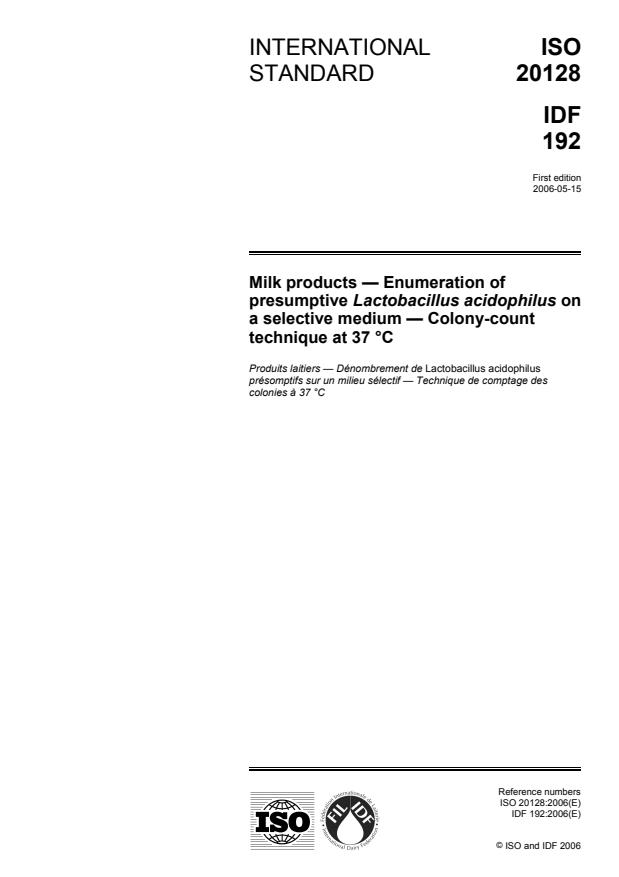
INTERNATIONAL ISO
STANDARD 20128
IDF
First edition
2006-05-15
Milk products — Enumeration of
presumptive Lactobacillus acidophilus on
a selective medium — Colony-count
technique at 37 °C
Produits laitiers — Dénombrement de Lactobacillus acidophilus
présomptifs sur un milieu sélectif — Technique de comptage des
colonies à 37 °C
Reference numbers
IDF 192:2006(E)
©
ISO and IDF 2006
IDF 192:2006(E)
PDF disclaimer
This PDF file may contain embedded typefaces. In accordance with Adobe's licensing policy, this file may be printed or viewed but
shall not be edited unless the typefaces which are embedded are licensed to and installed on the computer performing the editing. In
downloading this file, parties accept therein the responsibility of not infringing Adobe's licensing policy. Neither the ISO Central
Secretariat nor the IDF accepts any liability in this area.
Adobe is a trademark of Adobe Systems Incorporated.
Details of the software products used to create this PDF file can be found in the General Info relative to the file; the PDF-creation
parameters were optimized for printing. Every care has been taken to ensure that the file is suitable for use by ISO member bodies
and IDF national committees. In the unlikely event that a problem relating to it is found, please inform the ISO Central Secretariat at the
address given below.
© ISO and IDF 2006
All rights reserved. Unless otherwise specified, no part of this publication may be reproduced or utilized in any form or by any means,
electronic or mechanical, including photocopying and microfilm, without permission in writing from either ISO or IDF at the respective
address below.
ISO copyright office International Dairy Federation
Case postale 56 • CH-1211 Geneva 20 Diamant Building • Boulevard Auguste Reyers 80 • B-1030 Brussels
Tel. + 41 22 749 01 11 Tel. + 32 2 733 98 88
Fax + 41 22 749 09 47 Fax + 32 2 733 04 13
E-mail copyright@iso.org E-mail info@fil-idf.org
Web www.iso.org Web www.fil-idf.org
Published in Switzerland
ii © ISO and IDF 2006 – All rights reserved
IDF 192:2006(E)
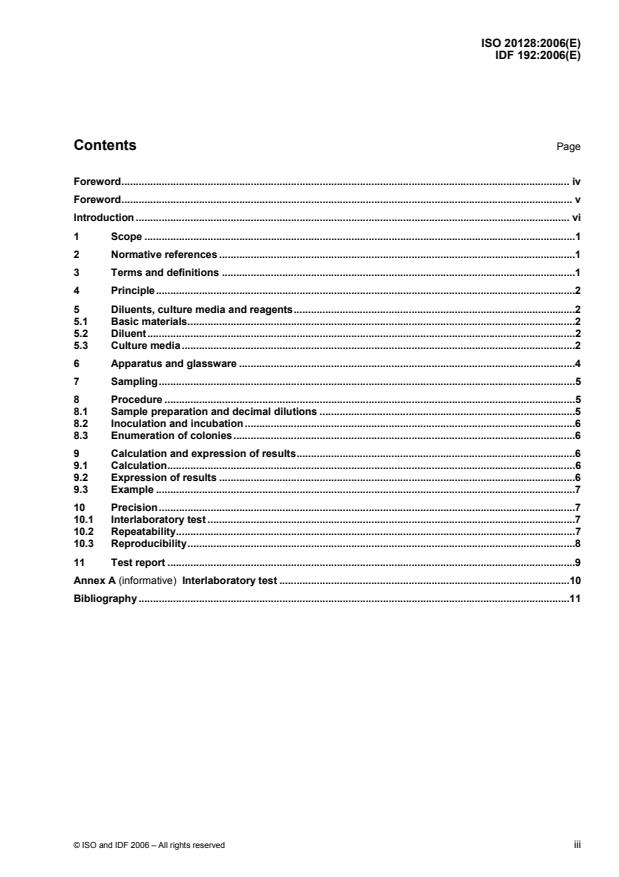
Contents Page
Foreword. iv
Foreword. v
Introduction . vi
1 Scope .1
2 Normative references .1
3 Terms and definitions .1
4 Principle.2
5 Diluents, culture media and reagents.2
5.1 Basic materials.2
5.2 Diluent.2
5.3 Culture media.2
6 Apparatus and glassware .4
7 Sampling.5
8 Procedure .5
8.1 Sample preparation and decimal dilutions .5
8.2 Inoculation and incubation .6
8.3 Enumeration of colonies.6
9 Calculation and expression of results.6
9.1 Calculation.6
9.2 Expression of results .6
9.3 Example .7
10 Precision.7
10.1 Interlaboratory test .7
10.2 Repeatability.7
10.3 Reproducibility.8
11 Test report .9
Annex A (informative) Interlaboratory test .10
Bibliography .11
IDF 192:2006(E)
Foreword
ISO (the International Organization for Standardization) is a worldwide federation of national standards
bodies (ISO member bodies). The work of preparing International Standards is normally carried out through
ISO technical committees. Each member body interested in a subject for which a technical committee has
been established has the right to be represented on that committee. International organizations, governmental
and non-governmental, in liaison with ISO, also take part in the work. ISO collaborates closely with the
International Electrotechnical Commission (IEC) on all matters of electrotechnical standardization.
International Standards are drafted in accordance with the rules given in the ISO/IEC Directives, Part 2.
The main task of technical committees is to prepare International Standards. Draft International Standards
adopted by the technical committees are circulated to the member bodies for voting. Publication as an
International Standard requires approval by at least 75 % of the member bodies casting a vote.
Attention is drawn to the possibility that some of the elements of this document may be the subject of patent
rights. ISO shall not be held responsible for identifying any or all such patent rights.
ISO 20128|IDF 192 was prepared by Technical Committee ISO/TC 34, Food products, Subcommittee SC 5,
Milk and milk products, and the International Dairy Federation (IDF). It is being published jointly by ISO and
IDF.
iv © ISO and IDF 2006 – All rights reserved
IDF 192:2006(E)
Foreword
IDF (the International Dairy Federation) is a worldwide federation of the dairy sector with a National
Committee in every member country. Every National Committee has the right to be represented on the IDF
Standing Committees carrying out the technical work. IDF collaborates with ISO in the development of
standard methods of analysis and sampling for milk and milk products.
Draft International Standards adopted by the Action Teams and Standing Committees are circulated to the
National Committees for voting. Publication as an International Standard requires approval by at least 50 % of
IDF National Committees casting a vote.
Attention is drawn to the possibility that some of the elements of this document may be the subject of patent
rights. IDF shall not be held responsible for identifying any or all such patent rights.
ISO 20128|IDF 192 was prepared by the International Dairy Federation (IDF) and Technical Committee
ISO/TC 34, Food products, Subcommittee SC 5, Milk and milk products. It is being published jointly by IDF
and ISO.
All work was carried out by the Joint ISO-IDF Action Team on Lactic acid bacteria and starters, of the
Standing Committee on Microbiological methods of analysis, under the aegis of its project leader,
Mrs D. Ellekaer (DK).
IDF 192:2006(E)
Introduction
Because of the large variety of fermented and non-fermented milks, this method may not be appropriate in
every detail for certain products.
This could be the case where the number of presumptive Lactobacillus acidophilus is very much lower than
the number of other microorganisms such as Lactobacillus rhamnosus, Lactobacillus reuteri, Lactobacillus
plantarum, Lactobacillus helveticus and yeasts.
vi © ISO and IDF 2006 – All rights reserved
INTERNATIONAL STANDARD
IDF 192:2006(E)
Milk products — Enumeration of presumptive Lactobacillus
acidophilus on a selective medium — Colony-count technique
at 37 °C
1 Scope
This International Standard specifies a method for the enumeration of presumptive Lactobacillus acidophilus
in milk products on a selective medium by using a colony-count technique at 37 °C.
The method is applicable to fermented and non-fermented milks, milk powders and infant formulae where
presumptive L. acidophilus is present and in combination with other lactic acid bacteria and bifidobacteria.
The method is not applicable when the number of presumptive L. acidophilus is less than 10 CFU/g and the
numbers of Lactobacillus rhamnosus, Lactobacillus reuteri and Lactobacillus paracasei subsp. paracasei are
greater than 10 CFU/g.
2 Normative references
The following referenced documents are indispensable for the application of this document. For dated
references, only the edition cited applies. For undated references, the latest edition of the referenced
document (including any amendments) applies.
ISO 7218, Microbiology of food and animal feeding stuffs — General rules for microbiological examinations
ISO 8261|IDF 122, Milk and milk products — General guidance for the preparation of test samples, initial
suspensions and decimal dilutions for microbiological examination
3 Terms and definitions
For the purposes of this document, the following terms and definitions apply.
3.1
presumptive Lactobacillus acidophilus
microorganism forming flat, mat, rough, grey to whitish colonies with more or less irregular edges and a
diameter of 1 mm to 3 mm depending on the number of colonies when grown on a solid selective medium
under the conditions specified in this International Standard
NOTE L. acidophilus is closely related to Lactobacillus johnsonii, Lactobacillus gasseri and Lactobacillus crispatus.
The method specified in this International Standard cannot distinguish between these four species and, therefore, only
presumptive L. acidophilus is mentioned.
IDF 192:2006(E)
4 Principle
4.1 The antibiotics clindamycin and ciprofloxacin both inhibit the growth of the most common
microorganisms used in fermented milks, non-fermented milks and infant formulae, such as Lactobacillus
delbrueckii subsp. bulgaricus, Lactobacillus delbrueckii subsp. lactis, Streptococcus thermophilus,
bifidobacteria, lactococci, Lactobacillus casei, Lactobacillus paracasei subsp. paracasei, Lactobacillus
rhamnosus, Lactobacillus reuteri and Leuconostoc species.
4.2 A known amount of sample is homogenized with diluent and decimal dilutions are prepared.
4.3 Appropriate dilutions are spread plated on MRS-agar with the addition of clindamycin and ciprofloxacin.
4.4 The plates are incubated anaerobically at 37 °C for 72 h ± 3 h.
4.5 Typical colonies are counted.
4.6 The number of characteristic microorganisms per gram of sample is calculated from the number of
colonies obtained on plates chosen at dilution levels so as to give a significant result.
5 Diluents, culture media and reagents
5.1 Basic materials
Use only reagents of recognized analytical grade, unless otherwise specified, and distilled or demineralized
water or water of equivalent purity. See ISO 7218.
5.2 Diluent
See ISO 8261|IDF 122.
5.3 Culture media
5.3.1 MRS/clindamycin/ciprofloxacin agar (MRS/CL/CIP agar)
MRS/CL/CIP agar consists of MRS agar (5.3.2) with the addition of 0,1 mg of clindamycin and 10,0 mg of
ciprofloxacin per litre of medium (see 5.3.4).
2 © ISO and IDF 2006 – All rights reserved
IDF 192:2006(E)
5.3.2 Basic medium: MRS agar
5.3.2.1 Composition
Peptone 1 (enzymatic digest of casein) 10,0 g
Meat extract 10,0 g
Yeast extract (dried) 5,0 g
Glucose 20,0 g
Tween 80 (sorbitan mono-oleate) 1,0 ml
Dipotassium hydrogen phosphate (K HPO) 2,0 g
2 4
Sodium acetate trihydrate (NaCH CO⋅3H O) 5,0 g
3 2 2
Triammonium citrate ((NH ) HC H O) 2,0 g
4 3 6 5 7
0,2 g
Magnesium sulfate heptahydrate (MgSO⋅7H O)
4 2
0,05 g
Manganese sulfate tetrahydrate (MnSO⋅4H O)
4 2
a
Agar
12 g to 18 g
Water 1 000 ml
a
Depending on the gel strength of the agar.
5.3.2.2 Preparation
Suspend the ingredients in the water. Heat the suspension to boiling with frequent agitation until a complete
solution is obtained. Distribute the medium in portions of 100 ml ± 1 ml into bottles (6.9) of 150 ml capacity or
in portions of 200 ml ± 2 ml into bottles (6.9) of 250 ml capacity.
If needed, adjust the pH (6.8) so that, after sterilization, it is 6,2 ± 0,2. Sterilize in the autoclave (6.6) set at
121 °C for 15 min. If the medium is to be used immediately, cool it in a water bath (6.7) to between 44 °C and
47 °C. Do not expose the medium to direct sunlight.
The thus-prepared MRS agar may be stored in the dark at 1 °C to 5 °C for 6 months.
NOTE The complete MRS agar is commercially available but the results obtained may differ significantly from one
supplier to another (See also ISO/TS 11133-1 and ISO/TS 11133-2.)
5.3.3 Clindamycin stock solution
5.3.3.1 Composition
Clindamycin hydrochloride 2,0 mg
Water up to 10,0 ml
5.3.3.2 Preparation
Dissolve the clindamycin hydrochloride in the water. Filter the solution then sterilize through a 0,22 µm filter
(6.13) into a sterile test tube (6.14).
If the solution is not to be used immediately, distribute it in small sterile cryotubes (6.17) and keep the tubes at
–20 °C. The f
...