

ISO 817:2024
(Main)Refrigerants — Designation and safety classification
General Information
- Abstract
This document provides an unambiguous system for assigning designations to refrigerants. It also establishes a system for assigning a safety classification to refrigerants based on toxicity and flammability data, and provides a means of determining the refrigerant concentration limit. Tables listing the refrigerant designations, safety classifications, refrigerant concentration limits and data necessary for safe use of the refrigerants are included based on data submitted with the application.
- Status
- Published
- Publication Date
- 26-Nov-2024
- Technical Committee
- ISO/TC 86/SC 8 - Refrigerants and refrigeration lubricants
- Drafting Committee
- ISO/TC 86/SC 8 - Refrigerants and refrigeration lubricants
- Current Stage
- 6060 - International Standard published
- Start Date
- 27-Nov-2024
- Due Date
- 13-Oct-2024
- Completion Date
- 27-Nov-2024
Overview
ISO 817:2024 - "Refrigerants - Designation and safety classification" is the fourth edition of the International Standard that defines an unambiguous system for naming refrigerants and assigning safety classifications. The standard establishes rules for refrigerant designation, a matrix-based safety group classification (based on toxicity and flammability), and a method for determining refrigerant concentration limits. It also includes tables and annexes with classification data, property data and calculation methods submitted with refrigerant applications. ISO 817:2024 replaces ISO 817:2014 and expands the scope to include data necessary for safe application and updated toxicity classification rules.
Key Topics
- Refrigerant numbering and designation rules: detailed conventions for identifying refrigerants, including digits, prefixes, isomer and cyclic/ether-based compound rules, and blend identification.
- Safety classification system: assignment of toxicity and flammability classes and a matrix diagram for safety group determination.
- Refrigerant concentration limits (RCLs): methods to determine safe concentration limits, incorporating concepts such as Acute-toxicity Exposure Limit (ATEL) and Oxygen Deprivation Limit (ODL).
- Blends and azeotropes/zeotropes: rules for blend designation, tolerances and composition uniqueness.
- Data and testing requirements: reference to testing and data sources (flammability test methods, hot surface ignition, fractionation analysis) and annexes detailing test procedures and calculation methods.
- Special compound classes: treatment of ether-based, inorganic and miscellaneous organic refrigerants, isomer identification and stereoisomer rules.
- Annexes and tables: normative annexes with classifications and properties, calculation examples (e.g., ATEL for blends) and informative guidance (e.g., isomer designation examples).
Applications / Who Uses It
ISO 817:2024 is essential for:
- Refrigeration and air-conditioning manufacturers specifying refrigerants and labeling equipment.
- Product designers and safety engineers performing risk assessments and charge-limit calculations.
- Standards bodies, regulators and certification agencies harmonizing refrigerant naming and safety requirements.
- Test laboratories preparing and submitting data for refrigerant classification and for flammability/toxicity testing.
- HVAC service providers and building safety managers ensuring compliant refrigerant use and safe installation practices.
Related Standards
ISO 817 references and aligns with established test methods and standards such as ANSI/ASHRAE Standard 34 and ASTM test methods (e.g., flammability and ignition tests). Application and submission requirements for designation and classification have been centralized at the ISO maintenance page (see ISO 817 online resource).
Keywords: ISO 817:2024, refrigerants designation and safety classification, refrigerant concentration limits, ATEL, ODL, toxicity and flammability, refrigerant numbering, blends, HVAC safety.
Relations
- Effective Date
- 10-Mar-2026
- Effective Date
- 20-Feb-2026
- Effective Date
- 20-Feb-2026
- Effective Date
- 09-Feb-2026
- Effective Date
- 06-Jun-2022
- Effective Date
- 06-Jun-2022
- Effective Date
- 06-Jun-2022
Get Certified
Connect with accredited certification bodies for this standard

ECOCERT
Organic and sustainability certification.

Eurofins Food Testing Global
Global leader in food, environment, and pharmaceutical product testing.

Intertek Bangladesh
Intertek certification and testing services in Bangladesh.
Sponsored listings
Frequently Asked Questions
ISO 817:2024 is a standard published by the International Organization for Standardization (ISO). Its full title is "Refrigerants — Designation and safety classification". This standard covers: This document provides an unambiguous system for assigning designations to refrigerants. It also establishes a system for assigning a safety classification to refrigerants based on toxicity and flammability data, and provides a means of determining the refrigerant concentration limit. Tables listing the refrigerant designations, safety classifications, refrigerant concentration limits and data necessary for safe use of the refrigerants are included based on data submitted with the application.
This document provides an unambiguous system for assigning designations to refrigerants. It also establishes a system for assigning a safety classification to refrigerants based on toxicity and flammability data, and provides a means of determining the refrigerant concentration limit. Tables listing the refrigerant designations, safety classifications, refrigerant concentration limits and data necessary for safe use of the refrigerants are included based on data submitted with the application.
ISO 817:2024 is classified under the following ICS (International Classification for Standards) categories: 71.100.45 - Refrigerants and antifreezes. The ICS classification helps identify the subject area and facilitates finding related standards.
ISO 817:2024 has the following relationships with other standards: It is inter standard links to CLC IEC/TS 63576:2026, prEN IEC 60335-2-11:2025, prEN IEC 60335-2-24:2026, EN 12900:2025, ISO 817:2014/Amd 1:2017, ISO 817:2014, ISO 817:2014/Amd 2:2021. Understanding these relationships helps ensure you are using the most current and applicable version of the standard.
ISO 817:2024 is available in PDF format for immediate download after purchase. The document can be added to your cart and obtained through the secure checkout process. Digital delivery ensures instant access to the complete standard document.
Standards Content (Sample)
International
Standard
ISO 817
Fourth edition
Refrigerants — Designation and
2024-11
safety classification
Fluides frigorigènes — Désignation et classification de sécurité
Reference number
© ISO 2024
All rights reserved. Unless otherwise specified, or required in the context of its implementation, no part of this publication may
be reproduced or utilized otherwise in any form or by any means, electronic or mechanical, including photocopying, or posting on
the internet or an intranet, without prior written permission. Permission can be requested from either ISO at the address below
or ISO’s member body in the country of the requester.
ISO copyright office
CP 401 • Ch. de Blandonnet 8
CH-1214 Vernier, Geneva
Phone: +41 22 749 01 11
Email: copyright@iso.org
Website: www.iso.org
Published in Switzerland
ii
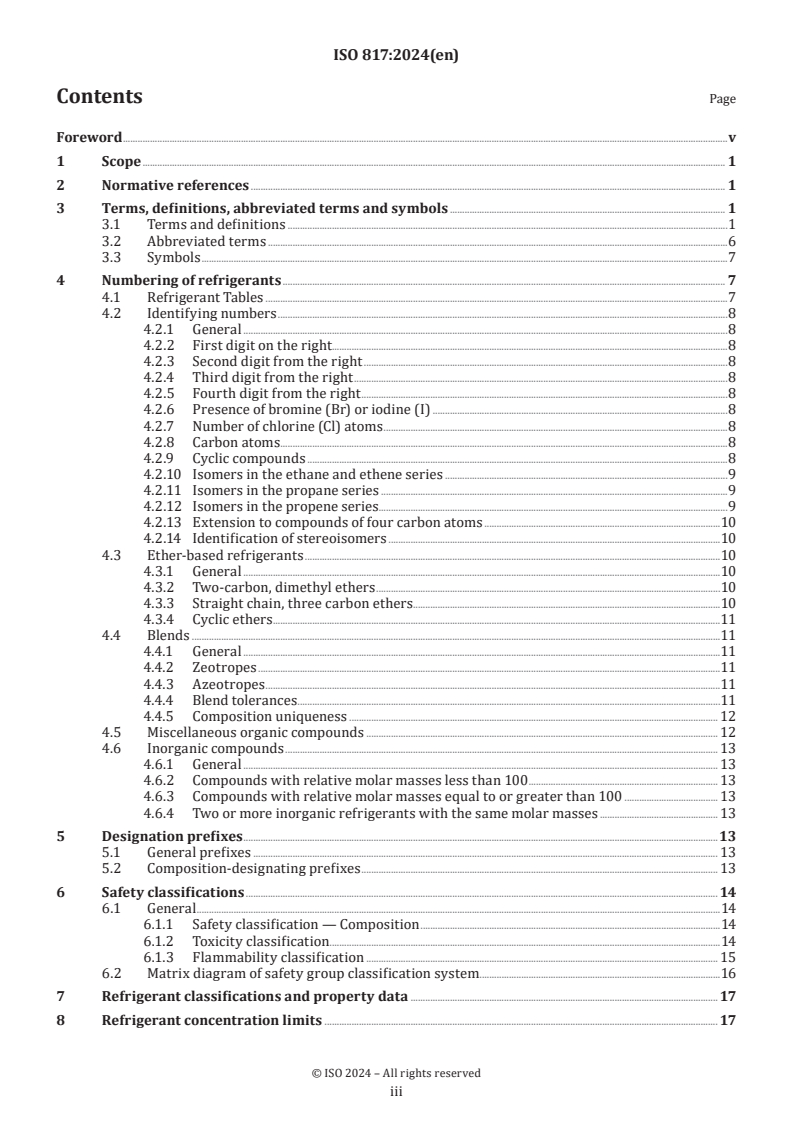
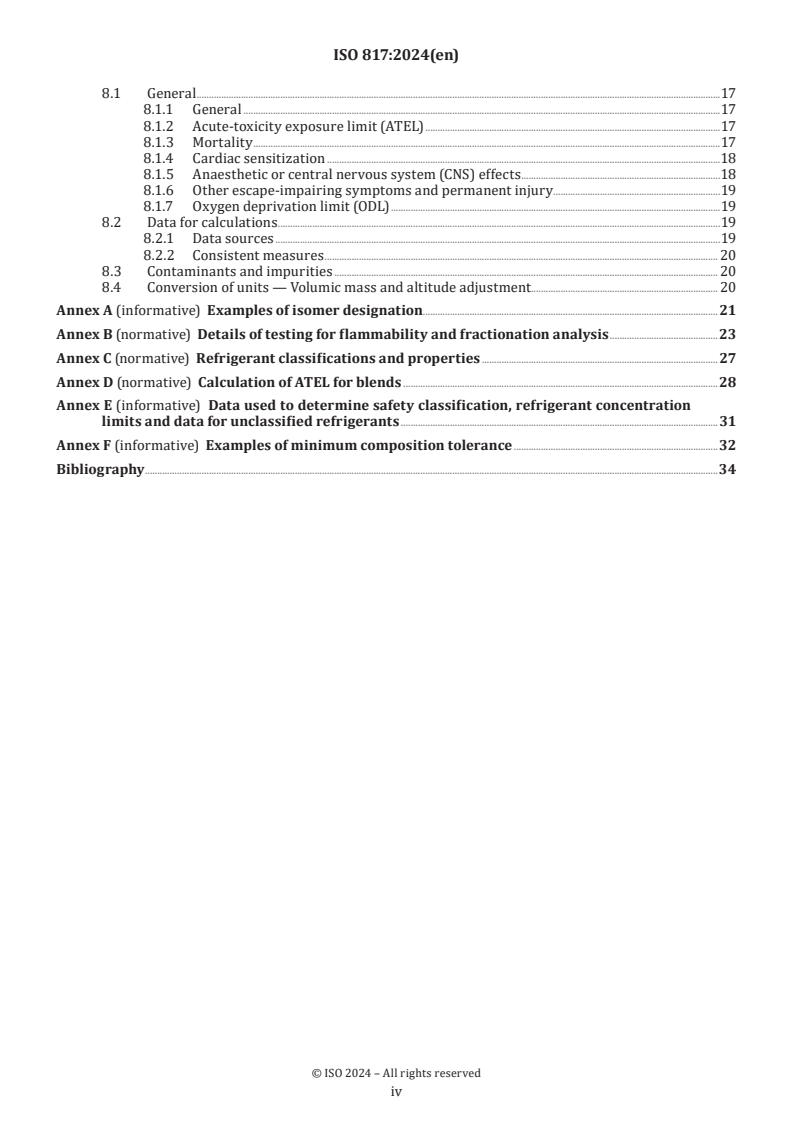
Contents Page
Foreword .v
1 Scope . 1
2 Normative references . 1
3 Terms, definitions, abbreviated terms and symbols . 1
3.1 Terms and definitions .1
3.2 Abbreviated terms .6
3.3 Symbols .7
4 Numbering of refrigerants . 7
4.1 Refrigerant Tables .7
4.2 Identifying numbers .8
4.2.1 General .8
4.2.2 First digit on the right.8
4.2.3 Second digit from the right .8
4.2.4 Third digit from the right .8
4.2.5 Fourth digit from the right .8
4.2.6 Presence of bromine (Br) or iodine (I) .8
4.2.7 Number of chlorine (Cl) atoms .8
4.2.8 Carbon atoms . .8
4.2.9 Cyclic compounds .8
4.2.10 Isomers in the ethane and ethene series .9
4.2.11 Isomers in the propane series .9
4.2.12 Isomers in the propene series.9
4.2.13 Extension to compounds of four carbon atoms .10
4.2.14 Identification of stereoisomers .10
4.3 Ether-based refrigerants .10
4.3.1 General .10
4.3.2 Two-carbon, dimethyl ethers .10
4.3.3 Straight chain, three carbon ethers . .10
4.3.4 Cyclic ethers .11
4.4 Blends .11
4.4.1 General .11
4.4.2 Zeotropes .11
4.4.3 Azeotropes .11
4.4.4 Blend tolerances . .11
4.4.5 Composition uniqueness . 12
4.5 Miscellaneous organic compounds . 12
4.6 Inorganic compounds . 13
4.6.1 General . 13
4.6.2 Compounds with relative molar masses less than 100 . 13
4.6.3 Compounds with relative molar masses equal to or greater than 100 . 13
4.6.4 Two or more inorganic refrigerants with the same molar masses . 13
5 Designation prefixes .13
5.1 General prefixes . 13
5.2 Composition-designating prefixes . 13
6 Safety classifications . 14
6.1 General .14
6.1.1 Safety classification — Composition .14
6.1.2 Toxicity classification . .14
6.1.3 Flammability classification . 15
6.2 Matrix diagram of safety group classification system.16
7 Refrigerant classifications and property data . 17
8 Refrigerant concentration limits . 17
iii
8.1 General .17
8.1.1 General .17
8.1.2 Acute-toxicity exposure limit (ATEL) .17
8.1.3 Mortality .17
8.1.4 Cardiac sensitization .18
8.1.5 Anaesthetic or central nervous system (CNS) effects .18
8.1.6 Other escape-impairing symptoms and permanent injury .19
8.1.7 Oxygen deprivation limit (ODL) .19
8.2 Data for calculations .19
8.2.1 Data sources .19
8.2.2 Consistent measures . 20
8.3 Contaminants and impurities . 20
8.4 Conversion of units — Volumic mass and altitude adjustment . 20
Annex A (informative) Examples of isomer designation .21
Annex B (normative) Details of testing for flammability and fractionation analysis .23
Annex C (normative) Refrigerant classifications and properties .27
Annex D (normative) Calculation of ATEL for blends .28
Annex E (informative) Data used to determine safety classification, refrigerant concentration
limits and data for unclassified refrigerants .31
Annex F (informative) Examples of minimum composition tolerance .32
Bibliography .34
iv
Foreword
ISO (the International Organization for Standardization) is a worldwide federation of national standards
bodies (ISO member bodies). The work of preparing International Standards is normally carried out through
ISO technical committees. Each member body interested in a subject for which a technical committee
has been established has the right to be represented on that committee. International organizations,
governmental and non-governmental, in liaison with ISO, also take part in the work. ISO collaborates closely
with the International Electrotechnical Commission (IEC) on all matters of electrotechnical standardization.
The procedures used to develop this document and those intended for its further maintenance are described
in the ISO/IEC Directives, Part 1. In particular the different approval criteria needed for the different types
of ISO document should be noted. This document was drafted in accordance with the editorial rules of the
ISO/IEC Directives, Part 2 (see www.iso.org/directives).
ISO draws attention to the possibility that the implementation of this document may involve the use of (a)
patent(s). ISO takes no position concerning the evidence, validity or applicability of any claimed patent
rights in respect thereof. As of the date of publication of this document, ISO had not received notice of (a)
patent(s) which may be required to implement this document. However, implementers are cautioned that
this may not represent the latest information, which may be obtained from the patent database available at
www.iso.org/patents. ISO shall not be held responsible for identifying any or all such patent rights.
Any trade name used in this document is information given for the convenience of users and does not
constitute an endorsement.
For an explanation on the meaning of ISO specific terms and expressions related to conformity assessment,
as well as information about ISO's adherence to the World Trade Organization (WTO) principles in the
Technical Barriers to Trade (TBT) see the following URL: www.iso.org/iso/foreword.html.
This document was prepared by Technical Committee ISO/TC 86, Refrigeration and air-conditioning,
Subcommittee SC 8, Refrigerants and refrigeration lubricants.
This fourth edition cancels and replaces the third edition (ISO 817:2014), which has been technically revised.
It also incorporates the Amendments ISO 817:2014/Amd 1:2017 and ISO 817:2014/Amd 2:2021.
The main changes are as follows:
— the scope has been expanded to include data necessary for safe applications of the refrigerants;
— the rules of toxicity safety classification to consider acute and chronic toxicity, have been incorporated
into 6.1.2;
— requirements to apply for designations, safety classifications, and refrigerant concentration
limits for refrigerants, including blends, and requirements to submit new or revised data for
refrigerants listed in ISO 817 tables, previously located in Annex F, have been relocated to
https://standards.iso.org/iso/817/ma/en/.
Any feedback or questions on this document should be directed to the user’s national standards body. A
complete listing of these bodies can be found at www.iso.org/members.html.
v
International Standard ISO 817:2024(en)
Refrigerants — Designation and safety classification
1 Scope
This document provides an unambiguous system for assigning designations to refrigerants. It also
establishes a system for assigning a safety classification to refrigerants based on toxicity and flammability
data, and provides a means of determining the refrigerant concentration limit. Tables listing the refrigerant
designations, safety classifications, refrigerant concentration limits and data necessary for safe use of the
refrigerants are included based on data submitted with the application.
2 Normative references
The following documents are referred to in the text in such a way that some or all of their content constitutes
requirements of this document. For dated references, only the edition cited applies. For undated references,
the latest edition of the referenced document (including any amendments) applies.
ISO/PAS 24499, Method of test for burning velocity measurement of A2L flammable gases
ANSI/ASHRAE Standard 34, Designation and Safety Classification of Refrigerants
ASTM D8211, Standard Test Method for Hot Surface Ignition Temperature of Gases on Flat Surface
ASTM E681, Standard Test Method for Concentration Limits of Flammability of Chemicals (Vapours and Gases)
3 Terms, definitions, abbreviated terms and symbols
3.1 Terms and definitions
For the purposes of this document, the following terms and definitions apply.
ISO and IEC maintain terminology databases for use in standardization at the following addresses:
— ISO Online browsing platform: available at https:// www .iso .org/ obp
— IEC Electropedia: available at https:// www .electropedia .org/
3.1.1
acute toxicity
adverse health effect(s) from a single, short-term exposure
3.1.2
acute-toxicity exposure limit
ATEL
maximum recommended refrigerant (3.1.37) concentration determined in accordance with the established
systems and intended to reduce the risks of acute toxicity (3.1.1) hazards to humans in the event of a
refrigerant release
Note 1 to entry: The systems are specified in this document.
3.1.3
anaesthetic effect
impairment of the ability to perceive pain and other sensory stimulation
3.1.4
approximate lethal concentration
ALC
concentration of a refrigerant (3.1.37) that is lethal to even a single test animal but to less than 50 % of the
animals in that group when tested by the same conditions as for an LC test
3.1.5
auto-ignition temperature
AIT
lowest temperature at or above which a substance can spontaneously ignite in air at standard atmospheric
pressure without an external source of ignition, such as a flame or spark
3.1.6
azeotrope
blend (3.1.7) composed of two or more refrigerants (3.1.37) whose equilibrium vapour and liquid phase
compositions are the same at a specific pressure, but can be different at other conditions
3.1.7
blend
mixture composed of two or more refrigerants (3.1.37)
3.1.8
burning velocity
S
u
velocity, relative to the unburnt gas, at which a laminar flame propagates in a direction normal to the flame
front, at the concentration of refrigerant (3.1.37) with air giving the maximum velocity
Note 1 to entry: This value is expressed in centimetres per second.
3.1.9
central nervous system effect
CNS
treatment-related depression, distraction, stimulation, or other behavioural modification to a degree that
could represent an impairment of the ability to escape from a hazard
3.1.10
chronic toxicity
adverse health effect(s) from long-term repeated exposures
3.1.11
combustion
exothermal reaction between an oxidant component (combustive) and a reducer (combustible fuel)
3.1.12
compound
substance composed of two or more atoms chemically bonded in definite proportions
3.1.13
critical point
point with conditions above which distinct liquid and gas phases do not exist
3.1.14
cyclic compound
organic compound whose structure is characterized by a closed ring of atoms
3.1.15
effective concentration 50 %
EC
concentration of a refrigerant (3.1.37) which causes a biological effect to 50 % of exposed animals in a test
for anaesthetic or other effects
Note 1 to entry: This value is typically a calculated value from experimental data.
3.1.16
elevated temperature flame limit
ETFL
minimum concentration by volumic ratio (volume per cent) of the refrigerant(3.1.37), which is capable of
propagating a flame (3.1.18) through a homogeneous mixture of the refrigerant and air under the specified
test conditions at 60,0 °C and 101,3 kPa
Note 1 to entry: The test conditions are specified in 6.1.3.
Note 2 to entry: 101,3 kPa is the standard atmospheric pressure at sea level.
3.1.17
equivalence ratio
fraction of the combustible in the mixture divided by the combustible fraction at the stoichiometric
conditions
Note 1 to entry: It can be written as (combustible fraction)/(combustible fraction) .
st
Note 2 to entry: It is used in the determination of burning velocity (3.1.8).
Note 3 to entry: Lean mixtures have an equivalence ratio lower than one and rich mixtures have an equivalence ratio
greater than one.
3.1.18
flame
collection of gases of a rapid combustion, generally visible due to the emission of light
3.1.19
flame propagation
combustion, causing a continuous flame (3.1.18) which moves upward and outward from the point of ignition
without help from the ignition source
Note 1 to entry: Flame propagation as applied in the test method for determining LFL and flammability classification
is specified in B.1.8. Flame propagation as applied in the test method for determining burning velocity (3.1.8) is
described in ISO/PAS 24499.
3.1.20
flame propagation velocity
velocity at which a flame (3.1.18) propagates in a space
3.1.21
flammable
property of a mixture in which a flame (3.1.18) is capable of self-propagating for a certain distance
3.1.22
fractionation
change in composition of a blend (3.1.7) by preferential evaporation of the more volatile component(s) or
condensation of the less volatile component(s)
3.1.23
heat of combustion
HOC
heat evolved from a specified exothermic reaction of a substance with oxygen.
Note 1 to entry: The heat of combustion is as determined in accordance with 6.1.3.7.
Note 2 to entry: The heat of combustion for this document is expressed as a positive value for exothermic reactions in
energy per unit mass (kJ/kg).
Note 3 to entry: The heat of combustion for Class 2L, 2, and 3 refrigerants (3.1.37) is listed in Tables E.2 and E.3
available at https:// standards .iso .org/ iso/ 817/ ma/ en.
3.1.24
hot surface ignition temperature
HSIT
lowest temperature at which a substance ignites in normal atmosphere when impinged upon a heated surface
Note 1 to entry: Refer to ASTM D8211.
3.1.25
immediately dangerous to life or health
IDLH
atmospheric concentration of any toxic, corrosive, or asphyxiant substance that poses an immediate threat
to life or would cause irreversible or delayed adverse health effects or would interfere with an individual's
ability to escape from a dangerous atmosphere
Note 1 to entry: IDLH values are used by the National Institute for Occupational Safety and Health (NIOSH) as
respirator selection criteria.
3.1.26
isomer
two or more compounds having the same chemical composition with differing molecular configurations
3.1.27
lethal concentration 50 %
LC
atmospheric concentration that is lethal to 50 % of the exposed population
Note 1 to entry: LC is associated with inhalation exposures.
3.1.28
lethal dose 50 %
LD
oral or dermal dose that is lethal to 50 % of the exposed population
3.1.29
lower flammability limit
LFL
minimum concentration of the refrigerant (3.1.37) that is capable of propagating a flame (3.1.18) through a
homogeneous mixture of the refrigerant and air under the specified test conditions at 23,0 °C and 101,3 kPa
Note 1 to entry: The test conditions are specified in 6.1.3.
Note 2 to entry: The LFL is expressed as refrigerant percentage by volume.
3.1.30
lowest observed adverse effect level
LOAEL
lowest concentration of a refrigerant (3.1.37) that causes any observed adverse effect on one or more test animals
3.1.31
no observed adverse effect level
NOAEL
highest concentration of a refrigerant (3.1.37) at which no adverse effect is observed on even one test animal.
3.1.32
nominal composition
nominal formulation
design composition as stated in the refrigerant blend (3.1.7) application, excluding any tolerances
Note 1 to entry: Composition of the refrigerant blends shall be as listed in Tables C.2 and C.3.
Note 2 to entry: When a container with the nominal composition is 80 % or more liquid filled, the liquid composition
can be considered the nominal composition.
3.1.33
occupational exposure limit
OEL
time-weighted average concentration for a normal 8 h workday and a 40 h work week to which nearly all
workers can be repeatedly exposed without adverse effect
Note 1 to entry: The OEL is determined by an independent organization that (1) is composed of health science experts,
(2) is experienced in generating OELs for refrigerant compounds and (3) formally publishes the derived OELs in a way
that is publicly accessible.
3.1.34
olefin
unsaturated chemical compound containing at least one carbon-to-carbon double bond
3.1.35
oxygen deprivation limit
ODL
concentration of a refrigerant (3.1.37) or other gas that can result in insufficient oxygen for normal breathing
3.1.36
quenching
effect of extinction of a flame (3.1.18) as it approaches a surface due to heat conduction losses, absorption of
active chemical species and viscous effects on the surface
3.1.37
refrigerant
fluid used for heat transfer in a refrigerating system
Note 1 to entry: A refrigerant absorbs heat at a low temperature and a low pressure of the fluid and rejects it at a
higher temperature and a higher pressure of the fluid, usually involving changes of the phase of the fluid.
3.1.38
relative molar mass
mass numerically equal to the molecular mass expressed in grams per mole, except that it is dimensionless
3.1.39
saturated organic compound
carbon-containing compound that has only single bonds between carbon atoms
3.1.40
stoichiometric concentration for combustion
C
st
concentration of a fuel in a fuel-air mixture that contains exactly the necessary quantity of air (21 % O /79 %
N by volume) needed for the complete oxidation of all compounds present
3.1.41
threshold limit value-short term exposure limit
TLV-STEL
15 min time weighted average exposure that should not be exceeded at any time during a workday
3.1.42
threshold limit value-time weighted average
TLV-TWA
time weighted average concentration for a normal 8 h workday and a 40 h work week, to which nearly all
workers may be repeatedly exposed, day after day, without adverse effect
3.1.43
unsaturated organic compound
carbon-containing compound containing at least one double or triple bond between carbon atoms
3.1.44
workplace environmental exposure limit
WEEL
occupational exposure limit (3.1.33) set by the Toxicology Excellence for Risk Assessment (TERA)
3.1.45
worst-case formulation
WCF
composition that results from application of the tolerances to the nominal composition (3.1.32) resulting in
the most toxic or the most flammable (3.1.21) formulation
3.1.46
worst-case fractionated formulation
WCFF
composition produced during fractionation (3.1.22) of the worst-case formulation (3.1.45) that results in the
most toxic or most flammable (3.1.21) formulation
3.1.47
zeotrope
blend (3.1.7) composed of two or more refrigerants (3.1.37) whose equilibrium vapour and liquid phase
compositions are not the same at any pressure below the critical pressure
3.2 Abbreviated terms
ACGIH American Conference of Governmental Industrial Hygienists
AIT auto-ignition temperature
ALC approximate lethal concentration
ATEL acute-toxicity exposure limit
CNS central nervous system effect
C stoichiometric concentration for combustion
st
EC effective concentration 50 %
ETFL elevated temperature flame limit
HOC heat of combustion
HSIT hot surface ignition temperature
IDLH immediately dangerous to life or health
LC lethal concentration 50 %
LD lethal dose 50 %
LFL lower flammability limit
LOAEL lowest observed adverse effect level
NIOSH National Institute for Occupational Safety and Health (United States)
NOAEL no observed adverse effect level
ODL oxygen deprivation limit
PEL permissible exposure limit
ppm parts per million
TCF toxic concentration factor
TLV-STEL threshold limit value short-term exposure limit
TLV-TWA threshold limit value-time weighted average
WCF worst-case formulation
WCFF worst-case fractionated formulation
WEEL workplace environmental exposure limit
3.3 Symbols
a mortality indicator for a refrigerant blend
blend
a mortality indicator for component n in a refrigerant blend
n
a cross-sectional area of the flame base
f
A flame surface area
f
b cardiac sensitization indicator for component n in a refrigerant blend
n
b anaesthetic effect indicator for a refrigerant blend
blend
c anaesthetic effect indicator for component n in a refrigerant blend
n
c anaesthetic effect indicator of a refrigerant blend
blend
C toxic concentration factor of a refrigerant blend
blend
C toxic concentration factor for component n
n
C stoichiometric concentration for combustion
st
S flame propagation speed, expressed in cm/s
s
S burning velocity, expressed in cm/s
u
x mole fraction of component n of a refrigerant blend
n
Φ equivalence ratio at the maximum burning velocity
max
4 Numbering of refrigerants
4.1 Refrigerant Tables
An identifying number shall be assigned to each refrigerant. Assigned numbers and safety classifications
are shown in Tables C.1, C.2 and C.3. Tables E.4, E.5 and E.6 provide designations for refrigerants for which
insufficient data are available for safety classification or determination of refrigerant concentration limits.
NOTE 1 Tables C.1, C.2, C.3, E.1, E.2, E.3, E.4, E.5, and E.6 are available at: https:// standards .iso .org/ iso/ 817/ ma/ en.
NOTE 2 Requirements to apply for designations, safety classifications, and refrigerant concentration limits for
refrigerants, including blends, and requirements to submit new or revised data for refrigerants are provided at
https:// standards .iso .org/ iso/ 817/ ma/ en/ .
NOTE 3 The name and contact information of the maintenance agency for this document can be found at www .iso
.org/ maintenance _agencies.
4.2 Identifying numbers
4.2.1 General
The identifying numbers assigned to the hydrocarbons, halocarbons and ethers of the methane, ethane,
ethene, propane, propene, butane, butene, cyclobutene and cyclobutane series are such that the chemical
composition of the compounds can be explicitly determined from the refrigerant numbers, and vice versa,
without ambiguity. The molecular structure can be similarly determined for the methane, ethane, ethene
and most of the propane and propene series from only the identification number.
4.2.2 First digit on the right
The first digit on the right is the number of fluorine (F) atoms in the compound.
4.2.3 Second digit from the right
The second digit from the right is one more than the number of hydrogen (H) atoms in the compound.
4.2.4 Third digit from the right
The third digit from the right is one less than the number of carbon (C) atoms in the compound. When this
digit is zero, it is omitted from the number.
4.2.5 Fourth digit from the right
The fourth digit from the right is equal to the number of carbon–carbon double bonds in the compound.
When this digit is zero, it is omitted from the number.
4.2.6 Presence of bromine (Br) or iodine (I)
In those instances where bromine (Br) or iodine (I) is present the same rules apply, except that the upper-
case letter B or I after the designation determined according to 4.2.2 to 4.2.5 shows the presence of bromine
or iodine. The number following the letter B or I shows the number of bromine or iodine atoms present.
4.2.7 Number of chlorine (Cl) atoms
The number of chlorine (Cl) atoms in the compound is found by subtracting the sum of fluorine (F), bromine
(Br), iodine (I) and hydrogen (H) atoms from the total number of atoms that can be connected to the carbon
(C) atoms. For saturated organic compounds, this number is 2n + 2, where n is the number of carbon atoms.
The number is 2n for compounds with one double bond and saturated cyclic compounds.
4.2.8 Carbon atoms
The carbon atoms shall be numbered with the number 1 assigned to the end carbon with the greatest
number of halogen atoms, and the following carbon atoms are numbered sequentially as they appear on
a straight chain. In the case where both end carbons contain the same number of (but different) halogen
atoms, the number 1 shall be assigned to the end carbon having the largest number of bromine then chlorine
then fluorine, and then iodine atoms. If the compound is an olefin (i.e., unsaturated organic compound), then
the end carbon nearest to the double bond will be assigned the number 1, as the presence of a double bond in
the back bone of the molecule has priority over substituent groups on the molecule.
4.2.9 Cyclic compounds
For cyclic compounds, the letter C is used before the identifying refrigerant numbers. (e.g. R-C318, PFC-C318).
4.2.10 Isomers in the ethane and ethene series
In the case of isomers in the ethane and ethene series, each shall have the same number, with the most
symmetrical one indicated by the number alone. As the isomers become more and more unsymmetrical,
successive lower-case letters (e.g. a, b, or c) are appended. Symmetry is determined by first summing the
atomic mass of the halogen and hydrogen atoms attached to each carbon atom. One sum is subtracted from
the other; the smaller the absolute value of the difference, the more symmetrical the isomer.
4.2.11 Isomers in the propane series
In the case of isomers in the propane series, each shall have the same number, and the isomers shall be
distinguished by two appended lower-case letters. The first appended letter indicates the substitution on
the central carbon atom (C2) as indicated in Table 1.
Table 1 — Propane isomer appended letters
Isomer Appended letter
CCl a
CClF b
CF c
CHCl d
CHF e
CH f
For halogenated derivatives of cyclopropane, the carbon atom with the largest sum of attached atomic masses
shall be considered the central carbon atom; for these compounds, the first appended letter is omitted. The
second appended letter indicates the relative symmetry of the substituents on the end carbon atoms (C1
and C3). Symmetry is determined by first summing the atomic masses of the halogen and hydrogen atoms
attached to the C1 and C3 carbon atoms. One sum is subtracted from the other; the smaller the absolute
value of this difference, the more symmetrical the isomer. In contrast to the ethane series, however, the
most symmetrical isomer has a second appended letter of a (as opposed to no appended letter for ethane
isomers); increasingly asymmetrical isomers are assigned successive letters. Appended letters are omitted
when no isomers are possible, and the number alone represents the molecular structure unequivocally; for
example, CF CF CF is designated R-218, not R218ca. An example of this system is given in Annex A.
3 2 3
4.2.12 Isomers in the propene series
In the case of isomers in the propene series, each has the same number, with the isomers distinguished by
two appended lower-case letters. The first appended letter designates the one atom attached to the central
carbon atom and shall be x, y, or z for Cl, F, and H, respectively. The second letter designates the substitution
on the terminal methylene carbon as indicated in Table 2.
Table 2 — Propene isomer appended letters
Isomer Appended letter
CCl a
CClF b
CF c
CHCl d
CHF e
CH f
4.2.13 Extension to compounds of four carbon atoms
Compounds are coded according to the above stated rules, with the designation number followed by a set of
letters indicating structure. The number of unsaturated linkages is given in the fourth digit from the right.
When the number for a digit place exceeds nine, it is set off by dashes.
Linear compounds are lettered starting at one end, cyclic compounds from a side group, or, if none, from a
carbon in the ring as described in 4.2.11. Carbon atoms with two hydrogens or halogens are lettered as in
4.2.11. Carbon atoms with three hydrogen or halogen atom substituents are lettered as indicated in Table 3:
Table 3 — Butane isomer appended letters
Isomer Appended letter
-CCl j
-CCl F k
-CClF l
-CF m
-CHCl n
-CH CL o
-CHF p
-CH F q
-CHCLF r
-CH s
Only as many letters are used as are required to completely define the compound when taken with the
empirical structure given by the numerical designation. It is understood that no branching occurs in the
remaining structure. After the starting point, side groups are given their letters before the back bone
substituent (if any). When two or more lettering sequences may be applied, that with the fewest letters and
first alphabetical sequence is used.
4.2.14 Identification of stereoisomers
In the case where stereoisomers can exist, the opposed (Entgegen) isomer will be identified by the suffix (E)
and the same side (Zusammen) isomer will be identified by the suffix (Z).
NOTE See Table A.3 for an example of this system.
4.3 Ether-based refrigerants
4.3.1 General
Ether-based refrigerants shall be designated with the prefix “E” (for “ethers”) immediately preceding the
number. 4.2 applies except for the following differences.
4.3.2 Two-carbon, dimethyl ethers
Two-carbon, dimethyl ethers (e.g. R-E125, CHF -O-CF ) require no suffixes other than those specified in
2 3
4.2.10, as the presence of the “E” prefix provides an unambiguous description.
4.3.3 Straight chain, three carbon ethers
4.3.3.1 General
For straight chain, three carbon ethers, the carbon atoms shall be numbered with the number 1 assigned to the
end carbon with the highest number of halogens, and the following carbon atoms are numbered sequentially as
they appear on a straight chain. In the case where both end carbons contain the same number of (but different)
halogen atoms, the number 1 shall be assigned to the end carbon having the largest number of bromine, then
chlorine, then fluorine and then iodine atoms. For ethers with more than three carbons, the compound shall
be assigned a number in the 600 series, miscellaneous organic compounds, as described in 4.5.
4.3.3.2 Identifying the first carbon to which the ether oxygen is attached
An additional integer identifying the first carbon to which the ether oxygen is attached shall be appended to
the suffix letters (e.g. R-E236ea2, CHF -O-CHF-CF ).
2 3
4.3.3.3 Symmetric hydrocarbon structures
In the case of otherwise symmetric hydrocarbon structures, the ether oxygen shall be assigned to the carbon
which has the leading position in the formula.
4.3.3.4 Only a single isomer exists
In those cases where only a single isomer exists for the hydrocarbon portion of the ether structure, such as
CF -O-CF -CF , the suffix letters described in 4.2.10, 4.2.11 and 4.2.13 shall be omitted. In this cited example,
3 2 3
the correct designation shall be R-E218.
4.3.3.5 Structures containing two oxygen atoms, di-ethers
Structures containing two oxygen atoms, di-ethers, shall be designated with two suffix integers to designate
the positions of the ether oxygen atoms.
4.3.4 Cyclic ethers
For cyclic ethers carrying both the “C” and “E” pre-fixes, the “C” shall precede the “E,” as “CE,” to designate
“cyclic ethers.” For four-membered cyclic ethers, including three carbon and one ether oxygen atom, the basic
number designations for the hydrocarbon atoms shall be constructed according to the current standard for
hydrocarbon nomenclature, as described in 4.2.
4.4 Blends
4.4.1 General
Blends are assigned a refrigerant number in the 400, 500, or 4000 series.
4.4.2 Zeotropes
Zeotropes shall be assigned an identifying number in the 400 or 4000 series. In order to differentiate among
the different zeotropes having the same components but in different proportions, an upper-case letter (A, B,
C, etc.) is added after the number.
NOTE Refrigerants in the R-4000 series start with R-4101A to avoid confusion with other common 400 series
refrigerants.
4.4.3 Azeotropes
Azeotropes shall be assigned an identifying number in the 500 series. In order to differentiate among the
different azeotropes having the same components but in different proportions, an upper-case letter (A, B, C,
etc.) is added after the number.
4.4.4 Blend tolerances
Blends shall have tolerances specified for individual refrigerants. Those tolerances shall be specified to the
nearest 0,1 % mass fraction. The maximum tolerance above or below the nominal composition shall not
exceed 2,0 % mass fraction.
The minimum tolerance above or below the nominal shall be as follows:
a) 0,1 % m/m for component, x, with concentration: 0,6 % ≤ x ≤ 16,6 % or 83,4 % ≤ x ≤ 99,4 %
b) 0,2 % m/m for component, x, with concentration: 16,7 % ≤ x ≤ 33,3 % or 66,7 % ≤ x ≤ 83,3 %
c) 0,3 % m/m for component, x, with concentration: 33,4 % ≤ x ≤ 66,6 %
The difference between the highest and the lowest tolerances shall not exceed one-half of the nominal
component composition. No component shall be permitted at less than 0,6 % m/m nominal.
NOTE Refer to
...