

ISO 817:2014/Amd 1:2017
(Amendment)Refrigerants — Designation and safety classification — Amendment 1
General Information
- Abstract
- Status
- Withdrawn
- Publication Date
- 12-Nov-2017
- Technical Committee
- ISO/TC 86/SC 8 - Refrigerants and refrigeration lubricants
- Current Stage
- 9599 - Withdrawal of International Standard
- Start Date
- 27-Nov-2024
- Completion Date
- 29-Aug-2026


Overview
ISO 817:2014/Amd 1:2017 is an important amendment to the international standard for refrigerants titled "Refrigerants - Designation and safety classification." Published by the International Organization for Standardization (ISO), this document updates the third edition of ISO 817 issued in June 2014. The amendment, released in November 2017, introduces clarifications and revisions related to the designation, classification, and safety criteria of refrigerants used globally in refrigeration and air conditioning systems.
This standard addresses the classification of refrigerants based on their safety characteristics, providing a framework to assess flammability, toxicity, and other critical parameters. The update enhances clarity and precision for stakeholders in the HVAC-R industry, ensuring compliance with evolving safety and environmental requirements.
Key Topics
The amendment brings several key modifications that refine the approach to refrigerant classification and designation:
Auto-Ignition Temperature Definition: Addition of a clear definition for auto-ignition temperature (AIT), describing it as the lowest temperature at which a substance ignites spontaneously under normal atmospheric conditions without an external ignition source like a flame or spark.
Blend Composition Tolerances: Specification of mass fraction tolerances for refrigerant blends to the nearest 0.1%, with a maximum allowable deviation of 2% above or below the nominal composition. Components comprising less than 0.6% by mass are excluded from blend designation and classification considerations.
Classification Tables Update: Replacement of the classification tables (5, 6, and 7) with a directive to consult the most current versions available online. These tables classify refrigerants based on safety criteria such as toxicity and flammability.
Conversion Methodology: Introduction of a formula for converting volumetric ratios (ppm by volume) into volumic mass (g/m³), ensuring consistent application of molecular mass values according to blend composition.
Data Tables Relocation: Movement of key safety classification and Refrigerant Concentration Limit (RCL) data tables (formerly in Annex E) to an online repository to maintain currency and accessibility.
Applications
This amendment to ISO 817 plays a critical role for:
HVAC-R Manufacturers: Ensuring that refrigerant designation and safety classification are accurately observed during system design and component manufacturing, adhering to international safety standards.
Safety Assessors: Applying consistent and up-to-date safety data for refrigerants when performing risk assessments related to flammability and toxicity in refrigeration and air conditioning installations.
Regulatory Bodies: Establishing compliance frameworks based on standardized refrigerant safety classifications, enabling effective regulation and monitoring in line with environmental and safety mandates.
Researchers and Developers: Accessing precise definitions and blend tolerances to innovate and develop new refrigerants or refrigeration technologies that meet stringent safety and performance criteria.
Related Standards
For comprehensive understanding and application of refrigerant safety and environmental management, ISO 817:2014/Amd 1:2017 is often used in conjunction with related international standards such as:
ISO 5149 - Refrigerating systems and heat pumps - Safety and environmental requirements: Covers safety requirements for refrigeration system design, incorporating refrigerant classification standards.
ISO 46xx series - Refrigerant testing and identification: Details test methods for refrigerant properties that complement classification data found in ISO 817.
IEC 60335-2-40 - Safety of electrical appliances for household and similar purposes: Includes requirements related to refrigerants used in heat pumps and air conditioners from an electrical appliance safety perspective.
ASHRAE Standard 34 - Designation and Safety Classification of Refrigerants: Provides safety classification similar to ISO 817 and is widely referenced in North America, highlighting the relevance of consistent refrigerant classification practices globally.
Conclusion
ISO 817:2014/Amd 1:2017 is a vital amendment that reinforces the safety classification and designation system for refrigerants worldwide. It enhances the accuracy of definitions, classification, and compositional tolerances, supporting safer design, operation, and regulation within the refrigeration and air conditioning sectors. Professionals involved in refrigerant handling, manufacturing, and regulation should reference the latest tables and online resources stipulated by this amendment to ensure compliance and promote best safety practices.
Relations
- Effective Date
- 25-Mar-2026
- Effective Date
- 01-Jan-2022
- Effective Date
- 06-Jun-2022
Get Certified
Connect with accredited certification bodies for this standard

ECOCERT
Organic and sustainability certification.

Eurofins Food Testing Global
Global leader in food, environment, and pharmaceutical product testing.

Intertek Bangladesh
Intertek certification and testing services in Bangladesh.
Sponsored listings
Frequently Asked Questions
ISO 817:2014/Amd 1:2017 is a standard published by the International Organization for Standardization (ISO). Its full title is "Refrigerants — Designation and safety classification — Amendment 1". This standard covers: Refrigerants — Designation and safety classification — Amendment 1
Refrigerants — Designation and safety classification — Amendment 1
ISO 817:2014/Amd 1:2017 is classified under the following ICS (International Classification for Standards) categories: 71.100.45 - Refrigerants and antifreezes. The ICS classification helps identify the subject area and facilitates finding related standards.
ISO 817:2014/Amd 1:2017 has the following relationships with other standards: It is inter standard links to EN 15502-2-3:2023, ISO 817:2014, ISO 817:2024. Understanding these relationships helps ensure you are using the most current and applicable version of the standard.
ISO 817:2014/Amd 1:2017 is available in PDF format for immediate download after purchase. The document can be added to your cart and obtained through the secure checkout process. Digital delivery ensures instant access to the complete standard document.
Standards Content (Sample)
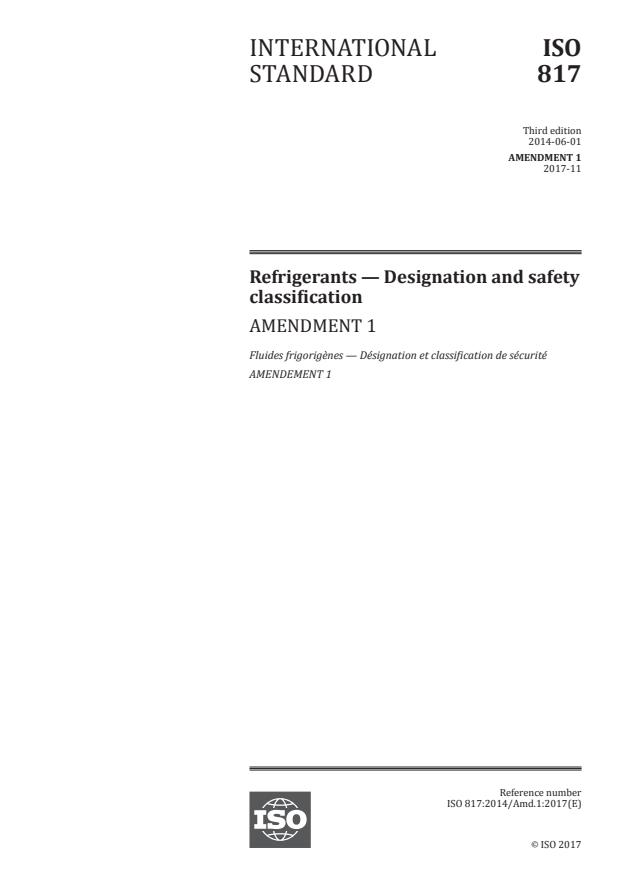
INTERNATIONAL ISO
STANDARD 817
Third edition
2014-06-01
AMENDMENT 1
2017-11
Refrigerants — Designation and safety
classification
AMENDMENT 1
Fluides frigorigènes — Désignation et classification de sécurité
AMENDEMENT 1
Reference number
ISO 817:2014/Amd.1:2017(E)
©
ISO 2017
ISO 817:2014/Amd.1:2017(E)
© ISO 2017, Published in Switzerland
All rights reserved. Unless otherwise specified, no part of this publication may be reproduced or utilized otherwise in any form
or by any means, electronic or mechanical, including photocopying, or posting on the internet or an intranet, without prior
written permission. Permission can be requested from either ISO at the address below or ISO’s member body in the country of
the requester.
ISO copyright office
Ch. de Blandonnet 8 • CP 401
CH-1214 Vernier, Geneva, Switzerland
Tel. +41 22 749 01 11
Fax +41 22 749 09 47
copyright@iso.org
www.iso.org
ii © ISO 2017 – All rights reserved
ISO 817:2014/Amd.1:2017(E)
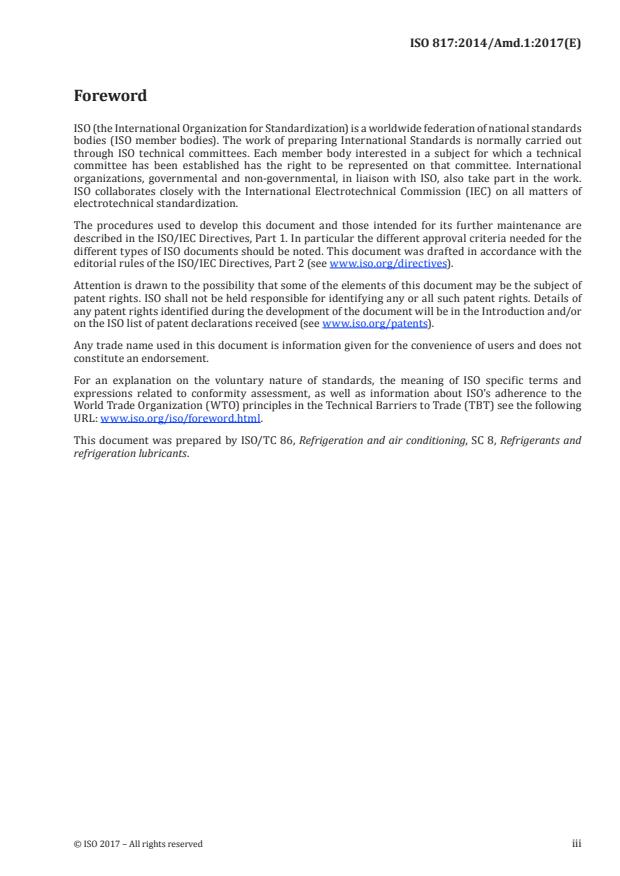
Foreword
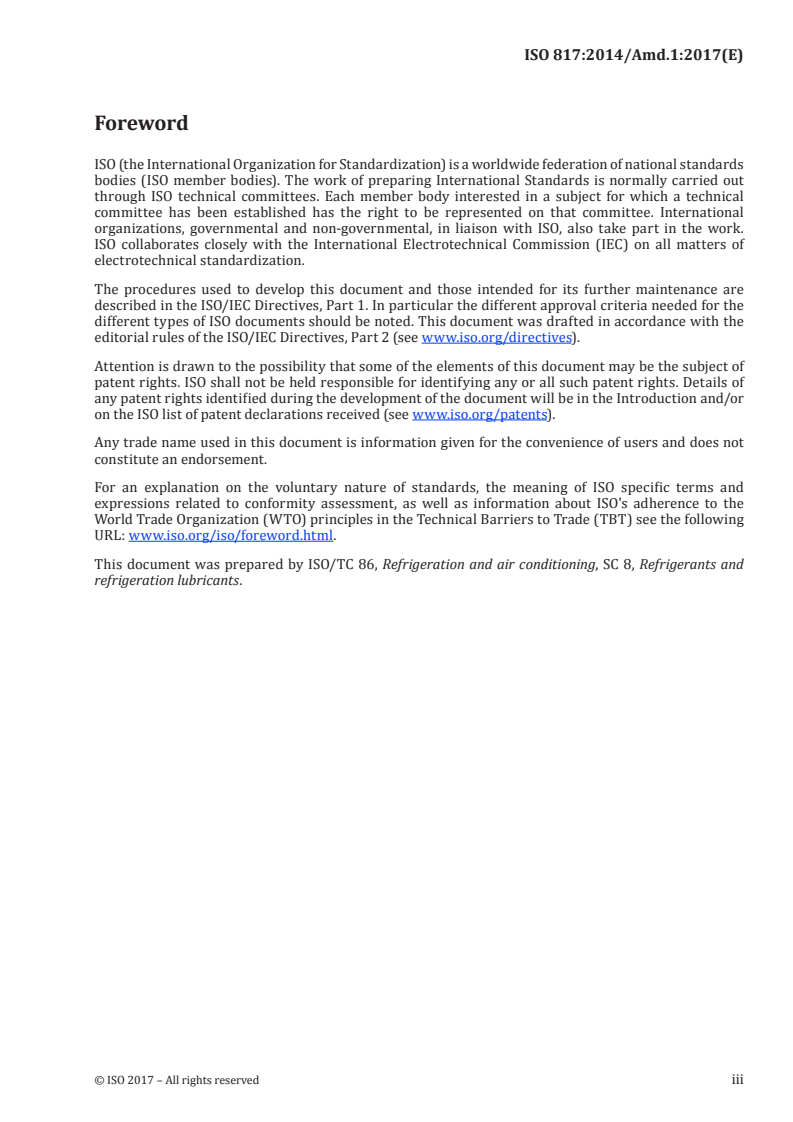
ISO (the International Organization for Standardization) is a worldwide federation of national standards
bodies (ISO member bodies). The work of preparing International Standards is normally carried out
through ISO technical committees. Each member body interested in a subject for which a technical
committee has been established has the right to be represented on that committee. International
organizations, governmental and non-governmental, in liaison with ISO, also take part in the work.
ISO collaborates closely with the International Electrotechnical Commission (IEC) on all matters of
electrotechnical standardization.
The procedures used to develop this document and those intended for its further maintenance are
described in the ISO/IEC Directives, Part 1. In particular the different approval criteria needed for the
different types of ISO documents should be noted. This document was drafted in accordance with the
editorial rules of the ISO/IEC Directives, Part 2 (see www.iso.org/directives).
Attention is drawn to the possibility that some of the elements of this document may be the subject of
patent rights. ISO shall not be held responsible for identifying any or all such patent rights. Details of
any patent rights identified during the development of the document will be in the Introduction and/or
on the ISO list of patent declarations received (see www.iso.org/patents).
Any trade name used in this document is information given for the convenience of users and does not
constitute an endorsement.
For an explanation on the voluntary nature of standards, the meaning of ISO specific terms and
expressions related to conformity assessment, as well as information about ISO's adherence to the
World Trade Organization (WTO) principles in the Technical Barriers to Trade (TBT) see the following
URL: www.iso.org/iso/foreword.html.
This document was prepared by ISO/TC 86, Refrigeration and air conditioning, SC 8, Refrigerants and
refrigeration lubricants.
ISO 817:2014/Amd.1:2017(E)
Refrigerants — Designation and safety classification
AMENDMENT 1
Page 1, Clause 3
Add definition of auto-ignition temperature to 3.1 and renumber subsequent definitions.
3.1.5
auto-ignition temperature
AIT
lowest temperature o
...
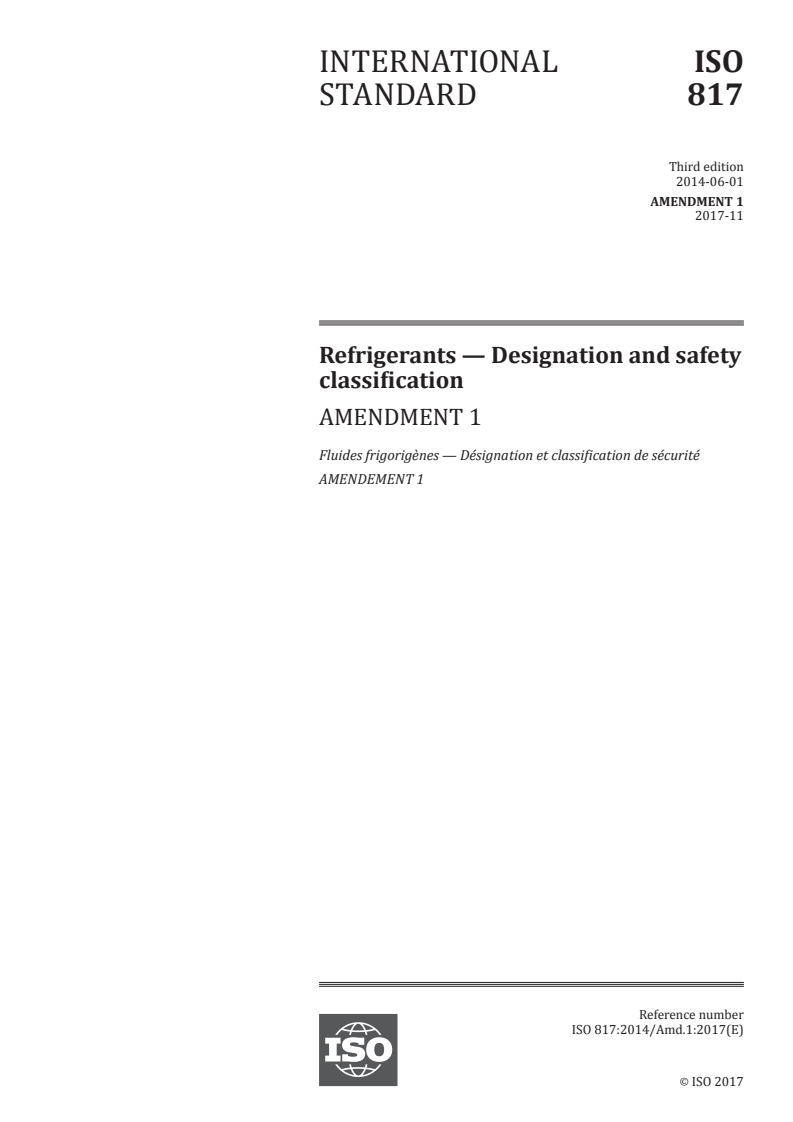
INTERNATIONAL ISO
STANDARD 817
Third edition
2014-06-01
AMENDMENT 1
2017-11
Refrigerants — Designation and safety
classification
AMENDMENT 1
Fluides frigorigènes — Désignation et classification de sécurité
AMENDEMENT 1
Reference number
ISO 817:2014/Amd.1:2017(E)
©
ISO 2017
ISO 817:2014/Amd.1:2017(E)
© ISO 2017, Published in Switzerland
All rights reserved. Unless otherwise specified, no part of this publication may be reproduced or utilized otherwise in any form
or by any means, electronic or mechanical, including photocopying, or posting on the internet or an intranet, without prior
written permission. Permission can be requested from either ISO at the address below or ISO’s member body in the country of
the requester.
ISO copyright office
Ch. de Blandonnet 8 • CP 401
CH-1214 Vernier, Geneva, Switzerland
Tel. +41 22 749 01 11
Fax +41 22 749 09 47
copyright@iso.org
www.iso.org
ii © ISO 2017 – All rights reserved
ISO 817:2014/Amd.1:2017(E)
Foreword
ISO (the International Organization for Standardization) is a worldwide federation of national standards
bodies (ISO member bodies). The work of preparing International Standards is normally carried out
through ISO technical committees. Each member body interested in a subject for which a technical
committee has been established has the right to be represented on that committee. International
organizations, governmental and non-governmental, in liaison with ISO, also take part in the work.
ISO collaborates closely with the International Electrotechnical Commission (IEC) on all matters of
electrotechnical standardization.
The procedures used to develop this document and those intended for its further maintenance are
described in the ISO/IEC Directives, Part 1. In particular the different approval criteria needed for the
different types of ISO documents should be noted. This document was drafted in accordance with the
editorial rules of the ISO/IEC Directives, Part 2 (see www.iso.org/directives).
Attention is drawn to the possibility that some of the elements of this document may be the subject of
patent rights. ISO shall not be held responsible for identifying any or all such patent rights. Details of
any patent rights identified during the development of the document will be in the Introduction and/or
on the ISO list of patent declarations received (see www.iso.org/patents).
Any trade name used in this document is information given for the convenience of users and does not
constitute an endorsement.
For an explanation on the voluntary nature of standards, the meaning of ISO specific terms and
expressions related to conformity assessment, as well as information about ISO's adherence to the
World Trade Organization (WTO) principles in the Technical Barriers to Trade (TBT) see the following
URL: www.iso.org/iso/foreword.html.
This document was prepared by ISO/TC 86, Refrigeration and air conditioning, SC 8, Refrigerants and
refrigeration lubricants.
ISO 817:2014/Amd.1:2017(E)
Refrigerants — Designation and safety classification
AMENDMENT 1
Page 1, Clause 3
Add definition of auto-ignition temperature to 3.1 and renumber subsequent definitions.
3.1.5
auto-ignition temperature
AIT
lowest temperature o
...