

ISO/IEC 21117:2012
(Main)Information technology — Office equipment — Copying machines and multi-function devices — Information to be included in specification sheets and related test methods
General Information
- Abstract
ISO/IEC 21117:2012 specifies the information to be listed in specification sheets for electrophotographic digital copying machines and multi-function devices.
- Status
- Published
- Publication Date
- 06-Jun-2012
- Technical Committee
- ISO/IEC JTC 1/SC 28 - Office equipment
- Drafting Committee
- ISO/IEC JTC 1/SC 28 - Office equipment
- Current Stage
- 9092 - International Standard to be revised
- Start Date
- 26-Aug-2024
- Completion Date
- 29-Aug-2026
Overview
ISO/IEC 21117:2012 is an international standard that defines the requirements for specification sheets of electrophotographic digital copying machines and multi-function devices used in office environments. Developed by ISO and IEC, this standard ensures that manufacturers provide clear, consistent, and comparable information about copier and multifunction device features, performance, and environmental characteristics. By standardizing the content and format of device specification sheets, ISO/IEC 21117:2012 empowers purchasers and users to make informed decisions when selecting office equipment that meets their operational, productivity, and sustainability needs.
Keywords: ISO/IEC 21117:2012, specification sheets, office equipment standard, copier test methods, multifunction device specifications, electrophotographic copier, performance comparison.
Key Topics
ISO/IEC 21117:2012 covers several essential aspects for specification sheets and related test methods for copying machines and multi-function devices, including:
- Main Unit Specifications: Detailed parameters for product identification, machine type (portable, desktop, console), copying method (analog/digital), color capability, photoreceptor type, memory capacity, and dimensions.
- Performance Metrics: Standardized ways to present copying speed, first-copy-out time, warm-up time, maximum number of continuous copies, and productivity based on referenced ISO test methods (e.g., ISO/IEC 24735, ISO/IEC 29183).
- Consumables and Materials: Requirements for indicating acceptable paper types, sizes, weights, and non-image areas, as well as details for original materials and paper supply capacity.
- Environmental and Safety Information: Mandates inclusion of power consumption, acoustical noise levels (in line with ISO 7779 and ISO 9296), EMC, safety regulations, and operating environment ranges.
- Extended and Optional Features: Guidelines for documenting scanner, printer, facsimile, and network functions as well as supported protocols, interface types, driver standards, and embedded options.
- Accessory Specifications: Separate sections and test methods for document feeders, paper supply devices, sorters, finishers, and their respective configurations and capacities.
Applications
ISO/IEC 21117:2012 has broad and practical applications across the office equipment lifecycle:
- Procurement and Vendor Comparison: Enables organizations to objectively compare specifications from multiple vendors, supporting transparent and competitive equipment selection.
- Regulatory and Environmental Compliance: Provides clarity on energy consumption, acoustical emissions, and safety, aiding compliance with local and international standards.
- Technical Documentation and Marketing: Guides manufacturers and resellers in developing comprehensive specification sheets and marketing collateral, enhancing communication with buyers.
- Performance Benchmarking: Offers standardized methods to test and report key performance indicators, allowing users to verify manufacturer claims and meet operational expectations.
- Device Integration and IT Planning: Assists IT managers in identifying devices with compatible network, scanning, and printing functions for seamless integration into office ecosystems.
Related Standards
ISO/IEC 21117:2012 references and aligns with several key international standards relevant to office equipment:
- ISO 7779:2010 - Measurement of airborne noise emitted by information technology and telecommunications equipment.
- ISO 9296:1988 - Declared noise emission values of computer and business equipment.
- ISO/IEC 24734 - Method for measuring digital printing productivity.
- ISO/IEC 24735 - Method for measuring digital copying productivity.
- ISO/IEC 29183 - Method for measuring digital copying productivity of a single one-sided original.
These standards ensure that equipment testing, performance reporting, and environmental characteristics are measured and communicated consistently across the industry, further enhancing the value and usability of ISO/IEC 21117:2012 in global office environments.
Relations
- Effective Date
- 31-Aug-2024
- Effective Date
- 11-Dec-2010
Frequently Asked Questions
ISO/IEC 21117:2012 is a standard published by the International Organization for Standardization (ISO). Its full title is "Information technology — Office equipment — Copying machines and multi-function devices — Information to be included in specification sheets and related test methods". This standard covers: ISO/IEC 21117:2012 specifies the information to be listed in specification sheets for electrophotographic digital copying machines and multi-function devices.
ISO/IEC 21117:2012 specifies the information to be listed in specification sheets for electrophotographic digital copying machines and multi-function devices.
ISO/IEC 21117:2012 is classified under the following ICS (International Classification for Standards) categories: 37.100.10 - Reproduction equipment. The ICS classification helps identify the subject area and facilitates finding related standards.
ISO/IEC 21117:2012 has the following relationships with other standards: It is inter standard links to ISO/IEC PRF 21117, ISO/IEC 21117:2005. Understanding these relationships helps ensure you are using the most current and applicable version of the standard.
ISO/IEC 21117:2012 is available in PDF format for immediate download after purchase. The document can be added to your cart and obtained through the secure checkout process. Digital delivery ensures instant access to the complete standard document.
Standards Content (Sample)
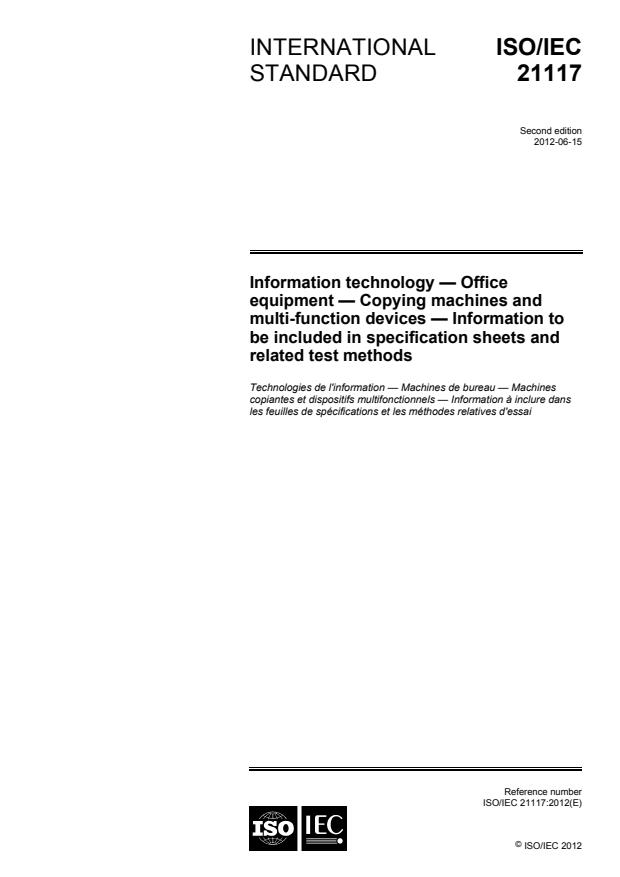
INTERNATIONAL ISO/IEC
STANDARD 21117
Second edition
2012-06-15
Information technology — Office
equipment — Copying machines and
multi-function devices — Information to
be included in specification sheets and
related test methods
Technologies de l'information — Machines de bureau — Machines
copiantes et dispositifs multifonctionnels — Information à inclure dans
les feuilles de spécifications et les méthodes relatives d'essai
Reference number
©
ISO/IEC 2012
© ISO/IEC 2012
All rights reserved. Unless otherwise specified, no part of this publication may be reproduced or utilized in any form or by any means,
electronic or mechanical, including photocopying and microfilm, without permission in writing from either ISO at the address below or
ISO's member body in the country of the requester.
ISO copyright office
Case postale 56 CH-1211 Geneva 20
Tel. + 41 22 749 01 11
Fax + 41 22 749 09 47
E-mail copyright@iso.org
Web www.iso.org
Published in Switzerland
ii © ISO/IEC 2012 – All rights reserved
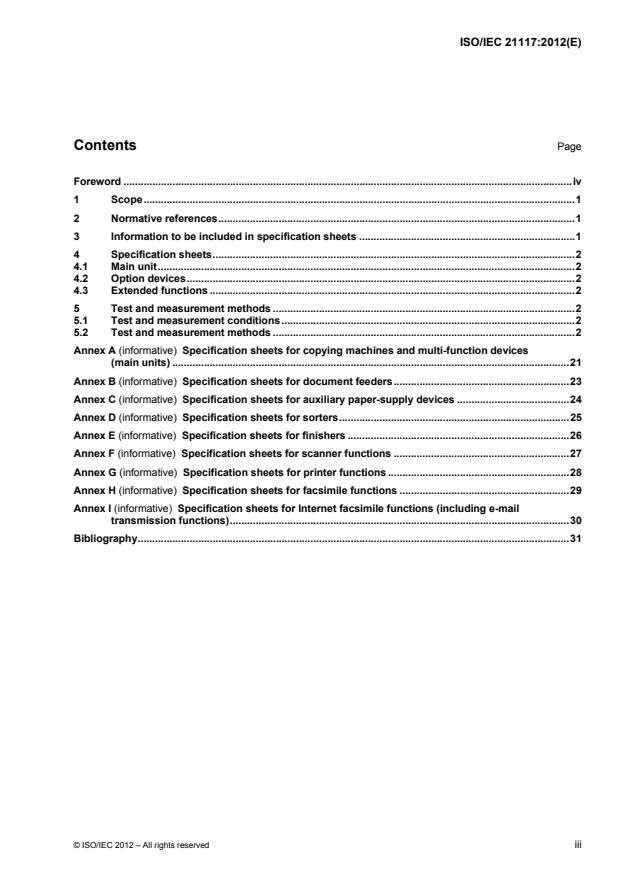
Contents Page
Foreword . iv
1 Scope . 1
2 Normative references . 1
3 Information to be included in specification sheets . 1
4 Specification sheets . 2
4.1 Main unit . 2
4.2 Option devices . 2
4.3 Extended functions . 2
5 Test and measurement methods . 2
5.1 Test and measurement conditions . 2
5.2 Test and measurement methods . 2
Annex A (informative) Specification sheets for copying machines and multi-function devices
(main units) . 21
Annex B (informative) Specification sheets for document feeders . 23
Annex C (informative) Specification sheets for auxiliary paper-supply devices . 24
Annex D (informative) Specification sheets for sorters . 25
Annex E (informative) Specification sheets for finishers . 26
Annex F (informative) Specification sheets for scanner functions . 27
Annex G (informative) Specification sheets for printer functions . 28
Annex H (informative) Specification sheets for facsimile functions . 29
Annex I (informative) Specification sheets for Internet facsimile functions (including e-mail
transmission functions) . 30
Bibliography . 31
© ISO/IEC 2012 – All rights reserved iii
Foreword
ISO (the International Organization for Standardization) and IEC (the International Electrotechnical
Commission) form the specialized system for worldwide standardization. National bodies that are members of
ISO or IEC participate in the development of International Standards through technical committees
established by the respective organization to deal with particular fields of technical activity. ISO and IEC
technical committees collaborate in fields of mutual interest. Other international organizations, governmental
and non-governmental, in liaison with ISO and IEC, also take part in the work. In the field of information
technology, ISO and IEC have established a joint technical committee, ISO/IEC JTC 1.
International Standards are drafted in accordance with the rules given in the ISO/IEC Directives, Part 2.
The main task of the joint technical committee is to prepare International Standards. Draft International
Standards adopted by the joint technical committee are circulated to national bodies for voting. Publication as
an International Standard requires approval by at least 75 % of the national bodies casting a vote.
Attention is drawn to the possibility that some of the elements of this document may be the subject of patent
rights. ISO and IEC shall not be held responsible for identifying any or all such patent rights.
ISO/IEC 21117 was prepared by Joint Technical Committee ISO/IEC JTC 1, Information technology,
Subcommittee SC 28, Office equipment.
This second edition cancels and replaces the first edition (ISO/IEC 21117:2005), which has been technically
revised.
iv © ISO/IEC 2012 – All rights reserved
INTERNATIONAL STANDARD ISO/IEC 21117:2012(E)
Information technology — Office equipment — Copying
machines and multi-function devices — Information to be
included in specification sheets and related test methods
1 Scope
This International Standard specifies the information to be listed in specification sheets for electrophotographic
digital copying machines and multi-function devices. The intention of this International Standard is to allow
purchasers and users to compare the characteristics of different models of copying machines and multi-
function devices so that they can more easily select copying machines and multi-function devices that meet
their requirements.
2 Normative references
The following referenced documents are indispensable for the application of this document. For dated
references, only the edition cited applies. For undated references, the latest edition of the referenced
document (including any amendments) applies.
ISO 7779:2010, Acoustics — Measurement of airborne noise emitted by information technology and
telecommunications equipment
ISO 9296:1988, Acoustics — Declared noise emission values of computer and business equipment
ISO/IEC 24734, Information technology — Office equipment — Method for measuring digital printing
productivity
ISO/IEC 24735, Information technology — Office equipment — Method for measuring digital copying
productivity
ISO/IEC 29183, Information technology — Office equipment — Method for measuring digital copying
productivity of a single one-sided original
3 Information to be included in specification sheets
Table 1 defines a name and a short description for each parameter entry. These constitute the information to
be included in specification sheets. Furthermore, test and measurement methods are defined for parameters
where applicable in the “Definitions and methods of measurement” column. Specification sheets shall use the
parameter names listed in Table 1. Specification sheets must include all applicable parameters in the given
order. Parameters that do not function, however, may be omitted.
NOTE When extracting parameters and specification values from specification sheets for use in catalogs, there are
no particular provisions on the parameter numbers or on the order in which the parameters are listed.
© ISO/IEC 2012 – All rights reserved 1
4 Specification sheets
4.1 Main unit
Refer to Annex A.
4.2 Option devices
a) document feeder: refer to Annex B.
b) auxiliary paper-supply devices: refer to Annex C.
c) sorters: refer to Annex D.
d) finishers: refer to Annex E.
4.3 Extended functions
a) scanner function: refer to Annex F.
b) printer function: refer to Annex G.
c) facsimile function: refer to Annex H.
d) e-mail / internet facsimile function: refer to Annex I.
5 Test and measurement methods
5.1 Test and measurement conditions
The test environment, including temperature and humidity, shall be within the ranges recommended by the
manufacturer for operating the device. If no recommendation is available, the following ranges shall apply.
Temperature: 23 ° C ± 5 ° C
Relative humidity: (50 ± 20) %
Supply voltage: rated input voltage
Supply frequency: rated frequency
Paper size: A4
Paper weight: 60 g/m2 to 90 g/m2
If a different paper size other than A4 is used, the size should be stated in the specification sheets. The paper
used in the tests should be conditioned under the environmental conditions given above.
5.2 Test and measurement methods
Test and measurement method for each parameter is specified in Table 1.
2 © ISO/IEC 2012 – All rights reserved
Table 1 — Parameters to be included in specification sheets
Parameter Description of the entry Definitions and methods of
Remarks and examples measurement
1 Main unit Refer to Annex A.
1.1 Name Product name and model number.
1.2 Type States if the machine is a portable,
desktop, or floor-standing (console)
type and if the machine is an all-in-
one or multi-component type.
1.3 Copying method Analog or digital
1.4 Colour States if single-colour or full-colour
copying is supported for machines
that support colour copying.
1.5 Type of photoreceptor Organic material, a-Si or Selenium.
1.6 Scanning light source States the type of light source used
for scanning and its rated power
consumption in watts.
1.7 Type of platen Moving or stationary.
If no platen is provided and the
original is fed into the machine by
hand or with a document carrier,
indicate the platen as “feed-through”.
1.8 Scanning method States the method by which originals
are scanned and the type of scanning
device.
1.9 Writing method States the method by which the latent
image is written to the photoreceptor.
1.10 Developing method Mono or dual components.
1.11 Copy density adjustment Manual or automatic.
If manual, indicate the adjustment
method, such as continuous or
discrete.
1.12 Fixing method Heat-roller, flash, oven, or pressure
fixing.
1.13 Paper-supply device/paper- States the paper-supply method
supply capacity (automatic or manual) and the
number of cassettes, decks, and
trays (attached to the main unit).
Also, indicate the loading capacity in
sheets for each cassette, deck, and
tray for a defined paper weight (in
g/m2). If there are multiple pickup
trays, indicate the loading capacity
for each pickup tray. For machines
that use roll sheets, list the width and
length of roll sheets.
© ISO/IEC 2012 – All rights reserved 3
Table 1 (continued)
Parameter Description of the entry Definitions and methods of
Remarks and examples measurement
States the main and sub scanning
1.14 Scanning resolution
resolutions as needed, expressed in
“dpi” or “dpi (number of dots/25.4
mm)”.
Example:
Optical resolution:1,200 x 1200 dpi
1.15 Writing resolution States the main and sub write
resolution, expressed in “dpi” or “dpi
(number of dots / 25.4 mm)”. Writing
resolution equals to the print engine's
native addressability.
Example:
1,200 x 1200 dpi
1.16 Scan colours The tones may be specified if they
vary when the machine operates in
copying mode.
Example:
24-bit colour (8-bits per colour plane)
1.17 Acceptable originals Lists sheets, books, computer forms,
and other acceptable originals.
1.18 Copy paper Indicates any specially processed
copy paper that is used.
Also, states the paper weight that
can be transported in the machine.
The recommended unit is g/m2.
1.19 Original sizes States the maximum size in
millimeters. The specification sheet
should indicate any limitations on the
thickness of originals as well as the
maximum weight that can be placed
on the platen.
1.20 Copying dimensions States the maximum and minimum
dimensions that can be copied in
millimeters.
If the copying size varies by the
paper-supply method (manual or
automatic), this is indicated.
1.21 Non-image area Non-image area is the area that The non-image areas at each edge
cannot be copied on when copying shall be indicated. The non-image
an original without margins on a areas shall be measured from the
given paper size. States in top, bottom, and sides of the copy
millimeters the width of the non-copy paper to the image, copied under
area at the top, bottom, and side of normal usage conditions.
the page.
4 © ISO/IEC 2012 – All rights reserved
Table 1 (continued)
Parameter Description of the entry Definitions and methods of
Remarks and examples measurement
1.22 Possible enlargement and Indicates the possible enlargement
reduction and reduction expressed as a
normalized ratio to the length of the
original. The ratio is stated for
enlarged copies, reduced copies, and
direct (1:1) copies to two decimal
places.
Express the error deviation of direct
(1:1) copying as a percent. The
deviation percentage (%) shall be the
maximum deviation, including
variations between machines of the
same model.
1.23 Number of continuous copies Indicates in pages the maximum
number of copies that can be set for
continuous copying when the
machine operates as a copying
machine.
1.24 Continuous copying speed States the number in pages/minute The machine shall be set to copy 11
that can be made under normal copies under normal usage
usage conditions (A4 paper, 1:1 conditions (A4 paper, 1:1
magnification, and standard feed magnification, and standard feed
direction) in continuous copying direction). Measure the time (that is,
mode. Specify if copying speeds vary obtain the value t in seconds) from
by paper size. when the first copy is fully ejected to
For colour copying machines, specify when the 11th copy is fully ejected.
the copying speeds for both colour This value shall be converted into the
copying and monochrome (black and number of copies per minute with the
white) copying. following equation:
Specify if copying speeds vary by 60 ÷ (t/10) = the number of copies per
copying process. Each respective minute
copying speed should be indicated. For continuous passed pages, a
The number of copies is expressed in number of pages equivalent to the
Copies Per Minute (CPM) in the number of copies per minute + 1 may
following formats. be passed.
a) Less than 10 CPM: Round off to In this case, “10” in the equation
two decimal places and express as above is replaced with “number of
two significant figures: X.X passed pages – 1”.
b) 10 CPM to 99 CPM: Express with
either of the methods below:
1) Round off to one decimal place
and express as two significant
figures: XX
2) Round off to two decimal places
and express as three significant
figures: XX.X
c) 100 CPM or more: Round off to
one decimal place and express as
three significant figures: XXX
ISO/IEC 24735 shall be used to
describe the copying productivity of
copier and MFP devices. (See
parameter 1.42 Copying Productivity)
© ISO/IEC 2012 – All rights reserved 5
Table 1 (continued)
Parameter Description of the entry Definitions and methods of
Remarks and examples measurement
1.25 First-copy-out time States in seconds the time from The first-copy-out time shall be
pressing the Print button to measured in seconds from the
completing the delivery of the first moment the Print button is pressed to
copy with the setting that produces the time the first copy is fully ejected
the fastest result under normal usage with the setting that produces the
conditions (A4 paper, 1:1 fastest result under normal usage
magnification, and standard feed conditions.
direction).
The specification sheet should also
indicate if the first-copy-out time
varies depending on certain
conditions, such as the basic
configuration of the copying machine
or the mode of or attachments to the
document feeder.
The specification sheet should also
indicate if the first-copy-out time
varies depending on the use and
modes of options, such as automatic
copy-density adjustment, original-
size detection, and automatic duplex
copying. It should also note these
different values.
ISO/IEC 29183 shall be used to
describe the copying productivity for
single originals. (See parameter 1.43
Copying Productivity for a single one
sided original)
1.26 Warm-up time States the time in minutes or Tests shall be performed on a
seconds from power on to a ready machine that has been turned off until
state. If the machine is pre-heated, its internal temperature can be
this is indicated along with the time to assumed the same as the ambient
pre-heat. temperature. The time from turning
The temperature and relative on the power switch to a copy-ready
humidity during the warm-up-time state shall be measured.
measurement shall also be reported The warm-up time should be tested
with the measured value. If the at a temperature of 20 ° C.
machine is pre-heated, this shall be
indicated along with the time to pre-
heat.
1.27 Power source Lists the voltage (in volts), frequency
(in hertz), and current (in amperes)
for AC-powered machines.
If the machine can operate at both 50
Hz and 60 Hz, this is indicated. For
DC-powered machines, list the
voltage (in volts) and current (in
amperes).
6 © ISO/IEC 2012 – All rights reserved
Table 1 (continued)
Parameter Description of the entry Definitions and methods of
Remarks and examples measurement
1.28 Maximum power consumption States the maximum power The maximum power consumption
consumed in kilowatts when the shall be measured in kilowatts while
machine is in use. copying under normal usage
conditions from the time the power is
turned on. Transient power
fluctuations, however, are excluded.
Options that can be adjusted, such as
the copy ratio and copy density, shall
be set so the maximum amount of
power is consumed.
1.29 Power-savings efficiency State the power-saving efficiency
value with unit of measurement for
machines that is subject to
regulations such as EPA Energy Star
TEC and OM.
Example: 9.75 kWh/week (TEC)
1.30 Extended functions States any extended functions that
can be installed, such as facsimile,
printer, scanner, and network
functions.
1.31 Memory capacity States the standard-equipped
memory capacity and the maximum
extendable memory capacity,
expressed in megabytes (MB) or
gigabytes (GB).
Example: 256 MB standard, 512 MB
maximum, 120 GB hard-disk drive
1.32 Primary options Lists any options not covered above, The copying machine unit shall be
such as duplex copying functions, tested with the options in place while
automatic colour functions, image being operated in accordance with
processing, magnification functions, the operating procedure given in
margin functions, and editing catalogs, specification sheets, or
functions. operating manuals. The existence or
When listing options, specify the test absence of malfunctions and other
parameters, test methods, and test required parameters shall be
results. examined.
1.33 Safety regulations States applicable standards.
Indicates the applicable national
deviations.
1.34 Safety data sheets Available/not available
1.35 Electromagnetic compatibility States electromagnetic compatibility
(EMC) in accordance with IEC 60950-1 :
Information technology equipment -
Safety - Part 1: General requirements
and CISPL 22:CISPR (The
International Special Committee on
Radio Interference)
© ISO/IEC 2012 – All rights reserved 7
Table 1 (continued)
Parameter Description of the entry Definitions and methods of
Remarks and examples measurement
1.36 Acoustical noise States the sound power levels and Sound power levels and sound
sound pressure levels of noise during pressure levels shall be measured in
standby and while copying. accordance with ISO 7779:2010.
Noise values shall be expressed in Noise shall be measured both during
accordance with ISO 9296. standby and while copying.
a) Method of measuring sound power
levels
1) Many types of measurement
points can be selected when
measuring sound power according to
Clause 7 in ISO 7779:2010. In this
Standard, the measurement points
shown in Figure C.2 in ISO 3744 (a
nine-point measurement on a
parallelepiped measurement surface)
are recommended.
When measuring sound power in a
reverberation room according to
Clause 6 in ISO 7779:2010, use the
measurement points described in 6.
2) The distance criteria is assumed to
be to each plane of the hypothetical
surface (the reference box) which is
the smallest rectangular
parallelepiped that just encloses the
copying machine.
Protruding sections of the copying
machine (such as cassettes and
trays) that do not appear to contribute
to noise are assumed not to be
included in the reference box
mentioned above because they are
considered not to affect
measurement values.
3) Measurements are expressed in
bels (B).
b) Method of measuring sound
pressure levels
1) Measurement points are defined in
ISO 7779:2010.
2) The distance between the machine
under measurement and the
measurement points is defined as
follows:
2.1) Operator distance: 0.25 m 0.03
m
2.2) Bystander distance: 1.00 m
0.03 m
Measurements are taken at four
bystander positions at the front, back,
left, and right of the machine.
3) The height of the measurement
points from the floor is 1.50 m 0.03
m.
8 © ISO/IEC 2012 – All rights reserved
Table 1 (continued)
Parameter Description of the entry Definitions and methods of
Remarks and examples measurement
1.36 Acoustical noise (continued) The height of 1.50 m 0.03 m
assumes a standing operator. If the
operator is seated, choose the most
appropriate operator position from
(b), (c), or (d) in Figure 1 of ISO
7779:2010.
If the operator position cannot be
determined, measurements from the
operator position may be omitted.
4) Measurements are expressed in
decibels (dB).
1.37 Additional features (options) States any extended features that
can be installed on the copying
machine.
1.38 Operating environment Specifies the minimum and maximum
ambient temperatures, and related
range of relative humidity.
1.39 Dimensions States the dimensions of the main
unit in either centimeters or
millimeters in the order: width
depth height.
1.40 Weight States the weight of the main unit in
kilograms.
1.41 Space required States the maximum dimensions in
either centimeters or millimeters of
the main unit when the largest
cassette, tray, and delivery unit are
installed in the order: width depth.
For machines with moving platens,
include the dimensions when the
platen is at its maximum extension
point. The specification sheet should
also list the space required when
accessories and options are installed,
such as automatic document feeders,
sorters, or large-capacity paper-
supply devices.
1.42 Copying productivity State FSOT and ESAT (copying) Refer to ISO/IEC 24735
parameters and a pointer to the full
test report only if copying productivity
is measured. These parameters shall
be measured according to ISO/IEC
24735.
1.43 Copying productivity(for a single State sFCOT and sESAT (copying) Refer to ISO/IEC 29183
one-sided original) parameters and a pointer to the full
test report only if copying productivity
is measured. These parameters shall
be measured according to ISO/IEC
29183.
© ISO/IEC 2012 – All rights reserved 9
Table 1 (continued)
Parameter Description of the entry Definitions and methods of
Remarks and examples measurement
1.44 Other parameters Lists required parameters not
covered between 1.1 and 1.43.
2 Accessories (options)
2.1 Document feeders Refer to Annex B.
2.1.1 Name Lists the product name or model
number.
2.1.2 Type States the feeder class, such as
document feeder, automatic
document feeder, or automatic
duplex document feeder. If the feeder
has a sheet-through feeding function,
this is indicated.
2.1.3 Acceptable originals States the maximum and minimum
original sizes in millimeters that the
feeder can accept. If special originals
can be used, their size is indicated.
2.1.4 Types of originals States the range of paper thickness,
expressed by weight in g/m2, that the
feeder can accept. If special originals
or special paper types can be used,
this is indicated.
2.1.5 Loading capacity States the maximum number of
originals that can be loaded in the
feeder at one time. If the capacity
varies by size or weight of originals,
this is indicated.
2.1.6 Original exchange speed States the original exchange speed in The original exchange speed shall be
sheets per minute when making one measured as the combined copying
copy of each A4 original from a speed when making one copy of
number of originals at a magnification each A4 original from a number of
of 1:1 in succession using the feeder originals at a magnification of 100%
and the copying machine together. (1:1) in succession using the feeder
If it is necessary to note the original and the copying machine together.
exchange speed of the feeder when Eleven pages shall be copied in
not combined with the copying succession and the time from when
machine, this value may be entered the first copy is fully ejected to when
on the specification sheet as the the 11th copy is fully ejected shall be
“original scanning speed”. measured (that is, obtain the value t
The specification sheet should in seconds). This value shall be
indicate if the original exchange converted into the number of sheets
speed varies when options are used, per minute with the following
such as automatic copy-density equation:
adjustment, original-size detection, 60 ÷ (t/10) = the number of sheets
and automatic duplex copying. Each per minute
respective copying speed should be
indicated.
10 © ISO/IEC 2012 – All rights reserved
Table 1 (continued)
Parameter Description of the entry Defin
...