


ISO 7396-1:2002
(Main)Medical gas pipeline systems — Part 1: Pipelines for compressed medical gases and vacuum
Medical gas pipeline systems — Part 1: Pipelines for compressed medical gases and vacuum
ISO 7396-1 specifies requirements for design, installation, function, performance, documentation, testing and commissioning of compressed medical gas and vacuum pipeline systems in health care facilities to ensure continuous delivery of the correct gas from the pipeline system. It includes requirements for supply systems, pipeline distribution systems, control systems, monitoring and alarm systems and non-interchangeability between components of different gas systems. ISO 7396-1 is applicable to pipeline systems for the following medical gases: oxygen; oxygen-enriched air; nitrous oxide; air for breathing; carbon dioxide; oxygen/nitrous oxide mixtures; air for driving surgical tools; nitrogen for driving surgical tools; and to vacuum pipeline systems. ISO 7396-1 is also applicable to pipeline distribution systems for oxygen-enriched air connected to supply systems with oxygen concentrators complying with ISO 10083. ISO 7396-1 also applies to extensions and modifications of existing pipeline systems. ISO 7396-1 is not applicable to provision for gas-specific connectors on mobile or stationary cryogenic vessels or on transport vehicles, or on the inlet/outlet of cylinders for non-cryogenic liquid or gas. ISO 7396-1 does not apply to medical gas pipeline systems supplying hyperbaric chambers.
Réseaux de distribution de gaz médicaux — Partie 1: Réseaux de distribution de gaz médicaux comprimés et de vide
General Information
- Status
- Withdrawn
- Publication Date
- 28-Aug-2002
- Withdrawal Date
- 28-Aug-2002
- Technical Committee
- ISO/TC 121/SC 6 - Medical gas supply systems
- Drafting Committee
- ISO/TC 121/SC 6 - Medical gas supply systems
- Current Stage
- 9599 - Withdrawal of International Standard
- Start Date
- 28-Mar-2007
- Completion Date
- 12-Feb-2026
Relations
- Effective Date
- 10-Feb-2026
- Effective Date
- 06-Jun-2022
- Effective Date
- 15-Apr-2008
- Effective Date
- 15-Apr-2008
Get Certified
Connect with accredited certification bodies for this standard

BSI Group
BSI (British Standards Institution) is the business standards company that helps organizations make excellence a habit.

TÜV Rheinland
TÜV Rheinland is a leading international provider of technical services.

TÜV SÜD
TÜV SÜD is a trusted partner of choice for safety, security and sustainability solutions.
Sponsored listings
Frequently Asked Questions
ISO 7396-1:2002 is a standard published by the International Organization for Standardization (ISO). Its full title is "Medical gas pipeline systems — Part 1: Pipelines for compressed medical gases and vacuum". This standard covers: ISO 7396-1 specifies requirements for design, installation, function, performance, documentation, testing and commissioning of compressed medical gas and vacuum pipeline systems in health care facilities to ensure continuous delivery of the correct gas from the pipeline system. It includes requirements for supply systems, pipeline distribution systems, control systems, monitoring and alarm systems and non-interchangeability between components of different gas systems. ISO 7396-1 is applicable to pipeline systems for the following medical gases: oxygen; oxygen-enriched air; nitrous oxide; air for breathing; carbon dioxide; oxygen/nitrous oxide mixtures; air for driving surgical tools; nitrogen for driving surgical tools; and to vacuum pipeline systems. ISO 7396-1 is also applicable to pipeline distribution systems for oxygen-enriched air connected to supply systems with oxygen concentrators complying with ISO 10083. ISO 7396-1 also applies to extensions and modifications of existing pipeline systems. ISO 7396-1 is not applicable to provision for gas-specific connectors on mobile or stationary cryogenic vessels or on transport vehicles, or on the inlet/outlet of cylinders for non-cryogenic liquid or gas. ISO 7396-1 does not apply to medical gas pipeline systems supplying hyperbaric chambers.
ISO 7396-1 specifies requirements for design, installation, function, performance, documentation, testing and commissioning of compressed medical gas and vacuum pipeline systems in health care facilities to ensure continuous delivery of the correct gas from the pipeline system. It includes requirements for supply systems, pipeline distribution systems, control systems, monitoring and alarm systems and non-interchangeability between components of different gas systems. ISO 7396-1 is applicable to pipeline systems for the following medical gases: oxygen; oxygen-enriched air; nitrous oxide; air for breathing; carbon dioxide; oxygen/nitrous oxide mixtures; air for driving surgical tools; nitrogen for driving surgical tools; and to vacuum pipeline systems. ISO 7396-1 is also applicable to pipeline distribution systems for oxygen-enriched air connected to supply systems with oxygen concentrators complying with ISO 10083. ISO 7396-1 also applies to extensions and modifications of existing pipeline systems. ISO 7396-1 is not applicable to provision for gas-specific connectors on mobile or stationary cryogenic vessels or on transport vehicles, or on the inlet/outlet of cylinders for non-cryogenic liquid or gas. ISO 7396-1 does not apply to medical gas pipeline systems supplying hyperbaric chambers.
ISO 7396-1:2002 is classified under the following ICS (International Classification for Standards) categories: 11.040.10 - Anaesthetic, respiratory and reanimation equipment. The ICS classification helps identify the subject area and facilitates finding related standards.
ISO 7396-1:2002 has the following relationships with other standards: It is inter standard links to EN 60601-2-13:2006, ISO 22442-3:2007, ISO 7396:1987, ISO 7396-1:2007. Understanding these relationships helps ensure you are using the most current and applicable version of the standard.
ISO 7396-1:2002 is available in PDF format for immediate download after purchase. The document can be added to your cart and obtained through the secure checkout process. Digital delivery ensures instant access to the complete standard document.
Standards Content (Sample)
INTERNATIONAL ISO
STANDARD 7396-1
First edition
2002-09-01
Medical gas pipeline systems —
Part 1:
Pipelines for compressed medical gases
and vacuum
Réseaux de distribution de gaz médicaux —
Partie 1: Réseaux de distribution de gaz médicaux comprimés et de vide
Reference number
©
ISO 2002
PDF disclaimer
This PDF file may contain embedded typefaces. In accordance with Adobe's licensing policy, this file may be printed or viewed but shall not
be edited unless the typefaces which are embedded are licensed to and installed on the computer performing the editing. In downloading this
file, parties accept therein the responsibility of not infringing Adobe's licensing policy. The ISO Central Secretariat accepts no liability in this
area.
Adobe is a trademark of Adobe Systems Incorporated.
Details of the software products used to create this PDF file can be found in the General Info relative to the file; the PDF-creation parameters
were optimized for printing. Every care has been taken to ensure that the file is suitable for use by ISO member bodies. In the unlikely event
that a problem relating to it is found, please inform the Central Secretariat at the address given below.
© ISO 2002
All rights reserved. Unless otherwise specified, no part of this publication may be reproduced or utilized in any form or by any means, electronic
or mechanical, including photocopying and microfilm, without permission in writing from either ISO at the address below or ISO's member body
in the country of the requester.
ISO copyright office
Case postale 56 • CH-1211 Geneva 20
Tel. + 41 22 749 01 11
Fax + 41 22 749 09 47
E-mail copyright@iso.ch
Web www.iso.ch
Printed in Switzerland
ii © ISO 2002 – All rights reserved
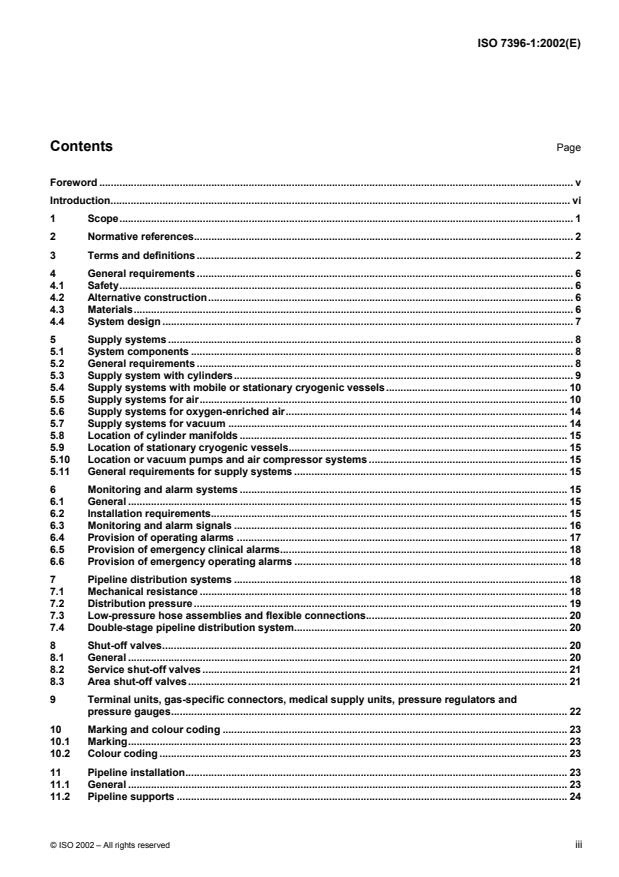
Contents Page
Foreword . v
Introduction. vi
1 Scope. 1
2 Normative references. 2
3 Terms and definitions. 2
4 General requirements . 6
4.1 Safety. 6
4.2 Alternative construction. 6
4.3 Materials. 6
4.4 System design . 7
5 Supply systems . 8
5.1 System components. 8
5.2 General requirements . 8
5.3 Supply system with cylinders. 9
5.4 Supply systems with mobile or stationary cryogenic vessels. 10
5.5 Supply systems for air. 10
5.6 Supply systems for oxygen-enriched air. 14
5.7 Supply systems for vacuum . 14
5.8 Location of cylinder manifolds . 15
5.9 Location of stationary cryogenic vessels. 15
5.10 Location or vacuum pumps and air compressor systems . 15
5.11 General requirements for supply systems . 15
6 Monitoring and alarm systems . 15
6.1 General . 15
6.2 Installation requirements. 15
6.3 Monitoring and alarm signals . 16
6.4 Provision of operating alarms . 17
6.5 Provision of emergency clinical alarms. 18
6.6 Provision of emergency operating alarms . 18
7 Pipeline distribution systems . 18
7.1 Mechanical resistance . 18
7.2 Distribution pressure. 19
7.3 Low-pressure hose assemblies and flexible connections. 20
7.4 Double-stage pipeline distribution system. 20
8 Shut-off valves. 20
8.1 General . 20
8.2 Service shut-off valves . 21
8.3 Area shut-off valves. 21
9 Terminal units, gas-specific connectors, medical supply units, pressure regulators and
pressure gauges. 22
10 Marking and colour coding . 23
10.1 Marking. 23
10.2 Colour coding . 23
11 Pipeline installation. 23
11.1 General . 23
11.2 Pipeline supports . 24
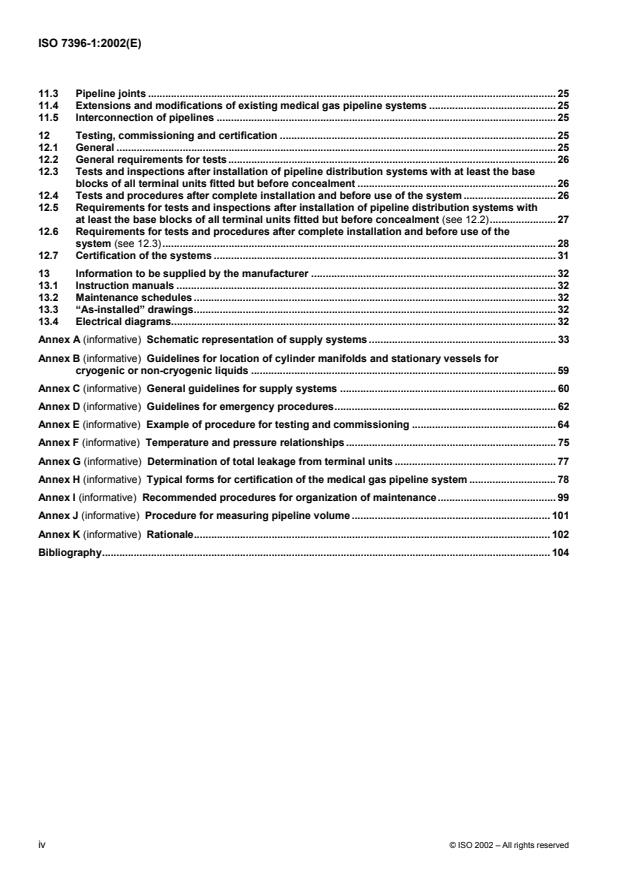
11.3 Pipeline joints . 25
11.4 Extensions and modifications of existing medical gas pipeline systems . 25
11.5 Interconnection of pipelines . 25
12 Testing, commissioning and certification . 25
12.1 General . 25
12.2 General requirements for tests. 26
12.3 Tests and inspections after installation of pipeline distribution systems with at least the base
blocks of all terminal units fitted but before concealment . 26
12.4 Tests and procedures after complete installation and before use of the system . 26
12.5 Requirements for tests and inspections after installation of pipeline distribution systems with
at least the base blocks of all terminal units fitted but before concealment (see 12.2). 27
12.6 Requirements for tests and procedures after complete installation and before use of the
system (see 12.3). 28
12.7 Certification of the systems . 31
13 Information to be supplied by the manufacturer . 32
13.1 Instruction manuals . 32
13.2 Maintenance schedules . 32
13.3 “As-installed” drawings. 32
13.4 Electrical diagrams. 32
Annex A (informative) Schematic representation of supply systems . 33
Annex B (informative) Guidelines for location of cylinder manifolds and stationary vessels for
cryogenic or non-cryogenic liquids . 59
Annex C (informative) General guidelines for supply systems . 60
Annex D (informative) Guidelines for emergency procedures. 62
Annex E (informative) Example of procedure for testing and commissioning . 64
Annex F (informative) Temperature and pressure relationships . 75
Annex G (informative) Determination of total leakage from terminal units . 77
Annex H (informative) Typical forms for certification of the medical gas pipeline system . 78
Annex I (informative) Recommended procedures for organization of maintenance. 99
Annex J (informative) Procedure for measuring pipeline volume . 101
Annex K (informative) Rationale. 102
Bibliography. 104
iv © ISO 2002 – All rights reserved
Foreword
ISO (the International Organization for Standardization) is a worldwide federation of national standards bodies (ISO
member bodies). The work of preparing International Standards is normally carried out through ISO technical
committees. Each member body interested in a subject for which a technical committee has been established has
the right to be represented on that committee. International organizations, governmental and non-governmental, in
liaison with ISO, also take part in the work. ISO collaborates closely with the International Electrotechnical
Commission (IEC) on all matters of electrotechnical standardization.
International Standards are drafted in accordance with the rules given in the ISO/IEC Directives, Part 3.
The main task of technical committees is to prepare International Standards. Draft International Standards adopted
by the technical committees are circulated to the member bodies for voting. Publication as an International
Standard requires approval by at least 75 % of the member bodies casting a vote.
Attention is drawn to the possibility that some of the elements of this part of ISO 7396 may be the subject of patent
rights. ISO shall not be held responsible for identifying any or all such patent rights.
ISO 7396-1 was prepared by Technical Committee ISO/TC 121, Anaesthetic and respiratory equipment,
Subcommittee SC 6, Medical gas systems.
This first edition of ISO 7396-1 cancels and replaces (with ISO 7396-2) the first edition of ISO 7396
(ISO 7396:1987), which has been technically revised.
ISO 7396 consists of the following parts, under the general title Medical gas pipeline systems:
Part 1: Pipelines for compressed medical gases and vaccum
Part 2: Anaesthetic gas scavenging disposal systems
Annexes A, B, C, D, E, F, G, H, I, J and K of this part of ISO 7396 are for information only.
Introduction
Many health care facilities use pipeline systems to deliver medical gases and vacuum to areas where they are
used in patient care or to power equipment such as ventilators and surgical tools.
This part of ISO 7396 specifies requirements for pipeline systems for compressed medical gases and vacuum. It is
intended for use by those persons involved in the design, construction, inspection and operation of health care
facilities treating human beings. Those persons involved in the design, manufacture and testing of equipment
intended to be connected to pipeline systems should also be aware of the contents of this document.
This part of ISO 7396 seeks to ensure that medical gas pipelines contain only the specific gas intended to be
supplied. For this reason gas-specific components are used for terminal units and for other connectors which are
intended to be used by the operator. In addition, each system is tested and certified to contain only the specific
gas.
The objectives of this part of ISO 7396 are to ensure the following:
a) non-interchangeability between different systems by design;
b) continuous supply of gases and vacuum by providing appropriate sources;
c) use of suitable materials;
d) cleanliness of components;
e) correct installation;
f) provision of monitoring and alarm systems;
g) correct marking of the pipeline system;
h) testing, commissioning and certification;
i) purity of the gases delivered by the system.
Annex K contains rationale statements for some of the requirements of this part of ISO 7396. It is included to
provide additional insight into the reasoning that led to the requirements and recommendations that have been
incorporated in this part of ISO 7396. The clauses and subclauses marked with R after their number have
corresponding rationale contained in annex K.
vi © ISO 2002 – All rights reserved
INTERNATIONAL STANDARD ISO 7396-1:2002(E)
Medical gas pipeline systems —
Part 1:
Pipelines for compressed medical gases and vacuum
1 Scope
This part of ISO 7396 specifies requirements for design, installation, function, performance, documentation, testing
and commissioning of compressed medical gas and vacuum pipeline systems in health care facilities to ensure
continuous delivery of the correct gas from the pipeline system. It includes requirements for supply systems,
pipeline distribution systems, control systems, monitoring and alarm systems and non-interchangeability between
components of different gas systems.
This part of ISO 7396 is applicable to pipeline systems for the following medical gases:
oxygen;
oxygen-enriched air;
nitrous oxide;
air for breathing;
carbon dioxide;
oxygen/nitrous oxide mixtures;
air for driving surgical tools;
nitrogen for driving surgical tools;
and to vacuum pipeline systems.
R This part of ISO 7396 is also applicable to pipeline distribution systems for oxygen-enriched air connected to
supply systems with oxygen concentrators complying with ISO 10083.
This part of ISO 7396 also applies to extensions and modifications of existing pipeline systems.
This part of ISO 7396 is not applicable to provision for gas-specific connectors on mobile or stationary cryogenic
vessels or on transport vehicles, or on the inlet/outlet of cylinders for non-cryogenic liquid or gas.
This part of ISO 7396 does not apply to medical gas pipeline systems supplying hyperbaric chambers.
2 Normative references
The following normative documents contain provisions which, through reference in this text, constitute provisions of
this part of ISO 7396. For dated references, subsequent amendments to, or revisions of, any of these publications
do not apply. However, parties to agreements based on this part of ISO 7396 are encouraged to investigate the
possibility of applying the most recent editions of the normative documents indicated below. For undated
references, the latest edition of the normative document referred to applies. Members of ISO and IEC maintain
registers of currently valid International Standards.
ISO 407, Small medical gas cylinders — Pin-index yoke-type valve connections
ISO 3746, Acoustics — Determination of sound power levels of noise sources using sound pressure — Survey
method using an enveloping measurement surface over a reflecting plane
ISO 4135, Anaesthesitic and respiratory equipment — Vocabulary
ISO 5145, Cylinder valve outlets for gases and gas mixtures — Selection and dimensioning
ISO 5359, Low-pressure hose assemblies for use with medical gases
ISO/TR 7470, Valve outlets for gas cylinders — List of provisions which are either standardized or in use
ISO 9170-1, Terminal units for medical gas pipeline systems — Part 1: Terminal units for use with compressed
medical gases and vacuum
ISO 9703-1, Anaesthesia and respiratory care alarm signals — Part 1: Visual alarm signals
ISO 9703-2, Anaesthesia and respiratory care alarm signals — Part 2: Auditory alarm signals
ISO 10083:1992, Oxygen concentrators for use with medical gas pipeline systems
ISO 10524:1995, Pressure regulators and pressure regulators with flow-metering devices for medical gas systems
ISO 10524-2, Pressure regulators for use with medical gases — Part 2: Manifold and line pressure regulators
ISO 11197, Medical electrical equipment — Particular requirements for safety of medical supply units
ISO 14971, Medical devices — Application of risk management to medical devices
ISO 15001, Anaesthetic and respiratory equipment — Compatibility with oxygen
EN 143:1990, Respiratory protective devices — Particle filters — Requirements, testing, marking
EN 286-1:1998, Simple unfired pressure vessels designed to contain air or nitrogen — Part 1: Pressure vessels for
general purposes
EN 13348:2001, Copper and copper alloys — Seamless round copper tubes for medical gases or vacuum
3 Terms and definitions
For the purposes of this part of ISO 7396, the following terms and definitions apply.
3.1
air compressor system
supply system with compressor(s) designed to provide air for breathing or air for driving surgical tools or both
2 © ISO 2002 – All rights reserved
3.2
air for breathing
natural or synthetic mixture of gases, mainly composed of oxygen and nitrogen in specified proportions, with
defined limits for the concentration of contaminants, supplied by a medical gas pipeline system and intended for
administration to patients
NOTE The volume fractions of oxygen and nitrogen in air are approximately 21 % oxygen and 79 % nitrogen.
3.3
air for driving surgical tools
natural or synthetic mixture of gases, mainly composed of oxygen and nitrogen in specified proportions, with
defined limits for the concentration of contaminants, supplied by a medical gas pipeline system and intended for
driving surgical tools
NOTE The volume fractions of oxygen and nitrogen in air are approximately 21 % oxygen and 79 % nitrogen.
3.4
branch
that portion of the pipeline distribution system which supplies one or more areas on the same floor of the facility
3.5
commissioning
proof of function to verify that the agreed system specification is met and is accepted by the user or his
representative
3.6
control equipment
those items necessary to maintain the medical gas pipeline system within the specified operating parameters
EXAMPLES Pressure regulators, pressure-relief valves, alarms, sensors and manual or automatic valves.
3.7
cryogenic liquid system
supply system containing liquefied gas stored at a very low temperature
3.8
cylinder bundle
pack or pallet of cylinders linked together with a single connector for filling and emptying
3.9
diversity factor
factor which represents the maximum proportion of terminal units in a defined clinical area which will be used at the
same time, at flowrates defined in agreement with the management of the health-care facility
3.10
double-stage pipeline distribution system
pipeline distribution system in which gas is initially distributed from the supply system at a pressure higher than the
nominal distribution pressure, and is then reduced to the nominal distribution pressure by additional line pressure
regulators
NOTE This initial higher pressure is the nominal supply system pressure.
3.11
emergency clinical alarm
alarm to indicate to technical and medical staff that there is abnormal pressure within a pipeline
3.12
emergency operating alarm
alarm to indicate to technical staff that there is abnormal pressure within a pipeline
3.13
gas-specific
having characteristics which prevent connection between different gas services
3.14
gas-specific connector
screw-threaded connector of type DISS (diameter-indexed safety system) or NIST (non-interchangeable screw-
threaded), or non-interchangeable quick connector
3.15
information signal
visual indication of normal status
3.16
line pressure regulator
pressure regulator designed for a maximum inlet pressure of 3 000 kPa and intended for installation within a
medical gas pipeline system
3.17
low-pressure hose assembly
assembly consisting of a flexible hose with permanently attached gas-specific inlet and outlet connectors and
designed to conduct a medical gas at pressures less than 1 400 kPa
3.18
main line
that portion of the pipeline distribution system connecting the supply system to risers or branches, or both
3.19
manifold
device for connecting the outlet(s) of one or more cylinders or cylinder bundles of the same medical gas to the
pipeline system
3.20
manifold pressure regulator
pressure regulator designed for a maximum inlet pressure of 20 000 kPa and intended for installation within
sources of supply containing cylinders or cylinder bundles
3.21
manufacturer
natural or legal person with responsibility for the design, manufacture, packaging and labelling of a device before it
is placed on the market under his own name, regardless of whether these operations are carried out by that person
himself or on his behalf by a third party
3.22
maximum distribution pressure
pressure at any terminal unit when the pipeline system is operating at zero flow
3.23
medical gas pipeline system
complete gas pipeline system which comprises a supply system, a monitoring and alarm system and a distribution
system with terminal units at the points where medical gases or vacuum may be required
3.24
minimum distribution pressure
lowest pressure occurring at any terminal unit when the pipeline system is operating at the system design flow
3.25
nominal distribution pressure
pressure of gas which the pipeline system is intended to deliver at the terminal units
4 © ISO 2002 – All rights reserved
3.26
nominal supply system pressure
pressure of gas which the supply system is intended to deliver at the inlet to the line pressure regulators
3.27
non-cryogenic liquid system
supply system containing a gas stored in the liquid state under pressure at ambient temperature
3.28
non-return valve
valve which permits flow in one direction only
3.29
operating alarm
alarm to indicate to technical staff that it is necessary to replenish the gas supply or to correct a malfunction
3.30
oxygen concentrator
device which provides oxygen-enriched gas from ambient air by the extraction of nitrogen
3.31
pipeline distribution system
that part of a medical gas pipeline system linking the supply system to the terminal units
3.32
pressure regulator
device which reduces a variable inlet pressure to keep the set outlet pressure within specified limits
3.33
pressure-relief valve
device activated at a pre-set pressure value and intended to relieve excess pressure
3.34
primary supply
that portion of the supply system which supplies the pipeline distribution system
3.35
proportioning system
supply system in which gases are mixed in a specified ratio
3.36
reserve supply
that portion of the supply system which supplies the pipeline distribution system in the event of exhaustion or failure
of the primary and secondary supplies
3.37
riser
that portion of the pipeline distribution system traversing one or more floors and connecting the main line with
branch lines on various levels
3.38
secondary supply
that portion of the supply system which automatically supplies the pipeline distribution system in the event of
exhaustion or failure of the primary supply
3.39
shut-off valve
valve which prevents flow in both directions when closed
3.40
silencing
temporary stopping of an auditory alarm signal by manual action
3.41
single fault condition
condition in which a single means for protection against a safety hazard in equipment is defective or a single
external abnormal condition is present
3.42
single-stage pipeline distribution system
pipeline distribution system in which gas is distributed from the supply system at the nominal distribution pressure
3.43
source of supply
that portion of the supply system with associated control equipment which supplies the pipeline distribution system
3.44
supply system
system which supplies the pipeline distribution system and which includes two or more sources of supply
3.45
system design flow
flow calculated from the maximum flow requirement of the health care facility and corrected by the diversity
factor(s)
3.46
terminal unit
outlet assembly (inlet for vacuum) in a medical gas pipeline system at which the operator makes connections and
disconnections
3.47
vacuum system
supply system equipped with vacuum pumps designed to provide negative pressure
4 General requirements
4.1 Safety
Medical gas pipeline systems shall, when installed, commissioned, operated in normal use and maintained
according to the instructions of the manufacturer, cause no safety hazard which could reasonably be foreseen
using risk analysis procedures in accordance with ISO 14971 and which is connected with their intended
application, in normal condition and in single fault condition.
4.2 R Alternative construction
Pipeline installations and components, or parts thereof, using materials or having forms of construction different
from those detailed in this part of ISO 7396 shall be accepted if it can be demonstrated that an equivalent degree of
safety is obtained. Evidence of an equivalent degree of safety shall be provided by the manufacturer.
4.3 Materials
4.3.1 R The manufacturer shall disclose, upon request, evidence of the corrosion resistance of the materials
used for pipes and fittings.
NOTE Corrosion resistance includes resistance against the influence of moisture and the surrounding materials.
6 © ISO 2002 – All rights reserved
4.3.2 R The manufacturer shall disclose, upon request, evidence of the compatibility with oxygen of the materials
used for components of the medical gas pipeline system which come into contact with the medical gas under the
operating conditions specified by the manufacturer.
NOTE 1 Compatibility with oxygen involves both combustibility and ease of ignition. Materials which burn in air will burn
violently in pure oxygen. Many materials which do not burn in air will do so in pure oxygen, particularly under pressure. Similarly,
materials which can be ignited in air require less energy to ignite in oxygen. Many such materials may be ignited by friction at a
valve seat or by adiabatic compression produced when oxygen at high pressure is rapidly introduced into a system initially at
low pressure.
NOTE 2 Attention is drawn to ISO 15001.
4.3.3 R Components of systems which may be exposed to cylinder pressure in normal or single fault condition
shall function according to their specifications after being exposed to a pressure of 1,5 times the cylinder working
pressure for 5 min. Evidence shall be provided by the manufacturer.
4.3.4 R Components of systems which may be exposed to cylinder pressure in normal or single fault condition
shall not ignite when submitted to a pneumatic impact test with oxygen. The test for ignition shall be in accordance
with ISO 10524:1995, 11.8.1. Evidence shall be provided by the manufacturer.
4.3.5 R Metallic materials shall be used for compressed medical gas pipelines. If copper pipes of < 54 mm
diameter are used for pipelines, they shall comply with EN 13348 or equivalent national standards. Copper pipes of
> 54 mm diameter and pipes of materials other than copper which are used for compressed medical gases shall
comply with the cleanliness requirements of EN 13348 or equivalent national standards. Evidence shall be
provided by the manufacturer.
NOTE 1 Copper pipes of > 54 mm diameter are not covered by EN 13348.
NOTE 2 Copper is the preferred material for all medical gas pipelines, including vacuum.
4.3.6 R If lubricants are used, they shall be compatible with oxygen at the operating conditions of the pipeline
system. Evidence shall be provided by the manufacturer.
4.3.7 Pipeline components which come in contact with the medical gas shall be protected from contamination
prior to installation.
4.3.8 R Components of the system, other than pipes, which are liable to come in contact with the medical gas
shall meet the cleanliness requirements of ISO 15001.
NOTE Examples of cleaning procedures are described in ISO 15001.
4.4 System design
4.4.1 General
The number of terminal units per bed-space/work-space and their location in each department or area of the health
care facility, together with the corresponding flowrate required and the diversity factors, shall be defined by the
management of the health care facility in consultation with the system manufacturer. National guidelines, if existing,
should be met.
NOTE Typical examples of locations of terminal units, flow requirements and diversity factors are given in HTM 2022,
FD S 90-155, CAN/CSA-Z305.1-92 and AS 2896-1998.
4.4.2 Extensions and modifications of existing medical gas pipeline systems
For extensions and modifications of existing pipeline systems, the following requirements apply.
a) The flow capacity of the supply system shall continue to meet the flow requirements of the extended or
modified pipeline system. For this purpose the existing supply system may need to be upgraded.
b) The flow and pressure drop characteristics of the pipeline distribution system shall continue to meet the
requirements of 7.2. For this purpose, modifications of the existing pipeline distribution system may be needed.
c) A risk analysis in accordance with ISO 14971 shall be carried out on the extended or modified pipeline system.
5 Supply systems
5.1 System components
Each supply system for a compressed medical gas shall consist of one or more of the following:
a) gas in cylinders or cylinder bundles (Figures A.1 and A.2);
b) non-cryogenic liquid in cylinders (Figures A.1 and A.2);
c) cryogenic liquid in mobile vessels (Figures A.3 and A.4);
d) cryogenic liquid in stationary vessels (Figures A.5 to A.8);
e) an air compressor system (Figures A.9 to A.14);
f) a proportioning system (Figures A.15 and A.16);
g) an oxygen concentrator system (see for example ISO 10083).
A supply system for vacuum shall consist of vacuum pumps (Figure A.17).
5.2 General requirements
5.2.1 Capacity
The capacity of any supply system shall be based on the estimated usage and frequency of delivery. The capacity
of the primary, secondary and reserve supplies of all supply systems should be defined by the management of the
health care facility in consultation with the system manufacturer and the gas supplier. The number of cylinders held
in storage should also be defined. Appropriate storage facilities for cylinders should be provided.
5.2.2 Continuity of supply
5.2.2.1 Supply systems shall cause no interruption of supply in normal condition and in single fault condition.
NOTE Loss of mains electrical power or water supply is a single fault condition.
5.2.2.2 Control equipment shall be designed so that components such as pressure regulators can be
maintained without interrupting the gas supply to the pipeline distribution system.
5.2.3 Secondary supply
The secondary supply shall be permanently connected and shall automatically supply the pipeline in the event that
the primary supply is unable to supply the pipeline.
5.2.4 Reserve supply
The reserve supply, if required, shall be permanently connected and shall supply the pipeline either manually or
automatically in the event of both the primary and the secondary supplies being unable to supply the pipeline or for
maintenance.
8 © ISO 2002 – All rights reserved
5.2.5 Pressure regulators
For single-stage pipeline distribution systems, the pressure regulators within the supply system shall be capable of
controlling pipeline pressure at levels which meet the requirements specified in Table 2, 7.2.2 and 7.2.3.
5.2.6 Pressure-relief valves
5.2.6.1 For all compressed medical gases except air, pressure-relief valves shall be vented to the outside of
the building and the vents shall be provided with means to prevent the ingress of insects, debris and precipitation.
The vents shall be located remote from any air intakes, doors, windows or other openings in buildings. All pressure-
relief valves shall close automatically when excess pressure has been released. Consideration should be given to
the potential effects of prevailing winds on the location of the vents.
5.2.6.2 Means of pressure relief shall not be isolated, for example by a shut-off valve, from the pipeline or the
pressure regulator to which they are connected. If a valve or a flow-limiting device is incorporated for maintenance,
it shall be fully opened by the insertion of the means of pressure relief.
NOTE Attention is drawn to regional or national standards for pressure-relief valves, e.g. prEN 1268-1.
5.2.7 Emergency and maintenance supply assembly
5.2.7.1 For oxygen and air for breathing an emergency and maintenance supply assembly shall be provided
downstream of the supply shut-off valve.
5.2.7.2 The emergency and maintenance supply assembly shall have a gas-specific inlet connector, a means
of pressure relief and a shut-off valve. The design of the supply assembly shall take into account the flow which
may be required under emergency conditions. The supply assembly shall be physically protected to prevent
tampering and unauthorized access.
5.2.7.3 The emergency and maintenance supply assembly should be located outside of the area of the supply
system and should allow access by vehicles.
5.2.8 Shut-off valves
5.2.8.1 A supply shut-off valve shall be provided between the supply system and the pipeline distribution
system.
5.2.8.2 A shut-off valve shall be provided on the pipeline immediately upstream of the emergency and
maintenance supply assembly.
5.2.8.3 Shut-off valves should only be used by authorized personnel and should not be accessible to
unauthorized persons. Valves which cannot be locked in the open or closed position should be protected from
improper operation.
5.3 Supply system with cylinders
NOTE Typical supply systems with gas and non-cryogenic liquid cylinders are shown in Figures A.1 and A.2.
5.3.1 A supply system with cylinders shall comprise
a) a primary supply which supplies the pipeline,
b) a secondary supply which shall automatically supply the pipeline when the primary supply becomes exhausted
or fails,
c) a reserve supply for oxygen and air for breathing.
NOTE In some countries, national regulations require a reserve supply for other medical gases.
5.3.2 A supply system with cylinders shall have two banks (or groups) of cylinders which alternately supply the
pipeline. When an exhausted bank of cylinders is replaced, the automatic changeover may be reset either manually
or automatically. Each bank shall have its cylinders connected to a manifold with its own pressure regulator. Vent
valves, if fitted on manifolds, should be vented outside of the building, except for air.
5.3.3 A non-return valve shall be installed at the manifold end of each flexible connection between the cylinder
and the manifold.
5.3.4 A filter having a pore size no greater than 100 µm shall be provided between the cylinder(s) and the first
pressure regulator.
5.3.5 The flexible connections between each cylinder and the manifold, intended to be disconnected during
cylinder-changing operations, shall be gas-specific at the cylinder valve connection in accordance with ISO 5145,
ISO 407 or relevant national standards (see ISO/TR 7470 for information).
5.3.6 The flexible connections between each cylinder and the manifold shall be gas-specific at the manifold
connection.
5.3.7 The flexible connections between each cylinder and the manifold shall be marked with the following:
the name and/or trademark of the manufacturer and/or supplier;
the symbol and/or name of the gas or the gas mixture in accordance with ISO 5359.
5.3.8 Means shall be provided to individually secure all cylinders located within the supply system to prevent
them from falling over. The flexible connections between each cylinder and the manifold shall not be used for this
purpose.
5.3.9 R Polymer-lined flexible hoses shall not be used as flexible connections between each cylinder and the
manifold.
NOTE Attention is drawn to ISO 21969.
5.3.10 All supply systems with cylinders shall comply with 5.2.2.1.
5.4 Supply systems with mobile or stationary cryogenic vessels
5.4.1 Typical supply systems with mobile cryogenic vessels are shown in Figures A.3 and A.4. Typical supply
systems with stationary cryogenic vessels are shown in Figures A.5 to A.8.
A supply system with mobile or stationary cryogenic vessels shall be provided with a means to relieve excess
pressure arising from the evaporation of entrapped cryogenic liquid.
NOTE A typical means of pressure relief is one or more pressure-relief valves and/or bursting discs.
5.4.2 A supply system with stationary cryogenic vessels shall be one of the following:
a) one stationary cryogenic vessel and two banks of cylinders;
b) two stationary cryogenic vessels.
5.4.3 All supply systems with mobile or stationary cryogenic vessels shall comply with 5.2.2.1.
5.5 Supply systems for air
5.5.1 General requirements
5.5.1.1 A supply system for air for breathing and/or for driving surgical tools shall be one of the following:
10 © ISO 2002 – All rights reserved
a) a supply system with cylinders as specified in 5.3;
b) a supply system with air compressors as specified in 5.5.2;
c) a proportioning system as specified in 5.5.3.
5.5.1.2 R If air for breathing or air for driving surgical tools is provided for other purposes, such as operation of
ceiling columns, anaesthetic gas scavenging systems, breathing air for medical personnel or testing of medical
equipment, means shall be provided to prevent backflow into the pipeline. The flow requirements of these
applications shall be taken into account.
5.5.1.3 Air for breathing and air for driving surgical tools shall not be provided for applications such as general
workshop use, motor repair workshop use, spray painting, tyre inflation, reservoirs for pressurization of hydraulic
fluids, sterilizing systems, pneumatic control of air conditioning, blowing down or drying equipment or uses which
may impose unforeseen demands, which could prejudice the availability and/or quality of air for normal patient care
purposes.
NOTE Such uses could increase service interruptions, reduce service life and introduce contamination.
5.4.1.4 All systems for air supply shall comply with 5.2.2.1. All compressors shall be connected to the
emergency electrical power supply.
5.5.2 Supply systems with air compressor(s)
5.5.2.1 R Typical supply systems with air compressor(s) are shown in Figures A.9 to A.14. In a supply system
with air compressor(s), the dewpoint temperature downstream of the dryer(s) shall not exceed 5 °C at the nominal
supply system pressure. If the environmental conditions can affect the operating temperature of the pipeline (e.g.
when the pipeline is outside the building), then the dewpoint temperatu
...
Questions, Comments and Discussion
Ask us and Technical Secretary will try to provide an answer. You can facilitate discussion about the standard in here.
Loading comments...