


ISO 7396-1:2007
(Main)Medical gas pipeline systems — Part 1: Pipeline systems for compressed medical gases and vacuum
Medical gas pipeline systems — Part 1: Pipeline systems for compressed medical gases and vacuum
ISO 7396-1:2007 specifies requirements for design, installation, function, performance, documentation, testing and commissioning of pipeline systems for compressed medical gases, gases for driving surgical tools and vacuum in healthcare facilities to ensure continuous delivery of the correct gas and the provision of vacuum from the pipeline system. It includes requirements for supply systems, pipeline distribution systems, control systems, monitoring and alarm systems and non-interchangeability between components of different gas systems. ISO 7396-1:2007 is applicable to pipeline systems for the following medical gases: oxygen, nitrous oxide, medical air, carbon dioxide, oxygen/nitrous oxide mixtures; to pipeline systems for the following gases: oxygen-enriched air, air for driving surgical tools, nitrogen for driving surgical tools; and to pipeline systems for vacuum. ISO 7396-1:2007 also applies to extensions of existing pipeline distribution systems, modifications of existing pipeline distribution systems and modifications or replacement of supply systems or sources of supply.
Systèmes de distribution de gaz médicaux — Partie 1: Systèmes de distribution de gaz médicaux comprimés et de vide
L'ISO 7396:2006 spécifie les exigences relatives à la conception, à l'installation, au fonctionnement, aux performances, à la documentation, à l'essai et à la réception des systèmes de distribution de gaz médicaux comprimés, de gaz moteurs pour les instruments chirurgicaux et de vide médical dans les établissements de soins afin que le système de distribution assure une fourniture continue du gaz prévu et du vide médical. Elle comporte des exigences relatives aux systèmes d'alimentation, de distribution, de contrôle, de surveillance et d'alarme, ainsi qu'à l'absence d'interchangeabilité entre les composants de plusieurs systèmes de distribution de gaz. L'ISO 7396:2006 s'applique également aux systèmes de distribution des gaz médicaux suivants (l'oxygène, le monoxyde d'azote, l'air médical, le dioxyde de carbone, les mélanges d'oxygène et de monoxyde d'azote, aux systèmes de distribution des gaz suivants (l'air enrichi en oxygène, l'air moteur des instruments chirurgicaux, l'azote moteur des instruments chirurgicaux et aux systèmes d'alimentation en vide médical. L'ISO 7396:2006 s'applique également aux extensions des systèmes de distribution installés, aux modifications des systèmes de distribution installés, aux modifications ou au remplacement des systèmes d'alimentation ou des sources d'alimentation.
General Information
- Status
- Withdrawn
- Publication Date
- 27-Mar-2007
- Withdrawal Date
- 27-Mar-2007
- Technical Committee
- ISO/TC 121/SC 6 - Medical gas supply systems
- Drafting Committee
- ISO/TC 121/SC 6 - Medical gas supply systems
- Current Stage
- 9599 - Withdrawal of International Standard
- Start Date
- 15-Feb-2016
- Completion Date
- 14-Feb-2026
Relations
- Effective Date
- 12-Feb-2026
- Effective Date
- 06-Jun-2022
- Effective Date
- 06-Jun-2022
- Effective Date
- 06-Jun-2022
- Effective Date
- 09-May-2020
- Effective Date
- 16-Jul-2011
- Effective Date
- 15-Apr-2008
- Effective Date
- 18-Dec-2008
- Effective Date
- 15-Apr-2008

Get Certified
Connect with accredited certification bodies for this standard

BSI Group
BSI (British Standards Institution) is the business standards company that helps organizations make excellence a habit.

TÜV Rheinland
TÜV Rheinland is a leading international provider of technical services.

TÜV SÜD
TÜV SÜD is a trusted partner of choice for safety, security and sustainability solutions.
Sponsored listings
Frequently Asked Questions
ISO 7396-1:2007 is a standard published by the International Organization for Standardization (ISO). Its full title is "Medical gas pipeline systems — Part 1: Pipeline systems for compressed medical gases and vacuum". This standard covers: ISO 7396-1:2007 specifies requirements for design, installation, function, performance, documentation, testing and commissioning of pipeline systems for compressed medical gases, gases for driving surgical tools and vacuum in healthcare facilities to ensure continuous delivery of the correct gas and the provision of vacuum from the pipeline system. It includes requirements for supply systems, pipeline distribution systems, control systems, monitoring and alarm systems and non-interchangeability between components of different gas systems. ISO 7396-1:2007 is applicable to pipeline systems for the following medical gases: oxygen, nitrous oxide, medical air, carbon dioxide, oxygen/nitrous oxide mixtures; to pipeline systems for the following gases: oxygen-enriched air, air for driving surgical tools, nitrogen for driving surgical tools; and to pipeline systems for vacuum. ISO 7396-1:2007 also applies to extensions of existing pipeline distribution systems, modifications of existing pipeline distribution systems and modifications or replacement of supply systems or sources of supply.
ISO 7396-1:2007 specifies requirements for design, installation, function, performance, documentation, testing and commissioning of pipeline systems for compressed medical gases, gases for driving surgical tools and vacuum in healthcare facilities to ensure continuous delivery of the correct gas and the provision of vacuum from the pipeline system. It includes requirements for supply systems, pipeline distribution systems, control systems, monitoring and alarm systems and non-interchangeability between components of different gas systems. ISO 7396-1:2007 is applicable to pipeline systems for the following medical gases: oxygen, nitrous oxide, medical air, carbon dioxide, oxygen/nitrous oxide mixtures; to pipeline systems for the following gases: oxygen-enriched air, air for driving surgical tools, nitrogen for driving surgical tools; and to pipeline systems for vacuum. ISO 7396-1:2007 also applies to extensions of existing pipeline distribution systems, modifications of existing pipeline distribution systems and modifications or replacement of supply systems or sources of supply.
ISO 7396-1:2007 is classified under the following ICS (International Classification for Standards) categories: 11.040.10 - Anaesthetic, respiratory and reanimation equipment. The ICS classification helps identify the subject area and facilitates finding related standards.
ISO 7396-1:2007 has the following relationships with other standards: It is inter standard links to EN ISO 7396-1:2007, ISO 12857-3:1997, ISO 7396-1:2007/Amd 1:2010, ISO 7396-1:2007/Amd 2:2010, ISO 7396-1:2007/Amd 3:2013, ISO 7396-1:2016, ISO 7396-1:2002; is excused to ISO 7396-1:2007/Amd 2:2010, ISO 7396-1:2007/Amd 1:2010. Understanding these relationships helps ensure you are using the most current and applicable version of the standard.
ISO 7396-1:2007 is available in PDF format for immediate download after purchase. The document can be added to your cart and obtained through the secure checkout process. Digital delivery ensures instant access to the complete standard document.
Standards Content (Sample)
INTERNATIONAL ISO
STANDARD 7396-1
Second edition
2007-04-01
Medical gas pipeline systems —
Part 1:
Pipeline systems for compressed medical
gases and vacuum
Réseaux de distribution de gaz médicaux —
Partie 1: Réseaux de distribution de gaz médicaux comprimés et
de vide
Reference number
©
ISO 2007
PDF disclaimer
This PDF file may contain embedded typefaces. In accordance with Adobe's licensing policy, this file may be printed or viewed but
shall not be edited unless the typefaces which are embedded are licensed to and installed on the computer performing the editing. In
downloading this file, parties accept therein the responsibility of not infringing Adobe's licensing policy. The ISO Central Secretariat
accepts no liability in this area.
Adobe is a trademark of Adobe Systems Incorporated.
Details of the software products used to create this PDF file can be found in the General Info relative to the file; the PDF-creation
parameters were optimized for printing. Every care has been taken to ensure that the file is suitable for use by ISO member bodies. In
the unlikely event that a problem relating to it is found, please inform the Central Secretariat at the address given below.
© ISO 2007
All rights reserved. Unless otherwise specified, no part of this publication may be reproduced or utilized in any form or by any means,
electronic or mechanical, including photocopying and microfilm, without permission in writing from either ISO at the address below or
ISO's member body in the country of the requester.
ISO copyright office
Case postale 56 • CH-1211 Geneva 20
Tel. + 41 22 749 01 11
Fax + 41 22 749 09 47
E-mail copyright@iso.org
Web www.iso.org
Published in Switzerland
ii © ISO 2007 – All rights reserved
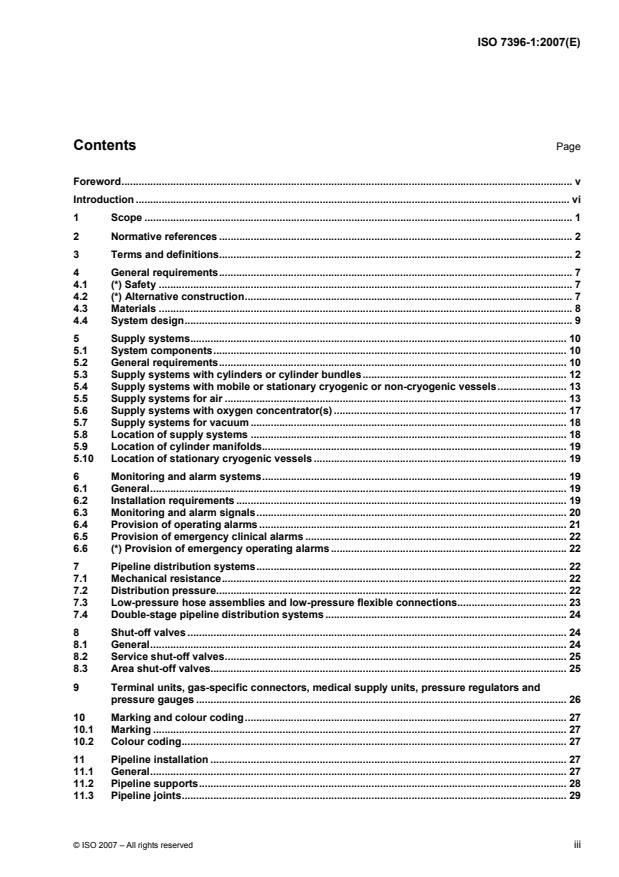
Contents Page
Foreword. v
Introduction . vi
1 Scope . 1
2 Normative references . 2
3 Terms and definitions. 2
4 General requirements. 7
4.1 (*) Safety . 7
4.2 (*) Alternative construction. 7
4.3 Materials . 8
4.4 System design. 9
5 Supply systems. 10
5.1 System components. 10
5.2 General requirements. 10
5.3 Supply systems with cylinders or cylinder bundles. 12
5.4 Supply systems with mobile or stationary cryogenic or non-cryogenic vessels. 13
5.5 Supply systems for air . 13
5.6 Supply systems with oxygen concentrator(s) . 17
5.7 Supply systems for vacuum . 18
5.8 Location of supply systems . 18
5.9 Location of cylinder manifolds. 19
5.10 Location of stationary cryogenic vessels .19
6 Monitoring and alarm systems. 19
6.1 General. 19
6.2 Installation requirements . 19
6.3 Monitoring and alarm signals. 20
6.4 Provision of operating alarms . 21
6.5 Provision of emergency clinical alarms . 22
6.6 (*) Provision of emergency operating alarms . 22
7 Pipeline distribution systems. 22
7.1 Mechanical resistance. 22
7.2 Distribution pressure. 22
7.3 Low-pressure hose assemblies and low-pressure flexible connections. 23
7.4 Double-stage pipeline distribution systems . 24
8 Shut-off valves . 24
8.1 General. 24
8.2 Service shut-off valves. 25
8.3 Area shut-off valves. 25
9 Terminal units, gas-specific connectors, medical supply units, pressure regulators and
pressure gauges . 26
10 Marking and colour coding. 27
10.1 Marking . 27
10.2 Colour coding. 27
11 Pipeline installation . 27
11.1 General. 27
11.2 Pipeline supports. 28
11.3 Pipeline joints. 29
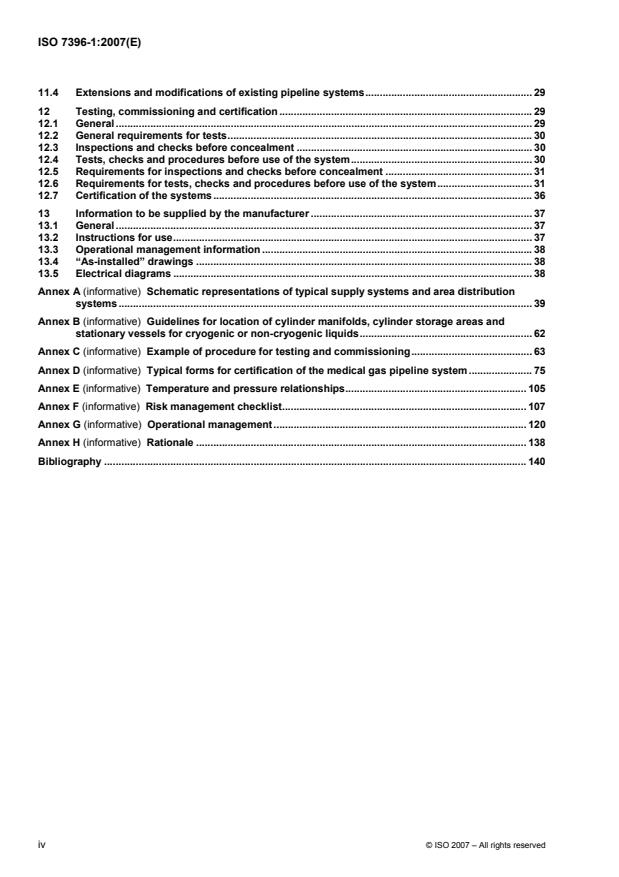
11.4 Extensions and modifications of existing pipeline systems. 29
12 Testing, commissioning and certification .29
12.1 General . 29
12.2 General requirements for tests. 30
12.3 Inspections and checks before concealment . 30
12.4 Tests, checks and procedures before use of the system. 30
12.5 Requirements for inspections and checks before concealment . 31
12.6 Requirements for tests, checks and procedures before use of the system. 31
12.7 Certification of the systems. 36
13 Information to be supplied by the manufacturer . 37
13.1 General . 37
13.2 Instructions for use. 37
13.3 Operational management information .38
13.4 “As-installed” drawings . 38
13.5 Electrical diagrams . 38
Annex A (informative) Schematic representations of typical supply systems and area distribution
systems. 39
Annex B (informative) Guidelines for location of cylinder manifolds, cylinder storage areas and
stationary vessels for cryogenic or non-cryogenic liquids. 62
Annex C (informative) Example of procedure for testing and commissioning. 63
Annex D (informative) Typical forms for certification of the medical gas pipeline system. 75
Annex E (informative) Temperature and pressure relationships. 105
Annex F (informative) Risk management checklist. 107
Annex G (informative) Operational management. 120
Annex H (informative) Rationale . 138
Bibliography . 140
iv © ISO 2007 – All rights reserved
Foreword
ISO (the International Organization for Standardization) is a worldwide federation of national standards bodies
(ISO member bodies). The work of preparing International Standards is normally carried out through ISO
technical committees. Each member body interested in a subject for which a technical committee has been
established has the right to be represented on that committee. International organizations, governmental and
non-governmental, in liaison with ISO, also take part in the work. ISO collaborates closely with the
International Electrotechnical Commission (IEC) on all matters of electrotechnical standardization.
International Standards are drafted in accordance with the rules given in the ISO/IEC Directives, Part 2.
The main task of technical committees is to prepare International Standards. Draft International Standards
adopted by the technical committees are circulated to the member bodies for voting. Publication as an
International Standard requires approval by at least 75 % of the member bodies casting a vote.
Attention is drawn to the possibility that some of the elements of this document may be the subject of patent
rights. ISO shall not be held responsible for identifying any or all such patent rights.
ISO 7396-1 was prepared by the European Committee for Standardization (CEN) Technical Committee
CEN/TC 215, Respiratory and anaesthetic equipment, in collaboration with Technical Committee ISO/TC 121,
Anaesthetic and respiratory equipment, Subcommittee SC 6, Medical gas systems, in accordance with the
Agreement on technical cooperation between ISO and CEN (Vienna Agreement).
This second edition cancels and replaces the first edition (ISO 7396-1:2002), which has been technically
revised.
ISO 7396 consists of the following parts, under the general title Medical gas pipeline systems:
⎯ Part 1: Pipeline systems for compressed medical gases and vacuum
⎯ Part 2: Anaesthetic gas scavenging disposal systems
Introduction
Many healthcare facilities use pipeline systems to deliver medical gases and to provide vacuum to areas
where they are used in patient care or to power equipment such as ventilators and surgical tools.
This part of ISO 7396 specifies requirements for pipeline systems for compressed medical gases, gases for
driving surgical tools and vacuum. It is intended for use by those persons involved in the design, construction,
inspection and operation of healthcare facilities treating human beings. Those persons involved in the design,
manufacture and testing of equipment intended to be connected to pipeline systems should also be aware of
the contents of this document.
This part of ISO 7396 seeks to ensure that medical gas pipelines contain only the specific gas (or vacuum)
intended to be supplied. For this reason, gas-specific components are used for terminal units and for other
connectors which are intended to be used by the operator. In addition, each system is tested and certified to
contain only the specific gas (or vacuum).
The objectives of this part of ISO 7396 are to ensure the following:
a) non-interchangeability between different pipeline systems by design;
b) continuous supply of gases and vacuum at specified pressures by providing appropriate sources;
c) use of suitable materials;
d) cleanliness of components;
e) correct installation;
f) provision of monitoring and alarm systems;
g) correct marking of the pipeline system;
h) testing, commissioning and certification;
i) purity of the gases delivered by the pipeline system;
j) correct operational management.
Annex H contains rationale statements for some of the requirements of this part of ISO 7396. It is included to
provide additional insight into the reasoning that led to the requirements and recommendations that have been
incorporated in this part of ISO 7396. The clauses and subclauses marked with (*) after their number have a
corresponding rationale contained in Annex H.
vi © ISO 2007 – All rights reserved
INTERNATIONAL STANDARD ISO 7396-1:2007(E)
Medical gas pipeline systems —
Part 1:
Pipeline systems for compressed medical gases and vacuum
1 Scope
This part of ISO 7396 specifies requirements for design, installation, function, performance, documentation,
testing and commissioning of pipeline systems for compressed medical gases, gases for driving surgical tools
and vacuum in healthcare facilities to ensure continuous delivery of the correct gas and the provision of
vacuum from the pipeline system. It includes requirements for supply systems, pipeline distribution systems,
control systems, monitoring and alarm systems and non-interchangeability between components of different
gas systems.
This part of ISO 7396 is applicable to:
a) pipeline systems for the following medical gases:
⎯ oxygen;
⎯ nitrous oxide;
⎯ medical air;
⎯ carbon dioxide;
⎯ oxygen/nitrous oxide mixtures (see Note 1);
b) pipeline systems for the following gases:
⎯ (*) oxygen-enriched air;
⎯ air for driving surgical tools;
⎯ nitrogen for driving surgical tools;
c) pipeline systems for vacuum.
This part of ISO 7396 also applies to:
⎯ extensions of existing pipeline distribution systems;
⎯ modifications of existing pipeline distribution systems;
⎯ modifications or replacement of supply systems or sources of supply.
NOTE 1 Regional or national regulations can prohibit the distribution of oxygen/nitrous oxide mixtures in medical gas
pipeline systems.
[23]
(*) NOTE 2 EN 14931 defines additional or alternative requirements for the specific application, in particular for flows
and pressures of compressed air required to pressurize the hyperbaric chambers and to drive other connected services
and of oxygen and other treatment gases administered to patients.
2 Normative references
The following referenced documents are indispensable for the application of this document. For dated
references, only the edition cited applies. For undated references, the latest edition of the referenced
document (including any amendments) applies.
ISO 3746, Acoustics — Determination of sound power levels and sound energy levels of noise sources using
sound pressure — Survey method using an enveloping measurement surface over a reflecting plane
ISO 5359, Low-pressure hose assemblies for use with medical gases
ISO 8573-1:2001, Compressed air — Part 1: Contaminants and purity classes
ISO 9170-1, Terminal units for medical gas pipeline systems — Part 1: Terminal units for use with
compressed medical gases and vacuum
ISO 10083, Oxygen concentrator supply systems for use with medical gas pipeline systems
ISO 10524-2, Pressure regulators for use with medical gases — Part 2: Manifold and line pressure regulators
ISO 11197, Medical supply units
ISO 14971, Medical devices — Application of risk management to medical devices
ISO 15001:2003, Anaesthetic and respiratory equipment — Compatibility with oxygen
ISO 21969, High-pressure flexible connections for use with medical gas systems
IEC 60601-1-8, Medical electrical equipment — Part 1-8: General requirements for safety — Collateral
standard: General requirements, tests and guidance for alarm systems in medical electrical equipment and
medical electrical systems
EN 286-1, Simple unfired pressure vessels designed to contain air or nitrogen — Part 1: Pressure vessels for
general purposes
EN 1041, Information supplied by the manufacturer with medical devices
EN 13348, Copper and copper alloys — Seamless, round copper tubes for medical gases or vacuum
3 Terms and definitions
For the purposes of this document, the following terms and definitions apply.
3.1
air compressor system
supply system with compressor(s) designed to provide medical air or air for driving surgical tools or both
3.2
air for driving surgical tools
natural or synthetic mixture of gases, mainly composed of oxygen and nitrogen in specified proportions, with
defined limits for the concentration of contaminants, supplied by a medical gas pipeline system and intended
for driving surgical tools
NOTE Different names or symbols are used for air for driving surgical tools, such as instrument air, surgical air, air
motor, air - 700 and air - 800.
2 © ISO 2007 – All rights reserved
3.3
branch
portion of the pipeline distribution system which supplies one or more areas on the same floor of the facility
3.4
commissioning
proof of function to verify that the agreed system specification is met and is accepted by the user or his
representative
3.5
control equipment
items necessary to maintain the medical gas pipeline system within the specified operating parameters
NOTE Examples of control equipment are pressure regulators, pressure-relief valves, alarms, sensors, manual or
automatic valves and non-return valves.
3.6
cryogenic liquid system
supply system containing a gas stored in the liquid state in a vessel at temperatures lower than −150 °C
3.7
cylinder bundle
pack or pallet of cylinders linked together with one or more connectors for filling and emptying
3.8
diversity factor
factor which represents the maximum proportion of terminal units in a defined clinical area which will be used
at the same time, at flowrates defined in agreement with the management of the healthcare facility
3.9
double-stage pipeline distribution system
pipeline distribution system in which gas is initially distributed from the supply system at a pressure higher
than the nominal distribution pressure, and is then reduced to the nominal distribution pressure by line
pressure regulator(s)
NOTE This initial higher pressure is the nominal supply system pressure (see 3.32).
3.10
emergency clinical alarm
alarm to indicate to medical and technical staff that there is abnormal pressure within a pipeline that requires
an immediate response
3.11
emergency inlet point
inlet point which allows the connection of an emergency supply
3.12
emergency operating alarm
alarm to indicate to technical staff that there is abnormal pressure within a pipeline that requires an immediate
response
3.13
emergency supply
source of supply intended to be connected to an emergency inlet point
3.14
gas-specific
having characteristics which prevent connections between different gas services
3.15
gas-specific connector
connector with dimensional characteristics which prevent connections between different gas services
NOTE Examples of gas-specific connectors are quick connectors, screw-threaded connectors, diameter-indexed
safety system (DISS) connectors or non-interchangeable screw-threaded (NIST) connectors.
3.16
high-dependency patient
patient with a continual need of a medical gas/vacuum supply, who will be adversely affected by a medical
gas/vacuum supply failure to such a degree that his/her clinical condition or his/her safety can be
compromised
3.17
information signal
visual indication of normal status
3.18
line pressure regulator
pressure regulator intended to supply the nominal distribution pressure to the terminal units
3.19
low-pressure hose assembly
assembly consisting of a flexible hose with permanently attached gas-specific inlet and outlet connectors and
designed to conduct a medical gas at pressures less than 1 400 kPa
3.20
main line
portion of the pipeline distribution system connecting the supply system to risers and/or branches
3.21
maintenance supply assembly
inlet point which allows the connection of a maintenance supply
3.22
maintenance supply
source of supply intended to supply the system during maintenance
3.23
manifold
device for connecting the outlet(s) of one or more cylinders or cylinder bundles of the same gas to the pipeline
system
3.24
manifold pressure regulator
pressure regulator intended to be installed within sources of supply containing cylinders or cylinder bundles
3.25
manufacturer
natural or legal person with responsibility for the design, manufacture, packaging and labelling of a device
before it is placed on the market under his own name, regardless of whether these operations are carried out
by that person himself or on his behalf by a third party
3.26
maximum distribution pressure
pressure at any terminal unit when the pipeline system is operating at zero flow
4 © ISO 2007 – All rights reserved
3.27
medical air
natural or synthetic mixture of gases, mainly composed of oxygen and nitrogen in specified proportions, with
defined limits for the concentration of contaminants, supplied by a medical gas pipeline system and intended
for administration to patients
NOTE 1 Medical air can be produced by supply systems with air compressors or by supply systems with proportioning
units.
NOTE 2 Medical air produced by air compressor systems is called “medicinal air” by European Pharmacopoeia 2005.
NOTE 3 Medical air produced by proportioning systems is called “synthetic medicinal air” by European
Pharmacopoeia 2005.
3.28
medical gas
any gas or mixture of gases intended for administration to patients for anaesthetic, therapeutic, diagnostic or
prophylactic purposes
3.29
medical gas pipeline system
complete system which comprises a supply system, a monitoring and alarm system and a distribution system
with terminal units at the points where medical gases or vacuum are required
3.30
minimum distribution pressure
lowest pressure occurring at any terminal unit when the pipeline system is operating at the system design flow
3.31
nominal distribution pressure
pressure which the medical gas pipeline system is intended to deliver at the terminal units
3.32
nominal supply system pressure
pressure which the supply system is intended to deliver at the inlet to the line pressure regulators
3.33
non-cryogenic liquid system
supply system containing a gas stored under pressure in the liquid state in a vessel at temperatures not lower
than −50 °C
3.34
non-return valve
valve which permits flow in one direction only
3.35
operating alarm
alarm to indicate to technical staff that it is necessary to replenish the gas supply or to correct a malfunction
3.36
oxygen concentrator
device which produces oxygen-enriched air from ambient air by extraction of nitrogen
3.37
oxygen-enriched air
gas produced by an oxygen concentrator
3.38
pipeline distribution system
portion of a medical gas or vacuum pipeline system linking the sources of supply of the supply system to the
terminal units
3.39
pressure regulator
device which reduces the inlet pressure and maintains the set outlet pressure within specified limits
3.40
pressure-relief valve
device intended to relieve excess pressure at a preset pressure value
3.41
primary source of supply
portion of the supply system which supplies the pipeline distribution system
3.42
proportioning unit
device in which gases are mixed in a specified ratio
3.43
reserve source of supply
that portion of the supply system which supplies the complete, or a portion(s) of the, pipeline distribution
system in the event of failure or exhaustion of both the primary and secondary sources of supply
3.44
riser
portion of the pipeline distribution system traversing one or more floors and connecting the main line with
branch lines on various levels
3.45
secondary source of supply
portion of the supply system which supplies the pipeline distribution system in the event of exhaustion or
failure of the primary source of supply
3.46
shut-off valve
valve which prevents flow in both directions when closed
3.47
silencing
temporary stopping of an auditory alarm signal by manual action
NOTE This is also referred to as audio pausing.
3.48
single fault condition
condition in which a single means for protection against a safety hazard in equipment is defective or a single
external abnormal condition is present
NOTE Maintenance of equipment is considered a normal condition.
3.49
single-stage pipeline distribution system
pipeline distribution system in which gas is distributed from the supply system at the nominal distribution
pressure
3.50
source of supply
portion of the supply system with associated control equipment which supplies the pipeline distribution system
6 © ISO 2007 – All rights reserved
3.51
supply pressure regulator
pressure regulator fitted within a source of supply and intended to regulate the pressure supplied to the line
pressure regulator(s)
NOTE For a source of supply with cylinders or cylinder bundles, this is referred to as the manifold pressure regulator.
3.52
supply system
assembly which supplies the pipeline distribution system and which includes all sources of supply
3.53
system design flow
flow calculated from the maximum flow requirement of the healthcare facility and corrected by the diversity
factor(s)
3.54
terminal unit
outlet assembly (inlet for vacuum) in a medical gas pipeline system at which the operator makes connections
and disconnections
3.55
vacuum supply system
supply system equipped with vacuum pumps designed to provide a flow at negative pressure
4 General requirements
4.1 (*) Safety
Medical gas pipeline systems shall, when installed, extended, modified, commissioned, operated and
maintained according to the instructions of the manufacturer, present no risks that are not reduced to an
acceptable level using risk management procedures in accordance with ISO 14971 and which are connected
with their intended application, in normal condition and in single fault condition.
NOTE 1 A situation in which a fault is not detected is considered a normal condition. Fault conditions/hazardous
situations can remain undetected over a period of time and as a consequence can lead to an unacceptable risk. In that
case, a subsequent detected fault condition needs to be considered as a single fault condition. Specific risk control
measures to deal with such situations need to be determined within the risk management process.
NOTE 2 Typical safety hazards (including discontinuity of supply, incorrect pressure and/or flow, wrong gas supply,
wrong gas composition, contamination, leakage, fire) are listed in Annex F.
4.2 (*) Alternative construction
Pipeline installations and components, or parts thereof, using materials or having forms of construction
different from those detailed in this part of ISO 7396, shall be presumed to be in compliance with the safety
objectives of this part of ISO 7396 if it can be demonstrated that an equivalent degree of safety is obtained
(i.e. compliance with requirements presumes that risks have been mitigated to acceptable levels) unless
objective evidence to the contrary becomes available.
NOTE 1 Objective evidence can be obtained by post-market surveillance.
Evidence of an equivalent degree of safety shall be provided by the manufacturer.
NOTE 2 Regional or national regulations can require the provision of evidence to a competent authority or a conformity
assessment body, e.g. to a notified body in the European Economic Area (EEA) upon request.
4.3 Materials
4.3.1 (*) The manufacturer shall disclose, upon request, evidence of the corrosion resistance of the
materials used for pipes and fittings.
NOTE Corrosion resistance includes resistance against the influence of moisture and the surrounding materials.
4.3.2 (*) The manufacturer shall disclose, upon request, evidence that the materials used in components of
the medical gas pipeline system which come into contact with the actual gas shall be compatible with the
actual gas and oxygen under normal and single fault condition. If lubricants are used, except within air
compressors and vacuum pumps, they shall be compatible with oxygen during normal and single fault
condition of the pipeline system.
Evidence shall be provided by the manufacturer.
NOTE 1 Criteria for the selection of metallic and non-metallic materials are given in ISO 15001.
NOTE 2 Regional or national regulations can require the provision of evidence to a notified body or competent authority
upon request.
NOTE 3 Compatibility with oxygen involves both combustibility and ease of ignition. Materials which burn in air will burn
violently in pure oxygen. Many materials which do not burn in air will do so in pure oxygen, particularly under pressure.
Similarly, materials which can be ignited in air require less energy to ignite in oxygen. Many such materials can be ignited
by friction at a valve seat or by adiabatic compression produced when oxygen at high pressure is rapidly introduced into a
system initially at low pressure.
4.3.3 The specific hazards of toxic products from combustion or decomposition of non-metallic materials
(including lubricants, if used) and potential contaminants shall be addressed. Some potential products of
combustion and/or decomposition for some commonly available non-metallic materials are listed in Table D.7
of ISO 15001:2003.
NOTE Typical “oxygen-compatible” lubricants can generate toxic products on combustion or decomposition.
Annex E of ISO 15001:2003 gives details of suitable test and quantitative analysis methods for the products of
combustion of non-metallic materials. Data from such tests shall be considered in any risk evaluation.
4.3.4 (*) Components of systems which can be exposed to cylinder pressure in normal or single fault
condition shall function according to their specifications after being exposed to a pressure of 1,5 times the
cylinder working pressure for 5 min.
Evidence shall be provided by the manufacturer.
NOTE Regional or national regulations can require the provision of evidence to a notified body or competent authority
upon request.
4.3.5 (*) Components of systems which can be exposed to cylinder pressure in normal or single fault
condition shall not ignite or show internal scorching damage when submitted to oxygen pressure shocks. The
test for resistance to ignition shall be in accordance with ISO 10524-2.
Evidence shall be provided by the manufacturer.
NOTE Regional or national regulations can require the provision of evidence to a notified body or competent authority
upon request.
4.3.6 (*) Except for low-pressure hose assemblies and low-pressure flexible connections, metallic materials
shall be used for compressed medical gas pipelines. If copper pipes of u 108 mm diameter are used for
pipelines, they shall comply with EN 13348 or equivalent national standards. Copper pipes of > 108 mm
diameter and pipes of materials other than copper which are used for compressed medical gases shall comply
with the cleanliness requirements of EN 13348 or equivalent national standards. If non-metallic materials are
used for vacuum pipelines, these materials shall be compatible with the potential contaminants that can be
present in the vacuum system.
8 © ISO 2007 – All rights reserved
Evidence shall be provided by the manufacturer.
NOTE 1 Regional or national regulations can require the provision of evidence to a notified body or competent authority
upon request.
NOTE 2 Copper pipes of > 108 mm diameter are not covered by EN 13348.
NOTE 3 Copper is the preferred material for all medical gas pipelines, including vacuum.
4.3.7 Pipeline components which come in contact with the actual gas shall be supplied in a clean condition
(see 4.3.8) and protected from contamination prior to, and during, installation.
4.3.8 (*) Components of the system other than pipes, which are liable to come in contact with the actual gas,
shall meet the cleanliness requirements of ISO 15001.
NOTE Examples of cleaning procedures are described in ISO 15001.
4.3.9 Materials for pipelines and components installed in the vicinity of strong magnetic or electromagnetic
fields [e.g. Nuclear Magnetic Resonance (NMR), Magnetic Resonance Imaging (MRI)] shall be selected for
compatibility with these applications.
4.4 System design
4.4.1 General
The number of terminal units per bed-space/work-space and their location in each department or area of the
healthcare facility, together with the corresponding flowrates required and the diversity factors, shall be
defined by the management of the healthcare facility in consultation with the system manufacturer.
NOTE 1 Typical examples of locations of terminal units, flow requirements and diversity factors are given in
[25], [26] [24] [16] [30]
HTM 02 , FD S 90-155 , AS 2896-1998 and SIS HB 370 .
The sizing of the pipelines shall take into account the potential hazards arising from high gas velocity.
[24] [30]
NOTE 2 Examples of maximum recommended gas velocity are given in FD S 90-155 and SIS HB 370 .
4.4.2 Extensions and modifications of existing pipeline systems
Extensions and modifications of existing pipeline systems shall comply with the relevant requirements of this
part of ISO 7396. In addition, the following requirements apply:
a) the flow capacity of the supply system shall continue to meet the flow requirements of the extended or
modified pipeline system. For this purpose, the existing supply system might need to be upgraded;
b) the flow and pressure drop characteristics of the existing pipeline distribution system shall continue to
meet at least the original design specifications;
c) the flow and pressure drop characteristics of the extension or modification to the existing pipeline
distribution system shall meet the requirements of 7.2. For this purpose, modifications of the existing
pipeline distribution system might be needed.
5 Supply systems
5.1 System components
5.1.1 Except for air or nitrogen for driving surgical tools, each supply system shall comprise at least three
independent sources of supply which can be a combination of the following:
a) gas in cylinders or cylinder bundles;
b) non-cryogenic liquid in cylinders;
c) cryogenic or non-cryogenic liquid in mobile vessels;
d) cryogenic or non-cryogenic liquid in stationary vessels;
e) an air compressor system;
f) a proportioning system;
g) an oxygen concentrator system (see ISO 10083).
5.1.2 A supply system for air or nitrogen for driving surgical tools shall comprise at least two sources of
supply.
5.1.3 A supply system for vacuum shall consist of at least three vacuum pumps.
5.1.4 Schematic representations of typical supply systems are given in Annex A (Figures A.1 to A.27).
5.2 General requirements
5.2.1 Capacity and storage
The capacity and storage of any supply system shall be based on the estimated usage and frequency of
delivery. The location and the capacity of the primary, secondary and reserve sources of supply of all supply
systems and the number of full cylinders held in storage, as defined by the management of the healthcare
facility in consultation with the gas supplier using risk management principles, shall be taken into account by
the system manufacturer. Appropriate undercover storage facilities for cylinders should be provided to ensure
that the cylinders are maintained in a safe, secured and clean condition.
5.2.2 Continuity of supply
5.2.2.1 The supply systems for compressed medical gases and vacuum shall be designed to achieve
continuity of system design flow at a distribution pressure complying with 7.2 in normal condition and in single
fault condition.
NOTE Loss of mains electrical power or water supply is a single fault condition. A fault in control equipment is a
single fault condition.
In order to achieve this objective,
a) the supply systems for compressed medical gases and vacuum shall comprise at least three sources of
supply, i.e. primary source of supply, secondary source of supply and reserve source of supply, and
b) the layout and the location of the pipelines shall reduce the risk of mechanical damage of the pipeline to
an acceptable level.
Failure of the pipeline is considered a catastrophic event and not a single fault condition, and should be
managed in accordance with the emergency procedure (see Annex G).
10 © ISO 2007 – All rights reserved
5.2.2.2 Control equipment shall be designed so that components can be maintained without interrupting
the gas supply.
5.2.3 Primary source of supply
The primary source of supply shall be permanently connected and shall be the main source of supply to the
medical gas pipeline.
5.2.4 Secondary source of supply
The secondary source of supply shall be permanently connected and shall automatically supply the pipeline in
the event that the primary source of supply is unable to supply the pipeline.
5.2.5 Reserve source of supply
The reserve source of supply shall be permanently connected. Activation of the reserve supply in the event of
both the primary and the secondary sources of supply being unable to supply the pipeline or for maintenance
can be automatic or manual. A reserve source of supply can also be required for air or nitrogen for driving
surgical tools.
The manufacturer together with the healthcare facility management shall determine the location of the reserve
source(s) of supply to cover the complete pipeline system.
NOTE This can result in a number of reserve sources of supply, some or all of which could be close to the terminal
units.
5.2.6 Means of pressure relief
5.2.6.1 For all compressed medical gases except air, pressure-relief valves shall be vented to the outside
of the building and the vents shall be provided with means to prevent the ingress of, for example, insects,
debris and water. The vents shall be located remote from any air intakes, doors, windows or other openings in
buildings. Consideration shall be given to the potential effects of prevailing winds on the location of the vents.
5.2.6.2 All pressure-relief valves shall close automatically when excess pressure has been released.
5.2.6.3 It shall not be possible to isolate a means of pressure relief, for example by a shut-off valve, from
the pipeline or the pressure regulator to which it is connected. If a valve or a flow-limiting device is
incorporated for maintenance, it shall be fully opened by the insertion of the means of pressure relief.
[1]
NOTE Attention is drawn to regional, national and international standards for pressure-relief valves, e.g. ISO 4126-1 .
5.2.6.4 Means shall be provided to protect the pressure-relief valve from tampering.
5.2.6.5 Any portion of a pipeline within a supply system where gas in liquid phase can be entrapped
between two shut-off valves shall be provided with means to relieve excess pressure resulting from
vaporization of the liquid.
5.2.7 Maintenance supply assembly
5.2.7.1 Except for pipelines for vacuum and air or nitrogen for driving surgical tools, one or more
maintenance supply assemblies shall be provided downstream of the main shut-off valve(s).
The manufacturer together with the healthcare facility management shall determine the location of the
maintenance supply assembly.
5.2.7.2 The maintenance supply assembly shall have a gas-specific inlet connector, a means of pressure
relief, a non-return valve and a shut-off valve. The design of the supply assembly shall take into account the
flow which can be required under maintenance conditions. The supply assembly shall be physically protected
to prevent tampering and
...
NORME ISO
INTERNATIONALE 7396-1
Deuxième édition
2007-04-01
Version corrigée
2007-10-15
Systèmes de distribution de gaz
médicaux —
Partie 1:
Systèmes de distribution de gaz
médicaux comprimés et de vide
Medical gas pipeline systems —
Part 1: Pipeline systems for compressed medical gases and vacuum
Numéro de référence
©
ISO 2007
PDF – Exonération de responsabilité
Le présent fichier PDF peut contenir des polices de caractères intégrées. Conformément aux conditions de licence d'Adobe, ce fichier
peut être imprimé ou visualisé, mais ne doit pas être modifié à moins que l'ordinateur employé à cet effet ne bénéficie d'une licence
autorisant l'utilisation de ces polices et que celles-ci y soient installées. Lors du téléchargement de ce fichier, les parties concernées
acceptent de fait la responsabilité de ne pas enfreindre les conditions de licence d'Adobe. Le Secrétariat central de l'ISO décline toute
responsabilité en la matière.
Adobe est une marque déposée d'Adobe Systems Incorporated.
Les détails relatifs aux produits logiciels utilisés pour la création du présent fichier PDF sont disponibles dans la rubrique General Info
du fichier; les paramètres de création PDF ont été optimisés pour l'impression. Toutes les mesures ont été prises pour garantir
l'exploitation de ce fichier par les comités membres de l'ISO. Dans le cas peu probable où surviendrait un problème d'utilisation,
veuillez en informer le Secrétariat central à l'adresse donnée ci-dessous.
© ISO 2007
Droits de reproduction réservés. Sauf prescription différente, aucune partie de cette publication ne peut être reproduite ni utilisée sous
quelque forme que ce soit et par aucun procédé, électronique ou mécanique, y compris la photocopie et les microfilms, sans l'accord écrit
de l'ISO à l'adresse ci-après ou du comité membre de l'ISO dans le pays du demandeur.
ISO copyright office
Case postale 56 • CH-1211 Geneva 20
Tel. + 41 22 749 01 11
Fax. + 41 22 749 09 47
E-mail copyright@iso.org
Web www.iso.org
Publié en Suisse
ii © ISO 2007 – Tous droits réservés
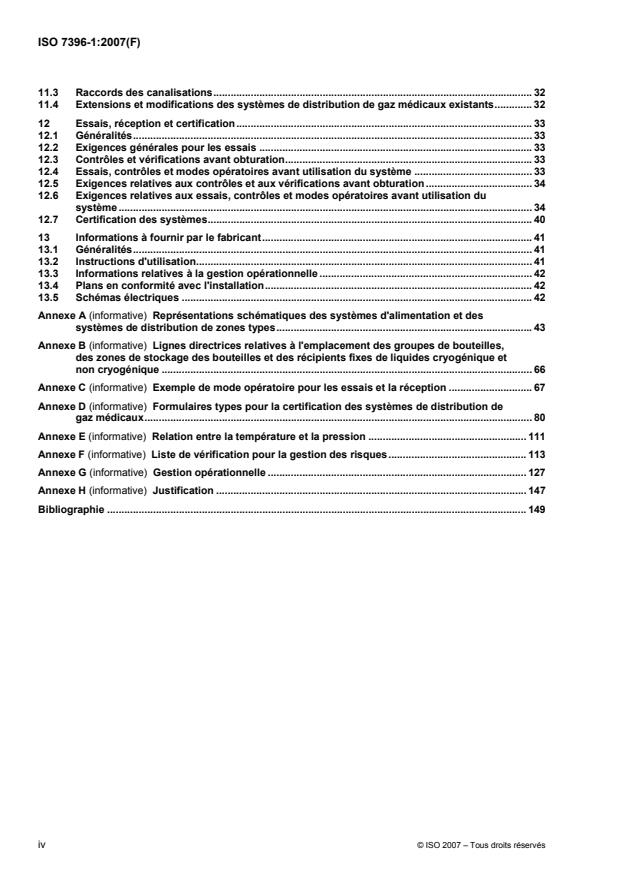
Sommaire Page
Avant-propos. v
Introduction . vi
1 Domaine d'application. 1
2 Références normatives . 2
3 Termes et définitions. 2
4 Exigences générales . 7
4.1 (*) Sécurité . 7
4.2 (*) Autre construction. 8
4.3 Matériaux . 8
4.4 Conception du système . 10
5 Systèmes d'alimentation. 10
5.1 Composants du système . 10
5.2 Exigences générales . 11
5.3 Systèmes d'alimentation par bouteilles ou par cadres de bouteilles . 13
5.4 Systèmes d'alimentation par récipients cryogéniques ou non cryogéniques mobiles ou
fixes. 14
5.5 Systèmes d'alimentation en air . 14
5.6 Systèmes d'alimentation équipés de concentrateur(s) d'oxygène. 19
5.7 Systèmes d'alimentation en vide médical. 19
5.8 Emplacement des systèmes d'alimentation . 20
5.9 Emplacement des groupes de bouteilles. 20
5.10 Emplacement des récipients cryogéniques fixes . 20
6 Systèmes de surveillance et systèmes d'alarme. 20
6.1 Généralités . 20
6.2 Exigences relatives à l'installation. 21
6.3 Signaux de surveillance et signaux d'alarme . 21
6.4 Dispositions relatives aux alarmes de contrôle de fonctionnement. 23
6.5 Dispositions relatives aux alarmes d'urgence médicale . 23
6.6 (*) Dispositions relatives aux alarmes de contrôle de fonctionnement d'urgence. 24
7 Systèmes de distribution . 24
7.1 Résistance mécanique . 24
7.2 Pression de service . 24
7.3 Flexibles et raccords à basse pression. 26
7.4 Système de distribution à deux niveaux de pression. 26
8 Vannes de sectionnement . 26
8.1 Généralités . 26
8.2 Vannes de sectionnement d'exploitation . 27
8.3 Vannes de sectionnement de zone. 28
9 Prises murales, raccords spécifiques au gaz, gaines techniques médicales, détendeurs et
manomètres. 29
10 Marquage et code couleur . 29
10.1 Marquage . 29
10.2 Code couleur . 30
11 Installation des canalisations. 30
11.1 Généralités . 30
11.2 Supports de canalisation . 31
11.3 Raccords des canalisations. 32
11.4 Extensions et modifications des systèmes de distribution de gaz médicaux existants. 32
12 Essais, réception et certification. 33
12.1 Généralités. 33
12.2 Exigences générales pour les essais . 33
12.3 Contrôles et vérifications avant obturation. 33
12.4 Essais, contrôles et modes opératoires avant utilisation du système . 33
12.5 Exigences relatives aux contrôles et aux vérifications avant obturation . 34
12.6 Exigences relatives aux essais, contrôles et modes opératoires avant utilisation du
système. 34
12.7 Certification des systèmes. 40
13 Informations à fournir par le fabricant. 41
13.1 Généralités. 41
13.2 Instructions d'utilisation. 41
13.3 Informations relatives à la gestion opérationnelle . 42
13.4 Plans en conformité avec l'installation. 42
13.5 Schémas électriques . 42
Annexe A (informative) Représentations schématiques des systèmes d'alimentation et des
systèmes de distribution de zones types.43
Annexe B (informative) Lignes directrices relatives à l'emplacement des groupes de bouteilles,
des zones de stockage des bouteilles et des récipients fixes de liquides cryogénique et
non cryogénique . 66
Annexe C (informative) Exemple de mode opératoire pour les essais et la réception . 67
Annexe D (informative) Formulaires types pour la certification des systèmes de distribution de
gaz médicaux. 80
Annexe E (informative) Relation entre la température et la pression . 111
Annexe F (informative) Liste de vérification pour la gestion des risques. 113
Annexe G (informative) Gestion opérationnelle . 127
Annexe H (informative) Justification . 147
Bibliographie . 149
iv © ISO 2007 – Tous droits réservés
Avant-propos
L'ISO (Organisation internationale de normalisation) est une fédération mondiale d'organismes nationaux de
normalisation (comités membres de l'ISO). L'élaboration des Normes internationales est en général confiée
aux comités techniques de l'ISO. Chaque comité membre intéressé par une étude a le droit de faire partie du
comité technique créé à cet effet. Les organisations internationales, gouvernementales et non
gouvernementales, en liaison avec l'ISO participent également aux travaux. L'ISO collabore étroitement avec
la Commission électrotechnique internationale (CEI) en ce qui concerne la normalisation électrotechnique.
Les Normes internationales sont rédigées conformément aux règles données dans les Directives ISO/CEI,
Partie 2.
La tâche principale des comités techniques est d'élaborer les Normes internationales. Les projets de Normes
internationales adoptés par les comités techniques sont soumis aux comités membres pour vote. Leur
publication comme Normes internationales requiert l'approbation de 75 % au moins des comités membres
votants.
L'attention est appelée sur le fait que certains des éléments du présent document peuvent faire l'objet de
droits de propriété intellectuelle ou de droits analogues. L'ISO ne saurait être tenue pour responsable de ne
pas avoir identifié de tels droits de propriété et averti de leur existence.
L'ISO 7396-1 a été élaborée par le comité technique CEN/TC 215, Équipement respiratoire et anesthésique,
du Comité européen de normalisation (CEN) en collaboration avec le comité technique ISO/TC 121, Matériel
d'anesthésie et de réanimation respiratoire, sous-comité SC 6, Systèmes de gaz médicaux, conformément à
l'Accord de coopération technique entre l'ISO et le CEN (Accord de Vienne).
Cette deuxième édition annule et remplace la première édition (ISO 7396-1:2002), qui a fait l'objet d'une
révision technique.
L'ISO 7396 comprend les parties suivantes, présentées sous le titre général Réseaux de distribution de gaz
médicaux:
⎯ Partie 1: Systèmes de distribution de gaz médicaux comprimés et de vide
⎯ Partie 2: Réseaux d'évacuation de gaz d'anesthésie non réutilisables
La présente version corrigée de l'ISO 7396-1:2007 inclut les corrections suivantes:
⎯ page de titre, Avant-propos et p. 1, le titre a été modifié comme suit: «Systèmes de distribution de gaz
médicaux — Partie 1: Systèmes de distribution de gaz médicaux comprimés et de vide»;
⎯ dans tout le document «monoxyde d’azote» a été remplacé par «protoxyde d'azote».
Introduction
De nombreux établissements de soins utilisent des systèmes de distribution pour la fourniture de gaz et de
vide médicaux aux services concernés dans le cadre des soins aux patients ou pour l'alimentation d'appareils
tels que des ventilateurs et des instruments chirurgicaux.
La présente partie de l'ISO 7396 spécifie des exigences relatives aux systèmes de distribution de gaz
médicaux comprimés, de gaz moteurs des instruments chirurgicaux et de vide médical. Elle s'adresse aux
personnes en charge de la conception, de la construction, du contrôle et du fonctionnement des
établissements de soins pour les êtres humains. Il convient que le contenu du présent document soit
communiqué aux personnes en charge de la conception, la fabrication et l'essai de l'appareil devant être
raccordé aux systèmes de distribution.
La présente partie de l'ISO 7396 vise à s'assurer que les systèmes de distribution de gaz médicaux ne
transportent que le gaz spécifique (ou le vide médical) dont la distribution est prévue. C'est pourquoi des
composants spécifiques à un gaz sont utilisés au niveau des prises murales et des autres branchements
devant être utilisés par l'opérateur. En outre, chaque système est soumis à essai et il est garanti de ne
contenir que le gaz spécifique (ou le vide).
La présente partie de l'ISO 7396 vise à garantir
a) l'absence d'interchangeabilité des différents systèmes de distribution de par leur conception,
b) la continuité de distribution de gaz et de vide médical à des pressions spécifiées, à l'aide de sources
adéquates,
c) l'utilisation de matériaux appropriés,
d) la propreté des composants,
e) une installation correcte,
f) la fourniture de systèmes de surveillance et d'alarme,
g) le marquage adéquat du système de distribution,
h) l'essai, la réception et la conformité,
i) la pureté des gaz distribués par le système de distribution,
j) une gestion opérationnelle adéquate.
L'exposé des motifs de certaines exigences de la présente partie de l'ISO 7396 est énoncé à l'Annexe H. Il
vise à faciliter la compréhension du raisonnement à l'origine des exigences et des recommandations
intégrées dans la présente partie de l'ISO 7396. Aux articles et paragraphes annotés d'un (*) après le numéro
du paragraphe correspond l'exposé des motifs énoncés à l'Annexe H.
vi © ISO 2007 – Tous droits réservés
NORME INTERNATIONALE ISO 7396-1:2007(F)
Systèmes de distribution de gaz médicaux —
Partie 1:
Systèmes de distribution de gaz médicaux comprimés et de
vide
1 Domaine d'application
La présente partie de l'ISO 7396 spécifie les exigences relatives à la conception, à l'installation, au
fonctionnement, aux performances, à la documentation, à l'essai et à la réception des systèmes de
distribution de gaz médicaux comprimés, de gaz moteurs pour les instruments chirurgicaux et de vide médical
dans les établissements de soins afin que le système de distribution assure une fourniture continue du gaz
prévu et du vide médical. Elle comporte des exigences relatives aux systèmes d'alimentation, de distribution,
de contrôle, de surveillance et d'alarme, ainsi qu'à l'absence d'interchangeabilité entre les composants de
plusieurs systèmes de distribution de gaz.
La présente partie de l'ISO 7396 s'applique également
a) aux systèmes de distribution des gaz médicaux suivants:
⎯ oxygène;
⎯ protoxyde d’azote;
⎯ air médical;
⎯ dioxyde de carbone;
⎯ mélanges d'oxygène et de protoxyde d’azote (voir Note 1);
b) aux systèmes de distribution des gaz suivants:
⎯ (*) air enrichi en oxygène;
⎯ air moteur des instruments chirurgicaux;
⎯ azote moteur des instruments chirurgicaux;
c) aux systèmes d'alimentation en vide médical.
La présente partie de l'ISO 7396 s'applique également
⎯ aux extensions des systèmes de distribution installés,
⎯ aux modifications des systèmes de distribution installés,
⎯ aux modifications ou au remplacement des systèmes d'alimentation ou des sources d'alimentation.
NOTE 1 Les réglementations locales ou nationales peuvent interdire la distribution de mélange d'oxygène et de
protoxyde d’azote par les systèmes de distribution de gaz médicaux.
[23]
(*) NOTE 2 L'EN 14931 se réfère à la présente partie de l'ISO 7396 et définisse des exigences supplémentaires ou de
substitution pour une application spécifique; il s'agit notamment des débits et des pressions d'air comprimé requis pour
mettre les chambres hyperbares sous pression et mettre en œuvre les autres services rattachés et l'oxygène, ainsi que
les autres gaz de traitement administrés aux patients.
2 Références normatives
Les documents de référence suivants sont indispensables pour l'application du présent document. Pour les
références datées, seule l'édition citée s'applique. Pour les références non datées, la dernière édition du
document de référence s'applique (y compris les éventuels amendements).
ISO 3746, Acoustique — Détermination des niveaux de puissance acoustique émis par les sources de bruit à
partir de la pression acoustique — Méthode de contrôle employant une surface de mesure enveloppante au-
dessus d'un plan réfléchissant
ISO 5359, Flexibles basse pression utilisés dans les systèmes de gaz médicaux
ISO 8573-1:2001, Air comprimé — Partie 1: Polluants et classes de pureté
ISO 9170-1, Prises murales pour réseaux de distribution de gaz médicaux — Partie 1: Prises murales pour les
gaz médicaux comprimés et le vide
ISO 10083, Systèmes d'approvisionnement par concentrateurs d'oxygène pour utilisation dans des réseaux
de distribution de gaz médicaux
ISO 10524-2, Détendeurs pour l'utilisation avec les gaz médicaux — Partie 2: Détendeurs de rampes et de
canalisations
ISO 11197, Gaines techniques à usage médical
ISO 14971, Dispositifs médicaux — Application de la gestion des risques aux dispositifs médicaux
ISO 15001:2003, Matériel d'anesthésie et respiratoire — Compatibilité avec l'oxygène
ISO 21969, Raccords flexibles haute pression pour utilisation avec les systèmes de gaz médicaux
CEI 60601-1-8, Appareils électromédicaux — Partie 1-8: Règles générales de sécurité — Normes collatérale:
Règles générales, essais et recommandations pour les systèmes d'alarme des appareils et des systèmes
électromédicaux
EN 286-1, Récipients à pression simples, non soumis à la flamme, destinés à contenir de l'air ou de l'azote —
Partie 1: Récipients pour usage général
EN 1041, Informations fournies par le fabricant avec les dispositifs médicaux
EN 13348, Cuivre et alliages de cuivre — Tubes ronds sans soudure en cuivre pour gaz médicaux ou le vide
3 Termes et définitions
Pour les besoins du présent document, les termes et définitions suivants s'appliquent.
3.1
système de production d'air par compresseurs
système d'alimentation comportant un ou plusieurs compresseurs, conçu pour fournir en air médical et/ou en
air moteur les instruments chirurgicaux
2 © ISO 2007 – Tous droits réservés
3.2
air moteur pour les instruments chirurgicaux
mélange de gaz naturels ou reconstitués, principalement composé d'oxygène et d'azote selon des proportions
spécifiées, avec des limites de concentration des contaminants définies, délivré par un système de distribution
de gaz médicaux et destiné à actionner les instruments chirurgicaux
NOTE Différents noms ou symboles sont utilisés pour l'air moteur des instruments chirurgicaux, tels que: air
instrument, air chirurgical, air moteur, air-700 et air-800.
3.3
branche
partie du système de distribution qui alimente une ou plusieurs zone(s) d'un même étage de l'établissement
3.4
réception
preuve de fonctionnement par vérification que la spécification agréée pour le système est obtenue et
acceptée par l'utilisateur ou son représentant
3.5
tableau de mise en œuvre
éléments nécessaires pour maintenir le système de distribution de gaz médicaux dans les limites de la
gamme des paramètres de fonctionnement spécifiés
NOTE Font partie de ces éléments, par exemple, les détendeurs, les soupapes de décharge, les alarmes, les
capteurs, les vannes manuelles ou automatiques et les clapets anti-retour.
3.6
source de gaz liquide (cryogénique)
système d'alimentation contenant un gaz conservé à l'état liquide dans un récipient, à une température
inférieure à −150 °C
3.7
cadre de bouteilles
ensemble ou palette de bouteilles reliées entre elles par un ou plusieurs raccord(s) permettant de les remplir
et de les vider
3.8
coefficient de foisonnement
coefficient représentant la proportion maximale de prises murales, dans un service médical donné, utilisées
simultanément, à des débits définis ayant fait l'objet d'un accord avec la direction de l'établissement de soins
3.9
système de distribution à deux niveaux de pression
système de distribution par lequel le gaz est distribué, depuis le système d'alimentation, initialement à une
pression plus élevée que la pression nominale de service et qui est ensuite réduite à la pression nominale par
un ou plusieurs détendeur(s) de canalisation
NOTE Cette pression initiale plus élevée est la pression nominale du système d'alimentation (voir 3.32).
3.10
alarme d'urgence médicale
alarme avertissant le personnel médical et technique que la pression dans une canalisation n'est pas normale
et qu'une intervention immédiate est nécessaire
3.11
point d'entrée d'urgence
point d'entrée permettant le branchement d'une alimentation d'urgence
3.12
alarme d'urgence de fonctionnement
alarme avertissant le personnel technique que la pression dans une canalisation n'est pas normale et qu'une
intervention immédiate est nécessaire
3.13
alimentation d'urgence
source d'alimentation devant être raccordée à un point d'entrée d'urgence
3.14
spécifique à un gaz
présentant des caractéristiques qui empêchent le raccordement entre différents gaz utilisés
3.15
raccord spécifique à un gaz
raccord dont les caractéristiques dimensionnelles empêchent le raccordement entre différents gaz utilisés
NOTE Des exemples de raccords spécifiques à un gaz sont les raccords rapides, les raccords à tête filetée, les
raccords de type DISS (système de sécurité à diamètre indexé) ou les raccords filetés non interchangeables (NIST).
3.16
patient hautement dépendant
patient ayant en permanence besoin d'une alimentation continue en gaz/vide médical et qui souffrirait d'une
rupture d'alimentation en gaz/vide médical à un niveau susceptible de nuire à sa condition clinique ou à sa
sécurité
3.17
signal d'information
indication visuelle de l'état normal
3.18
détendeur de canalisation
détendeur conçu pour alimenter les prises murales en gaz à la pression nominale
3.19
flexible de raccordement, basse pression
ensemble composé d'un flexible équipé de raccords d'entrée et de sortie spécifiques à un gaz, fixé en
permanence et prévu pour le transport d'un gaz médical à des pressions inférieures à 1 400 kPa
3.20
canalisation principale
partie du système de canalisations raccordant le système d'alimentation aux colonnes montantes et/ou aux
branches
3.21
ensemble de la source de maintenance
point d'entrée permettant le raccordement d'une alimentation de maintenance
3.22
source de maintenance
source destinée à l'alimentation du système pendant la maintenance
3.23
rampe
dispositif permettant de brancher la ou les sortie(s) d'une ou de plusieurs bouteilles ou cadre(s) de bouteilles
d'un même gaz au système de distribution
4 © ISO 2007 – Tous droits réservés
3.24
détendeur de rampe
détendeur devant être installé dans les sources d'alimentation comportant des bouteilles ou des cadres de
bouteilles
3.25
fabricant
personne physique ou morale en charge de la conception, de la fabrication, de l'emballage et de l'étiquetage
d'un dispositif avant sa mise sur le marché sous son propre nom, que ces opérations soient effectuées par la
personne ou par une tierce partie en son nom
3.26
pression de service maximale
pression de toute prise murale lorsque le système de distribution fonctionne à débit zéro
3.27
air médical
mélange de gaz synthétique ou naturel principalement composé d'oxygène et d'azote selon des proportions
spécifiées, avec des limites de concentration des contaminants définies, fourni par un système de distribution
de gaz médicaux et devant être administré aux patients
NOTE 1 L'air médical peut être fourni par des systèmes de production d'air par compresseurs ou par des systèmes
d'alimentation par mélangeur.
NOTE 2 L'air médical fourni par des systèmes de production d'air par compresseurs porte l'appellation «air médicinal»
définie par la Pharmacopée européenne 2005.
NOTE 3 L'air médical fourni par des systèmes d'alimentation par mélangeur porte l'appellation «air synthétique» définie
par la Pharmacopée européenne 2005.
3.28
gaz médical
tout gaz ou mélange de gaz devant être administré aux patients à des fins anesthésiques, thérapeutiques,
diagnostiques ou prophylactiques
3.29
système de distribution de gaz médicaux
système de distribution de gaz complet qui comprend un système d'alimentation, un système de surveillance
et d'alarme et un système de distribution équipé de prises murales aux endroits où l'alimentation en gaz
médicaux ou en vide médical peut être nécessaire
3.30
pression minimale de service
plus faible pression au niveau de toute prise murale lorsque le système de distribution fonctionne au débit de
conception
3.31
pression nominale de service
pression présumée du gaz fourni par le système de distribution aux prises murales
3.32
pression nominale du système d'alimentation
pression présumée du gaz fourni par le système d'alimentation à l'entrée des détendeurs de canalisation
3.33
système de gaz liquide non cryogénique
système d'alimentation contenant un gaz conservé sous pression à l'état liquide dans un récipient, à une
température supérieure ou égale à −50 °C
3.34
clapet anti-retour
clapet qui ne permet un écoulement que dans un seul sens
3.35
alarme de contrôle de fonctionnement
alarme avertissant le personnel technique de la nécessité de réapprovisionner en gaz ou de corriger un
dysfonctionnement
3.36
concentrateur d'oxygène
dispositif permettant de produire, à partir de l'air atmosphérique, un air enrichi en oxygène par l'extraction de
l'azote
3.37
air enrichi en oxygène
gaz produit par un concentrateur d'oxygène
3.38
système de distribution
partie d'un système de distribution de gaz ou de vide médical reliant les sources d'alimentation du système de
distribution aux prises murales
3.39
détendeur
dispositif qui réduit la pression d'entrée et maintient la pression de sortie définie dans les limites spécifiées
3.40
soupape de décharge
dispositif destiné à évacuer l'excès de pression à une pression prédéfinie
3.41
source en service
partie du système d'alimentation qui alimente le système de canalisations
3.42
mélangeur
dispositif dans lequel les gaz sont mélangés selon des proportions spécifiées
3.43
source de secours
partie du système d'alimentation qui alimente le système de distribution en partie ou en totalité en cas de
défaillance ou d'épuisement des sources en service et en attente
3.44
colonne montante
partie du système de distribution traversant un ou plusieurs étages et raccordant la canalisation principale aux
branches à plusieurs niveaux
3.45
source en attente
partie du système d'alimentation qui alimente le système de distribution en cas d'épuisement ou de
défaillance de la source en service
3.46
vanne de sectionnement
vanne qui empêche un écoulement dans les deux sens lorsqu'elle est fermée
6 © ISO 2007 – Tous droits réservés
3.47
suspension sonore
arrêt temporaire d'un signal d'alarme sonore par action manuelle
3.48
condition de premier défaut
condition réalisée lorsqu'un défaut affecte une seule des mesures de protection de l'appareil contre les
risques de sécurité dus à l'appareil ou en présence d'une seule condition anormale extérieure
NOTE La maintenance de l'appareil est considérée comme une condition normale.
3.49
système de distribution à un niveau de pression
système de distribution par lequel le gaz est distribué, depuis le système d'alimentation, à la pression
nominale de service
3.50
source d'alimentation
partie du système d'alimentation équipée d'un tableau de mise en œuvre associé qui alimente le système de
canalisations
3.51
détendeur de source d'alimentation
détendeur intégré à une source d'alimentation, servant à réguler la pression fournie au(x) détendeur(s) de
canalisation
NOTE Dans le cas d'une source d'alimentation comprenant des bouteilles ou des cadres de bouteilles, il s'agit d'un
«détendeur de rampe».
3.52
système d'alimentation
ensemble qui alimente le système de distribution et comprend toutes les sources d'alimentation
3.53
débit de conception du système
débit calculé à partir des exigences maximales en termes de débit de l'établissement de soins, corrigé par un
ou plusieurs coefficients de foisonnement
3.54
prise murale
raccordement de sortie (d'entrée pour le vide médical) d'un système de distribution de gaz médicaux, auquel
l'opérateur peut brancher et débrancher des appareils
3.55
système d'alimentation en vide médical
système d'alimentation équipé de pompes à vide permettant de fournir un débit à une pression négative
4 Exigences générales
4.1 (*) Sécurité
Une fois installés, prolongés, modifiés, mis en service, utilisés et entretenus conformément aux instructions du
fabricant, les systèmes de distribution de gaz ne doivent engendrer aucun risque non limité à un niveau
acceptable à l'aide des procédures de gestion des risques contenues dans l'ISO 14971, et lié à l'application
prévue, dans des conditions normales et en condition de premier défaut.
NOTE 1 Une situation dans laquelle un défaut n'est pas détecté est considérée comme une condition normale. Les
conditions de défaut/les situations de risque peuvent demeurer non détectées pendant un certain temps et, par
conséquent, conduire à un risque inacceptable. Dans ce cas, une condition de défaut détectée par la suite doit être
considérée comme une condition de premier défaut. Pour remédier à ces situations, des mesures de maîtrise des risques
spécifiques doivent être déterminées dans le cadre du processus de gestion des risques.
NOTE 2 La liste des dangers types en matière de sécurité (incluant l'interruption de l'alimentation, la pression et/ou le
débit incorrects, la fourniture d'un mauvais gaz, la composition de gaz incorrecte, la contamination, la fuite, l'incendie) est
dressée à l'Annexe F.
4.2 (*) Autre construction
Tout ou partie des installations et des composants d'un système de distribution, constitués de matériaux
différents ou présentant des formes de construction différentes de celles données dans la présente partie de
l'ISO 7396, doit être supposée conforme aux objectifs de sécurité de la présente partie de l'ISO 7396 s'il peut
être démontré qu'un niveau de sécurité équivalent est atteint (c'est-à-dire que la conformité aux exigences
présuppose que les risques sont réduits à des niveaux acceptables), sauf preuve objective du contraire.
NOTE 1 La preuve objective peut être obtenue par le suivi après la mise sur le marché.
Le fabricant doit fournir la preuve qu'un niveau de sécurité équivalent est atteint.
NOTE 2 Les réglementations locales ou nationales peuvent exiger la fourniture, sur demande, de la preuve à l'autorité
compétente ou à un organisme en charge de l'évaluation de la conformité, par exemple un organisme notifié établi au sein
de l'Espace économique européen (EEE).
4.3 Matériaux
4.3.1 (*) Le fabricant doit produire, sur demande, toute preuve attestant de la résistance à la corrosion des
matériaux constituant les canalisations et les raccords.
NOTE La résistance à la corrosion comprend la résistance aux influences de l'humidité et des matériaux
environnants.
4.3.2 (*) Le fabricant doit produire, sur demande, toute preuve de la compatibilité, avec le gaz utilisé et
l'oxygène, des matériaux constitutifs des composants du système de distribution des gaz médicaux en contact
avec le gaz utilisé dans des conditions normales et en condition de premier défaut. Hormis dans le cas des
compresseurs d'air et des pompes à vide, les lubrifiants éventuellement utilisés doivent être compatibles avec
l'oxygène en conditions normales et de premier défaut du système distribution.
Le fabricant doit en fournir la preuve.
NOTE 1 Les critères de sélection des matériaux métalliques et non métalliques sont indiqués dans l'ISO 15001.
NOTE 2 Les réglementations locales ou nationales peuvent exiger la fourniture, sur demande, de la preuve à l'autorité
compétente ou à un organisme notifié.
NOTE 3 La compatibilité avec l'oxygène concerne à la fois la combustibilité et la facilité d'inflammation. Les matériaux
qui brûlent dans l'air s'enflamment violemment dans l'oxygène pur. De nombreux matériaux brûlent dans l'oxygène pur, en
particulier sous pression, alors qu'ils ne brûlent pas dans l'air. De même, les matériaux inflammables dans l'air nécessitent
moins d'énergie pour s'enflammer dans l'oxygène. Beaucoup de ces matériaux peuvent être enflammés par friction au
niveau du siège d'une vanne ou par la compression adiabatique produite lorsque l'oxygène à haute pression est introduit
rapidement dans un système initialement à basse pression.
4.3.3 Les dangers de combustion et de décomposition spécifiques aux produits toxiques présents dans les
matériaux non métalliques (notamment lubrifiants, le cas échéant) et les contaminants potentiels doivent être
pris en compte. La liste de certains produits de combustion et/ou de décomposition potentiels de certains
matériaux non métalliques courants est dressée dans l'ISO 15001:2003, Tableau D.7.
NOTE Les lubrifiants types «compatibles avec l'oxygène» peuvent produire des produits toxiques en cours de
combustion ou de décomposition.
8 © ISO 2007 – Tous droits réservés
L'ISO 15001:2003, Annexe E donne des détails relatifs aux essais et aux méthodes d'analyse quantitatives
pour les produits de combustion des matériaux non métalliques. Les résultats de ces essais doivent être pris
en compte dans une évaluation des risques.
4.3.4 (*) Les composants des systèmes susceptibles d'être exposés à la pression de la bouteille en
conditions normales ou de premier défaut doivent fonctionner conformément à leurs spécifications après une
exposition de 5 min à une pression correspondant à 1,5 fois la pression de service de la bouteille.
Le fabricant doit en fournir la preuve.
NOTE Les réglementations locales ou nationales peuvent exiger la fourniture, sur demande, de la preuve à l'autorité
compétente ou à un organisme notifié.
4.3.5 (*) Les composants des systèmes susceptibles d'être exposés à la pression de la bouteille en
conditions normales ou de premier défaut ne doivent pas s'enflammer ni présenter de brûlures internes s'ils
sont soumis à des chocs de pression à l'oxygène. L'essai de résistance à l'inflammation doit être conduit
conformément à l'ISO 10524-2.
Le fabricant doit en fournir la preuve.
NOTE Les réglementations locales ou nationales peuvent exiger la fourniture, sur demande, de la preuve à l'autorité
compétente ou à un organisme notifié.
4.3.6 (*) Exception faite des flexibles et des raccordements basse pression, des matériaux métalliques
doivent être utilisés pour les systèmes de distribution de gaz médicaux comprimés. Si des canalisations en
cuivre d'un diamètre inférieur ou égal à 108 mm sont utilisées dans les systèmes de distribution, elles doivent
être conformes à l'EN 13348 ou aux normes nationales équivalentes. Les canalisations en cuivre d'un
diamètre supérieur à 108 mm et les canalisations en un matériau autre que le cuivre utilisées pour les gaz
médicaux comprimés doivent être conformes aux exigences relatives à la propreté de l'EN 13348 ou des
normes nationales équivalentes. Si les systèmes de distribution de vide sont constitués de matériaux non
métalliques, ces derniers doivent être compatibles avec les contaminants potentiellement présents dans le
système de production de vide.
Le fabricant doit en fournir la preuve.
NOTE 1 Les réglementations locales ou nationales peuvent exiger la fourniture, sur demande, de la preuve à l'autorité
compétente ou à un organisme notifié.
NOTE 2 L'EN 13348 ne traite pas des canalisations en cuivre d'un diamètre supérieur à 108 mm.
NOTE 3 Le cuivre est le matériau privilégié pour toutes les canalisations de gaz médicaux, y compris pour le vide
médical.
4.3.7 Les composants des canalisations en contact avec le gaz utilisé doivent être fournis en parfait état de
propreté (voir 4.3.8) et protégés de toute contamination avant et pendant l'installation.
4.3.8 (*) Indépendamment des canalisations, les autres composants du système susceptibles d'être en
contact avec le gaz utilisé doivent être conformes aux exigences relatives à la propreté stipulées
dans l'ISO 15001.
NOTE Des exemples de méthodes de nettoyage sont détaillés dans l'ISO 15001.
4.3.9 Les matériaux constitutifs des canalisations et des composants installés à proximité de champs
magnétiques ou électromagnétiques importants doivent être sélectionnés en fonction de leur compatibilité
avec ces conditions d'utilisation, telles que la résonance magnétique nucléaire (RMN) ou l'imagerie par
résonance magnétique (IRM).
4.4 Conception du système
4.4.1 Généralités
Le nombre de prises murales autour d'un lit ou dans un espace de soins, leur emplacement dans chaque
service ou zone de l'établissement de soins, les débits requis correspondants et les coefficients de
foisonnement doivent être définis par la direction de l'établissement de soins après concertation avec le
fabricant du système.
NOTE 1 Des exemples d'emplacements types des prises murales, de débits et de coefficients de foisonnement sont
[25], [26] [24] [16] [15] [30]
donnés dans les normes HTM 02 , FD S 90-155 , CAN/CSA-Z305.1-92 , AS 2896-1998 et SIS HB 370 .
Les dangers potentiels résultant des vitesses élevées des gaz doivent être pris en considération dans la
définition des dimensions des canalisations.
[24]
NOTE 2 Des exemples de vitesses de gaz maximales recommandées sont stipulés dans la FD S 90-155 et dans la
[30]
SIS HB 370 .
4.4.2 Extensions et modifications des systèmes de distribution de gaz médicaux existants
Les extensions et les modifications des systèmes de distribution de gaz médicaux doivent être conformes aux
exigences correspondantes de la présente Norme internationale. En outre, les exigences stipulées ci-après
sont applicables:
a) la capacité du système d'alimentation en termes de débit doit rester conforme aux exigences de débit
définies pour le système de distribution lors d'extensions ou de modifications. C'est pourquoi, il serait
éventuellement nécessaire de mettre à niveau le système d'alimentation existant;
b) la conformité minimale des caractéristiques de chute de débit et de pression du système de canalisations
existant avec au moins les spécifications de conception d'origine doit toujours se vérifier;
c) les caractéristiques de débit et de chute de pression de l'extension ou de la modification du système de
canalisations doivent être conformes aux exigences énoncées en 7.2. À cet effet, des modifications du
système de canalisations peuvent s'avérer nécessaires.
5 Systèmes d'alimentation
5.1 Composants du système
5.1.1 Exception faite de l'air ou de l'azote servant à actionner les instruments chirurgicaux, tout système
d'alimentation doit comporter au moins trois sources d'alimentation indépendantes qui peuvent être la
combinaison des éléments suivants:
a) gaz en bouteilles ou en cadres de bouteilles;
b) liquide non cryogénique en bouteilles;
c) liquide cryogénique ou non cryogénique en récipients mobiles;
d) liquide cryogénique ou non cryogénique en récipients fixes;
e) système de production par compresseurs d'air;
f) système d'alimentation par mélangeur;
g) système de concentrateur d'oxygène (voir ISO 10083).
10 © ISO 2007 – Tous droits réservés
5.1.2 Un système d'alimentation en air ou azote moteur pour les instruments chirurgicaux doit, en général,
comprendre au moi
...
МЕЖДУНАРОДНЫЙ ISO
СТАНДАРТ 7396-1
Второе издание
2007-04-01
Медицинские газопроводы.
Часть 1.
Газопроводы для сжатых медицинских
газов и вакуума
Medical gas pipeline systems —
Part 1: Pipeline systems for compressed medical gases and vacuum
Ответственность за подготовку русской версии несёт GOST R
(Российская Федерация) в соответствии со статьёй 18.1 Устава ISO
Ссылочный номер
©
ISO 2007
Отказ от ответственности при работе в PDF
Настоящий файл PDF может содержать интегрированные шрифты. В соответствии с условиями лицензирования, принятыми
фирмой Adobe, этот файл можно распечатать или смотреть на экране, но его нельзя изменить, пока не будет получена
лицензия на интегрированные шрифты и они не будут установлены на компьютере, на котором ведется редактирование. В
случае загрузки настоящего файла заинтересованные стороны принимают на себя ответственность за соблюдение
лицензионных условий фирмы Adobe. Центральный секретариат ISO не несет никакой ответственности в этом отношении.
Adobe - торговый знак фирмы Adobe Systems Incorporated.
Подробности, относящиеся к программным продуктам, использованные для создания настоящего файла PDF, можно найти в
рубрике General Info файла; параметры создания PDF были оптимизированы для печати. Были приняты во внимание все
меры предосторожности с тем, чтобы обеспечить пригодность настоящего файла для использования комитетами-членами
ISO. В редких случаях возникновения проблемы, связанной со сказанным выше, просьба проинформировать Центральный
секретариат по адресу, приведенному ниже.
ДОКУМЕНТ ЗАЩИЩЕН АВТОРСКИМ ПРАВОМ
Все права сохраняются. Если не указано иное, никакую часть настоящей публикации нельзя копировать или использовать в
какой-либо форме или каким-либо электронным или механическим способом, включая фотокопии и микрофильмы, без
предварительного письменного согласия ISO по адресу ниже или представительства ISO в соответствующей стране.
ISO copyright office
Case postale 56 • CH-1211 Geneva 20
Tel. + 41 22 749 01 11
Fax + 41 22 749 09 47
E-mail copyright@iso.org
Web www.iso.org
Опубликовано в Швейцарии
ii © ISO 2007 – Все права сохраняются
Содержание Страница
Предисловие .v
Введение .vi
1 Область применения .1
2 Нормативные ссылки .2
3 Термины и определения .2
4 Общие требования .9
4.1 (*) Безопасность.9
4.2 (*) Альтернативная конструкция .9
4.3 Материалы .9
4.4 Конструкция системы.11
5 Системы подачи .11
5.1 Компоненты системы .11
5.2 Общие требования .12
5.3 Системы подачи с баллонами или связками баллонов.14
5.4 Системы подачи с переносными или стационарными криогенными или не
криогенными резервуарами.15
5.5 Системы подачи воздуха.15
5.6 Системы подачи с кислородным концентратором(ами).20
5.7 Системы подачи вакуума.20
5.8 Положение систем подачи.21
5.9 Положение баллонных коллекторов.21
5.10 Положение стационарных криогенных резервуаров.21
6 Системы мониторинга и сигнализации.21
6.1 Общие положения .21
6.2 Требования установки.22
6.3 Сигналы мониторинга и сигнализации .22
6.4 Устройство рабочей сигнализации.24
6.5 Устройство аварийной клинической сигнализации .25
6.6 (*)Устройство аварийной рабочей сигнализации .25
7 Трубопроводные системы доставки.25
7.1 Механическая устойчивость .25
7.2 Давление поставки.25
7.3 Шланговые соединения низкого давления и гибкие соединения низкого давления.27
7.4 Двухступенчатые трубопроводные системы доставки .27
8 Запирающие клапаны.28
8.1 Общие положения .28
8.2 Служебные запирающие клапаны .29
8.3 Местные запирающие клапаны .29
9 Оконечные устройства, газоспецифичные соединения, медицинские модули подачи,
регуляторы давления и датчики давления.30
10 Маркировка и цветовое кодирование .30
10.1 Маркировка .30
10.2 Цветовое кодирование.31
11 Установка трубопровода .31
11.1 Общие положения .31
11.2 Опоры трубопровода .32
11.3 Стыки трубопроводов . 33
11.4 Удлинение и изменение существующих трубопроводных систем . 33
12 Испытание, ввод в эксплуатацию и сертификация. 34
12.1 Общие положения. 34
12.2 Общие требования к испытаниям . 34
12.3 Осмотр и проверка перед маскировкой. 34
12.4 Испытания, проверки и процедуры перед использованием системы. 34
12.5 Требования к осмотру и проверке перед маскировкой. 35
12.6 Требования к испытаниям, проверке и процедурам перед использованием системы . 36
12.7 Сертификация систем. 42
13 Информация, предоставляемая производителем. 42
13.1 Общие положения. 42
13.2 Инструкция по эксплуатации. 43
13.3 Информация по оперативному управлению. 43
13.4 Установочные чертежи. 44
13.5 Электрические диаграммы . 44
Приложение A (информативное) Схематичное представление типичных систем подачи и
местных распределительных систем . 45
Приложение B (информативное) Руководство по положению баллонных коллекторов,
областей хранения баллонов и стационарных резервуаров для криогенных и не
криогенных жидкостей . 68
Приложение C (информативное) Примеры испытательных процедур и ввода в
эксплуатацию . 69
Приложение D (информативное) Типичные формы для сертификации медицинских
газопроводов. 83
Приложение E (информативное) Соотношения температуры и давления . 113
Приложение F (информативное) Контрольный список управления рисками. 115
Приложение G (информативное) Оперативное управление. 128
Приложение H (информативное) Обоснование. 148
Библиография . 150
iv © ISO 2007 – Все права сохраняются
Предисловие
Международная организация по стандартизации (ISO) является всемирной федерацией национальных
организаций по стандартизации (комитетов-членов ISO). Разработка международных стандартов
обычно осуществляется техническими комитетами ISO. Каждый комитет-член, заинтересованный в
деятельности, для которой был создан технический комитет, имеет право быть представленным в этом
комитете. Международные правительственные и неправительственные организации, имеющие связи с
ISO, также принимают участие в работах. Что касается стандартизации в области электротехники, то
ISO работает в тесном сотрудничестве с Международной электротехнической комиссией (IEC).
Проекты международных стандартов разрабатываются в соответствии с правилами Директив ISO/IEC,
Часть 2.
Основная задача технических комитетов заключается в подготовке международных стандартов.
Проекты международных стандартов, принятые техническими комитетами, рассылаются комитетам-
членам на голосование. Их опубликование в качестве международных стандартов требует одобрения
не менее 75 % комитетов-членов, принимающих участие в голосовании.
Следует иметь в виду, что некоторые элементы настоящего международного стандарта могут быть
объектом патентных прав. ISO не может нести ответственность за идентификацию какого-либо одного
или всех патентных прав.
ISO 7396-1 был подготовлен Техническим комитетом Европейского комитета по стандартизации
(European Committee for Standardization, CEN) CEN/TC 215, Оборудование для анестезии и
искусственного дыхания, совместно с Техническим комитетом ISO/TC 121, Оборудование для
анестезии и искусственного дыхания, Подкомитетом SC 6, Медицинские газовые системы, в
соответствии с Соглашением о техническом сотрудничестве между ISO и CEN (Венское соглашение).
Настоящее второе издание отменяет и заменяет первое издание (ISO 7396-1:2002), которое было
технически пересмотрено.
ISO 7396 состоит из следующих частей под общим заголовком Медицинские газопроводы:
Часть 1. Газопроводы для сжатых медицинских газов и вакуума
Часть 2. Системы утилизации анестезирующих газов
Введение
Многие учреждения здравоохранения используют трубопроводные системы для доставки медицинских
газов и обеспечения вакуума в областях, где они используются для ухода за больным или управления
оборудованием, таким как респираторы и хирургические инструменты.
Данная часть ISO 7396 определяет требования к трубопроводным системам сжатых медицинских газов,
газов для управления хирургическими инструментами и вакуума. Они предназначены для
использования лицами, вовлеченными в процессы проектирования, разработки, проверки и
функционирование здравоохранительных учреждений, работающих с людьми. Лица, вовлеченные в
процессы разработки, производства и испытания оборудования, предназначенного для соединения с
трубопроводными системами, должны быть также ознакомлены с содержанием данного документа.
Данная часть ISO 7396 стремиться к обеспечению того, что медицинские газопроводы содержат только
специальные газы (или вакуум) для доставки. Для этого используются газоспецифичные компоненты в
оконечных устройствах и других соединителях, предназначенных для использования с оператором.
Кроме того, каждая система тестируется и сертифицируется на содержание только специального газа
(или вакуума).
Задачей данной части ISO 7396 является обеспечение следующего:
a) отсутствия взаимозаменяемости между различными по конструкции трубопроводными системами;
b) непрерывной поставки газа и вакуума под определенным давлением при обеспечении
соответствующих источников;
c) использования подходящих материалов;
d) чистоты компонентов;
e) правильной установки;
f) предоставления системы мониторинга и сигнализации;
g) правильной маркировки трубопроводных систем;
h) испытаний, ввода в эксплуатацию и сертификации;
i) чистоты газов, доставляемых трубопроводной системой;
j) правильного оперативного управления.
Приложение H содержит логическое обоснование некоторых требований данной части ISO 7396. Оно
включено для дополнительного понимания причин, которые привели к требованиям и рекомендациям,
включенным в данную часть ISO 7396. Разделы и подразделы, отмеченные (*) после их номера имеют
соответствующее обоснование, содержащееся в Приложении H.
vi © ISO 2007 – Все права сохраняются
МЕЖДУНАРОДНЫЙ СТАНДАРТ ISO 7396-1:2007(R)
Медицинские газопроводы.
Часть 1.
Газопроводы для сжатых медицинских газов и вакуума
1 Область применения
Данная часть ISO 7396 определяет требования к разработке, установке, функционированию,
характеристикам, документации, испытаниям и вводу в эксплуатацию трубопроводных систем для
сжатых медицинских газов, газов для управления хирургическими устройствами и вакуума в
учреждениях здравоохранения для обеспечения непрерывной доставки корректного газа и снабжения
вакуумом трубопроводными системами. Она включает требования к системам подачи,
трубопроводным системам доставки, системам контроля, системам мониторинга и сигнализации и не
взаимозаменяемости между компонентами различных газовых систем.
Данная часть ISO 7396 применима к:
a) трубопроводным системам для следующих медицинских газов:
кислород;
оксид азота;
медицинский воздух;
углекислый газ;
оксидная смесь кислород/азот (см. Примечание 1);
b) трубопроводным системам для следующих газов:
(*) воздух, обогащённый кислородом;
воздух для управления хирургическими инструментами;
азот для управления хирургическими инструментами;
c) трубопроводным системам для вакуума.
Данная часть ISO 7396 также применяется к:
удлинению существующих трубопроводных систем доставки;
изменению существующих трубопроводных систем доставки;
изменению или замене систем поставки или источников поставки.
ПРИМЕЧАНИЕ 1 Региональные или национальные нормативные документы могут запрещать доставку оксидной
смеси кислород/азот в медицинских газопроводах.
[23]
(*) ПРИМЕЧАНИЕ 2 EN 14931 определяет дополнительные или альтернативные требования к специальным
применениям, в частности для потока и давления сжатого воздуха, требуемого для обеспечения давления в
гипербарических камерах и для управления другими подсоединенными приборами, или кислорода и других
лечебных газов, применяемых к пациентам.
2 Нормативные ссылки
Ссылка на следующие документы обязательна при использовании данного документа. Для жестких
ссылок применяются только указанное по тексту издание. Для плавающих ссылок необходимо
использовать самое последнее издание нормативного ссылочного документа (включая любые
изменения).
ISO 3746, Акустика. Определение уровней акустической мощности и уровней акустической энергии
источников шума, использующих звуковое давление. Метод исследования, использующий
охватывающее измерение на поверхности плоскости отражения
ISO 5359, Шланговые соединители низкого давления для использования с медицинскими газами
ISO 8573-1:2001, Сжатый воздух. Часть 1. Классы загрязнения и чистоты
ISO 9170-1, Оконечные устройства медицинских газопроводов. Часть 1. Оконечные устройства для
использования со сжатыми медицинскими газами и вакуумом
ISO 10083, Системы поставки кислородных концентраторов для использования с медицинскими
газопроводами
ISO 10524-2, Pегуляторы давления для использования с медицинскими газами. Часть 2. Рамповые и
линейные регуляторы давления
ISO 11197, Медицинские источники
ISO 14971, Медицинские приборы. Применение управления рисками к медицинским устройствам
ISO 15001:2003, Оборудование для анестезии и искусственного дыхания. Совместимость с
кислородом
ISO 21969, Упругие соединители высокого давления для использования с медицинскими газовыми
системами
IEC 60601-1-8, Медицинское электрическое оборудование. Части 1-8. Общие требования
безопасности. Дополнительный стандарт. Общие требования, испытания и руководство по
системам сигнализации в медицинском электрическом оборудовании и медицинских электрических
системах
EN 286-1, Простые не горящие резервуары давления, сконструированные для содержания кислорода
или азота. Часть 1. Сосуды давления общего назначения
EN 1041, Информационная поддержка производителей медицинского оборудования
EN 13348, Медь и медные сплавы. Бесшовные круглые трубки для медицинских газов и вакуума
3 Термины и определения
В рамках данного документа применяются следующие термины и определения.
3.1
системы сжатого воздуха
air compressor system
система поставки с компрессором(ами), сконструированная для снабжения медицинским воздухом или
воздухом для управления хирургическими инструментами или и тем и другим
2 © ISO 2007 – Все права сохраняются
3.2
воздух для управления хирургическими инструментами
air for driving surgical tools
натуральная или синтетическая смесь газов, состоящая, главным образом, из кислорода и азота в
определенных пропорциях, с определенными пределами загрязнения, поставляемая медицинскими
газопроводами и предназначенная для управления хирургическими инструментами
ПРИМЕЧАНИЕ Для воздуха для управления хирургическими инструментами используются различные
названия и символы, такие как инструментальный воздух, хирургический воздух, пневмомотор, воздух - 700 и
воздух - 800.
3.3
ветвь
branch
часть трубопроводной системы доставки, которая снабжает одну или более областей на одном этаже
учреждения
3.4
ввод в эксплуатацию
commissioning
подтверждение функций для того, чтобы убедиться в том, что соответствие спецификации системы
имеет место и удовлетворяет пользователя или его представителя
3.5
аппаратура регулирования
control equipment
детали, необходимые для поддержания медицинских газопроводов в пределах определенных рабочих
параметров
ПРИМЕЧАНИЕ Примером аппаратуры регулирования служат регуляторы давления, клапаны сброса давления,
сигнализация, датчики, ручные и автоматические клапаны и обратные клапаны.
3.6
система криогенных жидкостей
cryogenic liquid system
система поставки, содержащая газ, хранящийся в жидком состоянии в резервуаре при температуре
ниже, чем −150 °C
3.7
связка баллонов
cylinder bundle
пачка или блок баллонов, соединенных вместе с одним или более соединителей для наполнения и
опустошения
3.8
фактор разновременности
diversity factor
фактор, которые представляет максимальное число оконечных устройств в определенной клинической
области, которое будет использоваться одновременно при скоростях потока, определенных в
соглашении с руководством учреждения здравоохранения
3.9
двухступенчатая трубопроводная система доставки
double-stage pipeline distribution system
трубопроводная система доставки, в которой газ первоначально распространяется от системы подачи
под давлением выше, чем номинальное давление доставки, и затем понижается до номинального
давления доставки линейным(и) регулятором(ами) давления
ПРИМЕЧАНИЕ Данное начальное повышенное давление является номинальным давлением системы подачи
(см. 3.32).
3.10
аварийная клиническая сигнализация
emergency clinical alarm
сигнализация, показывающая медицинскому и техническому персоналу, что в трубопроводе
ненормальное давление, что требует немедленного вмешательства
3.11
аварийная точка входа
emergency inlet point
точка входа, которая позволяет подсоединять аварийный источник питания
3.12
аварийная рабочая сигнализация
emergency operating alarm
сигнализация, показывающая техническому персоналу, что в трубопроводе ненормальное давление,
что требует немедленного вмешательства
3.13
аварийный источник питания
emergency supply
источник питания, предназначенный для подсоединения к аварийной точке входа
3.14
газоспецифичный
gas-specific
имеющий характеристики, которые препятствуют соединению между системами подачи различных
газов
3.15
газоспецифичный соединитель
gas-specific connector
соединитель, имеющий геометрические характеристики, которые препятствуют соединению между
системами подачи различных газов
ПРИМЕЧАНИЕ Примерами газо-специфичных соединителей являются быстрые соединители, резьбовые
соединители, соединители предохранительных систем с индексированными диаметрами (diameter-indexed safety
system, DISS) или невзаимозаменяемые резьбовые (non-interchangeable screw-threaded, NIST) соединители.
3.16
сильно зависимый пациент
high-dependency patient
пациент, который постоянно нуждается в поставке медицинского газа/вакуума и на котором негативно
скажется ошибка в поставке медицинского газа/вакуума до такой степени, что могут быть под угрозой
его/ее клиническое состояние или его/ее безопасность
3.17
информационный сигнал
information signal
визуальная индикация нормального состояния
3.18
линейный регулятор давления
line pressure regulator
регулятор давления, предназначенный для доставки номинального давления доставки к оконечному
устройству
4 © ISO 2007 – Все права сохраняются
3.19
шланговое соединение высокого давления
low-pressure hose assembly
соединение, состоящее из гибкого шланга с постоянно подсоединенными газо-специфичными
входными и выходными соединителями и сконструированное для проведения медицинских газов под
давлением меньше, чем 1 400 кПа
3.20
основная магистраль
main line
часть трубопроводной системы доставки, соединяющей систему доставки со стояком и/или ветвями
3.21
сборка источника для технического обслуживания
maintenance supply assembly
входная точка, которая позволяет подсоединять источник для технического обслуживания
3.22
источник для технического обслуживания
maintenance supply
источник поставки, предназначенный для поддержания системы в процессе технического
обслуживания
3.23
коллектор
manifold
устройство для подсоединения вывода(ов) одного или более баллонов или комплекта баллонов для
одинакового медицинского газа к трубопроводной системе
3.24
коллекторный регулятор давления
manifold pressure regulator
регулятор давления, предназначенный для установки в источниках подачи, содержащих баллоны или
связки баллонов
3.25
производитель
manufacturer
физическое или юридическое лицо, ответственное за разработку, производство, упаковку и маркировку
устройства до помещения его на рынок под именем данного лица, независимо от того, выполняются ли
эти операции непосредственно данным лицом или от его имени третьей стороной
3.26
максимальное давление доставки
maximum distribution pressure
давление в любом оконечном устройстве, когда трубопроводная система работает при нулевом потоке
3.27
медицинский воздух
medical air
натуральная или синтетическая смесь газов, состоящая, главным образом, из кислорода и азота в
определенных пропорциях, с определенными пределами загрязнения, поставляемая медицинскими
газопроводами и предназначенная для введения пациенту
ПРИМЕЧАНИЕ 1 Медицинский воздух может производиться системами подачи с воздушными компрессорами
или системами подачи с дозирующими устройствами.
ПРИМЕЧАНИЕ 2 Медицинский воздух, производимый системами подачи с воздушными компрессорами, в
Европейской фармакопее 2005 называется “лекарственным воздухом”.
ПРИМЕЧАНИЕ 3 Медицинский воздух, производимый системами подачи с дозирующими устройствами, в
Европейской фармакопее 2005 называется “синтетическим лекарственным воздухом”.
3.28
медицинский газ
medical gas
любой газ или смесь газов, предназначенные для введения пациенту с целью анестезии, терапии,
диагностики или профилактики
3.29
медицинские газопроводы
medical gas pipeline system
замкнутая система, которая включает систему подачи, систему мониторинга и сигнализации и систему
доставки с оконечными устройствами в местах, где требуются медицинские газы или вакуум
3.30
минимальное давление доставки
minimum distribution pressure
самое низкое давление, встречающееся в любом оконечном устройстве, когда трубопроводная
система работает при системном расчетном потоке
3.31
номинальное давление поставки
nominal distribution pressure
давление, которое в медицинских газопроводах предназначено для доставки к оконечным устройствам
3.32
номинальное давление системы подачи
nominal supply system pressure
давление, которое в медицинских газопроводах предназначено для доставки к входу линейных
регуляторов давления
3.33
система не криогенных жидкостей
non-cryogenic liquid system
система поставки, содержащая газ, хранящийся под давлением в жидком состоянии в резервуаре при
температуре не ниже, чем −50 °C
3.34
обратный клапан
non-return valve
клапан, который пропускает поток только в одном направлении
3.35
рабочая сигнализация
operating alarm
сигнализация, показывающая техническому персоналу, что необходимо пополнить источник газа или
устранить неисправности
3.36
кислородный концентратор
oxygen concentrator
устройство, которое производит воздух, обогащенный кислородом, из окружающего воздуха
выделением азота
3.37
воздух, обогащенный кислородом
oxygen-enriched air
газ, получаемый концентрацией кислорода
6 © ISO 2007 – Все права сохраняются
3.38
трубопроводная система поставки
pipeline distribution system
часть трубопроводной системы медицинского газа или вакуума, соединяющая источники подачи или
систему подачи с оконечными устройствами
3.39
регулятор давления
pressure regulator
устройство, которое понижает входное давление и поддерживает выходное давление в определенных
пределах
3.40
клапан сброса давления
pressure-relief valve
устройство, предназначенное для сброса избыточного давления до установленного давления
3.41
первичный источник подачи
primary source of supply
часть системы подачи, которая снабжает трубопроводную систему поставки
3.42
дозирующее устройство
proportioning unit
устройство, в котором газы смешиваются в определенных соотношениях
3.43
резервный источник подачи
reserve source of supply
та часть системы подачи, которая снабжает всю или часть(и) трубопроводной системы поставки в
случае неисправности или опустошения как первичного, так и вторичного источника подачи
3.44
стояк
riser
часть трубопроводной системы поставки, пересекающая один или более этажей и соединяющая
основную магистраль с ветвями на разных уровнях
3.45
вторичный источник подачи
secondary source of supply
часть системы подачи, которая снабжает трубопроводную систему поставки в случае опустошения или
неисправности первичного источника поставки
3.46
запорный клапан
shut-off valve
клапан, который препятствует потоку в обоих направлениях в закрытом состоянии
3.47
глушение
silencing
временная остановка звукового сигнала сигнализации ручными действиями
ПРИМЕЧАНИЕ Оно также упоминается как аудио пауза.
3.48
условия единичного отказа
single fault condition
условия, при которых не работает один способ обеспечения безопасности или присутствует одно
ненормальное внешнее условие
ПРИМЕЧАНИЕ Обслуживание оборудования рассматривается как нормальные условия.
3.49
одноступенчатая трубопроводная система поставки
single-stage pipeline distribution system
трубопроводная система поставки, в которой газ поставляется из системы подачи при номинальном
давлении подачи
3.50
источник подачи
source of supply
часть системы подачи с соответствующей аппаратурой регулирования, которая снабжает
трубопроводную систему поставки
3.51
регулятор давления подачи
supply pressure regulator
регулятор давления, установленный в источнике подачи и предназначенный для регулирования
давления, поставляемого на линейный(е) регулятор(ы) давления
ПРИМЕЧАНИЕ Для источников подачи с баллонами или связками баллонов, он рассматривается как
коллекторный регулятор давления.
3.52
система подачи
supply system
сборка, которая снабжает трубопроводную систему поставки и которая включает в себя все источники
подачи
3.53
расчетный поток системы
system design flow
поток, рассчитанный на основе максимального потока, требуемого учреждением здравоохранения и
скорректированный с учетом коэффициента(ов) разновременности
3.54
оконечное устройство
terminal unit
выходная сборка (входная для вакуума) в медицинских газопроводах, в которой оператор соединяется
и отсоединяется
3.55
система подачи вакуума
vacuum supply system
система подачи, оборудованная вакуумным насосом, сконструированным для обеспечения потока при
отрицательном давлении
8 © ISO 2007 – Все права сохраняются
4 Общие требования
4.1 (*) Безопасность
Медицинские газопроводы не должны при установке, сборке, изменении, вводе в эксплуатацию,
работе и обслуживании в соответствии с инструкциями производителя вызывать риски, которые не
снижаются до приемлемых уровней, используя процедуры управления рисками в соответствии с
ISO 14971 и которые связаны с предназначенным применением и условиями единичного отказа.
ПРИМЕЧАНИЕ 1 Ситуации, в которых неисправность не обнаруживается, рассматриваются как нормальные
условия. Условия неисправности/опасные ситуации могут оставаться незамеченными в течение определенного
периода времени и, как следствие, могут приводить к неприемлемому риску. В этом случае, последующее
обнаружение условия неисправности должно рассматриваться как условие единичного отказа. Специальные
контрольные измерения риска для таких случаев должны быть определены в процессе управления рисками.
ПРИМЕЧАНИЕ 2 Типичные угрозы безопасности (включая непостоянство поставки, некорректное давление и/или
поток, неверная смесь газов, загрязнение, утечка, пожар) перечислены в Приложении F.
4.2 (*) Альтернативная конструкция
Трубопроводная арматура и компоненты или их части, использующие материалы или имеющие форму
конструкции, отличные от описанных в данной части ISO 7396, должны полагаться соответствующими
требованиям безопасности данной части ISO 7396, если может быть продемонстрировано, что
получено эквивалентная степень безопасности (например, соответствие требованием предполагает,
что риск уменьшается до приемлемых уровней), до тех пор, пока не появятся объективные данные,
показывающее обратное.
ПРИМЕЧАНИЕ 1 Объективные данные могут быть получены в процессе послепродажного исследования.
Очевидность эквивалентной степени безопасности должна быть доказана производителем.
ПРИМЕЧАНИЕ 2 Региональные или национальные нормативные документы могут требовать предоставления
доказательств по первому требованию компетентным органам или соответствующим органам экспертизы,
например, в уполномоченный орган в Европейском экономическом пространстве (European Economic Area, EEA)
по первому требованию.
4.3 Материалы
4.3.1 (*) Производитель должен по первому требованию привести доказательства коррозионной
стойкости материалов, используемых для труб и фитингов.
ПРИМЕЧАНИЕ Коррозионная стойкость включает стойкость к влиянию влажности и окружающих материалов.
4.3.2 (*)Производитель должен по первому требованию привести доказательства того, что
материалы, используемые в компонентах медицинских газопроводов, вступающих в контакт с
реальным газом, должен быть совместим с реальным газом и кислородом при нормальных условиях и
условиях единичного отказа. Если используются смазки, за исключением областей внутри компрессора
и вакуумного насоса, они должны быть совместимы с кислородом при нормальных условиях и
условиях единичного отказа трубопроводной системы.
Доказательства должны предоставляться производителем.
ПРИМЕЧАНИЕ 1 Критерии для отбора металлических и неметаллических материалов даны в ISO 15001.
ПРИМЕЧАНИЕ 2 Региональные или национальные нормативные документы могут требовать предоставления
доказательств по первому требованию уполномоченным или компетентным органам.
ПРИМЕЧАНИЕ 3 Совместимость с кислородом включает как воспламеняемость, так и легкость зажигания.
Материалы, которые горят на воздухе, горят принудительно в чистом кислороде. Многие материалы, которые не
горят в воздухе, горят в чистом кислороде, особенно под давлением. Аналогично, для материалов, которые могут
воспламеняться в воздухе, требуется меньше энергии для воспламенения в кислороде. Многие такие материалы
могут воспламеняться от трения гнезда клапана или от адиабатического сжатия, получаемого, когда кислород под
высоким давлением быстро вытекает в систему низкого давления.
4.3.3 Должны учитываться специфические опасности токсических продуктов сгорания или
разложения неметаллических материалов (включая смазки, если они используются) и потенциальных
загрязнителей. Некоторые потенциальные продукты сгорания и/или разложения для некоторых
общедоступных неметаллических материалов перечислены в Таблице D.7, ISO 15001:2003.
ПРИМЕЧАНИЕ Типичные “кислородо совместимые” смазки могут производить токсические продукты при
горении или разложении.
В Приложении E ISO 15001:2003 даны детали подходящих тестов и методов количественного анализа
продуктов сгорания неметаллических материалов. Данные данных тестов должны рассматриваться
при любой оценке рисков.
4.3.4 (*) Компоненты системы, которые могут подвергаться баллонному давлению при нормальных
условиях или условиях единичного отказа, должны функционировать в соответствии с их
спецификациями после действия давления в 1,5 раза большего, чем рабочее баллонное давление, в
течение 5 мин.
Доказательства должны предоставляться производителем.
ПРИМЕЧАНИЕ Региональные или национальные нормативные документы могут требовать предоставления
доказательств по первому требованию уполномоченным или компетентным органам.
4.3.5 (*)Компоненты системы, которые могут подвергаться баллонному давлению при нормальных
условиях или условиях единичного отказа, не должны воспламеняться или показывать опасность
внутреннего возгорания при воздействии кислородной ударной волны. Испытания на устойчивость к
воспламенению должно соответствовать ISO 10524-2.
Доказательства должны предоставляться производителем.
ПРИМЕЧАНИЕ Региональные или национальные нормативные документы могут требовать предоставления
доказательств по первому требованию уполномоченным или компетентным органам.
4.3.6 (*) За исключением шланговых соединений низкого давления и гибких соединений низкого
давления, для компрессионных газопроводов должны использоваться металлические материалы.
Если для трубопроводов используются медные трубы диаметром u 108 мм, они должны
соответствовать EN 13348 или эквивалентным национальным стандартам. Медные трубы
диаметром > 108 мм и трубки из других материалов, используемые для компрессионных газопроводов
должны соответствовать требованиям по чистоте EN 13348 или эквивалентных национальных
стандартов. Если для вакуумных трубопроводов используются неметаллические материалы, данные
материалы должны быть совместимы с потенциальными загрязнителями, которые могут
присутствовать в вакуумной системе.
Доказательства должны предоставляться производителем.
ПРИМЕЧАНИЕ 1 Региональные или национальные нормативные документы могут требовать предоставления
доказательств по первому требованию уполномоченным или компетентным органам.
ПРИМЕЧАНИЕ 2 Медные трубы диаметром > 108 мм не включены в EN 13348.
ПРИМЕЧАНИЕ 3 Медь является предпочтительным материалом для всех медицинских газопроводов, включая
вакуумные.
4.3.7 Компоненты трубопроводов, контактирующие с реальным газом должны поставляться в чистом
состоянии (см. 4.3.8) и защищаться от загрязнения до и во время установки.
4.3.8 (*) Компоненты системы, отличные от труб, которые вероятно будут контактировать с
реальным газом, должны удовлетворять требованиям по чистоте ISO 15001.
10 © ISO 2007 – Все права сохраняются
ПРИМЕЧАНИЕ Примеры процедур очистки описаны в ISO 15001.
4.3.9 Материалы для трубопроводов и компонентов, устанавливаемых вблизи сильных магнитных
или электромагнитных полей [например, ядерный магнитный резонанс (Nuclear Magnetic Resonance,
NMR), магнитно-резонансная томография (Magnetic Resonance Imaging, MRI)] должны проверяться на
совместимость с данными применениями.
4.4 Конструкция системы
4.4.1 Общие положения
Число оконечных устройств на койко-место/рабочее место и их положение в каждом отделении или
области учреждения здравоохранения, совместно с соответствующими требуемыми расходами и
коэффициентами разновременности, должны быть определены управлением учреждения
здравоохранения совместно с производителем системы.
ПРИМЕЧАНИЕ 1 Типичные примеры положения оконечных устройств, требований к потокам и коэффициенты
[25], [26] [24] [16] [30]
разновременности даны в HTM 02 , FD S 90-155 , AS 2896-1998 и SIS HB 370 .
При определении размеров трубопровода необходимо учитывать потенциальные опасности, идущие
от высокой скорости газа.
[24]
ПРИМЕЧАНИЕ 2 Примеры максимальных рекомендованных скоростей газа даны в FD S 90-155 и SIS
[30]
HB 370 .
4.4.2 Удлинение и модификация существующих трубопроводных систем
Удлинение и модификация существующих трубопроводных систем должны соответствовать
соответствующим требованиям данной части ISO 7396. Кроме того, применяются следующие
требования:
a) пропускная способность системы подачи должна продолжать удовлетворять требованиям к потоку
удлиненной или модифицированной трубопроводной системы. Для этого, может понадобиться
улучшить существующую систему поставки;
b) характеристики потока и падения давления существующих трубопроводных систем поставки
должны продолжать удовлетворять, по крайней мере, оригинальному техническому заданию;
c) характеристики потока и падения давления удлинения или модификации существующей
трубопроводной системы поставки должны удовлетворять требованиям 7.2. Для этого, может
понадобиться модификация существующей трубопроводной системы поставки.
5 Системы подачи
5.1 Компоненты системы
5.1.1 За исключением кислорода или азота для управления хирургическими инструментами, каждая
система поставки должна включать, по крайней мере, три независимых источника подачи, которые
могут быть в комбинации со следующим:
a) газ в баллонах или связках баллонов;
b) не криогенная жидкость в баллонах;
c) криогенная или не криогенная жидкость в переносных резервуарах;
d) криогенная или не криогенная жидкость в стационарных резервуарах;
e) система сжатого воздуха;
f) дозирующая система;
g) система кислородного концентратора (см. ISO 10083).
5.1.2 Система подачи воздуха или азота для управления хирургическими инструментами должна
включать, по крайней мере, два источника подачи.
5.1.3 Система подачи вакуума должна состоять из, по крайней мере, трех вакуумных насосов.
5.1.4 Схематичное представление типичной системы подачи дано в Приложении A (Рисунки с A.1 по A.27).
5.2 Общие требования
5.2.1 Емкость и запас
Емкость и запас любых систем подачи должны основываться на предполагаемом уровне
использования и частоте поставок. Положение и емкость первичного, вторичного и резервного
источников подачи всех систем подачи и число полных баллонов, хранящихся в запасе, определенные
управлением учреждения здравоохранения совместно с поставщиком газа, используя принципы
управления рисками, должны учитываться производителем системы. Должны быть обеспечены
соответствующие секретные хранилища для баллонов для гарантии того, что баллоны
поддерживаются в безопасных, защищенных и чистых условиях.
5.2.2 Непрерывность подачи
5.2.2.1 Системы подачи сжатых медицинских газов и вакуума должны быть сконструированы
таким образом, чтобы обеспечивать непрерывность системного расчетного потока при давлении
подачи, удовлетворяющем 7.2 в нормальных условиях и условиях единичного отказа.
ПРИМЕЧАНИЕ Прекращение основного эл
...
Questions, Comments and Discussion
Ask us and Technical Secretary will try to provide an answer. You can facilitate discussion about the standard in here.
Loading comments...