

ISO 5668:2023
(Main)Corrosion of metals and alloys — Guidelines and requirements for corrosion testing in simulated environment of deep-sea water
General Information
- Abstract
This document provides guidelines and requirements for the corrosion testing of metals and alloys in the simulated environment of deep-sea water, including principle, testing equipment, specimen preparation, testing procedure and evaluation after test. This document applies to the immersion testing, corrosion testing under stress condition and electrochemical testing in the simulated environment of deep-sea water in the laboratory. Testing of other materials such as composites and elastomers can also be carried out in the simulated environment of deep-sea water with reference to this document, but the evaluation of these materials after the testing is different from that of metals and alloys.
- Status
- Published
- Publication Date
- 27-Jul-2023
- Technical Committee
- ISO/TC 156 - Corrosion of metals and alloys
- Drafting Committee
- ISO/TC 156 - Corrosion of metals and alloys
- Current Stage
- 6060 - International Standard published
- Start Date
- 28-Jul-2023
- Due Date
- 04-Nov-2023
- Completion Date
- 28-Jul-2023
Overview - ISO 5668:2023 in brief
ISO 5668:2023, "Corrosion of metals and alloys - Guidelines and requirements for corrosion testing in simulated environment of deep‑sea water," defines laboratory requirements for reproducing deep‑sea conditions and evaluating corrosion behavior of metals and alloys. The standard covers the principle, required testing equipment, specimen preparation, test procedures (immersion, stress‑conditioned and electrochemical tests) and post‑test evaluation. It also notes that composites and elastomers can be tested in the same simulated environment with adapted evaluation methods.
Key topics and technical requirements
- Purpose: Provide reproducible, meaningful corrosion testing in a simulated deep‑sea water environment to enable reliable material comparisons.
- Core environmental factors to simulate: hydrostatic pressure, low temperature, dissolved oxygen content, and seawater composition (salinity, pH, etc.).
- Test apparatus components:
- Test chamber capable of withstanding target pressure and ensuring uniform conditions.
- Environment controlling system (high‑pressure pump, reservoir, temperature control, gas injection for O2/N2) and monitoring (pressure gauge, thermoprobe, oxygen probe). Reservoir volume should be at least twice the test chamber volume.
- Experimental system (specimen supports, crevice formers, loading jigs for SCC, interface for electrochemical workstations).
- Materials and contamination control: Parts in contact with test solution must be inert/corrosion‑resistant to avoid contaminating the solution (e.g., UPVC, PTFE, titanium alloys, Hastelloy, corrosion‑resistant stainless steels).
- Measurement/control targets: temperature control of the solution within ±1 °C of the setpoint; dissolved oxygen measured per ISO 5814; continuous pressure monitoring.
- Test methods included: immersion testing, crevice and galvanic corrosion tests, stress corrosion cracking (SCC) under tensile load/slow strain rate, and electrochemical measurements in situ.
- Safety and documentation: Pressure‑container safety instructions and comprehensive test reports and specimen evaluation procedures.
Practical applications and users
ISO 5668:2023 is relevant for:
- Corrosion engineers and materials testing laboratories performing deep‑sea corrosion testing.
- Subsea equipment designers and manufacturers in oil & gas, offshore wind, marine science, and defense sectors.
- R&D groups evaluating alloys, coatings, and joints for long‑term subsea service life and failure modes (SCC, crevice, galvanic corrosion).
- Certification bodies and procurement teams specifying test protocols for subsea components.
Related standards and references
- ISO 23226 (guidelines for corrosion in sea water / subsea contexts)
- ISO 8044 (corrosion vocabulary)
- ISO 5814 (dissolved oxygen measurement)
- ISO 18070 and ASTM G78 (crevice corrosion test formers)
Keywords: ISO 5668:2023, corrosion testing, deep‑sea water, simulated environment, immersion testing, electrochemical testing, stress corrosion cracking, crevice corrosion, hydrostatic pressure.
Get Certified
Connect with accredited certification bodies for this standard

Element Materials Technology
Materials testing and product certification.

Inštitut za kovinske materiale in tehnologije
Institute of Metals and Technology. Materials testing, metallurgical analysis, NDT.
Sponsored listings
Frequently Asked Questions
ISO 5668:2023 is a standard published by the International Organization for Standardization (ISO). Its full title is "Corrosion of metals and alloys — Guidelines and requirements for corrosion testing in simulated environment of deep-sea water". This standard covers: This document provides guidelines and requirements for the corrosion testing of metals and alloys in the simulated environment of deep-sea water, including principle, testing equipment, specimen preparation, testing procedure and evaluation after test. This document applies to the immersion testing, corrosion testing under stress condition and electrochemical testing in the simulated environment of deep-sea water in the laboratory. Testing of other materials such as composites and elastomers can also be carried out in the simulated environment of deep-sea water with reference to this document, but the evaluation of these materials after the testing is different from that of metals and alloys.
This document provides guidelines and requirements for the corrosion testing of metals and alloys in the simulated environment of deep-sea water, including principle, testing equipment, specimen preparation, testing procedure and evaluation after test. This document applies to the immersion testing, corrosion testing under stress condition and electrochemical testing in the simulated environment of deep-sea water in the laboratory. Testing of other materials such as composites and elastomers can also be carried out in the simulated environment of deep-sea water with reference to this document, but the evaluation of these materials after the testing is different from that of metals and alloys.
ISO 5668:2023 is classified under the following ICS (International Classification for Standards) categories: 77.060 - Corrosion of metals. The ICS classification helps identify the subject area and facilitates finding related standards.
ISO 5668:2023 is available in PDF format for immediate download after purchase. The document can be added to your cart and obtained through the secure checkout process. Digital delivery ensures instant access to the complete standard document.
Standards Content (Sample)
INTERNATIONAL ISO
STANDARD 5668
First edition
2023-07
Corrosion of metals and alloys —
Guidelines and requirements for
corrosion testing in simulated
environment of deep-sea water
Corrosion des métaux et alliages — Lignes directrices et
recommandations relatives aux essais de corrosion dans
l'environnement simulé des eaux profondes
Reference number
© ISO 2023
All rights reserved. Unless otherwise specified, or required in the context of its implementation, no part of this publication may
be reproduced or utilized otherwise in any form or by any means, electronic or mechanical, including photocopying, or posting on
the internet or an intranet, without prior written permission. Permission can be requested from either ISO at the address below
or ISO’s member body in the country of the requester.
ISO copyright office
CP 401 • Ch. de Blandonnet 8
CH-1214 Vernier, Geneva
Phone: +41 22 749 01 11
Email: copyright@iso.org
Website: www.iso.org
Published in Switzerland
ii
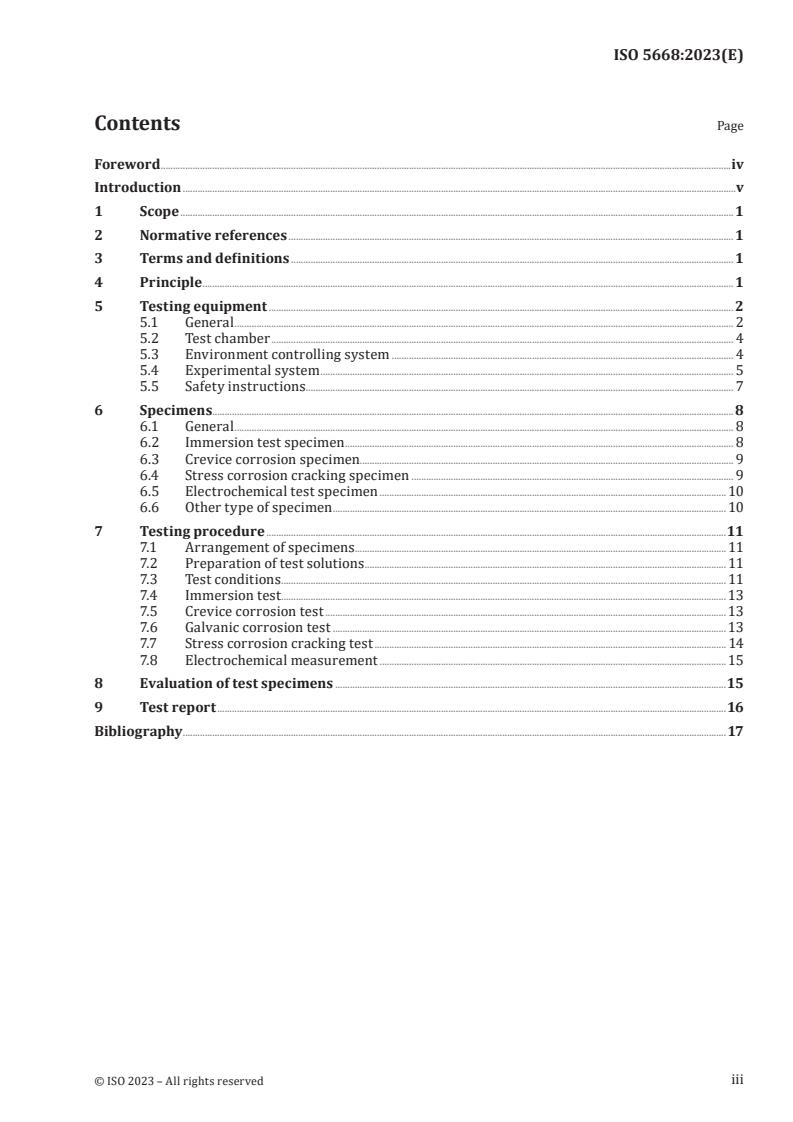
Contents Page
Foreword .iv
Introduction .v
1 Scope . 1
2 Normative references . 1
3 Terms and definitions . 1
4 Principle . 1
5 Testing equipment . 2
5.1 General . 2
5.2 Test chamber . 4
5.3 Environment controlling system . 4
5.4 Experimental system . 5
5.5 Safety instructions . 7
6 Specimens. 8
6.1 General . 8
6.2 Immersion test specimen . 8
6.3 Crevice corrosion specimen. 9
6.4 Stress corrosion cracking specimen . 9
6.5 Electrochemical test specimen . 10
6.6 Other type of specimen . 10
7 Testing procedure .11
7.1 Arrangement of specimens . . 11
7.2 Preparation of test solutions . 11
7.3 Test conditions . 11
7.4 Immersion test . 13
7.5 Crevice corrosion test . 13
7.6 Galvanic corrosion test . 13
7.7 Stress corrosion cracking test . 14
7.8 Electrochemical measurement .15
8 Evaluation of test specimens .15
9 Test report .16
Bibliography .17
iii
Foreword
ISO (the International Organization for Standardization) is a worldwide federation of national standards
bodies (ISO member bodies). The work of preparing International Standards is normally carried out
through ISO technical committees. Each member body interested in a subject for which a technical
committee has been established has the right to be represented on that committee. International
organizations, governmental and non-governmental, in liaison with ISO, also take part in the work.
ISO collaborates closely with the International Electrotechnical Commission (IEC) on all matters of
electrotechnical standardization.
The procedures used to develop this document and those intended for its further maintenance are
described in the ISO/IEC Directives, Part 1. In particular, the different approval criteria needed for the
different types of ISO document should be noted. This document was drafted in accordance with the
editorial rules of the ISO/IEC Directives, Part 2 (see www.iso.org/directives).
ISO draws attention to the possibility that the implementation of this document may involve the use
of (a) patent(s). ISO takes no position concerning the evidence, validity or applicability of any claimed
patent rights in respect thereof. As of the date of publication of this document, ISO had received notice of
(a) patent(s) which may be required to implement this document. However, implementers are cautioned
that this may not represent the latest information, which may be obtained from the patent database
available at www.iso.org/patents. ISO shall not be held responsible for identifying any or all such patent
rights.
Any trade name used in this document is information given for the convenience of users and does not
constitute an endorsement.
For an explanation of the voluntary nature of standards, the meaning of ISO specific terms and
expressions related to conformity assessment, as well as information about ISO's adherence to
the World Trade Organization (WTO) principles in the Technical Barriers to Trade (TBT), see
www.iso.org/iso/foreword.html.
This document was prepared by Technical Committee ISO/TC 156, Corrosion of metals and alloys.
Any feedback or questions on this document should be directed to the user’s national standards body. A
complete listing of these bodies can be found at www.iso.org/members.html.
iv
Introduction
Corrosion is a crucial problem for subsea equipment and systems for oil/gas production, environmental
observation, and scientific exploration due to exposure in deep-sea water. Guidelines for corrosion
testing of metals and alloys exposed in deep-sea water have been given in ISO 23226.
This document provides guidelines and requirements for the corrosion testing of metals and alloys
under the conditions of simulating the environment of deep-sea water. Thereby, the testing can be
conducted based on the specified conditions and procedures, and the meaningful comparisons can be
made for different tests.
This document applies to the immersion testing of specimens related to general corrosion and localized
corrosion, stress corrosion cracking (SCC) testing and electrochemical testing in the simulated
environment of deep-sea water in the laboratory.
v
INTERNATIONAL STANDARD ISO 5668:2023(E)
Corrosion of metals and alloys — Guidelines and
requirements for corrosion testing in simulated
environment of deep-sea water
1 Scope
This document provides guidelines and requirements for the corrosion testing of metals and alloys
in the simulated environment of deep-sea water, including principle, testing equipment, specimen
preparation, testing procedure and evaluation after test. This document applies to the immersion
testing, corrosion testing under stress condition and electrochemical testing in the simulated
environment of deep-sea water in the laboratory.
Testing of other materials such as composites and elastomers can also be carried out in the simulated
environment of deep-sea water with reference to this document, but the evaluation of these materials
after the testing is different from that of metals and alloys.
2 Normative references
The following documents are referred to in the text in such a way that some or all of their content
constitutes requirements of this document. For dated references, only the edition cited applies. For
undated references, the latest edition of the referenced document (including any amendments) applies.
ISO 8044, Corrosion of metals and alloys — Vocabulary
3 Terms and definitions
For the purposes of this document, the terms and definitions given in ISO 8044 and the following apply.
ISO and IEC maintain terminology databases for use in standardization at the following addresses:
— ISO Online browsing platform: available at https:// www .iso .org/ obp
— IEC Electropedia: available at https:// www .electropedia .org/
3.1
deep-sea water
sea water zone with a depth generally ranging from 200 m to thousands of meters
Note 1 to entry: Deep-sea water has a corrosive environment with parameters such as temperature, salinity,
dissolved oxygen content, microorganism and biofouling that are quite different from those in surface sea water.
3.2
simulated environment
environment for which the main corrosion factors are simulated
4 Principle
This document provides guidelines and requirements on corrosion tests in the simulated environment
of deep-sea water using a suitable apparatus. The apparatus should be able to form a corrosive
environment similar to the practical deep-sea water. The main environmental factors should include at
least hydrostatic pressure, temperature, dissolved oxygen content and compositions of deep-sea water.
The immersion testing of metals and alloys in the simulated environment of deep-sea water for
specimens with or without applied stress can be conducted using the apparatus. Electrochemical
testing, galvanic corrosion measurement and slow strain rate testing for stress corrosion cracking
under tensile condition can also be carried out when the apparatus is modified with these functions.
5 Testing equipment
5.1 General
5.1.1 The corrosion tests are carried out in a special testing apparatus which should be capable of
simulating deep-sea corrosive environment.
5.1.2 The significant environmental factors affecting corrosion behaviours of metals and alloys
should be included in the simulated deep-sea environment.
5.1.3 At least a test chamber, an environment controlling system and an experimental system should
be included in the corrosion test apparatus of simulating deep-sea environment. The schematic diagram
of a typical test apparatus and an actual test setup are shown in Figure 1. The placement of specimens
shown in the test chamber is just for the demonstration of different corrosion test functions. Different
tests that can have interference with each other should not be conducted in the test chamber at the
same time.
Key
1 specimen for immersion test 10 probe for dissolved oxygen and/or other electrolyte
factors
2 cooling coil 11 reservoir
3 specimen support 12 aeration/deaeration pipe
4 test chamber 13 oxygen or nitrogen gas
5 chamber inlet pipe 14 reservoir inlet pipe
6 chiller 15 chamber outlet pipe
7 high-pressure pump 16 pressure sensor and temperature sensor (thermoprobe)
8 environment controlling system 17 insulating sleeve
9 reservoir outlet pipe
Figure 1 — Schematic diagram of apparatus and actual setup for simulated deep-sea
environment corrosion test
5.1.4 All parts of the apparatus exposed to the test solution should be made of inert material which is
corrosion resistant in the test environment to avoid contaminating the test solution and consumption
or absorption of solute by the material of the apparatus. The recommended materials include non-
metallic materials, such as UPVC, PTFE and metallic materials, such as titanium alloy, Hastelloy alloy,
and stainless steel with high corrosion resistance.
5.2 Test chamber
5.2.1 The volume of the test chamber should be appropriate to hold test specimens and solution, and
to guarantee a uniform environmental condition.
5.2.2 The structure and components of the test chamber should have sufficient pressure rating to
withstand the test pressure. The safety instructions with the test chamber as a pressure container are
given in 5.5.
5.2.3 The inlet and outlet pipes connecting to the test chamber are used to establish a test solution
recycling and environment controlling system.
5.2.4 For in situ electrochemical corrosion testing, a connecting interface for electrochemical
workstation should be included, and the cables and connectors inside and through the test chamber
should have adequate pressure bearing capability and water tightness.
5.3 Environment controlling system
5.3.1 The test solution conditions including hydrostatic pressure, temperature, dissolved oxygen
content, etc. are monitored and controlled by the environment controlling system. It is reasonable to
apply additional reservoir to store the test solution and to facilitate the adjustment of the test solution
conditions (excluding pressure) before injecting solution into the test chamber. The volume of the
reservoir should be not less than twice that of the test chamber.
5.3.2 The high-pressure pump should be used to control the solution pressure in the test chamber
and realize the solution circulation. The circulation rate of the solution can be determined according
to the chamber volume and the test pressure. The pressure in the test chamber should be monitored
throughout the test by installing a pressure gauge or sensor as shown in Figure 1.
5.3.3 The temperature of the test solution is adjusted by the installation of the condensing cooling
coil in the test chamber to simulate the deep-sea low temperature conditions. The installation of
condensing cooling coil in the reservoir is also applicable. Thermal preservation measures should
be taken for the whole solution circulation system, for example, wrapping the outer walls of the test
chamber, the reservoir and the pipes with thermal insulation materials. The solution temperature in
the test chamber should be monitored by a thermoprobe and controlled within ±1 °C of the set value.
5.3.4 The dissolved oxygen content of the test solution should be adjusted by injecting nitrogen or
oxygen gas into the reservoir before solution circulation. During the test, the dissolved oxygen content
should be monitored and adjusted accordingly. The dissolved oxygen content in the testing solution can
be measured using an electrochemical probe method as specified in ISO 5814.
5.3.5 If other conditions of the solution need to be controlled, such as salinity, pH value, etc., it is also
advisable to adjust them in the reservoir before solution circulation according to the practical deep-sea
environment to be simulated.
5.4 Experimental system
5.4.1 Specimen support in the chamber
The specimen support should be made of corrosion-resistant metal or non-metallic material, and the
shape and size of the specimen support should be specified according to the volume of the test chamber
and the test requirements.
For general immersion test, the specimens should be placed in the test chamber with support.
For crevice corrosion test, the crevice formers specified in ISO 18070 and ASTM G78 can be used.
For stress corrosion cracking test of constant load/displacement, the preloaded specimen in the loading
jig should be used.
The above-mentioned specimen and assembly can be installed on the support by hanging or bolt fixing,
and the insulation between the support and the specimen should be made to eliminate galvanic effect.
In the multi-specimen test, sufficient spacing should be reserved to avoid the interference between
specimens.
5.4.2 Loading device of slow strain rate tensile test
For stress corrosion cracking test under tension at a slow strain rate, a loading device can be added in
the test chamber as shown in Figure 2.
Key
1 test chamber 8 sealing mechanism
2 loading frame 9 load and displacement testing device
3 loading jig 10 loading motor
4 specimen 11 tension rod
5 connection cable for load and displacement measuring devices 12 test chamber outlet pipe
6 series of environmental monitoring components 13 support bench
7 penetration gland 14 test chamber inlet pipe
Figure 2 — Schematic diagram and actual setup of simulated deep-sea environment test
chamber with dynamic loading device
The loading frame, loading jig and tension rod of the loading device should be able to withstand the
applied stress. For the sealing design of the bulkhead of the test chamber, the maximum rated pressure
of the apparatus should be considered.
The connection part between the end cap of the test chamber and the tension rod must be sealed to
ensure no leakage under test pressure, but the sealing treatment should not affect the normal movement
of the tension rod.
Load and displacement measuring devices shall be provided on the loading device for real-time testing
of the stress and strain of the specimen. When calculating the actual load of the specimen, the effect of
hydrostatic pressure and the friction force of the sealing structure on the tension rod should be fully
considered. In practical, the actual load is obtained after reducing the load measured without specimen
under the same conditions of strain rate and hydrostatic pressure as the case of applying specimen.
5.4.3 Electrochemical test system
The electrochemical test system in the simulated deep-sea water consists of a typical three-electrode
cell, an external electrochemical workstation, cables and connectors. The schematic diagram of the test
chamber for electrochemical test and an actual test setup are shown in Figure 3.
Key
1 chamber inlet pipe 6 series of environmental monitoring
components
2 test chamber 7 auxiliary electrode
3 cooling coil 8 work electrode
4 electrochemical measurement instrument 9 reference electrode
5 cables 10 chamber outlet pipe
Figure 3 — Schematic diagram and actual setup of simulated deep-sea environment test
chamber for electrochemical test
The specimen is used as a work electrode. The preparation of the work electrode is described in 6.5. The
auxiliary (counter) electrode is commonly made of platinum or other suitable inert material in the form
of a sheet or rod. The area of the auxiliary electrode should be at least the area of the working electrode.
A solid-state reference electrode such as Ag/AgCl solid electrode should be applicable in the simulated
deep-sea water. The information of Ag/AgCl electrode used in sea water can refer to ISO 12473. The
performance of the reference electrode should be examined and calibrated at ambient pressure in
the same solution as the simulated deep-sea water prior to the tests. The temperature coefficient of
the reference electrode should be considered in the simulated deep-sea environment. The measured
potentials should be converted to the values vs. a standard reference electrode (for example, Ag/AgCl
with saturated KCl) in report.
The working electrode, auxiliary electrode and reference electrode should be able to withstand the
hydrostatic pressure. The connecting point of the electrode to the cable or connector when exposed
in the test chamber should be insulated reliably, and the interfaces of the electrodes through the test
chamber should be sealed thoroughly in order to meet the requirement of high-pressure conditions.
For galvanic corrosion test, the couple can be connected to the electrochemical instrument to measure
the galvanic current and the coupled potential.
Commercially available electrochemical workstations can be used for electrochemical testing. The
instrument should meet the requirement specified in ISO 17475.
5.5 Safety instructions
5.5.1 As the test involves high pressure, the test equipment should be equipped with necessary safety
devices, e.g. blasting-proof disc/valve, emergency cut-off button, pressure monitoring instrument.
5.5.2 The test equipment should be calibrated or checked regularly, especially pressure instrument
and sealing system to ensure safety. Regular removal of corrosion products should also be exercised
manually or by applying filtration device to prevent corrosion products from blocking pumps and
valves.
5.5.3 It is recommended to maintain the pressure in the test chamber by pumping using the test
solution as the working fluid. The test gas should not be injected directly into the test chamber to
maintain the pressure as far as possible, but the gas content in the test solution should be pre-adjusted
in the reservoir. Tests that can produce a large amount of gas should not be allowed using this test
equipment.
5.5.4 The operator should use the equipment in strict accordance with the operating rules. It is
strictly forbidden to open the test chamber when the pressure is not relieved.
5.5.5 This document does not address all the safety concerns associated with its use. The user of this
document has the responsibility to establish appropriate safety and health practices and determine the
applicability of regulatory limitations prior to use.
6 Specimens
6.1 General
6.1.1 In the simulated deep-sea environment, commonly used corrosion test specimen includes
immersion test specimen (see 6.2), crevice corrosion specimen (see 6.3), stress corrosion cracking
specimen (see 6.4), electrochemical specimen (see 6.5), and other type of specimen (see 6.6). Coated
specimens or small-scale structural specimens may also be used.
6.1.2 In principle, only specimens of the same type of material should be tested in the test chamber
at the same time to avoid interference from dissolved ions and products unless it is required to test
the interaction of different materials. Except for galvanic corrosion tests, no metallically conducting
connection should exist between the specimens themselves. Insulation should also be kept for the
specimens from the test chamber and the metal support.
6.1.3 Specimens should be marked for identification. Drilled holes, edge notches, stamped codes or
other appropriate methods can be used for this purpose. The marking methods and positions should
not influence the corrosion testing of the specimens. The marks should be clear to be distinguished
during the whole testing process without being faded by corrosion or other factors.
6.1.4 The number of specimens should be determined according to the type of corrosion test, the
nature of test material or the specific requirements. Typically, three or more replicated specimens are
suggested in each test.
6.2 Immersion test specimen
6.2.1 Specimens used for immersion test should be prepared according to the purpose and
requirement of the corrosion test, which can refer to ASTM G1 and ASTM G31.
6.2.2 The shape of the specimen depends on the objective of the corrosion test and the type of
corrosion expected. Generally, specimen in the form of plate should be used. Specimens of other shapes,
such as bar or tube, can also be used if required.
6.2.3 The dimensions of the specimen vary with the purpose of the test, the nature of the
material, and the volume of the test chamber. Typically, the flat specimen with a dimension of
50 mm × 20 mm × (2~4) mm is recommended. A small hole of 5 mm or less in diameter can be machined
...