


ISO/DTS 17664-3
(Main)Processing of health care products — Information to be provided by the medical device manufacturer for the processing of medical devices — Part 3: Guidance on the designation of a reusable medical device to a cleaning classification
Processing of health care products — Information to be provided by the medical device manufacturer for the processing of medical devices — Part 3: Guidance on the designation of a reusable medical device to a cleaning classification
This document gives guidance on how to allocate reusable medical devices to a cleaning classification system that allows designation to a product family. Medical device design, material of construction and intended use are used as attributes for device classification and are used to designate processing parameters for cleaning. Guidance is provided for the designation of a master product within a product family. The cleaning classification system is comprised of two parts: i) classification of reusable medical devices; ii) classification of manual and or automated cleaning processes suitable for the cleaning classification assigned to a reusable medical device. This allows grouping of reusable medical devices into product families during routine cleaning and identification of master products during cleaning validation. It is applicable to manufacturers devising cleaning methods and instructions for processing, to healthcare facilities and to wherever medical devices are cleaned to be made ready for use or reuse.
Traitement de produits de soins de santé — Informations relatives au traitement des dispositifs médicaux à fournir par le fabricant du dispositif — Partie 3: Recommandations sur la désignation d'un dispositif médical réutilisable dans une classification de nettoyage
General Information
- Status
- Not Published
- Technical Committee
- ISO/TC 198 - Sterilization of health care products
- Drafting Committee
- ISO/TC 198 - Sterilization of health care products
- Current Stage
- 5020 - FDIS ballot initiated: 2 months. Proof sent to secretariat
- Start Date
- 10-Feb-2026
- Completion Date
- 10-Feb-2026
Relations
- Effective Date
- 17-Jun-2023
Overview
ISO/DTS 17664-3 provides essential guidance for the classification and processing of reusable medical devices, focusing specifically on their cleaning requirements. This standard aids medical device manufacturers and healthcare facilities in designating reusable devices to a cleaning classification system, which enables efficient grouping into product families and the identification of master products for cleaning validation.
By addressing attributes such as device design, material composition, and intended use, ISO/DTS 17664-3 ensures that appropriate cleaning processes-whether manual or automated-are effectively matched to device characteristics. This standard is crucial for maintaining patient safety, regulatory compliance, and workflow efficiency in medical device reprocessing.
Key Topics
Cleaning Classification System:
ISO/DTS 17664-3 introduces a two-part cleaning classification system:- Grouping reusable medical devices based on attributes such as geometric design, materials of construction, and clinical use.
- Aligning these groups-product families-with suitable manual or automated cleaning processes.
Product Families and Master Product Designation:
Devices sharing similar cleaning challenges and attributes can be grouped into product families, allowing streamlined validation and routine cleaning. A “master product” represents the most challenging-to-clean device in the family.Manual and Automated Cleaning Categories:
The standard defines categories (e.g., M1, M2, M3 for manual; A1, A2, A3 for automated) based on the device’s accessibility for cleaning and the need for specialized equipment.Risk Analysis:
Manufacturers must carry out risk analysis as part of the designation process, ensuring cleaning methods are appropriate and safe for the device's intended use.Material Compatibility and Device Complexity:
Device design, complexity, material resilience, and soiling risks are critical factors when assigning cleaning classification categories.
Applications
For Medical Device Manufacturers
Development of Cleaning Instructions:
ISO/DTS 17664-3 guides manufacturers in creating validated, comprehensive instructions for use (IFU) for cleaning reusable medical devices, ensuring safety and regulatory compliance.Device Design and Classification:
By considering factors such as geometric features, materials, and clinical use, manufacturers can categorize devices to streamline cleaning method development and validation.
For Healthcare Facilities
Implementing Effective Cleaning Protocols:
Facilities can use cleaning classification categories and product families to standardize cleaning procedures, allocate resources effectively, and ensure consistent reprocessing quality.Selecting Cleaning Equipment and Training Requirements:
Knowing the device classification allows facilities to choose appropriate cleaning equipment, develop targeted staff training, and establish protocols for verifying cleaning efficacy.Validation and Verification:
Healthcare facilities responsible for alternative or modified cleaning methods must validate their processes, using master products and product family designations outlined in ISO/DTS 17664-3.
Related Standards
ISO 17664-1:
Processing of health care products - Information to be provided by the medical device manufacturer for the processing of medical devices - Part 1: Critical and semi-critical medical devicesISO 17664-2:
Processing of health care products - Information to be provided by the medical device manufacturer for the processing of medical devices - Part 2: Non-critical medical devicesISO 15883-5:
Washer-disinfectors - Cleaning requirements and acceptance criteriaAAMI TIR12 / ANSI/AAMI ST98:
Guidance and requirements for reprocessing medical devices and assigning product families
ISO/DTS 17664-3 is vital for ensuring both manufacturers and healthcare facilities can classify, clean, and validate reusable medical devices safely and effectively, contributing to patient safety and streamlined healthcare operations.
ISO/DTS 17664-3 - Processing of health care products — Information to be provided by the medical device manufacturer for the processing of medical devices — Part 3: Guidance on the designation of a reusable medical device to a cleaning classification Released:27. 01. 2026
REDLINE ISO/DTS 17664-3 - Processing of health care products — Information to be provided by the medical device manufacturer for the processing of medical devices — Part 3: Guidance on the designation of a reusable medical device to a cleaning classification Released:27. 01. 2026
Get Certified
Connect with accredited certification bodies for this standard

BSI Group
BSI (British Standards Institution) is the business standards company that helps organizations make excellence a habit.

TÜV Rheinland
TÜV Rheinland is a leading international provider of technical services.

TÜV SÜD
TÜV SÜD is a trusted partner of choice for safety, security and sustainability solutions.
Sponsored listings
Frequently Asked Questions
ISO/DTS 17664-3 is a draft published by the International Organization for Standardization (ISO). Its full title is "Processing of health care products — Information to be provided by the medical device manufacturer for the processing of medical devices — Part 3: Guidance on the designation of a reusable medical device to a cleaning classification". This standard covers: This document gives guidance on how to allocate reusable medical devices to a cleaning classification system that allows designation to a product family. Medical device design, material of construction and intended use are used as attributes for device classification and are used to designate processing parameters for cleaning. Guidance is provided for the designation of a master product within a product family. The cleaning classification system is comprised of two parts: i) classification of reusable medical devices; ii) classification of manual and or automated cleaning processes suitable for the cleaning classification assigned to a reusable medical device. This allows grouping of reusable medical devices into product families during routine cleaning and identification of master products during cleaning validation. It is applicable to manufacturers devising cleaning methods and instructions for processing, to healthcare facilities and to wherever medical devices are cleaned to be made ready for use or reuse.
This document gives guidance on how to allocate reusable medical devices to a cleaning classification system that allows designation to a product family. Medical device design, material of construction and intended use are used as attributes for device classification and are used to designate processing parameters for cleaning. Guidance is provided for the designation of a master product within a product family. The cleaning classification system is comprised of two parts: i) classification of reusable medical devices; ii) classification of manual and or automated cleaning processes suitable for the cleaning classification assigned to a reusable medical device. This allows grouping of reusable medical devices into product families during routine cleaning and identification of master products during cleaning validation. It is applicable to manufacturers devising cleaning methods and instructions for processing, to healthcare facilities and to wherever medical devices are cleaned to be made ready for use or reuse.
ISO/DTS 17664-3 is classified under the following ICS (International Classification for Standards) categories: 11.080.01 - Sterilization and disinfection in general. The ICS classification helps identify the subject area and facilitates finding related standards.
ISO/DTS 17664-3 has the following relationships with other standards: It is inter standard links to ISO 23999:2021. Understanding these relationships helps ensure you are using the most current and applicable version of the standard.
ISO/DTS 17664-3 is available in PDF format for immediate download after purchase. The document can be added to your cart and obtained through the secure checkout process. Digital delivery ensures instant access to the complete standard document.
Standards Content (Sample)
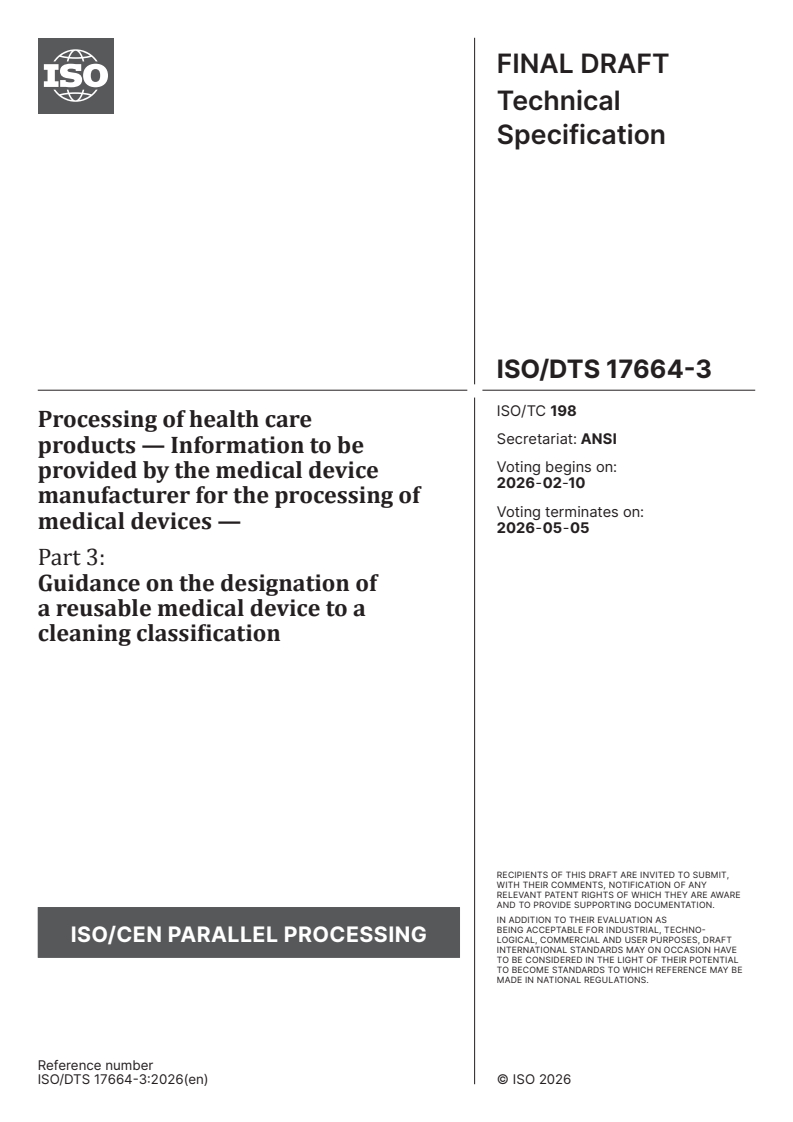
FINAL DRAFT
Technical
Specification
ISO/TC 198
Processing of health care
Secretariat: ANSI
products — Information to be
Voting begins on:
provided by the medical device
2026-02-10
manufacturer for the processing of
Voting terminates on:
medical devices —
2026-05-05
Part 3:
Guidance on the designation of
a reusable medical device to a
cleaning classification
RECIPIENTS OF THIS DRAFT ARE INVITED TO SUBMIT,
WITH THEIR COMMENTS, NOTIFICATION OF ANY
RELEVANT PATENT RIGHTS OF WHICH THEY ARE AWARE
AND TO PROVIDE SUPPOR TING DOCUMENTATION.
IN ADDITION TO THEIR EVALUATION AS
BEING ACCEPTABLE FOR INDUSTRIAL, TECHNO-
ISO/CEN PARALLEL PROCESSING LOGICAL, COMMERCIAL AND USER PURPOSES, DRAFT
INTERNATIONAL STANDARDS MAY ON OCCASION HAVE
TO BE CONSIDERED IN THE LIGHT OF THEIR POTENTIAL
TO BECOME STAN DARDS TO WHICH REFERENCE MAY BE
MADE IN NATIONAL REGULATIONS.
Reference number
FINAL DRAFT
Technical
Specification
ISO/TC 198
Processing of health care
Secretariat: ANSI
products — Information to be
Voting begins on:
provided by the medical device
manufacturer for the processing of
Voting terminates on:
medical devices —
Part 3:
Guidance on the designation of
a reusable medical device to a
cleaning classification
RECIPIENTS OF THIS DRAFT ARE INVITED TO SUBMIT,
WITH THEIR COMMENTS, NOTIFICATION OF ANY
RELEVANT PATENT RIGHTS OF WHICH THEY ARE AWARE
AND TO PROVIDE SUPPOR TING DOCUMENTATION.
© ISO 2026
IN ADDITION TO THEIR EVALUATION AS
All rights reserved. Unless otherwise specified, or required in the context of its implementation, no part of this publication may
BEING ACCEPTABLE FOR INDUSTRIAL, TECHNO-
ISO/CEN PARALLEL PROCESSING
LOGICAL, COMMERCIAL AND USER PURPOSES, DRAFT
be reproduced or utilized otherwise in any form or by any means, electronic or mechanical, including photocopying, or posting on
INTERNATIONAL STANDARDS MAY ON OCCASION HAVE
the internet or an intranet, without prior written permission. Permission can be requested from either ISO at the address below
TO BE CONSIDERED IN THE LIGHT OF THEIR POTENTIAL
or ISO’s member body in the country of the requester.
TO BECOME STAN DARDS TO WHICH REFERENCE MAY BE
MADE IN NATIONAL REGULATIONS.
ISO copyright office
CP 401 • Ch. de Blandonnet 8
CH-1214 Vernier, Geneva
Phone: +41 22 749 01 11
Email: copyright@iso.org
Website: www.iso.org
Published in Switzerland Reference number
ii
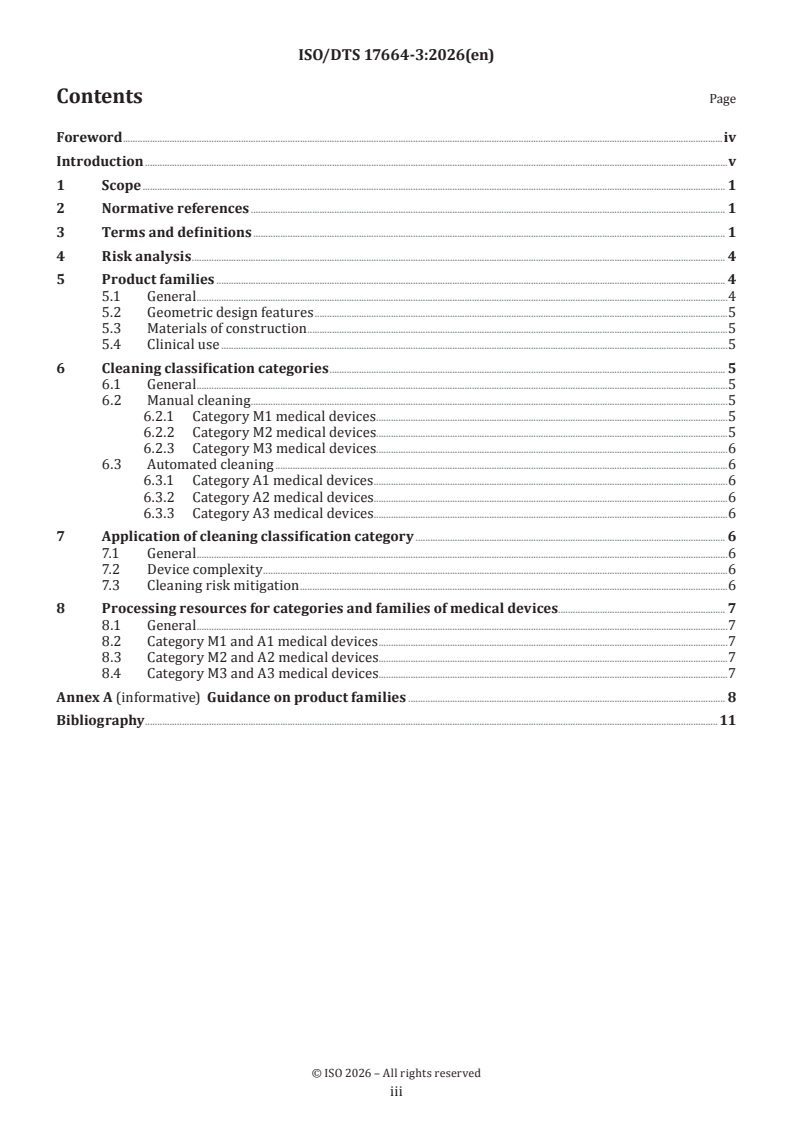
Contents Page
Foreword .iv
Introduction .v
1 Scope . 1
2 Normative references . 1
3 Terms and definitions . 1
4 Risk analysis . 4
5 Product families . 4
5.1 General .4
5.2 Geometric design features .5
5.3 Materials of construction .5
5.4 Clinical use .5
6 Cleaning classification categories . 5
6.1 General .5
6.2 Manual cleaning . .5
6.2.1 Category M1 medical devices .5
6.2.2 Category M2 medical devices.5
6.2.3 Category M3 medical devices.6
6.3 Automated cleaning .6
6.3.1 Category A1 medical devices .6
6.3.2 Category A2 medical devices.6
6.3.3 Category A3 medical devices.6
7 Application of cleaning classification category . 6
7.1 General .6
7.2 Device complexity .6
7.3 Cleaning risk mitigation .6
8 Processing resources for categories and families of medical devices. 7
8.1 General .7
8.2 Category M1 and A1 medical devices .7
8.3 Category M2 and A2 medical devices.7
8.4 Category M3 and A3 medical devices .7
Annex A (informative) Guidance on product families . 8
Bibliography .11
iii
Foreword
ISO (the International Organization for Standardization) is a worldwide federation of national standards
bodies (ISO member bodies). The work of preparing International Standards is normally carried out through
ISO technical committees. Each member body interested in a subject for which a technical committee
has been established has the right to be represented on that committee. International organizations,
governmental and non-governmental, in liaison with ISO, also take part in the work. ISO collaborates closely
with the International Electrotechnical Commission (IEC) on all matters of electrotechnical standardization.
The procedures used to develop this document and those intended for its further maintenance are described
in the ISO/IEC Directives, Part 1. In particular, the different approval criteria needed for the different types
of ISO documents should be noted. This document was drafted in accordance with the editorial rules of the
ISO/IEC Directives, Part 2 (see www.iso.org/directives).
ISO draws attention to the possibility that the implementation of this document may involve the use of (a)
patent(s). ISO takes no position concerning the evidence, validity or applicability of any claimed patent
rights in respect thereof. As of the date of publication of this document, ISO had not received notice of (a)
patent(s) which may be required to implement this document. However, implementers are cautioned that
this may not represent the latest information, which may be obtained from the patent database available at
www.iso.org/patents. ISO shall not be held responsible for identifying any or all such patent rights.
Any trade name used in this document is information given for the convenience of users and does not
constitute an endorsement.
For an explanation of the voluntary nature of standards, the meaning of ISO specific terms and expressions
related to conformity assessment, as well as information about ISO’s adherence to the World Trade
Organization (WTO) principles in the Technical Barriers to Trade (TBT), see www.iso.org/iso/foreword.html.
This document was prepared by Technical Committee ISO/TC 198, Sterilization of health care products, in
collaboration with the European Committee for Standardization (CEN) Technical Committee CEN/TC 204,
Sterilization of medical devices, in accordance with the Agreement on technical cooperation between ISO and
CEN (Vienna Agreement).
A list of all parts in the ISO 17664 series can be found on the ISO website.
Any feedback or questions on this document should be directed to the user’s national standards body. A
complete listing of these bodies can be found at www.iso.org/members.html.
iv
Introduction
The ISO 17664 series addresses the medical device manufacturer’s labelling requirements. Typically, these
requirements are mandated by law or government regulation to be validated to demonstrate effective
processes. This document is intended to bridge the gap between the manufacturer of reusable medical
devices and the facility responsible for device processing.
ISO 17664-1 and ISO 17664-2 specify requirements for the information to be provided by the medical device
manufacturer for processing. ISO 17665 gives specificity for designation to a product family or master
product, but this is for moist heat sterilization and not for cleaning.
Product family and master product are used within a number of documents (i.e. ISO 17664 series,
AAMI TIR12 and ANSI/AAMI ST98). These documents use the terminology, but do not provide guidance to
inform the medical device manufacturer as to how to define product family or designate the master product
using objective evidence.
The connection between the device manufacturer and the processing facility is intended to be communicated
through the instructions for use (IFU). In addition to providing guidance to the manufacturer, this document
provides the guidance to the processing facility to establish cleaning workflows based on device cleaning
classification within the clinical setting. This allows verification that the cleaning instructions can be
performed effectively for all reusable medical devices.
As the variability in design features for reusable medical devices continues to increase, guidance is needed
to establish appropriate device cleaning classification.
v
FINAL DRAFT Technical Specification ISO/DTS 17664-3:2026(en)
Processing of health care products — Information to be
provided by the medical device manufacturer for the
processing of medical devices —
Part 3:
Guidance on the designation of a reusable medical device to a
cleaning classification
1 Scope
This document gives guidance on designating medical devices to cleaning classification categories, attributes
to be used for medical device classification, and designation of a cleaning process.
The cleaning classification category is comprised of two parts:
a) designate medical devices to a product family;
b) designate product families to cleaning processes.
NOTE 1 This allows grouping of medical devices into cleaning classification categories during cleaning and
identification of master products during cleaning validation.
This document is applicable to manufacturers devising cleaning methods and instructions for processing. It
also applies to any processing facility where medical devices are cleaned.
This document does not cover processing of single-use devices provided as sterile before use and textile
devices.
NOTE 2 Manual cleaning steps before automated cleaning do not include steps that are considered pre-cleaning,
such as bedside pre-cleaning that can be required whether subsequently using automated or manual cleaning.
2 Normative references
There are no normative references in this document.
3 Terms and definitions
For the purposes of this document, the following terms and definitions apply.
ISO and IEC maintain terminology databases for use in standardization at the following addresses:
— ISO Online browsing platform: available at https:// www .iso .org/ obp
— IEC Electropedia: available at https:// www .electropedia .org/
3.1
cleaning
removal of contaminants to the extent necessary for further processing (3.10) or for intended use
Note 1 to entry: Cleaning consists of the removal of adherent soil (3.13) (e.g. blood, protein substances and other
debris) from the surfaces, crevices, serrations, joints and lumens of a medical device (3.8) by a manual or automated
process that prepares the items for safe handling, further processing, or both.
[SOURCE: ISO 11139:2018, 3.46, modified — Note 1 to entry has been added.]
3.2
cleaning agent
physical or chemical entity, or combination of entities, having activity to render an item clean
[SOURCE: ISO 11139:2018, 3.47]
3.3
cleaning classification category
grouping system of the included medical devices (3.8) wherein cleaning (3.1) processes, equipment and
accessories are considered suitable
Note 1 to entry: Different product families can be combined in the same cleaning classification category.
3.4
clinical use
use of a health care product during a procedure on a patient
[SOURCE: ISO 11139:2018, 3.49]
3.5
instructions for use
IFU
portion of the accompanying information that is essential for the safe and effective intended use of a medical
device (3.8) or accessory directed to the user of the medical device
Note 1 to entry: The instructions for use, or portions thereof, can be located on the display of a medical device or its
accessory.
[SOURCE: ISO 11139:2018/Amd 1:2024, 3.342]
3.6
manual cleaning
removal of contaminants from an item to the extent necessary for further processing (3.10) or for intended
use without the use of an automated process
[SOURCE: ISO 11139:2018, 3.159]
3.7
master product
health care product or procedure set used to represent the most difficult to clean item in a product family
(3.11) or processing (3.10) category
[SOURCE: ISO 11139:2018, 3.160, modified — The term “clean” has replaced “sterilize”.]
3.8
medical device
instrument, apparatus, implement, machine, appliance, implant, reagent for in vitro use, or software
material, or other similar related article, intended by the manufacturer to be used, alone or in combination,
for human beings for one or more of the specific medical purpose(s) of:
— diagnosis, prevention, monitoring, treatment, or alleviation of disease;
— diagnosis, monitoring, treatment, alleviation of, or compensation for an injury;
— investigation, replacement, modification, or support of the anatomy, or of a physiological process;
— supporting or sustaining life;
— control of conception;
— disinfection of medical devices;
— providing information by means of in vitro examination of specimens derived from the human body;
and which does not achieve its primary intended action by pharmacological, immunological or metabolic
means, in or on the human body, but which may be assisted in its intended function by such means
Note 1 to entry: Products which may be considered to be medical devices in some jurisdictions but not in others
include:
— items specifically intended for cleaning or sterilization of medical devices;
— pouches, reel goods, sterilization wrap and reusable containers for packaging of medical devices for sterilization;
— disinfection substances;
— aids for persons with disabilities;
— devices incorporating animal tissues and/or human tissues;
— devices for in vitro fertilization or assisted reproduction technologies.
[SOURCE: ISO 11139:2018/Amd 1:2024, 3.166]
3.9
medical device manufacturer
natural or legal person with responsibility for design or manufacture, or both, of a medical device (3.8) with
the intention of making the medical device available for use, under their name, whether or not such a medical
device is designed or manufactured, or both, by that person or on their behalf by another person(s)
Note 1 to entry: Attention is drawn to the fact that the provisions of national or regional regulations can apply to the
definition of manufacturer.
[SOURCE: ISO 11139:2018, 3.167, modified — Notes 1 to 7 to entry have been deleted and a new Note 1 to
entry has been added.]
3.10
processing
activity to prepare a new or used medical device (3.8) for its intended use
[SOURCE: ISO 11139:2018, 3.214, modified — The term “medical device” has replaced “health care product”.]
3.11
product family
group or subgroup of product characterized by similar attributes determined to be equivalent for evaluation
and processing (3.10) purposes
[SOURCE: ISO 11139:2018, 3.218]
3.12
reusable medical device
medical device (3.8) designated or intended by the manufacturer as suitable for processing (3.10) and reuse
Note 1 to entry: This is not a medical device that is designated or intended by the manufacturer for single use only.
[SOURCE: ISO 11139:2018, 3.236]
3.13
soil
natural or artificial contamination on a device or surface following its use or simulated use
[SOURCE: ISO 11139:2018, 3.257]
3.14
validation
confirmation process, through the provision of objective evidence, that the requirements for a specific
intended use or application have been fulfilled
Note 1 to entry: The word “validated” is used to designate the corresponding status.
[SOURCE: ISO 11139:2018, 3.313, modified — Notes 1 and 3 to entry have been deleted and Note 2 was
renumbered as Note 1.]
3.15
verification
confirmation, through the provision of objective evidence, that specified requirements have been fulfilled
Note 1 to entry: The word “verified” is used to designate the corresponding status.
[SOURCE: ISO 11139:2018, 3.314, modified — Note 1 to entry has been deleted and Note 2 renumbered as
Note 1.]
4 Risk analysis
The medical device manufacturer should undertake risk analysis in accordance with ISO 17664-1 or
ISO 17664-2, as applicable to the medical device. The p
...
ISO/TC 198/WG 12
Secretariat: ANSI
Date: 2025-12-312026-01-26
Processing of health care products — Information to be provided
by the medical device manufacturer for the processing of medical
devices — Part 3: Guidance on the designation of a reusable
medical device to a cleaning classification —
DTS stage
Warning for WDs and CDs
This document is not an ISO International Standard. It is distributed for review and comment. It is subject to
change without notice and may not be referred to as an International Standard.
Recipients of this draft are invited to submit, with their comments, notification of any relevant patent rights of
which they are aware and to provide supporting documentation.
This draft is submitted to a parallel vote in ISO, CEN.
ISO #####-#:####(X)
Part 3:
Guidance on the designation of a reusable medical device to a
cleaning classification
TTThhhiiis drs drs draaafffttt i i is s s sususubbbmmmiiitttttteeed d d tttooo aaa pppaaarrraaallellellel l l vvvooottteee i i innn IIISSSOOO,,, CCCEEEN.N.N.
2 © ISO #### – All rights reserved
All rights reserved. Unless otherwise specified, or required in the context of its implementation, no part of this publication
may be reproduced or utilized otherwise in any form or by any means, electronic or mechanical, including photocopying,
or posting on the internet or an intranet, without prior written permission. Permission can be requested from either ISO
at the address below or ISO’s member body in the country of the requester.
ISO copyright office
CP 401 • Ch. de Blandonnet 8
CH-1214 Vernier, Geneva
Phone: + 41 22 749 01 11
EmailE-mail: copyright@iso.org
Website: www.iso.orgwww.iso.org
Published in Switzerland
iii
ISO #####-#:####(X/DTS 17664-3:(en)
Contents
Foreword . v
Introduction . vi
1 Scope . 1
2 Normative references . 1
3 Terms and definitions . 1
4 Risk analysis . 4
5 Product families . 4
5.1 General . 4
5.2 Geometric design features . 5
5.3 Materials of construction . 5
5.4 Clinical use. 5
6 Cleaning classification categories . 6
6.1 General . 6
6.2 Manual cleaning . 6
6.3 Automated cleaning . 6
7 Application of cleaning classification category . 7
7.1 General . 7
7.2 Device complexity . 7
7.3 Cleaning risk mitigation . 7
8 Processing resources for categories and families of medical devices . 7
8.1 General . 7
8.2 Category M1 and A1 medical devices . 7
8.3 Category M2 and A2 medical devices . 8
8.4 Category M3 and A3 medical devices . 8
Annex A (informative) Guidance on product families . 9
Bibliography . 12
© ISO #### 2026 – All rights reserved
iv
Foreword
ISO (the International Organization for Standardization) is a worldwide federation of national standards
bodies (ISO member bodies). The work of preparing International Standards is normally carried out through
ISO technical committees. Each member body interested in a subject for which a technical committee has been
established has the right to be represented on that committee. International organizations, governmental and
non-governmental, in liaison with ISO, also take part in the work. ISO collaborates closely with the
International Electrotechnical Commission (IEC) on all matters of electrotechnical standardization.
The procedures used to develop this document and those intended for its further maintenance are described
in the ISO/IEC Directives, Part 1. In particular, the different approval criteria needed for the different types of
ISO documents should be noted. This document was drafted in accordance with the editorial rules of the
ISO/IEC Directives, Part 2 (see www.iso.org/directives).
ISO draws attention to the possibility that the implementation of this document may involve the use of (a)
patent(s). ISO takes no position concerning the evidence, validity or applicability of any claimed patent rights
in respect thereof. As of the date of publication of this document, ISO had not received notice of (a) patent(s)
which may be required to implement this document. However, implementers are cautioned that this may not
represent the latest information, which may be obtained from the patent database available at
www.iso.org/patents. ISO shall not be held responsible for identifying any or all such patent rights.
Any trade name used in this document is information given for the convenience of users and does not
constitute an endorsement.
For an explanation of the voluntary nature of standards, the meaning of ISO specific terms and expressions
related to conformity assessment, as well as information about ISO'sISO’s adherence to the World Trade
Organization (WTO) principles in the Technical Barriers to Trade (TBT), see www.iso.org/iso/foreword.html.
This document was prepared by Technical Committee ISO/TC 198, Sterilization of health care products, in
collaboration with the European Committee for Standardization (CEN) Technical Committee CEN/TC 204,
Sterilization of medical devices, in accordance with the Agreement on technical cooperation between ISO and
CEN (Vienna Agreement).
A list of all parts in the ISO 17664 series can be found on the ISO website.
Any feedback or questions on this document should be directed to the user’s national standards body. A
complete listing of these bodies can be found at www.iso.org/members.html.
v
ISO #####-#:####(X/DTS 17664-3:(en)
Introduction
The ISO 17664 series addresses the medical device manufacturer’s labelling requirements. Typically, these
requirements are mandated by law or government regulation to be validated to demonstrate effective
processes. This document is intended to bridge the gap between the manufacturer of reusable medical devices
and the facility responsible for device processing.
ISO 17664-1 and ISO 17664-2 specify requirements for the information to be provided by the medical device
manufacturer for processing. ISO 17665 [1] gives specificity for designation to a product family or master
product, but this is for moist heat sterilization and not for cleaning.
Product family and master product are used within a number of documents (i.e. ISO 17664 series, AAMI TIR12
[2] and ANSI/AAMI ST98 [3]).). These documents use the terminology, but do not provide guidance to inform
the medical device manufacturer as to how to define product family or designate the master product using
objective evidence.
The connection between the device manufacturer and the processing facility is intended to be communicated
through the instructions for use (IFU.)). In addition to providing guidance to the manufacturer, this document
provides the guidance to the processing facility to establish cleaning workflows based on device cleaning
classification within the clinical setting. This allows verification that the cleaning instructions can be
performed effectively for all reusable medical devices.
As the variability in design features for reusable medical devices continues to increase, guidance is needed to
establish appropriate device cleaning classification.
© ISO #### 2026 – All rights reserved
vi
Processing of health care products — Information to be provided by
the medical device manufacturer for the processing of medical devices
— Part 3: Guidance on the designation of a reusable medical device to
a cleaning classification —
Part 3:
Guidance on the designation of a reusable medical device to a cleaning
classification
1 Scope
This document gives guidance on designating medical devices to cleaning classification categories, attributes
to be used for medical device classification, and designation of a cleaning process.
The cleaning classification category is comprised of two parts:
a) designate medical devices to a product family;
b) designate product families to cleaning processes.
NOTE 1 This allows grouping of medical devices into cleaning classification categories during cleaning and
identification of master products during cleaning validation.
This document is applicable to manufacturers devising cleaning methods and instructions for processing. It
also applies to any processing facility where medical devices are cleaned.
This document does not cover processing of single-use devices provided as sterile before use and textile
devices.
NOTE 2 Manual cleaning steps before automated cleaning do not include steps that are considered pre-cleaning, such
as bedside pre-cleaning that can be required whether subsequently using automated or manual cleaning.
2 Normative references
The following documents are referred to in the text in such a way that some or all of their content constitutes
requirements of this document. For dated references, only the edition cited applies. For undated references,
the latest edition of the referenced document (including any amendments) applies.
ISO 17664-1, Processing of health care products — Information to be provided by the medical device
manufacturer for the processing of medical devices — Part 1: Critical and semi-critical medical devices
ISO 17664-2, Processing of health care products — Information to be provided by the medical device
manufacturer for the processing of medical devices — Part 2: Non-critical medical devices
There are no normative references in this document.
3 Terms and definitions
For the purposes of this document, the following terms and definitions apply.
ISO and IEC maintain terminology databases for use in standardization at the following addresses:
— ISO Online browsing platform: available at https://www.iso.org/obp
— IEC Electropedia: available at https://www.electropedia.org/
3.1 3.1
cleaning
removal of contaminants to the extent necessary for further processing (3.10) or for intended use
Note 1 to entry: Cleaning consists of the removal of adherent soil (3.13) (e.g. blood, protein substances and other debris)
from the surfaces, crevices, serrations, joints and lumens of a medical device (3.8(3.8)) by a manual or automated process
that prepares the items for safe handling, further processing, or both.
[SOURCE: ISO 11139:2018, 3.46, modified — Note 1 to entry has been added.]
3.2 3.2
cleaning agent
physical or chemical entity, or combination of entities, having activity to render an item clean
[SOURCE: ISO 11139:2018, 3.47]
3.3
3.3
cleaning classification category
grouping system of the included medical devices (3.8(3.8)) wherein cleaning (3.1) processes, equipment and
accessories are considered suitable
Note 1 to entry: Different product families can be combined in the same cleaning classification category.
3.4 3.4
clinical use
use of a health care product during a procedure on a patient
[SOURCE: ISO 11139:2018, 3.49]
3.5 3.5
instructions for use
IFU
portion of the accompanying information that is essential for the safe and effective intended use of a medical
device (3.8(3.8)) or accessory directed to the user of the medical device
Note 1 to entry: The instructions for use, or portions thereof, can be located on the display of a medical device or its
accessory.
[SOURCE: ISO 11139:2018/Amd 1:2024, 3.342]
3.6 3.6
manual cleaning
removal of contaminants from an item to the extent necessary for further processing (3.10) or for intended
use without the use of an automated process
[SOURCE: ISO 11139:2018, 3.159]
3.7 3.7
master product
health care product or procedure set used to represent the most difficult to clean item in a product family
(3.11) or processing (3.10) category
© ISO #### 2026 – All rights reserved
[SOURCE: ISO 11139:2018, 3.160, modified — The term “clean” has replaced “sterilize”.]
3.8 3.8
medical device
instrument, apparatus, implement, machine, appliance, implant, reagent for in vitro use, or software material,
or other similar related article, intended by the manufacturer to be used, alone or in combination, for human
beings for one or more of the specific medical purpose(s) of:
— diagnosis, prevention, monitoring, treatment, or alleviation of disease;
— diagnosis, monitoring, treatment, alleviation of, or compensation for an injury;
— investigation, replacement, modification, or support of the anatomy, or of a physiological process;
— supporting or sustaining life;
— control of conception;
— disinfection of medical devices;
— providing information by means of in vitro examination of specimens derived from the human body;
and which does not achieve its primary intended action by pharmacological, immunological or metabolic
means, in or on the human body, but which may be assisted in its intended function by such means
Note 1 to entry: Products which may be considered to be medical devices in some jurisdictions but not in others include:
— items specifically intended for cleaning or sterilization of medical devices;
— pouches, reel goods, sterilization wrap and reusable containers for packaging of medical devices for sterilization;
— disinfection substances;
— aids for persons with disabilities;
— devices incorporating animal tissues and/or human tissues;
— devices for in vitro fertilization or assisted reproduction technologies.
[SOURCE: ISO 11139:2018/Amd 1:2024, 3.166]
3.9 3.9
medical device manufacturer
natural or legal person with responsibility for design or manufacture, or both, of a medical device (3.8) with
the intention of making the medical device available for use, under their name, whether or not such a medical
device is designed or manufactured, or both, by that person or on their behalf by another person(s)
Note 1 to entry: Attention is drawn to the fact that the provisions of national or regional regulations can apply to the
definition of manufacturer.
[SOURCE: ISO 11139:2018, 3.167, modified — Notes 1 to 7 to entry have been deleted and a new Note 1 to
entry has been added.]
3.10 3.10
processing
activity to prepare a new or used medical device (3.8) for its intended use
[SOURCE: ISO 11139:2018, 3.214, modified — The term “medical device” has replaced “health care product”.]
3.11 3.11
product family
group or subgroup of product characterized by similar attributes determined to be equivalent for evaluation
and processing (3.10) purposes
[SOURCE: ISO 11139:2018, 3.218]
3.12 3.12
reusable medical device
medical device (3.8) designated or intended by the manufacturer as suitable for processing (3.10) and reuse
Note 1 to entry: This is not a medical device that is designated or intended by the manufacturer for single use only.
[SOURCE: ISO 11139:2018, 3.236]
3.13 3.13
soil
natural or artificial contamination on a device or surface following its use or simulated use
[SOURCE: ISO 11139:2018, 3.257]
3.14 3.14
validation
confirmation process, through the provision of objective evidence, that the requirements for a specific
intended use or application have been fulfilled
Note 1 to entry: The word “validated” is used to designate the corresponding status.
[SOURCE: ISO 11139:2018, 3.313, modified — Notes 1 and 3 to entry 1 and 3 have been deleted and Note 2
was renumbered as Note 1.]
3.15 3.15
verification
confirmation, through the provision of objective evidence, that specified requirements have been fulfilled
Note 1 to entry: The word “verified” is used to designate the corresponding status.
[SOURCE: ISO 11139:2018, 3.314, modified — Note 1 to entry has been deleted and Note 2 renumbered as
Note 1.]
4 Risk analysis
The medical device manufacturer should undertake risk analysis in accordance with ISO 17664-1 or
ISO 17664-2, as applicable to the medical device. The processing facility should undertake risk analysis if using
an alternative processing method not specified by the medical device manufacturer.
5 Product families
5.1 General
The designation of medical devices into product families is based on four primary attributes:
— geometric design feature (including surface characterization);
© ISO #### 2026 – All rights reserved
— material of construction;
— clinical use;
— type of cleaning process.
If a collection of medical devices has similar attributes for cleaning, the medical devices may be grouped into
the same product family. Multiple product families may be designated to a cleaning classification category.
Requirements for information to be provided by the manufacturer for the processing of reusable medical
devices are given in the ISO 17664 series.
For the purpose of identifying appropriate cleaning steps included within a device manufacturer’s instructions
for use (IFU) and designating a cleaning classification category, a medical device should be broadly identified
by its design attributes to include surface area, surface characterization, and device geometry (e.g. size). These
design attributes can affect the cleaning process and are considered as elements to the cleaning classification
c
...
Questions, Comments and Discussion
Ask us and Technical Secretary will try to provide an answer. You can facilitate discussion about the standard in here.
Loading comments...