

ISO/IEC 18046-5:2025
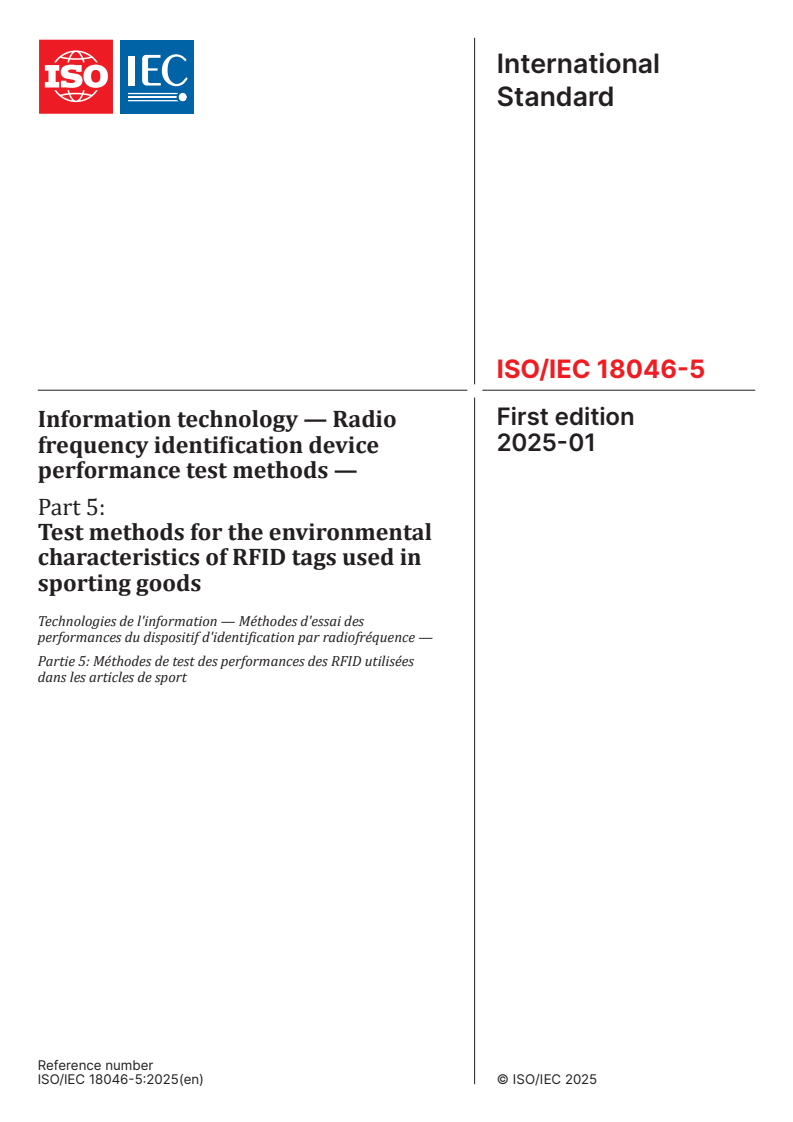
(Main)Information technology — Radio frequency identification device performance test methods — Part 5: Test methods for the environmental characteristics of RFID tags used in sporting goods
General Information
- Abstract
This document specifies the methods for testing the environmental characteristics of RFID-enabled sporting goods. This document suggest methods for identifying the main use environments and related testing of environmental characteristics of sporting goods for indoor and outdoor sports with RFID and optionally additional advanced electronic devices like sensors. The environmental characteristics addressed in this document are applicable to manufacturers, including distribution and inventory management, as well as the aspects of consumer use of the actual RFID-enabled sports items. This document establishes methods to measure and evaluate the performance change of tags after environmental characteristic testing.
- Status
- Published
- Publication Date
- 26-Jan-2025
- Technical Committee
- ISO/IEC JTC 1/SC 31 - Automatic identification and data capture techniques
- Current Stage
- 6060 - International Standard published
- Start Date
- 27-Jan-2025
- Due Date
- 20-Jul-2026
- Completion Date
- 27-Jan-2025
Buy Documents

ISO/IEC 18046-5:2025 - Information technology — Radio frequency identification device performance test methods — Part 5: Test methods for the environmental characteristics of RFID tags used in sporting goods Released:27. 01. 2025
Overview
ISO/IEC 18046-5:2025 - Information technology - Radio frequency identification device performance test methods - Part 5 - specifies standardized environmental test methods for RFID tags used in sporting goods. The standard defines how to identify typical indoor and outdoor sporting environments, select environmental stresses, and measure tag performance change after exposure. It covers RFID-only tags and items that include optional advanced electronics (e.g., sensors), and is intended for use across the product lifecycle from manufacturing and distribution to consumer use.
Keywords: ISO/IEC 18046-5:2025, RFID, sporting goods, environmental test methods, tag performance, performance degradation, testing methods
Key Topics and Requirements
- Purpose: Establish repeatable methods to measure and evaluate performance changes of RFID tags after environmental exposure.
- Test scope: Indoor and outdoor sports equipment, apparel, footwear, accessories and other sporting goods with embedded RFID.
- Test item forms: DUTs (devices under test) prepared both with tag attached to the sporting good and as the tag alone; some dynamic tests (shock/drop) must be performed with the tag attached.
- Sampling: 10 tags sampled as the principle lot (typically 5 attached + 5 unattached) plus 3 additional spare items for accidental damage replacement.
- Standard atmospheric conditions: Tests and measurements are performed under 15–35 °C, 25–75 % RH, 86–106 kPa unless a test specifies otherwise (per IEC 60068-1).
- Test composition:
- Performance tests (pre-test baseline measurement of tag sensitivity and other performance parameters).
- Environmental tests (exposure to climatic, mechanical, chemical and biological conditions encountered in use and transport).
- Evaluation metrics: performance change rate (PCR), performance degradation percentage (PDP) and related calculations to quantify post-test performance.
- Reference test methods: Aligns and references established environmental and EMC tests such as IEC 60068 series (cold, dry heat, damp heat, salt mist, shock, vibration) and IEC 61000-4-2 (ESD immunity).
Practical Applications - Who Uses This Standard
- Manufacturers and OEMs of sporting goods to validate RFID tag durability and reliability claims.
- Quality assurance and test laboratories for certifying tags and embedded electronics under realistic use conditions.
- Retailers and distribution centers for assessing tag robustness in storage and transport.
- Product designers and R&D teams integrating RFID and sensor technologies in footwear, apparel, balls, racks and accessories.
- Sports-technology integrators and service providers who depend on accurate in-field RFID data for athlete monitoring, inventory management, contactless payments and equipment maintenance.
Related Standards (applicable)
- ISO/IEC 18000 series (air‑interface parameters)
- ISO/IEC 18046-3:2020 (tag performance test methods)
- IEC 60068 series (environmental testing)
- IEC 61000-4-2 (ESD immunity)
- ISO 105‑E04 (colour fastness to perspiration)
This standard helps stakeholders ensure RFID-enabled sporting goods perform reliably through real-world environmental stresses, reducing field failures and improving lifecycle data quality.
Buy Documents
ISO/IEC 18046-5:2025 - Information technology — Radio frequency identification device performance test methods — Part 5: Test methods for the environmental characteristics of RFID tags used in sporting goods Released:27. 01. 2025
Get Certified
Connect with accredited certification bodies for this standard

BSI Group
BSI (British Standards Institution) is the business standards company that helps organizations make excellence a habit.

NYCE
Mexican standards and certification body.
Sponsored listings
Frequently Asked Questions
ISO/IEC 18046-5:2025 is a standard published by the International Organization for Standardization (ISO). Its full title is "Information technology — Radio frequency identification device performance test methods — Part 5: Test methods for the environmental characteristics of RFID tags used in sporting goods". This standard covers: This document specifies the methods for testing the environmental characteristics of RFID-enabled sporting goods. This document suggest methods for identifying the main use environments and related testing of environmental characteristics of sporting goods for indoor and outdoor sports with RFID and optionally additional advanced electronic devices like sensors. The environmental characteristics addressed in this document are applicable to manufacturers, including distribution and inventory management, as well as the aspects of consumer use of the actual RFID-enabled sports items. This document establishes methods to measure and evaluate the performance change of tags after environmental characteristic testing.
This document specifies the methods for testing the environmental characteristics of RFID-enabled sporting goods. This document suggest methods for identifying the main use environments and related testing of environmental characteristics of sporting goods for indoor and outdoor sports with RFID and optionally additional advanced electronic devices like sensors. The environmental characteristics addressed in this document are applicable to manufacturers, including distribution and inventory management, as well as the aspects of consumer use of the actual RFID-enabled sports items. This document establishes methods to measure and evaluate the performance change of tags after environmental characteristic testing.
ISO/IEC 18046-5:2025 is classified under the following ICS (International Classification for Standards) categories: 35.040.50 - Automatic identification and data capture techniques; 97.220.01 - Sports equipment and facilities in general. The ICS classification helps identify the subject area and facilitates finding related standards.
ISO/IEC 18046-5:2025 is available in PDF format for immediate download after purchase. The document can be added to your cart and obtained through the secure checkout process. Digital delivery ensures instant access to the complete standard document.
Standards Content (Sample)
International
Standard
ISO/IEC 18046-5
First edition
Information technology — Radio
2025-01
frequency identification device
performance test methods —
Part 5:
Test methods for the environmental
characteristics of RFID tags used in
sporting goods
Technologies de l'information — Méthodes d'essai des
performances du dispositif d'identification par radiofréquence —
Partie 5: Méthodes de test des performances des RFID utilisées
dans les articles de sport
Reference number
© ISO/IEC 2025
All rights reserved. Unless otherwise specified, or required in the context of its implementation, no part of this publication may
be reproduced or utilized otherwise in any form or by any means, electronic or mechanical, including photocopying, or posting on
the internet or an intranet, without prior written permission. Permission can be requested from either ISO at the address below
or ISO’s member body in the country of the requester.
ISO copyright office
CP 401 • Ch. de Blandonnet 8
CH-1214 Vernier, Geneva
Phone: +41 22 749 01 11
Email: copyright@iso.org
Website: www.iso.org
Published in Switzerland
© ISO/IEC 2025 – All rights reserved
ii
Contents Page
Foreword .iv
Introduction .v
1 Scope . 1
2 Normative references . 1
3 Terms and definitions . 2
4 Abbreviated terms and symbols . 3
4.1 Abbreviated terms .3
4.2 Symbols .3
5 Requirements . 3
5.1 Mechanical and electrical characteristics .3
5.2 Testing item form .4
6 Test method . 4
6.1 Sampling method .4
6.2 Standard atmospheric conditions .4
6.3 Environmental characteristic test .4
6.3.1 Performance test .5
6.3.2 Environmental test .6
6.3.3 Calculation . 13
Annex A (informative) Test design manual . 14
Annex B (informative) PCR use case .22
Bibliography .23
© ISO/IEC 2025 – All rights reserved
iii
Foreword
ISO (the International Organization for Standardization) and IEC (the International Electrotechnical
Commission) form the specialized system for worldwide standardization. National bodies that are
members of ISO or IEC participate in the development of International Standards through technical
committees established by the respective organization to deal with particular fields of technical activity.
ISO and IEC technical committees collaborate in fields of mutual interest. Other international organizations,
governmental and non-governmental, in liaison with ISO and IEC, also take part in the work.
The procedures used to develop this document and those intended for its further maintenance are described
in the ISO/IEC Directives, Part 1. In particular, the different approval criteria needed for the different types
of document should be noted. This document was drafted in accordance with the editorial rules of the ISO/
IEC Directives, Part 2 (see www.iso.org/directives or www.iec.ch/members_experts/refdocs).
ISO and IEC draw attention to the possibility that the implementation of this document may involve the
use of (a) patent(s). ISO and IEC take no position concerning the evidence, validity or applicability of any
claimed patent rights in respect thereof. As of the date of publication of this document, ISO and IEC had not
received notice of (a) patent(s) which may be required to implement this document. However, implementers
are cautioned that this may not represent the latest information, which may be obtained from the patent
database available at www.iso.org/patents and https://patents.iec.ch. ISO and IEC shall not be held
responsible for identifying any or all such patent rights.
Any trade name used in this document is information given for the convenience of users and does not
constitute an endorsement.
For an explanation of the voluntary nature of standards, the meaning of ISO specific terms and expressions
related to conformity assessment, as well as information about ISO's adherence to the World Trade
Organization (WTO) principles in the Technical Barriers to Trade (TBT) see www.iso.org/iso/foreword.html.
In the IEC, see www.iec.ch/understanding-standards.
This document was prepared by Joint Technical Committee ISO/IEC JTC 1, Information technology,
Subcommittee SC 31, Automatic identification and data capture techniques.
A list of all parts in the ISO/IEC 18046 series can be found on the ISO and IEC websites.
Any feedback or questions on this document should be directed to the user’s national standards
body. A complete listing of these bodies can be found at www.iso.org/members.html and
www.iec.ch/national-committees.
© ISO/IEC 2025 – All rights reserved
iv
Introduction
The global market for sporting goods is expanding rapidly each year, and as a result, RFID tags are becoming
increasingly popular in the industry. These small electronic devices transmit information using radio waves
and are particularly advantageous in efficiently tracking and managing individual products. While RFID
technology has primarily been used by manufacturers and distributors for inventory management, it is
gradually developing and being utilized by consumers for various purposes, such as monitoring an athlete's
performance or facilitating the payment and maintenance of sports equipment.
It is crucial to ensure the reliability of RFID tags in sporting goods, as errors or malfunctions can have
serious consequences. For instance, inaccurate inventory counts due to improperly registered RFID tags
can lead to under stocking or overstocking. Similarly, malfunctioning tags can result in inaccurate data,
potentially harming athlete training and leading to injury.
Various approaches can be taken to ensure the reliability of RFID tags. Performance and environmental
factors play a significant role, as the environment to which the tags are exposed can consist of physical,
chemical and biological conditions that can deteriorate the tag's performance or cause it to fail. This document
proposes a method to identify the main use environment and related environmental characteristics
of sporting goods, along with a way to measure and evaluate tag performance changes after testing the
environmental conditions. It recommends environmental tests that can demonstrate the product's ability
to operate or survive under the climatic and dynamic conditions typically encountered during the use of
sporting goods utilizing RFID tags.
While it is not always possible to make recommendations for all types of products, locations and applications,
this document offers a suitable test for the majority, increasing safety and success for businesses and users
alike. It is important to note that issues such as safety margins and acceleration factors are left to the
judgment of the designer, the manufacturer, the test consultant or the end user.
© ISO/IEC 2025 – All rights reserved
v
International Standard ISO/IEC 18046-5:2025(en)
Information technology — Radio frequency identification
device performance test methods —
Part 5:
Test methods for the environmental characteristics of RFID
tags used in sporting goods
1 Scope
This document specifies the methods for testing the environmental characteristics of RFID-enabled
sporting goods.
This document suggest methods for identifying the main use environments and related testing of
environmental characteristics of sporting goods for indoor and outdoor sports with RFID and optionally
additional advanced electronic devices like sensors.
The environmental characteristics addressed in this document are applicable to manufacturers, including
distribution and inventory management, as well as the aspects of consumer use of the actual RFID-enabled
sports items. This document establishes methods to measure and evaluate the performance change of tags
after environmental characteristic testing.
2 Normative references
The following documents are referred to in the text in such a way that some or all of their content constitutes
requirements of this document. For dated references, only the edition cited applies. For undated references,
the latest edition of the referenced document (including any amendments) applies.
ISO 105-E04, Textiles — Tests for colour fastness — Part E04: Colour fastness to perspiration
ISO/IEC 18000-2, Information technology — Radio frequency identification for item management — Part 2:
Parameters for air interface communications below 135 kHz
ISO/IEC 18000-3, Information technology — Radio frequency identification for item management — Part 3:
Parameters for air interface communications at 13,56 MHz
ISO/IEC 18000-61, Information technology — Radio frequency identification for item management — Part 61:
Parameters for air interface communications at 860 MHz to 960 MHz Type A
ISO/IEC 18000-62, Information technology — Radio frequency identification for item management — Part 62:
Parameters for air interface communications at 860 MHz to 960 MHz Type B
ISO/IEC 18000-63, Information technology — Radio frequency identification for item management — Part 63:
Parameters for air interface communications at 860 MHz to 960 MHz Type C
ISO/IEC 18000-64, Information technology — Radio frequency identification for item management — Part 64:
Parameters for air interface communications at 860 MHz to 960 MHz Type D
ISO/IEC 18046-3:2020, Information technology — Radio frequency identification device performance test
methods — Part 3: Test methods for tag performance
ISO/IEC 19762, Information technology — Automatic identification and data capture (AIDC) techniques —
Harmonized vocabulary
© ISO/IEC 2025 – All rights reserved
IEC 60068-1, Environmental Testing— Part 1: General and Guidance
IEC 60068-2-1, Environmental Testing— Part 2-1: Tests - Test A: Cold
IEC 60068-2-2, Environmental Testing— Part 2-2: Tests - Test B: Dry Heat
IEC 60068-2-11, Environmental Testing— Part 2-11: Tests - Test Ka: Salt Mist
IEC 60068-2-78, Environmental Testing Method (Electric/ Electronic) Damp Heat, Steady State Testing Method
IEC 60068-2-27, Environmental Testing— Part 2: Tests - Test Ea and Guidance: Shock
IEC 60068-2-6, Environmental Testing— Part 2-6: Tests - Test Fc: Vibration (sinusoidal)
IEC 61000-4-2, Electromagnetic compatibility (EMC) - Part 4-2: Testing and Measurement Techniques -
Electrostatic Discharge Immunity Test
3 Terms and definitions
For the purposes of this document, the terms and definitions given in ISO/IEC 19762 and the following apply.
ISO and IEC maintain terminology databases for use in standardization at the following addresses:
— ISO Online browsing platform: available at https:// www .iso .org/ obp
— IEC Electropedia: available at https:// www .electropedia .org/
3.1
sporting good
category of equipment, apparel, accessories, footwear and gear used in sports and recreational activities
Note 1 to entry: Further details regarding this classification are given by the Sports and Fitness Industry
Association (SFIA).
3.2
sports equipment
collection of gear, tools and accessories used by athletes and individuals participating in a diverse range of
sporting activities
EXAMPLE Ball, rackets, sticks, protective gear, goal and field equipment, training tools.
3.3
athletic footwear
type of footwear that is specifically designed and manufactured for sports and other physical activities
primarily to enhance performance and improve safety
EXAMPLE Athletic shoes, hiking and outdoor footwear, water and snow sports footwear.
3.4
sports apparel
clothing items specifically designed and engineered to offer comfort, support and performance enhancement
during sports and physical activities
EXAMPLE Tops, bottoms, compression wear, outwear, swimwear.
3.5
sports accessory
supplementary item used in conjunction with sports equipment and apparel to enhance performance,
comfort and safety during sports and physical activities
EXAMPLE Bags, caps, water bottles, heart rate monitors.
© ISO/IEC 2025 – All rights reserved
4 Abbreviated terms and symbols
4.1 Abbreviated terms
DUT device under test
PCR performance change rate
LTPD lot tolerance percent defective
PDP performance degradation percentage
RFID radio frequency identification
RH relative humidity
4.2 Symbols
c number of allowable defects
D distance between the tag and the antenna
l confidence level
conf
H identification magnetic field threshold
THR identification
n number of samples
p maximum allowable defect rate
P performance degradation percentage
DP
P average performance degradation percentage
DPaverage
P percentage change in performance degradation percentage from the initial value, i
DPi
P minimum power operation threshold (i.e. the minimum power received by the isotropic an-
min
tenna from the E-field required to turn on the tag)
R performance change rate
PC
R percentage change in performance change rate from the initial value, i
PCaverage
R receiver tag sensitivity
X
T transmitter tag sensitivity
X
x performance measurement result before the environmental test
x performance measurement result after the environmental test
χ value of the degrees of freedom of the inverse chi-square function
5 Requirements
5.1 Mechanical and electrical characteristics
A manufacturer shall provide mechanical and electrical characteristics necessary to evaluate RFID tags in
sporting goods (hereinafter referred to as “RFID tags”), including the allowable limit of error.
© ISO/IEC 2025 – All rights reserved
5.2 Testing item form
The manufacturer shall prepare the DUT in two forms: with the tag attached to the sporting good and with
the tag alone.
In principle, tests should be performed with the inlay tag. However, at the request of the manufacturer, the
tests may also be performed with the tag attached to the sporting goods.
Some environmental tests, such as shock and drop, shall be performed with the tag attached to the
sporting good.
6 Test method
6.1 Sampling method
For RFID tags to be used in the test, 10 tags shall be sampled in principle from the passed/qualifying products
manufactured under the same conditions during the most recent days using a process of conducting a total
inspection before a final shipment.
Furthermore, three additional testing items are sampled to replace a defective tag in case of defects caused
by an accident that is not the fault of the manufacturer.
For sampling, the manufacturer shall provide five RFID tags attached to sporting goods and five RFID tags
without sporting goods.
6.2 Standard atmospheric conditions
Unless testing environments are specified for individual testing items, testing and measurements shall be
conducted under the standard atmospheric conditions stipulated in IEC 60068-1 and Table 1.
Table 1 — Standard atmospheric conditions
Temperature Humidity Pressure
°C %RH kPa
15 to 35 25 to 75 86 to 106
6.3 Environmental characteristic test
The environmental characteristic test is composed of performance and environmental tests. Only the
passed/qualifying products from the performance test are used in the environmental test.
The stages in the test procedure for interference rejection performance measurement are as follows:
a) pre-test: measure R sensitivity of the tag before performing environmental testing;
X
b) environmental test: perform the exposure test to environmental stresses that can affect the performance
of DUTs throughout the life cycle of sporting goods from storage, transportation, installation, operation
and disposal;
c) post-test: measure the R sensitivity power of the tag after environmental test;
X
d) calculation: calculate the PCR, the amount of change in performance values from pre-test to post-test
due to the effects of environmental testing.
© ISO/IEC 2025 – All rights reserved
6.3.1 Performance test
6.3.1.1 Overview
The test items and conditions in the performance test conform with the H and P
THR identification min
measurement method required by ISO/IEC 18046-3, which is the international test standards of RFID tags.
The test setup described in ISO/IEC 18046-3 may be used.
The performance test shall use a form of RFID tags only without sporting goods.
Performance testing is done twice: before and after the environment test.
The performance test shall satisfy all the test items in Table 2.
Table 2 — Performance test items and decision criteria
Test Decision Allowable number
Category Testing method Tag type
procedure criteria of failures
ISO/IEC 18000-2
ISO/IEC 18046-3:2020, 7.1 6.3.1.2
ISO/IEC 18000-3
Performance ISO/IEC 18000-61 Manufacturer's
test specifications
ISO/IEC 18000-62
ISO/IEC 18046-3:2020, 8.1 6.3.1.3
ISO/IEC 18000-63
ISO/IEC 18000-64
6.3.1.2 Identification magnetic field threshold
The identification magnetic field threshold (H ) of a tag is measured at the conditions specified
THR identification
in ISO/IEC 18046-3:2020, 7.1.
6.3.1.3 Minimum power threshold
The minimum power threshold (P ) of tag is measured at the conditions specified in
min
ISO/IEC 18046-3:2020, 8.1.
The equipment and antenna layout for the identification minimum power threshold measurements used
shall be as described in ISO/IEC 18046-3:2020, Clause 6. The test equipment consists of an emulator (signal
generation and analysis) unit that plays the role of the reader, antenna, distance control unit (optional) and
driving software as shown in Figure 1.
© ISO/IEC 2025 – All rights reserved
Key
1 personal computer and control software
2 signal generation and analysis
3 antenna
4 DUT with antenna
5 distance control unit
6 radiofrequency cables (T /R )
X X
7 control
8 USB/serial/ethernet
Figure 1 — Layout of equipment for the measurement of P
min
6.3.2 Environmental test
6.3.2.1 Overview
The testing items (the quantity is given in Table 3) should be tested in sequence from the low-temperature
storage test to the washing test for which the decision criteria shall be satisfied.
© ISO/IEC 2025 – All rights reserved
Table 3 — Environmental test criteria of RFID tags used in sporting goods
Number Allowable
Applicable Testing Decision
Testing item Test conditions of testing number of
categories method criteria
items failures
Low temperature Test temperature: (−25 ± 2) °C
6.3.2.2
storage Test duration: 240 h
Test temperature: (−5 ± 2) °C
Low temperature Test duration: 96 h
6.3.2.3
operation Testing status: communicating with the
interrogator
High temperature Test temperature: (70 ± 2) °C
6.3.2.4
storage Test duration: 240 h
Test temperature: (45 ± 2) °C
High temperature Test duration: 96 h
6.3.2.5
operation Testing status: communicating with the
interrogator
Test temperature: (−25 to 70) °C
Temperature
6.3.2.6 Test duration: 120 h
change (sudden)
Number of cycles: 5
Test temperature: (40 ± 2) °C 5 (tag only)
High temperature
6.3.2.7 Relative humidity: (95 ± 5) % RH
and high humidity
Test duration: 240 h
All sports goods
Waveform: Half-sinusoidal wave
Acceleration: 300 m/s The criteria of
Duration: 18 ms performance
Impact 6.3.2.8 0
Number of shocks: 3 per angular direc- test should be
tion (i.e. in both directions of the X, Y satisfied.
and Z axes) for a total of 18 shocks
Air discharge: ±8 kV
Static electricity 6.3.2.9 Contact discharge: ±6 kV
Non-load state
Test temperature: (35 ± 2) °C
Salt solution concentration: (5 ± 1) %
Test duration: 96 h
Salt mist 6.3.2.10 Mist amount: 0,012 5 ml/cm ·h to
0,025 ml/cm ·h
Drying duration: 1 h to 2 h after
cleansing
Power spectral density: 2 g /Hz
Frequency range: 10 Hz to 12 Hz
Vibration Power spectral density: 0,16 g /Hz
6.3.2.11
(random) Frequency range: 12 Hz to 150 Hz
Total mass : 8 g
0,5 h per axis (for X, Y and Z axes)
Sports equipment and 5 (attached
Dust and water
sports accessories 6.3.2.12 IP67 on sporting
resistant
(optional) goods)
Sports apparel Angle ±60°
Torsion 6.3.2.13
(optional) Repeat 8 000 times
5 (tag only)
Sports apparel and
Angle ±60°
athletic footwear Bending 6.3.2.14
Repeat 8 000 times
(optional)
Drop height: 750 mm
Sports equipment and Number of drops: 12
sports accessories Drop 6.3.2.15 Perform 2 times in the directions ±X,
(optional) ±Y, ±Z on a three-dimensional coordi-
nate axis
5 (attached
Load weight: manufacturer proposed
on sporting
Sports equipment Repeated criteria
6.3.2.16 goods)
(optional) impacts Weight drop height: 1 m
Repeat manufacturer proposed criteria
Define perspiration immersion -> dry
Sports apparel (op-
Washing 6.3.2.17 -> washing -> dry as 1 cycle and repeat
tional)
200 times (see Figure 6)
NOTE The environmental tests presented in this table can be utilized for sporting goods used in a typical environment. Annex A describes the process for
determining the applicable environmental test profile. If configuring environmental tests for more specialized and harsh conditions is desired, refer to Annex A.
© ISO/IEC 2025 – All rights reserved
6.3.2.2 Low temperature storage test
This test shall be conducted in accordance with IEC 60068-2-1.
Leave a testing item for 240 hours without applying power at (−25 ± 2) °C.
Then, DUT is removed from the test tank.
Leave it for at least one hour, which is required for the testing item to reach temperature stability under
standard atmospheric conditions for post-processing.
Then, performance tests are performed to verify whether the decision criteria are met.
6.3.2.3 Low temperature operation test
The test shall be performed in accordance with IEC 60068-2-2.
The test article shall be left for 96 hours at (−5 ± 2) °C in communication with a RFID interrogator, and then
removed from the test chamber and left in standard atmospheric conditions for post-processing for at least
one hour, the time required for the DUT to reach temperature stability.
Then, performance tests are performed to verify whether the decision criteria are met.
6.3.2.4 High temperature storage test
The test shall be conducted in accordance with IEC 60068-2-2.
Leave a testing item for 240 hours without applying power at (70 ± 2) °C.
Then, DUT is removed from the test chamber. Leave it for at least one hour, which is required for the testing
item to reach temperature stability under standard atmospheric conditions for post-processing.
Then, performance tests are performed to verify whether the decision criteria are met.
6.3.2.5 High temperature operation test
The test shall be performed in accordance with IEC 60068-2-1.
DUT shall be left for 96 hours at (45 ± 2) °C in communication with a RFID interrogator, and then removed
from the test chamber and left in standard atmospheric conditions for post-processing for at least one hour,
the time required for the DUT to reach temperature stability.
Then, performance tests are performed to verify whether the decision criteria are met.
6.3.2.6 Temperature change (sudden)
The test shall be performed in accordance with IEC 60068-2-14.
Without applying power to the DUT, perform a total of 200 cycles of 30 minutes in a low temperature
(−25 ± 3) °C environment and 30 minutes in a high temperature (70 ± 2) °C environment under the conditions
shown in Figure 2.
Then, performance tests are performed to verify whether the decision criteria are met.
In Figure 2, the temperature change time t shall be within five minutes.
© ISO/IEC 2025 – All rights reserved
Key
1 chamber temperature B cycle end
2 time T minimum temperature
A
st
3 1 cycle T maximum temperature
B
nd
4 2 cycle t idle time
A cycle start t temperature change time
Figure 2 — Temperature change test cycle configuration
6.3.2.7 High-temperature and high-humidity test
This test shall be conducted in accordance with IEC 60068-2-78.
Leave a DUT for 240 hours without applying power at (40 ± 2) °C and (95 ± 5) %RH.
Then, DUT is removed from the test tank.
Leave it for at least one hour, which is required for the testing item to reach temperature stability under
standard atmospheric conditions for post-processing.
6.3.2.8 Shock test
This test shall be conducted in accordance with IEC 60068-2-27.
Without product packaging and applying the power, the acceleration is applied at 300 m/s , the type of shock
is a half-sinusoidal wave, the shock duration is 18 ms and the number of shocks is three times in each axis
direction.
The performance test is conducted after the test, for which the decision criteria should be satisfied.
6.3.2.9 Electrostatic discharge immunity
This test shall be conducted in accordance with IEC 61000-4-2. The electrostatic discha
...