

ISO 6944-1:2024
(Main)Fire containment — Elements of building construction — Part 1: Ventilation ducts
General Information
- Abstract
This document specifies a method for determining the fire resistance of vertical and horizontal ventilation ducts under standardized fire conditions. The test examines the behaviour of ducts exposed to fire from the outside (duct A) and fire inside the duct (duct B). This document is intended to be used in conjunction with ISO 834-1. This document is not applicable to: a) ducts whose fire resistance depends on the fire resistance performance of a ceiling; b) ducts containing fire dampers at points where they pass through fire separations; c) doors of inspection openings, unless included in the duct to be tested; d) two-sided or three-sided ducts; e) the fixing of suspension devices to floors or walls; f) kitchen extract ducts (see ISO 6944-2). NOTE Annex A provides general guidance and gives background information.
- Status
- Published
- Publication Date
- 25-Jun-2024
- Technical Committee
- ISO/TC 92/SC 2 - Fire containment
- Drafting Committee
- ISO/TC 92/SC 2/WG 4 - Ventilation ducts and fire dampers
- Current Stage
- 9092 - International Standard to be revised
- Start Date
- 13-Jul-2026
- Completion Date
- 29-Aug-2026

Overview
ISO 6944-1:2024 - Fire containment - Elements of building construction - Part 1: Ventilation ducts specifies a standardized laboratory method to determine the fire resistance of vertical and horizontal ventilation ducts. The test evaluates duct behaviour under standardized fire conditions when exposed to fire from outside the duct (duct A) and fire inside the duct (duct B). ISO 6944-1:2024 is intended to be used in conjunction with ISO 834-1 and replaces the 2008 edition (minor revision). Annex A provides general guidance and background.
Key topics and technical requirements
- Scope and exclusions: Applies to representative ducts and assemblies but is not applicable to ducts whose fire resistance depends on a ceiling, ducts with fire dampers at fire separations, inspection door leaves unless included in the tested duct, two- or three-sided ducts, suspension-device fixings to floors/walls, or kitchen extract ducts (see ISO 6944-2).
- Test apparatus and conditions: Detailed requirements for furnace, instrumentation and control to reproduce standardized fire curves.
- Test specimen specifications: Size, length, cross-section, number, joints, openings, compensators and support arrangements for both horizontal and vertical ducts.
- Instrumentation: Placement and use of thermocouples (furnace and unexposed surfaces), pressure measurement and data collection protocols.
- Test procedure and measurements: Criteria and methods for assessing integrity, insulation, smoke leakage, restraint forces, and thermal elongation/shortening during test exposure.
- Performance criteria and reporting: Defined pass/fail criteria for integrity and insulation, procedures for terminating tests, and required contents of the test report.
- Field of direct application: Guidance on extrapolating test results to different duct sizes, pressure differences, vertical heights, suspension devices and supporting constructions.
Practical applications - who uses ISO 6944-1:2024
- Fire safety engineers and consultants assessing or specifying duct fire performance for building designs.
- HVAC and mechanical designers selecting or detailing duct systems in fire-rated constructions.
- Manufacturers of ductwork, fire-resistant linings and firestopping systems validating products and claiming fire resistance ratings.
- Test laboratories and certification bodies performing standardized resistance tests and issuing reports.
- Building regulators and code officials referencing test methods and evidence for compliance.
Typical applications include evaluating duct assemblies for compartmentation, specifying passive fire protection for ventilation systems, and producing test evidence for product certification.
Related standards
- ISO 834-1 (standard fire-resistance furnace/time–temperature curve) - normative companion for fire exposure.
- ISO 6944-2 - covers kitchen extract ducts (excluded from Part 1).
- ISO 5167-2 / ISO 5167-3 - referenced flow measurement standards updated in this edition.
Keywords: ISO 6944-1:2024, fire containment, ventilation ducts, fire resistance test, duct A, duct B, HVAC fire safety, ISO 834-1, smoke leakage, integrity, insulation.
Relations
- Revises
ISO 6944-1:2008 - Fire containment — Elements of building construction — Part 1: Ventilation ducts - Effective Date
- 04-Nov-2023
- Effective Date
- 04-Nov-2023
Get Certified
Connect with accredited certification bodies for this standard

DIBt (Deutsches Institut für Bautechnik)
German Institute for Building Technology.
DIN CERTCO
DIN Group product certification.

Kiwa BDA Testing
Building and construction product certification.
Sponsored listings
Frequently Asked Questions
ISO 6944-1:2024 is a standard published by the International Organization for Standardization (ISO). Its full title is "Fire containment — Elements of building construction — Part 1: Ventilation ducts". This standard covers: This document specifies a method for determining the fire resistance of vertical and horizontal ventilation ducts under standardized fire conditions. The test examines the behaviour of ducts exposed to fire from the outside (duct A) and fire inside the duct (duct B). This document is intended to be used in conjunction with ISO 834-1. This document is not applicable to: a) ducts whose fire resistance depends on the fire resistance performance of a ceiling; b) ducts containing fire dampers at points where they pass through fire separations; c) doors of inspection openings, unless included in the duct to be tested; d) two-sided or three-sided ducts; e) the fixing of suspension devices to floors or walls; f) kitchen extract ducts (see ISO 6944-2). NOTE Annex A provides general guidance and gives background information.
This document specifies a method for determining the fire resistance of vertical and horizontal ventilation ducts under standardized fire conditions. The test examines the behaviour of ducts exposed to fire from the outside (duct A) and fire inside the duct (duct B). This document is intended to be used in conjunction with ISO 834-1. This document is not applicable to: a) ducts whose fire resistance depends on the fire resistance performance of a ceiling; b) ducts containing fire dampers at points where they pass through fire separations; c) doors of inspection openings, unless included in the duct to be tested; d) two-sided or three-sided ducts; e) the fixing of suspension devices to floors or walls; f) kitchen extract ducts (see ISO 6944-2). NOTE Annex A provides general guidance and gives background information.
ISO 6944-1:2024 is classified under the following ICS (International Classification for Standards) categories: 13.220.50 - Fire-resistance of building materials and elements; 91.140.30 - Ventilation and air-conditioning systems. The ICS classification helps identify the subject area and facilitates finding related standards.
ISO 6944-1:2024 has the following relationships with other standards: It is inter standard links to ISO 6944-1:2008, ISO 6944-1:2008/Amd 1:2015. Understanding these relationships helps ensure you are using the most current and applicable version of the standard.
ISO 6944-1:2024 is available in PDF format for immediate download after purchase. The document can be added to your cart and obtained through the secure checkout process. Digital delivery ensures instant access to the complete standard document.
Standards Content (Sample)
International
Standard
ISO 6944-1
Second edition
Fire containment — Elements of
2024-06
building construction —
Part 1:
Ventilation ducts
Endiguement du feu — Éléments de construction —
Partie 1: Conduits de ventilation
Reference number
© ISO 2024
All rights reserved. Unless otherwise specified, or required in the context of its implementation, no part of this publication may
be reproduced or utilized otherwise in any form or by any means, electronic or mechanical, including photocopying, or posting on
the internet or an intranet, without prior written permission. Permission can be requested from either ISO at the address below
or ISO’s member body in the country of the requester.
ISO copyright office
CP 401 • Ch. de Blandonnet 8
CH-1214 Vernier, Geneva
Phone: +41 22 749 01 11
Email: copyright@iso.org
Website: www.iso.org
Published in Switzerland
ii
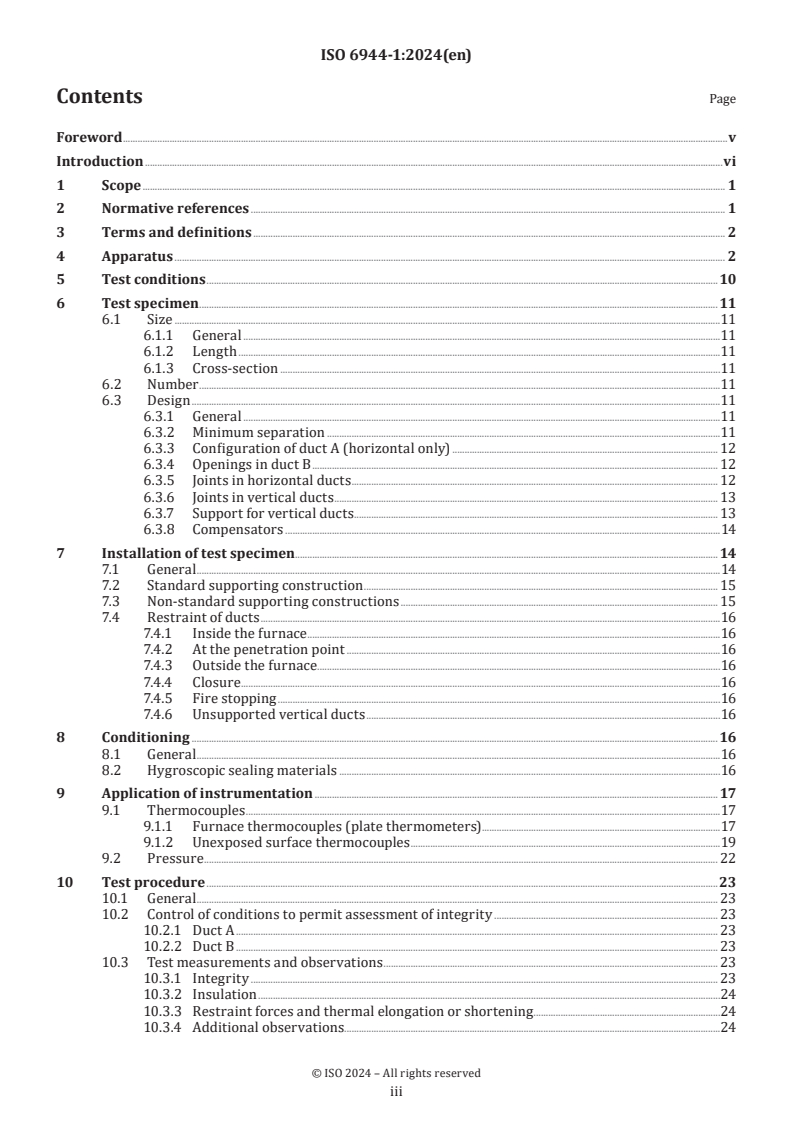
Contents Page
Foreword .v
Introduction .vi
1 Scope . 1
2 Normative references . 1
3 Terms and definitions . 2
4 Apparatus . 2
5 Test conditions .10
6 Test specimen .11
6.1 Size .11
6.1.1 General .11
6.1.2 Length .11
6.1.3 Cross-section .11
6.2 Number .11
6.3 Design .11
6.3.1 General .11
6.3.2 Minimum separation .11
6.3.3 Configuration of duct A (horizontal only) . 12
6.3.4 Openings in duct B . 12
6.3.5 Joints in horizontal ducts . 12
6.3.6 Joints in vertical ducts . 13
6.3.7 Support for vertical ducts. 13
6.3.8 Compensators .14
7 Installation of test specimen . . 14
7.1 General .14
7.2 Standard supporting construction . 15
7.3 Non-standard supporting constructions . 15
7.4 Restraint of ducts .16
7.4.1 Inside the furnace .16
7.4.2 At the penetration point .16
7.4.3 Outside the furnace . .16
7.4.4 Closure . .16
7.4.5 Fire stopping .16
7.4.6 Unsupported vertical ducts .16
8 Conditioning .16
8.1 General .16
8.2 Hygroscopic sealing materials .16
9 Application of instrumentation . 17
9.1 Thermocouples .17
9.1.1 Furnace thermocouples (plate thermometers) .17
9.1.2 Unexposed surface thermocouples .19
9.2 Pressure . 22
10 Test procedure .23
10.1 General . 23
10.2 Control of conditions to permit assessment of integrity . 23
10.2.1 Duct A . 23
10.2.2 Duct B . 23
10.3 Test measurements and observations . 23
10.3.1 Integrity . 23
10.3.2 Insulation .24
10.3.3 Restraint forces and thermal elongation or shortening .24
10.3.4 Additional observations.24
iii
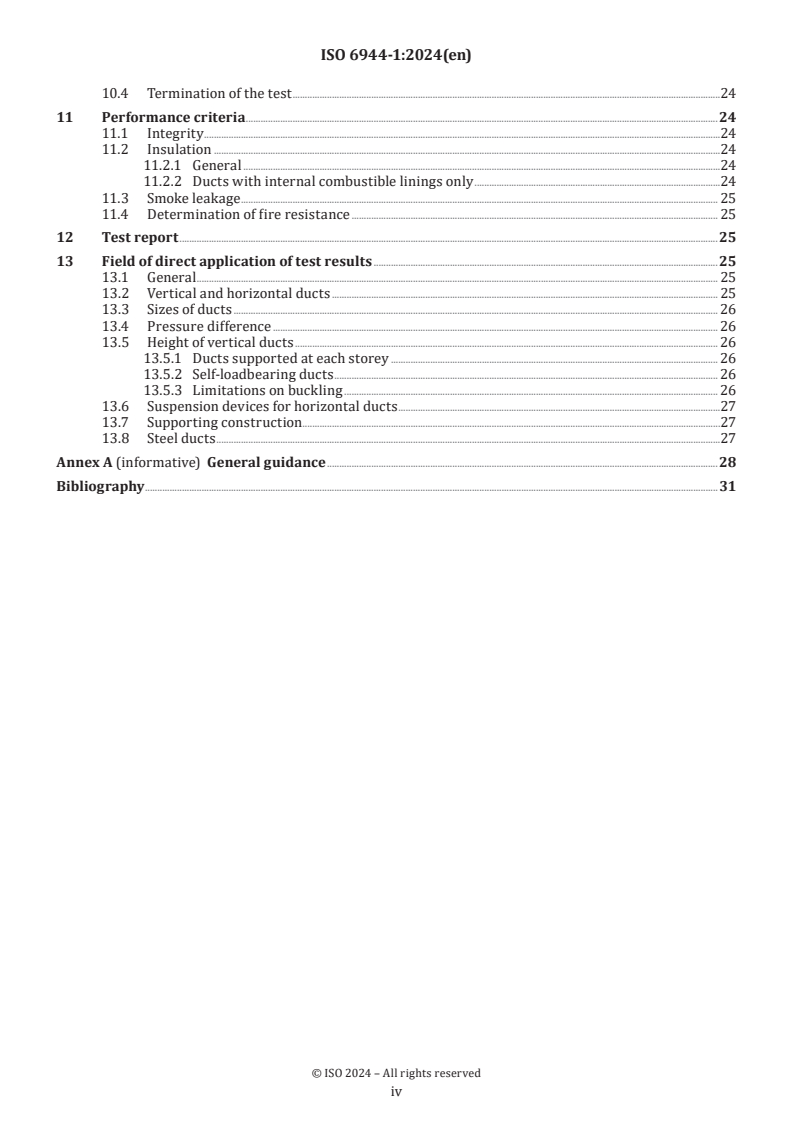
10.4 Termination of the test .24
11 Performance criteria .24
11.1 Integrity .24
11.2 Insulation .24
11.2.1 General .24
11.2.2 Ducts with internal combustible linings only .24
11.3 Smoke leakage . 25
11.4 Determination of fire resistance . 25
12 Test report .25
13 Field of direct application of test results .25
13.1 General . 25
13.2 Vertical and horizontal ducts . 25
13.3 Sizes of ducts . 26
13.4 Pressure difference . 26
13.5 Height of vertical ducts . 26
13.5.1 Ducts supported at each storey . 26
13.5.2 Self-loadbearing ducts . 26
13.5.3 Limitations on buckling . 26
13.6 Suspension devices for horizontal ducts .27
13.7 Supporting construction . .27
13.8 Steel ducts .27
Annex A (informative) General guidance .28
Bibliography .31
iv
Foreword
ISO (the International Organization for Standardization) is a worldwide federation of national standards
bodies (ISO member bodies). The work of preparing International Standards is normally carried out through
ISO technical committees. Each member body interested in a subject for which a technical committee
has been established has the right to be represented on that committee. International organizations,
governmental and non-governmental, in liaison with ISO, also take part in the work. ISO collaborates closely
with the International Electrotechnical Commission (IEC) on all matters of electrotechnical standardization.
The procedures used to develop this document and those intended for its further maintenance are described
in the ISO/IEC Directives, Part 1. In particular, the different approval criteria needed for the different types
of ISO document should be noted. This document was drafted in accordance with the editorial rules of the
ISO/IEC Directives, Part 2 (see www.iso.org/directives).
ISO draws attention to the possibility that the implementation of this document may involve the use of (a)
patent(s). ISO takes no position concerning the evidence, validity or applicability of any claimed patent
rights in respect thereof. As of the date of publication of this document, ISO had not received notice of (a)
patent(s) which may be required to implement this document. However, implementers are cautioned that
this may not represent the latest information, which may be obtained from the patent database available at
www.iso.org/patents. ISO shall not be held responsible for identifying any or all such patent rights.
Any trade name used in this document is information given for the convenience of users and does not
constitute an endorsement.
For an explanation of the voluntary nature of standards, the meaning of ISO specific terms and expressions
related to conformity assessment, as well as information about ISO's adherence to the World Trade
Organization (WTO) principles in the Technical Barriers to Trade (TBT), see www.iso.org/iso/foreword.html.
This document was prepared by Technical Committee ISO/TC 92, Fire safety, Subcommittee SC 2, Fire
Resistance.
This second edition cancels and replaces the first edition (ISO 6944-1:2008), of which it constitutes a minor
revision. It also incorporates the Amendment ISO 6944-1:2008/Amd. 1:2015.
The changes are as follows:
— references to ISO 5221:1984 (withdrawn) have been replaced with references to ISO 5167-2:2022 and
ISO 5167-3:2022;
— key element 2 in Figure 2 and key elements 18, 19 and 20 to Figure 4 have been revised.
A list of all parts in the ISO 6944 series can be found on the ISO website.
Any feedback or questions on this document should be directed to the user’s national standards body. A
complete listing of these bodies can be found at www.iso.org/members.html.
v
Introduction
The purpose of this test is to measure the ability of a representative duct or duct assembly that is part of an
air-distribution system to resist the spread of fire from one fire compartment to another, with fire attack
from inside or outside the duct. It is applicable to vertical and horizontal ducts, with or without branches,
taking into account joints and exhaust openings, as well as suspension devices and penetration points.
This document is very similar to EN 1366-1, but includes an alternative arrangement for testing elbows.
The test measures the length of time during which ducts of specified dimensions, suspended as they
normally are in practice, satisfy defined criteria when exposed to fire from either inside or outside the duct.
All ducts inside the furnace are fully restrained in all directions. Outside the furnace, ducts exposed to fire
from the outside are tested unrestrained, while ducts exposed to fire from the inside (horizontal only) are
tested restrained.
The test takes into account the effect of fire exposure from the outside, where a 300 Pa underpressure is
maintained in the duct, as well as the effect of fire entering the ducts under conditions where forced air
movement is potentially (but not necessarily) present, by maintaining an air velocity of 3 m/s.
Ducts exposed to fire from the inside are supplied with air in a manner that is representative of the “fan off”
and “fan on” situations that can arise in practice.
vi
International Standard ISO 6944-1:2024(en)
Fire containment — Elements of building construction —
Part 1:
Ventilation ducts
CAUTION — The attention of all persons concerned with managing and carrying out this fire
resistance test is drawn to the fact that fire testing can be hazardous and that there is the possibility
that toxic and/or harmful smoke and gases can be evolved during the test. Mechanical and operational
hazards can also arise during the construction of the test elements or structures, their testing and
the disposal of test residues.
The duct assembly should be allowed to cool completely after the fire test, before dismantling, to
minimize the possibility of ignition of combustible residues.
An assessment of all potential hazards and risks to health shall be made and safety precautions shall
be identified and provided. Written safety instructions shall be issued. Appropriate training shall
be given to relevant personnel. Laboratory personnel shall ensure that they follow written safety
instructions at all times.
1 Scope
This document specifies a method for determining the fire resistance of vertical and horizontal ventilation
ducts under standardized fire conditions. The test examines the behaviour of ducts exposed to fire from the
outside (duct A) and fire inside the duct (duct B). This document is intended to be used in conjunction with
ISO 834-1.
This document is not applicable to:
a) ducts whose fire resistance depends on the fire resistance performance of a ceiling;
b) ducts containing fire dampers at points where they pass through fire separations;
c) doors of inspection openings, unless included in the duct to be tested;
d) two-sided or three-sided ducts;
e) the fixing of suspension devices to floors or walls;
f) kitchen extract ducts (see ISO 6944-2).
NOTE Annex A provides general guidance and gives background information.
2 Normative references
The following documents are referred to in the text in such a way that some or all of their content constitutes
requirements of this document. For dated references, only the edition cited applies. For undated references,
the latest edition of the referenced document (including any amendments) applies.
ISO 834-1, Fire-resistance tests — Elements of building construction — Part 1: General requirements
ISO 5167-1, Measurement of fluid flow by means of pressure differential devices inserted in circular cross-section
conduits running full — Part 1: General principles and requirements
ISO 5167-2, Measurement of fluid flow by means of pressure differential devices inserted in circular cross-section
conduits running full — Part 2: Orifice plates
ISO 5167-3, Measurement of fluid flow by means of pressure differential devices inserted in circular cross-section
conduits running full — Part 3: Nozzles and Venturi nozzles
ISO 13943, Fire safety — Vocabulary
3 Terms and definitions
For the purposes of this document, the terms and definitions given in ISO 834-1 and ISO 13943 and the
following apply.
ISO and IEC maintain terminology databases for use in standardization at the following addresses:
— ISO Online browsing platform: available at https:// www .iso .org/ obp
— IEC Electropedia: available at https:// www .electropedia .org/
3.1
fire-resisting duct
duct used for the distribution or extraction of air and designed to provide a degree of fire resistance
3.2
suspension device
components used for supporting and fixing a duct from a floor or supporting a duct from a wall
3.3
supporting construction
wall, partition or floor through which the duct passes during the test
3.4
compensator
device that is used to prevent damage from the forces generated by expansion
4 Apparatus
4.1 In addition to the test equipment specified in ISO 834-1, the following apparatus is required.
4.2 Furnace, capable of subjecting ventilation ducts to the standard heating conditions specified in
ISO 834-1 and suitable for testing ducts in the vertical (see Figure 1) or horizontal (see Figure 2) orientation.
Figures 1 and 2 show two ducts being tested together. When two ducts are tested together, they shall be
separated by a minimum of 500 mm. It is also permitted to test each duct singularly in the furnace.
4.3 Fan A, capable of producing an underpressure of (300 ± 15) Pa within duct A (see Figure 3) at the
start and throughout the test, and which shall be connected, either directly or by a suitable length of flexible
ducting, to the volume flow-measuring station (4.5).
4.4 Fan B, capable of producing an air velocity when extracting gas from duct B (see Figure 4) of at least
3 m/s measured at ambient temperature in the duct before the test.
It shall be connected, either directly or by a suitable length of flexible ducting, to the velocity-measuring station
(4.8). The fan shall be provided with a by-pass vent that can be opened prior to shutting the damper (4.7).
Dimensions in millimetres
Key
1 furnace wall 7 furnace chamber
2 sealed end 8 openings providing a total area of 50 % of duct cross-section
3 fire-protection system 9 furnace floor
4 location for fire stopping (normal practice) 10 leakage-measuring station (see Figure 3 for details)
5 joint in fire-protection system 11 gas-velocity-measuring station (see Figure 4 for details)
6 furnace roof 12 duct A
13 duct B
W width
H height
D diameter
See 4.2.
Figure 1 — Test arrangement for vertical ducts
Dimensions in millimetres
Key
1 furnace wall 9 duct B
2 duct with 90° elbow 10 supporting construction
3 sealed end 11 furnace chamber
4 location for fire stopping (normal practice) 12 openings providing a total area of 50 % of duct cross-section
5 fire-protection system 13 sealed end of elbow
6 location of restraint positions 14 200 mm minimum supporting construction
7 joints in fire-protection system 15 leakage-measuring station (see Figure 3 for details)
8 duct A 16 gas-velocity-measuring station (see Figure 4 for details)
W width (rectangular duct) or D, diameter (circular duct)
See 4.2.
Figure 2 — Test arrangement for horizontal ducts
Key
1 pressure sensor to furnace 11 flexible connecting duct
2 pressure sensor on centre-line of duct 12 support for flow-measuring system
3 office plate, venture or similar 13 thermocouple, 1,5 mm diameter
4 pressure differential of 300 Pa 14 flow straightener (where necessary)
5 pressure sensor in laboratory 15 flange
6 pressure-differential control box 16 support for duct outside furnace
7 pressure-control dilution damper 17 test duct
8 pneumatic-actuator manual control 18 condensing device
9 balancing damper 19 horizontal duct A
10 fan 20 vertical duct A
a
Thermocouple located 2d from key item 3; see Note.
NOTE d is the diameter of the measuring duct downstream from the flow-measuring device.
Figure 3 — Leakage-measuring station for duct A
Key
1 pressure sensor to furnace 11 thermocouple, 1,5 mm diameter
2 pressure sensor on centre-line of duct 12 support for velocity-measuring station near duct
3 pressure sensor in laboratory 13 flange
4 pressure-differential control box 14 support for duct outside furnace
5 pressure-control dilution damper 15 inlet nozzle
6 pneumatic-actuator manual control 16 test duct
7 balancing damper 17 flow straightener (if required)
8 fan 18 horizontal duct B
9 flexible connecting duct 19 vertical duct B
10 support for velocity-measuring station near flexible duct
Figure 4 — Gas velocity station for duct B
4.5 Volume flow-measuring station, consisting of a venturi, orifice plate or other suitable device and
(where necessary) an air-flow straightener, installed in straight lengths of pipe, all sized to ISO 5167-1,
ISO 5167-2 and ISO 5167-3.
It shall be connected to the end of duct A outside the furnace to determine the volume flow rate of gas passing
through duct A during the test. The measuring device shall be capable of measuring to an accuracy of ±5 %.
Regardless of whether vertical or horizontal ducts are being tested, the volume flow-measuring station shall
always be used in a horizontal orientation.
4.6 Condensing unit, installed between the end of duct A and the flow-measuring device and which shall
allow for drainage.
The gas temperature adjacent to the flow-measuring device shall be measured by a 2 mm sheathed
thermocouple with an insulated hot junction, arranged pointing downwards to allow the moisture to drain.
Its measuring junction shall be located at the centre-line of the measuring duct and at a distance, d, equal to
twice the diameter of the measuring duct downstream from the flow-measuring device. The temperature
measured by this thermocouple shall not exceed 40 °C.
4.7 Damper, installed between the fan and the velocity-measuring station to shut off the air flow in duct B
during evaluation of integrity in the “fan off” condition.
4.8 Velocity-measuring station, to determine the air velocity in duct B and which shall consist of one
or two inlet nozzle(s), or another suitable device, installed in a straight length of pipe sized to ISO 5167-1,
ISO 5167-2 and ISO 5167-3.
It shall be connected to the end of both the vertical and horizontal ducts B outside the furnace.
4.9 Equipment for measuring gas pressure, located in the furnace and inside duct A.
4.10 Thermal-movement-measuring device, for measuring the expansion or contraction of duct A,
accurate to ±1 mm.
4.11 Force-measuring device, for measuring forces at the point of applying the restraint in duct B (see
Figure 5).
Dimensions in millimetres
Key
1 location of device measuring the restraining forces
2 duct
3 stiff load cells (used for applying and measuring restraint)
4 furnace
a
Allow movement in both directions.
b
Resist movement in both directions.
Figure 5 — Restraint of duct B outside the furnace
5 Test conditions
The heating conditions and the furnace atmosphere shall conform to those given in ISO 834-1.
The furnace pressure shall be controlled to (15 ± 3) Pa throughout the test at the mid-height position of the ducts.
Details of test conditions within the ducts during the test are given in Clause 10.
6 Test specimen
6.1 Size
6.1.1 General
Ducts of sizes other than those given in Tables 1 and 2 have restricted the field of direct application (see
Clause 13).
6.1.2 Length
The minimum lengths of the parts of the test specimen inside and outside the furnace shall be as given in
Table 1 (see also Figures 1 and 2).
Table 1 — Minimum length of test specimen
Minimum length
m
Orientation
Inside the furnace Outside the furnace
Horizontal 4,0 2,5
Vertical 2,0 2,0
6.1.3 Cross-section
The standard sizes of ducts given in Table 2 shall be tested unless only smaller cross-sections are used.
Table 2 — Cross-sectional dimensions of test specimen
Rectangular Circular
Duct
width height diameter
mm mm mm
A 1 000 ± 10 500 ± 10 800 ± 10
B 1 000 ± 10 250 ± 10 630 ± 10
6.2 Number
One test specimen shall be tested for each type of installation being evaluated.
6.3 Design
6.3.1 General
The test shall be performed on a test specimen representative of the complete duct assembly on which
information is required. The edge conditions and the method of fixing or support inside and outside the
furnace shall be representative of those used in normal practice.
Ducts shall be arranged as shown in Figures 1 and 2.
6.3.2 Minimum separation
There is no limit to the number of ducts that may be tested simultaneously in the same furnace, provided
that there is a minimum space of 500 mm between the ducts, in accordance with the dimensions shown in
Figures 1 and 2.
There shall be a separation of (500 ± 50) mm between the top of a horizontal duct and the ceiling. A minimum
separation of 500 mm shall be provided between the underside of a horizontal duct and the floor. Similarly,
there shall be a minimum separation of at least 500 mm between the sides of ducts and the furnace walls.
6.3.3 Configuration of duct A (horizontal only)
The horizontal duct A shall include one sharp bend, a T-piece and a 500 mm long length of duct forming a
short branch duct having a cross-section of 250 mm × 250 mm and shall be arranged as shown in Figure 2.
All specimens, including this branch, shall be mounted with the suspension or fixing devices as intended in
normal practice.
An alternative test arrangement where the elbow in horizontal duct A is replaced by a vertical section of
duct, which passes through the furnace roof and is then connected to the measuring system and the fan, is
illustrated in Figure 6.
6.3.4 Openings in duct B
Two openings shall be provided, one on each vertical side of the duct inside the furnace. For horizontal ducts,
the openings shall be positioned (500 ± 25) mm from the furnace wall. For vertical ducts, the openings shall
be positioned (200 ± 10) mm below the furnace roof. (See Figures 1 and 2.)
In both vertical and horizontal ducts, the openings shall have the same breadth-to-height ratio as the cross-
section of the duct and a total opening area of (50 ± 10) % of the cross-sectional area of the duct, i.e. each
opening shall have an area of (25 ± 5) % of the cross-sectional area of the duct.
6.3.5 Joints in horizontal ducts
The test configuration shall include at least one joint inside and at least one joint outside the furnace.
There shall be at least one joint per layer of fire-protection material, both inside and outside the furnace and
in any steel duct.
Outside the furnace, the joint in the outer layer of the fire-protection material shall be no further than 700 mm
from the supporting construction and no nearer than 100 mm to thermocouples T2; see Figures 10 to 12.
Inside the furnace, the joint in the outer layer of fire-protection material shall be located at approximately
mid-span.
The distance between joints and suspension devices shall not be less than that used in practice. If the
minimum distance has not been specified, suspension devices shall be arranged so that the joint at mid-span
lies midway between them. Centres of the suspension devices shall be specified by the manufacturer and
shall be representative of practice.
Dimensions in millimetres
Key
1 duct with vertical elbow 7 location of restraint positions
2 furnace roof/supporting construction 8 sealed end
3 fire-protection system 9 joints in fire-protection system
4 location for fire stopping (normal practice) 10 furnace wall
5 connection of elbow to measuring system and fan as shown in Figure 3 11 furnace chamber
6 duct supports (normal practice)
Figure 6 — Alternative arrangement for duct A with vertical elbow
6.3.6 Joints in vertical ducts
The test configuration shall include at least one joint inside and one joint outside the furnace (see Figure 1).
There shall be at least one joint for every layer of fire-protection material, both inside and outside the
furnace and in any steel duct.
Outside the furnace, the joint in the outer layer of the fire-protection material shall be no further than
700 mm from the supporting construction and no nearer than 100 mm to the thermocouples T2; see
Figures 10 to 12. Inside the furnace, the joint in the outer layer of fire-protection material shall be located at
approximately mid-span.
6.3.7 Support for vertical ducts
Vertical ducts shall be supported on the furnace floor and shall penetrate through the furnace roof slab/
supporting construction (see Figure 1); the ducts shall be fixed at the furnace-roof level as they are normally
fixed in practice when penetrating a floor. This shall be as specified by the sponsor.
6.3.8 Compensators
Only where compensators are normally used in practice shall they be incorporated in the test specimen.
Where a compensator is being tested, it shall be located within the furnace for duct A and, for duct B, outside
the furnace approximately 500 mm from the wall or floor.
7 Installation of test specimen
7.1 General
The test specimen shall be installed, as far as possible, in a manner representative of its use in normal
practice.
The supporting construction selected shall be a wall, partition or floor of the type used in normal practice
and shall have a fire resistance greater than the required fire resistance of the duct being tested.
Where the duct passes through an opening in the furnace wall or roof, the opening shall be of sufficient
dimensions that the minimum distance between the edge of the fire stopping (see 7.4.5) adjacent to the
supporting construction and the outside perimeter of the supporting construction is 200 mm (see Figure 7).
Key
1 furnace wall or furnace roof
2 fire stopping
3 supporting construction
4 duct
Dimension A shall be a minimum of 200 mm.
Figure 7 — Details of duct passing through an opening in the furnace wall or roof
7.2 Standard supporting construction
Where the type of supporting construction used in normal practice is not known, then one of the standard
supporting constructions described in Tables 3 to 5 shall be used.
Table 3 — Standard rigid-wall constructions
Type of Thickness Density Test duration
construction 3 t
mm kg/m
h
Normal concrete/masonry 110 ± 10 2 200 ± 200 t = 2
150 ± 10 2 200 ± 200 2 < t ≤ 3
175 ± 10 2 200 ± 200 3 < t ≤ 4
a
Aerated concrete 110 ± 10 650 ± 200 t = 2
150 ± 10 650 ± 200 2 < t ≤ 4
a
This supporting construction may be made from blocks bonded together with mortar or adhesive.
Table 4 — Standard flexible-wall constructions (gypsum plasterboard)
Fire resistance Wall constructions
a b
Number of layers Thickness Insulation Thickness
min
on each side mm D/ρ mm
30 1 12,5 40/40 75
60 2 12,5 40/40 100
90 2 12,5 60/50 125
120 2 12,5 60/100 150
180 3 12,5 60/100 175
240 3 15,0 80/100 190
a 3
D is the thickness in mm of mineral wool insulation inside the wall; ρ is the density in kg/m of mineral wool insulation inside
the wall.
b
Tolerance of ±10 %.
Table 5 — Standard floor constructions
Type of Thickness Density Test duration
construction 3 t
mm kg/m
h
Normal concrete 110 ± 10 2 200 ± 200 t = 1,5
150 ± 10 2 200 ± 200 1,5 < t ≤ 3
175 ± 10 2 200 ± 200 3 < t ≤ 4
Aerated concrete 125 ± 10 650 ± 200 t = 2
150 ± 10 650 ± 200 2 < t ≤ 4
7.3 Non-standard supporting constructions
When the test specimen is intended for use in a form of construction not covered by the standard supporting
constructions, it shall be tested in the supporting construction intended for use.
7.4 Restraint of ducts
7.4.1 Inside the furnace
All ducts shall be fully restrained in all directions at the furnace wall or floor remote from the penetration
point. Where there is a possibility of movement of the furnace wall, the fixings shall be made independent of
the furnace structure.
7.4.2 At the penetration point
Where, in practice, the duct is fixed at floor level, then both vertical ducts A and B shall be fixed where the
duct penetrates the furnace roof/supporting construction as specified by the sponsor.
7.4.3 Outside the furnace
Only horizontal duct B shall be restrained outside the furnace. The restraining point shall be located at a
position (2 000 ± 50) mm from the furnace wall and shall provide restraint on movement in the horizontal
directions but shall allow movement in the vertical directions (see Figure 5). The frame used to apply the
restraint shall be rigid and have sufficient strength to resist all horizontal forces. All other ducts shall be
unrestrained outside the furnace.
7.4.4 Closure
The end of the ducts within the furnace and the end of any branch duct attached shall be closed independently
of any furnace enclosure, by materials and construction similar to the remainder of the duct.
7.4.5 Fire stopping
The fire stopping at the penetration through the supporting construction shall be as intended in practice.
If the width of the gap for fire-stopping around the duct at the furnace penetration point is not specified, a
width of 50 mm shall be used.
7.4.6 Unsupported vertical ducts
Where, in practice, vertical ducts are not fixed to each floor, then the test specimen shall be suitably loaded
to simulate the weight of the remaining height of unsupported ducting.
8 Conditioning
8.1 General
Conditioning of the test construction shall be in accordance with ISO 834-1.
8.2 Hygroscopic sealing materials
Hygroscopic materials used to seal the gap between the supporting construction and the duct where the gap
is > 10 mm wide shall be conditioned for 7 days before fire testing.
Hygroscopic materials used to seal the gap between the supporting construction and the duct assembly
where the gap is > 10 mm wide shall be conditioned for 28 days before fire testing.
9 Application of instrumentation
9.1 Thermocouples
9.1.1 Furnace thermocouples (plate thermometers)
Plate thermometers shall be provided in accordance with ISO 834-1 and shall be positioned as shown in
Figures 8 and 9.
For all ducts, the plate thermometers shall be oriented so that side "A" faces the walls of the furnace opposite
the ducts being evaluated.
Dimensions in millimetres
Key
1 furnace wall 4 furnace floor
2 furnace roof 5 vertical duct A
3 one opening on each side of the duct, providing a total 6 vertical duct B
inlet area of 50 % of the cross-section of the duct (see
6.3.4)
X furnace thermocouple locations
This figure shows two ducts being tested together. It is also permitted to test each duct singularly in the furnace.
Figure 8 — Location of furnace thermocouples for vertical duct testing
Dimensions in millimetres
Key
1 furnace wall 4 furnace roof
2 duct A with 90° elbow (see 6.3.3) 5 one opening on each side of duct B providing a total
inlet area of 50 % of the cross-section of duct B (see
6.3.4)
3 fire-protection system 6 supporting construction
l span inside furnace
X location of furnace thermocouples
a
See Figure 3 for details of flow-measuring system.
b
See Figure 4 for detail o
...