


ISO 17573:2010
(Main)Electronic fee collection — Systems architecture for vehicle-related tolling
Electronic fee collection — Systems architecture for vehicle-related tolling
ISO 17573:2010 defines the architecture of a toll system environment in which a customer with one contract can use a vehicle in a variety of toll domains and with a different Toll Charger for each domain. Toll systems covered by ISO 17573:2010 can be used for various purposes including road (network) tolling, area tolling, collecting toll for bridges, tunnels, ferries, for access, and for parking. From a technical point of view the considered toll systems use electronic equipment on board a vehicle. From a process point of view the architectural description focuses on toll determination, toll charging, and the associated enforcement measures. The actual collection of the toll, i.e. collecting payments, is not included. The architecture in ISO 17573:2010 is defined with no more details than those required for an overall overview, a common language, an identification of the need for other standards, and the drafting of these standards.
Perception du télépéage — Architecture de systèmes pour le péage lié aux véhicules
General Information
- Status
- Withdrawn
- Publication Date
- 12-Dec-2010
- Withdrawal Date
- 12-Dec-2010
- Technical Committee
- ISO/TC 204 - Intelligent transport systems
- Drafting Committee
- ISO/TC 204/WG 5 - Fee and toll collection
- Current Stage
- 9599 - Withdrawal of International Standard
- Start Date
- 18-Jul-2019
- Completion Date
- 12-Feb-2026
Relations
- Effective Date
- 09-Feb-2026
- Effective Date
- 09-Feb-2026
- Effective Date
- 09-Feb-2026
- Effective Date
- 09-Feb-2026
- Effective Date
- 09-Feb-2026
- Effective Date
- 09-Feb-2026
- Referred By
CEN/TR 16219:2011 - Electronic Fee Collection - Value added services based on EFC on-board equipment - Effective Date
- 09-Feb-2026
- Effective Date
- 09-Feb-2026
- Effective Date
- 09-Feb-2026
- Effective Date
- 09-Feb-2026
- Effective Date
- 09-Feb-2026
- Effective Date
- 23-Jul-2016
- Effective Date
- 15-Apr-2008


Get Certified
Connect with accredited certification bodies for this standard

BSI Group
BSI (British Standards Institution) is the business standards company that helps organizations make excellence a habit.

Great Wall Tianjin Quality Assurance Center
Established 1993, first batch to receive national accreditation with IAF recognition.
Hong Kong Quality Assurance Agency (HKQAA)
Hong Kong's leading certification body.
Sponsored listings
Frequently Asked Questions
ISO 17573:2010 is a standard published by the International Organization for Standardization (ISO). Its full title is "Electronic fee collection — Systems architecture for vehicle-related tolling". This standard covers: ISO 17573:2010 defines the architecture of a toll system environment in which a customer with one contract can use a vehicle in a variety of toll domains and with a different Toll Charger for each domain. Toll systems covered by ISO 17573:2010 can be used for various purposes including road (network) tolling, area tolling, collecting toll for bridges, tunnels, ferries, for access, and for parking. From a technical point of view the considered toll systems use electronic equipment on board a vehicle. From a process point of view the architectural description focuses on toll determination, toll charging, and the associated enforcement measures. The actual collection of the toll, i.e. collecting payments, is not included. The architecture in ISO 17573:2010 is defined with no more details than those required for an overall overview, a common language, an identification of the need for other standards, and the drafting of these standards.
ISO 17573:2010 defines the architecture of a toll system environment in which a customer with one contract can use a vehicle in a variety of toll domains and with a different Toll Charger for each domain. Toll systems covered by ISO 17573:2010 can be used for various purposes including road (network) tolling, area tolling, collecting toll for bridges, tunnels, ferries, for access, and for parking. From a technical point of view the considered toll systems use electronic equipment on board a vehicle. From a process point of view the architectural description focuses on toll determination, toll charging, and the associated enforcement measures. The actual collection of the toll, i.e. collecting payments, is not included. The architecture in ISO 17573:2010 is defined with no more details than those required for an overall overview, a common language, an identification of the need for other standards, and the drafting of these standards.
ISO 17573:2010 is classified under the following ICS (International Classification for Standards) categories: 03.220.20 - Road transport; 35.240.60 - IT applications in transport. The ICS classification helps identify the subject area and facilitates finding related standards.
ISO 17573:2010 has the following relationships with other standards: It is inter standard links to EN ISO 12855:2012, CEN ISO/TS 17575-3:2011, CEN ISO/TS 16403-1:2012, EN ISO 12855:2015, CEN/TS 16331:2012, CEN ISO/TS 17444-1:2012, CEN/TR 16219:2011, EN ISO 17575-1:2016, CEN ISO/TS 17444-2:2013, CEN ISO/TS 17444-1:2017, CEN/TR 16690:2014, ISO 17573-1:2019, ISO/TS 17573:2003. Understanding these relationships helps ensure you are using the most current and applicable version of the standard.
ISO 17573:2010 is available in PDF format for immediate download after purchase. The document can be added to your cart and obtained through the secure checkout process. Digital delivery ensures instant access to the complete standard document.
Standards Content (Sample)
INTERNATIONAL ISO
STANDARD 17573
First edition
2010-12-15
Electronic fee collection — Systems
architecture for vehicle-related tolling
Perception du télépéage — Architecture de systèmes pour le péage lié
aux véhicules
Reference number
©
ISO 2010
PDF disclaimer
This PDF file may contain embedded typefaces. In accordance with Adobe's licensing policy, this file may be printed or viewed but
shall not be edited unless the typefaces which are embedded are licensed to and installed on the computer performing the editing. In
downloading this file, parties accept therein the responsibility of not infringing Adobe's licensing policy. The ISO Central Secretariat
accepts no liability in this area.
Adobe is a trademark of Adobe Systems Incorporated.
Details of the software products used to create this PDF file can be found in the General Info relative to the file; the PDF-creation
parameters were optimized for printing. Every care has been taken to ensure that the file is suitable for use by ISO member bodies. In
the unlikely event that a problem relating to it is found, please inform the Central Secretariat at the address given below.
© ISO 2010
All rights reserved. Unless otherwise specified, no part of this publication may be reproduced or utilized in any form or by any means,
electronic or mechanical, including photocopying and microfilm, without permission in writing from either ISO at the address below or
ISO's member body in the country of the requester.
ISO copyright office
Case postale 56 • CH-1211 Geneva 20
Tel. + 41 22 749 01 11
Fax + 41 22 749 09 47
E-mail copyright@iso.org
Web www.iso.org
Published in Switzerland
ii © ISO 2010 – All rights reserved
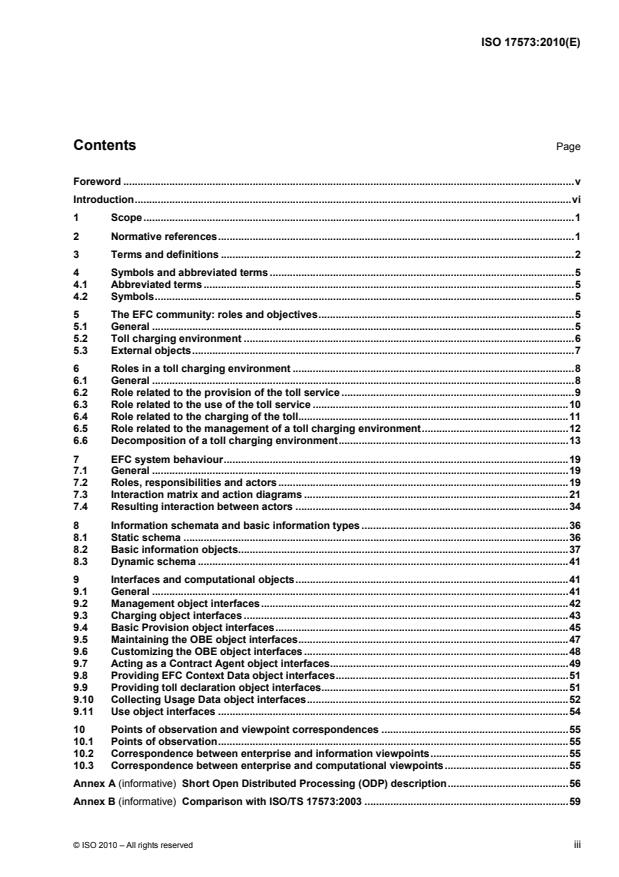
Contents Page
Foreword .v
Introduction.vi
1 Scope.1
2 Normative references.1
3 Terms and definitions .2
4 Symbols and abbreviated terms .5
4.1 Abbreviated terms .5
4.2 Symbols.5
5 The EFC community: roles and objectives.5
5.1 General .5
5.2 Toll charging environment .6
5.3 External objects.7
6 Roles in a toll charging environment .8
6.1 General .8
6.2 Role related to the provision of the toll service .9
6.3 Role related to the use of the toll service .10
6.4 Role related to the charging of the toll.11
6.5 Role related to the management of a toll charging environment.12
6.6 Decomposition of a toll charging environment.13
7 EFC system behaviour.19
7.1 General .19
7.2 Roles, responsibilities and actors .19
7.3 Interaction matrix and action diagrams .21
7.4 Resulting interaction between actors .34
8 Information schemata and basic information types .36
8.1 Static schema .36
8.2 Basic information objects.37
8.3 Dynamic schema .41
9 Interfaces and computational objects.41
9.1 General .41
9.2 Management object interfaces.42
9.3 Charging object interfaces .43
9.4 Basic Provision object interfaces.45
9.5 Maintaining the OBE object interfaces.47
9.6 Customizing the OBE object interfaces .48
9.7 Acting as a Contract Agent object interfaces.49
9.8 Providing EFC Context Data object interfaces.51
9.9 Providing toll declaration object interfaces.51
9.10 Collecting Usage Data object interfaces.52
9.11 Use object interfaces .54
10 Points of observation and viewpoint correspondences .55
10.1 Points of observation.55
10.2 Correspondence between enterprise and information viewpoints.55
10.3 Correspondence between enterprise and computational viewpoints.55
Annex A (informative) Short Open Distributed Processing (ODP) description.56
Annex B (informative) Comparison with ISO/TS 17573:2003 .59
Annex C (informative) Relations between this International Standard and IFMSA.62
Annex D (informative) Relation with the European Electronic Toll Service.66
Annex E (informative) Example of the Japanese electronic toll system .69
Bibliography .72
iv © ISO 2010 – All rights reserved
Foreword
ISO (the International Organization for Standardization) is a worldwide federation of national standards bodies
(ISO member bodies). The work of preparing International Standards is normally carried out through ISO
technical committees. Each member body interested in a subject for which a technical committee has been
established has the right to be represented on that committee. International organizations, governmental and
non-governmental, in liaison with ISO, also take part in the work. ISO collaborates closely with the
International Electrotechnical Commission (IEC) on all matters of electrotechnical standardization.
International Standards are drafted in accordance with the rules given in the ISO/IEC Directives, Part 2.
The main task of technical committees is to prepare International Standards. Draft International Standards
adopted by the technical committees are circulated to the member bodies for voting. Publication as an
International Standard requires approval by at least 75 % of the member bodies casting a vote.
Attention is drawn to the possibility that some of the elements of this document may be the subject of patent
rights. ISO shall not be held responsible for identifying any or all such patent rights.
ISO 17573 was prepared by Technical Committee ISO/TC 204, Intelligent transport systems, in collaboration
with Technical Committee CEN/TC 278, Road transport and traffic telematics.
This second edition cancels and replaces the first edition (ISO/TS 17573:2003), which has been technically
revised.
Introduction
The widespread use of tolling requires provisions for users of vehicles that are roaming through many different
toll domains. Users should be offered a single contract for driving a vehicle through various toll domains and
those vehicles require on-board equipment (OBE) that is interoperable with the toll system in the various toll
domains. In Europe, for example, this need has been officially recognized and legislation on interoperability
has already been adopted. See EFC Directive 2004/52/EC. There is a commercial and economic justification
both in respect to the OBE and the toll systems for standards enabling interoperability.
In addition to other standards, there is also a further need for a system architecture that
⎯ provides an architectural “umbrella” for other EFC standards in terms of a common definition of terms and
concepts, basic system functionalities, and structure;
⎯ provides a common terminology which enables its users
⎯ to improve the quality of specifications to be used in an international market,
⎯ to reduce the risk for different interpretations of specifications (purchaser) and descriptions (supplier),
⎯ to simplify the communication between experts from different continents, and
⎯ to enhance the potential use of other EFC standards;
⎯ defines a common framework, that enables both
⎯ identification of potential activities subject to standardization, and
⎯ maintenance of a common and consistent view of the whole area;
⎯ defines the boundaries between the EFC and the external world;
⎯ identifies all architectural objects that are within the EFC boundaries;
⎯ provides a basic understanding of EFC, EFC interoperability, and the EFC services being offered.
The previous edition of this International Standard was based on a conceptual model defined in ISO/TS 14904.
Since then, ideas on conceptual models have evolved in several regional projects and implementations, e.g.
in Japan and Europe. Those new models have been detailed to a further extent compared to
ISO/TS 17573:2003 and are closer to real-life implementations. This International Standard is based on these
new conceptual models and uses the associated terms and definitions. A comparison between
ISO/TS 17573:2003 and this edition is shown in Annex B.
Although there are many differences, collecting tolls for vehicles can be to some extent compared with
collecting fares for public transport. Architectural harmonization of the collection of fees and fares can be
desirable from a policy and from a user point of view. In the past ISO 24014-1 (prepared by CEN/TC 278
WG 3, Public Transport) used ISO/TS 17573:2003 as a starting point for their work. This International
Standard has benefited from that and has also taken ISO 24014-1 into account.
In this International Standard the open distributed processing (ODP) standard is used for the description of the
architecture.
The ODP standard gives a vocabulary and modelling tools to see the architecture of a system from different
perspectives (viewpoints), in order to cover, for example, hardware components as well as network protocols
vi © ISO 2010 – All rights reserved
or interfaces or roles and general policies of the system itself. This is accomplished using different sets of
concepts and terminologies, each one of those expressed as a viewpoint language. A complete description of
a real system can only be achieved when all viewpoint models are designed. This allows for a clear separation
of concerns and an easier way to define a system. A brief description of the ODP concepts can be found in
Annex A.
This International Standard gives a description of the architecture of the toll systems environment from the
enterprise viewpoint. In addition, this International Standard defines the foundations of the information
viewpoint by defining information interactions and general information objects, and gives the basis for the
computational view, by identifying needed computational objects and their interfaces.
INTERNATIONAL STANDARD ISO 17573:2010(E)
Electronic fee collection — Systems architecture for vehicle-
related tolling
1 Scope
This International Standard defines the architecture of a toll system environment in which a customer with one
contract can use a vehicle in a variety of toll domains and with a different Toll Charger for each domain.
Toll systems covered by this International Standard can be used for various purposes including road (network)
tolling, area tolling, collecting toll for bridges, tunnels, ferries, for access, and for parking. From a technical
point of view the considered toll systems use electronic equipment on board a vehicle.
From a process point of view the architectural description focuses on toll determination, toll charging, and the
associated enforcement measures. The actual collection of the toll, i.e. collecting payments, is not included.
The architecture in this International Standard is defined with no more details than those required for an
overall overview, a common language, an identification of the need for other standards, and the drafting of
these standards.
This International Standard provides
⎯ the enterprise view on the architecture, which is concerned with the purpose, scope and policies
governing the activities of the specified system within the organization of which it is a part,
⎯ terms and definitions for common use in a toll environment,
⎯ a decomposition of the toll systems environment into its main objects,
⎯ the responsibilities of the main actors,
⎯ an identification of the main interfaces between the main objects,
⎯ an identification of the main flows of information between the main objects, and
⎯ action diagrams reflecting the co-operation between the main actors.
2 Normative references
The following referenced documents are indispensable for the application of this document. For dated
references, only the edition cited applies. For undated references, the latest edition of the referenced
document (including any amendments) applies.
ISO/IEC 7498-1, Information Technology — Open systems interconnection reference model — Basic
Reference Model: The Basic Model (ITU-T Recommendation X.200, 1994)
ISO/IEC 10746-2, Information technology — Open distributed processing — Reference model: Foundations
(ITU-T Recommendation X.902)
ISO/IEC 10746-3, Information technology — Open distributed processing — Reference model: Architecture
(ITU-T Recommendation X.903)
ISO/IEC 15414, Information technology — Open distributed processing — Reference model: Enterprise
language (ITU-T Recommendation X.911)
3 Terms and definitions
For the purposes of this document, the terms and definitions given in ISO/IEC 7498-1, ISO/IEC 10746-2,
ISO/IEC 10746-3, ISO/IEC 15414, and the following apply.
3.1
context data
information defined by the responsible Toll Charger necessary to establish the toll due for circulating a vehicle
on a particular Toll Domain and to conclude the toll transaction
3.2
customer (of a Toll Service Provider)
person or legal entity that uses the service of a Toll Service Provider
NOTE Depending on the local situation, the customer can be the owner, lesser, lessee, keeper, (fleet) operator,
holder of the vehicle's registration certificate, driver of the vehicle, or any other third person.
3.3
driver
person who drives a vehicle
NOTE The driver is assumed to operate (use/serve) the OBE (e.g. the setting of the number of axles).
3.4
electronic fee collection
EFC
toll charging supported by electronic equipment on board a vehicle
NOTE The actual payment (collection of the fee) can take place outside the toll system.
3.5
enforcement
process of compelling observance of a law, regulation, etc.
NOTE In this context, “enforcement” is the process of compelling observance of a toll regime.
3.6
equipment interoperability
ability of two or more pieces of equipment to operate in conjunction
3.7
interoperability
ability of systems to provide services to, and accept services from, other systems and to use the services so
exchanged to enable them to operate effectively together
EXAMPLE Tolling interoperability aims at enabling a vehicle to drive through various toll domains while having only
one OBE operating under one contract with a Toll Service Provider.
3.8
localization augmentation
information sent by the roadside equipment to the on-board equipment to augment the positioning for
autonomous systems
3.9
on-board equipment
OBE
equipment fitted within or on the outside of a vehicle and used for toll purposes
NOTE The OBE does not need to include payment means.
2 © ISO 2010 – All rights reserved
3.10
one(s) liable for toll
person(s) or legal entity(ies) liable to pay toll under the operation of a toll regime
NOTE A toll regime can designate more than one person to be (jointly and severally) liable for paying the toll.
3.11
point of observation
interface, or in general identifiable access to a system, where conformance can be stated and verified
3.12
roadside equipment
equipment located along a road transport network, for the purpose of communication and data exchanges with
on-board equipments
3.13
role
set of responsibilities
3.14
tariff scheme
set of rules to determine the toll due for a vehicle in a toll domain for a tolled object at a certain day and time
EXAMPLE A table that shows the toll for various classes of vehicle.
3.15
toll
charge, tax, fee, or duty in connection with using a vehicle within a toll domain
NOTE The definition is a generalization of the classic definition of a toll as “a charge, a tax, or a duty for permission
to pass a barrier or to proceed along a road, over a bridge, etc.” The definition above also includes fees regarded as an
(administrative) obligation, e.g. a tax or a duty.
3.16
Toll Charger
legal entity charging toll for vehicles in a toll domain
NOTE In other documents the terms operator or toll operator can be used.
3.17
toll declaration
statement to a Toll Charger that confirms the presence of a vehicle in a toll domain in a format agreed
between the Toll Service Provider and the Toll Charger
NOTE A valid toll declaration has to fulfil formal requirements, including security requirements, agreed between the
Toll Service Provider and the Toll Charger.
3.18
toll domain
area or part of a road network where a toll regime is applied
3.19
toll point
location within a toll domain where the OBE has to issue a toll declaration
EXAMPLE A part of a toll plaza for electronic fee collection.
3.20
toll regime
set of rules, including enforcement rules, governing the collection of toll in a toll domain
3.21
toll schema
generic term used for toll regime and/or toll domain and/or toll system depending on the context
3.22
toll service
service enabling users having only one contract and one set of OBE to use a vehicle in one or more toll
domains
3.23
Toll Service Provider
legal entity providing customer toll services on one or more toll domains for one or more classes of vehicle
NOTE 1 In other documents the terms “issuer” or “contract issuer” can be used.
NOTE 2 The toll service provider can provide the OBE or can provide only a magnetic card or a smart card to be used
with the OBE provided by a third party (just as a mobile telephone and a SIM card can be obtained from different parties).
NOTE 3 The toll service provider is responsible for the operation (functioning) of the OBE with respect to tolling.
3.24
toll system
off-board equipment and possible other provisions used by a toll charger for the collection of toll for vehicles
NOTE 1 The OBE is excluded from the definition.
NOTE 2 The actual payment (collection of the fee) can take place outside the toll system.
3.25
toll systems environment management
controlling enterprise object for the toll systems environment
NOTE The toll systems environment management can encompass several distinct entities, e.g. a political/legislative
one, a regulatory one, private associations, standardization authorities, and so on.
3.26
tolled object
distinguished part of a toll domain for which one or more tariff schemes apply
EXAMPLE A tolled object can be e.g. an area, all public roads within an area, a bridge, a zone, or a stretch of road
(network).
3.27
transport service
service used by a toll-liable vehicle in a given toll regime under the responsibility of a toll charger
3.28
trust object
information object that is exchanged between entities to ensure mutual trust
EXAMPLE A trust object can be e.g. an electronic signature or an electronic certificate.
3.29
user
customer of a toll service provider, one liable for toll, the owner of the vehicle, a fleet operator, a driver, etc.
NOTE This is a generic term which is context dependent.
4 © ISO 2010 – All rights reserved
4 Symbols and abbreviated terms
4.1 Abbreviated terms
For the purposes of this document, the following abbreviations apply throughout the document unless
otherwise specified.
CE Central Equipment
CRM Customer Relationship Management
DSRC Dedicated Short-Range Communication
EETS European Electronic Toll System
EFC Electronic Fee Collection
GNSS Global Navigation Satellite Systems
ID Identity
IFMSA Interoperable Fare Management System Architecture
OBU On-board Unit
ODP Open Distributed Processing
RSE Roadside Equipment
SLA Service Level Agreements
TC Toll Charger
TMS Traffic Management System
TTP Trusted Third Party
UML Unified Modelling Language
4.2 Symbols
In action diagrams, the following graphical conventions apply.
Rounded corner boxes indicate responsibilities and related activities within roles
Horizontal arrows indicate information exchanges between roles as activities
performed within responsibilities
Vertical arrows represent execution steps within activities
Solid circles represent the start of activities
Partially coloured circles represent the end of activities
Solid horizontal bars represent decision gates
5 The EFC community: roles and objectives
5.1 General
This clause specifies the EFC community in terms of its relationships and interactions with the external objects
with which the EFC community interacts.
The EFC community is
a) the collection of all entities that have been set up for carrying through the different roles,
b) the EFC-specific equipment needed to fulfill the roles, and
c) the vehicle-related transport services subject to tolling.
External entities are objects that are involved in the toll charging but that are not set up for the only purpose of
toll charging, e.g. satellite positioning systems and standardization bodies.
The EFC community is represented as a toll charging environment and the objects that the toll charging
environment interacts with, which together act as a configuration of objects formed to meet an objective which,
in this case, is the electronic collection of tolls for vehicle-related transport services. The toll charging
environment itself is represented as an enterprise object in the community and the objectives and scope of the
toll charging environment are defined in terms of the roles it fulfils within the community of which it is part and
the policy statements about these roles. Also, the roles of the enterprise objects external to a toll charging
environment are defined here in terms of their implication in the tolling.
Figure 1 shows the external enterprise objects that define the environment of this International Standard.
Objects shown are the major objects, although there may be others, explicitly or implicitly involved in the toll
collection. There might also be interfaces between a toll charging environment and other types of ITS systems,
e.g. traffic information systems.
The lines between the objects indicate the major interactions between the enterprise objects, where interfaces
are located. Interfaces between the toll charging environment and the other objects in the EFC community will
be external interfaces to the toll charging environment while interfaces within the toll charging environment will
be internal interfaces.
Positioning systems
Authorities Financial systems
Toll charging
Standardization
Telecom systems
bodies
environment
EFC equipment Vehicle sensors and
suppliers data stores
Certification bodies
Environmental sensors
and other ITS systems
Figure 1 — Enterprise objects in the EFC community
5.2 Toll charging environment
The role of a toll charging environment is to electronically collect a toll in a secure and safe way enabling
issuing of a toll declaration without stopping at a charging point, e.g. a toll station.
The interactions between a toll charging environment and the other objects in the EFC community are
described below.
6 © ISO 2010 – All rights reserved
5.3 External objects
5.3.1 Financial systems, e.g. banks, credit card companies and clearing houses
The role of a financial system is to provide the financial services requested by a toll charging environment.
The services will mainly be the transfer of money between entities in the toll charging environment, including
users. It is important to note that the toll charging environment roles handle charging data while the financial
system handles payment information (“money”). The interactions between the toll charging environment and
the financial system are based on explicit and implicit contracts between the objects in the toll charging
environment and the objects in the financial system.
This International Standard makes a strict distinction between the payment (financial) domain supporting a toll
charging environment and the charging domain within the toll charging environment itself. Only the charging
domain is covered by this International Standard.
5.3.2 Telecom systems
The role of the telecom systems is to provide the telecom services requested by a toll charging environment.
Examples of such services could be cable network for transfer of data between the operators of the toll
charging environment and air-interface network for transfer of data between the toll charging equipment and
the OBE. The interactions between the toll charging environment and the telecom system are based on
explicit and implicit contracts between the objects in the toll charging environment and the objects in the
telecom system.
5.3.3 Positioning systems
The role of the positioning systems is to provide positioning services as part of the toll calculation, i.e. to
provide signals for registering the position of the vehicle subject to a toll. Examples of such registrations are
the registration of when a vehicle recognizes a tolling object or the distance that a vehicle has travelled in a
road network. Examples of real-life positioning systems are GPS and GALILEO. DSRC road infrastructure
could also be used for positioning but, in this case, it would be part of the toll charging environment as it has
no other roles outside the EFC community. The interactions between a toll charging environment and the
positioning system are based on explicit and implicit contracts between the objects in the toll charging
environment (objects related to the toll charging roles) and the objects in the positioning system.
5.3.4 Vehicle sensors and data stores
A toll charging environment may use information from vehicle sensors and data stores integrated in the
vehicle where the main purposes of the sensor or data store are not related to EFC. The information is
retrieved from the sensors and data stores and used for the toll calculation. Examples of such sensors and
data stores are GNSS sensors (e.g. in devices used for navigation, fleet management), tachographs, trailer
sensors, suspension sensors, axles in use sensors and vehicle-related information stored in a secure
application module (SAM). The data stores could be either in the vehicle or elsewhere, e.g. a computer
installed within the toll domain.
5.3.5 Environmental sensors and other ITS systems
A toll charging environment may use data from environmental sensors, e.g. pollution measurements, for the
toll calculation. Data from other ITS systems, e.g. traffic management systems (TMSs), may also be used for
toll calculation. A dynamic road pricing scheme may for instance use both the pollution measurements from
environmental sensors and the data on traffic flows and speeds from a TMS for the dynamic toll calculation.
5.3.6 EFC equipment suppliers
The role of the EFC equipment suppliers is to provide EFC equipment to a toll charging environment, e.g.
OBE and RSE. The interactions between the EFC equipment suppliers and the toll charging environment are
based on contracts between the different objects in the toll charging environment and the EFC equipment
suppliers. The main role of the toll charging environment will be to provide system requirements while the
main role of the EFC equipment suppliers will be to provide EFC equipment with EFC functionality in
accordance with the requirements.
5.3.7 Certification bodies
The role of the certification bodies is to certify the objects in a toll charging environment. The certification may
cover both the certification of roles and equipment/functions in the toll charging environment.
Certification of roles, e.g. the actors (companies) that take crucial roles, is important in an interoperable
environment with several different operators.
5.3.8 Standardization bodies
The role of the standardization bodies is to provide EFC standards and other standards or specifications
relevant for toll charging environments. There are interactions with a toll charging environment concerning
EFC standards to be used for toll charging environment requirements as well as input from toll charging
environments to the standardization bodies, e.g. by toll charging operators taking part in the preparation of
EFC standards.
5.3.9 Authorities
The role of the authorities is to define the framework in which a toll charging environment shall operate. The
framework is defined by policies constituting laws and regulations, mandates, constraints and requirements.
Different authorities define different policies:
⎯ Road and transport authorities, e.g. a Department of Transport, may define policies related to the type,
availability, reliability and quality of the transport service subject to a toll. The authorities may also, in co-
operation with the financial authorities, define policies for tariffing principles to be used in a toll charging
environment. The authorities may also, in co-operation with the financial authorities, define the policies
that govern the configuration of the EFC enterprise objects and assignment of roles to enterprise objects
as well as the environment contracts that govern the system. An example here would be that the
authorities define the policy which is the basis for the contract between an operator taking the role of
issuing EFC contracts and the operators taking the toll charging roles.
⎯ Telecom authorities may define policies for the use of telecom systems, e.g. frequencies in air-interface
communication systems.
⎯ Financial authorities may define policies for a toll charging environment and the financial environment it
shall operate, e.g. whether the toll is a tax or a fee. They may also define policies for the use of certain
types of payment means, e.g. electronic purses, and the split of roles between the toll charging
environment and the financial systems.
⎯ Data protection authorities may define policies for the security and privacy in a toll charging environment.
⎯ Certification authorities may issue public key certificates.
The interactions with the authorities also cover access to information kept by the authorities, e.g. national
vehicle registers.
6 Roles in a toll charging environment
6.1 General
Since a role is a collection of responsibilities for certain tasks (or functions), this International Standard
describes the different roles in a toll charging environment as the defined collections of responsibilities in the
EFC scope. Roles are described in general terms, i.e. as sets of responsibilities where each set includes
8 © ISO 2010 – All rights reserved
responsibilities that are logically related to each other, either by their objectives and/or the actors that may
take the role. The following roles are identified:
⎯ A role related to the provision of the toll service.
⎯ A role related to the use of the toll services.
⎯ A role related to the charging of the toll.
⎯ A role related to the management of a toll charging environment. Responsibilities in this role include
managing the interoperability among different EFC domains and acting like an advisory board, in the
sense of not covering any commercial responsibility or risk.
An overall picture of the main roles and their interactions is summarized in Figure 2. The two-way arrows
between roles are meant to indicate collections of interactions. Interactions to and from the management role
are management information flows, while interactions between the three other roles are operational
information flows of the toll charging environment, i.e. information flows that are present during daily operation.
Management of the toll
charging environment
Provision of the Charging of the
toll service toll
Use of the
services
Figure 2 — Roles in a toll charging environment
The following clauses describe the above identified roles, indicating, for each role, its responsibilities. It has to
be clear that this International Standard does not impose that all roles perform all indicated responsibilities.
Mandating the performance of certain responsibilities is the task of base standards derived from this
architecture.
6.2 Role related to the provision of the toll service
The role related to the provision of the toll service is responsible for providing the basic artefacts, mechanisms,
organization structures, and information transfer tools needed to run an EFC system.
Responsibilities related to this role include
⎯ providing basic provision, including
⎯ providing the OBE,
⎯ guaranteeing that the entity performing the charging of the toll role will be paid for it,
⎯ providing the payment means to the user or accepting an existing one,
⎯ collecting the money from the signer of the EFC contract,
⎯ managing the customer relationships related to the use of the toll service concerning information,
claims, questions and answers, error handling and any contractual or financial matters,
⎯ implementing and adhering to the security and privacy policies for the toll systems, and
⎯ monitoring the actual operational quality relative to agreed SLA's;
⎯ acting as a contract agent, including
⎯ offering contractual relations according to defined conditions to interested users and concluding
contractual agreements, and
⎯ providing and managing the EFC contract including the service rights for the toll service user;
⎯ providing toll declaration, including
⎯ making sure that the OBE is reporting in a secure way information needed for the toll charging;
⎯ providing EFC context data, including
⎯ providing context data originated elsewhere (e.g. by a Toll Charger) in a way that they can be
installed in the OBE;
⎯ customizing the OBE, including
⎯ customizing the OBE in a secure way;
⎯ maintaining the OBE, including
⎯ maintaining the functionality of the OBE.
6.3 Role related to the use of the toll service
In this International Standard, a transport service is related to the use of, or the presence of, a vehicle in a toll
domain. The toll domain may encompass a road network, a specific section of road (e.g. a bridge, a tunnel or
a ferry connection) or a specific area offering a service (e.g. a parking lot or access to a protected area in a
city). It could also be any service related to the use of a vehicle in the transport system, e.g. a petrol station
enabling the driver to buy petrol by means of EFC.
A role is thus identified that covers all aspects of using the toll system and, if applicable, of the transport
service. Implementations of toll systems in various domains identify actors in this role that are commonly
referred to as, e.g., driver, user or customer.
This role covers the following responsibilities:
⎯ Driving the vehicle subject to toll including
⎯ using the OBE as a tool to fulfil one's obligations,
⎯ interacting with the OBE, e.g. declaring the vehicle characteristics for the vehicle subject to toll or
receiving messages and acting on the messages from the OBE, and
⎯ behaving according to the rules of a specific toll system, e.g. recognizing a signal or a road sign.
10 © ISO 2010 – All rights reserved
⎯ Owning or operating a vehicle, including
⎯ adhering to the toll regime for a toll domain,
⎯ signing a contract with a Toll Service Provider,
⎯ signing a contract with the issuer of the EFC contract and becoming responsible for compliance to
the rules related to the use of the toll service,
⎯ acquiring an OBE,
⎯ installing and eventually de-installing the OBE in the vehicle,
⎯ terminating the contractual relation to the Toll Service Provider,
⎯ receiving the claim, e.g. by means of an invoice, for a service that has been used and a toll to be
paid,
⎯ paying the toll included in the claim,
⎯ storing and protecting the contractual data and eventually the payment means, e.g. an electronic
purse, needed for toll charging and communicating the data to other actors having roles related to
issuing or toll charging (this role is always bound to the OBE), and
⎯ contacting the CRM of the service provider in order to clarify uncertainties about issues covered by
contractual relations.
6.4 Role related to the charging of the toll
The role related to the charging of the toll covers all actors who define the toll regime, operate the toll system
and may provide transport services. The role includes the related charging infrastructures and who defines the
toll and operates the toll system. Enforcement operators also play this role.
The role related to the toll charging includes the following responsibilities:
⎯ Basic charging, including
⎯ providing, if applicable, the transport service, e.g. access to a road network, a parking lot or a ferry
connection, and
⎯ defining the charging principles for the service offered, e.g. the tariffing principles for a tolled road or
zone.
⎯ Calculating the toll, including
⎯ possibly communicating to the user the result of the charging process, and
⎯ communicating in a secure way with actors having roles related to the issuing of the EFC contract,
payment means and OBE.
⎯ Originating EFC context data, including
⎯ informing the driver of the vehicle about the EFC availability and the toll charging principles, e.g.
through signs and messages either directly or via the OBE.
⎯ Communicating with passing vehicles, including, whenever applicable and according to the technology
chosen in the given toll domain
⎯ providing, if applicable, to autonomous systems, geographical details of the charge objects in the toll
domain, as well as positioning information; this process is also known as localization augmentation,
⎯ detecting a vehicle subject to a toll,
⎯ collecting the characteristics of a vehicle enabling a correct classification of the vehicle used for a toll
calculation; the information collected can either be read from the OBE, measured (both used for toll
calculation or verification of data read from the OBE) or collected from a central database or vehicle
register (off-line toll calculation),
⎯ communicating in a secure way with the OBE, exchanging information needed for the toll charging,
⎯ accepting the service rights stored in the OBE, i.e. the medium carrying the contractual data, and
⎯ collecting the information enabling the operator of the toll domain to identify the receiver of a claim for
a transport service provided, e.g. by licence plate recognition. The role enables toll collection without
an OBE installed in the vehicle.
⎯ Operating enforcement, including
⎯ detecting, recording and handling exceptions (including fraud) whenever a vehicle passes through a
toll domain; compliance check of autonomous systems is included in this responsibility,
⎯ handling enforcement cases while protecting the privacy of the actors having taken the role of driver,
and
⎯ implementing and adhering to the security and privacy policies for the toll charging environments.
6.5 Role related to the management of a toll charging environment
There is also a need
...
Questions, Comments and Discussion
Ask us and Technical Secretary will try to provide an answer. You can facilitate discussion about the standard in here.
Loading comments...