

CEN/TR 16690:2014
(Main)Electronic fee collection - Guidelines for EFC applications based on in-vehicle ITS stations
- Abstract
This Technical Report (TR) contains an analysis of the technical and operational feasibility of using a generic ITS Station as specified in ETSI EN 302 665, Intelligent Transport Systems (ITS); Communications Architecture, for EFC applications compliant to the requirements specified in ISO 17573, EN ISO 12855, CEN ISO/TS 17575 (all parts), EN ISO 14906, EN 15509, CEN ISO/TS 12813, CEN ISO/TS 13141 and CEN/TS 16439.
The scope of this Technical Report includes:
- description of the context of Cooperative ITS and the ITS Stations;
- providing details of the context of EFC applications;
- outlining the basic architectural concepts and role model of both EFC and Cooperative ITS;
- identification of core requirement areas for operation of an EFC application on an ITS Station;
- specification of a set of recommendations for functional, operational and security requirements to the ITS Station supporting the EFC application(s);
- description of a possible role model in which the roles known in EFC applications make use of the roles in the C-ITS system in order to provide EFC services in an C-ITS context;
- provision of considerations in particular areas of EFC like certification and governances;
- guideless and recommendations for further standardization work in this area;
- emphasising on security related elements of EFC that need to be considered in a C-ITS environment.
The scope of this Technical Report is limited to in-vehicle ITS Stations. However, an EFC service always requires the involvement of in-vehicle and central functionalities. Furthermore, for enforcement purposes as well as in DSRC based toll domains for toll charging purposes also, it is essential that road-side based functions are provided and operated. In order to facilitate EFC services a set of functionalities, tasks and responsibilities are defined and specified in an EFC role model (ISO 17573). These functionalities, tasks and responsibilities are shared between the roles Toll Charger, Toll Service Provider, Road User and Interoperability Management. All these roles interact with each other. As a consequence this Technical Report provides in various areas explanations that are beyond the in-vehicle environment. This is required in order to present the full environment and context. It keeps the readability of this document at a sound level and provides valuable information to those readers which are not yet familiar with EFC in detail.
Outside the scope of this Technical Report is:
- detailed technical specifications for EFC services and applications on C-ITS systems;
- implementation specific elements.
- Status
- Published
- Publication Date
- 01-Jul-2014
- Technical Committee
- CEN/TC 278 - Road transport and traffic telematics
- Drafting Committee
- CEN/TC 278/WG 1 - Electronic fee collection and access control (EFC)
- Current Stage
- 9093 - Decision to confirm - Review Enquiry
- Start Date
- 17-Mar-2026
- Completion Date
- 14-Oct-2026

Overview
CEN/TR 16690:2014 - "Electronic fee collection (EFC) - Guidelines for EFC applications based on in-vehicle ITS stations" - is a CEN Technical Report that evaluates the technical and operational feasibility of using a generic ITS Station (per ETSI EN 302 665) to host EFC services. It maps EFC requirements to the C-ITS environment and gives recommendations for functional, operational and security capabilities required in in-vehicle ITS stations to support tolling and electronic fee collection.
Key scope facts:
- Analyses the use of a generic ITS Station for EFC compliant with standards such as ISO 17573, EN ISO 12855, EN 15509, EN ISO 14906, and related CEN/ISO technical specifications.
- Focused on in-vehicle ITS Stations, but explains central and roadside functions to provide full EFC context.
- Excludes detailed protocol specifications and implementation-specific elements.
Key technical topics and requirements
The report organizes EFC in a C-ITS context and highlights core technical areas:
- C-ITS architecture & ITS Station: role model and business/technical architecture alignment between EFC roles and C-ITS components.
- EFC role model: mapping of Toll Charger, Toll Service Provider, Road User and Interoperability Management to C-ITS roles and responsibilities.
- Communication technologies: considerations for DSRC and wide-area/positioning support when EFC is implemented on ITS Stations.
- Functional requirements: detection of chargeable events, fee calculation, charge-report generation, location support and enforcement support for both autonomous and DSRC-based toll domains.
- Security requirements: confidentiality, integrity, authentication, and privacy considerations specific to EFC in a C-ITS environment.
- Operational requirements: resource management, performance monitoring, application lifecycle and update procedures for ITS Stations.
- Certification & governance: suitability-for-use testing, conformity assessment, registration/certification authorities, and governance recommendations for safe deployment.
- Migration & coexistence: guidance for transitioning from dedicated OBE devices to ITS-Station-based EFC.
Practical applications and target users
This Technical Report is practical for:
- Toll operators and Toll Service Providers assessing ITS-Station based EFC deployment.
- ITS system architects and integrators designing in-vehicle applications that combine Cooperative ITS (C-ITS) and EFC functions.
- Vehicle OEMs and telematics suppliers implementing ITS Station platforms that must host EFC services.
- Regulators, certification bodies and interoperability managers establishing test rules, governance and certification frameworks.
- Project leads in ITS/C-ITS pilot deployments evaluating feasibility, security and operational implications.
Practical uses include feasibility studies, architecture alignment, security and certification planning, and preparing migration strategies from dedicated OBEs to in-vehicle ITS Stations.
Related standards (as referenced)
The Technical Report explicitly maps to and references:
- ETSI EN 302 665 (ITS Communications Architecture / ITS Station)
- ISO 17573, EN ISO 12855, CEN ISO/TS 17575 (all parts), EN ISO 14906, EN 15509, CEN ISO/TS 12813, CEN ISO/TS 13141, CEN/TS 16439
These references support interoperability, enforcement, data formats and lifecycle considerations for EFC in a C-ITS context.
Relations
- Effective Date
- 09-Feb-2026
- Effective Date
- 28-Jan-2026
- Effective Date
- 28-Jan-2026
- Effective Date
- 28-Jan-2026
- Effective Date
- 28-Jan-2026
- Effective Date
- 28-Jan-2026
- Effective Date
- 28-Jan-2026
- Effective Date
- 28-Jan-2026
- Effective Date
- 28-Jan-2026
- Effective Date
- 28-Jan-2026
Get Certified
Connect with accredited certification bodies for this standard

BSI Group
BSI (British Standards Institution) is the business standards company that helps organizations make excellence a habit.

NYCE
Mexican standards and certification body.
Sponsored listings
Frequently Asked Questions
CEN/TR 16690:2014 is a technical report published by the European Committee for Standardization (CEN). Its full title is "Electronic fee collection - Guidelines for EFC applications based on in-vehicle ITS stations". This standard covers: This Technical Report (TR) contains an analysis of the technical and operational feasibility of using a generic ITS Station as specified in ETSI EN 302 665, Intelligent Transport Systems (ITS); Communications Architecture, for EFC applications compliant to the requirements specified in ISO 17573, EN ISO 12855, CEN ISO/TS 17575 (all parts), EN ISO 14906, EN 15509, CEN ISO/TS 12813, CEN ISO/TS 13141 and CEN/TS 16439. The scope of this Technical Report includes: - description of the context of Cooperative ITS and the ITS Stations; - providing details of the context of EFC applications; - outlining the basic architectural concepts and role model of both EFC and Cooperative ITS; - identification of core requirement areas for operation of an EFC application on an ITS Station; - specification of a set of recommendations for functional, operational and security requirements to the ITS Station supporting the EFC application(s); - description of a possible role model in which the roles known in EFC applications make use of the roles in the C-ITS system in order to provide EFC services in an C-ITS context; - provision of considerations in particular areas of EFC like certification and governances; - guideless and recommendations for further standardization work in this area; - emphasising on security related elements of EFC that need to be considered in a C-ITS environment. The scope of this Technical Report is limited to in-vehicle ITS Stations. However, an EFC service always requires the involvement of in-vehicle and central functionalities. Furthermore, for enforcement purposes as well as in DSRC based toll domains for toll charging purposes also, it is essential that road-side based functions are provided and operated. In order to facilitate EFC services a set of functionalities, tasks and responsibilities are defined and specified in an EFC role model (ISO 17573). These functionalities, tasks and responsibilities are shared between the roles Toll Charger, Toll Service Provider, Road User and Interoperability Management. All these roles interact with each other. As a consequence this Technical Report provides in various areas explanations that are beyond the in-vehicle environment. This is required in order to present the full environment and context. It keeps the readability of this document at a sound level and provides valuable information to those readers which are not yet familiar with EFC in detail. Outside the scope of this Technical Report is: - detailed technical specifications for EFC services and applications on C-ITS systems; - implementation specific elements.
This Technical Report (TR) contains an analysis of the technical and operational feasibility of using a generic ITS Station as specified in ETSI EN 302 665, Intelligent Transport Systems (ITS); Communications Architecture, for EFC applications compliant to the requirements specified in ISO 17573, EN ISO 12855, CEN ISO/TS 17575 (all parts), EN ISO 14906, EN 15509, CEN ISO/TS 12813, CEN ISO/TS 13141 and CEN/TS 16439. The scope of this Technical Report includes: - description of the context of Cooperative ITS and the ITS Stations; - providing details of the context of EFC applications; - outlining the basic architectural concepts and role model of both EFC and Cooperative ITS; - identification of core requirement areas for operation of an EFC application on an ITS Station; - specification of a set of recommendations for functional, operational and security requirements to the ITS Station supporting the EFC application(s); - description of a possible role model in which the roles known in EFC applications make use of the roles in the C-ITS system in order to provide EFC services in an C-ITS context; - provision of considerations in particular areas of EFC like certification and governances; - guideless and recommendations for further standardization work in this area; - emphasising on security related elements of EFC that need to be considered in a C-ITS environment. The scope of this Technical Report is limited to in-vehicle ITS Stations. However, an EFC service always requires the involvement of in-vehicle and central functionalities. Furthermore, for enforcement purposes as well as in DSRC based toll domains for toll charging purposes also, it is essential that road-side based functions are provided and operated. In order to facilitate EFC services a set of functionalities, tasks and responsibilities are defined and specified in an EFC role model (ISO 17573). These functionalities, tasks and responsibilities are shared between the roles Toll Charger, Toll Service Provider, Road User and Interoperability Management. All these roles interact with each other. As a consequence this Technical Report provides in various areas explanations that are beyond the in-vehicle environment. This is required in order to present the full environment and context. It keeps the readability of this document at a sound level and provides valuable information to those readers which are not yet familiar with EFC in detail. Outside the scope of this Technical Report is: - detailed technical specifications for EFC services and applications on C-ITS systems; - implementation specific elements.
CEN/TR 16690:2014 is classified under the following ICS (International Classification for Standards) categories: 35.240.60 - IT applications in transport. The ICS classification helps identify the subject area and facilitates finding related standards.
CEN/TR 16690:2014 has the following relationships with other standards: It is inter standard links to ISO 17573:2010, EN ISO 12813:2024, CEN ISO/TS 17575-3:2011, EN ISO 14906:2023, EN ISO 12855:2012, CEN ISO/TS 17575-1:2010, EN ISO 13141:2024, CEN ISO/TS 17575-4:2011, EN ISO 17575-2:2016, EN 15509:2023. Understanding these relationships helps ensure you are using the most current and applicable version of the standard.
CEN/TR 16690:2014 is associated with the following European legislation: EU Directives/Regulations: 2004/52/EC; Standardization Mandates: M/338, M/453. When a standard is cited in the Official Journal of the European Union, products manufactured in conformity with it benefit from a presumption of conformity with the essential requirements of the corresponding EU directive or regulation.
CEN/TR 16690:2014 is available in PDF format for immediate download after purchase. The document can be added to your cart and obtained through the secure checkout process. Digital delivery ensures instant access to the complete standard document.
Standards Content (Sample)
SLOVENSKI STANDARD
01-december-2014
Elektronsko pobiranje pristojbin (EFC) - Smernice za aplikacije EFC na podlagi v
vozila vgrajenih postaj ITS
Electronic fee collection - Guidelines for EFC applications based on in-vehicle ITS
stations
Leitfaden zur elektronischen Gebührenerhebung (EFC) - Anwendungen basierend auf
fahrzeuginternen ITS Stationen
Perception de télépéage - Lignes directrices concernant les applications de perception
de télépéage basées sur des stations de systèmes de transport intelligents embarquées
à bord des véhicules
Ta slovenski standard je istoveten z: CEN/TR 16690:2014
ICS:
35.240.60 Uporabniške rešitve IT v IT applications in transport
transportu in trgovini and trade
2003-01.Slovenski inštitut za standardizacijo. Razmnoževanje celote ali delov tega standarda ni dovoljeno.
TECHNICAL REPORT
CEN/TR 16690
RAPPORT TECHNIQUE
TECHNISCHER BERICHT
July 2014
ICS 35.240.60
English Version
Electronic fee collection - Guidelines for EFC applications based
on in-vehicle ITS stations
Perception de télépéage - Lignes directrices pour les Elektronische Gebührenerhebung - Richtlinien für
applications de télépéage installées dans les stations de Anwendungen der Elektronischen Gebührenerhebung
systèmes de transport intelligents (ITS) embarquées dans basierend auf fahrzeuginternen IVS Geräten
les véhicules
This Technical Report was approved by CEN on 10 May 2014. It has been drawn up by the Technical Committee CEN/TC 278.
CEN members are the national standards bodies of Austria, Belgium, Bulgaria, Croatia, Cyprus, Czech Republic, Denmark, Estonia,
Finland, Former Yugoslav Republic of Macedonia, France, Germany, Greece, Hungary, Iceland, Ireland, Italy, Latvia, Lithuania,
Luxembourg, Malta, Netherlands, Norway, Poland, Portugal, Romania, Slovakia, Slovenia, Spain, Sweden, Switzerland, Turkey and United
Kingdom.
EUROPEAN COMMITTEE FOR STANDARDIZATION
COMITÉ EUROPÉEN DE NORMALISATION
EUROPÄISCHES KOMITEE FÜR NORMUNG
CEN-CENELEC Management Centre: Avenue Marnix 17, B-1000 Brussels
© 2014 CEN All rights of exploitation in any form and by any means reserved Ref. No. CEN/TR 16690:2014 E
worldwide for CEN national Members.
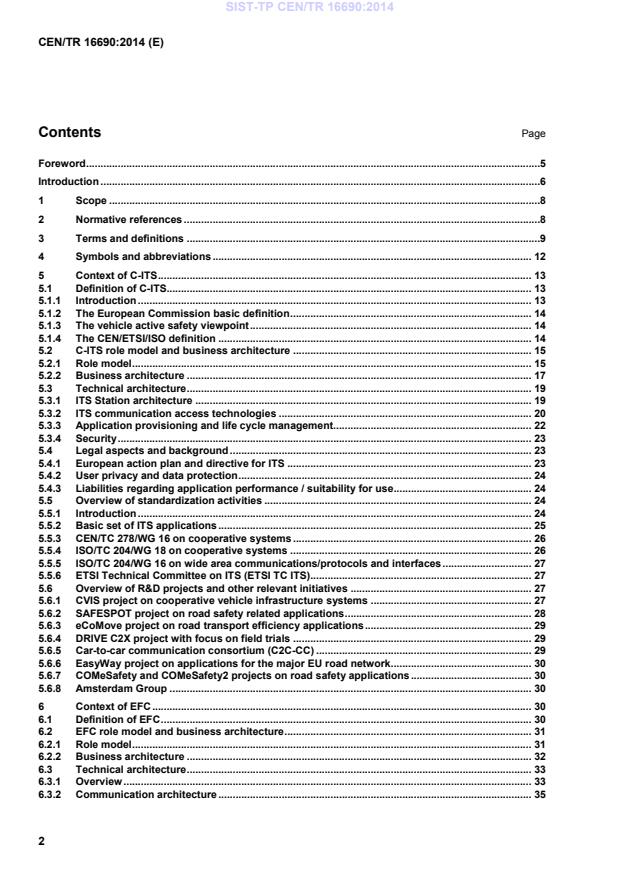
Contents Page
Foreword .5
Introduction .6
1 Scope .8
2 Normative references .8
3 Terms and definitions .9
4 Symbols and abbreviations . 12
5 Context of C-ITS . 13
5.1 Definition of C-ITS. 13
5.1.1 Introduction . 13
5.1.2 The European Commission basic definition . 14
5.1.3 The vehicle active safety viewpoint . 14
5.1.4 The CEN/ETSI/ISO definition . 14
5.2 C-ITS role model and business architecture . 15
5.2.1 Role model . 15
5.2.2 Business architecture . 17
5.3 Technical architecture . 19
5.3.1 ITS Station architecture . 19
5.3.2 ITS communication access technologies . 20
5.3.3 Application provisioning and life cycle management. 22
5.3.4 Security . 23
5.4 Legal aspects and background . 23
5.4.1 European action plan and directive for ITS . 23
5.4.2 User privacy and data protection . 24
5.4.3 Liabilities regarding application performance / suitability for use . 24
5.5 Overview of standardization activities . 24
5.5.1 Introduction . 24
5.5.2 Basic set of ITS applications . 25
5.5.3 CEN/TC 278/WG 16 on cooperative systems . 26
5.5.4 ISO/TC 204/WG 18 on cooperative systems . 26
5.5.5 ISO/TC 204/WG 16 on wide area communications/protocols and interfaces . 27
5.5.6 ETSI Technical Committee on ITS (ETSI TC ITS) . 27
5.6 Overview of R&D projects and other relevant initiatives . 27
5.6.1 CVIS project on cooperative vehicle infrastructure systems . 27
5.6.2 SAFESPOT project on road safety related applications . 28
5.6.3 eCoMove project on road transport efficiency applications . 29
5.6.4 DRIVE C2X project with focus on field trials . 29
5.6.5 Car-to-car communication consortium (C2C-CC) . 29
5.6.6 EasyWay project on applications for the major EU road network . 30
5.6.7 COMeSafety and COMeSafety2 projects on road safety applications . 30
5.6.8 Amsterdam Group . 30
6 Context of EFC . 30
6.1 Definition of EFC . 30
6.2 EFC role model and business architecture . 31
6.2.1 Role model . 31
6.2.2 Business architecture . 32
6.3 Technical architecture . 33
6.3.1 Overview . 33
6.3.2 Communication architecture . 35
6.3.3 Autonomous OBE / Front End implementation . 36
6.3.4 EFC security . 37
6.4 Additional major aspects . 38
6.4.1 Interoperability . 38
6.4.2 Value added services based on EFC OBE . 38
6.4.3 EFC outside Europe . 40
6.5 Legal aspects and background . 41
6.5.1 Toll domain specific . 41
6.5.2 European Electronic Toll Service (EETS) . 41
6.5.3 User privacy and data protection . 42
6.6 Overview of standardization activities . 42
6.6.1 CEN/TC 278/WG 1 on Electronic fee collection and access control applications . 42
6.6.2 ISO/TC 204/WG 5 on electronic fee collection and access control applications . 42
6.6.3 ETSI Technical Committee for ITS (ETSI TC ITS) . 42
6.7 Examples of commercial projects . 43
6.7.1 Small EFC system: Herrentunnel Lübeck (Germany) . 43
6.7.2 Nationwide EFC system: Germany . 43
6.7.3 Interoperable EFC system: EasyGo . 44
7 Outline of EFC requirements to an ITS Station . 44
7.1 High level EFC requirements . 44
7.2 Requirements for the EFC application(s) . 46
7.2.1 Detection of Charge Objects (autonomous toll domains) . 46
7.2.2 Provision of charge reports (autonomous toll domains) . 47
7.2.3 Fee calculation (autonomous toll domains) . 48
7.2.4 Generation of charge data (DSRC based toll domains) . 48
7.2.5 Location support (autonomous toll domains) . 49
7.2.6 Support of enforcement application . 49
7.2.7 Operation of an enforcement application . 49
7.2.8 Changing variable tariff parameters . 50
7.2.9 Feedback to the road user . 50
7.3 Resulting requirements for the ITS Station . 51
7.3.1 Technical requirements . 51
7.3.2 Security requirements . 55
7.3.3 Operational requirements . 58
8 EFC services in the C-ITS environment . 60
8.1 EFC services on ITS Stations . 60
8.2 Involved C-ITS sub-roles in the life cycle of EFC services . 61
8.2.1 Life cycle of EFC services . 61
8.2.2 C-ITS sub-roles involved in different phases of the EFC service life cycle . 62
8.3 Combined models of EFC services in C-ITS context . 66
8.3.1 C-ITS and EFC role model relations . 66
8.3.2 Technical EFC architecture in C-ITS context. 68
8.3.3 ITS Station Service Provider . 70
8.3.4 Extended EFC role model in C-ITS environment . 70
8.3.5 Business architecture . 71
9 Considerations on particular implementation aspects . 72
9.1 Introduction . 72
9.2 Synergies. 73
9.3 Particular and critical areas in relation to EFC in an ITS environment . 74
9.3.1 Phase of migration from dedicated EFC devices to ITS-S based EFC . 74
9.3.2 Resource management . 77
9.3.3 Performance monitoring . 80
9.4 Suitability for use and certification . 81
9.4.1 Introduction . 81
9.4.2 Conformity to specifications . 82
9.4.3 Suitability for use tests . 83
9.4.4 Certification . 83
9.4.5 Registration and Certification Authority . 84
9.4.6 Quality system approval und surveillance . 85
9.5 Governance and responsibility . 85
9.5.1 Introduction . 85
9.5.2 Application configuration of the ITS Station . 86
9.5.3 Technical implementation of the ITS Station . 87
9.5.4 Update and installation of applications . 88
10 Guidelines for further work . 89
10.1 Role of EFC to boost the deployment of C-ITS . 89
10.2 Actions to reduce barriers for the deployment of EFC applications — Create harmonized
certification and test rules . 90
10.2.1 Introduction . 90
10.2.2 Issuing test rules . 90
10.2.3 Guidelines on certification and tests . 91
10.3 Recommendations for further standardization activities . 91
10.3.1 Recommendations with regard to the area of EFC . 91
10.3.2 Recommendations with regard to the area of (C-)ITS. 93
10.4 Best practice . 94
Annex A (informative) Security Considerations . 95
A.1 Introduction . 95
A.1.1 Security areas and targets . 95
A.1.2 System and application availability and reliability . 95
A.1.3 Data security . 95
A.1.4 User privacy protection . 96
A.2 Security scope of this annex . 96
A.3 General EFC security considerations . 96
A.3.1 Security analysis. 96
A.3.2 Security system . 98
A.3.2.1 General . 98
A.3.2.2 Technical security architecture . 98
A.3.2.3 Organisational security architecture . 98
A.4 System and application availability and reliability . 99
A.5 Security of an ITS Station . 100
A.5.1 General . 100
A.5.2 Closed ITS Station application platform . 100
A.5.3 Open ITS Station application platform . 101
A.6 Summary . 101
Bibliography . 102
Foreword
This document (CEN/TR 16690:2014) has been prepared by Technical Committee CEN/TC 278 “Intelligent
transport systems”, the secretariat of which is held by NEN.
This document has been prepared under a mandate given to CEN by the European Commission and the
European Free Trade Association.
A CEN Technical Report is a document adopted by CEN/CENELEC containing informative material not
suitable for publication as a European Standard or a Technical Specification.
This document has been prepared by CEN/TC 278/WG 1, Project Team 136. The work done by the project
team has been governed by the Technical Committee CEN/TC 278 “Intelligent transport systems”, the
secretariat of which is held by NEN, and by CEN/TC 278/WG 1, Electronic fee collection and access control
(EFC).
Attention is drawn to the possibility that some of the elements of this document may be the subject of patent
rights. CEN shall not be held responsible for identifying any or all such patent rights.
Introduction
Increasingly, tolling systems are becoming automated and electronic fee collection (EFC) is becoming a
pervasive service in Europe. The widespread deployment of EFC systems requires provisions to allow users
to employ a single contract and a single OBE to circulate through many different toll domains. In Europe, for
example, this need has been officially recognized and legislation on interoperability has already been adopted
in the form of the Interoperability Directive 2004/52/EC and the EETS Decision 2009/750/EC.
Standardization in the context of Electronic Fee Collection has been active since the early '90s with the aim of
providing the architecture and the definition of interoperable interfaces for interoperable tolling systems.
Interoperable interfaces allow tolling systems to exchange information and make mutual use of it.
Specifications of such interfaces have been provided in the form of Application Interface Definitions, which are
to be considered as toolboxes for defining application protocols and application data exchanged. In many
cases, interoperable application profiles have been defined to narrow down the options and provide a sound
basis for interoperability.
The standardization results have major relevance for the future of the EETS. Some standards are directly
referenced by the EETS Decision and are hence of mandatory application. Other standards provide open and
interoperable definitions which are likely to be employed to fulfil the requirement that: “EETS equipment shall
be designed in such a manner that its interoperability constituents utilise open standards”.
EFC is one of the intelligent transport systems (ITS) applications with the widest deployment. Currently EFC
equipment is mostly dedicated to one or a few applications only. On the one hand, EFC equipment is also
becoming more capable and EFC OBE may provide platforms for delivering selected Value Added Services
as analysed in CEN/TR 16219. On the other hand, future ITS Stations may in principle deliver the EFC
Service to users, if certain requirements are fulfilled.
This Technical Report mainly provides a view on how “both worlds”, the established and wide-spread EFC
services and the emerging ITS services and platforms, could be combined to future solutions in which EFC
services are considered as one service amongst others offered by ITS. The Report provides information to
designers of ITS about the nature and specialities in the EFC services to be taken into account. It also
provides EFC stakeholders with guidance how an integration of EFC into the set of services provided in the
ITS environment may be achieved.
In order to identify the guidelines how EFC applications can be provided on ITS in-vehicle stations, the
following approach is chosen:
— provide a view and understanding of both EFC and cooperative ITS in terms of available architectures,
definitions, specifications, stakeholders and operational experiences (commercially available projects as
well as research and trial activities);
— identify major EFC requirements that will have an impact to the ITS Station;
— provide a view as to how EFC roles and functionalities (according to ISO 17573) shall be enabled and
supported in the cooperative ITS context (in different phases of the entire life cycle of an EFC service);
— identify a base technical architecture that enables EFC services in an ITS context;
— analyse stakeholders in a business architecture and provide an example of a business architecture for
EFC services in an ITS environment; and
— emphasize on particular key areas like conformance and certification, potential synergies in the context of
the ITS Station, areas of major concern, governance, critical elements.
This approach could be chosen as the EFC environment is seen very mature in terms of architectural,
technical and operational requirements and processes. EFC as a service is already in use in various
commercial projects in many countries throughout the world. Operational experiences have already been
taken into account in refining the landscape of existing specifications in EFC. This can be seen as an
extraordinary condition compared to other (future) ITS services for which such mature environmental and
context is not yet available
ETSI TC ITS has defined a Basic Set of Applications in ETSI/TR 102 638 which is expected to be deployed
relatively swiftly after completion of standardization of C-ITS. EFC is directly addressed in this Basic Set of
Applications and considered as a primary application. Standardization of the EFC application requirements is,
however, within the scope of CEN/TC 278/WG 1, which is in charge of defining the requirements for the EFC
use cases in accordance with the set of standards developed by this Working Group.
1 Scope
This Technical Report (TR) contains an analysis of the technical and operational feasibility of using a generic
ITS Station as specified in ETSI EN 302 665, Intelligent Transport Systems (ITS); Communications
Architecture, for EFC applications compliant to the requirements specified in ISO 17573, EN ISO 12855,
CEN ISO/TS 17575 (all parts), EN ISO 14906, EN 15509, CEN ISO/TS 12813, CEN ISO/TS 13141 and
CEN/TS 16439.
The scope of this Technical Report includes:
— description of the context of Cooperative ITS and the ITS Stations;
— providing details of the context of EFC applications;
— outlining the basic architectural concepts and role model of both EFC and Cooperative ITS;
— identification of core requirement areas for operation of an EFC application on an ITS Station;
— specification of a set of recommendations for functional, operational and security requirements to the ITS
Station supporting the EFC application(s);
— description of a possible role model in which the roles known in EFC applications make use of the roles in
the C-ITS system in order to provide EFC services in an C-ITS context;
— provision of considerations in particular areas of EFC like certification and governances;
— guideless and recommendations for further standardization work in this area;
— emphasizing on security related elements of EFC that need to be considered in a C-ITS environment.
The scope of this Technical Report is limited to in-vehicle ITS Stations. However, an EFC service always
requires the involvement of in-vehicle and central functionalities. Furthermore, for enforcement purposes as
well as in DSRC based toll domains for toll charging purposes also, it is essential that road-side based
functions are provided and operated. In order to facilitate EFC services a set of functionalities, tasks and
responsibilities are defined and specified in an EFC role model (ISO 17573). These functionalities, tasks and
responsibilities are shared between the roles Toll Charger, Toll Service Provider, Road User and
Interoperability Management. All these roles interact with each other. As a consequence this Technical Report
provides in various areas explanations that are beyond the in-vehicle environment. This is required in order to
present the full environment and context. It keeps the readability of this document at a sound level and
provides valuable information to those readers which are not yet familiar with EFC in detail.
Outside the scope of this Technical Report is:
— detailed technical specifications for EFC services and applications on C-ITS systems;
— implementation specific elements.
2 Normative references
The following documents, in whole or in part, are normatively referenced in this document and are
indispensable for its application. For dated references, only the edition cited applies. For undated references,
the latest edition of the referenced document (including any amendments) applies.
EN 15509, Road transport and traffic telematics - Electronic fee collection - Interoperability application profile
for DSRC
CEN ISO/TS 12813, Electronic fee collection - Compliance check communication for autonomous systems
(ISO/TS 12813)
EN ISO 12855:2012, Electronic fee collection - Information exchange between service provision and toll
charging (ISO 12855:2012)
CEN ISO/TS 13141, Electronic fee collection - Localisation augmentation communication for autonomous
systems (ISO/TS 13141)
EN ISO 14906, Electronic fee collection - Application interface definition for dedicated short-range
communication (ISO 14906)
CEN ISO/TS 17575-1:2010, Electronic fee collection - Application interface definition for autonomous systems
- Part 1: Charging (ISO/TS 17575-1:2010)
CEN ISO/TS 17575-2, Electronic fee collection - Application interface definition for autonomous systems - Part
2: Communication and connection to the lower layers (ISO/TS 17575-2)
CEN ISO/TS 17575-3:2011, Electronic fee collection - Application interface definition for autonomous systems
- Part 3: Context data (ISO/TS 17575-3:2011)
CEN ISO/TS 17575-4:2011, Electronic fee collection - Application interface definition for autonomous systems
- Part 4: Roaming (ISO/TS 17575-4:2011)
ISO 17573:2010, Electronic fee collection — Systems architecture for vehicle-related tolling
3 Terms and definitions
For the purposes of this document, the following terms and definitions apply.
3.1
back end
computing and communication facilities of an actor (e.g. a Toll Charger or a Toll Service Provider) exchanging
data with a Front or Back End
3.2
back office
generic name for the centrally located computing and communication facilities (of a role involved in EFC)
3.3
charge report
information containing road usage and related information originated at the Front End
3.4
cooperative ITS
subset of the overall ITS that communicates and shares information between ITS Stations to give advice or
facilitate actions with the objective of improving safety, sustainability, efficiency and comfort beyond the scope
of stand-alone systems
[SOURCE: ISO/DTR 17465]
3.5
electronic fee collection
fee collection by electronic means
3.6
front end
part(s) of the toll system where road usage data for an individual road user are collected, processed and
delivered to the Back End
Note 1 to entry: The Front End comprises the on-board equipment and an optional proxy.
[SOURCE: CEN ISO/TS 17575-1:2010, 3.13]
3.7
interoperability management
role that manages the toll charging environment, i.e. defining and maintaining a set of rules that, taken
together, defines the policy of a given toll regime or of the overall toll charging environment
3.8
ITS application
association of two or more complementary ITS-S applications
[SOURCE: ETSI EN 302 665 V1.1.1 (2010-09)]
3.9
ITS service
service provided by an ITS application to the user of ITS
[SOURCE: ETSI EN 302 665 V1.1.1 (2010-09)]
3.10
ITS station
entity in a communication network that executes ITS-S applications within a bounded, secured, managed
domain comprised of an ITS-S facilities layer, ITS-S networking & transport layer, ITS-S access layer, ITS-S
management entity and ITS-S security entity
Note 1 to entry: From an abstract point of view, the term “ITS station” refers to a set of functionalities. The term is often
used to refer to an instantiation of these functionalities in a physical unit. The appropriate interpretation is clear from the
context. The physical instantiation of an ITS-S is named ITS station unit (ITS-SU).
[SOURCE: ISO 21217:2010]
3.11
ITS station service provider
role that is responsible for procuring an ITS Station (ITS-S), arranging the installation of such ITS-S in vehicles
and maintains an ITS-S
Note 1 to entry: This role offers ITS Service providers to host their services on this ITS-S.
3.12
ITS station unit
implementation of an ITS-S
[SOURCE: ISO 21217:2010]
3.13
on-board equipment
equipment located on-board a vehicle including nomadic devices with the function of exchanging information
with external systems
3.14
policy framework
role that is responsible for all governing and institutional activities required in the system
[SOURCE: prCEN ISO/TS 17427]
3.15
system management
role that is responsible to fulfil all required management activities within the system, this especially includes
activities supporting the role 'System Operation'
[SOURCE: prCEN ISO/TS 17427]
3.16
system operation
role that is responsible for the proper execution of the applications that provide the end-to-end service(s)
[SOURCE: prCEN ISO/TS 17427]
3.17
toll charger
entity which levies toll for the use of vehicles in a toll domain
Note 1 to entry: In other documents the terms operator or toll operator may be used.
3.18
toll context data
information defined by the responsible toll charger necessary to establish the toll due for using a vehicle on a
particular toll context and to conclude the toll transaction
3.19
toll declaration
statement to declare the usage of a given EFC service to a toll charger
3.20
toll domain
area or a part of a road network where a certain toll regime is applied
3.21
toll service provider
entity providing toll services in one or more toll domains
Note 1 to entry: In other documents the terms issuer or contract issuer may be used.
Note 2 to entry: The Toll Service Provider may provide the OBE or may provide only a magnetic card or a smart card
to be used with OBE provided by a third party (like a mobile telephone and a SIM card can be obtained from different
parties).
Note 3 to entry: The Toll Service Provider is responsible for the operation (functioning) of the OBE with respect to
tolling.
3.22
trusted recorder
logical entity capable of cryptographic functions, used to provide the OBE with security services, including
data confidentiality, data integrity, authentication and non-repudiation
4 Symbols and abbreviations
For the purpose of this document, the following abbreviations apply throughout the document unless
otherwise specified.
ANPR Automatic Number Plate Recognition
BSDM Bounded Secure Management Domain
C2C-CC Car-to-Car Communication Consortium
CALM Communication Architecture for Land Mobiles
CALM FAST CALM network protocol stack
C-ITS Cooperative ITS
CMC Configuration Management Centre
CVIS Cooperative Vehicle Infrastructure Systems
CN Cellular Network
DSRC Dedicated Short Range Communication
EAL Evaluation Assurance Level
EC European Commission
ECU Electronic Control Unit
EETS European Electronic Toll Service
EFC Electronic Fee Collection
EGNOS European Geostationary Navigation Overlay Service
ESO European Standardization Organization(s)
ETSI ITS-G5 Access layer specification for ITS operating in the 5 GHz frequency band
(Draft ETSI EN 302 663)
ETSI TC ITS ETSI Technical Committee on ITS
EU7FP 7th framework program (2007 – 2013) of the European Commission
FNTP Fast Networking and Transport layer Protocol
GLONASS Globalnaya Navigatsionnaya Sputnikovaya Sistema (or Global Navigation Satellite
System)
GNSS Global Navigation Satellite System
GST Global System for Telematics
HGV Heavy Good Vehicle
HMC Host Management Centre
HMI Human Machine Interfaces
I2I Infrastructure-to-Infrastructure
ITS Intelligent Transport Systems
ITS-S ITS Station
ITS-S SP ITS Station Service Provider
ITS-SU ITS Station Unit
KPI Key Performance Indicator
LAC Localization Augmentation Communication
LDM Local Dynamic Map
OBE On Board Equipment
OEM Original Equipment Manufacturer
OSGi Open Services Gateway Initiative
PC Personal Computer
PKI Public Key Infrastructure
RSE Road Side Equipment
R&TTE Radio and Telecommunications Terminal Equipment
SAM Secure Application Module
SDO Standardization Developing Organization(s)
SLA Service Level Agreement
TC Toll Charger
TD Toll Domain
TEN-T Trans-European Transport Network
TR Technical Report
TS Technical Specification
TSP Toll Service Provider
VAS Value Added Services
V2I Vehicle-to-Infrastructure
V2V Vehicle-to-Vehicle
WLAN Wireless local area network
5 Context of C-ITS
5.1 Definition of C-ITS
5.1.1 Introduction
Cooperative System(s) or Cooperative ITS (C-ITS) is being proposed as a new paradigm in ITS, but its exact
definition sometimes remains unclear and is not agreed upon by all stakeholders. The most common
understanding is that C-ITS involves vehicle-to-vehicle (V2V) and vehicle-to-infrastructure (V2I)
communication to enhance safety and efficiency of the road transport system. C-ITS is also considered as a
mean to get away from the multitude of proprietary stand-alone devices invading the driver environment. The
feeling was that it is not sustainable to put a new box with antennas, display, keyboard, etc. for each new
application that was going into the car. This is too costly, too unsafe, does not give interoperability, and is just
not safe or sustainable from a windshield real estate point of view.
As a consequence ITS has to evolve from “silos” or vertical integration of all functions for each new
application, into a new world of sharing common resources where useful and possible.
The definition of what a cooperative system is has proven to be difficult. There are several reasons for this. A
major reason is the existence of a plethora of organizations and projects within the field, each deriving their
own definition. This can mostly be attributed to historical reasons, but it has also been influenced by turf wars
and commercial pressures from actors in existing markets feeling threatened by this new world. The result is
that currently several definitions of C-ITS exist.
5.1.2 The European Commission basic definition
The most prevalent understanding of C-ITS is the European Commission (EC) definition (as defined in
Mandate M/453): “Co-operative systems are ITS systems based on vehicle-to-vehicle (V2V), vehicle-to-
infrastructure (V2I, I2V) and infrastructure-to-infrastructure (I2I) communications for the exchange of
information. Co-operative systems have the potential to further increase the benefits of ITS services and
applications”.
The objective of the mandate from EC is primarily to create benefits in terms of transport efficiency,
sustainability, safety and security. To realize these benefits it is necessary to ensure interoperability through
standardization. It is also expected that a realization of C-ITS will contribute to the competitiveness objectives
of the EU Internal Market.
5.1.3 The vehicle active safety viewpoint
A more restricted understanding of C-ITS is the use of 5,9 GHz 802.11p WLAN communications for V2V and
V2I links, where the main application is active road traffic safety. The basic idea is that all vehicles broadcast
information that will be received by other vehicles at a distance of up to 1 000 m. The typical applications are
warnings or active collision avoidance. This is the understanding from many OEMs and authorities involved in
the active safety world, such as the Car-to-Car Communications Consortium (C2C-CC, http://www.car-to-
car.org/). In addition to V2V communication some safety related use cases employ V2I/I2V communication,
e.g. warning of construction sites or maintenance work.
5.1.4 The CEN/ETSI/ISO definition
Whereas the EC definition is seen as too generic, the C2C-CC view is often seen as too restrictive both in
terms of technology and services. Therefore CEN/ISO and ETSI agreed on another definition in their response
to Mandate M/453:
— a co-operative ITS is a subset of the overall IT
...