

ISO 41017:2024
(Main)Facility management — Guidance on emergency preparedness and management of an epidemic
General Information
- Abstract
This document provides general guidance to organizations on how to plan for, mitigate and/or manage the risks and impacts of an epidemic event to protect facility-related health, safety and well-being. This document is applicable to all organizations, fully or partially operating, resuming or new to operating.
- Status
- Published
- Publication Date
- 05-Mar-2024
- Technical Committee
- ISO/TC 267 - Facility management
- Drafting Committee
- ISO/TC 267 - Facility management
- Current Stage
- 6060 - International Standard published
- Start Date
- 06-Mar-2024
- Due Date
- 23-Jul-2023
- Completion Date
- 06-Mar-2024
Buy Documents

ISO 41017:2024 - Facility management — Guidance on emergency preparedness and management of an epidemic Released:6. 03. 2024

ISO 41017:2024 - Facility management — Recommandations relatives a l’anticipation des situations d’urgence et au management d’une épidémie Released:6. 03. 2024
Overview
ISO 41017:2024 - Facility management - Guidance on emergency preparedness and management of an epidemic provides practical, organization-level guidance to plan for, mitigate and manage the risks and impacts of an epidemic on facility-related health, safety and well‑being. Applicable to organizations that are fully or partially operating, resuming operations, or new to operating, the standard helps integrate epidemic preparedness into facility management, risk management and business continuity frameworks.
Key topics and technical requirements
ISO 41017:2024 structures epidemic preparedness around familiar management-system concepts and addresses technical topics including:
- Context and impact assessment
- Understanding operational, employee and stakeholder impacts of an epidemic.
- Leadership and governance
- Leadership commitment, policy, roles, responsibilities and emergency management principles.
- Planning
- Risk identification, emergency preparedness for an epidemic, ERP (Emergency Response Plan) considerations and escalation procedures.
- Operational controls
- Situational monitoring, incident detection, alerting and implementation of response actions.
- Support and resources
- Requirements for people, materials, finance, information, facility aspects and mechanisms to obtain resources.
- Communication
- Internal and external communications during alerts, response and recovery.
- Exercises, monitoring and evaluation
- Exercise programmes, monitoring, measurement, reviews of preparedness, response and recovery.
- Improvement
- Handling nonconformities, corrective action, continual improvement and action plans for lessons learned.
- Practical annex
- Informative example actions (e.g., Annex A on office facility controls) to help translate guidance into operational measures.
The document does not replace ISO 31000:2018 (risk management) but complements it by focusing on facility-specific epidemic assessment and controls.
Practical applications and who should use it
ISO 41017 is designed for:
- Facility managers and FM teams integrating epidemic risk into everyday operations.
- Emergency planners, business continuity managers and risk officers aligning ERPs with facility services.
- HR, occupational health & safety, procurement and building-services teams responsible for people, materials and infrastructure continuity.
- Property owners, facility service providers, campus operators and organisations preparing to resume operations after an outbreak.
Practical uses include developing or updating an Epidemic Emergency Response Plan (ERP), setting up monitoring and alerting protocols, defining resource and communication strategies, running epidemic exercises, and documenting lessons learned for continual improvement.
Related standards
- ISO 31000:2018 - Risk management (framework and processes)
- ISO 41001 - Facility management systems (requirements/guidance)
- ISO 22301 - Business continuity management
- ISO 45001 - Occupational health and safety
Keywords: ISO 41017:2024, facility management, epidemic preparedness, emergency response plan, business continuity, risk management, situational monitoring, facility-related health and safety.
Relations
- Effective Date
- 12-Feb-2026
- Effective Date
- 06-Jun-2022
- Consolidated By
ISO 23368:2022 - Anaesthetic and respiratory equipment — Low-flow nasal cannulae for oxygen therapy - Effective Date
- 06-Jun-2022
Buy Documents
ISO 41017:2024 - Facility management — Guidance on emergency preparedness and management of an epidemic Released:6. 03. 2024
ISO 41017:2024 - Facility management — Recommandations relatives a l’anticipation des situations d’urgence et au management d’une épidémie Released:6. 03. 2024
Get Certified
Connect with accredited certification bodies for this standard

Great Wall Tianjin Quality Assurance Center
Established 1993, first batch to receive national accreditation with IAF recognition.
Hong Kong Quality Assurance Agency (HKQAA)
Hong Kong's leading certification body.

Innovative Quality Certifications Pvt. Ltd. (IQCPL)
Known for integrity, providing ethical & impartial Assessment & Certification. CMMI Institute Partner.
Sponsored listings
Frequently Asked Questions
ISO 41017:2024 is a standard published by the International Organization for Standardization (ISO). Its full title is "Facility management — Guidance on emergency preparedness and management of an epidemic". This standard covers: This document provides general guidance to organizations on how to plan for, mitigate and/or manage the risks and impacts of an epidemic event to protect facility-related health, safety and well-being. This document is applicable to all organizations, fully or partially operating, resuming or new to operating.
This document provides general guidance to organizations on how to plan for, mitigate and/or manage the risks and impacts of an epidemic event to protect facility-related health, safety and well-being. This document is applicable to all organizations, fully or partially operating, resuming or new to operating.
ISO 41017:2024 is classified under the following ICS (International Classification for Standards) categories: 03.080.10 - Maintenance services. Facilities management. The ICS classification helps identify the subject area and facilitates finding related standards.
ISO 41017:2024 has the following relationships with other standards: It is inter standard links to EN ISO 41017:2024, ISO/IEC 23090-3:2021, ISO 23368:2022. Understanding these relationships helps ensure you are using the most current and applicable version of the standard.
ISO 41017:2024 is available in PDF format for immediate download after purchase. The document can be added to your cart and obtained through the secure checkout process. Digital delivery ensures instant access to the complete standard document.
Standards Content (Sample)
International
Standard
ISO 41017
First edition
Facility management — Guidance
2024-03
on emergency preparedness and
management of an epidemic
Facility management — Recommandations relatives à
l’anticipation des situations d’urgence et au management d’une
épidémie
Reference number
© ISO 2024
All rights reserved. Unless otherwise specified, or required in the context of its implementation, no part of this publication may
be reproduced or utilized otherwise in any form or by any means, electronic or mechanical, including photocopying, or posting on
the internet or an intranet, without prior written permission. Permission can be requested from either ISO at the address below
or ISO’s member body in the country of the requester.
ISO copyright office
CP 401 • Ch. de Blandonnet 8
CH-1214 Vernier, Geneva
Phone: +41 22 749 01 11
Email: copyright@iso.org
Website: www.iso.org
Published in Switzerland
ii
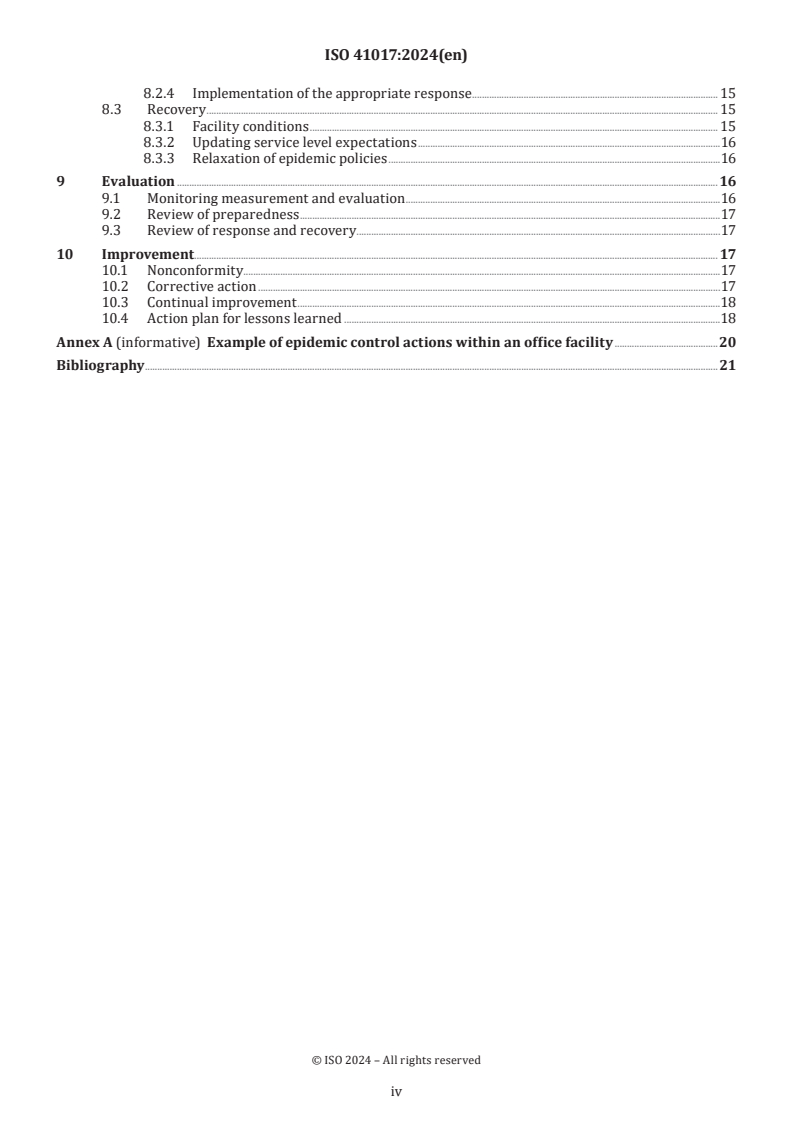
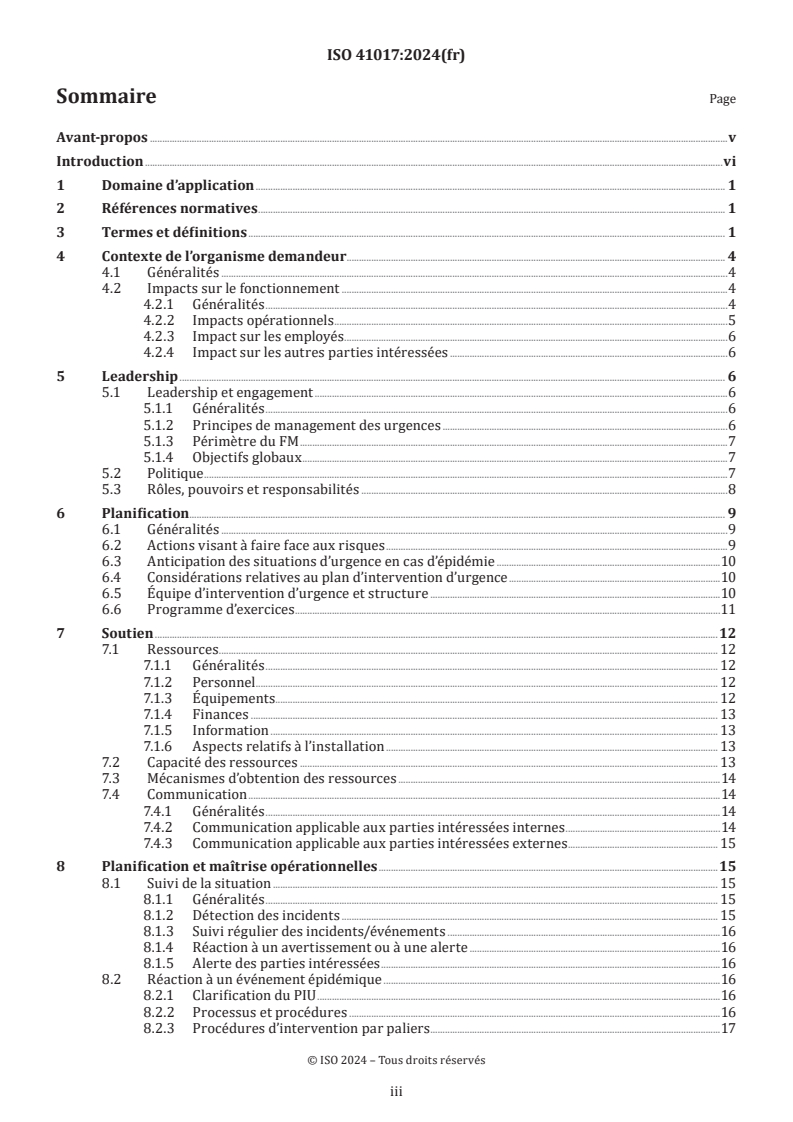
Contents Page
Foreword .v
Introduction .vi
1 Scope . 1
2 Normative references . 1
3 Terms and definitions . 1
4 Context of the demand organization . 3
4.1 General .3
4.2 Operation impact .4
4.2.1 General .4
4.2.2 Operational impact .4
4.2.3 Employee impact .5
4.2.4 Other interested party impact .5
5 L e ader s h ip . 6
5.1 L eadership and commitment .6
5.1.1 General .6
5.1.2 Emergency management principles .6
5.1.3 Scope of FM.6
5.1.4 Overall objectives .7
5.2 Policy .7
5.3 Roles, responsibilities and authorities .7
6 Pl a n n i n g . 8
6.1 General .8
6.2 Actions to address risks .8
6.3 Emergency preparedness for an epidemic .9
6.4 Emergency response plan considerations .9
6.5 Emergency response team and structure .10
6.6 Exercise programme .10
7 Support .11
7.1 Resources .11
7.1.1 General .11
7.1.2 People .11
7.1.3 Materials .11
7.1.4 Finance . 12
7.1.5 Information . 12
7.1.6 Facility aspects . 12
7.2 Capacity of resources . 12
7.3 Mechanisms for obtaining resources . 13
7.4 Communication . 13
7.4.1 General . 13
7.4.2 Communication applicable to internal interested parties . 13
7.4.3 Communication applicable to external interested parties . 13
8 Operational planning and control . 14
8.1 Situational monitoring .14
8.1.1 General .14
8.1.2 Incident detection.14
8.1.3 Regular monitoring of an incident/event .14
8.1.4 Response to a warning or alert . 15
8.1.5 Alerting interested parties . 15
8.2 Response to an epidemic event . 15
8.2.1 ERP clarification . 15
8.2.2 Process and procedures . 15
8.2.3 Escalation procedures . 15
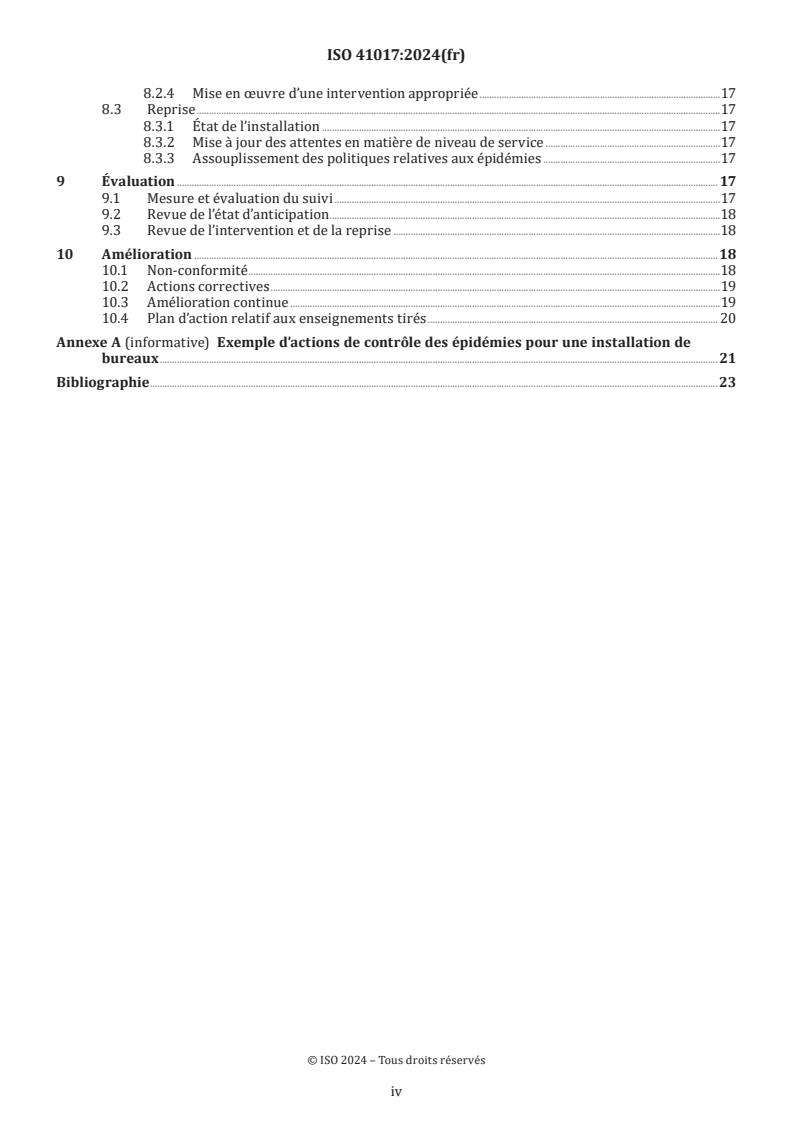
iii
8.2.4 Implementation of the appropriate response . 15
8.3 Recovery . 15
8.3.1 Facility conditions . 15
8.3.2 Updating service level expectations .16
8.3.3 Relaxation of epidemic policies .16
9 Ev a luat ion .16
9.1 M onitoring measurement and evaluation .16
9.2 R eview of preparedness .17
9.3 R eview of response and recovery . .17
10 Improvement . 17
10.1 Nonconformity.17
10.2 Corrective action .17
10.3 C ontinual improvement .18
10.4 Action plan for lessons learned .18
Annex A (informative) Example of epidemic control actions within an office facility .20
Bibliography .21
iv
Foreword
ISO (the International Organization for Standardization) is a worldwide federation of national standards
bodies (ISO member bodies). The work of preparing International Standards is normally carried out through
ISO technical committees. Each member body interested in a subject for which a technical committee
has been established has the right to be represented on that committee. International organizations,
governmental and non-governmental, in liaison with ISO, also take part in the work. ISO collaborates closely
with the International Electrotechnical Commission (IEC) on all matters of electrotechnical standardization.
The procedures used to develop this document and those intended for its further maintenance are described
in the ISO/IEC Directives, Part 1. In particular, the different approval criteria needed for the different types
of ISO document should be noted. This document was drafted in accordance with the editorial rules of the
ISO/IEC Directives, Part 2 (see www.iso.org/directives).
ISO draws attention to the possibility that the implementation of this document may involve the use of (a)
patent(s). ISO takes no position concerning the evidence, validity or applicability of any claimed patent
rights in respect thereof. As of the date of publication of this document, ISO had not received notice of (a)
patent(s) which may be required to implement this document. However, implementers are cautioned that
this may not represent the latest information, which may be obtained from the patent database available at
www.iso.org/patents. ISO shall not be held responsible for identifying any or all such patent rights.
Any trade name used in this document is information given for the convenience of users and does not
constitute an endorsement.
For an explanation of the voluntary nature of standards, the meaning of ISO specific terms and expressions
related to conformity assessment, as well as information about ISO's adherence to the World Trade
Organization (WTO) principles in the Technical Barriers to Trade (TBT), see www.iso.org/iso/foreword.html.
This document was prepared by Technical Committee ISO/TC 267, Facility management, in collaboration with
the European Committee for Standardization (CEN) Technical Committee CEN/TC 348, Facility Management,
in accordance with the Agreement on technical cooperation between ISO and CEN (Vienna Agreement).
Any feedback or questions on this document should be directed to the user’s national standards body. A
complete listing of these bodies can be found at www.iso.org/members.html.
v
Introduction
0.1 Purpose
In order to protect facility users and other interested parties as well as to provide reassurance and protect
the demand organization’s assets and reputation, an organization should include plans for mitigating the
effects of an epidemic in its overall emergency preparedness and business continuity plans.
This document serves as guidance to organizations for effective preparedness for and management of
an epidemic. The organization should create its own formal documentation detailing what actions and
responses should be followed.
By implementing the guidance in this document, an organization should be able to:
— take effective action to protect facility users and other interested parties from the risks related to an
epidemic event;
— demonstrate that it is addressing risks related to an epidemic event using a systematic approach;
— put in place a framework to enable effective and timely adaptation to the changing situation;
— create an emergency response plan (ERP) for an epidemic and integrated it into its overall risk
management, emergency preparedness and business continuity plans.
NOTE It is not the intent of this document to reproduce ISO 31000:2018, but rather to provide a framework
identifying the assessment processes specifically needed to mitigate the impact of an epidemic on facility management.
0.2 Principle
The safety and the quality of life of facility users and other interested parties is a requirement of the demand
organization and organization. At all times, the demand organization and organization should act in a
responsible manner to protect the facility users and other interested parties. Specifically, in response to an
outbreak or epidemic event, the following examples of principles can be considered:
— the demand organization should conduct an assessment of their requirements and capabilities during
the outbreak or epidemic event;
— risk factors and impacts should be anticipated and identified even before an outbreak or epidemic event
is confirmed by an authoritative body;
— risk factors and impacts should be reviewed once an outbreak or epidemic event is confirmed by an
authoritative body;
— gaps should be identified quickly for resolution;
— a plan should be developed and approved by the organization’s interested parties, placed in effect and
updated as needed;
— the verified evidence, data and facts should be used in developing facility policies and guidelines;
unsupported information from rumours or speculations should not be used in any determining factors;
— the chain of leadership and management should be clearly defined in the organization’s ERP;
— collaboration between supporting organizations and departments should start at the planning stage and
be maintained during the epidemic event;
— information should be made available as soon as possible with regular updates to all interested parties;
— information should be distributed to the appropriate interested parties; some information can be
sensitive and can only be distributed to approved personnel;
— temporary protocols should be implemented at the beginning of the outbreak or epidemic event to
promote facility user safety;
vi
— training and education should be provided to enable effective implementation;
— the regulatory variances should be considered.
0.3 Exposure risks
During a normal business day, facility users and other interested parties can be exposed to pathogens
before entering and while staying in the building. The guidance in this document addresses those pathogens
to which the facility users and other interested parties reasonably are or can be exposed during normal
business activities (e.g. transmission via direct/indirect contact, airborne, droplet).
0.4 Challenges
An organization can face challenges if it has to continue operating or return to business during or after an
epidemic event.
The guidance in this document can enable the organization to prepare for an epidemic event and provide
reasonable certainty regarding the safe conditions of the facility, by:
— protecting the facility user of the managed facility;
— maintaining occupied and unoccupied buildings;
— engaging with facility user reluctant to return to the building;
— managing the economic impact on businesses;
— communicating with internal and external interested parties;
— undertaking cleaning and decontamination activities;
— providing isolation/quarantine spaces as required or directed;
— maintaining the availability of personal protective equipment (PPE), which can be uncertain;
— screening people before they enter the building;
— maintaining the supply chain and logistics;
— controlling communications so that either multiple communications or conflicting information, or both,
are not distributed.
0.5 Structure
Figure 1 illustrates the framework structure detailed in Clauses 4 to 10 and its relationship to the
development stages of an epidemic.
vii
Figure 1 — Framework structure of this document
viii
International Standard ISO 41017:2024(en)
Facility management — Guidance on emergency
preparedness and management of an epidemic
1 Scope
This document provides general guidance to organizations on how to plan for, mitigate and/or manage the
risks and impacts of an epidemic event to protect facility-related health, safety and well-being.
This document is applicable to all organizations, fully or partially operating, resuming or new to operating.
2 Normative references
The following documents are referred to in the text in such a way that some or all of their content constitutes
requirements of this document. For dated references, only the edition cited applies. For undated references,
the latest edition of the referenced document (including any amendments) applies.
ISO 41011, Facility management — Vocabulary
3 Terms and definitions
For the purposes of this document, the terms and definitions given in ISO 41011 and the following apply.
ISO and IEC maintain terminology databases for use in standardization at the following addresses:
— ISO Online browsing platform: available at https:// www .iso .org/ obp
— IEC Electropedia: available at https:// www .electropedia .org/
3.1
organization
person or group of people that has its own functions with responsibilities, authorities and relationships to
achieve its objectives
Note 1 to entry: The concept of organization includes, but is not limited to, sole-trader, company, corporation, firm,
enterprise, authority, partnership, charity or institution, or part or combination thereof, whether incorporated or not,
public or private.
[SOURCE: ISO 41011:2017, 3.3.1]
3.2
facility management organization
FM organization
entity responsible for facility management
[SOURCE: ISO 41014:2020, 3.1.2]
3.3
policy
intentions and direction of an organization (3.1), as formally expressed by its top management
3.4
risk
effect of uncertainty on objectives
Note 1 to entry: An effect is a deviation from the expected. It can be positive, negative or both, and can address, create
or result in opportunities and threats.
Note 2 to entry: Objectives can have different aspects and categories, and can be applied at different levels.
Note 3 to entry: Risk is usually expressed in terms of risk sources, potential events (3.10), their consequences and their
likelihood.
[SOURCE: ISO 31000:2018, 3.1]
3.5
lessons learned
knowledge distilled from the performance of a process, activity or event (3.10) and used to improve future
performance
[SOURCE: ISO 41014:2020, 3.5.5]
3.6
outbreak
increase in cases of an infectious disease in excess of what is normally expected in a particular location,
community or geographical region in a specified time period
Note 1 to entry: An outbreak can affect a small and localized group or multiple groups and places and can result in an
epidemic or pandemic.
Note 2 to entry: Two linked cases of an infectious disease can be sufficient to constitute an outbreak.
[SOURCE: ISO 45006:2023, 3.11]
3.7
epidemic
large number of cases of a particular infectious disease, occurring at the same time in a community or
geographic region
[SOURCE: ISO 45006:2023, 3.12]
3.8
pandemic
worldwide spread of an infectious disease
Note 1 to entry: A pandemic is declared by the World Health Organization (WHO).
[SOURCE: ISO 45006:2023, 3.13]
3.9
incident
event (3.10) that can be, or could lead to, a disruption, loss, emergency or crisis
[SOURCE: ISO 22300:2021, 3.1.122]
3.10
event
occurrence or change of a particular set of circumstances
Note 1 to entry: An event can have one or more occurrences, and can have several causes and several consequences.
Note 2 to entry: An event can also be something that is expected which does not happen, or something that is not
expected which does happen.
Note 3 to entry: An event can be a risk source.
[SOURCE: ISO 31000:2018, 3.5]
3.11
emergency response plan
ERP
systematic procedures that clearly detail what is to be done, how, when, and by whom before, during and
after the time an emergency occurs
Note 1 to entry: In some jurisdictions, it can be called “emergency and remedial response plan”, “contingency plan”, etc.
Note 2 to entry: Emergency response plans often also cite preparations to be completed before an emergency occurs.
[SOURCE: ISO 27917:2017, 3.4.12, modified — the abbreviated term has been added.]
3.12
emergency response team
ERT
group of individuals responsible for developing, executing, rehearsing and maintaining the response plan,
including the processes and procedures
[SOURCE: ISO 28002:2011, 3.48, modified — “emergency” has been added to the term and the abbreviated
term has been added.]
3.13
personal protective equipment
PPE
device or appliance designed to be worn by an individual for their protection against one or more health and
safety hazards
Note 1 to entry: PPE includes, but is not limited to, gowns, gloves, respirators, safety glasses, helmets and goggles.
Note 2 to entry: While generally not considered PPE, masks and other face coverings can provide a level of protection
for the user in addition to their primary purpose as a public health measure to control the spread of transmission and
infection.
Note 3 to entry: In many countries PPE, is required to conform to national regulations.
[SOURCE: ISO 45006:2023, 3.5]
3.14
interested party
stakeholder
person or organization that can affect, be affected by or perceive itself to be affected by a decision or activity
[SOURCE: ISO 41011:2017, 3.3.3]
3.15
facility user
person who uses a facility
EXAMPLE Building occupants, residents, workers, customers and other relevant interested parties.
4 Context of the demand organization
4.1 General
Understanding how a demand organization anticipates, plans for and responds to an emergency or crisis
event, especially one that can affect its need for, and impact on, facility management (FM) and facility
services, is a key consideration for its top management. The set of beliefs and behaviours that people share
in an organization can define its approach to how work gets done. When developing an ERP for epidemic,
the FM organization in conjunction with demand organization team should work within the existing values,
expectations and practices of the demand organization with the goal of gaining participation and support
from interested parties during planning and cooperation during an emergency event.
The organization should develop a collaborative relationship with interested parties. Developing a
collaborative relationship involves behaviour that includes:
— accountability;
— transparency;
— inclusiveness;
— empathy;
— respect;
— trust;
— privacy;
— disclosure of conflicts of interest;
— financial responsibility;
— integrity;
— lawfulness;
— diversity.
4.2 Operation impact
4.2.1 General
An epidemic can have an immediate, delayed or lasting impact and can vary in severity from business to
business. The timing of the epidemic within the business cycle can also influence the degree of impact within
the demand organization. Contingency planning and timely activation of the ERP can influence the impact of
an epidemic on a business. The organization should identify the potential impacts and consider mitigation
strategies.
Impacts can be categorized as operational impact (see 4.2.2), employee impact (see 4.2.3) and other
interested party impact (see 4.2.4).
4.2.2 Operational impact
Operational impact can be categorised as given below:
a) Product and service demand: Client priorities, and purchasing appetite and ability can change either
positively or negatively, impacting demand levels. In some instances, demand can remain; however,
purchasing avenues can change (e.g. in person shopping to online). Demand can diminish entirely as
consumer preferences or requirements move entirely to a different product type or service model.
b) Supply chains: There can be a shortage of labour for production or services, as well as shortages or
changes in the levels of material and resource availability.
c) Capacity to deliver products and services in a changed environment resulting from travel restrictions
or a lack of resources to support the increases in demand. Alternatively, decreased demand can redirect
support services in a changed direction, impacting capacity to deliver or service.
d) Capability to deliver products and services in a changed environment resulting from changes in
transport and shipping, either due to labour shortages or restrictions of movement (imposed by the
government or by businesses).
e) Expanse of epidemic impact, whether locally, regionally or internationally. Local impacts can be more
easily managed; however, the more expansive the epidemic, the greater the impact as it can affect a
greater component of both consumers and service and product providers.
f) A plan of all built environment assets should be developed, including the capabilities to mitigate the
impact of an epidemic. Furthermore, the plan should capture the relative criticality of facilities with
respect to business impact and mission. It is important to have a plan for the use of facilities and
their assets in case of an epidemic, and the value of an asset's (facility’s) specific contribution to the
performance of the business’ mission.
g) Logistic impact: The impacts felt by the business and facility can be mirrored across business to
business, and is not limited to business to customers.
h) Process impact can include the following:
— Regulatory: The validity currency and relevance of processes, procedures and regulatory obligations
can be impacted, requiring review and resulting in amendments or a total reassessment. A timely
response influences the degree of impact experienced. This impacts not only supply and service
provision, but also the requirements and guidelines pertaining to a changed working environment
(partial, fully or remote).
— Conduct of business: Communication and guidance should be facilitated to support clients, staff and
external interested parties.
— Emergency preparedness: Emergency preparedness which can be impacted on every level
irrespective of epidemic severity. It should be considered whether emergency support personnel
are sufficient in number (accounting for absenteeism) and whether upskilling or training is required
for additional personnel. The emergency evacuation plan, as well as associate evacuation diagrams,
should review to ensure its relevance and to provide a safe and efficient path of evacuation.
4.2.3 Employee impact
Employees can be directly impacted through infection, mental health, welfare or restrictions on movement.
This impacts the business ability to deliver through a changed or diminished workforce. Changes can include
the following:
a) Workplace: Employees can continue to work from an office environment, but do not want to due to
health and safety concerns. Offices can be restricted due to physical distancing requirements or can
require sanitizing, preventing access for a period of time.
b) Site-based, remote or hybrid work arrangements: The business can require the ability to facilitate a
hybrid or single working model, depending on type of business or facility. This can impact the capacity
and capability of the facility to continue to operate. The capacity by businesses to continue to operate,
is not limited only to employee willingness and ability, but also by the business to support logistic and
Internet of Things (IoT) requirements. The provision of these products or services are also likely to be
impacted, therefore forward planning and resourcing is paramount.
c) Health and welfare: Facility managers in unison with employers and employees have an obligation to
provide and conform to a safe working environment.
d) Support and training, including change management and training support to re-skill or upskill employees
to support the ongoing viability of the business and its employees: The degree of impact influences
whether re-training or upskilling is viable and/or necessary in response to the changed environment.
4.2.4 Other interested party impact
There can also be an impact on visitors to the building, e.g. customers, contractors or other visitors.
Attendance should be facilitated in a safe and practical manner. This can require isolation locations, physical
distance requirements and communication, and a restriction on the number of visitors to the facility at any
one time. To be able to facilitate these requirements, resourcing considerations can include control factors,
signage and communication, and wardens or security considerations.
The impact can be such that, due to stipulated restrictions, attendance at the facility is entirely removed,
requiring the business to consider alternative ways to provide service to its clients.
5 Leadership
5.1 Leadership and c ommitment
5.1.1 General
Top management should demonstrate a commitment to the health and safety of its facility users and other
interested parties. Top management should also protect the interests of facility users by adopting and
adhering to emergency management principles. Commitment involves not only planning for emergencies,
but also continually reviewing and updating the plan to ensure its appropriateness.
5.1.2 Emergency management principles
To ensure its commitment to the health and safety of the facility users during an epidemic, leadership should
demonstrate a commitment to emergency management principles.
With respect to the epidemic, emergency management planning should be:
— Professional: It should value a science and knowledge-based approach based on education, training,
experience, ethical practice, public stewardship and continual improvement.
— Risk-driven: It should use sound risk management principles (hazard identification, risk analysis and
impact analysis) in assigning priorities and resources.
NOTE Risk management principles are given in ISO 31000.
— Collaborative and communicative: It should create and sustain broad and sincere relationships among
all interested parties to encourage trust, advocate a team atmosphere, build consensus and facilitate
communication while providing timely information.
— Comprehensive: It should consider all hazards, phases, interested parties and impacts relevant to the
epidemic event.
— Integrated: It should ensure unity of effort among all levels of the organization, including internal and
external interested parties.
— Coordinated: It should synchronize the activities of all relevant internal and external interested parties
to achieve a common purpose.
— Participation: The organization should encourage participation of facility users to facilitate better
understanding of infectious agents that can impact the organization as well as other hazards and risks
related to infectious diseases and health outcomes.
— Flexible: It should use creative and innovative approaches in solving epidemic challenges.
— Progressive (preparedness): It should anticipate future recurrence and take preventive and preparatory
measures to build resilient communities.
5.1.3 Scope of FM
The scope of facility-related emergency management varies depending on the facility type and the nature of
the core business of the demand organization. The FM organization should determine the boundaries and
applicability of FM to establish its emergency management plan scope with consideration for the interested
parties’ requirements.
5.1.4 Overall objectives
The organization should set facility-related emergency management objectives in regard to preparedness
and response to an epidemic. The following factors should be considered, but are not limited to:
— people’s safety and the well-being of the demand organization and interested parties;
— variations in local, governmental and health agency policies and guidance.
5.2 Policy
Top management should establish the epidemic emergency management policy based on the principles of
emergency management and the scope and objectives of FM.
New policies should address new work conditions, whether on site or from a remote location.
The FM policy should align with the demand organization and take into account the nature of the epidemic
characteristics, including the following considerations, such as:
— physical distancing;
— quarantine/isolation;
— facility modification, closure and re-opening;
— environmental factors, such as cleaning and indoor environmental quality/indoor air quality (IEQ/IAQ);
— travel;
— visitors;
— contact tracing;
— appropriate PPE;
— personal hygiene;
— working from home/remote work;
— testing requirement/vaccination requirement and immunization status;
— privacy;
— occupancy capacity/group size limitations;
— communications;
— monitoring;
— reporting.
If these policies are interim policies, the organization should provide reviews to determine when the policies
can be relaxed or terminated, or if they should be modified or escalated.
5.3 Roles, responsibilities and authorities
Roles and responsibilities should be clearly defined and communicated to avoid confusion and non-
compliance with the organization’s policy and procedures, and the requirements and directions of the
relevant authorities. See 6.5 regarding the emergency response structure.
Consideration should be given to the following areas with regard to clearly defining roles and responsibilities
in the emergency management plan:
— monitoring and reporting of the epidemic;
— communication (internal and external);
— training;
— authorization for building modifications, closure and re-opening;
— refusing entry or removing a facility user from the facility;
— authorization to modify policies;
— administering first aid;
— the need for effective engagement of facility users.
6 Planning
6.1 General
The constitution and severity of an emergency and its potential or actual impacts on facilities are many
and varied.
A response to an epidemic environment or emergency may include many of the plans and processes already
in situ within the facility, but with appropriate amendments and process development in support of the
facilities’ ERP and capability.
To support business continuity, the ERP should be a living document, requiring an extended view, and
involving regular review, testing and application. With the different stages of epidemic development, the
plan should be continually updated and communicated, understood and supported across all areas with
active involvement and engagement.
6.2 Actions to address risks
The organization should consider the impacts listed in 4.2 and address the risk associated with the epidemic.
When developing the ERP for the epidemic, the organization should take an all-hazards approach and pay
attention to the risks arising from the epidemic preparedness and response. To ensure effective planning,
top management should communicate the impact and criticality of identified risks.
Risks arising from epidemic preparedness and response are listed below, but are not limited to:
— people-related: for example, the risk of transfer of infected persons and the infection of asymptomatic
infected persons;
— places-related: for example, cross-infection can be brought by recirculation or short circuiting of fresh
air systems;
— process-related: for example, potential risks arising from waste streaming, recycling of materials, and
handling of cleaning chemicals and materials;
— environmental factors: for example, IAQ/IEQ.
Plans and strategies should incorporate the basic principles known to be imperative in controlling infection
during an epidemic at the time of the event. The treatment for risks can include, but is not limited to:
— adjusting administrative controls;
— adjusting engineering controls;
— promoting improved hygiene practices;
— ensuring the availability of sanitization products;
— updating the cleaning regime;
— implementing physical distancing;
— providing and encouraging the use of PPE;
— occurrence awareness, intelligence, early warning and monitoring;
— educating and training all facility users on the revised ERP;
— educating and training the emergency response team (ERT) to coordinate an emergency response.
NOTE ISO 31000 gives an overview of risk identification, analysis, assessment and treatment.
6.3 Emergency preparedness for an epidemic
Specific considerations exist that should be accounted for within the organization’s ERP to address an
emergency that involves an infectious outbreak such as can be found during an epidemic. The organization
can ensure it has an epidemic plan complementing its facility ERP.
In response to an epidemic, facilities require an emergency plan to address the health and safety of facility
users, the sudden impact to the capacity to continue business activity and facility operation, and the ability
to reasonably avoid contamination of the facility.
To be proactive and responsive to an epi
...
Norme
internationale
ISO 41017
Première édition
Facility management —
2024-03
Recommandations relatives
à l’anticipation des situations
d’urgence et au management d’une
épidémie
Facility management — Guidance on emergency preparedness
and management of an epidemic
Numéro de référence
DOCUMENT PROTÉGÉ PAR COPYRIGHT
© ISO 2024
Tous droits réservés. Sauf prescription différente ou nécessité dans le contexte de sa mise en œuvre, aucune partie de cette
publication ne peut être reproduite ni utilisée sous quelque forme que ce soit et par aucun procédé, électronique ou mécanique,
y compris la photocopie, ou la diffusion sur l’internet ou sur un intranet, sans autorisation écrite préalable. Une autorisation peut
être demandée à l’ISO à l’adresse ci-après ou au comité membre de l’ISO dans le pays du demandeur.
ISO copyright office
Case postale 401 • Ch. de Blandonnet 8
CH-1214 Vernier, Genève
Tél.: +41 22 749 01 11
E-mail: copyright@iso.org
Web: www.iso.org
Publié en Suisse
ii
Sommaire Page
Avant-propos .v
Introduction .vi
1 Domaine d’application . 1
2 Références normatives . 1
3 Termes et définitions . 1
4 Contexte de l’organisme demandeur . 4
4.1 Généralités .4
4.2 Impacts sur le fonctionnement .4
4.2.1 Généralités .4
4.2.2 Impacts opérationnels .5
4.2.3 Impact sur les employés .6
4.2.4 Impact sur les autres parties intéressées .6
5 Leadership . 6
5.1 Leadership et engagement .6
5.1.1 Généralités .6
5.1.2 Principes de management des urgences .6
5.1.3 Périmètre du FM .7
5.1.4 Objectifs globaux .7
5.2 Politique .7
5.3 Rôles, pouvoirs et responsabilités .8
6 Planification. 9
6.1 Généralités .9
6.2 Actions visant à faire face aux risques .9
6.3 Anticipation des situations d’urgence en cas d’épidémie .10
6.4 Considérations relatives au plan d’intervention d’urgence .10
6.5 Équipe d’intervention d’urgence et structure .10
6.6 Programme d’exercices .11
7 Soutien .12
7.1 Ressources . 12
7.1.1 Généralités . 12
7.1.2 Personnel . . 12
7.1.3 Équipements. 12
7.1.4 Finances . 13
7.1.5 Information . 13
7.1.6 Aspects relatifs à l’installation . 13
7.2 Capacité des ressources . 13
7.3 Mécanismes d’obtention des ressources .14
7.4 Communication .14
7.4.1 Généralités .14
7.4.2 Communication applicable aux parties intéressées internes .14
7.4.3 Communication applicable aux parties intéressées externes . 15
8 Planification et maîtrise opérationnelles .15
8.1 Suivi de la situation . 15
8.1.1 Généralités . 15
8.1.2 Détection des incidents . 15
8.1.3 Suivi régulier des incidents/événements .16
8.1.4 Réaction à un avertissement ou à une alerte .16
8.1.5 Alerte des parties intéressées .16
8.2 Réaction à un événement épidémique .16
8.2.1 Clarification du PIU .16
8.2.2 Processus et procédures .16
8.2.3 Procédures d’intervention par paliers .17
iii
8.2.4 Mise en œuvre d’une intervention appropriée .17
8.3 Reprise .17
8.3.1 État de l’installation .17
8.3.2 Mise à jour des attentes en matière de niveau de service .17
8.3.3 Assouplissement des politiques relatives aux épidémies .17
9 Évaluation . 17
9.1 Mesure et évaluation du suivi .17
9.2 Revue de l’état d’anticipation .18
9.3 Revue de l’intervention et de la reprise .18
10 Amélioration .18
10.1 Non-conformité .18
10.2 Actions correctives .19
10.3 Amélioration continue .19
10.4 Plan d’action relatif aux enseignements tirés . 20
Annexe A (informative) Exemple d’actions de contrôle des épidémies pour une installation de
bureaux .21
Bibliographie .23
iv
Avant-propos
L’ISO (Organisation internationale de normalisation) est une fédération mondiale d’organismes nationaux
de normalisation (comités membres de l’ISO). L’élaboration des Normes internationales est en général
confiée aux comités techniques de l’ISO. Chaque comité membre intéressé par une étude a le droit de faire
partie du comité technique créé à cet effet. Les organisations internationales, gouvernementales et non
gouvernementales, en liaison avec l’ISO participent également aux travaux. L’ISO collabore étroitement avec
la Commission électrotechnique internationale (IEC) en ce qui concerne la normalisation électrotechnique.
Les procédures utilisées pour élaborer le présent document et celles destinées à sa mise à jour sont
décrites dans les Directives ISO/IEC, Partie 1. Il convient, en particulier, de prendre note des différents
critères d’approbation requis pour les différents types de documents ISO. Le présent document
a été rédigé conformément aux règles de rédaction données dans les Directives ISO/IEC, Partie 2
(voir www.iso.org/directives).
L’ISO attire l’attention sur le fait que la mise en application du présent document peut entraîner l’utilisation
d’un ou de plusieurs brevets. L’ISO ne prend pas position quant à la preuve, à la validité et à l’applicabilité de
tout droit de brevet revendiqué à cet égard. À la date de publication du présent document, l’ISO n’avait pas
reçu notification qu’un ou plusieurs brevets pouvaient être nécessaires à sa mise en application. Toutefois,
il y a lieu d’avertir les responsables de la mise en application du présent document que des informations
plus récentes sont susceptibles de figurer dans la base de données de brevets, disponible à l’adresse
www.iso.org/brevets. L’ISO ne saurait être tenue pour responsable de ne pas avoir identifié tout ou partie de
tels droits de brevet.
Les appellations commerciales éventuellement mentionnées dans le présent document sont données pour
information, par souci de commodité, à l’intention des utilisateurs et ne sauraient constituer un engagement.
Pour une explication de la nature volontaire des normes, la signification des termes et expressions
spécifiques de l’ISO liés à l’évaluation de la conformité, ou pour toute information au sujet de l’adhésion de
l’ISO aux principes de l’Organisation mondiale du commerce (OMC) concernant les obstacles techniques au
commerce (OTC), www.iso.org/iso/fr/avant-propos.html.
Le présent document a été élaboré par le comité technique ISO/TC 267, Facility management, en collaboration
avec le comité technique CEN/TC 348, Facility management, du Comité européen de normalisation (CEN)
conformément à l’Accord de coopération technique entre l’ISO et le CEN (Accord de Vienne).
Il convient que l’utilisateur adresse tout retour d’information ou toute question concernant le présent
document à l’organisme national de normalisation de son pays. Une liste exhaustive desdits organismes se
trouve à l’adresse www.iso.org/fr/members.html.
v
Introduction
0.1 Objectif
Dans le but de protéger les utilisateurs d’installation et les autres parties intéressées, ainsi que pour rassurer
l’organisme demandeur et protéger ses actifs et sa réputation, il convient que cet organisme intègre des plans
d’atténuation des effets d’une épidémie dans ses plans généraux d’anticipation des situations d’urgence et de
continuité d’activité.
Le présent document fournit aux organismes des recommandations pour l’anticipation et le management
efficaces d’une épidémie. Il convient que l’organisme établisse sa propre documentation officielle détaillant
les actions et les réponses qu’il convient de mettre en œuvre.
Il convient que l’application des recommandations figurant dans le présent document permette à un
organisme:
— de mener des actions efficaces pour protéger les utilisateurs d’installation et les autres parties intéressées
des risques liés à un événement épidémique;
— de démontrer qu’il traite les risques liés à un événement épidémique au moyen d’une approche
systématique;
— de mettre en place un cadre permettant une adaptation efficace et opportune face à une situation
changeante;
— de créer un plan d’intervention d’urgence (PIU) en cas d’épidémie et de l’intégrer à ses plans globaux de
management du risque, d’anticipation des situations d’urgence et de continuité d’activité.
NOTE Le présent document n’est pas destiné à reproduire l’ISO 31000:2018, mais vise plutôt à établir un cadre
identifiant les processus d’évaluation spécifiquement nécessaires à l’atténuation de l’impact d’une épidémie sur le
facility management.
0.2 Principe
La sécurité et la qualité de vie des utilisateurs d’installation et des autres parties intéressées constituent une
exigence de l’organisme ainsi que de l’organisme demandeur. L’organisme et l’organisme demandeur doivent
en permanence agir de manière responsable pour protéger les utilisateurs d’installation et les autres parties
intéressées. Plus particulièrement, en réponse à une flambée ou à un événement épidémique, les exemples
de principes suivants peuvent être envisagés:
— il convient que l’organisme demandeur procède à une évaluation de ses exigences et de ses capacités
pendant la flambée ou l’événement épidémique;
— il convient d’anticiper et d’identifier les facteurs de risque et les impacts avant même que la survenue
d’une flambée ou d’un événement épidémique ne soit confirmée par un organe compétent;
— il convient de passer en revue les facteurs de risque et les impacts une fois la survenue d’une flambée ou
d’un événement épidémique confirmée par un organe compétent;
— il convient d’identifier rapidement les lacunes en vue de leur résolution;
— il convient qu’un plan soit élaboré et approuvé par les parties intéressées de l’organisme, que ce plan soit
mis en œuvre et qu’il soit mis à jour si nécessaire;
— il convient d’utiliser des preuves, données et faits vérifiés pour élaborer les politiques et les
recommandations relatives à l’installation. Il convient de ne pas utiliser d’informations non étayées
issues de rumeurs ou de spéculations dans les facteurs déterminants;
— il convient de définir clairement la chaîne de leadership et de management dans le PIU de l’organisme;
— il convient que la collaboration entre les organismes et services de soutien commence dès la phase de
planification et soit maintenue pendant l’événement épidémique;
vi
— il convient de mettre à la disposition de toutes les parties intéressées, dès que possible, des informations
régulièrement actualisées;
— il convient que les informations soient diffusées auprès des parties intéressées concernées. Certaines
informations peuvent être de nature confidentielle et n’être diffusées qu’auprès du personnel autorisé;
— il convient de mettre en place des protocoles provisoires dès le début de la flambée ou de l’événement
épidémique afin de privilégier la sécurité des utilisateurs d’installation;
— il convient de dispenser formation et sensibilisation pour permettre une mise en œuvre efficace;
— il convient de tenir compte des écarts réglementaires.
0.3 Risques d’exposition
Au cours d’une journée de travail ordinaire, les utilisateurs d’installation et les autres parties intéressées
peuvent être exposés à des agents pathogènes avant même de pénétrer dans les bâtiments et d’y demeurer un
certain temps. Les recommandations contenues dans le présent document concernent les agents pathogènes
auxquels les utilisateurs d’installation et les autres parties intéressées sont vraisemblablement exposés,
ou susceptibles de l’être, au cours d’activités professionnelles ordinaires (par exemple, transmission par
contact direct/indirect, par voie aérienne, par gouttelettes).
0.4 Difficultés
Un organisme peut être confronté à des difficultés s’il doit continuer à fonctionner ou reprendre ses activités
pendant ou après un événement épidémique.
Les recommandations contenues dans le présent document peuvent permettre à l’organisme de se préparer
à un événement épidémique et de fournir une certitude raisonnable quant aux conditions de sécurité de
l’installation par:
— la protection des utilisateurs de l’installation gérée;
— l’entretien des bâtiments occupés et inoccupés;
— le dialogue avec les utilisateurs d’installation réticents à réintégrer les bâtiments;
— le management de l’impact économique sur l’activité;
— la communication avec les parties intéressées internes et externes;
— la conduite d’activités de nettoyage et de décontamination;
— la mise à disposition d’espaces d’isolement/de quarantaine, selon les exigences ou les directives
applicables;
— le maintien de la disponibilité des équipements de protection individuelle (EPI), qui peut être incertaine;
— le contrôle des personnels avant leur entrée dans le bâtiment;
— le maintien de la chaîne d’approvisionnement et de la logistique;
— le contrôle des communications, de manière à éviter une multiplicité des communications et/ou la
diffusion d’informations contradictoires.
0.5 Structure
La Figure 1 illustre la structure-cadre détaillée dans les Articles 4 à 10 et sa relation avec les stades de
développement d’une épidémie.
vii
Figure 1 — Structure-cadre du présent document
viii
Norme internationale ISO 41017:2024(fr)
Facility management — Recommandations relatives à
l’anticipation des situations d’urgence et au management
d’une épidémie
1 Domaine d’application
Le présent document fournit des recommandations générales aux organismes sur la manière de prévoir,
d’atténuer et/ou de gérer les risques et les impacts d’un événement épidémique afin de protéger la santé, la
sécurité et le bien-être liés aux installations.
Le présent document est applicable à tous les organismes, qu’ils soient pleinement ou partiellement en
activité, en phase de reprise ou nouvellement en activité.
2 Références normatives
Les documents suivants sont cités dans le texte de sorte qu’ils constituent, pour tout ou partie de leur
contenu, des exigences du présent document. Pour les références datées, seule l’édition citée s’applique. Pour
les références non datées, la dernière édition du document de référence s'applique (y compris les éventuels
amendements).
ISO 41011, Facility management — Vocabulaire
3 Termes et définitions
Pour les besoins du présent document, les termes et les définitions de l’ISO 41011 ainsi que les suivants
s’appliquent.
L’ISO et l’IEC tiennent à jour des bases de données terminologiques destinées à être utilisées en normalisation,
consultables aux adresses suivantes:
— ISO Online browsing platform: disponible à l’adresse https:// www .iso .org/ obp
— IEC Electropedia: disponible à l’adresse https:// www .electropedia .org/
3.1
organisme
personne ou groupe de personnes ayant un rôle avec les responsabilités, l’autorité et les relations lui
permettant d’atteindre ses objectifs
Note 1 à l'article: Le concept d’organisme englobe sans s’y limiter, les travailleurs indépendants, les compagnies,
les sociétés, les firmes, les entreprises, les administrations, les partenariats, les organisations caritatives ou les
institutions, ou bien une partie ou une combinaison des entités précédentes, à responsabilité limitée ou ayant un autre
statut, de droit public ou privé.
[SOURCE: ISO 41011:2017, 3.3.1]
3.2
organisme de facility management
organisme de FM
entité responsable du facility management
[SOURCE: ISO 41014:2020, 3.1.2]
3.3
politique
intentions et orientations d’un organisme (3.1), telles qu’elles sont officiellement formulées par sa direction
3.4
risque
effet de l’incertitude sur les objectifs
Note 1 à l'article: Un effet est un écart par rapport à un attendu. Il peut être positif, négatif ou les deux à la fois, et
traiter, créer ou entraîner des opportunités et des menaces.
Note 2 à l'article: Les objectifs peuvent avoir différents aspects, être de catégories différentes, et peuvent concerner
différents niveaux.
Note 3 à l'article: Un risque est généralement exprimé en termes de sources de risque, événements (3.10) potentiels
avec leurs conséquences et leur vraisemblance.
[SOURCE: ISO 31000:2018, 3.1]
3.5
enseignements tirés
connaissances issues de la réalisation d’un processus, d’une activité ou d’un événement (3.10) et utilisées
pour améliorer les performances futures
[SOURCE: ISO 41014:2020, 3.5.5]
3.6
flambée
augmentation du nombre de cas d’une maladie infectieuse au-delà de ce qui est normalement attendu pour
un endroit, une communauté ou une région géographique donnés au cours d’une période spécifiée
Note 1 à l'article: Une flambée peut toucher un groupe restreint et localisé ou bien des groupes et lieux multiples, et
peut conduire à une épidémie ou à une pandémie.
Note 2 à l'article: La survenue de deux cas connexes d’une maladie infectieuse peut suffire à constituer une flambée.
[SOURCE: ISO 45006:2023, 3.11 — Cette source n’existe que dans la langue anglaise.]
3.7
épidémie
apparition d’un grand nombre de cas d’une certaine maladie infectieuse, survenant au même moment au
sein d’une collectivité ou dans une zone géographique
[SOURCE: ISO 45006:2023, 3.12 — Cette source n’existe que dans la langue anglaise.]
3.8
pandémie
propagation d’une maladie infectieuse à l’échelle mondiale
Note 1 à l'article: Les pandémies sont déclarées par l’Organisation mondiale de la santé (OMS).
[SOURCE: ISO 45006:2023, 3.13 — Cette source n’existe que dans la langue anglaise.]
3.9
incident
événement (3.10) qui peut être, ou conduire à, une perturbation, une perte, une situation d’urgence ou une crise
[SOURCE: ISO 22300:2021, 3.1.122]
3.10
événement
occurrence ou changement d’un ensemble particulier de circonstances
Note 1 à l'article: Un événement peut être unique ou se reproduire et peut avoir plusieurs causes et plusieurs
conséquences.
Note 2 à l'article: Un événement peut être quelque chose qui est attendu, mais qui ne se produit pas, ou quelque chose
auquel on ne s’attend pas, mais qui se produit.
Note 3 à l'article: Un événement peut être une source de risque.
[SOURCE: ISO 31000:2018, 3.5]
3.11
plan d’intervention d’urgence
PIU
modes opératoires systématiques détaillant clairement les actions à réaliser, les méthodes prescrites, les
différentes étapes dans le temps et le personnel requis avant, pendant et après l’instant où une urgence
apparaît
Note 1 à l'article: Dans certains pays, il est également appelé «plan d’intervention d’urgence et de réparation», «plan
d’urgence», etc.
Note 2 à l'article: De plus, les plans d’intervention d’urgence mentionnent souvent des préparatifs à exécuter avant
l’apparition d’une urgence.
[SOURCE: ISO 27917:2017, 3.4.12, modifié — Le terme abrégé a été ajouté.]
3.12
équipe d’intervention d’urgence
EIU
groupe de personnes chargées d’élaborer, d’exécuter, de répéter et de tenir à jour le plan d’intervention, y
compris ses processus et ses procédures
[SOURCE: ISO 28002:2011, 3.48, modifié — Cette source n’existe que dans la langue anglaise.]
3.13
équipement de protection individuelle
EPI
dispositif ou appareil conçu pour être porté par une personne en vue de la protéger contre un ou plusieurs
phénomènes dangereux pour sa santé et sa sécurité
Note 1 à l'article: Les EPI comprennent, entre autres, les blouses, les gants, les respirateurs, les lunettes de sécurité, les
casques et les lunettes de protection.
Note 2 à l'article: Bien qu’ils ne soient généralement pas considérés comme des EPI, les masques et autres protections
faciales peuvent assurer un certain niveau de protection à l’utilisateur, outre leur finalité première en tant que mesure
de santé publique visant à contrôler la propagation de la transmission et de l’infection.
Note 3 à l'article: Dans de nombreux pays, il est nécessaire que les EPI soient conformes aux réglementations nationales.
[SOURCE: ISO 45006:2023, 3.5 — Cette source n’existe que dans la langue anglaise.]
3.14
partie intéressée
partie prenante
personne ou organisme qui peut soit influer sur une décision ou une activité, soit être influencée ou s’estimer
influencée par une décision ou une activité
[SOURCE: ISO 41011:2017, 3.3.3]
3.15
utilisateur d’installation
personne qui utilise une installation
EXEMPLE Occupants, résidents, employés, clients et autres parties intéressées pertinentes d’un bâtiment.
4 Contexte de l’organisme demandeur
4.1 Généralités
Comprendre la manière dont un organisme demandeur anticipe, planifie et réagit à un événement
d’urgence ou de crise, en particulier un événement pouvant affecter ses besoins en matière de facility
management (FM) et de service de gestion des installations et d’avoir un impact sur ces aspects, est une
préoccupation essentielle pour sa direction. L’ensemble des convictions et des comportements partagés
par les personnels au sein d’un organisme peuvent définir son approche de la manière dont le travail est
effectué. Lors de l’élaboration d’un PIU en cas d’épidémie, il convient que l’organisme de FM, conjointement
avec les équipes de l’organisme demandeur, travaille dans le cadre des valeurs, des attentes et des pratiques
existantes de l’organisme demandeur afin d’obtenir la participation et l’appui des parties intéressées
pendant la planification et leur coopération lors d’un événement d’urgence.
Il convient que l’organisme développe une relation de collaboration avec les parties intéressées. Le
développement d’une relation de collaboration implique d’adopter un comportement qui soit notamment:
— responsable;
— transparent;
— inclusif;
— empathique;
— respectueux;
— empreint de confiance;
— respectueux de la vie privée;
— sans équivoque sur les conflits d’intérêts;
— clair en matière de responsabilité financière;
— intègre;
— légal;
— respectueux de la diversité.
4.2 Impacts sur le fonctionnement
4.2.1 Généralités
Une épidémie peut avoir un impact immédiat, différé ou durable et sa gravité peut varier d’une activité à
l’autre. Le moment où l’épidémie survient dans le cycle d’activité peut également influer sur la gravité des
impacts au sein de l’organisme demandeur. La planification d’urgence et la mise en œuvre en temps opportun
du PIU peuvent influer sur les impacts qu’une épidémie a sur une activité. Il convient que l’organisme
identifie les impacts potentiels et envisage des stratégies d’atténuation.
Les impacts peuvent être catégorisés en impacts opérationnels (voir 4.2.2), impacts sur les employés
(voir 4.2.3) et impacts sur les autres parties intéressées (voir 4.2.4).
4.2.2 Impacts opérationnels
Les impacts opérationnels peuvent être catégorisés comme suit:
a) Demande de produits et de services: les priorités des clients ainsi que leur volonté et leur capacité d’achat
peuvent varier de manière positive ou négative, ce qui a un impact sur les niveaux de demande. Dans
certains cas, la demande peut se maintenir; cependant, les modes d’achat peuvent changer (par exemple,
les achats en ligne remplaçant les achats en personne). La demande peut diminuer radicalement si les
préférences ou les exigences des consommateurs évoluent vers un autre type de produit ou un autre
modèle de service.
b) Chaînes d’approvisionnement: il peut se produire des pénuries de main-d’œuvre pour les activités
de production ou de services, ainsi que des pénuries ou variations des niveaux de disponibilité des
matériaux et des ressources.
c) Capacité à fournir des produits et des services dans un environnement modifié résultant de restrictions
de déplacement ou d’un manque de ressources pour soutenir l’augmentation de la demande. D’autre
part, une diminution de la demande peut réorienter les services de support dans une autre direction, ce
qui a un impact sur la capacité à approvisionner ou à servir.
d) Capacité à fournir des produits et des services dans un environnement modifié en raison de changements
dans le transport et l’expédition, soit en raison de pénuries de main-d’œuvre, soit en raison de
restrictions de mouvement (imposées par le gouvernement ou par les entreprises).
e) Étendue de l’impact de l’épidémie, qui peut être local, régional ou international. Les impacts locaux
peuvent être plus faciles à gérer; cependant, plus l’épidémie est étendue, plus l’impact est important car
celle-ci peut toucher une plus grande partie des consommateurs et des fournisseurs de services et de
produits.
f) Il convient d’élaborer un plan de tous les actifs de l’environnement bâti, y compris les capacités
d’atténuation de l’impact d’une épidémie. En outre, il convient que ce plan tienne compte de la criticité
relative des installations par rapport à l’impact sur l’activité et à la mission des entreprises. Il est
important de disposer d’un plan d’utilisation des installations et de leurs actifs en cas d’épidémie, ainsi
que de la valeur de la contribution spécifique d’un actif (installation) à la réalisation de la mission de
l’entreprise.
g) Impact logistique: les impacts ressentis par l’entreprise et l’installation peuvent se répercuter sur les
relations interentreprises et ne se limitent pas aux relations entre entreprise et clientèle.
h) Les éléments suivants peuvent relever de l’impact sur les processus:
— Réglementation: la validité, la modernité et la pertinence des processus, des procédures et des
obligations réglementaires peuvent être affectées, nécessitant une revue et entraînant des
modifications ou une réévaluation totale. Une réponse en temps opportun influe sur la gravité de
l’impact ressenti. Cela affecte non seulement la fourniture de produits et la prestation de services,
mais aussi les exigences et les directives relatives à un environnement de travail modifié (à temps
partiel, à temps plein ou à distance).
— Conduite de l’activité: il convient que la communication et les recommandations soient favorisées de
manière à soutenir les clients, le personnel et les parties intéressées externes.
— Anticipation des situations d’urgence: aspects susceptibles d’être affectés à tous les niveaux, quelle
que soit la gravité de l’épidémie. Il convient de déterminer si le personnel de support d’urgence est
en nombre suffisant (en tenant compte de l’absentéisme) et si une formation ou un perfectionnement
est nécessaire pour le personnel supplémentaire. Il convient que le plan d’évacuation d’urgence ainsi
que les schémas d’évacuation associés soient passés en revue pour s’assurer de leur validité et qu’ils
prévoient un chemin d’évacuation sûr et efficace.
4.2.3 Impact sur les employés
Les employés peuvent être directement touchés, que ce soit en lien avec l’infection, la santé mentale, le bien-
être ou les restrictions de déplacement. Cela a un impact sur la capacité de l’entreprise à fournir des services
en raison d’une main-d’œuvre altérée ou réduite. Les changements peuvent notamment être les suivants:
a) Lieu de travail: les employés ont la possibilité de continuer à travailler dans un environnement de
bureau, mais ne le souhaitent pas en raison de préoccupations liées à la santé et à la sécurité. L’accès aux
bureaux peut être limité en raison d’exigences de distanciation physique, ou ceux-ci peuvent nécessiter
une désinfection interdisant l’accès pendant un certain temps.
b) Travail sur place, à distance ou hybride: l’entreprise peut nécessiter d’être en mesure de favoriser un
modèle de travail hybride ou unique, selon le type d’activité ou d’installation. Cela peut avoir un impact
sur la capacité et la possibilité de l’installation de continuer à fonctionner. La capacité des entreprises
à poursuivre leurs activités ne repose pas uniquement sur la volonté et la capacité des employés, mais
aussi sur la capacité de l’entreprise à satisfaire aux exigences en matière de logistique et d’Internet des
objets (IdO). La fourniture de ces produits ou services est également susceptible d’être affectée, c’est
pourquoi la planification et l’approvisionnement anticipés sont primordiaux.
c) Santé et bien-être: les gestionnaires d’installations, de concert avec les employeurs et les employés, ont
l’obligation de proposer un environnement de travail sûr et de s’y conformer.
d) Support et formation, y compris gestion du changement et soutien à la formation pour requalifier ou
renforcer les compétences des employés afin d’appuyer la viabilité durable de l’entreprise et de ses
employés: la gravité de l’impact influe sur la viabilité et/ou la nécessité de procéder à des requalifications
ou à un renforcement des compétences pour faire face à l’évolution de l’environnement.
4.2.4 Impact sur les autres parties intéressées
Il peut également y avoir un impact sur les visiteurs du bâtiment, par exemple, les clients, les prestataires ou
autres. Il convient que la fréquentation soit encadrée de manière sûre et pragmatique. Cela peut nécessiter
des lieux d’isolement, des exigences en matière de distanciation physique et de communication ainsi qu’une
limitation du nombre de visiteurs présents simultanément au sein de l’installation. Pour pouvoir répondre
à ces exigences, les considérations en matière de ressources peuvent inclure des facteurs de contrôle, la
signalisation et la communication, ainsi que des considérations relatives aux gardiens ou à la sécurité.
L’impact peut être tel qu’en raison des restrictions prescrites, la fréquentation de l’installation soit totalement
interdite, ce qui oblige l’entreprise à envisager d’autres moyens de délivrer ses services à sa clientèle.
5 Leadership
5.1 Leadership et engagement
5.1.1 Généralités
Il convient que la direction manifeste son engagement envers la santé et la sécurité des utilisateurs de ses
installations et des autres parties intéressées. Il convient également que la direction protège les intérêts
des utilisateurs d’installation en adoptant et en respectant des principes de management des urgences. Cet
engagement implique non seulement de planifier les urgences, mais aussi de passer en revue et de mettre à
jour continuellement le plan afin de garantir son adéquation.
5.1.2 Principes de management des urgences
Pour garantir leur implication à l’égard de la santé et de la sécurité des utilisateurs de l’installation
pendant une épidémie, il convient que les dirigeants manifestent leur engagement envers les principes de
management des urgences.
En ce qui concerne les épidémies, il convient que la planification du management des situations d’urgence soit:
— Professionnelle: Il convient qu’elle privilégie une approche scientifique et fondée sur les connaissances,
basée sur la sensibilisation, la formation, l’expérience, la déontologie, la prise en charge du public et
l’amélioration continue;
— Axée sur le risque: Il convient qu’elle mette en œuvre des principes éprouvés de management du risque
(identification des dangers, analyse du risque et analyse d’impact) dans l’attribution des priorités et des
ressources;
NOTE Les principes de management du risque figurent dans l’ISO 31000.
— Collaborative et axée sur la communication: Il convient qu’elle suscite et entretienne des relations
ouvertes et sincères entre toutes les parties intéressées afin de stimuler la confiance, de prôner un
esprit d’équipe, de créer le consensus et de faciliter la communication tout en favorisant la transmission
d’informations en temps opportun;
— Globale: Il convient qu’elle tienne compte de l’ensemble des dangers, phases, parties intéressées et
impacts pertinents dans le cadre de l’événement épidémique;
— Intégrée: Il convient qu’elle garantisse la cohésion des efforts entre tous les niveaux de l’organisme, y
compris les parties intéressées tant internes qu’externes;
— Coordonnée: Il convient qu’elle synchronise les activités de toutes les parties intéressées internes et
externes concernées pour atteindre un objectif commun;
— Participative: Il convient que l’organisme encourage la participation des utilisateurs d’installation afin
de favoriser une meilleure compréhension des agents infectieux susceptibles d’avoir un impact sur
l’organisme, ainsi que des autres dangers et risques liés aux maladies infectieuses et à l’état de santé;
— Flexible: Il convient qu’elle ait recours à des approches créatives et innovantes pour résoudre les
difficultés posées par les épidémies;
— Evolutive (anticipation): Il convient qu’elle anticipe les événements futurs et prévoie des mesures
préventives et préparatoires pour bâtir des collectivités résilientes.
5.1.3 Périmètre du FM
Le périmètre du management des urgences liées aux installations varie en fonction du type d’installation et
de la nature du cœur de métier de l’organisme demandeur. Il convient que les organismes de FM fixent les
limites et l’applicabilité du FM pour établir le périmètre de leur plan de management des urgences en tenant
compte des exigences des parties intéressées.
5.1.4 Objectifs globaux
Il convient que l’organisme fixe des objectifs de management des urgences liés à l’installation en matière
d’anticipation et de réaction à une épidémie. Il convient de tenir compte des facteurs sui
...