


ISO 1306:1987
(Main)Rubber compounding ingredients — Carbon black (pelletized) — Determination of pour density
Rubber compounding ingredients — Carbon black (pelletized) — Determination of pour density
Ingrédients de mélange du caoutchouc — Noir de carbone (en granules) — Détermination de la masse volumique apparente
General Information
- Status
- Withdrawn
- Publication Date
- 08-Jul-1987
- Withdrawal Date
- 08-Jul-1987
- Drafting Committee
- ISO/TC 45/SC 3/WG 3 - Carbon black, silica and rubber chemicals
- Current Stage
- 9599 - Withdrawal of International Standard
- Start Date
- 16-Nov-1995
- Completion Date
- 12-Feb-2026
Relations
- Effective Date
- 15-Apr-2008
- Effective Date
- 15-Apr-2008

Get Certified
Connect with accredited certification bodies for this standard

Smithers Quality Assessments
US management systems and product certification.

DIN CERTCO
DIN Group product certification.
Sponsored listings
Frequently Asked Questions
ISO 1306:1987 is a standard published by the International Organization for Standardization (ISO). Its full title is "Rubber compounding ingredients — Carbon black (pelletized) — Determination of pour density". This standard covers: Rubber compounding ingredients — Carbon black (pelletized) — Determination of pour density
Rubber compounding ingredients — Carbon black (pelletized) — Determination of pour density
ISO 1306:1987 is classified under the following ICS (International Classification for Standards) categories: 83.040.20 - Rubber compounding ingredients. The ICS classification helps identify the subject area and facilitates finding related standards.
ISO 1306:1987 has the following relationships with other standards: It is inter standard links to ISO 1306:1995, ISO 1306:1981. Understanding these relationships helps ensure you are using the most current and applicable version of the standard.
ISO 1306:1987 is available in PDF format for immediate download after purchase. The document can be added to your cart and obtained through the secure checkout process. Digital delivery ensures instant access to the complete standard document.
Standards Content (Sample)
IS0
INTERNATIONAL STANDARD
Third edition
1987-07-15
INTERNATIONAL ORGANIZATION FOR STANDARDIZATION
ORGANISATION INTERNATIONALE DE NORMALISATION
MEXAYHAPOAHAR OPrAHM3AuMR Il0 CTAHAAPTMSAUMM
i
Rubber compounding ingredients - Carbon black
(pelletized) - Determination of pour density
Ingrédients de mélange du caoutchouc - Noir de carbone (en granules) - Détermination de
la masse volumique apparente
L
Reference number
IS0 1306: 1987 (E)
Foreword
IS0 (the International Organization for Standardization) is a worldwide federation of
national standards bodies (IS0 member bodies). The work of preparing International
Standards is normally carried out through IS0 technical committees. Each member
body interested in a subject for which a technical committee has been established has
the right to be represented on that committee. International organizations, govern-
mental and non-governmental, in liaison with ISO, also take part in the work.
Draft International Standards adopted by the technical committees are circulated to
the member bodies for approval before their acceptance as International Standards by
IS0 procedures requiring at
the IS0 Council. They are approved in accordance with
least 75 % approval by the member bodies voting.
International Standard IS0 1306 was prepared by Technical Committee ISO/TC 45,
Rubber and rubber products.
This third edition cancels and replaces the second edition (IS0 1306 :I981 1, of which it
constitutes a minor revision.
Users should note that all International Standards undergo revision from time to time
and that any reference made herein to any other International Standard implies its
latest edition, unless otherwise stated.
O International Organization for Standardization, 1987 0
Printed in Switzerland
IS0 1306 : 1987 (E)
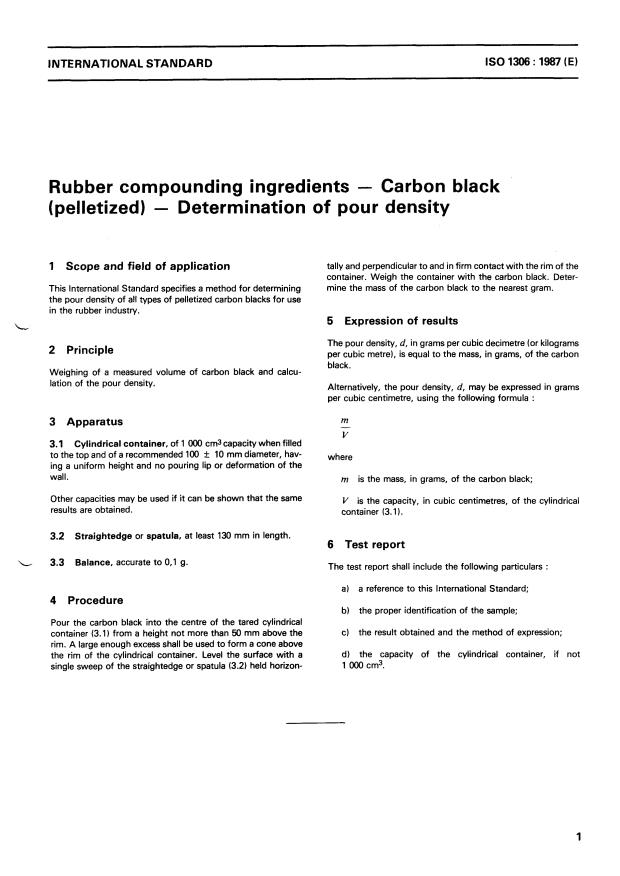
INTERNATIONAL STANDARD
Rubber compounding ingredients - Carbon black
- Determination of pour density
(pelletized)
tally and perpendicular to and in firm contact with the rim of the
1 Scope and
...
Questions, Comments and Discussion
Ask us and Technical Secretary will try to provide an answer. You can facilitate discussion about the standard in here.
Loading comments...