

ISO 1306:1995
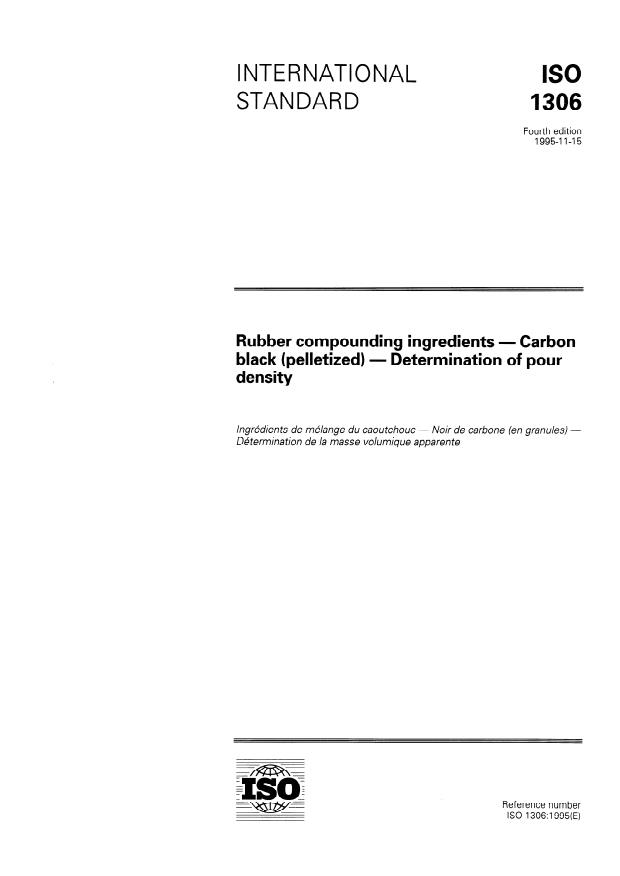
(Main)Rubber compounding ingredients — Carbon black (pelletized) — Determination of pour density
General Information
- Abstract
Gives a method for the determination of the pour density of all types of pelletized carbonblacks for use in the rubber industry. Replaces the third edition which has been technically revised.
- Status
- Published
- Publication Date
- 15-Nov-1995
- Drafting Committee
- ISO/TC 45/SC 3/WG 3 - Carbon black, silica and rubber chemicals
- Current Stage
- 9093 - International Standard confirmed
- Start Date
- 10-Jun-2025
- Completion Date
- 29-Aug-2026
Buy Documents
ISO 1306:1995 - Rubber compounding ingredients — Carbon black (pelletized) — Determination of pour density Released:11/16/1995


ISO 1306:1995 - Ingrédients de mélange du caoutchouc — Noir de carbone (en granules) — Détermination de la masse volumique apparente Released:11/16/1995
ISO 1306:1995 - Ingrédients de mélange du caoutchouc — Noir de carbone (en granules) — Détermination de la masse volumique apparente Released:11/16/1995
Overview
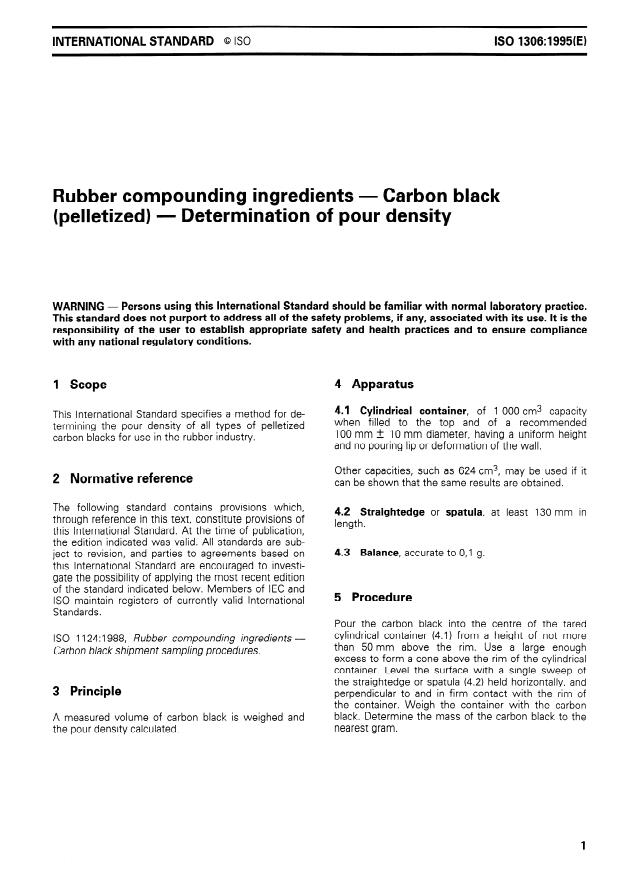
ISO 1306:1995 - Rubber compounding ingredients - Carbon black (pelletized) - Determination of pour density describes a laboratory method for measuring the pour (apparent) density of pelletized carbon blacks used in the rubber industry. This fourth edition (1995) replaces the 1987 edition and provides a simple, repeatable procedure for quality control and material specification of pelletized carbon black.
Key topics and technical requirements
- Scope: Applies to all types of pelletized carbon blacks intended for rubber compounding.
- Principle: Weigh a fixed volume of pelletized carbon black and calculate apparent (pour) density from the measured mass and vessel volume.
- Apparatus:
- Cylindrical vessel, recommended capacity 1 000 cm3 (diameter ~100 mm ±10 mm) with a regular wall and no spout or deformation (other capacities such as 624 cm3 may be used if equivalence is demonstrated).
- Straight blade or spatula, at least 130 mm long.
- Balance accurate to 0.1 g.
- Procedure (summary):
- Tare the cylindrical vessel and pour carbon black vertically to a specified height (not exceeding 50 mm below the rim).
- Overfill to form a cone, level once with the blade held horizontal and touching the rim, then weigh vessel plus sample.
- Determine the mass of carbon black (to 1 g where applicable) and compute apparent density (Pap).
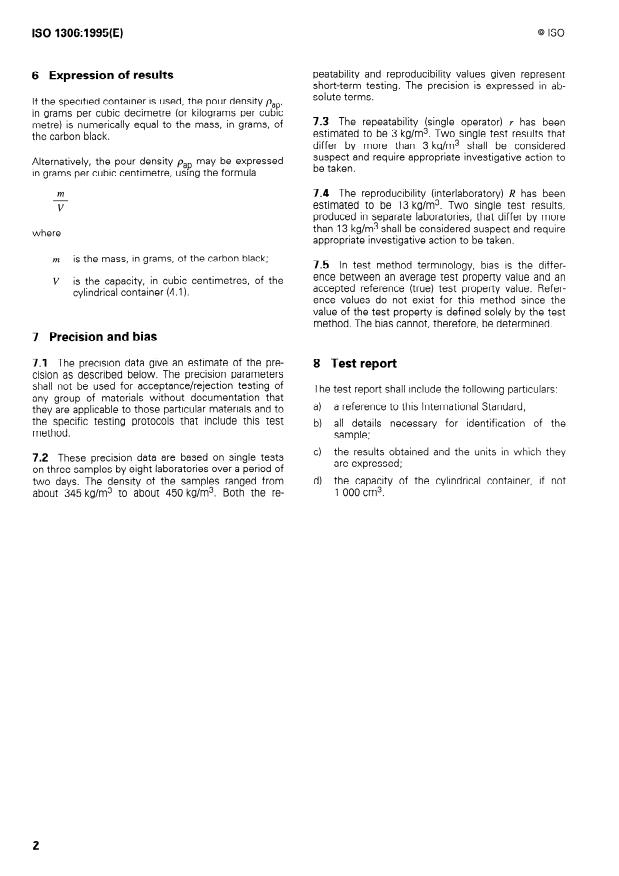
- Note: when using the specified 1 000 cm3 vessel, Pap in g/dm3 is numerically equal to the mass in grams.
- Performance characteristics:
- Repeatability (single operator): r ≈ 3 kg/m3 - differences greater than this between two tests by the same operator are suspect.
- Reproducibility (between laboratories): R ≈ 13 kg/m3 - larger differences between labs require investigation.
- Safety: Users must follow standard laboratory safety practices; the standard does not cover all safety aspects.
Applications and users
ISO 1306 is used for:
- Quality control and incoming inspection of pelletized carbon black shipments.
- Batch formulation and volume-to-mass conversions in rubber compounding.
- Supplier specifications, acceptance testing and comparative product evaluation. Typical users:
- Carbon black manufacturers and suppliers
- Rubber compounders and tyre manufacturers
- QC and analytical laboratories
- Standards bodies and testing service providers
Related standards
- ISO 1124:1988 - Rubber compounding ingredients - Sampling procedures for deliveries of carbon black (referenced for sampling practice).
Keywords: ISO 1306, pour density, apparent density, pelletized carbon black, rubber compounding, quality control, laboratory method, pour density determination.
Relations
- Effective Date
- 15-Apr-2008
Buy Documents
ISO 1306:1995 - Rubber compounding ingredients — Carbon black (pelletized) — Determination of pour density Released:11/16/1995
ISO 1306:1995 - Ingrédients de mélange du caoutchouc — Noir de carbone (en granules) — Détermination de la masse volumique apparente Released:11/16/1995
ISO 1306:1995 - Ingrédients de mélange du caoutchouc — Noir de carbone (en granules) — Détermination de la masse volumique apparente Released:11/16/1995
Get Certified
Connect with accredited certification bodies for this standard

DIN CERTCO
DIN Group product certification.

Smithers Quality Assessments
US management systems and product certification.
Sponsored listings
Frequently Asked Questions
ISO 1306:1995 is a standard published by the International Organization for Standardization (ISO). Its full title is "Rubber compounding ingredients — Carbon black (pelletized) — Determination of pour density". This standard covers: Gives a method for the determination of the pour density of all types of pelletized carbonblacks for use in the rubber industry. Replaces the third edition which has been technically revised.
Gives a method for the determination of the pour density of all types of pelletized carbonblacks for use in the rubber industry. Replaces the third edition which has been technically revised.
ISO 1306:1995 is classified under the following ICS (International Classification for Standards) categories: 83.040.20 - Rubber compounding ingredients. The ICS classification helps identify the subject area and facilitates finding related standards.
ISO 1306:1995 has the following relationships with other standards: It is inter standard links to ISO 1306:1987. Understanding these relationships helps ensure you are using the most current and applicable version of the standard.
ISO 1306:1995 is available in PDF format for immediate download after purchase. The document can be added to your cart and obtained through the secure checkout process. Digital delivery ensures instant access to the complete standard document.
Standards Content (Sample)
INTERNATIONAL,
ISO
STANDARD
Fourth edition
1995-1 l-1 5
Rubber compounding ingredients - Carbon
black (pelletized) -
Determination of pour
density
IngGdients de melange du caoutchouc
- Noir de carbone (en granules) -
Determination de Ia masse volumique apparen te
Reference number
ISO 1306: 1995(E)
Foreword
ISO (the International Organization for Standardization) is a worldwide
federation of national Standards bodies (ISO member bodies). The work of
preparing International Standards is normally carried out through ISO
technical committees. Esch member body interested in a subject for
which a technical committee has been established has the right to be
represented on that committee. International organizations, governmental
and non-governmental, in liaison with ISO, also take part in the work. ISO
collaborates closely with the International Electrotechnical Commission
(IEC) on all matters of electrotechnical standardization.
Draft International Standards adopted by the technical committees are
circulated to the member bodies for voting. Publication as an International
Standard requires approval by at least 75 % of the member bodies casting
a vote.
International Standard ISO 1306 was prepared by Techr lical Committee
ISO/TC 45, Rubber and rubber products, Subcommittee SC 3, Raw ma-
terials (including latex) for use in the rubber industry.
This fourth edition cancels and replaces the third edition ( ISO 1306: 1987)
which has been technically revised.
0 ISO 1995
All rights reserved. Unless otherwise specified, no part of this publication may be
reproduced or utilized in any form or by any means, electronie or mechanical, including
photocopying and microfilm, without Permission in writing from the publisher.
International Organization for Standardization
1 Geneve 20 l Switzerland
Case Postale 56 l CH-l 21
Printed in Switzerland
ii
INTERNATIONAL STANDARD @ ISO
Karbon black
Rubber compounding ingredients -
- Determination of pour density
(pelletized)
- Persons using this International Standard should be familiar with normal laboratory practice.
WARNING
This Standard does not purport to address all of the safety Problems, if any, associated with its use. lt is the
responsibility of the User to establish appropriate safety and health practices and to ensure compliance
with any national regulatory conditions.
4 Apparatus
1 Scope
4.1 Cylindrical Container, of 1 000 cm3 capacity
This International Standard specifies a method for de-
when filled to the top and of a recommended
termining the pour density of all types of pelletized
100 mm & 10 mm diameter, having a uniform height
carbon blacks for use in the rubber industry.
and no pouring lip or deformation of the Wall.
Other capacities, such as 624 cm3, may be used if it
2 Normative reference
tan be shown that the Same results are obtained.
The following Standard contains provisions which,
4.2 Straightedge or spatula, at least 130 mm in
through reference in this text, constitute provisions of
length.
this International Standard. At the time of publication,
the edition indicated was valid. All Standards are sub-
4.3 Balance, accurate to 0,l g.
ject to revision, and Parties to agreements based on
this International Standard are encouraged to investi-
gate the possibility of applying the most recent edition
of the Standard indicated below. Members of IEC and
5 Procedure
ISO maintain registers of currently valid International
...
ISO
NORME
INTERNATIONALE 1306
Quatrième édition
1995-11-15
Ingrédients de mélange du caoutchouc -
Noir de carbone (en granules) -
Détermination de la masse volumique
apparente
Rubber compounding ingredients - Carbon black (pelletized) -
De termina tion of pour density
Numéro de référence
Avant-propos
L’ISO (Organisation internationale de normalisation) est une fédération
mondiale d’organismes nationaux de normalisation (comités membres de
I’ISO). L’élaboration des Normes internationales est en général confiée aux
comités techniques de I’ISO. Chaque comité membre intéressé par une
étude a le droit de faire partie du comité technique créé a cet effet. Les
organisations internationales, gouvernementales et non gouvernemen-
tales, en liaison avec I’ISO participent également aux travaux. L’ISO colla-
bore étroitement avec la Commission électrotechnique internationale (CEI)
en ce qui concerne la normalisation électrotechnique.
Les projets de Normes internationales adoptes par les comités techniques
sont soumis aux comités membres pour vote. Leur publication comme
Normes internationales requiert l’approbation de 75 % au moins des co-
mités membres votants.
La Norme internationale ISO 1306 a été élaborée par le comité technique
ISO/TC 45, Élastomères et produits à base d’élastomères, sous-comité
SC 3, Matières premières (y compris le latex) à l’usage de l’industrie des
élastomères.
Cette quatrième édition annule et remplace la troisième édition
(ISO 1306:1987), dont elle constitue une révision technique.
0 60 1995
Droits de reproduction réservés. Sauf prescription différente, aucune partie de cette publi-
cation ne peut être reproduite ni utilisée sous quelque forme que ce soit et par aucun pro-
cédé, électronique ou mécanique, y compris la photocopie et les microfilms, sans l’accord
écrit de l’éditeur.
de normalisation
Organisation internationale
Case postale 56. CH-1 211 Genéve 20 l Suisse
Imprimé en Suisse
ii
NORME INTERNATIONALE @ ISO
Ingrédients de mélange du caoutchouc - Noir de carbone
(en granules) - Détermination de la masse volumique
apparente
Les utilisateurs de la présente Norme internationale doivent être familiarisés avec les
AVERTISSEMENT -
pratiques d’usage en laboratoire. La présente Norme internationale n’a pas la prétention d’aborder tous les
problèmes de sécurité concernés par son usage. II est de la responsabilité de l’utilisateur de consulter et
d’établir des règles de sécurité et d’hygiène appropriées et de déterminer I’applicabilité des restrictions
réglementaires avant utilisation.
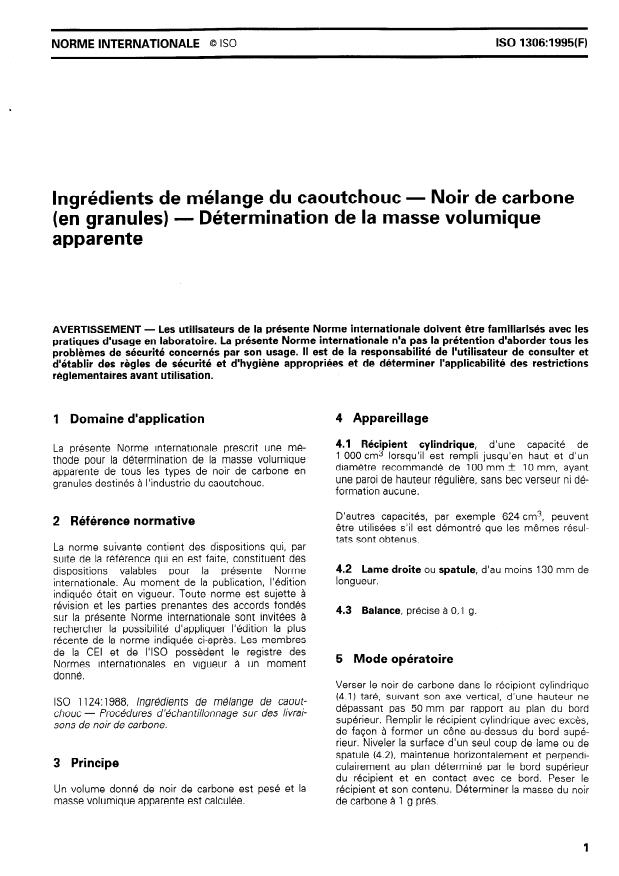
4 Appareillage
1 Domaine d’application
4.1 Récipient cylindrique, d’une capacité de
La présente Norme internationale prescrit une mé-
1 000 cm3 lorsqu’il est rempli jusqu’en haut et d’un
thode pour la détermination de la masse volumique
diamètre recommandé de 100 mm k 10 mm, ayant
apparente de tous les types de noir de carbone en
une paroi de hauteur régulière, sans bec verseur ni dé-
granules destinés à l’industrie du caoutchouc.
formation aucune.
D’autres capacités, par exemple 624 cm3, peuvent
2 Référence normative
être utilisées s’il est démontré que les mêmes résul-
tats sont obtenus.
La norme suivante contient des dispositions qui, par
suite de la référence qui en est faite, constituent des
4.2 Lame droite ou spatule, d’au moins 130 mm de
valables pour la présente Norme
dispositions
longueur.
internationale. Au moment de la publication, l’édition
indiquée était en vigueur. Toute norme est sujette à
révision et les parties prenantes des accords fondés
4.3 Balance, précise à 0,l g.
sur la présente Norme internationale sont invitées à
rechercher la possibilité d’appliquer l’édition la plus
récente de la norme indiquée ci-après. Les membres
de la CEI et de I’ISO possèdent le registre des
5 Mode opératoire
Normes internationales en vigueu
...
ISO
NORME
INTERNATIONALE 1306
Quatrième édition
1995-11-15
Ingrédients de mélange du caoutchouc -
Noir de carbone (en granules) -
Détermination de la masse volumique
apparente
Rubber compounding ingredients - Carbon black (pelletized) -
De termina tion of pour density
Numéro de référence
Avant-propos
L’ISO (Organisation internationale de normalisation) est une fédération
mondiale d’organismes nationaux de normalisation (comités membres de
I’ISO). L’élaboration des Normes internationales est en général confiée aux
comités techniques de I’ISO. Chaque comité membre intéressé par une
étude a le droit de faire partie du comité technique créé a cet effet. Les
organisations internationales, gouvernementales et non gouvernemen-
tales, en liaison avec I’ISO participent également aux travaux. L’ISO colla-
bore étroitement avec la Commission électrotechnique internationale (CEI)
en ce qui concerne la normalisation électrotechnique.
Les projets de Normes internationales adoptes par les comités techniques
sont soumis aux comités membres pour vote. Leur publication comme
Normes internationales requiert l’approbation de 75 % au moins des co-
mités membres votants.
La Norme internationale ISO 1306 a été élaborée par le comité technique
ISO/TC 45, Élastomères et produits à base d’élastomères, sous-comité
SC 3, Matières premières (y compris le latex) à l’usage de l’industrie des
élastomères.
Cette quatrième édition annule et remplace la troisième édition
(ISO 1306:1987), dont elle constitue une révision technique.
0 60 1995
Droits de reproduction réservés. Sauf prescription différente, aucune partie de cette publi-
cation ne peut être reproduite ni utilisée sous quelque forme que ce soit et par aucun pro-
cédé, électronique ou mécanique, y compris la photocopie et les microfilms, sans l’accord
écrit de l’éditeur.
de normalisation
Organisation internationale
Case postale 56. CH-1 211 Genéve 20 l Suisse
Imprimé en Suisse
ii
NORME INTERNATIONALE @ ISO
Ingrédients de mélange du caoutchouc - Noir de carbone
(en granules) - Détermination de la masse volumique
apparente
Les utilisateurs de la présente Norme internationale doivent être familiarisés avec les
AVERTISSEMENT -
pratiques d’usage en laboratoire. La présente Norme internationale n’a pas la prétention d’aborder tous les
problèmes de sécurité concernés par son usage. II est de la responsabilité de l’utilisateur de consulter et
d’établir des règles de sécurité et d’hygiène appropriées et de déterminer I’applicabilité des restrictions
réglementaires avant utilisation.
4 Appareillage
1 Domaine d’application
4.1 Récipient cylindrique, d’une capacité de
La présente Norme internationale prescrit une mé-
1 000 cm3 lorsqu’il est rempli jusqu’en haut et d’un
thode pour la détermination de la masse volumique
diamètre recommandé de 100 mm k 10 mm, ayant
apparente de tous les types de noir de carbone en
une paroi de hauteur régulière, sans bec verseur ni dé-
granules destinés à l’industrie du caoutchouc.
formation aucune.
D’autres capacités, par exemple 624 cm3, peuvent
2 Référence normative
être utilisées s’il est démontré que les mêmes résul-
tats sont obtenus.
La norme suivante contient des dispositions qui, par
suite de la référence qui en est faite, constituent des
4.2 Lame droite ou spatule, d’au moins 130 mm de
valables pour la présente Norme
dispositions
longueur.
internationale. Au moment de la publication, l’édition
indiquée était en vigueur. Toute norme est sujette à
révision et les parties prenantes des accords fondés
4.3 Balance, précise à 0,l g.
sur la présente Norme internationale sont invitées à
rechercher la possibilité d’appliquer l’édition la plus
récente de la norme indiquée ci-après. Les membres
de la CEI et de I’ISO possèdent le registre des
5 Mode opératoire
Normes internationales en vigueu
...