


ISO 10441:1999
(Main)Petroleum and natural gas industries — Flexible couplings for mechanical power transmission — Special purpose applications
Petroleum and natural gas industries — Flexible couplings for mechanical power transmission — Special purpose applications
La présente norme internationale s'applique à des accouplements de type à dents, ou à éléments métalliques flexibles, ou à arbre flexible (quillshaft) ou à élasticité torsionnelle (tortionally resilient-type). Elle ne s'applique pas à d'autres types d'accouplements comme ceux de types à embrayage (clutch), ou hydrauliques, ou à courants de Foucault (eddy-current) ou de type rigide, ou de type à cannelures radiales (radial spline), ou de types à chaînes ou de types à soufflets.La présente Norme internationale concerne la conception, les matériaux de construction, la qualité de fabrication, l'inspection et les tests des accouplements. Elle ne comprend pas de critères de choix des différents types d'accouplements convenant à des applications spécifiques.NOTE: Il est vivement recommandé, lorsque des utilisateurs veulent adapter des nouveaux accouplements sur un ensemble de machines existant, les nouveaux accouplements étant de types différents de ceux qui ont équipé le train de machines à l'origine, que les utilisateurs consultent le vendeur ayant eu la responsabilité de l'ensemble du train de machines à l'origine, de façon à avoir l'assurance qu'ils appliquent correctement la présente Norme internationale. Il sera alors généralement nécessaire de refaire un calcul d'ensemble du comportement dynamique des parties tournantes de l'ensemble du train de machines.
Industries du pétrole et du gaz naturel — Accouplements flexibles pour transmission de puissance mécanique — Applications spéciales
General Information
- Status
- Withdrawn
- Publication Date
- 17-Mar-1999
- Withdrawal Date
- 17-Mar-1999
- Technical Committee
- ISO/TC 67/SC 6 - Processing equipment and systems
- Drafting Committee
- ISO/TC 67/SC 6 - Processing equipment and systems
- Current Stage
- 9599 - Withdrawal of International Standard
- Start Date
- 08-Mar-2007
- Completion Date
- 12-Feb-2026
Relations
- Effective Date
- 09-Feb-2026
- Effective Date
- 09-Feb-2026
- Effective Date
- 12-Feb-2026
- Effective Date
- 28-Feb-2023
- Effective Date
- 15-Apr-2008
Get Certified
Connect with accredited certification bodies for this standard

ABS Quality Evaluations Inc.
American Bureau of Shipping quality certification.

Element Materials Technology
Materials testing and product certification.

ABS Group Brazil
ABS Group certification services in Brazil.
Sponsored listings
Frequently Asked Questions
ISO 10441:1999 is a standard published by the International Organization for Standardization (ISO). Its full title is "Petroleum and natural gas industries — Flexible couplings for mechanical power transmission — Special purpose applications". This standard covers: La présente norme internationale s'applique à des accouplements de type à dents, ou à éléments métalliques flexibles, ou à arbre flexible (quillshaft) ou à élasticité torsionnelle (tortionally resilient-type). Elle ne s'applique pas à d'autres types d'accouplements comme ceux de types à embrayage (clutch), ou hydrauliques, ou à courants de Foucault (eddy-current) ou de type rigide, ou de type à cannelures radiales (radial spline), ou de types à chaînes ou de types à soufflets.La présente Norme internationale concerne la conception, les matériaux de construction, la qualité de fabrication, l'inspection et les tests des accouplements. Elle ne comprend pas de critères de choix des différents types d'accouplements convenant à des applications spécifiques.NOTE: Il est vivement recommandé, lorsque des utilisateurs veulent adapter des nouveaux accouplements sur un ensemble de machines existant, les nouveaux accouplements étant de types différents de ceux qui ont équipé le train de machines à l'origine, que les utilisateurs consultent le vendeur ayant eu la responsabilité de l'ensemble du train de machines à l'origine, de façon à avoir l'assurance qu'ils appliquent correctement la présente Norme internationale. Il sera alors généralement nécessaire de refaire un calcul d'ensemble du comportement dynamique des parties tournantes de l'ensemble du train de machines.
La présente norme internationale s'applique à des accouplements de type à dents, ou à éléments métalliques flexibles, ou à arbre flexible (quillshaft) ou à élasticité torsionnelle (tortionally resilient-type). Elle ne s'applique pas à d'autres types d'accouplements comme ceux de types à embrayage (clutch), ou hydrauliques, ou à courants de Foucault (eddy-current) ou de type rigide, ou de type à cannelures radiales (radial spline), ou de types à chaînes ou de types à soufflets.La présente Norme internationale concerne la conception, les matériaux de construction, la qualité de fabrication, l'inspection et les tests des accouplements. Elle ne comprend pas de critères de choix des différents types d'accouplements convenant à des applications spécifiques.NOTE: Il est vivement recommandé, lorsque des utilisateurs veulent adapter des nouveaux accouplements sur un ensemble de machines existant, les nouveaux accouplements étant de types différents de ceux qui ont équipé le train de machines à l'origine, que les utilisateurs consultent le vendeur ayant eu la responsabilité de l'ensemble du train de machines à l'origine, de façon à avoir l'assurance qu'ils appliquent correctement la présente Norme internationale. Il sera alors généralement nécessaire de refaire un calcul d'ensemble du comportement dynamique des parties tournantes de l'ensemble du train de machines.
ISO 10441:1999 is classified under the following ICS (International Classification for Standards) categories: 75.180.20 - Processing equipment. The ICS classification helps identify the subject area and facilitates finding related standards.
ISO 10441:1999 has the following relationships with other standards: It is inter standard links to EN ISO 10439:2002, EN ISO 10440-2:2001, EN ISO 10441:1999, ISO/R 70:1958, ISO 10441:2007. Understanding these relationships helps ensure you are using the most current and applicable version of the standard.
ISO 10441:1999 is available in PDF format for immediate download after purchase. The document can be added to your cart and obtained through the secure checkout process. Digital delivery ensures instant access to the complete standard document.
Standards Content (Sample)
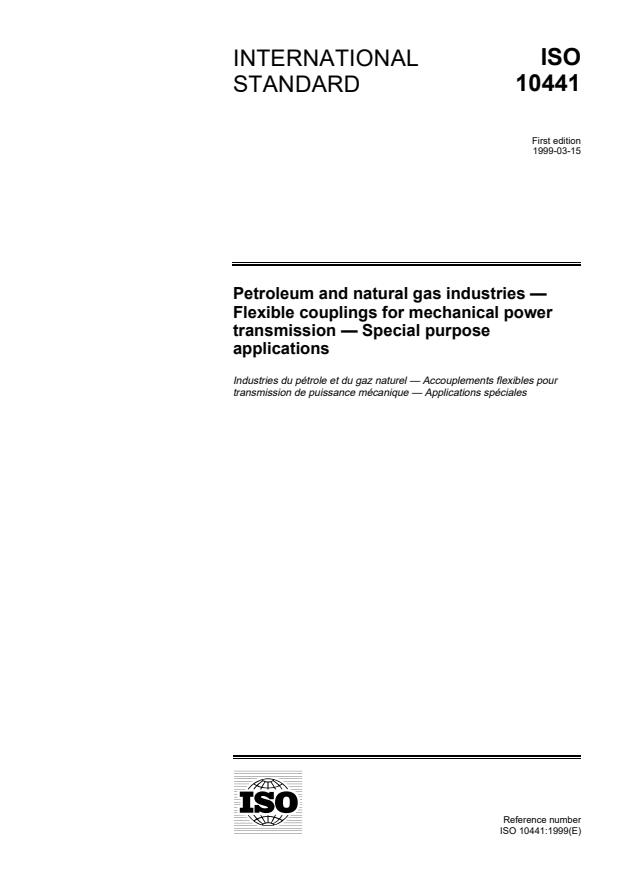
INTERNATIONAL ISO
STANDARD 10441
First edition
1999-03-15
Petroleum and natural gas industries —
Flexible couplings for mechanical power
transmission — Special purpose
applications
Industries du pétrole et du gaz naturel — Accouplements flexibles pour
transmission de puissance mécanique — Applications spéciales
A
Reference number
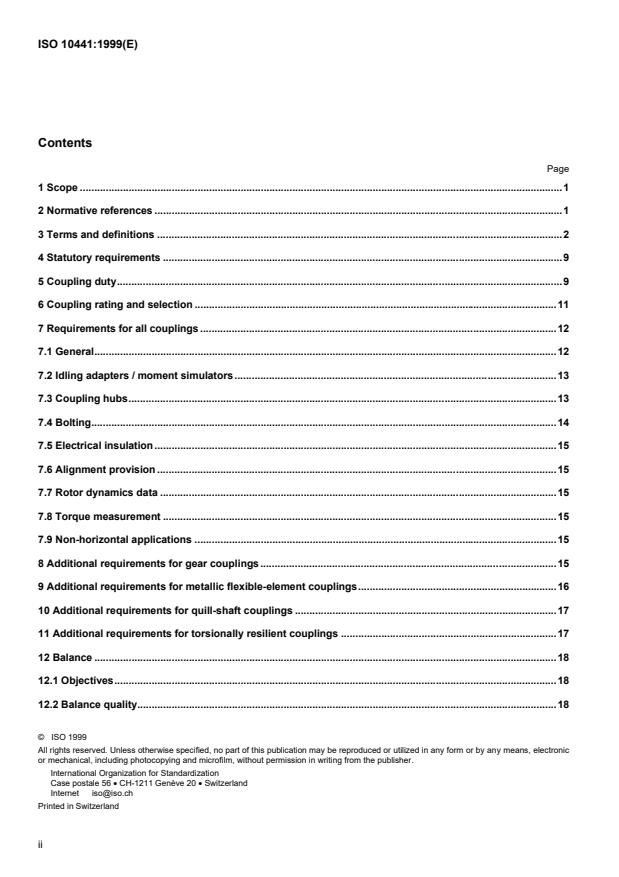
Contents
Page
1 Scope .1
2 Normative references .1
3 Terms and definitions .2
4 Statutory requirements .9
5 Coupling duty.9
6 Coupling rating and selection .11
7 Requirements for all couplings .12
7.1 General.12
7.2 Idling adapters / moment simulators.13
7.3 Coupling hubs.13
7.4 Bolting.14
7.5 Electrical insulation.15
7.6 Alignment provision .15
7.7 Rotor dynamics data .15
7.8 Torque measurement .15
7.9 Non-horizontal applications .15
8 Additional requirements for gear couplings.15
9 Additional requirements for metallic flexible-element couplings.16
10 Additional requirements for quill-shaft couplings .17
11 Additional requirements for torsionally resilient couplings .17
12 Balance .18
12.1 Objectives.18
12.2 Balance quality.18
© ISO 1999
All rights reserved. Unless otherwise specified, no part of this publication may be reproduced or utilized in any form or by any means, electronic
or mechanical, including photocopying and microfilm, without permission in writing from the publisher.
International Organization for Standardization
Case postale 56 • CH-1211 Genève 20 • Switzerland
Internet iso@iso.ch
Printed in Switzerland
ii
© ISO
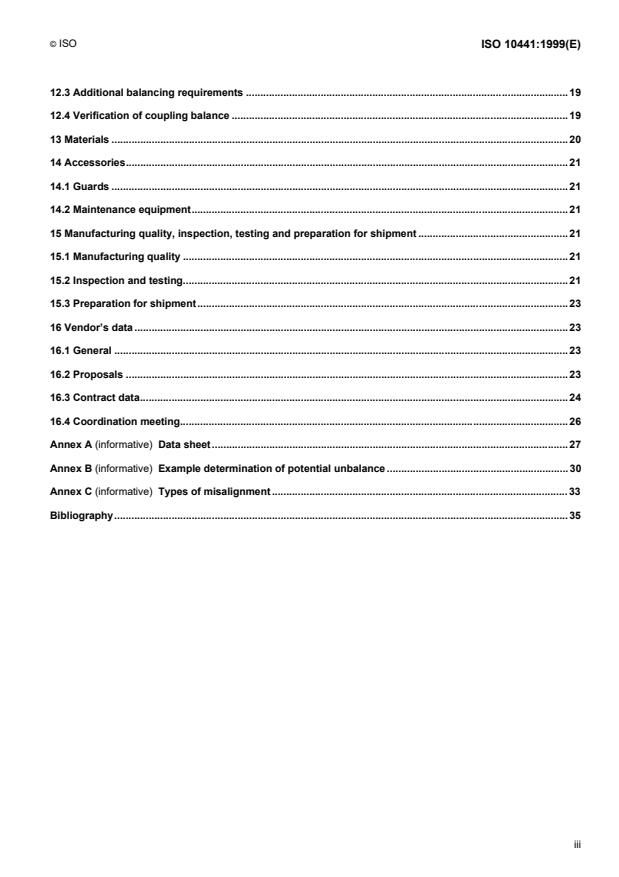
12.3 Additional balancing requirements . 19
12.4 Verification of coupling balance . 19
13 Materials . 20
14 Accessories. 21
14.1 Guards . 21
14.2 Maintenance equipment. 21
15 Manufacturing quality, inspection, testing and preparation for shipment . 21
15.1 Manufacturing quality . 21
15.2 Inspection and testing. 21
15.3 Preparation for shipment. 23
16 Vendor’s data . 23
16.1 General . 23
16.2 Proposals . 23
16.3 Contract data. 24
16.4 Coordination meeting. 26
Annex A (informative) Data sheet. 27
Annex B (informative) Example determination of potential unbalance . 30
Annex C (informative) Types of misalignment . 33
Bibliography. 35
iii
© ISO
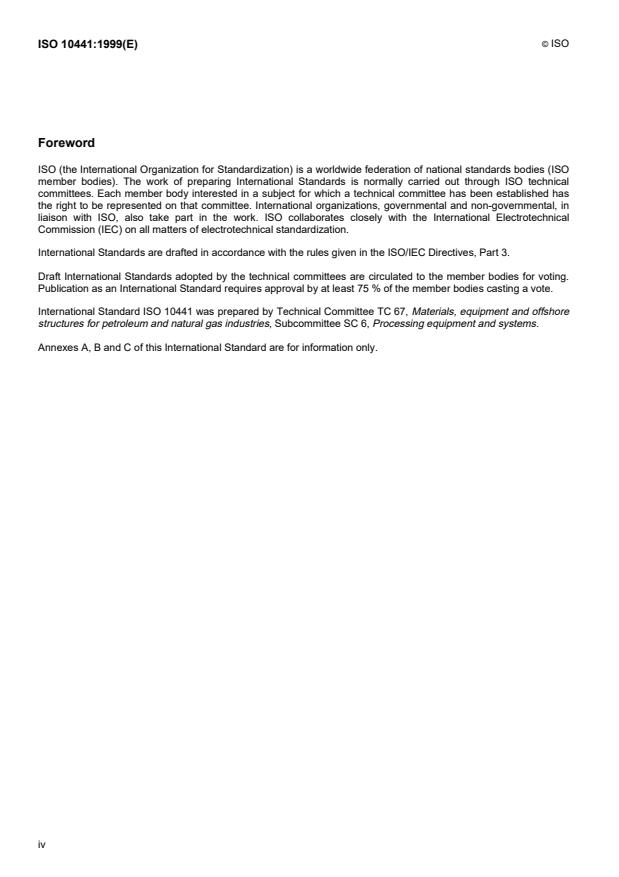
Foreword
ISO (the International Organization for Standardization) is a worldwide federation of national standards bodies (ISO
member bodies). The work of preparing International Standards is normally carried out through ISO technical
committees. Each member body interested in a subject for which a technical committee has been established has
the right to be represented on that committee. International organizations, governmental and non-governmental, in
liaison with ISO, also take part in the work. ISO collaborates closely with the International Electrotechnical
Commission (IEC) on all matters of electrotechnical standardization.
International Standards are drafted in accordance with the rules given in the ISO/IEC Directives, Part 3.
Draft International Standards adopted by the technical committees are circulated to the member bodies for voting.
Publication as an International Standard requires approval by at least 75 % of the member bodies casting a vote.
International Standard ISO 10441 was prepared by Technical Committee TC 67, Materials, equipment and offshore
structures for petroleum and natural gas industries, Subcommittee SC 6, Processing equipment and systems.
Annexes A, B and C of this International Standard are for information only.
iv
© ISO
Introduction
This International Standard is based on the accumulated knowledge and experience of manufacturers and users of
power transmission couplings used to couple large or critical machines in the petroleum and natural gas industries,
but its use is not restricted to these industries.
This International Standard has been derived from the American Petroleum Institute, standard 671 but contains
significant differences from that standard.
Users of this International Standard should be aware that further or differing requirements may be needed for
individual applications. This International Standard is not intended to inhibit a vendor from offering, or the purchaser
from accepting, alternative equipment or engineering solutions for the individual application. This may be particularly
appropriate where there is innovative or developing technology. Where an alternative is offered, the vendor should
identify any variations from this International Standard and provide details.
This International Standard requires the purchaser to specify certain details and features.
A bullet (•) at the beginning of a clause, subclause or paragraph indicates that either a decision is required or further
information is to be provided by the purchaser. This information or decision should be indicated on the data sheets;
otherwise it should be stated in the quotation request (enquiry) or in the order.
v
INTERNATIONAL STANDARD © ISO ISO 10441:1999(E)
Petroleum and natural gas industries — Flexible couplings for
mechanical power transmission — Special purpose applications
1 Scope
1.1 This International Standard specifies the requirements for couplings for the transmission of power between the
rotating shafts of two machines for service in special purpose applications in the petroleum and natural gas
industries. Such applications will typically be in large and/or high speed machines in services that may be required
to operate continuously for extended periods, are often unspared and are critical to the continued operation of the
installation. By agreement, it may be used to apply to other services.
NOTE Couplings for general purpose, less critical applications are covered in ISO 14691.
1.2 Couplings covered by this International Standard are designed to accommodate parallel (or lateral) offset,
angular misalignment and axial displacement of the shafts without imposing unacceptable mechanical loading on
the coupled machines. It is applicable to gear, metallic flexible-element, quillshaft and torsionally resilient-type
couplings. It is not applicable to other types, such as clutch, hydraulic, eddy-current, rigid, radial spline, chain and
bellows types.
1.3 This International Standard is applicable to the design, materials of construction, manufacturing quality,
inspection and testing of couplings. It does not include criteria for the selection of coupling types for specific
applications.
NOTE It is strongly recommended that, when users fit new couplings to existing equipment, which are different from those
originally fitted, they consult the vendor who originally had unit responsibilty for the equipment train, to ensure proper
application of this International Standard. It will generally be necessary to recalculate the rotor dynamics of the train.
2 Normative references
The following normative documents contain provisions which, through reference in this text, constitute provisions of
this International Standard. For dated references, subsequent amendments to, or revisions of, any of these
publications do not apply. However, parties to agreements based on this International Standard are encouraged to
investigate the possibility of applying the most recent editions of the normative documents indicated below. For
undated references, the latest edition of the normative document referred to applies. Members of IEC and ISO
maintain registers of currently valid International Standards.
ISO 1940-1:1986, Mechanical vibration — Balance quality requirements of rigid rotors — Part. 1: Determination of
permissible residual unbalance.
ISO 8821, Mechanical vibration — Balancing — Shaft and fitment key convention.
ISO 14691, Petroleum and natural gas industries — Flexible couplings for mechanical power transmission —
General purpose applications.
© ISO
3 Terms and definitions
For the purposes of this International Standard, the following terms and definitions apply.
3.1 Terms relating to coupling types
3.1.1
mechanical contact coupling
coupling designed to transmit torque by direct mechanical contact between mating parts and accommodate
misalignment and axial displacement by relative rocking and sliding motion between the parts in contact
NOTE The contacting parts may be metallic or may be made of self-lubricating nonmetallic material.
3.1.1.1
gear coupling
type of mechanical contact coupling designed to transmit torque and accommodate misalignment and axial
displacement by relative rocking and sliding motion between mating internal and external profiled gears
3.1.2
metallic flexible-element coupling
coupling that obtains its flexibility from the flexing of thin metallic discs, diaphragms or links
3.1.2.1
metallic diaphragm coupling
type of metallic flexible-element coupling consisting of one or more metallic flexible elements in the form of thin
circular plates that are attached to one part of the coupling at their outer diameter and the other part at their inner
diameter
3.1.2.2
metallic disc coupling
type of metallic flexible-element coupling consisting of one or more metallic flexible elements that are alternately
attached to the two parts of the coupling, the attachment points being essentially equidistant from the centreline
3.1.3
elastomeric flexible-element coupling
coupling in which the torque is transmitted through one or several elastomeric elements
3.1.3.1
elastomeric shear coupling
type of elastomeric flexible-element coupling in which the torque is transmitted through an elastomeric element
which is principally loaded in shear
NOTE 1 The element may be in the form of a tyre, a bellows (with one or more convolutions) or a diaphragm.
NOTE 2 A single such elastomeric element is usually able to accommodate angular misalignment, parallel offset and axial
displacement.
3.1.3.2
elastomeric compression coupling
type of elastomeric flexible-element coupling in which elastomeric inserts are located between adjacent parts of the
driving and driven halves of the coupling and are principally loaded in compression
NOTE 1 The inserts are often in the form of bushes or wedges, or one single insert.
NOTE 2 The ability of such couplings to accommodate misalignment, particularly of the parallel (or lateral) offset type, is
limited.
3.1.4
double-engagement coupling
coupling with two planes of flexure
NOTE This arrangement enables couplings of certain types, notably gear and metallic flexible-element types, which cannot
normally accommodate parallel (or lateral) offset, to do so.
© ISO
3.1.5
quill-shaft coupling
coupling designed to accommodate angular misalignment, parallel (or lateral) offset and torsional fluctuations by
elastic deformation of a relatively long slender shaft
NOTE Quill-shaft couplings cannot normally accommodate axial displacement.
3.1.6
single-engagement coupling
coupling with only one plane of flexure
NOTE Single-engagement couplings of some types, notably gear and metallic flexible-element types, will not normally
accommodate parallel (or lateral) offset.
3.1.7
torsionally resilient coupling
flexible coupling incorporating increased torsional flexibility and/or torsional damping
NOTE A torsionally resilient coupling may or may not also be designed to accommodate misalignment and/or axial
displacement.
3.2 Terms relating to coupling rating
3.2.1
coupling continuous rated torque
T
c
the coupling manufacturer's declared maximum torque which the coupling will transmit continuously, for unlimited
periods
NOTE 1 The coupling continuous rated torque is expressed as either:
a single value at the coupling rated speed, when simultaneously subjected to the coupling rated maximum continuous
angular misalignment (at each plane of flexure) and the coupling rated maximum continuous axial displacement,
or a range of values expressed as an interrelated function of speed, misalignment and axial displacement.
NOTE 2 For certain types of coupling, particularly those with elastomeric elements or inserts, the coupling continuous rated
torque may also be a function of the operating temperature.
3.2.2
coupling rated maximum continuous angular misalignment
maximum angular misalignment, at each plane of flexure, which the coupling is able to tolerate continuously for
unlimited periods
NOTE It is expressed as either:
a single value when transmitting the coupling continuous rated torque at the coupling rated speed, and simultaneously
subjected to the coupling rated maximum continuous axial displacement
or a range of values expressed as an interrelated function of speed, torque and axial displacement.
3.2.3
coupling rated maximum continuous axial displacement
maximum axial displacement the coupling is able to tolerate continuously for unlimited periods
NOTE It is expressed as either:
a single value when transmitting the coupling continuous rated torque at the coupling rated speed, and simultaneously
subjected to the coupling rated maximum continuous angular misalignment
or a range of values expressed as an interrelated function of speed, torque and angular misalignment.
© ISO
3.2.4
coupling rated speed
maximum rotational speed at which the coupling is capable of continuously transmitting the coupling continuous
rated torque when simultaneously subjected to the coupling rated maximum continuous angular misalignment and
the coupling rated maximum continuous axial displacement
3.2.5
maximum allowable speed
highest rotational speed at which the coupling design will permit transient operation
3.2.6
maximum allowable temperature
maximum ambient temperature in the immediate vicinity of the coupling for which the manufacturer has designed
the coupling
3.3 Terms relating to coupling duty
3.3.1
application factor
K
a
factor by which the machine rated torque is multiplied to allow for the fact that the torque required to be transmitted
with certain types of driving or driven machines is not constant but varies in a cyclic manner
NOTE Examples of such machines are reciprocating engines or compressors.
3.3.2
experience factor
K
e
factor by which the machine rated torque is increased to allow for uncertainties in the determination of the machine
rated torque and possible future changes to the application
3.3.3
machine rated speed
highest rotational speed at which the machine rated torque is required to be transmitted continuously by the
coupling
3.3.4
machine rated torque
T
m
maximum mean torque required to be transmitted continuously by the coupling
NOTE Mean torque is the average torque over a few revolutions and does not include cyclic variations such as those
associated with reciprocating machines.
3.3.5
maximum continuous speed
maximum rotational speed at which the coupling is required to operate continuously but not necessarily transmitting
the machine rated torque
NOTE In most cases the machine rated speed and the maximum continuous speed are the same. In some applications,
however, the coupling may be required to operate at speeds above the speed at which it is required to transmit its rated torque.
3.3.6
maximum continuous temperature
maximum ambient temperature in the immediate vicinity of the coupling, at which the coupling will be required to
continuously transmit the coupling continuous rated torque at the specified operating conditions of speed and
misalignment
3.3.7
minimum continuous speed
lowest rotational speed at which the coupling is required to operate continuously
© ISO
3.3.8
minimum operating temperature
lowest ambient temperature in the immediate vicinity of the coupling, at which the coupling is required to transmit
torque and/or accommodate misalignment or axial displacement
3.3.9
trip speed
rotational speed of the coupling corresponding to the speed at which the independent emergency overspeed device
operates to shut down a variable speed prime mover
NOTE Where the term is used in relation to a machine train driven by a constant-speed, alternating-current electric motor,
the trip speed is assumed to be the coupling speed corresponding to the motor synchronous speed at the maximum supply
frequency.
3.4 General terms
3.4.1
angular misalignment
minor angle between the centrelines of two shafts that intersect at a point or, where the shafts do not intersect, the
minor angle between the centreline of one shaft and an intersecting line parallel to the centreline of the other shaft
See Figure C.2.
NOTE With double-engagement couplings, the term also applies to the minor angle between the centreline of one shaft
and the effective centreline of the (3.4.8).
floating shaft
3.4.2
axial displacement
change in the relative axial position of the adjacent shaft ends of two coupled machines
3.4.3
axial reference point
axial position on the shaft of the driving or driven machine (normally the extreme end of the shaft) from which axial
distance is measured
3.4.4
coupling axial reaction force
axial force developed within the coupling which results from the imposed operating conditions
NOTE 1 Axial deflection, misalignment, speed, temperature, etc. are examples of imposed operating conditions.
NOTE 2 Coupling axial reaction force is a function of the shape and stiffness of the flexible elements or the sliding friction
between the elements of a mechanical contact coupling.
3.4.5
coupling mass simulator
auxiliary device designed to correctly simulate both the effective mass and the effective location of the centre of
mass of a half-coupling with respect to the shaft on which it is mounted
3.4.6
electrically insulated coupling
coupling designed to prevent the flow of electrical current from one shaft to the other through the coupling
3.4.7
flexing length
axial distance between the effective planes of flexure of a double-engagement coupling
3.4.8
floating shaft
floating part, or assembly, of a double-engagement coupling that connects, and is flexibly supported from, the shaft-
mounted assemblies and through which the power is transmitted
NOTE The floating shaft may include the spacer or may be only part of the spacer.
© ISO
3.4.9
half-coupling
composite of all the components of the coupling attached to and supported from one shaft, including an appropriate
portion of the spacer assembly in the case of a double-engagement coupling or of the flexing elements of a single-
engagement coupling
3.4.10
hub
part of a coupling mounted directly onto the shaft of the driving or driven machine
3.4.11
idling adapter
solo plate
device designed to rigidly hold in alignment the floating parts at the drive end of certain types of coupling, to allow
uncoupled operation of the driving machine without dismounting the coupling hub
3.4.12
lateral offset
lateral distance between the centrelines of two coupled shafts that are not parallel, measured at the axial reference
point of the driving machine shaft
See Figures C.3 and C.4.
3.4.13
limited-end-float coupling
coupling designed to limit the axial movement of the coupled shaft ends with respect to each other and transmit an
axial force of a prescribed magnitude
3.4.14
manufacturer
body responsible for the design and manufacture of the coupling
NOTE The manufacturer is not necessarily the vendor.
3.4.15
moment simulator
auxiliary device designed to simulate the effective moment of the mass of a half-coupling with respect to the centre
of the adjacent bearing
3.4.16
parallel offset
lateral distance between the centrelines of two coupled shafts that are parallel but not in the same straight line
See Figure C.1.
3.4.17
potential unbalance
maximum probable net unbalance of a complete coupling after installation
NOTE 1 Potential unbalance results from a combination of the residual unbalance of individual components and
subassemblies and possible eccentricity of the components and subassemblies due to run-out and tolerances of the various
locating surfaces and registers. Since it may be assumed that the actual values of the various contributory unbalances are
random in both magnitude and direction, the numerical value of the potential unbalance is the square root of the sum of the
squares of the maximum likely values of all the contributory unbalances. Typical contributory unbalances are:
the measured residual unbalance of each component or subassembly;
errors in the balance of each component or subassembly resulting from eccentricity in the fixture used to mount the
component or subassembly in the balancing machine;
the unbalance of each component or subassembly due to eccentricity resulting from clearance or run-out of the relevant
registers or fits.
NOTE 2 The concept of potential unbalance is explained more fully and a worked example is given in annex B.
© ISO
3.4.18
purchaser
body that issues the order and the specification for the coupling to the vendor
NOTE The purchaser may be the end user, the end user’s agent or the vendor of the driving or driven machine.
3.4.19
residual unbalance
level of unbalance remaining in a component or assembly after it has been balanced, either to the limit of the
capability of the balancing machine or in accordance with the relevant standard
3.4.20
shaft-mounted assembly
total assembly of parts rigidly connected to the shaft of the driving or driven machine
NOTE This includes the hub, where supplied, and all other components up to the flexible element(s) of a metallic or
elastomeric flexible-element coupling or one of the pair of contacting parts in a mechanical contact type coupling.
3.4.21
spacer
that part of a coupling that is removable to provide space and give access for the use of tools to remove the
coupling hubs or for other purposes
NOTE The spacer may be a single component or an assembly.
3.4.22
spacer gap length
axial length of the free gap, after the removal of the spacer, that is available for the use of tools to remove the hubs
or for other purposes
NOTE Spacer gap length may be less than the distance between the shaft ends.
3.4.23
torsional damping
absorption or dissipation of oscillatory rotary energy
NOTE Torsional damping may be necessary to limit the build-up of transient or steady-state torsional resonant oscillations
in a system.
3.4.24
torsional natural frequency
natural rotational oscillatory frequency of a system composed of rotating mass inertias acting in combination with
the restraining torsional rigidities of the connected shafts and couplings
3.4.25
torsional stiffness
ratio of the applied torque to the resulting angular displacement of either a complete coupling or part of a coupling,
such as the spacer
NOTE With some types of coupling, the torsional stiffness may not be constant but may be a function of the magnitude of
the torque and, with oscillating torques, also the frequency.
3.4.26
torsional tuning
changing of one or more torsional natural frequencies of a coupled system to avoid system resonance at a known
excitation frequency
NOTE Torsional tuning may be accomplished by varying one or more of the torsional stiffnesses or mass inertias in the
system.
© ISO
3.4.27
total indicated runout
total indicator reading
TIR
difference between the maximum and minimum readings of a dial indicator, or similar device, monitoring a face or
cylindrical surface, during one complete revolution of the monitored surface
NOTE With a truly flat face or a truly cylindrical surface, the TIR implies respectively an out-of-squareness equal to the
reading or an eccentricity equal to half the reading. If the surface in question is not truly flat or cylindrical, interpretation of the
meaning of TIR is more complex and may represent ovality or lobing.
3.4.28
unit responsibility
responsibility for coordinating the technical aspects of the complete machine train and the associated auxiliary
systems
NOTE 1 The technical aspects to be considered include, but are not limited to, such factors as the power requirements,
speed, rotation, general arrangement, couplings and coupling guards, dynamics, noise, lubrication, sealing system,
instrumentation, piping, conformance to specifications and testing of components.
NOTE 2 Unit responsibility will normally reside with the vendor of the driven machine.
3.4.29
vendor
body that supplies the coupling in reponse to an order from the purchaser
NOTE The vendor may be the manufacturer of the coupling or the manufacturer’s agent and is normally responsible for
service support.
3.5 Terms relating to gear couplings
The terms defined in 3.5.1 through 3.5.10 are applicable only to gear-type couplings.
3.5.1
anti-sludge design
design feature of continuously lubricated couplings, intended to minimize the accumulation of sludge
3.5.2
backlash
gear-tooth circumferential clearance normally necessary to provide angular misalignment capability
3.5.3
batch-lubricated coupling
coupling designed to be lubricated by a periodically changed charge of oil or grease
3.5.4
continuously lubricated coupling
coupling designed to be lubricated by a continuous external supply of oil
3.5.5
coupling sleeve
component with internal teeth
3.5.6
crown diameter
major diameter of the external teeth
3.5.7
diametral crown clearance
clearance between the crown diameter of the external teeth and the root diameter of the mating internal teeth when
the coupling is in perfect alignment
© ISO
3.5.8
flooded-mesh coupling
continuously lubricated coupling in which the tooth meshes are completely submerged in oil during normal operation
3.5.9
neutral state
Æof a gear couplingæ state in which the meshing pairs of gear teeth are axially centrally located with respect to each
other, i.e with equal scope for axial displacement in either direction
3.5.10
root diameter
diameter of the root circle of the internal teeth
3.6 Terms relating to flexible-element couplings
The terms defined in 3.6.1 and 3.6.2 are applicable only to metallic flexible-element couplings and elastomeric
flexible-element couplings.
3.6.1
axial natural frequency
natural frequency of the mass of the floating shaft supported by the flexible elements acting as axial springs
NOTE Some types of flexible-element couplings which have significantly non-linear axial stiffness and/or internal damping
may not exhibit an axial natural frequency.
3.6.2
neutral state
Æof a metallic or elastomeric flexible-element type couplingæ state in which there is no net axial force imposed on the
coupling
4 Statutory requirements
The purchaser and the vendor shall mutually determine the measures to be taken to comply with any federal, state
or local codes, regulations, ordinances or rules that are applicable to the equipment.
5 Coupling duty
• 5.1 The purchaser shall specify the following:
a) the type of coupling (gear, metallic flexible element, etc.) required and the method of attachment to the shaft
(integrally flanged shaft ends or removable hubs, tapered or parallel bores, with or without keys, etc.) and
details of the attachment (shaft diameter, degree of taper if any, interference, flange bolting details, etc.);
b) the machine rated speed, the equipment's operating speed range (maximum continuous speed and minimum
continuous speed) and the trip speed. See NOTE 1 below. Where it is required to run the driving machine
uncoupled (with an idling adapter if necessary) at a speed higher than the specified trip speed, the purchaser
shall also specify such a speed;
c) the machine rated torque as defined in 3.3.4, and the required torque capability at maximum continuous speed,
if different (see NOTE 2 below);
d) the value to be used for the application factor (K ) as defined in 3.3.1 (see NOTE 3 below);
a
e) the value to be used for the experience factor (K ) as defined in 3.3.2 (see NOTE 4 below);
c
f) the expected magnitude, nature and number of occurrences of torsional transients which the coupling is
required to tolerate, in service, without damage (see NOTE 5 below);
© ISO
g) the expected magnitude of momentary torques, resulting from fault conditions, which the coupling is required to
survive and maintain the integrity of the drive to permit safe shutdown of the unit. After such an event, the
coupling would be inspected and repaired, as necessary, before being recommissioned;
h) the maximum misalignment that the coupling can be expected to be subjected to in continuous service, in
terms of the lateral offset and the angle between the centrelines of the coupled shafts, due to thermal or other
effects; also the maximum short-term misalignment expected during start-up, shut-down or any other transient
condition;
i) the axial distance between the ends of the shafts of the two machines to be coupled, in the cold static
condition, and precisely the point on each shaft from which this distance is measured (the axial reference
points). If the purchaser fails to define the axial reference points, the vendor shall assume that they are the
extreme ends of the shafts;
j) the expected change in the axial distance between shaft axial reference points, from the cold static condition to
the normal operating condition, due to differential thermal growths and other effects; also the extremes of any
transient change such as during start-up, shut-down, load change, etc.
NOTE 1 The machine rated speed should normally be the maximum continuous speed. However, in some cases a lower
value may be appropriate, for example where the maximum torque capability of the driver is significantly higher at such lower
speed.
NOTE 2 The machine rated torque should be not less than the maximum continuous torque required to be transmitted under
any operating conditions. Where two or more machines are driven from one driver, either in tandem, through a multi-shaft
gearbox or from both ends of the driver, care should be taken in determining the machine rated torque for each coupling.
Generally this should be based on the most adverse possible split of power consumption between the driven machines.
NOTE 3 The value of the application factor ( ) should be selected to allow for cyclic variation in the continuous torque to be
K
a
transmitted. Ideally, this factor should be determined by a torsional analysis of the complete train making due allowance for any
amplification due to resonant effects. In the absence of a torsional analysis, for example at the initial coupling selection stage,
an estimated value for K may be used based on the values given in Table 1.
a
Table 1 — Application factors
Driving machine Driven machine Value of K
a
Turbine or electric motor Generator 1,0
Centrifugal pump of compressor 1,2
Fan or screw compressor 1,5
Reciprocating pump or compressor with 4 or 1,75
more cylinders
Reciprocating pump or compressor with less To be agreed, preferably based on
than 4 cylinders torsional analysis
Reciprocating engine All To be agreed, preferably based on
torsional analysis
NOTE 4 The value of the experience factor (K ) should normally be 1,25. A higher value may be specified if the torque
e
required to be transmitted is particularly uncertain or if the purchaser wishes to provide an exceptional uprating capability.
However, the use of a higher value may result in a larger coupling which may adversely affect the rotor dynamics of the
coupled machines or have other disadvantages. In exceptional cases, where one or both of the coupled machines is
particularly sensitive to coupling mass and where the torque required to be transmitted can be precisely and reliably predicted,
a lower value may be agreed. In no case shall the value of K be less than 1,0.
e
NOTE 5 Torsional transients should include start-up and shut-down effects, particularly those associated with synchronous
motors and variable frequency drive systems.
NOTE 6 In determining the data required in f), g), h) and j), the purchaser should include appropriate margins to allow for the
probable inaccuracy of the calculations on which the data is based.
© ISO
NOTE 7 It is recommended that the information required to be specified by the purchaser is entered on a suitable data sheet,
a typical form of which is given in annex A.
NOTE 8 It is recommended that the information required in items a), f), g), h), i) and j) can best be provided in the form of
sketches or diagrams.
• 5.2 The purchaser shall specify which, if any, properties of the coupling are considered important from
consideration of the rotor dynamics of the driving or driven machines, or for any other reason. For example:
low overhung mass;
limited range of acceptable torsional stiffness;
limited transmitted axial force.
6 Coupling rating and selection
6.1 The vendor shall state the coupling continuous rated torque. This may be one single value or expressed as a
function of angular misalignment, axial displacement and/or speed. The single value, or the value corresponding to
the machine rated speed and at levels of misalignment and axial displacement, sufficient to satisfy the most severe
operating conditions specified by the purchaser and assumed to occur simultaneously, shall be not less than the
value determined by equation (1).
T = T � K � K (1)
c m a e
where
T is the coupling continuous rated torque (see 3.2.1);
c
T is the machine rated torque [see 3.2.4 and 5.1 c)];
m
K is the application factor [see 3.3.1 and 5.1 d)];
a
K is the experience factor [see 3.3.2 and 5.1 e)].
e
Should the purchaser fail to specify values for K and K , the vendor may, for the purpose of initial selection of a
a
e
coupling, assume a value of 1,25 for K and a value for K in accordance with the Table 1. The vendor shall clearly
e a
state his assumed values in his proposal.
6.2 The vendor shall state the maximum allowable speed for the fully assembled coupling. The maximum
allowable speed shall not be less than the specified trip speed. Also the maximum allowable speed for the driver-
side shaft-mounted assembly when running uncoupled (fitted with an idling adapter if necessary), shall be not less
than the trip speed or the maximum uncoupled speed specified by the purchaser, whichever is greater.
6.3 The vendor shall state the coupling rated maximum continuous angular misalignment at each plane of flexure,
as a single value or as a function of speed, torque and axial displacement. This shall be not less than 0,2° at each
plane of flexure. If the vendor is unable to comply with this requirement or considers the required value to be
undesirable or inappropriate, he shall propose an alternative to the purchaser. The vendor shall also state the
maximum acceptable short-term misalignment if different from this.
6.4 The coupling may be designed such that its neutral state (see 3.5.9 or 3.6.2) is either the cold static condition
or the normal operating condition or some other condition. Unless the purchaser has expressed a preference in this
regard, the vendor shall select the most suitable neutral state with regard to the information provided by the
purchaser [see 5.1 j)]. The value of the axial displacement in the normal operating condition shall be based on the
selected neutral state and the specified shaft-end axial movements.
6.5 The vendor shall state the coupling rated maximum continuous axial displacement from the neutral state in
each direction, as a single value or as a function of speed, torque and angular misalignment. Unless otherwise
agreed, this shall be not less than 1 % of the diameter of the driving or driven shaft, whichever is larger. The vendor
shall also state the maximum acceptable short-term axial displacement if different from this.
© ISO
The vendor shall state the relationship between the coupling continuous rated torque, the coupling rated
6.6
maximum continuous angular misalignment and the coupling rated maximum continuous axial displacement if the
maximum values of each cannot be accepted simultaneously.
6.7 The capability of the coupling to accept misalignment and axial displacement continuously, whilst transmitting
the machine rated torque multiplied by the factors K and K , at the coupling rated speed, shall be not less than the
a e
maximum continuous misalignment specified by the purchaser [see 5.1 h)] and the maximum continuous axial
displacement from the selected neutral state [see 5.1 j) and 6.4].
6.8 The coupling shall be capable of transmitting 115 % of the purchaser-specified maximum transient torque, as
specified in 5.1 f), whilst subject to the maximum continuous misalignment specified by the purchaser [see 5.1 h)]
and the maximum continuous axial displacement specified by the purchaser [see 5.1 j)], for sufficient duration and
frequency to satisfy the operational requirements as specified in 5.1 f), without damage. If the purchaser has failed
to provide the necessary information on transients, the vendor shall submit data on the short-term torque capability
of the coupling, for the purchaser’s approval.
6.9 The coupling shall have sufficient strength to survive the momentary fault condition torques specified in
accordance with 5.1 g) to enable the machine train to be safely shut down. However it is accepted that the coupling
may suffer some damage from the fault condition which may affect its subsequent life. The vendor shall therefore
warn the purchaser of the appropriate inspection and/or monitoring actions to be taken following such an event.
• When specified, the coupling shall incorporate an agreed type of torque limiting feature to prevent damage to the
coupling or to the coupled equipment from fault condition torques. However, the vendor shall warn the purchaser of
the axial and radial loads that may be imposed on the coupled machines by the actuation of the agreed device.
6.10 The coupling, when transmitting the machine rated torque multiplied by the factors K and K , at the machine
a e
rated speed, shall be capable of accepting, for sufficient periods and frequencies, the maximum transient
misalignments and axial displacements specified by the purchaser in accordance with 5.1 h) and j). If the purchaser
has failed to specify the transient misalignments and axial displacements, the vendor shall submit data on the
maximum angular misalignment and axial displacement the coupling will tolerate for short term operation, for the
purchaser’s approval.
6.11 The vendor shall submit the coupling selection for the purchaser's approval.
• 6.12 When specified, the vendor shall make available for review by the purchaser, or his representative, evidence
in support of his stated values for the coupling continuous rated torque and the coupling rated maximum continu
...
Questions, Comments and Discussion
Ask us and Technical Secretary will try to provide an answer. You can facilitate discussion about the standard in here.
Loading comments...