


ISO 5725-1:2023
(Main)Accuracy (trueness and precision) of measurement methods and results - Part 1: General principles and definitions
Accuracy (trueness and precision) of measurement methods and results - Part 1: General principles and definitions
This document - introduces conditions, constraints and resources necessary to evaluate a measurement method or a result; - defines an organizational scheme for the acquisition of trueness and precision data by study; - provides the necessary definitions, statistical model and principles for ISO 5725 (all parts). - is not applicable to proficiency testing or production of the reference item that has their own standards (ISO 13528, respectively and ISO Guide 35). This document is concerned exclusively with measurement methods which yield results on a continuous scale and give a single value as the test result, although this single value may be the outcome of a calculation from a set of observations. It defines values which describe, in quantitative terms, the ability of a measurement method to give a true result (trueness) or to replicate a given result (precision). Thus, there is an implication that exactly the identical item is being measured, in exactly the same way, and that the measurement process is under control. This document may be applied to a very wide range of test items, including gas, liquids, powders and solid objects, manufactured or naturally occurring, provided that due consideration is given to any heterogeneity of the test item. This document does not include methods of calculation that are described in the other parts.
Exactitude (justesse et fidélité) des résultats et méthodes de mesure — Partie 1: Principes généraux et définitions
Le présent document — décrit les conditions, les contraintes et les ressources nécessaires pour évaluer une méthode de mesure ou un résultat; — définit un cadre organisationnel pour l’acquisition de données de justesse et de fidélité par l’étude; — fournit les définitions, le modèle statistique et les principes nécessaires à l’utilisation des normes de l’ISO 5725 (toutes les parties); — ne s’applique pas aux essais d’aptitude ni à la production d’un individu de référence, des thèmes abordés par d’autres normes (ISO 13528 et ISO Guide 35). Le présent document traite exclusivement des méthodes de mesure qui fournissent des résultats sur une échelle continue et qui donnent comme résultat d’essai une seule valeur, bien que cette valeur unique puisse être le résultat d’un calcul effectué à partir d’un ensemble d’observations. Il définit des valeurs qui décrivent, en termes quantitatifs, la capacité d’une méthode de mesure à donner un résultat correct (justesse) ou à répéter un résultat donné (fidélité). Cette capacité suppose donc de mesurer un individu identique exactement de la même façon et de maîtriser le processus de mesure. Le présent document peut être appliqué à une très grande variété d’individus d’essai, y compris des gaz, des liquides, des poudres et des objets solides, fabriqués ou naturels, sous réserve de prendre correctement en compte l’hétérogénéité éventuelle de l’individu d’essai. Le présent document ne porte pas sur les méthodes de calcul qui sont décrites dans les autres parties.
Točnost (pravilnost in natančnost) merilnih metod in rezultatov – 1. del : Splošna načela in definicije
Ta dokument
– uvaja pogoje, omejitve in vire, potrebne za vrednotenje merilne metode ali rezultata;
– opredeljuje organizacijsko shemo za pridobivanje podatkov o pravilnosti in natančnosti s študijo;
– podaja potrebne definicije, statistični model in načela za standard ISO 5725 (vsi deli);
– se ne uporablja za preverjanje strokovnosti ali ustvarjanje reference, ki je že opisano v drugem standardu (ISO 13528 oziroma Vodilo ISO 35).
Ta dokument se navezuje izključno na merilne metode, ki dajejo stalne rezultate in kot rezultat preskusa podajo eno samo vrednost, čeprav je ta vrednost lahko rezultat izračuna iz sklopa opazovanj.
Določa vrednosti, ki kvantitativno opisujejo zmožnost merilne metode, da poda pravi rezultat (pravilnost) oziroma ponovi dani rezultat (natančnost). Tako obstaja domneva, da se meri enaka postavka na povsem enak način ter da je postopek merjenja pod nadzorom.
Ta dokument se lahko uporablja za zelo širok nabor preskušancev, vključno s plini, tekočinami, praški in trdnimi predmeti, ki so proizvedeni ali nastanejo naravno, pri čemer je treba ustrezno upoštevati morebitno raznovrstnost preskušanca.
Ta dokument ne vključuje metod izračuna, ki so opisane v drugih delih.
General Information
Relations
Overview
ISO 5725-1:2023 - Accuracy (trueness and precision) of measurement methods and results - Part 1: General principles and definitions - establishes the fundamental concepts, organization and statistical framework for evaluating the accuracy of measurement methods. Part 1 defines terms, conditions and resources needed to assess trueness (systematic error) and precision (variability), and sets out a generic statistical model and experimental-principles for subsequent parts of the ISO 5725 series. It applies to measurement methods that produce a single continuous-value result (including results computed from multiple observations) and covers a wide range of test items (gases, liquids, powders, solids), with attention to heterogeneity.
Key technical topics and requirements
- Core definitions: precise meanings for test result, accepted reference value, level, trueness, precision, repeatability and reproducibility.
- Scope and applicability: focused on continuous-scale measurement methods; not intended for proficiency testing or reference-material production (see ISO 13528 and ISO Guide 35).
- Experimental principles: organizational scheme for acquiring trueness and precision data, planning accuracy experiments and selecting test items and participating laboratories.
- Conditions for evaluation: guidance on conditions for repeatability (short intervals), trueness assessment and intermediate precision.
- Statistical model: basic model components (general mean, laboratory bias term, random error term) and their relationship to precision measures.
- Use of results: guidance on publication of trueness/precision values and practical uses in uncertainty evaluation, method comparison, laboratory performance assessment and result acceptability checks.
- Normative references: ISO 3534-1 and ISO 3534-2 for statistical vocabulary and symbols.
Practical applications
ISO 5725-1:2023 is used to:
- Design and plan accuracy experiments to estimate repeatability, reproducibility and trueness.
- Provide a common vocabulary and statistical framework for method validation, method comparison and performance reporting.
- Support estimation of measurement uncertainty by informing which precision components should be included (links to ISO 21748 guidance are provided).
- Help laboratories, regulators and manufacturers interpret measurement variability, set acceptance criteria, and assess method suitability for intended use.
Who should use this standard
- Metrologists, laboratory managers and quality assurance teams
- Standards developers and test method authors
- Statisticians engaged in measurement evaluation
- Accreditation bodies and regulatory agencies
- Instrument and reagent manufacturers performing method validation
Related standards
- ISO 5725 series (Parts 2–6) - detailed methods and calculations for precision and trueness studies
- ISO 3534‑1 / ISO 3534‑2 - statistical vocabulary
- ISO 13528 - proficiency testing
- ISO Guide 35 - reference materials production
- ISO 21748 - guidance on uncertainty evaluation using trueness and precision
Keywords: ISO 5725-1, accuracy, trueness, precision, repeatability, reproducibility, measurement methods, measurement uncertainty, statistical model, method validation.

Frequently Asked Questions
ISO 5725-1:2023 is a standard published by the International Organization for Standardization (ISO). Its full title is "Accuracy (trueness and precision) of measurement methods and results - Part 1: General principles and definitions". This standard covers: This document - introduces conditions, constraints and resources necessary to evaluate a measurement method or a result; - defines an organizational scheme for the acquisition of trueness and precision data by study; - provides the necessary definitions, statistical model and principles for ISO 5725 (all parts). - is not applicable to proficiency testing or production of the reference item that has their own standards (ISO 13528, respectively and ISO Guide 35). This document is concerned exclusively with measurement methods which yield results on a continuous scale and give a single value as the test result, although this single value may be the outcome of a calculation from a set of observations. It defines values which describe, in quantitative terms, the ability of a measurement method to give a true result (trueness) or to replicate a given result (precision). Thus, there is an implication that exactly the identical item is being measured, in exactly the same way, and that the measurement process is under control. This document may be applied to a very wide range of test items, including gas, liquids, powders and solid objects, manufactured or naturally occurring, provided that due consideration is given to any heterogeneity of the test item. This document does not include methods of calculation that are described in the other parts.
This document - introduces conditions, constraints and resources necessary to evaluate a measurement method or a result; - defines an organizational scheme for the acquisition of trueness and precision data by study; - provides the necessary definitions, statistical model and principles for ISO 5725 (all parts). - is not applicable to proficiency testing or production of the reference item that has their own standards (ISO 13528, respectively and ISO Guide 35). This document is concerned exclusively with measurement methods which yield results on a continuous scale and give a single value as the test result, although this single value may be the outcome of a calculation from a set of observations. It defines values which describe, in quantitative terms, the ability of a measurement method to give a true result (trueness) or to replicate a given result (precision). Thus, there is an implication that exactly the identical item is being measured, in exactly the same way, and that the measurement process is under control. This document may be applied to a very wide range of test items, including gas, liquids, powders and solid objects, manufactured or naturally occurring, provided that due consideration is given to any heterogeneity of the test item. This document does not include methods of calculation that are described in the other parts.
ISO 5725-1:2023 is classified under the following ICS (International Classification for Standards) categories: 03.120.30 - Application of statistical methods; 17.020 - Metrology and measurement in general. The ICS classification helps identify the subject area and facilitates finding related standards.
ISO 5725-1:2023 has the following relationships with other standards: It is inter standard links to ISO 13688:2013/Amd 1:2021, ISO 5725-1:1994/Cor 1:1998, ISO 5725-1:1994. Understanding these relationships helps ensure you are using the most current and applicable version of the standard.
You can purchase ISO 5725-1:2023 directly from iTeh Standards. The document is available in PDF format and is delivered instantly after payment. Add the standard to your cart and complete the secure checkout process. iTeh Standards is an authorized distributor of ISO standards.
Standards Content (Sample)
SLOVENSKI STANDARD
01-september-2024
Točnost (pravilnost in natančnost) merilnih metod in rezultatov – 1. del : Splošna
načela in definicije
Accuracy (trueness and precision) of measurement methods and results — Part 1:
General principles and definitions
Exactitude (justesse et fidélité) des résultats et méthodes de mesure — Partie 1:
Principes généraux et définitions
Ta slovenski standard je istoveten z: ISO 5725-1:2023
ICS:
03.120.30 Uporaba statističnih metod Application of statistical
methods
17.020 Meroslovje in merjenje na Metrology and measurement
splošno in general
2003-01.Slovenski inštitut za standardizacijo. Razmnoževanje celote ali delov tega standarda ni dovoljeno.
INTERNATIONAL ISO
STANDARD 5725-1
Second edition
2023-07
Accuracy (trueness and precision) of
measurement methods and results —
Part 1:
General principles and definitions
Exactitude (justesse et fidélité) des résultats et méthodes de mesure —
Partie 1: Principes généraux et définitions
Reference number
© ISO 2023
All rights reserved. Unless otherwise specified, or required in the context of its implementation, no part of this publication may
be reproduced or utilized otherwise in any form or by any means, electronic or mechanical, including photocopying, or posting on
the internet or an intranet, without prior written permission. Permission can be requested from either ISO at the address below
or ISO’s member body in the country of the requester.
ISO copyright office
CP 401 • Ch. de Blandonnet 8
CH-1214 Vernier, Geneva
Phone: +41 22 749 01 11
Email: copyright@iso.org
Website: www.iso.org
Published in Switzerland
ii
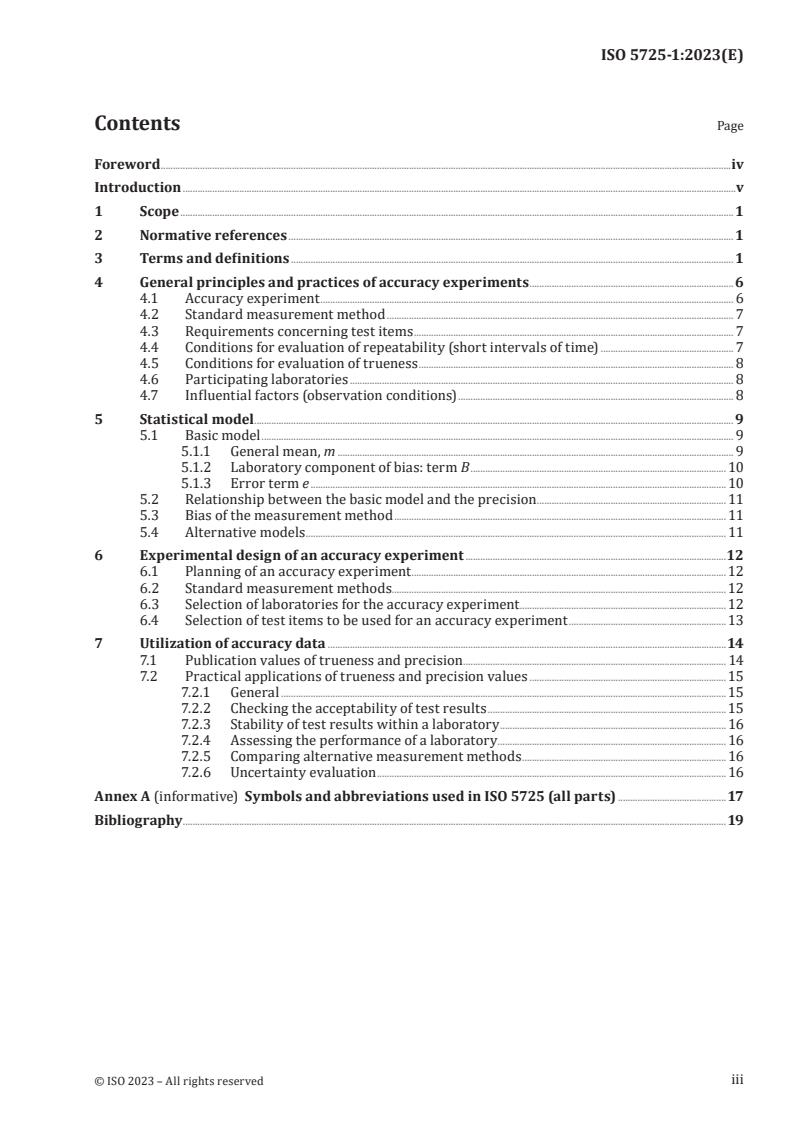
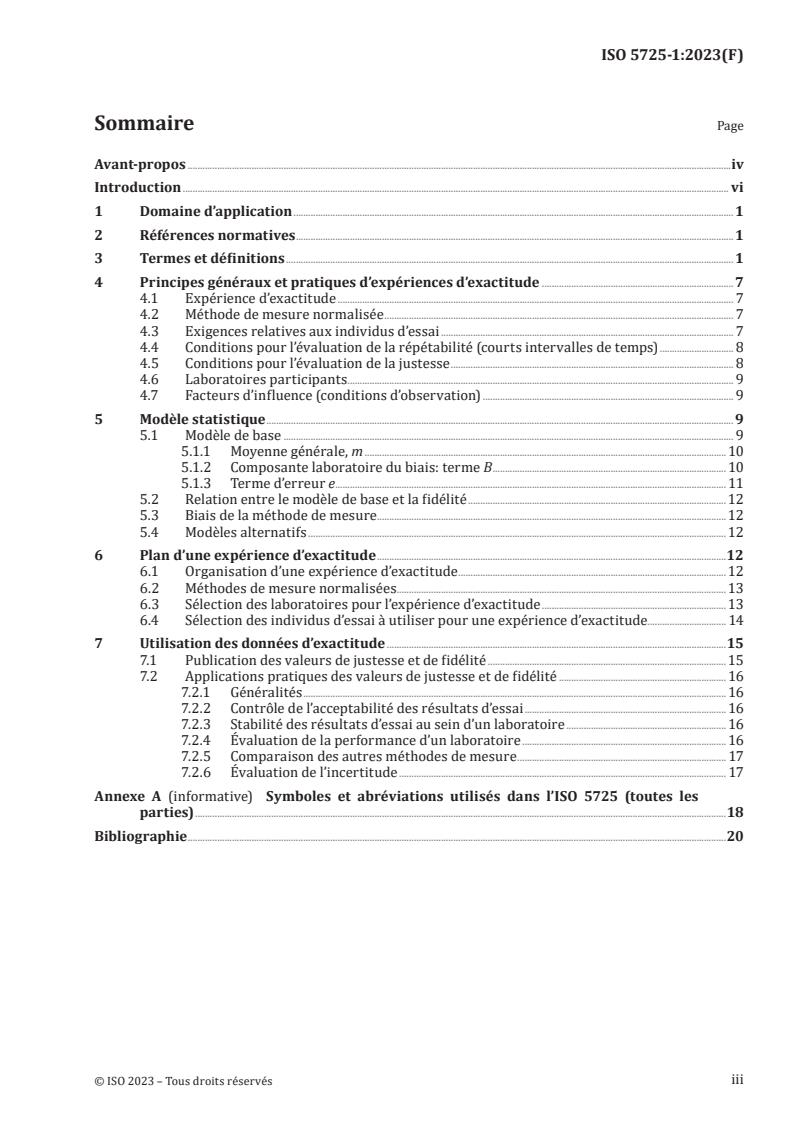
Contents Page
Foreword .iv
Introduction .v
1 Scope . 1
2 Normative references . 1
3 Terms and definitions . 1
4 General principles and practices of accuracy experiments . 6
4.1 Accuracy experiment . 6
4.2 Standard measurement method . 7
4.3 Requirements concerning test items . 7
4.4 Conditions for evaluation of repeatability (short intervals of time) . 7
4.5 Conditions for evaluation of trueness . 8
4.6 Participating laboratories . 8
4.7 Influential factors (observation conditions) . 8
5 Statistical model . 9
5.1 Basic model . 9
5.1.1 General mean, m . 9
5.1.2 Laboratory component of bias: term B . 10
5.1.3 Error term e . 10
5.2 Relationship between the basic model and the precision . 11
5.3 Bias of the measurement method . 11
5.4 Alternative models . 11
6 Experimental design of an accuracy experiment .12
6.1 Planning of an accuracy experiment .12
6.2 Standard measurement methods.12
6.3 Selection of laboratories for the accuracy experiment .12
6.4 Selection of test items to be used for an accuracy experiment .13
7 Utilization of accuracy data .14
7.1 Publication values of trueness and precision . 14
7.2 Practical applications of trueness and precision values . 15
7.2.1 General .15
7.2.2 Checking the acceptability of test results . 15
7.2.3 Stability of test results within a laboratory . 16
7.2.4 Assessing the performance of a laboratory . 16
7.2.5 Comparing alternative measurement methods . 16
7.2.6 Uncertainty evaluation . 16
Annex A (informative) Symbols and abbreviations used in ISO 5725 (all parts) .17
Bibliography .19
iii
Foreword
ISO (the International Organization for Standardization) is a worldwide federation of national standards
bodies (ISO member bodies). The work of preparing International Standards is normally carried out
through ISO technical committees. Each member body interested in a subject for which a technical
committee has been established has the right to be represented on that committee. International
organizations, governmental and non-governmental, in liaison with ISO, also take part in the work.
ISO collaborates closely with the International Electrotechnical Commission (IEC) on all matters of
electrotechnical standardization.
The procedures used to develop this document and those intended for its further maintenance are
described in the ISO/IEC Directives, Part 1. In particular, the different approval criteria needed for the
different types of ISO document should be noted. This document was drafted in accordance with the
editorial rules of the ISO/IEC Directives, Part 2 (see www.iso.org/directives).
ISO draws attention to the possibility that the implementation of this document may involve the use
of (a) patent(s). ISO takes no position concerning the evidence, validity or applicability of any claimed
patent rights in respect thereof. As of the date of publication of this document, ISO had not received
notice of (a) patent(s) which may be required to implement this document. However, implementers are
cautioned that this may not represent the latest information, which may be obtained from the patent
database available at www.iso.org/patents. ISO shall not be held responsible for identifying any or all
such patent rights.
Any trade name used in this document is information given for the convenience of users and does not
constitute an endorsement.
For an explanation of the voluntary nature of standards, the meaning of ISO specific terms and
expressions related to conformity assessment, as well as information about ISO's adherence to
the World Trade Organization (WTO) principles in the Technical Barriers to Trade (TBT), see
www.iso.org/iso/foreword.html.
This document was prepared by Technical Committee ISO/TC 69, Applications of statistical methods,
Subcommittee SC 6, Measurement methods and results.
This second edition of ISO 5725-1 cancels and replaces the first edition (ISO 5725-1:1994) which has
been technically revised. It also incorporates the Technical Corrigendum ISO 5725-1:1994/Cor.1:1998.
The main changes are as follows:
— normative references have been revisited;
— some definitions have been deleted (observed value, cell in a precision experiment, collaborative
assessment experiment) and others have been added (repeatability critical difference, reproducibility
critical difference, intermediate precision conditions, intermediate precision standard deviation,
intermediate precision critical difference, intermediate precision limit);
— the number of laboratories required for a precision study and Annex B presenting charts of
uncertainties for precision measures have been moved in ISO 5725-2;
— guidance on the practical use of trueness and precision to evaluate uncertainty and the use of
ISO 21748 was added.
A list of all parts in the ISO 5725 series can be found on the ISO website.
Any feedback or questions on this document should be directed to the user’s national standards body. A
complete listing of these bodies can be found at www.iso.org/members.html.
iv
Introduction
0.1 The general term accuracy is used in ISO 5725 (all parts) to refer to both trueness and precision.
The term accuracy was at one time used to cover only the one component now named trueness, but it
became clear that to many persons it should imply the total displacement of a result from a reference
value, due to random as well as systematic effects.
The term bias has been in use for statistical matters for a very long time, but because it caused certain
philosophical objections among members of some professions (such as medical and legal practitioners),
the positive aspect has been emphasized by the invention of the term trueness.
0.2 ISO 5725 (all parts) uses two terms "trueness" and "precision" to describe the accuracy of a
measurement method. "Trueness" refers to the closeness of agreement between the arithmetic mean
of a large number of test results and the true or accepted reference value. "Precision" refers to the
closeness of agreement between test results obtained under stipulated conditions.
0.3 The need to consider "precision" arises because tests or measures performed on presumably
identical test items in presumably identical circumstances do not, in general, yield identical results.
This is attributed to unavoidable random errors inherent in every measurement procedure; the factors
that influence the outcome of a measurement cannot all be completely controlled. In the practical
interpretation of measurement data, this variability should be taken into account. For instance, the
difference between a test result and some specified value may be within the scope of unavoidable
random errors, in which case a real deviation from such a specified value has not been established.
Similarly, comparing test results from two batches of product will not indicate a fundamental quality
difference if the difference between them can be attributed to the inherent variation in the measurement
procedure.
0.4 The general term for variability between replicate measurements is precision. Two conditions
of precision, termed repeatability and reproducibility conditions, have been found necessary and,
for many practical cases, useful for describing the variability of a measurement method. Under
repeatability conditions, all factors that influence the measurement are considered constant and do not
contribute to the variability, while under reproducibility conditions, some or all influential factors vary
and do contribute to the variability of the test results. Thus repeatability and reproducibility are the
two extremes of precision, the first describing the minimum and the second the maximum variability
in results. Other intermediate conditions between these two extreme conditions also occur when one
or more of the factors that influence the measurement are allowed to vary, and are used in certain
specified circumstances. Precision is normally expressed in terms of standard deviations.
0.5 The purpose of ISO 5725 (all parts) is as follows:
a) to outline the general principles to be understood when assessing accuracy (trueness and precision)
of measurement methods and results, and in applications, and to establish practical estimations of
the various measures by experiment (ISO 5725-1);
b) to provide basic methods for estimating the two extreme measures of the precision of measurement
methods by experiment, giving the circumstances in which they apply (ISO 5725-2);
c) to provide designs for obtaining intermediate measures of precision, giving the circumstances
in which they apply and methods for estimating them and to provide some alternative designs to
those given in ISO 5725-2, for determining the precision and trueness of measurement methods for
use under certain circumstances (ISO 5725-3);
d) to provide basic methods for the determination of the trueness of a measurement method
(ISO 5725-4);
e) to provide some alternatives to the methods, given in ISO 5725-2 to ISO 5725-4, for determining the
precision and trueness of measurement methods for use under certain circumstances (ISO 5725-5);
v
f) to present some practical applications and use of these measures of trueness and precision
(ISO 5725-6).
vi
INTERNATIONAL STANDARD ISO 5725-1:2023(E)
Accuracy (trueness and precision) of measurement
methods and results —
Part 1:
General principles and definitions
1 Scope
1.1 This document
— introduces conditions, constraints and resources necessary to evaluate a measurement method or
a result;
— defines an organizational scheme for the acquisition of trueness and precision data by study;
— provides the necessary definitions, statistical model and principles for ISO 5725 (all parts).
— is not applicable to proficiency testing or production of the reference item that has their own
standards (ISO 13528, respectively and ISO Guide 35).
1.2 This document is concerned exclusively with measurement methods which yield results on a
continuous scale and give a single value as the test result, although this single value may be the outcome
of a calculation from a set of observations.
It defines values which describe, in quantitative terms, the ability of a measurement method to give a
true result (trueness) or to replicate a given result (precision). Thus, there is an implication that exactly
the identical item is being measured, in exactly the same way, and that the measurement process is
under control.
This document may be applied to a very wide range of test items, including gas, liquids, powders and
solid objects, manufactured or naturally occurring, provided that due consideration is given to any
heterogeneity of the test item.
This document does not include methods of calculation that are described in the other parts.
2 Normative references
The following documents are referred to in the text in such a way that some or all of their content
constitutes requirements of this document. For undated references, the latest edition of the referenced
document (including any amendments) applies.
ISO 3534-1, Statistics — Vocabulary and symbols — Part 1: General statistical terms and terms used in
probability
ISO 3534-2, Statistics — Vocabulary and symbols — Part 2: Applied statistics
3 Terms and definitions
For the purpose of this document, the terms and definitions given in ISO 3534-1, ISO 3534-2 and the
following apply.
The symbols used in ISO 5725 (all parts) are given in Annex A.
ISO and IEC maintain terminological databases for use in standardization at the following addresses:
— ISO Online browsing platform: available at https:// www .iso .org/ obp
— IEC Electropedia: available at https:// www .electropedia .org/
3.1
test result
value of a characteristic obtained by carrying out a specified test method
Note 1 to entry: The test method should specify that one or a number of individual observations be made, and
their average or another appropriate function (such as the median or the standard deviation) be reported as the
test result. It can also require standard corrections to be applied, such as correction of gas volumes to standard
temperature and pressure. Thus a test result can be a result calculated from several observed values. In the
simple case, the test result is the observed value itself.
Note 2 to entry: When measurement is used (for methods or results) in this document it means test or
measurement (for methods or results).
[SOURCE: ISO 3534-2:2006, 3.4.1, modified — Note 2 to entry rephrased.]
3.2
accepted reference value
value that serves as an agreed-upon reference for comparison, which is derived as:
a) a theoretical or established value, based on scientific principles;
b) an assigned or certified value, based on experimental work of some national or international
organization;
c) a consensus or certified value, based on collaborative experimental work under the auspices of a
scientific or engineering group;
d) the expectation, i.e. the mean of a specified population of measurements when a), b) and c) are not
available.
[SOURCE: ISO 3534-2:2006, 3.2.7]
3.3
level
general average of the test results (3.1) or test results (3.1) from all laboratories for one
particular test item or test item tested
Note 1 to entry: The accuracy of a measurement method is defined at each level and can be different.
3.4
measurement
test item
sample which is prepared and can be presumed to be identical for the intended purpose
Note 1 to entry: Practical requirements are stated in the protocol of the intended purpose.
Note 2 to entry: Examples of test items: sample, product, artifact, reference test item, equipment, measurement
standard.
3.5
accuracy
closeness of agreement between a test result (3.1) and the true value
Note 1 to entry: In practice, the accepted reference value is substituted for the true value.
Note 2 to entry: The term accuracy, when applied to a set of test results, involves a combination of random
components and a common systematic error or bias component.
Note 3 to entry: Accuracy refers to a combination of trueness and precision.
Note 4 to entry: Common systematic error is called bias component.
[SOURCE: ISO 3534-2:2006, 3.3.1, modified — Note 4 to entry added.]
3.6
trueness
closeness of agreement between the expectation of test results (3.1) and a true value
Note 1 to entry: The measure of trueness is usually expressed in terms of bias.
Note 2 to entry: Trueness is sometimes referred to as “accuracy of the mean”. This usage is not recommended.
Note 3 to entry: In practice, the accepted reference value is substituted for the true value.
[SOURCE: ISO 3534-2:2006, 3.3.3]
3.7
outlier
value from a set of values which is inconsistent with the other values of that set, identified by a statistical
test
Note 1 to entry: ISO 5725-2 specifies the statistical tests and the significance level (3.3) to be used to identify
outliers in trueness and precision experiments.
3.8
bias
difference between the expectation of the test results (3.1) and a true value
Note 1 to entry: Bias is the total systematic error as contrasted to random error. There can be one or more
systematic error components contributing to the bias. A larger systematic difference from the accepted reference
value is reflected by a larger bias value.
Note 2 to entry: The bias of a measuring instrument is normally estimated by averaging the error of indication
over an appropriate number of repeated measurements. The error of indication is the ‘’indication of a measuring
instrument minus a true value of corresponding input quantity’’.
Note 3 to entry: In practice, the accepted reference value is substituted for the true value.
[SOURCE: ISO 3534-2:2006, 3.3.2]
3.9
bias of the measurement method
difference between the expectation of test results (3.1) obtained from all laboratories using the same
method on identical test or measurement items and an accepted reference value (3.2)
Note 1 to entry: In practice, the bias of the measurement method is measured by the displacement of the average
of results from a large number of different laboratories all using the same method. The bias of a measurement
method can be different at different levels (3.3).
3.10
laboratory bias
difference between the expectation of the test results (3.1) obtained from a particular laboratory and
an accepted reference value (3.2) under the conditions of a particular experiment
Note 1 to entry: It is assessed based on the performance of a particular laboratory.
3.11
laboratory component of bias B
difference between the laboratory bias (3.10) and the bias of the measurement method (3.9)
Note 1 to entry: The laboratory component of bias is specific to a given laboratory and the conditions of
measurement within the laboratory, and also it can be different at different levels of the measurement method.
Note 2 to entry: The laboratory component of bias is relative to the overall average result, not the true or accepted
reference value.
Note 3 to entry: Laboratory component of bias can be named effect of laboratory.
Note 4 to entry: The relationship between the laboratory bias, Δ, the bias of the measurement method, δ, and the
laboratory component of the bias B is detailed in ISO 5725-4.
3.12
precision
closeness of agreement between independent test results (3.1) obtained under stipulated conditions
Note 1 to entry: Precision depends only on the distribution of random errors and does not relate to the true value
or the specified value.
Note 2 to entry: The measure of precision is usually expressed in terms of imprecision and computed as a
standard deviation of the test results. Less precision is reflected by a larger standard deviation.
Note 3 to entry: Quantitative measures of precision depend critically on the stipulated conditions. Repeatability
and reproducibility conditions are particular sets of extreme conditions.
[SOURCE: ISO 3534-2:2006, 3.3.4]
3.13
repeatability
precision under repeatability conditions (3.14)
Note 1 to entry: Repeatability can be expressed quantitatively in terms of the dispersion characteristics of the
results.
[SOURCE: ISO 3534-2:2006, 3.3.5]
3.14
repeatability conditions
observation conditions where independent test results (3.1) are obtained with the same method on
identical test or measurement items in the same test or measuring facility by the same operator using
the same equipment within short intervals of time
Note 1 to entry: Repeatability conditions include:
a) The same measurement procedure or test procedure;
b) The same operator;
c) The same measuring or test equipment used under the same conditions;
d) The same location;
e) Repetition over a short period of time.
[SOURCE: ISO 3534-2:2006, 3.3.6]
3.15
repeatability standard deviation
standard deviation of test results (3.1) obtained under repeatability conditions (3.14)
Note 1 to entry: It is a measure of dispersion of the distribution of test results under repeatability conditions.
Note 2 to entry: Similarly "repeatability variance” and “repeatability coefficient of variation” can be defined and
used as measures of the dispersion of test results under repeatability conditions.
Note 3 to entry: Coefficient of variation should be used with caution. Variance or standard deviation is preferred.
[SOURCE: ISO 3534-2:2006, 3.3.7, modified — Note 3 to entry added.]
3.16
repeatability critical difference
value less than or equal to which the absolute difference between two final values, each of them
representing a series of test results (3.1) obtained under repeatability (3.13), is expected to be with a
specified probability
Note 1 to entry: Examples of final results are the mean and the median of the series of results; the series itself can
consist of only one result.
[SOURCE: ISO 3534-2:2006, 3.3.8]
3.17
repeatability limit
r
repeatability critical difference (3.16) for a specified probability of 95 %
[SOURCE: ISO 3534-2:2006, 3.3.9]
3.18
reproducibility
precision under reproducibility conditions (3.19)
Note 1 to entry: Reproducibility can be expressed quantitatively in terms of the dispersion characteristics of the
results.
Note 2 to entry: Results are usually understood to be corrected results.
[SOURCE: ISO 3534-2:2006, 3.3.10]
3.19
reproducibility conditions
observation conditions where independent test results (3.1) are obtained with the same method on
identical test or measurement items in different test or measurement facilities with different operators
using different equipment
[SOURCE: ISO 3534-2:2006, 3.3.11]
3.20
reproducibility standard deviation
standard deviation of test results (3.1) obtained under reproducibility conditions (3.19)
Note 1 to entry: It is a measure of the dispersion of the distribution of test results under reproducibility
conditions.
Note 2 to entry: Similarly a "reproducibility variance” and "reproducibility coefficient of variation” can be defined
and used as measures of the dispersion of test results under reproducibility conditions.
[SOURCE: ISO 3534-2:2006, 3.3.12]
3.21
reproducibility critical difference
value less than or equal to which the absolute difference between two final values, each of them
representing a series of test results (3.1) obtained under reproducibility conditions (3.19), is expected to
be with a specified probability
Note 1 to entry: Instances of final results are the mean and the median of the series of test results, the series
itself can consist of only one test result.
[SOURCE: ISO 3534-2:2006, 3.3.13]
3.22
reproducibility limit
R
reproducibility critical difference (3.21) for a specified probability of 95 %
[SOURCE: ISO 3534-2:2006, 3.3.14]
3.23
intermediate precision
precision under intermediate precision conditions
[SOURCE: ISO 3534-2:2006, 3.3.15]
3.24
intermediate precision conditions
conditions where test results (3.1) are obtained with the same method, on identical test or measurement
items in the same test or measurement facility, under some different operating condition
Note 1 to entry: There are four elements to the operating condition: time, calibration, operator and equipment;
Note 2 to entry: A test house is an example of a test facility. A metrology laboratory is an example of a measurement
facility;
Note 3 to entry: In addition to the four elements of the operating condition listed above, some more elements may
be different as batch, preparation and others.
Note 4 to entry: The above conditions can change independently.
[SOURCE: ISO 3534-2:2006, 3.3.16, modified —Notes 3 and 4 to entry added.]
3.25
intermediate precision standard deviation
standard deviation of test results (3.1) obtained under intermediate precision conditions (3.24)
[SOURCE: ISO 3534-2:2006, 3.3.17]
3.26
intermediate precision critical difference
value less than or equal to which the absolute difference between two final values, each of them
representing a series of test results (3.1) obtained under intermediate precisions conditions (3.24), is
expected to be with a specified probability
[SOURCE: ISO 3534-2:2006, 3.3.18]
3.27
intermediate precision limit
intermediate precision critical difference (3.26) for a specified probability of 95 %
[SOURCE: ISO 3534-2:2006, 3.3.19]
4 General principles and practices of accuracy experiments
4.1 Accuracy experiment
4.1.1 The accuracy (trueness and precision) measures should be determined from a series of test
results reported by the participating laboratories, organized under a panel of experts established
specifically for that purpose.
Such an interlaboratory experiment is called an “accuracy experiment”. The accuracy experiment may
also be called a “precision” or “trueness experiment” according to its limited purpose. If the purpose
is to determine trueness, then a precision experiment shall either have been completed previously or
shall occur simultaneously.
The estimates of accuracy derived from such an experiment should always be quoted as being valid
only for tests carried out according to the standard measurement method.
4.1.2 An accuracy experiment can often be considered to be a practical test of the adequacy of the
standard measurement method. One of the main purposes of standardization is to eliminate differences
between users (laboratories) as far as possible, and the data provided by an accuracy experiment will
reveal how effectively this purpose has been achieved. Pronounced differences in the within-laboratory
variances (see Clause 7) or between the laboratory means may indicate the inadequacy of the standard
measurement method.
4.2 Standard measurement method
4.2.1 In order that the measurements are made in the same way, the measurement method shall have
been standardized. All measurements shall be carried out according to that standard method. This
means that there has to be a written document that lays down in full detail how the measurement shall
be carried out, preferably including a description as to how the measurement item should be obtained
and prepared.
4.2.2 The existence of a documented measurement method implies the existence of an organization
responsible for the establishment of the measurement method under study.
NOTE The standard measurement method is discussed more fully in 6.2.
4.3 Requirements concerning test items
4.3.1 In an accuracy experiment, samples of a specific test item or samples of a specific product are
sent from a central point to a number of laboratories in different places, different countries, or even in
different continents. The definition of repeatability conditions (3.14) stating that the measurements
in these laboratories shall be performed on identical test items refers to the moment when these
measurements are actually carried out. To achieve this, two different conditions have to be satisfied:
a) the samples have to be identical when dispatched to the laboratories but at one or different levels;
b) they have to remain identical during transport and during the different time intervals that may
elapse before the measurements are actually performed.
In organizing accuracy experiments, both conditions shall be carefully observed.
NOTE The selection of test items is discussed more in details in 6.4.
4.4 Conditions for evaluation of repeatability (short intervals of time)
4.4.1 According to the definition of repeatability conditions (3.14), measurements for the
determination of repeatability have to be made under constant operating conditions; i.e. during the
time covered by the measurements, factors such as, by example, those listed should be constant:
a) the time elapsed between measurements;
b) the operator (experience, dexterity, …);
c) the equipment or test bench used;
d) the calibration of the equipment;
e) the environment (temperature, humidity, air pollution, vibration, etc.);
f) the batch of reagent;
g) preparation of test item;
h) other influential factors.
These influent factors should be constant. In particular, the equipment should not be recalibrated or
readjusted between the measurements unless this is an essential part of every single measurement.
In practice, tests under repeatability conditions should be conducted in as short a time as possible in
order to minimize changes in those factors, such as environmental, which cannot always be guaranteed
constant.
4.4.2 There is also a second consideration which may affect the interval elapsing between
measurements, and that is that the test results are assumed to be independent. If it is feared that
previous results may influence subsequent test results (and so reduce the estimate of repeatability
variance), it may be necessary to provide separate test items coded in such a way that an operator will
not know which are supposedly identical. Instructions would be given as to the order in which those
test items are to be measured, and presumably that order will be randomized so that all the “identical”
test items are not measured together. This might mean that the time interval between repeated
measurements may appear to defeat the object of a short interval of time unless the measurements are
of such a nature that the whole series of measurements could all be completed within a short interval of
time. Common sense must prevail.
4.5 Conditions for evaluation of trueness
The “trueness” of a measurement method is of interest when it is possible to conceive of a true value
for the property being measured. Although the true value cannot be known exactly, it may be possible
to have an accepted reference value for the property being measured; for example, if suitable reference
test items or measurement standards are available, or if the accepted reference value can be established
by reference to another measurement method or by preparation of a known sample. The trueness of the
measurement method can be investigated by comparing the accepted reference value with the level of
the results given by the measurement method. Trueness is normally expressed in terms of bias.
4.6 Participating laboratories
4.6.1 A basic assumption underlying this document is that, for a standard measurement method,
repeatability will be, at least approximately, the same for all laboratories applying the standard
procedure, so that it is permissible to establish one common average repeatability standard deviation
which will be applicable to any laboratory. However, by carrying out a series of measurements under
repeatability conditions, any laboratory can arrive at an estimate of its own repeatability standard
deviation for the measurement method and check it against the common standard value. Such a
procedure is dealt with in ISO 5725-6.
4.6.2 Values of the quantities defined in 3.10 to 3.26 apply theoretically to all laboratories which
are likely to perform the measurement method. In practice, they are determined from a sample of this
population of laboratories. Further details of the selection of this sample are given in 6.3. Provided
the instructions given there regarding the number of laboratories to be included and the number
of measurements that they carry out are followed, then the resulting estimates of trueness and
precision should suffice. If, however, at some future date it should become evident that the laboratories
participating were not, or are no longer, truly representative of all those using the standard
measurement method, then the measurement should be repeated.
4.7 Influential factors (observation conditions)
4.7.1 The factors which contribute to the variability of the observed values obtained within a
laboratory are listed in 4.4.1. They may be given as time; operator and equipment when observations
at different times include the effects due to the change of environmental conditions, the calibration
of equipment between observations and other factors. Under repeatability conditions, observations
are carried out with all these factors constant, and under reproducibility conditions observations
are carried out at different laboratories; i.e. not only with all the other factors varying but also with
additional effects due to the difference between laboratories in management and maintenance of the
laboratory, stability checking of the observations, etc.
4.7.2 Under intermediate precision conditions, observations are carried out in the same laboratory,
but one or more of the influential factors are allowed to vary. In establishing the precision of a
measurement method, it is very important to define the appropriate observation conditions, i.e. which
influential factors should be constant or not.
NOTE The size (magnitude) of the variability arising from a factor will depend on the measurement method.
5 Statistical model
5.1 Basic model
In this standard the model is not a physical or chemical equation, but by a statistical model.
For estimating the accuracy (trueness and precision) of a measurement method, it is useful to consider
the statistical model according to which every test result. So the basic model given by Formula (1) is
used:
ym=+Be+ (1)
where, for the particular test item tested,
m is the general mean (expectation);
B is the laboratory component of bias under repeatability conditions;
e is the random error occurring in every measurement under repeatability conditions.
NOTE 1 Methods described in ISO 5725-2 to evaluate precision parameters (variance of B and variance of e)
are based on this basic statistical model. Alternative models are described in ISO 5725-3 and ISO 5725-4.
NOTE 2 The general mean, m, includes the bias of the measurement method. The relationship is described in
ISO 5725-4.
5.1.1 General mean, m
5.1.1.1 For the particular test item, the general mean m is the level of a particular test item. Test
items of different purities of a chemical, or different test items (e.g. different types of steel), will have
different levels. In many technical situations the level of the test item is exclusively determined by
the measurement method, and the notion of an independent true value does not apply. However, in
some situations the concept of a true value µ of the test property may hold good, such as the accepted
reference concentration of a solution that is being titrated. The level m is not necessarily equal to the
true value or accepted reference value µ.
5.1.1.2 When examining the difference between results obtained by the same measurement
method, the bias of the measurement method will have no influence and can be ignored. However,
when comparing test results with a value specified in a contract or a standard where the contract or
specification refers to the true value (µ) and not to the “mean of the test item ”(m), or when comparing
results produced using different measurement methods, the bias of the measurement method will have
to be taken into account. If a true value exists and a satisfactory reference test item is available, the bias
of the measurement method should be determined as shown in ISO 5725-4.
5.1.2 Laboratory component of bias: term B
5.1.2.1 This term is considered to be constant during series of tests performed under repeatability
conditions, but differs in value for tests carried out under other conditions (intermediate precision
conditions/reproducibility conditions).
Using the basic model, it is considered that the repeatability conditions are the conditions for a given
laboratory.
When other sources of variation are identified (e.g. assembly/disassembly of test items) they could be
taken into account in the repeatability conditions. For example, with a more complicated model with a
laboratory effect and an operator effect, these conditions apply for a given laboratory, a given operator
and given sources of variation.
Coming back to the basic model, as there are several laboratories then a general distribution of
laboratory components of bias must be considered.
The variance of the between-laboratory variance is the unknown variance of that distribution that
must be estimated.
The procedures to evaluate precision parameters (variance of B and variance of e), given in ISO 5725-2
were developed assuming that the distribution of laboratory components of bias is approximately
normal but in practice they work for most distributions that are unimodal and approximately
symmetric.
NOTE When test results are always compared between the same two laboratories, it is necessary for them
to determine their relative bias, either from their individual bias values as determined during an accuracy
experiment, or by carrying out a private trial between themselves. However, in order to make general statements
regarding differences between two unspecified laboratories or when making comparisons between two
laboratories that have not determined their own bias, then a general distribution of laboratory components of
bias must be considered. This was the reasoning behind the concept of reproducibility.
5.1.2.2 The variance of B is called the “between-laboratory” variance and is expressed as shown in
Formula (2)
varB =σ (2)
()
L
where σ includes at least the “between-operator” and “between-equipment” variabilities and
L
gen
...
INTERNATIONAL ISO
STANDARD 5725-1
Second edition
2023-07
Accuracy (trueness and precision) of
measurement methods and results —
Part 1:
General principles and definitions
Exactitude (justesse et fidélité) des résultats et méthodes de mesure —
Partie 1: Principes généraux et définitions
Reference number
© ISO 2023
All rights reserved. Unless otherwise specified, or required in the context of its implementation, no part of this publication may
be reproduced or utilized otherwise in any form or by any means, electronic or mechanical, including photocopying, or posting on
the internet or an intranet, without prior written permission. Permission can be requested from either ISO at the address below
or ISO’s member body in the country of the requester.
ISO copyright office
CP 401 • Ch. de Blandonnet 8
CH-1214 Vernier, Geneva
Phone: +41 22 749 01 11
Email: copyright@iso.org
Website: www.iso.org
Published in Switzerland
ii
Contents Page
Foreword .iv
Introduction .v
1 Scope . 1
2 Normative references . 1
3 Terms and definitions . 1
4 General principles and practices of accuracy experiments . 6
4.1 Accuracy experiment . 6
4.2 Standard measurement method . 7
4.3 Requirements concerning test items . 7
4.4 Conditions for evaluation of repeatability (short intervals of time) . 7
4.5 Conditions for evaluation of trueness . 8
4.6 Participating laboratories . 8
4.7 Influential factors (observation conditions) . 8
5 Statistical model . 9
5.1 Basic model . 9
5.1.1 General mean, m . 9
5.1.2 Laboratory component of bias: term B . 10
5.1.3 Error term e . 10
5.2 Relationship between the basic model and the precision . 11
5.3 Bias of the measurement method . 11
5.4 Alternative models . 11
6 Experimental design of an accuracy experiment .12
6.1 Planning of an accuracy experiment .12
6.2 Standard measurement methods.12
6.3 Selection of laboratories for the accuracy experiment .12
6.4 Selection of test items to be used for an accuracy experiment .13
7 Utilization of accuracy data .14
7.1 Publication values of trueness and precision . 14
7.2 Practical applications of trueness and precision values . 15
7.2.1 General .15
7.2.2 Checking the acceptability of test results . 15
7.2.3 Stability of test results within a laboratory . 16
7.2.4 Assessing the performance of a laboratory . 16
7.2.5 Comparing alternative measurement methods . 16
7.2.6 Uncertainty evaluation . 16
Annex A (informative) Symbols and abbreviations used in ISO 5725 (all parts) .17
Bibliography .19
iii
Foreword
ISO (the International Organization for Standardization) is a worldwide federation of national standards
bodies (ISO member bodies). The work of preparing International Standards is normally carried out
through ISO technical committees. Each member body interested in a subject for which a technical
committee has been established has the right to be represented on that committee. International
organizations, governmental and non-governmental, in liaison with ISO, also take part in the work.
ISO collaborates closely with the International Electrotechnical Commission (IEC) on all matters of
electrotechnical standardization.
The procedures used to develop this document and those intended for its further maintenance are
described in the ISO/IEC Directives, Part 1. In particular, the different approval criteria needed for the
different types of ISO document should be noted. This document was drafted in accordance with the
editorial rules of the ISO/IEC Directives, Part 2 (see www.iso.org/directives).
ISO draws attention to the possibility that the implementation of this document may involve the use
of (a) patent(s). ISO takes no position concerning the evidence, validity or applicability of any claimed
patent rights in respect thereof. As of the date of publication of this document, ISO had not received
notice of (a) patent(s) which may be required to implement this document. However, implementers are
cautioned that this may not represent the latest information, which may be obtained from the patent
database available at www.iso.org/patents. ISO shall not be held responsible for identifying any or all
such patent rights.
Any trade name used in this document is information given for the convenience of users and does not
constitute an endorsement.
For an explanation of the voluntary nature of standards, the meaning of ISO specific terms and
expressions related to conformity assessment, as well as information about ISO's adherence to
the World Trade Organization (WTO) principles in the Technical Barriers to Trade (TBT), see
www.iso.org/iso/foreword.html.
This document was prepared by Technical Committee ISO/TC 69, Applications of statistical methods,
Subcommittee SC 6, Measurement methods and results.
This second edition of ISO 5725-1 cancels and replaces the first edition (ISO 5725-1:1994) which has
been technically revised. It also incorporates the Technical Corrigendum ISO 5725-1:1994/Cor.1:1998.
The main changes are as follows:
— normative references have been revisited;
— some definitions have been deleted (observed value, cell in a precision experiment, collaborative
assessment experiment) and others have been added (repeatability critical difference, reproducibility
critical difference, intermediate precision conditions, intermediate precision standard deviation,
intermediate precision critical difference, intermediate precision limit);
— the number of laboratories required for a precision study and Annex B presenting charts of
uncertainties for precision measures have been moved in ISO 5725-2;
— guidance on the practical use of trueness and precision to evaluate uncertainty and the use of
ISO 21748 was added.
A list of all parts in the ISO 5725 series can be found on the ISO website.
Any feedback or questions on this document should be directed to the user’s national standards body. A
complete listing of these bodies can be found at www.iso.org/members.html.
iv
Introduction
0.1 The general term accuracy is used in ISO 5725 (all parts) to refer to both trueness and precision.
The term accuracy was at one time used to cover only the one component now named trueness, but it
became clear that to many persons it should imply the total displacement of a result from a reference
value, due to random as well as systematic effects.
The term bias has been in use for statistical matters for a very long time, but because it caused certain
philosophical objections among members of some professions (such as medical and legal practitioners),
the positive aspect has been emphasized by the invention of the term trueness.
0.2 ISO 5725 (all parts) uses two terms "trueness" and "precision" to describe the accuracy of a
measurement method. "Trueness" refers to the closeness of agreement between the arithmetic mean
of a large number of test results and the true or accepted reference value. "Precision" refers to the
closeness of agreement between test results obtained under stipulated conditions.
0.3 The need to consider "precision" arises because tests or measures performed on presumably
identical test items in presumably identical circumstances do not, in general, yield identical results.
This is attributed to unavoidable random errors inherent in every measurement procedure; the factors
that influence the outcome of a measurement cannot all be completely controlled. In the practical
interpretation of measurement data, this variability should be taken into account. For instance, the
difference between a test result and some specified value may be within the scope of unavoidable
random errors, in which case a real deviation from such a specified value has not been established.
Similarly, comparing test results from two batches of product will not indicate a fundamental quality
difference if the difference between them can be attributed to the inherent variation in the measurement
procedure.
0.4 The general term for variability between replicate measurements is precision. Two conditions
of precision, termed repeatability and reproducibility conditions, have been found necessary and,
for many practical cases, useful for describing the variability of a measurement method. Under
repeatability conditions, all factors that influence the measurement are considered constant and do not
contribute to the variability, while under reproducibility conditions, some or all influential factors vary
and do contribute to the variability of the test results. Thus repeatability and reproducibility are the
two extremes of precision, the first describing the minimum and the second the maximum variability
in results. Other intermediate conditions between these two extreme conditions also occur when one
or more of the factors that influence the measurement are allowed to vary, and are used in certain
specified circumstances. Precision is normally expressed in terms of standard deviations.
0.5 The purpose of ISO 5725 (all parts) is as follows:
a) to outline the general principles to be understood when assessing accuracy (trueness and precision)
of measurement methods and results, and in applications, and to establish practical estimations of
the various measures by experiment (ISO 5725-1);
b) to provide basic methods for estimating the two extreme measures of the precision of measurement
methods by experiment, giving the circumstances in which they apply (ISO 5725-2);
c) to provide designs for obtaining intermediate measures of precision, giving the circumstances
in which they apply and methods for estimating them and to provide some alternative designs to
those given in ISO 5725-2, for determining the precision and trueness of measurement methods for
use under certain circumstances (ISO 5725-3);
d) to provide basic methods for the determination of the trueness of a measurement method
(ISO 5725-4);
e) to provide some alternatives to the methods, given in ISO 5725-2 to ISO 5725-4, for determining the
precision and trueness of measurement methods for use under certain circumstances (ISO 5725-5);
v
f) to present some practical applications and use of these measures of trueness and precision
(ISO 5725-6).
vi
INTERNATIONAL STANDARD ISO 5725-1:2023(E)
Accuracy (trueness and precision) of measurement
methods and results —
Part 1:
General principles and definitions
1 Scope
1.1 This document
— introduces conditions, constraints and resources necessary to evaluate a measurement method or
a result;
— defines an organizational scheme for the acquisition of trueness and precision data by study;
— provides the necessary definitions, statistical model and principles for ISO 5725 (all parts).
— is not applicable to proficiency testing or production of the reference item that has their own
standards (ISO 13528, respectively and ISO Guide 35).
1.2 This document is concerned exclusively with measurement methods which yield results on a
continuous scale and give a single value as the test result, although this single value may be the outcome
of a calculation from a set of observations.
It defines values which describe, in quantitative terms, the ability of a measurement method to give a
true result (trueness) or to replicate a given result (precision). Thus, there is an implication that exactly
the identical item is being measured, in exactly the same way, and that the measurement process is
under control.
This document may be applied to a very wide range of test items, including gas, liquids, powders and
solid objects, manufactured or naturally occurring, provided that due consideration is given to any
heterogeneity of the test item.
This document does not include methods of calculation that are described in the other parts.
2 Normative references
The following documents are referred to in the text in such a way that some or all of their content
constitutes requirements of this document. For undated references, the latest edition of the referenced
document (including any amendments) applies.
ISO 3534-1, Statistics — Vocabulary and symbols — Part 1: General statistical terms and terms used in
probability
ISO 3534-2, Statistics — Vocabulary and symbols — Part 2: Applied statistics
3 Terms and definitions
For the purpose of this document, the terms and definitions given in ISO 3534-1, ISO 3534-2 and the
following apply.
The symbols used in ISO 5725 (all parts) are given in Annex A.
ISO and IEC maintain terminological databases for use in standardization at the following addresses:
— ISO Online browsing platform: available at https:// www .iso .org/ obp
— IEC Electropedia: available at https:// www .electropedia .org/
3.1
test result
value of a characteristic obtained by carrying out a specified test method
Note 1 to entry: The test method should specify that one or a number of individual observations be made, and
their average or another appropriate function (such as the median or the standard deviation) be reported as the
test result. It can also require standard corrections to be applied, such as correction of gas volumes to standard
temperature and pressure. Thus a test result can be a result calculated from several observed values. In the
simple case, the test result is the observed value itself.
Note 2 to entry: When measurement is used (for methods or results) in this document it means test or
measurement (for methods or results).
[SOURCE: ISO 3534-2:2006, 3.4.1, modified — Note 2 to entry rephrased.]
3.2
accepted reference value
value that serves as an agreed-upon reference for comparison, which is derived as:
a) a theoretical or established value, based on scientific principles;
b) an assigned or certified value, based on experimental work of some national or international
organization;
c) a consensus or certified value, based on collaborative experimental work under the auspices of a
scientific or engineering group;
d) the expectation, i.e. the mean of a specified population of measurements when a), b) and c) are not
available.
[SOURCE: ISO 3534-2:2006, 3.2.7]
3.3
level
general average of the test results (3.1) or test results (3.1) from all laboratories for one
particular test item or test item tested
Note 1 to entry: The accuracy of a measurement method is defined at each level and can be different.
3.4
measurement
test item
sample which is prepared and can be presumed to be identical for the intended purpose
Note 1 to entry: Practical requirements are stated in the protocol of the intended purpose.
Note 2 to entry: Examples of test items: sample, product, artifact, reference test item, equipment, measurement
standard.
3.5
accuracy
closeness of agreement between a test result (3.1) and the true value
Note 1 to entry: In practice, the accepted reference value is substituted for the true value.
Note 2 to entry: The term accuracy, when applied to a set of test results, involves a combination of random
components and a common systematic error or bias component.
Note 3 to entry: Accuracy refers to a combination of trueness and precision.
Note 4 to entry: Common systematic error is called bias component.
[SOURCE: ISO 3534-2:2006, 3.3.1, modified — Note 4 to entry added.]
3.6
trueness
closeness of agreement between the expectation of test results (3.1) and a true value
Note 1 to entry: The measure of trueness is usually expressed in terms of bias.
Note 2 to entry: Trueness is sometimes referred to as “accuracy of the mean”. This usage is not recommended.
Note 3 to entry: In practice, the accepted reference value is substituted for the true value.
[SOURCE: ISO 3534-2:2006, 3.3.3]
3.7
outlier
value from a set of values which is inconsistent with the other values of that set, identified by a statistical
test
Note 1 to entry: ISO 5725-2 specifies the statistical tests and the significance level (3.3) to be used to identify
outliers in trueness and precision experiments.
3.8
bias
difference between the expectation of the test results (3.1) and a true value
Note 1 to entry: Bias is the total systematic error as contrasted to random error. There can be one or more
systematic error components contributing to the bias. A larger systematic difference from the accepted reference
value is reflected by a larger bias value.
Note 2 to entry: The bias of a measuring instrument is normally estimated by averaging the error of indication
over an appropriate number of repeated measurements. The error of indication is the ‘’indication of a measuring
instrument minus a true value of corresponding input quantity’’.
Note 3 to entry: In practice, the accepted reference value is substituted for the true value.
[SOURCE: ISO 3534-2:2006, 3.3.2]
3.9
bias of the measurement method
difference between the expectation of test results (3.1) obtained from all laboratories using the same
method on identical test or measurement items and an accepted reference value (3.2)
Note 1 to entry: In practice, the bias of the measurement method is measured by the displacement of the average
of results from a large number of different laboratories all using the same method. The bias of a measurement
method can be different at different levels (3.3).
3.10
laboratory bias
difference between the expectation of the test results (3.1) obtained from a particular laboratory and
an accepted reference value (3.2) under the conditions of a particular experiment
Note 1 to entry: It is assessed based on the performance of a particular laboratory.
3.11
laboratory component of bias B
difference between the laboratory bias (3.10) and the bias of the measurement method (3.9)
Note 1 to entry: The laboratory component of bias is specific to a given laboratory and the conditions of
measurement within the laboratory, and also it can be different at different levels of the measurement method.
Note 2 to entry: The laboratory component of bias is relative to the overall average result, not the true or accepted
reference value.
Note 3 to entry: Laboratory component of bias can be named effect of laboratory.
Note 4 to entry: The relationship between the laboratory bias, Δ, the bias of the measurement method, δ, and the
laboratory component of the bias B is detailed in ISO 5725-4.
3.12
precision
closeness of agreement between independent test results (3.1) obtained under stipulated conditions
Note 1 to entry: Precision depends only on the distribution of random errors and does not relate to the true value
or the specified value.
Note 2 to entry: The measure of precision is usually expressed in terms of imprecision and computed as a
standard deviation of the test results. Less precision is reflected by a larger standard deviation.
Note 3 to entry: Quantitative measures of precision depend critically on the stipulated conditions. Repeatability
and reproducibility conditions are particular sets of extreme conditions.
[SOURCE: ISO 3534-2:2006, 3.3.4]
3.13
repeatability
precision under repeatability conditions (3.14)
Note 1 to entry: Repeatability can be expressed quantitatively in terms of the dispersion characteristics of the
results.
[SOURCE: ISO 3534-2:2006, 3.3.5]
3.14
repeatability conditions
observation conditions where independent test results (3.1) are obtained with the same method on
identical test or measurement items in the same test or measuring facility by the same operator using
the same equipment within short intervals of time
Note 1 to entry: Repeatability conditions include:
a) The same measurement procedure or test procedure;
b) The same operator;
c) The same measuring or test equipment used under the same conditions;
d) The same location;
e) Repetition over a short period of time.
[SOURCE: ISO 3534-2:2006, 3.3.6]
3.15
repeatability standard deviation
standard deviation of test results (3.1) obtained under repeatability conditions (3.14)
Note 1 to entry: It is a measure of dispersion of the distribution of test results under repeatability conditions.
Note 2 to entry: Similarly "repeatability variance” and “repeatability coefficient of variation” can be defined and
used as measures of the dispersion of test results under repeatability conditions.
Note 3 to entry: Coefficient of variation should be used with caution. Variance or standard deviation is preferred.
[SOURCE: ISO 3534-2:2006, 3.3.7, modified — Note 3 to entry added.]
3.16
repeatability critical difference
value less than or equal to which the absolute difference between two final values, each of them
representing a series of test results (3.1) obtained under repeatability (3.13), is expected to be with a
specified probability
Note 1 to entry: Examples of final results are the mean and the median of the series of results; the series itself can
consist of only one result.
[SOURCE: ISO 3534-2:2006, 3.3.8]
3.17
repeatability limit
r
repeatability critical difference (3.16) for a specified probability of 95 %
[SOURCE: ISO 3534-2:2006, 3.3.9]
3.18
reproducibility
precision under reproducibility conditions (3.19)
Note 1 to entry: Reproducibility can be expressed quantitatively in terms of the dispersion characteristics of the
results.
Note 2 to entry: Results are usually understood to be corrected results.
[SOURCE: ISO 3534-2:2006, 3.3.10]
3.19
reproducibility conditions
observation conditions where independent test results (3.1) are obtained with the same method on
identical test or measurement items in different test or measurement facilities with different operators
using different equipment
[SOURCE: ISO 3534-2:2006, 3.3.11]
3.20
reproducibility standard deviation
standard deviation of test results (3.1) obtained under reproducibility conditions (3.19)
Note 1 to entry: It is a measure of the dispersion of the distribution of test results under reproducibility
conditions.
Note 2 to entry: Similarly a "reproducibility variance” and "reproducibility coefficient of variation” can be defined
and used as measures of the dispersion of test results under reproducibility conditions.
[SOURCE: ISO 3534-2:2006, 3.3.12]
3.21
reproducibility critical difference
value less than or equal to which the absolute difference between two final values, each of them
representing a series of test results (3.1) obtained under reproducibility conditions (3.19), is expected to
be with a specified probability
Note 1 to entry: Instances of final results are the mean and the median of the series of test results, the series
itself can consist of only one test result.
[SOURCE: ISO 3534-2:2006, 3.3.13]
3.22
reproducibility limit
R
reproducibility critical difference (3.21) for a specified probability of 95 %
[SOURCE: ISO 3534-2:2006, 3.3.14]
3.23
intermediate precision
precision under intermediate precision conditions
[SOURCE: ISO 3534-2:2006, 3.3.15]
3.24
intermediate precision conditions
conditions where test results (3.1) are obtained with the same method, on identical test or measurement
items in the same test or measurement facility, under some different operating condition
Note 1 to entry: There are four elements to the operating condition: time, calibration, operator and equipment;
Note 2 to entry: A test house is an example of a test facility. A metrology laboratory is an example of a measurement
facility;
Note 3 to entry: In addition to the four elements of the operating condition listed above, some more elements may
be different as batch, preparation and others.
Note 4 to entry: The above conditions can change independently.
[SOURCE: ISO 3534-2:2006, 3.3.16, modified —Notes 3 and 4 to entry added.]
3.25
intermediate precision standard deviation
standard deviation of test results (3.1) obtained under intermediate precision conditions (3.24)
[SOURCE: ISO 3534-2:2006, 3.3.17]
3.26
intermediate precision critical difference
value less than or equal to which the absolute difference between two final values, each of them
representing a series of test results (3.1) obtained under intermediate precisions conditions (3.24), is
expected to be with a specified probability
[SOURCE: ISO 3534-2:2006, 3.3.18]
3.27
intermediate precision limit
intermediate precision critical difference (3.26) for a specified probability of 95 %
[SOURCE: ISO 3534-2:2006, 3.3.19]
4 General principles and practices of accuracy experiments
4.1 Accuracy experiment
4.1.1 The accuracy (trueness and precision) measures should be determined from a series of test
results reported by the participating laboratories, organized under a panel of experts established
specifically for that purpose.
Such an interlaboratory experiment is called an “accuracy experiment”. The accuracy experiment may
also be called a “precision” or “trueness experiment” according to its limited purpose. If the purpose
is to determine trueness, then a precision experiment shall either have been completed previously or
shall occur simultaneously.
The estimates of accuracy derived from such an experiment should always be quoted as being valid
only for tests carried out according to the standard measurement method.
4.1.2 An accuracy experiment can often be considered to be a practical test of the adequacy of the
standard measurement method. One of the main purposes of standardization is to eliminate differences
between users (laboratories) as far as possible, and the data provided by an accuracy experiment will
reveal how effectively this purpose has been achieved. Pronounced differences in the within-laboratory
variances (see Clause 7) or between the laboratory means may indicate the inadequacy of the standard
measurement method.
4.2 Standard measurement method
4.2.1 In order that the measurements are made in the same way, the measurement method shall have
been standardized. All measurements shall be carried out according to that standard method. This
means that there has to be a written document that lays down in full detail how the measurement shall
be carried out, preferably including a description as to how the measurement item should be obtained
and prepared.
4.2.2 The existence of a documented measurement method implies the existence of an organization
responsible for the establishment of the measurement method under study.
NOTE The standard measurement method is discussed more fully in 6.2.
4.3 Requirements concerning test items
4.3.1 In an accuracy experiment, samples of a specific test item or samples of a specific product are
sent from a central point to a number of laboratories in different places, different countries, or even in
different continents. The definition of repeatability conditions (3.14) stating that the measurements
in these laboratories shall be performed on identical test items refers to the moment when these
measurements are actually carried out. To achieve this, two different conditions have to be satisfied:
a) the samples have to be identical when dispatched to the laboratories but at one or different levels;
b) they have to remain identical during transport and during the different time intervals that may
elapse before the measurements are actually performed.
In organizing accuracy experiments, both conditions shall be carefully observed.
NOTE The selection of test items is discussed more in details in 6.4.
4.4 Conditions for evaluation of repeatability (short intervals of time)
4.4.1 According to the definition of repeatability conditions (3.14), measurements for the
determination of repeatability have to be made under constant operating conditions; i.e. during the
time covered by the measurements, factors such as, by example, those listed should be constant:
a) the time elapsed between measurements;
b) the operator (experience, dexterity, …);
c) the equipment or test bench used;
d) the calibration of the equipment;
e) the environment (temperature, humidity, air pollution, vibration, etc.);
f) the batch of reagent;
g) preparation of test item;
h) other influential factors.
These influent factors should be constant. In particular, the equipment should not be recalibrated or
readjusted between the measurements unless this is an essential part of every single measurement.
In practice, tests under repeatability conditions should be conducted in as short a time as possible in
order to minimize changes in those factors, such as environmental, which cannot always be guaranteed
constant.
4.4.2 There is also a second consideration which may affect the interval elapsing between
measurements, and that is that the test results are assumed to be independent. If it is feared that
previous results may influence subsequent test results (and so reduce the estimate of repeatability
variance), it may be necessary to provide separate test items coded in such a way that an operator will
not know which are supposedly identical. Instructions would be given as to the order in which those
test items are to be measured, and presumably that order will be randomized so that all the “identical”
test items are not measured together. This might mean that the time interval between repeated
measurements may appear to defeat the object of a short interval of time unless the measurements are
of such a nature that the whole series of measurements could all be completed within a short interval of
time. Common sense must prevail.
4.5 Conditions for evaluation of trueness
The “trueness” of a measurement method is of interest when it is possible to conceive of a true value
for the property being measured. Although the true value cannot be known exactly, it may be possible
to have an accepted reference value for the property being measured; for example, if suitable reference
test items or measurement standards are available, or if the accepted reference value can be established
by reference to another measurement method or by preparation of a known sample. The trueness of the
measurement method can be investigated by comparing the accepted reference value with the level of
the results given by the measurement method. Trueness is normally expressed in terms of bias.
4.6 Participating laboratories
4.6.1 A basic assumption underlying this document is that, for a standard measurement method,
repeatability will be, at least approximately, the same for all laboratories applying the standard
procedure, so that it is permissible to establish one common average repeatability standard deviation
which will be applicable to any laboratory. However, by carrying out a series of measurements under
repeatability conditions, any laboratory can arrive at an estimate of its own repeatability standard
deviation for the measurement method and check it against the common standard value. Such a
procedure is dealt with in ISO 5725-6.
4.6.2 Values of the quantities defined in 3.10 to 3.26 apply theoretically to all laboratories which
are likely to perform the measurement method. In practice, they are determined from a sample of this
population of laboratories. Further details of the selection of this sample are given in 6.3. Provided
the instructions given there regarding the number of laboratories to be included and the number
of measurements that they carry out are followed, then the resulting estimates of trueness and
precision should suffice. If, however, at some future date it should become evident that the laboratories
participating were not, or are no longer, truly representative of all those using the standard
measurement method, then the measurement should be repeated.
4.7 Influential factors (observation conditions)
4.7.1 The factors which contribute to the variability of the observed values obtained within a
laboratory are listed in 4.4.1. They may be given as time; operator and equipment when observations
at different times include the effects due to the change of environmental conditions, the calibration
of equipment between observations and other factors. Under repeatability conditions, observations
are carried out with all these factors constant, and under reproducibility conditions observations
are carried out at different laboratories; i.e. not only with all the other factors varying but also with
additional effects due to the difference between laboratories in management and maintenance of the
laboratory, stability checking of the observations, etc.
4.7.2 Under intermediate precision conditions, observations are carried out in the same laboratory,
but one or more of the influential factors are allowed to vary. In establishing the precision of a
measurement method, it is very important to define the appropriate observation conditions, i.e. which
influential factors should be constant or not.
NOTE The size (magnitude) of the variability arising from a factor will depend on the measurement method.
5 Statistical model
5.1 Basic model
In this standard the model is not a physical or chemical equation, but by a statistical model.
For estimating the accuracy (trueness and precision) of a measurement method, it is useful to consider
the statistical model according to which every test result. So the basic model given by Formula (1) is
used:
ym=+Be+ (1)
where, for the particular test item tested,
m is the general mean (expectation);
B is the laboratory component of bias under repeatability conditions;
e is the random error occurring in every measurement under repeatability conditions.
NOTE 1 Methods described in ISO 5725-2 to evaluate precision parameters (variance of B and variance of e)
are based on this basic statistical model. Alternative models are described in ISO 5725-3 and ISO 5725-4.
NOTE 2 The general mean, m, includes the bias of the measurement method. The relationship is described in
ISO 5725-4.
5.1.1 General mean, m
5.1.1.1 For the particular test item, the general mean m is the level of a particular test item. Test
items of different purities of a chemical, or different test items (e.g. different types of steel), will have
different levels. In many technical situations the level of the test item is exclusively determined by
the measurement method, and the notion of an independent true value does not apply. However, in
some situations the concept of a true value µ of the test property may hold good, such as the accepted
reference concentration of a solution that is being titrated. The level m is not necessarily equal to the
true value or accepted reference value µ.
5.1.1.2 When examining the difference between results obtained by the same measurement
method, the bias of the measurement method will have no influence and can be ignored. However,
when comparing test results with a value specified in a contract or a standard where the contract or
specification refers to the true value (µ) and not to the “mean of the test item ”(m), or when comparing
results produced using different measurement methods, the bias of the measurement method will have
to be taken into account. If a true value exists and a satisfactory reference test item is available, the bias
of the measurement method should be determined as shown in ISO 5725-4.
5.1.2 Laboratory component of bias: term B
5.1.2.1 This term is considered to be constant during series of tests performed under repeatability
conditions, but differs in value for tests carried out under other conditions (intermediate precision
conditions/reproducibility conditions).
Using the basic model, it is considered that the repeatability conditions are the conditions for a given
laboratory.
When other sources of variation are identified (e.g. assembly/disassembly of test items) they could be
taken into account in the repeatability conditions. For example, with a more complicated model with a
laboratory effect and an operator effect, these conditions apply for a given laboratory, a given operator
and given sources of variation.
Coming back to the basic model, as there are several laboratories then a general distribution of
laboratory components of bias must be considered.
The variance of the between-laboratory variance is the unknown variance of that distribution that
must be estimated.
The procedures to evaluate precision parameters (variance of B and variance of e), given in ISO 5725-2
were developed assuming that the distribution of laboratory components of bias is approximately
normal but in practice they work for most distributions that are unimodal and approximately
symmetric.
NOTE When test results are always compared between the same two laboratories, it is necessary for them
to determine their relative bias, either from their individual bias values as determined during an accuracy
experiment, or by carrying out a private trial between themselves. However, in order to make general statements
regarding differences between two unspecified laboratories or when making comparisons between two
laboratories that have not determined their own bias, then a general distribution of laboratory components of
bias must be considered. This was the reasoning behind the concept of reproducibility.
5.1.2.2 The variance of B is called the “between-laboratory” variance and is expressed as shown in
Formula (2)
varB =σ (2)
()
L
where σ includes at least the “between-operator” and “between-equipment” variabilities and
L
generally all variabilities due to the change of an influential factor in a given laboratory or from one
laboratory to another.
In the basic precision experiment described in ISO 5725-2, these components are not separated.
Methods are given in ISO 5725-3 for measuring the variance component of B.
5.1.2.3 In general, B can be considered as the sum of both random and systematic components. No
attempt is made to give here an exhaustive list of the factors that contribute to B, but they include
different climatic conditions, variations of equipment within the manufacturer's tolerances, and even
differences in the techniques in which operators are trained in different places.
5.1.3 Error term e
5.1.3.1 This term represents a random error occurring in every test result and the procedures
given throughout this document were developed assuming that the distribution of this error variable
was approximately normal, but in practice they work for most distributions provided that they are
unimodal.
5.1.3.2 Within a single laboratory, its variance under repeatability conditions is called the wit
...
NORME ISO
INTERNATIONALE 5725-1
Deuxième édition
2023-07
Exactitude (justesse et fidélité) des
résultats et méthodes de mesure —
Partie 1:
Principes généraux et définitions
Accuracy (trueness and precision) of measurement methods and
results —
Part 1: General principles and definitions
Numéro de référence
DOCUMENT PROTÉGÉ PAR COPYRIGHT
© ISO 2023
Tous droits réservés. Sauf prescription différente ou nécessité dans le contexte de sa mise en œuvre, aucune partie de cette
publication ne peut être reproduite ni utilisée sous quelque forme que ce soit et par aucun procédé, électronique ou mécanique,
y compris la photocopie, ou la diffusion sur l’internet ou sur un intranet, sans autorisation écrite préalable. Une autorisation peut
être demandée à l’ISO à l’adresse ci-après ou au comité membre de l’ISO dans le pays du demandeur.
ISO copyright office
Case postale 401 • Ch. de Blandonnet 8
CH-1214 Vernier, Genève
Tél.: +41 22 749 01 11
E-mail: copyright@iso.org
Web: www.iso.org
Publié en Suisse
ii
Sommaire Page
Avant-propos .iv
Introduction . vi
1 Domaine d’application . 1
2 Références normatives .1
3 Termes et définitions . 1
4 Principes généraux et pratiques d’expériences d’exactitude . 7
4.1 Expérience d’exactitude . 7
4.2 Méthode de mesure normalisée . 7
4.3 Exigences relatives aux individus d’essai . 7
4.4 Conditions pour l’évaluation de la répétabilité (courts intervalles de temps) . 8
4.5 Conditions pour l’évaluation de la justesse . 8
4.6 Laboratoires participants . . 9
4.7 Facteurs d’influence (conditions d’observation) . 9
5 Modèle statistique . 9
5.1 Modèle de base . 9
5.1.1 Moyenne générale, m . 10
5.1.2 Composante laboratoire du biais: terme B . 10
5.1.3 Terme d’erreur e . . 11
5.2 Relation entre le modèle de base et la fidélité .12
5.3 Biais de la méthode de mesure . .12
5.4 Modèles alternatifs .12
6 Plan d’une expérience d’exactitude .12
6.1 Organisation d’une expérience d’exactitude .12
6.2 Méthodes de mesure normalisées . 13
6.3 Sélection des laboratoires pour l’expérience d’exactitude .13
6.4 Sélection des individus d’essai à utiliser pour une expérience d’exactitude. 14
7 Utilisation des données d’exactitude .15
7.1 Publication des valeurs de justesse et de fidélité . 15
7.2 Applications pratiques des valeurs de justesse et de fidélité . 16
7.2.1 Généralités . 16
7.2.2 Contrôle de l’acceptabilité des résultats d’essai . 16
7.2.3 Stabilité des résultats d’essai au sein d’un laboratoire . 16
7.2.4 Évaluation de la performance d’un laboratoire . 16
7.2.5 Comparaison des autres méthodes de mesure . 17
7.2.6 Évaluation de l’incertitude . 17
Annexe A (informative) Symboles et abréviations utilisés dans l’ISO 5725 (toutes les
parties) .18
Bibliographie .20
iii
Avant-propos
L'ISO (Organisation internationale de normalisation) est une fédération mondiale d'organismes
nationaux de normalisation (comités membres de l'ISO). L'élaboration des Normes internationales est
en général confiée aux comités techniques de l'ISO. Chaque comité membre intéressé par une étude
a le droit de faire partie du comité technique créé à cet effet. Les organisations internationales,
gouvernementales et non gouvernementales, en liaison avec l'ISO participent également aux travaux.
L'ISO collabore étroitement avec la Commission électrotechnique internationale (IEC) en ce qui
concerne la normalisation électrotechnique.
Les procédures utilisées pour élaborer le présent document et celles destinées à sa mise à jour sont
décrites dans les Directives ISO/IEC, Partie 1. Il convient, en particulier, de prendre note des différents
critères d'approbation requis pour les différents types de documents ISO. Le présent document a
été rédigé conformément aux règles de rédaction données dans les Directives ISO/IEC, Partie 2 (voir
www.iso.org/directives).
L’ISO attire l’attention sur le fait que la mise en application du présent document peut entraîner
l’utilisation d’un ou de plusieurs brevets. L’ISO ne prend pas position quant à la preuve, à la validité
et à l’applicabilité de tout droit de brevet revendiqué à cet égard. À la date de publication du présent
document, l’ISO n'avait pas reçu notification qu’un ou plusieurs brevets pouvaient être nécessaires à sa
mise en application. Toutefois, il y a lieu d’avertir les responsables de la mise en application du présent
document que des informations plus récentes sont susceptibles de figurer dans la base de données de
brevets, disponible à l'adresse www.iso.org/brevets. L’ISO ne saurait être tenue pour responsable de ne
pas avoir identifié tout ou partie de tels droits de propriété.
Les appellations commerciales éventuellement mentionnées dans le présent document sont données
pour information, par souci de commodité, à l’intention des utilisateurs et ne sauraient constituer un
engagement.
Pour une explication de la nature volontaire des normes, la signification des termes et expressions
spécifiques de l'ISO liés à l'évaluation de la conformité, ou pour toute information au sujet de l'adhésion
de l'ISO aux principes de l’Organisation mondiale du commerce (OMC) concernant les obstacles
techniques au commerce (OTC), voir www.iso.org/avant-propos.
Le présent document a été élaboré par le comité technique ISO/TC 69, Application des méthodes
statistiques, sous-comité SC 6, Méthodes et résultats de mesure.
Cette deuxième édition de l’ISO 5725-1 annule et remplace la première édition (ISO 5725-1:1994) qui a
fait l’objet d’une révision technique. Elle intègre également le Rectificatif technique ISO 5725-1:1994/
Cor.1:1998.
Les principales modifications sont les suivantes:
— les références normatives ont été mises à jour;
— certaines définitions ont été supprimées (valeur observée, classe [cellule] dans une expérience
de fidélité, expérience d’évaluation collective), tandis que d’autres ont été ajoutées (différence
critique de répétabilité, différence critique de reproductibilité, conditions de fidélité intermédiaire,
écart-type de fidélité intermédiaire, différence critique de fidélité intermédiaire, limite de fidélité
intermédiaire);
— le nombre de laboratoires nécessaires pour la réalisation d’une étude de fidélité et l’Annexe B
présentant les graphiques pour les incertitudes dans les mesures de fidélité ont été déplacés dans
l’ISO 5725-2;
— des recommandations ont été ajoutées au sujet de l’utilisation pratique de la justesse et de la fidélité
dans l’évaluation de l’incertitude et de l’utilisation de l’ISO 21748.
Une liste de toutes les parties de la série ISO 5725 se trouve sur le site web de l’ISO.
iv
Il convient que l’utilisateur adresse tout retour d’information ou toute question concernant le présent
document à l’organisme national de normalisation de son pays. Une liste exhaustive desdits organismes
se trouve à l’adresse www.iso.org/fr/members.html.
v
Introduction
0.1 L’ISO 5725 (toutes les parties) utilise le terme général «exactitude» en référence à la fois à la
justesse et à la fidélité.
Ce terme était utilisé, à une période, pour couvrir uniquement la composante désormais appelée
«justesse», mais pour de nombreuses personnes, il est devenu clair que ce terme devait comprendre
le déplacement total d’un résultat par rapport à la valeur de référence dû aux effets tant aléatoires que
systématiques.
Le terme «biais» est utilisé depuis très longtemps dans le domaine des statistiques, mais comme il
donnait lieu à des objections philosophiques parmi les représentants de certaines professions (tels que
des praticiens du droit et de la médecine), l’aspect positif a été mis en avant par l’invention du terme
«justesse».
0.2 L’ISO 5725 (toutes les parties) emploie deux termes, «justesse» et «fidélité», pour décrire
l’exactitude d’une méthode de mesure. La «justesse» désigne l’étroitesse de l’accord entre la moyenne
arithmétique obtenue à partir d’une large série de résultats d’essai et la valeur de référence acceptée
ou la valeur vraie. La «fidélité» désigne l’étroitesse de l’accord entre des résultats d’essai indépendants
obtenus dans des conditions déterminées.
0.3 La nécessité de considérer la «fidélité» se pose, car des mesures ou des essais réalisés sur des
individus d’essai présumés identiques dans des circonstances présumées identiques ne donnent pas,
en général, de résultats identiques. Ce phénomène est attribué à des erreurs aléatoires inévitables,
inhérentes à tout mode opératoire de mesure; les facteurs qui influencent le résultat d’un mesurage
ne peuvent pas tous être complètement contrôlés. Il convient de prendre en compte cette variabilité
dans l’interprétation pratique des données de mesure. Par exemple, la différence entre un résultat
d’essai et une valeur spécifiée peut se trouver à l’intérieur du champ d’erreurs aléatoires inévitables,
auquel cas un écart réel par rapport à cette valeur spécifiée n’est pas établi. De même, la comparaison
des résultats d’essai de deux lots de produit n’indiquera pas une différence de qualité fondamentale si la
différence entre eux peut être attribuée à une variation inhérente au mode opératoire de mesure.
0.4 Le terme général pour désigner la variabilité entre des mesures répétées est la fidélité.
Deux conditions de fidélité, à savoir les conditions de répétabilité et de reproductibilité, se sont
révélées nécessaires et, dans de nombreux cas pratiques, utiles pour décrire la variabilité d’une
méthode de mesure. Dans des conditions de répétabilité, tous les facteurs qui influencent les mesures
sont considérés comme étant constants et ne contribuent pas à la variabilité, tandis que dans des
conditions de reproductibilité, ils varient et contribuent à la variabilité des résultats d’essai. De ce fait,
la répétabilité et la reproductibilité constituent les deux extrêmes de la fidélité, les premières décrivant
la variabilité minimale des résultats et les secondes leur variabilité maximale. D’autres conditions
intermédiaires se situant entre ces deux conditions extrêmes se produisent également, lorsqu’un ou
plusieurs facteurs qui influencent le mesurage sont autorisés à varier et sont utilisés dans certaines
circonstances spécifiées. La fidélité est normalement exprimée sous forme d’écart-type.
0.5 L’objectif de l’ISO 5725 (toutes les parties) est le suivant:
a) définir les principes généraux à comprendre lors de l’estimation de l’exactitude (justesse et fidélité)
des méthodes et des résultats de mesure, ainsi que dans le cadre de leurs applications, et établir
des estimations pratiques des différentes mesures par l’expérience (ISO 5725-1);
b) fournir des méthodes de base pour l’estimation des deux mesures extrêmes de la fidélité
des méthodes de mesure par l’expérience, en donnant les circonstances dans lesquelles elles
s’appliquent (ISO 5725-2);
c) fournir des plans pour l’obtention de mesures intermédiaires de fidélité, en donnant les
circonstances dans lesquelles elles s’appliquent, et des méthodes pour les estimer, et fournir des
alternatives aux plans donnés dans l’ISO 5725-2 pour la détermination de la fidélité et de la justesse
des méthodes de mesure destinées à être utilisées dans certaines circonstances (ISO 5725-3);
vi
d) fournir des méthodes de base pour la détermination de la justesse d’une méthode de mesure
(ISO 5725-4);
e) fournir des alternatives aux méthodes données de l’ISO 5725-2 à l’ISO 5725-4, pour la détermination
de la fidélité et de la justesse des méthodes de mesure destinées à être utilisées dans certaines
circonstances (ISO 5725-5);
f) présenter des applications pratiques et l’utilisation de ces mesures de la justesse et de la fidélité
(ISO 5725-6).
vii
NORME INTERNATIONALE ISO 5725-1:2023(F)
Exactitude (justesse et fidélité) des résultats et méthodes
de mesure —
Partie 1:
Principes généraux et définitions
1 Domaine d’application
1.1 Le présent document
— décrit les conditions, les contraintes et les ressources nécessaires pour évaluer une méthode de
mesure ou un résultat;
— définit un cadre organisationnel pour l’acquisition de données de justesse et de fidélité par l’étude;
— fournit les définitions, le modèle statistique et les principes nécessaires à l’utilisation des normes de
l’ISO 5725 (toutes les parties);
— ne s’applique pas aux essais d’aptitude ni à la production d’un individu de référence, des thèmes
abordés par d’autres normes (ISO 13528 et ISO Guide 35).
1.2 Le présent document traite exclusivement des méthodes de mesure qui fournissent des résultats
sur une échelle continue et qui donnent comme résultat d’essai une seule valeur, bien que cette valeur
unique puisse être le résultat d’un calcul effectué à partir d’un ensemble d’observations.
Il définit des valeurs qui décrivent, en termes quantitatifs, la capacité d’une méthode de mesure à
donner un résultat correct (justesse) ou à répéter un résultat donné (fidélité). Cette capacité suppose
donc de mesurer un individu identique exactement de la même façon et de maîtriser le processus de
mesure.
Le présent document peut être appliqué à une très grande variété d’individus d’essai, y compris des
gaz, des liquides, des poudres et des objets solides, fabriqués ou naturels, sous réserve de prendre
correctement en compte l’hétérogénéité éventuelle de l’individu d’essai.
Le présent document ne porte pas sur les méthodes de calcul qui sont décrites dans les autres parties.
2 Références normatives
Les documents suivants sont cités dans le texte de sorte qu’ils constituent, pour tout ou partie de leur
contenu, des exigences du présent document. Pour les références datées, seule l’édition citée s’applique.
Pour les références non datées, la dernière édition du document de référence s'applique (y compris les
éventuels amendements).
ISO 3534-1, Statistique — Vocabulaire et symboles — Partie 1: Termes statistiques généraux et termes
utilisés en calcul des probabilités
ISO 3534-2, Statistique — Vocabulaire et symboles — Partie 2: Statistique appliquée
3 Termes et définitions
Pour les besoins du présent document, les termes et définitions de l’ISO 3534-1, l’ISO 3534-2 ainsi que
les suivants s’appliquent.
Les symboles utilisés dans l’ISO 5725 (toutes les parties) sont présentés à l’Annexe A.
L’ISO et l’IEC tiennent à jour des bases de données terminologiques destinées à être utilisées en
normalisation, consultables aux adresses suivantes:
— ISO Online browsing platform: disponible à l’adresse https:// www .iso .org/ obp;
— IEC Electropedia: disponible à l’adresse https:// www .electropedia .org/ .
3.1
résultat d’essai
valeur d’une caractéristique obtenue par l’application d’une méthode d’essai spécifiée
Note 1 à l'article: Il convient que la méthode d’essai spécifie qu’un nombre donné d’observations individuelles
soient faites, et que leur moyenne, ou une autre fonction appropriée (telle que la médiane ou l’écart-type),
soit consignée dans le rapport comme résultat d’essai. Elle peut aussi spécifier que des corrections normalisées
soient appliquées, telles que la correction de volumes de gaz à des températures et pressions normalisées.
Un résultat d’essai peut donc être calculé à partir de plusieurs valeurs observées. Dans le cas simple, le résultat
d’essai est la valeur observée elle-même.
Note 2 à l'article: Lorsque le terme «mesure» est utilisé (pour des méthodes ou résultats) dans le présent
document, il signifie essai ou mesure (pour des méthodes ou des résultats).
[SOURCE: ISO 3534-2:2006, 3.4.1, modifié — La Note 2 à l’article a été reformulée.]
3.2
valeur de référence acceptée
valeur qui sert de référence, selon un agrément pour une comparaison, et qui résulte:
a) d’une valeur théorique ou établie, fondée sur des principes scientifiques;
b) d’une valeur assignée ou certifiée, fondée sur les travaux d’une organisation nationale ou
internationale;
c) d’une valeur de consensus ou certifiée, fondée sur un travail expérimental en collaboration et placé
sous les auspices d’un groupe scientifique ou technique;
d) de l’espérance, c’est-à-dire la moyenne d’une population spécifiée de mesures, dans les cas où a), b)
et c) ne sont pas applicables.
[SOURCE: ISO 3534-2:2006, 3.2.7]
3.3
niveau
moyenne générale des résultats d’essai (3.1) ou des résultats des essais (3.1) de tous
les laboratoires pour un individu d’essai précis ou l’individu d’essai soumis à essai
Note 1 à l'article: L’exactitude de la méthode de mesure est définie à chaque niveau et peut être différente.
3.4
mesure
individu d’essai
échantillon qui est préparé et peut être supposé identique pour les besoins souhaités
Note 1 à l'article: Des exigences pratiques sont clairement données dans le protocole présentant les besoins
souhaités.
Note 2 à l'article: Exemples d’individus d’essai: échantillon, produit, artefact, individu d’essai de référence,
équipement, étalon de mesure.
3.5
exactitude
étroitesse de l’accord entre le résultat d’essai (3.1) et la valeur vraie
Note 1 à l'article: Dans la pratique, la valeur de référence acceptée remplace la valeur vraie.
Note 2 à l'article: Le terme «exactitude», appliqué à un ensemble de résultats d’essai, implique une combinaison
de composantes aléatoires et d’une erreur systématique commune ou d’une composante de biais.
Note 3 à l'article: L’exactitude fait référence à une combinaison de justesse et de fidélité.
Note 4 à l'article: Une erreur systématique courante est appelée composante du biais.
[SOURCE: ISO 3534-2:2006, 3.3.1, modifié — La Note 4 à l’article a été ajoutée.]
3.6
justesse
étroitesse de l’accord entre l’espérance mathématique des résultats d’essai (3.1) et une valeur vraie
Note 1 à l'article: La mesure de la justesse est généralement exprimée en termes de biais.
Note 2 à l'article: La justesse a été également appelée «exactitude de la moyenne». Cet usage n’est pas recommandé.
Note 3 à l'article: Dans la pratique, la valeur de référence acceptée remplace la valeur vraie.
[SOURCE: ISO 3534-2:2006, 3.3.3]
3.7
valeur aberrante
valeur d’un ensemble de valeurs présentant une incohérence par rapport aux autres valeurs de cet
ensemble, identifiée par un test statistique
Note 1 à l'article: L’ISO 5725-2 spécifie les tests statistiques et le niveau (3.3) de signification à utiliser pour
identifier les valeurs aberrantes dans les expériences de justesse et de fidélité.
3.8
biais
différence entre les résultats d’essai (3.1) attendus et une valeur vraie
Note 1 à l'article: Le biais est une erreur systématique totale par opposition à l’erreur aléatoire. Une ou plusieurs
composantes d’erreur systématique peuvent contribuer au biais. Une différence systématique importante
par rapport à la valeur de référence acceptée est reflétée par une grande valeur du biais.
Note 2 à l'article: Le biais (erreur de justesse) d’un instrument de mesure est normalement estimé en prenant
la moyenne de l’erreur d’indication sur un nombre approprié d’observations répétées. L’erreur d’indication est
l’«indication de l’instrument de mesure moins une valeur vraie de la grandeur d’entrée correspondante».
Note 3 à l'article: Dans la pratique, la valeur de référence acceptée remplace la valeur vraie.
[SOURCE: ISO 3534-2:2006, 3.3.2]
3.9
biais de la méthode de mesure
différence entre l’espérance mathématique des résultats d’essai (3.1) obtenus par tous les laboratoires
à l’aide de la même méthode sur des individus d’essai ou de mesure identiques et une valeur de référence
acceptée (3.2)
Note 1 à l'article: En pratique, le biais de la méthode de mesure est déterminé par le déplacement de la moyenne
des résultats d’un grand nombre de laboratoires différents utilisant tous la même méthode. Le biais de la méthode
de mesure peut varier selon les niveaux (3.3).
3.10
biais de laboratoire
différence entre l’espérance mathématique des résultats d’essai (3.1) obtenu par un laboratoire
particulier et une valeur de référence acceptée (3.2) dans les conditions d’une expérience particulière
Note 1 à l'article: Il est estimé selon les performances d’un laboratoire particulier.
3.11
composante laboratoire du biais B
différence entre le biais du laboratoire (3.10) et le biais de la méthode de mesure (3.9)
Note 1 à l'article: La composante laboratoire du biais est propre à un laboratoire donné et aux conditions de
mesure au sein de ce laboratoire. Elle peut également varier selon les niveaux de la méthode de mesure.
Note 2 à l'article: La composante laboratoire du biais dépend du résultat général moyen, et non de la valeur vraie
ou de la valeur de référence acceptée.
Note 3 à l'article: La composante laboratoire du biais peut aussi s’appeler effet du laboratoire.
Note 4 à l'article: La relation entre le biais de laboratoire, Δ, le biais de la méthode de mesure, δ, et la composante
laboratoire du biais, B, est détaillée dans l’ISO 5725-4.
3.12
fidélité
étroitesse d’accord entre des résultats d’essai (3.1) indépendants obtenus sous des conditions stipulées
Note 1 à l'article: La fidélité dépend uniquement de la distribution des erreurs aléatoires et n’a aucune relation
avec la valeur vraie ou la valeur spécifiée.
Note 2 à l'article: La mesure de la fidélité est généralement exprimée en termes d’infidélité et est calculée à partir
de l’écart-type des résultats d’essai. Une fidélité faible est reflétée par un grand écart-type.
Note 3 à l'article: Les mesures quantitatives de la fidélité dépendent de façon critique des conditions stipulées.
Les conditions de répétabilité et de reproductibilité sont des ensembles particuliers de conditions extrêmes.
[SOURCE: ISO 3534-2:2006, 3.3.4]
3.13
répétabilité
fidélité sous des conditions de répétabilité (3.14)
Note 1 à l'article: La répétabilité peut s’exprimer quantitativement à l’aide des caractéristiques de dispersion
des résultats.
[SOURCE: ISO 3534-2:2006, 3.3.5]
3.14
conditions de répétabilité
conditions où les résultats d’essai (3.1) indépendants sont obtenus par la même méthode sur des
individus d’essai ou de mesure identiques sur la même installation d’essai ou de mesure, par le même
opérateur, utilisant le même équipement et pendant un court intervalle de temps
Note 1 à l'article: Les conditions de répétabilité comprennent:
a) le même mode opératoire de mesure ou d’essai;
b) le même opérateur;
c) le même dispositif de mesure ou d’essai utilisé dans les mêmes conditions;
d) le même lieu;
e) la répétition durant une courte période.
[SOURCE: ISO 3534-2:2006, 3.3.6]
3.15
écart-type de répétabilité
écart-type des résultats d’essai (3.1) obtenus dans des conditions de répétabilité (3.14)
Note 1 à l'article: C’est une mesure de la dispersion de la loi de distribution des résultats d’essai dans des
conditions de répétabilité.
Note 2 à l'article: On peut définir de façon similaire la «variance de répétabilité» et le «coefficient de variation
de répétabilité» et les utiliser comme mesures de la dispersion des résultats d’essais dans des conditions
de répétabilité.
Note 3 à l'article: Il convient d’utiliser «coefficient de variation» avec précaution. Il est préférable d’utiliser
variance ou écart-type.
[SOURCE: ISO 3534-2:2006, 3.3.7, modifié — La Note 3 à l’article a été ajoutée.]
3.16
différence critique de répétabilité
valeur au-dessous de laquelle est située, avec une probabilité spécifiée, la valeur absolue de la différence
entre deux valeurs finales, chacune d’elles représentant une série de résultats d’essai (3.1), obtenus dans
des conditions de répétabilité (3.13)
Note 1 à l'article: Des exemples de résultats finals sont la moyenne et la médiane d’une série de résultats; la série
elle-même peut consister en seulement un résultat.
[SOURCE: ISO 3534-2:2006, 3.3.8]
3.17
limite de répétabilité
r
différence critique de répétabilité (3.16) pour une probabilité spécifiée de 95 %
[SOURCE: ISO 3534-2:2006, 3.3.9]
3.18
reproductibilité
fidélité sous des conditions de reproductibilité (3.19)
Note 1 à l'article: La reproductibilité peut s’exprimer quantitativement à l’aide des caractéristiques de dispersion
des résultats.
Note 2 à l'article: Les résultats considérés sont habituellement des résultats corrigés.
[SOURCE: ISO 3534-2:2006, 3.3.10]
3.19
conditions de reproductibilité
conditions où les résultats d’essai (3.1) indépendants sont obtenus par la même méthode sur des
individus d’essai ou de mesure identiques sur différentes installations d’essai ou de mesure avec
différents opérateurs et utilisant des équipements différents
[SOURCE: ISO 3534-2:2006, 3.3.11]
3.20
écart-type de reproductibilité
écart-type des résultats d’essai (3.1) obtenus dans des conditions de reproductibilité (3.19)
Note 1 à l'article: C’est une mesure de dispersion de la loi de distribution des résultats d’essai dans des conditions
de reproductibilité.
Note 2 à l'article: On peut définir de façon similaire la «variance de reproductibilité» et le «coefficient de variation
de reproductibilité» et les utiliser comme mesures de la dispersion des résultats d’essais dans des conditions
de reproductibilité.
[SOURCE: ISO 3534-2:2006, 3.3.12]
3.21
différence critique de reproductibilité
valeur au-dessous de laquelle est située, avec une probabilité spécifiée, la valeur absolue de la différence
entre deux valeurs finales, chacune d’elles représentant une série de résultats d’essai (3.1), obtenus dans
des conditions de reproductibilité (3.19)
Note 1 à l'article: Des exemples de résultats finals sont la moyenne et la médiane d’une série de résultats d’essai,
la série elle-même peut consister en seulement un résultat.
[SOURCE: ISO 3534-2:2006, 3.3.13]
3.22
limite de reproductibilité
R
différence critique de reproductibilité (3.21) pour une probabilité spécifiée de 95 %
[SOURCE: ISO 3534-2:2006, 3.3.14]
3.23
fidélité intermédiaire
fidélité sous des conditions de fidélité intermédiaire
[SOURCE: ISO 3534-2:2006, 3.3.15]
3.24
conditions de fidélité intermédiaire
conditions où les résultats d’essai (3.1) sont obtenus par la même méthode sur des individus d’essai
ou de mesure identiques sur la même installation d’essai ou de mesure, dans différentes conditions de
fonctionnement données
Note 1 à l'article: Les conditions de fonctionnement comprennent quatre éléments: temps, étalonnage, opérateur
et équipement.
Note 2 à l'article: Un banc d’essai est un exemple d’installation d’essai. Un laboratoire de métrologie est un
exemple d’installation de mesure.
Note 3 à l'article: En plus des quatre éléments des conditions de fonctionnement répertoriés ci-dessus,
d’autres éléments peuvent être différents, comme les lots ou la préparation.
Note 4 à l'article: Les conditions ci-dessus peuvent varier indépendamment les unes des autres.
[SOURCE: ISO 3534-2:2006, 3.3.16, modifié — Les Notes 3 et 4 à l’article ont été ajoutées.]
3.25
écart-type de fidélité intermédiaire
écart-type des résultats d’essai (3.1) obtenus dans des conditions de fidélité intermédiaire (3.24)
[SOURCE: ISO 3534-2:2006, 3.3.17]
3.26
différence critique de fidélité intermédiaire
valeur au-dessous de laquelle est située, avec une probabilité spécifiée, la valeur absolue de la différence
entre deux valeurs finales, chacune d’elles représentant une série de résultats d’essai (3.1), obtenus dans
des conditions de fidélité intermédiaire (3.24)
[SOURCE: ISO 3534-2:2006, 3.3.18]
3.27
limite de fidélité intermédiaire
différence critique de fidélité intermédiaire (3.26) pour une probabilité spécifiée de 95 %
[SOURCE: ISO 3534-2:2006, 3.3.19]
4 Principes généraux et pratiques d’expériences d’exactitude
4.1 Expérience d’exactitude
4.1.1 II convient de déterminer les mesures de l’exactitude (justesse et fidélité) à partir d’une série
de résultats d’essai, consignés dans un rapport par les laboratoires participants placés sous la direction
d’un panel d’experts établi spécifiquement dans ce but.
Cette expérience interlaboratoires est appelée «expérience d’exactitude». L’expérience d’exactitude
peut également être appelée «expérience de fidélité ou de justesse» selon son but limité. Si le but est de
déterminer la justesse, une expérience de fidélité doit soit avoir été réalisée précédemment, soit être
menée simultanément.
II convient de toujours indiquer que les estimations de l’exactitude, obtenues à partir de ce type
d’expérience, sont valables uniquement pour des essais réalisés conformément à la méthode de mesure
normalisée.
4.1.2 Une expérience de validation peut souvent être considérée comme un essai pratique de
l’adéquation de la méthode de mesure normalisée. L’un des buts principaux de la normalisation
est d’éliminer, autant que possible, les différences entre utilisateurs (laboratoires), et les données
fournies par une expérience d’exactitude révèleront l’efficacité avec laquelle ce but aura été atteint.
Des différences prononcées des variances intralaboratoires (voir l’Article 7) ou entre les moyennes des
laboratoires peuvent indiquer une inadéquation de la méthode de mesure normalisée.
4.2 Méthode de mesure normalisée
4.2.1 Afin de s’assurer que les mesures sont réalisées de la même manière, la méthode de mesure
doit avoir fait l’objet d’une normalisation. Toutes les mesures doivent être effectuées conformément à
cette méthode normalisée. Cela signifie qu’un document écrit doit détailler la façon dont la mesure doit
être effectuée et comporter de préférence une description de la manière dont il convient d’obtenir et
de préparer l’individu de mesure.
4.2.2 L’existence d’une méthode de mesure documentée implique l’existence d’une organisation
responsable de l’établissement de la méthode de mesure étudiée.
NOTE La méthode de mesure normalisée est abordée plus en détail en 6.2.
4.3 Exigences relatives aux individus d’essai
4.3.1 Dans une expérience d’exactitude, des échantillons d’un individu d’essai spécifique ou d’un
produit spécifique sont envoyés à partir d’un point central à un certain nombre de laboratoires situés
dans différents endroits, différents pays, voire dans différents continents. La définition des conditions
de répétabilité (3.14) selon laquelle les mesures dans ces laboratoires doivent être effectuées sur
des individus d’essai identiques fait référence au moment où ces essais sont réellement effectués.
Pour ce faire, deux conditions différentes doivent être remplies:
a) les échantillons doivent être identiques à un ou plusieurs niveaux au moment d’être envoyés aux
laboratoires;
b) ils doivent rester identiques au cours du transport et au cours des différents intervalles de temps
pouvant s’écouler avant que les mesures ne soient réellement effectuées.
Dans le cas de l’organisation d’expériences d’exactitude, ces deux conditions doivent être
scrupuleusement respectées.
NOTE La sélection des individus d’essai est abordée en détail en 6.4.
4.4 Conditions pour l’évaluation de la répétabilité (courts intervalles de temps)
4.4.1 Conformément à la définition des conditions de répétabilité (3.14), les mesures pour la
détermination de la répétabilité doivent être effectuées dans des conditions opératoires constantes,
c’est-à-dire qu’il convient que certains facteurs, tels que ceux répertoriés ci-après, soient constants tout
au long de la durée couverte par les mesures:
a) le temps écoulé entre les mesures;
b) l’opérateur (expérience, dextérité…);
c) l’équipement ou le banc d’essai utilisé;
d) l’étalonnage de l’équipement;
e) l’environnement (température, humidité, pollution de l’air, vibration, etc.);
f) le lot de réactif;
g) la préparation de l’individu d’essai;
h) d’autres facteurs d’influence.
Il convient que ces facteurs d’influence soient constants. En particulier, il convient de ne pas réétalonner
ou réajuster l’équipement entre les mesures à moins qu’il ne s’agisse d’une partie essentielle de chaque
mesure individuelle. En pratique, il convient d’effectuer des essais dans des conditions de répétabilité
dans le plus court intervalle de temps possible afin de réduire le plus possible les variations de
ces facteurs, tels que les facteurs environnementaux, dont la constance ne peut pas toujours être
garantie.
4.4.2 Une deuxième considération peut avoir une incidence sur l’intervalle de temps s’écoulant
entre deux mesures, à savoir l’indépendance présumée des résultats d’essai. En cas de crainte que les
précédents résultats puissent influencer les prochains résultats d’essai (et, de ce fait, réduire l’estimation
de la variance de la répétabilité), il peut se révéler nécessaire de fournir des individus d’essai séparés,
codés de telle manière que l’opérateur ne saura pas lesquels sont censés être identiques. De même,
il est nécessaire de donner des instructions concernant l’ordre de mesure des individus, et cet ordre
sera réputé être randomisé de sorte que tous les individus d’essai «identiques» ne soient pas mesurés
ensemble. Cela peut signifier que l’intervalle de temps entre des mesures répétées peut sembler aller
à l’encontre de l’objectif d’un court intervalle de temps, à moins que les mesures ne soient de telle nature
que toute la série de mesures puisse être terminée dans un court intervalle de temps. Le bon sens doit
prévaloir.
4.5 Conditions pour l’évaluation de la justesse
La «justesse» d’une méthode de mesure présente un intérêt lorsqu’il est possible de concevoir une
valeur vraie pour la propriété mesurée. Bien que la valeur vraie ne puisse pas être connue exactement,
il peut être possible d’avoir une valeur de référence acceptée pour la propriété mesurée, par exemple,
si des étalons ou des individus d’essai de référence appropriés sont disponibles, ou que la valeur de
référence acceptée peut être établie par référence à une autre méthode de mesure ou par préparation
d’un échantillon connu. La justesse de la méthode de mesure peut être recherchée en comparant la
valeur de référence acceptée avec le même niveau des résultats donnés par la méthode de mesure. La
justesse est normalement exprimée sous forme de biais.
4.6 Laboratoires participants
4.6.1 Une hypothèse de base sous-jacente au présent document est que, pour une méthode de mesure
normalisée, la répétabilité sera, au moins approximativement, la même pour tous les laboratoires
appliquant le mode opératoire normalisé, de sorte qu’il sera possible d’établir un écart-type de
répétabilité moyen commun qui sera applicable à tout laboratoire. Cependant, tout laboratoire peut,
en effectuant une série de mesures dans des conditions de répétabilité, obtenir une estimation de son
propre écart-type de répétabilité pour la méthode de mesure et la vérifier par rapport à la valeur type
commune. Ce mode opératoire est traité dans l’ISO 5725-6.
4.6.2 Les valeurs des grandeurs définies de 3.10 à 3.26 s’appliquent en théorie à tous les laboratoires
susceptibles d’utiliser la méthode de mesure. En pratique, elles sont déterminées à partir d’un
échantillon de cette population de laboratoires. Des détails supplémentaires concernant la sélection
de cet échantillon sont fournis en 6.3. Sous réserve que les instructions des présentes concernant le
nombre de laboratoires à inclure et le nombre de mesures à réaliser soient respectées, les estimations
obtenues pour la justesse et la fidélité devraient suffire. Cependant, s’il devenait évident par la suite
que les laboratoires participants ne sont pas, ou ne sont plus, réellement représentatifs de tous ceux
utilisant la méthode de mesure normalisée, il conviendrait de répéter la mesure.
4.7 Facteurs d’influence (conditions d’observation)
4.7.1 Les facteurs qui contribuent à la variabilité des valeurs observées obtenues au sein d’un
laboratoire sont répertoriés en 4.4.1. Ces facteurs peuvent être donnés par rapport au temps, à
l’opérateur et à l’équipement, lorsque des observations à différents moments incluent les effets dus aux
variations des conditions environnementales, au réétalonnage de l’équipement entre les observations
et à d’autres facteurs. Dans le cas d’observations effectuées dans des conditions de répétabilité, les
trois facteurs sont constants, tandis que dans le cas d’observations effectuées dans des conditions de
reproductibilité par des laboratoires différents, non seulement les trois facteurs varient, mais des effets
supplémentaires surviennent en raison de la différence entre les laboratoires en matière de gestion et
de maintenance du laboratoire, de contrôle de la stabilité des observations, etc.
4.7.2 Dans des conditions de fidélité intermédiaire, les observations sont effectuées au sein du même
laboratoire, mais un ou plusieurs facteurs d’influence sont autorisés à varier. Lors de la détermination
de la fidélité d’une méthode de mesure, il est primordial de définir les conditions d’observation
appropriées, c’est-à-dire s’il convient que les facteurs d’influence soient constants ou non.
NOTE La taille (ampleur) de la variabilité provenant d’un facteur dépendra de la méthode de mesure.
5 Modèle statistique
5.1 Modèle de base
Dans la présente norme, le modèle n'est pas une équation physique ou chimique, mais un modèle
statistique.
Afin d’estimer l’exactitude (justesse et fidélité) d’une méthode de mesure, il est utile de prendre en
compte le modèle statistique selon lequel chaque essai est réalisé. C’est pourquoi le modèle de base
donné par la Formule (1) est utilisé:
ym=+Be+ (1)
où, pour l’individu d’essai particulier soumis à essai,
m désigne la moyenne générale (espérance);
B est la composante laboratoire du biais dans des conditions de répétabilité;
e est l’erreur aléatoire survenant à chaque mesurage dans des conditions de répétabilité.
NOTE 1 Les méthodes décrites dans l’ISO 5725-2 pour évaluer les paramètres de fidélité (variance de B et de
e) s’appuient sur ce modèle statistique de base. D’autres modèles sont décrits dans l’ISO 5725-3 et l’ISO 5725-4.
NOTE 2 La moyenne générale, m, inclut le biais de la méthode de mesure. La relation est décrite dans
l’ISO 5725-4.
5.1.1 Moyenne générale, m
5.1.1.1 Pour l’individu d’essai particulier, la moyenne générale, m, est le niveau d’un individu d’essai
particulier. Des individus d’essai de différentes puretés chimiques ou différents individus d’essai
(par exemple, différents types d’acier) auront différents niveaux. Dans de nombreuses situations
techniques, le niveau de l’individu d’essai est exclusivement déterminé par la méthode de mesure,
et la notion d’une valeur vraie indépendante ne s’applique pas. Cependant, dans certaines si
...
ISO 5725-1:2023 표준은 측정 방법과 결과의 정확성(진정성 및 정밀성)에 대한 일반 원칙 및 정의를 제시합니다. 이 문서는 측정 방법 또는 결과를 평가하는 데 필요한 조건, 제약 및 자원을 도입하며, 진정성 및 정밀성 데이터를 연구를 통해 수집하기 위한 조직적 틀을 정의합니다. 이 표준의 주요 강점은 주어진 측정 방법이 실제 결과(진정성)를 제공하거나 특정 결과를 복제(정밀성)할 수 있는 능력을 수량적으로 설명하는 값들을 정의한다는 점입니다. 또한, ISO 5725의 모든 부분에 대한 필수 정의, 통계 모델 및 원칙을 제공합니다. 따라서 사용자는 측정 방법이 동일한 방식으로 동일한 항목을 측정하고 있으며, 측정 과정이 통제되고 있다는 전제 하에 평가를 진행할 수 있습니다. 표준은 가스, 액체, 분말, 고체 물체 등 매우 다양한 테스트 항목에 적용될 수 있으며, 제조된 물질이나 자연 발생 물질 모두 포함됩니다. 다만, 테스트 항목의 이질성에 대한 충분한 고려가 필요합니다. ISO 5725-1:2023는 산출물 계산 방법을 다른 부분에서 설명하고 있는 점은 유의해야 합니다. 이 표준의 중요성은 측정 방법의 품질과 신뢰성을 보장하는 데 있으며, 지속적인 품질 개선과 관련 산업의 신뢰성을 높이는 데 기여합니다.
Le document SIST ISO 5725-1:2024 présente une base fondamentale pour l’évaluation de la précision et de la justesse des méthodes de mesure. Ce standard définit les principes généraux et les définitions nécessaires pour garantir l'intégrité des résultats de mesure, en établissant des conditions et des contraintes claires accompagnées des ressources nécessaires à cette évaluation. L'un des points forts de ce document est sa capacité à structurer l'acquisition de données de justesse et de précision à travers un schéma organisationnel. Cela permet aux utilisateurs de recueillir et d'analyser les données de manière systématique, facilitant ainsi l'évaluation rigoureuse des méthodes de mesure. En outre, les définitions et le modèle statistique fournis cimentent la compréhension des concepts clés, rendant le standard pertinent pour une grande variété de contextes de mesure. Sa pertinence se manifeste dans son application à une vaste gamme d'objets à tester, que ce soit des gaz, des liquides, des poudres ou des solides. Le document assure également que les utilisateurs prennent en compte l'hétérogénéité potentielle des éléments testés, ce qui est essentiel pour garantir des résultats fiables. Cependant, il se concentre uniquement sur les méthodes de mesure qui fournissent des résultats sur une échelle continue, évitant ainsi de couvrir des domaines tels que les tests de compétence ou la production d’éléments de référence. En résumé, la norme ISO 5725-1:2024 est un outil crucial pour les professionnels des mesures, offrant des directives précises pour assurer l'exactitude et la répétabilité des résultats. Ces éléments font du standard un cadre indispensable pour toute entité concernée par l'évaluation des méthodes de mesure.
Die ISO 5725-1:2023 legt die allgemeinen Prinzipien und Definitionen zur Genauigkeit (Richtigkeit und Präzision) von Messmethoden und -ergebnissen fest. Der Anwendungsbereich dieses Dokuments ist entscheidend, da es die notwendigen Bedingungen, Einschränkungen und Ressourcen definiert, um eine Messmethode oder ein Ergebnis zu bewerten. Dies ist besonders relevant in einer Vielzahl von wissenschaftlichen und industriellen Bereichen, in denen die Genauigkeit von Messungen von großer Bedeutung ist. Ein herausragendes Merkmal der ISO 5725-1 ist die Einführung eines organisatorischen Schemas zur Erfassung von Daten zur Richtigkeit und Präzision. Dies ermöglicht eine systematische Herangehensweise an die Erhebung von Messdaten, was die Validität und Verlässlichkeit von Ergebnissen erhöht. Dank der bereitgestellten statistischen Modelle und Prinzipien wird eine solide Grundlage geschaffen, die für die Anwendung in allen Teilen der ISO 5725 von Bedeutung ist. Die Definitionen innerhalb des Dokuments sind klar strukturiert und ermöglichen eine präzise Kommunikation von Messkonzepten. Es wird hervorgerufen, dass dieses Dokument speziell auf Messmethoden abzielt, die Ergebnisse auf einer kontinuierlichen Skala liefern und einen einzelnen Wert als Testergebnis bereitstellen. Diese Fokussierung auf Einzelwerte ist besonders nützlich, wenn die Messmethode ordnungsgemäß kontrolliert wird und die identischen Gegenstände unter den gleichen Bedingungen gemessen werden. Des Weiteren ist die Anwendbarkeit auf eine breite Palette von Testobjekten, einschließlich Gase, Flüssigkeiten, Pulver und feste Objekte, ein wesentlicher Vorteil der ISO 5725-1. Solange die Heterogenität des Testobjekts angemessen berücksichtigt wird, können die im Dokument vorgestellten Prinzipien auf viele unterschiedliche Materialien angewendet werden. Dies zeigt die Flexibilität und Relevanz des Standards in verschiedenen Messkontexten. Es ist auch wichtig zu betonen, dass die ISO 5725-1 nicht auf die Eignungsprüfung oder die Produktion von Referenzgegenständen anwendbar ist, die ihre eigenen Standards haben. Dies unterstreicht die spezifische Fokussierung des Dokuments auf Messmethoden und stellt sicher, dass die hier behandelten Konzepte nicht in Konflikt mit anderen Normen stehen. Insgesamt sind die Stärken der ISO 5725-1:2023 klar: Sie bietet eine umfassende Grundlage für die Bewertung von Genauigkeit in der Messmethodik durch klar definierte Prinzipien und einen strukturierten Ansatz. Daher ist die Relevanz dieses Dokuments in der aktuellen wissenschaftlichen und industriellen Landschaft unbestreitbar und trägt maßgeblich zur Verbesserung der Qualität von Messungen bei.
ISO 5725-1:2023は、測定方法と結果の精度(真実性と精密度)に関する重要な標準であり、その内容は測定方法を評価するために必要な条件、制約、およびリソースを示しています。この文書は、真実性と精密度に関するデータを取得するための組織的な枠組みを定義し、ISO 5725全体のために必要な定義、統計モデル、および原則を提供しています。 この標準の大きな強みは、測定の精度を評価するための基本的な原則を明確に示している点です。特に、測定の結果が連続スケールで得られ、単一の値として結果を提示する場合について詳述されており、これは計算に基づく観察の結果である場合も含まれます。真実性(トゥルネス)と精密度(プレシジョン)の定義は、測定手法が真の結果を提供する能力を数量的に説明するための基盤となります。この文書によって、同一の試料を同じ方法で測定することが前提とされており、測定プロセスが管理されていることが強調されています。 適用範囲に関しては、ガス、液体、粉体、固体物体といった非常に広範な試験項目に適用できるため、多様な分野での利用が期待されます。特に、試験項目の不均一性に配慮することが求められるため、実施性の高い基準としての価値があります。さらに、ISO 13528やISO Guide 35など、他の基準に該当する能力試験や基準品の製造には適用されないことも明示されています。 このSIST ISO 5725-1:2024が備える定義、原則、ならびに統計モデルは、測定手法の評価において重要な役割を果たし、精度の高い結果を得るための信頼性を提供します。全体として、ISO 5725-1:2023は、測定精度を確保するために不可欠な文書であり、多様な産業や研究分野における信頼性の高い測定結果を支えるための基盤を形成しています。
The ISO 5725-1:2023 standard, titled "Accuracy (trueness and precision) of measurement methods and results - Part 1: General principles and definitions," offers a comprehensive framework for evaluating measurement methods and their results. Its robust scope encompasses the essential conditions, constraints, and resources necessary for the thorough assessment of measurement methodologies and results. One of the key strengths of this standard is its detailed organizational scheme, which facilitates the systematic acquisition of trueness and precision data through structured studies. By providing clear definitions and a statistical model, ISO 5725-1:2023 lays a solid foundation for understanding the critical aspects of measurement accuracy. The emphasis on trueness and precision not only ensures that measurement methods yield accurate results but also reinforces the reliability of those results in various applications, including the testing of gases, liquids, powders, and solid objects. The document's relevance is underscored by its focus on continuous scale measurement methods. By defining the values that quantitatively describe a measurement method's ability to deliver true results (trueness) and replicate results (precision), the standard proves instrumental for organizations aiming to maintain high-quality measurement practices. Importantly, the standard recognizes that measurements must be consistent and controlled, reinforcing its application in both manufacturing and testing environments. While it effectively addresses the measurement context, the standard also clarifies its limitations by explicitly stating that it does not cover proficiency testing or the production of reference items, which are governed by other specific standards. This delineation of scope further strengthens ISO 5725-1:2023's clarity and applicability, ensuring that users can navigate its principles without ambiguity. Overall, ISO 5725-1:2023 is a vital resource for professionals and organizations involved in measurement methodologies, providing the necessary guidelines to enhance trueness and precision in their results while ensuring the integrity of their measurement processes.
아래 기사를 한국어로 요약해주세요: 기사 제목: ISO 5725-1:2023 - 측정 방법과 결과의 정확도(진실성과 정밀도)에 관한 국제 표준 - 파트1: 일반 원칙과 정의 기사 내용: 이 문서는 측정 방법이나 결과를 평가하기 위해 필요한 조건, 제한사항 및 자원을 소개합니다. 이는 연구를 통해 진실성과 정밀도 데이터를 수집하기 위한 조직적인 체계를 정의합니다. 또한 ISO 5725(모든 파트)을 위한 필요한 정의, 통계 모델 및 원칙을 제공합니다. 이 문서는 능력치를 정량적으로 설명하는 값들을 정의하는데, 이 값들은 측정 방법이 진실한 결과를 제공하는 능력(진실성) 또는 주어진 결과를 복제하는 능력(정밀도)을 나타냅니다. 그렇기 때문에, 동일한 항목이 정확히 동일한 방식으로 측정되며, 측정 과정이 통제된다는 전제가 있습니다. 이 문서는 가스, 액체, 파우더, 고체 등 다양한 테스트 항목에 적용할 수 있습니다. 다만, 테스트 항목의 이질성을 고려해야 합니다. 이 문서에는 다른 파트에서 설명된 계산 방법은 포함되어 있지 않습니다.
記事タイトル: ISO 5725-1:2023 - 測定方法と結果の正確さ(真実性と精密さ)- 第1部:一般原則と定義 記事内容: この文書は、測定方法や結果を評価するために必要な条件、制約、リソースを紹介し、スタディによる真実性と精密さのデータを取得するための組織的なスキームを定義します。また、ISO 5725(全部分)のための定義、統計モデルおよび原則を提供します。この文書は、連続的なスケールで結果を提供し、テスト結果として単一の値を提供する測定方法にのみ適用されます。この単一の値は、観測値の集合からの計算の結果である場合もあります。この文書は、ガス、液体、粉体、固体オブジェクトなど、非常に幅広いテストアイテムに適用できますが、テストアイテムの異質性に十分な考慮を払う必要があります。この文書には他の部分で説明されている計算方法は含まれていません。
ISO 5725-1:2023 - 측정 방법과 결과의 정확도(적격성 및 정밀도) - 제1부: 일반 원칙과 정의 이 문서는 측정 방법이나 결과를 평가하기 위해 필요한 조건, 제약 사항 및 자원을 소개하며, 정밀도와 적격성 데이터를 스터디를 통해 획득하기 위한 조직 체계를 정의한다. 또한 ISO 5725 (전체 부분)에 대한 정의, 통계 모델 및 원칙도 제공한다. 이 문서는 능력이 연속적인 척도로 결과를 제공하고 테스트 결과로 단일 값을 제공하는 측정 방법에만 적용된다. 이 단일 값은 관측 값 집합에서의 계산 결과일 수 있다. 이 문서는 물질의 변동이 있는 경우에도 적용될 수 있으며, 가스, 액체, 분말, 고체 등의 다양한 테스트 항목에 적용될 수 있다. 그러나 테스트 항목의 불균일성을 고려해야 한다. 이 문서에는 다른 부분에 기술 된 계산 방법이 포함되어 있지 않다.
記事の要約: 記事のタイトル: ISO 5725-1:2023 - 測定方法と結果の正確さ(真実性と精度)に関する国際規格 - パート1: 一般的な原則と定義 記事の内容: この文書は、測定方法または結果を評価するために必要な条件、制約、およびリソースを紹介します。それは研究によって真実性と精度のデータを取得するための組織的なスキームを定義します。また、ISO 5725(すべてのパート)に対する必要な定義、統計モデル、および原則を提供します。この文書は、連続したスケールで結果を提供し、テスト結果として単一の値を返す測定方法にのみ適用されます。それは、測定方法が真の結果(真実性)を与える能力や指定された結果(精度)を複製する能力を定量的に示す値を定義します。そのため、まったく同じアイテムをまったく同じ方法で測定し、測定プロセスが制御されているという前提があります。この文書は、気体、液体、粉体、固体など、非常に広範なテストアイテムに適用することができますが、テストアイテムの異質性に十分な考慮が必要です。また、他のパートで説明されている計算方法は含まれていません。
The article discusses ISO 5725-1:2023, which focuses on the accuracy of measurement methods and results. It introduces the necessary conditions and resources for evaluating measurement methods and defines an organizational scheme for acquiring data on trueness and precision through studies. The document provides definitions, a statistical model, and principles for ISO 5725. It does not cover proficiency testing or the production of reference items, as those have their own standards. The document specifically applies to measurement methods that produce results on a continuous scale and provide a single value as the test result. It defines values that quantify the accuracy of a measurement method in terms of trueness and precision. The assumption is that the same item is being measured in the same way, with the measurement process being controlled. This document can be applied to a wide range of test items, such as gases, liquids, powders, and solid objects, as long as any heterogeneity of the test item is considered. It does not include calculation methods described in other parts of the standard.
The article discusses ISO 5725-1:2023, which is a standard that deals with the accuracy of measurement methods and results. It introduces the necessary conditions, constraints, and resources to evaluate a measurement method or result. It also provides an organizational scheme for acquiring trueness and precision data through studies and defines definitions, statistical models, and principles for ISO 5725. The standard is not applicable to proficiency testing or the production of reference items, as those have their own standards. It focuses on measurement methods that yield results on a continuous scale and provide a single value as the test result. The document defines values that describe the ability of a measurement method to give a true result (trueness) or replicate a given result (precision). It assumes that the measurement is conducted under controlled conditions, with exactly the same item being measured in the same way. The standard can be applied to a wide range of test items, such as gases, liquids, powders, and solid objects, considering the heterogeneity of the test item. It does not include calculation methods described in other parts of the standard.
Questions, Comments and Discussion
Ask us and Technical Secretary will try to provide an answer. You can facilitate discussion about the standard in here.
Loading comments...