

ISO 13006:2018
(Main)Ceramic tiles — Definitions, classification, characteristics and marking
General Information
- Abstract
This document defines terms and establishes classifications, characteristics and marking requirements for ceramic tiles of the best commercial quality (first quality). This document is not applicable to tiles made by other than normal processes of extrusion or dry pressing. It is not applicable to decorative accessories or trim such as edges, corners, skirting, capping, coves, beads, steps, curved tiles and other accessory pieces or mosaics (i.e. any piece that can fit into a square, the side of which is less than 7 cm). NOTE ISO 10545 (all parts) describes the test procedures required to determine the product characteristics listed in this document. ISO 10545 is a multi-part standard, each part describes a specific test procedure or related matter.
- Status
- Published
- Publication Date
- 04-Sep-2018
- Technical Committee
- ISO/TC 189 - Ceramic tile
- Drafting Committee
- ISO/TC 189/WG 2 - Product specifications
- Current Stage
- 9092 - International Standard to be revised
- Start Date
- 19-Nov-2025
- Completion Date
- 29-Aug-2026
Buy Documents



ISO 13006:2018 - Ceramic tiles -- Definitions, classification, characteristics and marking

ISO 13006:2018 - Ceramic tiles — Definitions, classification, characteristics and marking/5/2018
Overview
ISO 13006:2018 - "Ceramic tiles - Definitions, classification, characteristics and marking" is the international standard that specifies terminology, classification rules and marking/identification requirements for first‑quality commercial ceramic tiles. It covers tiles produced by the two normal manufacturing processes - extrusion (Group A) and dry pressing (Group B) - and classifies tiles by water absorption into Groups I, II and III (low, medium, high). The standard excludes non‑normal processes, decorative trim and mosaics with pieces fitting a square side < 7 mm. ISO 10545 (all parts) is referenced for the test methods used to determine the characteristics listed.
Key Topics
- Definitions and terminology: clear definitions for terms such as ceramic tile, porcelain tile (E ≤ 0.5% mass fraction), glaze, engobed surface, extruded and dry‑pressed tiles, rectified, spacer lug, back feet, etc.
- Classification by manufacture and water absorption:
- Method A: extruded tiles (Group A)
- Method B: dry‑pressed tiles (Group B)
- Water absorption categories: Group I (E ≤ 3%), Group II (3% < E ≤ 10%), Group III (E > 10%), with subgroups (e.g., AI, AII, BI, BII).
- Characteristics and requirements: lists product characteristics to be determined (e.g., dimensions, surface quality, thermal and frost resistance, abrasion resistance) and acceptance criteria.
- Sampling and acceptance: refers to ISO 10545‑1 for sampling procedures and basis for acceptance.
- Marking, product literature and ordering: requirements for product marking, labelling and information to be supplied to purchasers (work size, nominal size, water absorption group, glaze/finish, etc.).
- Sizes and tolerances: definitions of nominal, work, actual, coordinating and modular sizes; rules for tolerances and modular coordination.
- Test method update: the 2018 edition references the vacuum method (ISO 10545‑3) for water absorption instead of the boiling method.
Applications / Who uses it
- Tile manufacturers - to classify products, establish labels and ensure compliance for first‑quality tiles.
- Testing laboratories - to apply ISO 10545 test methods and report results consistent with ISO 13006 classifications.
- Architects, specifiers and contractors - to select appropriate tiles (porcelain vs. glazed, frost‑resistant, abrasion class) for floors, walls and exterior use.
- Distributors, regulators and quality inspectors - for product conformity, marking verification and procurement.
Related standards
- ISO 10545 series (Parts 1–16) - test methods for dimensions, water absorption, mechanical, thermal, chemical and surface properties.
- ISO 1006 - modular coordination (reference for modular sizes).
Keywords: ISO 13006, ceramic tiles standard, tile classification, water absorption, porcelain tile, glazed tile, tile marking, ISO 10545.
Relations
- Effective Date
- 19-Jan-2013
Buy Documents
ISO 13006:2018 - Ceramic tiles -- Definitions, classification, characteristics and marking
ISO 13006:2018 - Ceramic tiles — Definitions, classification, characteristics and marking/5/2018
Get Certified
Connect with accredited certification bodies for this standard

DIBt (Deutsches Institut für Bautechnik)
German Institute for Building Technology.
DIN CERTCO
DIN Group product certification.

Aboma Certification B.V.
Specialized in construction, metal, and transport sectors.
Sponsored listings
Frequently Asked Questions
ISO 13006:2018 is a standard published by the International Organization for Standardization (ISO). Its full title is "Ceramic tiles — Definitions, classification, characteristics and marking". This standard covers: This document defines terms and establishes classifications, characteristics and marking requirements for ceramic tiles of the best commercial quality (first quality). This document is not applicable to tiles made by other than normal processes of extrusion or dry pressing. It is not applicable to decorative accessories or trim such as edges, corners, skirting, capping, coves, beads, steps, curved tiles and other accessory pieces or mosaics (i.e. any piece that can fit into a square, the side of which is less than 7 cm). NOTE ISO 10545 (all parts) describes the test procedures required to determine the product characteristics listed in this document. ISO 10545 is a multi-part standard, each part describes a specific test procedure or related matter.
This document defines terms and establishes classifications, characteristics and marking requirements for ceramic tiles of the best commercial quality (first quality). This document is not applicable to tiles made by other than normal processes of extrusion or dry pressing. It is not applicable to decorative accessories or trim such as edges, corners, skirting, capping, coves, beads, steps, curved tiles and other accessory pieces or mosaics (i.e. any piece that can fit into a square, the side of which is less than 7 cm). NOTE ISO 10545 (all parts) describes the test procedures required to determine the product characteristics listed in this document. ISO 10545 is a multi-part standard, each part describes a specific test procedure or related matter.
ISO 13006:2018 is classified under the following ICS (International Classification for Standards) categories: 01.040.91 - Construction materials and building (Vocabularies); 91.100.23 - Ceramic tiles. The ICS classification helps identify the subject area and facilitates finding related standards.
ISO 13006:2018 has the following relationships with other standards: It is inter standard links to ISO 13006:2012. Understanding these relationships helps ensure you are using the most current and applicable version of the standard.
ISO 13006:2018 is available in PDF format for immediate download after purchase. The document can be added to your cart and obtained through the secure checkout process. Digital delivery ensures instant access to the complete standard document.
Standards Content (Sample)
INTERNATIONAL ISO
STANDARD 13006
Third edition
2018-09
Ceramic tiles — Definitions,
classification, characteristics and
marking
Carreaux et dalles céramiques — Définitions, classification,
caractéristiques et marquage
Reference number
©
ISO 2018
© ISO 2018
All rights reserved. Unless otherwise specified, or required in the context of its implementation, no part of this publication may
be reproduced or utilized otherwise in any form or by any means, electronic or mechanical, including photocopying, or posting
on the internet or an intranet, without prior written permission. Permission can be requested from either ISO at the address
below or ISO’s member body in the country of the requester.
ISO copyright office
CP 401 • Ch. de Blandonnet 8
CH-1214 Vernier, Geneva
Phone: +41 22 749 01 11
Fax: +41 22 749 09 47
Email: copyright@iso.org
Website: www.iso.org
Published in Switzerland
ii © ISO 2018 – All rights reserved
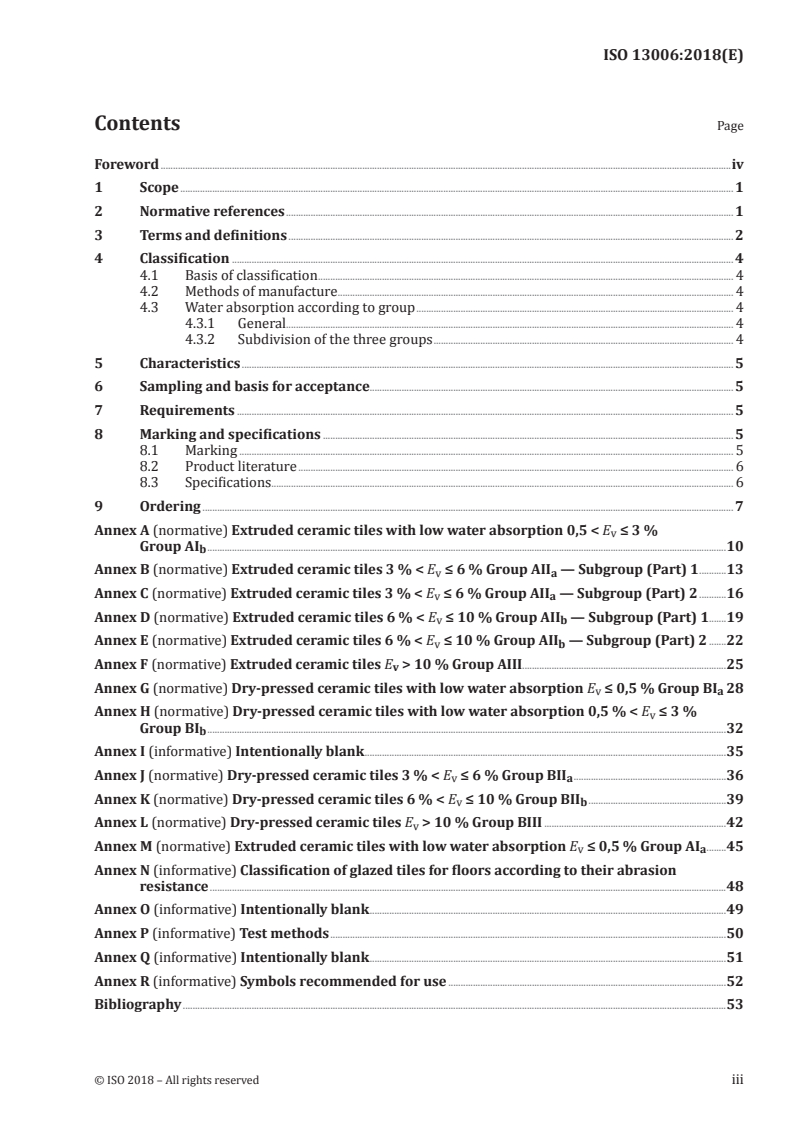
Contents Page
Foreword .iv
1 Scope . 1
2 Normative references . 1
3 Terms and definitions . 2
4 Classification . 4
4.1 Basis of classification . 4
4.2 Methods of manufacture . 4
4.3 Water absorption according to group . 4
4.3.1 General. 4
4.3.2 Subdivision of the three groups . 4
5 Characteristics . 5
6 Sampling and basis for acceptance. 5
7 Requirements . 5
8 Marking and specifications . 5
8.1 Marking . 5
8.2 Product literature . 6
8.3 Specifications. 6
9 Ordering . 7
Annex A (normative) Extruded ceramic tiles with low water absorption 0,5 < E ≤ 3 %
v
Group AI .10
b
Annex B (normative) Extruded ceramic tiles 3 % < E ≤ 6 % Group AII — Subgroup (Part) 1 .13
v a
Annex C (normative) Extruded ceramic tiles 3 % < E ≤ 6 % Group AII — Subgroup (Part) 2 .16
v a
Annex D (normative) Extruded ceramic tiles 6 % < E ≤ 10 % Group AII — Subgroup (Part) 1.19
v b
Annex E (normative) Extruded ceramic tiles 6 % < E ≤ 10 % Group AII — Subgroup (Part) 2 .22
v b
Annex F (normative) Extruded ceramic tiles E > 10 % Group AIII.25
v
Annex G (normative) Dry-pressed ceramic tiles with low water absorption E ≤ 0,5 % Group BI 28
v a
Annex H (normative) Dry-pressed ceramic tiles with low water absorption 0,5 % < E ≤ 3 %
v
Group BI .32
b
Annex I (informative) Intentionally blank .35
Annex J (normative) Dry-pressed ceramic tiles 3 % < E ≤ 6 % Group BII .36
v a
Annex K (normative) Dry-pressed ceramic tiles 6 % < E ≤ 10 % Group BII .39
v b
Annex L (normative) Dry-pressed ceramic tiles E > 10 % Group BIII .42
v
Annex M (normative) Extruded ceramic tiles with low water absorption E ≤ 0,5 % Group AI .45
v a
Annex N (informative) Classification of glazed tiles for floors according to their abrasion
resistance .48
Annex O (informative) Intentionally blank .49
Annex P (informative) Test methods .50
Annex Q (informative) Intentionally blank .51
Annex R (informative) Symbols recommended for use .52
Bibliography .53
Foreword
ISO (the International Organization for Standardization) is a worldwide federation of national standards
bodies (ISO member bodies). The work of preparing International Standards is normally carried out
through ISO technical committees. Each member body interested in a subject for which a technical
committee has been established has the right to be represented on that committee. International
organizations, governmental and non-governmental, in liaison with ISO, also take part in the work.
ISO collaborates closely with the International Electrotechnical Commission (IEC) on all matters of
electrotechnical standardization.
The procedures used to develop this document and those intended for its further maintenance are
described in the ISO/IEC Directives, Part 1. In particular the different approval criteria needed for the
different types of ISO documents should be noted. This document was drafted in accordance with the
editorial rules of the ISO/IEC Directives, Part 2 (see www .iso .org/directives).
Attention is drawn to the possibility that some of the elements of this document may be the subject of
patent rights. ISO shall not be held responsible for identifying any or all such patent rights. Details of
any patent rights identified during the development of the document will be in the Introduction and/or
on the ISO list of patent declarations received (see www .iso .org/patents).
Any trade name used in this document is information given for the convenience of users and does not
constitute an endorsement.
For an explanation of the voluntary nature of standards, the meaning of ISO specific terms and
expressions related to conformity assessment, as well as information about ISO's adherence to the
World Trade Organization (WTO) principles in the Technical Barriers to Trade (TBT) see: www .iso
.org/iso/foreword .html.
This document was prepared by ISO/TC 189, Ceramic tile.
This third edition cancels and replaces the second edition (ISO 13006:2012), which has been technically
revised.
This main changes compared to the previous edition are as follows:
— The boiling method in ISO 10545-3 is no longer referenced for the determination of water absorption.
The vacuum method is now referenced for the determination of water absorption.
Any feedback or questions on this document should be directed to the user’s national standards body. A
complete listing of these bodies can be found at www .iso .org/members .html.
iv © ISO 2018 – All rights reserved
INTERNATIONAL STANDARD ISO 13006:2018(E)
Ceramic tiles — Definitions, classification, characteristics
and marking
1 Scope
This document defines terms and establishes classifications, characteristics and marking requirements
for ceramic tiles of the best commercial quality (first quality). This document is not applicable to tiles
made by other than normal processes of extrusion or dry pressing. It is not applicable to decorative
accessories or trim such as edges, corners, skirting, capping, coves, beads, steps, curved tiles and other
accessory pieces or mosaics (i.e. any piece that can fit into a square, the side of which is less than 7 cm).
NOTE ISO 10545 (all parts) describes the test procedures required to determine the product characteristics
listed in this document. ISO 10545 is a multi-part standard, each part describes a specific test procedure or
related matter.
2 Normative references
The following documents are referred to in the text in such a way that some or all of their content
constitutes requirements of this document. For dated references, only the edition cited applies. For
undated references, the latest edition of the referenced document (including any amendments) applies.
ISO 1006, Building construction — Modular coordination — Basic module
ISO 10545-1, Ceramic tiles — Part 1: Sampling and basis for acceptance
ISO 10545-2, Ceramic tiles — Part 2: Determination of dimensions and surface quality
ISO 10545-3, Ceramic tiles — Part 3: Determination of water absorption, apparent porosity, apparent
relative density and bulk density
ISO 10545-4, Ceramic tiles — Part 4: Determination of modulus of rupture and breaking strength
ISO 10545-5, Ceramic tiles — Part 5: Determination of impact resistance by measurement of coefficient of
restitution
ISO 10545-6, Ceramic tiles — Part 6: Determination of resistance to deep abrasion for unglazed tiles
ISO 10545-7, Ceramic tiles — Part 7: Determination of resistance to surface abrasion for glazed tiles
ISO 10545-8, Ceramic tiles — Part 8: Determination of linear thermal expansion
ISO 10545-9, Ceramic tiles — Part 9: Determination of resistance to thermal shock
ISO 10545-10, Ceramic tiles — Part 10: Determination of moisture expansion
ISO 10545-11, Ceramic tiles — Part 11: Determination of crazing resistance for glazed tiles
ISO 10545-12, Ceramic tiles — Part 12: Determination of frost resistance
ISO 10545-13, Ceramic tiles — Part 13: Determination of chemical resistance
ISO 10545-14, Ceramic tiles — Part 14: Determination of resistance to stains
ISO 10545-15, Ceramic tiles — Part 15: Determination of lead and cadmium given off by glazed tiles
ISO 10545-16, Ceramic tiles — Part 16: Determination of small colour differences
3 Terms and definitions
For the purposes of this document, the terms and definitions given in ISO 1006 and the following apply.
ISO and IEC maintain terminological databases for use in standardization at the following addresses:
— IEC Electropedia: available at https: //www .electropedia .org/
— ISO Online browsing platform: available at https: //www .iso .org/obp
3.1
ceramic tile
thin slab made from clays and/or other inorganic raw materials, generally used as covering for floors
and walls, usually shaped by extruding (A) or pressing (B) at room temperature, but may be formed
by other processes (C), then dried and subsequently fired at temperatures sufficient to develop the
required properties
Note 1 to entry: Tiles may be glazed (GL) or unglazed (UGL); they are incombustible and are not affected by light.
3.2
porcelain tile
fully vitrified tile with water absorption coefficient less than or equal to a mass fraction of 0,5 %,
belonging to groups AI and BI
a a
3.3
glaze
vitrified covering that is impermeable
3.4
engobed surface
clay-based covering with a matt finish which may be permeable or impermeable
Note 1 to entry: A tile with an engobed surface is regarded as an unglazed tile.
3.5
polished surface
surface of glazed and unglazed tile which has been given a glossy finish by mechanical polishing as the
last stage of manufacture
3.6
extruded tile
tile, whose body is shaped in the plastic state in an extruder, the column obtained being cut into tiles of
pre-determined dimension, and which is designated as Group A
Note 1 to entry: This document classifies extruded tiles as “precision” or “natural”. The classification is dependent
upon the different technical characteristics as listed in the individual product standards.
Note 2 to entry: Traditional terms used for extruded products are “split tiles” and “quarry tiles”. They commonly
indicate double-extruded and single-extruded tiles, respectively. The term “quarry tiles” only refers to extruded
tiles with a water absorption coefficient of a mass fraction not exceeding 6 %.
3.7
dry-pressed tile
tile, formed from a finely milled body mixture and shaped (e.g. in dies or moulds) at high pressure, and
which is designated as Group B
3.8
water absorption
E
v
percentage of water impregnating a tile
Note 1 to entry: This is measured in accordance with ISO 10545-3.
2 © ISO 2018 – All rights reserved
Note 2 to entry: Water absorption is expressed as a mass fraction of dry mass.
3.9 Sizes
Note 1 to entry The sizes are only defined for rectangular tiles. If the sizes of non-rectangular tiles are required,
they are defined by the smallest rectangle into which they fit.
3.9.1
nominal size
size used to describe the product
Note 1 to entry: See Figures 1 and 2.
3.9.2
work size
size of a tile specified for manufacturing to which the actual size shall conform within specified
permissible deviations
Note 1 to entry: See Figures 1 and 2.
3.9.3
actual size
size obtained by measuring the face of a tile
Note 1 to entry: This is measured in accordance with ISO 10545-2.
Note 2 to entry: See Figures 1 and 2.
3.9.4
coordinating size
work size plus the joint width
Note 1 to entry: See Figures 1 and 2.
3.9.5
modular size
tile and size based on module M, 2 M, 3 M and 5 M and also their multiples or subdivisions, except for
tiles with a surface area of less than 9 000 mm
Note 1 to entry: See ISO 1006, where 1 M = 100 mm.
Note 2 to entry: See Figures 1 and 2.
3.9.6
non-modular size
size not based on module M
Note 1 to entry: See ISO 1006, where 1 M = 100 mm.
Note 2 to entry: Tiles of these sizes are those commonly used in most countries.
Note 3 to entry: See Figures 1 and 2.
3.9.7
tolerance
difference between the permissible limits of size
Note 1 to entry: See Figures 1 and 2.
3.10
spacer lug
projection that is located along certain edges of tiles so that where two tiles are placed together, in line,
the lugs on adjacent edges separate the tiles by a distance of not less than the specified width of the joint
Note 1 to entry: See Figure 2.
3.11
rectified tile
ceramic tile that, after firing, is subjected to a precise mechanical finishing of the edges
3.12
back feet
parallel ridges running across the back surface of some exterior wall tiles which possess a geometry
intended to facilitate an interlocking connection between tile and cement mortar
Note 1 to entry: See Figure 3.
Note 2 to entry: Back feet dimensions shall be measured with vernier calipers, and each specimen in a 10-tile
sample is required to satisfy the requirements in Annexes A to H and Annexes J to M.
4 Classification
4.1 Basis of classification
Ceramic tiles are divided into groups according to their method of manufacture and their water
absorption (see 3.8 and Table 1). The groups do not presuppose the usage of the products.
4.2 Methods of manufacture
The following are the two methods of manufacture:
— method A, extruded tiles (see 3.6);
— method B, dry-pressed tiles (see 3.7).
4.3 Water absorption according to group
4.3.1 General
The following are the three groups according to water absorption, E .
v
4.3.2 Subdivision of the three groups
The three groups are divided into tiles of low, medium and high water absorption, namely Groups I, II
and III, respectively.
a) Tiles of low water absorption, i.e. absorption coefficient less than or equal to a mass fraction of 3 %,
E ≤ 3 %, belong to Group I. Group I consists of the following:
v
1) for extruded tiles
i) E ≤ 0,5 % (Group AI ), and
v a
ii) 0,5 % < E ≤ 3 % (Group AI );
v b
2) for dry-pressed tiles:
i) E ≤ 0,5 % (Group BI );
v a
4 © ISO 2018 – All rights reserved
ii) 0,5 % < E ≤ 3 % (Group BI ).
v b
b) Tiles of medium water absorption, i.e. 3 % < E ≤ 10 %, belong to Group II. Group II consists of the
v
following:
1) for extruded tiles
i) 3 % < E ≤ 6 % [Group AII , Subgroups (Parts) 1 and 2; see Annex B for Subgroup (Part) 1
v a
or Annex C for Subgroup (Part) 2], and
ii) 6 % < E ≤ 10 % [Group AII , Subgroups (Parts) 1 and 2; see Annex D for Subgroup (Part) 1
v b
or Annex E for Subgroup (Part) 2];
2) for dry-pressed tiles
i) 3 % < E ≤ 6 % (Group BII ), and
v a
ii) 6 % < E ≤ 10 % (Group BII ).
v b
c) Tiles of high water absorption, i.e. E > 10 %, belong to Group III.
v
5 Characteristics
The characteristics for different applications of ceramic tiles are given in Table 2.
6 Sampling and basis for acceptance
The sampling and basis for acceptance shall be in accordance with that presented in ISO 10545-1.
7 Requirements
Dimensional and surface quality requirements and physical and chemical properties shall be as given
in the relevant/specific annex, of Annexes A to H and Annexes J to M, for each tile class.
NOTE Annexes I, O and Q are intentionally left blank. This is as a convenience to producers in order to avoid
changes to packaging and related costs. In addition, at the time of publication, the market offers consumers
various products identified by the matching annex headings of this document.
8 Marking and specifications
8.1 Marking
Tiles and/or their packaging are required to bear the following marking:
a) manufacturer’s mark and/or trademark and the country where the tile was manufactured (i.e.
country of origin, as determined by the relevant international regulation);
b) indication of first quality;
c) type of tile and reference to the appropriate group and/or annex of Annexes A to H and Annexes J to
M covering the specific group of tile;
d) nominal and work sizes, and “M” if modular;
e) nature of the surface, i.e. glazed (GL) or unglazed (UGL);
f) any surface treatment applied after firing;
g) total number of tiles in the package;
h) manufacturer’s production run or batch number;
i) an indication of colour consistency, as defined by the manufacturer;
j) total dry weight which the tiles and their packaging shall not exceed.
EXAMPLE 1
The ABC Tile Co., Made in China, Ceramic Tile of First Quality
Extruded tile, ISO 13006:2018, Annex A, Group Al , Precision
b
M, 25 cm × 12,5 cm (S 240 mm × 115 mm × 12,5 mm), UGL, Protective Sealer Added
w
20 pcs/box, batch A50, 0100-Gray, Max dry weight: 20 kg
EXAMPLE 2
The 123 Tile Co., Made in Spain, Ceramic Tile of First Quality
Dry-pressed porcelain tile, ISO 13006:2018, Annex G, Group BI , Rectified
a
60 cm × 60 cm (S 598 mm × 598 mm × 10 mm) UGL
w
3 pcs/box, batch B52, 0590-Slate, Max dry weight: 16 kg
EXAMPLE 3
The XYX Tile Co., Made in Indonesia, Ceramic Tile of First Quality
Dry-pressed tile, ISO 13006:2018, Annex H, Group BI Non-rectified
b
30 cm × 30 cm (S 299 mm × 299 mm × 10 mm) GL
w
10 pcs/box, batch C60, 0320-Ivory, Max dry weight: 20 kg
Each tile conforming to this document is required to bear on its reverse side or edge, the country where
it was manufactured.
8.2 Product literature
Product literature for tiles intended for use on floors shall state the abrasion class or the place of use of
glazed tiles.
8.3 Specifications
Tiles shall be designated by the following:
a) the method of shaping;
b) the relevant group and/or annex of Annexes A to H and Annexes J to M covering the specific
group of tile
c) nominal and work sizes, and “M” if modular;
d) the nature of the surface, i.e. glazed (GL) or unglazed (UGL);
e) the addition of back feet, if required.
EXAMPLE 1 Precision extruded tile, ISO 13006:2018, Annex M, AIa M 25 cm × 12,5 cm
(S 240 mm × 115 mm × 10 mm) GL.
w
EXAMPLE 2 Natural extruded tile, ISO 13006:2018, Annex A, AIb 15 cm × 15 cm
(S 150 mm × 150 mm × 12,5 mm) UGL.
w
EXAMPLE 3 Dry-pressed tile, ISO 13006:2018, Annex G, BI M 25 cm × 12,5 cm
a
(S 240 mm × 115 mm × 10 mm) GL.
w
EXAMPLE 4 Dry-pressed tile, ISO 13006:2018, Annex L, BIII 15 cm × 15 cm
(S 150 mm × 150 mm × 12,5 mm) UGL.
w
6 © ISO 2018 – All rights reserved
9 Ordering
Each time that an order is placed, items, such as size, thickness, type of surface, colour, profile, abrasion
class for glazed tiles and other properties, shall be agreed upon by the parties concerned.
Table 1 — Classification of ceramic tiles with respect to water absorption and shaping
Group I Group II Group II Group III
a b
Shaping
E ≤ 3 % 3 % < E ≤ 6 % 6 % < E ≤ 10 % E > 10 %
v v v v
Group AI
a
a a
Group AII Group AII
a-1 b-1
E ≤ 0,5 %
v
(see Annex B) (see Annex D)
A Group AIII
(see Annex M)
Group AI
Extruded (see Annex F)
b
a a
Group AII Group AII
a-2 b-2
0,5 % < E ≤ 3 %
v
(see Annex C) (see Annex E)
(see Annex A)
Group BI
a
E ≤ 0,5 %
v
b
B Group BII Group BII Group BIII
(see Annex G)
a b
Group BI
Dry pressed (see Annex J) (see Annex K) (see Annex L)
b
0,5 % < E ≤ 3 %
v
(see Annex H)
a
Groups AII and AII are divided into two subgroups (Parts 1 and 2) with different product specifications.
a b
b
Group BIII covers glazed tiles only. There is a low quantity of dry-pressed unglazed tiles produced with water
absorption greater than 10 % mass fraction, which is not covered by this product group.
Table 2 — Characteristics required for different applications
Characteristics Floor Wall Test
Dimensions and surface quality Interior Exterior Interior Exterior Reference
Length and width X X X X ISO 10545-2
Thickness X X X X ISO 10545-2
Straightness of sides X X X X ISO 10545-2
Rectangularity X X X X ISO 10545-2
Surface flatness (curvature and warpage) X X X X ISO 10545-2
Surface quality X X X X ISO 10545-2
a
Back feet (if specified) X Figure 3
Physical property Interior Exterior Interior Exterior Reference
Water absorption X X X X ISO 10545-3
Breaking strength X X X X ISO 10545-4
Modulus of rupture X X X X ISO 10545-4
Resistance to deep abrasion — unglazed tiles X X ISO 10545-6
Resistance to surface abrasion — glazed tiles X X ISO 10545-7
b
Linear thermal expansion X X X X ISO 10545-8
b
Resistance to thermal shock X X X X ISO 10545-9
Resistance to crazing — glazed tiles X X X X ISO 10545-11
c
Frost resistance X X ISO 10545-12
b
Moisture expansion X X X X ISO 10545-10
b
Small colour differences X X X X ISO 10545-16
Table 2 (continued)
Characteristics Floor Wall Test
Dimensions and surface quality Interior Exterior Interior Exterior Reference
b
Impact resistance X X ISO 10545-5
Chemical property Interior Exterior Interior Exterior Reference
Resistance to staining ISO 10545-14
— glazed tiles X X X X ISO 10545-14
b
— unglazed tiles X X X X ISO 10545-14
Resistance to low concentrations of acids X X X X ISO 10545-13
and alkalis
Resistance to high concentrations of acids and X X X X ISO 10545-13
b
alkalis
Resistance to household cleaners and swim- X X X X ISO 10545-13
ming pool salts
b
Lead and cadmium release — glazed tiles X X X X ISO 10545-15
a
For application to exterior tiles installed by cement mortar, including tunnels, where back feet are specified.
b
Test method is available.
c
For tiles intended to be used in situations where frost conditions apply.
Key
a, b dimensions of the tile
d thickness
j joint
S coordinating size
c
S work size
w
S = S + j
c w
S = a, b, d
w
Figure 1 — Tile
8 © ISO 2018 – All rights reserved
Key
1 spacer lugs
j joint
S coordinating size
c
S work size
w
S = S + j
c w
S = a, b, d
w
Figure 2 — Tile with spacer lug
a) Example 1 b) Example 2 c) Example 3
Key
h height
L length
Figure 3 — Back feet — Examples
Annex A
(normative)
Extruded ceramic tiles with low water absorption 0,5 < E ≤ 3 %
v
Group AI
b
Dimensional and surface quality requirements and physical and chemical properties are required to be
in accordance with Table A.1.
Table A.1 — Requirements for extruded ceramic tiles — Group AI , 0,5 < E ≤ 3 %
b v
Dimensions and surface quality Precision Natural Test
Length and width
The manufacturer shall choose the work
size as follows:
a) for modular tiles in order to allow a
nominal joint width of between 3 mm
a
and 11 mm ;
b) for non-modular tiles so that the
difference between the work size
and the nominal size is not more
than ±3 mm.
The deviation, in percent, of the average
±1,0 % to a ±2,0 % to a
size for each tile (two or four sides) from ISO 10545-2
maximum of ±2 mm maximum of ±4 mm
the work size, S
w
The deviation, in percent, of the average
size for each tile (two or four sides) from
±1,0 % ±1,5 % ISO 10545-2
the average size of the 10 test specimens
(20 or 40 sides)
Thickness
a) The thickness shall be specified by
g
the manufacturer
b) The deviation, in percent, of the
average thickness of each tile from ±10 % ±10 % ISO 10545-2
g
the work size thickness
b
Straightness of sides (facial sides)
The maximum deviation from straight-
ness, in percent, related to the corre- ±0,5 % ±0,6 % ISO 10545-2
sponding work sizes
b
Rectangularity
The maximum deviation from rectangu-
larity, in percent, related to the corre- ±1,0 % ±1,0 % ISO 10545-2
sponding work sizes
Surface flatness
The maximum deviation from flatness, in
percent:
a) centre curvature, related to diagonal
±0,5 % ±1,5 % ISO 10545-2
calculated from the work sizes;
b) edge curvature, related to the
±0,5 % ±1,5 % ISO 10545-2
corresponding work sizes;
10 © ISO 2018 – All rights reserved
Table A.1 (continued)
Dimensions and surface quality Precision Natural Test
c) warpage, related to the diagonal
±0,8 % ±1,5 % ISO 10545-2
calculated from the work sizes.
Back feet (if specified)
a) Height, h, for tiles of surface area, A
2 2
49 cm ≤ A < 60 cm Minimum h = 0,7 mm; Maximum h = 3,5 mm Figure 3
A ≥ 60 cm Minimum h = 1,5 mm; Maximum h = 3,5 mm Figure 3
Back feet as specified by the manufacturer
b) Shape and as shown in one of the examples in Figure 3
Figure 3
Example 1 (see Figure 3) L − L > 0 Figure 3
0 1
Example 2 (see Figure 3) L − L > 0 Figure 3
0 2
Example 3 (see Figure 3) L − L > 0 Figure 3
0 3
A minimum of 95 % of the tiles are to be
c
Surface quality free from visible defects which can impair ISO 10545-2
the appearance of a major area of tiles
Physical property Precision Natural Test
0,5 < E ≤ 3,0 % 0,5 < E ≤ 3,0 %
v v
Water absorption
Individual maximum Individual maximum ISO 10545-3
Percent mass fraction
3,3 % 3,3 %
Breaking strength, in Newtons
a) Thickness ≥7,5 mm Not less than 1 100 Not less than 1 100 ISO 10545-4
b) Thickness <7,5 mm Not less than 600 Not less than 600 ISO 10545-4
Modulus of rupture, in Newtons per
Minimum 23 Minimum 23
square millimetre
Individual minimum Individual minimum ISO 10545-4
Not applicable to tiles with breaking
18 18
strength ≥3 000 N
Abrasion resistance
a) Resistance to deep abrasion of
unglazed tiles: removed volume, in Maximum 275 Maximum 275 ISO 10545-6
cubic millimetres
b) Resistance to surface abrasion of Report abrasion class Report abrasion class
ISO 10545-7
d
glazed tiles intended for use on floors and cycles passed and cycles passed
e
Coefficient of linear thermal expansion
From ambient temperature to 100 °C Test method available Test method available ISO 10545-8
e
Thermal shock resistance Test method available Test method available ISO 10545-9
f
Crazing resistance: glazed tiles Required Required ISO 10545-11
Frost resistance Required Required ISO 10545-12
Moisture expansion, in millimetres
Test method available Test method available ISO 10545-10
e
per metre
Plain coloured tiles Plain coloured tiles
only where required only where required
e
Small colour differences ISO 10545-16
GL: ΔE < 0,75 GL: ΔE < 0,75
UGL: ΔE < 1,0 UGL: ΔE < 1,0
e
Impact resistance Test method available Test method available ISO 10545-5
Chemical property Precision Natural Test
Resistance to staining
a) Glazed tiles Minimum class 3 Minimum class 3 ISO 10545-14
e
b) Unglazed tiles Test method available Test method available ISO 10545-14
Table A.1 (continued)
Dimensions and surface quality Precision Natural Test
Resistance to chemicals
Resistance to low concentrations of acids Manufacturer is to Manufacturer is to
ISO 10545-13
and alkalis state classification state classification
Resistance to high concentrations of acids
Test method available Test method available ISO 10545-13
e
and alkalis
Resistance to household chemicals and
Minimum B Minimum B ISO 10545-13
swimming pool salts
e
Lead and cadmium release Test method available Test method available ISO 10545-15
a
Similar joint widths shall be used to apply to traditional systems based on non-metric sizes.
b
Not applicable to tiles having curved shapes.
c
As a result of firing, slight variations from this standard colour are unavoidable. This does not apply to inten-
tional irregularities of colour variation of the face of tiles (which can be unglazed, glazed or partly glazed) or to
the colour variation over a tile area which is characteristic for this type of tile and desirable. Spots or coloured
dots which are introduced for decorative purposes are not considered a defect.
d
Use Annex N for the abrasion resistance classification for all glazed tiles intended for use on floors.
e
Annex P gives information regarding requirements which are non-compulsory but which are listed as “test
method available”.
f
Certain decorative effects can have a tendency to craze. These are to be identified by the manufacturer, in
which case, the crazing test given in ISO 10545-11 is not applicable.
g
Where applicable, tile thickness shall include the addition of back feet heights, as measured in accordance
with Figure 3.
12 © ISO 2018 – All rights reserved
Annex B
(normative)
Extruded ceramic tiles 3 % < E ≤ 6 % Group AII — Subgroup
v a
(Part) 1
Dimensional and surface quality requirements and physical and chemical properties are required to be
in accordance with Table B.1.
Table B.1 — Requirements for extruded ceramic tiles — Group AII , 3 % < E ≤ 6 %
a-1 v
Dimensions and surface quality Precision Natural Test
Length and width
The manufacturer shall choose the work
size as follows:
a) for modular tiles in order to allow a
nominal joint width of between 3 mm
a
and 11 mm ;
b) for non-modular tiles so that the
difference between the work size
and the nominal size is not more
than ±3 mm.
The deviation, in percent, of the average
±1,25 % to a ±2,0 % to a
size for each tile (two or four sides) from ISO 10545-2
maximum of ±2 mm maximum of ±4 mm
the work size, S
w
The deviation, in percent, of the average
size for each tile (two or four sides) from
±1,0 % ±1,5 % ISO 10545-2
the average size of the 10 test specimens
(20 or 40 sides)
Thickness
a) The thickness shall be specified by
g
the manufacturer
b) The deviation, in percent, of the
average thickness of each tile from ±10 % ±10 % ISO 10545-2
g
the work size thickness
b
Straightness of sides (facial sides)
The maximum deviation from straight-
ness, in percent, related to the corre- ±0,5 % ±0,6 % ISO 10545-2
sponding work sizes
b
Rectangularity
The maximum deviation from rectangu-
larity, in percent, related to the corre- ±1,0 % ±1,0 % ISO 10545-2
sponding work sizes
Surface flatness
The maximum deviation from flatness, in
percent:
a) centre curvature, related to diagonal
±0,5 % ±1,5 % ISO 10545-2
calculated from the work sizes;
b) edge curvature, related to the
±0,5 % ±1,5 % ISO 10545-2
corresponding work sizes;
Table B.1 (continued)
Dimensions and surface quality Precision Natural Test
c) warpage, related to diagonal
±0,8 % ±1,5 % ISO 10545-2
calculated from the work sizes.
Back feet (if specified)
a) Height, h, for tiles of surface area, A
2 2
49 cm ≤ A < 60 cm Minimum h = 0,7 mm; Maximum h = 3,5 mm Figure 3
A ≥ 60 cm Minimum h = 1,5 mm; Maximum h = 3,5 mm Figure 3
Back feet as specified by the manufacturer
b) Shape and as shown in one of the examples in Figure 3
Figure 3
Example 1 (see Figure 3) L − L > 0 Figure 3
0 1
Example 2 (see Figure 3) L − L > 0 Figure 3
0 2
Example 3 (see Figure 3) L − L > 0 Figure 3
0 3
A minimum of 95 % of the tiles are to be
c
Surface quality free from visible defects which can impair ISO 10545-2
the appearance of a major area of tiles
Physical property Precision Natural Test
3,0 % < E ≤ 6,0 % 3,0 % < E ≤ 6,0 %
v v
Water absorption
Individual maximum Individual maximum ISO 10545-3
Percent mass fraction
6,5 % 6,5 %
Breaking strength, in Newtons
a) Thickness ≥7,5 mm Not less than 950 Not less than 950 ISO 10545-4
b) Thickness <7,5 mm Not less than 600 Not less than 600 ISO 10545-4
Modulus of rupture, in Newtons per
Minimum 20 Minimum 20
square millimetre
Individual minimum Individual minimum ISO 10545-4
Not applicable to tiles with breaking
18 18
strength ≥3 000 N
Abrasion resistance
a) Resistance to deep abrasion of
unglazed tiles: removed volume, in Maximum 393 Maximum 393 ISO 10545-6
cubic millimetres
b) Resistance to surface abrasion of Report abrasion class Report abrasion class
ISO 10545-7
d
glazed tiles intended for use on floors and cycles passed and cycles passed
e
Coefficient of linear thermal expansion
From ambient temperature to 100 °C Test method available Test method available ISO 10545-8
e
Thermal shock resistance Test method available Test method available ISO 10545-9
f
Crazing resistance: glazed tiles Required Required ISO 10545-11
e
Frost resistance Test method available Test method available ISO 10545-12
Moisture expansion, in millimetres
Test method available Test method available ISO 10545-10
e
per metre
Plain coloured tiles Plain coloured tiles
only where required only where required
e
Small colour differences ISO 10545-16
GL: ΔE < 0,75 GL: ΔE < 0,75
UGL: ΔE < 1,0 UGL: ΔE < 1,0
e
Impact resistance Test method available Test method available ISO 10545-5
Chemical property Precision Natural Test
Resistance to staining
a) Glazed tiles Minimum class 3 Minimum class 3 ISO 10545-14
e
b) Unglazed tiles Test method available Test method available ISO 10545-14
14 © ISO 2018 – All rights reserved
Table B.1 (continued)
Dimensions and surface quality Precision Natural Test
Resistance to chemicals
Resistance to low concentrations of acids Manufacturer is to Manufacturer is to
ISO 10545-13
and alkalis state classification state classification
Resistance to high concentrations of acids
Test method available Test method available ISO 10545-13
e
and alkalis
Resistance to household chemicals and
Minimum B Minimum B ISO 10545-13
swimming pool salts
e
Lead and cadmium release Test method available Test method available ISO 10545-15
a
Similar joint widths are to be used to apply to traditional systems based on non-metric sizes.
b
Not applicable to tiles having curved shapes.
c
As a result of firing, slight variations from this standard colour are unavoidable. This does not apply to inten-
tional irregularities of colour variation of the face of tiles (which can be unglazed, glazed or partly glazed) or to
the colour variation over a tile area which is characteristic for this type of tile and desirable. Spots or coloured
dots which are introduced for decorative purposes are not considered a defect.
d
Use Annex N for the abrasion resistance classification for all glazed tiles intended for use on floors.
e
Annex P gives information regarding requirements which are non-compulsory but which are listed as “test
method available”.
f
Certain decorative effects can have a tendency to craze. These are to be identified by the manufacturer, in
which case the crazing test given in ISO 10545-11 is not applicable.
g
Where applicable, tile thickness shall include the addition of back feet heights, as measured in accordance
with Figure 3.
Annex C
(normative)
Extruded ceramic tiles 3 % < E ≤ 6 % Group AII — Subgroup
v a
(Part) 2
Dimensional and surface quality requirements and physical and chemical properties are required to be
in accordance with Table C.1.
Table C.1 — Requirements for extruded ceramic tiles — Group AII , 3 % < E ≤ 6 %
a-2 v
Dimensions and surface quality Precision Natural Test
Length and width
The manufacturer shall choose the work
size as follows:
a) for modular tiles in order to allow a
nominal joint width of between 3 mm
a
and 11 mm ;
b) for non-modular tiles so that the
difference between the work size
and the nominal size is not more
than ±3 mm.
The deviation, in percent, of the average
±1,5 % to a ±2,0 % to a
size for each tile (two or four sides) from ISO 10545-2
maximum of ±2 mm maximum of ±4 mm
the work size, S
w
The deviation, in percent, of the average
size for each tile (two or four sides) from
±1,5 % ±1,5 % ISO 10545-2
the average size of the 10 test specimens
(20 or 40 sides)
Thickness
a) The thickness shall be specified by
g
the manufacturer
b) The deviation, in percent, of the
average thickness of each tile from ±10 % ±10 % ISO 10545-2
g
the work size thickness
b
Straightness of sides (facial sides)
The maximum deviation from straight-
ness, in percent, related to the corre- ±1,0 % ±1,0 % ISO 10545-2
sponding work sizes
b
Rectangularity
The maximum deviation from rectangu-
larity, in percent related to the corre- ±1,0 % ±1,0 % ISO 10545-2
sponding work sizes
Surface flatness
The maximum deviation from flatness, in
percent:
a) centre curvature, related to diagonal
±1,0 % ±1,5 % ISO 10545-2
calculated from the work sizes;
b) edge curvature, related to the
±1,0 % ±1,5 % ISO 10545-2
corresponding work sizes;
16 © ISO 2018 – All rights reserved
Table C.1 (continued)
Dimensions and surface quality Precision Natural Test
c) warpage, related to diagonal
±1,5 % ±1,5 % ISO 10545-2
calculated from the work sizes.
Back feet (if specified)
a) Height, h, for tiles of surface area, A
2 2
49 cm ≤ A < 60 cm Minimum h = 0,7 mm; Maximum h = 3,5 mm Figure 3
A ≥ 60 cm Minimum h = 1,5 mm; Maximum h = 3,5 mm Figure 3
Back feet as specified by the manufacturer
b) Shape and as shown in one of the examples in Figure 3
Figure 3
Example 1 (see Figure 3) L − L > 0 Figure 3
0 1
Example 2 (see Figure 3) L − L > 0 Figure 3
0 2
Example 3 (see Figure 3) L − L > 0 Figure 3
0 3
A minimum of 95 % of the tiles are to be
c
Surface quality free from visible defects which can impair ISO 10545-2
the appearance of a major area of tiles
Physical property Precision Natural Test
3,0 % < E ≤ 6,0 % 3,0 % < E ≤ 6,0 %
v v
Water absorption
Individual maximum Individual maximum ISO 10545-3
Percent mass fraction
6,5 % 6,5 %
Breaking strength, in Newtons
a) Thickness ≥7,5 mm Not less than 800 Not less than 800 ISO 10545-4
b) Thickness <7,5 mm Not less than 600 Not less than 600 ISO 10545-4
Modulus of rupture, in Newtons per
Minimum 13 Minimum 13
square millimetre
Individual minimum Individual minimum ISO 10545-4
Not applicable to tiles with breaking
11 11
strength ≥3 000 N
Abrasion resistance
a) Resistance to deep abrasion of
unglazed tiles: removed volume, in Maximum 541 Maximum 541 ISO 10545-6
cubic millimetres
b) Resistance to surface abrasion of Report abrasion class Report abrasion class
ISO 10545-7
d
glazed tiles intended for use on floors and cycles passed and cycles passed
e
Coefficient of linear thermal expansion
From ambient temperature to 100 °C Test method available Test method available ISO 10545-8
e
Thermal shock resistance Test method available Test method available ISO 10545-9
f
Crazing resistance: glazed tiles Required Required ISO 10545-11
e
Frost resistance Test method available Test method available ISO 10545-12
Moisture expansion, in millimetres
Test method available Test method available ISO 10545-10
e
per metre
Plain coloured tiles Plain coloured tiles
only where required only where required
e
Small colour differences ISO 10545-16
GL: ΔE < 0,75 GL: ΔE < 0,75
UGL: ΔE < 1,0 UGL: ΔE < 1,0
e
Impact resistance Test method available Test method available ISO 10545-5
Chemical property Precision Natural Test
Resistance to staining
a) Glazed tiles Minimum class 3 Minimum class 3 ISO 10545-14
e
b) Unglazed tiles Test method available Test method available ISO 10545-14
Table C.1 (continued)
Dimensions and surface quality
...
INTERNATIONAL ISO
STANDARD 13006
Third edition
2018-09
Ceramic tiles — Definitions,
classification, characteristics and
marking
Carreaux et dalles céramiques — Définitions, classification,
caractéristiques et marquage
Reference number
©
ISO 2018
© ISO 2018
All rights reserved. Unless otherwise specified, or required in the context of its implementation, no part of this publication may
be reproduced or utilized otherwise in any form or by any means, electronic or mechanical, including photocopying, or posting
on the internet or an intranet, without prior written permission. Permission can be requested from either ISO at the address
below or ISO’s member body in the country of the requester.
ISO copyright office
CP 401 • Ch. de Blandonnet 8
CH-1214 Vernier, Geneva
Phone: +41 22 749 01 11
Fax: +41 22 749 09 47
Email: copyright@iso.org
Website: www.iso.org
Published in Switzerland
ii © ISO 2018 – All rights reserved
Contents Page
Foreword .iv
1 Scope . 1
2 Normative references . 1
3 Terms and definitions . 2
4 Classification . 4
4.1 Basis of classification . 4
4.2 Methods of manufacture . 4
4.3 Water absorption according to group . 4
4.3.1 General. 4
4.3.2 Subdivision of the three groups . 4
5 Characteristics . 5
6 Sampling and basis for acceptance. 5
7 Requirements . 5
8 Marking and specifications . 5
8.1 Marking . 5
8.2 Product literature . 6
8.3 Specifications. 6
9 Ordering . 7
Annex A (normative) Extruded ceramic tiles with low water absorption 0,5 < E ≤ 3 %
v
Group AI .10
b
Annex B (normative) Extruded ceramic tiles 3 % < E ≤ 6 % Group AII — Subgroup (Part) 1 .13
v a
Annex C (normative) Extruded ceramic tiles 3 % < E ≤ 6 % Group AII — Subgroup (Part) 2 .16
v a
Annex D (normative) Extruded ceramic tiles 6 % < E ≤ 10 % Group AII — Subgroup (Part) 1.19
v b
Annex E (normative) Extruded ceramic tiles 6 % < E ≤ 10 % Group AII — Subgroup (Part) 2 .22
v b
Annex F (normative) Extruded ceramic tiles E > 10 % Group AIII.25
v
Annex G (normative) Dry-pressed ceramic tiles with low water absorption E ≤ 0,5 % Group BI 28
v a
Annex H (normative) Dry-pressed ceramic tiles with low water absorption 0,5 % < E ≤ 3 %
v
Group BI .32
b
Annex I (informative) Intentionally blank .35
Annex J (normative) Dry-pressed ceramic tiles 3 % < E ≤ 6 % Group BII .36
v a
Annex K (normative) Dry-pressed ceramic tiles 6 % < E ≤ 10 % Group BII .39
v b
Annex L (normative) Dry-pressed ceramic tiles E > 10 % Group BIII .42
v
Annex M (normative) Extruded ceramic tiles with low water absorption E ≤ 0,5 % Group AI .45
v a
Annex N (informative) Classification of glazed tiles for floors according to their abrasion
resistance .48
Annex O (informative) Intentionally blank .49
Annex P (informative) Test methods .50
Annex Q (informative) Intentionally blank .51
Annex R (informative) Symbols recommended for use .52
Bibliography .53
Foreword
ISO (the International Organization for Standardization) is a worldwide federation of national standards
bodies (ISO member bodies). The work of preparing International Standards is normally carried out
through ISO technical committees. Each member body interested in a subject for which a technical
committee has been established has the right to be represented on that committee. International
organizations, governmental and non-governmental, in liaison with ISO, also take part in the work.
ISO collaborates closely with the International Electrotechnical Commission (IEC) on all matters of
electrotechnical standardization.
The procedures used to develop this document and those intended for its further maintenance are
described in the ISO/IEC Directives, Part 1. In particular the different approval criteria needed for the
different types of ISO documents should be noted. This document was drafted in accordance with the
editorial rules of the ISO/IEC Directives, Part 2 (see www .iso .org/directives).
Attention is drawn to the possibility that some of the elements of this document may be the subject of
patent rights. ISO shall not be held responsible for identifying any or all such patent rights. Details of
any patent rights identified during the development of the document will be in the Introduction and/or
on the ISO list of patent declarations received (see www .iso .org/patents).
Any trade name used in this document is information given for the convenience of users and does not
constitute an endorsement.
For an explanation of the voluntary nature of standards, the meaning of ISO specific terms and
expressions related to conformity assessment, as well as information about ISO's adherence to the
World Trade Organization (WTO) principles in the Technical Barriers to Trade (TBT) see: www .iso
.org/iso/foreword .html.
This document was prepared by ISO/TC 189, Ceramic tile.
This third edition cancels and replaces the second edition (ISO 13006:2012), which has been technically
revised.
This main changes compared to the previous edition are as follows:
— The boiling method in ISO 10545-3 is no longer referenced for the determination of water absorption.
The vacuum method is now referenced for the determination of water absorption.
Any feedback or questions on this document should be directed to the user’s national standards body. A
complete listing of these bodies can be found at www .iso .org/members .html.
iv © ISO 2018 – All rights reserved
INTERNATIONAL STANDARD ISO 13006:2018(E)
Ceramic tiles — Definitions, classification, characteristics
and marking
1 Scope
This document defines terms and establishes classifications, characteristics and marking requirements
for ceramic tiles of the best commercial quality (first quality). This document is not applicable to tiles
made by other than normal processes of extrusion or dry pressing. It is not applicable to decorative
accessories or trim such as edges, corners, skirting, capping, coves, beads, steps, curved tiles and other
accessory pieces or mosaics (i.e. any piece that can fit into a square, the side of which is less than 7 cm).
NOTE ISO 10545 (all parts) describes the test procedures required to determine the product characteristics
listed in this document. ISO 10545 is a multi-part standard, each part describes a specific test procedure or
related matter.
2 Normative references
The following documents are referred to in the text in such a way that some or all of their content
constitutes requirements of this document. For dated references, only the edition cited applies. For
undated references, the latest edition of the referenced document (including any amendments) applies.
ISO 1006, Building construction — Modular coordination — Basic module
ISO 10545-1, Ceramic tiles — Part 1: Sampling and basis for acceptance
ISO 10545-2, Ceramic tiles — Part 2: Determination of dimensions and surface quality
ISO 10545-3, Ceramic tiles — Part 3: Determination of water absorption, apparent porosity, apparent
relative density and bulk density
ISO 10545-4, Ceramic tiles — Part 4: Determination of modulus of rupture and breaking strength
ISO 10545-5, Ceramic tiles — Part 5: Determination of impact resistance by measurement of coefficient of
restitution
ISO 10545-6, Ceramic tiles — Part 6: Determination of resistance to deep abrasion for unglazed tiles
ISO 10545-7, Ceramic tiles — Part 7: Determination of resistance to surface abrasion for glazed tiles
ISO 10545-8, Ceramic tiles — Part 8: Determination of linear thermal expansion
ISO 10545-9, Ceramic tiles — Part 9: Determination of resistance to thermal shock
ISO 10545-10, Ceramic tiles — Part 10: Determination of moisture expansion
ISO 10545-11, Ceramic tiles — Part 11: Determination of crazing resistance for glazed tiles
ISO 10545-12, Ceramic tiles — Part 12: Determination of frost resistance
ISO 10545-13, Ceramic tiles — Part 13: Determination of chemical resistance
ISO 10545-14, Ceramic tiles — Part 14: Determination of resistance to stains
ISO 10545-15, Ceramic tiles — Part 15: Determination of lead and cadmium given off by glazed tiles
ISO 10545-16, Ceramic tiles — Part 16: Determination of small colour differences
3 Terms and definitions
For the purposes of this document, the terms and definitions given in ISO 1006 and the following apply.
ISO and IEC maintain terminological databases for use in standardization at the following addresses:
— IEC Electropedia: available at https: //www .electropedia .org/
— ISO Online browsing platform: available at https: //www .iso .org/obp
3.1
ceramic tile
thin slab made from clays and/or other inorganic raw materials, generally used as covering for floors
and walls, usually shaped by extruding (A) or pressing (B) at room temperature, but may be formed
by other processes (C), then dried and subsequently fired at temperatures sufficient to develop the
required properties
Note 1 to entry: Tiles may be glazed (GL) or unglazed (UGL); they are incombustible and are not affected by light.
3.2
porcelain tile
fully vitrified tile with water absorption coefficient less than or equal to a mass fraction of 0,5 %,
belonging to groups AI and BI
a a
3.3
glaze
vitrified covering that is impermeable
3.4
engobed surface
clay-based covering with a matt finish which may be permeable or impermeable
Note 1 to entry: A tile with an engobed surface is regarded as an unglazed tile.
3.5
polished surface
surface of glazed and unglazed tile which has been given a glossy finish by mechanical polishing as the
last stage of manufacture
3.6
extruded tile
tile, whose body is shaped in the plastic state in an extruder, the column obtained being cut into tiles of
pre-determined dimension, and which is designated as Group A
Note 1 to entry: This document classifies extruded tiles as “precision” or “natural”. The classification is dependent
upon the different technical characteristics as listed in the individual product standards.
Note 2 to entry: Traditional terms used for extruded products are “split tiles” and “quarry tiles”. They commonly
indicate double-extruded and single-extruded tiles, respectively. The term “quarry tiles” only refers to extruded
tiles with a water absorption coefficient of a mass fraction not exceeding 6 %.
3.7
dry-pressed tile
tile, formed from a finely milled body mixture and shaped (e.g. in dies or moulds) at high pressure, and
which is designated as Group B
3.8
water absorption
E
v
percentage of water impregnating a tile
Note 1 to entry: This is measured in accordance with ISO 10545-3.
2 © ISO 2018 – All rights reserved
Note 2 to entry: Water absorption is expressed as a mass fraction of dry mass.
3.9 Sizes
Note 1 to entry The sizes are only defined for rectangular tiles. If the sizes of non-rectangular tiles are required,
they are defined by the smallest rectangle into which they fit.
3.9.1
nominal size
size used to describe the product
Note 1 to entry: See Figures 1 and 2.
3.9.2
work size
size of a tile specified for manufacturing to which the actual size shall conform within specified
permissible deviations
Note 1 to entry: See Figures 1 and 2.
3.9.3
actual size
size obtained by measuring the face of a tile
Note 1 to entry: This is measured in accordance with ISO 10545-2.
Note 2 to entry: See Figures 1 and 2.
3.9.4
coordinating size
work size plus the joint width
Note 1 to entry: See Figures 1 and 2.
3.9.5
modular size
tile and size based on module M, 2 M, 3 M and 5 M and also their multiples or subdivisions, except for
tiles with a surface area of less than 9 000 mm
Note 1 to entry: See ISO 1006, where 1 M = 100 mm.
Note 2 to entry: See Figures 1 and 2.
3.9.6
non-modular size
size not based on module M
Note 1 to entry: See ISO 1006, where 1 M = 100 mm.
Note 2 to entry: Tiles of these sizes are those commonly used in most countries.
Note 3 to entry: See Figures 1 and 2.
3.9.7
tolerance
difference between the permissible limits of size
Note 1 to entry: See Figures 1 and 2.
3.10
spacer lug
projection that is located along certain edges of tiles so that where two tiles are placed together, in line,
the lugs on adjacent edges separate the tiles by a distance of not less than the specified width of the joint
Note 1 to entry: See Figure 2.
3.11
rectified tile
ceramic tile that, after firing, is subjected to a precise mechanical finishing of the edges
3.12
back feet
parallel ridges running across the back surface of some exterior wall tiles which possess a geometry
intended to facilitate an interlocking connection between tile and cement mortar
Note 1 to entry: See Figure 3.
Note 2 to entry: Back feet dimensions shall be measured with vernier calipers, and each specimen in a 10-tile
sample is required to satisfy the requirements in Annexes A to H and Annexes J to M.
4 Classification
4.1 Basis of classification
Ceramic tiles are divided into groups according to their method of manufacture and their water
absorption (see 3.8 and Table 1). The groups do not presuppose the usage of the products.
4.2 Methods of manufacture
The following are the two methods of manufacture:
— method A, extruded tiles (see 3.6);
— method B, dry-pressed tiles (see 3.7).
4.3 Water absorption according to group
4.3.1 General
The following are the three groups according to water absorption, E .
v
4.3.2 Subdivision of the three groups
The three groups are divided into tiles of low, medium and high water absorption, namely Groups I, II
and III, respectively.
a) Tiles of low water absorption, i.e. absorption coefficient less than or equal to a mass fraction of 3 %,
E ≤ 3 %, belong to Group I. Group I consists of the following:
v
1) for extruded tiles
i) E ≤ 0,5 % (Group AI ), and
v a
ii) 0,5 % < E ≤ 3 % (Group AI );
v b
2) for dry-pressed tiles:
i) E ≤ 0,5 % (Group BI );
v a
4 © ISO 2018 – All rights reserved
ii) 0,5 % < E ≤ 3 % (Group BI ).
v b
b) Tiles of medium water absorption, i.e. 3 % < E ≤ 10 %, belong to Group II. Group II consists of the
v
following:
1) for extruded tiles
i) 3 % < E ≤ 6 % [Group AII , Subgroups (Parts) 1 and 2; see Annex B for Subgroup (Part) 1
v a
or Annex C for Subgroup (Part) 2], and
ii) 6 % < E ≤ 10 % [Group AII , Subgroups (Parts) 1 and 2; see Annex D for Subgroup (Part) 1
v b
or Annex E for Subgroup (Part) 2];
2) for dry-pressed tiles
i) 3 % < E ≤ 6 % (Group BII ), and
v a
ii) 6 % < E ≤ 10 % (Group BII ).
v b
c) Tiles of high water absorption, i.e. E > 10 %, belong to Group III.
v
5 Characteristics
The characteristics for different applications of ceramic tiles are given in Table 2.
6 Sampling and basis for acceptance
The sampling and basis for acceptance shall be in accordance with that presented in ISO 10545-1.
7 Requirements
Dimensional and surface quality requirements and physical and chemical properties shall be as given
in the relevant/specific annex, of Annexes A to H and Annexes J to M, for each tile class.
NOTE Annexes I, O and Q are intentionally left blank. This is as a convenience to producers in order to avoid
changes to packaging and related costs. In addition, at the time of publication, the market offers consumers
various products identified by the matching annex headings of this document.
8 Marking and specifications
8.1 Marking
Tiles and/or their packaging are required to bear the following marking:
a) manufacturer’s mark and/or trademark and the country where the tile was manufactured (i.e.
country of origin, as determined by the relevant international regulation);
b) indication of first quality;
c) type of tile and reference to the appropriate group and/or annex of Annexes A to H and Annexes J to
M covering the specific group of tile;
d) nominal and work sizes, and “M” if modular;
e) nature of the surface, i.e. glazed (GL) or unglazed (UGL);
f) any surface treatment applied after firing;
g) total number of tiles in the package;
h) manufacturer’s production run or batch number;
i) an indication of colour consistency, as defined by the manufacturer;
j) total dry weight which the tiles and their packaging shall not exceed.
EXAMPLE 1
The ABC Tile Co., Made in China, Ceramic Tile of First Quality
Extruded tile, ISO 13006:2018, Annex A, Group Al , Precision
b
M, 25 cm × 12,5 cm (S 240 mm × 115 mm × 12,5 mm), UGL, Protective Sealer Added
w
20 pcs/box, batch A50, 0100-Gray, Max dry weight: 20 kg
EXAMPLE 2
The 123 Tile Co., Made in Spain, Ceramic Tile of First Quality
Dry-pressed porcelain tile, ISO 13006:2018, Annex G, Group BI , Rectified
a
60 cm × 60 cm (S 598 mm × 598 mm × 10 mm) UGL
w
3 pcs/box, batch B52, 0590-Slate, Max dry weight: 16 kg
EXAMPLE 3
The XYX Tile Co., Made in Indonesia, Ceramic Tile of First Quality
Dry-pressed tile, ISO 13006:2018, Annex H, Group BI Non-rectified
b
30 cm × 30 cm (S 299 mm × 299 mm × 10 mm) GL
w
10 pcs/box, batch C60, 0320-Ivory, Max dry weight: 20 kg
Each tile conforming to this document is required to bear on its reverse side or edge, the country where
it was manufactured.
8.2 Product literature
Product literature for tiles intended for use on floors shall state the abrasion class or the place of use of
glazed tiles.
8.3 Specifications
Tiles shall be designated by the following:
a) the method of shaping;
b) the relevant group and/or annex of Annexes A to H and Annexes J to M covering the specific
group of tile
c) nominal and work sizes, and “M” if modular;
d) the nature of the surface, i.e. glazed (GL) or unglazed (UGL);
e) the addition of back feet, if required.
EXAMPLE 1 Precision extruded tile, ISO 13006:2018, Annex M, AIa M 25 cm × 12,5 cm
(S 240 mm × 115 mm × 10 mm) GL.
w
EXAMPLE 2 Natural extruded tile, ISO 13006:2018, Annex A, AIb 15 cm × 15 cm
(S 150 mm × 150 mm × 12,5 mm) UGL.
w
EXAMPLE 3 Dry-pressed tile, ISO 13006:2018, Annex G, BI M 25 cm × 12,5 cm
a
(S 240 mm × 115 mm × 10 mm) GL.
w
EXAMPLE 4 Dry-pressed tile, ISO 13006:2018, Annex L, BIII 15 cm × 15 cm
(S 150 mm × 150 mm × 12,5 mm) UGL.
w
6 © ISO 2018 – All rights reserved
9 Ordering
Each time that an order is placed, items, such as size, thickness, type of surface, colour, profile, abrasion
class for glazed tiles and other properties, shall be agreed upon by the parties concerned.
Table 1 — Classification of ceramic tiles with respect to water absorption and shaping
Group I Group II Group II Group III
a b
Shaping
E ≤ 3 % 3 % < E ≤ 6 % 6 % < E ≤ 10 % E > 10 %
v v v v
Group AI
a
a a
Group AII Group AII
a-1 b-1
E ≤ 0,5 %
v
(see Annex B) (see Annex D)
A Group AIII
(see Annex M)
Group AI
Extruded (see Annex F)
b
a a
Group AII Group AII
a-2 b-2
0,5 % < E ≤ 3 %
v
(see Annex C) (see Annex E)
(see Annex A)
Group BI
a
E ≤ 0,5 %
v
b
B Group BII Group BII Group BIII
(see Annex G)
a b
Group BI
Dry pressed (see Annex J) (see Annex K) (see Annex L)
b
0,5 % < E ≤ 3 %
v
(see Annex H)
a
Groups AII and AII are divided into two subgroups (Parts 1 and 2) with different product specifications.
a b
b
Group BIII covers glazed tiles only. There is a low quantity of dry-pressed unglazed tiles produced with water
absorption greater than 10 % mass fraction, which is not covered by this product group.
Table 2 — Characteristics required for different applications
Characteristics Floor Wall Test
Dimensions and surface quality Interior Exterior Interior Exterior Reference
Length and width X X X X ISO 10545-2
Thickness X X X X ISO 10545-2
Straightness of sides X X X X ISO 10545-2
Rectangularity X X X X ISO 10545-2
Surface flatness (curvature and warpage) X X X X ISO 10545-2
Surface quality X X X X ISO 10545-2
a
Back feet (if specified) X Figure 3
Physical property Interior Exterior Interior Exterior Reference
Water absorption X X X X ISO 10545-3
Breaking strength X X X X ISO 10545-4
Modulus of rupture X X X X ISO 10545-4
Resistance to deep abrasion — unglazed tiles X X ISO 10545-6
Resistance to surface abrasion — glazed tiles X X ISO 10545-7
b
Linear thermal expansion X X X X ISO 10545-8
b
Resistance to thermal shock X X X X ISO 10545-9
Resistance to crazing — glazed tiles X X X X ISO 10545-11
c
Frost resistance X X ISO 10545-12
b
Moisture expansion X X X X ISO 10545-10
b
Small colour differences X X X X ISO 10545-16
Table 2 (continued)
Characteristics Floor Wall Test
Dimensions and surface quality Interior Exterior Interior Exterior Reference
b
Impact resistance X X ISO 10545-5
Chemical property Interior Exterior Interior Exterior Reference
Resistance to staining ISO 10545-14
— glazed tiles X X X X ISO 10545-14
b
— unglazed tiles X X X X ISO 10545-14
Resistance to low concentrations of acids X X X X ISO 10545-13
and alkalis
Resistance to high concentrations of acids and X X X X ISO 10545-13
b
alkalis
Resistance to household cleaners and swim- X X X X ISO 10545-13
ming pool salts
b
Lead and cadmium release — glazed tiles X X X X ISO 10545-15
a
For application to exterior tiles installed by cement mortar, including tunnels, where back feet are specified.
b
Test method is available.
c
For tiles intended to be used in situations where frost conditions apply.
Key
a, b dimensions of the tile
d thickness
j joint
S coordinating size
c
S work size
w
S = S + j
c w
S = a, b, d
w
Figure 1 — Tile
8 © ISO 2018 – All rights reserved
Key
1 spacer lugs
j joint
S coordinating size
c
S work size
w
S = S + j
c w
S = a, b, d
w
Figure 2 — Tile with spacer lug
a) Example 1 b) Example 2 c) Example 3
Key
h height
L length
Figure 3 — Back feet — Examples
Annex A
(normative)
Extruded ceramic tiles with low water absorption 0,5 < E ≤ 3 %
v
Group AI
b
Dimensional and surface quality requirements and physical and chemical properties are required to be
in accordance with Table A.1.
Table A.1 — Requirements for extruded ceramic tiles — Group AI , 0,5 < E ≤ 3 %
b v
Dimensions and surface quality Precision Natural Test
Length and width
The manufacturer shall choose the work
size as follows:
a) for modular tiles in order to allow a
nominal joint width of between 3 mm
a
and 11 mm ;
b) for non-modular tiles so that the
difference between the work size
and the nominal size is not more
than ±3 mm.
The deviation, in percent, of the average
±1,0 % to a ±2,0 % to a
size for each tile (two or four sides) from ISO 10545-2
maximum of ±2 mm maximum of ±4 mm
the work size, S
w
The deviation, in percent, of the average
size for each tile (two or four sides) from
±1,0 % ±1,5 % ISO 10545-2
the average size of the 10 test specimens
(20 or 40 sides)
Thickness
a) The thickness shall be specified by
g
the manufacturer
b) The deviation, in percent, of the
average thickness of each tile from ±10 % ±10 % ISO 10545-2
g
the work size thickness
b
Straightness of sides (facial sides)
The maximum deviation from straight-
ness, in percent, related to the corre- ±0,5 % ±0,6 % ISO 10545-2
sponding work sizes
b
Rectangularity
The maximum deviation from rectangu-
larity, in percent, related to the corre- ±1,0 % ±1,0 % ISO 10545-2
sponding work sizes
Surface flatness
The maximum deviation from flatness, in
percent:
a) centre curvature, related to diagonal
±0,5 % ±1,5 % ISO 10545-2
calculated from the work sizes;
b) edge curvature, related to the
±0,5 % ±1,5 % ISO 10545-2
corresponding work sizes;
10 © ISO 2018 – All rights reserved
Table A.1 (continued)
Dimensions and surface quality Precision Natural Test
c) warpage, related to the diagonal
±0,8 % ±1,5 % ISO 10545-2
calculated from the work sizes.
Back feet (if specified)
a) Height, h, for tiles of surface area, A
2 2
49 cm ≤ A < 60 cm Minimum h = 0,7 mm; Maximum h = 3,5 mm Figure 3
A ≥ 60 cm Minimum h = 1,5 mm; Maximum h = 3,5 mm Figure 3
Back feet as specified by the manufacturer
b) Shape and as shown in one of the examples in Figure 3
Figure 3
Example 1 (see Figure 3) L − L > 0 Figure 3
0 1
Example 2 (see Figure 3) L − L > 0 Figure 3
0 2
Example 3 (see Figure 3) L − L > 0 Figure 3
0 3
A minimum of 95 % of the tiles are to be
c
Surface quality free from visible defects which can impair ISO 10545-2
the appearance of a major area of tiles
Physical property Precision Natural Test
0,5 < E ≤ 3,0 % 0,5 < E ≤ 3,0 %
v v
Water absorption
Individual maximum Individual maximum ISO 10545-3
Percent mass fraction
3,3 % 3,3 %
Breaking strength, in Newtons
a) Thickness ≥7,5 mm Not less than 1 100 Not less than 1 100 ISO 10545-4
b) Thickness <7,5 mm Not less than 600 Not less than 600 ISO 10545-4
Modulus of rupture, in Newtons per
Minimum 23 Minimum 23
square millimetre
Individual minimum Individual minimum ISO 10545-4
Not applicable to tiles with breaking
18 18
strength ≥3 000 N
Abrasion resistance
a) Resistance to deep abrasion of
unglazed tiles: removed volume, in Maximum 275 Maximum 275 ISO 10545-6
cubic millimetres
b) Resistance to surface abrasion of Report abrasion class Report abrasion class
ISO 10545-7
d
glazed tiles intended for use on floors and cycles passed and cycles passed
e
Coefficient of linear thermal expansion
From ambient temperature to 100 °C Test method available Test method available ISO 10545-8
e
Thermal shock resistance Test method available Test method available ISO 10545-9
f
Crazing resistance: glazed tiles Required Required ISO 10545-11
Frost resistance Required Required ISO 10545-12
Moisture expansion, in millimetres
Test method available Test method available ISO 10545-10
e
per metre
Plain coloured tiles Plain coloured tiles
only where required only where required
e
Small colour differences ISO 10545-16
GL: ΔE < 0,75 GL: ΔE < 0,75
UGL: ΔE < 1,0 UGL: ΔE < 1,0
e
Impact resistance Test method available Test method available ISO 10545-5
Chemical property Precision Natural Test
Resistance to staining
a) Glazed tiles Minimum class 3 Minimum class 3 ISO 10545-14
e
b) Unglazed tiles Test method available Test method available ISO 10545-14
Table A.1 (continued)
Dimensions and surface quality Precision Natural Test
Resistance to chemicals
Resistance to low concentrations of acids Manufacturer is to Manufacturer is to
ISO 10545-13
and alkalis state classification state classification
Resistance to high concentrations of acids
Test method available Test method available ISO 10545-13
e
and alkalis
Resistance to household chemicals and
Minimum B Minimum B ISO 10545-13
swimming pool salts
e
Lead and cadmium release Test method available Test method available ISO 10545-15
a
Similar joint widths shall be used to apply to traditional systems based on non-metric sizes.
b
Not applicable to tiles having curved shapes.
c
As a result of firing, slight variations from this standard colour are unavoidable. This does not apply to inten-
tional irregularities of colour variation of the face of tiles (which can be unglazed, glazed or partly glazed) or to
the colour variation over a tile area which is characteristic for this type of tile and desirable. Spots or coloured
dots which are introduced for decorative purposes are not considered a defect.
d
Use Annex N for the abrasion resistance classification for all glazed tiles intended for use on floors.
e
Annex P gives information regarding requirements which are non-compulsory but which are listed as “test
method available”.
f
Certain decorative effects can have a tendency to craze. These are to be identified by the manufacturer, in
which case, the crazing test given in ISO 10545-11 is not applicable.
g
Where applicable, tile thickness shall include the addition of back feet heights, as measured in accordance
with Figure 3.
12 © ISO 2018 – All rights reserved
Annex B
(normative)
Extruded ceramic tiles 3 % < E ≤ 6 % Group AII — Subgroup
v a
(Part) 1
Dimensional and surface quality requirements and physical and chemical properties are required to be
in accordance with Table B.1.
Table B.1 — Requirements for extruded ceramic tiles — Group AII , 3 % < E ≤ 6 %
a-1 v
Dimensions and surface quality Precision Natural Test
Length and width
The manufacturer shall choose the work
size as follows:
a) for modular tiles in order to allow a
nominal joint width of between 3 mm
a
and 11 mm ;
b) for non-modular tiles so that the
difference between the work size
and the nominal size is not more
than ±3 mm.
The deviation, in percent, of the average
±1,25 % to a ±2,0 % to a
size for each tile (two or four sides) from ISO 10545-2
maximum of ±2 mm maximum of ±4 mm
the work size, S
w
The deviation, in percent, of the average
size for each tile (two or four sides) from
±1,0 % ±1,5 % ISO 10545-2
the average size of the 10 test specimens
(20 or 40 sides)
Thickness
a) The thickness shall be specified by
g
the manufacturer
b) The deviation, in percent, of the
average thickness of each tile from ±10 % ±10 % ISO 10545-2
g
the work size thickness
b
Straightness of sides (facial sides)
The maximum deviation from straight-
ness, in percent, related to the corre- ±0,5 % ±0,6 % ISO 10545-2
sponding work sizes
b
Rectangularity
The maximum deviation from rectangu-
larity, in percent, related to the corre- ±1,0 % ±1,0 % ISO 10545-2
sponding work sizes
Surface flatness
The maximum deviation from flatness, in
percent:
a) centre curvature, related to diagonal
±0,5 % ±1,5 % ISO 10545-2
calculated from the work sizes;
b) edge curvature, related to the
±0,5 % ±1,5 % ISO 10545-2
corresponding work sizes;
Table B.1 (continued)
Dimensions and surface quality Precision Natural Test
c) warpage, related to diagonal
±0,8 % ±1,5 % ISO 10545-2
calculated from the work sizes.
Back feet (if specified)
a) Height, h, for tiles of surface area, A
2 2
49 cm ≤ A < 60 cm Minimum h = 0,7 mm; Maximum h = 3,5 mm Figure 3
A ≥ 60 cm Minimum h = 1,5 mm; Maximum h = 3,5 mm Figure 3
Back feet as specified by the manufacturer
b) Shape and as shown in one of the examples in Figure 3
Figure 3
Example 1 (see Figure 3) L − L > 0 Figure 3
0 1
Example 2 (see Figure 3) L − L > 0 Figure 3
0 2
Example 3 (see Figure 3) L − L > 0 Figure 3
0 3
A minimum of 95 % of the tiles are to be
c
Surface quality free from visible defects which can impair ISO 10545-2
the appearance of a major area of tiles
Physical property Precision Natural Test
3,0 % < E ≤ 6,0 % 3,0 % < E ≤ 6,0 %
v v
Water absorption
Individual maximum Individual maximum ISO 10545-3
Percent mass fraction
6,5 % 6,5 %
Breaking strength, in Newtons
a) Thickness ≥7,5 mm Not less than 950 Not less than 950 ISO 10545-4
b) Thickness <7,5 mm Not less than 600 Not less than 600 ISO 10545-4
Modulus of rupture, in Newtons per
Minimum 20 Minimum 20
square millimetre
Individual minimum Individual minimum ISO 10545-4
Not applicable to tiles with breaking
18 18
strength ≥3 000 N
Abrasion resistance
a) Resistance to deep abrasion of
unglazed tiles: removed volume, in Maximum 393 Maximum 393 ISO 10545-6
cubic millimetres
b) Resistance to surface abrasion of Report abrasion class Report abrasion class
ISO 10545-7
d
glazed tiles intended for use on floors and cycles passed and cycles passed
e
Coefficient of linear thermal expansion
From ambient temperature to 100 °C Test method available Test method available ISO 10545-8
e
Thermal shock resistance Test method available Test method available ISO 10545-9
f
Crazing resistance: glazed tiles Required Required ISO 10545-11
e
Frost resistance Test method available Test method available ISO 10545-12
Moisture expansion, in millimetres
Test method available Test method available ISO 10545-10
e
per metre
Plain coloured tiles Plain coloured tiles
only where required only where required
e
Small colour differences ISO 10545-16
GL: ΔE < 0,75 GL: ΔE < 0,75
UGL: ΔE < 1,0 UGL: ΔE < 1,0
e
Impact resistance Test method available Test method available ISO 10545-5
Chemical property Precision Natural Test
Resistance to staining
a) Glazed tiles Minimum class 3 Minimum class 3 ISO 10545-14
e
b) Unglazed tiles Test method available Test method available ISO 10545-14
14 © ISO 2018 – All rights reserved
Table B.1 (continued)
Dimensions and surface quality Precision Natural Test
Resistance to chemicals
Resistance to low concentrations of acids Manufacturer is to Manufacturer is to
ISO 10545-13
and alkalis state classification state classification
Resistance to high concentrations of acids
Test method available Test method available ISO 10545-13
e
and alkalis
Resistance to household chemicals and
Minimum B Minimum B ISO 10545-13
swimming pool salts
e
Lead and cadmium release Test method available Test method available ISO 10545-15
a
Similar joint widths are to be used to apply to traditional systems based on non-metric sizes.
b
Not applicable to tiles having curved shapes.
c
As a result of firing, slight variations from this standard colour are unavoidable. This does not apply to inten-
tional irregularities of colour variation of the face of tiles (which can be unglazed, glazed or partly glazed) or to
the colour variation over a tile area which is characteristic for this type of tile and desirable. Spots or coloured
dots which are introduced for decorative purposes are not considered a defect.
d
Use Annex N for the abrasion resistance classification for all glazed tiles intended for use on floors.
e
Annex P gives information regarding requirements which are non-compulsory but which are listed as “test
method available”.
f
Certain decorative effects can have a tendency to craze. These are to be identified by the manufacturer, in
which case the crazing test given in ISO 10545-11 is not applicable.
g
Where applicable, tile thickness shall include the addition of back feet heights, as measured in accordance
with Figure 3.
Annex C
(normative)
Extruded ceramic tiles 3 % < E ≤ 6 % Group AII — Subgroup
v a
(Part) 2
Dimensional and surface quality requirements and physical and chemical properties are required to be
in accordance with Table C.1.
Table C.1 — Requirements for extruded ceramic tiles — Group AII , 3 % < E ≤ 6 %
a-2 v
Dimensions and surface quality Precision Natural Test
Length and width
The manufacturer shall choose the work
size as follows:
a) for modular tiles in order to allow a
nominal joint width of between 3 mm
a
and 11 mm ;
b) for non-modular tiles so that the
difference between the work size
and the nominal size is not more
than ±3 mm.
The deviation, in percent, of the average
±1,5 % to a ±2,0 % to a
size for each tile (two or four sides) from ISO 10545-2
maximum of ±2 mm maximum of ±4 mm
the work size, S
w
The deviation, in percent, of the average
size for each tile (two or four sides) from
±1,5 % ±1,5 % ISO 10545-2
the average size of the 10 test specimens
(20 or 40 sides)
Thickness
a) The thickness shall be specified by
g
the manufacturer
b) The deviation, in percent, of the
average thickness of each tile from ±10 % ±10 % ISO 10545-2
g
the work size thickness
b
Straightness of sides (facial sides)
The maximum deviation from straight-
ness, in percent, related to the corre- ±1,0 % ±1,0 % ISO 10545-2
sponding work sizes
b
Rectangularity
The maximum deviation from rectangu-
larity, in percent related to the corre- ±1,0 % ±1,0 % ISO 10545-2
sponding work sizes
Surface flatness
The maximum deviation from flatness, in
percent:
a) centre curvature, related to diagonal
±1,0 % ±1,5 % ISO 10545-2
calculated from the work sizes;
b) edge curvature, related to the
±1,0 % ±1,5 % ISO 10545-2
corresponding work sizes;
16 © ISO 2018 – All rights reserved
Table C.1 (continued)
Dimensions and surface quality Precision Natural Test
c) warpage, related to diagonal
±1,5 % ±1,5 % ISO 10545-2
calculated from the work sizes.
Back feet (if specified)
a) Height, h, for tiles of surface area, A
2 2
49 cm ≤ A < 60 cm Minimum h = 0,7 mm; Maximum h = 3,5 mm Figure 3
A ≥ 60 cm Minimum h = 1,5 mm; Maximum h = 3,5 mm Figure 3
Back feet as specified by the manufacturer
b) Shape and as shown in one of the examples in Figure 3
Figure 3
Example 1 (see Figure 3) L − L > 0 Figure 3
0 1
Example 2 (see Figure 3) L − L > 0 Figure 3
0 2
Example 3 (see Figure 3) L − L > 0 Figure 3
0 3
A minimum of 95 % of the tiles are to be
c
Surface quality free from visible defects which can impair ISO 10545-2
the appearance of a major area of tiles
Physical property Precision Natural Test
3,0 % < E ≤ 6,0 % 3,0 % < E ≤ 6,0 %
v v
Water absorption
Individual maximum Individual maximum ISO 10545-3
Percent mass fraction
6,5 % 6,5 %
Breaking strength, in Newtons
a) Thickness ≥7,5 mm Not less than 800 Not less than 800 ISO 10545-4
b) Thickness <7,5 mm Not less than 600 Not less than 600 ISO 10545-4
Modulus of rupture, in Newtons per
Minimum 13 Minimum 13
square millimetre
Individual minimum Individual minimum ISO 10545-4
Not applicable to tiles with breaking
11 11
strength ≥3 000 N
Abrasion resistance
a) Resistance to deep abrasion of
unglazed tiles: removed volume, in Maximum 541 Maximum 541 ISO 10545-6
cubic millimetres
b) Resistance to surface abrasion of Report abrasion class Report abrasion class
ISO 10545-7
d
glazed tiles intended for use on floors and cycles passed and cycles passed
e
Coefficient of linear thermal expansion
From ambient temperature to 100 °C Test method available Test method available ISO 10545-8
e
Thermal shock resistance Test method available Test method available ISO 10545-9
f
Crazing resistance: glazed tiles Required Required ISO 10545-11
e
Frost resistance Test method available Test method available ISO 10545-12
Moisture expansion, in millimetres
Test method available Test method available ISO 10545-10
e
per metre
Plain coloured tiles Plain coloured tiles
only where required only where required
e
Small colour differences ISO 10545-16
GL: ΔE < 0,75 GL: ΔE < 0,75
UGL: ΔE < 1,0 UGL: ΔE < 1,0
e
Impact resistance Test method available Test method available ISO 10545-5
Chemical property Precision Natural Test
Resistance to staining
a) Glazed tiles Minimum class 3 Minimum class 3 ISO 10545-14
e
b) Unglazed tiles Test method available Test method available ISO 10545-14
Table C.1 (continued)
Dimensions and surface quality
...