

ISO 18639-1:2018
(Main)PPE ensembles for firefighters undertaking specific rescue activities — Part 1: General
General Information
- Abstract
ISO 18639 series of standards specify requirements of personal protective equipment (PPE) specifically designed to protect firefighters from injury and/or loss of life while engaged in specific rescue activities. ISO 18639 series provides the principles that govern the development of incident type and/or hazard specific minimum test methods including design and performance requirements for personal protective equipment (PPE) worn by firefighters and other rescue workers to reduce injury and/or the loss of life while engaged in rescue activities. To assist with selection based on a risk assessment (see Annex C), type of PPE, (if applicable) and performance levels, for different categories of protection are included. ISO 18639-1:2018 covers PPE for use in the rescue activities for road traffic crash (RTC) and urban search and rescue (USAR), but could also include other rescue activities depending on the risk assessment. ISO 18639-1:2018 does not include PPE for use in high risk fire exposures. Similarly, this document does not include PPE to protect against chemical and biological hazards, except against short term and accidental exposures whilst engaged in rescue activities. ISO 18639-1:2018 describes the general structure of the ISO 18639 series, including each subsection, sets design and performance requirements for PPE and includes requirements for marking and manufacturer's instructions.
- Status
- Published
- Publication Date
- 04-Jan-2018
- Technical Committee
- ISO/TC 94/SC 14 - Firefighters' personal equipment
- Drafting Committee
- ISO/TC 94/SC 14/WG 5 - Non-fire rescue incidents (Rescue)
- Current Stage
- 9092 - International Standard to be revised
- Start Date
- 22-Oct-2024
- Completion Date
- 29-Aug-2026
Buy Documents


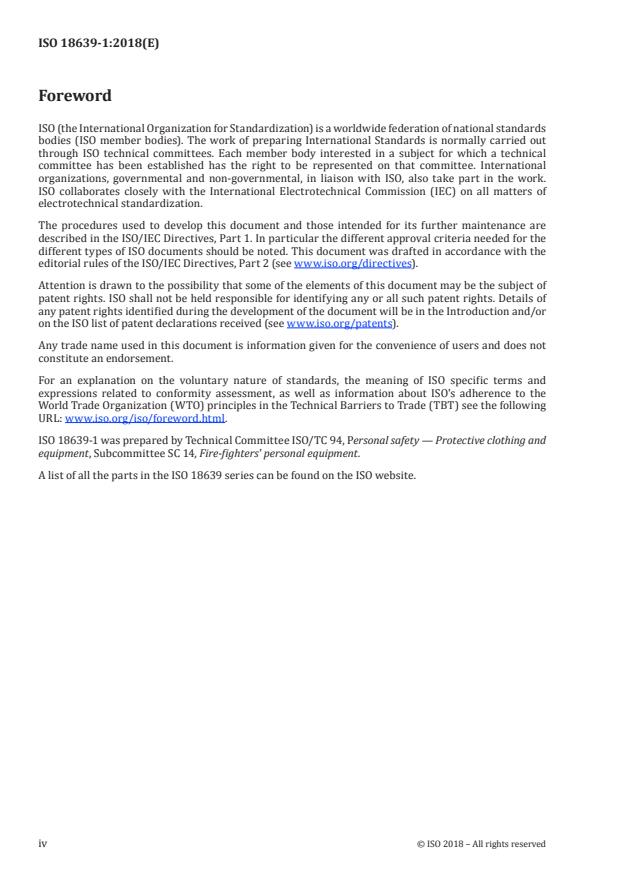
ISO 18639-1:2018 - PPE ensembles for firefighters undertaking specific rescue activities

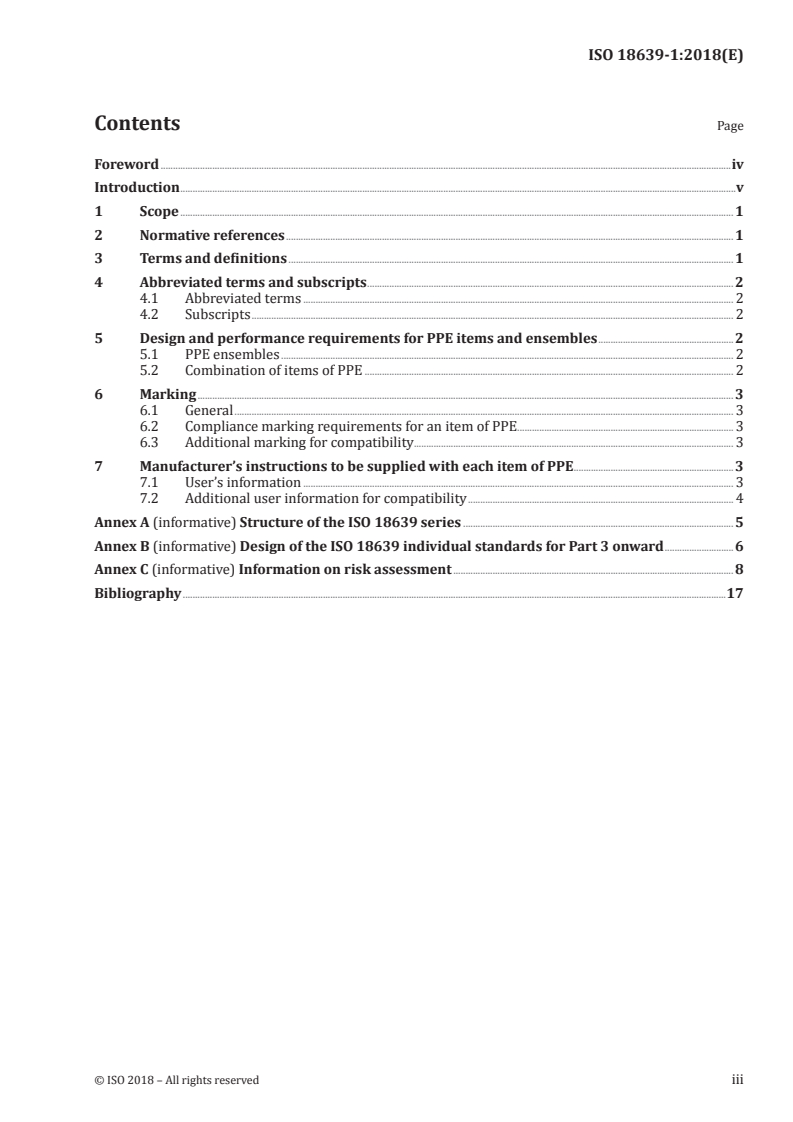

ISO 18639-1:2018 - PPE ensembles for firefighters undertaking specific rescue activities — Part 1: General/5/2018
Overview
ISO 18639-1:2018 - "PPE ensembles for firefighters undertaking specific rescue activities - Part 1: General" defines the structure, principles and general requirements for personal protective equipment (PPE) designed to protect firefighters and rescue workers during specific rescue tasks (notably road traffic crash (RTC) and urban search and rescue (USAR)). It sets out how the ISO 18639 series is organised, the relationship between individual item standards and ensemble performance, and mandatory requirements for marking and manufacturer’s instructions. This part excludes PPE for high-risk fire exposures and routine chemical/biological protection (except short-term accidental exposures during rescue).
Key topics and technical requirements
- Series structure and scope: Describes how Parts 2+ are to be written and how individual item standards combine into ensemble requirements. Annex A/B explain series organisation and drafting approach.
- Design & performance principles: Establishes that PPE selection should be risk-based and that items must meet minimum design and performance requirements appropriate to identified hazards.
- Ensembles vs combinations:
- Ensemble = complete set of PPE items providing whole-body protection and tested to meet ensemble requirements.
- Combination = two or more individual items meeting their relevant part requirements but not classed as a full ensemble.
- Compatibility: Items claiming compatibility must be assessed to interface tests per ISO/TS 11999-2.
- Marking: Conforms with ISO 13688 and additional ISO 18639 rules. Required label content includes product standard reference (ISO 18639-X:YYYY), manufacturer identification and model number; printed characters must be at least 1.5 mm high.
- Manufacturer’s instructions: Minimum user information, care, limitations and compatibility guidance; Annex C provides guidance on carrying out risk assessments.
- Technical indices/abbreviations: Common metrics used in the series (examples listed in the standard) include HTI, RHTI, TTI, retroreflection coefficient R’, and water absorption (w).
Applications and users
- Fire & rescue services selecting PPE for RTC, USAR and other rescue operations based on formal risk assessment.
- PPE manufacturers designing and certifying firefighter helmets, suits, gloves, boots and ensemble compatibility.
- Procurement officers, safety managers and standards bodies who need consistent, performance-based PPE specifications.
- Test laboratories and conformity assessors performing compatibility and marking verification.
Related standards
- ISO/TS 11999-2 (compatibility test methods for firefighter PPE ensembles)
- ISO 13688 (protective clothing - general requirements)
- EN 1149-3 / EN 1149-5 (electrostatic properties)
- ISO/TR 21808 (guidance referenced by SC 14)
Keywords: ISO 18639-1:2018, PPE ensembles, firefighters, rescue activities, RTC, USAR, PPE compatibility, marking, manufacturer’s instructions, risk assessment, performance requirements.
Buy Documents
ISO 18639-1:2018 - PPE ensembles for firefighters undertaking specific rescue activities
ISO 18639-1:2018 - PPE ensembles for firefighters undertaking specific rescue activities — Part 1: General/5/2018
Get Certified
Connect with accredited certification bodies for this standard

CIS Institut d.o.o.
Personal Protective Equipment (PPE) certification body. Notified Body NB-2890 for EU Regulation 2016/425 PPE.

Kiwa BDA Testing
Building and construction product certification.
Kmetijski inštitut Slovenije
Agricultural Institute of Slovenia. Soil testing, plant health, agricultural product analysis.
Sponsored listings
Frequently Asked Questions
ISO 18639-1:2018 is a standard published by the International Organization for Standardization (ISO). Its full title is "PPE ensembles for firefighters undertaking specific rescue activities — Part 1: General". This standard covers: ISO 18639 series of standards specify requirements of personal protective equipment (PPE) specifically designed to protect firefighters from injury and/or loss of life while engaged in specific rescue activities. ISO 18639 series provides the principles that govern the development of incident type and/or hazard specific minimum test methods including design and performance requirements for personal protective equipment (PPE) worn by firefighters and other rescue workers to reduce injury and/or the loss of life while engaged in rescue activities. To assist with selection based on a risk assessment (see Annex C), type of PPE, (if applicable) and performance levels, for different categories of protection are included. ISO 18639-1:2018 covers PPE for use in the rescue activities for road traffic crash (RTC) and urban search and rescue (USAR), but could also include other rescue activities depending on the risk assessment. ISO 18639-1:2018 does not include PPE for use in high risk fire exposures. Similarly, this document does not include PPE to protect against chemical and biological hazards, except against short term and accidental exposures whilst engaged in rescue activities. ISO 18639-1:2018 describes the general structure of the ISO 18639 series, including each subsection, sets design and performance requirements for PPE and includes requirements for marking and manufacturer's instructions.
ISO 18639 series of standards specify requirements of personal protective equipment (PPE) specifically designed to protect firefighters from injury and/or loss of life while engaged in specific rescue activities. ISO 18639 series provides the principles that govern the development of incident type and/or hazard specific minimum test methods including design and performance requirements for personal protective equipment (PPE) worn by firefighters and other rescue workers to reduce injury and/or the loss of life while engaged in rescue activities. To assist with selection based on a risk assessment (see Annex C), type of PPE, (if applicable) and performance levels, for different categories of protection are included. ISO 18639-1:2018 covers PPE for use in the rescue activities for road traffic crash (RTC) and urban search and rescue (USAR), but could also include other rescue activities depending on the risk assessment. ISO 18639-1:2018 does not include PPE for use in high risk fire exposures. Similarly, this document does not include PPE to protect against chemical and biological hazards, except against short term and accidental exposures whilst engaged in rescue activities. ISO 18639-1:2018 describes the general structure of the ISO 18639 series, including each subsection, sets design and performance requirements for PPE and includes requirements for marking and manufacturer's instructions.
ISO 18639-1:2018 is classified under the following ICS (International Classification for Standards) categories: 13.340.01 - Protective equipment in general. The ICS classification helps identify the subject area and facilitates finding related standards.
ISO 18639-1:2018 is available in PDF format for immediate download after purchase. The document can be added to your cart and obtained through the secure checkout process. Digital delivery ensures instant access to the complete standard document.
Standards Content (Sample)
INTERNATIONAL ISO
STANDARD 18639-1
First edition
2018-01
PPE ensembles for firefighters
undertaking specific rescue
activities —
Part 1:
General
Équipements de protection personnelle pour pompiers entreprenant
des activités de sauvetage particulières —
Partie 1: Généralités
Reference number
©
ISO 2018
© ISO 2018, Published in Switzerland
All rights reserved. Unless otherwise specified, no part of this publication may be reproduced or utilized otherwise in any form
or by any means, electronic or mechanical, including photocopying, or posting on the internet or an intranet, without prior
written permission. Permission can be requested from either ISO at the address below or ISO’s member body in the country of
the requester.
ISO copyright office
Ch. de Blandonnet 8 • CP 401
CH-1214 Vernier, Geneva, Switzerland
Tel. +41 22 749 01 11
Fax +41 22 749 09 47
copyright@iso.org
www.iso.org
ii © ISO 2018 – All rights reserved
Contents Page
Foreword .iv
Introduction .v
1 Scope . 1
2 Normative references . 1
3 Terms and definitions . 1
4 Abbreviated terms and subscripts . 2
4.1 Abbreviated terms . 2
4.2 Subscripts . 2
5 Design and performance requirements for PPE items and ensembles .2
5.1 PPE ensembles . 2
5.2 Combination of items of PPE . 2
6 Marking . 3
6.1 General . 3
6.2 Compliance marking requirements for an item of PPE. 3
6.3 Additional marking for compatibility . . 3
7 Manufacturer’s instructions to be supplied with each item of PPE .3
7.1 User’s information . 3
7.2 Additional user information for compatibility . 4
Annex A (informative) Structure of the ISO 18639 series . 5
Annex B (informative) Design of the ISO 18639 individual standards for Part 3 onward .6
Annex C (informative) Information on risk assessment . 8
Bibliography .17
Foreword
ISO (the International Organization for Standardization) is a worldwide federation of national standards
bodies (ISO member bodies). The work of preparing International Standards is normally carried out
through ISO technical committees. Each member body interested in a subject for which a technical
committee has been established has the right to be represented on that committee. International
organizations, governmental and non-governmental, in liaison with ISO, also take part in the work.
ISO collaborates closely with the International Electrotechnical Commission (IEC) on all matters of
electrotechnical standardization.
The procedures used to develop this document and those intended for its further maintenance are
described in the ISO/IEC Directives, Part 1. In particular the different approval criteria needed for the
different types of ISO documents should be noted. This document was drafted in accordance with the
editorial rules of the ISO/IEC Directives, Part 2 (see www.iso.org/directives).
Attention is drawn to the possibility that some of the elements of this document may be the subject of
patent rights. ISO shall not be held responsible for identifying any or all such patent rights. Details of
any patent rights identified during the development of the document will be in the Introduction and/or
on the ISO list of patent declarations received (see www.iso.org/patents).
Any trade name used in this document is information given for the convenience of users and does not
constitute an endorsement.
For an explanation on the voluntary nature of standards, the meaning of ISO specific terms and
expressions related to conformity assessment, as well as information about ISO's adherence to the
World Trade Organization (WTO) principles in the Technical Barriers to Trade (TBT) see the following
URL: www.iso.org/iso/foreword.html.
ISO 18639-1 was prepared by Technical Committee ISO/TC 94, Personal safety — Protective clothing and
equipment, Subcommittee SC 14, Fire-fighters' personal equipment.
A list of all the parts in the ISO 18639 series can be found on the ISO website.
iv © ISO 2018 – All rights reserved
Introduction
ISO 18639 series of standards specify requirements of personal protective equipment (PPE) specifically
designed to protect firefighters from injury and/or loss of life while engaged in special rescue activities.
This document specifies the organisational structure of the ISO 18639 series of standards (see Annex A)
with common standard design for easier end user access (see Annex B for ISO 18639-3 onward) and the
drafting structure to be used consistently in the individual standards within the ISO 18639 series.
ISO/TS 11999-2 specifies design and performance requirements for the compatibility of the relevant
parts of the ISO 18639 series when all or some of the items covered in these parts are worn together,
thereby creating an ensemble standard. All items meet the general requirements for marking
and manufacturer’s instructions detailed in this document, as well as the specific marking and
manufacturer’s instructions of the respective parts.
Under best practice health and safety procedures, prior to choosing any PPE, a risk assessment of the
workplace is carried out. Where hazards are identified and cannot be removed from a work place, the items
of PPE chosen to protect personnel need to be fit for their intended use. They need to protect personnel
whilst allowing them to carry out the work required in their workplace without unduly increasing the
risk. In environments where firefighters can be required to work, not only needs the PPE protect the
firefighter whilst enabling them to achieve the objectives of attendance at an incident, but it also needs
safeguard them and allow a safe escape in the event that this becomes necessary. The risk assessment
is the responsibility of the firefighting organisation that is purchasing the PPE. The PPE chosen will also
allow the firefighter to carry out their duties without undue stress being caused by the PPE.
Some PPE, particularly PPE to protect against mortal danger, may have failure levels far above the
limit of exposures of human beings. In situations such as this, it is important to ensure that proper and
suitable safety procedures are in place that will both identify when personnel should be withdrawn
from dangerous or potentially dangerous situations. In addition, they need to ensure that the relevant
medical support is available for firefighters when they exit the incident, if rehydration or any other
medical treatment is required.
As the risk assessment will dictate the performance parameters for the PPE, it is critical that decision-
makers have the necessary knowledge of the risks against which the PPE is designed to protect. In
addition, they also need to understand the limitations of the equipment. It is recommended that those
who make the decision on the choice of PPE for particular work places should be competent in their
knowledge and understanding of both the work place hazards and the PPE from which to choose, prior
to making these decisions, to ensure that informed decisions are taken.
Further detail on carrying out risk assessment to ascertain the type of PPE required to protect
personnel working in specific areas is included in Annex C of this document.
Hazards in the workplaces of firefighters are varied but may be common from workplace to workplace
therefore some uses of PPE for firefighters can be multi-purpose. Because this Standard has been
developed on a risk assessment approach, a number of different types, levels or classes are given for
certain performance requirements of various parts of a PPE ensemble.
ISO 18639 series includes separate parts for each item of a firefighter's ensemble. As PPE to protect
each part of the body can be so complex, this Standard draws from the expertise of other technical
Committees in ISO, which specialise in such protection.
The results of the risk assessment for certain work places may require the use of PPE with higher
and/or different levels or classes of performance than those in this Standard. PPE covered in this
document will not protect from all possible exposures. Nothing in this document is intended to restrict
any jurisdiction, purchaser or manufacturer from exceeding the minimum performance requirements
specified in this Standard.
ISO/TC 94/SC 14 was established in 2000 with the purpose of standardisation of the performance
of personal protective equipment (PPE) intended to safeguard firefighters against the hazards
encountered in the performance of their duties. Two of the objectives of the ISO/TC 94/SC 14 Business
Plan are:
— to move away from prescriptive-based requirements in standards to a performance-based approach
incorporating a risk assessment in all areas of firefighters personal protective equipment, and
— to ensure wherever practical, compatibility, integration and consistency between the components
of firefighters PPE.
ISO/TC 94/SC 14 has developed a Technical Report on this subject, ISO/TR 21808. Firefighters are
trained in the selection, use, care and maintenance of their PPE. Firefighters need also to be trained in
the performance and limitation of their PPE.
vi © ISO 2018 – All rights reserved
INTERNATIONAL STANDARD ISO 18639-1:2018(E)
PPE ensembles for firefighters undertaking specific rescue
activities —
Part 1:
General
1 Scope
ISO 18639 series of standards specify requirements of personal protective equipment (PPE) specifically
designed to protect firefighters from injury and/or loss of life while engaged in specific rescue activities.
ISO 18639 series provides the principles that govern the development of incident type and/or hazard
specific minimum test methods including design and performance requirements for personal protective
equipment (PPE) worn by firefighters and other rescue workers to reduce injury and/or the loss of life
while engaged in rescue activities.
To assist with selection based on a risk assessment (see Annex C), type of PPE, (if applicable) and
performance levels, for different categories of protection are included.
This document covers PPE for use in the rescue activities for road traffic crash (RTC) and urban search
and rescue (USAR), but could also include other rescue activities depending on the risk assessment.
It does not include PPE for use in high risk fire exposures.
Similarly, this document does not include PPE to protect against chemical and biological hazards, except
against short term and accidental exposures whilst engaged in rescue activities.
This document describes the general structure of the ISO 18639 series, including each subsection,
sets design and performance requirements for PPE and includes requirements for marking and
manufacturer’s instructions.
2 Normative references
The following documents are referred to in the text in such a way that some or all of their content
constitutes requirements of this document. For dated references, only the edition cited applies. For
undated references, the latest edition of the referenced document (including any amendments) applies.
ISO/TS 11999-2, PPE for firefighters — Test methods and requirements for PPE used by firefighters who
are at risk of exposure to high levels of heat and/or flame while fighting fires occurring in structures —
Part 2: Compatibility
ISO 13688, Protective clothing — General requirements
EN 1149-3, Protective clothing — Electrostatic properties — Test methods for measurement of charge decay
EN 1149-5, Protective clothing — Electrostatic properties — Material performance and design
requirements
3 Terms and definitions
There are no normative references in this document.
4 Abbreviated terms and subscripts
4.1 Abbreviated terms
RTC Road Traffic Crash
USAR Urban Search and Rescue
PPE personal protective equipment
RPD respiratory protective device
HTI heat transmission index (12 °C temperature rise)
HTI heat transmission index (24 °C temperature rise)
TTI thermal threshold index
m mass
R’ coefficient of retroreflection
RHTI radiant heat transmission index (12 °C temperature rise)
RHTI radiant heat transmission index (24 °C temperature rise)
w mass fraction of water absorbed
w
4.2 Subscripts
12 at 12 °C temperature rise
24 at 24 °C temperature rise
w water
5 Design and performance requirements for PPE items and ensembles
5.1 PPE ensembles
An ensemble of PPE items is classified as meeting the requirements of this document, if every item in
the ensemble meets the appropriate requirements of the relevant parts of ISO 18639 series and provide
as an ensemble protection to the whole body of the firefighter for rescue operations.
For example, any item of PPE or any PPE ensemble, which are intended to provide protection for the
firefighter’s upper and lower torso, head, neck, arms, hands, legs and feet, shall be in accordance with
the requirements of relevant part of ISO 18639 series.
Nevertheless, an item of PPE, which is in accordance with the requirements of one of the relevant part
of ISO 18639 series, can individually be designated and marked for that item of PPE according to the
relevant part of the ISO 18639 series.
5.2 Combination of items of PPE
A PPE combination is the use of 2 or more PPE elements, each of which meets the requirements of the
relevant individual part of ISO the 18639 series but is not classed as an ensemble (see 5.1).
2 © ISO 2018 – All rights reserved
PPE combinations that claim compatibility shall be assessed according to the relevant interface
compatibility testing method(s) described in relevant clause(s) or subclause(s) of ISO/TS 11999-2.
NOTE A combination is more than a single item of PPE but less than an ensemble, i.e. it is not an offering
protection for the whole firefighter.
6 Marking
6.1 General
Marking requirements shall be as specified in ISO 13688 and in this clause.
ISO 13688 shall include the marking requirements specified in this clause and in additional specified
requirements for the individual PPE elements of the relevant parts of ISO 18639 series.
Any marking in the form of labels shall not adversely affect the performance of any item to which they
are attached or present a hazard to the wearer.
When required labels that shall be tested for flammability according to the requirements for labels in
ISO 18639-3 only where placed on the exterior of the garment. Labels (interior and exterior) and closure
systems shall be tested to the relevant requirements according to the PPE item they are attached.
Marking of PPE shall be under the specific requirements of the item in the relevant parts of
ISO 18639 series.
6.2 Compliance marking requirements for an item of PPE
Each item of PPE, for which compliance with this document is claimed, shall have a label permanently
and conspicuously attached in conformance with ISO 13688 and upon which the following information
is printed in letters at least 1,5 mm high:
a) identification of product standard — ISO 18639-X:YYYY;
b) the name, trademark, or other means of identifying or tracing back to the manufacturer;
c) the manufacturer’s model number and/or user’s specified number.
6.3 Additional marking for compatibility
Ensembles and combination of PPE items which are intended to be worn together and or assembled, shall
be tested together according to the respective compatibility requirements clause(s) and subclause(s) of
ISO/TS 11999-2 and meet the requirements of the individual parts of ISO 18639 series. An additional
marking shall be added to the item individual markings, clearly listing and identifying all items that are
compatible:
― compatible with …………….[using information in 6.2 c)].
7 Manufacturer’s instructions to be supplied with each item of PPE
7.1 User’s information
The manufacturer shall meet the requirements of ISO 13688 and the minimum requirements in 7.1 and
7.2. Manufacturers shall also add additional relevant information from each part of ISO 18639 series.
The manufacturer shall provide user’s information including, but not limited to, data showing
conformity to the item of relevant part(s) of ISO 18639 series, any additional data required by this
document, the results of any optional tests undertaken, warnings, information, and instructions with
each PPE.
Instructions shall be supplied in the official language(s) of the country of destination.
The manufacturer shall provide at least the following instructions and information with each PPE:
a) safety considerations,
b) information about the markings,
c) limitations of use,
d) preparation for use,
e) sizing,
f) recommended storage practices,
g) inspection frequency and details,
h) donning and doffing procedures,
i) maintenance and cleaning,
j) retirement and disposal,
k) known shelf life limitations, and
l) information about the use of integrated devices.
The manufacturer shall attach the manufacturer’s instructions, or packaging containing this
information, to the relevant item of PPE in such a manner that it is not possible to use the item of PPE
without being aware of the availability of the information and that a deliberate action is necessary to
remove it.
The manufacturer shall provide notice that the information is to be removed ONLY by the end user.
Instructions shall give the following additional information:
— In the situation where a combination of PPE items or an ensemble, do not have the same rating, for
example, different levels of heat and flame protection, the manufacturer’s instructions shall indicate
additional effects and risks which may result.
7.2 Additional user information for compatibility
The combination of PPE items which are intended to be worn and or assembled together, shall be tested
together according to the respective compatibility requirements of ISO/TS 11999-2 and meet the
requirements of the individual parts of ISO 18639 series.
For the compatible items of PPE, the manufacture shall provide a declaration for each compatible PPE,
additional information on the conformity to the requirements of relevant clause(s) and subclause(s) of
ISO/TS 11999-2 and any additional checks or warnings, such as but not limited to:
— compatible with …………….[using information in 6.2 c)];
— testing and classification of performance for items of PPE, for combinations of items of PPE for
ensembles;
— additional compatibility testing, including detailed instructions, that shall be completed by the end
user before wearing the PPE in hazard situations.
4 © ISO 2018 – All rights reserved
Annex A
(informative)
Structure of the ISO 18639 series
Figure A.1 — Representation of the structure of the ISO 18639 series
Annex B
(informative)
Design of the ISO 18639 individual standards for Part 3 onward
Keep only first two levels as fixed: Foreword, Introduction, Clauses 1, 2, 3, 4, 5, 6, 6.1 to 6.8, 7 and 8. The
titles of 6.3.1, 6.4.1, 6.5.1, 6.7.1-6.7.2, and 6.8.1 to 6.8.3 are given as examples.
Foreword
Introduction
1. Scope
2. Normative References
3. Terms and Definitions
4. Design and General Requirements
5. Pre-treatment, Conditioning and Sampling
6. Performance Requirements
6.1 General
6.2 Summary of Requirements and Classification
Requirements RTC USAR Xxxx
Flame resistance 6.xx Index Index
Radiant heat 6.xxx
Contact heat 6.xx
….
Tensile strength
www WWW
— outer material
xxx XXX
— seams
Tear strength yyy YYY
Abrasion resistance (rubs) zzz ZZZ
…
6.3 Thermal/arc requirements
6.3.1 Flame spread
6.3.2 …
6.4 Mechanical protection requirements
6.4.1 Tensile Strength
6.4.2 …
6.5 Environmental Protection requirements
6.5.1 Surface wetting
6 © ISO 2018 – All rights reserved
6.5.2 ….
6.6 Visibility requirements
6.7 Biological and chemical requirements
6.7.1 Chemical
6.7.2 Viral
6.7.3 ….
6.8 Other requirements
6.8.1 Ergonomics
6.8.2 Dexterity
6.8.3 Grip
6.8.4 …
7. Marking
8. User I
...
INTERNATIONAL ISO
STANDARD 18639-1
First edition
2018-01
PPE ensembles for firefighters
undertaking specific rescue
activities —
Part 1:
General
Équipements de protection personnelle pour pompiers entreprenant
des activités de sauvetage particulières —
Partie 1: Généralités
Reference number
©
ISO 2018
© ISO 2018, Published in Switzerland
All rights reserved. Unless otherwise specified, no part of this publication may be reproduced or utilized otherwise in any form
or by any means, electronic or mechanical, including photocopying, or posting on the internet or an intranet, without prior
written permission. Permission can be requested from either ISO at the address below or ISO’s member body in the country of
the requester.
ISO copyright office
Ch. de Blandonnet 8 • CP 401
CH-1214 Vernier, Geneva, Switzerland
Tel. +41 22 749 01 11
Fax +41 22 749 09 47
copyright@iso.org
www.iso.org
ii © ISO 2018 – All rights reserved
Contents Page
Foreword .iv
Introduction .v
1 Scope . 1
2 Normative references . 1
3 Terms and definitions . 1
4 Abbreviated terms and subscripts . 2
4.1 Abbreviated terms . 2
4.2 Subscripts . 2
5 Design and performance requirements for PPE items and ensembles .2
5.1 PPE ensembles . 2
5.2 Combination of items of PPE . 2
6 Marking . 3
6.1 General . 3
6.2 Compliance marking requirements for an item of PPE. 3
6.3 Additional marking for compatibility . . 3
7 Manufacturer’s instructions to be supplied with each item of PPE .3
7.1 User’s information . 3
7.2 Additional user information for compatibility . 4
Annex A (informative) Structure of the ISO 18639 series . 5
Annex B (informative) Design of the ISO 18639 individual standards for Part 3 onward .6
Annex C (informative) Information on risk assessment . 8
Bibliography .17
Foreword
ISO (the International Organization for Standardization) is a worldwide federation of national standards
bodies (ISO member bodies). The work of preparing International Standards is normally carried out
through ISO technical committees. Each member body interested in a subject for which a technical
committee has been established has the right to be represented on that committee. International
organizations, governmental and non-governmental, in liaison with ISO, also take part in the work.
ISO collaborates closely with the International Electrotechnical Commission (IEC) on all matters of
electrotechnical standardization.
The procedures used to develop this document and those intended for its further maintenance are
described in the ISO/IEC Directives, Part 1. In particular the different approval criteria needed for the
different types of ISO documents should be noted. This document was drafted in accordance with the
editorial rules of the ISO/IEC Directives, Part 2 (see www.iso.org/directives).
Attention is drawn to the possibility that some of the elements of this document may be the subject of
patent rights. ISO shall not be held responsible for identifying any or all such patent rights. Details of
any patent rights identified during the development of the document will be in the Introduction and/or
on the ISO list of patent declarations received (see www.iso.org/patents).
Any trade name used in this document is information given for the convenience of users and does not
constitute an endorsement.
For an explanation on the voluntary nature of standards, the meaning of ISO specific terms and
expressions related to conformity assessment, as well as information about ISO's adherence to the
World Trade Organization (WTO) principles in the Technical Barriers to Trade (TBT) see the following
URL: www.iso.org/iso/foreword.html.
ISO 18639-1 was prepared by Technical Committee ISO/TC 94, Personal safety — Protective clothing and
equipment, Subcommittee SC 14, Fire-fighters' personal equipment.
A list of all the parts in the ISO 18639 series can be found on the ISO website.
iv © ISO 2018 – All rights reserved
Introduction
ISO 18639 series of standards specify requirements of personal protective equipment (PPE) specifically
designed to protect firefighters from injury and/or loss of life while engaged in special rescue activities.
This document specifies the organisational structure of the ISO 18639 series of standards (see Annex A)
with common standard design for easier end user access (see Annex B for ISO 18639-3 onward) and the
drafting structure to be used consistently in the individual standards within the ISO 18639 series.
ISO/TS 11999-2 specifies design and performance requirements for the compatibility of the relevant
parts of the ISO 18639 series when all or some of the items covered in these parts are worn together,
thereby creating an ensemble standard. All items meet the general requirements for marking
and manufacturer’s instructions detailed in this document, as well as the specific marking and
manufacturer’s instructions of the respective parts.
Under best practice health and safety procedures, prior to choosing any PPE, a risk assessment of the
workplace is carried out. Where hazards are identified and cannot be removed from a work place, the items
of PPE chosen to protect personnel need to be fit for their intended use. They need to protect personnel
whilst allowing them to carry out the work required in their workplace without unduly increasing the
risk. In environments where firefighters can be required to work, not only needs the PPE protect the
firefighter whilst enabling them to achieve the objectives of attendance at an incident, but it also needs
safeguard them and allow a safe escape in the event that this becomes necessary. The risk assessment
is the responsibility of the firefighting organisation that is purchasing the PPE. The PPE chosen will also
allow the firefighter to carry out their duties without undue stress being caused by the PPE.
Some PPE, particularly PPE to protect against mortal danger, may have failure levels far above the
limit of exposures of human beings. In situations such as this, it is important to ensure that proper and
suitable safety procedures are in place that will both identify when personnel should be withdrawn
from dangerous or potentially dangerous situations. In addition, they need to ensure that the relevant
medical support is available for firefighters when they exit the incident, if rehydration or any other
medical treatment is required.
As the risk assessment will dictate the performance parameters for the PPE, it is critical that decision-
makers have the necessary knowledge of the risks against which the PPE is designed to protect. In
addition, they also need to understand the limitations of the equipment. It is recommended that those
who make the decision on the choice of PPE for particular work places should be competent in their
knowledge and understanding of both the work place hazards and the PPE from which to choose, prior
to making these decisions, to ensure that informed decisions are taken.
Further detail on carrying out risk assessment to ascertain the type of PPE required to protect
personnel working in specific areas is included in Annex C of this document.
Hazards in the workplaces of firefighters are varied but may be common from workplace to workplace
therefore some uses of PPE for firefighters can be multi-purpose. Because this Standard has been
developed on a risk assessment approach, a number of different types, levels or classes are given for
certain performance requirements of various parts of a PPE ensemble.
ISO 18639 series includes separate parts for each item of a firefighter's ensemble. As PPE to protect
each part of the body can be so complex, this Standard draws from the expertise of other technical
Committees in ISO, which specialise in such protection.
The results of the risk assessment for certain work places may require the use of PPE with higher
and/or different levels or classes of performance than those in this Standard. PPE covered in this
document will not protect from all possible exposures. Nothing in this document is intended to restrict
any jurisdiction, purchaser or manufacturer from exceeding the minimum performance requirements
specified in this Standard.
ISO/TC 94/SC 14 was established in 2000 with the purpose of standardisation of the performance
of personal protective equipment (PPE) intended to safeguard firefighters against the hazards
encountered in the performance of their duties. Two of the objectives of the ISO/TC 94/SC 14 Business
Plan are:
— to move away from prescriptive-based requirements in standards to a performance-based approach
incorporating a risk assessment in all areas of firefighters personal protective equipment, and
— to ensure wherever practical, compatibility, integration and consistency between the components
of firefighters PPE.
ISO/TC 94/SC 14 has developed a Technical Report on this subject, ISO/TR 21808. Firefighters are
trained in the selection, use, care and maintenance of their PPE. Firefighters need also to be trained in
the performance and limitation of their PPE.
vi © ISO 2018 – All rights reserved
INTERNATIONAL STANDARD ISO 18639-1:2018(E)
PPE ensembles for firefighters undertaking specific rescue
activities —
Part 1:
General
1 Scope
ISO 18639 series of standards specify requirements of personal protective equipment (PPE) specifically
designed to protect firefighters from injury and/or loss of life while engaged in specific rescue activities.
ISO 18639 series provides the principles that govern the development of incident type and/or hazard
specific minimum test methods including design and performance requirements for personal protective
equipment (PPE) worn by firefighters and other rescue workers to reduce injury and/or the loss of life
while engaged in rescue activities.
To assist with selection based on a risk assessment (see Annex C), type of PPE, (if applicable) and
performance levels, for different categories of protection are included.
This document covers PPE for use in the rescue activities for road traffic crash (RTC) and urban search
and rescue (USAR), but could also include other rescue activities depending on the risk assessment.
It does not include PPE for use in high risk fire exposures.
Similarly, this document does not include PPE to protect against chemical and biological hazards, except
against short term and accidental exposures whilst engaged in rescue activities.
This document describes the general structure of the ISO 18639 series, including each subsection,
sets design and performance requirements for PPE and includes requirements for marking and
manufacturer’s instructions.
2 Normative references
The following documents are referred to in the text in such a way that some or all of their content
constitutes requirements of this document. For dated references, only the edition cited applies. For
undated references, the latest edition of the referenced document (including any amendments) applies.
ISO/TS 11999-2, PPE for firefighters — Test methods and requirements for PPE used by firefighters who
are at risk of exposure to high levels of heat and/or flame while fighting fires occurring in structures —
Part 2: Compatibility
ISO 13688, Protective clothing — General requirements
EN 1149-3, Protective clothing — Electrostatic properties — Test methods for measurement of charge decay
EN 1149-5, Protective clothing — Electrostatic properties — Material performance and design
requirements
3 Terms and definitions
There are no normative references in this document.
4 Abbreviated terms and subscripts
4.1 Abbreviated terms
RTC Road Traffic Crash
USAR Urban Search and Rescue
PPE personal protective equipment
RPD respiratory protective device
HTI heat transmission index (12 °C temperature rise)
HTI heat transmission index (24 °C temperature rise)
TTI thermal threshold index
m mass
R’ coefficient of retroreflection
RHTI radiant heat transmission index (12 °C temperature rise)
RHTI radiant heat transmission index (24 °C temperature rise)
w mass fraction of water absorbed
w
4.2 Subscripts
12 at 12 °C temperature rise
24 at 24 °C temperature rise
w water
5 Design and performance requirements for PPE items and ensembles
5.1 PPE ensembles
An ensemble of PPE items is classified as meeting the requirements of this document, if every item in
the ensemble meets the appropriate requirements of the relevant parts of ISO 18639 series and provide
as an ensemble protection to the whole body of the firefighter for rescue operations.
For example, any item of PPE or any PPE ensemble, which are intended to provide protection for the
firefighter’s upper and lower torso, head, neck, arms, hands, legs and feet, shall be in accordance with
the requirements of relevant part of ISO 18639 series.
Nevertheless, an item of PPE, which is in accordance with the requirements of one of the relevant part
of ISO 18639 series, can individually be designated and marked for that item of PPE according to the
relevant part of the ISO 18639 series.
5.2 Combination of items of PPE
A PPE combination is the use of 2 or more PPE elements, each of which meets the requirements of the
relevant individual part of ISO the 18639 series but is not classed as an ensemble (see 5.1).
2 © ISO 2018 – All rights reserved
PPE combinations that claim compatibility shall be assessed according to the relevant interface
compatibility testing method(s) described in relevant clause(s) or subclause(s) of ISO/TS 11999-2.
NOTE A combination is more than a single item of PPE but less than an ensemble, i.e. it is not an offering
protection for the whole firefighter.
6 Marking
6.1 General
Marking requirements shall be as specified in ISO 13688 and in this clause.
ISO 13688 shall include the marking requirements specified in this clause and in additional specified
requirements for the individual PPE elements of the relevant parts of ISO 18639 series.
Any marking in the form of labels shall not adversely affect the performance of any item to which they
are attached or present a hazard to the wearer.
When required labels that shall be tested for flammability according to the requirements for labels in
ISO 18639-3 only where placed on the exterior of the garment. Labels (interior and exterior) and closure
systems shall be tested to the relevant requirements according to the PPE item they are attached.
Marking of PPE shall be under the specific requirements of the item in the relevant parts of
ISO 18639 series.
6.2 Compliance marking requirements for an item of PPE
Each item of PPE, for which compliance with this document is claimed, shall have a label permanently
and conspicuously attached in conformance with ISO 13688 and upon which the following information
is printed in letters at least 1,5 mm high:
a) identification of product standard — ISO 18639-X:YYYY;
b) the name, trademark, or other means of identifying or tracing back to the manufacturer;
c) the manufacturer’s model number and/or user’s specified number.
6.3 Additional marking for compatibility
Ensembles and combination of PPE items which are intended to be worn together and or assembled, shall
be tested together according to the respective compatibility requirements clause(s) and subclause(s) of
ISO/TS 11999-2 and meet the requirements of the individual parts of ISO 18639 series. An additional
marking shall be added to the item individual markings, clearly listing and identifying all items that are
compatible:
― compatible with …………….[using information in 6.2 c)].
7 Manufacturer’s instructions to be supplied with each item of PPE
7.1 User’s information
The manufacturer shall meet the requirements of ISO 13688 and the minimum requirements in 7.1 and
7.2. Manufacturers shall also add additional relevant information from each part of ISO 18639 series.
The manufacturer shall provide user’s information including, but not limited to, data showing
conformity to the item of relevant part(s) of ISO 18639 series, any additional data required by this
document, the results of any optional tests undertaken, warnings, information, and instructions with
each PPE.
Instructions shall be supplied in the official language(s) of the country of destination.
The manufacturer shall provide at least the following instructions and information with each PPE:
a) safety considerations,
b) information about the markings,
c) limitations of use,
d) preparation for use,
e) sizing,
f) recommended storage practices,
g) inspection frequency and details,
h) donning and doffing procedures,
i) maintenance and cleaning,
j) retirement and disposal,
k) known shelf life limitations, and
l) information about the use of integrated devices.
The manufacturer shall attach the manufacturer’s instructions, or packaging containing this
information, to the relevant item of PPE in such a manner that it is not possible to use the item of PPE
without being aware of the availability of the information and that a deliberate action is necessary to
remove it.
The manufacturer shall provide notice that the information is to be removed ONLY by the end user.
Instructions shall give the following additional information:
— In the situation where a combination of PPE items or an ensemble, do not have the same rating, for
example, different levels of heat and flame protection, the manufacturer’s instructions shall indicate
additional effects and risks which may result.
7.2 Additional user information for compatibility
The combination of PPE items which are intended to be worn and or assembled together, shall be tested
together according to the respective compatibility requirements of ISO/TS 11999-2 and meet the
requirements of the individual parts of ISO 18639 series.
For the compatible items of PPE, the manufacture shall provide a declaration for each compatible PPE,
additional information on the conformity to the requirements of relevant clause(s) and subclause(s) of
ISO/TS 11999-2 and any additional checks or warnings, such as but not limited to:
— compatible with …………….[using information in 6.2 c)];
— testing and classification of performance for items of PPE, for combinations of items of PPE for
ensembles;
— additional compatibility testing, including detailed instructions, that shall be completed by the end
user before wearing the PPE in hazard situations.
4 © ISO 2018 – All rights reserved
Annex A
(informative)
Structure of the ISO 18639 series
Figure A.1 — Representation of the structure of the ISO 18639 series
Annex B
(informative)
Design of the ISO 18639 individual standards for Part 3 onward
Keep only first two levels as fixed: Foreword, Introduction, Clauses 1, 2, 3, 4, 5, 6, 6.1 to 6.8, 7 and 8. The
titles of 6.3.1, 6.4.1, 6.5.1, 6.7.1-6.7.2, and 6.8.1 to 6.8.3 are given as examples.
Foreword
Introduction
1. Scope
2. Normative References
3. Terms and Definitions
4. Design and General Requirements
5. Pre-treatment, Conditioning and Sampling
6. Performance Requirements
6.1 General
6.2 Summary of Requirements and Classification
Requirements RTC USAR Xxxx
Flame resistance 6.xx Index Index
Radiant heat 6.xxx
Contact heat 6.xx
….
Tensile strength
www WWW
— outer material
xxx XXX
— seams
Tear strength yyy YYY
Abrasion resistance (rubs) zzz ZZZ
…
6.3 Thermal/arc requirements
6.3.1 Flame spread
6.3.2 …
6.4 Mechanical protection requirements
6.4.1 Tensile Strength
6.4.2 …
6.5 Environmental Protection requirements
6.5.1 Surface wetting
6 © ISO 2018 – All rights reserved
6.5.2 ….
6.6 Visibility requirements
6.7 Biological and chemical requirements
6.7.1 Chemical
6.7.2 Viral
6.7.3 ….
6.8 Other requirements
6.8.1 Ergonomics
6.8.2 Dexterity
6.8.3 Grip
6.8.4 …
7. Marking
8. User I
...