

ISO 9813:2023
(Main)Corrosion of metals and alloys — Performance test method for corrosion inhibitors used in chemical cleaning of industry equipment
General Information
- Abstract
This document specifies the performance evaluation test method for corrosion inhibitors used in chemical cleaning of industry equipment. It includes instruments, reagents, preparation and pretreatment of the specimen, test conditions, test methods, reports, etc. The performance evaluation test method includes the static or the dynamic test. This document is applicable to testing the performance of corrosion inhibitors used in chemical cleaning of industry equipment.
- Status
- Published
- Publication Date
- 19-Oct-2023
- Technical Committee
- ISO/TC 156 - Corrosion of metals and alloys
- Drafting Committee
- ISO/TC 156 - Corrosion of metals and alloys
- Current Stage
- 6060 - International Standard published
- Start Date
- 20-Oct-2023
- Due Date
- 08-Nov-2024
- Completion Date
- 20-Oct-2023
Overview
ISO 9813:2023 - "Corrosion of metals and alloys - Performance test method for corrosion inhibitors used in chemical cleaning of industry equipment" defines standardized laboratory methods to evaluate how well corrosion inhibitors protect industrial equipment during chemical cleaning. The standard covers both static and dynamic test methods, required apparatus, reagents, specimen preparation and pretreatment, test conditions, measurement and calculation of corrosion rates, and reporting of results.
Keywords: ISO 9813:2023, corrosion inhibitors, chemical cleaning, performance test method, static test, dynamic test.
Key topics and technical requirements
- Test types: Specifies two main approaches - static tests (wide-mouth jars for <100 °C; autoclaves for 100–200 °C) and dynamic tests (flow-controlled sample tubes with adjustable flow 0–1.0 m/s).
- Apparatus and accuracy:
- Autoclave operating range 100–200 °C and 0.1–2.0 MPa.
- Flow control accuracy ±5%; temperature control accuracy ±3 °C.
- Analytical balance precision ±0.1 mg; vernier caliper ±0.02 mm; magnifier 10×.
- Specimens: Material must match the equipment under evaluation. Typical specimen dimension: 50 mm × 10 mm × 4 mm with two 5 mm mounting holes. Specimens are degreased (ethanol or acetone), abraded (≥120 grit) and rinsed per the standard.
- Reagents and materials: Experimental water per ISO 3696; acetone and ethanol per ISO 6353-2; abrasive paper per ISO 8486-1.
- Test conditions:
- Minimum ratio of solution volume to immersed metal surface area: ≥ 15 ml/cm².
- Defines concentration ranges for cleaning agents and inhibitors, temperature, and test duration (see standard for exact parameters).
- Performance measures: Corrosion rate calculation, assessment of intergranular and stress corrosion, solubility/dispersion, and time-effectiveness of inhibitors.
- Reporting: Specifies the content and format of test reports and includes an informative annex with example results.
Applications and users
ISO 9813:2023 is intended for:
- Corrosion engineers and materials scientists validating inhibitor formulations.
- Chemical cleaning service providers assessing inhibitor performance before field use.
- Quality assurance and R&D teams in oil & gas, chemical processing, power generation, and water treatment industries.
- Test laboratories conducting standardized corrosion testing for compliance, product selection, or comparative evaluation.
Practical benefits include consistent, repeatable evaluation of inhibitor effectiveness during chemical cleaning, reduced risk of unexpected corrosion-induced failures, and evidence-based selection of inhibitors for industrial systems.
Related standards
- ISO 3696 - Water for analytical laboratory use
- ISO 6353-2 - Reagents for chemical analysis (acetone, ethanol)
- ISO 7539-1 and ISO 7539-5 - Stress corrosion testing guidance and C-ring specimens
- ISO 11463 - Guidelines for evaluation of pitting corrosion
For implementation details, consult the full ISO 9813:2023 text.
Get Certified
Connect with accredited certification bodies for this standard

Element Materials Technology
Materials testing and product certification.

Inštitut za kovinske materiale in tehnologije
Institute of Metals and Technology. Materials testing, metallurgical analysis, NDT.
Sponsored listings
Frequently Asked Questions
ISO 9813:2023 is a standard published by the International Organization for Standardization (ISO). Its full title is "Corrosion of metals and alloys — Performance test method for corrosion inhibitors used in chemical cleaning of industry equipment". This standard covers: This document specifies the performance evaluation test method for corrosion inhibitors used in chemical cleaning of industry equipment. It includes instruments, reagents, preparation and pretreatment of the specimen, test conditions, test methods, reports, etc. The performance evaluation test method includes the static or the dynamic test. This document is applicable to testing the performance of corrosion inhibitors used in chemical cleaning of industry equipment.
This document specifies the performance evaluation test method for corrosion inhibitors used in chemical cleaning of industry equipment. It includes instruments, reagents, preparation and pretreatment of the specimen, test conditions, test methods, reports, etc. The performance evaluation test method includes the static or the dynamic test. This document is applicable to testing the performance of corrosion inhibitors used in chemical cleaning of industry equipment.
ISO 9813:2023 is classified under the following ICS (International Classification for Standards) categories: 77.060 - Corrosion of metals. The ICS classification helps identify the subject area and facilitates finding related standards.
ISO 9813:2023 is available in PDF format for immediate download after purchase. The document can be added to your cart and obtained through the secure checkout process. Digital delivery ensures instant access to the complete standard document.
Standards Content (Sample)
INTERNATIONAL ISO
STANDARD 9813
First edition
2023-10
Corrosion of metals and alloys —
Performance test method for
corrosion inhibitors used in chemical
cleaning of industry equipment
Corrosion des métaux et des alliages — Méthode d'essai de
performance pour les inhibiteurs de corrosion utilisés dans le
nettoyage chimique des équipements industriels
Reference number
© ISO 2023
All rights reserved. Unless otherwise specified, or required in the context of its implementation, no part of this publication may
be reproduced or utilized otherwise in any form or by any means, electronic or mechanical, including photocopying, or posting on
the internet or an intranet, without prior written permission. Permission can be requested from either ISO at the address below
or ISO’s member body in the country of the requester.
ISO copyright office
CP 401 • Ch. de Blandonnet 8
CH-1214 Vernier, Geneva
Phone: +41 22 749 01 11
Email: copyright@iso.org
Website: www.iso.org
Published in Switzerland
ii
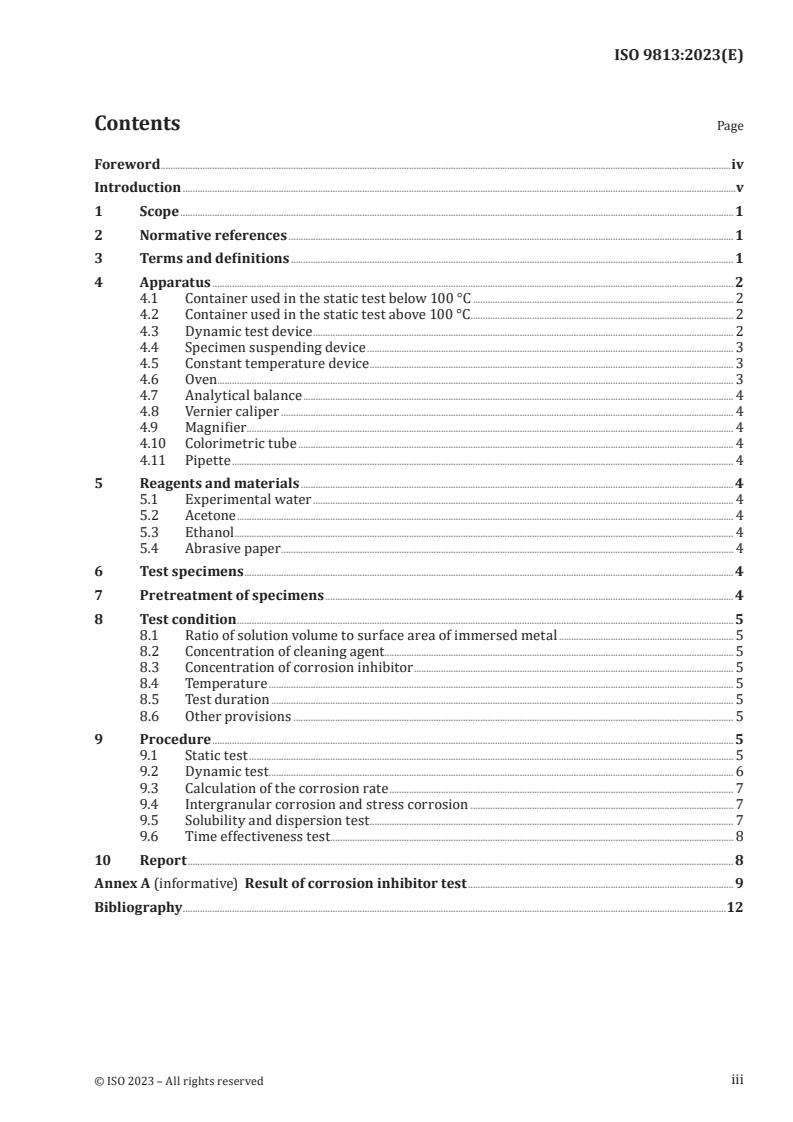
Contents Page
Foreword .iv
Introduction .v
1 Scope . 1
2 Normative references . 1
3 Terms and definitions . 1
4 Apparatus . 2
4.1 Container used in the static test below 100 °C . 2
4.2 Container used in the static test above 100 °C . 2
4.3 Dynamic test device . 2
4.4 Specimen suspending device . 3
4.5 Constant temperature device . 3
4.6 Oven. 3
4.7 Analytical balance . 4
4.8 Vernier caliper . 4
4.9 Magnifier . 4
4.10 Colorimetric tube . 4
4.11 Pipette . 4
5 Reagents and materials . 4
5.1 Experimental water . 4
5.2 Acetone . 4
5.3 Ethanol . 4
5.4 Abrasive paper . 4
6 Test specimens . 4
7 Pretreatment of specimens . 4
8 Test condition .5
8.1 Ratio of solution volume to surface area of immersed metal . 5
8.2 Concentration of cleaning agent. 5
8.3 Concentration of corrosion inhibitor . 5
8.4 Temperature . 5
8.5 Test duration . 5
8.6 Other provisions . 5
9 Procedure .5
9.1 Static test . 5
9.2 Dynamic test . 6
9.3 Calculation of the corrosion rate . 7
9.4 Intergranular corrosion and stress corrosion . 7
9.5 Solubility and dispersion test . 7
9.6 Time effectiveness test. 8
10 Report . 8
Annex A (informative) Result of corrosion inhibitor test . 9
Bibliography .12
iii
Foreword
ISO (the International Organization for Standardization) is a worldwide federation of national standards
bodies (ISO member bodies). The work of preparing International Standards is normally carried out
through ISO technical committees. Each member body interested in a subject for which a technical
committee has been established has the right to be represented on that committee. International
organizations, governmental and non-governmental, in liaison with ISO, also take part in the work.
ISO collaborates closely with the International Electrotechnical Commission (IEC) on all matters of
electrotechnical standardization.
The procedures used to develop this document and those intended for its further maintenance are
described in the ISO/IEC Directives, Part 1. In particular, the different approval criteria needed for the
different types of ISO document should be noted. This document was drafted in accordance with the
editorial rules of the ISO/IEC Directives, Part 2 (see www.iso.org/directives).
ISO draws attention to the possibility that the implementation of this document may involve the use
of (a) patent(s). ISO takes no position concerning the evidence, validity or applicability of any claimed
patent rights in respect thereof. As of the date of publication of this document, ISO had not received
notice of (a) patent(s) which may be required to implement this document. However, implementers are
cautioned that this may not represent the latest information, which may be obtained from the patent
database available at www.iso.org/patents. ISO shall not be held responsible for identifying any or all
such patent rights.
Any trade name used in this document is information given for the convenience of users and does not
constitute an endorsement.
For an explanation of the voluntary nature of standards, the meaning of ISO specific terms and
expressions related to conformity assessment, as well as information about ISO's adherence to
the World Trade Organization (WTO) principles in the Technical Barriers to Trade (TBT), see
www.iso.org/iso/foreword.html.
This document was prepared by Technical Committee ISO/TC 156, Corrosion of metal and alloys.
Any feedback or questions on this document should be directed to the user’s national standards body. A
complete listing of these bodies can be found at www.iso.org/members.html.
iv
Introduction
Corrosion inhibitor can markedly decrease the corrosion rate during metals and alloys chemical
cleaning process, but there is no standard for detection the performance of industry equipment
chemical cleaning corrosion inhibitor. In the current environment, it is of great practical significance
to establish International Standards for the performance evaluation test method of corrosion inhibitor
used in industry equipment chemical cleaning process scientifically and perfectly. This document
provides a basis for performance detection of corrosion inhibitor used in industry equipment chemical
cleaning process and helps prevent potential hazards caused by chemical cleaning.
v
INTERNATIONAL STANDARD ISO 9813:2023(E)
Corrosion of metals and alloys — Performance test method
for corrosion inhibitors used in chemical cleaning of
industry equipment
1 Scope
This document specifies the performance evaluation test method for corrosion inhibitors used
in chemical cleaning of industry equipment. It includes instruments, reagents, preparation and
pretreatment of the specimen, test conditions, test methods, reports, etc. The performance evaluation
test method includes the static or the dynamic test.
This document is applicable to testing the performance of corrosion inhibitors used in chemical cleaning
of industry equipment.
2 Normative references
The following documents are referred to in the text in such a way that some or all of their content
constitutes requirements of this document. For dated references, only the edition cited applies. For
undated references, the latest edition of the referenced document (including any amendments) applies.
ISO 3696, Water for analytical laboratory use — Specification and test methods
ISO 6353-2, Reagents for chemical analysis — Part 2: Specifications — First series
ISO 7539-1, Corrosion of metals and alloys — Stress corrosion testing — Part 1: General guidance on testing
procedures
ISO 7539-5, Corrosion of metals and alloys — Stress corrosion testing — Part 5: Preparation and use of
C-ring specimens
ISO 11463, Corrosion of metals and alloys — Guidelines for the evaluation of pitting corrosion
3 Terms and definitions
For the purposes of this document, the following terms and definitions apply.
ISO and IEC maintain terminology databases for use in standardization at the following addresses:
— ISO Online browsing platform: available at https:// www .iso .org/ obp
— IEC Electropedia: available at https:// www .electropedia .org/
3.1
solubility and dispersion
ability that the corrosion inhibitor can form uniform and stable solution or form tiny particles
suspended in solution without precipitation in water or cleaning liquid
3.2
time effectiveness
chemical cleaning time within which the corrosion inhibitor can maintain a good corrosion resistance
performance in chemical cleaning liquid
4 Apparatus
4.1 Container used in the static test below 100 °C
The wide-mouth jar is chosen in the static test below 100 °C. The volume of the wide-mouth jar
should not be less than 500 ml. The plastic container should be used to evaluate corrosion inhibitor
in hydrofluoric acid medium. A matched reflux cooler shall be equipped to the wide-mouth jar or the
plastic container to prevent the solution from evaporation.
4.2 Container used in the static test above 100 °C
The autoclave is chosen in the static test above 100 °C. The volume of autoclave should not be less than
500 ml. The using temperature range of the autoclave is between 100 °C and 200 °
...