

IEC 63086-2-1:2024
(Main)Household and similar electrical air cleaning appliances - Methods for measuring the performance — Part 2-1: Particular requirements for determination of particle reduction
General Information
- Abstract
This document specifies test methods for measuring the performance of electrically powered household and similar air cleaners intended for the reduction of particulate pollutants.
- Status
- Published
- Publication Date
- 22-Jan-2024
- Technical Committee
- ISO/TC 142 - Cleaning equipment for air and other gases
- Current Stage
- 9092 - International Standard to be revised
- Start Date
- 27-Mar-2026
- Completion Date
- 29-Aug-2026
Buy Documents
IEC 63086-2-1:2024 - Household and similar electrical air cleaning appliances - Methods for measuring the performance — Part 2-1: Particular requirements for determination of particle reduction/23/2024
IEC/FDIS 63086-2-1 - Household and similar electrical air cleaning appliances - Methods for measuring the performance — Part 2-1: Particular requirements for determination of particle reduction Released:5. 10. 2023
Overview
IEC 63086-2-1:2024 - Household and similar electrical air cleaning appliances - Methods for measuring the performance - Part 2-1: Particular requirements for determination of particle reduction - specifies laboratory test methods to quantify how effectively electrically powered household and similar air cleaners remove particulate pollutants. The standard defines aerosols, measurement instrumentation, calculation procedures and acceptance criteria used to determine particle reduction performance metrics such as the clean air delivery rate (CADR) and decay constants for particle number concentration.
Key Topics
- Scope and purpose: Test methods for electrically powered household and similar air cleaners intended to reduce particles.
- Test aerosols: Defined aerosols include salt (KCl), smoke, dust, and pollen for different particle size ranges and test conditions.
- Measurement instrumentation: Guidance on appropriate particle counters and optical instruments, and maximum background particle concentrations.
- Test chamber and execution: Requirements for aerosol generation, mixing/homogenization, test duration and data-point collection for reliable decay measurements.
- Calculation procedures: Methods to calculate decay constants, regression analysis, sample standard deviation of slopes, and derivation of CADR and its uncertainty.
- Acceptance criteria & limits: Criteria for acceptability of runs, outlier handling, measurability limits for maximum/minimum CADR (Annex A), and statistical limits for natural and total decay.
- Annexes and normative appendices: Practical content includes chamber cleaning procedures, long-term pollutant storage guidance, test report templates, derivation of effective room size, power measurement in maximum-performance mode, and an alternative fine particle size range.
Applications and Users
Who uses IEC 63086-2-1:2024:
- Air purifier and appliance manufacturers - to design, validate and compare particle-removal performance.
- Independent test laboratories and certification bodies - to produce reproducible CADR and particle-removal reports.
- Regulators and standards committees - to reference uniform test methods for product claims and possible regulatory measures.
- HVAC and indoor air quality consultants - to interpret product performance for application sizing and recommendations. Practical uses include product R&D, compliance testing, marketing claims substantiation, and comparative performance benchmarking.
Related Standards
- IEC 63086-1:2020 - General requirements for measuring performance of household air cleaning appliances
- ISO 12103-1 - Arizona test dust (for filter evaluation)
- ISO 29463-1 - High-efficiency filters: classification and testing
- ISO 5011:2020 - Inlet air cleaning equipment performance testing
- EN 1822-1 - HEPA/ULPA filter classification and testing
Keywords: IEC 63086-2-1:2024, air cleaner performance, CADR, particle reduction, air purifier testing, household air cleaners, test methods, particle number concentration.
Buy Documents
IEC 63086-2-1:2024 - Household and similar electrical air cleaning appliances - Methods for measuring the performance — Part 2-1: Particular requirements for determination of particle reduction/23/2024
IEC/FDIS 63086-2-1 - Household and similar electrical air cleaning appliances - Methods for measuring the performance — Part 2-1: Particular requirements for determination of particle reduction Released:5. 10. 2023
Get Certified
Connect with accredited certification bodies for this standard

Institut za varilstvo d.o.o. (Welding Institute)
Slovenia's leading welding institute since 1952. ISO 3834, EN 1090, pressure equipment certification, NDT personnel, welder qualification. Only IIW Au
Sponsored listings
Frequently Asked Questions
IEC 63086-2-1:2024 is a standard published by the International Organization for Standardization (ISO). Its full title is "Household and similar electrical air cleaning appliances - Methods for measuring the performance — Part 2-1: Particular requirements for determination of particle reduction". This standard covers: This document specifies test methods for measuring the performance of electrically powered household and similar air cleaners intended for the reduction of particulate pollutants.
This document specifies test methods for measuring the performance of electrically powered household and similar air cleaners intended for the reduction of particulate pollutants.
IEC 63086-2-1:2024 is classified under the following ICS (International Classification for Standards) categories: 23.120 - Ventilators. Fans. Air-conditioners. The ICS classification helps identify the subject area and facilitates finding related standards.
IEC 63086-2-1:2024 is available in PDF format for immediate download after purchase. The document can be added to your cart and obtained through the secure checkout process. Digital delivery ensures instant access to the complete standard document.
Standards Content (Sample)
IEC 63086-2-1
Edition 1.0 2024-01
INTERNATIONAL
STANDARD
NORME
INTERNATIONALE
Household and similar electrical air cleaning appliances – Methods for
measuring the performance –
Part 2-1: Particular requirements for determination of particle reduction
Appareils d'épuration d'air électriques domestiques et appareils similaires –
Méthodes de mesure de l'aptitude à la fonction –
Partie 2-1: Exigences particulières pour la détermination de la réduction des
particules
All rights reserved. Unless otherwise specified, no part of this publication may be reproduced or utilized in any form
or by any means, electronic or mechanical, including photocopying and microfilm, without permission in writing from
either IEC or IEC's member National Committee in the country of the requester. If you have any questions about IEC
copyright or have an enquiry about obtaining additional rights to this publication, please contact the address below or
your local IEC member National Committee for further information.
Droits de reproduction réservés. Sauf indication contraire, aucune partie de cette publication ne peut être reproduite ni
utilisée sous quelque forme que ce soit et par aucun procédé, électronique ou mécanique, y compris la photocopie et
les microfilms, sans l'accord écrit de l'IEC ou du Comité national de l'IEC du pays du demandeur. Si vous avez des
questions sur le copyright de l'IEC ou si vous désirez obtenir des droits supplémentaires sur cette publication, utilisez
les coordonnées ci-après ou contactez le Comité national de l'IEC de votre pays de résidence.
IEC Secretariat Tel.: +41 22 919 02 11
3, rue de Varembé info@iec.ch
CH-1211 Geneva 20 www.iec.ch
Switzerland
About the IEC
The International Electrotechnical Commission (IEC) is the leading global organization that prepares and publishes
International Standards for all electrical, electronic and related technologies.
About IEC publications
The technical content of IEC publications is kept under constant review by the IEC. Please make sure that you have the
latest edition, a corrigendum or an amendment might have been published.
IEC publications search - webstore.iec.ch/advsearchform IEC Products & Services Portal - products.iec.ch
The advanced search enables to find IEC publications by a Discover our powerful search engine and read freely all the
variety of criteria (reference number, text, technical publications previews, graphical symbols and the glossary.
committee, …). It also gives information on projects, replaced With a subscription you will always have access to up to date
and withdrawn publications. content tailored to your needs.
IEC Just Published - webstore.iec.ch/justpublished
Electropedia - www.electropedia.org
Stay up to date on all new IEC publications. Just Published
The world's leading online dictionary on electrotechnology,
details all new publications released. Available online and once
containing more than 22 500 terminological entries in English
a month by email.
and French, with equivalent terms in 25 additional languages.
Also known as the International Electrotechnical Vocabulary
IEC Customer Service Centre - webstore.iec.ch/csc
(IEV) online.
If you wish to give us your feedback on this publication or need
further assistance, please contact the Customer Service
Centre: sales@iec.ch.
A propos de l'IEC
La Commission Electrotechnique Internationale (IEC) est la première organisation mondiale qui élabore et publie des
Normes internationales pour tout ce qui a trait à l'électricité, à l'électronique et aux technologies apparentées.
A propos des publications IEC
Le contenu technique des publications IEC est constamment revu. Veuillez vous assurer que vous possédez l’édition la
plus récente, un corrigendum ou amendement peut avoir été publié.
Recherche de publications IEC - Découvrez notre puissant moteur de recherche et consultez
webstore.iec.ch/advsearchform gratuitement tous les aperçus des publications, symboles
La recherche avancée permet de trouver des publications IEC graphiques et le glossaire. Avec un abonnement, vous aurez
en utilisant différents critères (numéro de référence, texte, toujours accès à un contenu à jour adapté à vos besoins.
comité d’études, …). Elle donne aussi des informations sur les
projets et les publications remplacées ou retirées. Electropedia - www.electropedia.org
Le premier dictionnaire d'électrotechnologie en ligne au monde,
IEC Just Published - webstore.iec.ch/justpublished
avec plus de 22 500 articles terminologiques en anglais et en
Restez informé sur les nouvelles publications IEC. Just
français, ainsi que les termes équivalents dans 25 langues
Published détaille les nouvelles publications parues.
additionnelles. Egalement appelé Vocabulaire
Disponible en ligne et une fois par mois par email.
Electrotechnique International (IEV) en ligne.
Service Clients - webstore.iec.ch/csc
Si vous désirez nous donner des commentaires sur cette
publication ou si vous avez des questions contactez-nous:
sales@iec.ch.
IEC Products & Services Portal - products.iec.ch
IEC 63086-2-1
Edition 1.0 2024-01
INTERNATIONAL
STANDARD
NORME
INTERNATIONALE
Household and similar electrical air cleaning appliances – Methods for
measuring the performance –
Part 2-1: Particular requirements for determination of particle reduction
Appareils d'épuration d'air électriques domestiques et appareils similaires –
Méthodes de mesure de l'aptitude à la fonction –
Partie 2-1: Exigences particulières pour la détermination de la réduction des
particules
INTERNATIONAL
ELECTROTECHNICAL
COMMISSION
COMMISSION
ELECTROTECHNIQUE
INTERNATIONALE
ICS 23.120 ISBN 978-2-8322-8122-2
– 2 – IEC 63086-2-1:2024 © IEC 2024
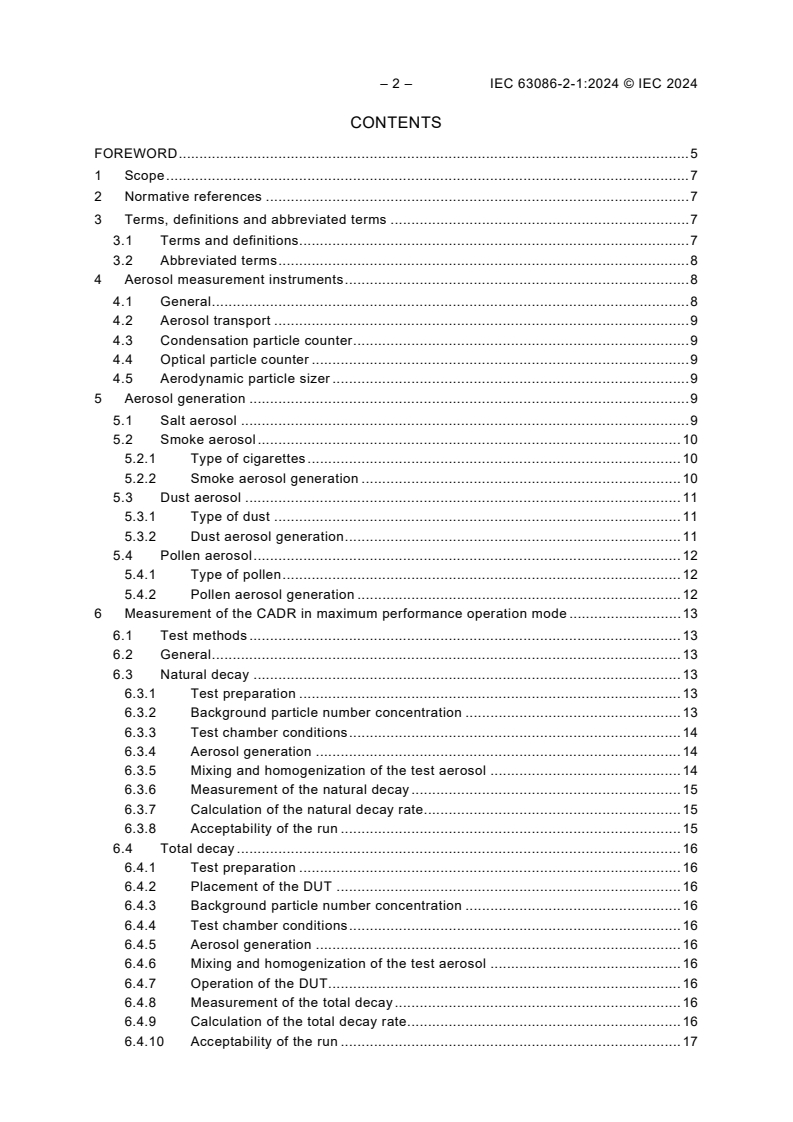
CONTENTS
FOREWORD . 5
1 Scope . 7
2 Normative references . 7
3 Terms, definitions and abbreviated terms . 7
3.1 Terms and definitions. 7
3.2 Abbreviated terms . 8
4 Aerosol measurement instruments . 8
4.1 General . 8
4.2 Aerosol transport . 9
4.3 Condensation particle counter . 9
4.4 Optical particle counter . 9
4.5 Aerodynamic particle sizer . 9
5 Aerosol generation . 9
5.1 Salt aerosol . 9
5.2 Smoke aerosol . 10
5.2.1 Type of cigarettes . 10
5.2.2 Smoke aerosol generation . 10
5.3 Dust aerosol . 11
5.3.1 Type of dust . 11
5.3.2 Dust aerosol generation . 11
5.4 Pollen aerosol . 12
5.4.1 Type of pollen . 12
5.4.2 Pollen aerosol generation . 12
6 Measurement of the CADR in maximum performance operation mode . 13
6.1 Test methods . 13
6.2 General . 13
6.3 Natural decay . 13
6.3.1 Test preparation . 13
6.3.2 Background particle number concentration . 13
6.3.3 Test chamber conditions . 14
6.3.4 Aerosol generation . 14
6.3.5 Mixing and homogenization of the test aerosol . 14
6.3.6 Measurement of the natural decay . 15
6.3.7 Calculation of the natural decay rate. 15
6.3.8 Acceptability of the run . 15
6.4 Total decay . 16
6.4.1 Test preparation . 16
6.4.2 Placement of the DUT . 16
6.4.3 Background particle number concentration . 16
6.4.4 Test chamber conditions . 16
6.4.5 Aerosol generation . 16
6.4.6 Mixing and homogenization of the test aerosol . 16
6.4.7 Operation of the DUT . 16
6.4.8 Measurement of the total decay . 16
6.4.9 Calculation of the total decay rate. 16
6.4.10 Acceptability of the run . 17
6.5 Calculation of the clean air delivery rate . 17
7 Calculation procedures . 17
7.1 Criteria for the acceptance of data points . 17
7.1.1 Outliers from the regression line . 17
7.1.2 Particle number concentration below 1 % of the value at t = 0 . 17
7.2 Calculation of decay constants . 17
7.3 Sample standard deviation of the slope of the regression line . 18
7.4 Calculation of the clean air delivery rate . 19
7.5 Sample standard deviation of the clean air delivery rate. 19
Annex A (normative) Limits of measurability . 20
A.1 General . 20
A.2 Maximum clean air delivery rate . 20
A.3 Minimum clean air delivery rate. 20
Annex B (informative) Long-term storage of the target pollutants . 21
B.1 Salt . 21
B.2 Cigarettes . 21
B.3 Dust . 21
B.4 Pollen . 21
Annex C (informative) Test report information . 22
C.1 General . 22
C.2 General data . 22
C.3 Description of the DUT . 22
C.4 Test chamber . 22
C.5 Aerosol generation . 22
C.6 Particle measurement instrumentation . 22
C.7 Test conditions . 22
C.8 Test execution . 23
C.9 Results . 23
Annex D (normative) Derivation of the effective room size . 24
D.1 Effective room size . 24
D.2 Basic indoor air model for particle number concentrations . 24
Annex E (informative) Schematic representation of a CADR measurement . 27
Annex F (informative) Cleaning procedures for the test chamber . 28
F.1 Daily start-up cleaning procedure . 28
F.2 Comprehensive test chamber cleaning procedure . 28
F.2.1 General . 28
F.2.2 Equipment . 28
F.2.3 Procedure . 28
Annex G (normative) Measurement of the average power in maximum performance
operation mode . 29
G.1 General . 29
G.2 Setup of the DUT . 29
G.3 Measurement procedure . 29
G.4 Calculation of the average operating power . 29
Annex H (informative) Calculation of the 99 % prediction interval of the regression line . 31
Annex I (normative) Alternative fine particle size range . 33
I.1 General . 33
I.2 Optical particle counter . 33
– 4 – IEC 63086-2-1:2024 © IEC 2024
I.3 Measurement of the CADR in maximum performance operation mode . 33
I.4 Derivation of the effective room size . 34
Bibliography . 35
Figure 1 – Schematic of a Laskin atomizer (a) and a Collison atomizer (b) . 10
Figure 2 – Schematic of two possible methods to generate the smoke aerosol . 11
Figure 3 – Schematic of two possible methods to generate the dust aerosol . 12
Figure 4 – Schematic of two possible methods to generate the pollen aerosol . 12
Figure E.1 – Schematic representation of the CADR measurement in accordance with
Clause 6 . 27
Table 1 – Measurement instruments, test aerosols and maximum background particle
number concentrations for the different particle size ranges . 14
Table 2 – Test aerosols and initial particle number concentrations for different particle
size ranges . 14
Table 3 – Test aerosols, mixing and homogenization time for different particle size
ranges . 15
Table 4 – Test aerosols, test duration and minimum number of data points for different
particle size ranges . 15
Table 5 – Limits for the sample standard deviation of the slope of the regression line
for the natural decay . 15
Table 6 – Limits for the sample standard deviation of the slope of the regression line
for the total decay . 17
Table H.1 – Values of the Student t-distribution with n – 2 degrees of freedom for
different numbers of data points n . 32
Table I.1 – Measurement instrument, test aerosols and maximum background particle
number concentration for the alternative fine particle size range . 33
Table I.2 – Test aerosols and initial particle number concentrations for the alternative
fine particle size range . 34
INTERNATIONAL ELECTROTECHNICAL COMMISSION
____________
HOUSEHOLD AND SIMILAR ELECTRICAL AIR CLEANING APPLIANCES –
METHODS FOR MEASURING THE PERFORMANCE –
Part 2-1: Particular requirements for determination of particle reduction
FOREWORD
1) The International Electrotechnical Commission (IEC) is a worldwide organization for standardization comprising
all national electrotechnical committees (IEC National Committees). The object of IEC is to promote international
co-operation on all questions concerning standardization in the electrical and electronic fields. To this end and
in addition to other activities, IEC publishes International Standards, Technical Specifications, Technical Reports,
Publicly Available Specifications (PAS) and Guides (hereafter referred to as “IEC Publication(s)”). Their
preparation is entrusted to technical committees; any IEC National Committee interested in the subject dealt with
may participate in this preparatory work. International, governmental and non-governmental organizations liaising
with the IEC also participate in this preparation. IEC collaborates closely with the International Organization for
Standardization (ISO) in accordance with conditions determined by agreement between the two organizations.
2) The formal decisions or agreements of IEC on technical matters express, as nearly as possible, an international
consensus of opinion on the relevant subjects since each technical committee has representation from all
interested IEC National Committees.
3) IEC Publications have the form of recommendations for international use and are accepted by IEC National
Committees in that sense. While all reasonable efforts are made to ensure that the technical content of IEC
Publications is accurate, IEC cannot be held responsible for the way in which they are used or for any
misinterpretation by any end user.
4) In order to promote international uniformity, IEC National Committees undertake to apply IEC Publications
transparently to the maximum extent possible in their national and regional publications. Any divergence between
any IEC Publication and the corresponding national or regional publication shall be clearly indicated in the latter.
5) IEC itself does not provide any attestation of conformity. Independent certification bodies provide conformity
assessment services and, in some areas, access to IEC marks of conformity. IEC is not responsible for any
services carried out by independent certification bodies.
6) All users should ensure that they have the latest edition of this publication.
7) No liability shall attach to IEC or its directors, employees, servants or agents including individual experts and
members of its technical committees and IEC National Committees for any personal injury, property damage or
other damage of any nature whatsoever, whether direct or indirect, or for costs (including legal fees) and
expenses arising out of the publication, use of, or reliance upon, this IEC Publication or any other IEC
Publications.
8) Attention is drawn to the Normative references cited in this publication. Use of the referenced publications is
indispensable for the correct application of this publication.
9) IEC draws attention to the possibility that the implementation of this document may involve the use of (a)
patent(s). IEC takes no position concerning the evidence, validity or applicability of any claimed patent rights in
respect thereof. As of the date of publication of this document, IEC had not received notice of (a) patent(s), which
may be required to implement this document. However, implementers are cautioned that this may not represent
the latest information, which may be obtained from the patent database available at https://patents.iec.ch. IEC
shall not be held responsible for identifying any or all such patent rights.
IEC 63086-2-1 has been prepared by subcommittee 59N: Electrical air cleaners for household
and similar purposes, of IEC technical committee 59: Performance of household and similar
electrical appliances, in co-operation with ISO technical committee 142: Cleaning equipment
for air and other gases. It is an International Standard.
It is published as a double logo International Standard.
– 6 – IEC 63086-2-1:2024 © IEC 2024
The text of this International Standard is based on the following documents:
Draft Report on voting
59N/44/FDIS 59N/46/RVD
Full information on the voting for its approval can be found in the report on voting indicated in
the above table.
The language used for the development of this International Standard is English.
In this standard, the following print types are used:
– terms defined in Clause 3 of IEC 63086-1: bold type
– terms defined in Clause 3 of IEC 63086-2-1: bold type.
This document was drafted in accordance with ISO/IEC Directives, Part 2, and developed in
accordance with ISO/IEC Directives, Part 1 and ISO/IEC Directives, IEC Supplement, available
at www.iec.ch/members_experts/refdocs. The main document types developed by IEC are
described in greater detail at www.iec.ch/publications.
A list of all parts in the IEC 63086 series, published under the general title Household and
similar electrical air cleaning appliances – Methods for measuring the performance, can be
found on the IEC website.
The committee has decided that the contents of this document will remain unchanged until the
stability date indicated on the IEC website under webstore.iec.ch in the data related to the
specific document. At this date, the document will be
• reconfirmed,
• withdrawn, or
• revised.
HOUSEHOLD AND SIMILAR ELECTRICAL AIR CLEANING APPLIANCES –
METHODS FOR MEASURING THE PERFORMANCE –
Part 2-1: Particular requirements for determination of particle reduction
1 Scope
This part of IEC 63086 specifies test methods for measuring the performance of electrically
powered household and similar air cleaners intended for the reduction of particulate pollutants.
NOTE The limits of measurability for the CADR are described in Annex A.
2 Normative references
The following documents are referred to in the text in such a way that some or all of their content
constitutes requirements of this document. For dated references, only the edition cited applies.
For undated references, the latest edition of the referenced document (including any
amendments) applies.
IEC 63086-1:2020, Household and similar electrical air cleaning appliances – Methods for
measuring the performance – Part 1: General requirements
IEC 63086-1:2020/AMD1:2023
ISO 12103-1, Road vehicles – Test dust for filter evaluation – Part 1: Arizona test dust
ISO 29463-1, High efficiency filters and filter media for removing particles from air – Part 1:
Classification, performance, testing and marking
ISO 5011:2020, Inlet air cleaning equipment for internal combustion engines and compressors
– Performance testing
EN 1822-1, High efficiency air filters (EPA, HEPA and ULPA) – Part 1: Classification,
performance testing, marking
3 Terms, definitions and abbreviated terms
3.1 Terms and definitions
For the purposes of this document, the terms and definitions given in IEC 63086-1:2020 and
the following apply.
ISO and IEC maintain terminology databases for use in standardization at the following
addresses:
• IEC Electropedia: available at https://www.electropedia.org/
• ISO Online browsing platform: available at https://www.iso.org/obp
3.1.1
aerosol
suspension of fine solid particles or liquid droplets in air or another gas
– 8 – IEC 63086-2-1:2024 © IEC 2024
3.1.2
smoke aerosol
aerosol produced by burning tobacco with air forced through a cigarette's filter
3.1.3
salt aerosol
aerosol produced by atomization of an aqueous potassium chloride (KCl) solution with
subsequent drying
3.1.4
dust aerosol
aerosol produced by dispersion of commercially available test powder
3.1.5
pollen aerosol
aerosol produced by dispersion of naturally occurring particulate matter from plants
Note 1 to entry: In this document, non-defatted paper mulberry pollen including fragments are used.
3.1.6
natural decay rate
reduction rate of the target pollutant in the test chamber due to natural factors, principally
sedimentation, agglomeration, surface deposition, chemical reaction, and air exchange
−1
Note 1 to entry: The unit is per hour (h ).
3.1.7
total decay rate
reduction rate of the target pollutant in the test chamber due to the combined effect of the
natural decay rate and the operation decay rate
−1
Note 1 to entry: The unit is per hour (h ).
3.2 Abbreviated terms
APS aerodynamic particle sizer
CADR clean air delivery rate
CPC condensation particle counter
DUT device under test
HEPA filter high-efficiency particulate air filter
KCl potassium chloride
OPC optical particle counter
RH relative humidity
4 Aerosol measurement instruments
4.1 General
Calibration of all aerosol measurement instruments shall be performed at least annually in
accordance with the manufacturer's instructions. A check of the zero counting rates shall be
performed regularly by sampling with a high-efficiency particulate air (HEPA) filter on the
sample intake. The HEPA filter shall be at least of class H13 in accordance with EN 1822-1 or
ISO 35H in accordance with ISO 29463-1.
The maximum measurable particle number concentration of the aerosol measurement
instruments should be higher than the initial particle number concentration required by the
respective test methods. Otherwise, a dilution system shall be used to operate the aerosol
measurement instruments in the permissible particle number concentration range. If possible,
dilution should be avoided to exclude a potential source of error. If it is not avoidable, the
dilution ratio shall be checked regularly.
-3
NOTE This document always refers to the particle number concentration, which is expressed in cm .
4.2 Aerosol transport
The transport tubing for aerosols shall consist of conductive materials, such as metal or carbon
embedded silicon, to avoid electrostatic effects and excessive losses. Similarly, all valves and
connectors on the aerosol transport path shall also consist of conductive materials. The length
of the tubing shall be as short as possible to avoid excessive losses due to diffusion.
4.3 Condensation particle counter
A condensation particle counter (CPC) is based on counting aerosol particles by first enlarging
them by using the particles as nucleation centres to create droplets in a supersaturated gas
and then counting them by optical means. Both n-butanol and water can be used as working
fluids. CPC can have different lower detection limits (D ), which are typically in the range
between 0,002 5 µm and 0,015 µm. As the particle number concentration of the used salt
aerosol is negligible in this particle size range, the exact value of D does not significantly
influence the results. It is recommended to use a CPC with a high analysed flow rate as higher
counting rates increase the statistical accuracy.
4.4 Optical particle counter
An optical particle counter (OPC) – also known as optical aerosol spectrometer or optical
particle size spectrometer (OPSS) – is based on detecting the light scattered by individual
aerosol particles. The OPC shall count and size individual aerosol particles in the 0,1 µm to
10 µm range. The counting efficiency of the OPC shall be ≥ 50 % for 0,1 µm particles. The OPC
shall have a minimum of six equally logarithmically spaced particle size channels per decade.
4.5 Aerodynamic particle sizer
An aerodynamic particle sizer (APS) is based on the acceleration of aerosol particles in a
nozzle. Due to their longer relaxation time, the time of flight of larger particles between two
laser beams is longer than for smaller particles. The APS shall count and size individual aerosol
particles at least in the particle size range from 5 µm to 10 µm. The counting efficiency of the
APS shall be 100 % in this particle size range. The APS shall have a minimum of six equally
logarithmically spaced particle size channels per decade.
5 Aerosol generation
5.1 Salt aerosol
The salt aerosol shall consist of polydisperse solid-phase (dry) KCl particles generated from
an aqueous KCl solution using a mass concentration of 50 g KCl per 1 l of de-ionized water.
Long-term storage of the salt shall be in accordance with Annex B. Figure 1 gives two examples
of common systems for generating the aerosol. The salt aerosol is generated by feeding
compressed particle-free air to the atomizer. Varying the operating air pressure of the generator
allows control of the time to reach the initial particle number concentration. Spray nozzles
producing size distributions with mode values above 0,1 µm shall not be used. The aerosol
leaving the atomizer shall be dried with a silica gel diffusion dryer or mixing with a sufficient
flow of dry air below the efflorescence humidity of KCl to ensure a solid-phase aerosol. It shall
be checked periodically that the relative humidity of the air leaving the diffusion dryer is less
than 55 %RH. The dried salt aerosol is introduced into the test chamber via tubes or hoses.
– 10 – IEC 63086-2-1:2024 © IEC 2024
a) Laskin atomizer b) Collison atomizer
Figure 1 – Schematic of a Laskin atomizer (a) and a Collison atomizer (b)
NOTE Experimental data for several air cleaners have shown that the CADR measured with non-neutralized and
neutralized salt aerosol particles does not significantly differ. Thus, neutralization of the generated salt aerosol
before entering the test chamber is optional.
5.2 Smoke aerosol
5.2.1 Type of cigarettes
Cigarettes with filters and a maximum tar content of 8 mg per cigarette shall be used. It is
recommended to use reference cigarettes, such as 1R6F reference cigarettes provided by the
University of Kentucky . To increase the reproducibility of test results, each laboratory shall
always use the same cigarettes. Before changing to a new type of cigarette, CADR tests for the
same DUT with the old and new cigarettes shall be performed and compared. Long-term storage
of the cigarettes shall be in accordance with Annex B.
5.2.2 Smoke aerosol generation
The cigarette(s) used for testing shall equilibrate for at least 24 h at (23 ± 2) °C and
(50 ± 5) %RH before use. Two different examples of smoke aerosol generators are shown in
Figure 2.
a) The cigarette is placed in a glass hood. Air is extracted either from the test chamber or the
surrounding after filtration by a pump, filtered and fed into the glass hood. By the arising
overpressure, the smoke of the burning cigarette is pressed through the cigarette's filter and
fed into the test chamber via tubes or hoses.
b) The cigarette is placed in an ejector pump based on the Venturi effect. A compressed air
source followed by a maintenance unit (including a water separator, particle and oil filter
and pressure control valve) provides a constant flow through the ejector pump. The smoke
of the burning cigarette is sucked by the arising underpressure through the cigarette's filter
and transported with the main flow inside the test chamber via tubes or hoses. The cigarette
smoke generation system is located inside an enclosure that is vented to the outside.
___________
The 1R6F reference cigarette supplied by the University of Kentucky is an example of a suitable product available
commercially. The exact nomenclature of the current batch of cigarettes can change over time. This information
is given for the convenience of users of this document and does not constitute an endorsement by IEC of
this/these product(s).
Figure 2 – Schematic of two possible methods to generate the smoke aerosol
NOTE 1 Equilibration of the cigarettes can either take place in a regulated climate cabinet or in a desiccator
containing a specific saturated salt solution. To prepare the salt solution, first NH Cl (at least 99,5 % purity) and then
(at least 99 % purity) is added to de-ionized water until the solution is fully saturated. The cigarettes are placed
KNO
on a platform above the saturated salt solution in the desiccator. If the humidity in the desiccator drops over time,
the exhausted solution is replaced by a fresh one.
NOTE 2 There are commercial smoke aerosol generators available that can be used for smoke generation. They
are typically based on principle a).
NOTE 3 The cigarettes can be lighted using either a manual lighter or an automatized solution.
5.3 Dust aerosol
5.3.1 Type of dust
Commercially available ISO 12103-1, A2 fine test dust shall be used. Long-term storage of the
dust shall be in accordance with Annex B.
5.3.2 Dust aerosol generation
The test dust shall be put for 24 h in a desiccator (container with a drying agent) with a relative
humidity below 20 %RH before use. Two examples of dust aerosol generation methods are
shown in Figure 3.
a) The dust aerosol can be continuously dispersed with a powder disperser based on the
principle shown in Figure 3a. The dust is filled little by little into the cylindrical solid material
reservoir and uniformly compressed with a tamper. The dust is conveyed onto a rotating
brush at a controlled feed rate. An adjustable flow of compressed air streams over the brush
and tears the particles out of the brush.
b) Alternatively, a light-duty dust injector (see ISO 5011:2020, Figure B.2) can be used as
shown in Figure 3b. The injector shall be operated such that the required particle number
concentrations listed in Table 2 are reached. These particle number concentrations are
considerably lower than those required by ISO 5011:2020. The test dust is filled in a small
funnel connected to the suction port of the ISO 5011:2020 dust injector. Filtered compressed
air is fed into the dust injector for a short time by opening a ball valve.
As both generation principles can lead to highly charged particles, the dust aerosol shall be
neutralized before entering the test chamber with an Kr neutralizer or an equivalent method,
such as soft X-rays or bipolar corona discharge.
– 12 – IEC 63086-2-1:2024 © IEC 2024
Figure 3 – Schematic of two possible methods to generate the dust aerosol
5.4 Pollen aerosol
5.4.1 Type of pollen
Non-defatted paper mulberry pollen including fragments shall be used. Long-term storage of
the pollen shall be in accordance with Annex B.
5.4.2 Pollen aerosol generation
Two examples of pollen aerosol generation methods are shown in Figure 4.
a) For generation of the pollen aerosol, 0,3 g to 1,0 g of pollen are weighed in a 60 ml
screw-top glass laboratory sample jar and stored in a desiccator with drying agent for a
minimum of 24 h prior to testing. Before the test, the sample jar is sealed airtight with a
screw top containing two fittings for air entry and pollen discharge. To disperse the pollen,
filtered compressed air is fed into the dust injector for a short time by opening a ball valve.
b) If the required initial particle number concentration of pollen cannot be reached in this setup
because of the deposition losses in the transportation tubes, the pollen jar can alternatively
be mounted inside the test chamber as shown in Figure 4b.
Figure 4 – Schematic of two possible methods to generate the pollen aerosol
6 Measurement of the CADR in maximum performance operation mode
6.1 Test methods
The CADR of an air cleaner generally depends on the size of the target pollutant. The
intention of this document is to determine CADR values for a range of particle sizes that occur
in indoor environments. However, it is not possible to cover the complete relevant particle size
range by using a single test aerosol and a single measurement technique. Thus, this document
provides test methods for four different particle size ranges (ultrafine, fine, medium, and
coarse). For each particle size range, a test aerosol yielding a sufficiently high particle number
concentration for accurate statistics and a measurement technique sensitive to particles in the
size range are chosen. For the fine particle size range, there are two alternative test aerosols,
which are expected to yield equivalent test results because of their similarity in the size
distribution.
It is not mandatory to perform the tests for all particle size ranges. However, for reporting results
(see Annex C), the CADR value shall be stated always in combination with the investigated size
range (ultrafine, fine, medium, or coarse). This ensures an unambiguous correlation between
the CADR value and the chosen test method.
NOTE Annex D describes a model how to derive an effective room size from the measured CADR value.
6.2 General
The test procedures described in 6.3 (natural decay rate) and 6.4 (total decay rate) are used
to determine the CADR of the DUT. For smoke, salt and dust, one measurement of the natural
decay rate taken on the same day as the total decay rate measurement is sufficient. For
pollen, a natural decay rate measurement shall be performed prior to each total decay rate
measurement. All tests shall be performed in a well-mixed test chamber in accordance with
the requirements in IEC 63086-1:2020, 5.6 to achieve repeatable and reproducible test results.
NOTE 1 The test methods in 6.3 and 6.4 are essentially the same. The only difference is that the DUT is switched
on before measuring the total decay rate in 6.4.
NOTE 2 Procedures for testing the DUT in automatic operation mode are under consideration for a future revision.
NOTE 3 The test procedures for the maximum performance operation mode can also be applied for other manual
operation modes, as defined in IEC 63086-1:2020, 3.11.
NOTE 4 A graphical scheme of the test procedure is shown in Annex E.
6.3 Natural decay
6.3.1 Test preparation
Check the aerosol generating and measuring instruments as well as the data recording and
processing equipment for readiness in accordance with the manufacturer's instructions.
NOTE General cleaning procedures for the test chamber are described in Annex F.
6.3.2 Background particle number concentration
Start operating the mixing and the recirculation fan. Clean the test chamber air using the
filtration part of the test chamber air treatment unit until the background particle number
concentration reaches a level below the values indicated in Table 1 for the corresponding
particle size range. After that, turn off the filtration part of the test chamber air treatment unit
and record the background particle number concentration.
– 14 – IEC 63086-2-1:2024 © IEC 2024
Table 1 – Measurement instruments, test aerosols and maximum background particle
number concentrations for the different particle size ranges
Ultrafine Fine Medium Coarse
Size range (µm) see NOTE 4 0,1 to 1 0,5 to 3 5 to 10
Measurement instrument(s) CPC OPC APS/OPC APS/OPC
Test aerosol(s) Salt Smoke/Salt Dust Pollen
Maximum background particle
800 240 2 0,04
−3
number concentration (cm )
NOTE 1 The test aerosols can also contain smaller and larger particles than listed in Table 1, but those are not
included in the CADR calculation.
NOTE 2 Whereas the OPC determines the optical equivalent diameter, the APS classifies based on the
aerodynamic diameter. Consequently, the two instruments potentially take into accou
...
FINAL
INTERNATIONAL ISO/FDIS
DRAFT
STANDARD 63086-2-1
ISO/TC 142
Household and similar electrical air
Secretariat: UNI
cleaning appliances - Methods for
Voting begins on:
2023-10-06 measuring the performance —
Voting terminates on:
Part 2-1:
2023-12-01
Particular requirements for
determination of particle reduction
This draft is submitted to a parallel vote in ISO and in IEC.
RECIPIENTS OF THIS DRAFT ARE INVITED TO
SUBMIT, WITH THEIR COMMENTS, NOTIFICATION
OF ANY RELEVANT PATENT RIGHTS OF WHICH
THEY ARE AWARE AND TO PROVIDE SUPPOR TING
DOCUMENTATION.
IN ADDITION TO THEIR EVALUATION AS
Reference number
BEING ACCEPTABLE FOR INDUSTRIAL, TECHNO-
ISO/FDIS 63086-2-1:2023(E)
LOGICAL, COMMERCIAL AND USER PURPOSES,
DRAFT INTERNATIONAL STANDARDS MAY ON
OCCASION HAVE TO BE CONSIDERED IN THE
LIGHT OF THEIR POTENTIAL TO BECOME STAN-
DARDS TO WHICH REFERENCE MAY BE MADE IN
NATIONAL REGULATIONS. © ISO 2023
ISO/FDIS 63086-2-1:2023(E)
FINAL
INTERNATIONAL IEC/FDIS
DRAFT
STANDARD 63086-2-1
ISO/TC 142
Household and similar electrical air
Secretariat: UNI
cleaning appliances - Methods for
Voting begins on:
2023-10-06 measuring the performance —
Voting terminates on:
Part 2-1:
2023-12-01
Particular requirements for
determination of particle reduction
© ISO 2023
This draft is submitted to a parallel vote in ISO and in IEC.
All rights reserved. Unless otherwise specified, or required in the context of its implementation, no part of this publication may
be reproduced or utilized otherwise in any form or by any means, electronic or mechanical, including photocopying, or posting on
the internet or an intranet, without prior written permission. Permission can be requested from either ISO at the address below
or ISO’s member body in the country of the requester.
RECIPIENTS OF THIS DRAFT ARE INVITED TO
ISO copyright office
SUBMIT, WITH THEIR COMMENTS, NOTIFICATION
OF ANY RELEVANT PATENT RIGHTS OF WHICH
CP 401 • Ch. de Blandonnet 8
THEY ARE AWARE AND TO PROVIDE SUPPOR TING
CH-1214 Vernier, Geneva
DOCUMENTATION.
Phone: +41 22 749 01 11
IN ADDITION TO THEIR EVALUATION AS
Reference number
Email: copyright@iso.org
BEING ACCEPTABLE FOR INDUSTRIAL, TECHNO-
IEC/FDIS 63086-2-1:2023(E)
Website: www.iso.org
LOGICAL, COMMERCIAL AND USER PURPOSES,
DRAFT INTERNATIONAL STANDARDS MAY ON
Published in Switzerland
OCCASION HAVE TO BE CONSIDERED IN THE
LIGHT OF THEIR POTENTIAL TO BECOME STAN-
DARDS TO WHICH REFERENCE MAY BE MADE IN
ii
NATIONAL REGULATIONS. © IEC 2023
IEC FDIS 63086-2-1 © IEC 2023 – 3 –
6.4.10 Acceptability of the run . 17
6.5 Calculation of the clean air delivery rate . 17
7 Calculation procedures . 17
7.1 Criteria for the acceptance of data points . 17
7.1.1 Outliers from the regression line . 17
7.1.2 Particle number concentration below 1 % of the value at t = 0 . 17
7.2 Calculation of decay constants . 17
7.3 Sample standard deviation of the slope of the regression line . 18
7.4 Calculation of the clean air delivery rate . 19
7.5 Sample standard deviation of the clean air delivery rate. 19
Annex A (normative) Limits of measurability . 20
A.1 General . 20
A.2 Maximum clean air delivery rate . 20
A.3 Minimum clean air delivery rate. 20
Annex B (informative) Long-term storage of the target pollutants . 21
B.1 Salt . 21
B.2 Cigarettes . 21
B.3 Dust . 21
B.4 Pollen . 21
Annex C (informative) Test report information . 22
C.1 General . 22
C.2 General data . 22
C.3 Description of the DUT . 22
C.4 Test chamber . 22
C.5 Aerosol generation . 22
C.6 Particle measurement instrumentation . 22
C.7 Test conditions . 22
C.8 Test execution . 23
C.9 Results . 23
Annex D (normative) Derivation of the effective room size . 24
D.1 Effective room size . 24
D.2 Basic indoor air model for particle number concentrations . 24
Annex E (informative) Schematic representation of a CADR measurement . 27
Annex F (informative) Cleaning procedures for the test chamber . 28
F.1 Daily start-up cleaning procedure . 28
F.2 Comprehensive test chamber cleaning procedure . 28
F.2.1 General . 28
F.2.2 Equipment . 28
F.2.3 Procedure . 28
Annex G (normative) Measurement of the average power in maximum performance
operation mode . 29
G.1 General . 29
G.2 Setup of the DUT . 29
G.3 Measurement procedure . 29
G.4 Calculation of the average operating power . 29
Annex H (informative) Calculation of the 99 % prediction interval of the regression line . 31
Annex I (normative) Alternative fine particle size range . 33
I.1 General . 33
– 4 – IEC FDIS 63086-2-1 © IEC 2023
I.2 Optical particle counter . 33
I.3 Measurement of the CADR in maximum performance operation mode . 33
I.4 Derivation of the effective room size . 34
Bibliography . 35
Figure 1 – Schematic of a Laskin atomizer (a) and a Collison atomizer (b) . 10
Figure 2 – Schematic of two possible methods to generate the smoke aerosol . 11
Figure 3 – Schematic of two possible methods to generate the dust aerosol . 12
Figure 4 – Schematic of two possible methods to generate the pollen aerosol . 12
Figure E.1 – Schematic representation of the CADR measurement in accordance with
Clause 6 . 27
Table 1 – Measurement instruments, test aerosols and maximum background particle
number concentrations for the different particle size ranges . 14
Table 2 – Test aerosols and initial particle number concentrations for different particle
size ranges . 14
Table 3 – Test aerosols, mixing and homogenization time for different particle size
ranges . 15
Table 4 – Test aerosols, test duration and minimum number of data points for different
particle size ranges . 15
Table 5 – Limits for the sample standard deviation of the slope of the regression line
for the natural decay . 15
Table 6 – Limits for the sample standard deviation of the slope of the regression line
for the total decay . 17
Table H.1 – Values of the Student t-distribution with n – 2 degrees of freedom for
different numbers of data points n . 32
Table I.1 – Measurement instrument, test aerosols and maximum background particle
number concentration for the alternative fine particle size range . 33
Table I.2 – Test aerosols and initial particle number concentrations for the alternative
fine particle size range . 33
IEC FDIS 63086-2-1 © IEC 2023 – 5 –
INTERNATIONAL ELECTROTECHNICAL COMMISSION
____________
HOUSEHOLD AND SIMILAR ELECTRICAL AIR CLEANING APPLIANCES –
METHODS FOR MEASURING THE PERFORMANCE –
Part 2-1: Particular requirements for determination of particle reduction
FOREWORD
1) The International Electrotechnical Commission (IEC) is a worldwide organization for standardization comprising
all national electrotechnical committees (IEC National Committees). The object of IEC is to promote international
co-operation on all questions concerning standardization in the electrical and electronic fields. To this end and
in addition to other activities, IEC publishes International Standards, Technical Specifications, Technical Reports,
Publicly Available Specifications (PAS) and Guides (hereafter referred to as “IEC Publication(s)”). Their
preparation is entrusted to technical committees; any IEC National Committee interested in the subject dealt with
may participate in this preparatory work. International, governmental and non-governmental organizations liaising
with the IEC also participate in this preparation. IEC collaborates closely with the International Organization for
Standardization (ISO) in accordance with conditions determined by agreement between the two organizations.
2) The formal decisions or agreements of IEC on technical matters express, as nearly as possible, an international
consensus of opinion on the relevant subjects since each technical committee has representation from all
interested IEC National Committees.
3) IEC Publications have the form of recommendations for international use and are accepted by IEC National
Committees in that sense. While all reasonable efforts are made to ensure that the technical content of IEC
Publications is accurate, IEC cannot be held responsible for the way in which they are used or for any
misinterpretation by any end user.
4) In order to promote international uniformity, IEC National Committees undertake to apply IEC Publications
transparently to the maximum extent possible in their national and regional publications. Any divergence between
any IEC Publication and the corresponding national or regional publication shall be clearly indicated in the latter.
5) IEC itself does not provide any attestation of conformity. Independent certification bodies provide conformity
assessment services and, in some areas, access to IEC marks of conformity. IEC is not responsible for any
services carried out by independent certification bodies.
6) All users should ensure that they have the latest edition of this publication.
7) No liability shall attach to IEC or its directors, employees, servants or agents including individual experts and
members of its technical committees and IEC National Committees for any personal injury, property damage or
other damage of any nature whatsoever, whether direct or indirect, or for costs (including legal fees) and
expenses arising out of the publication, use of, or reliance upon, this IEC Publication or any other IEC
Publications.
8) Attention is drawn to the Normative references cited in this publication. Use of the referenced publications is
indispensable for the correct application of this publication.
9) IEC draws attention to the possibility that the implementation of this document may involve the use of (a)
patent(s). IEC takes no position concerning the evidence, validity or applicability of any claimed patent rights in
respect thereof. As of the date of publication of this document, IEC had not received notice of (a) patent(s), which
may be required to implement this document. However, implementers are cautioned that this may not represent
the latest information, which may be obtained from the patent database available at https://patents.iec.ch. IEC
shall not be held responsible for identifying any or all such patent rights.
IEC 63086-2-1 has been prepared by subcommittee 59N: Electrical air cleaners for household
and similar purposes, of IEC technical committee 59: Performance of household and similar
electrical appliances, in co-operation with ISO technical committee 142: Cleaning equipment
for air and other gases. It is an International Standard.
It is published as a double logo International Standard.
– 6 – IEC FDIS 63086-2-1 © IEC 2023
The text of this International Standard is based on the following documents:
Draft Report on voting
59N/XX/FDIS 59N/XX/RVD
Full information on the voting for its approval can be found in the report on voting indicated in
the above table.
The language used for the development of this International Standard is English.
In this standard, the following print types are used:
– terms defined in Clause 3 of IEC 63086-1: bold type
– terms defined in Clause 3 of IEC 63086-2-1: bold type.
This document was drafted in accordance with ISO/IEC Directives, Part 2, and developed in
accordance with ISO/IEC Directives, Part 1 and ISO/IEC Directives, IEC Supplement, available
at www.iec.ch/members_experts/refdocs. The main document types developed by IEC are
described in greater detail at www.iec.ch/publications.
A list of all parts in the IEC 63086 series, published under the general title Household and
similar electrical air cleaning appliances – Methods for measuring the performance, can be
found on the IEC website.
The committee has decided that the contents of this document will remain unchanged until the
stability date indicated on the IEC website under webstore.iec.ch in the data related to the
specific document. At this date, the document will be
• reconfirmed,
• withdrawn, or
• revised.
IEC FDIS 63086-2-1 © IEC 2023 – 7 –
HOUSEHOLD AND SIMILAR ELECTRICAL AIR CLEANING APPLIANCES –
METHODS FOR MEASURING THE PERFORMANCE –
Part 2-1: Particular requirements for determination of particle reduction
1 Scope
This part of IEC 63086 specifies test methods for measuring the performance of electrically
powered household and similar air cleaners intended for the reduction of particulate pollutants.
NOTE The limits of measurability for the CADR are described in Annex A.
2 Normative references
The following documents are referred to in the text in such a way that some or all of their content
constitutes requirements of this document. For dated references, only the edition cited applies.
For undated references, the latest edition of the referenced document (including any
amendments) applies.
IEC 63086-1:2020, Household and similar electrical air cleaning appliances – Methods for
measuring the performance – Part 1: General requirements
ISO 12103-1, Road vehicles – Test dust for filter evaluation – Part 1: Arizona test dust
ISO 29463-1, High efficiency filters and filter media for removing particles from air – Part 1:
Classification, performance, testing and marking
ISO 5011:2020, Inlet air cleaning equipment for internal combustion engines and compressors
– Performance testing
EN 1822-1, High efficiency air filters (EPA, HEPA and ULPA) – Part 1: Classification,
performance testing, marking
3 Terms, definitions and abbreviated terms
3.1 Terms and definitions
For the purposes of this document, the terms and definitions given in IEC 63086-1:2020 and
the following apply.
ISO and IEC maintain terminology databases for use in standardization at the following
addresses:
• IEC Electropedia: available at https://www.electropedia.org/
• ISO Online browsing platform: available at https://www.iso.org/obp
3.1.1
aerosol
suspension of fine solid particles or liquid droplets in air or another gas
3.1.2
smoke aerosol
aerosol produced by burning tobacco with air forced through a cigarette's filter
– 8 – IEC FDIS 63086-2-1 © IEC 2023
3.1.3
salt aerosol
aerosol produced by atomization of an aqueous potassium chloride (KCl) solution with
subsequent drying
3.1.4
dust aerosol
aerosol produced by dispersion of commercially available test powder
3.1.5
pollen aerosol
aerosol produced by dispersion of naturally occurring particulate matter from plants
Note 1 to entry: In this document, non-defatted paper mulberry pollen including fragments are used.
3.1.6
natural decay rate
reduction rate of the target pollutant in the test chamber due to natural factors, principally
sedimentation, agglomeration, surface deposition, chemical reaction, and air exchange
−1
Note 1 to entry: The unit is per hour (h ).
3.1.7
total decay rate
reduction rate of the target pollutant in the test chamber due to the combined effect of the
natural decay rate and the operation decay rate
−1
Note 1 to entry: The unit is per hour (h ).
3.2 Abbreviated terms
APS aerodynamic particle sizer
CADR clean air delivery rate
CPC condensation particle counter
DUT device under test
HEPA filter high-efficiency particulate air filter
KCl potassium chloride
OPC optical particle counter
RH relative humidity
4 Aerosol measurement instruments
4.1 General
Calibration of all aerosol measurement instruments shall be performed at least annually in
accordance with the manufacturer's instructions. A check of the zero counting rates shall be
performed regularly by sampling with a high-efficiency particulate air (HEPA) filter on the
sample intake. The HEPA filter shall be at least of class H13 in accordance with EN 1822-1 or
ISO 35H in accordance with ISO 29463-1.
The maximum measurable particle number concentration of the aerosol measurement
instruments should be higher than the initial particle number concentration required by the
respective test methods. Otherwise, a dilution system shall be used to operate the condensation
particle counter in the permissible particle number concentration range. If possible, dilution
should be avoided to exclude a potential source of error. If it is not avoidable, the dilution ratio
shall be checked regularly.
IEC FDIS 63086-2-1 © IEC 2023 – 9 –
-3
NOTE This document always refers to the particle number concentration, which is expressed in cm .
4.2 Aerosol transport
The transport tubing for aerosols shall consist of conductive materials, such as metal or carbon
embedded silicon, to avoid electrostatic effects and excessive losses. Similarly, all valves and
connectors on the aerosol transport path shall also consist of conductive materials. The length
of the tubing shall be as short as possible to avoid excessive losses due to diffusion.
4.3 Condensation particle counter
A condensation particle counter (CPC) is based on counting aerosol particles by first enlarging
them by using the particles as nucleation centres to create droplets in a supersaturated gas
and then counting them by optical means. Both n-butanol and water can be used as working
fluids. CPC can have different lower detection limits (D ), which are typically in the range
between 0,002 5 µm and 0,015 µm. As the particle number concentration of the used salt
aerosol is negligible in this particle size range, the exact value of D does not significantly
influence the results. It is recommended to use a CPC with a high analysed flow rate as higher
counting rates increase the statistical accuracy.
4.4 Optical particle counter
An optical particle counter (OPC) – also known as optical aerosol spectrometer – is based on
detecting the light scattered by individual aerosol particles. The OPC shall count and size
individual aerosol particles in the 0,1 µm to 10 µm range. The counting efficiency of the OPC
shall be ≥ 50 % for 0,1 µm particles. The OPC shall have a minimum of six equally
logarithmically spaced particle size channels per decade.
4.5 Aerodynamic particle sizer
An aerodynamic particle sizer (APS) is based on the acceleration of aerosol particles in a
nozzle. Due to their longer relaxation time, the time of flight of larger particles between two
laser beams is longer than for smaller particles. The APS shall count and size individual aerosol
particles at least in the particle size range from 5 µm to 10 µm. The counting efficiency of the
APS shall be 100 % in this particle size range. The APS shall have a minimum of six equally
logarithmically spaced particle size channels per decade.
5 Aerosol generation
5.1 Salt aerosol
The salt aerosol shall consist of polydisperse solid-phase (dry) KCl particles generated from
an aqueous KCl solution using a mass concentration of 50 g KCl per 1 l of de-ionized water.
Long-term storage of the salt shall be in accordance with Annex B. Figure 1 gives two examples
of common systems for generating the aerosol. The salt aerosol is generated by feeding
compressed particle-free air to the atomizer. Varying the operating air pressure of the generator
allows control of the time to reach the initial particle number concentration. Spray nozzles
producing size distributions with mode values above 0,1 µm shall not be used. The aerosol
leaving the atomizer shall be dried with a silica gel diffusion dryer or mixing with a sufficient
flow of dry air below the efflorescence humidity of KCl to ensure a solid-phase aerosol. It shall
be checked periodically that the relative humidity of the air leaving the diffusion dryer is less
than 55 %RH. The dried salt aerosol is introduced into the test chamber via tubes or hoses.
– 10 – IEC FDIS 63086-2-1 © IEC 2023
a) Laskin atomizer b) Collison atomizer
Figure 1 – Schematic of a Laskin atomizer (a) and a Collison atomizer (b)
NOTE Experimental data for several air cleaners have shown that the CADR measured with non-neutralized and
neutralized salt aerosol particles does not significantly differ. Thus, neutralization of the generated salt aerosol
before entering the test chamber is optional.
5.2 Smoke aerosol
5.2.1 Type of cigarettes
Cigarettes with filters and a maximum tar content of 8 mg per cigarette shall be used. It is
recommended to use reference cigarettes, such as 1R6F reference cigarettes provided by the
University of Kentucky . To increase the reproducibility of test results, each laboratory shall
always use the same cigarettes. Before changing to a new type of cigarette, CADR tests for the
same DUT with the old and new cigarettes shall be performed and compared. Long-term storage
of the cigarettes shall be in accordance with Annex B.
5.2.2 Smoke aerosol generation
The cigarette(s) used for testing shall equilibrate for at least 24 h at (23 ± 2) °C and
(50 ± 5) %RH before use. Two different examples of smoke aerosol generators are shown in
Figure 2.
a) The cigarette is placed in a glass hood. Air is extracted either from the test chamber or the
surrounding after filtration by a pump, filtered and fed into the glass hood. By the arising
overpressure, the smoke of the burning cigarette is pressed through the cigarette's filter and
fed into the test chamber via tubes or hoses.
b) The cigarette is placed in an ejector pump based on the Venturi effect. A compressed air
source followed by a maintenance unit (including a water separator, particle and oil filter
and pressure control valve) provides a constant flow through the ejector pump. The smoke
of the burning cigarette is sucked by the arising underpressure through the cigarette's filter
and transported with the main flow inside the test chamber via tubes or hoses. The cigarette
smoke generation system is located inside an enclosure that is vented to the outside.
___________
The 1R6F reference cigarette supplied by the University of Kentucky is an example of a suitable product available
commercially. The exact nomenclature of the current batch of cigarettes can change over time. This information
is given for the convenience of users of this document and does not constitute an endorsement by IEC of
this/these product(s).
IEC FDIS 63086-2-1 © IEC 2023 – 11 –
Figure 2 – Schematic of two possible methods to generate the smoke aerosol
NOTE 1 Equilibration of the cigarettes can either take place in a regulated climate cabinet or in a desiccator
containing a specific saturated salt solution. To prepare the salt solution, first NH Cl (at least 99,5 % purity) and then
(at least 99 % purity) is added to de-ionized water until the solution is fully saturated. The cigarettes are placed
KNO
on a platform above the saturated salt solution in the desiccator. If the humidity in the desiccator drops over time,
the exhausted solution is replaced by a fresh one.
NOTE 2 There are commercial smoke aerosol generators available that can be used for smoke generation. They
are typically based on principle a).
NOTE 3 The cigarettes can be lighted using either a manual lighter or an automatized solution.
5.3 Dust aerosol
5.3.1 Type of dust
Commercially available ISO 12103-1, A2 fine test dust shall be used. Long-term storage of the
dust shall be in accordance with Annex B.
5.3.2 Dust aerosol generation
The test dust shall be put for 24 h in a desiccator (container with a drying agent) with a relative
humidity below 20 %RH before use. Two examples of dust aerosol generation methods are
shown in Figure 3.
a) The dust aerosol can be continuously dispersed with a powder disperser based on the
principle shown in Figure 3a. The dust is filled little by little into the cylindrical solid material
reservoir and uniformly compressed with a tamper. The dust is conveyed onto a rotating
brush at a controlled feed rate. An adjustable flow of compressed air streams over the brush
and tears the particles out of the brush.
b) Alternatively, a light-duty dust injector (see ISO 5011:2020, Figure B.2) can be used as
shown in Figure 3b. The injector shall be operated such that the required particle number
concentrations listed in Table 2 are reached. These particle number concentrations are
considerably lower than those required by ISO 5011:2020. The test dust is filled in a small
funnel connected to the suction port of the ISO 5011:2020 dust injector. Filtered compressed
air is fed into the dust injector for a short time by opening a ball valve.
As both generation principles can lead to highly charged particles, the dust aerosol shall be
neutralized before entering the test chamber with an Kr neutralizer or an equivalent method,
such as soft X-rays or bipolar corona discharge.
– 12 – IEC FDIS 63086-2-1 © IEC 2023
Figure 3 – Schematic of two possible methods to generate the dust aerosol
5.4 Pollen aerosol
5.4.1 Type of pollen
Non-defatted paper mulberry pollen including fragments shall be used. Long-term storage of
the pollen shall be in accordance with Annex B.
5.4.2 Pollen aerosol generation
Two examples of pollen aerosol generation methods are shown in Figure 4.
a) For generation of the pollen aerosol, 0,3 g to 1,0 g of pollen are weighed in a 60 ml
screw-top glass laboratory sample jar and stored in a desiccator with drying agent for a
minimum of 24 h prior to testing. Before the test, the sample jar is sealed airtight with a
screw top containing two fittings for air entry and pollen discharge. To disperse the pollen,
filtered compressed air is fed into the dust injector for a short time by opening a ball valve.
b) If the required initial particle number concentration of pollen cannot be reached in this setup
because of the deposition losses in the transportation tubes, the pollen jar can alternatively
be mounted inside the test chamber as shown in Figure 4b.
Figure 4 – Schematic of two possible methods to generate the pollen aerosol
IEC FDIS 63086-2-1 © IEC 2023 – 13 –
6 Measurement of the CADR in maximum performance operation mode
6.1 Test methods
The CADR of an air cleaner generally depends on the size of the target pollutant. The
intention of this document is to determine CADR values for a range of particle sizes that occur
in indoor environments. However, it is not possible to cover the complete relevant particle size
range by using a single test aerosol and a single measurement technique. Thus, this document
provides test methods for four different particle size ranges (ultrafine, fine, medium, and
coarse). For each particle size range, a test aerosol yielding a sufficiently high particle number
concentration for accurate statistics and a measurement technique sensitive to particles in the
size range are chosen. For the fine particle size range, there are two alternative test aerosols,
which are expected to yield equivalent test results because of their similarity in the size
distribution.
It is not mandatory to perform the tests for all particle size ranges. However, for reporting results
(see Annex C), the CADR value shall be stated always in combination with the investigated size
range (ultrafine, fine, medium, or coarse). This ensures an unambiguous correlation between
the CADR value and the chosen test method.
NOTE Annex D describes a model how to derive an effective room size from the measured CADR value.
6.2 General
The test procedures described in 6.3 (natural decay rate) and 6.4 (total decay rate) are used
to determine the CADR of the DUT. For smoke, salt and dust, one measurement of the natural
decay rate taken on the same day as the total decay rate measurement is sufficient. For
pollen, a natural decay rate measurement shall be performed prior to each total decay rate
measurement. All tests shall be performed in a well-mixed test chamber in accordance with
the requirements in IEC 63086-1:2020, 5.6 to achieve repeatable and reproducible test results.
NOTE 1 The test methods in 6.3 and 6.4 are essentially the same. The only difference is that the DUT is switched
on before measuring the total decay rate in 6.4.
NOTE 2 Procedures for testing the DUT in automatic operation mode are under consideration for a future revision.
NOTE 3 The test procedures for the maximum performance operation mode can also be applied for other manual
operation modes, as defined in IEC 63086-1:2020, 3.11.
NOTE 4 A graphical scheme of the test procedure is shown in Annex E.
6.3 Natural decay
6.3.1 Test preparation
Check the aerosol generating and measuring instruments as well as the data recording and
processing equipment for readiness in accordance with the manufacturer's instructions.
NOTE General cleaning procedures for the test chamber are described in Annex F.
6.3.2 Background particle number concentration
Start operating the mixing and the recirculation fan. Clean the test chamber air using the
filtration part of the test chamber air treatment unit until the background particle number
concentration reaches a level below the values indicated in Table 1 for the corresponding
particle size range. After that, turn off the filtration part of the test chamber air treatment unit
and record the background particle number concentration.
– 14 – IEC FDIS 63086-2-1 © IEC 2023
Table 1 – Measurement instruments, test aerosols and maximum background particle
number concentrations for the different particle size ranges
Ultrafine Fine Medium Coarse
Size range (µm) see NOTE 4 0,1 to 1 0,5 to 3 5 to 10
Measurement instrument(s) CPC OPC APS/OPC APS/OPC
Test aerosol(s) Salt Smoke/Salt Dust Pollen
Maximum background particle
800 240 2 0,04
−3
number concentration (cm )
NOTE 1 The test aerosols can also contain smaller and larger particles than listed in Table 1, but those are not
included in the CADR calculation.
NOTE 2 Whereas the OPC determines the optical equivalent diameter, the APS classifies based on the
aerodynamic diameter. Consequently, the two instruments potentially take into account different size fractions.
NOTE 3 The maximum background particle number concentrations are set to 1 % of the minimum initial particle
number concentrations listed in Table 2.
NOTE 4 The CPC only measures the total particle number concentration and cannot fractionate with respect to the
particle size. Thus, no specific particle size range can be stated here. However, the majority of the salt aerosol
particles using the generation methods described in 5.1 is smaller than 0,1 µm. Thus, the decay rate of the total
particle number concentration is considered as representative for the ultrafine particle size range. The lower detection
limit of the CPC does not have considerable influence as only a negligible fraction of particles is present in this
particle size range.
NOTE 5 An alternative for the fine particle size range starting at 0,3 µm instead of 0,1 µm is described in Annex I.
6.3.3 Test chamber conditions
While cleaning the test chamber, operate the conditioning part of test chamber air treatment
unit until the temperature and relative humidity ranges specified in IEC 63086-1:2020, 5.2.1 are
reached. After that, turn off the conditioning part of the test chamber air treatment unit. Record
the relative humidity and temperature of the test chamber during the whole test period. Values
outside the limits invalidate the run.
6.3.4 Aerosol generation
Start feeding the test aerosol into the test chamber as described in Clause 5 until the initial
particle number concentration in the corresponding particle size range listed in Table 2 is
reached. After that, turn off the aerosol generator and close the test chamber valve.
Table 2 – Test aerosols and initial particle number concentrations
for different particle size ranges
Ultrafine Fine Medium Coarse
Particle size range (µm) see 6.3.2 0,1 to 1 0,5 to 3 5 to 10
Test aerosol(s) Salt Smoke/Salt Dust Pollen
Initial particle number 80 000 to 24 000 to 200 to 4 to
-3
concentration (cm ) 120 000 35 000 400 9
6.3.5 Mixing and homogenization of the test aerosol
Mix the test aerosol in the test chamber for the mixing time indicated in Table 3. After that,
turn off the mixing fan. The recirculation fan continues to operate for the duration of the test.
Wait for the homogenization time indicated in Table 3 to ensure a sufficient homogenization of
the aerosol. Check whether the particle number concentration is still within the limits listed in
Table 2. If this is not the case, terminate the run.
IEC FDIS 63086-2-1 © IEC 2023 – 15 –
NOTE The recirculation fan is operated during the whole test to ensure sufficient mixing in the test chamber, which
is essential for reproducible results. This situation might differ from a scenario without forced recirculation.
Table 3 – Test aerosols, mixing and homogenization time
for different particle size ranges
Ultrafine Fine Medium Coarse
Test aerosol(s) Salt Smoke/Salt Dust Pollen
Mixing time (min) 1 1 1 1
Homogenization time (min) 3 3 3 1
NOTE 1 The homogenization time required for pollen is less than for salt, smoke and dust because of the higher
natural decay rate of pollen.
6.3.6 Measurement of the natural decay
Wait for 1 min before starting to acquire particle number concentration data in evenly distributed
time intervals for the test duration indicated in Table 4. The time stamp allocated to the first
data point defines t = 0 in the calculation of the natural decay rate. The minimum number data
points shall be in accordance with Table 4.
Table 4 – Test aerosols, test duration and minimum number
of data points for different particle size ranges
Ultrafine Fine Medium Coarse
Test aerosol(s) Salt Smoke/Salt Dust Pollen
Test duration (min) 5 to 20 5 to 20 5 to 20 3 to 10
Minimum number of data points 18 18 18 9
NOTE 1 The minimum number of data points required for pollen is less than for salt, smoke and dust because of
the higher natural decay rate of pollen.
NOTE 2 The waiting time before collection of the first data point is introduced to follow the same time scheme as
for the measurement of the total decay rate.
6.3.7 Calculation of the natural decay rate
Calculate the natural decay rate as described in 7.2.
6.3.8 Acceptability of the run
Calculate the sample standard deviation of the slope of the regression line for the natural decay
in accordance with 7.3. A sample standard deviation less than the values indicated in Table 5
determines the acceptability of the run.
Table 5 – Limits for the sample standard deviation of the slope
of the regression line for the natural decay
Ultrafine Fine Medium Coarse
Test aerosol Salt Smoke/Salt Dust Pollen
Limit for sample standard
0,12 0,12 0,06 0,36
−1
deviation (h )
– 16 – IEC FDIS 63086-2-1 © IEC 2023
6.4 Total decay
6.4.1 Test preparation
Perform as in 6.3.1.
6.4.2 Placement of the DUT
Inspect the DUT for shipping damages or other obvious visual defects and check if it properly
operates in the maximum performance operation mode. Place the DUT in accordance with
IEC 63086-1:2020, 5.7 in the test chamber and connect it to a power supply providing the
required voltage and frequency in accordance with IEC 63086-1:2020, 5.2. If the DUT is
battery-operated, the battery shall be fully charged at the beginning of the test.
NOTE Fully charged defines the point during charging when – in accordance with the manufacturer's instructions,
by indicator or time period – the DUT does not need to be charged anymore.
6.4.3 Background particle number concentration
Perform as in 6.3.2.
6.4.4 Test chamber conditions
Perform as in 6.3.3.
6.4.5 Aerosol generation
Perform as in 6.3.4.
6.4.6 Mixing and homogenization of the test aerosol
Perform as in 6.3.5.
6.4.7 Operation of the DUT
Set the DUT to maximum performance operation mode as defined in IEC 63086-1:2020, 3.14
at the end of measuring the initial particle number concentration. The test chamber shall not
be entered for switching on the DUT. After switching on the DUT, wait for 1 min before starting
the first sampling interval. The time stamp allocated to the first measurement after switching on
the DUT defines t = 0 in the calculations of the total decay rate.
NOTE 1 The DUT can be switched on from outside the test chamber by remote operation, a remote-controlled
power supply, or a robotic setup to touch the necessary buttons or surfaces.
NOTE 2 The waiting time of 1 min between switching on the DUT and collection of the first data point is to avoid
the influence of startup phenomena of the DUT. Furthermore, it serves to avoid distortions of the decay curve that
can be caused by allocation of the time stamps to the end or beginning of the sampling interval or by the finite time
needed to switch on the air cleaner.
6.4.8 Measurement of the total decay
Perform as in 6.3.6. The measurement of the average power in maximum performance
operation mode described in Annex G shall be conducted during this data acquisition phase.
6.4.9 Calculation of the total decay rate
Calculate the total decay rate as described in 7.2.
IEC FDIS 63086-2-1 © IEC 2023 – 17 –
6.4.10 Acceptability of the run
Calculate the sample standard deviation of the slope of the regression line for the total decay
in accordance with 7.3. A sample standard deviation less than the values indicated in Table 6
determines the acceptability of the run.
Table 6 – Limits for the sample standard deviation of the slope
of the regression line for the total decay
Ultrafine Fine Medium Coarse
Test aerosol Salt Smoke/Salt Dust Pollen
Limit for sample standard
0,48 0,48 0,18 1,32
−1
deviation (h )
6.5 Calculation of the clean air delivery rate
Determine the CADR of the DUT in accordance with 7.4.
7 Calculation procedures
7.1 Criteria for the acceptance of data points
7.1.1 Outliers from the regression line
Any data point found outside the 99 % prediction interval of the regression line shall be
eliminated. The new data set without the eliminated data point(s) shall be used for calculation
of the natural and total decay rates.
NOTE 1 The calculation of the 99 % prediction interval of the regression line is described in Annex H.
NOTE 2 The cause of the outlier data can be due to the operator, test chamber instrumentation, air cleaner
inconsistency, or other test chamber effects.
7.1.2 Particle number concentration below 1 % of the value at t = 0
Any data point reporting a particle number concentration below 1 % of the value at t = 0 shall
be eliminated along with all subsequent data points of the run.
NOTE Subsequent data points are eliminated based on the anticipated exponential reduction of the particle number
concentration with time.
7.2 Calculation of decay constants
The decay of the particle number concentration is based on the formula:
−kt
i
(1)
Ct C⋅e
( )
i 0
where
−3
C(t ) is the particle number concentration at time t , expressed in cm ;
i i
−3
C is the particle number concentration at time t = 0, expressed in cm ;
0 i
−1
k is the decay const
...