

IEC 81714-2:2006
(Main)Design of graphical symbols for use in the technical documentation of products — Part 2: Specification for graphical symbols in a computer sensible form, including graphical symbols for a reference library, and requirements for their interchange
General Information
- Abstract
Specifies requirements for graphical symbols to be included in a reference symbol library in a computer sensible form, and requirements for their interchange among computer aided tools. The reference symbol library may be used as a basis for the design and editing of documents, and for the interchange of documents and graphical symbol libraries among computer-aided tools.
- Status
- Published
- Publication Date
- 05-Jul-2006
- Technical Committee
- ISO/TC 10/SC 10 - Process plant documentation
- Drafting Committee
- ISO/TC 10/SC 10 - Process plant documentation
- Parallel Committee
- IEC/IEC/SC 3B - Documentation
- Current Stage
- 9060 - Close of review
- Completion Date
- 02-Dec-2031
Buy Documents
IEC 81714-2:2006 - Design of graphical symbols for use in the technical documentation of products — Part 2: Specification for graphical symbols in a computer sensible form, including graphical symbols for a reference library, and requirements for their interchange Released:7/6/2006
Overview
IEC 81714-2:2006 - Design of graphical symbols for use in the technical documentation of products (Part 2) specifies how graphical symbols should be represented in a computer sensible form for inclusion in a reference symbol library and for interchange among computer-aided tools. The standard defines how symbol libraries are structured and documented so symbols can be reused, scaled, routed and exchanged reliably between CAD, electrical design and documentation systems.
Key Topics
- Computer-sensible symbol representation: Requirements for encoding graphical symbols so they are machine-readable and consistent across tools.
- Reference symbol library structure: Rules for organizing symbols, variants, module sizes and default layouts to support reuse.
- Variants and scaling: Guidance on symbol variants, scaling behavior and module/grid sizes to preserve visual and functional integrity.
- Connect nodes and reference points: Definitions for nodes, markers, and reference points used for routing, placement and connection in diagrams.
- Text and labeling: Requirements for text fields, alignment, label placement and identification of terminals and functions.
- Layering and graphical constructs: Use of layers and building blocks to manage symbol visibility, variants and editing.
- Interchange requirements: Specifications and informative guidance (including Annex B) for exchanging diagrams and symbol libraries between computer-aided tools.
- Normative annexes: Formal requirements for data types/formats, line and text properties, library versions and global definitions to ensure interoperability.
Applications / Who uses this standard
IEC 81714-2 is practical for organizations and professionals who develop, manage or consume technical drawings and product documentation:
- CAD and EDA software developers - implement symbol library formats and import/export functions for interoperability.
- Electrical and electronic engineers - create consistent schematic symbols for design and documentation.
- Technical authors and documentation teams - standardize symbols across manuals, service documents and product datasheets.
- Manufacturers and OEMs - ensure consistent symbol use across product lines and suppliers.
- Standards bodies and library maintainers - build compliant reference symbol libraries for distribution and reuse.
Practical benefits include more reliable symbol interchange, consistent technical documentation, reduced rework when migrating between tools, and clearer maintenance/assembly instructions.
Related Standards
- IEC 60617 and ISO 14617 - graphical symbol repositories and graphical symbol definitions referenced by IEC 81714-2.
- Annexes in IEC 81714-2 cover interchange models, data types, text/line requirements and versioning to support tool interoperability.
Keywords: IEC 81714-2, graphical symbols, reference symbol library, computer sensible form, symbol interchange, CAD, technical documentation, symbol libraries.
Relations
- Effective Date
- 15-Apr-2008
Buy Documents
IEC 81714-2:2006 - Design of graphical symbols for use in the technical documentation of products — Part 2: Specification for graphical symbols in a computer sensible form, including graphical symbols for a reference library, and requirements for their interchange Released:7/6/2006
Frequently Asked Questions
IEC 81714-2:2006 is a standard published by the International Organization for Standardization (ISO). Its full title is "Design of graphical symbols for use in the technical documentation of products — Part 2: Specification for graphical symbols in a computer sensible form, including graphical symbols for a reference library, and requirements for their interchange". This standard covers: Specifies requirements for graphical symbols to be included in a reference symbol library in a computer sensible form, and requirements for their interchange among computer aided tools. The reference symbol library may be used as a basis for the design and editing of documents, and for the interchange of documents and graphical symbol libraries among computer-aided tools.
Specifies requirements for graphical symbols to be included in a reference symbol library in a computer sensible form, and requirements for their interchange among computer aided tools. The reference symbol library may be used as a basis for the design and editing of documents, and for the interchange of documents and graphical symbol libraries among computer-aided tools.
IEC 81714-2:2006 is classified under the following ICS (International Classification for Standards) categories: 01.080.01 - Graphical symbols in general; 01.110 - Technical product documentation. The ICS classification helps identify the subject area and facilitates finding related standards.
IEC 81714-2:2006 has the following relationships with other standards: It is inter standard links to IEC 81714-2:1998. Understanding these relationships helps ensure you are using the most current and applicable version of the standard.
IEC 81714-2:2006 is available in PDF format for immediate download after purchase. The document can be added to your cart and obtained through the secure checkout process. Digital delivery ensures instant access to the complete standard document.
Standards Content (Sample)
NORME CEI
INTERNATIONALE
IEC
81714-2
INTERNATIONAL
Deuxième édition
STANDARD
Second edition
2006-06
Création de symboles graphiques utilisables
dans la documentation technique de produits –
Partie 2:
Spécification pour symboles graphiques
sous forme adaptée à l'ordinateur, y compris
les symboles pour bibliothèque de références
et exigences relatives à leur échange
Design of graphical symbols for use in the
technical documentation of products –
Part 2:
Specification for graphical symbols in a computer
sensible form, including graphical symbols
for a reference library, and requirements for
their interchange
Numéro de référence
Reference number
CEI/IEC 81714-2:2006
Numérotation des publications Publication numbering
Depuis le 1er janvier 1997, les publications de la CEI As from 1 January 1997 all IEC publications are
sont numérotées à partir de 60000. Ainsi, la CEI 34-1 issued with a designation in the 60000 series. For
devient la CEI 60034-1. example, IEC 34-1 is now referred to as IEC 60034-1.
Editions consolidées Consolidated editions
Les versions consolidées de certaines publications de la The IEC is now publishing consolidated versions of its
CEI incorporant les amendements sont disponibles. Par publications. For example, edition numbers 1.0, 1.1
exemple, les numéros d’édition 1.0, 1.1 et 1.2 indiquent and 1.2 refer, respectively, to the base publication,
respectivement la publication de base, la publication de the base publication incorporating amendment 1 and
base incorporant l’amendement 1, et la publication de the base publication incorporating amendments 1
base incorporant les amendements 1 et 2. and 2.
Informations supplémentaires Further information on IEC publications
sur les publications de la CEI
Le contenu technique des publications de la CEI est The technical content of IEC publications is kept
constamment revu par la CEI afin qu'il reflète l'état under constant review by the IEC, thus ensuring that
actuel de la technique. Des renseignements relatifs à the content reflects current technology. Information
cette publication, y compris sa validité, sont dispo- relating to this publication, including its validity, is
nibles dans le Catalogue des publications de la CEI available in the IEC Catalogue of publications
(voir ci-dessous) en plus des nouvelles éditions, (see below) in addition to new editions, amendments
amendements et corrigenda. Des informations sur les and corrigenda. Information on the subjects under
sujets à l’étude et l’avancement des travaux entrepris consideration and work in progress undertaken by the
par le comité d’études qui a élaboré cette publication, technical committee which has prepared this
ainsi que la liste des publications parues, sont publication, as well as the list of publications issued,
également disponibles par l’intermédiaire de: is also available from the following:
• Site web de la CEI (www.iec.ch) • IEC Web Site (www.iec.ch)
• Catalogue des publications de la CEI • Catalogue of IEC publications
Le catalogue en ligne sur le site web de la CEI The on-line catalogue on the IEC web site
(www.iec.ch/searchpub) vous permet de faire des (www.iec.ch/searchpub) enables you to search by a
recherches en utilisant de nombreux critères, variety of criteria including text searches,
comprenant des recherches textuelles, par comité technical committees and date of publication. On-
d’études ou date de publication. Des informations en line information is also available on recently
ligne sont également disponibles sur les nouvelles issued publications, withdrawn and replaced
publications, les publications remplacées ou retirées, publications, as well as corrigenda.
ainsi que sur les corrigenda.
• IEC Just Published • IEC Just Published
Ce résumé des dernières publications parues This summary of recently issued publications
(www.iec.ch/online_news/justpub) est aussi dispo- (www.iec.ch/online_news/justpub) is also available
nible par courrier électronique. Veuillez prendre by email. Please contact the Customer Service
contact avec le Service client (voir ci-dessous) Centre (see below) for further information.
pour plus d’informations.
• Service clients • Customer Service Centre
Si vous avez des questions au sujet de cette If you have any questions regarding this
publication ou avez besoin de renseignements publication or need further assistance, please
supplémentaires, prenez contact avec le Service contact the Customer Service Centre:
clients:
Email: custserv@iec.ch Email: custserv@iec.ch
Tél: +41 22 919 02 11 Tel: +41 22 919 02 11
Fax: +41 22 919 03 00 Fax: +41 22 919 03 00
.
NORME CEI
INTERNATIONALE
IEC
81714-2
INTERNATIONAL
Deuxième édition
STANDARD
Second edition
2006-06
Création de symboles graphiques utilisables
dans la documentation technique de produits –
Partie 2:
Spécification pour symboles graphiques
sous forme adaptée à l'ordinateur, y compris
les symboles pour bibliothèque de références
et exigences relatives à leur échange
Design of graphical symbols for use in the
technical documentation of products –
Part 2:
Specification for graphical symbols in a computer
sensible form, including graphical symbols
for a reference library, and requirements for
their interchange
IEC 2006 Droits de reproduction réservés Copyright - all rights reserved
Aucune partie de cette publication ne peut être reproduite ni No part of this publication may be reproduced or utilized in any
utilisée sous quelque forme que ce soit et par aucun procédé, form or by any means, electronic or mechanical, including
électronique ou mécanique, y compris la photocopie et les photocopying and microfilm, without permission in writing from
microfilms, sans l'accord écrit de l'éditeur. the publisher.
International Electrotechnical Commission, 3, rue de Varembé, PO Box 131, CH-1211 Geneva 20, Switzerland
Telephone: +41 22 919 02 11 Telefax: +41 22 919 03 00 E-mail: inmail@iec.ch Web: www.iec.ch
CODE PRIX
XC
PRICE CODE
Pour prix, voir catalogue en vigueur
For price, see current catalogue
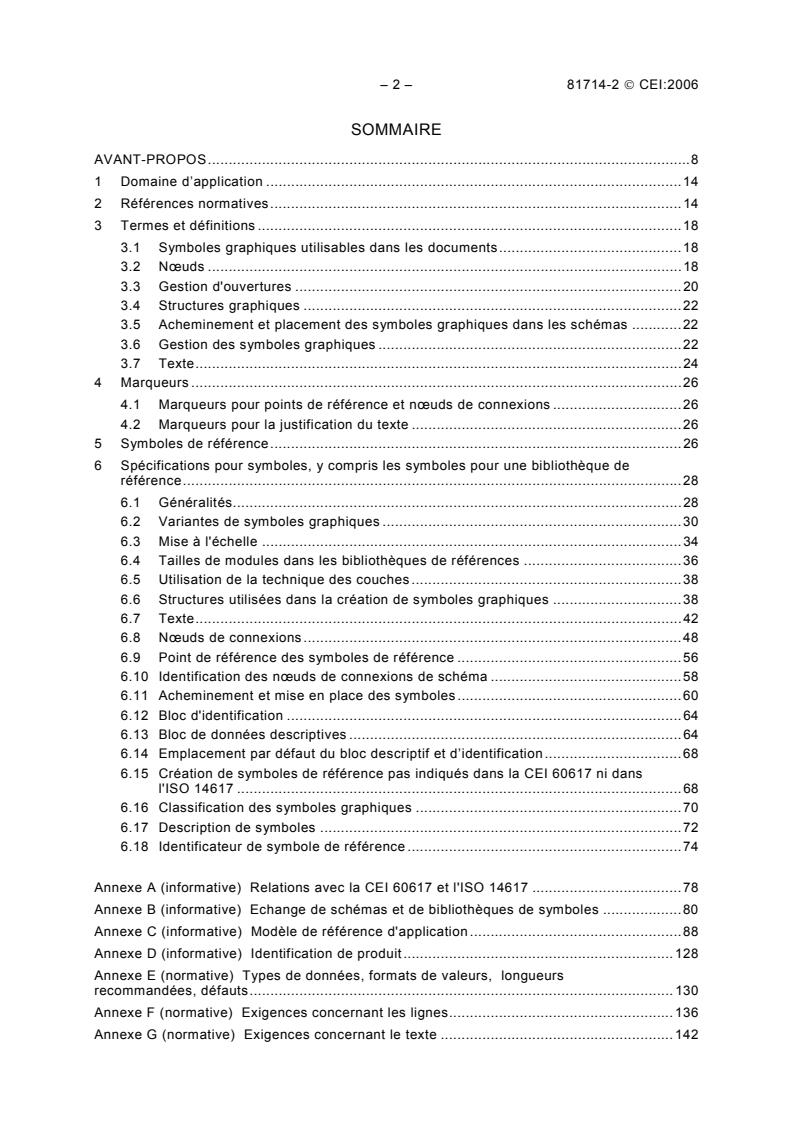
– 2 – 81714-2 CEI:2006
SOMMAIRE
AVANT-PROPOS.8
1 Domaine d’application .14
2 Références normatives.14
3 Termes et définitions .18
3.1 Symboles graphiques utilisables dans les documents.18
3.2 Nœuds .18
3.3 Gestion d'ouvertures .20
3.4 Structures graphiques .22
3.5 Acheminement et placement des symboles graphiques dans les schémas .22
3.6 Gestion des symboles graphiques .22
3.7 Texte.24
4 Marqueurs .26
4.1 Marqueurs pour points de référence et nœuds de connexions .26
4.2 Marqueurs pour la justification du texte .26
5 Symboles de référence.26
6 Spécifications pour symboles, y compris les symboles pour une bibliothèque de
référence.28
6.1 Généralités.28
6.2 Variantes de symboles graphiques .30
6.3 Mise à l'échelle .34
6.4 Tailles de modules dans les bibliothèques de références .36
6.5 Utilisation de la technique des couches .38
6.6 Structures utilisées dans la création de symboles graphiques .38
6.7 Texte.42
6.8 Nœuds de connexions.48
6.9 Point de référence des symboles de référence .56
6.10 Identification des nœuds de connexions de schéma .58
6.11 Acheminement et mise en place des symboles .60
6.12 Bloc d'identification .64
6.13 Bloc de données descriptives .64
6.14 Emplacement par défaut du bloc descriptif et d’identification.68
6.15 Création de symboles de référence pas indiqués dans la CEI 60617 ni dans
l'ISO 14617 .68
6.16 Classification des symboles graphiques .70
6.17 Description de symboles .72
6.18 Identificateur de symbole de référence .74
Annexe A (informative) Relations avec la CEI 60617 et l'ISO 14617 .78
Annexe B (informative) Echange de schémas et de bibliothèques de symboles .80
Annexe C (informative) Modèle de référence d'application.88
Annexe D (informative) Identification de produit.128
Annexe E (normative) Types de données, formats de valeurs, longueurs
recommandées, défauts.130
Annexe F (normative) Exigences concernant les lignes.136
Annexe G (normative) Exigences concernant le texte .142
81714-2 IEC:2006 – 3 –
CONTENTS
FOREWORD.9
1 Scope.15
2 Normative references .15
3 Terms and definitions .19
3.1 Graphical symbols for use on documents .19
3.2 Nodes .19
3.3 Administration of openings .21
3.4 Graphical constructs.23
3.5 Routing and placing of graphical symbols in diagrams.23
3.6 Administration of graphical symbols .23
3.7 Text.25
4 Markers .27
4.1 Markers for reference points and connect nodes .27
4.2 Markers for alignment of text .27
5 Reference symbols.27
6 Specifications for symbols including symbols for a reference library .29
6.1 General .29
6.2 Variants of graphical symbols.31
6.3 Scaling .35
6.4 Module sizes in reference libraries .37
6.5 Use of layer technique.39
6.6 Constructs used in the creation of graphical symbols .39
6.7 Text.43
6.8 Connect nodes .49
6.9 Reference point of reference symbols .57
6.10 Identification of schematic connect nodes .59
6.11 Routing and placing of symbols .61
6.12 Identifying block .65
6.13 Descriptive data block .65
6.14 Defaulted location of identifying and descriptive block.69
)
6.15 Creation of reference symbols not shown in IEC 60617 nor in ISO 14617 .69
6.16 Classification of graphical symbols .71
6.17 Description of symbols .73
6.18 Reference symbol identifier .75
)
Annex A (informative) Relations to IEC 60617 and ISO 14617 .79
Annex B (informative) Interchange of diagrams and symbol libraries.81
Annex C (informative) Application reference model.89
Annex D (informative) Product identification .129
Annex E (normative) Data types, value formats, recommended lengths, defaults .131
Annex F (normative) Requirements concerning lines.137
Annex G (normative) Requirements concerning text.143
– 4 – 81714-2 CEI:2006
Annexe H (informative) Exemples de définitions de modèles .150
Annexe I (normative) Versions de bibliothèque – Exigences de conformité .154
Annexe J (normative) Exigences concernant les définitions globales dans une
bibliothèque .156
Annexe K (informative) Spécification des types d'éléments de données.160
Bibliographie.168
Figure 1 – Exemples de présentation de liaison de nœuds de connexions .20
Figure 2 – Codage de l’alignement des textes.26
Figure 3 – Variantes d’un symbole graphique .30
Figure 4 – Exemple de variantes d’un symbole graphique représentant un thyristor.32
Figure 5 – Exemple de variantes d’un symbole graphique représentant une résistance
variable, montrant les désignations de bornes en fonction de l’aspect de produit .32
Figure 6 – Exemple de variantes d’un symbole graphique représentant une résistance.34
Figure 7 – Symboles graphiques indiquant une action retardée.34
Figure 8 – Exemple d’agrandissement d’un symbole avec un facteur d’échelle de 1:2 .36
Figure 9 – Exemple de changement de la taille du module.38
Figure 10 – Exemple d’utilisation de la fonction de lissage.40
Figure 11 – Couleurs recommandées.40
Figure 12 – Etiquettes générales dans les symboles graphiques et leur alignement.46
Figure 13 – Utilisation d'étiquettes générales dans les symboles graphiques .46
Figure 14 – Exemples d’emplacement des nœuds de connexions de schéma .48
Figure 15 – Exemples d’emplacement des nœuds de connexions de schéma .50
Figure 16 – Exemple d'emplacement du champ texte pour les identifications des
bornes de produit.52
Figure 17 – Exemple d’emplacement du champ texte pour les identifications des
bornes de produit pour les symboles sans lignes de bornes.54
Figure 18 – Exemple d’emplacement des champs textes pour les identifications des
bornes de produit et des bornes de fonction .54
Figure 19 – Point de référence des symboles .56
Figure 20 – Identification des nœuds de connexions.58
Figure 21 – Identification des nœuds de connexions de schéma .58
Figure 22 – Exemples de zones d'imbrication .60
Figure 23 – Exemples de secteurs pour dessiner les tracés de connexions sur un
nœud de connexions de schéma.60
Figure 24 – Exemples de permutation graphique des nœuds de connexions de schéma .62
Figure 25 – Exemples de permutation graphique des nœuds de connexions de schéma .62
Figure 26 – Séquence et justification des champs textes associés avec le bloc
d’identification .64
Figure 27 – Justification et séquence des champs textes associés au bloc descriptif .66
Figure 28 – Exemple d'emplacements par défaut pour ib, db, et champ texte pour
l'identification des bornes de produit .68
Figure 29 – Exemples tirés de la section sur les appareils de mesure, intégrateurs et
enregistreurs .70
81714-2 IEC:2006 – 5 –
Annex H (informative) Examples of pattern definitions .151
Annex I (normative) Library versions – Conformance requirements.155
Annex J (normative) Requirements concerning global definitions in a library.157
Annex K (informative) Data element type specification.161
Bibliography.169
Figure 1 – Examples of presentation of connect node linkage .21
Figure 2 – Encoding of text alignment .27
Figure 3 – Variants of a graphical symbol .31
Figure 4 – Example of variants of a graphical symbol representing a thyristor.33
Figure 5 – Example of variants of a graphical symbol representing a variable resistor
showing terminal designations with respect to the product aspect.33
Figure 6 – Example of variants of a graphical symbol representing a resistor.35
Figure 7 – Graphical symbols indicating a delayed action .35
Figure 8 – Example of enlarging a symbol with a scaling factor 1:2.37
Figure 9 – Example of a change of the module size .39
Figure 10 – Example of use of the spline function .41
Figure 11 – Recommended colours.41
Figure 12 – General labels in graphical symbols and their alignment .47
Figure 13 – Use of general labels in graphical symbols.47
Figure 14 – Examples of location of schematic connect nodes .49
Figure 15 – Examples of locations of schematic connect nodes .51
Figure 16 – Example of position of the textfield for product terminal designations .53
Figure 17 – Example of position of the textfield for product terminal designations for
symbols without terminal lines .55
Figure 18 – Example of position of the textfields for product terminal and function
terminal designations.55
Figure 19 – Reference point of symbols .57
Figure 20 – Connect node identification .59
Figure 21 –Schematic connect node identification.59
Figure 22 – Examples of embedded areas .61
Figure 23 – Examples of sectors for drawing connecting lines onto a schematic
connect node .61
Figure 24 – Example of graphical swapping of schematic connect nodes .63
Figure 25 – Example of graphical swapping of schematic connect nodes .63
Figure 26 – Sequence and justification of the textfields associated with the identifying
block.65
Figure 27 – Justification and sequence of the textfields associated with the descriptive
block.67
Figure 28 – Example of defaulted locations of ib, db, and textfield for the product
terminal designation.69
Figure 29 – Examples taken from the section on recording, integrating and measuring
instruments.71
– 6 – 81714-2 CEI:2006
Figure 30 – Structure de l'identificateur de symbole.74
Figure 31 – Exemples d’identificateurs de symboles de symboles de référence .76
Figure B.1 – Echange de données .82
Figure C.1 – EXPRESS-G model of the graphical part of a symbol.90
Figure C.2 – Hatching patterns .98
Figure C.3 – EXPRESS–G model concerning text requirements.102
Figure C.4 – EXPRESS–G symbol part .108
Figure C.5 – Symbol variant text block part.122
Figure F.1 – Types d'extrémité de ligne et leurs codes.138
Figure F.2 – Types de coin de ligne et leurs codes .140
Figure F.3 – Groupement de lignes .140
Figure G.1 – Angle d’inclinaison de caractère .142
Figure G.2 – Espacement de caractères .144
Figure G.3 – Ecriture fixe.144
Figure G.4 – Exemples d'écriture proportionnelle avec espacement différent des
caractères.146
Figure G.5 – Alignements possibles d’une chaîne de textes utilisant un angle
d’inclinaison de caractère de 0° et une rotation de 0° .148
81714-2 IEC:2006 – 7 –
Figure 30 – Structure of the symbol identifier.75
Figure 31 – Examples of symbol identifiers of reference symbols.77
Figure B.1 – Data interchange .83
Figure C.1 – EXPRESS-G model of the graphical part of a symbol.91
Figure C.2 – Hatching patterns .99
Figure C.3 – EXPRESS–G model concerning text requirements.103
Figure C.4 – EXPRESS–G symbol part .109
Figure C.5 – Symbol variant text block part.123
Figure F.1 – Line end types and their codes .139
Figure F.2 – Line corner types and their codes .141
Figure F.3 – Grouping of lines.141
Figure G.1 – Character slant angle .143
Figure G.2 – Character spacing .145
Figure G.3 – Tabular lettering .145
Figure G.4 – Examples of proportional lettering with different character spacing.147
Figure G.5 – Possible alignments of a textstring using a character slant angle of 0° and
a rotation of 0°.149
– 8 – 81714-2 CEI:2006
COMMISSION ÉLECTROTECHNIQUE INTERNATIONALE
____________
CRÉATION DE SYMBOLES GRAPHIQUES UTILISABLES
DANS LA DOCUMENTATION TECHNIQUE DE PRODUITS –
Partie 2: Spécification pour symboles graphiques sous forme adaptée
à l'ordinateur, y compris les symboles pour bibliothèque de références
et exigences relatives à leur échange
AVANT-PROPOS
1) La Commission Electrotechnique Internationale (CEI) est une organisation mondiale de normalisation
composée de l'ensemble des comités électrotechniques nationaux (Comités nationaux de la CEI). La CEI a
pour objet de favoriser la coopération internationale pour toutes les questions de normalisation dans les
domaines de l'électricité et de l'électronique. A cet effet, la CEI – entre autres activités – publie des Normes
internationales, des Spécifications techniques, des Rapports techniques, des Spécifications accessibles au
public (PAS) et des Guides (ci-après dénommés "Publication(s) de la CEI"). Leur élaboration est confiée à des
comités d'études, aux travaux desquels tout Comité national intéressé par le sujet traité peut participer. Les
organisations internationales, gouvernementales et non gouvernementales, en liaison avec la CEI, participent
également aux travaux. La CEI collabore étroitement avec l'Organisation Internationale de Normalisation (ISO),
selon des conditions fixées par accord entre les deux organisations.
2) Les décisions ou accords officiels de la CEI concernant les questions techniques représentent, dans la mesure
du possible, un accord international sur les sujets étudiés, étant donné que les Comités nationaux de la CEI
intéressés sont représentés dans chaque comité d’études.
3) Les Publications de la CEI se présentent sous la forme de recommandations internationales et sont agréées
comme telles par les Comités nationaux de la CEI. Tous les efforts raisonnables sont entrepris afin que la CEI
s'assure de l'exactitude du contenu technique de ses publications; la CEI ne peut pas être tenue responsable
de l'éventuelle mauvaise utilisation ou interprétation qui en est faite par un quelconque utilisateur final.
4) Dans le but d'encourager l'uniformité internationale, les Comités nationaux de la CEI s'engagent, dans toute la
mesure possible, à appliquer de façon transparente les Publications de la CEI dans leurs publications
nationales et régionales. Toutes divergences entre toutes Publications de la CEI et toutes publications
nationales ou régionales correspondantes doivent être indiquées en termes clairs dans ces dernières.
5) La CEI n’a prévu aucune procédure de marquage valant indication d’approbation et n'engage pas sa
responsabilité pour les équipements déclarés conformes à une de ses Publications.
6) Tous les utilisateurs doivent s'assurer qu'ils sont en possession de la dernière édition de cette publication.
7) Aucune responsabilité ne doit être imputée à la CEI, à ses administrateurs, employés, auxiliaires ou
mandataires, y compris ses experts particuliers et les membres de ses comités d'études et des Comités
nationaux de la CEI, pour tout préjudice causé en cas de dommages corporels et matériels, ou de tout autre
dommage de quelque nature que ce soit, directe ou indirecte, ou pour supporter les coûts (y compris les frais
de justice) et les dépenses découlant de la publication ou de l'utilisation de cette Publication de la CEI ou de
toute autre Publication de la CEI, ou au crédit qui lui est accordé.
8) L'attention est attirée sur les références normatives citées dans cette publication. L'utilisation de publications
référencées est obligatoire pour une application correcte de la présente publication.
9) L’attention est attirée sur le fait que certains des éléments de la présente Publication de la CEI peuvent faire
l’objet de droits de propriété intellectuelle ou de droits analogues. La CEI ne saurait être tenue pour
responsable de ne pas avoir identifié de tels droits de propriété et de ne pas avoir signalé leur existence.
La Norme internationale 81714-2 a été établie par le comité d’études 3 de la CEI: Structures
d'information, documentation et symboles graphiques, en coopération avec le sous-comité
SC 1: Conventions de base, du comité d’études 10 de l’ISO: Documentation technique de
produits.
La présente publication est une norme double logo.
Cette deuxième édition annule et remplace la première édition publiée en 1998, dont elle
constitue une révision technique. Les principaux changements par rapport à l’édition
précédente sont les suivants:
Les paragraphes 6.16, 6.18 et l’Annexe D contiennent les principaux changements; les autres
modifications sont des mises à jour.
81714-2 IEC:2006 – 9 –
INTERNATIONAL ELECTROTECHNICAL COMMISSION
____________
DESIGN OF GRAPHICAL SYMBOLS FOR USE
IN THE TECHNICAL DOCUMENTATION OF PRODUCTS –
Part 2: Specification for graphical symbols in a computer sensible form,
including graphical symbols for a reference library, and requirements
for their interchange
FOREWORD
1) The International Electrotechnical Commission (IEC) is a worldwide organization for standardization comprising
all national electrotechnical committees (IEC National Committees). The object of IEC is to promote
international co-operation on all questions concerning standardization in the electrical and electronic fields. To
this end and in addition to other activities, IEC publishes International Standards, Technical Specifications,
Technical Reports, Publicly Available Specifications (PAS) and Guides (hereafter referred to as “IEC
Publication(s)”). Their preparation is entrusted to technical committees; any IEC National Committee interested
in the subject dealt with may participate in this preparatory work. International, governmental and non-
governmental organizations liaising with the IEC also participate in this preparation. IEC collaborates closely
with the International Organization for Standardization (ISO) in accordance with conditions determined by
agreement between the two organizations.
2) The formal decisions or agreements of IEC on technical matters express, as nearly as possible, an international
consensus of opinion on the relevant subjects since each technical committee has representation from all
interested IEC National Committees.
3) IEC Publications have the form of recommendations for international use and are accepted by IEC National
Committees in that sense. While all reasonable efforts are made to ensure that the technical content of IEC
Publications is accurate, IEC cannot be held responsible for the way in which they are used or for any
misinterpretation by any end user.
4) In order to promote international uniformity, IEC National Committees undertake to apply IEC Publications
transparently to the maximum extent possible in their national and regional publications. Any divergence
between any IEC Publication and the corresponding national or regional publication shall be clearly indicated in
the latter.
5) IEC provides no marking procedure to indicate its approval and cannot be rendered responsible for any
equipment declared to be in conformity with an IEC Publication.
6) All users should ensure that they have the latest edition of this publication.
7) No liability shall attach to IEC or its directors, employees, servants or agents including individual experts and
members of its technical committees and IEC National Committees for any personal injury, property damage or
other damage of any nature whatsoever, whether direct or indirect, or for costs (including legal fees) and
expenses arising out of the publication, use of, or reliance upon, this IEC Publication or any other IEC
Publications.
8) Attention is drawn to the Normative references cited in this publication. Use of the referenced publications is
indispensable for the correct application of this publication.
9) Attention is drawn to the possibility that some of the elements of this IEC Publication may be the subject of
patent rights. IEC shall not be held responsible for identifying any or all such patent rights.
International Standard IEC 81714-2 has been prepared by IEC technical committee 3:
Information structures, documentation and graphical symbols in cooperation with ISO
subcommittee SC 1: Basic conventions of ISO technical committee 10: Technical product
documentation.
This publication is published as a double logo standard.
This second edition cancels and replaces the first edition published in 1998. It constitutes a
technical revision. The main changes with respect to the previous edition are as follows:
Subclauses 6.16, 6.18 and Annex D contain the major changes; other changes are basically
updates.
– 10 – 81714-2 CEI:2006
Le texte de la présente norme est issu des documents CEI suivants:
CDV Rapport de vote
3/738/CDV 3/760A/RVC
Le rapport de vote indiqué dans le tableau ci-dessus donne toute information sur le vote ayant
abouti à l'approbation de cette partie de la présente norme. A l’ISO, la norme a été approuvée
par 8 membres P sur un total de 8 votes exprimés.
Cette publication a été rédigée selon les Directives ISO/CEI, Partie 2.
Le comité d'études 3 de la CEI et le comité technique 10 de l’ISO: Documentation technique
de produits, se sont entendus pour publier toutes les parties de la présente norme
internationale dans la série 81714, dans le but de rassembler toutes les exigences
concernant les symboles graphiques importants au sein d’une seule série numérique.
Le Bureau de gestion technique de l’ISO et le Bureau de gestion de la normalisation de la CEI
ont décidé que, pour chaque partie de cette série, une organisation sera choisie pour être
l’organisation responsable. Les comités techniques participants sont d’accord pour ne
changer aucune partie de la norme internationale 81714 sans une entente mutuelle.
La norme internationale 81714 comprend les parties suivantes, sous le titre général Création
de symboles graphiques utilisables dans la documentation technique de produits:
Partie 1: Règles fondamentales (publié par l'ISO)
Partie 2: Spécification pour symboles graphiques sous forme adaptée à l’ordinateur,
y compris symboles pour bibliothèque de références et exigences relatives à leur
échange (publié par la CEI)
Partie 3: Classification des nœuds de connexion, des réseaux et leur codage
(publié par la CEI)
La partie 2 sert de base pour la création des symboles graphiques utilisables dans des
systèmes de conception assistée par ordinateur (XAO) dans tous les domaines de la
documentation technique de produits. Des applications de cette norme sont, par exemple, les
normes CEI 60617 et ISO 14617 ainsi que les bases de données issues de ces normes qui
sont accessibles par le WEB.
ère
Ce document a été mis à jour mais il a été maintenu compatible avec la 1 édition de cette
partie de la 81714.
L'Annexe A décrit les relations entre cette norme, la CEI 60617 et l'ISO 14617 [8] .
L’Annexe B contient des informations concernant l’échange de bibliothèques de symboles
graphiques entre systèmes assistés par ordinateur.
L’Annexe C contient le modèle EXPRESS–G [2], [12] des exigences spécifiées dans la
présente norme.
L’Annexe E contient une liste des types de données, des longueurs recommandées et des
valeurs par défaut des attributs utilisés du modèle EXPRESS–G de l’Annexe D.
———————
)
Les chiffres entre crochets se rapportent à la bibliographie.
81714-2 IEC:2006 – 11 –
The text of this standard is based on the following documents of IEC:
CDV Report on voting
3/738/CDV 3/760A/RVC
Full information on the voting for the approval of this part of this standard can be found in the
report on voting indicated in the above table. In ISO, the standard has been approved by 8 P
members out of 8 having cast a vote.
This publication has been drafted in accordance with the ISO/IEC Directives, Part 2.
In order to collect all requirements concerning relevant graphical symbols within one single
numerical series, IEC technical committee 3 in conjunction with ISO technical committee 10:
Technical product documentation, agreed to publish all parts of this International Standard
within the 81714 series.
The Technical Management Board of ISO and the Standardization Management Board of IEC
have decided that, for each part of this series, one organization shall be chosen responsible.
The technical committees involved have agreed not to change any part of International
Standard 81714 without mutual agreement.
International Standard 81714 consists of the following parts, under the general title Design of
graphical symbols for use in the technical documentation of products:
Part 1: Basic rules (published by ISO)
Part 2: Specification for graphical symbols in a computer sensible form, including graphical
symbols for a reference library, and requirements for their interchange
(published by IEC)
Part 3: Classification of connect nodes, networks and their encoding
(published by IEC)
Part 2 serves as the basis for the design of graphical symbols for use in CAx-systems in all
fields of the technical documentation of products. Applications of the standard are, for
example, IEC 60617 and ISO 14617 as well as the web based databases of those standards.
st
This standard has been updated and is kept compatible with the 1 edition of this part of IEC
81714.
Annex A describes the relations between this standard, IEC 60617 and the edition of
ISO 14617 [8] .
Annex B contains information concerning the interchange of graphical symbol libraries among
computer-aided systems.
Annex C contains the EXPRESS-G [2] ,[12] model of the requirements specified in this
standard.
Annex E lists data types, recommended lengths and default values of the attributes used in
the EXPRESS–G model of annex D.
———————
)
Figures in square brackets refer to the bibliography.
– 12 – 81714-2 CEI:2006
L'Annexe F contient des exigences concernant les tracés qui ne sont pas inclus dans l'édition
actuelle de la série ISO 128.
L’Annexe G contient des exigences concernant le texte non inclus dans l’édition actuelle des
ISO 3098-0:1997 et 3098- 5:1997.
L’Annexe H spécifie les modèles de hachures prédéfinis qu’il est possible d’utiliser dans les
dessins et les symboles graphiques.
L’Annexe I contient une description des différentes versions de bibliothèques qui peuvent être
produites par la mise en application de la présente norme.
L’Annexe J contient des exigences concernant les définitions globales des symboles
graphiques à l’intérieur d’une bibliothèque.
L’Annexe K spécifie des exempl
...