


ISO/IEC TR 20000-10:2015
(Main)Information technology — Service management — Part 10: Concepts and terminology
Information technology — Service management — Part 10: Concepts and terminology
ISO/IEC TR 20000-10:2015 describes the core concepts of ISO/IEC 20000, identifying how the different parts support ISO/IEC 20000‑1:2011 as well as the relationships between ISO/IEC 20000 and other International Standards and Technical Reports. This part of ISO/IEC 20000 also explains the terminology used in ISO/IEC 20000, so that organisations and individuals can interpret the concepts correctly. ISO/IEC TR 20000-10:2015 is for a) service providers considering using any part of ISO/IEC 20000 and looking for guidance on how to use the different parts of ISO/IEC 20000 to achieve their goal, b) service providers that wish to understand how ISO/IEC 20000 can be used in combination with other International Standards, and c) practitioners, auditors, and other parties who wish to gain an understanding of ISO/IEC 20000.
Technologies de l'information — Gestion des services — Partie 10: Concepts et terminologie
L'ISO/IEC 20000-10:2015 expose les concepts principaux de l'ISO/IEC 20000, identifie la façon dont les différentes parties viennent à l'appui de l'ISO/IEC 20000‑1 et décrit les relations entre l'ISO/IEC 20000 et d'autres Normes internationales et Rapports techniques. L'ISO/IEC 20000-10:2015 explique aussi la terminologie utilisée dans l'ISO/IEC 20000, afin que les organismes et les individus puissent interpréter correctement les concepts. L'ISO/IEC 20000-10:2015 s'adresse a) aux fournisseurs de services qui envisagent d'utiliser une partie de l'ISO/IEC 20000 et qui recherchent des recommandations concernant la manière d'utiliser les différentes parties de l'ISO/IEC 20000 pour atteindre leur objectif; b) aux fournisseurs de services qui souhaitent comprendre comment l'ISO/IEC 20000 peut être utilisée avec d'autres Normes internationales; et c) aux professionnels, auditeurs et autres parties qui souhaitent mieux comprendre l'ISO/IEC 20000.
General Information
- Status
- Withdrawn
- Publication Date
- 12-Nov-2015
- Withdrawal Date
- 12-Nov-2015
- Technical Committee
- ISO/IEC JTC 1/SC 40 - IT service management and IT governance
- Drafting Committee
- ISO/IEC JTC 1/SC 40/WG 2 - Service management – Information technology
- Current Stage
- 9599 - Withdrawal of International Standard
- Start Date
- 14-Sep-2018
- Completion Date
- 14-Feb-2026
Relations
- Effective Date
- 05-Aug-2017
- Effective Date
- 05-Nov-2015
Buy Documents
ISO/IEC TR 20000-10:2015 - Information technology -- Service management
ISO/IEC TR 20000-10:2015 - Technologies de l'information -- Gestion des services
Get Certified
Connect with accredited certification bodies for this standard

BSI Group
BSI (British Standards Institution) is the business standards company that helps organizations make excellence a habit.

Great Wall Tianjin Quality Assurance Center
Established 1993, first batch to receive national accreditation with IAF recognition.
Hong Kong Quality Assurance Agency (HKQAA)
Hong Kong's leading certification body.
Sponsored listings
Frequently Asked Questions
ISO/IEC TR 20000-10:2015 is a technical report published by the International Organization for Standardization (ISO). Its full title is "Information technology — Service management — Part 10: Concepts and terminology". This standard covers: ISO/IEC TR 20000-10:2015 describes the core concepts of ISO/IEC 20000, identifying how the different parts support ISO/IEC 20000‑1:2011 as well as the relationships between ISO/IEC 20000 and other International Standards and Technical Reports. This part of ISO/IEC 20000 also explains the terminology used in ISO/IEC 20000, so that organisations and individuals can interpret the concepts correctly. ISO/IEC TR 20000-10:2015 is for a) service providers considering using any part of ISO/IEC 20000 and looking for guidance on how to use the different parts of ISO/IEC 20000 to achieve their goal, b) service providers that wish to understand how ISO/IEC 20000 can be used in combination with other International Standards, and c) practitioners, auditors, and other parties who wish to gain an understanding of ISO/IEC 20000.
ISO/IEC TR 20000-10:2015 describes the core concepts of ISO/IEC 20000, identifying how the different parts support ISO/IEC 20000‑1:2011 as well as the relationships between ISO/IEC 20000 and other International Standards and Technical Reports. This part of ISO/IEC 20000 also explains the terminology used in ISO/IEC 20000, so that organisations and individuals can interpret the concepts correctly. ISO/IEC TR 20000-10:2015 is for a) service providers considering using any part of ISO/IEC 20000 and looking for guidance on how to use the different parts of ISO/IEC 20000 to achieve their goal, b) service providers that wish to understand how ISO/IEC 20000 can be used in combination with other International Standards, and c) practitioners, auditors, and other parties who wish to gain an understanding of ISO/IEC 20000.
ISO/IEC TR 20000-10:2015 is classified under the following ICS (International Classification for Standards) categories: 03.080.99 - Other services; 35.020 - Information technology (IT) in general. The ICS classification helps identify the subject area and facilitates finding related standards.
ISO/IEC TR 20000-10:2015 has the following relationships with other standards: It is inter standard links to ISO/IEC 20000-10:2018, ISO/IEC TR 20000-10:2013. Understanding these relationships helps ensure you are using the most current and applicable version of the standard.
ISO/IEC TR 20000-10:2015 is available in PDF format for immediate download after purchase. The document can be added to your cart and obtained through the secure checkout process. Digital delivery ensures instant access to the complete standard document.
Standards Content (Sample)
TECHNICAL ISO/IEC TR
REPORT 20000-10
Second edition
2015-11-01
Information technology — Service
management —
Part 10:
Concepts and terminology
Technologies de l’information — Gestion des services —
Partie 10: Concepts et terminologie
Reference number
©
ISO/IEC 2015
© ISO/IEC 2015, Published in Switzerland
All rights reserved. Unless otherwise specified, no part of this publication may be reproduced or utilized otherwise in any form
or by any means, electronic or mechanical, including photocopying, or posting on the internet or an intranet, without prior
written permission. Permission can be requested from either ISO at the address below or ISO’s member body in the country of
the requester.
ISO copyright office
Ch. de Blandonnet 8 • CP 401
CH-1214 Vernier, Geneva, Switzerland
Tel. +41 22 749 01 11
Fax +41 22 749 09 47
copyright@iso.org
www.iso.org
ii © ISO/IEC 2015 – All rights reserved
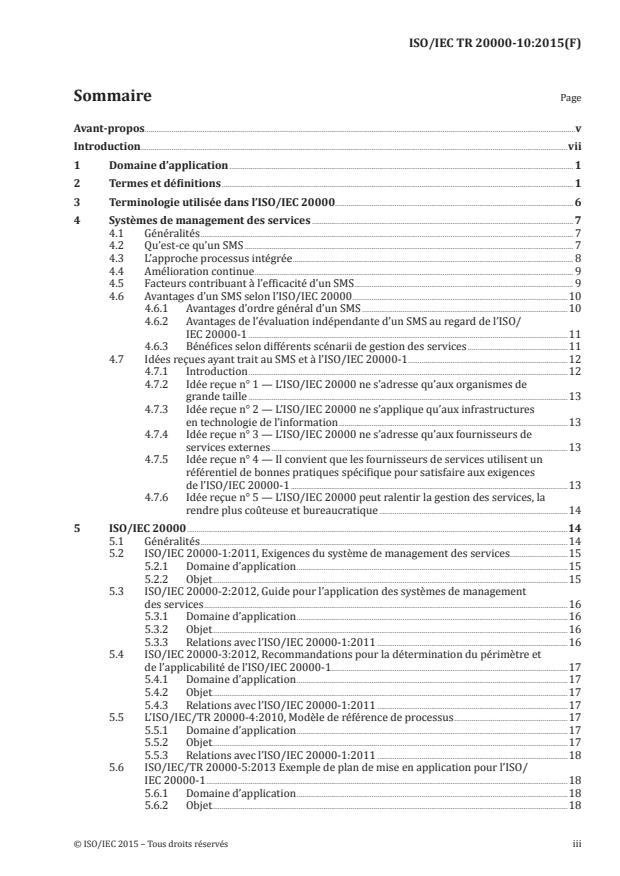
Contents Page
Foreword .v
Introduction .vii
1 Scope . 1
2 Terms and definitions . 1
3 Terminology used in ISO/IEC 20000 . 6
4 Service management systems . 7
4.1 General . 7
4.2 What is an SMS . 7
4.3 The integrated process approach . 8
4.4 Continual improvement . 8
4.5 What constitutes an effective SMS . 9
4.6 Benefits of an SMS based on ISO/IEC 20000 . 9
4.6.1 General benefits of an SMS . 9
4.6.2 Benefits from independent assessment of an SMS against ISO/IEC 20000-1 .10
4.6.3 Benefits related to different service management scenarios .11
4.7 Misperceptions about an SMS and ISO/IEC 20000-1 .12
4.7.1 Introduction .12
4.7.2 Misperception 1 — ISO/IEC 20000 is only for large commercial organisations .12
4.7.3 Misperception 2 — ISO/IEC 20000 is only applicable to IT infrastructure .13
4.7.4 Misperception 3 — ISO/IEC 20000 is only for external service providers .13
4.7.5 Misperception 4 — Service providers should use a specific best practice
framework to fulfil the requirements specified in ISO/IEC 20000-1 .13
4.7.6 Misperception 5 — ISO/IEC 20000 can make service management slow,
more costly and bureaucratic .13
5 ISO/IEC 20000 .14
5.1 General .14
5.2 ISO/IEC 20000-1:2011 Service management system requirements .15
5.2.1 Scope .15
5.2.2 Purpose .15
5.3 ISO/IEC 20000-2:2012 Guidance on application of service management systems .15
5.3.1 Scope .15
5.3.2 Purpose .15
5.3.3 Relationship with ISO/IEC 20000-1:2011 .15
5.4 ISO/IEC 20000-3:2012 Guidance on scope definition and applicability of ISO/
IEC 20000-1 .16
5.4.1 Scope .16
5.4.2 Purpose .16
5.4.3 Relationship with ISO/IEC 20000-1:2011 .16
5.5 ISO/IEC TR 20000-4:2010 Process reference model .16
5.5.1 Scope .16
5.5.2 Purpose .16
5.5.3 Relationship with ISO/IEC 20000-1:2011 .17
5.6 ISO/IEC TR 20000-5:2013 Exemplar implementation plan for ISO/IEC 20000-1 .17
5.6.1 Scope .17
5.6.2 Purpose .17
5.6.3 Relationships with ISO/IEC 20000-1:2011 .17
5.7 ISO/IEC TR 20000-9:2015 Guidance on the application of ISO/IEC 20000-1 to
cloud services .18
5.7.1 Scope .18
5.7.2 Purpose .18
5.7.3 Relationships with ISO/IEC 20000-1:2011 .18
6 Other related International Standards and Technical Reports .18
© ISO/IEC 2015 – All rights reserved iii
6.1 Closely related International Standards and Technical Reports .18
6.2 ISO/IEC TS 15504-8:2012 .19
6.2.1 Scope .19
6.2.2 Purpose .19
6.2.3 Relationships with ISO/IEC 20000-1:2011 .19
6.3 ISO/IEC 27013: — .19
6.3.1 Scope .19
6.3.2 Purpose .19
6.3.3 Relationships with ISO/IEC 20000-1:2011 .19
6.4 ISO/IEC TR 90006:2013 .20
6.4.1 Scope .20
6.4.2 Purpose .20
6.4.3 Relationships with ISO/IEC 20000-1:2011 .20
6.5 Supporting International Standards .21
6.5.1 General.21
6.5.2 ISO 9000:2005 .21
6.5.3 ISO 9001:2008 .21
6.5.4 ISO 10007:2003 .22
6.5.5 ISO/IEC 19770-1:2012 .22
6.5.6 ISO/IEC 27000:2014 .22
6.5.7 ISO/IEC 27001:2013 .23
6.5.8 ISO/IEC 27031:2011 .23
6.5.9 ISO 31000:2009 .23
6.5.10 ISO/IEC 38500:2015 .23
6.5.11 ISO 22301:2012 .24
Bibliography .25
iv © ISO/IEC 2015 – All rights reserved
Foreword
ISO (the International Organization for Standardization) and IEC (the International Electrotechnical
Commission) form the specialized system for worldwide standardization. National bodies that are
members of ISO or IEC participate in the development of International Standards through technical
committees established by the respective organization to deal with particular fields of technical
activity. ISO and IEC technical committees collaborate in fields of mutual interest. Other international
organizations, governmental and non-governmental, in liaison with ISO and IEC, also take part in the
work. In the field of information technology, ISO and IEC have established a joint technical committee,
ISO/IEC JTC 1.
The procedures used to develop this document and those intended for its further maintenance are
described in the ISO/IEC Directives, Part 1. In particular the different approval criteria needed for
the different types of document should be noted. This document was drafted in accordance with the
editorial rules of the ISO/IEC Directives, Part 2 (see www.iso.org/directives).
Attention is drawn to the possibility that some of the elements of this document may be the subject
of patent rights. ISO and IEC shall not be held responsible for identifying any or all such patent
rights. Details of any patent rights identified during the development of the document will be in the
Introduction and/or on the ISO list of patent declarations received (see www.iso.org/patents).
Any trade name used in this document is information given for the convenience of users and does not
constitute an endorsement.
For an explanation on the meaning of ISO specific terms and expressions related to conformity
assessment, as well as information about ISO’s adherence to the WTO principles in the Technical
Barriers to Trade (TBT) see the following URL: Foreword - Supplementary information
The committee responsible for this document is ISO/IEC JTC 1, Information technology, Subcommittee
SC 40, IT Service Management and IT Governance.
This second edition cancels and replaces the first edition (ISO/IEC TR 20000-10:2013), which has been
technically revised.
ISO/IEC 20000 consists of the following parts, under the general title Information technology —
Service management:
— Part 1: Service management system requirements
— Part 2: Guidance on the application of service management systems
— Part 3: Guidance on scope definition and applicability of ISO/IEC 20000‑1
— Part 4: Process reference model [Technical Report]
— Part 5: Exemplar implementation plan for ISO/IEC 20000‑1 [Technical Report]
— Part 9: Guidance on the application of ISO/IEC 20000‑1 to cloud services [Technical Report]
— Part 10: Concepts and terminology [Technical Report]
— Part 11: Guidance on the relationship between ISO/IEC 20000‑1:2011 and service management
1)
frameworks: ITIL® [Technical Report]
The following parts are under preparation
— Part 6: Requirements for bodies providing audit and certification of service management systems
— Part 8: Guidance on usage and benefits of the application of service management systems for smaller
organizations [Technical Report]
1) ITIL® is a registered trademark of AXELOS Limited.
© ISO/IEC 2015 – All rights reserved v
— Part 12: Guidance on the relationship between ISO/IEC 20000‑1:2011 and service management
2)
frameworks: CMMI-SVC® [Technical Report]
2) CMMI® and CMMI-SVC® are registered trademarks of the CMMI Institute.
vi © ISO/IEC 2015 – All rights reserved
Introduction
This part of ISO/IEC 20000 provides an overview of the concepts and the terminology of ISO/IEC 20000. It
establishes a common framework for helping organizations to understand the purpose of all the parts of
ISO/IEC 20000 and the relationships between the parts. This part of ISO/IEC 20000 is intended to become
the authoritative source for definitions used in all the parts of ISO/IEC 20000. Terms defined in this part
of ISO/IEC 20000 will be removed from other published parts of ISO/IEC 20000 as they are updated.
This part of ISO/IEC 20000 also identifies other documents that have relationships with ISO/IEC 20000-
1:2011 and identifies common areas with related International Standards to aid the use and integration
of multiple International Standards in organizations.
This part of ISO/IEC 20000 can be used by any organization or individual involved in the planning,
design, transition, delivery and improvement of services using ISO/IEC 20000-1:2011. It can also be used
for those involved in the assessment or audit of service management systems (SMS), providing details
of all parts of ISO/IEC 20000 and how they can be used. More specifically, this part of ISO/IEC 20000
a) defines the terms used in ISO/IEC 20000,
b) promotes cohesion between the parts of ISO/IEC 20000 by explaining the concepts and terminology
used across all parts,
c) contributes to the understanding of ISO/IEC 20000 by clarifying the relationships between all the
parts,
d) clarifies the possible interfaces and integration between the service provider’s SMS and other
management systems,
e) provides an overview of other International Standards which can be used in combination with
ISO/IEC 20000, and
f) identifies common areas between ISO/IEC 20000-1 and other International Standards.
Figure 1 represents an overview of the relationships between the parts of ISO/IEC 20000 as well as
relevant frameworks and other external influences.
© ISO/IEC 2015 – All rights reserved vii
Frameworks
Sector specific National International
and good
Standards
standards standards
practices
ISO/IEC 20000
ISO/IEC 20000 -1:2011
Information technology—Service management system requirements
ISO/IEC 20000 -2:2012 ISO/IEC 20000-6
Guidance on application of Requirements for bodies
service management systems providing audit and certification
of service management systems
ISO/IEC 20000 -3:2012 ISO/IEC 20000 -9:2015
Guidance on scope definition and Guidance on the application of
applicability of ISO/IEC 20000-1 ISO/IEC 20000-1 to cloud services
ISO/IEC TR 20000- 4:2010 ISO/IEC 20000 -11
Process reference model Guidance on the relationship
between ISO/IEC 20000-1 and
service management framework: ITIL
ISO/IEC TR 20000- 5:2013
Exemplar implementation plan
for ISO/IEC 20000-1
ISO/IEC TR 20000 -10:2015
Concepts and terminology
Key
External
Under
influences
development
in the series
Figure 1 — Overview of parts of ISO/IEC 20000 addressed in ISO/IEC/TR 20000-10
viii © ISO/IEC 2015 – All rights reserved
TECHNICAL REPORT ISO/IEC TR 20000-10:2015(E)
Information technology — Service management —
Part 10:
Concepts and terminology
1 Scope
This part of ISO/IEC 20000 describes the core concepts of ISO/IEC 20000, identifying how the different
parts support ISO/IEC 20000-1:2011 as well as the relationships between ISO/IEC 20000 and other
International Standards and Technical Reports. This part of ISO/IEC 20000 also explains the terminology
used in ISO/IEC 20000, so that organisations and individuals can interpret the concepts correctly.
This part of ISO/IEC 20000 is for
a) service providers considering using any part of ISO/IEC 20000 and looking for guidance on how to
use the different parts of ISO/IEC 20000 to achieve their goal,
b) service providers that wish to understand how ISO/IEC 20000 can be used in combination with
other International Standards, and
c) practitioners, auditors, and other parties who wish to gain an understanding of ISO/IEC 20000.
2 Terms and definitions
For the purposes of this document, the following terms and definitions apply.
NOTE 1 Terms and definitions used in ISO/IEC 20000 but not included in this part can be found in standard
English dictionaries.
NOTE 2 The formatting of the terms and definitions clause has been edited to reflect the ISO/IEC Directives, Part
2, 2011 version. It has not changed the content of the definitions as they were published in ISO/IEC 20000-1:2011.
2.1
availability
ability of a service or service component to perform its required function at an agreed instant or over
an agreed period of time
Note 1 to entry: Availability is normally expressed as a ratio or percentage of the time that the service or service
component is actually available for use by the customer to the agreed time that the service should be available.
2.2
configuration baseline
configuration information formally designated at a specific time during a service or service
component’s life
Note 1 to entry: Configuration baselines, plus approved changes from those baselines, constitute the current
configuration information.
[SOURCE: ISO/IEC/IEEE 24765:2010, modified]
2.3
configuration item
CI
element that needs to be controlled in order to deliver a service or services
© ISO/IEC 2015 – All rights reserved 1
2.4
configuration management database
CMDB
data store used to record attributes of configuration items, and the relationships between configuration
items, throughout their lifecycle
2.5
continual improvement
recurring activity to increase the ability to fulfil service requirements
[SOURCE: ISO 9000:2005, modified]
2.6
corrective action
action to eliminate the cause or reduce the likelihood of recurrence of a detected nonconformity or
other undesirable situation
[SOURCE: ISO 9000:2005, modified]
2.7
customer
organization or part of an organization that receives a service or services
Note 1 to entry: A customer can be internal or external to the service provider’s organization.
[SOURCE: ISO 9000:2005, modified]
2.8
document
information and its supporting medium
[SOURCE: ISO 9000:2005]
EXAMPLE Policies, plans, process descriptions, procedures, service level agreements, contracts or records.
Note 1 to entry: The documentation can be in any form or type of medium.
Note 2 to entry: In ISO/IEC 20000, documents, except for records, state the intent to be achieved.
2.9
effectiveness
extent to which planned activities are realized and planned results achieved
[SOURCE: ISO 9000:2005]
2.10
incident
unplanned interruption to a service, a reduction in the quality of a service or an event that has not yet
impacted the services to the customer
2.11
information security
preservation of confidentiality, integrity and accessibility of information
Note 1 to entry: In addition, other properties such as authenticity, accountability, non-repudiation and reliability
can also be involved.
Note 2 to entry: The term ‘availability’ has not been used in this definition because it is a defined term in this part
of ISO/IEC 20000 which would not be appropriate for this definition.
[SOURCE: ISO/IEC 27000:2014, modified]
2 © ISO/IEC 2015 – All rights reserved
2.12
information security incident
single or a series of unwanted or unexpected information security events that have a significant
probability of compromising business operations and threatening information security
[SOURCE: ISO/IEC 27000:2014]
2.13
interested party
person or group having a specific interest in the performance or success of the service provider’s
activity or activities
EXAMPLE Customers, owners, management, people in the service provider’s organization, suppliers,
bankers, unions or partners.
Note 1 to entry: A group can comprise an organization, a part thereof, or more than one organization.
[SOURCE: ISO 9000:2005, modified]
2.14
internal group
part of the service provider’s organization that enters into a documented agreement with the service
provider to contribute to the design, transition, delivery and improvement of a service or services
Note 1 to entry: The internal group is outside the scope of the service provider’s SMS.
2.15
known error
problem that has an identified root cause or a method of reducing or eliminating its impact on the
services by working around it
2.16
nonconformity
non-fulfilment of a requirement
[SOURCE: ISO 9000:2005]
2.17
organization
group of people and facilities with an arrangement of responsibilities, authorities and relationships
EXAMPLE Company, corporation, firm, enterprise, institution, charity, sole trader, association, or parts or
combination thereof.
Note 1 to entry: The arrangement is generally orderly.
Note 2 to entry: An organization can be public or private.
[SOURCE: ISO 9000:2005]
2.18
preventive action
action to avoid or eliminate the causes, or reduce the likelihood, of occurrence of a potential
nonconformity or other potential undesirable situation
[SOURCE: ISO 9000:2005, modified]
2.19
problem
root cause of one or more incidents
Note 1 to entry: The root cause is not usually known at the time a problem record is created and the problem
management process is responsible for further investigation.
© ISO/IEC 2015 – All rights reserved 3
2.20
procedure
specified way to carry out an activity or a process
[SOURCE: ISO 9000:2005]
Note 1 to entry: Procedures can be documented or not.
2.21
process
set of interrelated or interacting activities which transforms inputs into outputs
[SOURCE: ISO 9000:2005]
2.22
record
document stating results achieved or providing evidence of activities performed
[SOURCE: ISO 9000:2005]
EXAMPLE Audit reports, incident reports, training records or minutes of meetings.
2.23
release
collection of one or more new or changed configuration items deployed into the live environment as a
result of one or more changes
2.24
request for change
proposal for a change to be made to a service, service component or the SMS
Note 1 to entry: A change to a service includes the provision of a new service or the removal of a service which is
no longer required.
2.25
risk
effect of uncertainty on objectives
Note 1 to entry: An effect is a deviation from the expected — positive and/or negative.
Note 2 to entry: Objectives can have different aspects (such as financial, health and safety, and environmental
goals) and can apply at different levels (such as strategic, organization-wide, project, product and process).
Note 3 to entry: Risk is often characterized by reference to potential events and consequences, or a
combination of these.
Note 4 to entry: Risk is often expressed in terms of a combination of the consequences of an event (including
changes in circumstances) and the associated likelihood of occurrence.
[SOURCE: ISO 31000:2009]
2.26
service
means of delivering value for the customer by facilitating results the customer wants to achieve
Note 1 to entry: Service is generally intangible.
Note 2 to entry: A service can also be delivered to the service provider by a supplier, an internal group or a
customer acting as a supplier.
4 © ISO/IEC 2015 – All rights reserved
2.27
service component
single unit of a service that when combined with other units will deliver a complete service
EXAMPLE Hardware, software, tools, applications, documentation, information, processes or supporting
services
Note 1 to entry: A service component can consist of one or more configuration items.
2.28
service continuity
capability to manage risks and events that could have serious impact on a service or services in order to
continually deliver services at agreed levels
2.29
service level agreement
SLA
documented agreement between the service provider and customer that identifies services and
service targets
Note 1 to entry: A service level agreement can also be established between the service provider and a supplier or
an internal group or a customer acting as a supplier.
Note 2 to entry: A service level agreement can be included in a contract or another type of documented agreement.
2.30
service management
set of capabilities and processes to direct and control the service provider’s activities and resources for
the design, transition, delivery and improvement of services to fulfil the service requirements
2.31
service management system
SMS
management system to direct and control the service management activities of the service provider
Note 1 to entry: A management system is a set of interrelated or interacting elements to establish policy and
objectives and to achieve those objectives.
Note 2 to entry: The SMS includes all service management policies, objectives, plans, processes, documentation
and resources required for the design, transition, delivery and improvement of services and to fulfil the
requirements specified in ISO/IEC 20000-1:2011.
Note 3 to entry: Adapted from the definition of ‘quality management system’ in ISO 9000:2005.
2.32
service provider
organization or part of an organization that manages and delivers a service or services to the customer
Note 1 to entry: A customer can be internal or external to the service provider’s organization.
2.33
service request
request for information, advice, access to a service or a pre-approved change
2.34
service requirement
needs of the customer and the users of the service, including service level requirements, and the needs
of the service provider
© ISO/IEC 2015 – All rights reserved 5
2.35
supplier
organization or part of an organization that is external to the service provider’s organization and
enters into a contract with the service provider to contribute to the design, transition, delivery and
improvement of a service or services or processes
Note 1 to entry: Suppliers include designated lead suppliers but not their sub-contracted suppliers.
2.36
top management
person or group of people who direct and control the service provider at the highest level
[SOURCE: ISO 9000:2005, modified]
2.37
transition
activities involved in moving a new or changed service to or from the live environment
3 Terminology used in ISO/IEC 20000
Most terms in ISO/IEC 20000 use the definitions found in commonly available English language
dictionaries and in some cases use defined terms. These defined terms are taken from other management
system standards or are specifically defined for ISO/IEC 20000, e.g. ‘document’, ‘effectiveness’ and ‘top
management’ from ISO 9000:2005, ‘information security’ from ISO/IEC 27000, ‘service’ specifically
defined for ISO/IEC 20000.
The term ‘top management’ in the context of ISO/IEC 20000 refers to the person or group of people
who direct and control the service provider at the highest level. If the service provider is part of a
larger organisation ‘top management’ in ISO/IEC 20000 still refers to those who direct and control the
part of the organisation that is defined as the service provider. The term ‘top management’ is used
in ISO 9000:2005 for those responsible for the organization. In ISO/IEC 20000 ‘top management’ is
responsible for that part of the organization relevant to the service provider’s SMS and its scope.
Other terms defined in ISO 9000:2005 are used in ISO/IEC 20000-1:2011. Generally these terms are
closely linked to management systems (e.g. process, procedure, document, record, corrective action,
preventive action). In some cases the definitions in ISO 9000:2005 have been adapted to apply to
services, because ISO/IEC 20000-1:2011 was developed specifically for SMS and services.
The term ‘governance’ is an example of a term commonly available in English language dictionaries but
that is used in ISO/IEC 20000 only in the context of ‘governance of processes operated by other parties’.
ISO/IEC 20000-1:2011 uses a defined term, configuration item (CI), as an element that should be controlled
in order to deliver a service or services. The service provider should therefore define what should be
controlled as a CI to support business objectives and service requirements specific to its organization.
Some but not necessarily all assets can be considered CIs, for example a software application or a service
level agreement (SLA) are assets that are also CIs. Records can be assets but not CIs.
Although the wording of the definition of ‘information security incident’ used in ISO/IEC 20000 was
taken from ISO/IEC 27000:2009, the way is defined and used in ISO/IEC 20000 is different.
In ISO/IEC 27000:2014, information security incident is the term used for all unwanted events
threatening information security. ISO/IEC 27001:2013 describes a single process to deal with
information security incidents.
NOTE ISO/IEC 27013 provides further information about the integration of ISO/IEC 20000-1 and
ISO/IEC 27001 including how to reconcile the differences between terminology in the two standards.
In contrast, in ISO/IEC 20000-1:2011 there are several mechanisms used for managing unwanted
events and related records: incident, information security incident, problem, known error, and major
6 © ISO/IEC 2015 – All rights reserved
incident. These can all be information security incidents according to ISO/IEC 27001:2013, depending
on their characteristics.
ISO/IEC 20000-1:2011 also has a variety of mechanisms to manage these events, such as incident and
service request management, major incident procedure and problem management. An unwanted event
can be managed by more than one of these processes and procedures during its lifecycle.
In order to keep all parts of ISO/IEC 20000 aligned, defined terms, words and phrases are used
consistently across all parts. For example, the phrase ‘fulfil requirements’, is used, not ‘meet
requirements’. This consistency has also been adopted to assist in the consistent translation of the
parts of ISO/IEC 20000 into other languages.
4 Service management systems
4.1 General
An SMS can provide service providers with a means of delivering services that are aligned to the business
needs and the customer requirements. The implementation of an SMS can enable top management to
have the visibility and control they require to deliver business value and sustain competitive advantage.
Managing services via an integrated process approach can help to ensure that services are consistent
and that the introduction of new or changed services is planned and coordinated.
4.2 What is an SMS
An SMS is a set of interacting components to direct and control the service management activities of
the service provider. It includes policies, objectives, plans, processes, documentation and resources to
achieve the service management objectives of the service provider and to fulfil the service requirements.
An SMS should direct and control the service management activities of the service provider to design,
transition, deliver, manage and improve services to fulfil the business needs and customer requirements
(internal or external).
An SMS for delivering and managing services to the customer, based on ISO/IEC 20000-1:2011, can
provide increased control, greater effectiveness and more opportunities for improvement within the
service provider organization. An SMS can directly contribute to the efficient and effective management
of service components and services, providing value and reducing the potential risk of failure by the
service provider. As an SMS can contribute to an improved quality of the services provided, more
flexible time to market, faster response to customer needs and improved relations with customers,
among other things, the service provider can benefit from increased credibility as a service provider
and a stronger market position.
The SMS relies on the following principles:
a) focus on the customer’s agreed service requirements;
b) strong leadership to support the SMS and communicate its importance to interested parties;
c) end to end management of services involving:
1) the service provider;
2) internal or external customers;
3) suppliers;
4) internal groups;
5) interested parties;
d) integrated process approach;
© ISO/IEC 2015 – All rights reserved 7
e) continual improvement using the Plan-Do-Check-Act (PDCA) methodology.
The effectiveness of an SMS depends on the level and quality of implementation of each of these principles.
The design and establishment of an SMS can be influenced by the service requirements and service
management objectives, which should be revised over time as the organization evolves. Other factors
can contribute. For example the size and structure of the service provider, the type of services and
whether the services are provided to internal customers, external customers, or both.
SMS and associated concepts are generic and intended to be applicable to all service providers,
regardless of type, size and the nature of the service delivered. ISO/IEC 20000-1 can be applied
by many types and sizes of organizations from very large enterprises with thousands of staff in
multiple locations to small and medium enterprises with a low number of staff in a single location.
ISO/IEC 20000-1 can be used for management of information, communication and technology enabled
services within these organizations. ISO/IEC 20000-1 can be used across various business sectors
and for various services such as telecommunications, finance, transportation, cloud services, facilities
management, business process outsourcing, and many other services. The requirements for an SMS
specified by ISO/IEC 20000-1 can be readily adopted for each organization to fit the sector, size and
type of service.
4.3 The integrated process approach
A process is a set of interrelated or interacting activities with a defined objective that should be managed
in an integrated way with other processes. This integration is achieved via interfaces between processes,
specifically the process inputs and outputs. The output from one process can directly form the input to
another process. Examples of process inputs and outputs can be viewed in ISO/IEC 20000-2:2012, Annex
A. Processes state ‘what’ is to be done and they are often supported by procedures that state ‘how’
activities should be performed. The adoption of an integrated process approach requires the service
provider to document and implement the service management processes, their interfaces with each other
and their integration with the rest of the SMS. Critical processes can often apply across organizational
boundaries thus complicating the specification of process management roles and responsibilities. In
order to support a truly integrated model, top management should expect a degree of organizational
transformation facilitated by consistent top management commitment and decision-making.
4.4 Continual improvement
The benefits derived from the continual improvement of the SMS include ensuring ongoing alignment of
the SMS and services to the evolving needs of the business. This can enable the service provider to work
as a mature learning organisation.
The improvement approach used in ISO/IEC 20000-1:2011 is based on the PDCA methodology.
Figure 2 illustrates how the PDCA methodology can be applied to the SMS, including the service
management processes specified in ISO/IEC 20000-1:2011, Clauses 5 to 9 and the services. Each
element of the PDCA methodology is dependent on the previous element and is a vital part of a
successful implementation of an SMS.
8 © ISO/IEC 2015 – All rights reserved
Plan
Service
management
system
Service
management
processes
Do Act
Services
Check
Figure 2 — PDCA methodology applied to service management
4.5 What constitutes an effective SMS
Many factors contribute to an effective SMS that can enable a service provider to address its service
management objectives. Example factors include having:
a) policies that drive the correct behaviours;
b) a set of integrated service management processes, policies and plans contributing to and supporting
measurable service management objectives;
c) an approach and framework for the design, transition, delivery and improvement of services
consistent with the organizational culture;
d) visible support and commitment from all levels of management, especially top management;
e) a measurement system used to assess performance in service management and provide feedback
and suggestions for improvement;
f) a service management owner and champion who has a mandate to manage and improve the SMS
and services.
For the service provider to show evidence of the effectiveness of the SMS, specific performance
indicators should be defined, monitored and reported for each of the factors listed above. For each
indicator, the service provider should confirm its level of effectiveness and any improvements required.
4.6 Benefits of an SMS based on ISO/IEC 20000
4.6.1 General benefits of an SMS
When service providers implement an SMS, the ability to apply consistent and well understood
management principles can be demonstrated to customers and other interested parties.
© ISO/IEC 2015 – All rights reserved 9
Benefits realised from the adoption of an SMS can include but are not limited to:
a) improving service performance and the value provided by the service provider to the business and
customers through the implementation and continual improvement of the SMS and services;
b) reducing cost, time and disruption to services;
c) ensuring the SMS components are aligned with business objectives and that they provide value to
the business;
d) ensuring the service management activities meet the business needs and fulfil service requirements
in the scope of the SMS;
e) facilitating confidence of the business and customers with an SMS based on ISO/IEC 20000-1;
f) reducing risks through the use of an agreed risk management approach;
g) enabling improved coordination between a servi
...
RAPPORT ISO/IEC TR
TECHNIQUE 20000-10
Deuxième édition
2015-11-01
Technologies de l’information —
Gestion des services —
Partie 10:
Concepts et terminologie
Information technology — Service management —
Part 10: Concepts and terminology
Numéro de référence
©
ISO/IEC 2015
DOCUMENT PROTÉGÉ PAR COPYRIGHT
© ISO/IEC 2015, Publié en Suisse
Droits de reproduction réservés. Sauf indication contraire, aucune partie de cette publication ne peut être reproduite ni utilisée
sous quelque forme que ce soit et par aucun procédé, électronique ou mécanique, y compris la photocopie, l’affichage sur
l’internet ou sur un Intranet, sans autorisation écrite préalable. Les demandes d’autorisation peuvent être adressées à l’ISO à
l’adresse ci-après ou au comité membre de l’ISO dans le pays du demandeur.
ISO copyright office
Ch. de Blandonnet 8 • CP 401
CH-1214 Vernier, Geneva, Switzerland
Tel. +41 22 749 01 11
Fax +41 22 749 09 47
copyright@iso.org
www.iso.org
ii © ISO/IEC 2015 – Tous droits réservés
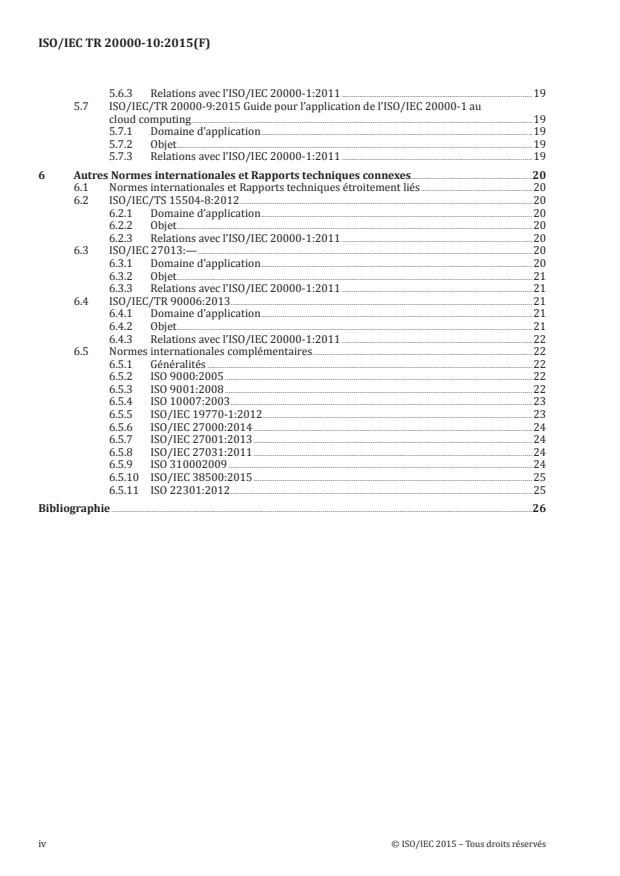
Sommaire Page
Avant-propos .v
Introduction .vii
1 Domaine d’application . 1
2 Termes et définitions . 1
3 Terminologie utilisée dans l’ISO/IEC 20000 . 6
4 Systèmes de management des services . 7
4.1 Généralités . 7
4.2 Qu’est-ce qu’un SMS . 7
4.3 L’approche processus intégrée . 8
4.4 Amélioration continue . 9
4.5 Facteurs contribuant à l’efficacité d’un SMS . 9
4.6 Avantages d’un SMS selon l’ISO/IEC 20000 .10
4.6.1 Avantages d’ordre général d’un SMS .10
4.6.2 Avantages de l’évaluation indépendante d’un SMS au regard de l’ISO/
IEC 20000-1 .11
4.6.3 Bénéfices selon différents scénarii de gestion des services .11
4.7 Idées reçues ayant trait au SMS et à l’ISO/IEC 20000-1 .12
4.7.1 Introduction .12
4.7.2 Idée reçue n° 1 — L’ISO/IEC 20000 ne s’adresse qu’aux organismes de
grande taille .13
4.7.3 Idée reçue n° 2 — L’ISO/IEC 20000 ne s’applique qu’aux infrastructures
en technologie de l’information .13
4.7.4 Idée reçue n° 3 — L’ISO/IEC 20000 ne s’adresse qu’aux fournisseurs de
services externes .13
4.7.5 Idée reçue n° 4 — Il convient que les fournisseurs de services utilisent un
référentiel de bonnes pratiques spécifique pour satisfaire aux exigences
de l’ISO/IEC 20000-1 .13
4.7.6 Idée reçue n° 5 — L’ISO/IEC 20000 peut ralentir la gestion des services, la
rendre plus coûteuse et bureaucratique .14
5 ISO/IEC 20000 .14
5.1 Généralités .14
5.2 ISO/IEC 20000-1:2011, Exigences du système de management des services .15
5.2.1 Domaine d’application .15
5.2.2 Objet.15
5.3 ISO/IEC 20000-2:2012, Guide pour l’application des systèmes de management
des services .16
5.3.1 Domaine d’application .16
5.3.2 Objet.16
5.3.3 Relations avec l’ISO/IEC 20000-1:2011 .16
5.4 ISO/IEC 20000-3:2012, Recommandations pour la détermination du périmètre et
de l’applicabilité de l’ISO/IEC 20000-1.17
5.4.1 Domaine d’application .17
5.4.2 Objet.17
5.4.3 Relations avec l’ISO/IEC 20000-1:2011 .17
5.5 L’ISO/IEC/TR 20000-4:2010, Modèle de référence de processus .17
5.5.1 Domaine d’application .17
5.5.2 Objet.17
5.5.3 Relations avec l’ISO/IEC 20000-1:2011 .18
5.6 ISO/IEC/TR 20000-5:2013 Exemple de plan de mise en application pour l’ISO/
IEC 20000-1 .18
5.6.1 Domaine d’application .18
5.6.2 Objet.18
© ISO/IEC 2015 – Tous droits réservés iii
5.6.3 Relations avec l’ISO/IEC 20000-1:2011 .19
5.7 ISO/IEC/TR 20000-9:2015 Guide pour l’application de l’ISO/IEC 20000-1 au
cloud computing .19
5.7.1 Domaine d’application .19
5.7.2 Objet.19
5.7.3 Relations avec l’ISO/IEC 20000-1:2011 .19
6 Autres Normes internationales et Rapports techniques connexes .20
6.1 Normes internationales et Rapports techniques étroitement liés .20
6.2 ISO/IEC/TS 15504-8:2012 .20
6.2.1 Domaine d’application .20
6.2.2 Objet.20
6.2.3 Relations avec l’ISO/IEC 20000-1:2011 .20
6.3 ISO/IEC 27013:— .20
6.3.1 Domaine d’application .20
6.3.2 Objet.21
6.3.3 Relations avec l’ISO/IEC 20000-1:2011 .21
6.4 ISO/IEC/TR 90006:2013.21
6.4.1 Domaine d’application .21
6.4.2 Objet.21
6.4.3 Relations avec l’ISO/IEC 20000-1:2011 .22
6.5 Normes internationales complémentaires .22
6.5.1 Généralités .22
6.5.2 ISO 9000:2005 .22
6.5.3 ISO 9001:2008 .22
6.5.4 ISO 10007:2003 .23
6.5.5 ISO/IEC 19770-1:2012 .23
6.5.6 ISO/IEC 27000:2014 .24
6.5.7 ISO/IEC 27001:2013 .24
6.5.8 ISO/IEC 27031:2011 .24
6.5.9 ISO 310002009 .24
6.5.10 ISO/IEC 38500:2015 .25
6.5.11 ISO 22301:2012 .25
Bibliographie .26
iv © ISO/IEC 2015 – Tous droits réservés
Avant-propos
L’ISO (Organisation internationale de normalisation) et l’IEC (Commission électrotechnique
internationale) forment le système spécialisé de la normalisation mondiale. Les organismes
nationaux membres de l’ISO ou de l’IEC participent au développement de Normes internationales
par l’intermédiaire des comités techniques créés par l’organisation concernée afin de s’occuper des
domaines particuliers de l’activité technique. Les comités techniques de l’ISO et de l’IEC collaborent
dans des domaines d’intérêt commun. D’autres organisations internationales, gouvernementales et non
gouvernementales, en liaison avec l’ISO et l’IEC, participent également aux travaux. Dans le domaine
des technologies de l’information, l’ISO et l’IEC ont créé un comité technique mixte, l’ISO/IEC JTC 1.
Les procédures utilisées pour élaborer le présent document et celles destinées à sa mise à jour sont
décrites dans les Directives ISO/IEC, Partie 1. Il convient, en particulier de prendre note des différents
critères d’approbation requis pour les différents types de documents ISO. Le présent document a été
rédigé conformément aux règles de rédaction données dans les Directives ISO/IEC, Partie 2 (voir www.
iso.org/directives).
L’attention est appelée sur le fait que certains des éléments du présent document peuvent faire l’objet
de droits de propriété intellectuelle ou de droits analogues. L’ISO et l’IEC ne sauraient être tenues pour
responsables de ne pas avoir identifié de tels droits de propriété et averti de leur existence. Les détails
concernant les références aux droits de propriété intellectuelle ou autres droits analogues identifiés
lors de l’élaboration du document sont indiqués dans l’Introduction et/ou dans la liste des déclarations
de brevets reçues par l’ISO (voir www.iso.org/brevets).
Les appellations commerciales éventuellement mentionnées dans le présent document sont données
pour information, par souci de commodité, à l’intention des utilisateurs et ne sauraient constituer
un engagement.
Pour une explication de la signification des termes et expressions spécifiques de l’ISO liés à l’évaluation
de la conformité, ou pour toute information au sujet de l’adhésion de l’ISO aux principes de l’Organisation
mondiale du commerce (OMC) concernant les obstacles techniques au commerce (OTC), voir le lien
suivant: http://www.iso.org/iso/fr/foreword.html.
Le comité chargé de l’élaboration du présent document est l’ISO/IEC JTC 1, Technologies de l’information,
sous-comité SC 40, IT Service Management and IT Governance (Gestion des services issus des technologies
de l’information et gouvernance des technologies de l’information).
Cette seconde édition annule et remplace la première édition (ISO/IEC/TR 20000-10:2013), qui a fait
l’objet d’une révision technique.
L’ISO/IEC 20000 comprend les parties suivantes, présentées sous le titre général Technologies de
l’information — Gestion des services:
— Partie 1: Exigences du système de management des services
— Partie 2: Guide pour l’application des systèmes de management des services
— Partie 3: Recommandations pour la détermination du périmètre et l’applicabilité de l’ISO/IEC 20000-1
— Partie 4: Modèle de référence de processus [Rapport technique]
— Partie 5: Exemple de plan de mise en application pour l’ISO/IEC 20000-1 [Rapport Technique]
— Partie 9: Guide pour l’application de l’ISO/IEC 20000-1 au cloud computing [Rapport technique]
— Partie 10: Concepts et terminologie [Rapport technique]
1)
— Partie 11: Relations entre ISO/IEC 20000-1:2011 et les référentiels de gestion de service: ITIL®
[Rapport technique]
1) ITIL® est une marque déposée de AXELOS Limited.
© ISO/IEC 2015 – Tous droits réservés v
Les parties suivantes sont en cours d’élaboration:
— Partie 6: Exigences pour les organismes procédant à l’audit et à la certification des systèmes de
management des services
— Partie 8: Lignes directrices sur l’utilisation et les bénéfices des systèmes de gestion des services dans les
plus petites organisations
— Partie 12: Guide d’orientation sur la relation entre l’ISO/IEC 20000-1:2011 et les référentiels de gestion
2)
des services: CMMI-SVC ® [Rapport technique]
2) CMMI® et CMMI-SVC® sont des marques déposées du CMMI Institute.
vi © ISO/IEC 2015 – Tous droits réservés
Introduction
La présente partie de l’ISO/IEC 20000 fournit une vue d’ensemble des concepts et de la terminologie
de l’ISO/IEC 20000. Elle établit un référentiel commun pour aider les organismes à comprendre la
finalité de toutes les parties de l’ISO/IEC 20000, et les relations entre ces parties. La présente partie de
l’ISO/IEC 20000 est destinée à devenir la source de référence pour les définitions utilisées dans toutes
les parties de l’ISO/IEC 20000. Les termes définis dans la présente partie de l’ISO/IEC 20000 seront
retirés des autres parties publiées de l’ISO/IEC 20000 lorsqu’elles seront mises à jour.
La présente partie de l’ISO/IEC 20000 identifie d’autres documents corrélés à l’ISO/IEC 20000-1:2011
et identifie des domaines communs avec les Normes internationales qui lui sont liées afin de faciliter
l’utilisation et l’intégration de multiples Normes internationales dans les organismes.
La présente partie de l’ISO/IEC 20000 peut être utilisée par tout organisme ou individu impliqué
dans la planification, la conception, la transition, la fourniture et l’amélioration des services utilisant
l’ISO/IEC 20000-1:2011. Elle peut également être utilisée par les personnes concernées par l’évaluation
ou l’audit des systèmes de management des services (SMS) car elle fournit des détails sur toutes les
parties de l’ISO/IEC 20000 et sur la façon dont celles-ci peuvent être utilisées. Plus précisément, la
présente partie de l’ISO/IEC 20000
a) définit les termes utilisés dans l’ISO/IEC 20000;
b) favorise la cohésion entre les parties de l’ISO/IEC 20000 en expliquant les concepts et la terminologie
utilisés dans toutes les parties;
c) facilite la compréhension de l’ISO/IEC 20000 en clarifiant les relations entre toutes les parties;
d) clarifie les interfaces possibles et l’intégration entre le SMS du fournisseur de services et les autres
systèmes de management;
e) fournit une vue d’ensemble des autres Normes internationales qui peuvent être utilisées en
combinaison avec l’ISO/IEC 20000; et
f) identifie des domaines communs entre l’ISO/IEC 20000-1 et d’autres Normes internationales.
La Figure 1 montre une vue d’ensemble des relations entre les parties de l’ISO/IEC 20000, ainsi que les
influences des référentiels pertinents et des autres sources externes.
© ISO/IEC 2015 – Tous droits réservés vii
Figure 1 — Synoptique des parties de l’ISO/IEC 20000 traitées dans l’ISO/IEC/TR 20000-10
viii © ISO/IEC 2015 – Tous droits réservés
RAPPORT TECHNIQUE ISO/IEC TR 20000-10:2015(F)
Technologies de l’information — Gestion des services —
Partie 10:
Concepts et terminologie
1 Domaine d’application
La présente partie de l’ISO/IEC 20000 expose les concepts principaux de l’ISO/IEC 20000, identifie la
façon dont les différentes parties viennent à l’appui de l’ISO/IEC 20000-1:2011 et décrit les relations
entre l’ISO/IEC 20000 et d’autres Normes internationales et Rapports techniques. La présente partie de
l’ISO/IEC 20000 explique aussi la terminologie utilisée dans l’ISO/IEC 20000, afin que les organismes et
les individus puissent interpréter correctement les concepts.
La présente partie de l’ISO/IEC 20000 s’adresse
a) aux fournisseurs de services qui envisagent d’utiliser une partie de l’ISO/IEC 20000 et qui
recherchent des recommandations concernant la manière d’utiliser les différentes parties de
l’ISO/IEC 20000 pour atteindre leur objectif;
b) aux fournisseurs de services qui souhaitent comprendre comment l’ISO/IEC 20000 peut être
utilisée avec d’autres Normes internationales; et
c) aux professionnels, auditeurs et autres parties qui souhaitent mieux comprendre l’ISO/IEC 20000.
2 Termes et définitions
Pour les besoins du présent document, les termes et définitions suivants s’appliquent.
NOTE 1 Les termes et définitions utilisés dans l’ISO/IEC 20000, mais ne figurant pas dans la présente partie
peuvent être consultés dans des dictionnaires standard.
NOTE 2 Le format de l’article Termes et définitions a été édité conformément aux Directives
ISO/IEC, Partie 2, édition de 2011. Cela ne modifie pas le contenu des définitions, qui sont telles que
publiées dans l’ISO/IEC 20000-1:2011.
2.1
disponibilité
aptitude d’un service ou d’un composant de service à remplir la fonction spécifiée à un instant donné ou
pendant une période de temps définie
Note 1 à l’article: En règle générale, la disponibilité s’exprime par le rapport ou le pourcentage entre, d’une part, la
période pendant laquelle le service ou le composant de service est réellement disponible pour le client et, d’autre
part, la période définie pendant laquelle il convient que le service soit disponible.
2.2
configuration de référence
informations de configuration formellement identifiées à un moment donné de la durée de vie d’un
service ou d’un composant de service
Note 1 à l’article: Les configurations de référence, ainsi que les changements approuvés apportés à ces dernières,
constituent les informations de configuration actuelles.
[SOURCE: ISO/IEC/IEEE 24765:2010, modifiée]
2.3
élément de configuration
CI
élément qui doit être contrôlé afin de fournir un ou plusieurs services
2.4
base de données de gestion des configurations
CMDB
base de données utilisée pour enregistrer les attributs des éléments de configuration, ainsi que les
relations entre les éléments de configuration, tout au long de leur cycle de vie
2.5
amélioration continue
activité régulière permettant d’accroître la capacité à satisfaire aux exigences de services
[SOURCE: ISO 9000:2005, modifiée]
2.6
action corrective
action visant à éliminer la cause ou à réduire la probabilité de récurrence d’une non-conformité ou
d’une autre situation indésirable détectée
[SOURCE: ISO 9000:2005, modifiée]
2.7
client
organisme ou partie d’un organisme qui reçoit un ou plusieurs services
Note 1 à l’article: Un client peut être interne ou externe à l’organisme fournisseur de services.
[SOURCE: ISO 9000:2005, modifiée]
2.8
document
support d’information et l’information qu’il contient
[SOURCE: ISO 9000:2005]
EXEMPLE Politiques, plans, descriptions de processus, procédures, accords sur les niveaux de services,
contrats ou enregistrements.
Note 1 à l’article: La documentation peut se présenter sous toute forme et sur tout type de support.
Note 2 à l’article: Dans l’ISO/IEC 20000, les documents, à l’exception des enregistrements, font état de
l’objectif à atteindre.
2.9
efficacité
niveau de réalisation des activités planifiées et d’obtention des résultats escomptés
[SOURCE: ISO 9000:2005]
2.10
incident
interruption non planifiée d’un service, altération de la qualité d’un service ou événement qui n’a pas
encore eu d’impact sur le service au client
2.11
sécurité de l’information
protection de la confidentialité, de l’intégrité et de l’accessibilité de l’information
Note 1 à l’article: En outre, d’autres propriétés telles que l’authenticité, l’imputabilité, la non-répudiation et la
fiabilité peuvent également être concernées.
2 © ISO/IEC 2015 – Tous droits réservés
Note 2 à l’article: Le terme « disponibilité » n’est pas utilisé dans la présente définition car il s’agit d’un terme
défini dans la présente partie de l’ISO/IEC 20000 qui ne serait pas adapté à la présente définition.
[SOURCE: ISO/IEC 27000:2014, modifiée]
2.12
incident lié à la sécurité de l’information
un ou plusieurs événements liés à la sécurité de l’information, indésirables ou inattendus, présentant
une probabilité forte de compromettre les opérations liées à l’activité de l’organisation et de menacer la
sécurité de l’information
[SOURCE: ISO/IEC 27000:2014]
2.13
partie intéressée
personne ou groupe de personnes ayant un intérêt particulier dans le fonctionnement ou le succès de
l’activité ou des activités du fournisseur de services
EXEMPLE Clients, propriétaires, direction, personnels de l’organisme fournisseur de services, fournisseurs,
banques, syndicats ou partenaires.
Note 1 à l’article: Un groupe peut être un organisme, une partie de celui-ci ou plusieurs organismes.
[SOURCE: ISO 9000:2005, modifiée]
2.14
groupe interne
partie d’un organisme fournisseur de services qui s’engage auprès du fournisseur de services, via un
accord documenté, à contribuer à la conception, la transition, la fourniture et l’amélioration d’un ou de
plusieurs services
Note 1 à l’article: Le groupe interne n’est pas couvert par le domaine d’application du SMS du fournisseur de services.
2.15
erreur connue
problème dont la cause sous-jacente est identifiée ou qui bénéficie d’une méthode pour limiter ou
éliminer son impact sur un service en le contournant
2.16
non-conformité
non-satisfaction d’une exigence
[SOURCE: ISO 9000:2005]
2.17
organisme
ensemble d’installations et de personnes avec des responsabilités, pouvoirs et relations
EXEMPLE Compagnie, société, firme, entreprise, institution, œuvre de bienfaisance, travailleur indépendant,
association, ou parties ou combinaison de ceux-ci.
Note 1 à l’article: Cet ensemble est généralement structuré.
Note 2 à l’article: Un organisme peut être public ou privé.
[SOURCE: ISO 9000:2005]
2.18
action préventive
action visant à éviter ou éliminer les causes d’une non-conformité potentielle ou d’une autre situation
indésirable potentielle, ou à réduire la probabilité de leur survenue
[SOURCE: ISO 9000:2005, modifiée]
© ISO/IEC 2015 – Tous droits réservés 3
2.19
problème
cause sous-jacente d’un ou de plusieurs incidents
Note 1 à l’article: La cause sous-jacente n’est en général pas connue au moment de l’enregistrement du problème
et le processus de gestion des problèmes est chargé des investigations plus approfondies.
2.20
procédure
manière spécifiée d’effectuer une activité ou un processus
[SOURCE: ISO 9000:2005]
Note 1 à l’article: Les procédures peuvent être documentées ou pas.
2.21
processus
ensemble d’activités corrélées ou interactives qui transforme des éléments d’entrée en éléments de sortie
[SOURCE: ISO 9000:2005]
2.22
enregistrement
document faisant état des résultats obtenus ou apportant la preuve de la réalisation d’une activité
[SOURCE: ISO 9000:2005]
EXEMPLE Rapports d’audit, rapports d’incidents, enregistrements de formation ou comptes-rendus de
réunions.
2.23
mise en production
ensemble d’un ou de plusieurs éléments de configuration, nouveaux ou modifiés, déployés dans
l’environnement de production en tant que résultat d’un ou de plusieurs changements
2.24
demande de changement
proposition de changement à apporter à un service, à un composant de service ou au SMS
Note 1 à l’article: Un changement apporté à un service inclut la mise à disposition d’un nouveau service ou la
suppression d’un service qui n’est plus requis.
2.25
risque
effet de l’incertitude sur l’atteinte des objectifs
Note 1 à l’article: Un effet est un écart, positif et/ou négatif, par rapport à une attente.
Note 2 à l’article: Les objectifs peuvent avoir différents aspects (par exemple, buts financiers, de santé et de
sécurité, ou environnementaux) et peuvent concerner différents niveaux (niveau stratégique, niveau d’un projet,
d’un produit, d’un processus ou d’un organisme tout entier).
Note 3 à l’article: Un risque est souvent caractérisé en référence à des événements et des conséquences potentiels
ou à une combinaison des deux.
Note 4 à l’article: Un risque est souvent exprimé en termes de combinaison des conséquences d’un événement
(incluant des changements de circonstances) et de sa vraisemblance.
[SOURCE: ISO 31000:2009]
4 © ISO/IEC 2015 – Tous droits réservés
2.26
service
moyen visant à fournir de la valeur au client en lui offrant les résultats qu’il souhaite atteindre
Note 1 à l’article: Un service est en général intangible.
Note 2 à l’article: Un service peut également être fourni au fournisseur de services par un fournisseur, un groupe
interne ou un client agissant en tant que fournisseur.
2.27
composant de service
élément simple d’un service qui, lorsqu’il est combiné à d’autres éléments, fournit un service complet
EXEMPLE Matériel, logiciel, outils, applications, documentation, informations, processus ou services de
soutien.
Note 1 à l’article: Un composant de service peut comprendre un ou plusieurs éléments de configuration.
2.28
continuité de service
capacité et efficience en gestion des risques et des événements susceptibles d’avoir de graves
conséquences sur un ou plusieurs services afin de fournir sans interruption les services prévus aux
accords sur les niveaux de services
2.29
accord sur les niveaux de services
SLA
accord documenté entre le fournisseur de services et le client qui identifie les services et leurs objectifs
Note 1 à l’article: Un accord sur les niveaux de services peut également être établi entre le fournisseur de services
et un fournisseur, un groupe interne ou un client agissant en tant que fournisseur.
Note 2 à l’article: Un accord sur les niveaux de services peut être inclus dans un contrat ou un autre type
d’accord documenté.
2.30
gestion des services
ensemble d’aptitudes et de processus permettant de diriger et de contrôler les activités et les ressources
du fournisseur de services pour la conception, la transition, la fourniture et l’amélioration des services
afin de satisfaire aux exigences de services
2.31
système de management des services
SMS
système de management permettant d’orienter et de contrôler les activités de gestion des services du
fournisseur de services
Note 1 à l’article: Un système de management est un ensemble d’éléments corrélés ou interdépendants visant à
établir une politique ainsi que des objectifs, et à atteindre ces objectifs.
Note 2 à l’article: Le SMS inclut l’intégralité des politiques de gestion des services, objectifs, plans, processus,
documentations et ressources requis pour la conception, la transition, la fourniture et l’amélioration des services,
et pour satisfaire aux exigences de l’ISO/IEC 20000-1:2011.
Note 3 à l’article: Adapté de la définition du «système de management de la qualité» de l’ISO 9000:2005.
2.32
fournisseur de services
organisme ou partie d’un organisme qui gère et fournit au client un ou plusieurs services
Note 1 à l’article: Un client peut être interne ou externe à l’organisme fournisseur de services.
© ISO/IEC 2015 – Tous droits réservés 5
2.33
demande de service
demande d’informations, de conseils, d’accès à un service ou à un changement préalablement approuvé
2.34
exigence de service
besoins du client et des utilisateurs du service, comprenant les exigences de niveaux de services, et
besoins du fournisseur de services
2.35
fournisseur
organisme ou partie d’un organisme qui est externe à l’organisme fournisseur de services et qui conclut
un contrat avec le fournisseur de services pour contribuer à la conception, la transition, la fourniture et
l’amélioration d’un ou de plusieurs services ou processus
Note 1 à l’article: Le terme «fournisseurs» inclut les principaux fournisseurs désignés, mais pas leurs sous-traitants.
2.36
direction
personne ou groupe de personnes qui oriente et contrôle le fournisseur de services au plus haut niveau
[SOURCE: ISO 9000:2005, modifiée]
2.37
transition
activités impliquées dans le déploiement d’un service nouveau ou modifié vers l’environnement de
production, ou dans le retrait d’un service de l’environnement de production
3 Terminologie utilisée dans l’ISO/IEC 20000
La plupart des termes de l’ISO/IEC 20000 utilisent les définitions contenues dans des dictionnaires
courants et, dans certains cas, des termes spécifiquement définis pour le contexte. Ces termes
définis sont repris d’autres normes de système de management ou sont spécifiquement définis pour
l’ISO/IEC 20000, par exemple, «document», «efficacité» et «direction» proviennent de l’ISO 9000:2005,
«sécurité de l’information» de l’ISO/IEC 27000, et «service» est spécifiquement défini pour
l’ISO/IEC 20000.
Le terme «direction» dans le contexte de l’ISO/IEC 20000 désigne la personne ou le groupe de personnes
qui oriente et contrôle le fournisseur de services au plus haut niveau. Si le fournisseur de services fait
partie d’un organisme plus large, le terme «direction» dans le contexte de l’ISO/IEC 20000 continue
de désigner la ou les personnes qui orientent et contrôlent la partie de l’organisme identifiée comme
le fournisseur de services. Le terme «direction» est utilisé dans l’ISO 9000:2005 pour désigner les
personnes responsables de l’organisme. Dans l’ISO/IEC 20000 la «direction» est la partie de l’organisme
responsable du SMS du fournisseur de services et de son champ d’application.
D’autres termes définis dans l’ISO 9000:2005 sont utilisés dans l’ISO/IEC 20000-1:2011. En règle
générale, ces termes sont étroitement liés aux systèmes de management (par exemple, processus,
procédure, document, enregistrement, action corrective, action préventive). Dans certains cas, les
définitions de l’ISO 9000:2005 ont été adaptées pour s’appliquer aux services car l’ISO/IEC 20000-
1:2011 a été élaborée spécifiquement pour le SMS et les services.
Le terme «gouvernance» est un exemple de terme couramment défini dans les dictionnaires, mais il
n’est utilisé dans l’ISO/IEC 20000 que dans le contexte de «gouvernance de processus opérés par
d’autres parties».
L’ISO/IEC 20000-1:2011 utilise un terme défini, le terme «élément de configuration (CI)», pour désigner
un élément qu’il convient de contrôler pour fournir un ou plusieurs services. Il est donc recommandé au
fournisseur de services de définir ce qu’il convient de contrôler en tant que CI pour soutenir les objectifs
métier et les exigences de services spécifiques à son organisme. Certains actifs, mais pas nécessairement
tous, peuvent être considérés comme des CI, par exemple une application logicielle ou un accord sur les
6 © ISO/IEC 2015 – Tous droits réservés
niveaux de services (SLA) sont des actifs qui sont également des CI. Les enregistrements peuvent être
des actifs d’information mais ne sont pas des CI.
Bien que la définition du terme «incident lié à la sécurité de l’information» dans l’ISO/IEC 20000 ait été
reprise de l’ISO/IEC 27000:2009, la manière dont ce terme est défini et utilisé dans l’ISO/IEC 20000
est différente.
Dans l’ISO/IEC 27000:2014, «incident lié à la sécurité de l’information» est le terme utilisé pour désigner
tous les événements indésirables qui représentent une menace pour la sécurité de l’information.
L’ISO/IEC 27001:2013 décrit un seul processus pour traiter des incidents liés à la sécurité de
l’information.
NOTE L’ISO/IEC 27013 fournit de plus amples informations sur l’intégration de l’ISO/IEC 20000-1 et
l’ISO/IEC 27001, y compris la manière d’harmoniser les différences de terminologie dans les deux normes.
À l’inverse, l’ISO/IEC 20000-1:2011 utilise plusieurs mécanismes pour la gestion des événements
indésirables et des enregistrements qui s’y rapportent: incident, incident lié à la sécurité de
l’information, problème, erreur connue et incident majeur. Tous peuvent être des incidents liés à la
sécurité de l’information selon l’ISO/IEC 27001:2013, en fonction de leurs caractéristiques.
L’ISO/IEC 20000-1:2011 dispose également de divers mécanismes pour gérer ces événements, tels que
la gestion des incidents et des demandes de services, la procédure d’incident majeur et la gestion des
problèmes. Un événement indésirable peut être géré par plusieurs de ces processus et procédures au
cours de son cycle de vie.
Dans un souci de maintien de l’alignement de toutes les parties de l’ISO/IEC 20000, les termes définis,
les mots et les expressions sont utilisés de manière cohérente entre toutes les parties. Par exemple,
l’expression «satisfaire aux exigences» est utilisée par toutes les parties, contrairement à l’expression
«répondre aux exigences». Cette cohérence a également été adoptée pour favoriser l’homogénéité de la
traduction des parties de l’ISO/IEC 20000 dans d’autres langues.
4 Systèmes de management des services
4.1 Généralités
Un SMS peut offrir aux fournisseurs de services un moyen de fournir des services alignés sur les
besoins métier et les exigences du client. L’implémentation d’un SMS peut permettre à la direction de
disposer de la visibilité et du contrôle nécessaires pour faciliter l’atteinte de la valeur et de l’avantage
concurrentiel par les métiers. La gestion des services, via une approche processus intégrée, peut aider à
assurer la cohérence des services, et que l’introduction de services nouveaux ou modifiés soit planifiée
et coordonnée.
4.2 Qu’est-ce qu’un SMS
Un SMS est un ensemble de composants interactifs servant à diriger et à contrôler les activités de
gestion des services du fournisseur de services. Il inclut les politiques, objectifs, plans, processus,
documentations et ressources nécessaires à la réalisation des objectifs de gestion des services du
fournisseur de services et à la satisfaction des exigences de services. Il convient que le SMS dirige et
contrôle les activités de gestion des services du fournisseur de services pour permettre la conception,
la transition, la fourniture, la gestion et l’amélioration des services afin de satisfaire aux besoins métier
et aux exigences du client (interne ou externe).
Un SMS destiné à fournir et à gérer des services pour le client, selon l’ISO/IEC 20000-1:2011, peut offrir
un contrôle accru, une plus grande efficacité et davantage d’opportunités d’amélioration au sein de
l’organisme fournisseur de services. Un SMS peut contribuer directement à la gestion efficiente et efficace
des composants de services et des services, en apportant de la valeur et en réduisant le risque potentiel
de défaillance du fait du fournisseur de services. Étant donné qu’un SMS peut contribuer à améliorer
la qualité des services fournis, à assouplir les délais de mise sur le marché, à accélérer la satisfaction
© ISO/IEC 2015 – Tous droits réservés 7
des besoins des clients et à renforcer les relations avec les clients, entre autres choses, le fournisseur de
services peut bénéficier d’une plus forte crédibilité et d’une position sur le marché plus forte.
Le SMS repose sur les principes suivants:
a) focalisation sur les exigences de services convenues avec le client;
b) leadership fort pour soutenir le SMS et communiquer son importance aux parties intéressées;
c) gestion de bout en bout des services impliquant:
1) le fournisseur de services,
2) les clients internes ou externes,
3) les fournisseurs,
4) les groupes internes,
5) les parties intéressées;
d) approche processus intégrée;
e) amélioration continue grâce à la méthodologie appelée «Roue de Deming» (PDCA, Plan-Do-Check-
Act).
L’efficacité d’un SMS dépend du niveau et de la qualité de la mise en œuvre de chacun de ces principes.
La conception et l’établissement d’un SMS peuvent être influencés par les exigences de services et les
objectifs de gestion des services qu’il convient de réviser au fur et à mesure de l’évolution de l’organisme.
D’autres facteurs peuvent avoir une influence. C’est le cas par exemple de la taille et de la structure
du fournisseur de services, du type de service fourni et du type de clients auxquels les services sont
fournis (clients internes et/ou clients externes).
Les SMS et les concepts associés sont génériques et destinés à être applicables par tous les fournisseurs
de services, indépendamment du type, de la taille et de la nature du service fourni. L’ISO/IEC 20000-1
peut être appliquée par des organismes de type et de taille variés, allant des très grandes entreprises
employant des milliers de personnes dans plusieurs sites aux petites et moyennes entreprises dont le
personnel réduit opère depuis un seul et même site. L’ISO/IEC 20000-1 peut être utilisée pour la gestion
des services au sein de ces organismes, reposant sur l’information, la communication et les technologies.
L’ISO/IEC 20000-1 peut être utilisée dans divers secteurs d’activité et pour divers services, tels que
les télécommunications, la finance, les transports, le cloud computing, la gestion des installations,
l’externalisation des processus métier, et bien d’autres services. Les exigences en matière de SMS
spécifiées par l’ISO/IEC 20000-1 peuvent facilement être adoptées pour chaque organisme et adaptées
au secteur, à la taille et au type de service.
4.3 L’approche processus intégrée
Un processus est un ensembl
...
Questions, Comments and Discussion
Ask us and Technical Secretary will try to provide an answer. You can facilitate discussion about the standard in here.
Loading comments...