


ISO/IEC TR 29194:2015
(Main)Information Technology — Biometrics — Guide on designing accessible and inclusive biometric systems
Information Technology — Biometrics — Guide on designing accessible and inclusive biometric systems
Procurements of biometric systems often stipulate requirements for the systems to be inclusive and make provision for exception handling. ISO/IEC TR 29194:2015 provides guidance for biometric system design and procurement to handle the range of accessibility and usability issues. This report will build upon the generic guidance in ISO/IEC/TR 24714‑1, Information technology ? Biometrics ? Jurisdictional and societal considerations for commercial applications ? Part 1: General guidance.
Technologies de l'information — Biométrie — Guide sur la conception des systèmes biométriques accessibles et inclusifs
General Information
Standards Content (Sample)
TECHNICAL ISO/IEC TR
REPORT 29194
First edition
2015-05-15
Information Technology — Biometrics
— Guide on designing accessible and
inclusive biometric systems
Technologies de l’information — Biométrie — Guide sur la conception
des systèmes biométriques accessibles et inclusifs
Reference number
©
ISO/IEC 2015
© ISO/IEC 2015, Published in Switzerland
All rights reserved. Unless otherwise specified, no part of this publication may be reproduced or utilized otherwise in any form
or by any means, electronic or mechanical, including photocopying, or posting on the internet or an intranet, without prior
written permission. Permission can be requested from either ISO at the address below or ISO’s member body in the country of
the requester.
ISO copyright office
Ch. de Blandonnet 8 • CP 401
CH-1214 Vernier, Geneva, Switzerland
Tel. +41 22 749 01 11
Fax +41 22 749 09 47
copyright@iso.org
www.iso.org
ii © ISO/IEC 2015 – All rights reserved
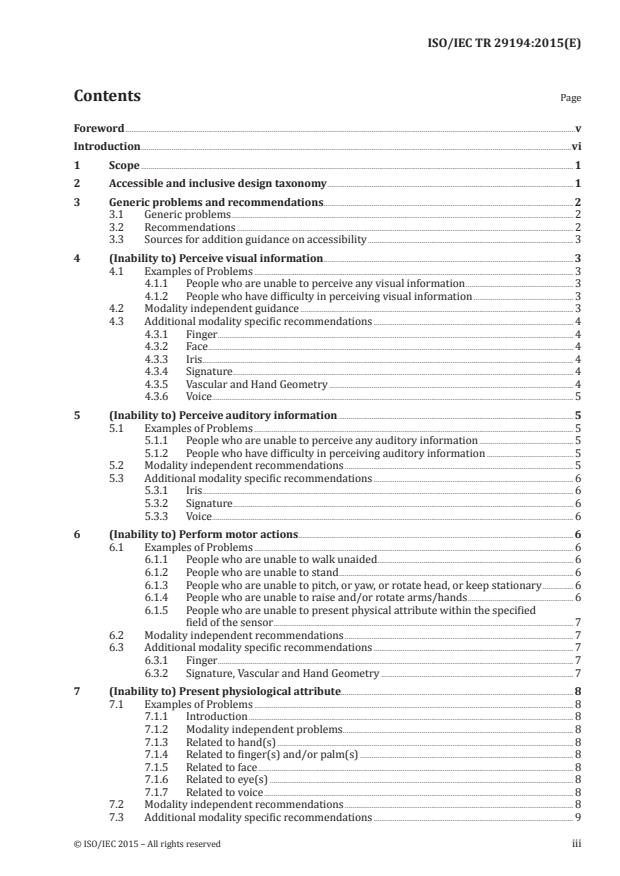
Contents Page
Foreword .v
Introduction .vi
1 Scope . 1
2 Accessible and inclusive design taxonomy . 1
3 Generic problems and recommendations . 2
3.1 Generic problems . 2
3.2 Recommendations . 2
3.3 Sources for addition guidance on accessibility . 3
4 (Inability to) Perceive visual information . 3
4.1 Examples of Problems . 3
4.1.1 People who are unable to perceive any visual information . 3
4.1.2 People who have difficulty in perceiving visual information . 3
4.2 Modality independent guidance . 3
4.3 Additional modality specific recommendations . 4
4.3.1 Finger . 4
4.3.2 Face . 4
4.3.3 Iris . . 4
4.3.4 Signature . 4
4.3.5 Vascular and Hand Geometry . 4
4.3.6 Voice . 5
5 (Inability to) Perceive auditory information . 5
5.1 Examples of Problems . 5
5.1.1 People who are unable to perceive any auditory information . 5
5.1.2 People who have difficulty in perceiving auditory information . 5
5.2 Modality independent recommendations . 5
5.3 Additional modality specific recommendations . 6
5.3.1 Iris . . 6
5.3.2 Signature . 6
5.3.3 Voice . 6
6 (Inability to) Perform motor actions . 6
6.1 Examples of Problems . 6
6.1.1 People who are unable to walk unaided . 6
6.1.2 People who are unable to stand . 6
6.1.3 People who are unable to pitch, or yaw, or rotate head, or keep stationary . 6
6.1.4 People who are unable to raise and/or rotate arms/hands . 6
6.1.5 People who are unable to present physical attribute within the specified
field of the sensor . 7
6.2 Modality independent recommendations . 7
6.3 Additional modality specific recommendations . 7
6.3.1 Finger . 7
6.3.2 Signature, Vascular and Hand Geometry . 7
7 (Inability to) Present physiological attribute. 8
7.1 Examples of Problems . 8
7.1.1 Introduction . 8
7.1.2 Modality independent problems . 8
7.1.3 Related to hand(s) . 8
7.1.4 Related to finger(s) and/or palm(s) . 8
7.1.5 Related to face . 8
7.1.6 Related to eye(s) . 8
7.1.7 Related to voice . 8
7.2 Modality independent recommendations . 8
7.3 Additional modality specific recommendations . 9
© ISO/IEC 2015 – All rights reserved iii
7.3.1 Signature . 9
8 (Inability to) Understand and apply the instructions . 9
8.1 Examples of Problems . 9
8.1.1 People with cognitive or learning difficulties . 9
8.1.2 Where interaction and/or responses from system are counter to intuition
or familiarity . 9
8.2 Modality independent recommendations . 9
8.3 Additional modality specific recommendations .10
8.3.1 Signature .10
9 (Inability to) Follow guidance due to cultural discrepancies .10
9.1 Examples of Problems .10
9.1.1 People with language differences.10
9.2 Modality independent recommendations .10
9.3 Additional modality specific recommendations .10
9.3.1 Finger and Hand Geometry.10
9.3.2 Face and Iris .10
9.3.3 Signature .11
9.3.4 Voice .11
Annex A (informative) Description of impairments .12
Bibliography .17
iv © ISO/IEC 2015 – All rights reserved
Foreword
ISO (the International Organization for Standardization) and IEC (the International Electrotechnical
Commission) form the specialized system for worldwide standardization. National bodies that are
members of ISO or IEC participate in the development of International Standards through technical
committees established by the respective organization to deal with particular fields of technical
activity. ISO and IEC technical committees collaborate in fields of mutual interest. Other international
organizations, governmental and non-governmental, in liaison with ISO and IEC, also take part in the
work. In the field of information technology, ISO and IEC have established a joint technical committee,
ISO/IEC JTC 1.
The procedures used to develop this document and those intended for its further maintenance are
described in the ISO/IEC Directives, Part 1. In particular the different approval criteria needed for
the different types of document should be noted. This document was drafted in accordance with the
editorial rules of the ISO/IEC Directives, Part 2
...
Questions, Comments and Discussion
Ask us and Technical Secretary will try to provide an answer. You can facilitate discussion about the standard in here.