

ISO 2821:1974/Amd 1:1996
(Amendment)Leather — Raw hides of cattle and horses — Preservation by stack salting — Amendment 1
General Information
- Abstract
Contains minor technical amendments only.
- Status
- Published
- Publication Date
- 11-Dec-1996
- Technical Committee
- ISO/TC 120/SC 1 - Raw hides and skins, including pickled pelts
- Drafting Committee
- ISO/TC 120/SC 1 - Raw hides and skins, including pickled pelts
- Current Stage
- 6060 - International Standard published
- Start Date
- 12-Dec-1996
- Completion Date
- 29-Aug-2026
Buy Documents

ISO 2821:1974/Amd 1:1996 - Leather — Raw hides of cattle and horses — Preservation by stack salting — Amendment 1 Released:12/12/1996
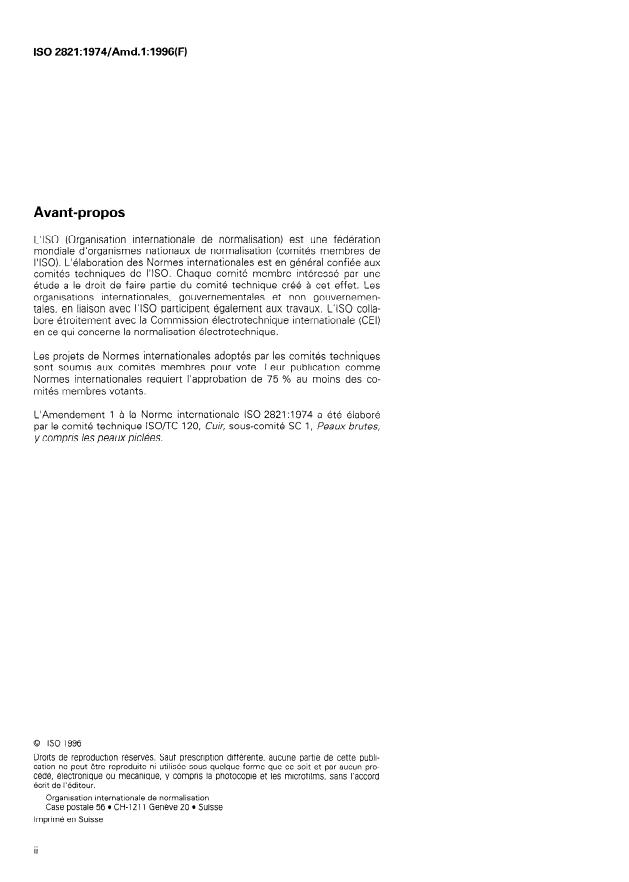
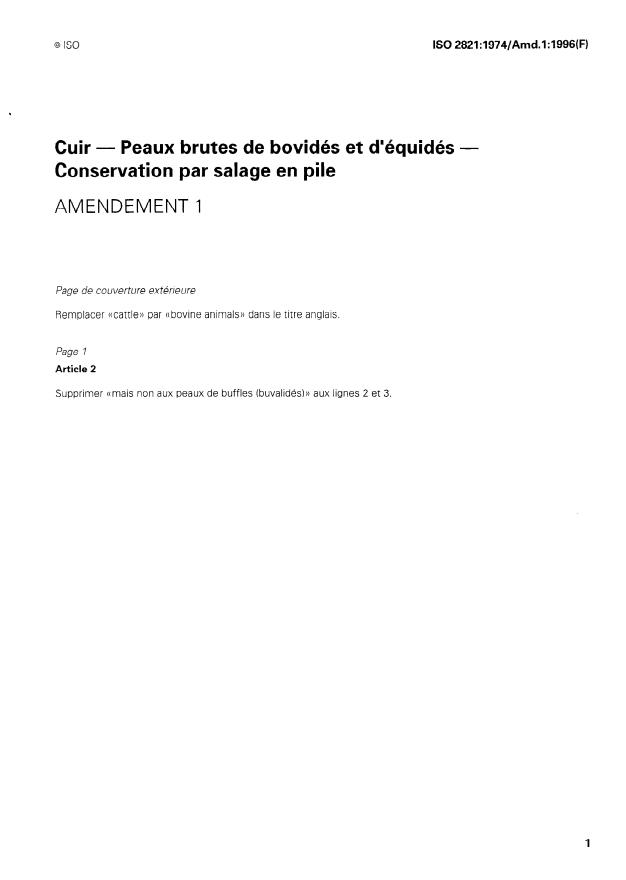

ISO 2821:1974/Amd 1:1996 - Cuir — Peaux brutes de bovidés et d'équidés — Conservation par salage en pile — Amendement 1 Released:12/12/1996
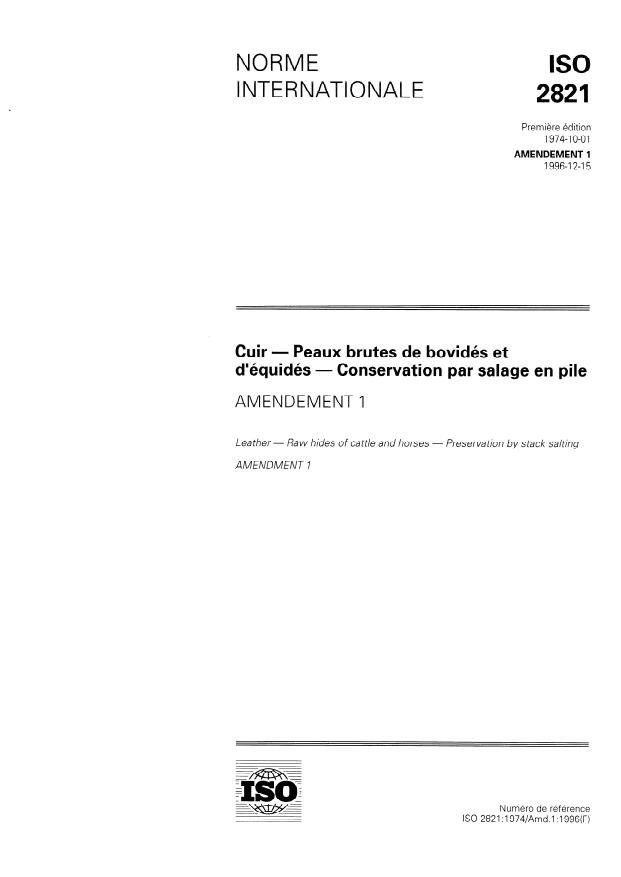
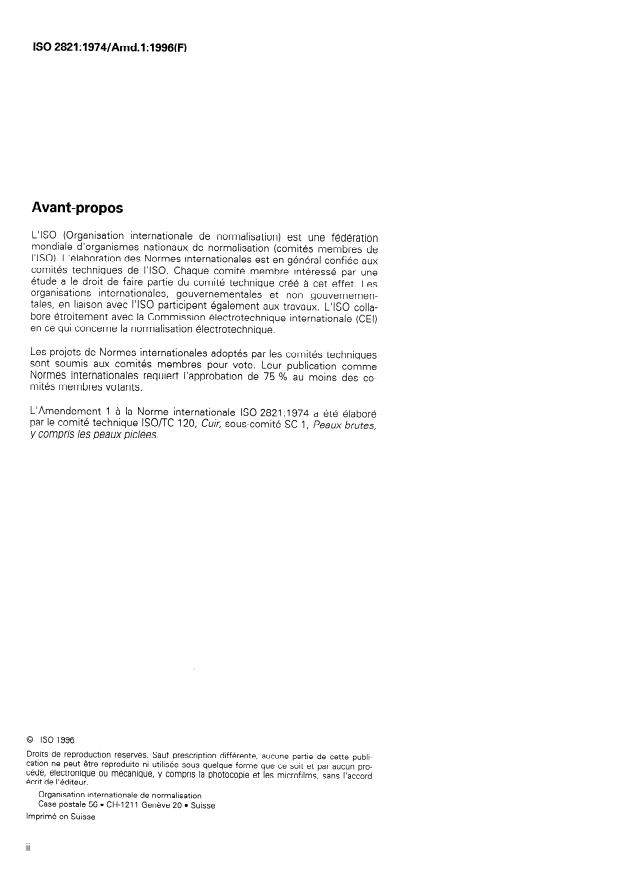

ISO 2821:1974/Amd 1:1996 - Cuir — Peaux brutes de bovidés et d'équidés — Conservation par salage en pile — Amendement 1 Released:12/12/1996
Overview
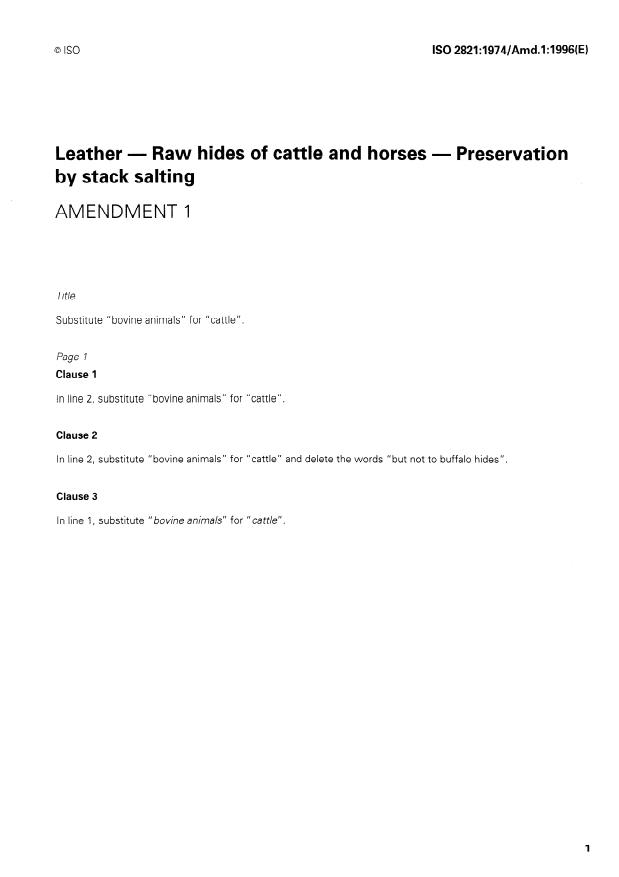
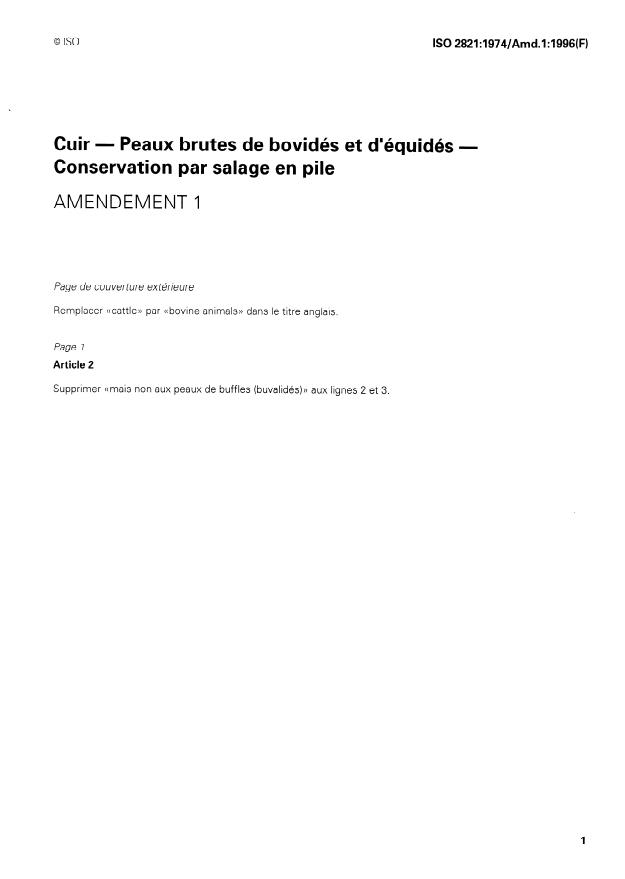
ISO 2821:1974/Amd 1:1996 is an important international standard focusing on the preservation of raw hides of bovine animals and horses through the method of stack salting. This amendment introduces minor technical updates to the original 1974 edition, particularly updating the terminology used-from "cattle" to "bovine animals"-to reflect a broader classification.
Developed by ISO Technical Committee TC 120/Subcommittee SC 1, which specializes in leather and raw hides, this standard ensures consistency and best practices in the preservation process. By adhering to ISO 2821 and its amendments, leather producers and processors can maintain raw hide quality during storage and transport, reducing spoilage and ensuring high-quality leather production.
Key Topics
Scope of Preservation
The standard covers the preservation of raw hides from bovine animals (including cattle) and horses, specifically through the stack salting technique.Terminology Update
Amendment 1 replaces the term “cattle” with “bovine animals” throughout the standard to encompass a wider variety of species.Preservation Method
Stack salting involves layering raw hides with salt in piles (stacks) to inhibit bacterial growth and decay during transportation and storage.Exclusions
The original exclusion of buffalo hides was removed, reflecting adjustments in scope and terminology.Technical Amendments
The amendment mainly consists of wording and terminology refinements without changing the fundamental preservation process or technical requirements.
Applications
ISO 2821:1974/Amd 1:1996 is highly relevant for industries and stakeholders involved in:
Leather manufacturing
Preserving raw hides effectively ensures premium leather quality and reduces material losses due to spoilage.Leather trading and export
Standardized stack salting methods guarantee that hides remain preserved during long-distance shipping and handling.Tanning operations
Proper preservation prior to tanning mitigates risks of microbial damage affecting hide integrity and leather final properties.Quality control and compliance
Leather processing companies use the standard as a benchmark for quality assurance during raw material handling.
By implementing this internationally recognized preservation method, businesses can improve supply chain reliability and meet regulatory or customer expectations for raw hide quality.
Related Standards
- ISO 2418 – Leather - Chemical determination of fat content in raw hides and skins
- ISO 17075 – Leather - Chemical determination of chromium content in leather
- ISO 21493 – Leather - Sampling procedures for chemical testing
- ISO 4885 – Leather - Chemical tests - Tests for soluble matter
These related ISO standards complement ISO 2821 by covering additional aspects of leather raw material analysis and processing, helping manufacturers achieve comprehensive quality management in leather production.
Keywords: ISO 2821 amendment, leather preservation, stack salting, raw bovine hides, raw horse hides, leather processing standard, international leather standard, hide preservation techniques, leather quality assurance.
Relations
- Effective Date
- 06-Jun-2022
- Effective Date
- 15-Apr-2008
Buy Documents
ISO 2821:1974/Amd 1:1996 - Leather — Raw hides of cattle and horses — Preservation by stack salting — Amendment 1 Released:12/12/1996
ISO 2821:1974/Amd 1:1996 - Cuir — Peaux brutes de bovidés et d'équidés — Conservation par salage en pile — Amendement 1 Released:12/12/1996
ISO 2821:1974/Amd 1:1996 - Cuir — Peaux brutes de bovidés et d'équidés — Conservation par salage en pile — Amendement 1 Released:12/12/1996
Get Certified
Connect with accredited certification bodies for this standard

Control Union Certifications
Global certification for agriculture and sustainability.

Hohenstein Institut
Textile testing and certification.

Bureau Veritas Bangladesh
Bureau Veritas certification services in Bangladesh.
Sponsored listings
Frequently Asked Questions
ISO 2821:1974/Amd 1:1996 is a standard published by the International Organization for Standardization (ISO). Its full title is "Leather — Raw hides of cattle and horses — Preservation by stack salting — Amendment 1". This standard covers: Contains minor technical amendments only.
Contains minor technical amendments only.
ISO 2821:1974/Amd 1:1996 is classified under the following ICS (International Classification for Standards) categories: 59.140.20 - Raw skins, hides and pelts. The ICS classification helps identify the subject area and facilitates finding related standards.
ISO 2821:1974/Amd 1:1996 has the following relationships with other standards: It is inter standard links to ISO 2821:1974; is excused to ISO 2821:1974. Understanding these relationships helps ensure you are using the most current and applicable version of the standard.
ISO 2821:1974/Amd 1:1996 is available in PDF format for immediate download after purchase. The document can be added to your cart and obtained through the secure checkout process. Digital delivery ensures instant access to the complete standard document.
Standards Content (Sample)
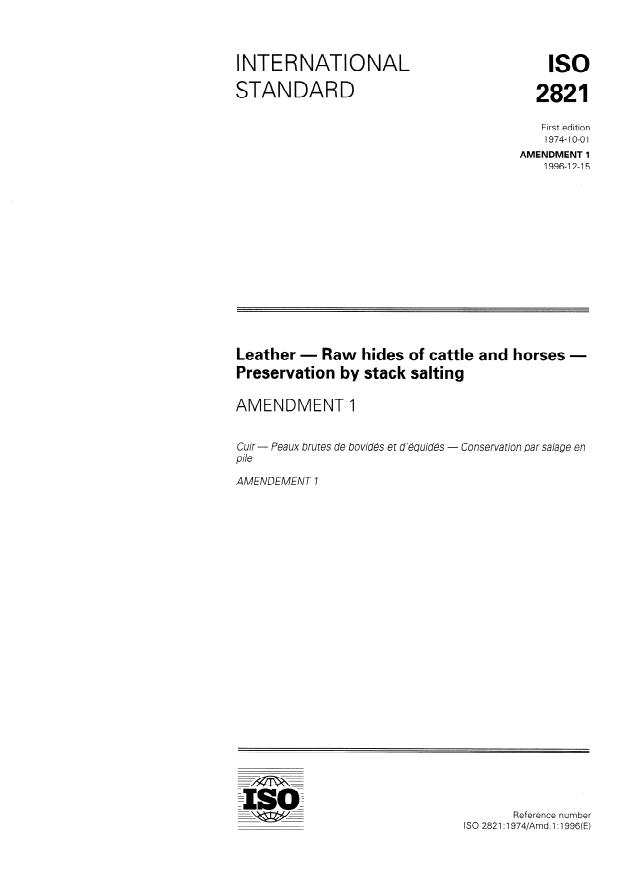
INTERNATIONAL IS0
STANDARD
First edition
1974-l Q-01
AMENDMENT 1
1996-l 2-l 5
Leather - Raw hides of cattle and horses -
Preservation by stack salting
AMENDMENT 1
cuir - Peaux brutes de bovid& et d’@quid& - Conservation par salage en
pile
AMENDEMENT 1
Reference number
IS0 2821 :I 974/Amd.l :I 996(E)
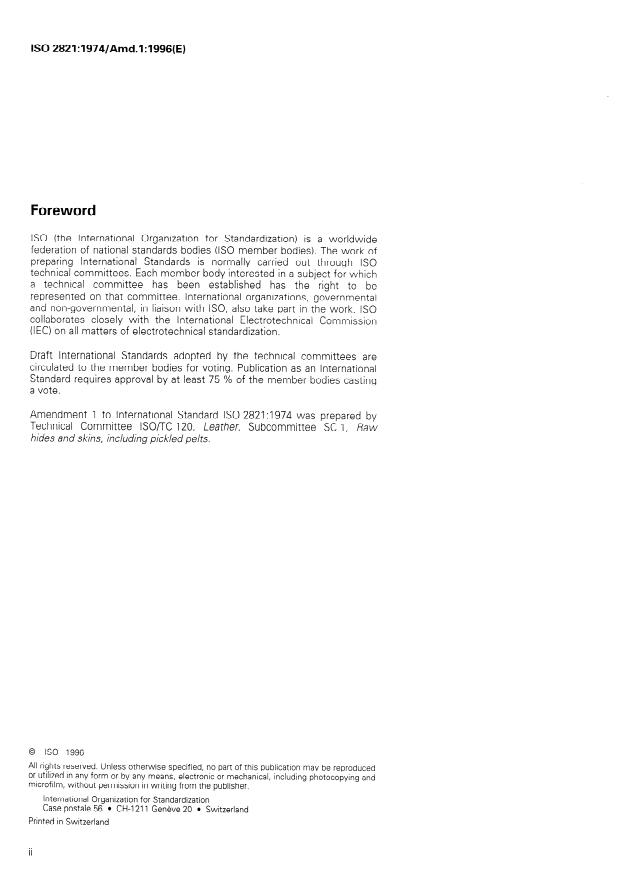
IS0 2821:1974/Amd.l:1996(E)
Foreword
IS0 (the lnternational Organization for Standardizationj is a worldwide
federation of national standards bodies (IS0 member bodies). The work of
preparing International Standards is normally carried out through IS0
technical committees. Each member body interested in a subject for which
a technical committee has been established has the right to be
represented on that committee. International organizations, governmental
and non-governmental, in liaison with ISO, also take part in the work. IS0
collaborates closely with the International Electrotechnical Commission
(IEC) on all matters of electrotechnical standardization.
Draft International Standards adopted by the technical committees are
circulated to the member bodies for voting. Publication as an International
Standard requires approval by at least 75 % of the member bodies casting
a vote.
Amendment 1 to I
...
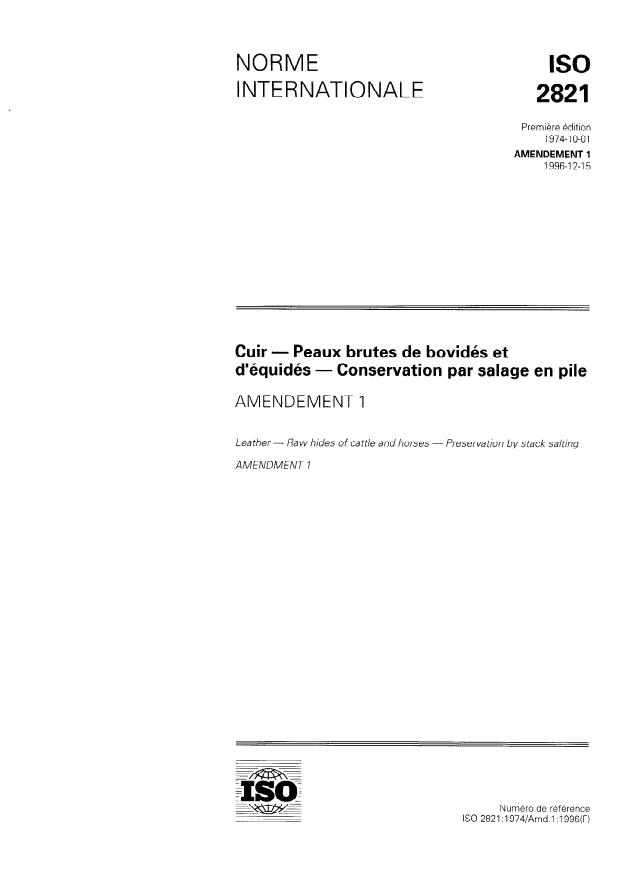
NORME
ISO
INTERNATIONALE
Première édition
1974-I O-OI
AMENDEMENT 1
1996-I 2-l 5
Cuir - Peaux brutes de bovidés et
d’équidés -
Conservation par salage en pile
AMENDEMENT 1
Leather - Raw hides of cattle and horses
- Preserva tion by stack saltiny
AMENDMENT 1
Numéro de référence
ISO 2821:1974/Amd.l :1996(F)
ISO 2821:1974/Amd.1:1996(F)
Avant-propos
L’&O (Organisation internationale de normalisation) est une fédération
mondiale d’organismes nationaux de normalisation (comités membres de
I’ISO). L’élaboration des Normes internationales est en général confiée aux
comités techniques de I’ISO. Chaque comité membre intéressé par une
étude a le droit de faire partie du comité technique créé à cet effet. Les
organisations internationales, gouvernementales et non gouvernemen-
tales, en liaison avec I’ISO participent également aux travaux. L’ISO colla-
bore étroitement avec la Commission électrotechnique internationale (CEI)
en ce qui concerne la normalisation électrotechnique.
Les projets de Normes internationales adoptés par les comités techniques
sont soumis aux comités membres pour vote. Leur publication comme
Normes internationales requiert l’approbation de 75 % au moins des
...
NORME
ISO
INTERNATIONALE
Première édition
1974-I O-OI
AMENDEMENT 1
1996-I 2-l 5
Cuir - Peaux brutes de bovidés et
d’équidés - Conservation par salage en pile
AMENDEMENT 1
Leather - Raw hides of cattle and horses
- Preserva tion by stack saltiny
AMENDMENT 1
Numéro de référence
ISO 2821:1974/Amd.l :1996(F)
ISO 2821:1974/Amd.1:1996(F)
Avant-propos
L’&O (Organisation internationale de normalisation) est une fédération
mondiale d’organismes nationaux de normalisation (comités membres de
I’ISO). L’élaboration des Normes internationales est en général confiée aux
comités techniques de I’ISO. Chaque comité membre intéressé par une
étude a le droit de faire partie du comité technique créé à cet effet. Les
organisations internationales, gouvernementales et non gouvernemen-
tales, en liaison avec I’ISO participent également aux travaux. L’ISO colla-
bore étroitement avec la Commission électrotechnique internationale (CEI)
en ce qui concerne la normalisation électrotechnique.
Les projets de Normes internationales adoptés par les comités techniques
sont soumis aux comités membres pour vote. Leur publication comme
Normes internationales requiert l’approbation de 75 % au moins des co
...