

ISO 21924-3:2017
(Main)Protective equipment for martial arts — Part 3: Additional requirements and test methods for trunk protectors
General Information
- Abstract
ISO 21924-3:2017 specifies additional requirements and test methods for trunk protectors used in unarmed martial arts such as taekwondo, karate, kick-boxing and similar disciplines. It also applies to breast protectors for men. For general requirements and test methods for protective equipment for martial arts, see ISO 21924‑1.
- Status
- Published
- Publication Date
- 28-Nov-2017
- Technical Committee
- ISO/TC 83/SC 6 - Martial arts
- Drafting Committee
- ISO/TC 83/SC 6 - Martial arts
- Current Stage
- 9060 - Close of review
- Completion Date
- 03-Jun-2028
Buy Documents
ISO 21924-3:2017 - Protective equipment for martial arts
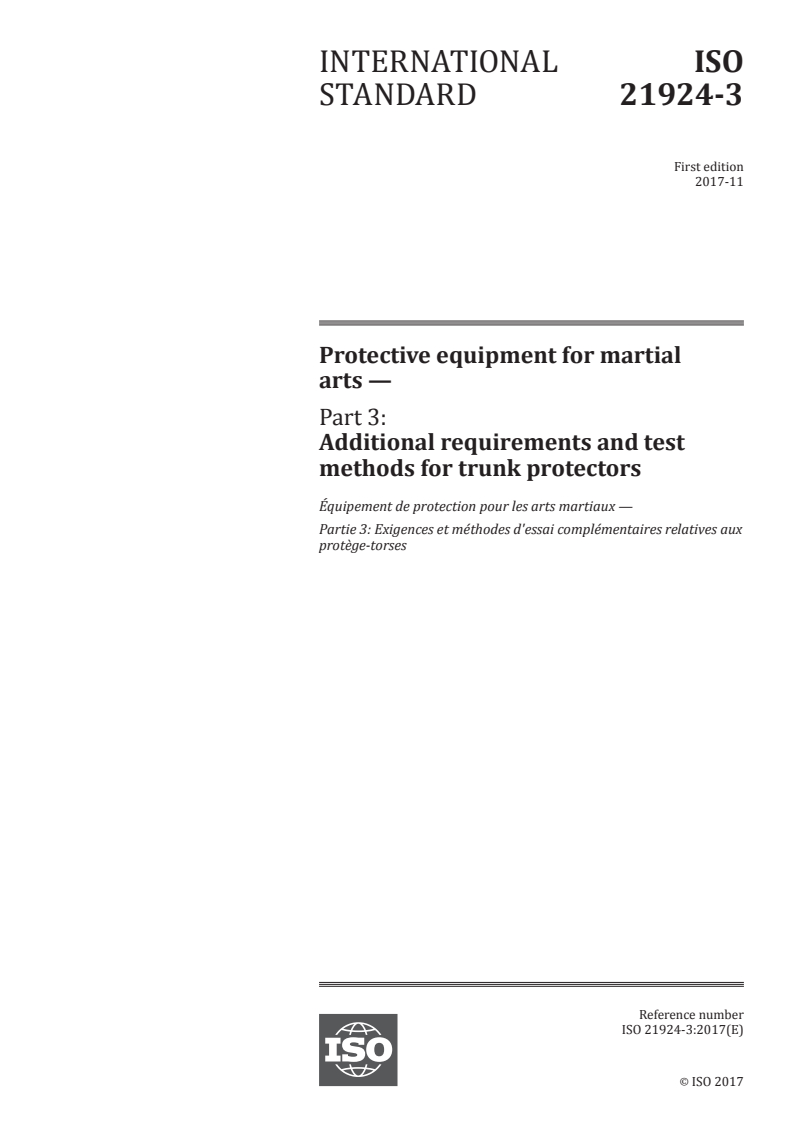
ISO 21924-3:2017 - Protective equipment for martial arts — Part 3: Additional requirements and test methods for trunk protectors/29/2017
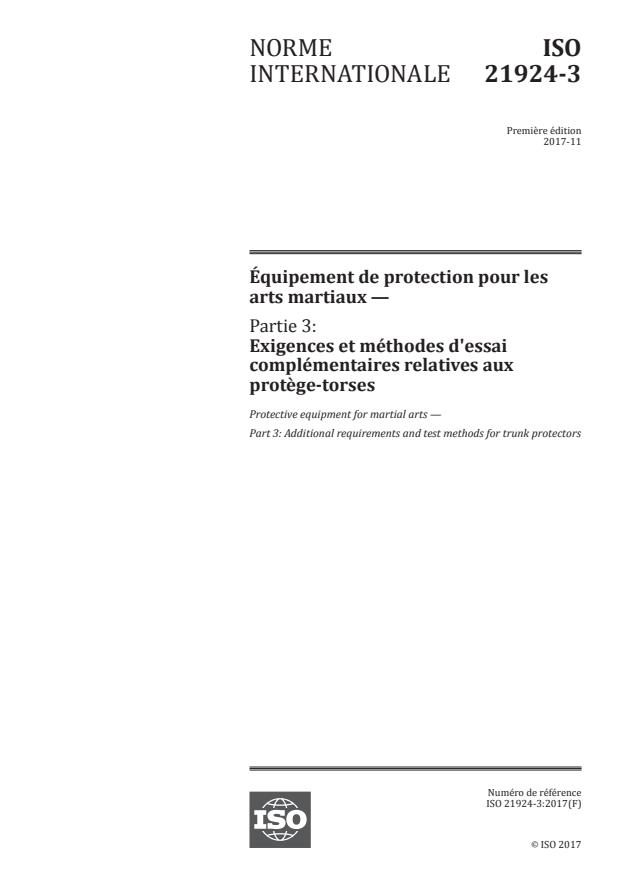
ISO 21924-3:2017 - Équipement de protection pour les arts martiaux
ISO 21924-3:2017 - Équipement de protection pour les arts martiaux — Partie 3: Exigences et méthodes d'essai complémentaires relatives aux protège-torses/18/2017
Overview
ISO 21924-3:2017 - "Protective equipment for martial arts - Part 3: Additional requirements and test methods for trunk protectors" specifies supplemental requirements and test procedures for trunk (torso) protectors used in unarmed martial arts such as taekwondo, karate, kick‑boxing and similar disciplines. It also explicitly applies to breast protectors for men. General requirements and baseline test methods are covered in ISO 21924‑1:2017; ISO 21924‑3 adds trunk‑specific sizing, restraint, impact and marking rules.
Key topics and technical requirements
- Scope: Applies to trunk protectors and male breast protectors for unarmed martial arts.
- Sizing: Manufacturers must indicate the wearer's height range (in centimetres) for each protector.
- Combinations: States whether the trunk protector can be used in combination with other protectors; restrictions must be declared.
- Restraint: A restraint system must allow the wearer to don the protector with the aid of at most one assistant. For karate, fixing systems must be textile only (no metal, plastic or hard materials).
- Zone of protection: Location and dimensions for protected areas are defined (see standard table/figure for height‑based dimensions).
- Impact performance:
- General impact energy: 12 J
- Karate specific impact energy: 2.6 J
- Maximum peak force: 3 kN
- Minimum positions to be tested: 3
- Karate‑specific mass & thickness limits:
- Maximum mass: 250 g
- Maximum thickness: 15 mm
- Testing requirements:
- Sampling and conditioning referenced to ISO 21924‑1.
- Restraint test: 50 N applied around the edge of the protection zone in prescribed directions.
- Impact test apparatus: flat steel plate with central hole, 100 ± 2 mm cylindrical anvil, compression ring (10 kg), guided free‑fall striker; load cell with ≥2000 Hz measurement frequency and max load 10 kN.
- Marking & manufacturer information: Follows ISO 21924‑1; karate protectors must be marked for karate-only use.
Applications and who uses this standard
- Manufacturers and product designers - to design compliant trunk protectors that meet sizing, restraint, impact and material limits.
- Testing laboratories and certification bodies - to perform standardized sampling, conditioning and impact tests for type approval or quality control.
- Sports federations and competition organizers - to specify acceptable protective equipment for events (taekwondo, karate, kick‑boxing).
- Procurement and safety officers - to select products meeting published performance criteria for training centers, dojos and clubs.
- Regulators and standards committees - to harmonize protective equipment requirements and reduce injury risk.
Related standards
- ISO 21924‑1:2017 - Protective equipment for martial arts - Part 1: General requirements and test methods (referenced for sampling, conditioning, marking and general rules).
- See the ISO 21924 series for other parts addressing different protective items.
Keywords: ISO 21924-3, trunk protectors, martial arts protective equipment, impact performance, test methods, karate trunk protector, taekwondo safety.
Buy Documents
ISO 21924-3:2017 - Protective equipment for martial arts
ISO 21924-3:2017 - Protective equipment for martial arts — Part 3: Additional requirements and test methods for trunk protectors/29/2017
ISO 21924-3:2017 - Équipement de protection pour les arts martiaux
ISO 21924-3:2017 - Équipement de protection pour les arts martiaux — Partie 3: Exigences et méthodes d'essai complémentaires relatives aux protège-torses/18/2017
Get Certified
Connect with accredited certification bodies for this standard

CIS Institut d.o.o.
Personal Protective Equipment (PPE) certification body. Notified Body NB-2890 for EU Regulation 2016/425 PPE.

Kiwa BDA Testing
Building and construction product certification.
Kmetijski inštitut Slovenije
Agricultural Institute of Slovenia. Soil testing, plant health, agricultural product analysis.
Sponsored listings
Frequently Asked Questions
ISO 21924-3:2017 is a standard published by the International Organization for Standardization (ISO). Its full title is "Protective equipment for martial arts — Part 3: Additional requirements and test methods for trunk protectors". This standard covers: ISO 21924-3:2017 specifies additional requirements and test methods for trunk protectors used in unarmed martial arts such as taekwondo, karate, kick-boxing and similar disciplines. It also applies to breast protectors for men. For general requirements and test methods for protective equipment for martial arts, see ISO 21924‑1.
ISO 21924-3:2017 specifies additional requirements and test methods for trunk protectors used in unarmed martial arts such as taekwondo, karate, kick-boxing and similar disciplines. It also applies to breast protectors for men. For general requirements and test methods for protective equipment for martial arts, see ISO 21924‑1.
ISO 21924-3:2017 is classified under the following ICS (International Classification for Standards) categories: 13.340.99 - Other protective equipment; 97.220.01 - Sports equipment and facilities in general. The ICS classification helps identify the subject area and facilitates finding related standards.
ISO 21924-3:2017 is available in PDF format for immediate download after purchase. The document can be added to your cart and obtained through the secure checkout process. Digital delivery ensures instant access to the complete standard document.
Standards Content (Sample)
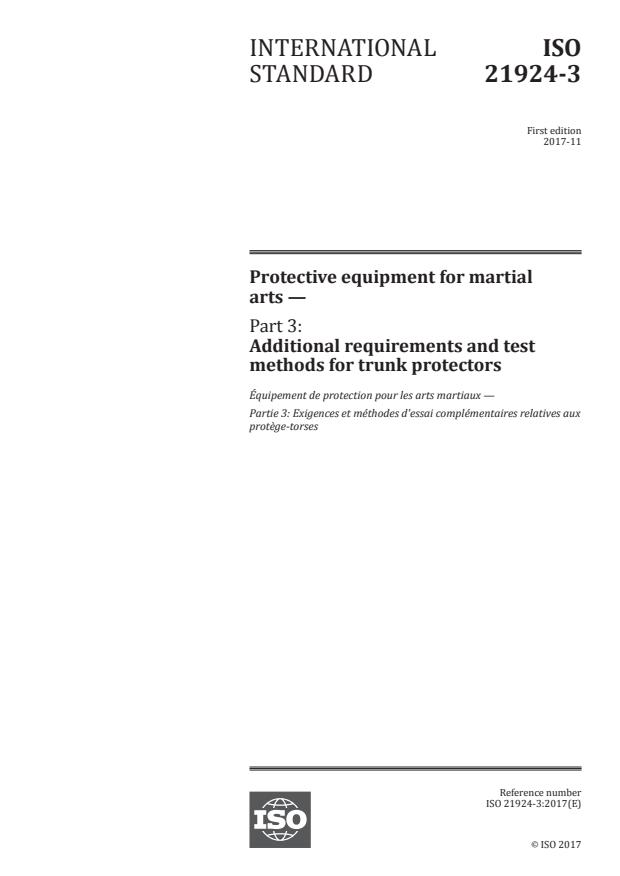
INTERNATIONAL ISO
STANDARD 21924-3
First edition
2017-11
Protective equipment for martial
arts —
Part 3:
Additional requirements and test
methods for trunk protectors
Équipement de protection pour les arts martiaux —
Partie 3: Exigences et méthodes d'essai complémentaires relatives aux
protège-torses
Reference number
©
ISO 2017
© ISO 2017, Published in Switzerland
All rights reserved. Unless otherwise specified, no part of this publication may be reproduced or utilized otherwise in any form
or by any means, electronic or mechanical, including photocopying, or posting on the internet or an intranet, without prior
written permission. Permission can be requested from either ISO at the address below or ISO’s member body in the country of
the requester.
ISO copyright office
Ch. de Blandonnet 8 • CP 401
CH-1214 Vernier, Geneva, Switzerland
Tel. +41 22 749 01 11
Fax +41 22 749 09 47
copyright@iso.org
www.iso.org
ii © ISO 2017 – All rights reserved
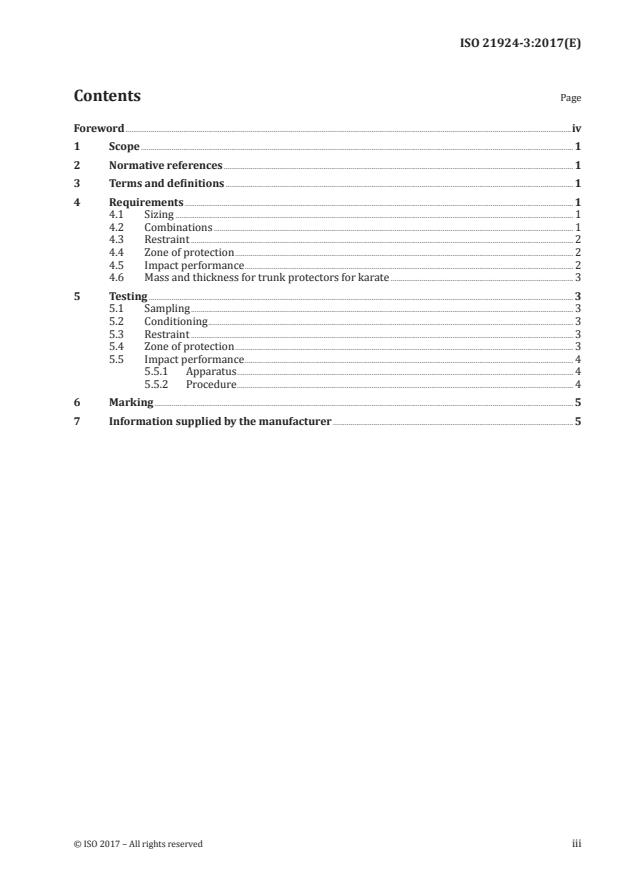
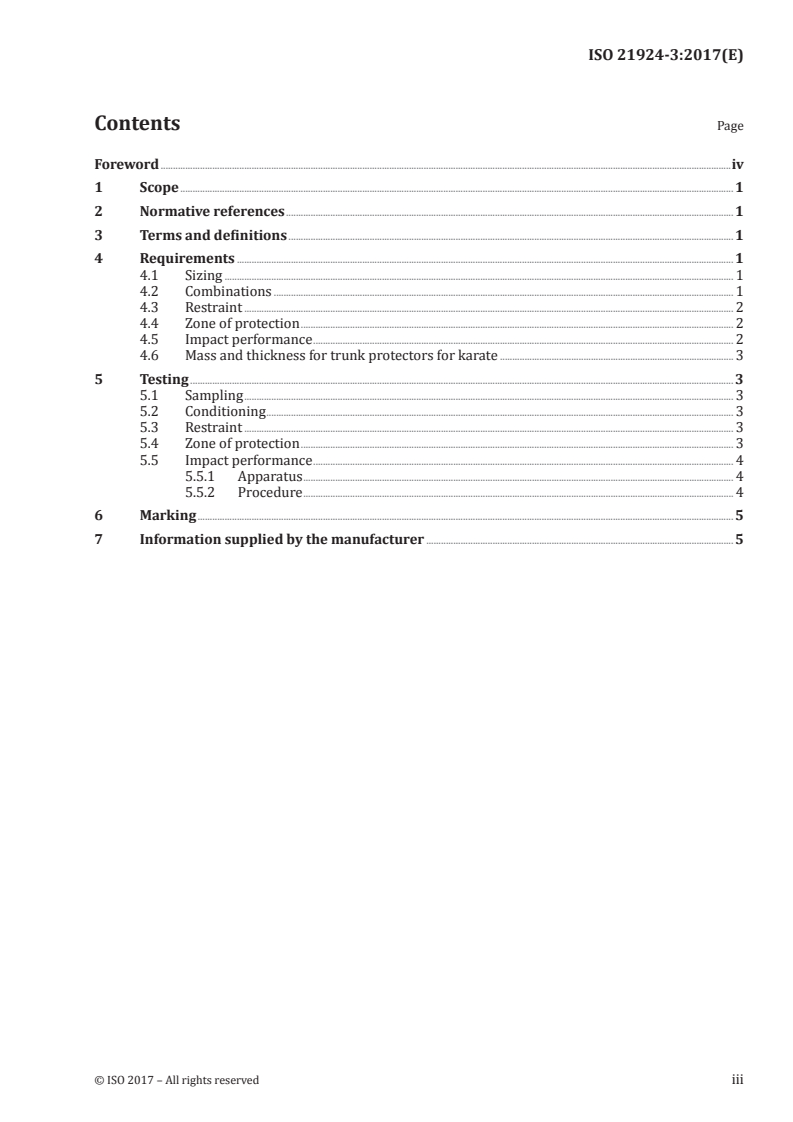
Contents Page
Foreword .iv
1 Scope . 1
2 Normative references . 1
3 Terms and definitions . 1
4 Requirements . 1
4.1 Sizing . 1
4.2 Combinations . 1
4.3 Restraint . 2
4.4 Zone of protection . 2
4.5 Impact performance . 2
4.6 Mass and thickness for trunk protectors for karate . 3
5 Testing . 3
5.1 Sampling . 3
5.2 Conditioning . 3
5.3 Restraint . 3
5.4 Zone of protection . 3
5.5 Impact performance . 4
5.5.1 Apparatus . 4
5.5.2 Procedure . 4
6 Marking . 5
7 Information supplied by the manufacturer . 5
Foreword
ISO (the International Organization for Standardization) is a worldwide federation of national standards
bodies (ISO member bodies). The work of preparing International Standards is normally carried out
through ISO technical committees. Each member body interested in a subject for which a technical
committee has been established has the right to be represented on that committee. International
organizations, governmental and non-governmental, in liaison with ISO, also take part in the work.
ISO collaborates closely with the International Electrotechnical Commission (IEC) on all matters of
electrotechnical standardization.
The procedures used to develop this document and those intended for its further maintenance are
described in the ISO/IEC Directives, Part 1. In particular the different approval criteria needed for the
different types of ISO documents should be noted. This document was drafted in accordance with the
editorial rules of the ISO/IEC Directives, Part 2 (see www.iso.org/directives).
Attention is drawn to the possibility that some of the elements of this document may be the subject of
patent rights. ISO shall not be held responsible for identifying any or all such patent rights. Details of
any patent rights identified during the development of the document will be in the Introduction and/or
on the ISO list of patent declarations received (see www.iso.org/patents).
Any trade name used in this document is information given for the convenience of users and does not
constitute an endorsement.
For an explanation on the voluntary nature of standards, the meaning of ISO specific terms and
expressions related to conformity assessment, as well as information about ISO's adherence to the
World Trade Organization (WTO) principles in the Technical Barriers to Trade (TBT) see the following
URL: www.iso.org/iso/foreword.html.
This document was prepared by Technical Committee ISO/TC 83, Sports and other recreational facilities
and equipment, Subcommittee SC 6, Martial arts.
A list of all parts in the ISO 21924 series can be found on the ISO website.
iv © ISO 2017 – All rights reserved
INTERNATIONAL STANDARD ISO 21924-3:2017(E)
Protective equipment for martial arts —
Part 3:
Additional requirements and test methods for trunk
protectors
1 Scope
This document specifies additional requirements and test meth
...
INTERNATIONAL ISO
STANDARD 21924-3
First edition
2017-11
Protective equipment for martial
arts —
Part 3:
Additional requirements and test
methods for trunk protectors
Équipement de protection pour les arts martiaux —
Partie 3: Exigences et méthodes d'essai complémentaires relatives aux
protège-torses
Reference number
©
ISO 2017
© ISO 2017, Published in Switzerland
All rights reserved. Unless otherwise specified, no part of this publication may be reproduced or utilized otherwise in any form
or by any means, electronic or mechanical, including photocopying, or posting on the internet or an intranet, without prior
written permission. Permission can be requested from either ISO at the address below or ISO’s member body in the country of
the requester.
ISO copyright office
Ch. de Blandonnet 8 • CP 401
CH-1214 Vernier, Geneva, Switzerland
Tel. +41 22 749 01 11
Fax +41 22 749 09 47
copyright@iso.org
www.iso.org
ii © ISO 2017 – All rights reserved
Contents Page
Foreword .iv
1 Scope . 1
2 Normative references . 1
3 Terms and definitions . 1
4 Requirements . 1
4.1 Sizing . 1
4.2 Combinations . 1
4.3 Restraint . 2
4.4 Zone of protection . 2
4.5 Impact performance . 2
4.6 Mass and thickness for trunk protectors for karate . 3
5 Testing . 3
5.1 Sampling . 3
5.2 Conditioning . 3
5.3 Restraint . 3
5.4 Zone of protection . 3
5.5 Impact performance . 4
5.5.1 Apparatus . 4
5.5.2 Procedure . 4
6 Marking . 5
7 Information supplied by the manufacturer . 5
Foreword
ISO (the International Organization for Standardization) is a worldwide federation of national standards
bodies (ISO member bodies). The work of preparing International Standards is normally carried out
through ISO technical committees. Each member body interested in a subject for which a technical
committee has been established has the right to be represented on that committee. International
organizations, governmental and non-governmental, in liaison with ISO, also take part in the work.
ISO collaborates closely with the International Electrotechnical Commission (IEC) on all matters of
electrotechnical standardization.
The procedures used to develop this document and those intended for its further maintenance are
described in the ISO/IEC Directives, Part 1. In particular the different approval criteria needed for the
different types of ISO documents should be noted. This document was drafted in accordance with the
editorial rules of the ISO/IEC Directives, Part 2 (see www.iso.org/directives).
Attention is drawn to the possibility that some of the elements of this document may be the subject of
patent rights. ISO shall not be held responsible for identifying any or all such patent rights. Details of
any patent rights identified during the development of the document will be in the Introduction and/or
on the ISO list of patent declarations received (see www.iso.org/patents).
Any trade name used in this document is information given for the convenience of users and does not
constitute an endorsement.
For an explanation on the voluntary nature of standards, the meaning of ISO specific terms and
expressions related to conformity assessment, as well as information about ISO's adherence to the
World Trade Organization (WTO) principles in the Technical Barriers to Trade (TBT) see the following
URL: www.iso.org/iso/foreword.html.
This document was prepared by Technical Committee ISO/TC 83, Sports and other recreational facilities
and equipment, Subcommittee SC 6, Martial arts.
A list of all parts in the ISO 21924 series can be found on the ISO website.
iv © ISO 2017 – All rights reserved
INTERNATIONAL STANDARD ISO 21924-3:2017(E)
Protective equipment for martial arts —
Part 3:
Additional requirements and test methods for trunk
protectors
1 Scope
This document specifies additional requirements and test meth
...
NORME ISO
INTERNATIONALE 21924-3
Première édition
2017-11
Équipement de protection pour les
arts martiaux —
Partie 3:
Exigences et méthodes d'essai
complémentaires relatives aux
protège-torses
Protective equipment for martial arts —
Part 3: Additional requirements and test methods for trunk protectors
Numéro de référence
©
ISO 2017
DOCUMENT PROTÉGÉ PAR COPYRIGHT
© ISO 2017, Publié en Suisse
Droits de reproduction réservés. Sauf indication contraire, aucune partie de cette publication ne peut être reproduite ni utilisée
sous quelque forme que ce soit et par aucun procédé, électronique ou mécanique, y compris la photocopie, l’affichage sur
l’internet ou sur un Intranet, sans autorisation écrite préalable. Les demandes d’autorisation peuvent être adressées à l’ISO à
l’adresse ci-après ou au comité membre de l’ISO dans le pays du demandeur.
ISO copyright office
Ch. de Blandonnet 8 • CP 401
CH-1214 Vernier, Geneva, Switzerland
Tel. +41 22 749 01 11
Fax +41 22 749 09 47
copyright@iso.org
www.iso.org
ii © ISO 2017 – Tous droits réservés
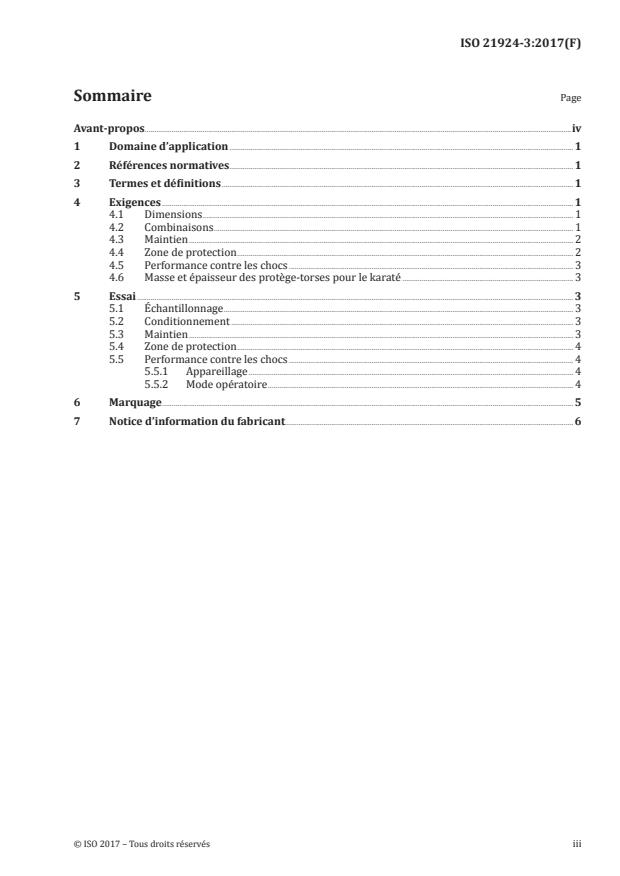
Sommaire Page
Avant-propos .iv
1 Domaine d’application . 1
2 Références normatives . 1
3 Termes et définitions . 1
4 Exigences . 1
4.1 Dimensions . 1
4.2 Combinaisons . 1
4.3 Maintien . 2
4.4 Zone de protection . 2
4.5 Performance contre les chocs . 3
4.6 Masse et épaisseur des protège-torses pour le karaté . 3
5 Essai . 3
5.1 Échantillonnage . 3
5.2 Conditionnement . 3
5.3 Maintien . 3
5.4 Zone de protection . 4
5.5 Performance contre les chocs . 4
5.5.1 Appareillage . 4
5.5.2 Mode opératoire . 4
6 Marquage . 5
7 Notice d’information du fabricant . 6
Avant-propos
L'ISO (Organisation internationale de normalisation) est une fédération mondiale d'organismes
nationaux de normalisation (comités membres de l'ISO). L'élaboration des Normes internationales est
en général confiée aux comités techniques de l'ISO. Chaque comité membre intéressé par une étude
a le droit de faire partie du comité technique créé à cet effet. Les organisations internationales,
gouvernementales et non gouvernementales, en liaison avec l'ISO participent également aux travaux.
L'ISO collabore étroitement avec la Commission électrotechnique internationale (IEC) en ce qui
concerne la normalisation électrotechnique.
Les procédures utilisées pour élaborer le présent document et celles destinées à sa mise à jour sont
décrites dans les Directives ISO/IEC, Partie 1. Il convient, en particulier de prendre note des différents
critères d'approbation requis pour les différents types de documents ISO. Le présent document a été
rédigé conformément aux règles de rédaction données dans les Directives ISO/IEC, Partie 2 (voir www.
iso.org/directives).
L'attention est attirée sur le fait que certains des éléments du présent document peuvent faire l'objet de
droits de propriété intellectuelle ou de droits analogues. L'ISO ne saurait être tenue pour responsable
de ne pas avoir identifié de tels droits de propriété et averti de leur existence. Les détails concernant
les références aux droits de propriété intellectuelle ou autres droits analogues identifiés lors de
l'élaboration du document sont indiqués dans l'Introduction et/ou dans la liste des déclarations de
brevets reçues par l'ISO (voir www.iso.org/brevets).
Les appellations commerciales éventuellement mentionnées dans le présent document sont données
pour information, par souci de commodité, à l’intention des utilisateurs et ne sauraient constituer un
engagement.
Pour une explication de la nature volontaire des normes, la signification des termes et expressions
spécifiques de l'ISO liés à l'évaluation de la conformité, ou pour toute information au sujet de l'adhésion
de l'ISO aux principes de l’Organisation mondiale du commerce (OMC) concernant les obstacles
techniques au commerce (OTC), voir le lien suivant: www.iso.org/avant-propos.
Le présent document a été élaboré par le comité technique ISO/TC 83, Matériel et équipements de sports
et autres activités de loisirs, sous-comité SC 6, Arts martiaux.
Une liste de toutes les parties de la série ISO 21924 se trouve sur le site Web de l’ISO.
iv © ISO 2017 – Tous droits réservés
NORME INTERNATIONALE ISO 21924-3:2017(F)
Équipement de protection pour les arts martiaux —
Partie 3:
Exigences et méthodes d'essai complémentaires relatives
aux protège-torses
1 Domaine d’application
La présente Norme internationale spécifie les exigences et les méthodes d’essais complémentaires
relatives aux protège-torses utilisés dans les arts martiaux à mains nues comme le taekwondo, le
karaté, le kickboxing et d’autres disciplines similaires.
Elle s’applique également aux protecteurs de poitrine masculine.
Les exigences et les méthodes d’essai générales des équi
...
NORME ISO
INTERNATIONALE 21924-3
Première édition
2017-11
Équipement de protection pour les
arts martiaux —
Partie 3:
Exigences et méthodes d'essai
complémentaires relatives aux
protège-torses
Protective equipment for martial arts —
Part 3: Additional requirements and test methods for trunk protectors
Numéro de référence
©
ISO 2017
DOCUMENT PROTÉGÉ PAR COPYRIGHT
© ISO 2017, Publié en Suisse
Droits de reproduction réservés. Sauf indication contraire, aucune partie de cette publication ne peut être reproduite ni utilisée
sous quelque forme que ce soit et par aucun procédé, électronique ou mécanique, y compris la photocopie, l’affichage sur
l’internet ou sur un Intranet, sans autorisation écrite préalable. Les demandes d’autorisation peuvent être adressées à l’ISO à
l’adresse ci-après ou au comité membre de l’ISO dans le pays du demandeur.
ISO copyright office
Ch. de Blandonnet 8 • CP 401
CH-1214 Vernier, Geneva, Switzerland
Tel. +41 22 749 01 11
Fax +41 22 749 09 47
copyright@iso.org
www.iso.org
ii © ISO 2017 – Tous droits réservés
Sommaire Page
Avant-propos .iv
1 Domaine d’application . 1
2 Références normatives . 1
3 Termes et définitions . 1
4 Exigences . 1
4.1 Dimensions . 1
4.2 Combinaisons . 1
4.3 Maintien . 2
4.4 Zone de protection . 2
4.5 Performance contre les chocs . 3
4.6 Masse et épaisseur des protège-torses pour le karaté . 3
5 Essai . 3
5.1 Échantillonnage . 3
5.2 Conditionnement . 3
5.3 Maintien . 3
5.4 Zone de protection . 4
5.5 Performance contre les chocs . 4
5.5.1 Appareillage . 4
5.5.2 Mode opératoire . 4
6 Marquage . 5
7 Notice d’information du fabricant . 6
Avant-propos
L'ISO (Organisation internationale de normalisation) est une fédération mondiale d'organismes
nationaux de normalisation (comités membres de l'ISO). L'élaboration des Normes internationales est
en général confiée aux comités techniques de l'ISO. Chaque comité membre intéressé par une étude
a le droit de faire partie du comité technique créé à cet effet. Les organisations internationales,
gouvernementales et non gouvernementales, en liaison avec l'ISO participent également aux travaux.
L'ISO collabore étroitement avec la Commission électrotechnique internationale (IEC) en ce qui
concerne la normalisation électrotechnique.
Les procédures utilisées pour élaborer le présent document et celles destinées à sa mise à jour sont
décrites dans les Directives ISO/IEC, Partie 1. Il convient, en particulier de prendre note des différents
critères d'approbation requis pour les différents types de documents ISO. Le présent document a été
rédigé conformément aux règles de rédaction données dans les Directives ISO/IEC, Partie 2 (voir www.
iso.org/directives).
L'attention est attirée sur le fait que certains des éléments du présent document peuvent faire l'objet de
droits de propriété intellectuelle ou de droits analogues. L'ISO ne saurait être tenue pour responsable
de ne pas avoir identifié de tels droits de propriété et averti de leur existence. Les détails concernant
les références aux droits de propriété intellectuelle ou autres droits analogues identifiés lors de
l'élaboration du document sont indiqués dans l'Introduction et/ou dans la liste des déclarations de
brevets reçues par l'ISO (voir www.iso.org/brevets).
Les appellations commerciales éventuellement mentionnées dans le présent document sont données
pour information, par souci de commodité, à l’intention des utilisateurs et ne sauraient constituer un
engagement.
Pour une explication de la nature volontaire des normes, la signification des termes et expressions
spécifiques de l'ISO liés à l'évaluation de la conformité, ou pour toute information au sujet de l'adhésion
de l'ISO aux principes de l’Organisation mondiale du commerce (OMC) concernant les obstacles
techniques au commerce (OTC), voir le lien suivant: www.iso.org/avant-propos.
Le présent document a été élaboré par le comité technique ISO/TC 83, Matériel et équipements de sports
et autres activités de loisirs, sous-comité SC 6, Arts martiaux.
Une liste de toutes les parties de la série ISO 21924 se trouve sur le site Web de l’ISO.
iv © ISO 2017 – Tous droits réservés
NORME INTERNATIONALE ISO 21924-3:2017(F)
Équipement de protection pour les arts martiaux —
Partie 3:
Exigences et méthodes d'essai complémentaires relatives
aux protège-torses
1 Domaine d’application
La présente Norme internationale spécifie les exigences et les méthodes d’essais complémentaires
relatives aux protège-torses utilisés dans les arts martiaux à mains nues comme le taekwondo, le
karaté, le kickboxing et d’autres disciplines similaires.
Elle s’applique également aux protecteurs de poitrine masculine.
Les exigences et les méthodes d’essai générales des équi
...