

ISO/IEC 24734:2021
(Main)Information technology — Office equipment — Method for measuring digital printing productivity
General Information
- Abstract
This document specifies a method for measuring the digital printing productivity of digital printing devices with various office applications and print job characteristics. This document is applicable to digital printing devices, including single-function and multi-function devices, regardless of print technology (e.g. inkjet, laser). Devices can be equipped with a range of paper feed and finishing options either directly connected to the computer system or via a network. It is intended to be used for black and white (B&W) as well as colour digital printing devices. It allows for the comparison of the productivity of machines operating in various available modes (simplex, duplex, size of substrates, etc.) and office applications when the test system environment, operating modes, and job mix for each machine are held identical. This document includes test files, test setup procedure, test runtime procedure, and the reporting requirements for the digital printing productivity measurements. This document is not intended to be used for devices which are not able to print on a media size of A4/8,5” × 11” or for devices which are not able to collate multiple copies of a print. This document is not intended to replace manufacturer's rated speeds.
- Status
- Published
- Publication Date
- 08-Apr-2021
- Technical Committee
- ISO/IEC JTC 1/SC 28 - Office equipment
- Drafting Committee
- ISO/IEC JTC 1/SC 28 - Office equipment
- Current Stage
- 9093 - International Standard confirmed
- Start Date
- 09-Sep-2026
- Completion Date
- 12-Sep-2026
Buy Documents


ISO/IEC 24734:2021 - Information technology -- Office equipment -- Method for measuring digital printing productivity

ISO/IEC 24734:2021 - Information technology — Office equipment — Method for measuring digital printing productivity/9/2021
Overview
ISO/IEC 24734:2021 - Information technology - Office equipment - Method for measuring digital printing productivity - defines a repeatable, standardized method for measuring the digital printing productivity of office printing devices. The standard applies to single‑function and multi‑function digital printing devices (inkjet, laser, etc.) for both black & white (B&W) and colour printing. It specifies test files, test platform setup, runtime procedures and reporting requirements so devices can be compared when tested under identical test system environments, operating modes and job mixes.
The standard is explicit about scope limits: it is not intended for devices that cannot print on A4 / 8.5" × 11" media or cannot collate multiple copies, and it does not replace manufacturer rated speeds.
Key Topics and Requirements
- Test platform and setup: hardware/software platform configuration, initial test state, optional disk image creation. (See clauses on test platform parameters and setup.)
- Printing device system setup and connection: consistent device configuration, network/connected options and finishing settings.
- Test files and job mixes: pre‑defined test suites for representative office, advertising/graphics workflows (Annex C contains test suites).
- Test procedures: “1 set”, “1 set +30 seconds”, and “1 set +4 minutes” test runs from ready state; ready delay time determination (Annex D).
- Operational parameters: simplex/duplex modes, substrate size and grammage, output order, feature performance tests and optional special tests.
- Data handling and calculations: rules for processing measurements, ±5% consistency criteria, estimating set counts and reporting of summary and full results.
- Reporting requirements: minimum declaration, summary and full report formats including environment, paper grammage, output order and ready delay time.
Practical Applications and Who Uses It
- Manufacturers: benchmark product performance across configurations and document device productivity claims consistently.
- Test laboratories and certification bodies: perform repeatable, standardized productivity tests and publish comparable results.
- Procurement teams and IT managers: compare devices for office deployment based on measured productivity under representative job mixes.
- R&D and product managers: evaluate the impact of firmware, finishing options or connectivity changes on real‑world throughput.
- Resellers and consultants: produce objective, comparable performance reports for customers.
Related Standards and Notes
- ISO/IEC 24734:2021 complements other printing standards (see normative references in the document). It updates and replaces prior editions, adding requirements such as ready delay time, output order reporting, and changed terminology (paper grammage). It should be used alongside other office equipment and throughput standards when developing comprehensive equipment specifications.
Relations
- Effective Date
- 22-Jul-2017
Buy Documents
ISO/IEC 24734:2021 - Information technology -- Office equipment -- Method for measuring digital printing productivity
ISO/IEC 24734:2021 - Information technology — Office equipment — Method for measuring digital printing productivity/9/2021
Frequently Asked Questions
ISO/IEC 24734:2021 is a standard published by the International Organization for Standardization (ISO). Its full title is "Information technology — Office equipment — Method for measuring digital printing productivity". This standard covers: This document specifies a method for measuring the digital printing productivity of digital printing devices with various office applications and print job characteristics. This document is applicable to digital printing devices, including single-function and multi-function devices, regardless of print technology (e.g. inkjet, laser). Devices can be equipped with a range of paper feed and finishing options either directly connected to the computer system or via a network. It is intended to be used for black and white (B&W) as well as colour digital printing devices. It allows for the comparison of the productivity of machines operating in various available modes (simplex, duplex, size of substrates, etc.) and office applications when the test system environment, operating modes, and job mix for each machine are held identical. This document includes test files, test setup procedure, test runtime procedure, and the reporting requirements for the digital printing productivity measurements. This document is not intended to be used for devices which are not able to print on a media size of A4/8,5” × 11” or for devices which are not able to collate multiple copies of a print. This document is not intended to replace manufacturer's rated speeds.
This document specifies a method for measuring the digital printing productivity of digital printing devices with various office applications and print job characteristics. This document is applicable to digital printing devices, including single-function and multi-function devices, regardless of print technology (e.g. inkjet, laser). Devices can be equipped with a range of paper feed and finishing options either directly connected to the computer system or via a network. It is intended to be used for black and white (B&W) as well as colour digital printing devices. It allows for the comparison of the productivity of machines operating in various available modes (simplex, duplex, size of substrates, etc.) and office applications when the test system environment, operating modes, and job mix for each machine are held identical. This document includes test files, test setup procedure, test runtime procedure, and the reporting requirements for the digital printing productivity measurements. This document is not intended to be used for devices which are not able to print on a media size of A4/8,5” × 11” or for devices which are not able to collate multiple copies of a print. This document is not intended to replace manufacturer's rated speeds.
ISO/IEC 24734:2021 is classified under the following ICS (International Classification for Standards) categories: 37.100.10 - Reproduction equipment. The ICS classification helps identify the subject area and facilitates finding related standards.
ISO/IEC 24734:2021 has the following relationships with other standards: It is inter standard links to ISO/IEC 24734:2014. Understanding these relationships helps ensure you are using the most current and applicable version of the standard.
ISO/IEC 24734:2021 is available in PDF format for immediate download after purchase. The document can be added to your cart and obtained through the secure checkout process. Digital delivery ensures instant access to the complete standard document.
Standards Content (Sample)
INTERNATIONAL ISO/IEC
STANDARD 24734
Third edition
2021-04
Information technology — Office
equipment — Method for measuring
digital printing productivity
Technologies de l'information — Équipements de bureau — Méthode
de mesure de la productivité d'impression numérique
Reference number
©
ISO/IEC 2021
© ISO/IEC 2021
All rights reserved. Unless otherwise specified, or required in the context of its implementation, no part of this publication may
be reproduced or utilized otherwise in any form or by any means, electronic or mechanical, including photocopying, or posting
on the internet or an intranet, without prior written permission. Permission can be requested from either ISO at the address
below or ISO’s member body in the country of the requester.
ISO copyright office
CP 401 • Ch. de Blandonnet 8
CH-1214 Vernier, Geneva
Phone: +41 22 749 01 11
Email: copyright@iso.org
Website: www.iso.org
Published in Switzerland
ii © ISO/IEC 2021 – All rights reserved
Contents Page
Foreword .v
Introduction .vi
1 Scope . 1
2 Normative references . 1
3 Terms and definitions . 1
4 Test parameters and conditions . 5
4.1 Test platform . 5
4.2 Test platform test setup procedures . 6
4.2.1 Initial platform setup . 6
4.2.2 Creation of disk image of test platform (optional) . 6
4.2.3 Initial test state . 6
4.3 Printing device system setup . 6
4.4 Printing device connection . 8
4.5 Printing device condition . 8
4.6 Sample size . 8
4.7 Paper . 8
4.8 Maintenance . 8
4.9 Test files, test suites and software applications . 8
4.10 Environment . 9
4.11 Voltage . 9
5 Test method . 9
5.1 Overview . 9
5.2 Test measurement procedure .10
5.2.1 Test setup .10
5.2.2 “1 set” test from ready.11
5.2.3 “1 set + 30 seconds” test from ready .11
5.2.4 “1 set + 4 minutes” test from ready .12
5.3 Test method process .13
5.3.1 Suggested flow chart .13
5.3.2 ±5 % consistency criteria .14
5.3.3 Estimating the set count .15
5.4 Category tests .16
5.4.1 Overview .16
5.4.2 Office test .16
5.4.3 Advertising and graphics test .18
5.5 Feature performance test .20
5.5.1 Overview .20
5.5.2 Feature performance test procedure .21
5.6 Optional special tests .22
6 Calculations and treatment of data .22
6.1 Overview .22
6.2 Category tests .22
6.2.1 “1 set” test from ready.22
6.2.2 “1 set + 30 seconds” test from ready .23
6.2.3 “1 set + 4 minutes” test from ready .23
6.3 Feature performance test .24
6.3.1 “1 set” test from ready.24
6.3.2 “1 set + 30 seconds” test from ready .24
7 Presentation of results .25
7.1 Sharing testing and reports .25
7.2 Category tests .26
7.2.1 Overview .26
© ISO/IEC 2021 – All rights reserved iii
7.2.2 Minimum declaration .26
7.2.3 Summary report .26
7.2.4 Full report .27
7.3 Advertising and graphics tests .29
7.3.1 Overview .29
7.3.2 Summary report .30
7.3.3 Full report .31
7.4 Feature performance tests .34
7.4.1 Overview .34
7.4.2 Summary report .34
7.4.3 Full report .35
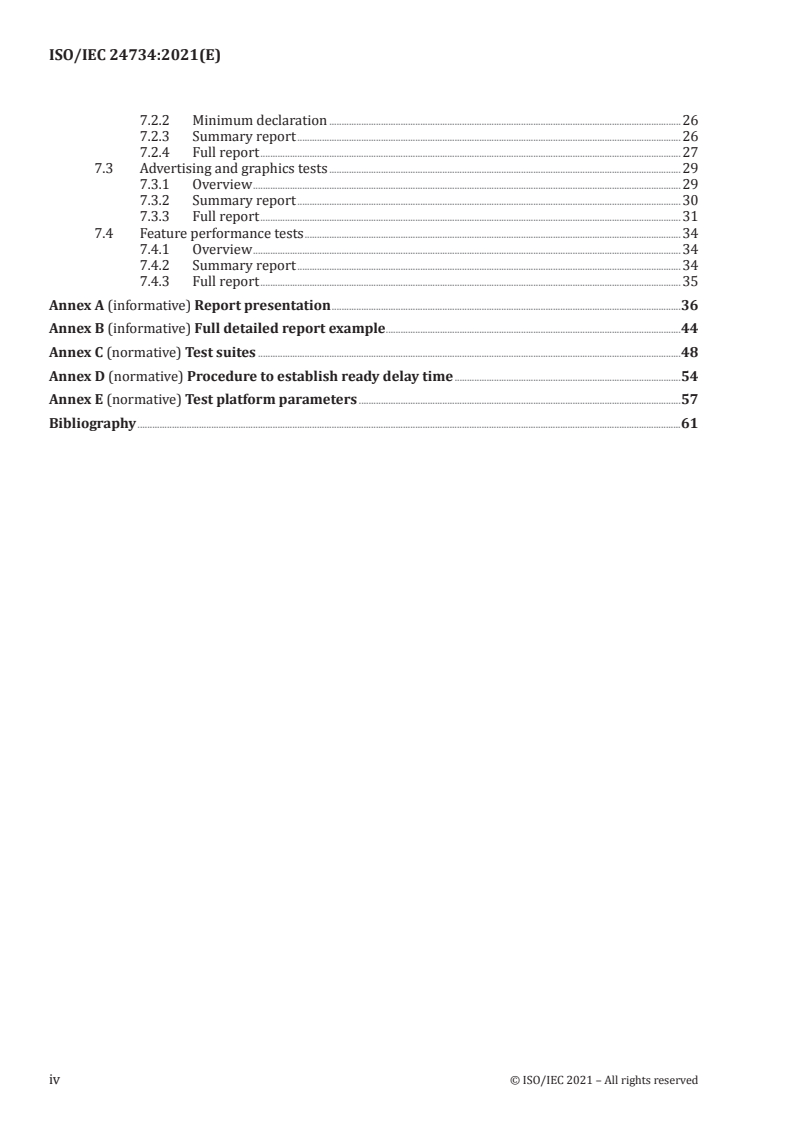
Annex A (informative) Report presentation .36
Annex B (informative) Full detailed report example .44
Annex C (normative) Test suites .48
Annex D (normative) Procedure to establish ready delay time .54
Annex E (normative) Test platform parameters .57
Bibliography .61
iv © ISO/IEC 2021 – All rights reserved
Foreword
ISO (the International Organization for Standardization) and IEC (the International Electrotechnical
Commission) form the specialized system for worldwide standardization. National bodies that
are members of ISO or IEC participate in the development of International Standards through
technical committees established by the respective organization to deal with particular fields of
technical activity. ISO and IEC technical committees collaborate in fields of mutual interest. Other
international organizations, governmental and non-governmental, in liaison with ISO and IEC, also
take part in the work.
The procedures used to develop this document and those intended for its further maintenance are
described in the ISO/IEC Directives, Part 1. In particular, the different approval criteria needed for
the different types of document should be noted. This document was drafted in accordance with the
editorial rules of the ISO/IEC Directives, Part 2 (see www .iso .org/ directives or www .iec .ch/ members
_experts/ refdocs).
Attention is drawn to the possibility that some of the elements of this document may be the subject
of patent rights. ISO and IEC shall not be held responsible for identifying any or all such patent
rights. Details of any patent rights identified during the development of the document will be in the
Introduction and/or on the ISO list of patent declarations received (see www .iso .org/ patents) or the IEC
list of patent declarations received (see patents.iec.ch).
Any trade name used in this document is information given for the convenience of users and does not
constitute an endorsement.
For an explanation of the voluntary nature of standards, the meaning of ISO specific terms and
expressions related to conformity assessment, as well as information about ISO's adherence to the
World Trade Organization (WTO) principles in the Technical Barriers to Trade (TBT) see www .iso .org/
iso/ foreword .html. In the IEC, see www .iec .ch/ understanding -standards.
This document was prepared by Joint Technical Committee ISO/IEC JTC 1, Information technology,
Subcommittee SC 28, Office equipment.
This third edition cancels and replaces the second edition (ISO/IEC 24734:2014), which has been
technically revised. It also incorporates the Corrigenda ISO/IEC 24734:2014/Cor 1:2016.
The main changes compared to the previous edition are as follows:
— added a “Normative references” clause;
— annex structure was changed to be consistent with other productivity standards;
— “Terms and definitions” clause has been modified to add new definitions and removed definitions of
terms not used in the text;
— added a requirement that single copy output shall use the default “output order” setting and the
alternate “order output” is an optional test;
— added reporting of the “output order” setting as part of the summary and detailed reports since it
has a direct impact on the ability for results to be repeatable;
— added “ready delay time” requirement to “test measurement” procedures;
— added Annex D for the procedure to determine the “ready delay time”;
— changed paper weight to paper grammage in body and reporting.
Any feedback or questions on this document should be directed to the user’s national standards body. A
complete listing of these bodies can be found at www .iso .org/ members .html and www .iec .ch/ national
-committees.
© ISO/IEC 2021 – All rights reserved v
Introduction
Many digital printing devices produce printed pages at a different rate than their nominal speed
when running with different modes (simplex, duplex, print quality modes), different substrate
grammage, system environments, applications and file content, and finishing options. The degree to
which a reduction in productivity is experienced depends significantly on multiple parameters of the
job workflow. The most dominant of the parameters of the job workflow are: system environment,
application, and job characteristics such as the number of pages in a set to be printed, single-sided or
double-sided output pages, quality mode, number of print sets to be produced, substrate grammage/size
used, and finishing options, and job content complexities such as monochrome vs. colour, text/vector
vs. raster, page scaling and colour conversion. The existing International Standard (ISO/IEC 10561)
only addresses printing throughput for Class 1 and Class 2 printers and, therefore is not suitable for
comparing colour printing devices or high-speed page-oriented printing devices with many finishing
options and connectivity configurations.
This document provides a general method for measuring the productivity when the above-mentioned
job workflow parameters for digital printing devices are taken into consideration. This document also
includes a suite of test files, test-platform (hardware and software) setup guidelines, and a procedure
to be used for measuring digital printing productivity. It allows manufacturers and buyers of digital
printing devices to describe the productivity of various digital printing devices with respect to
representative office usage patterns.
vi © ISO/IEC 2021 – All rights reserved
INTERNATIONAL STANDARD ISO/IEC 24734:2021(E)
Information technology — Office equipment — Method for
measuring digital printing productivity
1 Scope
This document specifies a method for measuring the digital printing productivity of digital printing
devices with various office applications and print job characteristics. This document is applicable
to digital printing devices, including single-function and multi-function devices, regardless of print
technology (e.g. inkjet, laser). Devices can be equipped with a range of paper feed and finishing options
either directly connected to the computer system or via a network. It is intended to be used for black and
white (B&W) as well as colour digital printing devices. It allows for the comparison of the productivity
of machines operating in various available modes (simplex, duplex, size of substrates, etc.) and office
applications when the test system environment, operating modes, and job mix for each machine are
held identical. This document includes test files, test setup procedure, test runtime procedure, and the
reporting requirements for the digital printing productivity measurements.
This document is not intended to be used for devices which are not able to print on a media size of
A4/8,5” × 11” or for devices which are not able to collate multiple copies of a print.
This document is not intended to replace manufacturer's rated speeds.
2 Normative references
The following documents are referred to in the text in such a way that some or all of their content
constitutes requirements of this document. For dated references, only the edition cited applies. For
undated references, the latest edition of the referenced document (including any amendments) applies.
ISO 536, Paper and board — Determination of grammage
3 Terms and definitions
For the purposes of this document, the following terms and definitions apply.
ISO and IEC maintain terminological databases for use in standardization at the following addresses:
— ISO Online browsing platform: available at https:// www. iso. org/o bp
— IEC Electropedia: available at http:// www.e lectropedia. org/
3.1
category test
test pertaining to one of two separate categories: office category, and advertising and graphics category
Note 1 to entry: The office category test is used to test and report first set out time (FSOT) (3.10), estimated
saturated throughput (ESAT) (3.7) and effective throughput (EFTP) (3.6) using content from typical office
applications and the advertising and graphics category test is used to test and report FSOT, ESAT and EFTP using
applications and files representing more complexity, higher coverage and a higher ratio of image and graphic
content such as pictures, gradients and embedded elements.
© ISO/IEC 2021 – All rights reserved 1
3.2
collate
collation
device’s ability to produce multiple hard copies of an electronic document in repeating original order
which may be achieved through either software features or via a hardware finishing device
EXAMPLE Repeating original order 1234, 1234, 1234, etc.
Note 1 to entry: Hard disk drive (HDD) is an example of a device feature that can be used to ensure proper output
order (3.19) by saving the images to disk then reading the saved pages to output in order.
3.3
default driver
printing device driver that is automatically selected as the default per the manufacturers’ installation
procedure
3.4
dual output order device
printing devices that support both original order output (3.18) and reverse order output (3.25)
3.5
duplex
duplex printing
two-sided printing
two-sided perfecting
printing where the printing device can make a number of prints with the printing being done to
both sides of the sheet
3.6
EFTP
effective throughput
rate at which a device produces pages measured from the initiation of the job through the complete exit
of the last page of the last test set (3.32)
Note 1 to entry: EFTP is expressed in images per minute (ipm) (3.13). EFTP can be affected by the digital processing
time of the test set as well as the run time of the test set.
3.7
ESAT
estimated saturated throughput
rate at which a device produces pages measured from the complete exit of the last page of the first test
set (3.32) through the complete exit of the last page of the last test set
Note 1 to entry: ESAT is expressed in images per minute (ipm) (3.13).
3.8
feature performance ratio
ratio of the device performance [such as first set out time (FSOT) (3.10) and estimated saturated
throughput (ESAT) (3.7)] with the subject feature ON versus the device default baseline performance
(without the subject feature ON)
3.9
feature performance test
optional test used to evaluate productivity changes with various printing and finishing
features enabled
Note 1 to entry: The feature performance test suite is run with default printing system settings to establish a
base line, and then with the selected feature (e.g. stapling) ON, for comparison.
2 © ISO/IEC 2021 – All rights reserved
3.10
FSOT
first set out time
number of seconds between the initiation of the job to the complete exit of the last page of the first test
set (3.32)
3.11
full detailed report
presentation of information including machine setup and full measured test results
Note 1 to entry: An example of a full detailed report is shown in Annex B.
3.12
full report
presentation of results including the first set out time (FSOT) (3.10), effective throughput (EFTP)
(3.6) and estimated saturated throughput (ESAT) (3.7) values for each file tested for a given category or
feature test as well as the calculated averages for the overall FSOT, EFTP and ESAT values
3.13
ipm
images per minute
printing rate, excluding time to first page printed, as measured when producing pages in a continuous
print mode for one minute with a single static document using a nominal grammage substrate
Note 1 to entry: Nominal printing speed is expressed in pages per minute or images per minute.
3.14
initial installation state
state of the test platform (3.30) after the installation and configuration of the operating system and
applications but before the installation of unique software, e.g. print driver for the printing device
under test
3.15
interface
data transmission between the host and the printing device, such as a direct (via parallel, serial, USB,
Firewire, network or wireless) or an indirect (via network router/server) connection
3.16
LSOT
last set out time
number of seconds between the initiation of the job to the complete exit of the last page of the last test
set (3.32)
3.17
N-up
inclusion of N page images on a single side of a single sheet of paper
Note 1 to entry: N is typically 1, 2 or 4 original images.
EXAMPLE 2-up copy mode scans two originals and creates one sheet of paper with two originals on it.
3.18
original order output
in-order output
printed document output stack is in the same order as the original electronic document
Note 1 to entry: For a device that prints simplex (3.27) imaged media side up, the device would print pages in
reverse order 4321 for the output stack to be in the same order 1234 as the original electronic document when
viewed by the user.
Note 2 to entry: For a device that prints simplex imaged media side down, the device would print pages in order
1234 for the output stack to be in the same order as the original electronic document when viewed by the user.
© ISO/IEC 2021 – All rights reserved 3
3.19
output order
order of printed pages in the output stack relative to the original electronic document
Note 1 to entry: The original document is ordered 1234, the printed output can be either 1234 or 4321.
3.20
PDL
page description language
commands and data structures that a printing system interprets to produce an intended print page image
3.21
performance test
test used to evaluate productivity by providing first set out time (FSOT) (3.10), effective throughput
(EFTP) (3.6) and estimated saturated throughput (ESAT) (3.7) without using any special feature or mode,
including both the simplex (3.27) printing mode and duplex (3.5) printing mode if available
3.22
RIP
raster image processor
component used in a printing system, which produces a bitmap
3.23
ready
ready state
state which a device typically enters after the exit of the last page of the last job and the device is in a
stable condition, but fully warmed up and prepared to operate
Note 1 to entry: While in the ready state, systems not directly involved with marking the media are allowed to be
in motion.
EXAMPLE Fans may still be spinning and all other motors stopped.
3.24
ready delay time
required delay time from the complete exit of the last page of the previous job to the start of the next job
3.25
reverse order output
printed document output stack is in the reverse order as the original electronic document
Note 1 to entry: For a device that prints simplex (3.27) imaged media side up, the device would print pages in
order 1234 for the output stack to be in the reverse order 4321 as the original electronic document when viewed
by the user.
Note 2 to entry: For a device that prints simplex imaged media side down, the device would print pages in reverse
order 4321 for the output stack to be in the reverse order 4321 as the original electronic document when viewed
by the user.
3.26
set count
total number of sets printed during a test run (3.31), with set count N, and then N (as in N test sets
(3.32)) × M (number of pages in one test file (3.29)) pages will be printed
Note 1 to entry: This is often referred to as copy count in the application or print driver setting.
4 © ISO/IEC 2021 – All rights reserved
3.27
simplex
simplex printing
use of a printing device when only a single side of a sheet is printed on
Note 1 to entry: Single-sided printing mode is similar to the copying modes often referred to as 1:1 mode, simplex
to simplex, or single-sided originals to single-sided copies.
3.28
summary report
presentation of results including the average overall first set out time (FSOT) (3.10) and estimated
saturated throughput (ESAT) (3.7) values calculated for a given category or feature test
3.29
test file
individual files used for testing as per the test method
® ®1)
EXAMPLE A single Microsoft Excel file within the office test is a “test file”.
3.30
test platform
set of hardware and software system components configured to perform the collection of digital
printing productivity tests
Note 1 to entry: The test platform includes, but is not limited to, a computer installed with an operating system
and applicable application software, installed printing device software, hardware and software interfaces (3.15),
and timing devices (stopwatch or automated).
3.31
test run
operation of printing one test file (3.29), in a particular system configuration, with a particular set and
page count
Note 1 to entry: Print times are recorded for each test run.
3.32
test set
all of the pages of a single test file (3.29)
3.33
test suite
combination of test files (3.29) for each category test (3.1)
EXAMPLE 1 The office category test suite consists of three test files.
EXAMPLE 2 The advertising and graphics category test suite consists of four test files.
4 Test parameters and conditions
4.1 Test platform
Due to the rapid change of computer technology, a common test platform (hardware and software)
that can be used for productivity testing over time is not considered practical. Instead, when a test
platform is used, the test platform system parameters that may affect digital printing productivity
measurements (see Annex E) shall be recorded.
1) Microsoft Excel is the trademark of a product supplied by Microsoft. This information is given for the convenience
of users of this document and does not constitute an endorsement by ISO or IEC of the product named. Equivalent
products may be used if they can be shown to lead to the same results.
© ISO/IEC 2021 – All rights reserved 5
4.2 Test platform test setup procedures
4.2.1 Initial platform setup
The test platform hardware should be installed as per the manufacturer's instructions. The test platform
hardware information shall be recorded as listed in Annex E. The test platform operating system and
applications should be installed as per the manufacturer’s instructions. The test platform operating
system and application information shall be recorded as per Annex E. All settings or selections made
during installation that differ from the application's default settings or operating system’s default
settings shall be recorded.
The test platform should be configured for the appropriate connection environment, such as direct
USB connection or network Ethernet connection, and the information shall be recorded as per Annex E
along with all settings and selections that differ from the installation default configuration.
It should be verified that the test platform is configured for optimal performance by evaluating system
parameters such as hard disk fragmentation and compression, swap memory size, etc. Any settings,
changes or optimizations made that differ from the installation default condition shall be recorded.
The test platform is now in the initial installation state. All recorded settings shall be included in the
full detailed report.
4.2.2 Creation of disk image of test platform (optional)
Disk imaging software may be used to enable the system to be restored to the initial installation state.
Create the disk image after the test platform has been configured and before the print driver for the
printing device is installed. Record the disk imaging software used and all settings that differ from the
imaging software’s installation default condition.
4.2.3 Initial test state
The test platform shall be restored to the initial installation state before beginning the sequence of
tests for each new printing device. Products that are of the same distinct print system can share testing
and reports. Two or more products or bundles may be part of a distinct print system when they use
the same print mechanism and operating points, and there are no differences that might be expected
to affect performance. Devices with differences that could affect performance are not part of the same
distinct print system, and are different print systems, even if they use the same print mechanism, and
shall not share testing and reports. Record the method used to establish the initial installation state.
4.3 Printing device system setup
Place the printing device on a horizontal surface and setup the printing device according to the
manufacturer's recommendation. Install the software (driver, port, etc.) recommended by the
manufacturer. Use the most recent print driver available from the manufacturer. The driver and driver
version shall be recorded on the test report.
The standard test shall be conducted using the manufacturer's default driver for the given printing
device. If a default driver is not installed/selected automatically by the manufacturer's installation
procedure, consult the manufacturer's documentation and use the recommended driver. All image, print
quality, mode and speed modifiers shall be at their factory preset configuration for the printing device
and default installed condition for the driver. If the printing device and driver differ, then the driver
defaults shall be used. Disabling manufacturer default installed features, routines or applications, is not
allowed.
EXAMPLE 1 Example routines that may not be disabled include, but are not limited to the following:
— automatic cleaning;
— calibration cycles;
6 © ISO/IEC 2021 – All rights reserved
— energy save settings.
Testing shall be carried out in the specified modes, regardless of whether they are default settings or not.
EXAMPLE 2 If the default driver setting is duplex, the setting is changed to simplex for the simplex tests.
Other modes that may need to be modified for specific tests include B&W mode on colour devices, paper
size, paper scaling and collation. It is allowable to disable automatic media detect and select plain paper.
All changes to the default settings shall be recorded in the full detailed report.
The file shall be rendered on the page in a size corresponding to the dimensions in the test page
description.
EXAMPLE 3 When testing an A4 sized document, the media settings shall be set to A4, and when testing an
8,5” × 11” (215,9 mm × 279,4 mm) sized document, set to 8,5” × 11” and so forth.
Verify that the printing device and print driver default page margin settings are not larger than
12,7 mm (0,5 inches). Adjust the settings as necessary to insure the test page printable area is rendered
correctly. Adjust the settings as necessary to insure the test pages printable area is rendered to cover
the paper page area as shown in the softcopy display of the test file. Any modifications to the printing
device or print driver settings shall be recorded. Page placement modifiers such as page centring and
auto-rotation can be used to place the image properly on the page. Any change from the printing device
defaults shall be recorded in the full detailed report.
Adjust the settings such as turning off “page scaling” setting to ensure the test page printable area is
rendered correctly.
Multiple copy output shall be collated. If collated output is not included in the default settings, follow
the manufacturer’s recommendation for obtaining collated output. In the case that collation settings do
affect performance, the faster of the results should be reported. As with other settings, the test report
shall disclose the manner in which collation was achieved.
Single and multiple copy output will be ordered according to default settings. If it is not the default
and if it is supported, optional original order output may be done by following the manufacturer’s
instructions on how to change the printing device or driver for the result of producing original order
output. If other settings change automatically as a result of changing to original order output this shall
be noted on the test report.
For colour and B&W printing devices, printing the three files in the office suite, using default settings
is required. The output of the three files on a colour device shall be in colour, whereas the output of the
three files on a B&W device shall be in B&W. For colour printing devices, an optional B&W result may be
reported by using the same three colour files, changing the printing device or driver to produce B&W
output, but maintaining the default quality or resolution setting.
Procedurally, the optional B&W output on a colour device test shall be done as follows: select the printing
device or driver options which are intended to produce B&W only output. Follow the manufacturer's
instructions on how to change the printing device or driver for the result of producing B&W output
utilising only the black toner or ink. If other settings change automatically as a result of changing to
B&W mode, such as quality mode, this shall be noted on the test report. If B&W printing is performed by
composite black, it should be reported.
NOTE Common means of setting a printing device in B&W include, but are not limited to, selecting a B&W
option in the driver. In the driver, it is possible that this appears as: “print in B&W”, “print in grayscale” or “print in
black only”. The selection of B&W printing can occur in several places in the driver and printing device. When the
best method to set the printing device to print in B&W only is in question, it is best to contact the manufacturer
regarding the best method to change this setting.
Additional tests may be conducted using other, non-default, drivers or printing device description
languages provided by the manufacturer for the printing device. Additional tests may also be
conducted using other settings available with the device. Such settings may be, but are not limited to,
print quality and speed modifier choices available in the driver. The results of such additional tests
© ISO/IEC 2021 – All rights reserved 7
will be documented as having system parameters that differ from the factory defaults and shown in
comparison to the default system parameter results.
4.4 Printing device connection
Connection to the test platform should be determined by the manufacturer’s targeted usage. A printing
device intended to be shared by several users should be connected via the network connection with
which the printing device is equipped from the manufacturer. A printing device intended to be personal
or desktop should be connected direct to the test computer (such as USB). The connection type, version,
and all settings that differ from the system or printing device defaults shall be recorded and reported.
4.5 Printing device condition
All supplies used in the test(s), including paper and printing device consumables, shall be only those
specified as acceptable for use by the manufacturer (or otherwise noted). If available, the number
of pages printed on the engine and printed on the consumables prior to the start of the test shall be
recorded and reported. The machine and all of its necessary supplies shall be acclimated in the test
environment prior to conducting the test(s) at least 8 h.
4.6 Sample size
Each file shall be tested and measured at least twice for repeatability. All required tests shall be run
using one device.
4.7 Paper
The paper used in this test shall be within the range of, and/or not violate, specific written attribute
guidelines and recommendations provided by the printing device manufacturer, which may include
but are not limited to: size, grammage, composition, paper manufacturer(s), paper type, part number
and other physical characteristics. Care shall be taken to use a paper that conforms to the printing
device manufacturer's paper specifications for the default printing settings. The paper manufacturer,
grammage, size and paper type/name used in each test shall be noted on the report. The paper
grammage shall be measured according to ISO 536.
In all cases the paper size used shall be indicated in the measurement results tables, and the paper feed
orientation shall be noted in the test report. When a comparison is made between the productivity of
one machine with that of other machines the measurement shall be done with the same paper sizes and
paper feed orientation.
4.8 Maintenance
Print engine maintenance shall be performed throughout testing per the manufacturer's
recommendations on an as needed basis.
EXAMPLE Cleaning routines or consumables replacement.
4.9 Test files, test suites and software applications
The productivity test suites and test files are specified in Annex C. The tests shall be conducted using
the standard official electronic test files as the input. Failure to use the exact files as specified in
Annex C shall invalidate test results. The versions of the test files and application software used shall
be included in the test report.
A single set of each test file is printed and measured to determine FSOT. Multiple, N sets, of each test
file are printed and measured for the 1 set + 30 seconds test run to calculate ESAT and EFTP, where
N is the number of sets needed to meet LSOT - FSOT ≥ 30 s. This method is used to provide varying
tests for products across varying segments. This approach allows faster products to be tested with
more sets and slower products to be tested with fewer sets without defining and categorizing products
8 © ISO/IEC 2021 – All rights reserved
by segment and weighting some test pages more heavily than others. The 1 set + 4 minutes test is a
similar concept used to calculate EFTP and is intended to provide a test to illustrate that differences in
productivity can occur for longer printing times compared to shorter printing times. It is understood
and recognized that 4 min may be a long test for some devices, but a short test for other, higher-end
devices. The 4 min time is a compromise to meet the needs of the many products across many segments
covered in the scope of this document.
The office category test is the required test. The advertising and graphics category test is an optional
test. If the printing device under test serves more than one market category, or if testing more
applications and content is of interest, both category tests can
...
INTERNATIONAL ISO/IEC
STANDARD 24734
Third edition
2021-04
Information technology — Office
equipment — Method for measuring
digital printing productivity
Technologies de l'information — Équipements de bureau — Méthode
de mesure de la productivité d'impression numérique
Reference number
©
ISO/IEC 2021
© ISO/IEC 2021
All rights reserved. Unless otherwise specified, or required in the context of its implementation, no part of this publication may
be reproduced or utilized otherwise in any form or by any means, electronic or mechanical, including photocopying, or posting
on the internet or an intranet, without prior written permission. Permission can be requested from either ISO at the address
below or ISO’s member body in the country of the requester.
ISO copyright office
CP 401 • Ch. de Blandonnet 8
CH-1214 Vernier, Geneva
Phone: +41 22 749 01 11
Email: copyright@iso.org
Website: www.iso.org
Published in Switzerland
ii © ISO/IEC 2021 – All rights reserved
Contents Page
Foreword .v
Introduction .vi
1 Scope . 1
2 Normative references . 1
3 Terms and definitions . 1
4 Test parameters and conditions . 5
4.1 Test platform . 5
4.2 Test platform test setup procedures . 6
4.2.1 Initial platform setup . 6
4.2.2 Creation of disk image of test platform (optional) . 6
4.2.3 Initial test state . 6
4.3 Printing device system setup . 6
4.4 Printing device connection . 8
4.5 Printing device condition . 8
4.6 Sample size . 8
4.7 Paper . 8
4.8 Maintenance . 8
4.9 Test files, test suites and software applications . 8
4.10 Environment . 9
4.11 Voltage . 9
5 Test method . 9
5.1 Overview . 9
5.2 Test measurement procedure .10
5.2.1 Test setup .10
5.2.2 “1 set” test from ready.11
5.2.3 “1 set + 30 seconds” test from ready .11
5.2.4 “1 set + 4 minutes” test from ready .12
5.3 Test method process .13
5.3.1 Suggested flow chart .13
5.3.2 ±5 % consistency criteria .14
5.3.3 Estimating the set count .15
5.4 Category tests .16
5.4.1 Overview .16
5.4.2 Office test .16
5.4.3 Advertising and graphics test .18
5.5 Feature performance test .20
5.5.1 Overview .20
5.5.2 Feature performance test procedure .21
5.6 Optional special tests .22
6 Calculations and treatment of data .22
6.1 Overview .22
6.2 Category tests .22
6.2.1 “1 set” test from ready.22
6.2.2 “1 set + 30 seconds” test from ready .23
6.2.3 “1 set + 4 minutes” test from ready .23
6.3 Feature performance test .24
6.3.1 “1 set” test from ready.24
6.3.2 “1 set + 30 seconds” test from ready .24
7 Presentation of results .25
7.1 Sharing testing and reports .25
7.2 Category tests .26
7.2.1 Overview .26
© ISO/IEC 2021 – All rights reserved iii
7.2.2 Minimum declaration .26
7.2.3 Summary report .26
7.2.4 Full report .27
7.3 Advertising and graphics tests .29
7.3.1 Overview .29
7.3.2 Summary report .30
7.3.3 Full report .31
7.4 Feature performance tests .34
7.4.1 Overview .34
7.4.2 Summary report .34
7.4.3 Full report .35
Annex A (informative) Report presentation .36
Annex B (informative) Full detailed report example .44
Annex C (normative) Test suites .48
Annex D (normative) Procedure to establish ready delay time .54
Annex E (normative) Test platform parameters .57
Bibliography .61
iv © ISO/IEC 2021 – All rights reserved
Foreword
ISO (the International Organization for Standardization) and IEC (the International Electrotechnical
Commission) form the specialized system for worldwide standardization. National bodies that
are members of ISO or IEC participate in the development of International Standards through
technical committees established by the respective organization to deal with particular fields of
technical activity. ISO and IEC technical committees collaborate in fields of mutual interest. Other
international organizations, governmental and non-governmental, in liaison with ISO and IEC, also
take part in the work.
The procedures used to develop this document and those intended for its further maintenance are
described in the ISO/IEC Directives, Part 1. In particular, the different approval criteria needed for
the different types of document should be noted. This document was drafted in accordance with the
editorial rules of the ISO/IEC Directives, Part 2 (see www .iso .org/ directives or www .iec .ch/ members
_experts/ refdocs).
Attention is drawn to the possibility that some of the elements of this document may be the subject
of patent rights. ISO and IEC shall not be held responsible for identifying any or all such patent
rights. Details of any patent rights identified during the development of the document will be in the
Introduction and/or on the ISO list of patent declarations received (see www .iso .org/ patents) or the IEC
list of patent declarations received (see patents.iec.ch).
Any trade name used in this document is information given for the convenience of users and does not
constitute an endorsement.
For an explanation of the voluntary nature of standards, the meaning of ISO specific terms and
expressions related to conformity assessment, as well as information about ISO's adherence to the
World Trade Organization (WTO) principles in the Technical Barriers to Trade (TBT) see www .iso .org/
iso/ foreword .html. In the IEC, see www .iec .ch/ understanding -standards.
This document was prepared by Joint Technical Committee ISO/IEC JTC 1, Information technology,
Subcommittee SC 28, Office equipment.
This third edition cancels and replaces the second edition (ISO/IEC 24734:2014), which has been
technically revised. It also incorporates the Corrigenda ISO/IEC 24734:2014/Cor 1:2016.
The main changes compared to the previous edition are as follows:
— added a “Normative references” clause;
— annex structure was changed to be consistent with other productivity standards;
— “Terms and definitions” clause has been modified to add new definitions and removed definitions of
terms not used in the text;
— added a requirement that single copy output shall use the default “output order” setting and the
alternate “order output” is an optional test;
— added reporting of the “output order” setting as part of the summary and detailed reports since it
has a direct impact on the ability for results to be repeatable;
— added “ready delay time” requirement to “test measurement” procedures;
— added Annex D for the procedure to determine the “ready delay time”;
— changed paper weight to paper grammage in body and reporting.
Any feedback or questions on this document should be directed to the user’s national standards body. A
complete listing of these bodies can be found at www .iso .org/ members .html and www .iec .ch/ national
-committees.
© ISO/IEC 2021 – All rights reserved v
Introduction
Many digital printing devices produce printed pages at a different rate than their nominal speed
when running with different modes (simplex, duplex, print quality modes), different substrate
grammage, system environments, applications and file content, and finishing options. The degree to
which a reduction in productivity is experienced depends significantly on multiple parameters of the
job workflow. The most dominant of the parameters of the job workflow are: system environment,
application, and job characteristics such as the number of pages in a set to be printed, single-sided or
double-sided output pages, quality mode, number of print sets to be produced, substrate grammage/size
used, and finishing options, and job content complexities such as monochrome vs. colour, text/vector
vs. raster, page scaling and colour conversion. The existing International Standard (ISO/IEC 10561)
only addresses printing throughput for Class 1 and Class 2 printers and, therefore is not suitable for
comparing colour printing devices or high-speed page-oriented printing devices with many finishing
options and connectivity configurations.
This document provides a general method for measuring the productivity when the above-mentioned
job workflow parameters for digital printing devices are taken into consideration. This document also
includes a suite of test files, test-platform (hardware and software) setup guidelines, and a procedure
to be used for measuring digital printing productivity. It allows manufacturers and buyers of digital
printing devices to describe the productivity of various digital printing devices with respect to
representative office usage patterns.
vi © ISO/IEC 2021 – All rights reserved
INTERNATIONAL STANDARD ISO/IEC 24734:2021(E)
Information technology — Office equipment — Method for
measuring digital printing productivity
1 Scope
This document specifies a method for measuring the digital printing productivity of digital printing
devices with various office applications and print job characteristics. This document is applicable
to digital printing devices, including single-function and multi-function devices, regardless of print
technology (e.g. inkjet, laser). Devices can be equipped with a range of paper feed and finishing options
either directly connected to the computer system or via a network. It is intended to be used for black and
white (B&W) as well as colour digital printing devices. It allows for the comparison of the productivity
of machines operating in various available modes (simplex, duplex, size of substrates, etc.) and office
applications when the test system environment, operating modes, and job mix for each machine are
held identical. This document includes test files, test setup procedure, test runtime procedure, and the
reporting requirements for the digital printing productivity measurements.
This document is not intended to be used for devices which are not able to print on a media size of
A4/8,5” × 11” or for devices which are not able to collate multiple copies of a print.
This document is not intended to replace manufacturer's rated speeds.
2 Normative references
The following documents are referred to in the text in such a way that some or all of their content
constitutes requirements of this document. For dated references, only the edition cited applies. For
undated references, the latest edition of the referenced document (including any amendments) applies.
ISO 536, Paper and board — Determination of grammage
3 Terms and definitions
For the purposes of this document, the following terms and definitions apply.
ISO and IEC maintain terminological databases for use in standardization at the following addresses:
— ISO Online browsing platform: available at https:// www. iso. org/o bp
— IEC Electropedia: available at http:// www.e lectropedia. org/
3.1
category test
test pertaining to one of two separate categories: office category, and advertising and graphics category
Note 1 to entry: The office category test is used to test and report first set out time (FSOT) (3.10), estimated
saturated throughput (ESAT) (3.7) and effective throughput (EFTP) (3.6) using content from typical office
applications and the advertising and graphics category test is used to test and report FSOT, ESAT and EFTP using
applications and files representing more complexity, higher coverage and a higher ratio of image and graphic
content such as pictures, gradients and embedded elements.
© ISO/IEC 2021 – All rights reserved 1
3.2
collate
collation
device’s ability to produce multiple hard copies of an electronic document in repeating original order
which may be achieved through either software features or via a hardware finishing device
EXAMPLE Repeating original order 1234, 1234, 1234, etc.
Note 1 to entry: Hard disk drive (HDD) is an example of a device feature that can be used to ensure proper output
order (3.19) by saving the images to disk then reading the saved pages to output in order.
3.3
default driver
printing device driver that is automatically selected as the default per the manufacturers’ installation
procedure
3.4
dual output order device
printing devices that support both original order output (3.18) and reverse order output (3.25)
3.5
duplex
duplex printing
two-sided printing
two-sided perfecting
printing where the printing device can make a number of prints with the printing being done to
both sides of the sheet
3.6
EFTP
effective throughput
rate at which a device produces pages measured from the initiation of the job through the complete exit
of the last page of the last test set (3.32)
Note 1 to entry: EFTP is expressed in images per minute (ipm) (3.13). EFTP can be affected by the digital processing
time of the test set as well as the run time of the test set.
3.7
ESAT
estimated saturated throughput
rate at which a device produces pages measured from the complete exit of the last page of the first test
set (3.32) through the complete exit of the last page of the last test set
Note 1 to entry: ESAT is expressed in images per minute (ipm) (3.13).
3.8
feature performance ratio
ratio of the device performance [such as first set out time (FSOT) (3.10) and estimated saturated
throughput (ESAT) (3.7)] with the subject feature ON versus the device default baseline performance
(without the subject feature ON)
3.9
feature performance test
optional test used to evaluate productivity changes with various printing and finishing
features enabled
Note 1 to entry: The feature performance test suite is run with default printing system settings to establish a
base line, and then with the selected feature (e.g. stapling) ON, for comparison.
2 © ISO/IEC 2021 – All rights reserved
3.10
FSOT
first set out time
number of seconds between the initiation of the job to the complete exit of the last page of the first test
set (3.32)
3.11
full detailed report
presentation of information including machine setup and full measured test results
Note 1 to entry: An example of a full detailed report is shown in Annex B.
3.12
full report
presentation of results including the first set out time (FSOT) (3.10), effective throughput (EFTP)
(3.6) and estimated saturated throughput (ESAT) (3.7) values for each file tested for a given category or
feature test as well as the calculated averages for the overall FSOT, EFTP and ESAT values
3.13
ipm
images per minute
printing rate, excluding time to first page printed, as measured when producing pages in a continuous
print mode for one minute with a single static document using a nominal grammage substrate
Note 1 to entry: Nominal printing speed is expressed in pages per minute or images per minute.
3.14
initial installation state
state of the test platform (3.30) after the installation and configuration of the operating system and
applications but before the installation of unique software, e.g. print driver for the printing device
under test
3.15
interface
data transmission between the host and the printing device, such as a direct (via parallel, serial, USB,
Firewire, network or wireless) or an indirect (via network router/server) connection
3.16
LSOT
last set out time
number of seconds between the initiation of the job to the complete exit of the last page of the last test
set (3.32)
3.17
N-up
inclusion of N page images on a single side of a single sheet of paper
Note 1 to entry: N is typically 1, 2 or 4 original images.
EXAMPLE 2-up copy mode scans two originals and creates one sheet of paper with two originals on it.
3.18
original order output
in-order output
printed document output stack is in the same order as the original electronic document
Note 1 to entry: For a device that prints simplex (3.27) imaged media side up, the device would print pages in
reverse order 4321 for the output stack to be in the same order 1234 as the original electronic document when
viewed by the user.
Note 2 to entry: For a device that prints simplex imaged media side down, the device would print pages in order
1234 for the output stack to be in the same order as the original electronic document when viewed by the user.
© ISO/IEC 2021 – All rights reserved 3
3.19
output order
order of printed pages in the output stack relative to the original electronic document
Note 1 to entry: The original document is ordered 1234, the printed output can be either 1234 or 4321.
3.20
PDL
page description language
commands and data structures that a printing system interprets to produce an intended print page image
3.21
performance test
test used to evaluate productivity by providing first set out time (FSOT) (3.10), effective throughput
(EFTP) (3.6) and estimated saturated throughput (ESAT) (3.7) without using any special feature or mode,
including both the simplex (3.27) printing mode and duplex (3.5) printing mode if available
3.22
RIP
raster image processor
component used in a printing system, which produces a bitmap
3.23
ready
ready state
state which a device typically enters after the exit of the last page of the last job and the device is in a
stable condition, but fully warmed up and prepared to operate
Note 1 to entry: While in the ready state, systems not directly involved with marking the media are allowed to be
in motion.
EXAMPLE Fans may still be spinning and all other motors stopped.
3.24
ready delay time
required delay time from the complete exit of the last page of the previous job to the start of the next job
3.25
reverse order output
printed document output stack is in the reverse order as the original electronic document
Note 1 to entry: For a device that prints simplex (3.27) imaged media side up, the device would print pages in
order 1234 for the output stack to be in the reverse order 4321 as the original electronic document when viewed
by the user.
Note 2 to entry: For a device that prints simplex imaged media side down, the device would print pages in reverse
order 4321 for the output stack to be in the reverse order 4321 as the original electronic document when viewed
by the user.
3.26
set count
total number of sets printed during a test run (3.31), with set count N, and then N (as in N test sets
(3.32)) × M (number of pages in one test file (3.29)) pages will be printed
Note 1 to entry: This is often referred to as copy count in the application or print driver setting.
4 © ISO/IEC 2021 – All rights reserved
3.27
simplex
simplex printing
use of a printing device when only a single side of a sheet is printed on
Note 1 to entry: Single-sided printing mode is similar to the copying modes often referred to as 1:1 mode, simplex
to simplex, or single-sided originals to single-sided copies.
3.28
summary report
presentation of results including the average overall first set out time (FSOT) (3.10) and estimated
saturated throughput (ESAT) (3.7) values calculated for a given category or feature test
3.29
test file
individual files used for testing as per the test method
® ®1)
EXAMPLE A single Microsoft Excel file within the office test is a “test file”.
3.30
test platform
set of hardware and software system components configured to perform the collection of digital
printing productivity tests
Note 1 to entry: The test platform includes, but is not limited to, a computer installed with an operating system
and applicable application software, installed printing device software, hardware and software interfaces (3.15),
and timing devices (stopwatch or automated).
3.31
test run
operation of printing one test file (3.29), in a particular system configuration, with a particular set and
page count
Note 1 to entry: Print times are recorded for each test run.
3.32
test set
all of the pages of a single test file (3.29)
3.33
test suite
combination of test files (3.29) for each category test (3.1)
EXAMPLE 1 The office category test suite consists of three test files.
EXAMPLE 2 The advertising and graphics category test suite consists of four test files.
4 Test parameters and conditions
4.1 Test platform
Due to the rapid change of computer technology, a common test platform (hardware and software)
that can be used for productivity testing over time is not considered practical. Instead, when a test
platform is used, the test platform system parameters that may affect digital printing productivity
measurements (see Annex E) shall be recorded.
1) Microsoft Excel is the trademark of a product supplied by Microsoft. This information is given for the convenience
of users of this document and does not constitute an endorsement by ISO or IEC of the product named. Equivalent
products may be used if they can be shown to lead to the same results.
© ISO/IEC 2021 – All rights reserved 5
4.2 Test platform test setup procedures
4.2.1 Initial platform setup
The test platform hardware should be installed as per the manufacturer's instructions. The test platform
hardware information shall be recorded as listed in Annex E. The test platform operating system and
applications should be installed as per the manufacturer’s instructions. The test platform operating
system and application information shall be recorded as per Annex E. All settings or selections made
during installation that differ from the application's default settings or operating system’s default
settings shall be recorded.
The test platform should be configured for the appropriate connection environment, such as direct
USB connection or network Ethernet connection, and the information shall be recorded as per Annex E
along with all settings and selections that differ from the installation default configuration.
It should be verified that the test platform is configured for optimal performance by evaluating system
parameters such as hard disk fragmentation and compression, swap memory size, etc. Any settings,
changes or optimizations made that differ from the installation default condition shall be recorded.
The test platform is now in the initial installation state. All recorded settings shall be included in the
full detailed report.
4.2.2 Creation of disk image of test platform (optional)
Disk imaging software may be used to enable the system to be restored to the initial installation state.
Create the disk image after the test platform has been configured and before the print driver for the
printing device is installed. Record the disk imaging software used and all settings that differ from the
imaging software’s installation default condition.
4.2.3 Initial test state
The test platform shall be restored to the initial installation state before beginning the sequence of
tests for each new printing device. Products that are of the same distinct print system can share testing
and reports. Two or more products or bundles may be part of a distinct print system when they use
the same print mechanism and operating points, and there are no differences that might be expected
to affect performance. Devices with differences that could affect performance are not part of the same
distinct print system, and are different print systems, even if they use the same print mechanism, and
shall not share testing and reports. Record the method used to establish the initial installation state.
4.3 Printing device system setup
Place the printing device on a horizontal surface and setup the printing device according to the
manufacturer's recommendation. Install the software (driver, port, etc.) recommended by the
manufacturer. Use the most recent print driver available from the manufacturer. The driver and driver
version shall be recorded on the test report.
The standard test shall be conducted using the manufacturer's default driver for the given printing
device. If a default driver is not installed/selected automatically by the manufacturer's installation
procedure, consult the manufacturer's documentation and use the recommended driver. All image, print
quality, mode and speed modifiers shall be at their factory preset configuration for the printing device
and default installed condition for the driver. If the printing device and driver differ, then the driver
defaults shall be used. Disabling manufacturer default installed features, routines or applications, is not
allowed.
EXAMPLE 1 Example routines that may not be disabled include, but are not limited to the following:
— automatic cleaning;
— calibration cycles;
6 © ISO/IEC 2021 – All rights reserved
— energy save settings.
Testing shall be carried out in the specified modes, regardless of whether they are default settings or not.
EXAMPLE 2 If the default driver setting is duplex, the setting is changed to simplex for the simplex tests.
Other modes that may need to be modified for specific tests include B&W mode on colour devices, paper
size, paper scaling and collation. It is allowable to disable automatic media detect and select plain paper.
All changes to the default settings shall be recorded in the full detailed report.
The file shall be rendered on the page in a size corresponding to the dimensions in the test page
description.
EXAMPLE 3 When testing an A4 sized document, the media settings shall be set to A4, and when testing an
8,5” × 11” (215,9 mm × 279,4 mm) sized document, set to 8,5” × 11” and so forth.
Verify that the printing device and print driver default page margin settings are not larger than
12,7 mm (0,5 inches). Adjust the settings as necessary to insure the test page printable area is rendered
correctly. Adjust the settings as necessary to insure the test pages printable area is rendered to cover
the paper page area as shown in the softcopy display of the test file. Any modifications to the printing
device or print driver settings shall be recorded. Page placement modifiers such as page centring and
auto-rotation can be used to place the image properly on the page. Any change from the printing device
defaults shall be recorded in the full detailed report.
Adjust the settings such as turning off “page scaling” setting to ensure the test page printable area is
rendered correctly.
Multiple copy output shall be collated. If collated output is not included in the default settings, follow
the manufacturer’s recommendation for obtaining collated output. In the case that collation settings do
affect performance, the faster of the results should be reported. As with other settings, the test report
shall disclose the manner in which collation was achieved.
Single and multiple copy output will be ordered according to default settings. If it is not the default
and if it is supported, optional original order output may be done by following the manufacturer’s
instructions on how to change the printing device or driver for the result of producing original order
output. If other settings change automatically as a result of changing to original order output this shall
be noted on the test report.
For colour and B&W printing devices, printing the three files in the office suite, using default settings
is required. The output of the three files on a colour device shall be in colour, whereas the output of the
three files on a B&W device shall be in B&W. For colour printing devices, an optional B&W result may be
reported by using the same three colour files, changing the printing device or driver to produce B&W
output, but maintaining the default quality or resolution setting.
Procedurally, the optional B&W output on a colour device test shall be done as follows: select the printing
device or driver options which are intended to produce B&W only output. Follow the manufacturer's
instructions on how to change the printing device or driver for the result of producing B&W output
utilising only the black toner or ink. If other settings change automatically as a result of changing to
B&W mode, such as quality mode, this shall be noted on the test report. If B&W printing is performed by
composite black, it should be reported.
NOTE Common means of setting a printing device in B&W include, but are not limited to, selecting a B&W
option in the driver. In the driver, it is possible that this appears as: “print in B&W”, “print in grayscale” or “print in
black only”. The selection of B&W printing can occur in several places in the driver and printing device. When the
best method to set the printing device to print in B&W only is in question, it is best to contact the manufacturer
regarding the best method to change this setting.
Additional tests may be conducted using other, non-default, drivers or printing device description
languages provided by the manufacturer for the printing device. Additional tests may also be
conducted using other settings available with the device. Such settings may be, but are not limited to,
print quality and speed modifier choices available in the driver. The results of such additional tests
© ISO/IEC 2021 – All rights reserved 7
will be documented as having system parameters that differ from the factory defaults and shown in
comparison to the default system parameter results.
4.4 Printing device connection
Connection to the test platform should be determined by the manufacturer’s targeted usage. A printing
device intended to be shared by several users should be connected via the network connection with
which the printing device is equipped from the manufacturer. A printing device intended to be personal
or desktop should be connected direct to the test computer (such as USB). The connection type, version,
and all settings that differ from the system or printing device defaults shall be recorded and reported.
4.5 Printing device condition
All supplies used in the test(s), including paper and printing device consumables, shall be only those
specified as acceptable for use by the manufacturer (or otherwise noted). If available, the number
of pages printed on the engine and printed on the consumables prior to the start of the test shall be
recorded and reported. The machine and all of its necessary supplies shall be acclimated in the test
environment prior to conducting the test(s) at least 8 h.
4.6 Sample size
Each file shall be tested and measured at least twice for repeatability. All required tests shall be run
using one device.
4.7 Paper
The paper used in this test shall be within the range of, and/or not violate, specific written attribute
guidelines and recommendations provided by the printing device manufacturer, which may include
but are not limited to: size, grammage, composition, paper manufacturer(s), paper type, part number
and other physical characteristics. Care shall be taken to use a paper that conforms to the printing
device manufacturer's paper specifications for the default printing settings. The paper manufacturer,
grammage, size and paper type/name used in each test shall be noted on the report. The paper
grammage shall be measured according to ISO 536.
In all cases the paper size used shall be indicated in the measurement results tables, and the paper feed
orientation shall be noted in the test report. When a comparison is made between the productivity of
one machine with that of other machines the measurement shall be done with the same paper sizes and
paper feed orientation.
4.8 Maintenance
Print engine maintenance shall be performed throughout testing per the manufacturer's
recommendations on an as needed basis.
EXAMPLE Cleaning routines or consumables replacement.
4.9 Test files, test suites and software applications
The productivity test suites and test files are specified in Annex C. The tests shall be conducted using
the standard official electronic test files as the input. Failure to use the exact files as specified in
Annex C shall invalidate test results. The versions of the test files and application software used shall
be included in the test report.
A single set of each test file is printed and measured to determine FSOT. Multiple, N sets, of each test
file are printed and measured for the 1 set + 30 seconds test run to calculate ESAT and EFTP, where
N is the number of sets needed to meet LSOT - FSOT ≥ 30 s. This method is used to provide varying
tests for products across varying segments. This approach allows faster products to be tested with
more sets and slower products to be tested with fewer sets without defining and categorizing products
8 © ISO/IEC 2021 – All rights reserved
by segment and weighting some test pages more heavily than others. The 1 set + 4 minutes test is a
similar concept used to calculate EFTP and is intended to provide a test to illustrate that differences in
productivity can occur for longer printing times compared to shorter printing times. It is understood
and recognized that 4 min may be a long test for some devices, but a short test for other, higher-end
devices. The 4 min time is a compromise to meet the needs of the many products across many segments
covered in the scope of this document.
The office category test is the required test. The advertising and graphics category test is an optional
test. If the printing device under test serves more than one market category, or if testing more
applications and content is of interest, both category tests can
...