


ISO/FDIS 21321
(Main)Ships and marine technology — Manned submersibles — Manoeuvring tests
Ships and marine technology — Manned submersibles — Manoeuvring tests
This document defines general requirement, test item and test method of manoeuvring test on manned submersibles. It is applicable to manoeuvring test for all manned submersibles at pool, lake and sea. It is a reference for manoeuvring test on other types of submersibles at pool, lake and sea.
Navires et technologie maritime — Submersibles habités — Essais de manœuvre
General Information
- Status
- Not Published
- Technical Committee
- ISO/TC 8/SC 13 - Marine technology
- Drafting Committee
- ISO/TC 8/SC 13 - Marine technology
- Current Stage
- 5020 - FDIS ballot initiated: 2 months. Proof sent to secretariat
- Start Date
- 30-Jan-2026
- Completion Date
- 30-Jan-2026
Overview
ISO/FDIS 21321, titled Ships and Marine Technology - Manned Submersibles - Manoeuvring Tests, is an international standard developed by ISO Technical Committee 8 (Ships and marine technology), Subcommittee 13. This document specifies the general requirements, test items, and test methods for conducting manoeuvring tests on manned submersibles. It applies to tests performed in pools, lakes, and open seas and serves as a reference for testing other types of submersibles.
Adherence to ISO/FDIS 21321 ensures consistent evaluation of submersible maneuverability, safety, and performance, providing essential guidance for manufacturers, operators, and regulatory bodies involved in manned underwater vehicle operations.
Key Topics
Scope and General Requirements
- Defines the range of manoeuvring tests applicable to all manned submersibles.
- Details support vessel requirements and test instrumentation accuracy.
- Establishes test conditions including environmental and operational parameters.
- Emphasizes emergency procedures critical for personnel safety during tests.
Test Types and Methods
The standard presents comprehensive test categories covering various maneuvering capabilities:
Physical Buoyancy Test
Measures the submersible’s ability to maintain or change buoyancy under static conditions.Powered Submerging and Surfacing Tests
Evaluates propulsion and control systems during submerged descent and ascent, both powered and unpowered with releasable ballast.Auto-Depth and Auto-Heading Tests
Assesses the submersible’s automatic control systems for maintaining target depth and heading.Triple-Direction Speed Test
Measures the maximum sustainable speeds in different directions to validate propulsion efficiency.Stopping Distance and Turning Tests
Determines maneuvering responsiveness, critical for operational safety and navigation accuracy.Hovering and Auto-Altitude Tests
Validates ability to maintain position and altitude over seabed or water column.
Each test type is supported by detailed test procedures, measuring parameters, and criteria for test result evaluation ensuring consistent test execution and outcome reliability.
Applications
ISO/FDIS 21321 is applicable to:
Submersible Manufacturers
Use these standardized manoeuvring tests during development and certification to optimize vehicle design and safety compliance.Marine Testing Facilities
Provides a reference framework for conducting controlled manoeuvring trials in pools, lakes, and seas.Underwater Research and Exploration Operators
Ensures that manned submersibles used in scientific, commercial, or recreational activities meet rigorous operational performance standards.Regulatory Authorities
Aids in establishing certification requirements and safety protocols for manned submersible operation in national and international waters.
Using this standard helps enhance operational safety, improve design reliability, and promote interoperability within the marine technology sector focusing on manned underwater vehicles.
Related Standards
- ISO 8487 – Ships and marine technology - Hydrostatic tests for underwater vehicles
- ISO 13628 Series – Petroleum and natural gas industries - Design and operation of subsea production systems
- ISO 19030 Series – Measurement of hull and propeller performance for vessels
- IMO Submersible Regulations – International Maritime Organization guidelines applicable for manned submersible operations
These related documents complement ISO/FDIS 21321 by covering associated aspects of underwater vehicle performance, safety, and operational standards, helping stakeholders adopt a thorough approach to marine technology compliance.
Keywords: ISO 21321, manned submersibles, manoeuvring tests, marine technology, underwater vehicles, submersible testing standards, buoyancy test, submersible performance, maritime safety, marine operations standards, manoeuvring test methods.
Buy Documents
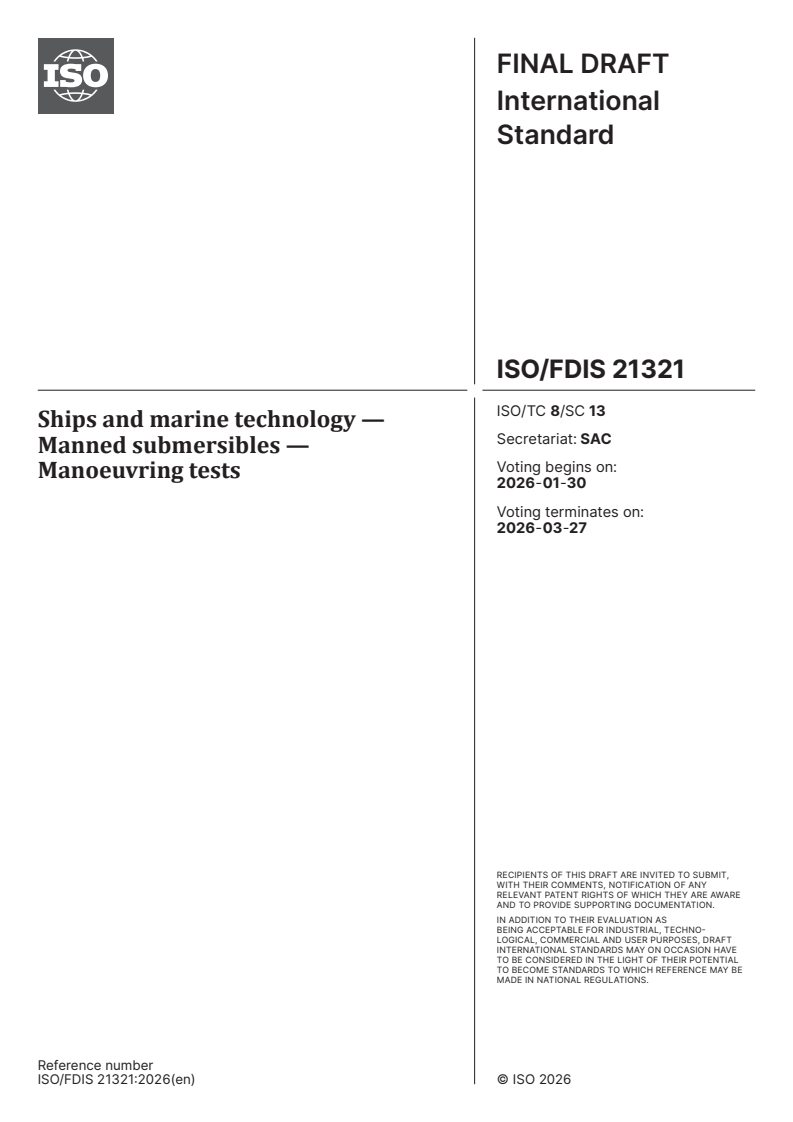
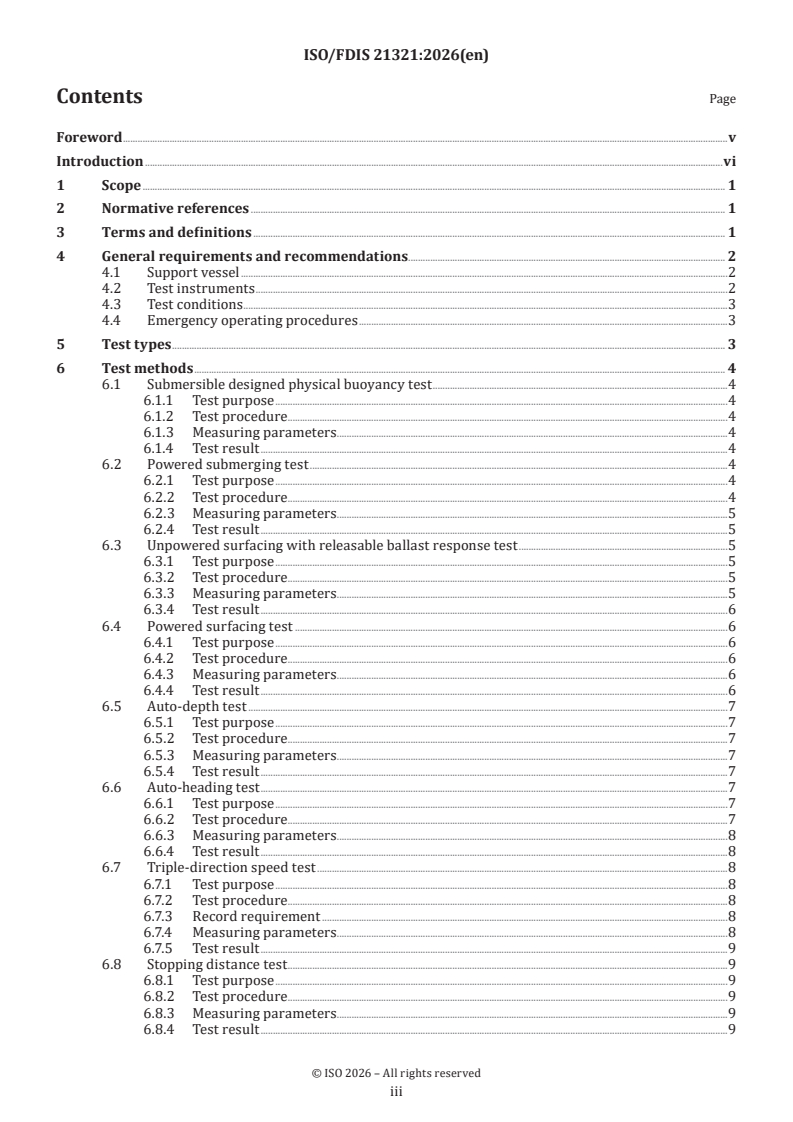
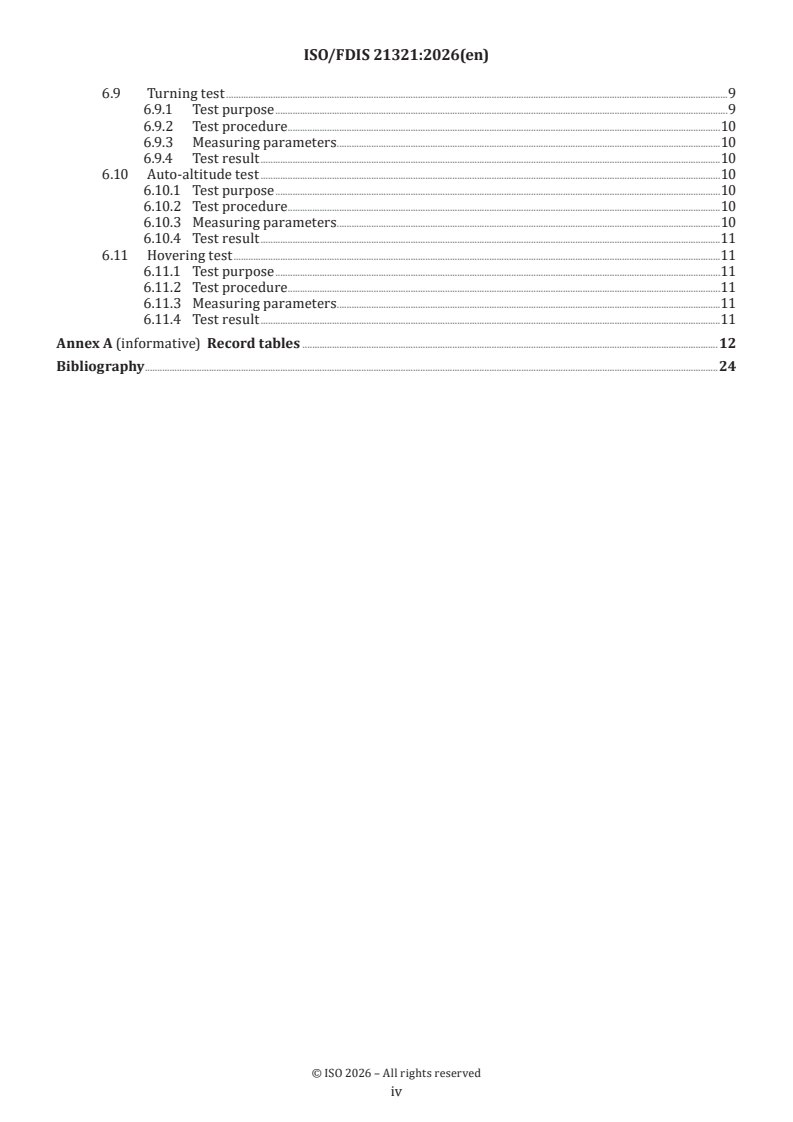
ISO/FDIS 21321 - Ships and marine technology — Manned submersibles — Manoeuvring tests Released:16. 01. 2026

REDLINE ISO/FDIS 21321 - Ships and marine technology — Manned submersibles — Manoeuvring tests Released:16. 01. 2026
Get Certified
Connect with accredited certification bodies for this standard

DNV
DNV is an independent assurance and risk management provider.

Lloyd's Register
Lloyd's Register is a global professional services organisation specialising in engineering and technology.

ABS Quality Evaluations Inc.
American Bureau of Shipping quality certification.
Sponsored listings
Frequently Asked Questions
ISO/FDIS 21321 is a draft published by the International Organization for Standardization (ISO). Its full title is "Ships and marine technology — Manned submersibles — Manoeuvring tests". This standard covers: This document defines general requirement, test item and test method of manoeuvring test on manned submersibles. It is applicable to manoeuvring test for all manned submersibles at pool, lake and sea. It is a reference for manoeuvring test on other types of submersibles at pool, lake and sea.
This document defines general requirement, test item and test method of manoeuvring test on manned submersibles. It is applicable to manoeuvring test for all manned submersibles at pool, lake and sea. It is a reference for manoeuvring test on other types of submersibles at pool, lake and sea.
ISO/FDIS 21321 is classified under the following ICS (International Classification for Standards) categories: 47.080 - Small craft. The ICS classification helps identify the subject area and facilitates finding related standards.
ISO/FDIS 21321 is available in PDF format for immediate download after purchase. The document can be added to your cart and obtained through the secure checkout process. Digital delivery ensures instant access to the complete standard document.
Standards Content (Sample)
FINAL DRAFT
International
Standard
ISO/TC 8/SC 13
Ships and marine technology —
Secretariat: SAC
Manned submersibles —
Voting begins on:
Manoeuvring tests
2026-01-30
Voting terminates on:
2026-03-27
RECIPIENTS OF THIS DRAFT ARE INVITED TO SUBMIT,
WITH THEIR COMMENTS, NOTIFICATION OF ANY
RELEVANT PATENT RIGHTS OF WHICH THEY ARE AWARE
AND TO PROVIDE SUPPOR TING DOCUMENTATION.
IN ADDITION TO THEIR EVALUATION AS
BEING ACCEPTABLE FOR INDUSTRIAL, TECHNO
LOGICAL, COMMERCIAL AND USER PURPOSES, DRAFT
INTERNATIONAL STANDARDS MAY ON OCCASION HAVE
TO BE CONSIDERED IN THE LIGHT OF THEIR POTENTIAL
TO BECOME STAN DARDS TO WHICH REFERENCE MAY BE
MADE IN NATIONAL REGULATIONS.
Reference number
FINAL DRAFT
International
Standard
ISO/TC 8/SC 13
Ships and marine technology —
Secretariat: SAC
Manned submersibles —
Voting begins on:
Manoeuvring tests
Voting terminates on:
RECIPIENTS OF THIS DRAFT ARE INVITED TO SUBMIT,
WITH THEIR COMMENTS, NOTIFICATION OF ANY
RELEVANT PATENT RIGHTS OF WHICH THEY ARE AWARE
AND TO PROVIDE SUPPOR TING DOCUMENTATION.
© ISO 2026
IN ADDITION TO THEIR EVALUATION AS
All rights reserved. Unless otherwise specified, or required in the context of its implementation, no part of this publication may
BEING ACCEPTABLE FOR INDUSTRIAL, TECHNO
LOGICAL, COMMERCIAL AND USER PURPOSES, DRAFT
be reproduced or utilized otherwise in any form or by any means, electronic or mechanical, including photocopying, or posting on
INTERNATIONAL STANDARDS MAY ON OCCASION HAVE
the internet or an intranet, without prior written permission. Permission can be requested from either ISO at the address below
TO BE CONSIDERED IN THE LIGHT OF THEIR POTENTIAL
or ISO’s member body in the country of the requester.
TO BECOME STAN DARDS TO WHICH REFERENCE MAY BE
MADE IN NATIONAL REGULATIONS.
ISO copyright office
CP 401 • Ch. de Blandonnet 8
CH-1214 Vernier, Geneva
Phone: +41 22 749 01 11
Email: copyright@iso.org
Website: www.iso.org
Published in Switzerland Reference number
ii
Contents Page
Foreword .v
Introduction .vi
1 Scope . 1
2 Normative references . 1
3 Terms and definitions . 1
4 General requirements and recommendations. 2
4.1 Support vessel .2
4.2 Test instruments .2
4.3 Test conditions .3
4.4 Emergency operating procedures .3
5 Test types . 3
6 Test methods . 4
6.1 Submersible designed physical buoyancy test .4
6.1.1 Test purpose .4
6.1.2 Test procedure.4
6.1.3 Measuring parameters .4
6.1.4 Test result .4
6.2 Powered submerging test .4
6.2.1 Test purpose .4
6.2.2 Test procedure.4
6.2.3 Measuring parameters .5
6.2.4 Test result .5
6.3 Unpowered surfacing with releasable ballast response test .5
6.3.1 Test purpose .5
6.3.2 Test procedure.5
6.3.3 Measuring parameters .5
6.3.4 Test result .6
6.4 Powered surfacing test .6
6.4.1 Test purpose .6
6.4.2 Test procedure.6
6.4.3 Measuring parameters .6
6.4.4 Test result .6
6.5 Auto-depth test .7
6.5.1 Test purpose .7
6.5.2 Test procedure.7
6.5.3 Measuring parameters .7
6.5.4 Test result .7
6.6 Auto-heading test .7
6.6.1 Test purpose .7
6.6.2 Test procedure.7
6.6.3 Measuring parameters . .8
6.6.4 Test result .8
6.7 Triple-direction speed test .8
6.7.1 Test purpose .8
6.7.2 Test procedure.8
6.7.3 Record requirement .8
6.7.4 Measuring parameters . .8
6.7.5 Test result .9
6.8 Stopping distance test .9
6.8.1 Test purpose .9
6.8.2 Test procedure.9
6.8.3 Measuring parameters .9
6.8.4 Test result .9
iii
6.9 Turning test .9
6.9.1 Test purpose .9
6.9.2 Test procedure.10
6.9.3 Measuring parameters .10
6.9.4 Test result .10
6.10 Auto-altitude test .10
6.10.1 Test purpose .10
6.10.2 Test procedure.10
6.10.3 Measuring parameters .10
6.10.4 Test result .11
6.11 Hovering test .11
6.11.1 Test purpose .11
6.11.2 Test procedure.11
6.11.3 Measuring parameters .11
6.11.4 Test result .11
Annex A (informative) Record tables .12
Bibliography .24
iv
Foreword
ISO (the International Organization for Standardization) is a worldwide federation of national standards
bodies (ISO member bodies). The work of preparing International Standards is normally carried out through
ISO technical committees. Each member body interested in a subject for which a technical committee
has been established has the right to be represented on that committee. International organizations,
governmental and non-governmental, in liaison with ISO, also take part in the work. ISO collaborates closely
with the International Electrotechnical Commission (IEC) on all matters of electrotechnical standardization.
The procedures used to develop this document and those intended for its further maintenance are described
in the ISO/IEC Directives, Part 1. In particular, the different approval criteria needed for the different types
of ISO document should be noted. This document was drafted in accordance with the editorial rules of the
ISO/IEC Directives, Part 2 (see www.iso.org/directives).
ISO draws attention to the possibility that the implementation of this document may involve the use of (a)
patent(s). ISO takes no position concerning the evidence, validity or applicability of any claimed patent
rights in respect thereof. As of the date of publication of this document, ISO had not received notice of (a)
patent(s) which may be required to implement this document. However, implementers are cautioned that
this may not represent the latest information, which may be obtained from the patent database available at
www.iso.org/patents. ISO shall not be held responsible for identifying any or all such patent rights.
Any trade name used in this document is information given for the convenience of users and does not
constitute an endorsement.
For an explanation of the voluntary nature of standards, the meaning of ISO specific terms and expressions
related to conformity assessment, as well as information about ISO's adherence to the World Trade
Organization (WTO) principles in the Technical Barriers to Trade (TBT), see www.iso.org/iso/foreword.html.
This document was prepared by Technical Committee ISO/TC 8, Ships and marine technology, Subcommittee
SC 13, Marine technology.
Any feedback or questions on this document should be directed to the user’s national standards body. A
complete listing of these bodies can be found at www.iso.org/members.html.
v
Introduction
As global marine technology continues to develop, manned submersibles are being utilized in an increasing
number of fields. A standardized manoeuvring test for manned submersibles may be employed to provide
a common approach to the analysis and assessment of the manoeuvrability performance of newly built
submersibles. The output of such a common approach can provide useful information for the design,
development and selection of navigation, power management and other ancillary systems used in the
subsequent completion of the submersible’s manufacture.
To meet the operating safety requirements, it is essential that the manoeuvring test is conducted within
the designed safe operating envelope of the submersible including environmental, depth and endurance
parameters. The measurement of manoeuvring performance is expected to be accurate and verifiable
against an appropriately considered set of performance expectations. However, at the time of publication
of this document, there is no International Standard that covers this element of submersible design and
development in the industry. Therefore, the aim of this document is to provide standardized requirements
for the submersible manufacturing and operating community.
vi
FINAL DRAFT International Standard ISO/FDIS 21321:2026(en)
Ships and marine technology — Manned submersibles —
Manoeuvring tests
1 Scope
This document specifies the general requirements, test items and methods for conducting manoeuvring
tests on manned submersibles.
It is applicable to manoeuvring tests for all manned submersibles operating in the sea and inland waterway
areas.
It can also be used as a reference for manoeuvring tests on other types of submersibles operating in pools,
lakes and seas.
2 Normative references
There are no normative references in this document.
3 Terms and definitions
For the purposes of this document, the following terms and definitions apply.
ISO and IEC maintain terminology databases for use in standardization at the following addresses:
— ISO Online browsing platform: available at https://www.iso.org/obp
— IEC Electropedia: available at https://www.electropedia.org/
3.1
manned submersible
submersible that encloses one or more persons within its pressure hull, fitted with one or more available
surface accesses, or underwater pressurized or non-pressurized accesses
[SOURCE: ISO 5411:2024, 3.1.2]
3.2
unpowered surfacing
free rising movement of a manned submersible (3.1) which occurs without the use of propulsion or operation
of the submersible's ballast system
3.3
unpowered submerging
free sinking movement of a manned submersible (3.1) which occurs without the use of propulsion or operation
of the submersible's ballast system
3.4
auto-depth keeping
computer-controlled mode to maintain the designated depth relative to the surface
[SOURCE: ISO 5411:2024, 3.9.6]
3.5
auto-heading control
computer-controlled mode to maintain the designated heading relative to the seabed
[SOURCE: ISO 5411:2024, 3.9.4]
3.6
auto-height keeping
computer-controlled mode to maintain the designated height above the seabed
[SOURCE: ISO 5411:2024, 3.9.7]
3.7
stopping distance
distance from slow down to stop with the use of propulsion, when a manned submersible (3.1) travels at an
initial speed
3.8
design maximum safe operating depth
maximum water depth at which the submersible is permitted to operate repeatedly and normally throughout
its entire design life
4 General requirements and recommendations
4.1 Support vessel
For all submersible trial activities undertaken in open water such as the sea or an inland lake, a trial support
surface vessel should be available to ensure the safe conduct of the trial programmes and meet any relevant
requirements. If required, the support vessel should be capable of safely launching and recovering the
submersible in the safe operating envelope of the submersible system. It can be necessary for the support
vessel to be capable of dynamic positioning or mooring, thereby enabling the safe launch and recovery to be
conducted in the environmental conditions in which the trials will take place. The vessel should be capable
of dealing with any foreseeable emergency likely to be encountered during the trial programmes. The vessel
should also have a robust communication capability such that the submersible’s crew can communicate with
the support vessel at all times during the trials and testing activities.
4.2 Test instruments
Test instruments include but are not limited to:
a) doppler velocity log;
b) depth gauge;
c) altimeter;
d) motion sensor;
e) conductivity, temperature and depth (CTD) sensor;
f) positioning system.
NOTE Test instruments can be subject to approval by national authorities for use in the testing process.
Test instruments should be valid for use in the testing regime and as required by the testing protocol.
Test instruments should be installed in a suitable location to achieve the objective of the test process and not
adversely affected by movement, moisture, vibration or external environmental conditions during the test.
...
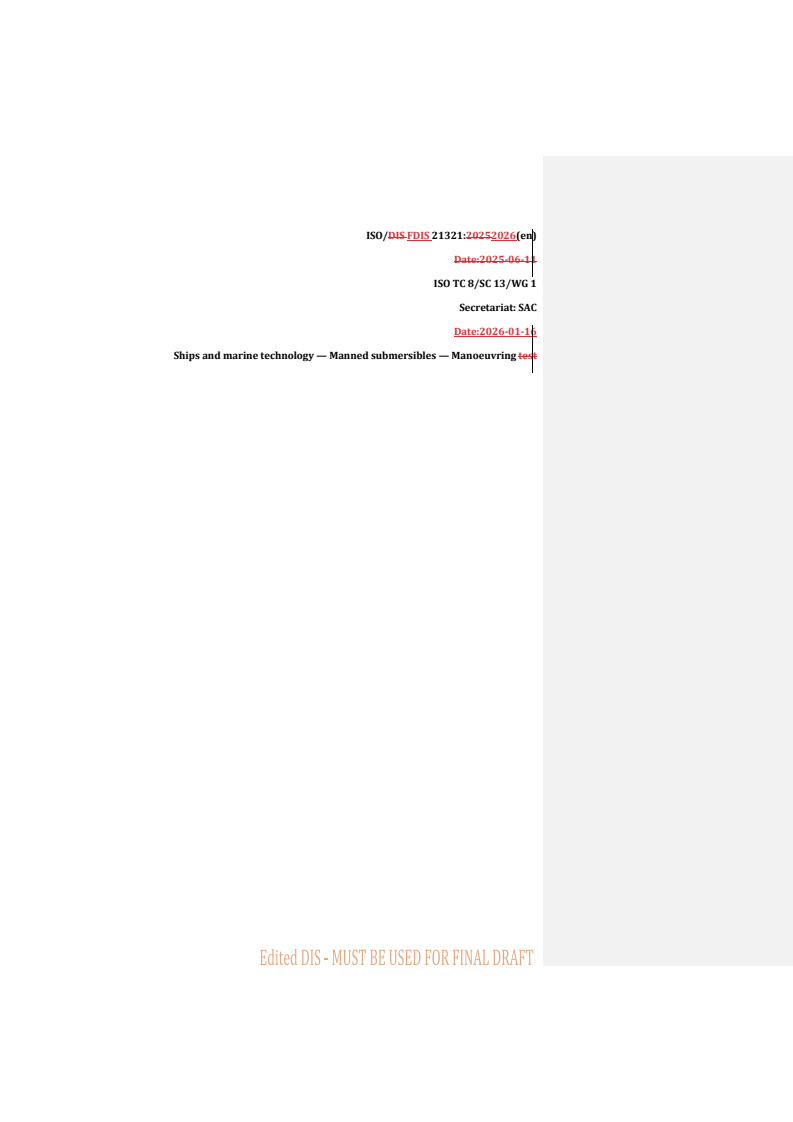
ISO/DIS FDIS 21321:20252026(en)
Date:2025-06-11
ISO TC 8/SC 13/WG 1
Secretariat: SAC
Date:2026-01-16
Ships and marine technology — Manned submersibles — Manoeuvring test
Formatted: Centered
tests
Formatted: Centered
ISO/DISFDIS 21321:20252026(en)
Formatted: Font color: Custom Color(RGB(33,29,30))
Formatted: Font color: Custom Color(RGB(33,29,30))
Formatted: Font color: Custom Color(RGB(33,29,30))
Formatted: Indent: Left: 0.5 cm, Right: 0.5 cm, Space
Before: 0 pt, No page break before
All rights reserved. Unless otherwise specified, or required in the context of its implementation,
no part of this publication may be reproduced or utilized otherwise in any form or by any means,
Formatted: Indent: Left: 0.5 cm, Right: 0.5 cm
electronic or mechanical, including photocopying, or posting on the internet or an intranet,
without prior written permission. Permission can be requested from either ISO at the address
below or ISO’s member body in the country of the requester.
ISO copyright office
Formatted: Indent: Left: 0.5 cm, First line: 0 cm, Right:
0.5 cm
CP 401 • Ch. de Blandonnet 8
CH-1214 Vernier, Geneva
Phone: +41 22 749 01 11
Email: copyright@iso.org
Website: www.iso.orgwww.iso.org
Published in Switzerland
Formatted: Indent: Left: 0.5 cm, Right: 0.5 cm
Formatted: Font: Bold
Formatted: Normal, Space Before: 18 pt, Line spacing:
single, Tab stops: 17.2 cm, Right
Formatted: Font: 11 pt
Formatted: Normal, Line spacing: single, Tab stops:
17.2 cm, Right
ii
ISO/DISFDIS 21321:20252026(en)
Formatted: Font color: Custom Color(RGB(33,29,30))
Formatted: Font color: Custom Color(RGB(33,29,30))
Formatted: Font color: Custom Color(RGB(33,29,30))
Contents
Foreword . vii
Introduction . viii
1 Scope . 1
2 Normative references . 1
3 Terms and definitions . 1
4 General requirements and recommendations . 2
4.1 Support vessel . 2
4.2 Test instruments . 2
4.3 Test conditions . 3
4.4 Emergency operating procedures . 3
5 Test types . 3
6 Test methods . 4
6.1 Submersible designed physical buoyancy test . 4
6.1.1 Test purpose . 4
6.1.2 Test procedure . 4
6.1.3 Measuring parameters . 4
6.1.4 Test result. 4
6.2 Powered submerging test . 5
6.2.1 Test purpose . 5
6.2.2 Test procedure . 5
6.2.3 Measuring parameters . 5
6.2.4 Test result. 5
6.3 Unpowered surfacing with releasable ballast response test . 5
6.3.1 Test purpose . 5
6.3.2 Test procedure . 5
6.3.3 Measuring parameters . 6
6.3.4 Test result. 6
6.4 Powered surfacing test . 6
6.4.1 Test purpose . 6
Formatted: Font: Bold
6.4.2 Test procedure . 6
Formatted: Normal, Space Before: 18 pt, Line spacing:
6.4.3 Measuring parameters . 6
single, Tab stops: 17.2 cm, Right
6.4.4 Test result. 7
Formatted: Font: 11 pt
6.5 Auto-depth test . 7
Formatted: Normal, Line spacing: single, Tab stops:
17.2 cm, Right
iii
ISO/DISFDIS 21321:20252026(en)
Formatted: Font color: Custom Color(RGB(33,29,30))
Formatted: Font color: Custom Color(RGB(33,29,30))
Formatted: Font color: Custom Color(RGB(33,29,30))
6.5.1 Test purpose . 7
6.5.2 Test procedure . 7
6.5.3 Measuring parameters . 7
6.5.4 Test result . 8
6.6 Auto-heading test . 8
6.6.1 Test purpose . 8
6.6.2 Test procedure . 8
6.6.3 Measuring parameters . 9
6.6.4 Test result . 9
6.7 Triple-direction speed test . 9
6.7.1 Test purpose . 9
6.7.2 Test procedure . 9
6.7.3 Record requirement . 10
6.7.4 Measuring parameters . 10
6.7.5 Test result . 10
6.8 Stopping distance test . 10
6.8.1 Test purpose . 10
6.8.2 Test procedure . 10
6.8.3 Measuring parameters . 10
6.8.4 Test result . 11
6.9 Turning test . 11
6.9.1 Test purpose . 11
6.9.2 Test procedure . 11
6.9.3 Measuring parameters . 11
6.9.4 Test result . 11
6.10 Auto-altitude test . 11
6.10.1 Test purpose . 11
6.10.2 Test procedure . 11
6.10.3 Measuring parameters . 12
6.10.4 Test result . 12
6.11 Hovering test . 13
6.11.1 Test purpose . 13
6.11.2 Test procedure . 13
Formatted: Font: Bold
6.11.3 Measuring parameters . 13
Formatted: Normal, Space Before: 18 pt, Line spacing:
single, Tab stops: 17.2 cm, Right
6.11.4 Test result . 13
Formatted: Font: 11 pt
Bibliography . 25
Formatted: Normal, Line spacing: single, Tab stops:
Foreword . vii
17.2 cm, Right
iv
ISO/DISFDIS 21321:20252026(en)
Formatted: Font color: Custom Color(RGB(33,29,30))
Formatted: Font color: Custom Color(RGB(33,29,30))
Formatted: Font color: Custom Color(RGB(33,29,30))
Introduction . viii
1 Scope . 1
2 Normative references . 1
3 Terms and definitions . 1
4 General requirements and recommendations . 2
4.1 Support vessel . 2
4.2 Test instruments . 2
4.3 Test conditions . 3
4.4 Emergency operating procedures . 3
5 Test types . 3
6 Test methods . 4
6.1 Submersible designed physical buoyancy test . 4
6.1.1 Test purpose . 4
6.1.2 Test procedure . 4
6.1.3 Measuring parameters . 4
6.1.4 Test result. 4
6.2 Powered submerging test . 5
6.2.1 Test purpose . 5
6.2.2 Test procedure . 5
6.2.3 Measuring parameters . 5
6.2.4 Test result. 5
6.3 Unpowered surfacing with releasable ballast response test . 5
6.3.1 Test purpose . 5
6.3.2 Test procedure . 5
6.3.3 Measuring parameters . 6
6.3.4 Test result. 6
6.4 Powered surfacing test . 6
6.4.1 Test purpose . 6
6.4.2 Test procedure . 6
6.4.3 Measuring parameters . 7
6.4.4 Test result. 8
6.5 Auto-depth test . 8
6.5.1 Test purpose . 8
6.5.2 Test procedure . 8
6.5.3 Measuring parameters . 8
6.5.4 Test result. 8
6.6 Auto-heading test . 8
6.6.1 Test purpose . 8
6.6.2 Test procedure . 8
6.6.3 Measuring parameters . 9
6.6.4 Test result. 9
6.7 Triple-direction speed test . 9
6.7.1 Test purpose . 9
6.7.2 Test procedure . 9
6.7.3 Record requirement . 10
Formatted: Font: Bold
6.7.4 Measuring parameters . 10
6.7.5 Test result. 10 Formatted: Normal, Space Before: 18 pt, Line spacing:
single, Tab stops: 17.2 cm, Right
6.8 Stopping distance test . 10
6.8.1 Test purpose . 10
Formatted: Font: 11 pt
6.8.2 Test procedure . 10
Formatted: Normal, Line spacing: single, Tab stops:
6.8.3 Measuring parameters . 10
17.2 cm, Right
v
ISO/DISFDIS 21321:20252026(en)
Formatted: Font color: Custom Color(RGB(33,29,30))
Formatted: Font color: Custom Color(RGB(33,29,30))
Formatted: Font color: Custom Color(RGB(33,29,30))
6.8.4 Test result . 11
6.9 Turning test . 11
6.9.1 Test purpose . 11
6.9.2 Test procedure . 11
6.9.3 Measuring parameters . 12
6.9.4 Test result . 12
6.10 Auto-altitude test . 12
6.10.1 Test purpose . 12
6.10.2 Test procedure . 12
6.10.3 Measuring parameters . 12
6.10.4 Test result . 13
6.11 Hovering test . 13
6.11.1 Test purpose . 13
6.11.2 Test procedure . 13
6.11.3 Measuring parameters . 13
6.11.4 Test result . 13
Annex A (informative) Record tables . 14
Bibliography . 25
Formatted: Font: Bold
Formatted: Normal, Space Before: 18 pt, Line spacing:
single, Tab stops: 17.2 cm, Right
Formatted: Font: 11 pt
Formatted: Normal, Line spacing: single, Tab stops:
17.2 cm, Right
vi
ISO/DISFDIS 21321:20252026(en)
Formatted: Font color: Custom Color(RGB(33,29,30))
Formatted: Font color: Custom Color(RGB(33,29,30))
Formatted: Font color: Custom Color(RGB(33,29,30))
Foreword
ISO (the International Organization for Standardization) is a worldwide federation of national
standards bodies (ISO member bodies). The work of preparing International Standards is normally
carried out through ISO technical committees. Each member body interested in a subject for which a
technical committee has been established has the right to be represented on that committee.
International organizations, governmental and non-governmental, in liaison with ISO, also take part in
the work. ISO collaborates closely with the International Electrotechnical Commission (IEC) on all
matters of electrotechnical standardization.
The procedures used to develop this document and those intended for its further maintenance are
described in the ISO/IEC Directives, Part 1. In particular, the different approval criteria needed for the
different types of ISO document should be noted. This document was drafted in accordance with the
editorial rules of the ISO/IEC Directives, Part 2 (see www.iso.org/directiveswww.iso.org/directives).
ISO draws attention to the possibility that the implementation of this document may involve the use of
(a) patent(s). ISO takes no position concerning the evidence, validity or applicability of any claimed
patent rights in respect thereof. As of the date of publication of this document, ISO had not received
notice of (a) patent(s) which may be required to implement this document. However, implementers are
cautioned that this may not represent the latest information, which may be obtained from the patent
database available at www.iso.org/patents.www.iso.org/patents. ISO shall not be held responsible for
identifying any or all such patent rights.
Any trade name used in this document is information given for the convenience of users and does not
constitute an endorsement.
For an explanation of the voluntary nature of standards, the meaning of ISO specific terms and
expressions related to conformity assessment, as well as information about ISO's adherence to the
World Trade Organization (WTO) principles in the Technical Barriers to Trade (TBT), see
www.iso.org/iso/foreword.htmlwww.iso.org/iso/foreword.html.
This document was prepared by Technical Committee ISO/TC 8, Ships and marine technology,
Subcommittee SC 13, Marine technology.
Any feedback or questions on this document should be directed to the user’s national standards body. A
complete listing of these bodies can be found at
www.iso.org/members.htmlwww.iso.org/members.html.
Formatted: Font: Bold
Formatted: Normal, Space Before: 18 pt, Line spacing:
single, Tab stops: 17.2 cm, Right
Formatted: Font: 11 pt
Formatted: Normal, Line spacing: single, Tab stops:
17.2 cm, Right
vii
ISO/DISFDIS 21321:20252026(en)
Formatted: Font color: Custom Color(RGB(33,29,30))
Formatted: Font color: Custom Color(RGB(33,29,30))
Formatted: Font color: Custom Color(RGB(33,29,30))
Introduction
As global marine technology continues to develop, manned submersibles are being utilisedutilized in an
increasing number of fields. A standardized manoeuvring test for manned submersibles may be
employed to provide a common approach to the analysis and assessment of the manoeuvrability
performance of newly built submersibles. The output of such a common approach can provide useful
information for the design, development and selection of navigation, power management and other
ancillary systems used in the subsequent completion of the submersible’s manufacture.
To meet the operating safety requirements, it is essential that the manoeuvring test is conducted within
the designed safe operating envelope of the submersible including environmental, depth and endurance
parameters. The measurement of manoeuvring performance is expected to be accurate and verifiable
against an appropriately considered set of performance expectations. However, at the time of
publication of this document, there is no International Standard that covers this element of submersible
design and development in the industry. Therefore, the aim of this document is to provide standardized
requirements for the submersible manufacturing and operating community.
Formatted: Font: Bold
Formatted: Normal, Space Before: 18 pt, Line spacing:
single, Tab stops: 17.2 cm, Right
Formatted: Font: 11 pt
Formatted: Normal, Line spacing: single, Tab stops:
17.2 cm, Right
viii
FINAL DRAFT International Standard ISO/DISFDIS 21321:20252026(en)
Formatted: Font color: Custom Color(RGB(33,29,30))
Formatted: Font color: Custom Color(RGB(33,29,30))
Formatted: Font color: Custom Color(RGB(33,29,30))
Formatted: Font color: Custom Color(RGB(33,29,30))
Ships and marine technology —Manned submersibles —
Manoeuvring testtests
1 Scope
This document specifies the general requirements, test items and test methodmethods for conducting a
manoeuvring testtests on manned submersibles.
It is applicable to manoeuvring tests for all manned submersibles operating in in the sea and inland
waterway areas.
It can also be used as a reference for manoeuvring tests on other types of submersibles operating in
pools, lakes and seas.
2 Normative references
ISO 5411, Ships and marine technology —Submersibles — Vocabulary,2024
There are no normative references in this document.
3 Terms and definitions
Formatted: English (United States)
For the purposes of this document, the following terms and definitions apply.
Formatted: Font: 12 pt, English (United States)
ISO and IEC maintain terminology databases for use in standardization at the following addresses:
Formatted: Adjust space between Latin and Asian text,
— ISO Online browsing platform: available at https://www.iso.org/obphttps://www.iso.org/obp
Adjust space between Asian text and numbers
Formatted: English (United States)
— IEC Electropedia: available at https://www.electropedia.org/https://www.electropedia.org/
Formatted: English (United States)
3.1
Formatted: English (United Kingdom)
manned submersible
Formatted: std_publisher
submersible that encloses one or more persons within its pressure hull, fitted with one or more
available surface accesses, or underwater pressurized or non-pressurized accesses Formatted: std_docNumber
Formatted: std_year
[SOURCE: ISO 5411:2024, 3.1.2]
Formatted: std_section
3.2unpowered2
Formatted: Source
unpowered surfacing
Formatted: Term(s)
free rising movement of a manned submersible (3.1) which occurs without the use of propulsion or
operation of the submersiblessubmersible's ballast system Formatted: cite_sec
Formatted: Font: Not Italic
3.3
Formatted: cite_sec
unpowered submerging
free sinking movement of a manned submersible (3.1) which occurs without the use of propulsion or Formatted: Normal, Space Before: 18 pt, Line spacing:
operation of the submersiblessubmersible's ballast system single, Tab stops: 17.2 cm, Right
Formatted: Font: Not Bold
3.4
Formatted: Font: 11 pt
auto-depth keeping
computer-controlled mode to maintain the designated depth relative to the surface Formatted: Normal, Line spacing: single, Tab stops:
17.2 cm, Right
ISO/DIS 21321:20252026(en)
[SOURCE: ISO 5411:2024, 3.9.6]
Formatted: std_publisher
Formatted: std_docNumber
3.5
Formatted: std_year
auto-heading control
computer-controlled mode to maintain the designated heading relative to the seabed
Formatted: std_section
Formatted: Source
[SOURCE: ISO 5411:2024, 3.9.4]
Formatted: std_publisher
3.6
Formatted: std_docNumber
auto-height keeping
Formatted: std_year
computer-controlled mode to maintain the designated height above the seabed
Formatted: std_section
[SOURCE: ISO 5411:2024, 3.9.7]
Formatted: Source
3.7 Formatted: std_publisher
stopping distance
Formatted: std_docNumber
a manned submersible travels at an initial speed, the distance from slow down to stop with the use of
Formatted: std_year
propulsion, when a manned submersible (3.1) travels at an initial speed
Formatted: std_section
3.8
Formatted: Source
design maximum safe operating depth
Formatted: Font: Not Italic
maximum water depth at which the submersible is permitted to operate repeatedly and normally
throughout its entire design life
Formatted: cite_sec
4 General requirements and recommendations
4.1 Support vessel
For all submersible trial activities undertaken in open water such as the sea or an inland lake, a trial
support surface vessel should be available to ensure the safe conduct of the trial programmes and meet
any relevant requirements. If required, the support vessel should be capable of safely launching and
recovering the submersible in the safe operating envelope of the submersible system. It can be
necessary for the support vessel to be capable of dynamic positioning or mooring, thereby enabling the
safe launch and recovery to be conducted in the environmental conditions in which the trials will take
place. The vessel should be capable of dealing with any foreseeable emergency likely to be encountered
during the trial programmes. The vessel should also have a robust communication capability such that
the submersible’s crew can communicate with the support vessel at all times during the trials and
testing activities.
4.2 Test instruments
Test instruments include but are not limited to:
Formatted: Body Text, Tab stops: Not at 0.7 cm + 1.4
cm + 2.1 cm + 2.8 cm + 3.5 cm + 4.2 cm + 4.9 cm +
a) a) doppler velocity log;
5.6 cm + 6.3 cm + 7 cm
b) b) depth gauge;
c) c) altimeter;
d) d) motion sensor;
e) e) conductivity, temperature and depth (CTD) sensor (CTD);
f) f) positioning system.
NOTE Test instruments can be subject to approval by national authorities for use in the testing process.
ISO/DIS 21321:20252026(en)
Test instruments should be valid for use in the testing regime and as required by the testing protocol.
Test instruments should be installed in a suitable location to achieve the objective of the test process
and not adversely affected by movement, moisture, vibration or external environmental conditions
during the test.
4.3 Test conditions
The test shall be conducted in a designated sea or inland waterway area where the water depth should
be less than the design maximum safe operating depth of the manned submersible. The specified test
depth should not be affected by surface waves and appropriate safety precautions shall be
implemented. This should include a suitably considered plan for recovery of a disabled submersible
from the seabed or bottom of the inland waterway and establishing a safe depth which the submersible
should not cross without approval.
The temperature, salinity, depth, seafloor topography and current of the seawater in the test area
Formatted: Body Text, Tab stops: Not at 0.7 cm + 1.4
should be measured in advance, as a reference for whether a submersible can dive.
cm + 2.1 cm + 2.8 cm + 3.5 cm + 4.2 cm + 4.9 cm +
5.6 cm + 6.3 cm + 7 cm
The submersible must successfully complete pre-dive checks and be fully serviceable throughout the
test procedure. Any defects impacting on the safe conduct of the test or trial shall be rectified before
continuing the test activity.
4.4 Emergency operating procedures
Emergency operating procedures must be established and tested or drilled to ensure that they are
Formatted: Body Text, Tab stops: Not at 0.7 cm + 1.4
adequate.
cm + 2.1 cm + 2.8 cm + 3.5 cm + 4.2 cm + 4.9 cm +
5.6 cm + 6.3 cm + 7 cm
Any trial or test should be conducted in accordance with an authorisedauthorized and defined set of
specifications described in a formal trial order or similar auditable document. This should specify the
aim, objectives, conditions, parameters, procedures to be used including the emergency procedures and
the trials area where the trial is conducted. The person controlling the trial activity should formally sign
the trial order or document.
At any time during the trial or test, the person responsible for conducting the activity should terminate
the test or trial if there is any danger to the submersible crew or anyone else involved in the activity.
5 Test types
The following manoeuvring tests may be included in the trials and test programme:
a) a) unpowered submerging with releasable ballast response test;
Formatted: Indent: Left: 0 cm, Hanging: 0.71 cm, No
bullets or numbering
b) b) powered submerging test;
c) c) unpowered surfacing with releasable ballast response test;
d) d) powered surfacing test;
e) e) auto-depth keeping test;
f) f) auto-heading control test;
g) g) triple-direction speed test;
h) h) braking sliding distance test;
i) i) turning test;
j) j) auto-height keeping test;
ISO/DIS 21321:20252026(en)
k) k) hovering test.
The listed tests should be chosen according to actual situation, which means some items can be
removed depending on the capability of manned submersibles.
6 Test methods
6.1 Submersible designed physical buoyancy test
6.1.1 Test purpose
This test aims to determine the rate at which the submersible will submerge due to its designed ratio of
mass to volume of internal air space, which constitutes its natural buoyancy without the use of
propulsion or its ballast management system, and is fitted with a fixed releasable ballast weight.
6.1.2 Test procedure
a) a) Make the manned submersible submerge toin a secure location off the seabed without power.
Formatted: Indent: Left: 0 cm, Hanging: 0.71 cm, No
Subsequently release some quantity of ballast to terminate the descent, based on theoretical
bullets or numbering
calculation.
b) b) Record the depth, vertical speed, attitude angle and time point of the manned submersible
before and after releasing the ballast.
c) c) Record the depth, attitude angle and time point of the manned submersible while its vertical
speed decreases to zero, including the inertia factor.
d) d) Adjust the attitude angle and equilibrium of the manned submersible through its trim
regulating device and variable ballast device.
6.1.3 Measuring parameters
The following parameters are measured during the test:
Formatted: Body Text, Tab stops: Not at 0.7 cm + 1.4
cm + 2.1 cm + 2.8 cm + 3.5 cm + 4.2 cm + 4.9 cm +
a) a) time at start of test ;
5.6 cm + 6.3 cm + 7 cm
b) b) depth at start of test if not on the surface;
c) c) descent rate;
d) d) pitch and roll angle at the start of the test;
e) e) pitch and roll angle at the end of the test;
f) f) time to reach required depth;
g) g) test depth ;
h) h) total time duration of dive to specified depth.
6.1.4 Test result
Record theThe test data should be recorded as shown in accordance with the form of Table A.1.
ISO/DIS 21321:20252026(en)
6.2 Powered submerging test
6.2.1 Test purpose
This test aims to determine the controlled diving performance of the manned submersible using ballast
system and propulsion.
6.2.2 Test procedure
a) a) Operate ballast system to enable the submersible to dive.
Formatted: Indent: Left: 0 cm, Hanging: 0.71 cm, No
bullets or numbering
b) b) Activate the thrusters of the manned submersible.
c) c) Make the manned submersible descend using the thrusters and maintain a sufficient safety
distance from the seabed throughout the descent.
d) d) After reaching the maximum descent speed, shut off the thrusters.
e) e) Adjust the attitude angle and equilibrium of the manned submersible through its trim
regulating device and variable ballast device.
6.2.3 Measuring parameters
The following parameters are measured during the test:
Formatted: Body Text, Don't adjust space between Latin
and Asian text, Don't adjust space between Asian text
a) a) time left surface;
and numbers
Formatted: Indent: Left: 0 cm, Hanging: 0.71 cm, No
b) b) depth at start of test if not on the surface;
bullets or numbering
c) c) descent rate;
d) d) pitch and roll angle at the start of the test;
e) e) pitch and roll angle at the end of the test;
f) f) time to reach required depth;
g) g) test depth ;
h) h) total time duration of dive to specified depth;
i) i) thruster power level, revolutions per minute (rpm) and voltage of thrusters.
6.2.4 Test result
RecordThe test data should be recorded as shown in accordance with the form of Table A.2.
6.3 Unpowered surfacing with releasable ballast response test
6.3.1 Test purpose
This test aims to determine the manned submersible’s designed physical buoyancy using a releasable
weight system.
6.3.2 Test procedure
a) a) Release some quantity of ballast to ensure the manned submersible to surface issurfaces
Formatted: Indent: Left: 0 cm, Hanging: 0.71 cm, No
without any other power based on theoretical calculation.
bullets or numbering
ISO/DIS 21321:20252026(en)
b) b) Record the depth, vertical speed, attitude angle and time point of the manned submersible
during surfacing.
c) c) Adjust the attitude angle and equilibrium of the manned submersible through its trim
regulating device and the variable ballast device.
6.3.3 Measuring parameters
The following parameters are measured during the test:
Formatted: Body Text, Tab stops: Not at 0.7 cm + 1.4
cm + 2.1 cm + 2.8 cm + 3.5 cm + 4.2 cm + 4.9 cm +
a) a) depth at the start of the test;
5.6 cm + 6.3 cm + 7 cm
b) b) descent rat
...
Questions, Comments and Discussion
Ask us and Technical Secretary will try to provide an answer. You can facilitate discussion about the standard in here.
Loading comments...