


ISO/FDIS 21319
(Main)Marine technology — Toolings for submersibles — Technology requirements
Marine technology — Toolings for submersibles — Technology requirements
This standard defines classification, general requirements, design requirements, and general characteristics of tools for submersibles, and also describes general test and detection methods for tools. This standard is applicable to design, manufacture, inspection, and post-acceptance of submersible.
Technologie maritime — Outillages pour les submersibles — Exigences technologiques
General Information
- Status
- Not Published
- Technical Committee
- ISO/TC 8/SC 13 - Marine technology
- Drafting Committee
- ISO/TC 8/SC 13 - Marine technology
- Current Stage
- 5020 - FDIS ballot initiated: 2 months. Proof sent to secretariat
- Start Date
- 29-Jan-2026
- Completion Date
- 29-Jan-2026
Overview
ISO/FDIS 21319:2026 is an international standard published by the International Organization for Standardization (ISO) that focuses on toolings for submersibles within the marine technology sector. It defines comprehensive technology requirements including classification, design criteria, general characteristics, and testing methods for tools used on submersible vessels. The standard is applicable across the lifecycle of submersible toolings-from design and manufacturing to inspection and post-acceptance-ensuring consistent quality, safety, and interoperability on a global scale.
This standard addresses the critical need for unified specifications in submersible tooling technology to enhance the operational effectiveness and safety of underwater missions involving scientific experiments, rescue operations, and specialized underwater tasks.
Key Topics
Tooling Classification
The standard classifies various types of toolings used on submersibles, including manipulator-held tools, portable operating toolings, and tooling deployment units. This classification facilitates clear communication and specification standards across manufacturers and operators.General Requirements
Key general requirements focus on proper installation, dimensional standards, interface compatibility (including electrical, hydraulic, and communication interfaces), and functional performance.- Installation protocols to ensure secure and effective deployment
- Interface standards to maintain seamless interaction with submersible systems
- Dimensional and weight limitations for optimized balance and handling
Design Requirements
Design considerations emphasize pressure boundary integrity to withstand internal and external pressures in underwater environments.- Seal design to ensure waterproofing and system reliability
- Oil-filled compensation structures to manage pressure differentials
- Tool jettisoning functions for emergency detachment
Testing and Inspection Methods
The standard lays out standardized procedures for verifying tooling integrity and functionality, including:- Hydrostatic pressure tests to validate structural strength under simulated deep-water conditions
- Equipment operational tests to confirm tool compatibility and performance
- Recommended operational tests post-manufacture and during maintenance phases
Terminology and Definitions
Clarifies key terms such as submersible, tooling, manipulator, maximum working pressure, and test pressure to ensure a shared understanding within the industry.
Applications
ISO/FDIS 21319:2026 serves as a foundational guide for manufacturers, operators, and inspectors involved in the marine technology domain, particularly focusing on:
- Design and production of tooling systems adapted for deep-sea submersibles
- Standardization of underwater tool interfaces for enhanced interoperability
- Quality assurance during manufacturing and post-acceptance testing to maintain high safety and performance standards
- Support for underwater research vessels conducting scientific data collection or sample retrieval
- Enhancing operational safety and efficiency in underwater rescue and maintenance missions
By implementing this standard, stakeholders can reduce operational risks, improve tooling compatibility, and support sustainable practices in marine technological explorations.
Related Standards
ISO/FDIS 21319 complements other standards published by ISO Technical Committee 8 (TC 8), which specializes in ships and marine technology, including:
- ISO 13628 series for subsea production systems
- ISO 18801 series on remotely operated underwater vehicles (ROV)
- ISO 25649 for marine electronics interfaces
These related standards collectively address design, performance, and safety aspects to ensure cohesive development and usage of marine technology equipment in complex underwater environments.
Keywords: ISO 21319, marine technology standards, submersible toolings, underwater tool design, submersible equipment testing, marine tool classification, submersible pressure requirements, underwater tooling interface, hydrostatic pressure testing, marine submersible safety standards.
Buy Documents
ISO/FDIS 21319 - Marine technology — Toolings for submersibles — Technology requirements Released:15. 01. 2026
REDLINE ISO/FDIS 21319 - Marine technology — Toolings for submersibles — Technology requirements Released:15. 01. 2026
Get Certified
Connect with accredited certification bodies for this standard

DNV
DNV is an independent assurance and risk management provider.

Lloyd's Register
Lloyd's Register is a global professional services organisation specialising in engineering and technology.

ABS Quality Evaluations Inc.
American Bureau of Shipping quality certification.
Sponsored listings
Frequently Asked Questions
ISO/FDIS 21319 is a draft published by the International Organization for Standardization (ISO). Its full title is "Marine technology — Toolings for submersibles — Technology requirements". This standard covers: This standard defines classification, general requirements, design requirements, and general characteristics of tools for submersibles, and also describes general test and detection methods for tools. This standard is applicable to design, manufacture, inspection, and post-acceptance of submersible.
This standard defines classification, general requirements, design requirements, and general characteristics of tools for submersibles, and also describes general test and detection methods for tools. This standard is applicable to design, manufacture, inspection, and post-acceptance of submersible.
ISO/FDIS 21319 is classified under the following ICS (International Classification for Standards) categories: 47.020.01 - General standards related to shipbuilding and marine structures; 47.080 - Small craft. The ICS classification helps identify the subject area and facilitates finding related standards.
ISO/FDIS 21319 is available in PDF format for immediate download after purchase. The document can be added to your cart and obtained through the secure checkout process. Digital delivery ensures instant access to the complete standard document.
Standards Content (Sample)
FINAL DRAFT
International
Standard
ISO/TC 8/SC 13
Marine technology — Toolings
Secretariat: SAC
for submersibles — Technology
Voting begins on:
requirements
2026-01-29
Voting terminates on:
2026-03-26
RECIPIENTS OF THIS DRAFT ARE INVITED TO SUBMIT,
WITH THEIR COMMENTS, NOTIFICATION OF ANY
RELEVANT PATENT RIGHTS OF WHICH THEY ARE AWARE
AND TO PROVIDE SUPPOR TING DOCUMENTATION.
IN ADDITION TO THEIR EVALUATION AS
BEING ACCEPTABLE FOR INDUSTRIAL, TECHNO
LOGICAL, COMMERCIAL AND USER PURPOSES, DRAFT
INTERNATIONAL STANDARDS MAY ON OCCASION HAVE
TO BE CONSIDERED IN THE LIGHT OF THEIR POTENTIAL
TO BECOME STAN DARDS TO WHICH REFERENCE MAY BE
MADE IN NATIONAL REGULATIONS.
Reference number
FINAL DRAFT
International
Standard
ISO/TC 8/SC 13
Marine technology — Toolings
Secretariat: SAC
for submersibles — Technology
Voting begins on:
requirements
Voting terminates on:
RECIPIENTS OF THIS DRAFT ARE INVITED TO SUBMIT,
WITH THEIR COMMENTS, NOTIFICATION OF ANY
RELEVANT PATENT RIGHTS OF WHICH THEY ARE AWARE
AND TO PROVIDE SUPPOR TING DOCUMENTATION.
© ISO 2026
IN ADDITION TO THEIR EVALUATION AS
All rights reserved. Unless otherwise specified, or required in the context of its implementation, no part of this publication may
BEING ACCEPTABLE FOR INDUSTRIAL, TECHNO
LOGICAL, COMMERCIAL AND USER PURPOSES, DRAFT
be reproduced or utilized otherwise in any form or by any means, electronic or mechanical, including photocopying, or posting on
INTERNATIONAL STANDARDS MAY ON OCCASION HAVE
the internet or an intranet, without prior written permission. Permission can be requested from either ISO at the address below
TO BE CONSIDERED IN THE LIGHT OF THEIR POTENTIAL
or ISO’s member body in the country of the requester.
TO BECOME STAN DARDS TO WHICH REFERENCE MAY BE
MADE IN NATIONAL REGULATIONS.
ISO copyright office
CP 401 • Ch. de Blandonnet 8
CH-1214 Vernier, Geneva
Phone: +41 22 749 01 11
Email: copyright@iso.org
Website: www.iso.org
Published in Switzerland Reference number
ii
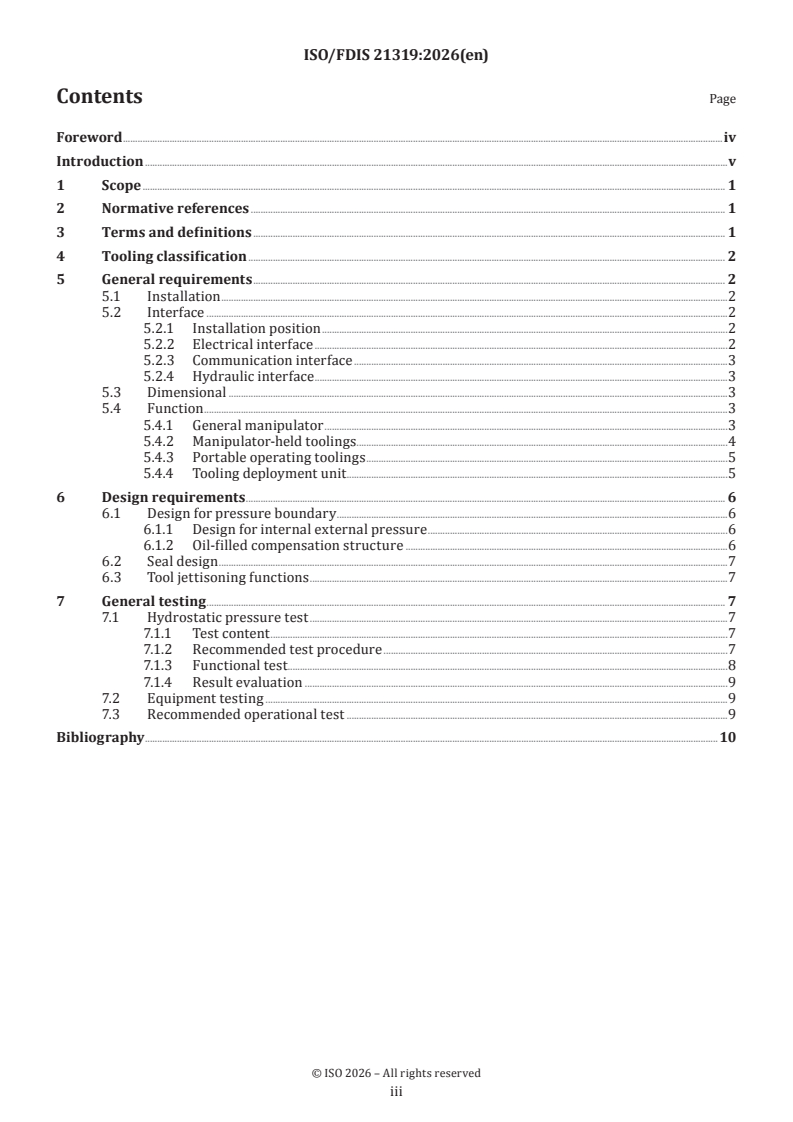
Contents Page
Foreword .iv
Introduction .v
1 Scope . 1
2 Normative references . 1
3 Terms and definitions . 1
4 Tooling classification . 2
5 General requirements . 2
5.1 Installation .2
5.2 Interface .2
5.2.1 Installation position .2
5.2.2 Electrical interface .2
5.2.3 Communication interface .3
5.2.4 Hydraulic interface .3
5.3 Dimensional .3
5.4 Function .3
5.4.1 General manipulator .3
5.4.2 Manipulator-held toolings . . .4
5.4.3 Portable operating toolings .5
5.4.4 Tooling deployment unit .5
6 Design requirements . 6
6.1 Design for pressure boundary .6
6.1.1 Design for internal external pressure .6
6.1.2 Oil-filled compensation structure .6
6.2 Seal design .7
6.3 Tool jettisoning functions .7
7 General testing . 7
7.1 Hydrostatic pressure test .7
7.1.1 Test content .7
7.1.2 Recommended test procedure .7
7.1.3 Functional test.8
7.1.4 Result evaluation .9
7.2 Equipment testing .9
7.3 Recommended operational test .9
Bibliography .10
iii
Foreword
ISO (the International Organization for Standardization) is a worldwide federation of national standards
bodies (ISO member bodies). The work of preparing International Standards is normally carried out through
ISO technical committees. Each member body interested in a subject for which a technical committee
has been established has the right to be represented on that committee. International organizations,
governmental and non-governmental, in liaison with ISO, also take part in the work. ISO collaborates closely
with the International Electrotechnical Commission (IEC) on all matters of electrotechnical standardization.
The procedures used to develop this document and those intended for its further maintenance are described
in the ISO/IEC Directives, Part 1. In particular, the different approval criteria needed for the different types
of ISO document should be noted. This document was drafted in accordance with the editorial rules of the
ISO/IEC Directives, Part 2 (see www.iso.org/directives).
ISO draws attention to the possibility that the implementation of this document may involve the use of (a)
patent(s). ISO takes no position concerning the evidence, validity or applicability of any claimed patent
rights in respect thereof. As of the date of publication of this document, ISO had not received notice of (a)
patent(s) which may be required to implement this document. However, implementers are cautioned that
this may not represent the latest information, which may be obtained from the patent database available at
www.iso.org/patents. ISO shall not be held responsible for identifying any or all such patent rights.
Any trade name used in this document is information given for the convenience of users and does not
constitute an endorsement.
For an explanation of the voluntary nature of standards, the meaning of ISO specific terms and expressions
related to conformity assessment, as well as information about ISO's adherence to the World Trade
Organization (WTO) principles in the Technical Barriers to Trade (TBT), see www.iso.org/iso/foreword.html.
This document was prepared by Technical Committee ISO/TC 8, Ships and marine technology, Subcommittee
SC 13, Marine technology.
Any feedback or questions on this document should be directed to the user’s national standards body. A
complete listing of these bodies can be found at www.iso.org/members.html.
iv
Introduction
This document specifies the general requirements for toolings used with submersibles, including
requirements for their functionality, installation, interfaces, weight, and dimensions. It also covers tool
design requirements, general performance requirements, general testing and inspection methods. The
purpose of this document is to establish unified common requirements, thereby ensuring that the basic
requirements for toolings installed on submersibles are consistently maintained on a global scale.
v
FINAL DRAFT International Standard ISO/FDIS 21319:2026(en)
Marine technology — Toolings for submersibles —
Technology requirements
1 Scope
This document specifies the classification, general requirements, design requirements, general
characteristics, general testing and inspection methods for submersible toolings.
This document applies to the design, manufacture, inspection, and post-acceptance of submersible toolings.
2 Normative references
There are no normative references in this document.
3 Terms and definitions
For the purposes of this document, the following terms and definitions apply.
ISO and IEC maintain terminology databases for use in standardization at the following addresses:
— ISO Online browsing platform: available at https:// www .iso .org/ obp
— IEC Electropedia: available at https:// www .electropedia .org/
3.1
submersible
type of powered vessel that can travel or manoeuvre underwater, or both
3.2
tooling
types of devices, equipment and combinations of tools involved in underwater sampling, rescue, scientific
experiments and special operations carried out on a submersible (3.1)
3.3
manipulator
device having one or more degrees of freedom for grasping or carrying objects or toolings by remote control
or by a fixed procedure
Note 1 to entry: The maximum working depth is expressed in metres.
3.4
maximum working pressure
p
maximum pressure in which a system (pressure vessel, supporting controls, and instrumentation) is
operated
3.5
test pressure
p
t
specified amount of pressure applied during a test of a submersible’s structural integrity
4 Tooling classification
It is recommended that toolings used with submersibles be classified into the following categories based on
their application purposes:
a) general manipulator;
b) manipulator-held toolings;
c) portable operating toolings;
d) tool deployment unit.
5 General requirements
5.1 Installation
The following installation requirements for toolings of crewed submersibles shall apply.
a) The manipulator shall generally be installed on the bottom frame structure at the forward part of the
bow. It shall be arranged within the field of view of personnel in the crewed cabin, or mounted at a
position equipped with a camera.
b) Other toolings shall be centrally installed on the sampling basket; this arrangement shall facilitate
monitoring and operation by personnel.
c) The manipulator for uncrewed submersibles shall generally be installed on the bow frame structure.
d) Other toolings for uncrewed submersibles shall be installed within the range of video surveillance;
generally, no dedicated sampling basket is required.
5.2 Interface
5.2.1 Installation position
The following installation position requirements for toolings of crewed submersibles shall apply.
a) The connection interface between the toolings and the crewed submersible shall reserve sufficient
operating space to facilitate routine maintenance and disassembly operations.
b) When the metal materials of the installation contact surfaces between the toolings and the crewed
submersible are inconsistent, isolation measures shall be adopted to mitigate electrochemical corrosion.
c) During installation of the toolings, fasteners shall be equipped with necessary anti-loosening measures.
d) For vibration-generating toolings, vibration isol
...
Formatted
...
Style Definition
...
Style Definition
...
Style Definition
...
Style Definition
...
ISO/DISFDIS 21319:2025(en)
Style Definition
...
Style Definition
...
ISO TC8/SC13/TC 8/SC 13
Style Definition
...
Style Definition
Secretariat: SAC
...
Style Definition
...
Date: 2025-07-082026-01-13
Style Definition
...
Style Definition
...
Style Definition
...
Style Definition
...
Style Definition
...
Style Definition
...
Marine technology - — Toolings for submersibles — Technology
Style Definition
...
requirements
Style Definition
...
Style Definition
...
Style Definition
...
Style Definition
...
Style Definition
...
Style Definition
...
Style Definition
...
Style Definition
...
Style Definition
...
FDIS stage
Style Definition
...
Style Definition
...
Style Definition
...
Style Definition
...
Style Definition
...
Style Definition
...
Style Definition
...
Style Definition
...
Style Definition
...
Style Definition
...
Style Definition
...
Style Definition
...
Style Definition
...
Style Definition
...
Style Definition
...
Style Definition
...
Style Definition
...
Style Definition
...
Style Definition
...
Style Definition
...
Style Definition
...
Style Definition
...
Style Definition
...
Style Definition
...
Style Definition
...
Style Definition
...
Style Definition
...
Style Definition
...
Style Definition
...
Style Definition
...
Style Definition
...
Style Definition
...
Style Definition
...
Style Definition
...
Style Definition
...
Style Definition
...
Style Definition
Formatted: Font: Bold
Formatted: HeaderCentered
Formatted: Default Paragraph Font
Formatted: Indent: Left: 0 cm, Right: 0 cm, Space
All rights reserved. Unless otherwise specified, or required in the context of its implementation, no part of this publication
Before: 0 pt, No page break before, Adjust space between
may be reproduced or utilized otherwise in any form or by any means, electronic or mechanical, including photocopying
Latin and Asian text, Adjust space between Asian text
and microfilm, or posting on the internet or an intranet, without prior written permission in writing. Permission can be
and numbers
requested from the publisher. Requests for permission to reproduce should be addressed toeither ISO at the address
below or ISO’s member body in the country of the requester.
ISO copyright office
CP 401 • Ch. de Blandonnet 8 • CP 401
CH-1214 Vernier, Geneva, Switzerland
Tel.Phone: + 41 22 749 01 11
Fax + 41 22 749 09 47
E-mail: copyright@iso.org
Formatted: German (Germany)
Website: www.iso.org
Formatted: zzCopyright address, Indent: Left: 0 cm,
First line: 0 cm, Right: 0 cm, Adjust space between Latin
and Asian text, Adjust space between Asian text and
Published in Switzerlandwww.iso.org
Formatted: Font: 11 pt
Formatted: FooterPageRomanNumber, Space Before: 0
pt, Line spacing: single
ii © ISO 2xxxx 2026 – All rights reserved
ii
ISO/DISFDIS 21319:20252026(en) Formatted: Font: 11 pt, Bold
Formatted: Font: 11 pt, Bold
Formatted: Font: 11 pt, Bold
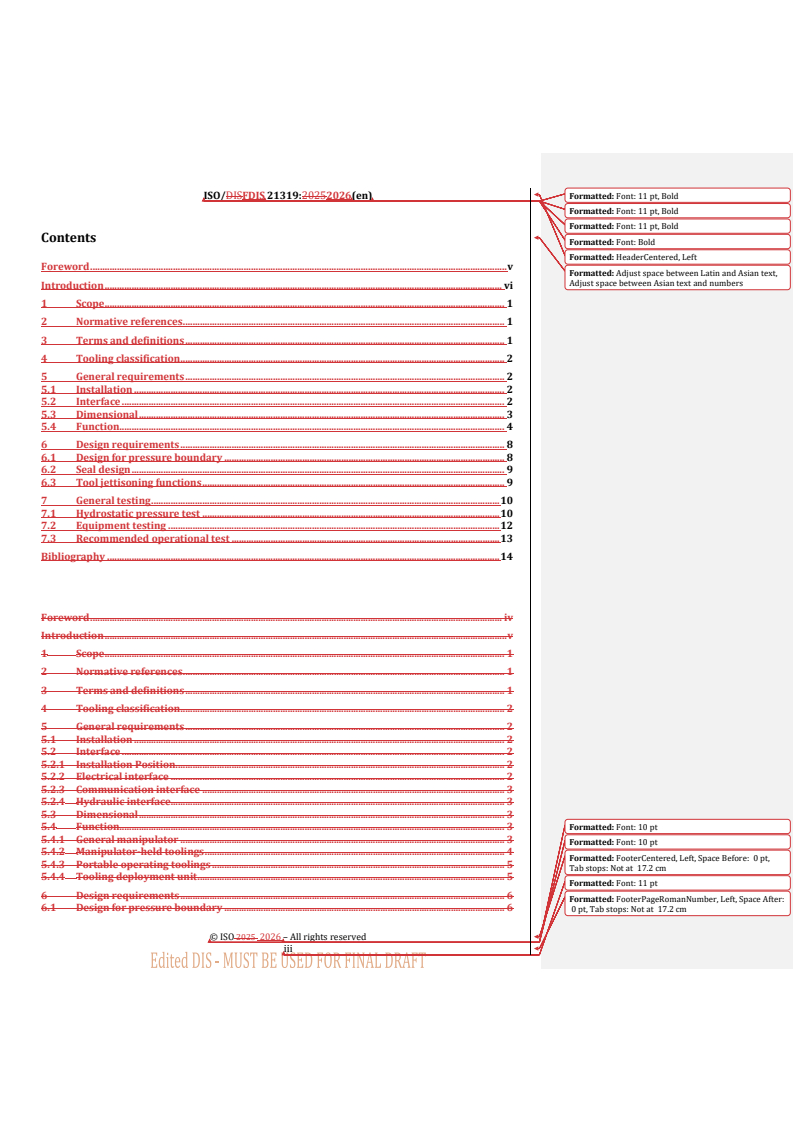
Contents
Formatted: Font: Bold
Formatted: HeaderCentered, Left
Foreword . v
Formatted: Adjust space between Latin and Asian text,
Adjust space between Asian text and numbers
Introduction . vi
1 Scope . 1
2 Normative references . 1
3 Terms and definitions . 1
4 Tooling classification . 2
5 General requirements . 2
5.1 Installation . 2
5.2 Interface . 2
5.3 Dimensional . 3
5.4 Function . 4
6 Design requirements . 8
6.1 Design for pressure boundary . 8
6.2 Seal design . 9
6.3 Tool jettisoning functions . 9
7 General testing . 10
7.1 Hydrostatic pressure test . 10
7.2 Equipment testing . 12
7.3 Recommended operational test . 13
Bibliography . 14
Foreword . iv
Introduction . v
1 Scope . 1
2 Normative references . 1
3 Terms and definitions . 1
4 Tooling classification . 2
5 General requirements . 2
5.1 Installation . 2
5.2 Interface . 2
5.2.1 Installation Position. 2
5.2.2 Electrical interface . 2
5.2.3 Communication interface . 3
5.2.4 Hydraulic interface. 3
5.3 Dimensional . 3
Formatted: Font: 10 pt
5.4 Function . 3
5.4.1 General manipulator . 3
Formatted: Font: 10 pt
5.4.2 Manipulator-held toolings . 4
Formatted: FooterCentered, Left, Space Before: 0 pt,
5.4.3 Portable operating toolings . 5
Tab stops: Not at 17.2 cm
5.4.4 Tooling deployment unit . 5
Formatted: Font: 11 pt
6 Design requirements . 6
Formatted: FooterPageRomanNumber, Left, Space After:
6.1 Design for pressure boundary . 6
0 pt, Tab stops: Not at 17.2 cm
iii
Formatted: Font: Bold
Formatted: HeaderCentered
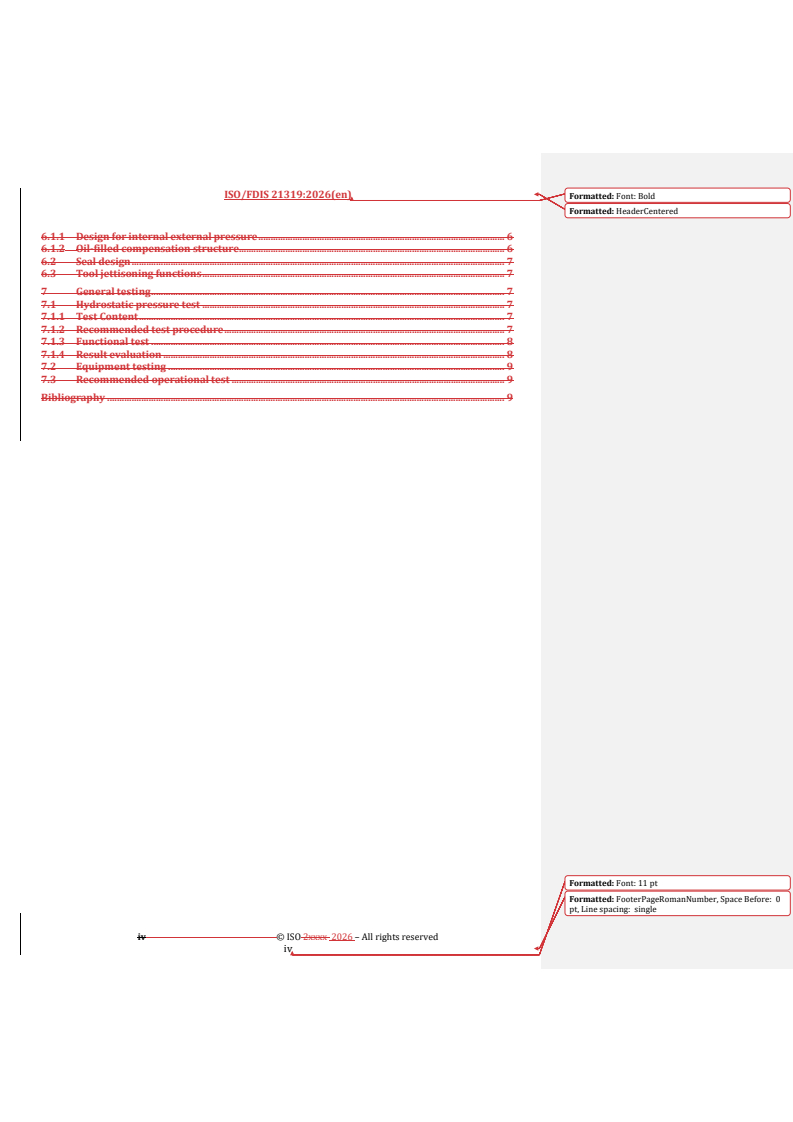
6.1.1 Design for internal external pressure . 6
6.1.2 Oil-filled compensation structure . 6
6.2 Seal design . 7
6.3 Tool jettisoning functions . 7
7 General testing . 7
7.1 Hydrostatic pressure test . 7
7.1.1 Test Content . 7
7.1.2 Recommended test procedure . 7
7.1.3 Functional test . 8
7.1.4 Result evaluation . 8
7.2 Equipment testing . 9
7.3 Recommended operational test . 9
Bibliography . 9
Formatted: Font: 11 pt
Formatted: FooterPageRomanNumber, Space Before: 0
pt, Line spacing: single
iv © ISO 2xxxx 2026 – All rights reserved
iv
ISO/DISFDIS 21319:20252026(en) Formatted: Font: 11 pt, Bold
Formatted: Font: 11 pt, Bold
Formatted: Font: 11 pt, Bold
Foreword
Formatted: Font: Bold
Formatted: HeaderCentered, Left
ISO (the International Organization for Standardization) is a worldwide federation of national standards
Formatted: Adjust space between Latin and Asian text,
bodies (ISO member bodies). The work of preparing International Standards is normally carried out through
Adjust space between Asian text and numbers
ISO technical committees. Each member body interested in a subject for which a technical committee has been
established has the right to be represented on that committee. International organizations, governmental and
non-governmental, in liaison with ISO, also take part in the work. ISO collaborates closely with the
International Electrotechnical Commission (IEC) on all matters of electrotechnical standardization.
The procedures used to develop this document and those intended for its further maintenance are described
in the ISO/IEC Directives, Part 1. In particular, the different approval criteria needed for the different types of
ISO document should be noted. This document was drafted in accordance with the editorial rules of the
ISO/IEC Directives, Part 2 (see www.iso.org/directives). Formatted: English (United Kingdom)
ISO draws attention to the possibility that the implementation of this document may involve the use of (a)
patent(s). ISO takes no position concerning the evidence, validity or applicability of any claimed patent rights
in respect thereof. As of the date of publication of this document, ISO had not received notice of (a) patent(s)
which may be required to implement this document. However, implementers are cautioned that this may not
represent the latest information, which may be obtained from the patent database available at
www.iso.org/patents.www.iso.org/patents. ISO shall not be held responsible for identifying any or all such
patent rights.
Any trade name used in this document is information given for the convenience of users and does not
constitute an endorsement.
For an explanation of the voluntary nature of standards, the meaning of ISO specific terms and expressions
related to conformity assessment, as well as information about ISO's adherence to the World Trade
Organization (WTO) principles in the Technical Barriers to Trade (TBT), see
www.iso.org/iso/foreword.htmlwww.iso.org/iso/foreword.html. Formatted: English (United Kingdom)
This document was prepared by Technical Committee ISO/TC 8, Ships and marine technology, Subcommittee Formatted: Adjust space between Latin and Asian text,
Adjust space between Asian text and numbers
SC 13, Marine technology.
Any feedback or questions on this document should be directed to the user’s national standards body. A
Formatted: English (United Kingdom)
complete listing of these bodies can be found at www.iso.org/members.htmlwww.iso.org/members.html.
Formatted: English (United Kingdom)
Formatted: Font: 10 pt
Formatted: Font: 10 pt
Formatted: FooterCentered, Left, Space Before: 0 pt,
Tab stops: Not at 17.2 cm
Formatted: Font: 11 pt
Formatted: FooterPageRomanNumber, Left, Space After:
0 pt, Tab stops: Not at 17.2 cm
v
Formatted: Font: Bold
Formatted: HeaderCentered
Formatted: Adjust space between Latin and Asian text,
Introduction
Adjust space between Asian text and numbers
This document specifies the general requirements for toolings used with submersibles, including
requirements for their functionality, installation, interfaces, weight, and dimensions. It also covers tool design
requirements, general performance requirements, and general testing and inspection methods. The purpose
of this document is to establish unified common requirements, thereby ensuring that the basic requirements
for toolings installed on submersibles are consistently maintained on a global scale.
Formatted: Font: 11 pt
Formatted: FooterPageRomanNumber, Space Before: 0
pt, Line spacing: single
vi © ISO 2xxxx 2026 – All rights reserved
vi
DRAFT International Standard ISO/DIS 21319:2025(en)
Formatted: Font: Not Bold
Formatted: Header, Space After: 0 pt, Line spacing:
single
Formatted: Font color: Auto
Marine technology - — Toolings for submersibles — Technology
Formatted: Font color: Auto
requirements
Formatted: Font color: Auto
Formatted: Main Title 1, Left
1 Scope
Formatted: Font: Not Bold, Font color: Auto
This standarddocument specifies the classification, general requirements, design requirements, general
Formatted: Adjust space between Latin and Asian text,
characteristics, and general testing and inspection methods for submersible toolings.
Adjust space between Asian text and numbers
This document applies to the design, manufacture, inspection, and post-acceptance of submersible toolings.
2 Normative references
There are no normative references in this document.
3 Terms and definitions
For the purposes of this document, the following terms and definitions apply.
ISO and IEC maintain terminology databases for use in standardization at the following addresses: Formatted: English (United Kingdom)
Formatted: Font: 11 pt, English (United Kingdom)
— — ISO Online browsing platform: available at https://www.iso.org/obphttps://www.iso.org/obp
Formatted: English (United Kingdom)
— — IEC Electropedia: available at https://www.electropedia.org/https://www.electropedia.org/ Formatted: English (United Kingdom)
3.1
submersible3.1
Submersible
type of powered vessel that can travel or manoeuvre underwater, or both. Formatted: Adjust space between Latin and Asian text,
Adjust space between Asian text and numbers
3.2 3.2
tooling
types of devices, equipment and combinations of tools involved in underwater sampling, rescue, scientific
experiments and special operations carried out on a submersible (3.1).(3.1)
3.3 3.3
manipulator
device having one or more degrees of freedom for grasping or carrying objects or toolings by remote control
or by a fixed procedure.
Note 1 to entry: The maximum working depth is expressed in metres.
3.4 3.4
maximum working pressure
p Formatted: Regular Italic, Font: Cambria, Bold, Not Italic,
Font color: Auto, Not Raised by / Lowered by
maximum pressure in which a system (pressure vessel, supporting controls, and instrumentation) is operated.
Formatted: Font: Cambria, Bold, Not Italic
Formatted: Footer, Left, Space After: 0 pt, Tab stops: Not
at 17.2 cm
Formatted: Font: Bold
Formatted: HeaderCentered
3.5 3.5
test pressure
p Formatted: Regular Italic, Font: Cambria, Bold, Not Italic,
t
Font color: Auto, Not Raised by / Lowered by
specified amount of pressure applied during a test of a submersible’s structural integrity.
Formatted: Font: Bold, Not Italic
4 Tooling classification
Formatted: Font: 13 pt, Bold
It is recommended that toolings used with submersibles be classified into the following categories based on
their application purposes:
a) a) general manipulator;
Formatted: Space After: 0 pt, Numbered + Level: 1 +
Numbering Style: a, b, c, … + Start at: 1 + Alignment: Left
+ Aligned at: 0 cm + Indent at: 0 cm, Adjust space
b) b) manipulator-held toolings;
between Latin and Asian text, Adjust space between
Asian text and numbers, Tab stops: Not at 0.7 cm + 1.4
c) c) portable operating toolings;
cm + 2.1 cm + 2.8 cm + 3.5 cm + 4.2 cm + 4.9 cm + 5.6
cm + 6.3 cm + 7 cm
d) d) tool deployment unit.
5 General requirements Formatted: Adjust space between Latin and Asian text,
Adjust space between Asian text and numbers
5.1 Installation
Formatted: Adjust space between Latin and Asian text,
Adjust space between Asian text and numbers, Tab stops:
Not at 0.71 cm
The following installation requirements for toolings of crewed submersiblessubmersible shall apply.
Formatted: Body Text, Indent: Left: 0 cm, First line: 0
a) a) The manipulator shall generally be installed on the bottom frame structure at the forward part of the ch, Space After: 0 pt, Adjust space between Latin and
Asian text, Adjust space between Asian text and
bow. It shall be arranged within the field of view of personnel in the crewed cabin, or mounted at a position
numbers, Tab stops: Not at 0.7 cm + 1.4 cm + 2.1 cm +
equipped with a camera.
2.8 cm + 3.5 cm + 4.2 cm + 4.9 cm + 5.6 cm + 6.3 cm + 7
b) b) Other toolings shall be centrally installed on the sampling basket; this arrangement shall facilitate
monitoring and operation by personnel.
c) c) The manipulator for uncrewed submersibles shall generally be installed on the bow frame structure.
d) d) Other toolings for uncrewed submersibles shall be installed within the range of video surveillance;
generally, no dedicated sampling basket is required.
5.2 Interface Formatted: Adjust space between Latin and Asian text,
Adjust space between Asian text and numbers, Tab stops:
Not at 0.71 cm
5.2.1 Installation Position position
Formatted: Adjust space between Latin and Asian text,
The following installation positions position requirements for toolings of crewed submersiblesubmersibles Adjust space between Asian text and numbers, Tab stops:
Not at 0.71 cm + 0.99 cm + 1.27 cm
shall apply.
Formatted: Body Text, Space After: 0 pt, Adjust space
between Latin and Asian text, Adjust space between
a) a) The connection interface between the toolings and the crewed submersible shall reserve sufficient
Asian text and numbers, Tab stops: Not at 0.7 cm + 1.4
operating space to facilitate routine maintenance and disassembly operations.
cm + 2.1 cm + 2.8 cm + 3.5 cm + 4.2 cm + 4.9 cm + 5.6
cm + 6.3 cm + 7 cm
b) b) When the metal materials of the installation contact surfaces between the toolings and the crewed
submersible are inconsistent, isolation measures shall be adopted to mitigate electrochemical corrosion.
.
c) c) During installation of the toolings, fasteners shall be equipped with necessary anti-loosening measures.
.
d) d) For vibration-generating toolings, vibration isolation measures shall be considered at their connection
Formatted: Font: 11 pt
positions; additionally, the reliability of the connections shall be enhanced to prevent slippage.
Formatted: FooterPageNumber, Space Before: 0 pt, Line
spacing: single
2 © ISO 2xxxx 2026 – All rights reserved
ISO/DISFDIS 21319:20252026(en) Formatted: Font: 11 pt, Bold
Formatted: Font: 11 pt, Bold
Formatted: Font: 11 pt, Bold
5.2.2 Electrical interface
Formatted: Font: Bold
Formatted: HeaderCentered, Left
The following electrical interfaces interface requirements for toolings of crewed submersiblesubmersibles
shall apply. Formatted: Adjust space between Latin and Asian text,
Adjust space between Asian text and numbers, Tab stops:
Not at 0.71 cm + 0.99 cm + 1.27 cm
a) a) The toolings shall ensure that their electrical interfaces are compatible with those of the crewed
Formatted: English (United Kingdom)
submersible.
Formatted
...
b) b) The watertight electrical connectors and cables selected for the toolings shall be capable of operating
Formatted: English (United Kingdom)
normally in the working environment of the crewed submersible.
Formatted: English (United Kingdom)
c) c) The voltage level used by the toolings shall be consistent with that of the power supply interface;
Formatted: English (United Kingdom)
additionally, the maximum operating power of the toolings shall not exceed the rated power of the
Formatted: English (United Kingdom)
reserved power supply interface of the crewed submersible.
Formatted: English (United Kingdom)
Formatted: English (United Kingdom)
d) d) The electrical design of the toolings shall meet the requirements for the insulation level of the crewed
submersible. Formatted: English (United Kingdom)
Formatted: English (United Kingdom)
5.2.3 Communication interface
Formatted
...
The following communication interface requirements for toolings of crewed submersiblesubmersibles shall Formatted
...
apply.
a) a)The wired/wireless transmission carriers selected for various communications shall be able to work
normally in the working environment of the submersible.
b) b)The technical parameters of various communication interfaces shall be matched with the reserved
interfaces of the submersible to facilitate data transmission.
Formatted
...
Formatted: English (United Kingdom)
c) c)The selection of various communication interfaces shouldshall be planned in advance, and the
submersible shall be fully commissioned and evaluated. Formatted: Font color: Auto, English (United Kingdom)
Formatted
...
5.2.4 Hydraulic interface
Formatted: English (United Kingdom)
Formatted: English (United Kingdom)
The following hydraulic interface requirements for toolings of crewed submersiblesubmersibles shall apply.
Formatted: English (United Kingdom)
a) a) The accessories (such as oil pipes and joints) selected for the toolings shall be capable of operating
Formatted: English (United Kingdom)
normally in the working environment of the crewed submersible.
Formatted: English (United Kingdom)
b) b) The hydraulic connection interfaces of the toolings shall be compatible with the reserved interfaces of Formatted: English (United Kingdom)
the crewed submersible.
Formatted: English (United Kingdom)
Formatted: English (United Kingdom)
c) c) The oil interfaces shall be clearly marked to prevent incorrect oil connection.
Formatted: English (United Kingdom)
d) d) The working pressure and flow rate of the hydraulic oil used by the toolings shall not exceed the rated Formatted: English (United Kingdom)
range of the reserved interfaces of the crewed submersible.
Formatted
...
Formatted: English (United Kingdom)
e) e) The toolings shall be repeatedly flushed using the hydraulic station (configured with hydraulic oil
Formatted: English (United Kingdom)
consistent with that of the crewed submersible’s hydraulic system). After flushing, the hydraulic oil
sample shall be analysed using a particle size analyzeranalyser, and its cleanliness level shall not be lower
Formatted
...
than the requirements specified for the crewed submersible.
Formatted: Font: 10 pt
Formatted: Font: 10 pt
5.3 Dimensional
Formatted
...
The following dimensional requirements for toolings of crewed submersible shall apply.
Formatted: Font: 11 pt
Formatted
...
...
Questions, Comments and Discussion
Ask us and Technical Secretary will try to provide an answer. You can facilitate discussion about the standard in here.
Loading comments...