

ISO 21590:2026
(Main)Traditional Chinese medicine — Crocus sativus stigma
General Information
- Abstract
This document specifies the minimum quality and safety requirements for Crocus sativus stigma. It applies to Crocus sativus stigma that is sold and used as natural medicines in international trade, including in Chinese materia medica and decoction pieces.
- Status
- Published
- Publication Date
- 19-Feb-2026
- Technical Committee
- ISO/TC 249 - Traditional Chinese medicine
- Drafting Committee
- ISO/TC 249 - Traditional Chinese medicine
- Current Stage
- 6060 - International Standard published
- Start Date
- 20-Feb-2026
- Due Date
- 02-Aug-2026
- Completion Date
- 20-Feb-2026
Overview
ISO 21590:2026 defines international requirements for the quality and safety of Crocus sativus stigma, commonly known as saffron stigma, when used as a traditional Chinese medicine ingredient. This ISO standard establishes a unified framework for Crocus sativus stigma (Xihonghua) intended for use in global trade, including applications in Chinese materia medica and decoction pieces. By setting minimum quality benchmarks and safety protocols, it promotes consistent, safe, and effective utilization of this herbal raw material across different countries and regulatory environments.
The standard is developed by the International Organization for Standardization (ISO) Technical Committee ISO/TC 249, dedicated to traditional medicine, ensuring that all requirements reflect best practices in the field of herbal medicines.
Key Topics
ISO 21590:2026 outlines essential quality and safety criteria for Crocus sativus stigma as a medicinal product, supporting international consistency and consumer protection. Key topics covered include:
- General Characteristics: Stigma must be clean, free from foreign matter, and not contaminated with living insects.
- Morphological Features: Standards specify visual, tactile, and olfactory criteria, such as characteristic odor and slightly bitter taste.
- Microscopic Identification: Includes recognition of unique cellular structures and saffron powder color under the microscope.
- Thin-Layer Chromatogram (TLC) Identification: Ensures the specific chemical profile of the stigma.
- Moisture and Total Ash Content: Establishes limits to maintain quality and minimize degradation (moisture ≤12%, total ash ≤7.5%).
- Heavy Metals and Pesticide Residues: Requires determination of hazardous substances like arsenic, mercury, lead, cadmium, and specific pesticides.
- Artificial Colorants: Mandates the absence of non-natural coloring agents.
- Marker Compounds: Specifies determination of key constituents such as crocin-I and crocin-II.
- Sampling, Testing, and Reporting: Details protocols for consistent sampling and robust test reporting.
- Packaging, Storage, and Labelling: Sets rules to ensure product integrity during transportation and storage, as well as comprehensive product labelling.
Applications
ISO 21590:2026 is highly relevant for stakeholders in the herbal medicine and traditional Chinese medicine (TCM) sectors, especially where Crocus sativus stigma is handled as a raw material. Practical applications include:
- Manufacturing and Trade: Provides clear specifications for producers and suppliers, facilitating international commerce and regulatory compliance.
- Pharmaceutical Quality Control: Enables consistent testing and quality assessment in analytical laboratories.
- Regulatory Authorities: Supports harmonized evaluation and inspection of imported and exported saffron stigma used in TCM preparations.
- Clinical and Retail Sectors: Assists practitioners and retailers in sourcing standardized, safe, and effective herbal products.
- Research Institutions: Offers a reference point for scientific studies on Crocus sativus stigma quality and pharmacology.
ISO 21590:2026 supports safer use, enhanced global trade, and increased trust in natural medical products by enforcing strict quality and safety requirements.
Related Standards
Several ISO standards complement ISO 21590:2026, streamlining the quality assurance process for traditional Chinese medicine herbal raw materials:
- ISO 3632-2: Spices - Saffron (Crocus sativus L.) - Part 2: Test methods
- ISO 18664: Determination of heavy metals in herbal medicines used in Traditional Chinese Medicine
- ISO/TS 21310: Microscopic examination of medicinal herbs
- ISO 21371: Labelling requirements for TCM products for oral or topical use
- ISO 22217: Storage requirements for raw materials and decoction pieces
- ISO 22258: Determination of pesticide residues in natural products by gas chromatography
- ISO 23723:2021: General requirements for herbal raw material and materia medica
These standards together create a comprehensive quality and safety framework, enhancing international reliability and fostering trust in the supply and use of traditional Chinese medicinal materials.
Get Certified
Connect with accredited certification bodies for this standard

BSI Group
BSI (British Standards Institution) is the business standards company that helps organizations make excellence a habit.

TÜV Rheinland
TÜV Rheinland is a leading international provider of technical services.

TÜV SÜD
TÜV SÜD is a trusted partner of choice for safety, security and sustainability solutions.
Sponsored listings
Frequently Asked Questions
ISO 21590:2026 is a standard published by the International Organization for Standardization (ISO). Its full title is "Traditional Chinese medicine — Crocus sativus stigma". This standard covers: This document specifies the minimum quality and safety requirements for Crocus sativus stigma. It applies to Crocus sativus stigma that is sold and used as natural medicines in international trade, including in Chinese materia medica and decoction pieces.
This document specifies the minimum quality and safety requirements for Crocus sativus stigma. It applies to Crocus sativus stigma that is sold and used as natural medicines in international trade, including in Chinese materia medica and decoction pieces.
ISO 21590:2026 is classified under the following ICS (International Classification for Standards) categories: 11.120.10 - Medicaments. The ICS classification helps identify the subject area and facilitates finding related standards.
ISO 21590:2026 is available in PDF format for immediate download after purchase. The document can be added to your cart and obtained through the secure checkout process. Digital delivery ensures instant access to the complete standard document.
Standards Content (Sample)
International
Standard
ISO 21590
First edition
Traditional Chinese medicine —
2026-02
Crocus sativus stigma
Médecine traditionnelle chinoise — Stigmate de Crocus sativus
Reference number
© ISO 2026
All rights reserved. Unless otherwise specified, or required in the context of its implementation, no part of this publication may
be reproduced or utilized otherwise in any form or by any means, electronic or mechanical, including photocopying, or posting on
the internet or an intranet, without prior written permission. Permission can be requested from either ISO at the address below
or ISO’s member body in the country of the requester.
ISO copyright office
CP 401 • Ch. de Blandonnet 8
CH-1214 Vernier, Geneva
Phone: +41 22 749 01 11
Email: copyright@iso.org
Website: www.iso.org
Published in Switzerland
ii
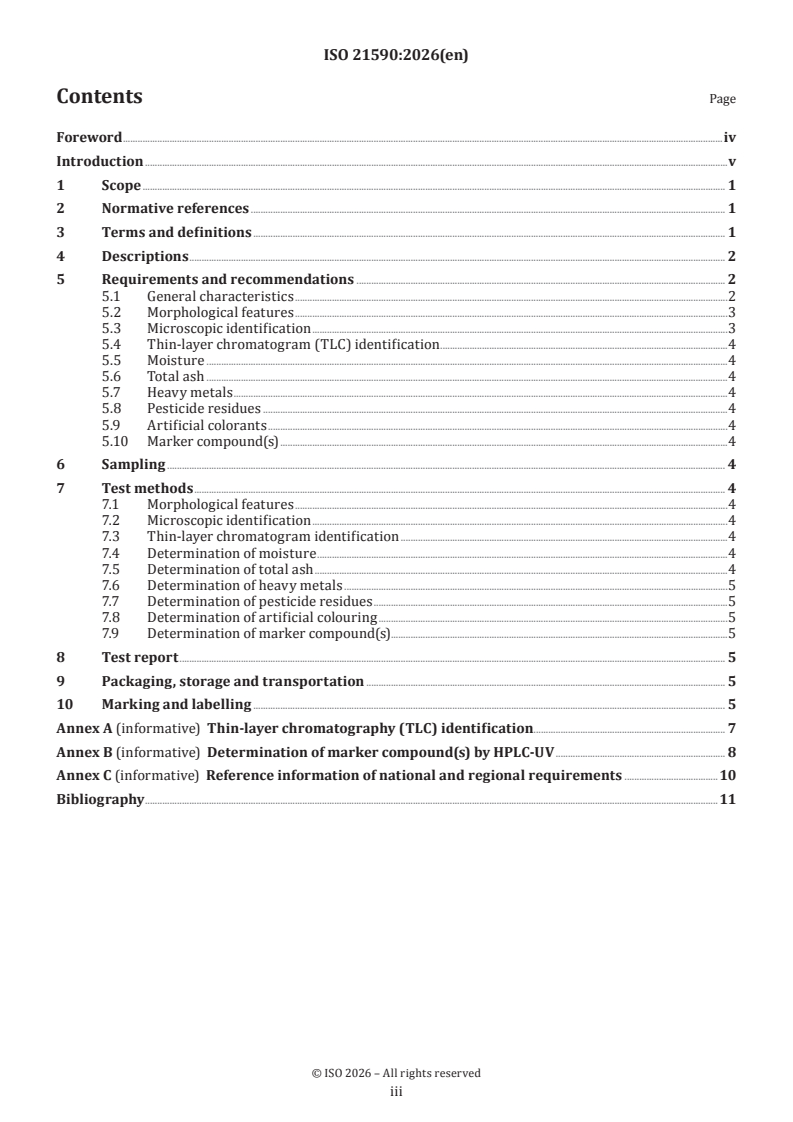
Contents Page
Foreword .iv
Introduction .v
1 Scope . 1
2 Normative references . 1
3 Terms and definitions . 1
4 Descriptions . 2
5 Requirements and recommendations . 2
5.1 General characteristics .2
5.2 Morphological features .3
5.3 Microscopic identification .3
5.4 Thin-layer chromatogram (TLC) identification .4
5.5 Moisture .4
5.6 Total ash .4
5.7 Heavy metals .4
5.8 Pesticide residues .4
5.9 Artificial colorants .4
5.10 Marker compound(s) .4
6 Sampling . 4
7 Test methods . 4
7.1 Morphological features .4
7.2 Microscopic identification .4
7.3 Thin-layer chromatogram identification .4
7.4 Determination of moisture .4
7.5 Determination of total ash .4
7.6 Determination of heavy metals .5
7.7 Determination of pesticide residues .5
7.8 Determination of artificial colouring .5
7.9 Determination of marker compound(s).5
8 Test report . 5
9 Packaging, storage and transportation . 5
10 Marking and labelling . 5
Annex A (informative) Thin-layer chromatography (TLC) identification . 7
Annex B (informative) Determination of marker compound(s) by HPLC-UV . 8
Annex C (informative) Reference information of national and regional requirements .10
Bibliography .11
iii
Foreword
ISO (the International Organization for Standardization) is a worldwide federation of national standards
bodies (ISO member bodies). The work of preparing International Standards is normally carried out through
ISO technical committees. Each member body interested in a subject for which a technical committee
has been established has the right to be represented on that committee. International organizations,
governmental and non-governmental, in liaison with ISO, also take part in the work. ISO collaborates closely
with the International Electrotechnical Commission (IEC) on all matters of electrotechnical standardization.
The procedures used to develop this document and those intended for its further maintenance are described
in the ISO/IEC Directives, Part 1. In particular, the different approval criteria needed for the different types
of ISO document should be noted. This document was drafted in accordance with the editorial rules of the
ISO/IEC Directives, Part 2 (see www.iso.org/directives).
ISO draws attention to the possibility that the implementation of this document may involve the use of (a)
patent(s). ISO takes no position concerning the evidence, validity or applicability of any claimed patent
rights in respect thereof. As of the date of publication of this document, ISO had not received notice of (a)
patent(s) which may be required to implement this document. However, implementers are cautioned that
this may not represent the latest information, which may be obtained from the patent database available at
www.iso.org/patents. ISO shall not be held responsible for identifying any or all such patent rights.
Any trade name used in this document is information given for the convenience of users and does not
constitute an endorsement.
For an explanation of the voluntary nature of standards, the meaning of ISO specific terms and expressions
related to conformity assessment, as well as information about ISO's adherence to the World Trade
Organization (WTO) principles in the Technical Barriers to Trade (TBT), see www.iso.org/iso/foreword.html.
This document was prepared by Technical Committee ISO/TC 249, Traditional medicine, Subcommittee SC 1,
Traditional Chinese medicine.
Any feedback or questions on this document should be directed to the user’s national standards body. A
complete listing of these bodies can be found at www.iso.org/members.html.
iv
Introduction
Crocus sativus stigma (Xihonghua) is originally native to Europe and was introduced in China via the Silk
Road for application in traditional Chinese medicine. In China, Crocus sativus stigma was first recorded in
[1]
Bencao Pinhui Jingyao in 1505. The primary producers of Crocus sativus stigma include countries such
as Iran, India, Spain, Afghanistan, Greece and Italy, with emerging countries like China gaining prominence.
Crocus sativus stigma is utilized medicinally in over 100 countries, thereby facilitating its global trade and
its significant role in pharmaceutical applications. However, no international standard exists to evaluate the
quality of Crocus sativus stigma as a raw material of traditional Chinese medicine.
The main chemical constituents of Crocus sativus stigma include carotene and volatile oil. Modern
pharmacological studies have shown that crocin-I and crocin-II in Crocus sativus stigma have definite
benefits for neurodegenerative diseases, mental disorders, epilepsy, seizures and insomnia, as well as
several cardiovascular system conditions including hypertension, hyperlipidemia and atherosclerosis.
China, Japan, South Korea, India and Europe have established standards for Crocus sativus stigma in their
respective pharmacopoeias. But each pharmacopoeia’s requirements are different. The Crocus sativus stigma
standard has not been unified at the international level, and many countries have different regulation levels.
As national implementation can differ, national standards bodies are invited to modify the values given in
5.5 and 5.6 in their national standards. An example of national values is given in Annex C.
v
International Standard ISO 21590:2026(en)
Traditional Chinese medicine — Crocus sativus stigma
1 Scope
This document specifies the minimum quality and safety requirements for Crocus sativus stigma.
It applies to Crocus sativus stigma that is sold and used as natural medicines in international trade, including
in Chinese materia medica and decoction pieces.
2 Normative references
The following documents are referred to in the text in such a way that some or all of their content constitutes
requirements of this document. For dated references, only the edition cited applies. For undated references,
the latest edition of the referenced document (including any amendments) applies.
ISO 3632-2, Spices — Saffron (Crocus sativus L.) — Part 2: Test methods
ISO 18664, Traditional Chinese Medicine — Determination of heavy metals in herbal medicines used in
Traditional Chinese Medicine
ISO/TS 21310, Traditional Chinese medicine — Microscopic examination of medicinal herbs
ISO 21371, Traditional Chinese medicine — Labelling requirements of products intended for oral or topical use
ISO 22217, Traditional Chinese medicine —Storage requirements for raw materials and decoction pieces
ISO 22258, Traditional Chinese medicine — Determination of pesticide residues in natural products by gas
chromatography
ISO 23723:2021, Traditional Chinese medicine — General requirements for herbal raw material and materia
medica
3 Terms and definitions
For the purposes of this document, the following terms and definitions apply.
ISO and IEC maintain terminology databases for use in standardization at the following addresses:
— ISO Online browsing platform: available at https
...