

ISO/TS 21758:2026
(Main)Traditional Chinese medicine — General requirements of stick-type package for viscous extracts
General Information
- Abstract
This document specifies the general requirements for the safety and quality of stick-type single-dose package for viscous extracts. This document does not apply to solid dosage forms.
- Status
- Published
- Publication Date
- 25-Jan-2026
- Technical Committee
- ISO/TC 249 - Traditional Chinese medicine
- Drafting Committee
- ISO/TC 249 - Traditional Chinese medicine
- Current Stage
- 6060 - International Standard published
- Start Date
- 26-Jan-2026
- Due Date
- 09-Nov-2026
- Completion Date
- 26-Jan-2026
Overview
ISO/TS 21758:2026, Traditional Chinese medicine - General requirements of stick-type package for viscous extracts, sets forth internationally recognized guidelines for the safety and quality of stick-type single-dose packaging designed for viscous extracts commonly used in Traditional Chinese Medicine (TCM). This technical specification focuses on critical requirements that ensure packaging integrity, minimize contamination risks, and maintain the quality of the contained viscous extracts throughout handling, storage, and use. Notably, the standard does not apply to solid dosage forms, concentrating solely on semi-liquid and semi-solid extracts.
Key Topics
ISO/TS 21758:2026 addresses several key areas relevant to manufacturers, quality assurance professionals, and regulatory authorities:
External Appearance: Packaging must be free from contamination, physical damage, and ensure uniform shape and adhesion without film separation. Accurate and clear labeling is mandatory, aligning with ISO 21371.
Heavy Metals in Combustion Test: Guarantees that heavy metal residues (as measured by the presence of lead) in the packaging materials do not exceed acceptable levels, protecting consumers from toxicity.
Extractable Substances Testing:
- Foaming Test: Detects the presence of surfactants that may compromise product quality.
- pH Stability: Ensures the packaging does not alter the extract’s pH beyond specified limits.
- Potassium Permanganate Reducing Substances: Measures potential oxidizable substances leached from packaging, indicating cleanliness and chemical inertness.
- Residue on Evaporation: Confirms that minimal non-volatile contaminants are present after extraction.
Test Methods: Provides standardized procedures for assessing compliance with the above requirements, ensuring reproducibility and accuracy across manufacturing and quality control environments.
Applications
ISO/TS 21758:2026 is widely applicable across the Traditional Chinese Medicine sector and other herbal extract industries:
- Manufacturers of Viscous Extracts: Ensures that stick-type, single-dose packages meet international safety and quality benchmarks, supporting global trade and acceptance.
- Quality Assurance & Regulatory Compliance: Facilitates easier validation during inspection, reducing non-compliance risk.
- Product Development: Offers guidelines for material selection and packaging design for single-use viscous herbal extracts such as ginseng, compound herbal pastes, and other semi-liquid TCM products.
- Consumer Safety: Minimizes contamination, ensuring the consistent delivery of potent and safe herbal medicine.
By adhering to this standard, organizations can demonstrate commitment to product safety and support regulatory submissions in various global markets.
Related Standards
Stakeholders interested in ISO/TS 21758:2026 may find these related standards useful for further guidance:
- ISO 21371:2018 - Traditional Chinese medicine - Labelling requirements of products intended for oral or topical use: Sets out comprehensive labeling criteria critical for packaged herbal products.
- World Health Organization TRS 902 - Annex 9: Offers packaging guidelines for pharmaceutical products, referenced for broader context.
- Korean Pharmacopoeia (12th edition) & Japanese Pharmacopoeia (18th edition): Provide foundational requirements for the assessment of plastics and other packaging materials in medicinal contexts.
Organizations already implementing these standards can integrate ISO/TS 21758:2026 to strengthen quality systems specific to stick-type packages for viscous herbal extracts.
By following ISO/TS 21758:2026, manufacturers and quality teams can ensure the structural integrity and chemical safety of TCM stick-pack packaging, ultimately protecting both product efficacy and consumer health. This standard is critical for advancing global trade and harmonization in the fast-evolving field of Traditional Chinese Medicine packaging.
Get Certified
Connect with accredited certification bodies for this standard

BSI Group
BSI (British Standards Institution) is the business standards company that helps organizations make excellence a habit.

TÜV Rheinland
TÜV Rheinland is a leading international provider of technical services.

TÜV SÜD
TÜV SÜD is a trusted partner of choice for safety, security and sustainability solutions.
Sponsored listings
Frequently Asked Questions
ISO/TS 21758:2026 is a technical specification published by the International Organization for Standardization (ISO). Its full title is "Traditional Chinese medicine — General requirements of stick-type package for viscous extracts". This standard covers: This document specifies the general requirements for the safety and quality of stick-type single-dose package for viscous extracts. This document does not apply to solid dosage forms.
This document specifies the general requirements for the safety and quality of stick-type single-dose package for viscous extracts. This document does not apply to solid dosage forms.
ISO/TS 21758:2026 is classified under the following ICS (International Classification for Standards) categories: 11.120.10 - Medicaments. The ICS classification helps identify the subject area and facilitates finding related standards.
ISO/TS 21758:2026 is available in PDF format for immediate download after purchase. The document can be added to your cart and obtained through the secure checkout process. Digital delivery ensures instant access to the complete standard document.
Standards Content (Sample)
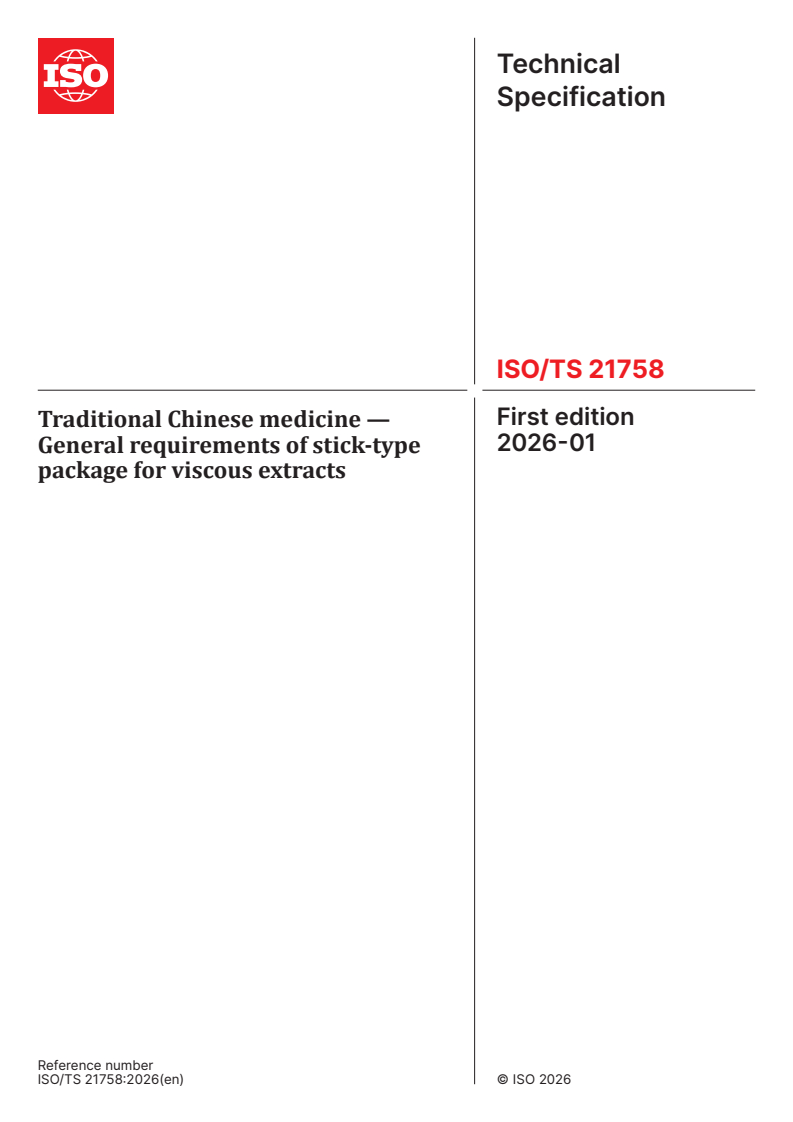
Technical
Specification
ISO/TS 21758
First edition
Traditional Chinese medicine —
2026-01
General requirements of stick-type
package for viscous extracts
Reference number
© ISO 2026
All rights reserved. Unless otherwise specified, or required in the context of its implementation, no part of this publication may
be reproduced or utilized otherwise in any form or by any means, electronic or mechanical, including photocopying, or posting on
the internet or an intranet, without prior written permission. Permission can be requested from either ISO at the address below
or ISO’s member body in the country of the requester.
ISO copyright office
CP 401 • Ch. de Blandonnet 8
CH-1214 Vernier, Geneva
Phone: +41 22 749 01 11
Email: copyright@iso.org
Website: www.iso.org
Published in Switzerland
ii
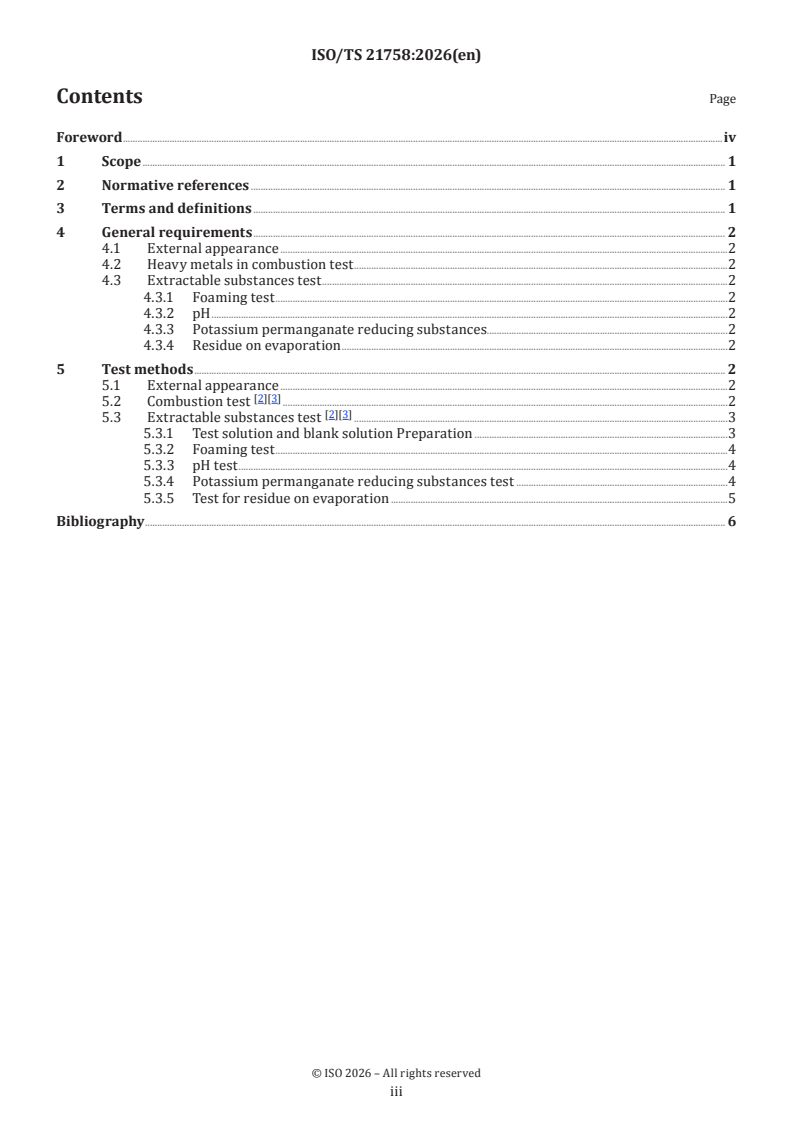
Contents Page
Foreword .iv
1 Scope . 1
2 Normative references . 1
3 Terms and definitions . 1
4 General requirements . 2
4.1 External appearance .2
4.2 Heavy metals in combustion test .2
4.3 Extractable substances test .2
4.3.1 Foaming test .2
4.3.2 pH .2
4.3.3 Potassium permanganate reducing substances.2
4.3.4 Residue on evaporation .2
5 Test methods . 2
5.1 External appearance .2
[2][3]
5.2 Combustion test .2
[2][3]
5.3 Extractable substances test .3
5.3.1 Test solution and blank solution Preparation .3
5.3.2 Foaming test .4
5.3.3 pH test .4
5.3.4 Potassium permanganate reducing substances test .4
5.3.5 Test for residue on evaporation .5
Bibliography . 6
iii
Foreword
ISO (the International Organization for Standardization) is a worldwide federation of national standards
bodies (ISO member bodies). The work of preparing International Standards is normally carried out through
ISO technical committees. Each member body interested in a subject for which a technical committee
has been established has the right to be represented on that committee. International organizations,
governmental and non-governmental, in liaison with ISO, also take part in the work. ISO collaborates closely
with the International Electrotechnical Commission (IEC) on all matters of electrotechnical standardization.
The procedures used to develop this document and those intended for its further maintenance are described
in the ISO/IEC Directives, Part 1. In particular, the different approval criteria needed for the different types
of ISO document should be noted. This document was drafted in accordance with the editorial rules of the
ISO/IEC Directives, Part 2 (see www.iso.org/directives).
ISO draws attention to the possibility that the implementation of this document may involve the use of (a)
patent(s). ISO takes no position concerning the evidence, validity or applicability of any claimed patent
rights in respect thereof. As of the date of publication of this document, ISO had not received notice of (a)
patent(s) which may be required to implement this document. However, implementers are cautioned that
this may not represent the latest information, which may be obtained from the patent database available at
www.iso.org/patents. ISO shall not be held responsible for identifying any or all such patent rights.
Any trade name used in this document is information given for the convenience of users and does not
constitute an endorsement.
For an explanation of the voluntary nature of standards, the meaning of ISO specific terms and expressions
related to conformity assessment, as well as information about ISO's adherence to the World Trade
Organization (WTO) principles in the Technical Barriers to Trade (TBT), see www.iso.org/iso/foreword.html.
This document was prepared by Technical Committee ISO/TC 249, Traditional medicine, Subcommittee SC 1,
Traditional Chinese medicine.
A list of all parts in the ISO TS 21758 series can be found on the ISO website.
Any feedback or questions on this document should be directed to the user’s national standards body. A
complete listing of these bodies can be found at www.iso.org/members.html.
iv
Technical Specification ISO/TS 21758:2026(en)
Traditional Chinese medicine — General requirements of
stick-type package for viscous extracts
1 Scope
This document specifies the general requirements for the safety and quality of stick-type single-dose
package for viscous extracts. This document does not apply to solid dosage forms.
2 Normative references
The following documents are referred to in the text in such a way that some or all of their content constitutes
requirements of this document. For dated references, only the edition cited applies. For undated references,
the latest edition of the referenced document (including any amendments) applies.
ISO 21371, Traditional Chinese medicine — Labelling requirements of products intended for oral or topi
...