

ISO 25099:2026
(Main)Traditional Chinese medicine — Curcuma phaeocaulis, Curcuma kwangsiensis and Curcuma wenyujin rhizome
General Information
- Abstract
This document specifies requirements and test methods for Curcuma rhizome (Curcuma phaeocaulis, Curcuma kwangsiensis and Curcuma wenyujin rhizome). It is applicable to the Curcuma rhizome that is sold and used as a natural medicine in international trade, including Chinese materia medica (whole medicinal materials) and decoction pieces derived from the plant. This document does not apply to the processing methods and processed products of Curcuma rhizome.
- Status
- Published
- Publication Date
- 09-Feb-2026
- Technical Committee
- ISO/TC 249 - Traditional Chinese medicine
- Current Stage
- 6060 - International Standard published
- Start Date
- 10-Feb-2026
- Due Date
- 06-May-2027
- Completion Date
- 10-Feb-2026
Overview
ISO 25099:2026, published by the International Organization for Standardization (ISO), sets out the international requirements and test methods for Curcuma rhizome, specifically from Curcuma phaeocaulis, Curcuma kwangsiensis, and Curcuma wenyujin. Known collectively as “E’zhu” or zedoary, these rhizomes are widely used in Traditional Chinese Medicine (TCM) and traded globally as herbal raw materials and decoction pieces. This standard is designed to harmonize international quality specifications, ensuring consistency, safety, and efficacy in the global herbal market.
Key ISO 25099:2026 features:
- Applies to unprocessed Curcuma rhizomes and their decoction pieces
- Defines quality, safety, and identification criteria
- Excludes processed Curcuma products and proprietary preparations
Key Topics
ISO 25099:2026 addresses critical quality assurance and control topics, including:
- Morphological and macroscopic features: Detailed descriptions enable visual identification of Curcuma phaeocaulis, Curcuma kwangsiensis, and Curcuma wenyujin rhizomes.
- Microscopic identification: Ensures authenticity by examining structural and cellular characteristics, supporting differentiation between Curcuma species.
- Chemical identification: Methods like Thin-Layer Chromatography (TLC) and High-Performance Liquid Chromatography (HPLC) verify the presence of characteristic marker compounds (e.g., germacrone).
- Physicochemical parameters:
- Moisture, total ash, and acid-insoluble ash content
- Levels of ethanol-soluble extractives and essential oils
- Contaminant limits: Specifications for heavy metals (arsenic, cadmium, lead, mercury) and pesticide residues ensure safety.
- Packaging and labelling: Defines mandatory labelling (scientific name, origin, batch, mass) and packaging requirements to preserve product integrity.
Test methods are referenced to relevant ISO standards, supporting reliable and reproducible assessment for quality control laboratories and supply chains.
Applications
ISO 25099:2026 finds significant practical value across the international herbal medicine industry:
- Quality assurance in sourcing and procurement: Herbal suppliers and buyers use the standard to specify and verify the quality of raw Curcuma rhizome materials.
- Regulatory compliance: National authorities, customs, and inspection agencies rely on ISO 25099 to assess imported and exported Traditional Chinese herbal materials, harmonizing international and domestic quality requirements.
- Product safety and efficacy: TCM practitioners, manufacturers, and retailers benefit from assurance that batches of Curcuma rhizome meet defined safety thresholds for contaminants and maintain key pharmacological properties.
- Labelling and traceability: Clear labelling enhances traceability and consumer confidence, facilitating market access and reducing the risk of adulteration or misidentification.
- International trade facilitation: Harmonized criteria reduce disputes and streamline cross-border trade in botanical raw materials.
By supporting standardized assessment and transparent labelling, ISO 25099:2026 underpins trust and consistency in the Traditional Chinese Medicine market.
Related Standards
To ensure complete and compliant application of ISO 25099:2026, the following related ISO standards are referenced:
- ISO 18664: Determination of heavy metals in herbal medicines
- ISO/TS 21310: Microscopic examination of medicinal herbs
- ISO 21371: Labelling requirements for herbal products
- ISO 22217: Storage requirements for raw materials and decoction pieces
- ISO 22258: Determination of pesticide residues
- ISO 22590: Determination of sulfur dioxide in natural products
- ISO 23723: General requirements for herbal raw material and materia medica
Utilizing these related standards together ensures comprehensive quality, safety, and regulatory compliance for Curcuma rhizome used in Traditional Chinese Medicine and international trade.
Get Certified
Connect with accredited certification bodies for this standard

BSI Group
BSI (British Standards Institution) is the business standards company that helps organizations make excellence a habit.

TÜV Rheinland
TÜV Rheinland is a leading international provider of technical services.

TÜV SÜD
TÜV SÜD is a trusted partner of choice for safety, security and sustainability solutions.
Sponsored listings
Frequently Asked Questions
ISO 25099:2026 is a standard published by the International Organization for Standardization (ISO). Its full title is "Traditional Chinese medicine — Curcuma phaeocaulis, Curcuma kwangsiensis and Curcuma wenyujin rhizome". This standard covers: This document specifies requirements and test methods for Curcuma rhizome (Curcuma phaeocaulis, Curcuma kwangsiensis and Curcuma wenyujin rhizome). It is applicable to the Curcuma rhizome that is sold and used as a natural medicine in international trade, including Chinese materia medica (whole medicinal materials) and decoction pieces derived from the plant. This document does not apply to the processing methods and processed products of Curcuma rhizome.
This document specifies requirements and test methods for Curcuma rhizome (Curcuma phaeocaulis, Curcuma kwangsiensis and Curcuma wenyujin rhizome). It is applicable to the Curcuma rhizome that is sold and used as a natural medicine in international trade, including Chinese materia medica (whole medicinal materials) and decoction pieces derived from the plant. This document does not apply to the processing methods and processed products of Curcuma rhizome.
ISO 25099:2026 is classified under the following ICS (International Classification for Standards) categories: 11.120.10 - Medicaments. The ICS classification helps identify the subject area and facilitates finding related standards.
ISO 25099:2026 is available in PDF format for immediate download after purchase. The document can be added to your cart and obtained through the secure checkout process. Digital delivery ensures instant access to the complete standard document.
Standards Content (Sample)
International
Standard
ISO 25099
First edition
Traditional Chinese medicine —
2026-02
Curcuma phaeocaulis, Curcuma
kwangsiensis and Curcuma wenyujin
rhizome
Médecine traditionnelle chinoise — Rhizome de Curcuma
phaeocaulis, Curcuma kwangsiensis et Curcuma wenyujin
Reference number
© ISO 2026
All rights reserved. Unless otherwise specified, or required in the context of its implementation, no part of this publication may
be reproduced or utilized otherwise in any form or by any means, electronic or mechanical, including photocopying, or posting on
the internet or an intranet, without prior written permission. Permission can be requested from either ISO at the address below
or ISO’s member body in the country of the requester.
ISO copyright office
CP 401 • Ch. de Blandonnet 8
CH-1214 Vernier, Geneva
Phone: +41 22 749 01 11
Email: copyright@iso.org
Website: www.iso.org
Published in Switzerland
ii
Contents Page
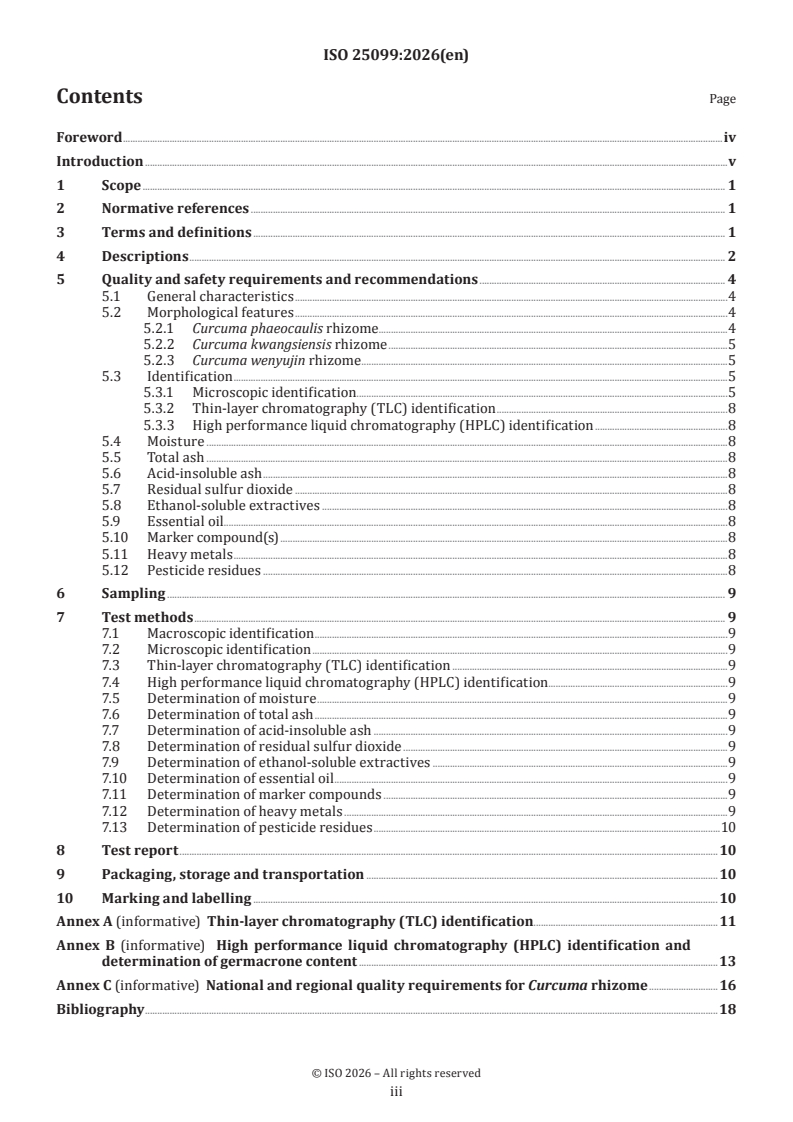
Foreword .iv
Introduction .v
1 Scope . 1
2 Normative references . 1
3 Terms and definitions . 1
4 Descriptions . 2
5 Quality and safety requirements and recommendations . 4
5.1 General characteristics .4
5.2 Morphological features .4
5.2.1 Curcuma phaeocaulis rhizome .4
5.2.2 Curcuma kwangsiensis rhizome .5
5.2.3 Curcuma wenyujin rhizome .5
5.3 Identification .5
5.3.1 Microscopic identification . . .5
5.3.2 Thin-layer chromatography (TLC) identification .8
5.3.3 High performance liquid chromatography (HPLC) identification .8
5.4 Moisture .8
5.5 Total ash .8
5.6 Acid-insoluble ash .8
5.7 Residual sulfur dioxide .8
5.8 Ethanol-soluble extractives .8
5.9 Essential oil.8
5.10 Marker compound(s) .8
5.11 Heavy metals .8
5.12 Pesticide residues .8
6 Sampling . 9
7 Test methods . 9
7.1 Macroscopic identification .9
7.2 Microscopic identification .9
7.3 Thin-layer chromatography (TLC) identification .9
7.4 High performance liquid chromatography (HPLC) identification.9
7.5 Determination of moisture .9
7.6 Determination of total ash .9
7.7 Determination of acid-insoluble ash .9
7.8 Determination of residual sulfur dioxide .9
7.9 Determination of ethanol-soluble extractives .9
7.10 Determination of essential oil . .9
7.11 Determination of marker compounds .9
7.12 Determination of heavy metals .9
7.13 Determination of pesticide residues .10
8 Test report .10
9 Packaging, storage and transportation . 10
10 Marking and labelling . 10
Annex A (informative) Thin-layer chromatography (TLC) identification .11
Annex B (informative) High performance liquid chromatography (HPLC) identification and
determination of germacrone content .13
Annex C (informative) National and regional quality requirements for Curcuma rhizome .16
Bibliography .18
iii
Foreword
ISO (the International Organization for Standardization) is a worldwide federation of national standards
bodies (ISO member bodies). The work of preparing International Standards is normally carried out through
ISO technical committees. Each member body interested in a subject for which a technical committee
has been established has the right to be represented on that committee. International organizations,
governmental and non-governmental, in liaison with ISO, also take part in the work. ISO collaborates closely
with the International Electrotechnical Commission (IEC) on all matters of electrotechnical standardization.
The procedures used to develop this document and those intended for its further maintenance are described
in the ISO/IEC Directives, Part 1. In particular, the different approval criteria needed for the different types
of ISO documents should be noted. This document was drafted in accordance with the editorial rules of the
ISO/IEC Directives, Part 2 (see www.iso.org/directives).
ISO draws attention to the possibility that the implementation of this document may involve the use of (a)
patent(s). ISO takes no position concerning the evidence, validity or applicability of any claimed patent
rights in respect thereof. As of the date of publication of this document, ISO had not received notice of (a)
patent(s) which may be required to implement this document. However, implementers are cautioned that
this may not represent the latest information, which may be obtained from the patent database available at
www.iso.org/patents. ISO shall not be held responsible for identifying any or all such patent rights.
Any trade name used in this document is information given for the convenience of users and does not
constitute an endorsement.
For an explanation of the voluntary nature of standards, the meaning of ISO specific terms and expressions
related to conformity assessment, as well as information about ISO's adherence to the World Trade
Organization (WTO) principles in the Technical Barriers to Trade (TBT), see www.iso.org/iso/foreword.html.
This document was prepared by Technical Committee ISO/TC 249, Traditional medicine, Subcommittee SC 1,
Traditional Chinese medicine.
Any feedback or questions on this document should be directed to the user’s national standards body. A
complete listing of these bodies can be found at www.iso.org/members.html.
iv
Introduction
Curcuma rhizome, the dried rhizome of Curcuma phaeocaulis, Curcuma kwangsiensis and Curcuma wenyujin,
is widely used as a herbal medicine in China and many other countries. This herb is also known as “E’zhu”
or zedoray/zedoary. In traditional Chinese medicine, the herb can enhance blood circulation, alleviate chest
discomfort, and treat abdominal distension and pain. Modern pharmacological studies have demonstrated
that Curcuma rhizome exhibits good anti-tumour, anti-thrombotic, anti-inflammatory, and analgesic effects.
The market, yield, and trade volume of Curcuma rhizome develop rapidly in recent years.
Curcuma rhizome has been recorded in several pharmacopoeias and standards, including the Chinese
[1] [2] [3]
Pharmacopoeia , the Japanese Pharmacopoeia , the Korean Pharmacopoeia and the Hong Kong Chinese
[4]
Materia Medical Standards . The requirements and specifications in these standards vary. Therefore, it is
important to develop an International Standard for harmonizing the existing standards, as well as ensuring
the safety and effectiveness of Curcuma rhizome, which can benefit farmers, consumers, enterprises and
governments involved in the production, regulation and trade of this herb.
As national implementation can differ, national standards bodies are invited to modify the values given in
5.5 in their national standards. Examples of national and regional values are given in Annex C.
v
International Standard ISO 25099:2026(en)
Traditional Chinese medicine — Curcuma phaeocaulis,
Curcuma kwangsiensis and Curcuma wenyujin rhizome
1 Scope
This document specifies requirements and test methods for Curcuma rhizome (Curcuma phaeocaulis,
Curcuma kwangsiensis and Curcuma wenyujin rhizome).
It is applicable to the Curcuma rhizome that is sold and used as a natural medicine in international trade,
including Chinese materia medica (whole medicinal materials) and decoction pieces derived from the plant.
This document does not apply to the processing methods and processed products of Curcuma rhizome.
2 Normative references
The following documents are referred to in the text in such a way that some or all of their content constitutes
requirements of this document. For dated references, only the edition cited applies. For undated references,
the latest edition of the referenced document (including any amendments) applies.
ISO 18664, Traditional Chinese medicine — Determination of heavy metals in herbal medicines used in
Traditional Chinese Medicine
ISO/TS 21310, Traditional Chinese medicine — Microscopic examination of medicinal herbs
ISO 21371, Traditional Chinese medicine — Labelling requirements of products intended for oral or topical use
ISO 22217, Traditional Chinese medicine —Storage requirements for raw materials and decoction pieces
ISO 22258, Traditional Chinese medicine — Determination of pesticide residues in natural products by gas
chromatography
ISO 22590, Traditional Chinese medicine — Determination of sulfur dioxide in natural products by titration
ISO 23723, Traditional Chinese medicine — General requirements for herbal raw material and materia medica
3 Terms and definitions
For the purposes of this document, the following terms and definitions apply.
ISO and IEC maintain terminology databases for use in standardization at the following addresses:
— ISO Online browsing platform: available at https:// www .iso .org/ obp
— IEC Electropedia: available at https:// www .electropedia .org/
3.1
Curcuma rhizome
dried rhizome (3.2) of Curcuma phaeocaulis Valeton, Curcuma kwangsiensis S. G. Lee et C. F. Liang and Curcuma
wenyujin Y. H. Chen et C. Ling
Note 1 to entry: In China, Curcuma phaeocaulis, Curcuma kwangsiensis and Curcuma wenyujin are commonly known as
"Peng E’zhu", "Guangxi E’zhu", and "Wen E’zhu".
3.2
rhizome
creeping rootstalk
main stem of a plant that sends out roots and shoots from its nodes
[SOURCE: ISO 13615:2024, 3.2]
4 Descriptions
Figure 1 illustrates the structure of Curcuma phaeocaulis, Curcuma kwangsiensis and Curcuma wenyujin
rhizomes, which are collected in winter when the stem and leaves wither. They are washed clean, steamed
or boiled thoroughly, dried in the sun or dried at a low temperature (not more than
...