

ISO 24898:2026
(Main)Traditional Chinese medicine — General requirements for the cultivation and primary processing of herbal materials
General Information
- Abstract
This document specifies the general technical requirements for the process of cultivation and collection of medicinal plants, including selection of site, seeds and other propagation materials, cultivation, harvest and collection, post-harvest processing, packaging and labelling, storage and transportation. This document applies to the cultivation, harvest and collection of medicinal plants used as the source for herbal medicines, including certain post-harvest operations. This document also provides practical record formats for the entire process.
- Status
- Published
- Publication Date
- 05-Mar-2026
- Technical Committee
- ISO/TC 249 - Traditional Chinese medicine
- Current Stage
- 6060 - International Standard published
- Start Date
- 06-Mar-2026
- Due Date
- 01-Mar-2027
- Completion Date
- 06-Mar-2026
Overview
ISO 24898:2026 - Traditional Chinese Medicine - General Requirements for the Cultivation and Primary Processing of Herbal Materials establishes comprehensive standards for the cultivation, harvest, and primary processing of medicinal plants for herbal medicines. Developed by ISO, this document aims to harmonize technical requirements across the traditional Chinese medicine (TCM) sector, ensuring safety, efficacy, and traceability from the selection of propagation materials to packaging and transportation. It is relevant for growers, collectors, and processors of medicinal plants, supporting adherence to international good agricultural and collection practices (GACP).
Key Topics
Selection of Propagation Materials
- Emphasizes the use of high-quality, traceable seeds, seedlings, and other materials free from contamination and diseases
- Requires botanical identification and record-keeping for all propagation sources
Cultivation Techniques
- Covers site selection based on geography, climate, and soil suitability
- Recommends sustainable agricultural practices, including ecological planting and crop rotation
- Highlights the assessment and prevention of environmental contamination
Fertilization and Pest Management
- Encourages the use of organic fertilizers and careful application of agrochemicals
- Integrates various pest and disease management methods, prioritizing environmental safety
Harvest and Collection
- Specifies optimal harvest timing and handling methods to preserve medicinal quality
- Stresses the importance of differentiating between cultivated and wild-sourced plants
- Minimizes habitat impact during wild plant collection
Post-harvest Processing
- Outlines procedures for inspection, sorting, drying, and specific processing requirements
- Emphasizes maintaining product integrity during processing and cleanliness of facilities
Packaging, Labelling, Storage, and Transportation
- Ensures packaging materials are clean, non-contaminating, and suitable for transport
- Labels must comply with ISO requirements, clearly indicating source and dates
- Storage and transportation protocols maintain product quality and safety
Record Formats
- Provides practical templates for recording identification, cultivation, fertilization, collection, and processing stages
Applications
ISO 24898:2026 is applicable throughout the herbal medicine supply chain, particularly:
- Medicinal Plant Cultivation: Guides growers in selecting suitable sites, adopting sustainable practices, and maintaining records, supporting both large-scale farms and smallholders.
- Post-harvest Processing Facilities: Enables processors to standardize inspection, handling, and drying to prevent contamination and maintain active ingredient quality.
- Quality Assurance: Offers traceability through detailed record-keeping-essential for market acceptance, product certification, and regulatory compliance.
- Export and International Trade: By adhering to recognized international standards, producers can facilitate access to global markets, ensuring products meet importer safety and traceability requirements.
- Wild Harvest Management: Assists collectors and natural resource managers in sustainably harvesting wild medicinal plants while protecting biodiversity.
Related Standards
ISO 21371: Traditional Chinese Medicine - Labelling Requirements for Oral or Topical Products
- Details mandatory labelling information for finished TCM products
ISO 22217: Traditional Chinese Medicine - Storage Requirements
- Defines storage conditions for raw materials and processed herbal decoction pieces
ISO 22258: Determination of Pesticide Residues
- Specifies analytical methods for detecting pesticide residues in herbal materials
These standards, when used alongside ISO 24898:2026, form a comprehensive framework for quality management within the TCM herbal supply chain.
By implementing ISO 24898:2026, stakeholders in the herbal medicine industry can achieve international recognition for quality, support sustainable growth, and protect consumer health through rigorous technical controls and documentation.
Get Certified
Connect with accredited certification bodies for this standard

BSI Group
BSI (British Standards Institution) is the business standards company that helps organizations make excellence a habit.

TÜV Rheinland
TÜV Rheinland is a leading international provider of technical services.

TÜV SÜD
TÜV SÜD is a trusted partner of choice for safety, security and sustainability solutions.
Sponsored listings
Frequently Asked Questions
ISO 24898:2026 is a standard published by the International Organization for Standardization (ISO). Its full title is "Traditional Chinese medicine — General requirements for the cultivation and primary processing of herbal materials". This standard covers: This document specifies the general technical requirements for the process of cultivation and collection of medicinal plants, including selection of site, seeds and other propagation materials, cultivation, harvest and collection, post-harvest processing, packaging and labelling, storage and transportation. This document applies to the cultivation, harvest and collection of medicinal plants used as the source for herbal medicines, including certain post-harvest operations. This document also provides practical record formats for the entire process.
This document specifies the general technical requirements for the process of cultivation and collection of medicinal plants, including selection of site, seeds and other propagation materials, cultivation, harvest and collection, post-harvest processing, packaging and labelling, storage and transportation. This document applies to the cultivation, harvest and collection of medicinal plants used as the source for herbal medicines, including certain post-harvest operations. This document also provides practical record formats for the entire process.
ISO 24898:2026 is classified under the following ICS (International Classification for Standards) categories: 11.120.10 - Medicaments. The ICS classification helps identify the subject area and facilitates finding related standards.
ISO 24898:2026 is available in PDF format for immediate download after purchase. The document can be added to your cart and obtained through the secure checkout process. Digital delivery ensures instant access to the complete standard document.
Standards Content (Sample)
International
Standard
ISO 24898
First edition
Traditional Chinese medicine —
2026-03
General requirements for the
cultivation and primary processing
of herbal materials
Médecine traditionnelle chinoise — Exigences générales relatives
à la culture et à la transformation primaire des matières issues
des plantes
Reference number
© ISO 2026
All rights reserved. Unless otherwise specified, or required in the context of its implementation, no part of this publication may
be reproduced or utilized otherwise in any form or by any means, electronic or mechanical, including photocopying, or posting on
the internet or an intranet, without prior written permission. Permission can be requested from either ISO at the address below
or ISO’s member body in the country of the requester.
ISO copyright office
CP 401 • Ch. de Blandonnet 8
CH-1214 Vernier, Geneva
Phone: +41 22 749 01 11
Email: copyright@iso.org
Website: www.iso.org
Published in Switzerland
ii
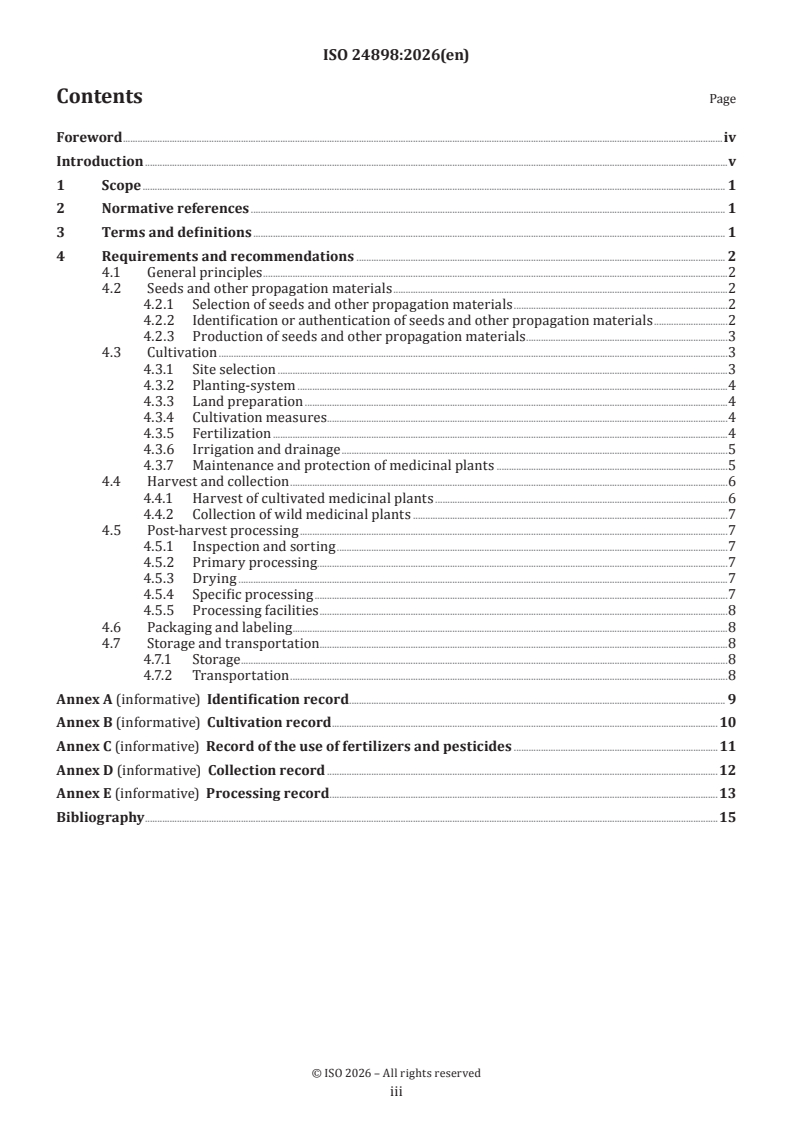
Contents Page
Foreword .iv
Introduction .v
1 Scope . 1
2 Normative references . 1
3 Terms and definitions . 1
4 Requirements and recommendations . 2
4.1 General principles .2
4.2 Seeds and other propagation materials .2
4.2.1 Selection of seeds and other propagation materials .2
4.2.2 Identification or authentication of seeds and other propagation materials .2
4.2.3 Production of seeds and other propagation materials .3
4.3 Cultivation .3
4.3.1 Site selection .3
4.3.2 Planting-system .4
4.3.3 Land preparation .4
4.3.4 Cultivation measures.4
4.3.5 Fertilization .4
4.3.6 Irrigation and drainage .5
4.3.7 Maintenance and protection of medicinal plants .5
4.4 Harvest and collection .6
4.4.1 Harvest of cultivated medicinal plants .6
4.4.2 Collection of wild medicinal plants .7
4.5 Post-harvest processing .7
4.5.1 Inspection and sorting .7
4.5.2 Primary processing.7
4.5.3 Drying .7
4.5.4 Specific processing .7
4.5.5 Processing facilities .8
4.6 Packaging and labeling .8
4.7 Storage and transportation .8
4.7.1 Storage .8
4.7.2 Transportation .8
Annex A (informative) Identification record . 9
Annex B (informative) Cultivation record . 10
Annex C (informative) Record of the use of fertilizers and pesticides .11
Annex D (informative) Collection record .12
Annex E (informative) Processing record.13
Bibliography .15
iii
Foreword
ISO (the International Organization for Standardization) is a worldwide federation of national standards
bodies (ISO member bodies). The work of preparing International Standards is normally carried out through
ISO technical committees. Each member body interested in a subject for which a technical committee
has been established has the right to be represented on that committee. International organizations,
governmental and non-governmental, in liaison with ISO, also take part in the work. ISO collaborates closely
with the International Electrotechnical Commission (IEC) on all matters of electrotechnical standardization.
The procedures used to develop this document and those intended for its further maintenance are described
in the ISO/IEC Directives, Part 1. In particular, the different approval criteria needed for the different types
of ISO document should be noted. This document was drafted in accordance with the editorial rules of the
ISO/IEC Directives, Part 2 (see www.iso.org/directives).
ISO draws attention to the possibility that the implementation of this document may involve the use of (a)
patent(s). ISO takes no position concerning the evidence, validity or applicability of any claimed patent
rights in respect thereof. As of the date of publication of this document, ISO had not received notice of (a)
patent(s) which may be required to implement this document. However, implementers are cautioned that
this may not represent the latest information, which may be obtained from the patent database available at
www.iso.org/patents. ISO shall not be held responsible for identifying any or all such patent rights.
Any trade name used in this document is information given for the convenience of users and does not
constitute an endorsement.
For an explanation of the voluntary nature of standards, the meaning of ISO specific terms and expressions
related to conformity assessment, as well as information about ISO's adherence to the World Trade
Organization (WTO) principles in the Technical Barriers to Trade (TBT), see www.iso.org/iso/foreword.html.
This document was prepared by Technical Committee ISO/TC 249, Traditional medicine, Subcommittee SC 1,
Traditional Chinese medicine.
Any feedback or questions on this document should be directed to the user’s national standards body. A
complete listing of these bodies can be found at www.iso.org/members.html.
iv
Introduction
The efficacy and safety of traditional Chinese medicine (TCM) is largely influenced by the quality of medicinal
plants that are used as the starting materials for TCM. And the changes in components of medicinal parts
during cultivating, harvesting, processing, storage and transportation ultimately also affect the quality of
medicinal plants.
Good agricultural and collection practices (GACP) are crucial to ensuring the quality of medicinal plants
(herbal medicine). World Health Organization (WHO) guidelines on GACP for medicinal plants was issued
in 2004. Several countries and regions, like the European Union, the United State, Canada and China, have
established or improved their own GACP standards subsequently, e.g. EU-GACP, AHPA-GACP, CHSNC-
GACP, China-GACP. However, all these standards include both management and technical content. There is
currently a lack of guidelines based on WHO-GACP that mainly focus on the production process of herbal
materials, including their cultivation and collection. Such guidelines can enable practitioners to better grasp
the technical aspects and obtain medicinal plants that are more in line with market demand.
The current GACP have played an important role in guiding the production of medicinal plants for TCM in
those regions such as the EU, USA, Canada and China. With the improvement of people's living standards,
herbal materials with preventive and health-care functions are gradually becoming more and more
popular, and the demand for herbal materials is increasing. However, due to the long growth period and
poor accessibility of wild populations of many medicinal plants, wild resources are not enough to support
the growing demand. Hence, the demand for cultivated medicinal plants has increased sharply. However,
the allelopathic or autotoxic effects of medicinal plants cause continuous cropping obstacles, making them
difficult to cultivate. There is an urgent need for more clarifications on the cultivation techniques and a
global general reference for medicinal materials cultivation. The specifications of some techniques in the
current GACP are either too detailed and lack operability, or no longer applicable due to the updates and
changes in production techniques over time. Therefore, in order to promote safety and quality at the first
and most important stage of the production process of herbal medicines, it is necessary to develop globally
applicable technical requirements for medicinal plant growers, collectors and processors to fulfill the
current situation and demand. This document is developed to address this need. Annexes A to E provide
templates for recording content during the production and processing of herbal materials. Annex A provides
an example of an identification record for seeds and other propagation materials. Annex B gives an example
of a record for the entire cultivation process. Annex C contains examples of records for the use of fertilizers
and pesticides. Annex D provides an example of a record of the entire collection process. Annex E provides
an example of a processing record.
v
International Standard ISO 24898:2026(en)
Traditional Chinese medicine — General requirements for the
cultivation and primary processing of herbal materials
1 Scope
This document specifies the general technical requirements for the process of cultivation and collection of
medicinal plants, including selection of site, seeds and other propagation materials, cultivation, harvest and
collection, post-harvest processing, packaging and labelling, storage and transportation.
This document applies to the cultivation, harvest and collection of medicinal plants used as the source for
herbal medicines, including certain post-harvest operations.
This document also provides practical record formats for the entire process.
2 Normative references
The following documents are referred to in the text in such a way that some or all of their content constitutes
requirements of this document. For dated references, only the edition cited applies. For undated references,
the latest edition of the referenced document (including any amendments) applies.
ISO 21371, Traditional Chinese medicine — Labelling requirements of products intended for oral or topical use
ISO 22217, Traditional Chinese medicine —Storage requirements for raw materials and decoction pieces
ISO 22258, Traditional Chinese medicine — Determination of pesticide residues in natural products by gas
chromatography
3 Terms and definitions
For the purposes of this document, the following terms and definitions apply.
ISO and IEC maintain terminology databases for use in standardization at the following addresses:
— ISO Online browsing platform: available at https:// www .iso .org/ obp
— IEC Electropedia: available at https:// www .electropedia .org/
3.1
medicinal plant
plant (wild or cultivated) used for medical purposes
Note 1 to entry: Medicinal plants include fungi such as mushrooms.
[SOURCE: ISO 19617:2018, 3.6, modified — Note 1 to entry has been added.]
3.2
identification
method to determine the medicinal plant species, cultivars and varieities based on genetic information or
external morphological characteristics
3.3
contamination
undesired introduction of impurities of a chemical or microbiological nature, or of foreign matter, into or on
to a starting material of intermediate during production, sampling, packaging or repackaging, storage or
transport
[SOURCE: WHO guidelines on good agricultural and collection practices (GACP) for medicinal plants, World
Health Organization, Geneva, 2003, modified]
3.4
integrated pest management
IPM
sustainable approach to managing pests by combining biological, cultural, physical and chemical tools in a
way that minimizes economic, health and environmental risks
3.5
primary processing
stage of the pre-treatment of natural materials during the collecting and harvesting process by which the
raw materials are transformed into medicinal materials
[SOURCE: ISO 21300:2019, 3.4]
4 Requirements and recommendations
4.1 General principles
Medicinal plant growers, collectors and processors should establish effective supervision and recording
procedures throughout the agricultural and collection practices. Planning of production bases, supply of
seeds, seedlings and other propagation materials, supply of fertilizers, pesticides and other agricultural
inputs, planting technical procedures, harvesting and post-harvest processing technical procedures,
packaging and storage technical procedures should be consistent.
Considering regional variations in agricultural practices, infrastructure, and resource availability, it
is crucial that governments or non-governmental organizations (NGOs) provide necessary technical
and related support to growers and processors. Such assistance can significantly enhance the practical
implementation of this standard and contribute to achieving international harmonization in the quality of
herbal medicines.
4.2 Seeds and other propagation materials
4.2.1 Selection of seeds and other propagation materials
Seeds, seedlings or other propagation materials with clear source and good germplasm should be selected.
4.2.2 Identification or authentication of seeds and other propagation materials
The botanical identity – scientific name (genus, species, subspecies or variety, author and family) – of each
medicinal plant under cultivation should be verified and recorded. If available, the local common names
should also be recorded.
The specimen or color photograph used for identification should be retained. The identification report
should be presented by accreditation institutions in operation country or user countries.
4.2.3 Production of seeds and other propagation materials
4.2.3.1 Quality
All necessary information relating to the identity, quality and performance of the seeds and other
propagation materials, as well as their breeding history should be specified if possible. The propagation or
planting materials should be of the appropriate quality and be as free as possible from contamination and
diseases in order to promote healthy plant growth. Planting material should be resistant or tolerant to biotic
or abiotic factors.
4.2.3.2 Propagation methods
The propagation methods should be selected according to the varietal characteristics of medicinal plants,
including sexual propagation and asexual propagation.
NOTE The asexual propagation methods usually include separation propagation, cutting propagation, layering
propagation, grafting propagation, in vitro tissue culture, etc.
4.2.3.3 Sowing and nursing of seeds and other propagation materials
The appropriate sowing period, sowing method and thickness of covering soil should be selected according
to climatic conditions, cultivation system and varietal characteristics.
Care should be taken to exclude extraneous species, botanical varieties and strains of medicinal plants
during the entire production process. Strengthen the breeding of medicinal plants. Counterfeit, substandard
and adulterated propagation materials shall be avoided.
NOTE Many methods can be used to protect the germplasm resources of medicinal plants, such as strengthening
the selection and breeding of improved medicinal plants varieties, establishing breeding bases.
EXAMPLE Cold stratification of Panax ginseng or Epimedium seeds before sowing.
4.3 Cultivation
4.3.1 Site selection
4.3.1.1 Geography
Geologic characteristics of the cultivated land for medicinal plants should be evaluated before cultivation.
The key aspects include elevation, latitude, longitude, site’s facing in relation to cardinal direction (north,
south, east, west), slope, topography, the presence of bedrock, hardpan, or a high-water table that affects
water drainage or root growth, etc.
EXAMPLE Cultivating Atractylodes lancea Thunb. or Atractylodes chinensis Koidz. on well-drained slopes with
appropriate shading can improve their quality.
4.3.1.2 Climate
Climatic conditions that can affect the physiological and biochemical activities of medicinal plants should
be considered based on prior knowledge. These include, for example, frost-free period, sunshine hours,
solar intensity, average rainfall (water supply) and average temperature (field temperature, daytime and
nighttime temperature), and shading by trees or buildings.
4.3.1.3 Soil
The soil for cultivation should be evaluated and selected according to the type of medicinal plant being
cultivated. Soil conditions that should be considered include soil type, drainage, moisture retention, fertility
(organic matter and other elements relevant to the growth of medicinal plants), soil thickness and pH, and
chemical properties (salinity, bicarbonate concentration, etc.).
...