

ISO 18977:2026
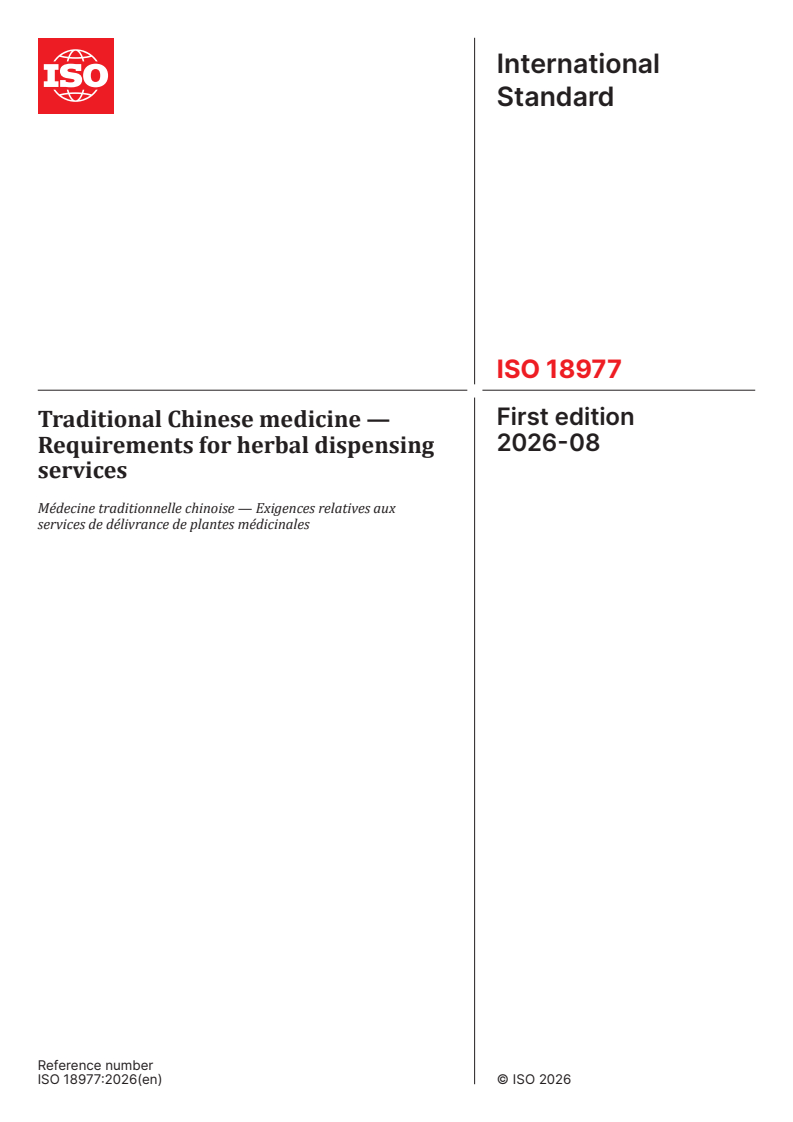
(Main)Traditional Chinese medicine — Requirements for herbal dispensing services
- Abstract
This document specifies the safety and quality requirements for herbal dispensing services. It is applicable to facilities related to large-scale herbal dispensaries, in-house hospital dispensaries and medium to large commercial dispensaries. It does not apply to dispensing services in medical clinics where herbal preparations are dispensed to patients by or under the supervision of the prescribing practitioners. The specifications regarding tools and equipment used in these services are excluded.
- Status
- Published
- Publication Date
- 10-Aug-2026
- Technical Committee
- ISO/TC 249 - Traditional Chinese medicine
- Drafting Committee
- ISO/TC 249 - Traditional Chinese medicine
- Current Stage
- 6060 - International Standard published
- Start Date
- 11-Aug-2026
- Due Date
- 20-Mar-2026
- Completion Date
- 11-Aug-2026
ISO 18977:2026 is an International Standard from ISO for herbal dispensing services in Traditional Chinese medicine. It sets safety and quality requirements for the facilities, personnel, procedures, records, sanitation, storage, training, self-inspection, and traceability used when medicinal herbs are prepared and dispensed for patients.
It is intended for large-scale herbal dispensaries, in-house hospital dispensaries, and medium to large commercial dispensaries. It does not cover medical clinics where herbal preparations are dispensed directly by, or under the supervision of, the prescribing practitioners.
What does ISO 18977:2026 specify?
ISO 18977:2026 specifies the safety and quality requirements for herbal dispensing services, and it excludes clinic-based dispensing under the prescribing practitioner’s supervision. It also excludes the specifications for the tools and equipment themselves, even though the document still sets requirements for how equipment is used, checked, and maintained.
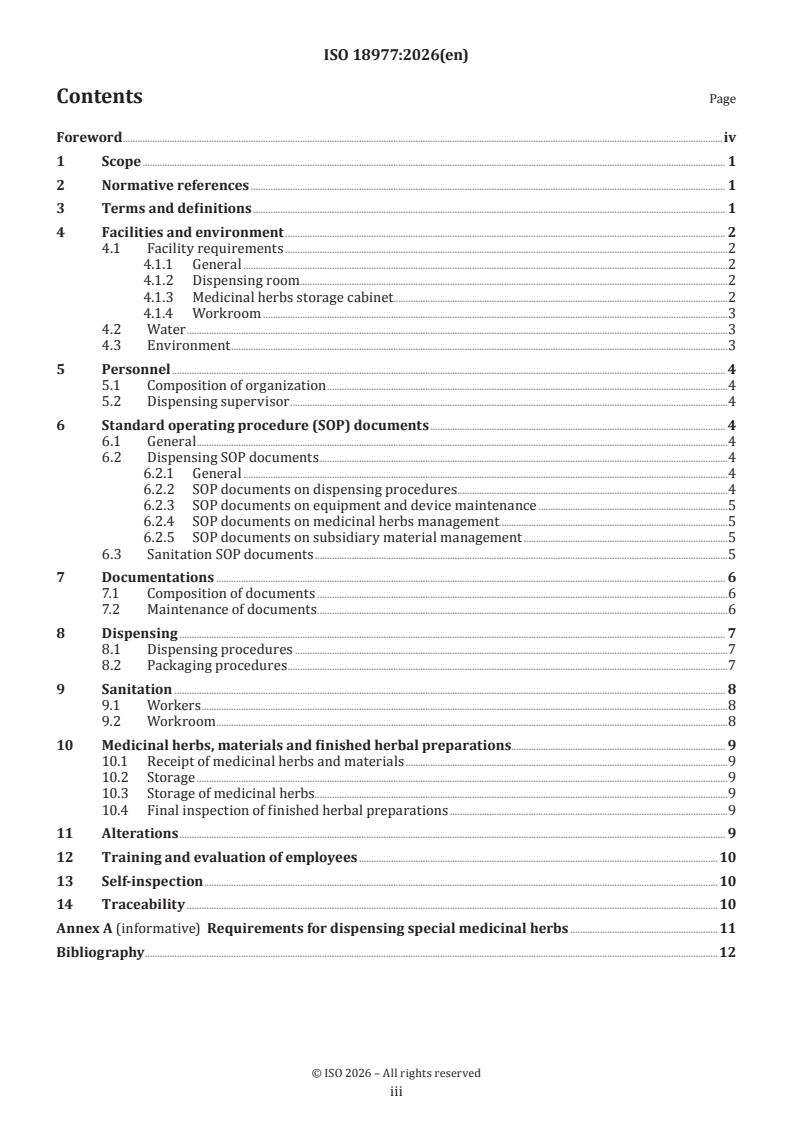
The document is organized into Clauses 1 to 14, followed by one informative annex.
| Part | What it covers |
|---|---|
| Annex A | Requirements for dispensing special medicinal herbs |
The main clauses cover scope, normative references, terms and definitions, facilities and environment, personnel, SOP documents, documentation, dispensing, sanitation, medicinal herbs and materials, alterations, training and evaluation, self-inspection, and traceability.
What are the key requirements of ISO 18977:2026?
Facilities and environment (Clause 4) - ISO 18977:2026 requires a dispensing room, storage cabinet, and workroom arranged for preparation and decoction, with controlled temperature, humidity, ventilation, lighting control, and pest protection. In practice, this means the layout and environment must support clean work, accurate weighing, and reduced contamination or mix-ups.
Equipment control and water quality (Clauses 4.1 and 4.2) - Critical equipment should be identified, unusable equipment removed or marked, and water facilities should follow ISO 24512. For users, this means the process depends on equipment status and water quality being checked and documented, not assumed.
Personnel and supervision (Clause 5) - A suitably educated and experienced person should oversee the dispensary, and the dispensing supervisor is responsible for operations, sanitation, storage, and verification of finished herbal preparations. Practically, the standard expects one accountable person to control quality and investigate issues such as adulteration or substitution.
SOP documents and document control (Clauses 6 and 7) - The standard requires written SOPs for dispensing, equipment maintenance, medicinal herbs, subsidiary materials, and sanitation, plus rules for approval, correction, revision, retention, and electronic record control. This matters because consistent written instructions and controlled records are the basis for repeatable dispensing.
Dispensing and packaging controls (Clause 8) - Prescriptions or in-pharmacy formulation guidelines must be reviewed before dispensing, and records must capture the compounder, serial number, dates, dosage form, solvent details, herb quantities, and confirmations. Packaging must prevent confusion, verify labels against records, and document leftovers and discrepancies.
Sanitation, storage, and final inspection (Clauses 9 and 10) - Workers need suitable workwear and health checks, workrooms must be cleaned under SOPs, and medicinal herbs, materials, and finished herbal preparations must be stored separately or under a confusion-proof system. Finished herbal preparations are checked for characteristic odour, absence of abnormal particles, and rejection of dry or burned products.
Training, self-inspection, and traceability (Clauses 12 to 14) - Staff training, planned self-inspections, corrective actions, and an internal traceability system with preparation numbers are required. In practice, this gives the dispensary a way to prove who did what, find problems quickly, and follow each preparation through the process.
What terms does ISO 18977:2026 define?
- Herbal medicine dispensary - A place where medicinal herbs are traditionally processed or prepared into decoctions or other dosage forms and then dispensed.
- Dispensing - The process of cleaning, cutting, roasting, steaming, or otherwise processing medicinal herbs and then extracting, decocting, or formulating them.
- Medicinal herb - Material from plants, minerals, or animals processed or to be processed for use as raw material for finished herbal preparations.
- Subsidiary material - Material used for packaging, storing, and labelling finished herbal preparations.
- Herbal preparation - A dosage form made with medicinal herbs for treatment or prevention for a specific individual.
- Finished herbal preparation - A dosage form that has been dispensed and is ready to be administered to patients.
- Standard operating procedure (SOP) - A documented set of instructions or guidelines for carrying out a task or process.
Who uses ISO 18977:2026?
ISO 18977:2026 is used by operators and managers of herbal medicine dispensaries, especially in hospital, commercial, and large-scale settings. It is also relevant to dispensing supervisors, quality managers, pharmacy or dispensary staff, sanitation staff, trainers, self-inspectors, and buyers who need to specify process control for Traditional Chinese medicine dispensing services.
Which standards are used with ISO 18977:2026?
- ISO 22217 - Provides storage requirements for raw materials and decoction pieces, and ISO 18977:2026 uses it for storage temperature, humidity, and storage location decisions.
- ISO 21371 - Provides labelling requirements for products intended for oral or topical use, and ISO 18977:2026 uses it for medicinal herb labelling.
- ISO 24512 - Provides guidance for drinking water utility management and drinking water services, and Clause 4.2 points to it for water dispensing facilities.
What does the ISO 18977:2026 document contain?
ISO 18977:2026 contains the full framework for an herbal dispensing service, from facility layout and staff responsibilities to SOP content, record keeping, packaging controls, sanitation, and traceability. It also includes detailed points for receiving, storing, checking, and rejecting medicinal herbs and finished herbal preparations.
The document sets out what must be documented in dispensing records, sanitation records, correction records, training records, and self-inspection reports. It also describes practical checks such as equipment identification, water checks, environmental monitoring, inventory control, and verification against prescriptions or in-pharmacy formulation guidelines.
Annex A adds special handling requirements for toxic medicinal herbs, aesthetic medicinal herbs, and valuable medicinal herbs. This annex is informative, but it is useful where dispensaries need extra controls for higher-risk or higher-value materials.
Get Certified
Connect with accredited certification bodies for this standard

BSI Group
BSI (British Standards Institution) is the business standards company that helps organizations make excellence a habit.

TÜV Rheinland
TÜV Rheinland is a leading international provider of technical services.

TÜV SÜD
TÜV SÜD is a trusted partner of choice for safety, security and sustainability solutions.
Sponsored listings
Frequently Asked Questions
ISO 18977:2026 is a standard published by the International Organization for Standardization (ISO). Its full title is "Traditional Chinese medicine — Requirements for herbal dispensing services". This standard covers: This document specifies the safety and quality requirements for herbal dispensing services. It is applicable to facilities related to large-scale herbal dispensaries, in-house hospital dispensaries and medium to large commercial dispensaries. It does not apply to dispensing services in medical clinics where herbal preparations are dispensed to patients by or under the supervision of the prescribing practitioners. The specifications regarding tools and equipment used in these services are excluded.
This document specifies the safety and quality requirements for herbal dispensing services. It is applicable to facilities related to large-scale herbal dispensaries, in-house hospital dispensaries and medium to large commercial dispensaries. It does not apply to dispensing services in medical clinics where herbal preparations are dispensed to patients by or under the supervision of the prescribing practitioners. The specifications regarding tools and equipment used in these services are excluded.
ISO 18977:2026 is classified under the following ICS (International Classification for Standards) categories: 11.120.10 - Medicaments; 11.120.99 - Other standards related to pharmaceutics. The ICS classification helps identify the subject area and facilitates finding related standards.
ISO 18977:2026 is available in PDF format for immediate download after purchase. The document can be added to your cart and obtained through the secure checkout process. Digital delivery ensures instant access to the complete standard document.
Standards Content (Sample)
International
Standard
ISO 18977
First edition
Traditional Chinese medicine —
2026-08
Requirements for herbal dispensing
services
Médecine traditionnelle chinoise — Exigences relatives aux
services de délivrance de plantes médicinales
Reference number
© ISO 2026
All rights reserved. Unless otherwise specified, or required in the context of its implementation, no part of this publication may
be reproduced or utilized otherwise in any form or by any means, electronic or mechanical, including photocopying, or posting on
the internet or an intranet, without prior written permission. Permission can be requested from either ISO at the address below
or ISO’s member body in the country of the requester.
ISO copyright office
CP 401 • Ch. de Blandonnet 8
CH-1214 Vernier, Geneva
Phone: +41 22 749 01 11
Email: copyright@iso.org
Website: www.iso.org
Published in Switzerland
ii
Contents Page
Foreword .iv
1 Scope . 1
2 Normative references . 1
3 Terms and definitions . 1
4 Facilities and environment . 2
4.1 Facility requirements .2
4.1.1 General .2
4.1.2 Dispensing room.2
4.1.3 Medicinal herbs storage cabinet.2
4.1.4 Workroom .3
4.2 Water .3
4.3 Environment .3
5 Personnel . 4
5.1 Composition of organization .4
5.2 Dispensing supervisor .4
6 Standard operating procedure (SOP) documents . 4
6.1 General .4
6.2 Dispensing SOP documents .4
6.2.1 General .4
6.2.2 SOP documents on dispensing procedures .4
6.2.3 SOP documents on equipment and device maintenance .5
6.2.4 SOP documents on medicinal herbs management.5
6.2.5 SOP documents on subsidiary material management .5
6.3 Sanitation SOP documents .5
7 Documentations . 6
7.1 Composition of documents .6
7.2 Maintenance of documents . . .6
8 Dispensing . 7
8.1 Dispensing procedures .7
8.2 Packaging procedures .7
9 Sanitation . 8
9.1 Workers .8
9.2 Workroom .8
10 Medicinal herbs, materials and finished herbal preparations . 9
10.1 Receipt of medicinal herbs and materials .9
10.2 Storage .9
10.3 Storage of medicinal herbs.9
10.4 Final inspection of finished herbal preparations .9
11 Alterations . 9
12 Training and evaluation of employees . 10
13 Self-inspection . 10
14 Traceability . 10
Annex A (informative) Requirements for dispensing special medicinal herbs .11
Bibliography .12
iii
Foreword
ISO (the International Organization for Standardization) is a worldwide federation of national standards
bodies (ISO member bodies). The work of preparing International Standards is normally carried out through
ISO technical committees. Each member body interested in a subject for which a technical committee
has been established has the right to be represented on that committee. International organizations,
governmental and non-governmental, in liaison with ISO, also take part in the work. ISO collaborates closely
with the International Electrotechnical Commission (IEC) on all matters of electrotechnical standardization.
The procedures used to develop this document and those intended for its further maintenance are described
in the ISO/IEC Directives, Part 1. In particular, the different approval criteria needed for the different types
of ISO document should be noted. This document was drafted in accordance with the editorial rules of the
ISO/IEC Directives, Part 2 (see www.iso.org/directives).
ISO draws attention to the possibility that the implementation of this document may involve the use of (a)
patent(s). ISO takes no position concerning the evidence, validity or applicability of any claimed patent
rights in respect thereof. As of the date of publication of this document, ISO had not received notice of (a)
patent(s) which may be required to implement this document. However, implementers are cautioned that
this may not represent the latest information, which may be obtained from the patent database available at
www.iso.org/patents. ISO shall not be held responsible for identifying any or all such patent rights.
Any trade name used in this document is information given for the convenience of users and does not
constitute an endorsement.
For an explanation of the voluntary nature of standards, the meaning of ISO specific terms and expressions
related to conformity assessment, as well as information about ISO's adherence to the World Trade
Organization (WTO) principles in the Technical Barriers to Trade (TBT), see www.iso.org/iso/foreword.html.
This document was prepared by Technical Committee ISO/TC 249, Traditional medicine, Subcommittee SC 1,
Traditional Chinese medicine.
Any feedback or questions on this document should be directed to the user’s national standards body. A
complete listing of these bodies can be found at www.iso.org/members.html.
iv
International Standard ISO 18977:2026(en)
Traditional Chinese medicine — Requirements for herbal
dispensing services
1 Scope
This document specifies the safety and quality requirements for herbal dispensing services. It is applicable
to facilities related to large-scale herbal dispensaries, in-house hospital dispensaries and medium to large
commercial dispensaries.
It does not apply to dispensing services in medical clinics where herbal preparations are dispensed to
patients by or under the supervision of the prescribing practitioners. The specifications regarding tools and
equipment used in these services are excluded.
2 Normative references
The following documents are referred to in the text in such a way that some or all of their content constitutes
requirements of this document. For dated references, only the edition cited applies. For undated references,
the latest edition of the referenced document (including any amendments) applies.
ISO 22217, Traditional Chinese medicine —Storage requirements for raw materials and decoction pieces
ISO 21371, Traditional Chinese medicine — Labelling requirements of products intended for oral or topical use
3 Terms and definitions
For the purposes of this document, the following terms and definitions apply.
ISO and IEC maintain terminology databases for use in standardization at the following addresses:
— ISO Online browsing platform: available at https:// www .iso .org/ obp
— IEC Electropedia: available at https:// www .electropedia .org/
3.1
herbal medicine dispensary
place where medicinal herbs (3.3) are either traditionally processed or prepared into decoctions or other
dosage forms, or both, in accordance with prescriptions or in-pharmacy formulation guidelines, and
subsequently dispensed
Note 1 to entry: This term does not include dispensing services provided within medical clinics where herbal
preparations are dispensed directly to patients by, or under the supervision of, the prescribing practitioners.
3.2
dispensing
process by which medicinal herbs (3.3) are traditionally prepared through cleaning, cutting, roasting,
steaming, or other processing techniques, and subsequently extracted, decocted, or formulated into specific
dosage forms according to an individualized prescription or standardized in-pharmacy formulation
3.3
medicinal herb
material collected from plants, minerals or animals, processed or to be processed for use as raw material for
finished herbal preparations (3.6)
3.4
subsidiary material
material used for packaging, storing and labelling of finished herbal preparations (3.6)
3.5
herbal preparation
dosage form made with medicinal herbs (3.3) to be used for the purposes of treatment or prevention of
a certain disease for a specific individual according to the prescription or guidelines for in-pharmacy
formulation
3.6
finished herbal preparation
dosage form that has been dispensed and is ready to be administered to patients
Note 1 to entry: This applies to traditionally processed herbal formulations that have been processed into decoction
or dosage forms ready for administration.
3.7
standard operating procedure
SOP
documented sets of instructions or guidelines that describe the steps and specifications for carrying out a
particular task or process
Note 1 to entry: SOPs aim to standardize operations, ensure consistency, and promote efficiency within organizations.
4 Facilities and environment
4.1 Facility requirements
4.1.1 General
The herbal medicine dispensary is equipped with the necessary and qualified equipment for preparation
and decoction, such as a dispensing room, medicinal herbs storage facility, and workroom. Regular records
and inspections shall be conducted to ensure proper operation and eliminate errors in the process.
General safety includes as following:
a) As part of the operational procedure, the ID code of critical equipment used for preparation should be
documented.
b) Equipment that are broken, malfunctioning, or otherwise unusable should be removed or marked as
unavailable.
c) Lubricating oil or refrigerant shall be managed to avoid affecting the quality of finished herbal
preparations.
4.1.2 Dispensing room
The dispensing room shall be furnished with a clean cabinet to store and preserve opened in-use medicinal
herbs and granules, table and also machine and devices to dispense herbal preparations. The dispensing
room should be maintained with well controlled sanitation. The weighing devices shall be provided after
verifying their accuracy.
4.1.3 Medicinal herbs storage cabinet
a) The storage cabinet for medicinal herbs , partially prepared and finished herbal preparations shall
operate under controlled temperature and humidity conditions as specified in ISO 22217.
b) The cabinet shall be well-ventilated and kept out of direct light.
c) The cabinet shall be protected against rodents, vermin and dust.
d) Standard names of medicinal herbs shall be written on the tabs. The labelling of medicinal herbs shall
be in accordance with ISO 21371.
e) The layout of medicinal herbs shall:
1) facilitate reducing labour intensity, convenient for adjusting and adding herbs;
2) help prevent mistakes and accidents;
3) aid in memory retention;
4) contribute to the management of herbal pieces;
5) support division of labour and cooperation among personnel.
4.1.4 Workroom
a) The arrangement of machinery and equipment in the workroom shall align with the relevant workflow.
b) Machinery and equipment crucial to quality, such as decoction machines or packaging machines, should
be distinctly identified with non-removable numbers or codes. Additionally, the prescription name,
internal preparation number, and date of use on critical machinery or equipment shall be documented.
c) Walls should be finished with decorative materials that are waterproof, moisture-resistant, and mould-
resistant, and that can withstand scrubbing, if a large amount of water is used.
d) Plumbing systems should be clearly labelled to indicate their content and flow direction for easy
differentiation.
e) The workroom drain should be designed to prevent reflux and regularly undergo disinfection.
f) If grinding of medicinal herbs into powders is performed, the workroom should be divided into
compartments to prevent dust accumulation and contamination.
g) The herbal extracts workroom should be equipped with steam emission facilities and washable
concentration units.
h) The workroom should provide facilities for tap water or other suitable water sources of appropriate
quality (refer to 4.2).
i) If feasible, a separate locker room and handwashing facility should be established, independent of the
workroom.
j) The workroom for preparing herbal powder or pills should be equipped with a magnetic device to
remove any foreign metallic objects.
4.2 Water
The water dispensing facilities should be according to ISO 24512. In situations where strict conformance
with these requirements is not possible due to regional limitations, sufficient effort should be made to
ensure that the dispensing facilities adhere to the best practices outlined in the standard.
4.3 Environment
Regular monitoring of temperature and humidity levels, suitable for the preparation and storage conditions,
should be conducted to ensure they are adequate. Periodic checks should be carried out to maintain the
appropriate environmental conditions in the designated areas.
5 Personnel
5.1 Composition of organization
An individual with a suitable education and expertise should be assigned to oversee the herbal medicine
dispensary, ensuring effective management and operation of the facility.
5.2 Dispensing supervisor
The dispensing supervisor is responsible for the management of the herbal medicine dispensary, overseeing
procedures, sanitation, storage, and the preparation of finished herbal preparations through compounding
decoction pieces. The dispensing supervisor shall adhere to the following guidelines:
a) To ensure proper dispensing, the supervisor shall document their name on the preparation/sanitation
standard document, grant permission for operation, and oversee the process.
b) It shall be verified whether the finished herbal preparations are prepared in accordance with
prescriptions or guidelines for in-pharmacy formulations. Additionally, any instances of adulteration or
substitution of medicinal herbs shall be thoroughly investigated and recorded.
c) The supervisor should be aware of local requirements when conducting inspect of sanitation and
storage practices.
d) The supervisor is responsible for maintaining appropriate storage condi
...