

ISO 22575:2026
(Main)Railway applications — General vocabulary
General Information
- Abstract
This document defines general terms and definitions for systems, products and services related to railway applications. This document does not cover terms and definitions related to electrotechnical and electronic products and services for railway applications.
- Status
- Published
- Publication Date
- 19-Feb-2026
- Technical Committee
- ISO/TC 269 - Railway applications
- Drafting Committee
- ISO/TC 269 - Railway applications
- Current Stage
- 9092 - International Standard to be revised
- Start Date
- 15-Apr-2026
- Completion Date
- 29-Aug-2026
Buy Documents
ISO 22575:2026 - Railway applications — General vocabulary
ISO 22575:2026 - Applications ferroviaires — Vocabulaire général
ISO 22575:2026 - Railway applications — General vocabulary
Overview
ISO 22575:2026 - Railway applications - General vocabulary is an international standard developed by the International Organization for Standardization (ISO). Its primary purpose is to define general terms and definitions used across systems, products, and services involved in railway applications. By providing clear and unified terminology, this standard helps eliminate misunderstandings, streamlines standard development and revision, and reduces errors during translation. It covers terminology relevant to various aspects of railway systems, such as design, construction, operations, and maintenance, but excludes terms related to electrotechnical and electronic components, which are addressed in IEC standards.
Key Topics
Railway System Terminology
ISO 22575:2026 presents foundational terms such as "railway system," differentiating between conventional and non-conventional systems (like magnetic levitation, monorail, and rubber-tyred systems).Rolling Stock and Vehicles
Definitions include various types of railway vehicles (rolling stock), units, trainsets, multiple units (EMU, DMU, HMU, battery units), locomotives, coaches, wagons, metro vehicles, tram vehicles, and rail mounted machines.Rolling Stock Equipment
Terms for key equipment and sub-systems are included, such as brake systems, coupler systems, running gear, bogies, wheelsets, propulsion systems, and the driver’s cab.Railway Infrastructure
The standard captures essential infrastructure elements like tracks, stations, platforms, and related facilities and equipment.Railway Operations
Vocabulary related to operational aspects includes terms such as railway operation, vehicle gauge, infrastructure gauge, track gauge, train detection, and timetabling.
Applications
ISO 22575:2026 serves multiple practical purposes in the global railway sector:
Standard Development and Consistency:
Facilitates the creation of new railway standards and the revision of existing ones by providing a reference vocabulary, reducing duplication and inconsistency.Engineering and Design:
Ensures unambiguous communication among engineers, designers, manufacturers, and maintenance teams working on railway projects internationally.Procurement and Contracting:
Helps both buyers and suppliers to use standardized railway terminology, preventing misinterpretations in specifications, contracts, and technical documents.Training and Personnel Development:
Offers a reference for training materials and educational resources, supporting uniform understanding among railway professionals.Translation and Localization:
Assists in accurate and consistent translation of railway terms across languages by providing a single source of agreed definitions.
Related Standards
To provide comprehensive coverage of railway terminology, ISO 22575:2026 should be used in conjunction with related standards, which specialize in particular areas:
- ISO 24478 - Railway applications - Braking - General vocabulary
- ISO 19659-1 - Railway applications - Heating, ventilation, and air conditioning systems for rolling stock - Terms and definitions
- ISO 24675-1 - Railway applications - Running time calculation for timetabling
- IEC 60050-811 / 821 - International Electrotechnical Vocabulary for electric traction and signalling
- IEC 62290-1 - Urban guided transport management and control systems - Fundamental concepts
- EN 16186-1 - Driver's cab - Anthropometric data and visibility
Summary
ISO 22575:2026 is an essential tool for the global railway sector, promoting clarity and consistency in technical communications, documentation, and standards development. By providing a harmonized vocabulary for railway applications, it enables more efficient collaboration and supports the safe, reliable, and interoperable operation of railway systems worldwide. For anyone involved in railway systems-whether in design, manufacturing, operations, or procurement-familiarity with ISO 22575:2026 is key to best practice and compliance.
Buy Documents
ISO 22575:2026 - Railway applications — General vocabulary
ISO 22575:2026 - Applications ferroviaires — Vocabulaire général
ISO 22575:2026 - Railway applications — General vocabulary
Get Certified
Connect with accredited certification bodies for this standard

IRIS Certification (UNIFE)
International Railway Industry Standard certification.

TÜV SÜD Rail GmbH
TÜV SÜD railway certification services.

Bureau Veritas Railway Certification
Railway and transportation certification.
Sponsored listings
Frequently Asked Questions
ISO 22575:2026 is a standard published by the International Organization for Standardization (ISO). Its full title is "Railway applications — General vocabulary". This standard covers: This document defines general terms and definitions for systems, products and services related to railway applications. This document does not cover terms and definitions related to electrotechnical and electronic products and services for railway applications.
This document defines general terms and definitions for systems, products and services related to railway applications. This document does not cover terms and definitions related to electrotechnical and electronic products and services for railway applications.
ISO 22575:2026 is classified under the following ICS (International Classification for Standards) categories: 01.040.45 - Railway engineering (Vocabularies); 45.020 - Railway engineering in general. The ICS classification helps identify the subject area and facilitates finding related standards.
ISO 22575:2026 is available in PDF format for immediate download after purchase. The document can be added to your cart and obtained through the secure checkout process. Digital delivery ensures instant access to the complete standard document.
Standards Content (Sample)
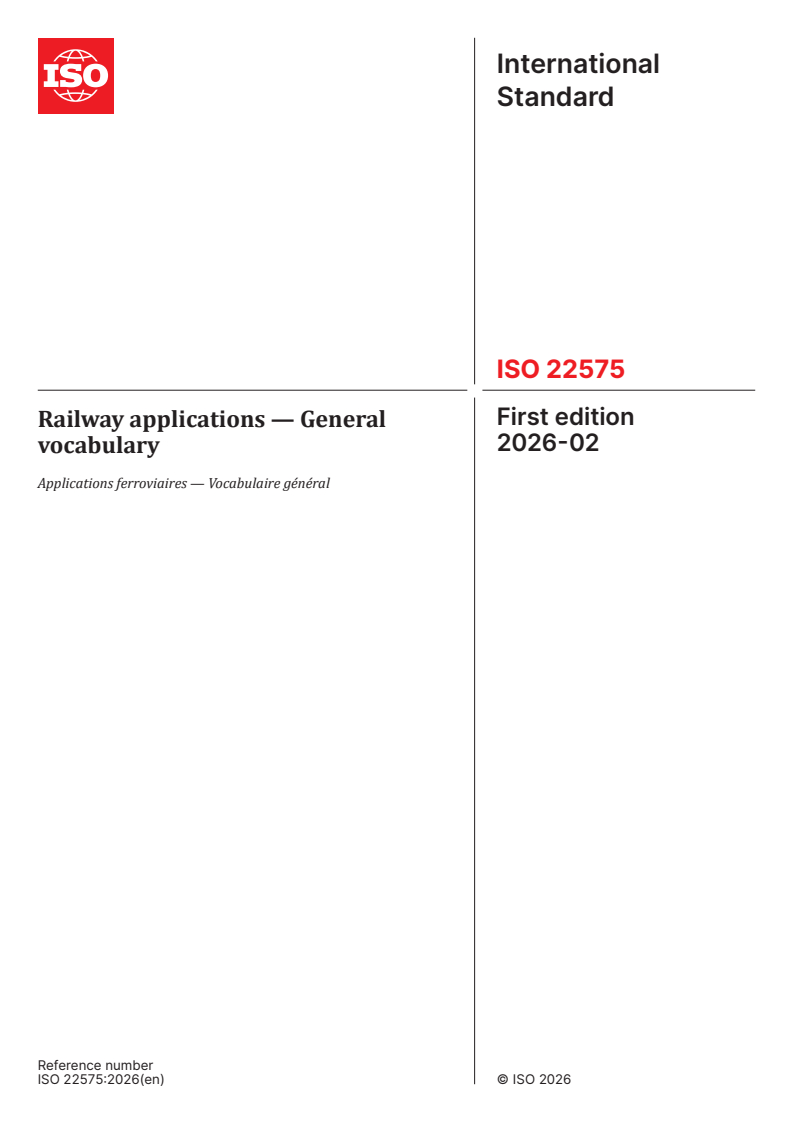
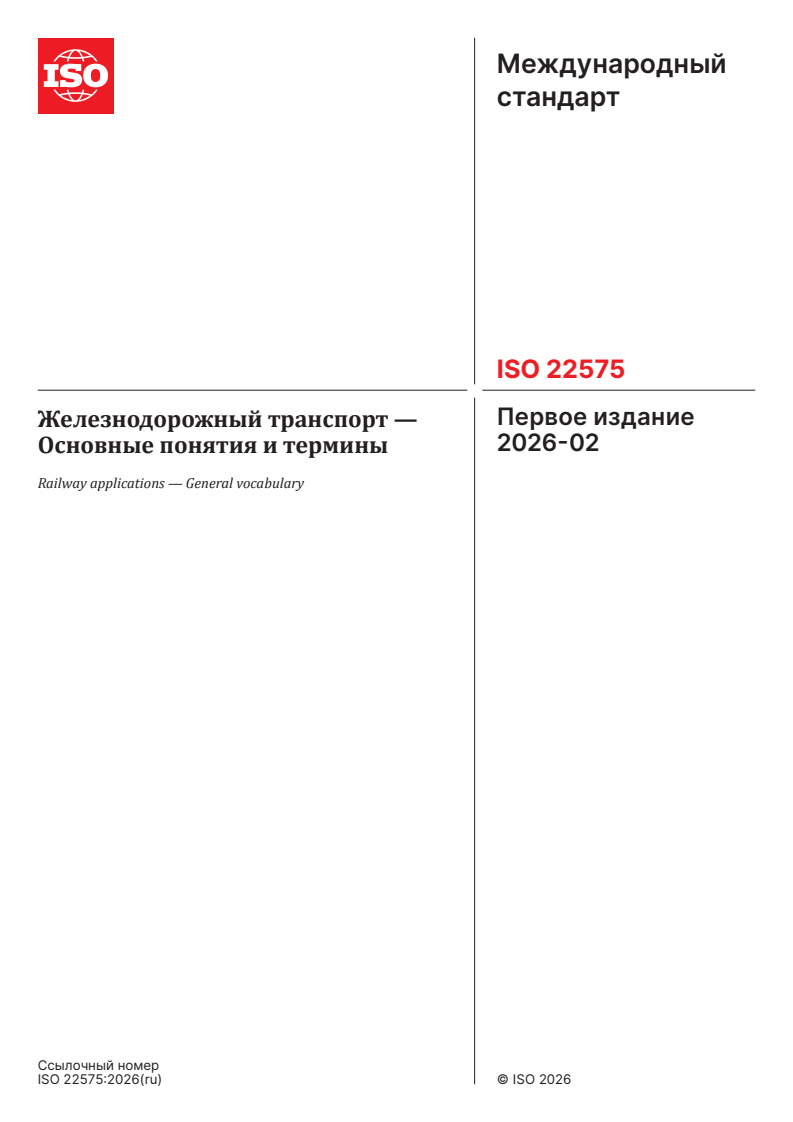
International
Standard
ISO 22575
First edition
Railway applications — General
2026-02
vocabulary
Applications ferroviaires — Vocabulaire général
Reference number
© ISO 2026
All rights reserved. Unless otherwise specified, or required in the context of its implementation, no part of this publication may
be reproduced or utilized otherwise in any form or by any means, electronic or mechanical, including photocopying, or posting on
the internet or an intranet, without prior written permission. Permission can be requested from either ISO at the address below
or ISO’s member body in the country of the requester.
ISO copyright office
CP 401 • Ch. de Blandonnet 8
CH-1214 Vernier, Geneva
Phone: +41 22 749 01 11
Email: copyright@iso.org
Website: www.iso.org
Published in Switzerland
ii
Contents Page
Foreword .iv
Introduction .v
1 Scope . 1
2 Normative references . 1
3 Terms and definitions . 1
Annex A (informative) Structure of terms . 7
Bibliography . 9
iii
Foreword
ISO (the International Organization for Standardization) is a worldwide federation of national standards
bodies (ISO member bodies). The work of preparing International Standards is normally carried out through
ISO technical committees. Each member body interested in a subject for which a technical committee
has been established has the right to be represented on that committee. International organizations,
governmental and non-governmental, in liaison with ISO, also take part in the work. ISO collaborates closely
with the International Electrotechnical Commission (IEC) on all matters of electrotechnical standardization.
The procedures used to develop this document and those intended for its further maintenance are described
in the ISO/IEC Directives, Part 1. In particular, the different approval criteria needed for the different types
of ISO documents should be noted. This document was drafted in accordance with the editorial rules of the
ISO/IEC Directives, Part 2 (see www.iso.org/directives).
ISO draws attention to the possibility that the implementation of this document may involve the use of (a)
patent(s). ISO takes no position concerning the evidence, validity or applicability of any claimed patent
rights in respect thereof. As of the date of publication of this document, ISO had not received notice of (a)
patent(s) which may be required to implement this document. However, implementers are cautioned that
this may not represent the latest information, which may be obtained from the patent database available at
www.iso.org/patents. ISO shall not be held responsible for identifying any or all such patent rights.
Any trade name used in this document is information given for the convenience of users and does not
constitute an endorsement.
For an explanation of the voluntary nature of standards, the meaning of ISO specific terms and expressions
related to conformity assessment, as well as information about ISO's adherence to the World Trade
Organization (WTO) principles in the Technical Barriers to Trade (TBT), see www.iso.org/iso/foreword.html.
This document was prepared by Technical Committee ISO/TC 269, Railway applications.
Any feedback or questions on this document should be directed to the user’s national standards body. A
complete listing of these bodies can be found at www.iso.org/members.html.
iv
Introduction
The purpose of this document is to standardize the terms and definitions, used in the field of railway
application including design, construction, manufacture, equipment, operations and maintenance.
This document aims to eliminate:
— misunderstandings;
— effort and time related to defining terms during the preparation of a new standard or the revision of a
standard; and
— errors arising from the translation process.
Terms and definitions that are common between different structural subsystems are given in this document.
Terms and definitions exclusively used within a specialist area are not included, such as those in:
— ISO 24478;
— ISO 19659-1.
This document also does not cover terms and definitions related to electrotechnical and electronic products
and services for railway application, which are given in IEC standards.
It is the intention to extend this document with further terms and definitions in future revisions.
It is intended for new railway standards or revisions of existing railway standards to reference this
document, to avoid repetitions and deviations of terms and definitions in railway standards.
Several of the terms used in the field of railway systems have had different meanings in different languages
and at different periods in history. This document brings together a consensus of opinions by those charged
with its drafting as to the most effective unambiguous definitions for future use.
Typically, the terms and definitions in this document do not imply operational or geographical aspects. If
a term is implying operational or geographical aspects, the respective term can be expanded by using the
definitions of this document.
Terms given in this document are basic terms, some of which can be combined.
v
International Standard ISO 22575:2026(en)
Railway applications — General vocabulary
1 Scope
This document defines general terms and definitions for systems, products and services related to railway
applications.
This document does not cover terms and definitions related to electrotechnical and electronic products and
services for railway applications.
2 Normative references
There are no normative references in this document.
3 Terms and definitions
ISO and IEC maintain terminology databases for use in standardization at the following addresses:
— ISO Online browsing platform: available at https:// www .iso .org/ obp
— IEC Electropedia: available at https:// www .electropedia .org/
3.1
railway system
system of railway infrastructure (3.5), related rolling stock (3.2) and railway operation (3.6)
Note 1 to entry: The term “railroad” is used in some regions, e.g. in North America.
Note 2 to entry: For the structure of terms, see Figure A.1.
3.1.1
conventional railway system
railway system (3.1) in which rolling stock (3.2) is supported and guided by steel wheels on a pair of steel
rails located beneath the rolling stock
Note 1 to entry: Speed and track gauge are not considered for defining conventional railway system.
3.1.2
non-conventional railway system
railway system (3.1) in which rolling stock (3.2) is supported and guided by means other than steel wheels on
a pair of steel rails located beneath the rolling stock
EXAMPLE Monorail system, hanging system, magnetic levitation system, rubber tyred system.
3.1.2.1
magnetic levitation system
maglev system
non-conventional railway system (3.1.2) in which the vehicle is lifted, guided and propelled using magnetic
attraction or repulsion
3.1.3
main line railway system
railway system (3.1) intended either for regional or long-distance transport services, either at national or
international level
3.1.4
urban guided transport
UGT
railway system (3.1) designed to provide urban and suburban transport services
EXAMPLE Metro system, tram system.
3.1.4.1
metro system
urban guided transport (UGT) (3.1.4) operated using a command and control system segregated from road
traffic and any other railway system (3.1)
Note 1 to entry: A metro system can include underground, elevated or surface sections.
Note 2 to entry: The term “subway” is also used for an underground system.
3.1.4.2
tram system
urban guided transport (UGT) (3.1.4) operated on infrastructure shared with road traffic or separate
infrastructure, or both
Note 1 to entry: Tram systems having some sections segregated from road traffic can be called a light rail system
(LRS).
Note 2 to entry: Road traffic includes powered road vehicles, pedestrians, cyclists, wheelchair users, etc.
3.2
rolling stock
railway vehicles (3.2.1) covering all types or formations of railway vehicles
3.2.1
railway vehicle
rail vehicle
individual element of a means of transport mechanically or magnetically guided and supported by track
3.2.2
unit
assembly of one or mo
...
Norme
internationale
ISO 22575
Première édition
Applications ferroviaires —
2026-02
Vocabulaire général
Railway applications — General vocabulary
Numéro de référence
DOCUMENT PROTÉGÉ PAR COPYRIGHT
© ISO 2026
Tous droits réservés. Sauf prescription différente ou nécessité dans le contexte de sa mise en œuvre, aucune partie de cette
publication ne peut être reproduite ni utilisée sous quelque forme que ce soit et par aucun procédé, électronique ou mécanique,
y compris la photocopie, ou la diffusion sur l’internet ou sur un intranet, sans autorisation écrite préalable. Une autorisation peut
être demandée à l’ISO à l’adresse ci-après ou au comité membre de l’ISO dans le pays du demandeur.
ISO copyright office
Case postale 401 • Ch. de Blandonnet 8
CH-1214 Vernier, Genève
Tél.: +41 22 749 01 11
E-mail: copyright@iso.org
Web: www.iso.org
Publié en Suisse
ii
Sommaire Page
Avant-propos .iv
Introduction .v
1 Domaine d'application . 1
2 Références normatives . 1
3 Termes et définitions . 1
Annexe A (informative) Structure des termes . 7
Bibliographie . 9
iii
Avant-propos
L'ISO (Organisation internationale de normalisation) est une fédération mondiale d'organismes nationaux
de normalisation (comités membres de l'ISO). L'élaboration des Normes internationales est en général
confiée aux comités techniques de l'ISO. Chaque comité membre intéressé par une étude a le droit de faire
partie du comité technique créé à cet effet. Les organisations internationales, gouvernementales et non
gouvernementales, en liaison avec l'ISO participent également aux travaux. L'ISO collabore étroitement avec
la Commission électrotechnique internationale (IEC) en ce qui concerne la normalisation électrotechnique.
Les procédures utilisées pour élaborer le présent document et celles destinées à sa mise à jour sont
décrites dans les Directives ISO/IEC, Partie 1. Il convient, en particulier, de prendre note des différents
critères d'approbation requis pour les différents types de documents ISO. Le présent document a
été rédigé conformément aux règles de rédaction données dans les Directives ISO/IEC, Partie 2 (voir
www.iso.org/directives).
L’ISO attire l’attention sur le fait que la mise en application du présent document peut entraîner l’utilisation
d’un ou de plusieurs brevets. L’ISO ne prend pas position quant à la preuve, à la validité et à l’applicabilité de
tout droit de brevet revendiqué à cet égard. À la date de publication du présent document, l’ISO n'avait pas
reçu notification qu’un ou plusieurs brevets pouvaient être nécessaires à sa mise en application. Toutefois,
il y a lieu d’avertir les responsables de la mise en application du présent document que des informations
plus récentes sont susceptibles de figurer dans la base de données de brevets, disponible à l'adresse
www.iso.org/brevets. L’ISO ne saurait être tenue pour responsable de ne pas avoir identifié tout ou partie de
tels droits de propriété.
Les appellations commerciales éventuellement mentionnées dans le présent document sont données pour
information, par souci de commodité, à l’intention des utilisateurs et ne sauraient constituer un engagement.
Pour une explication de la nature volontaire des normes, la signification des termes et expressions
spécifiques de l'ISO liés à l'évaluation de la conformité, ou pour toute information au sujet de l'adhésion de
l'ISO aux principes de l’Organisation mondiale du commerce (OMC) concernant les obstacles techniques au
commerce (OTC), voir www.iso.org/avant-propos.
Le présent document a été élaboré par le comité technique ISO/TC 269, Applications ferroviaires.
Il convient que l’utilisateur adresse tout retour d’information ou toute question concernant le présent
document à l’organisme national de normalisation de son pays. Une liste exhaustive desdits organismes se
trouve à l’adresse www.iso.org/fr/members.html.
iv
Introduction
L'objectif du document est de normaliser les termes et définitions utilisés dans le domaine des applications
ferroviaires, y compris la conception, la construction, la fabrication, l'équipement, l'exploitation et la
maintenance.
Le présent document vise à éliminer:
— les malentendus;
— les efforts et le temps liés à la définition des termes lors de la préparation ou de la révision d'une nouvelle
norme;
— les erreurs résultant du processus de traduction.
Le présent document fournit les termes et définitions communs à différents sous-systèmes structurels. Les
termes et définitions exclusivement utilisés dans un domaine spécialisé ne sont pas inclus, par exemple ceux
des documents suivants:
— ISO 24478;
— ISO 19659-1.
Le présent document ne couvre pas non plus les termes et définitions liés aux produits et services
électrotechniques et électroniques destinés aux applications ferroviaires, fournis dans les normes de l'IEC.
Il est prévu d'étoffer ce document avec d'autres termes et définitions dans les révisions futures.
Il est prévu que les nouvelles normes ferroviaires ou les révisions des normes ferroviaires existantes fassent
référence au présent document afin d'éviter les répétitions et d’uniformiser les termes et définitions dans les
normes ferroviaires.
Certains termes utilisés dans le domaine des systèmes ferroviaires ont eu des significations différentes dans
différentes langues et à différentes périodes de l'histoire. Le présent document résulte d’un consensus des
opinions exprimées par ceux qui ont été chargés de sa rédaction dans le sens le moins ambigu possible pour
un usage futur.
En règle générale, les termes et définitions contenus dans le présent document n'impliquent pas d'aspects
opérationnels ou géographiques. Si un terme implique des aspects opérationnels ou géographiques, il peut
être développé en utilisant les définitions du présent document.
Les termes contenus dans ce document sont des termes de base, dont certains peuvent être combinés.
v
Norme internationale ISO 22575:2026(fr)
Applications ferroviaires — Vocabulaire général
1 Domaine d'application
Le présent document fournit des termes généraux et des définitions pour les systèmes, produits et services
liés aux applications ferroviaires.
Le présent document ne couvre pas les termes et définitions liés aux produits et services électrotechniques
et électroniques pour les applications ferroviaires.
2 Références normatives
Le présent document ne contient aucune référence normative.
3 Termes et définitions
L'ISO et l'IEC tiennent à jour des bases de données terminologiques destinées à être utilisées en normalisation,
consultables aux adresses suivantes:
— ISO Online browsing platform: disponible à l'adresse https:// www .iso .org/ obp
— IEC Electropedia: disponible à l'adresse https:// www .electropedia .org/
3.1
système ferroviaire
système d’infrastructure ferroviaire (3.5), matériel roulant (3.2) et exploitation ferroviaire (3.6) associés
Note 1 à l'article: Pour la structure des termes, voir la Figure A.1.
3.1.1
système ferroviaire conventionnel
système ferroviaire (3.1) dans lequel le matériel roulant (3.2) est soutenu et guidé par des roues en acier sur
deux rails en acier situés au-dessous du matériel roulant
Note 1 à l'article: La vitesse et l'écartement des voies ne sont pas pris en compte pour la définition du système
ferroviaire conventionnel.
3.1.2
système ferroviaire non conventionnel
système ferroviaire (3.1) dans lequel le matériel roulant (3.2) est soutenu et guidé par des moyens autres que
des roues en acier sur deux rails en acier situés au-dessous du matériel roulant
EXEMPLE Système monorail, système suspendu, système à sustentation magnétique, système à pneus en
caoutchouc.
3.1.2.1
système à sustentation magnétique
système Maglev
système ferroviaire non conventionnel (3.1.2) dans lequel le véhicule est en sustentation, guidé et propulsé à
l’aide de l’attraction ou de la répulsion magnétiques
3.1.3
système ferroviaire de grandes lignes
système ferroviaire (3.1) destiné aux services de transport régionaux ou longue distance, au niveau national
ou international
3.1.4
transport guidé urbain
TGU
système ferroviaire (3.1) conçu pour fournir des services de transport urbain et suburbain
EXEMPLE Système métro, système tram.
3.1.4.1
système métro
transport guidé urbain (TGU) (3.1.4) exploité par un système de contrôle-commande, séparé du trafic routier
et de tout autre système ferroviaire (3.1)
Note 1 à l'article: Le système métro peut comprendre des parties souterraines, surélevées ou au niveau du sol.
3.1.4.2
système tram
transport guidé urbain (TGU) (3.1.4) exploité sur une infrastructure partagée avec le trafic routier ou une
infrastructure séparée, ou les deux
Note 1 à l'article: Pour des systèmes tram ayant des sections séparées du trafic routier, le terme système ferroviaire
léger (SFL) peut être utilisé.
Note 2 à l'article: Le trafic routier comprend les véhicules routiers motorisés, les piétons, les cyclistes, les personnes
en fauteuil roulant, etc.
3.2
matériel roulant
véhicules ferroviaires (3.2.1), y compris tous les types de ou toute formation de véhicules ferroviaires
3.2.1
véhicule ferroviaire
élément individuel d’un moyen de transport avec un guidage mécanique ou magnétique et soutenu par la
voie
3.2.2
unité
assemblage d’un ou de plusieurs véhicules ferroviaires (3.2.1)
3.2.2.1
formation fixe de véhicules
véhicules ferroviaires (3.2.1) ou unités (3.2.2) conçus pour être accouplés ou désaccouplés ou assemblés ou
désassemblés uniquement en atelier
3.2.2.1.1
unité articulée
unité (3.2.2) dans laquelle les véhicules ferroviaires (3.2.1) partagent des organes de roulement ou so
...
Международный
стандарт
ISO 22575
Первое издание
Железнодорожный транспорт —
2026-02
Основные понятия и термины
Railway applications — General vocabulary
Ссылочный номер
ДОКУМЕНТ ЗАЩИЩЕН АВТОРСКИМ ПРАВОМ
© ISO 2026
Все права сохраняются. Если не указано иное и не требуется в контексте внедрения, никакую часть настоящей
публикации нельзя копировать или использовать в какой-либо форме или каким-либо электронным или механическим
способом, включая фотокопирование, или размещение в сети интернет или интранет, без предварительного
письменного согласия ISO. Запрос о разрешении может быть направлен по адресу, приведенному ниже, или в комитет –
член ISO в стране запрашивающей стороны.
ISO copyright office
CP 401 • Ch. de Blandonnet 8
CH-1214 Vernier, Geneva
Телефон: +41 22 749 01 11
Email: copyright@iso.org
Веб-сайт: www.iso.org
Опубликовано в Швейцарии
ii
Содержание Стр.
Предисловие .iv
Введение .v
1 Область применения .1
2 Нормативные ссылки .1
3 Термины и определения .1
Приложение А (справочное) Структура терминов .9
Библиография .11
iii
Предисловие
Международная организация по стандартизации (ISO) является всемирной федерацией
национальных организаций по стандартизации (комитетов-членов ISO). Разработка
международных стандартов обычно осуществляется техническими комитетами ISO. Каждый
комитет-член, заинтересованный в деятельности, для которой был создан технический комитет,
имеет право быть представленным в этом комитете. Международные правительственные и
неправительственные организации, имеющие связи с ISO, также принимают участие в работах.
Что касается стандартизации в области электротехники, ISO работает в тесном сотрудничестве с
Международной электротехнической комиссией (IEC).
Процедуры, используемые для разработки настоящего документа и предназначенные для его
дальнейшего поддержания, указаны в Директивах ISO/IEC, часть 1. В особенности следует отметить,
что для различных типов документов ISO необходимы разные критерии для утверждения.
Настоящий документ был разработан в соответствии с редакционными правилами Директив ISO/
IEC, часть 2 (см. www.iso.org/directives).
Необходимо обратить внимание на возможность того, что ряд элементов данного документа могут
быть предметом патентных прав. ISO не занимает никакой позиции относительно доказательств,
действительности или применимости любых заявленных патентных прав в отношении них. На
дату публикации этого документа ИСО не получила уведомление о патенте(ах), который может
потребоваться для внедрения этого документа. Однако разработчики предупреждаются, что это
может не отражать последнюю информацию, которая может быть получена из патентной базы
данных, доступной по адресу. см. www.iso.org/patents. Международная организация ISO не должна
нести ответственность за идентификацию таких прав, частично или полностью.
Любое торговое наименование, использованное в данном документе, является информацией,
предоставляемой для удобства пользователей, а не свидетельством в пользу того или иного товара
или той или иной компании.
Для пояснения добровольного характера стандартов, значения конкретных терминов и
выражений ISO, относящихся к оценке соответствия, а также информацию о соблюдении
Международной организацией ISO принципов ВТО по техническим барьерам в торговле (TБT), см.
www.iso.org/iso/foreword.html.
Данный документ был подготовлен Техническим комитетом ISO/TC 269 Железнодорожный
транспорт.
Все замечания, вопросы и запросы по данному документу следует направлять в свой
национальный орган по стандартизации. Полный перечень этих органов можно найти на сайте
www.iso.org/members.html.
iv
Введение
Цель настоящего документа стандартизировать термины и определения, используемые в
железнодорожной области при проектировании, строительстве, производстве, включая
оборудование, эксплуатацию и техническое обслуживание.
Цель документа:
— исключить недопонимания;
— ократить время и усилия на определение терминов при разработке или пересмотре стандартов;
а также
— исключить ошибки, возникающие в процессе перевода.
В настоящем документе приведены термины и определения, являющиеся общими для различных
структурных подсистем. Термины и определения, используемые исключительно в рамках какой-
либо специализированной области, не включены, например, содержащиеся в стандартах:
— ISO 24478;
— ISO 19659-1.
Настоящий документ также не охватывает термины и определения, относящиеся к
электротехнической и электронной продукции и услугам для железнодорожного транспорта,
которые приведены в стандартах МЭК.
Предполагается расширять настоящий документ дополнительными терминами и определениями в
будущих редакциях.
Предполагается, что новые железнодорожные стандарты или пересматриваемые действующие
железнодорожные стандарты будут ссылаться на настоящий документ, чтобы избежать повторений
и разночтений в терминологии в железнодорожных стандартах.
Некоторые термины, используемые в области железнодорожного транспорта, имели различные
значения в разных языках и в разные исторические периоды. Настоящий документ объединяет
согласованное мнение разработчиков о наиболее эффективных однозначных определениях для
будущего применения.
Как правило, термины и определения в настоящем документе не затрагивают эксплуатационные
или географические аспекты. Если какой-либо термин подразумевает эксплуатационные или
географические аспекты, то он может быть расширен с использованием определений настоящего
документа.
Термины, приведенные в настоящем документе, являются базовыми, некоторые из них могут
сочетаться.
v
Международный стандарт ISO 22575:2026(ru)
Железнодорожный транспорт — Основные понятия и
термины
1 Область применения
Настоящий документ устанавливает общие термины и определения для систем, продукции и услуг
в сфере железнодорожного транспорта.
Настоящий документ не охватывает термины и определения, относящиеся к электротехнической и
электронной продукции и услугам в сфере железнодорожного транспорта.
2 Нормативные ссылки
Настоящий документ не содержит нормативных ссылок.
3 Термины и определения
ISO и IEC ведут терминологические базы данных для применения в стандартизации по следующим
адресам:
— Онлайн-платформа ISO: доступна по адресу https:// www .iso .org/ obp
— Электропедия IEC: доступна по адресу https:// www .electropedia .org/
3.1
железнодорожная система
railway system
система, состоящая из инфраструктуры железных дорог (3.5), соответствующего подвижного
состава (3.2) и эксплуатации железных дорог (3.6)
Примечание 1 к статье: Термин “желензная дорога” используется в некоторых регионах, например, в Северной
Америке.
Примечание 2 к статье: Структура терминов приведена на Рисунке A.1.
3.1.1
традиционная железнодорожная система общего пользования
conventional railway system
железнодорожная система (3.1) в которой подвижной состав (3.2) поддерживается и направляется
стальными колесами на паре стальных рельсов, расположенных под подвижным составом
Примечание 1 к статье: Скорость и ширина колеи не учитываются при определении железнодорожной
системы общего пользования.
3.1.2
нетрадиционная железнодорожная система
non-conventional railway system
железнодорожная система (3.1), в которой подвижной состав (3.2) поддерживается и направляется
средствами, отличными от стальных колес, на паре стальных рельсов, расположенных под
подвижным составом
ПРИМЕР Монорельсовая система, подвесная система, система магнитном подвесе, система на резиновых
колесах.
3.1.2.1
система на магнитном подвесе
magnetic levitation system
система маглев
maglev system
нетрадиционная железнодорожная системаsystem (3.1.2), при которой транспортное средство
приподнимается, направляется и приводится в движение с использованием магнитного
притяжения и отталкивания
3.1.3
система магистральных железных дорог
main line railway system
железнодорожная система (3.1) предназначенная для региональных или дальних перевозок на
национальном или международном уровне
3.1.4
городской направляемый транспорт
ГНТ
urban guided transport
UGT
железнодорожная система (3.1), разработанная для обеспечения городских и пригородных
перевозок
ПРИМЕР Система метро, трамваи.
3.1.4.1
система метро
metro system
городской направляемый транспорт (ГНТ) (3.1.4), работающий с использованием системы
управления и контроля, отделенной от автомобильного движения и любой другой железнодорожной
системы (3.1)
Примечание 1 к статье: Система метро может включать подземные, надземные или наземные участки.
Примечание 2 к статье: Термин “subway” также используется для обозначения подземной системы.
3.1.4.2
трамвай
tram system
городской направляемый транспорт (ГНТ) (3.1.4), эксплуатируемый на инфраструктуре,
совмещенной с дорожным движением и/или обособленной инфраструктуре,
Примечание 1 к статье: Трамвайные системы, имеющие некоторые участки, отделенные от автомобильного
движения, могут называться системой легкорельсового транспорта (ЛРП).
Примечание 2 к статье: Дорожное движение включает в себя моторизированные транспортные средства,
пешеходов, велосипедистов, пользователей инвалидных колясок и т. д.
3.2
подвижной состав
rolling stock
железнодорожные транспортные средства (3.2.1), включающие все типы или конфигурации
железнодорожных транспортных средств
3.2.1
железнодорожное транспортное средство
railway vehicle
рельсовое транспортное средство
rail vehicle
отдельный элемент транспортного средства, механически или магнитно направляемое и
опирающееся на железнодорожный путь (рельсы)
3.2.2
единица (подвижного состава)
unit
сборка одного или нескольких железнодорожных транспортных средств (3.2.1)
3.2.2.1
поезд постоянного формирования
fixed formation
железнодорожные транспортные средства (3.2.1) или единицы подвижного состава (3.2.2)
предназначенные для соединения или рассоединения, сборки или переконфигурации
исключительно в условиях депо
3.2.2.1.1
сочлененная единица
articulated unit
единица (3.2.2), в которой железнодорожные транспортные средства (3.2.1) имеют общее ходовое
оборудование или поддерживаются соседними железнодорожными транспортными средствами
3.2.2.2
подвижной состав
trainset
поезд постоянного формирования (3.2.2.1), который является самоходным
3.2.2.3
моторвагонный подвижной состав
МВПС
multiple unit
MU
поезд (3.2.2.2), в котором все железнодорожные транспортные средства (3.2.1) предназначены для
перевозки коммерческих грузов
Примечание 1 к статье: Коммерческим грузом могут быть пассажиры, багаж или грузы.
Примечание 2 к статье: Некоторые МВПС включают промежуточные моторные ваго
...