


ISO/FDIS 25557
(Main)Ageing societies — Care quality for older persons at home and in care facilities
Ageing societies — Care quality for older persons at home and in care facilities
This document would specify requirements and recommendations for the provision of health and social care services for older persons provided by healthcare and social care personnel, irrespective of whether the service is provided in the persons own home or in a care home. The services concerned also include those offered to older people who do not reside permanently at a care home, such as temporary accommodations. Care services are provided in a variety of settings. While this document would focus on those delivered in care facilities including preventive, responsive, and palliative care, many of the requirements can be applied to the provision of care services in any setting. Service provision is based on the individual needs and preferences of the older person to assist self-determination, participation, and a safe and secure old age. The document would encompass the compressive needs of care home residents and the workforce, taking into consideration principles of equity, diversity, and inclusion. This document would apply to all providers of care and support to older persons irrespective of size, structure, legal set up, or funding model (i. e. public or private). Care homes, also referred to as residential, long-term care homes, continuing care, personal care, or nursing homes, are residential settings where the majority of residents often live with complex health care needs. They provide a range of professional health services, lodging, food, and personal care (e.g., assistance with everyday activities) for their residents 24 hours/day, 7 days a week. The document is structured to provide clear requirements and accountabilities to enable care home teams, governing bodies, and other stakeholders to work together toward a common vision for resident-centred, high-quality care. This document would be intended to be used in quality assurance, follow-up, evaluation, and development of such services and can be used as a basis for procurement, training, supervision, and certification. This document would not cover standardization of clinical guidelines and/or medical devices.
Vieillissement de la population — Qualité des soins prodigués aux personnes âgées à domicile et dans les établissements de soins
General Information
- Status
- Not Published
- Technical Committee
- ISO/TC 314 - Ageing societies
- Drafting Committee
- ISO/TC 314 - Ageing societies
- Current Stage
- 5020 - FDIS ballot initiated: 2 months. Proof sent to secretariat
- Start Date
- 06-Jan-2026
- Completion Date
- 06-Jan-2026
Overview
ISO/FDIS 25557 - "Ageing societies - Care quality for older persons at home and in care facilities" defines requirements and recommendations for delivering health and social care to older persons, whether in their own homes, temporary accommodation, or 24/7 residential care homes (including long‑term, nursing or assisted living settings). The standard promotes a person‑centred, integrated care approach that supports self‑determination, dignity, equity, diversity and inclusion. It is intended for use in quality assurance, evaluation, procurement, training, supervision and certification of care services. The document does not standardize clinical guidelines or medical devices.
Key topics and technical requirements
The standard is structured to provide clear requirements and accountabilities across the care lifecycle. Major technical topics include:
- Context and governance: understanding stakeholder needs, integrated care coordination, and governing documents for providers.
- Leadership and ethos: leadership commitment, governance, and organisational culture that support resident‑centred care.
- Risk management: prevention, handling of risks to individuals and organisations, emergency and disaster preparedness.
- Workforce and resources: recruitment, training, supervision, staff wellbeing, and workforce governance.
- Facilities and infrastructure: accessibility, maintenance, food safety, environmental stewardship and household services.
- Clinical and support processes: initial assessment, care planning, documentation, medication handling, infection prevention and palliative care.
- Technology and innovation: use of assistive technology and guidance on artificial intelligence in care settings.
- Quality system and improvement: performance assessment, audits, user feedback, complaints handling and continuous improvement.
- Equity and inclusion: requirements addressing diverse needs and protecting human rights of older persons.
Applications and who uses it
ISO/FDIS 25557 is practical for a broad range of stakeholders:
- Care home operators, residential and long‑term care providers
- Home care agencies and community care coordinators
- Healthcare administrators and nursing leadership
- Regulators, inspectors and accreditation bodies
- Procurement officers using standards for contracting services
- Training organisations and workforce developers
- Quality managers and auditors seeking a framework for assessment and improvement
Practical uses include developing policies, designing care pathways, establishing governance and risk frameworks, staff training curricula, procurement specifications, and preparing for certification or external audits.
Related standards
ISO/FDIS 25557 is produced by ISO/TC 314 (Ageing societies) and complements other ISO standards on health management systems, occupational health and safety, and digital health. Organisations should align implementation with applicable national regulations and clinical guidance where relevant.
Keywords: ISO 25557, care quality, ageing societies, person‑centred care, care home standards, integrated care, long‑term care quality, risk management, workforce training, assistive technology.
Buy Documents

ISO/FDIS 25557 - Ageing societies — Care quality for older persons at home and in care facilities Released:23. 12. 2025
REDLINE ISO/FDIS 25557 - Ageing societies — Care quality for older persons at home and in care facilities Released:23. 12. 2025
Get Certified
Connect with accredited certification bodies for this standard

BSI Group
BSI (British Standards Institution) is the business standards company that helps organizations make excellence a habit.

TÜV Rheinland
TÜV Rheinland is a leading international provider of technical services.

TÜV SÜD
TÜV SÜD is a trusted partner of choice for safety, security and sustainability solutions.
Sponsored listings
Frequently Asked Questions
ISO/FDIS 25557 is a draft published by the International Organization for Standardization (ISO). Its full title is "Ageing societies — Care quality for older persons at home and in care facilities". This standard covers: This document would specify requirements and recommendations for the provision of health and social care services for older persons provided by healthcare and social care personnel, irrespective of whether the service is provided in the persons own home or in a care home. The services concerned also include those offered to older people who do not reside permanently at a care home, such as temporary accommodations. Care services are provided in a variety of settings. While this document would focus on those delivered in care facilities including preventive, responsive, and palliative care, many of the requirements can be applied to the provision of care services in any setting. Service provision is based on the individual needs and preferences of the older person to assist self-determination, participation, and a safe and secure old age. The document would encompass the compressive needs of care home residents and the workforce, taking into consideration principles of equity, diversity, and inclusion. This document would apply to all providers of care and support to older persons irrespective of size, structure, legal set up, or funding model (i. e. public or private). Care homes, also referred to as residential, long-term care homes, continuing care, personal care, or nursing homes, are residential settings where the majority of residents often live with complex health care needs. They provide a range of professional health services, lodging, food, and personal care (e.g., assistance with everyday activities) for their residents 24 hours/day, 7 days a week. The document is structured to provide clear requirements and accountabilities to enable care home teams, governing bodies, and other stakeholders to work together toward a common vision for resident-centred, high-quality care. This document would be intended to be used in quality assurance, follow-up, evaluation, and development of such services and can be used as a basis for procurement, training, supervision, and certification. This document would not cover standardization of clinical guidelines and/or medical devices.
This document would specify requirements and recommendations for the provision of health and social care services for older persons provided by healthcare and social care personnel, irrespective of whether the service is provided in the persons own home or in a care home. The services concerned also include those offered to older people who do not reside permanently at a care home, such as temporary accommodations. Care services are provided in a variety of settings. While this document would focus on those delivered in care facilities including preventive, responsive, and palliative care, many of the requirements can be applied to the provision of care services in any setting. Service provision is based on the individual needs and preferences of the older person to assist self-determination, participation, and a safe and secure old age. The document would encompass the compressive needs of care home residents and the workforce, taking into consideration principles of equity, diversity, and inclusion. This document would apply to all providers of care and support to older persons irrespective of size, structure, legal set up, or funding model (i. e. public or private). Care homes, also referred to as residential, long-term care homes, continuing care, personal care, or nursing homes, are residential settings where the majority of residents often live with complex health care needs. They provide a range of professional health services, lodging, food, and personal care (e.g., assistance with everyday activities) for their residents 24 hours/day, 7 days a week. The document is structured to provide clear requirements and accountabilities to enable care home teams, governing bodies, and other stakeholders to work together toward a common vision for resident-centred, high-quality care. This document would be intended to be used in quality assurance, follow-up, evaluation, and development of such services and can be used as a basis for procurement, training, supervision, and certification. This document would not cover standardization of clinical guidelines and/or medical devices.
ISO/FDIS 25557 is classified under the following ICS (International Classification for Standards) categories: 11.020.10 - Health care services in general. The ICS classification helps identify the subject area and facilitates finding related standards.
ISO/FDIS 25557 is available in PDF format for immediate download after purchase. The document can be added to your cart and obtained through the secure checkout process. Digital delivery ensures instant access to the complete standard document.
Standards Content (Sample)
FINAL DRAFT
International
Standard
ISO/TC 314
Ageing societies — Care quality for
Secretariat: BSI
older persons at home and in care
Voting begins on:
facilities
2026-01-06
Voting terminates on:
2026-03-03
RECIPIENTS OF THIS DRAFT ARE INVITED TO SUBMIT,
WITH THEIR COMMENTS, NOTIFICATION OF ANY
RELEVANT PATENT RIGHTS OF WHICH THEY ARE AWARE
AND TO PROVIDE SUPPOR TING DOCUMENTATION.
IN ADDITION TO THEIR EVALUATION AS
BEING ACCEPTABLE FOR INDUSTRIAL, TECHNO
LOGICAL, COMMERCIAL AND USER PURPOSES, DRAFT
INTERNATIONAL STANDARDS MAY ON OCCASION HAVE
TO BE CONSIDERED IN THE LIGHT OF THEIR POTENTIAL
TO BECOME STAN DARDS TO WHICH REFERENCE MAY BE
MADE IN NATIONAL REGULATIONS.
Reference number
FINAL DRAFT
International
Standard
ISO/TC 314
Ageing societies — Care quality for
Secretariat: BSI
older persons at home and in care
Voting begins on:
facilities
2026-01-02
Voting terminates on:
RECIPIENTS OF THIS DRAFT ARE INVITED TO SUBMIT,
WITH THEIR COMMENTS, NOTIFICATION OF ANY
RELEVANT PATENT RIGHTS OF WHICH THEY ARE AWARE
AND TO PROVIDE SUPPOR TING DOCUMENTATION.
© ISO 2026
IN ADDITION TO THEIR EVALUATION AS
All rights reserved. Unless otherwise specified, or required in the context of its implementation, no part of this publication may
BEING ACCEPTABLE FOR INDUSTRIAL, TECHNO
LOGICAL, COMMERCIAL AND USER PURPOSES, DRAFT
be reproduced or utilized otherwise in any form or by any means, electronic or mechanical, including photocopying, or posting on
INTERNATIONAL STANDARDS MAY ON OCCASION HAVE
the internet or an intranet, without prior written permission. Permission can be requested from either ISO at the address below
TO BE CONSIDERED IN THE LIGHT OF THEIR POTENTIAL
or ISO’s member body in the country of the requester.
TO BECOME STAN DARDS TO WHICH REFERENCE MAY BE
MADE IN NATIONAL REGULATIONS.
ISO copyright office
CP 401 • Ch. de Blandonnet 8
CH-1214 Vernier, Geneva
Phone: +41 22 749 01 11
Email: copyright@iso.org
Website: www.iso.org
Published in Switzerland Reference number
ii
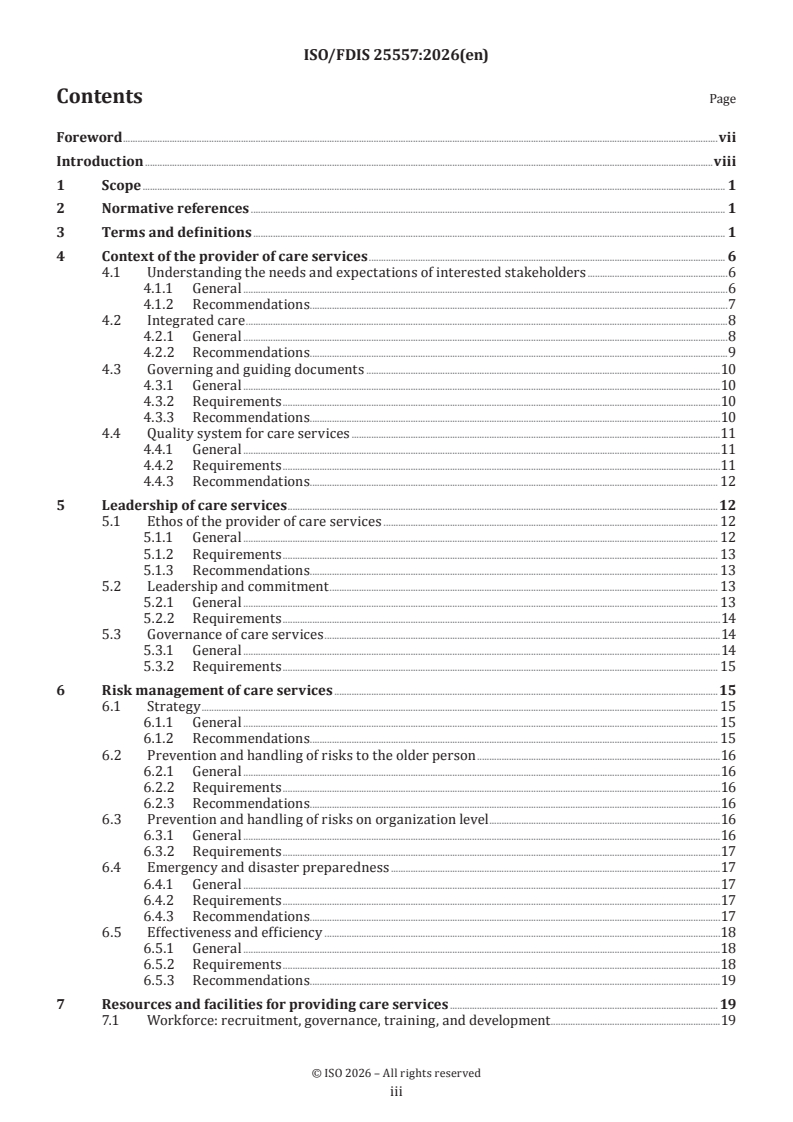
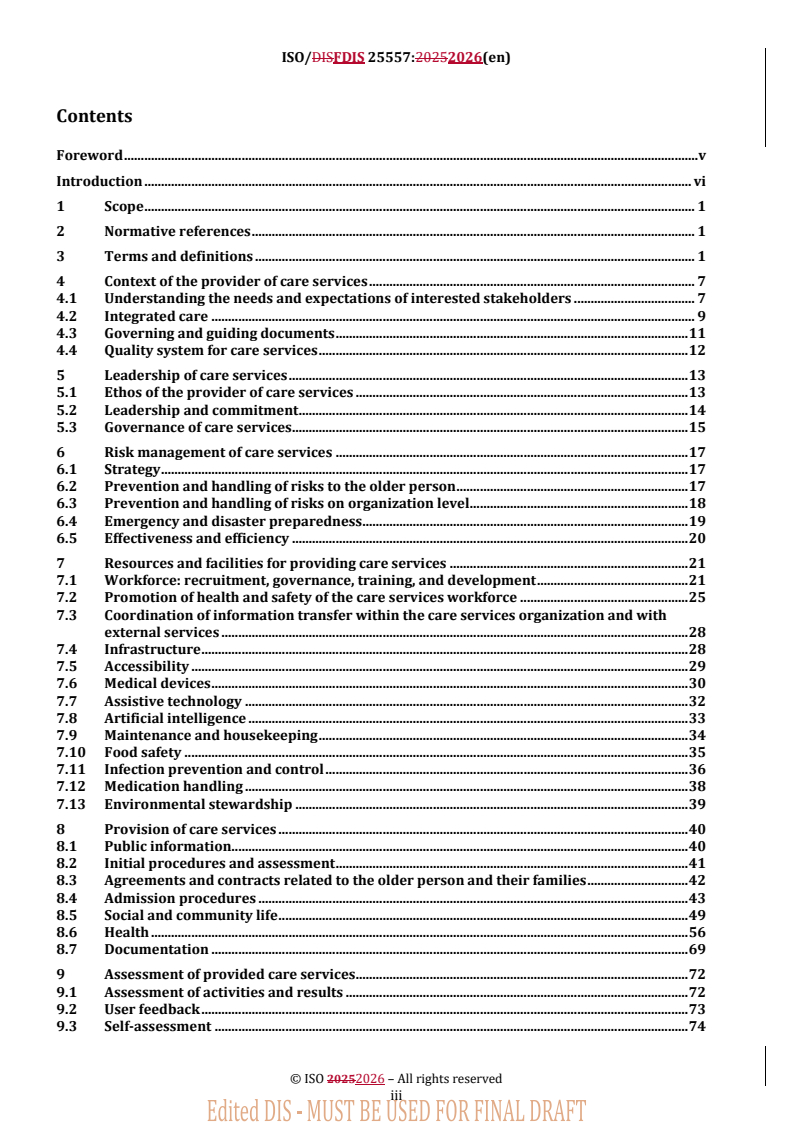
Contents Page
Foreword .vii
Introduction .viii
1 Scope . 1
2 Normative references . 1
3 Terms and definitions . 1
4 Context of the provider of care services . 6
4.1 Understanding the needs and expectations of interested stakeholders .6
4.1.1 General .6
4.1.2 Recommendations.7
4.2 Integrated care .8
4.2.1 General .8
4.2.2 Recommendations.9
4.3 Governing and guiding documents .10
4.3.1 General .10
4.3.2 Requirements .10
4.3.3 Recommendations.10
4.4 Quality system for care services .11
4.4.1 General .11
4.4.2 Requirements .11
4.4.3 Recommendations. 12
5 Leadership of care services .12
5.1 Ethos of the provider of care services . 12
5.1.1 General . 12
5.1.2 Requirements . 13
5.1.3 Recommendations. 13
5.2 Leadership and commitment . 13
5.2.1 General . 13
5.2.2 Requirements .14
5.3 Governance of care services .14
5.3.1 General .14
5.3.2 Requirements . 15
6 Risk management of care services .15
6.1 Strategy . 15
6.1.1 General . 15
6.1.2 Recommendations. 15
6.2 Prevention and handling of risks to the older person .16
6.2.1 General .16
6.2.2 Requirements .16
6.2.3 Recommendations.16
6.3 Prevention and handling of risks on organization level .16
6.3.1 General .16
6.3.2 Requirements .17
6.4 Emergency and disaster preparedness .17
6.4.1 General .17
6.4.2 Requirements .17
6.4.3 Recommendations.17
6.5 Effectiveness and efficiency .18
6.5.1 General .18
6.5.2 Requirements .18
6.5.3 Recommendations.19
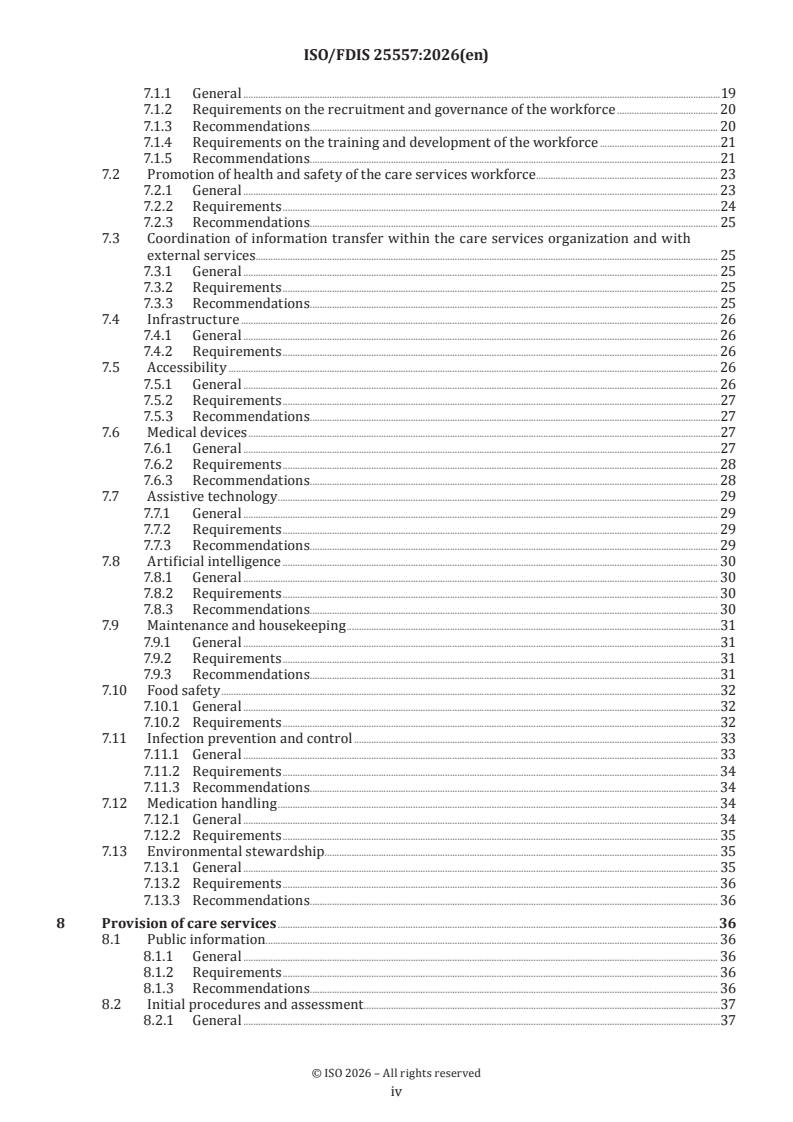
7 Resources and facilities for providing care services . 19
7.1 Workforce: recruitment, governance, training, and development .19
iii
7.1.1 General .19
7.1.2 Requirements on the recruitment and governance of the workforce . 20
7.1.3 Recommendations. 20
7.1.4 Requirements on the training and development of the workforce .21
7.1.5 Recommendations.21
7.2 Promotion of health and safety of the care services workforce . 23
7.2.1 General . 23
7.2.2 Requirements .24
7.2.3 Recommendations. 25
7.3 Coordination of information transfer within the care services organization and with
external services. 25
7.3.1 General . 25
7.3.2 Requirements . 25
7.3.3 Recommendations. 25
7.4 Infrastructure . 26
7.4.1 General . 26
7.4.2 Requirements . 26
7.5 Accessibility . 26
7.5.1 General . 26
7.5.2 Requirements .27
7.5.3 Recommendations.27
7.6 Medical devices .27
7.6.1 General .27
7.6.2 Requirements . 28
7.6.3 Recommendations. 28
7.7 Assistive technology . 29
7.7.1 General . 29
7.7.2 Requirements . 29
7.7.3 Recommendations. 29
7.8 Artificial intelligence . 30
7.8.1 General . 30
7.8.2 Requirements . 30
7.8.3 Recommendations. 30
7.9 Maintenance and housekeeping .31
7.9.1 General .31
7.9.2 Requirements .31
7.9.3 Recommendations.31
7.10 Food safety .32
7.10.1 General .32
7.10.2 Requirements .32
7.11 Infection prevention and control . 33
7.11.1 General . 33
7.11.2 Requirements . 34
7.11.3 Recommendations. 34
7.12 Medication handling . 34
7.12.1 General . 34
7.12.2 Requirements . 35
7.13 Environmental stewardship. 35
7.13.1 General . 35
7.13.2 Requirements . 36
7.13.3 Recommendations. 36
8 Provision of care services .36
8.1 Public information . . 36
8.1.1 General . 36
8.1.2 Requirements . 36
8.1.3 Recommendations. 36
8.2 Initial procedures and assessment .37
8.2.1 General .37
iv
8.2.2 Requirements .37
8.2.3 Recommendations. 38
8.3 Agreements and contracts related to the older person and their families . 38
8.3.1 General . 38
8.3.2 Requirements . 39
8.3.3 Recommendations. 39
8.4 Admission procedures . 39
8.4.1 When receiving care at home. 39
8.4.2 When receiving care at a care home .41
8.4.3 Providing a welcoming and safe home-like environment .43
8.5 Social and community life . 44
8.5.1 Rights, diversity, integrity and participation . 44
8.5.2 Security and safety . 46
8.5.3 Communication and information .47
8.5.4 Activities and events . 48
8.5.5 Financial procedures . 49
8.5.6 Informal carers, people close to the older person and volunteers . 50
8.6 Health.51
8.6.1 Health promotion . .51
8.6.2 Health literacy .52
8.6.3 Assessment of care and support during ongoing care .52
8.6.4 Cognitive function and mental health . 53
8.6.5 Food, drink, meals, nutrition and dehydration . 54
8.6.6 Oral health, dental health and swallowing . 55
8.6.7 Bladder and bowel function. 56
8.6.8 Personal care, skin integrity and wounds .57
8.6.9 Pain . 58
8.6.10 Sleep .59
8.6.11 Medications .59
8.6.12 Palliative and end-of-life -care . 60
8.7 Documentation .62
8.7.1 Care plans .62
8.7.2 Records and documentation . 64
9 Assessment of provided care services .64
9.1 Assessment of activities and results . 64
9.1.1 General . 64
9.1.2 Requirements . 65
9.1.3 Recommendations. 65
9.2 User feedback . 66
9.2.1 General . 66
9.2.2 Requirements . 66
9.2.3 Recommendations. 66
9.3 Self-assessment . 66
9.3.1 General . 66
9.3.2 Requirements .67
9.4 Audits .67
9.4.1 General .67
9.4.2 Requirements .67
9.4.3 Recommendations. 68
10 Improvement of care services .68
10.1 Promoting quality improvement and innovation in care services . 68
10.1.1 General . 68
10.1.2 Requirements . 68
10.1.3 Recommendations. 68
10.2 Non-fulfilment of requirements and adverse events. 69
10.2.1 General . 69
10.2.2 Requirements . 69
10.2.3 Recommendations. 69
v
10.3 Suggestions and complaints . 69
10.3.1 General . 69
10.3.2 Requirements .70
10.4 Conformance assessment . .70
Annex A (informative) The holistic framework of health and care services in ageing societies .71
Annex B (informative) Assessment and assessment tools . 74
Annex C (informative) Conformity with requirements and recommendations .78
Bibliography .81
vi
Foreword
ISO (the International Organization for Standardization) is a worldwide federation of national standards
bodies (ISO member bodies). The work of preparing International Standards is normally carried out through
ISO technical committees. Each member body interested in a subject for which a technical committee
has been established has the right to be represented on that committee. International organizations,
governmental and non-governmental, in liaison with ISO, also take part in the work. ISO collaborates closely
with the International Electrotechnical Commission (IEC) on all matters of electrotechnical standardization.
The procedures used to develop this document and those intended for its further maintenance are described
in the ISO/IEC Directives, Part 1. In particular, the different approval criteria needed for the different types
of ISO documents should be noted. This document was drafted in accordance with the editorial rules of the
ISO/IEC Directives, Part 2 (see www.iso.org/directives).
ISO draws attention to the possibility that the implementation of this document may involve the use of (a)
patent(s). ISO takes no position concerning the evidence, validity or applicability of any claimed patent
rights in respect thereof. As of the date of publication of this document, ISO had not received notice of (a)
patent(s) which may be required to implement this document. However, implementers are cautioned that
this may not represent the latest information, which may be obtained from the patent database available at
www.iso.org/patents. ISO shall not be held responsible for identifying any or all such patent rights.
Any trade name used in this document is information given for the convenience of users and does not
constitute an endorsement.
For an explanation of the voluntary nature of standards, the meaning of ISO specific terms and expressions
related to conformity assessment, as well as information about ISO’s adherence to the World Trade
Organization (WTO) principles in the Technical Barriers to Trade (TBT), see www.iso.org/iso/foreword.html.
This document was prepared by Technical Committee ISO/TC 314, Ageing societies.
Any feedback or questions on this document should be directed to the user’s national standards body. A
complete listing of these bodies can be found at www.iso.org/members.html.
vii
Introduction
This document supports the United Nations Principles for older persons:
— Older persons should be able to live in environments that are safe and adaptable to personal preferences
and changing capacities.
— Older persons should be able to reside at home for as long as possible.
— Older persons should benefit from family and community care and protection in accordance with each
society’s system of cultural values.
— Older persons should be able to utilize appropriate levels of institutional care providing protection,
rehabilitation, and social and mental stimulation in a humane and secure environment.
— Older persons should be able to enjoy human rights and fundamental freedoms when residing in any
shelter, care, or treatment facility, including full respect for their dignity, beliefs, needs and privacy and
for the right to make decisions about their care and the quality of their lives.
— Older persons should be able to live in dignity and security and be free of exploitation and physical or
mental abuse. Older persons should be treated fairly regardless of age, sex, ethnic background, disability,
or other status, and be valued independently of their economic contribution.
NOTE 1 The first article of the Universal Declaration of Human Rights states that “All human beings are born free
and equal in dignity and rights”. The notion of dignity is defined as the inherent and inalienable worth of all human
beings irrespective of social status such as ethnicity, sex, physical or mental state. Dignity is deeply embedded in
international human rights instruments.
This document is based on the concept integrated care that can be described as methods and strategies for
linking and coordinating the various aspects of care delivered by different care systems, such as the work of
general practitioners, primary and specialty care, preventive and curative services, as well as physical and
mental health services and social care, to meet the multiple needs of an individual older person or category
of persons with similar needs.
An integrated response to care covers health care, social care, care for cognitive diseases, palliative and
end-of-life care, respite care, rehabilitation, services provided at home, in the community, in hospitals or in
care homes, public or private-funded, informal care or care by volunteers.
Care is care, regardless of the environment and should be a seamless provision of health and social services
which are not divided up into silos.
This document adopts a person-centred approach, outlining that care is to be provided with the older
persons’ identity and preferences taking priority. Person-centred care planning is made in close consultation
with the older person, with a goal to improve, restore, and maintain health and wellbeing so the older person
can age with dignity, be respected, and determine how they will live their life while receiving care. For those
persons assessed as “lacking mental capacity” the care planning is made in consultation with appointed
chosen decision maker or representative.
Care providers are responsible for ensuring that the health and wellbeing of the workforce are protected as
this impacts the conditions under which care will be delivered to older persons.
Informal carers provide a high amount of care and support and are able to do so in culturally appropriate
ways that align with the older person’s values. The quality of life of the informal carer is closely linked to the
quality of life of the older person in need of care and support.
Care coordination is needed at a systems level. The integration between social care and health care, both
administratively and at the points of use, is crucial to providing high-quality care. The separation of
social care and health care services can result in fragmented coverage, gaps in the provision of care and
inappropriate use of acute services. This interferes with the rights of older persons to access the support
they need to live to their fullest potential.
viii
A well-supported infrastructure of an aged society includes a comprehensive, holistic framework of health
and care services. See Annex A.
There is also a need for a different approach in the way care and support is organized and a change in the
way older persons and ageing in general are perceived.
Care homes, also referred to as residential care facilities, assisted living facilities, retirement homes or
communities, are settings where the majority of older persons often live with complex care needs. They
provide a range of professional health services, lodging, food, and personal care (e.g. assistance with
everyday activities) for older persons 24 hours a day, every day.
NOTE 2 In some countries medical care is separated from care and is provided by organizations from the health
care sector. When this is the case, the care provider needs to have systems in place to provide medical services or
access to such when needed.
The concepts of healthy ageing and age-friendly environments stresses the importance of enabling the older
person in need of care and support to be involved and empowered to decide how their needs, expectations
and preferences can be met to live as autonomously as possible.
This docume
...
ISO/DISFDIS 25557:2025(en)
ISO/TC 314
Secretariat: BSI
Date: 2025-06-2612-23
Ageing societies - — Care quality for older persons at home and in
care facilities
FDIS stage
Voting begins on: 2026-01-02
Voting terminates on:
All rights reserved. Unless otherwise specified, or required in the context of its implementation, no part of this publication
may be reproduced or utilized otherwise in any form or by any means, electronic or mechanical, including photocopying,
or posting on the internet or an intranet, without prior written permission. Permission can be requested from either ISO
at the address below or ISO’s member body in the country of the requester.
ISO copyright office
CP 401 • Ch. de Blandonnet 8
CH-1214 Vernier, Geneva
Phone: + 41 22 749 01 11
EmailE-mail: copyright@iso.org
Website: www.iso.org
Published in Switzerland
ii
ISO/DISFDIS 25557:20252026(en)
Contents
Foreword . v
Introduction . vi
1 Scope . 1
2 Normative references . 1
3 Terms and definitions . 1
4 Context of the provider of care services . 7
4.1 Understanding the needs and expectations of interested stakeholders . 7
4.2 Integrated care . 9
4.3 Governing and guiding documents . 11
4.4 Quality system for care services . 12
5 Leadership of care services . 13
5.1 Ethos of the provider of care services . 13
5.2 Leadership and commitment . 14
5.3 Governance of care services. 15
6 Risk management of care services . 17
6.1 Strategy . 17
6.2 Prevention and handling of risks to the older person . 17
6.3 Prevention and handling of risks on organization level . 18
6.4 Emergency and disaster preparedness . 19
6.5 Effectiveness and efficiency . 20
7 Resources and facilities for providing care services . 21
7.1 Workforce: recruitment, governance, training, and development . 21
7.2 Promotion of health and safety of the care services workforce . 25
7.3 Coordination of information transfer within the care services organization and with
external services . 28
7.4 Infrastructure . 28
7.5 Accessibility . 29
7.6 Medical devices . 30
7.7 Assistive technology . 32
7.8 Artificial intelligence . 33
7.9 Maintenance and housekeeping . 34
7.10 Food safety . 35
7.11 Infection prevention and control . 36
7.12 Medication handling . 38
7.13 Environmental stewardship . 39
8 Provision of care services . 40
8.1 Public information. 40
8.2 Initial procedures and assessment . 41
8.3 Agreements and contracts related to the older person and their families . 42
8.4 Admission procedures . 43
8.5 Social and community life . 49
8.6 Health . 56
8.7 Documentation . 69
9 Assessment of provided care services . 72
9.1 Assessment of activities and results . 72
9.2 User feedback . 73
9.3 Self-assessment . 74
iii
9.4 Audits . 74
10 Improvement of care services . 75
10.1 Promoting quality improvement and innovation in care services . 75
10.2 Non-fulfilment of requirements and adverse events . 76
10.3 Suggestions and complaints . 77
10.4 Conformance assessment. 78
Annex A (informative) The holistic framework of health and care services in ageing societies . 79
Annex B (informative) Assessment and assessment tools . 83
Annex C (informative) Conformity with requirements and recommendations . 87
Bibliography . 90
iv
ISO/DISFDIS 25557:20252026(en)
Foreword
ISO (the International Organization for Standardization) is a worldwide federation of national standards
bodies (ISO member bodies). The work of preparing International Standards is normally carried out through
ISO technical committees. Each member body interested in a subject for which a technical committee has been
established has the right to be represented on that committee. International organizations, governmental and
non-governmental, in liaison with ISO, also take part in the work. ISO collaborates closely with the
International Electrotechnical Commission (IEC) on all matters of electrotechnical standardization.
The procedures used to develop this document and those intended for its further maintenance are described
in the ISO/IEC Directives, Part 1. In particular, the different approval criteria needed for the different types of
ISO documents should be noted. This document was drafted in accordance with the editorial rules of the
ISO/IEC Directives, Part 2 (see www.iso.org/directives).
Attention is drawnISO draws attention to the possibility that some of the elementsimplementation of this
document may beinvolve the subjectuse of (a) patent(s). ISO takes no position concerning the evidence,
validity or applicability of any claimed patent rights in respect thereof. As of the date of publication of this
document, ISO had not received notice of (a) patent(s) which may be required to implement this document.
However, implementers are cautioned that this may not represent the latest information, which may be
obtained from the patent database available at www.iso.org/patents. ISO shall not be held responsible for
identifying any or all such patent rights. Details of any patent rights identified during the development of the
document will be in the Introduction and/or on the ISO list of patent declarations received (see ).
Any trade name used in this document is information given for the convenience of users and does not
constitute an endorsement.
For an explanation of the voluntary nature of standards, the meaning of ISO specific terms and expressions
related to conformity assessment, as well as information about ISO'sISO’s adherence to the World Trade
Organization (WTO) principles in the Technical Barriers to Trade (TBT), see www.iso.org/iso/foreword.html.
This document was prepared by Technical Committee ISO/TC 314, Ageing societies.
Any feedback or questions on this document should be directed to the user’s national standards body. A
complete listing of these bodies can be found at www.iso.org/members.html.
v
Introduction
This document supports the United Nations Principles for older persons:
— — Older persons should be able to live in environments that are safe and adaptable to personal
preferences and changing capacities.
— — Older persons should be able to reside at home for as long as possible.
— — Older persons should benefit from family and community care and protection in accordance with each
society'ssociety’s system of cultural values.
— — Older persons should be able to utilize appropriate levels of institutional care providing protection,
rehabilitation, and social and mental stimulation in a humane and secure environment.
— — Older persons should be able to enjoy human rights and fundamental freedoms when residing in any
shelter, care, or treatment facility, including full respect for their dignity, beliefs, needs and privacy and
for the right to make decisions about their care and the quality of their lives.
— — Older persons should be able to live in dignity and security and be free of exploitation and physical or
mental abuse. Older persons should be treated fairly regardless of age, gender, racial orsex, ethnic
background, disability, or other status, and be valued independently of their economic contribution.
NOTE 1 The first article of the Universal Declaration of Human Rights states that “All human beings are born free and
equal in dignity and rights”. The notion of dignity is defined as the inherent and inalienable worth of all human beings
irrespective of social status such as race, genderethnicity, sex, physical or mental state. Dignity is deeply embedded in
international human rights instruments.
This document is based on the concept integrated care that can be described as methods and strategies for
linking and coordinating the various aspects of care delivered by different care systems, such as the work of
general practitioners, primary and specialty care, preventive and curative services, as well as physical and
mental health services and social care, to meet the multiple needs of an individual older person or category of
persons with similar needs.
An integrated response to care covers health care, social care, care for cognitive diseases, palliative and end-
of-life care, respite care, rehabilitation, services provided at home, in the community, in hospitals or in care
homes, public or private-funded, informal care or care by volunteers.
Care is care, regardless of the environment and should be a seamless provision of health and social services
which are not divided up into silos.
This document adopts a person-centred approach, outlining that care is to be provided with the older persons’
identity and preferences taking priority. Person-centred care planning is made in close consultation with the
older person, with a goal to improve, restore, and maintain health and wellbeing so the older person can age
with dignity, be respected, and determine how they will live their life while receiving care. For those persons
assessed as 'lacking“lacking mental capacity'capacity” the care planning is made in consultation with
appointed chosen decision maker or representative.
Care providers are responsible for ensuring that the health and wellbeing of the workforce are protected as
this impacts the conditions under which care will be delivered to older persons.
Informal carers provide a high amount of care and support and are able to do so in culturally appropriate ways
that align with the older person’s values. The quality of life of the informal carer is closely linked to the quality
of life of the older person in need of care and support.
vi
ISO/DISFDIS 25557:20252026(en)
Care coordination is needed at a systems level. The integration between social care and health care, both
administratively and at the points of use, is crucial to providing high-quality care. The separation of social care
and health care services can result in fragmented coverage, gaps in the provision of care and inappropriate
use of acute services. This interferes with the rights of older persons to access the support they need to live to
their fullest potential.
A well-supported infrastructure of an aged society includes a comprehensive, holistic framework of health and
care services. See Annex AAnnex A.
There is also a need for a different approach in the way care and support is organized and a change in the way
older persons and ageing in general are perceived.
Care homes, also referred to as residential care facilities, assisted living facilities, retirement homes/ or
communities, are settings where the majority of older persons often live with complex care needs. They
provide a range of professional health services, lodging, food, and personal care (e.g.,. assistance with everyday
activities) for older persons 24 hours/ a day, 7 days a weekevery day.
NOTE 2 In some countries medical care is separated from care and is provided by organizations from the health care
sector. When this is the case, the care provider needs to have systems in place to provide medical services or access to
such when needed.
The concepts of healthy ageing and age-friendly environments stresses the importance of enabling the older
person in need of care and support to be involved and empowered to decide how their needs, expectations
and preferences can be met to live as autonomously as possible.
This document is based on the principle that care and support for older persons needs to evolve in light of the
current social situation. It is important to move away from care that focuses on meeting the basic needs of
older persons to challenge broader objectives such as ensuring wellbeing, meaning in life, and that older
persons feel respected.
As the birth-rate declines and the population ages, caregiving needs to fundamentally evolve to sustainably
meet the growing needs of older persons. The service providers can significantly contribute to promote the
older person’s autonomy.
The providers of care services are expected to develop new ways of thinking through digital technology,
including result-based quality improvement, productivity improvements that support sustainable systems,
and encourage self-determination for users.
To ensure that medical care is provided where people live, including in care homes, networking of medical
and care services in cooperation with health care and social care professionals, medical and care services can
be provided in an integrated manner in the community.
Care and support ought to play a sustained role in maintaining the functional abilities of older persons and
ensuring their dignity, wellbeing, and opportunities for activity and social participation.
The target groups intended to benefit from the results of the proposed document includesinclude:
— Older persons in need of care and support as well persons with caregiving responsibilities, e.g. family and
close friends and volunteers. The main benefits includesinclude safety and security to the older person
receiving care and to their family and friends who support them. The document gives a picture of what the
older person as a consumer can expect of the care service. Key benefits to the older person are
independence, participation, self-fulfillmentfulfilment, dignity, respect, and inclusiveness.
— The provider of care services who provide or deliver care and support will benefit by using the document
as a competence-checklist so that all important aspects of the competence needed in the workforce can be
vii
described and, when relevant, provide an image of the skills development needed within the organization.
The skills required of the workforce include various important qualities such as emotional resilience,
patience, intuition, empathy, and communication skills. These are attributes that, even with the
advancement of digital technology, cannot be provided by robots.
The providers of care services are expected to refer to relevant national guidance about how to deliver safe
and effective care and to implement this in their services. It’sIt is understood that there isn’t always strong
evidence for all aspects of clinical and personal care is not always available. However, where there is evidence,
services should use this to provide best practice care. This provides the best possible basis for decisions about
the type of care provided to meet older persons’ identified needs, as well as the way the provides that care is
provided.
The document is structured to provide clear requirements and accountabilities to enable the workforce,
governing bodies, and other stakeholders to work together toward a common vision for person-centred, high-
quality care services for older persons.
This document is intended to be used in quality assurance and improvement, follow-up, evaluation, and
development of such services and can be used as a basis for procurement, training, supervision, and
confirmation of level of achievement.
Governmental organizations and policy makers will benefit through:
— — Thethe same acceptable equitable level of care being applied regardless of where the older person
lives.;
— — Thethe same set of requirements and recommendations being applied to all within the field regardless
of organization (private or public and non-profit).);
— — Moremore efficient use of tax money.
Different local authorities and municipalities do not have to develop their own templates or tender requests
but can use the document as a common reference in the whole jurisdiction. It facilitates comparisons if all
tenders are arranged in the same way.
An authority which exercises supervision and inspections can use the document as a complement to legislation
that sometimes are more general and needs to be interpreted in relation to the actual elements of the care
service.
This document is intended to be useful to all types and sizes of providers in the private, public, and non- profit
sectors. While not all parts of this document will be of equal use to all types of providers, the principles are
relevant to every provider.
This document can be selectively applied by the provider of care services, recognizing that resources and
supports available will differ from organization to organization depending on the size and sector of the
organization and the jurisdiction.
The text in the clauseseach subclause of this document is divided into three parts, titled “General, ”,
“Requirements” and “Recommendations.”. The text in “General” is written as a vision, a desirable state, that
some care organizations are close to achieve while other organizations have a longer way to go.are still far
from. The “General” part of the clausessubclauses is intended to help the provider of care services to reach the
goal “Care quality for older persons at home and in care facilities” by applying the requirements and the
recommendations in this document in their organization.
When starting to use this document, each provider of care services:
viii
ISO/DISFDIS 25557:20252026(en)
— — describes the organizations service content in a service description, which includes for example a
statement of purpose and character of the care and support service, measures for ensuring the older
persons’ wellbeing and security, the ethical principles, the services, and facilities provided, governance
and workforce in terms of skills and numbers, methods for quality control and evaluation of the service.
— — compares the service description with the content of this document and, when needed, gives a
statement that lists what clauses, requirements and recommendations are not in the service description
and therefore not applicable to the organization’s services.
ix
DRAFT International Standard ISO/DIS 25557:2025(en)
Ageing societies — Care quality for older persons at home and in care
facilities
1 Scope
This document specifies requirements and recommendations for the provision of health and social care
services for older persons provided by healthcare and social care workforce, irrespective of whether the
service is provided in the persons own home or in a care home. The services concerned also include short-
term care e.g. respite care, enablement, and rehabilitation.
Care services are provided in a variety of settings. While this document focuses on services provided in care
facilities and care at home, including preventive, responsive, palliative and end of life care, many of the
requirements and recommendations can be applied to the provision of care services in any setting.
Service provision is based on the individual needs and preferences of the older person to assist self-
determination, participation, safety, and security. The document encompasses the holistic needs of older
persons receiving care at home and at care homes and the workforce, taking into consideration principles of
equity, diversity, and inclusion.
This document applies to all providers of care and support to older persons irrespective of size, structure,
legal set up, or funding model (i.e. public, private or non-profit).
This document does not cover standardization of clinical guidelines, medical devices and building codes
(engineering and structural).
2 Normative references
There are no normative references in this document.
3 Terms and definitions
For the purposes of this document, the following terms and definitions apply.
ISO and IEC maintain terminology databases for use in standardization at the following addresses:
— — ISO Online browsing platform: available at https://www.iso.org/obp
— — IEC Electropedia: available at https://www.electropedia.org/
3.1 3.1
assistive technology
equipment, product, system, hardware, software, or service that is used to increase, maintain, or improve
capabilities of individuals
Note 1 to entry: Assistive technology is an umbrella term that is broader than assistive products.
Note 2 to entry: Assistive technology can include assistive services, and professional services needed for assessment,
recommendation, and provision.
[SOURCE: ISO/IEC Guide 71:2014, 2.16]
3.2 3.2
audit
systematic and independent process for obtaining evidence and evaluating it objectively to determine the
extent to which the audit criteria are fulfilled
Note 1 to entry: An audit can be an internal audit (first party) or an external audit (second party or third party), and it
can be a combined audit (combining two or more disciplines).
Note 2 to entry: An internal audit is conducted by the organization (3.20) itself, or by an external party on its behalf.
Note 3 to entry: “Audit evidence” and “audit criteria” are defined in ISO 19011.
[SOURCE: ISO 7101:2023, 3.19]
3.3 3.3
care
activities or actions (social, physical, emotional, spiritual, mental) that take place across a variety of settings,
including the home, community (3.6,), institution, and all care settings
Note 1 to entry: Applies to both paid and unpaid care.
[SOURCE: ISO 25551:2021, 3.1]
3.4 3.4
care home
place of residence for older persons and persons with physical or mental disabilities, or both, who can require
nursing care (3.3) to perform activities of daily living
Note 1 to entry: The facility provides 24-h supervision, nursing care, rehabilitation programmes and social activities as
well as assisting contact with the social environment, including assistance with asserting rights, justified interests, and
handling personal matters.
Note 2 to entry: Care homes are often referred to as nursing homes.
Note 3 to entry: A care home might specialize in certain types of disability or conditions such as dementia.
[SOURCE: CEN/TS 17500:2021, 3.7, modified — “older persons” has been added to the definition; “daily living
activities” has been replaced with “activities of daily living”]
3.5 3.5
care plan
personalized statement of planned healthcare activities and social care (3.3) services for older persons
[SOURCE: ISO 18308:2011, 3.7 modified] — “relating to one or more specified health issues” was changed to
“and social care services for older persons”.]
3.6 3.6
community
group of people with an arrangement of responsibilities, activities, and relationships
Note 1 to entry: In the context of this document, a community has defined geographical boundaries.
Note 2 to entry: A city is a type of community.
[SOURCE: ISO 37151:2024, 3.1]
ISO/DISFDIS 25557:20252026(en)
3.7competence
3.7
competence
ability to apply knowledge and skills to achieve intended results
[SOURCE: ISO 7101:2023, 3.9]
3.73.8 3.8
data-driven
informing an activity by evidence
[SOURCE: ISO/IEC/IEEE 32675:2022, 3.1.14]
3.83.9 3.9
digital device
electronic equipment used to process or store digital data
[SOURCE: ISO/IEC 27037:2012, 3.4]
3.93.10 3.10
dignity
recognition by others of one’s human rights including the value, worth, and right to ethical treatment
[SOURCE: ISO 7101:2023, 3.35, modified — “inherent value” has been replaced with “human rights, including
the value”]
3.103.11 3.11
effectiveness
extent to which planned activities are realized and planned results are achieved
[SOURCE: ISO 7101:2023, 3.13]
3.113.12 3.12
enablement
process of enabling an older person to gain new skills or abilities to manage changes in their care (3.3) needs
Note 1 to entry: This mightcan be required, for example, if the individual has to start injecting insulin or learn how to
change a stoma bag, with the associated challenges, or following a period of ill health, acute health event such as a stroke,
or hospital admission.
[SOURCE: BS 8606:2019]
3.123.13 3.13
informal carer
generally unpaid person who provides care (3.3) from time to time
Note 1 to entry: This term does not include trained care providers affiliated with home care agencies when working with
clients at those agencies.
Note 2 to entry: An informal carer is likely to be a family member, relative, close friend, neighbour, or volunteer. Support
provided by an informal carer may include assisting with the activities of daily living and helping with advance care
planning.
[SOURCE: ISO 25552:2022, 3.19], modified — The admitted term “informal caregiver” has been removed.]
3.133.14 3.14
integrated care
methods and strategies for linking and coordinating the various aspects of care (3.3) delivered by different
care systems, such as the work of general practitioners, primary and specialty care, preventive and curative
services, and acute and long-term care, as well as physical and mental health services and social care, to meet
the multiple needs of an individual client or category of persons with similar needs
Note 1 to entry: Integrated care includes independence support care services as well as the interface with medical care.
In some countries, medical care or acute care can be excluded. It also includes independence support care services in the
community (3.6) after medical (curative) care has been delivered by professionals.
3.143.15 3.15
integrated health services
continuum of services that are managed and delivered at different levels and sites within the health system
Note 1 to entry: Care (3.3) is provided according to the needs of the individual throughout the course of their life.
Note 2 to entry: Integrated health services includes health promotion services as well as the interface with medical
services but does not include medical (preventive and curative) services provided by professionals.
3.153.16 3.16
medical device
instrument, apparatus, implement, machine, appliance, implant, reagent for in vitro use, software, material or
other similar or related article, intended by the manufacturer to be used, alone or in combination, for human
beings, for one or more of the specific medical purpose(s) of:
— — diagnosis, prevention, monitoring, treatment, or alleviation of disease;
— — diagnosis, monitoring, treatment, alleviation of or compensation for an injury;
— — investigation, replacement, modification, or support of the anatomy or of a physiological process;
— — supporting or sustaining life;
— — control of conception;
— — disinfection of medical devices;
— — providing information by means of in vitro examination of specimens derived from the human body;
and does not achieve its primary intended action by pharmacological, immunological, or metabolic means, in
or on the human body, but which may be assisted in its intended function by such means
Note 1 to entry: Products which may be considered to be medical devices in some jurisdictions but not in others include:
— — disinfection substances;
— — aids for persons with disabilities;
— — devices incorporating animal and/or human tissues;
— — devices for in vitro fertilization or assisted reproduction technologies.
[SOURCE: ISO 13485:2016, 3.11]
ISO/DISFDIS 25557:20252026(en)
3.163.17 3.17
monitoring
determining the status of a system, a process (3.25,) or an activity
Note 1 to entry: To determine the status, there can be a need to check, supervise or critically observe.
[SOURCE: ISO 7101:2023, 3.21]
3.173.18 3.18
nonconformity
non-fulfilment of a requirement
[SOURCE: ISO 7101:2023, 3.17]
3.183.19 3.19
objective
result to be achieved
Note 1 to entry: An objective can be strategic, tactical, or operational.
Note 2 to entry: Objectives can relate to different disciplines (such as financial, health and safety, and environmental
goals) and can apply at different levels (such as strategic, organization-wide, project, product, and process).
[SOURCE: ISO 7101:2023, 3.6, modified — Note 2 to entry was modified by adding “can apply at different
levelslevels”; Notes 3 and 4 to entry were removed.]
3.193.20 3.20
organization
person or group of people that has its own functions with responsibilities, authorities, and relationships to
achieve its objectives (3.19)
Note 1 to entry: The concept of organization includes, but is not limited to, sole-trader, company, corporation, firm,
enterprise, authority, partnership, charity or institution, or part or combination thereof, whether incorporated or not,
public, or private.
Note 2 to entry: If the organization is part of a larger entity, the term “organization” refers only to the part of the larger
entity that is within the scope of the care (3.3) for older persons guidelines.
[SOURCE: ISO 7101:2023, 3.1, modified -—— In Note 2 to entry, “healthcare quality management system” has
been replaced with “care for older persons guidelines”, and”; Note 3 to entry was deleted.]
3.203.21 3.21
performance
measurable result
Note 1 to entry: Performance can relate either to quantitative or qualitative findings.
Note 2 to entry: Performance can relate to managing activities, processes (3.25,), products, services, systems or
organizations (3.20.).
[SOURCE: ISO 7101:2023, 3.11]
3.213.22 3.22
personal protective equipment
PPE
device or appliance designed to be worn by an individual for protection against one or more health and safety
hazards
Note 1 to entry: PPE includes, but is not limited to, gowns, gloves, respirators, safety glasses, helmets, and goggles.
Note 2 to entry: While generally not considered PPE, masks (and face coverings) can provide a level of protection for the
user, in addition to their primary purpose as a public health measure to control the spread of transmission and infection.
Note 3 to entry: National regulations can apply with respect to PPE.
[SOURCE: ISO 15384:2018, 3.12, modified — The words “or held” have been removed from the definition and
the Notes to entry have been added.]
3.223.23 3.23
person-centred care
way of organising and conducting care (3.3) that promotes the provision of care centred on a specific person’s
needs and preferences, identity, and their engagement in the care process (3.25)
Note 1 to entry: Person-centred care usually relies on concepts such as individualisation, personalisation, autonomy,
participation, and engagement to achieve its goals.
[SOURCE: ISO 25552:2022, 3.21]
3.233.24 3.24
policy
) as formally expressed by its top management
intentions and direction of an organization (3.20
[SOURCE: ISO 7101:2023, 3.5]
3.243.25 3.25
process
set of interrelated or interacting activities that uses or transforms inputs to deliver a result
Note 1 to entry: Whether the result of a process is called an output, a product or a service depends on the context of the
reference.
[SOURCE: ISO 7101:2023, 3.8]
3.253.26 3.26
risk management
systematic application of management policies, procedures, and practices to the tasks of analysing, evaluating,
controlling, and monitoring (3.17) risk
[SOURCE: ISO/IEC Guide 63:2019, 3.15]
3.263.27 3.27
stakeholder
person or organization (3.20) that can affect, be affected by, or perceive itself to be affected by a decision or
activity
Note 1 to entry: Stakeholders can include but are not limited to: Ministry or Department of Health, Finance, Treasury,
Education; non-governmental organizations and not-for-profit sector; community (3.6) groups and civil society
organizations; local government, health insurance groups, financial contributors and other healthcare funders; donor
and aid agencies, UN agencies (including the WHO), health professions associations, regulatory bodies, health workers’
organizations and networks; patients, families, caregivers, and other health service users.
[SOURCE: ISO 7101:2023, 3.2]
ISO/DISFDIS 25557:20252026(en)
3.273.28 3.28
wellbeing
state of being comfortable, healthy and happy
Note 1 to entry: Wellbeing is achieved by improving physical, mental, and social conditions.
Note 2 to entry: The wellbeing of a community (3.6) consists of the wellbeing of all its members.
[SOURCE: ISO 25554:2024, 3.1]
3.283.29 3.29
workforce
staff
personnel
individuals employed by the organization (3.20)
Note 1 to entry: This concept includes full-time, part-time, casual or contract, clinical and non-clinical workers.
[SOURCE: ISO 7101:2023, 3.30]
4 Context of the provider of care services
4.1 Understanding the needs and expectations of interested stakeholders
4.1.1 General
Every organization has a purpose, in this case providing care services to older persons. The organization
determines the external and internal needs that are relevant to its purpose and that affect its ability to achieve
the intended results. To make sure the organization understands the issues that can affect, either positively or
negatively, itself and its ability to achieve the intended results of its purpose, information is gained and used
to guide the planning, implementation, operation, evaluation, and improvement of the provision of care
services.
The determined issues represent the main inputs for several other aspects of the operations of the
organization. To understand the needs and expectations of interested stakeholders, the organization
determines:
— — the interested stakeholders that are relevant to the organization;
— — the relevant demands of these interested stakeholders;
— — which of these demands will be addressed through the organizations delivery of its services.
The primary interested stakeholders are the older persons that the organization will provide care for.
This means that the organization needs to have information on demographic data concerning the population
of older persons focusing on the size, composition and change over time. The future challenge of care is to
focus not on all individuals over the age of 65, but mostly on those in the oldest age groups. The oldest-old
people are those with major health and social care needs. The oldest-old population is expected to continue to
increase.
NOTE The concept 'oldest-old people' varies depending on factors such as national regulations, but it is generally
agreed on as those aged 75 or 80 and older.
At the same time, the age composition of the aged population is not the only structural factor affecting the
demand for care. Other factors are socio-economic ones, tax capacity and public health. Changes in the
population structure means that the need for foresight and prioritization in planning and decision-making
processes increases.
The care of older persons in the future refers to what the needs will be and how they can be met in the form
of home care, care homes, etc. Furthermore, it refers to how the workforce supply is met and how the society
works with new technologies. These are issues that together create the conditions for what care for older
persons will look like in the future.
The governing body stays informed about changes in laws, regulations, and contractual obligations that can
affect the delivery of care services and the qualifications of the workforce. When changes are required in the
delivery of care services, the governing body ensures the organization’s strategic plans are aligned to those
changes.
The provider of care services conducts activities to expand the added expected value by each of the
stakeholders in care, while paying attention to their mutual relationships.
For example, these stakeholders and their expected added value can include:
— — governments and local governments (stabilization of civilian populations, economic growth
through welfare, maintenance of market discipline, etc.);
— — communities (seamless and efficient service provision according to life stages);
— — financial contributors (improvement of cost effectiveness of financial resources);
— — older persons and their relatives (provision of high-quality services);
— — care workers (creation of high-quality employment environment).
4.1.2 Recommendations
The provider of care services should ensure that there is a strategic plan that includes, but is not limited to,
the following areas:
a) a) plansPlans concerning demographic information on older persons in the community. Where
are they located geographically? How many are they? What is their age distribution? What is their health
status? What expectations do they have concerning care services?;?
b) b) housingHousing plans that aim to ensure a safe housing situation for the older persons in the
municipality. The housing plans describes, based on the population forecast, the number care homes that
will be needed;.
c) c) workforceWorkforce and proper skills mix supply plans. The plan provides a description of the
current staffing level and based on current staffing and demographic developments, also includes
predictions of what the supply of and skills will look like in both the short and long term;.
d) d) plansPlans for digitalisation and new technology. The plan is a description of the digital
technologies that are already in use and a plan for how digitalisation and new technology can be used in
the future. This requires digital competence among the workforce and efforts to increase the digital
knowledge of the users;.
e) e) plansPlans for health promotion and preventive work programs on the health and wellbeing
of the old
...
Questions, Comments and Discussion
Ask us and Technical Secretary will try to provide an answer. You can facilitate discussion about the standard in here.
Loading comments...