

ISO 25557:2026
(Main)Ageing societies — Care quality for older persons at home and in care facilities
General Information
- Abstract
This document specifies requirements and recommendations for the provision of health and social care services for older persons by healthcare and social care workforce, irrespective of whether the service is provided in the persons own home or in a care home. The services concerned also include short-term care e.g. respite care, enablement, and rehabilitation. Care services are provided in a variety of settings. While this document focuses on services provided in care facilities and care at home, including preventive, responsive, palliative and end of life care, many of the requirements and recommendations can be applied to the provision of care services in any setting. Service provision is based on the individual needs and preferences of the older person to assist self-determination, participation, safety, and security. The document encompasses the holistic needs of older persons receiving care at home and at care homes and the workforce, taking into consideration principles of equity, diversity, and inclusion. This document applies to all providers of care and support to older persons irrespective of size, structure, legal set up, or funding model (i.e. public, private or non-profit). This document does not cover standardization of clinical guidelines, medical devices and building codes (engineering and structural).
- Status
- Published
- Publication Date
- 22-Mar-2026
- Technical Committee
- ISO/TC 314 - Ageing societies
- Drafting Committee
- ISO/TC 314 - Ageing societies
- Current Stage
- 6060 - International Standard published
- Start Date
- 23-Mar-2026
- Due Date
- 30-May-2026
- Completion Date
- 23-Mar-2026

Overview
ISO 25557:2026: Ageing societies - Care quality for older persons at home and in care facilities is an international standard developed by ISO, designed to support the delivery of high-quality health and social care services for older persons. Applicable to both home-based care and care facilities, the standard provides requirements and recommendations to guide care providers-regardless of size, structure, or funding model-on how to meet the holistic needs of older adults while promoting self-determination, safety, inclusion, and dignity.
This standard covers care services delivered in various settings, including long-term, short-term, respite, enablement, and rehabilitation care. It emphasizes individualized, person-centered services that respect the preferences and rights of older persons and integrate principles of equity and diversity.
Key Topics
1. Person-Centered and Holistic Care
- Focuses on respect for individual needs, values, and preferences
- Promotes self-determination, participation, and independence
- Encompasses physical, mental, and social well-being
2. Inclusive Service Provision
- Applies to all care providers (public, private, non-profit)
- Encourages equity, diversity, and inclusion
- Addresses community and cultural values
3. Comprehensive Quality Management
- Requires clear leadership and governance structures
- Stresses continuous improvement and innovation
- Promotes robust quality management systems
4. Workforce Management and Training
- Covers recruitment, training, and ongoing development
- Emphasizes appropriate staffing and workforce well-being
- Details practices for health and safety, including risk management
5. Environment and Safety
- Provides guidance on infrastructure, safety, and accessibility
- Contains recommendations for infection prevention, food safety, and emergency preparedness
- Addresses environmental stewardship
6. Care Process
- Outlines requirements for care planning, assessment, and documentation
- Includes agreements with older persons and family involvement
- Promotes effective communication and transitions of care
7. Service Evaluation and Feedback
- Sets out requirements for user feedback, self-assessment, and audits
- Details processes for improvement, complaints, and adverse events
Applications
ISO 25557:2026 offers practical value across a range of care settings:
- Home care organizations: Structure service delivery to support independence, quality of life, and personalized care.
- Care facilities (nursing homes, assisted living): Standardize quality assurance, staff training, and person-centered administration.
- Short-term and respite care providers: Ensure consistent quality and safety for temporary support services.
- Health and social care regulators: Use as a benchmark for accreditation, inspection, or policy development.
- Professional training organizations: Develop curricula to train care staff on up-to-date best practices.
- Families and older persons: Clarify expectations and advocate for high-quality care supported by international standards.
Implementing ISO 25557:2026 facilitates compliance, builds trust with service users and stakeholders, and contributes to improved outcomes for older persons in both home-based and facility-based care.
Related Standards
When implementing ISO 25557:2026, organizations may also consider related standards for comprehensive quality and safety:
- ISO 9001: Quality management systems
- ISO 45001: Occupational health and safety management systems
- ISO 26000: Guidance on social responsibility
- ISO 7101: Health care organization management
- National standards for elderly care and health services
Adopting ISO 25557:2026 demonstrates a commitment to international best practices in care quality, safety, and equity for ageing populations, ensuring that older persons receive respectful, person-centered, and effective care, regardless of the setting.
Get Certified
Connect with accredited certification bodies for this standard

BSI Group
BSI (British Standards Institution) is the business standards company that helps organizations make excellence a habit.

TÜV Rheinland
TÜV Rheinland is a leading international provider of technical services.

TÜV SÜD
TÜV SÜD is a trusted partner of choice for safety, security and sustainability solutions.
Sponsored listings
Frequently Asked Questions
ISO 25557:2026 is a standard published by the International Organization for Standardization (ISO). Its full title is "Ageing societies — Care quality for older persons at home and in care facilities". This standard covers: This document specifies requirements and recommendations for the provision of health and social care services for older persons by healthcare and social care workforce, irrespective of whether the service is provided in the persons own home or in a care home. The services concerned also include short-term care e.g. respite care, enablement, and rehabilitation. Care services are provided in a variety of settings. While this document focuses on services provided in care facilities and care at home, including preventive, responsive, palliative and end of life care, many of the requirements and recommendations can be applied to the provision of care services in any setting. Service provision is based on the individual needs and preferences of the older person to assist self-determination, participation, safety, and security. The document encompasses the holistic needs of older persons receiving care at home and at care homes and the workforce, taking into consideration principles of equity, diversity, and inclusion. This document applies to all providers of care and support to older persons irrespective of size, structure, legal set up, or funding model (i.e. public, private or non-profit). This document does not cover standardization of clinical guidelines, medical devices and building codes (engineering and structural).
This document specifies requirements and recommendations for the provision of health and social care services for older persons by healthcare and social care workforce, irrespective of whether the service is provided in the persons own home or in a care home. The services concerned also include short-term care e.g. respite care, enablement, and rehabilitation. Care services are provided in a variety of settings. While this document focuses on services provided in care facilities and care at home, including preventive, responsive, palliative and end of life care, many of the requirements and recommendations can be applied to the provision of care services in any setting. Service provision is based on the individual needs and preferences of the older person to assist self-determination, participation, safety, and security. The document encompasses the holistic needs of older persons receiving care at home and at care homes and the workforce, taking into consideration principles of equity, diversity, and inclusion. This document applies to all providers of care and support to older persons irrespective of size, structure, legal set up, or funding model (i.e. public, private or non-profit). This document does not cover standardization of clinical guidelines, medical devices and building codes (engineering and structural).
ISO 25557:2026 is classified under the following ICS (International Classification for Standards) categories: 11.020.10 - Health care services in general. The ICS classification helps identify the subject area and facilitates finding related standards.
ISO 25557:2026 is available in PDF format for immediate download after purchase. The document can be added to your cart and obtained through the secure checkout process. Digital delivery ensures instant access to the complete standard document.
Standards Content (Sample)
International
Standard
ISO 25557
First edition
Ageing societies — Care quality for
2026-03
older persons at home and in care
facilities
Vieillissement de la population — Qualité des soins prodigués aux
personnes âgées à domicile et dans les établissements de soins
Reference number
© ISO 2026
All rights reserved. Unless otherwise specified, or required in the context of its implementation, no part of this publication may
be reproduced or utilized otherwise in any form or by any means, electronic or mechanical, including photocopying, or posting on
the internet or an intranet, without prior written permission. Permission can be requested from either ISO at the address below
or ISO’s member body in the country of the requester.
ISO copyright office
CP 401 • Ch. de Blandonnet 8
CH-1214 Vernier, Geneva
Phone: +41 22 749 01 11
Email: copyright@iso.org
Website: www.iso.org
Published in Switzerland
ii
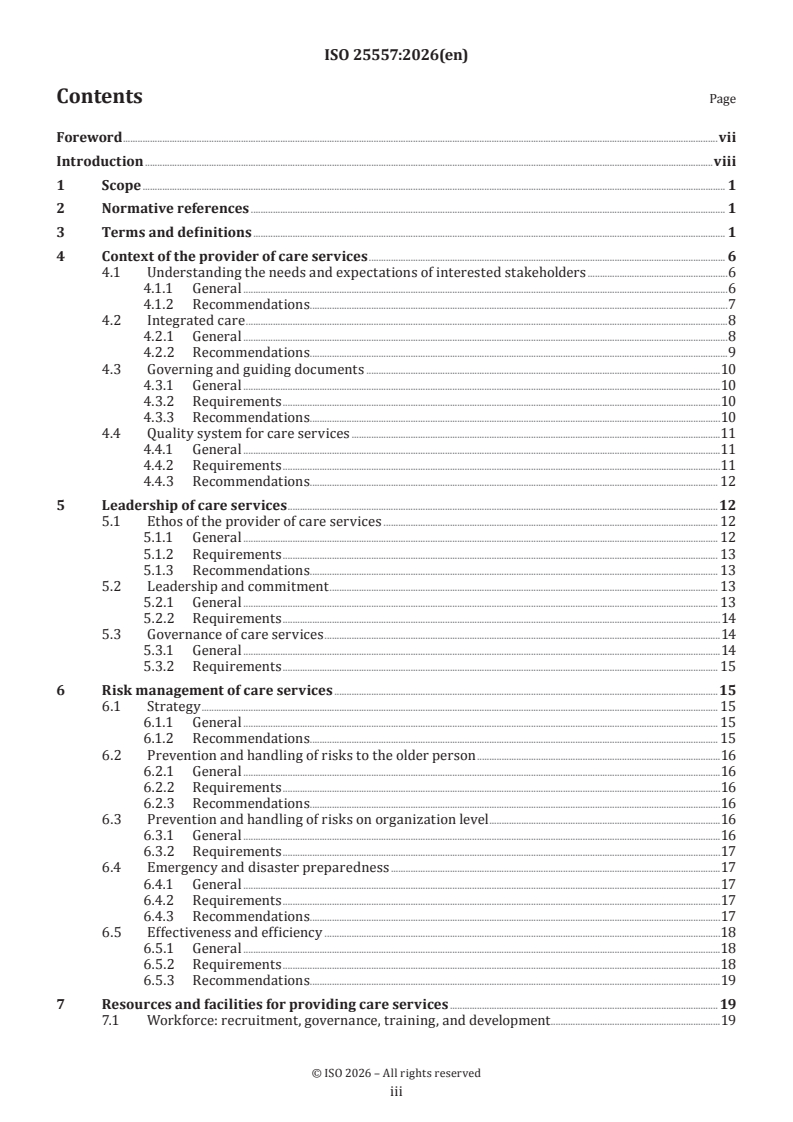
Contents Page
Foreword .vii
Introduction .viii
1 Scope . 1
2 Normative references . 1
3 Terms and definitions . 1
4 Context of the provider of care services . 6
4.1 Understanding the needs and expectations of interested stakeholders .6
4.1.1 General .6
4.1.2 Recommendations.7
4.2 Integrated care .8
4.2.1 General .8
4.2.2 Recommendations.9
4.3 Governing and guiding documents .10
4.3.1 General .10
4.3.2 Requirements .10
4.3.3 Recommendations.10
4.4 Quality system for care services .11
4.4.1 General .11
4.4.2 Requirements .11
4.4.3 Recommendations. 12
5 Leadership of care services .12
5.1 Ethos of the provider of care services . 12
5.1.1 General . 12
5.1.2 Requirements . 13
5.1.3 Recommendations. 13
5.2 Leadership and commitment . 13
5.2.1 General . 13
5.2.2 Requirements .14
5.3 Governance of care services .14
5.3.1 General .14
5.3.2 Requirements . 15
6 Risk management of care services .15
6.1 Strategy . 15
6.1.1 General . 15
6.1.2 Recommendations. 15
6.2 Prevention and handling of risks to the older person .16
6.2.1 General .16
6.2.2 Requirements .16
6.2.3 Recommendations.16
6.3 Prevention and handling of risks on organization level .16
6.3.1 General .16
6.3.2 Requirements .17
6.4 Emergency and disaster preparedness .17
6.4.1 General .17
6.4.2 Requirements .17
6.4.3 Recommendations.17
6.5 Effectiveness and efficiency .18
6.5.1 General .18
6.5.2 Requirements .18
6.5.3 Recommendations.19
7 Resources and facilities for providing care services . 19
7.1 Workforce: recruitment, governance, training, and development .19
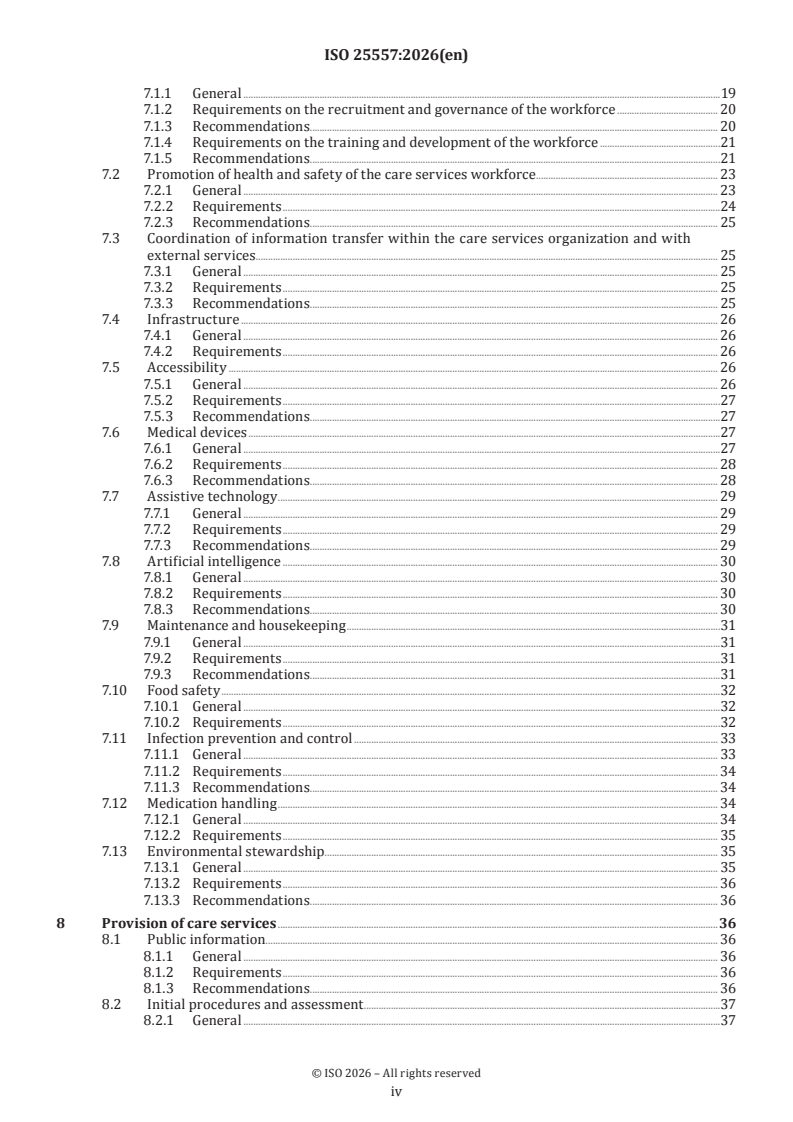
iii
7.1.1 General .19
7.1.2 Requirements on the recruitment and governance of the workforce . 20
7.1.3 Recommendations. 20
7.1.4 Requirements on the training and development of the workforce .21
7.1.5 Recommendations.21
7.2 Promotion of health and safety of the care services workforce . 23
7.2.1 General . 23
7.2.2 Requirements .24
7.2.3 Recommendations. 25
7.3 Coordination of information transfer within the care services organization and with
external services. 25
7.3.1 General . 25
7.3.2 Requirements . 25
7.3.3 Recommendations. 25
7.4 Infrastructure . 26
7.4.1 General . 26
7.4.2 Requirements . 26
7.5 Accessibility . 26
7.5.1 General . 26
7.5.2 Requirements .27
7.5.3 Recommendations.27
7.6 Medical devices .27
7.6.1 General .27
7.6.2 Requirements . 28
7.6.3 Recommendations. 28
7.7 Assistive technology . 29
7.7.1 General . 29
7.7.2 Requirements . 29
7.7.3 Recommendations. 29
7.8 Artificial intelligence . 30
7.8.1 General . 30
7.8.2 Requirements . 30
7.8.3 Recommendations. 30
7.9 Maintenance and housekeeping .31
7.9.1 General .31
7.9.2 Requirements .31
7.9.3 Recommendations.31
7.10 Food safety .32
7.10.1 General .32
7.10.2 Requirements .32
7.11 Infection prevention and control . 33
7.11.1 General . 33
7.11.2 Requirements . 34
7.11.3 Recommendations. 34
7.12 Medication handling . 34
7.12.1 General . 34
7.12.2 Requirements . 35
7.13 Environmental stewardship. 35
7.13.1 General . 35
7.13.2 Requirements . 36
7.13.3 Recommendations. 36
8 Provision of care services .36
8.1 Public information . . 36
8.1.1 General . 36
8.1.2 Requirements . 36
8.1.3 Recommendations. 36
8.2 Initial procedures and assessment .37
8.2.1 General .37
iv
8.2.2 Requirements .37
8.2.3 Recommendations. 38
8.3 Agreements and contracts related to the older person and their families . 38
8.3.1 General . 38
8.3.2 Requirements . 39
8.3.3 Recommendations. 39
8.4 Admission procedures . 39
8.4.1 When receiving care at home. 39
8.4.2 When receiving care at a care home .41
8.4.3 Providing a welcoming and safe home-like environment .43
8.5 Social and community life . 44
8.5.1 Rights, diversity, integrity and participation . 44
8.5.2 Security and safety . 46
8.5.3 Communication and information .47
8.5.4 Activities and events . 48
8.5.5 Financial procedures . 49
8.5.6 Informal carers, people close to the older person and volunteers . 50
8.6 Health.51
8.6.1 Health promotion . .51
8.6.2 Health literacy .52
8.6.3 Assessment of care and support during ongoing care .52
8.6.4 Cognitive function and mental health . 53
8.6.5 Food, drink, meals, nutrition and dehydration . 54
8.6.6 Oral health, dental health and swallowing . 55
8.6.7 Bladder and bowel function. 56
8.6.8 Personal care, skin integrity and wounds .57
8.6.9 Pain . 58
8.6.10 Sleep .59
8.6.11 Medications .59
8.6.12 Palliative and end-of-life -care . 60
8.7 Documentation .62
8.7.1 Care plans .62
8.7.2 Records and documentation . 64
9 Assessment of provided care services .64
9.1 Assessment of activities and results . 64
9.1.1 General . 64
9.1.2 Requirements . 65
9.1.3 Recommendations. 65
9.2 User feedback . 66
9.2.1 General . 66
9.2.2 Requirements . 66
9.2.3 Recommendations. 66
9.3 Self-assessment . 66
9.3.1 General . 66
9.3.2 Requirements .67
9.4 Audits .67
9.4.1 General .67
9.4.2 Requirements .67
9.4.3 Recommendations. 68
10 Improvement of care services .68
10.1 Promoting quality improvement and innovation in care services . 68
10.1.1 General . 68
10.1.2 Requirements . 68
10.1.3 Recommendations. 68
10.2 Non-fulfilment of requirements and adverse events. 69
10.2.1 General . 69
10.2.2 Requirements . 69
10.2.3 Recommendations. 69
v
10.3 Suggestions and complaints . 69
10.3.1 General . 69
10.3.2 Requirements .70
10.4 Conformance assessment . .70
Annex A (informative) The holistic framework of health and care services in ageing societies .71
Annex B (informative) Assessment and assessment tools . 74
Annex C (informative) Conformity with requirements and recommendations .78
Bibliography .81
vi
Foreword
ISO (the International Organization for Standardization) is a worldwide federation of national standards
bodies (ISO member bodies). The work of preparing International Standards is normally carried out through
ISO technical committees. Each member body interested in a subject for which a technical committee
has been established has the right to be represented on that committee. International organizations,
governmental and non-governmental, in liaison with ISO, also take part in the work. ISO collaborates closely
with the International Electrotechnical Commission (IEC) on all matters of electrotechnical standardization.
The procedures used to develop this document and those intended for its further maintenance are described
in the ISO/IEC Directives, Part 1. In particular, the different approval criteria needed for the different types
of ISO documents should be noted. This document was drafted in accordance with the editorial rules of the
ISO/IEC Directives, Part 2 (see www.iso.org/directives).
ISO draws attention to the possibility that the implementation of this document may involve the use of (a)
patent(s). ISO takes no position concerning the evidence, validity or applicability of any claimed patent
rights in respect thereof. As of the date of publication of this document, ISO had not received notice of (a)
patent(s) which may be required to implement this document. However, implementers are cautioned that
this may not represent the latest information, which may be obtained from the patent database available at
www.iso.org/patents. ISO shall not be held responsible for identifying any or all such patent rights.
Any trade name used in this document is information given for the convenience of users and does not
constitute an endorsement.
For an explanation of the voluntary nature of standards, the meaning of ISO specific terms and expressions
related to conformity assessment, as well as information about ISO’s adherence to the World Trade
Organization (WTO) principles in the Technical Barriers to Trade (TBT), see www.iso.org/iso/foreword.html.
This document was prepared by Technical Committee ISO/TC 314, Ageing societies.
Any feedback or questions on this document should be directed to the user’s national standards body. A
complete listing of these bodies can be found at www.iso.org/members.html.
vii
Introduction
This document supports the United Nations Principles for older persons:
— Older persons should be able to live in environments that are safe and adaptable to personal preferences
and changing capacities.
— Older persons should be able to reside at home for as long as possible.
— Older persons should benefit from family and community care and protection in accordance with each
society’s system of cultural values.
— Older persons should be able to utilize appropriate levels of institutional care providing protection,
rehabilitation, and social and mental stimulation in a humane and secure environment.
— Older persons should be able to enjoy human rights and fundamental freedoms when residing in any
shelter, care, or treatment facility, including full respect for their dignity, beliefs, needs and privacy and
for the right to make decisions about their care and the quality of their lives.
— Older persons should be able to live in dignity and security and be free of exploitation and physical or
mental abuse. Older persons should be treated fairly regardless of age, sex, ethnic background, disability,
or other status, and be valued independently of their economic contribution.
NOTE 1 The first article of the Universal Declaration of Human Rights states that “All human beings are born free
and equal in dignity and rights”. The notion of dignity is defined as the inherent and inalienable worth of all human
beings irrespective of social status such as ethnicity, sex, physical or mental state. Dignity is deeply embedded in
international human rights instruments.
This document is based on the concept integrated care that can be described as methods and strategies for
linking and coordinating the various aspects of care delivered by different care systems, such as the work of
general practitioners, primary and specialty care, preventive and curative services, as well as physical and
mental health services and social care, to meet the multiple needs of an individual older person or category
of persons with similar needs.
An integrated response to care covers health care, social care, care for cognitive diseases, palliative and
end-of-life care, respite care, rehabilitation, services provided at home, in the community, in hospitals or in
care homes, public or private-funded, informal care or care by volunteers.
Care is care, regardless of the environment and should be a seamless provision of health and social services
which are not divided up into silos.
This document adopts a person-centred approach, outlining that care is to be provided with the older
persons’ identity and preferences taking priority. Person-centred care planning is made in close consultation
with the older person, with a goal to improve, restore, and maintain health and wellbeing so the older person
can age with dignity, be respected, and determine how they will live their life while receiving care. For those
persons assessed as “lacking mental capacity” the care planning is made in consultation with appointed
chosen decision maker or representative.
Care providers are responsible for ensuring that the health and wellbeing of the workforce are protected as
this impacts the conditions under which care will be delivered to older persons.
Informal carers provide a high amount of care and support and are able to do so in culturally appropriate
ways that align with the older person’s values. The quality of life of the informal carer is closely linked to the
quality of life of the older person in need of care and support.
Care coordination is needed at a systems level. The integration between social care and health care, both
administratively and at the points of use, is crucial to providing high-quality care. The separation of
social care and health care services can result in fragmented coverage, gaps in the provision of care and
inappropriate use of acute services. This interferes with the rights of older persons to access the support
they need to live to their fullest potential.
viii
A well-supported infrastructure of an aged society includes a comprehensive, holistic framework of health
and care services. See Annex A.
There is also a need for a different approach in the way care and support is organized and a change in the
way older persons and ageing in general are perceived.
Care homes, also referred to as residential care facilities, assisted living facilities, retirement homes or
communities, are settings where the majority of older persons often live with complex care needs. They
provide a range of professional health services, lodging, food, and personal care (e.g. assistance with
everyday activities) for older persons 24 hours a day, every day.
NOTE 2 In some countries medical care is separated from care and is provided by organizations from the health
care sector. When this is the case, the care provider needs to have systems in place to provide medical services or
access to such when needed.
The concepts of healthy ageing and age-friendly environments stresses the importance of enabling the older
person in need of care and support to be involved and empowered to decide how their needs, expectations
and preferences can be met to live as autonomously as possible.
This document is based on the principle that care and support for older persons needs to evolve in light of
the current social situation. It is important to move away from care that focuses on meeting the basic needs
of older persons to challenge broader objectives such as ensuring wellbeing, meaning in life, and that older
persons feel respected.
As the birth-rate declines and the population ages, caregiving needs to fundamentally evolve to sustainably
meet the growing needs of older persons. The service providers can significantly contribute to promote the
older person’s autonomy.
The providers of care services are expected to develop new ways of thinking through digital technology,
including result-based quality improvement, productivity improvements that support sustainable systems,
and encourage self-determination for users.
To ensure that medical care is provided where people live, including in care homes, networking of medical
and care services in cooperation with health care and social care professionals, medical and care services
can be provided in an integrated manner in the community.
Care and support ought to play a sustained role in maintaining the functional abilities of older persons and
ensuring
...