


ISO 11547:1994
(Main)Small craft — Start-in-gear protection
Small craft — Start-in-gear protection
Specifies requirements to prevent an outboard motor from being started in gear, when installed on small craft of up to 24 m length of hull.
Navires de plaisance — Dispositif de protection contre le démarrage avec vitesse en prise
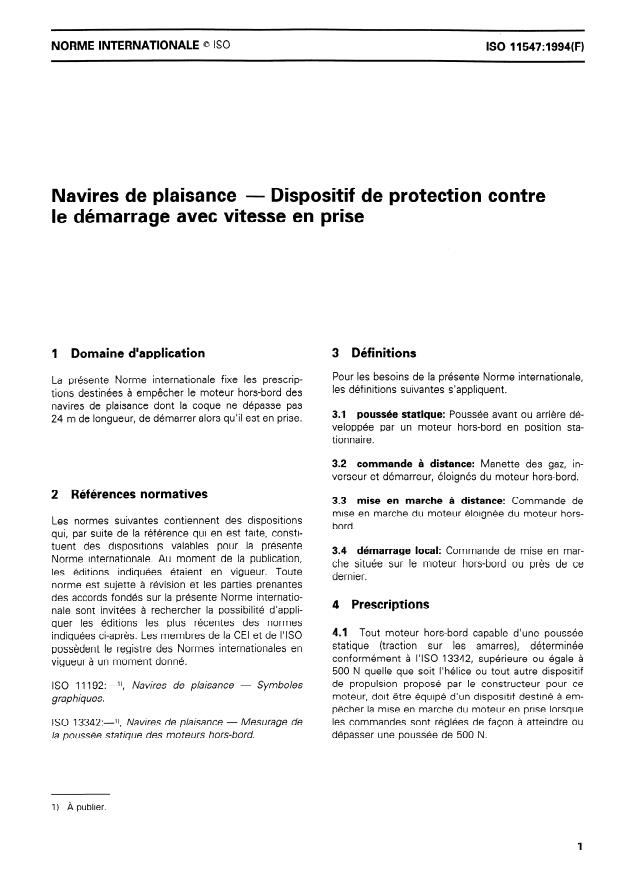
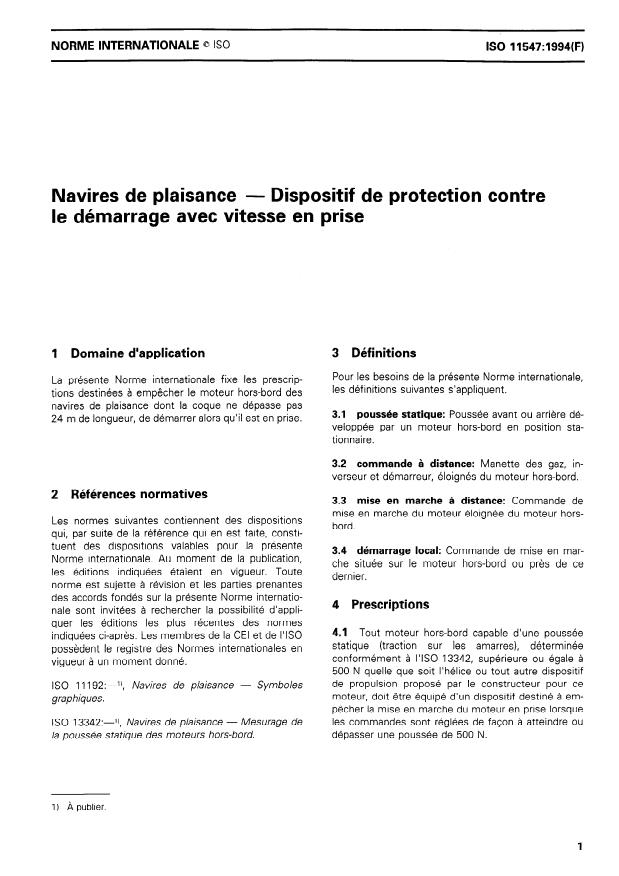
La présente Norme internationale fixe les prescriptions destinées à empêcher le moteur hors-bord des navires de plaisance dont la coque ne dépasse pas 24 m de longueur, de démarrer alors qu'il est en prise.
General Information
- Status
- Published
- Publication Date
- 05-Oct-1994
- Technical Committee
- ISO/TC 188 - Small craft
- Drafting Committee
- ISO/TC 188 - Small craft
- Current Stage
- 9093 - International Standard confirmed
- Start Date
- 06-Jun-2023
- Completion Date
- 14-Feb-2026
Relations
- Effective Date
- 09-Feb-2026
- Effective Date
- 09-Feb-2026
- Effective Date
- 09-Feb-2026
- Effective Date
- 09-Feb-2026
- Effective Date
- 09-Feb-2026
Overview
ISO 11547:1994 - Small craft: Start-in-gear protection - is an international safety standard that specifies requirements to prevent an outboard motor from being started while in gear on small craft (hull length up to 24 m). First published in 1994 by ISO/TC 188 (Pleasure craft), the standard targets outboard propulsion systems where inadvertent starting in gear could produce dangerous thrust or sudden vessel movement.
Key topics and technical requirements
- Scope: Applies to outboard motors installed on small craft up to 24 m length of hull.
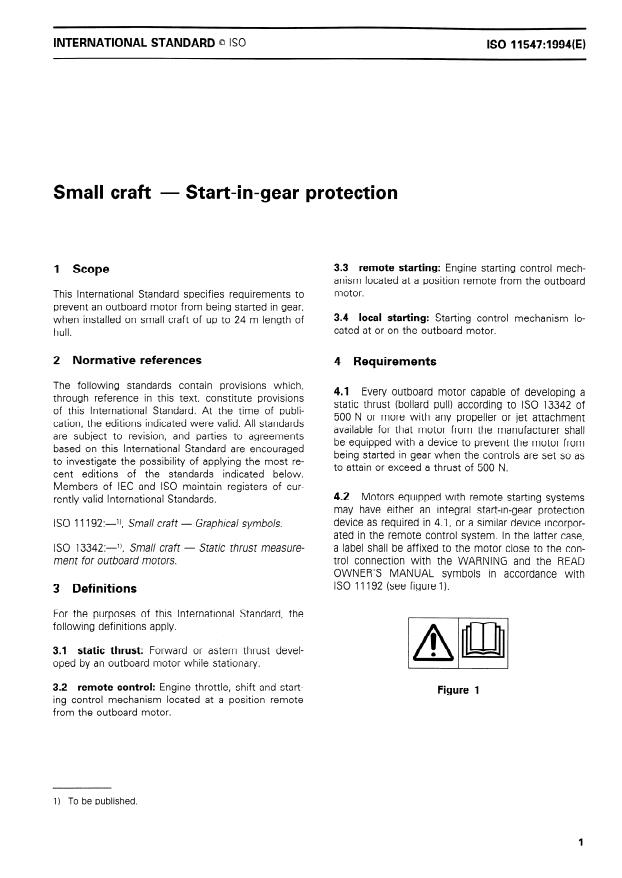
- Static thrust threshold: Any outboard with a static thrust (measured per ISO 13342) of 500 N or greater must have a start-in-gear protection device.
- Protection location: The protective device may be:
- Integrated into the motor’s local starter system, or
- Integrated into the remote control/starting system.
- Definitions provided: important terms such as static thrust, remote control, remote starting, and local starting are defined to ensure consistent interpretation.
- Labeling:
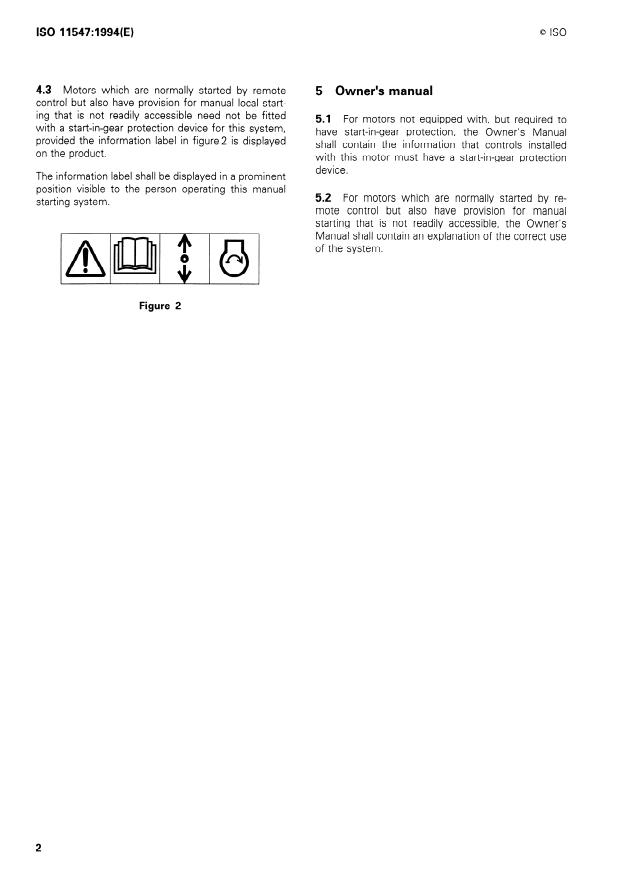
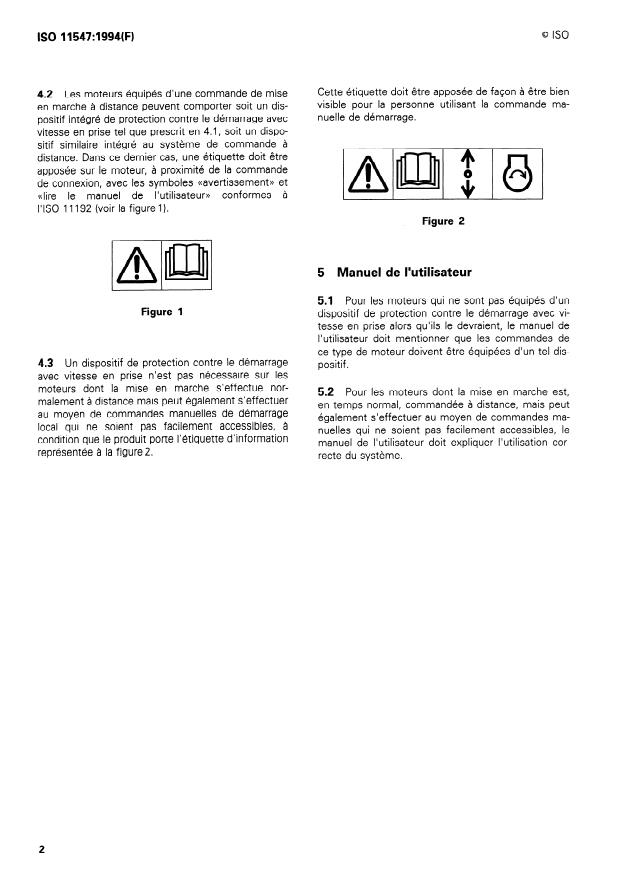
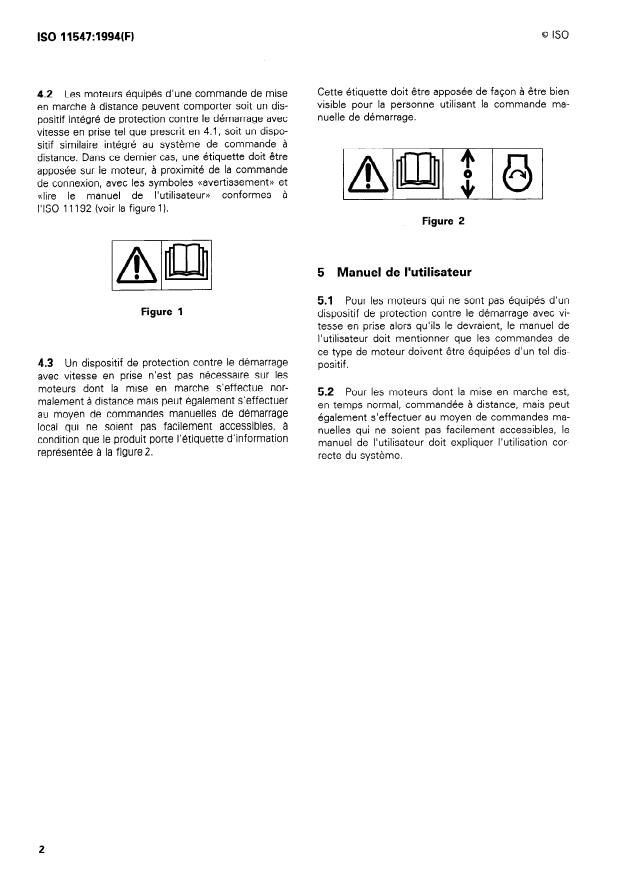
- Products must carry an information label visible to the person operating the manual start control.
- If protection is in the remote system, an additional label near the motor connection must show the ISO 11192 symbols for warning and read the user manual.
- User documentation:
- If a motor that should have a protection device is not equipped with one, the user manual must state that the controls should be equipped with such a device.
- For motors normally started remotely but that also permit local starting (where the local controls are not easily accessible), the user manual must explain correct system use.
Practical applications and users
ISO 11547 is practical for:
- Outboard motor manufacturers - to design compliant starters and incorporate required interlocks.
- Boat builders and marine OEMs - for safe installation and system integration on small craft (≤24 m).
- Marina operators, installers and service technicians - to verify correct labeling and functional protection during commissioning and maintenance.
- Regulatory and conformity assessors - to audit compliance, safety labeling and user manual content.
- Safety engineers - to mitigate risks of accidental vessel movement or injury caused by starting an engine while in gear.
Adhering to ISO 11547 helps reduce accidental starts in gear, improves operator awareness via labeling and manuals, and supports regulatory compliance for small craft propulsion safety.
Related standards
- ISO 13342 - Measurement of static thrust for outboard motors (referenced for the 500 N threshold).
- ISO 11192 - Graphical symbols - used for warning and “read manual” symbols on labels.
Buy Documents
ISO 11547:1994 - Small craft -- Start-in-gear protection
ISO 11547:1994 - Navires de plaisance -- Dispositif de protection contre le démarrage avec vitesse en prise
ISO 11547:1994 - Navires de plaisance -- Dispositif de protection contre le démarrage avec vitesse en prise
Get Certified
Connect with accredited certification bodies for this standard

DNV
DNV is an independent assurance and risk management provider.

Lloyd's Register
Lloyd's Register is a global professional services organisation specialising in engineering and technology.

ABS Quality Evaluations Inc.
American Bureau of Shipping quality certification.
Sponsored listings
Frequently Asked Questions
ISO 11547:1994 is a standard published by the International Organization for Standardization (ISO). Its full title is "Small craft — Start-in-gear protection". This standard covers: Specifies requirements to prevent an outboard motor from being started in gear, when installed on small craft of up to 24 m length of hull.
Specifies requirements to prevent an outboard motor from being started in gear, when installed on small craft of up to 24 m length of hull.
ISO 11547:1994 is classified under the following ICS (International Classification for Standards) categories: 47.080 - Small craft. The ICS classification helps identify the subject area and facilitates finding related standards.
ISO 11547:1994 has the following relationships with other standards: It is inter standard links to EN ISO 10240:2020, EN ISO 10240:2004, EN ISO 6185-3:2018, EN ISO 10240:2024, EN ISO 6185-3:2014. Understanding these relationships helps ensure you are using the most current and applicable version of the standard.
ISO 11547:1994 is available in PDF format for immediate download after purchase. The document can be added to your cart and obtained through the secure checkout process. Digital delivery ensures instant access to the complete standard document.
Standards Content (Sample)
ISO
INTERNATIONAL
STANDARD
First edition
1994-10-01
- Start-in-gear protection
Small traft
- Dispositif de protection contre Ie dkmarrage avec
Navires de plaisance
vitesse en Prise
Reference number
Foreword
ISO (the International Organization for Standardization) is a worldwide
federation of national Standards bodies (ISO member bodies). The work
of preparing International Standards is normally carried out through ISO
technical committees. Esch member body interested in a subject for
which a technical committee has been established has the right to be
represented on that committee. International organizations, governmental
and non-governmental, in liaison with ISO, also take part in the work. ISO
collaborates closely with the International Electrotechnical Commission
(IEC) on all matters of electrotechnical standardization.
Draft International Standards adopted by the technical committees are
circulated to the member bodies for voting. Publication as an International
Standard requires approval by at least 75 % of the member bodies casting
a vote.
International Standard ISO 11547 was prepared by Technical Committee
lSO/TC 188, Small traft.
0 ISO 1994
All rights reserved. Unless otherwise specified, no part of this publication may be reproduced
or utilized in any form or by any means, electrontc or mechanicai, rncluding photocopyrng and
microfilm, without Permission in writing from the publisher.
International Organization for Standardiza tion
1 Geneve 20 8 Switzerland
Case Postale 56 l CH-121
Printed in Switzerland
INTERNATIONAL STANDARD 0 ISO ISO 11547:1994(E)
- Start-in-gear protection
Small traft
3.3 remote starting: Engine starting control mech-
1 Scope
anism located at a Position remote from the outboard
motor.
This International Standard specifies requirements to
prevent an outboard motor from being started in gear,
3.4 local starting: Starting control mechanism lo-
when installed on small traft of up to 24 m length of
cated at or on the outboard motor.
hull .
2 Normative references 4 Requirements
The following Standards contain provisions which,
4.1 Every outboard motor capable of developing a
through reference in this text, constitute provisions
static thrust (bollard pull) according to ISO 13342 of
of this International Standard. At the time of publi-
500 N or more with any Propeller or jet attachment
cation, the editions indicated were valid. All Standards
available for that motor from the manufacturer shall
are subject to revision, and Par
...
Iso
NORME
INTERNATIONALE
Première édition
1994-I O-OI
Navires de plaisance - Dispositif de
protection contre le démarrage avec
vitesse en prise
- Start-in-gear protection
Small craft
Numéro de référence
ISO 11547:+-I 994(F)
Avant-propos
L’ISO (Organisation internationale de normalisation) est une fédération
mondiale d’organismes nationaux de normalisation (comités membres de
I’ISO). L’élaboration des Normes internationales est en général confiée aux
comités techniques de I’ISO. Chaque comité membre intéressé par une
étude a le droit de faire partie du comité technique créé à cet effet. Les
organisations internationales, gouvernementales et non gouvernemen-
tales, en liaison avec I’ISO participent également aux travaux. L’ISO colla-
bore étroitement avec la Commission électrotechnique internationale (CEI)
en ce qui concerne la normalisation électrotechnique.
Les projets de Normes internationales adoptés par les comités techniques
sont soumis aux comités membres pour vote. Leur publication comme
Normes internationales requiert l’approbation de 75 % au moins des co-
mités membres votants.
La Norme internationale ISO 11547 a été élaborée par le comité technique
ISO/TC 188, Navires de plaisance.
0 ISO 1994
Droits de reproduction réservés. Sauf prescription différente, aucune partie de cette pub&
cation ne peut être reproduite ni utilisée sous quelque forme que ce soit et par aucun pro-
cédé, électronique ou mécanique, y compris la photocopie et les microfilms, sans l’accord
écrit de l’éditeur.
Organisation internationale de normalisation
Case Postale 56 l CH-l 211 Genève 20 l Suisse
Imprimé en Suisse
ii
NORME INTERNATIONALE 0 BO
Navires de plaisance - Dispositif de protection contre
le démarrage avec vitesse en prise
1 Domaine d’application 3 Définitions
Pour les besoins de la présente Norme internationale,
La présente Norme internationale fixe les prescrip-
les définitions suivantes s’appliquent.
tions destinées à empêcher le moteur hors-bord des
navires de plaisance dont la coque ne dépasse pas
3.1 poussée statique: Poussée avant ou arrière dé-
24 m de longueur, de démarrer alors qu’il est en prise.
veloppée par un moteur hors-bord en position sta-
tionnaire.
3.2 commande à distance: Manette des gaz, in-
verseur et démarreur, éloignés du moteur hors-bord.
2 Références normatives
3.3 mise en marche à distance: Commande de
mise en marche du moteur éloignée du moteur hors-
Les normes suivantes contiennent des dispositions
bord.
qui, par suite de la référence qui en est faite, consti-
tuent des dispositions valables pour la présente
3.4 démarrage local: Commande de mise en mar-
Norme internationale. Au moment de la publication,
che située sur le moteur hors-bord ou près de ce
les éditions indiquées étaient en vigueur. Toute
dernier.
norme est sujette à révision et les parties prenantes
des accords fondés sur la présente Norme internatio-
4 Prescriptions
nale sont invit
...
Iso
NORME
INTERNATIONALE
Première édition
1994-I O-OI
Navires de plaisance - Dispositif de
protection contre le démarrage avec
vitesse en prise
- Start-in-gear protection
Small craft
Numéro de référence
ISO 11547:+-I 994(F)
Avant-propos
L’ISO (Organisation internationale de normalisation) est une fédération
mondiale d’organismes nationaux de normalisation (comités membres de
I’ISO). L’élaboration des Normes internationales est en général confiée aux
comités techniques de I’ISO. Chaque comité membre intéressé par une
étude a le droit de faire partie du comité technique créé à cet effet. Les
organisations internationales, gouvernementales et non gouvernemen-
tales, en liaison avec I’ISO participent également aux travaux. L’ISO colla-
bore étroitement avec la Commission électrotechnique internationale (CEI)
en ce qui concerne la normalisation électrotechnique.
Les projets de Normes internationales adoptés par les comités techniques
sont soumis aux comités membres pour vote. Leur publication comme
Normes internationales requiert l’approbation de 75 % au moins des co-
mités membres votants.
La Norme internationale ISO 11547 a été élaborée par le comité technique
ISO/TC 188, Navires de plaisance.
0 ISO 1994
Droits de reproduction réservés. Sauf prescription différente, aucune partie de cette pub&
cation ne peut être reproduite ni utilisée sous quelque forme que ce soit et par aucun pro-
cédé, électronique ou mécanique, y compris la photocopie et les microfilms, sans l’accord
écrit de l’éditeur.
Organisation internationale de normalisation
Case Postale 56 l CH-l 211 Genève 20 l Suisse
Imprimé en Suisse
ii
NORME INTERNATIONALE 0 BO
Navires de plaisance - Dispositif de protection contre
le démarrage avec vitesse en prise
1 Domaine d’application 3 Définitions
Pour les besoins de la présente Norme internationale,
La présente Norme internationale fixe les prescrip-
les définitions suivantes s’appliquent.
tions destinées à empêcher le moteur hors-bord des
navires de plaisance dont la coque ne dépasse pas
3.1 poussée statique: Poussée avant ou arrière dé-
24 m de longueur, de démarrer alors qu’il est en prise.
veloppée par un moteur hors-bord en position sta-
tionnaire.
3.2 commande à distance: Manette des gaz, in-
verseur et démarreur, éloignés du moteur hors-bord.
2 Références normatives
3.3 mise en marche à distance: Commande de
mise en marche du moteur éloignée du moteur hors-
Les normes suivantes contiennent des dispositions
bord.
qui, par suite de la référence qui en est faite, consti-
tuent des dispositions valables pour la présente
3.4 démarrage local: Commande de mise en mar-
Norme internationale. Au moment de la publication,
che située sur le moteur hors-bord ou près de ce
les éditions indiquées étaient en vigueur. Toute
dernier.
norme est sujette à révision et les parties prenantes
des accords fondés sur la présente Norme internatio-
4 Prescriptions
nale sont invit
...
Questions, Comments and Discussion
Ask us and Technical Secretary will try to provide an answer. You can facilitate discussion about the standard in here.
Loading comments...