


ISO 50004:2014
(Main)Energy management systems — Guidance for the implementation, maintenance and improvement of an energy management system
Energy management systems — Guidance for the implementation, maintenance and improvement of an energy management system
ISO 50004:2014 provides practical guidance and examples for establishing, implementing, maintaining and improving an energy management system (EnMS) in accordance with the systematic approach of ISO 50001. The guidance in ISO 50004:2014 is applicable to any organization, regardless of its size, type, location or level of maturity. ISO 50004:2014 does not provide guidance on how to develop an integrated management system. While the guidance in ISO 50004:2014 is consistent with the ISO 50001 energy management system model, it is not intended to provide interpretations of the requirements of ISO 50001.
Systèmes de management de l'énergie — Lignes directrices pour la mise en oeuvre, la maintenance et l'amélioration d'un système de management de l'énergie
General Information
- Status
- Withdrawn
- Publication Date
- 14-Dec-2014
- Withdrawal Date
- 14-Dec-2014
- Technical Committee
- ISO/TC 301 - Energy management and energy savings
- Drafting Committee
- ISO/TC 301 - Energy management and energy savings
- Current Stage
- 9599 - Withdrawal of International Standard
- Start Date
- 16-Jun-2020
- Completion Date
- 14-Feb-2026
Relations
- Effective Date
- 04-Nov-2017

Get Certified
Connect with accredited certification bodies for this standard

DNV
DNV is an independent assurance and risk management provider.

Lloyd's Register
Lloyd's Register is a global professional services organisation specialising in engineering and technology.

BSI Group
BSI (British Standards Institution) is the business standards company that helps organizations make excellence a habit.
Sponsored listings
Frequently Asked Questions
ISO 50004:2014 is a standard published by the International Organization for Standardization (ISO). Its full title is "Energy management systems — Guidance for the implementation, maintenance and improvement of an energy management system". This standard covers: ISO 50004:2014 provides practical guidance and examples for establishing, implementing, maintaining and improving an energy management system (EnMS) in accordance with the systematic approach of ISO 50001. The guidance in ISO 50004:2014 is applicable to any organization, regardless of its size, type, location or level of maturity. ISO 50004:2014 does not provide guidance on how to develop an integrated management system. While the guidance in ISO 50004:2014 is consistent with the ISO 50001 energy management system model, it is not intended to provide interpretations of the requirements of ISO 50001.
ISO 50004:2014 provides practical guidance and examples for establishing, implementing, maintaining and improving an energy management system (EnMS) in accordance with the systematic approach of ISO 50001. The guidance in ISO 50004:2014 is applicable to any organization, regardless of its size, type, location or level of maturity. ISO 50004:2014 does not provide guidance on how to develop an integrated management system. While the guidance in ISO 50004:2014 is consistent with the ISO 50001 energy management system model, it is not intended to provide interpretations of the requirements of ISO 50001.
ISO 50004:2014 is classified under the following ICS (International Classification for Standards) categories: 03.100.70 - Management systems; 27.010 - Energy and heat transfer engineering in general; 27.015 - Energy efficiency. Energy conservation in general. The ICS classification helps identify the subject area and facilitates finding related standards.
ISO 50004:2014 has the following relationships with other standards: It is inter standard links to ISO 50004:2020. Understanding these relationships helps ensure you are using the most current and applicable version of the standard.
ISO 50004:2014 is available in PDF format for immediate download after purchase. The document can be added to your cart and obtained through the secure checkout process. Digital delivery ensures instant access to the complete standard document.
Standards Content (Sample)
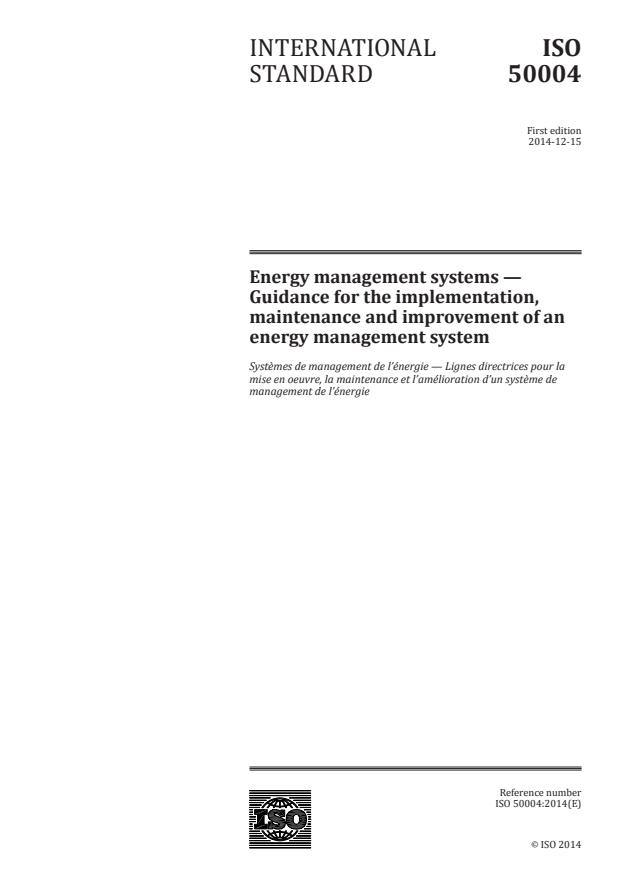
INTERNATIONAL ISO
STANDARD 50004
First edition
2014-12-15
Energy management systems —
Guidance for the implementation,
maintenance and improvement of an
energy management system
Systèmes de management de l’énergie — Lignes directrices pour la
mise en oeuvre, la maintenance et l’amélioration d’un système de
management de l’énergie
Reference number
©
ISO 2014
© ISO 2014
All rights reserved. Unless otherwise specified, no part of this publication may be reproduced or utilized otherwise in any form
or by any means, electronic or mechanical, including photocopying, or posting on the internet or an intranet, without prior
written permission. Permission can be requested from either ISO at the address below or ISO’s member body in the country of
the requester.
ISO copyright office
Case postale 56 • CH-1211 Geneva 20
Tel. + 41 22 749 01 11
Fax + 41 22 749 09 47
E-mail copyright@iso.org
Web www.iso.org
Published in Switzerland
ii © ISO 2014 – All rights reserved
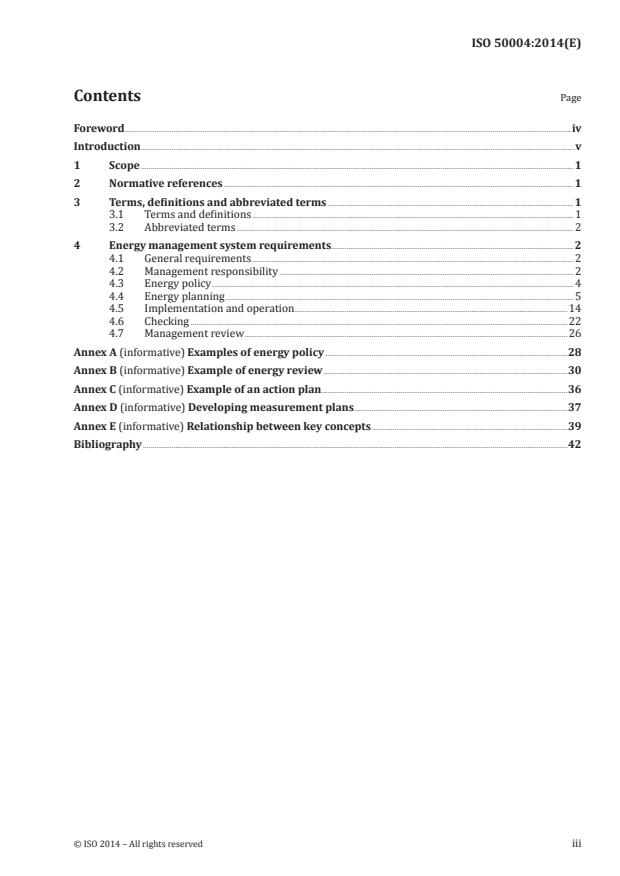
Contents Page
Foreword .iv
Introduction .v
1 Scope . 1
2 Normative references . 1
3 Terms, definitions and abbreviated terms . 1
3.1 Terms and definitions . 1
3.2 Abbreviated terms . 2
4 Energy management system requirements . 2
4.1 General requirements . 2
4.2 Management responsibility . 2
4.3 Energy policy . 4
4.4 Energy planning . 5
4.5 Implementation and operation .14
4.6 Checking .22
4.7 Management review .26
Annex A (informative) Examples of energy policy .28
Annex B (informative) Example of energy review .30
Annex C (informative) Example of an action plan .36
Annex D (informative) Developing measurement plans .37
Annex E (informative) Relationship between key concepts .39
Bibliography .42
Foreword
ISO (the International Organization for Standardization) is a worldwide federation of national standards
bodies (ISO member bodies). The work of preparing International Standards is normally carried out
through ISO technical committees. Each member body interested in a subject for which a technical
committee has been established has the right to be represented on that committee. International
organizations, governmental and non-governmental, in liaison with ISO, also take part in the work.
ISO collaborates closely with the International Electrotechnical Commission (IEC) on all matters of
electrotechnical standardization.
The procedures used to develop this document and those intended for its further maintenance are
described in the ISO/IEC Directives, Part 1. In particular the different approval criteria needed for the
different types of ISO documents should be noted. This document was drafted in accordance with the
editorial rules of the ISO/IEC Directives, Part 2 (see www.iso.org/directives).
Attention is drawn to the possibility that some of the elements of this document may be the subject of
patent rights. ISO shall not be held responsible for identifying any or all such patent rights. Details of any
patent rights identified during the development of the document will be in the Introduction and/or on
the ISO list of patent declarations received (see www.iso.org/patents).
Any trade name used in this document is information given for the convenience of users and does not
constitute an endorsement.
For an explanation on the meaning of ISO specific terms and expressions related to conformity
assessment, as well as information about ISO’s adherence to the WTO principles in the Technical Barriers
to Trade (TBT) see the following URL: Foreword - Supplementary information
The committee responsible for this document is Technical Committee ISO/TC 242, Energy management.
iv © ISO 2014 – All rights reserved
Introduction
This International Standard provides guidance when implementing the requirements of an energy
management system (EnMS) based on ISO 50001 and guides the organization to take a systematic
approach in order to achieve continual improvement in energy management and energy performance.
This International Standard is not prescriptive and each organization determines how to best approach
meeting the requirements of ISO 50001.
This International Standard provides guidance to users with varying levels of energy management and
EnMS experience, including those:
— with little or no experience of energy management or management system standards;
— undertaking energy efficiency projects but with little or no EnMS experience;
— having an EnMS in place, not necessarily based on ISO 50001;
— having experience with ISO 50001 and looking for additional ideas or suggestions for improvement.
Energy management will be sustainable and most effective when it is integrated with an organization’s
overall business processes (e.g. operations, finance, quality, maintenance, human resources, procurement,
health and safety and environmental).
ISO 50001 can be integrated with other management system standards, such as ISO 9001, ISO 14001, and
OHSAS 18001. Integration can have a positive effect on business culture, business practice, embedding
energy management into daily practice, operational efficiency and the operating cost of the management
system.
The examples and approaches presented in this International Standard are for illustrative purposes.
They are neither intended to represent the only possibilities, nor are they necessarily suitable for every
organization. In implementing, maintaining or improving an EnMS, it is important that organizations
select approaches appropriate to their own circumstances.
This International Standard includes practical help boxes designed to provide the user with ideas,
examples and strategies for implementing an EnMS.
Ongoing commitment and engagement by top management is essential to the effective implementation,
maintenance and improvement of the EnMS, in order to achieve the benefits in energy performance
improvement. Top management demonstrates its commitment through leadership actions and active
involvement in the EnMS, ensuring ongoing allocation of resources, including people to implement and
sustain the EnMS over time.
INTERNATIONAL STANDARD ISO 50004:2014(E)
Energy management systems — Guidance for the
implementation, maintenance and improvement of an
energy management system
1 Scope
This International Standard provides practical guidance and examples for establishing, implementing,
maintaining and improving an energy management system (EnMS) in accordance with the systematic
approach of ISO 50001. The guidance in this International Standard is applicable to any organization,
regardless of its size, type, location or level of maturity.
This International Standard does not provide guidance on how to develop an integrated management
system.
While the guidance in this International Standard is consistent with the ISO 50001 energy management
system model, it is not intended to provide interpretations of the requirements of ISO 50001.
2 Normative references
The following documents, in whole or in part, are normatively referenced in this document and are
indispensable for its application. For dated references, only the edition cited applies. For undated
references, the latest edition of the referenced document (including any amendments) applies.
ISO 50001:2011, Energy management systems — Requirements with guidance for use
3 Terms, definitions and abbreviated terms
3.1 Terms and definitions
For the purposes of this document, the terms and definitions given in ISO 50001 and the following apply.
3.1.1
commissioning
process by which equipment, a system, a facility or a plant that is installed, is completed or near
completion is tested to verify if it functions according to its design specification and intended application
3.1.2
energy balance
accounting of inputs and/or generation of energy supply versus energy outputs based on energy
consumption by energy use
Note 1 to entry: Where present, energy storage can be considered within energy supply or energy use.
[SOURCE: ISO 50002:2014, 3.6, modified — Deleted original Notes 1 and 2 to entry; added new Note 1
to entry]
3.2 Abbreviated terms
EnMS energy management system
EnPI energy performance indicator
PDCA Plan–Do–Check–Act
SEU significant energy use
HDD heating degree days
4 Energy management system requirements
4.1 General requirements
It is good practice to keep the EnMS as simple and easy to understand as possible while still meeting the
ISO 50001 requirements. For example, organizational objectives for energy management and energy
performance should be reasonable and achievable and aligned with current organizational or business
priorities. Documentation should be straight forward and responsive to organizational needs, as well as
easy to update and maintain. As the system develops based on continual improvement, simplicity should
be maintained.
Defining the scope and boundaries of the EnMS allows the organization to focus their efforts and
resources in energy management and energy performance improvement. When defining the scope and
boundaries, an organization should not divide or exclude energy using equipment or systems unless it is
separately metered or a dependable calculation can be made. Over time, the scope and boundaries may
change due to energy performance improvement, organizational change or other circumstances, and
the EnMS is reviewed and updated as needed to reflect the change.
Documenting the scope and boundaries of the EnMS can be in any format. For example, it may be a
simple list, or a map or line drawing indicating what is included within the EnMS.
Practical Help Box 1 – Items to consider in defining scope and boundaries
Scope:
— What facilities are included?
— What operations and activities are included?
— Is energy for transport included?
— Are other media, for example, water and gas flows such as nitrogen included?
— Who is top management within the defined scope and boundaries?
Boundaries:
— What parts of the site are included?
— Are all buildings and processes included?
— Are other sites included?
— What parts of the site or locations are not included?
4.2 Management responsibility
4.2.1 Top management
Ongoing top management commitment is a critical factor in the continued success of the EnMS and
the improvement of energy performance. Top management demonstrates its commitment through
its leadership actions and active involvement in the EnMS. Top management needs to retain its EnMS
responsibilities and should make its actions visible to employees across the organization.
2 © ISO 2014 – All rights reserved
Top management should understand that a fundamental requirement for demonstration of its
commitment is ongoing allocation of resources – which includes people to implement, sustain and
improve the EnMS and energy performance over time. One resource area that is often overlooked and
needs to be specifically addressed is the means of gathering and reporting data to support the ongoing
maintenance and improvement of the EnMS.
Early in the EnMS implementation process, top management should initiate ongoing communications
across the organization about the importance of energy performance and energy management.
A communication approach that has proven itself within the organization and the organizational
culture is more likely to be effective. Initial communication can be accomplished by top management’s
announcement of the appointment of the management representative, the establishment of the energy
team and by presenting the energy policy and the decision to implement an EnMS directly to the
employees.
Energy management and energy performance improvement should align with the organization’s
business strategy and long-term planning and resource allocation processes.
4.2.2 Management representative
Regardless of whether the management representative has a technical background, certain capabilities
are key to the success of the role. The following capabilities should be considered in the choice of
management representative:
— leading and motivating personnel;
— managing or effecting change;
— communicating effectively across all levels of the organization;
— problem solving and conflict resolution skills;
— understanding energy use and consumption concepts;
— basic analytical skills to understand energy performance.
Often the management representative is the individual responsible for the operation of a process or
facility.
Whether the management representative is internal or external to the organization, top management
needs to ensure that the representative has the appropriate authority to fulfil their duties. Additional
communications by top management with employees may be needed in order to clearly establish the
authority of an external management representative.
Practical Help Box 2 – Communication of energy management responsibilities and authorities
Energy management responsibilities and authorities can be defined and communicated in a variety of ways. For example, they can be:
— included in EnMS procedures or instructions;
— incorporated into job descriptions;
— identified in a responsibility matrix;
— set forth in an energy or EnMS manual;
— included in operational and technical training, including workbooks;
— part of employee performance reviews;
— reinforced during awareness training or shift meeting presentations.
Ways that the management representative can ensure that both the operation and control of the EnMS
are effective could include:
a) scheduling regular team meetings;
b) reviewing internal audit and corrective action results;
c) the use of management tools such as business scorecards and trends in energy data;
d) reviewing of energy performance indicator (EnPI) control limit anomalies.
Integration of energy management responsibilities with the organization’s performance evaluation
(appraisal) system may improve EnMS outcomes by institutionalizing responsibilities.
Good practice is to have a cross functional energy management team of more than one person that
includes representatives from areas that can affect energy performance. This approach provides an
effective mechanism to engage different parts of the organization in the planning, implementation
and maintenance of the EnMS. Membership of the team may change over time and should be based on
defined roles rather than named individuals.
Practical Help Box 3 – Considerations in selecting members of the energy management team
Selection of members of the energy management team (as appropriate to the organization’s size and complexity) should consider the
following:
— personnel representing a mix of skills and functions to address both the technical and organizational components of the EnMS;
— financial decision makers or access to them;
— procurement personnel;
— operational personnel, particularly those performing tasks associated with SEUs;
— representatives of tenants in commercial buildings, where appropriate;
— individuals who can take responsibility for operational controls or other elements of the EnMS;
— maintenance and facility personnel;
— production or other personnel who may be already involved in improvement mechanisms such as continuous improvement teams;
— individuals that will further the integration of EnMS into the organization;
— people who are committed to energy performance improvement and able to promote the EnMS throughout the organization;
— representatives from different shifts, where applicable;
— supply chain managers as appropriate;
— personnel who may not be directly working with energy uses but may be important, for example accessing critical data (utility energy
bills, building management data, financial data, etc.), making changes to work practices, raising awareness.
The team approach takes advantage of the diversity of skills and knowledge of individuals. The
organization should consider building energy management and improvement capability and capacity
throughout the organization. This could include additional training and rotation of the management
representative position and membership of the energy management team.
4.3 Energy policy
The energy policy sets the direction for implementing and improving the organization’s EnMS and energy
performance. The policy demonstrates the commitment of top management so that the organization is
able to continually maintain and enhance its efforts to achieve improved energy performance.
The energy policy can be developed either before or after the initial energy review. In either case
the energy policy should be reviewed to ensure its appropriateness to the nature and scale of the
organization’s energy use and consumption. Developing the energy policy before the initial energy
review can provide a strong platform of management commitment on which to build the initial energy
review. Developing it after the energy review can provide solid data and information on which to build a
strong policy. Developing the energy policy before the energy review and then revisiting it to ensure its
appropriateness to energy use and consumption afterwards is a good practice.
Whether the energy policy is made available to the public is a decision by the organization, consistent
with its own priorities and needs. Once the EnMS is fully implemented and begins to mature, the policy
could be made publicly available as part of an improvement to the system (e.g. the energy policy could be
included in sustainability, corporate social responsibility and other annual reports, the organization’s
website, etc.).
4 © ISO 2014 – All rights reserved
Top management’s commitment is required to fully integrate the energy policy into the underlying
culture of the organization to ensure its continuity. As a part of an integrated management system, it
may be possible to integrate an energy policy with an existing organizational policy (e.g. environmental,
sustainability, health and safety, quality). Care should be taken to ensure that the energy policy is not
weakened or compromised and conforms with ISO 50001 requirements.
During the initial EnMS implementation, defining the energy policy should focus on the commitments
explicitly required. The commitments can be stated using terminology consistent with the culture
of the organization. It is recommended to avoid lengthy policy statements that may be difficult for
personnel to understand and apply. Implementation of lengthy policies can consume significant training
and communication resources. The organization should avoid duplicating within the policy other
components of the EnMS i.e. scope and boundaries. The policy statement itself need not include the fact
that it is documented, communicated, regularly reviewed and updated as necessary, however, it includes
the required commitments of ISO 50001.
The energy policy’s support for the procurement of energy efficient products and services and design
would not require the organization to always purchase the most energy efficient items. Support for the
purchase of energy efficient products and services and design for energy performance improvement
should support business productivity and longer term profitability.
In general, the energy policy does not change often. Decisions on changes to the policy are made as
part of the management review process. Possible reasons to change the policy include changes in
organizational ownership, structure, legal and other energy requirements, and major changes in energy
uses, sources, operations or business conditions or as part of continual improvement.
NOTE Examples of energy policies are given in Annex A.
4.4 Energy planning
4.4.1 General
Energy planning is the “Plan” part of the PDCA cycle of the EnMS.
Energy planning provides the foundation for developing an EnMS that is based on an understanding of
an organization’s energy performance. This is the step where the organization’s analysis of its energy
data, along with other energy information is used to make informed decisions on actions to continually
improve energy performance.
Examples of the relationship between objectives, associated energy targets, action plans, EnPIs,
operational control, monitoring and measurement are given in Table E.1. Examples of the relationship
between significant energy uses (SEUs), operational controls, competency and training, procurement,
associated EnPIs, monitoring and measurement and calibration are given in Table E.2.
4.4.2 Legal requirements and other requirements
Legal requirements refer to applicable mandatory requirements related to an organization’s energy use,
consumption, or energy efficiency.
Other requirements could refer to voluntary agreements, contractual arrangements or corporate
requirements subscribed to by the organization related to energy use, energy consumption and energy
efficiency.
Information on legal requirements and other requirements can be obtained from a variety of sources,
such as in–house legal departments, government or other official websites, consultants, professional
bodies and various regulatory bodies. If the organization already has a process to determine legal
requirements, that process may be used to identify and access energy related legal requirements. The
process used to identify and evaluate legal compliance should be clear and include a description of how
compliance is assessed. In addition, it should establish the responsibilities for monitoring, reviewing
and ensuring compliance.
In addition to reviewing legal requirements and other requirements at defined intervals, examples of
occasions when additional review may be required include:
a) changes in applicable legal requirements and other requirements;
b) changes in the operations of the organization that might affect applicable requirements.
Early consideration of legal requirements and other requirements can assist the organization in
identifying related data requirements to address in the energy review. It may be useful to establish a list
of legal requirements and other requirements so their implications can be considered for other parts of
the EnMS including SEUs, operational controls, records, and communication.
Practical Help Box 4 – Examples of legal requirements and other requirements
Legal requirements:
— Local, state, provincial, national and international legal requirements;
— Energy performance standards required by law for equipment;
— Regulated energy assessment or audit requirements;
— Building energy codes;
— Energy source installation codes.
Other requirements to which the organization may subscribe, if applicable:
— Organizational guidelines or requirements;
— Agreements with customers or suppliers;
— Non-regulatory guidelines;
— Voluntary principles or codes of practice;
— Voluntary energy agreements;
— Requirements of trade associations;
— Agreements with community groups or non-governmental organizations;
— Public commitment of the organization or its parent organization;
— Voluntary minimum specifications for energy performance issued by government or private agencies;
— Network limits on electricity or gas supply, or limitations on electricity exports to the network.
4.4.3 Energy review
The energy review is the analytical part of the energy planning process. The quality of the energy review
is influenced by the availability, quality and analysis of the data collected.
When implementing an energy review for the first time, the starting point is the available data. The
energy review can be improved as the organization gains more experience with energy data management
and decision making based on energy data analysis.
A good practice is to utilize the output of any available energy audits or engineering studies as part of
the energy review.
NOTE ISO 50002 provides information on energy audits.
a) Analysis of energy use and consumption
Developing an understanding of the organization’s energy use and consumption is the first step in an
energy review. This is accomplished through:
— identifying current energy sources;
— identifying current energy uses;
— evaluating energy use and consumption, including past and present trends.
The resulting information is used to identify SEUs and energy performance improvement opportunities.
6 © ISO 2014 – All rights reserved
Energy sources can include, but are not limited to: electricity, natural gas, fuel oil, propane, solar, wind,
biomass, cogeneration and recovered waste energy. In some organizations, it can include externally
supplied energy sources such as compressed air, chilled or hot water and steam. Typically, energy
sources should exclude feedstock except where the feedstock also contributes energy within the scope
and boundaries of the EnMS.
Identification of energy sources can be accomplished through the review of existing records (e.g. utility
bills, fuel delivery receipts, procurement records, etc.). It is good practice to examine energy flows and
end uses to ensure all energy sources are identified. These results form the basis for the remainder of
the energy review.
The next step in the energy review is linking the energy sources to energy uses. A single energy source
can be associated with multiple energy uses. Interviews with organizational personnel responsible for
the operation of equipment, systems and processes can be helpful in identifying energy uses. Other
possible sources for energy use information and energy consumption data can be found in Practical Help
Box 5.
Once the energy uses are identified, evaluate past and present energy use and consumption. A suitable
period (e.g. one, three, six or twelve months) is established to evaluate historic energy consumption
and identify trends. The period(s) selected should be representative of the variation in organizational
operations (e.g. seasonal production, occupancy levels). It is good practice to analyse data for a period of
at least one year to account for seasonal effects and other variables.
Additionally, the data should be of a suitable frequency to understand the variability in energy
performance and any anomalies in energy consumption. The frequency of data collection should be at
least monthly to allow for identification of trends in energy use and consumption. For some operations,
more frequent data collection may be appropriate.
Energy use and consumption information should be presented by graphs, charts, tables, spreadsheets,
process maps and simulation models.
Practical Help Box 5 – Possible sources of energy use and consumption data
Possible sources of energy use and consumption data include:
— compiled utility bills for the period of examination for each energy source, including individual line items for energy charges:
— whenever possible bills should be checked for accuracy against utility meter readings and not based on utility estimates;
— attention is needed to check that the period of energy consumption and the period represented by the compiled bills correspond to
each other;
— meter readings from utility meters and applicable submeters (recorded manually or electronically), for energy consumption of facili-
ties, equipment, systems and processes;
— estimations of energy consumption;
— model simulations of energy use and consumption;
— equipment data (e.g. name plate energy rating, stated efficiencies from manufacturer’s equipment manuals, asset inventory lists and
data sheets);
— weekly or daily maintenance logs (e.g. boiler house logs, compressor run hours);
— service logs (e.g. vendor or distributer service visit records);
— control system data;
— bills or other records of purchase of other energy sources, such as fuel oil, coal, biofuels, that may be delivered periodically and stored
onsite;
— bills or other records of purchase of compressed air, steam, hot and chilled water;
— energy audit reports or engineering studies;
— records of previous energy reviews.
The outputs from the analysis of energy use and consumption include:
— identified current energy sources;
— identified energy uses;
— measured or estimated energy consumption associated with each identified energy use for the
period established as suitable.
This information provides a basis for the identification and analysis of SEUs.
b) Based on the analysis of energy use and consumption, identify the areas of SEUs
SEUs are determined for the purpose of establishing priorities for energy management, energy
performance improvement and resource allocation. In identifying areas of SEU, it may be helpful for
the organization to take a holistic view of its uses and consumption of energy within the scope and
boundaries.
The selection of the number of SEUs should consider available resources since for SEUs there are
requirements for competency and training, procurement, operational controls, and monitoring and
measurement. Organizations starting to implement an EnMS may find it helpful to limit the number of
SEUs with a plan to develop additional SEUs as resources are available.
Based on the definition of SEU, the organization has the flexibility to determine SEUs based on energy
consumption, energy improvement opportunity, or a combination of both. Establishing a process for
determining SEUs involves deciding the criteria for:
— “substantial energy consumption”, which could include the use of an energy balance to determine
energy uses that account for at least a certain percentage of the organization’s total energy
consumption (alternatively, Pareto analysis could be used for this purpose);
— “considerable opportunity for energy performance improvement”, which could include the outputs
of energy audits, engineering studies, interviews with personnel with responsibilities related to the
energy use, comparison with internal and external benchmarks and other information to evaluate
and prioritize energy improvement opportunities.
The determination of SEUs may be an iterative rather than a sequential process. Opportunities
for improvement can be an input into the determination of SEUs at this point in the energy review
process. This includes consideration of how the behaviour of personnel working for or on behalf of the
organization, and the organization’s work practices can influence energy performance.
Practical Help Box 6 – Possible methods to assist in the identification of an organization’s SEUs
Possible methods to assist in the identification of an organization’s SEUs include:
— energy audits (e.g. ISO 50002 and other energy assessment standards);
— process maps;
— graphs and charts;
— spreadsheets or tables;
— Sankey diagrams;
— mass and energy balance;
— mapping of energy use;
— energy use and consumption simulation models;
— surveys of end-use equipment, systems, or processes;
— inventory of energy-using equipment, including energy rating and typical hours of operation;
— regression analysis of energy consumption of equipment, systems, or processes against relevant variables that affect their energy
consumption.
Analysis of energy uses will result in a list for consideration as SEUs. In the absence of measured data,
energy consumption should be estimated. Final determination of SEUs will consider whether the energy
consumption of these energy uses is substantial or whether they represent considerable opportunity
for improvement or both. Any use with substantial energy consumption should receive consideration
as an SEU.
8 © ISO 2014 – All rights reserved
Energy consumption is affected by many variables. Data should be collected and analysed to determine
the effects of the relevant variables on the SEU. If estimates of SEU energy consumption are made, then
additional analysis will be needed to determine the effects of relevant variables.
Submetering of SEUs represents a good practice to establish the current energy performance of SEUs
and to track future improvements in their energy performance. Careful consideration should be given
to the submetering and its potential use in the EnMS. The energy management team should engage with
appropriate operations personnel when identifying and defining the relevant variables.
ISO 50001 requires energy data to be monitored in order to fulfil the requirements of several of its
clauses, including energy baselines, EnPI, monitoring and measurement and analysis. When appropriate,
normalize the energy data to levels of production, weather or other relevant variables that affect energy
consumption.
NOTE ISO 50006 provides additional information on normalization of energy data.
Practical Help Box 7 – Examples of relevant variables that can affect SEUs
Examples of relevant variables that can affect SEUs (preferably over the same time period as the energy consumption data) include the
following:
— weather, including heating and cooling degree days;
— production related, such as rate, product mix, quality, rework or output;
— process parameters such as ambient temperature, cooling water temperature setpoint, steam temperature;
— material flows, properties and characteristics (including raw materials);
— building occupancy levels;
— daylight availability and ambient light levels;
— operating hours;
— levels of activity (e.g. work load, occupancy);
— distances travelled for transportation energy;
— vehicle loading and utilization;
— variation in availability or energy content of the energy sources (e.g. moisture content, calorific value).
The current energy performance of the SEUs should be established using available energy consumption
data and information concerning the identified relevant variables.
Practical Help Box 8 – Example of methods for determining current energy performance of the SEUs
Examples for determining current energy performance of the SEUs include comparisons such as:
— normalization of:
— air compressor electricity consumption against production volumes and ambient air temperature;
— refrigeration plant electricity consumption against cooling load, supply temperature and ambient temperature;
— building electricity consumption against occupancy and cooling degree days;
— building natural gas consumption against occupancy and heating degree days;
— aircraft fuel consumption against flying hours and the number of take offs;
— energy consumption per unit of output and other simple ratio such as energy efficiency and coefficient of performance;
— coefficient of performance of refrigeration systems at their operating loads and environmental conditions compared to energy effi-
cient systems;
— comparison of current energy consumption with historical consumption if consumption is not affected by a relevant variable.
After collecting and analysing energy use and consumption data and relevant variables for the suitable
period, estimate future energy use and consumption for an equivalent time period. The estimation
should consider each SEU, relevant variable, and anticipated changes to facilities, equipment, systems
and processes during this future period. Some organizations choose to complete the future estimates
after decisions regarding action plans have been finalized for the coming period.
Outputs from this part of the energy review include a list of potential SEUs based on substantial energy
consumption; the relevant variables affecting the identified SEUs, an analysis of the current performance
of the SEUs and an estimation of future energy use and consumption.
c) Identify, prioritize and evaluate opportunities for improving energy performance
The identification of opportunities for improving energy performance and the development of a
prioritized list of these improvement opportunities is an output from the energy review. The collection
and analysis of data forms the foundation for prioritizing opportunities for improvement.
— Identifying opportunities
Opportunities for improvement begin with ideas that can be generated from the analysis of energy
use and consumption, the determination of SEUs or from a variety of other sources. Involving a
range of people in this process such as operational and maintenance staff can help to reveal a full
range of ideas. These ideas become opportunities through examination and refinement, using data
analysis to determine potential for energy performance improvement and feasibility.
The identification of opportunities for the improvement of energy performance should be part of a
continuous process, but may also involve periodic analysis using proven techniques.
Practical Help Box 9 – Example of tools and techniques for identifying opportunities
Tools and techniques for identifying opportunities can include the following:
— employee suggestions;
— other business improvement methodologies (e.g. Lean Manufacturing, Six Sigma, Kaizen);
— energy audits, ranging in cost and complexity from walkthroughs to detailed audits;
— needs analysis to avoid inappropriate design decisions;
— internal or external benchmarking;
— equipment specification and data sheets;
— metering reviews;
— maintenance techniques (e.g. maintenance assessments, predictive maintenance);
— examination of the age, condition, operation and level of maintenance of the energy uses;
— review of new and emerging technologies;
— review of case studies;
— team meetings, brainstorming, opportunity identification workshops;
— opportunity lists and energy saving tips available on various government and efficiency organization websites;
— continuous monitoring systems that report any deviations from pre-established energy performance parameters (fully or partially
automated);
— energy efficiency networks, seminars, forums, conferences to exchange ideas and experiences;
— engineering analysis techniques and modelling (e.g. review of pump and systems curves, pinch analysis).
— Prioritizing opportunities
Prioritizing energy performance improvement opportunities starts with evaluation. Evaluation
involves data analysis to quantify the expected energy performance improvement, benefits and
costs of opportunities. Evaluation of opportunities can include technical feasibility and business
consideration such as asset management strategies and maintenance impacts. The evaluation
should include additional benefits of energy performance and be derived from examination of
system interactions wherever possible.
Having evaluated the identified opportunities, the organization prioritizes its energy performance
improvement opportunities based on its own criteria and maintains and updates the information
in a format selected by it.
Methods to prioritize opportunities are described in Practical Help Box 10.
10 © ISO 2014 – All rights reserved
Practical Help Box 10 – Examples of criteria for prioritizing opportunities
Criteria for prioritizing opportunities can include:
— estimated energy savings;
— return on investment or other organizational investment criteria (capital or operational);
— other business impacts or priorities;
— estimated cost of implementation;
— ease of implementation;
— improved environmental impacts;
— actual or potential legal requirements;
— perceived level of risk including technological risk;
— availability of funding (internal or external);
— impact and value of additional benefits (e.g. reduced maintenance, increased comfort, improved safety, increased throughput).
Organizations should examine the prioritized list of opportunities to determine which opportunities
can proceed to a detailed investigation.
NOTE An abridged example of an energy review output is given in Annex B.
— Recommendations to management
Once the organization’s criteria have been applied to establish prioritized opportunities, the
management representative typically compiles recommendations for improvement and whether
opportunities should undergo further investigations, be implemented or not be implemented. The
management representative should communicate to top management the results from the energy
review together with the recommendations for impro
...
Questions, Comments and Discussion
Ask us and Technical Secretary will try to provide an answer. You can facilitate discussion about the standard in here.
Loading comments...