

ISO 19881:2018
(Main)Gaseous hydrogen — Land vehicle fuel containers
General Information
- Abstract
This document contains requirements for the material, design, manufacture, marking and testing of serially produced, refillable containers intended only for the storage of compressed hydrogen gas for land vehicle operation. These containers a) are permanently attached to the vehicle, b) have a capacity of up to 1 000 l water capacity, and c) have a nominal working pressure that does not exceed 70 MPa. The scope of this document is limited to fuel containers containing fuel cell grade hydrogen according to ISO 14687 for fuel cell land vehicles and Grade A or better hydrogen as per ISO 14687 for internal combustion engine land vehicles. This document also contains requirements for hydrogen fuel containers acceptable for use on-board light duty vehicles, heavy duty vehicles and industrial powered trucks such as forklifts and other material handling vehicles.
- Status
- Withdrawn
- Publication Date
- 17-Oct-2018
- Technical Committee
- ISO/TC 197 - Hydrogen technologies
- Drafting Committee
- ISO/TC 197/WG 18 - Gaseous hydrogen land vehicle fuel tanks and TPRDs
- Current Stage
- 9599 - Withdrawal of International Standard
- Start Date
- 13-Jun-2025
- Completion Date
- 29-Aug-2026
Buy Documents
ISO 19881:2018 - Gaseous hydrogen — Land vehicle fuel containers/18/2018

ISO 19881:2018 - Gaseous hydrogen -- Land vehicle fuel containers
Overview
ISO 19881:2018 - Gaseous hydrogen - Land vehicle fuel containers sets requirements for the material, design, manufacture, marking and testing of serially produced, refillable containers for compressed hydrogen used in land vehicles. It applies to containers that are permanently attached to the vehicle, have a capacity up to 1 000 L water capacity, and a nominal working pressure not exceeding 70 MPa. The standard covers containers intended for fuel cell grade hydrogen (ISO 14687) and Grade A or better hydrogen for internal combustion engines. It is applicable to light‑duty, heavy‑duty vehicles and industrial powered trucks (e.g., forklifts).
Key technical topics and requirements
ISO 19881 organizes technical requirements across design, materials, manufacture and testing. Major topics include:
Service conditions and categories
Defines standard service conditions, pressure ranges (nominal and maximum), temperature considerations, maximum filling cycles, service life and periodic in‑service inspections.Material qualification and properties
Requirements and tests for metals, aluminum alloys (including sustained load cracking and corrosion tests), nonmetallic liners (Type 4), fibers and resins, and UV resistance of external coatings.Container types and wall thickness
Guidance for Type 1, Type 2, Type 3 and Type 4 containers, liners and composite reinforcement, including stress analysis, stress ratios and hybrid designs.Manufacture and joining methods
Rules for welding, brazing, end closing, mounting/protection, and batch definitions.Testing and inspection
Production, batch and periodic tests such as hydrostatic test, leak test, burst test, cycle (fatigue) testing, design qualification tests (ambient, environmental, extreme temperature cycling, flaw tolerance), and rejection criteria.Safety features and documentation
Pressure relief device requirements, marking, dispatch inspection, records of manufacture and quality assurance procedures.
Practical applications and users
ISO 19881 is intended for:
- Automotive OEMs and system integrators designing hydrogen fuel systems
- Tank and composite container manufacturers
- Component suppliers (liners, bosses, pressure relief devices)
- Test laboratories and certification bodies conducting hydrostatic, burst and cycle tests
- Fleet operators, regulators and safety authorities assessing in‑service inspection and marking compliance
Using ISO 19881 helps ensure safe, reliable and compliant hydrogen fuel tanks for vehicles, supporting hydrogen mobility deployment and regulatory acceptance.
Related standards
- ISO 14687 (Hydrogen - Fuel quality - Product specification)
- Other ISO standards referenced within ISO 19881 for materials and test methods
Keywords: ISO 19881, gaseous hydrogen, land vehicle fuel containers, hydrogen fuel tanks, hydrogen storage, fuel cell hydrogen, 70 MPa, 1000 L, hydrostatic test, burst test.
Relations
- Effective Date
- 06-Jun-2022
Buy Documents
ISO 19881:2018 - Gaseous hydrogen — Land vehicle fuel containers/18/2018
ISO 19881:2018 - Gaseous hydrogen -- Land vehicle fuel containers
Get Certified
Connect with accredited certification bodies for this standard

TÜV Rheinland
TÜV Rheinland is a leading international provider of technical services.

TÜV SÜD
TÜV SÜD is a trusted partner of choice for safety, security and sustainability solutions.

DEKRA Certification Inc.
DEKRA US certification services.
Sponsored listings
Frequently Asked Questions
ISO 19881:2018 is a standard published by the International Organization for Standardization (ISO). Its full title is "Gaseous hydrogen — Land vehicle fuel containers". This standard covers: This document contains requirements for the material, design, manufacture, marking and testing of serially produced, refillable containers intended only for the storage of compressed hydrogen gas for land vehicle operation. These containers a) are permanently attached to the vehicle, b) have a capacity of up to 1 000 l water capacity, and c) have a nominal working pressure that does not exceed 70 MPa. The scope of this document is limited to fuel containers containing fuel cell grade hydrogen according to ISO 14687 for fuel cell land vehicles and Grade A or better hydrogen as per ISO 14687 for internal combustion engine land vehicles. This document also contains requirements for hydrogen fuel containers acceptable for use on-board light duty vehicles, heavy duty vehicles and industrial powered trucks such as forklifts and other material handling vehicles.
This document contains requirements for the material, design, manufacture, marking and testing of serially produced, refillable containers intended only for the storage of compressed hydrogen gas for land vehicle operation. These containers a) are permanently attached to the vehicle, b) have a capacity of up to 1 000 l water capacity, and c) have a nominal working pressure that does not exceed 70 MPa. The scope of this document is limited to fuel containers containing fuel cell grade hydrogen according to ISO 14687 for fuel cell land vehicles and Grade A or better hydrogen as per ISO 14687 for internal combustion engine land vehicles. This document also contains requirements for hydrogen fuel containers acceptable for use on-board light duty vehicles, heavy duty vehicles and industrial powered trucks such as forklifts and other material handling vehicles.
ISO 19881:2018 is classified under the following ICS (International Classification for Standards) categories: 43.060.40 - Fuel systems; 71.100.20 - Gases for industrial application. The ICS classification helps identify the subject area and facilitates finding related standards.
ISO 19881:2018 has the following relationships with other standards: It is inter standard links to ISO 19881:2025. Understanding these relationships helps ensure you are using the most current and applicable version of the standard.
ISO 19881:2018 is available in PDF format for immediate download after purchase. The document can be added to your cart and obtained through the secure checkout process. Digital delivery ensures instant access to the complete standard document.
Standards Content (Sample)
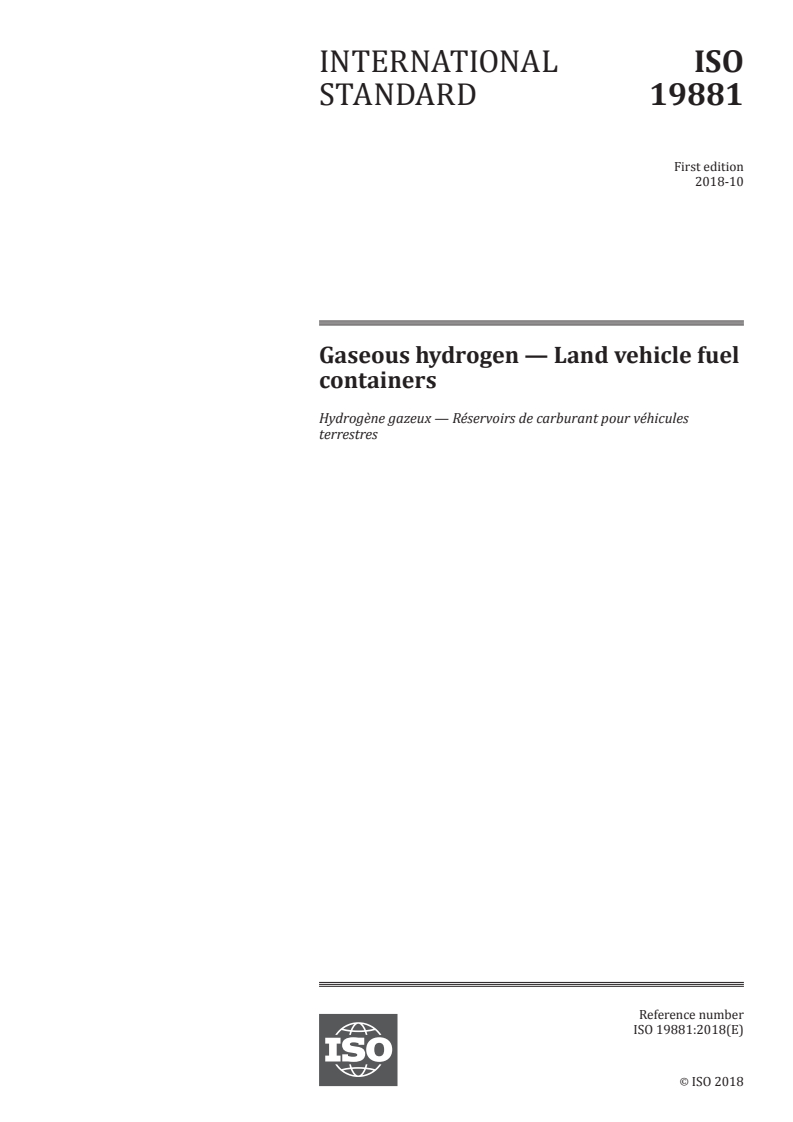
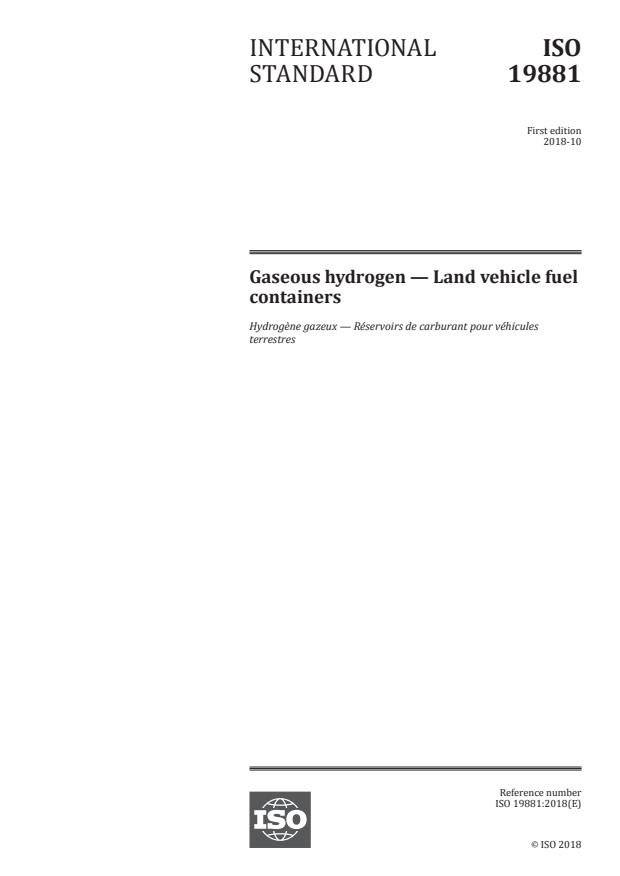
INTERNATIONAL ISO
STANDARD 19881
First edition
2018-10
Gaseous hydrogen — Land vehicle fuel
containers
Hydrogène gazeux — Réservoirs de carburant pour véhicules
terrestres
Reference number
©
ISO 2018
© ISO 2018
All rights reserved. Unless otherwise specified, or required in the context of its implementation, no part of this publication may
be reproduced or utilized otherwise in any form or by any means, electronic or mechanical, including photocopying, or posting
on the internet or an intranet, without prior written permission. Permission can be requested from either ISO at the address
below or ISO’s member body in the country of the requester.
ISO copyright office
CP 401 • Ch. de Blandonnet 8
CH-1214 Vernier, Geneva
Phone: +41 22 749 01 11
Fax: +41 22 749 09 47
Email: copyright@iso.org
Website: www.iso.org
Published in Switzerland
ii © ISO 2018 – All rights reserved
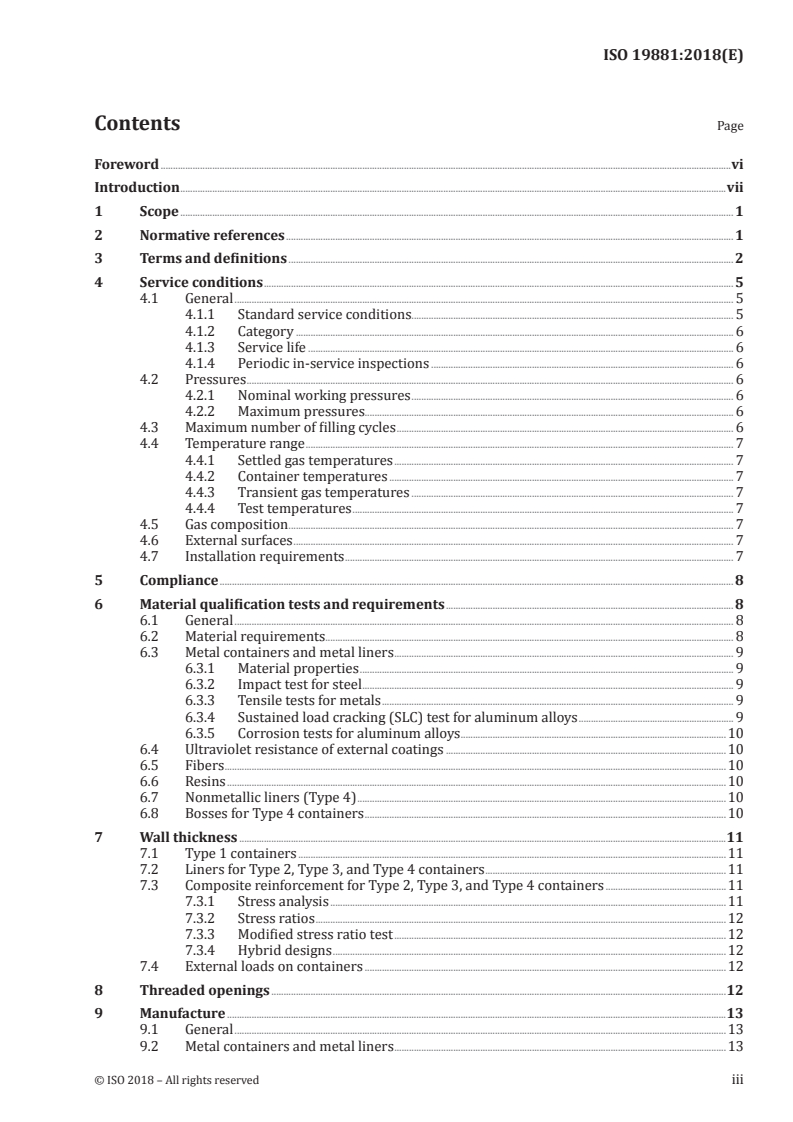
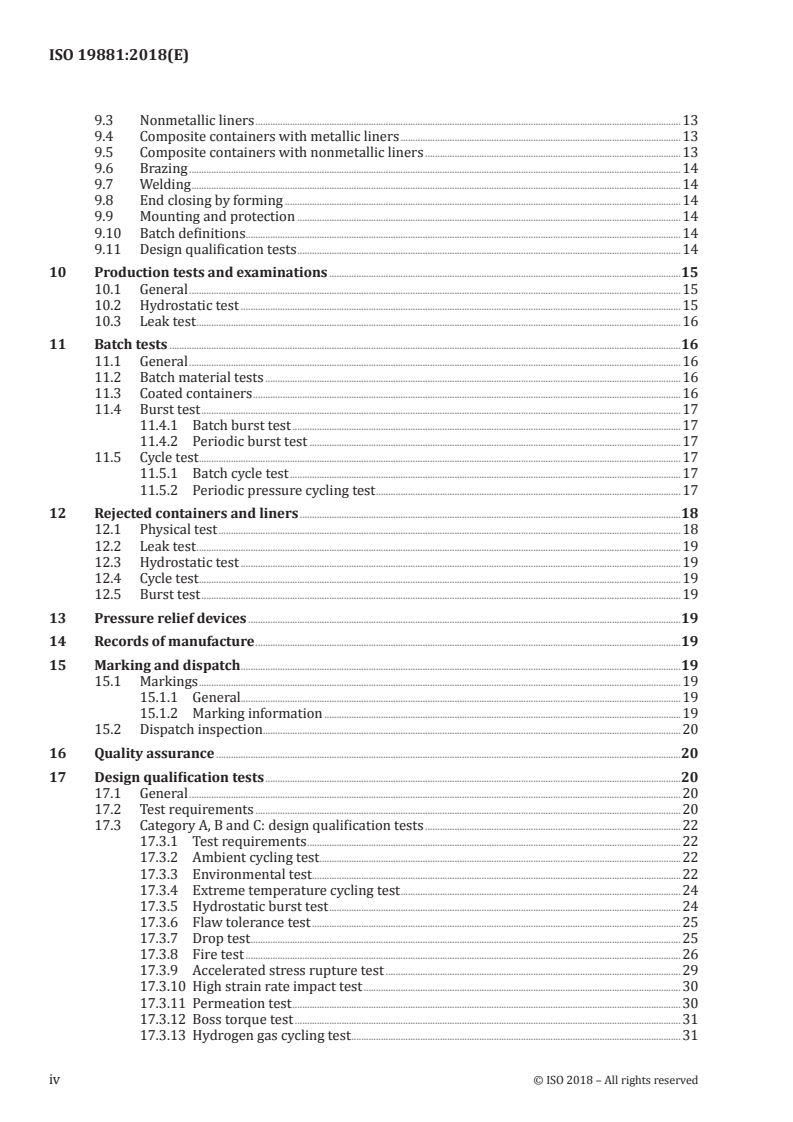
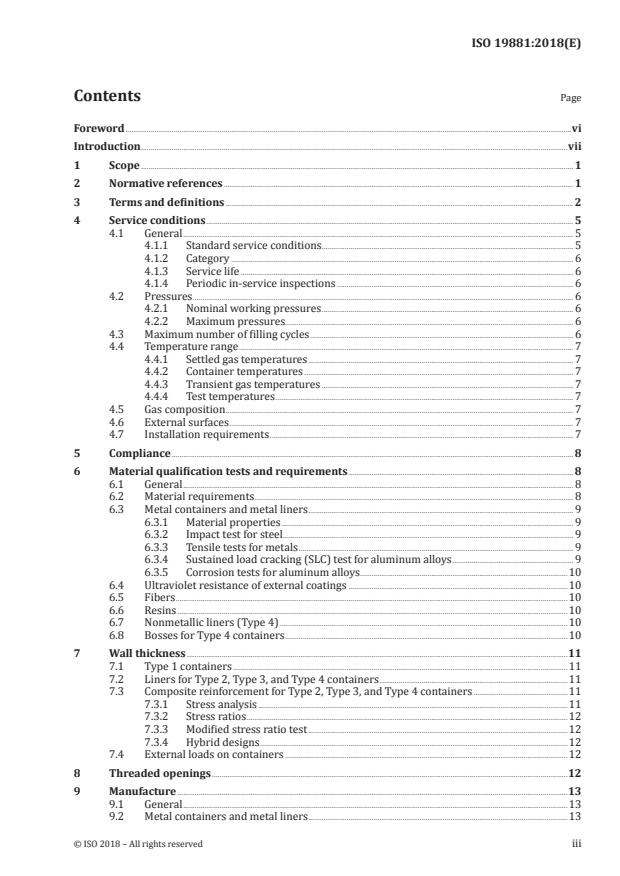
Contents Page
Foreword .vi
Introduction .vii
1 Scope . 1
2 Normative references . 1
3 Terms and definitions . 2
4 Service conditions . 5
4.1 General . 5
4.1.1 Standard service conditions. 5
4.1.2 Category . 6
4.1.3 Service life . 6
4.1.4 Periodic in-service inspections . 6
4.2 Pressures . 6
4.2.1 Nominal working pressures . 6
4.2.2 Maximum pressures. 6
4.3 Maximum number of filling cycles . 6
4.4 Temperature range . 7
4.4.1 Settled gas temperatures . 7
4.4.2 Container temperatures . 7
4.4.3 Transient gas temperatures . 7
4.4.4 Test temperatures . 7
4.5 Gas composition . 7
4.6 External surfaces . 7
4.7 Installation requirements . 7
5 Compliance . 8
6 Material qualification tests and requirements . 8
6.1 General . 8
6.2 Material requirements. 8
6.3 Metal containers and metal liners . 9
6.3.1 Material properties . 9
6.3.2 Impact test for steel . 9
6.3.3 Tensile tests for metals . 9
6.3.4 Sustained load cracking (SLC) test for aluminum alloys . 9
6.3.5 Corrosion tests for aluminum alloys .10
6.4 Ultraviolet resistance of external coatings .10
6.5 Fibers .10
6.6 Resins .10
6.7 Nonmetallic liners (Type 4) .10
6.8 Bosses for Type 4 containers .10
7 Wall thickness .11
7.1 Type 1 containers .11
7.2 Liners for Type 2, Type 3, and Type 4 containers .11
7.3 Composite reinforcement for Type 2, Type 3, and Type 4 containers .11
7.3.1 Stress analysis .11
7.3.2 Stress ratios .12
7.3.3 Modified stress ratio test .12
7.3.4 Hybrid designs .12
7.4 External loads on containers .12
8 Threaded openings .12
9 Manufacture .13
9.1 General .13
9.2 Metal containers and metal liners .13
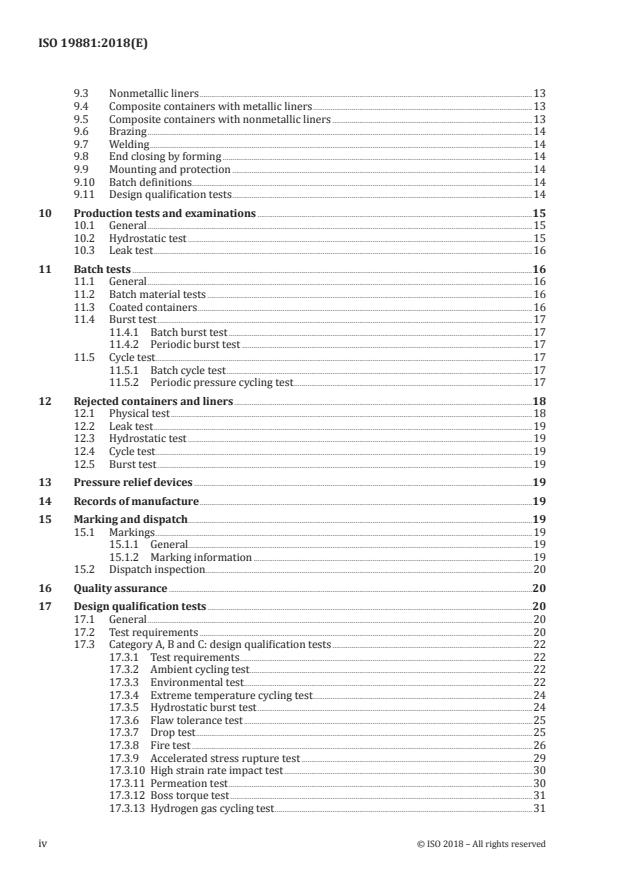
9.3 Nonmetallic liners .13
9.4 Composite containers with metallic liners .13
9.5 Composite containers with nonmetallic liners .13
9.6 Brazing .14
9.7 Welding .14
9.8 End closing by forming .14
9.9 Mounting and protection .14
9.10 Batch definitions .14
9.11 Design qualification tests .14
10 Production tests and examinations .15
10.1 General .15
10.2 Hydrostatic test .15
10.3 Leak test .16
11 Batch tests .16
11.1 General .16
11.2 Batch material tests .16
11.3 Coated containers .16
11.4 Burst test .17
11.4.1 Batch burst test .17
11.4.2 Periodic burst test .17
11.5 Cycle test .17
11.5.1 Batch cycle test .17
11.5.2 Periodic pressure cycling test .17
12 Rejected containers and liners .18
12.1 Physical test .18
12.2 Leak test .19
12.3 Hydrostatic test .19
12.4 Cycle test .19
12.5 Burst test .19
13 Pressure relief devices .19
14 Records of manufacture .19
15 Marking and dispatch .19
15.1 Markings .19
15.1.1 General.19
15.1.2 Marking information .19
15.2 Dispatch inspection .20
16 Quality assurance .20
17 Design qualification tests .20
17.1 General .20
17.2 Test requirements .20
17.3 Category A, B and C: design qualification tests .22
17.3.1 Test requirements .22
17.3.2 Ambient cycling test . .22
17.3.3 Environmental test.22
17.3.4 Extreme temperature cycling test .24
17.3.5 Hydrostatic burst test .24
17.3.6 Flaw tolerance test .25
17.3.7 Drop test .25
17.3.8 Fire test .26
17.3.9 Accelerated stress rupture test .29
17.3.10 High strain rate impact test .30
17.3.11 Permeation test .30
17.3.12 Boss torque test .31
17.3.13 Hydrogen gas cycling test .31
iv © ISO 2018 – All rights reserved
17.3.14 Leak before break test .32
17.4 Change of design .32
17.5 Category B: design qualification tests .35
17.5.1 General test requirements .35
17.5.2 Ambient cycling test . .35
17.5.3 Hydrostatic burst test .35
17.5.4 Container test for performance durability .35
17.5.5 Container test for expected on-road performance .37
17.6 Category C: design qualification conditions and limitations .37
17.6.1 Marking information .37
17.6.2 Material tests for steel containers and liners .37
17.6.3 Material tests for aluminum alloy containers and liners .37
17.7 Qualification test results .38
Annex A (informative) Visual inspection .39
Annex B (informative) Non-destructive examination .40
Annex C (informative) Records of manufacture .42
Annex D (informative) Design qualification test rationale .45
Bibliography .53
Foreword
ISO (the International Organization for Standardization) is a worldwide federation of national standards
bodies (ISO member bodies). The work of preparing International Standards is normally carried out
through ISO technical committees. Each member body interested in a subject for which a technical
committee has been established has the right to be represented on that committee. International
organizations, governmental and non-governmental, in liaison with ISO, also take part in the work.
ISO collaborates closely with the International Electrotechnical Commission (IEC) on all matters of
electrotechnical standardization.
The procedures used to develop this document and those intended for its further maintenance are
described in the ISO/IEC Directives, Part 1. In particular the different approval criteria needed for the
different types of ISO documents should be noted. This document was drafted in accordance with the
editorial rules of the ISO/IEC Directives, Part 2 (see www .iso .org/directives).
Attention is drawn to the possibility that some of the elements of this document may be the subject of
patent rights. ISO shall not be held responsible for identifying any or all such patent rights. Details of
any patent rights identified during the development of the document will be in the Introduction and/or
on the ISO list of patent declarations received (see www .iso .org/patents).
Any trade name used in this document is information given for the convenience of users and does not
constitute an endorsement.
For an explanation on the voluntary nature of standards, the meaning of ISO specific terms and
expressions related to conformity assessment, as well as information about ISO's adherence to the
World Trade Organization (WTO) principles in the Technical Barriers to Trade (TBT) see the following
URL: www .iso .org/iso/foreword .html.
This document was prepared by Technical Committee TC 197, Hydrogen technologies.
Any feedback or questions on this document should be directed to the user’s national standards body. A
complete listing of these bodies can be found at www .iso .org/members .html.
vi © ISO 2018 – All rights reserved
Introduction
The purpose of this document is to promote the implementation of hydrogen powered land vehicles
through the creation of performance based testing requirements for compressed hydrogen fuel
containers. The successful commercialization of hydrogen land vehicle technologies requires
standards pertaining to fueling stations, vehicle fuel system components and the global homologation
of standards requirements for technologies with the same end use. This will allow manufacturers to
achieve economies of scale in production through the ability to manufacture one product for global use.
This document is based on the CSA Standard ANSI/HGV 2-2014.
INTERNATIONAL STANDARD ISO 19881:2018(E)
Gaseous hydrogen — Land vehicle fuel containers
1 Scope
This document contains requirements for the material, design, manufacture, marking and testing of
serially produced, refillable containers intended only for the storage of compressed hydrogen gas for
land vehicle operation. These containers
a) are permanently attached to the vehicle,
b) have a capacity of up to 1 000 l water capacity, and
c) have a nominal working pressure that does not exceed 70 MPa.
The scope of this document is limited to fuel containers containing fuel cell grade hydrogen according
to ISO 14687 for fuel cell land vehicles and Grade A or better hydrogen as per ISO 14687 for internal
combustion engine land vehicles. This document also contains requirements for hydrogen fuel
containers acceptable for use on-board light duty vehicles, heavy duty vehicles and industrial powered
trucks such as forklifts and other material handling vehicles.
2 Normative references
The following documents are referred to in the text in such a way that some or all of their content
constitutes requirements of this document. For dated references, only the edition cited applies. For
undated references, the latest edition of the referenced document (including any amendments) applies.
ISO 148-1, Metallic materials — Charpy pendulum impact test — Part 1: Test method
ISO 306, Plastics — Thermoplastic Materials — Determination of Vicat Softening Temperature (VST)
ISO 7866:2012, Gas cylinders — Refillable seamless aluminium alloy gas cylinders — Design, construction
and testing
ISO 9809-1:2010, Gas cylinders — Refillable seamless steel gas cylinders — Design, construction and
testing — Part 1: Quenched and tempered steel cylinders with tensile strength less than 1 100 MPa
ISO 9809-2:2010, Gas cylinders — Refillable seamless steel gas cylinders — Design, construction and
testing — Part 2: Quenched and tempered steel cylinders with tensile strength greater than or equal to
1 100 MPa
ISO 11439:2013, Gas cylinders — High pressure cylinders for the on-board storage of natural gas as a fuel
for automotive vehicles
ISO 19078:2013, Gas cylinders — Inspection of the cylinder installation, and requalification of high pressure
cylinders for the on-board storage of natural gas as a fuel for automotive vehicles
ISO 19882, Gaseous hydrogen — Thermally activated pressure relief devices for compressed hydrogen
vehicle fuel containers
ASTM D638, Standard Test Method for Tensile Properties of Plastics
ASTM D2344/D2344M-00, Standard Test Method for Short-Beam Strength of Polymer Matrix Composite
Materials and Their Laminates
ASTM D3359, Standard Test Methods for Measuring Adhesion by Tape Test
ASTM D3418, Standard Test Method for Transition Temperatures and Enthalpies of Fusion and
Crystallization of Polymers by Differential Scanning Calorimetry
ASTM D4138, Standard Practices for Measurement of Dry Film Thickness of Protective Coating Systems by
Destructive, Cross Sectioning Means
ASTM D4814, Standard Specification for Automotive Spark-Ignition Engine Fuel
ASTM D7091, Standard Practice for Nondestructive Measurement of Fry Film Thickness of Nonmagnetic
Coatings Applied to Ferrous Metals and Nonmagnetic, Nonconductive Coatings Applied to Non-Ferrous Metals
ASTM E8/E8M, Standard Test Methods for Tension Testing of Metallic Materials
ASTM E23, Standard Test Methods for Notched Bar Impact Testing of Metallic Materials
ASTM G154-12, Standard Practice for Operating Fluorescent Ultraviolet (UV) Lamp Apparatus for
Exposure of Nonmetallic Materials
CGA C-1-2009, Methods for Pressure Testing Compressed Gas Cylinders
CGA C-6.4, Methods for External Visual Inspection of Natural Gas Vehicle (NGV) and Hydrogen Gas Vehicle
(HGV) Fuel Containers and Their Installations
SAE J2579: 2013, Standard for Fuel Systems in Fuel Cell and Other Hydrogen Vehicles
SAE J2601, Fueling Protocols for Light Duty Gaseous Hydrogen Surface Vehicles
UN GTR No. 13, UN Global Technical Regulation on Hydrogen and Fuel Cell Vehicles
3 Terms and definitions
For the purposes of this document, the following terms and definitions apply.
ISO and IEC maintain terminological databases for use in standardization at the following addresses:
— ISO Online browsing platform: available at https: //www .iso .org/obp
— IEC Electropedia: available at https: //www .electropedia .org/
3.1
autofrettage
pressure application procedure, used in manufacturing composite containers with metal liners (3.14),
which strains the liner (3.14) past its yield point sufficiently to cause permanent plastic deformation
that results in the liner (3.14) having residual compressive stresses and the fibers having residual
tensile stresses at zero internal pressure
3.2
burst pressure
highest pressure reached in a container during a burst test
3.3
composite
filament and resin system
3.4
container category
unique class of containers that are intended for a specific usage
2 © ISO 2018 – All rights reserved
3.4.1
Category A
class of containers that are intended to be used in light duty and heavy duty land vehicle applications,
regardless of the potential for further qualification to the UN GTR No. 13 for hydrogen and fuel cell
vehicles
3.4.2
Category B
class of Type 4 (3.5.4) containers of 70 MPa nominal working pressure that are intended to be further
qualified in accordance with the UN GTR No. 13 for hydrogen and fuel cell vehicles with a gross vehicle
mass of 4 536 kg or less
3.4.3
Category C
class of containers that are intended to be used on hydrogen powered industrial trucks
3.5 Container type
3.5.1
Type 1
metal container
3.5.2
Type 2
container which contains a metal liner (3.14) reinforced with a resin impregnated continuous filament
(hoop-wrapped)
Note 1 to entry: See 3.11.
3.5.3
Type 3
container which contains a metal liner (3.14) reinforced with a resin impregnated continuous filament
(fully-wrapped)
Note 1 to entry: See 3.10.
3.5.4
Type 4
container which contains a resin impregnated continuous filament with a nonmetallic liner (3.14) (all
composite)
Note 1 to entry: See 3.3.
3.6
design family
group of containers consisting of one fully qualified design and variations on that design that comply
with Table 6
3.7
destroyed
in a state of alteration which makes a container physically unusable for its purpose
3.8
dry hydrogen
hydrogen which meets or exceeds the quality level in ISO 14687
3.9
fold
place where two material flows meet in such a manner as to create a sharp visual groove
3.10
full-wrapped
reinforced by a composite (3.3) material applied over the entire liner (3.14) including the domes
3.11
hoop-wrapped
reinforced by a composite (3.3) material applied in a substantially circumferential pattern over the
cylindrical portion of the liner (3.14) so that the filament does not transmit any significant stresses in a
direction parallel to the container longitudinal axis
3.12
leakage
release of contents through a defect or crack
3.13
leak test gas
gas for testing leaks that consists of dry hydrogen (3.8), dry helium or blends that contain these gases at
a detectable level
Note 1 to entry: Use leak test gas in 9.3.
3.14
liner
inner gas tight container or gas container to which the overwrap is applied
3.15
maximum fueling pressure
MFP
maximum pressure applied to a compressed system during fueling
Note 1 to entry: The maximum fueling pressure is 125 % of the nominal working pressure (3.18).
3.16
minimum required burst pressure
minimum burst pressure (3.2) that is to be met during a burst test and which is needed to demonstrate
the required stress ratio (3.26)
3.17
normal cubic centimeter
Ncc
dry gas that occupies a volume of 1 cm at a temperature of 273,15 K (0 °C) and an absolute pressure of
101,325 kPa (1 atm)
3.18
nominal working pressure
container pressure, as specified by the container manufacturer, at a uniform gas temperature of 15 °C
and full gas content
3.19
permanently attached
intended to remain fixed to a particular vehicle for the lifetime of the container or vehicle, whichever
comes first
3.20
permeation
diffusion of the gaseous contents to the atmosphere at a molecular level, by means of pores or
molecular gaps
4 © ISO 2018 – All rights reserved
3.21 Pressures
3.21.1
autofrettage pressure
pressure to which a container is taken with the intent of yielding the liner (3.14) or inner surface of the
container
Note 1 to entry: The autofrettage operation is considered to be part of the manufacturing operation and is
conducted prior to proof testing.
3.21.2
fill pressure
pressure attained at the actual time of filling
Note 1 to entry: Fill pressure varies according to the gas temperature in the container, which is dependent on
the filling parameters and the ambient conditions. The maximum fill pressure should not exceed 125 % of the
nominal working pressure (3.18).
3.21.3
hydrostatic pressure
pressure to which a container is taken during acceptance testing
Note 1 to entry: See 17.3.5.
3.22
pressure relief device
PRD
device that, when activated under specified performance conditions, is used to vent the container
contents
3.23
rejectable damage
damage as outlined in ISO 19078 or CGA C-6.4 and in agreement with the container manufacturer's
recommendations
3.24
rupture
sudden and unstable damage propagation in the structural components of the container resulting in
loss of contents
3.25
settled temperature
uniform gas temperature after any change in the temperature caused by filling has dissipated
3.26
stress ratio
minimum ultimate strength of the fiber, as determined in pressure container burst tests, divided by the
stress in the fiber at the nominal working pressure (3.18)
4 Service conditions
4.1 General
4.1.1 Standard service conditions
The standard service conditions specified herein are provided as a basis for the design, manufacture,
inspection, testing and approval of containers that are to be mounted permanently on vehicles and
used to store compressed hydrogen for use as a fuel on-board the vehicles. Containers are intended to
be installed on vehicles in accordance with SAE J2578, SAE J2579, IEC 62282-4-101, UN GTR No. 13, or
other equivalent standards.
4.1.2 Category
Category A, Category B and Category C containers are intended to provide a sufficient level of safety for
the intended application, but test methods and records are different.
4.1.3 Service life
The service life for the containers shall be specified by the container manufacturer. The specified life
shall not be less than 10 years or greater than 25 years as defined in 4.3.
4.1.4 Periodic in-service inspections
Any requirements and procedures for periodic re-qualification by inspection or testing during the
service life shall be specified by the container or vehicle manufacturer on the basis of use under the
service conditions specified herein. For containers that require periodic re-qualification by inspection
or testing, the container label shall identify this requirement according to Clause 15. Guidance on
periodic inspection is included in Annex A.
4.2 Pressures
4.2.1 Nominal working pressures
This document applies to containers that have a nominal working pressure, as specified by the container
manufacturer, of 25 MPa, 35 MPa, 50 MPa or 70 MPa at 15 °C, hereinafter referred to in this document
as the following:
a) “H25” — 25 MPa;
b) “H35” — 35 MPa;
c) “H50” — 50 MPa;
d) “H70” — 70 MPa.
4.2.2 Maximum pressures
Containers are designed to be filled to a pressure not exceeding any of the following conditions:
a) A pressure that would settle to the nominal working pressure at a settled temperature of 15 °C. The
fill pressure shall be temperature compensated to prevent pressures from exceeding the maximum
pressures that are defined.
b) Normally up to 125 % of the nominal working pressure immediately after filling, regardless of the
gas temperature, and infrequently up to 150 % under dispenser fault conditions.
4.3 Maximum number of filling cycles
Containers are designed to be filled to pressures not exceeding the requirements of 4.2.2, as follows:
a) Category A:
For a maximum of 750 times the service life of the container in years for a minimum of 10 years and
a maximum of 25 years.
b) Category B:
For a maximum of 5 500, 7 500, or 11 000 for a 15 year service life.
6 © ISO 2018 – All rights reserved
c) Category C:
For a maximum of 1 125 times the service life of the container in years for a minimum of 10 years
and a maximum of 25 years.
NOTE 1 Refer to D.3, D.4, and D.5 for the rationale on container fill cycles.
NOTE 2 Containers are expected to be removed from service when the service life used in the design
qualification has expired, consistent with the labelling requirements in Clause 15.
4.4 Temperature range
4.4.1 Settled gas temperatures
Settled temperature of the gas in containers may vary from −40 °C to 85 °C.
4.4.2 Container temperatures
The temperature of the container materials may vary from −40 °C to 85 °C.
4.4.3 Transient gas temperatures
Transient gas temperatures (temperatures that would be insufficient to change the bulk temperature
of the liner material) during filling and discharge may vary beyond the limits described in 4.4.1.
Containers qualified to meet this document shall be capable of being filled safely utilizing SAE J2601
fueling protocol or an equivalent fueling protocol.
4.4.4 Test temperatures
Unless otherwise specified, all tests shall be conducted at an ambient temperature of 20 °C ± 5 °C.
4.5 Gas composition
Containers made according to this document are designed to be used with hydrogen fuel complying with
ISO 14687 or SAE J2719. Containers made according to this document can also be used for hydrogen
road vehicles with hydrogen fuel (Type I Grade A) complying with ISO 14687.
4.6 External surfaces
Container external surfaces shall be designed to be resistant to environmental conditions outlined
in 17.3.3.
4.7 Installation requirements
The container manufacturer shall provide information to the vehicle manufacturer or system integrator
as necessary to support proper installation in the vehicle.
The vehicle manufacturer or system integrator shall be responsible for the protection of the container,
container valves, pressure relief devices and connections as required.
If this protection is mounted to the container, the design and method of attachment shall be approved
by the container manufacturer. Factors to be considered include the ability of the container to support
the transferred impact loads and the effect of local stiffening on container stresses and fatigue life.
Containers shall be protected from accidental cargo spillage and from mechanical damage. This
document contains no requirements for container integrity in a vehicle collision. Container locations
and mountings should be designed to provide adequate impact protection to prevent container failure
in a collision.
5 Compliance
Compliance shall be required in all details, without exception. If there is evidence of a fault in carrying
out a test or an error in measurement, another test shall be performed. If the results of this test are
satisfactory, the results of the prior test shall not be a basis for rejection.
6 Material qualification tests and requirements
6.1 General
All structural materials shall be traceable to their original manufacturer's certified test reports. The
materials shall be of uniform quality. Materials not in compliance with the original manufacturer's
design specifications are not authorized.
Table 1 summarizes specific material tests that are required herein subsequently.
Table 1 — Material tests
Container type
Material tests Clause Material type
1 2 3 4
Impact test 6.3.2 Steel • • • •
Tensile test 6.3.3 Metals • • • •
Sustained load cracking test 6.3.4 Aluminum • • • •
Corrosion test 6.3.5 Aluminum • • • •
Ultraviolet resistance test 6.4 External coatings • • • •
Shear strength test 6.6 Resins • • •
Glass transition temperature test 6.6 Resins • • •
Tensile test 6.7 Nonmetallic liners •
Softening temperature test 6.7 Nonmetallic liners •
Tensile test 9.3 Nonmetallic liner welds •
6.2 Material requirements
Materials normally in contact with hydrogen shall be determined to be acceptable in hydrogen service,
with the consideration of hydrogen embrittlement and hydrogen accelerated fatigue. The performance
tests cannot guarantee that all cases and conditions of hydrogen service will be validated, so it is
still incumbent on the container manufacturer to carefully screen materials of
...
INTERNATIONAL ISO
STANDARD 19881
First edition
2018-10
Gaseous hydrogen — Land vehicle fuel
containers
Hydrogène gazeux — Réservoirs de carburant pour véhicules
terrestres
Reference number
©
ISO 2018
© ISO 2018
All rights reserved. Unless otherwise specified, or required in the context of its implementation, no part of this publication may
be reproduced or utilized otherwise in any form or by any means, electronic or mechanical, including photocopying, or posting
on the internet or an intranet, without prior written permission. Permission can be requested from either ISO at the address
below or ISO’s member body in the country of the requester.
ISO copyright office
CP 401 • Ch. de Blandonnet 8
CH-1214 Vernier, Geneva
Phone: +41 22 749 01 11
Fax: +41 22 749 09 47
Email: copyright@iso.org
Website: www.iso.org
Published in Switzerland
ii © ISO 2018 – All rights reserved
Contents Page
Foreword .vi
Introduction .vii
1 Scope . 1
2 Normative references . 1
3 Terms and definitions . 2
4 Service conditions . 5
4.1 General . 5
4.1.1 Standard service conditions. 5
4.1.2 Category . 6
4.1.3 Service life . 6
4.1.4 Periodic in-service inspections . 6
4.2 Pressures . 6
4.2.1 Nominal working pressures . 6
4.2.2 Maximum pressures. 6
4.3 Maximum number of filling cycles . 6
4.4 Temperature range . 7
4.4.1 Settled gas temperatures . 7
4.4.2 Container temperatures . 7
4.4.3 Transient gas temperatures . 7
4.4.4 Test temperatures . 7
4.5 Gas composition . 7
4.6 External surfaces . 7
4.7 Installation requirements . 7
5 Compliance . 8
6 Material qualification tests and requirements . 8
6.1 General . 8
6.2 Material requirements. 8
6.3 Metal containers and metal liners . 9
6.3.1 Material properties . 9
6.3.2 Impact test for steel . 9
6.3.3 Tensile tests for metals . 9
6.3.4 Sustained load cracking (SLC) test for aluminum alloys . 9
6.3.5 Corrosion tests for aluminum alloys .10
6.4 Ultraviolet resistance of external coatings .10
6.5 Fibers .10
6.6 Resins .10
6.7 Nonmetallic liners (Type 4) .10
6.8 Bosses for Type 4 containers .10
7 Wall thickness .11
7.1 Type 1 containers .11
7.2 Liners for Type 2, Type 3, and Type 4 containers .11
7.3 Composite reinforcement for Type 2, Type 3, and Type 4 containers .11
7.3.1 Stress analysis .11
7.3.2 Stress ratios .12
7.3.3 Modified stress ratio test .12
7.3.4 Hybrid designs .12
7.4 External loads on containers .12
8 Threaded openings .12
9 Manufacture .13
9.1 General .13
9.2 Metal containers and metal liners .13
9.3 Nonmetallic liners .13
9.4 Composite containers with metallic liners .13
9.5 Composite containers with nonmetallic liners .13
9.6 Brazing .14
9.7 Welding .14
9.8 End closing by forming .14
9.9 Mounting and protection .14
9.10 Batch definitions .14
9.11 Design qualification tests .14
10 Production tests and examinations .15
10.1 General .15
10.2 Hydrostatic test .15
10.3 Leak test .16
11 Batch tests .16
11.1 General .16
11.2 Batch material tests .16
11.3 Coated containers .16
11.4 Burst test .17
11.4.1 Batch burst test .17
11.4.2 Periodic burst test .17
11.5 Cycle test .17
11.5.1 Batch cycle test .17
11.5.2 Periodic pressure cycling test .17
12 Rejected containers and liners .18
12.1 Physical test .18
12.2 Leak test .19
12.3 Hydrostatic test .19
12.4 Cycle test .19
12.5 Burst test .19
13 Pressure relief devices .19
14 Records of manufacture .19
15 Marking and dispatch .19
15.1 Markings .19
15.1.1 General.19
15.1.2 Marking information .19
15.2 Dispatch inspection .20
16 Quality assurance .20
17 Design qualification tests .20
17.1 General .20
17.2 Test requirements .20
17.3 Category A, B and C: design qualification tests .22
17.3.1 Test requirements .22
17.3.2 Ambient cycling test . .22
17.3.3 Environmental test.22
17.3.4 Extreme temperature cycling test .24
17.3.5 Hydrostatic burst test .24
17.3.6 Flaw tolerance test .25
17.3.7 Drop test .25
17.3.8 Fire test .26
17.3.9 Accelerated stress rupture test .29
17.3.10 High strain rate impact test .30
17.3.11 Permeation test .30
17.3.12 Boss torque test .31
17.3.13 Hydrogen gas cycling test .31
iv © ISO 2018 – All rights reserved
17.3.14 Leak before break test .32
17.4 Change of design .32
17.5 Category B: design qualification tests .35
17.5.1 General test requirements .35
17.5.2 Ambient cycling test . .35
17.5.3 Hydrostatic burst test .35
17.5.4 Container test for performance durability .35
17.5.5 Container test for expected on-road performance .37
17.6 Category C: design qualification conditions and limitations .37
17.6.1 Marking information .37
17.6.2 Material tests for steel containers and liners .37
17.6.3 Material tests for aluminum alloy containers and liners .37
17.7 Qualification test results .38
Annex A (informative) Visual inspection .39
Annex B (informative) Non-destructive examination .40
Annex C (informative) Records of manufacture .42
Annex D (informative) Design qualification test rationale .45
Bibliography .53
Foreword
ISO (the International Organization for Standardization) is a worldwide federation of national standards
bodies (ISO member bodies). The work of preparing International Standards is normally carried out
through ISO technical committees. Each member body interested in a subject for which a technical
committee has been established has the right to be represented on that committee. International
organizations, governmental and non-governmental, in liaison with ISO, also take part in the work.
ISO collaborates closely with the International Electrotechnical Commission (IEC) on all matters of
electrotechnical standardization.
The procedures used to develop this document and those intended for its further maintenance are
described in the ISO/IEC Directives, Part 1. In particular the different approval criteria needed for the
different types of ISO documents should be noted. This document was drafted in accordance with the
editorial rules of the ISO/IEC Directives, Part 2 (see www .iso .org/directives).
Attention is drawn to the possibility that some of the elements of this document may be the subject of
patent rights. ISO shall not be held responsible for identifying any or all such patent rights. Details of
any patent rights identified during the development of the document will be in the Introduction and/or
on the ISO list of patent declarations received (see www .iso .org/patents).
Any trade name used in this document is information given for the convenience of users and does not
constitute an endorsement.
For an explanation on the voluntary nature of standards, the meaning of ISO specific terms and
expressions related to conformity assessment, as well as information about ISO's adherence to the
World Trade Organization (WTO) principles in the Technical Barriers to Trade (TBT) see the following
URL: www .iso .org/iso/foreword .html.
This document was prepared by Technical Committee TC 197, Hydrogen technologies.
Any feedback or questions on this document should be directed to the user’s national standards body. A
complete listing of these bodies can be found at www .iso .org/members .html.
vi © ISO 2018 – All rights reserved
Introduction
The purpose of this document is to promote the implementation of hydrogen powered land vehicles
through the creation of performance based testing requirements for compressed hydrogen fuel
containers. The successful commercialization of hydrogen land vehicle technologies requires
standards pertaining to fueling stations, vehicle fuel system components and the global homologation
of standards requirements for technologies with the same end use. This will allow manufacturers to
achieve economies of scale in production through the ability to manufacture one product for global use.
This document is based on the CSA Standard ANSI/HGV 2-2014.
INTERNATIONAL STANDARD ISO 19881:2018(E)
Gaseous hydrogen — Land vehicle fuel containers
1 Scope
This document contains requirements for the material, design, manufacture, marking and testing of
serially produced, refillable containers intended only for the storage of compressed hydrogen gas for
land vehicle operation. These containers
a) are permanently attached to the vehicle,
b) have a capacity of up to 1 000 l water capacity, and
c) have a nominal working pressure that does not exceed 70 MPa.
The scope of this document is limited to fuel containers containing fuel cell grade hydrogen according
to ISO 14687 for fuel cell land vehicles and Grade A or better hydrogen as per ISO 14687 for internal
combustion engine land vehicles. This document also contains requirements for hydrogen fuel
containers acceptable for use on-board light duty vehicles, heavy duty vehicles and industrial powered
trucks such as forklifts and other material handling vehicles.
2 Normative references
The following documents are referred to in the text in such a way that some or all of their content
constitutes requirements of this document. For dated references, only the edition cited applies. For
undated references, the latest edition of the referenced document (including any amendments) applies.
ISO 148-1, Metallic materials — Charpy pendulum impact test — Part 1: Test method
ISO 306, Plastics — Thermoplastic Materials — Determination of Vicat Softening Temperature (VST)
ISO 7866:2012, Gas cylinders — Refillable seamless aluminium alloy gas cylinders — Design, construction
and testing
ISO 9809-1:2010, Gas cylinders — Refillable seamless steel gas cylinders — Design, construction and
testing — Part 1: Quenched and tempered steel cylinders with tensile strength less than 1 100 MPa
ISO 9809-2:2010, Gas cylinders — Refillable seamless steel gas cylinders — Design, construction and
testing — Part 2: Quenched and tempered steel cylinders with tensile strength greater than or equal to
1 100 MPa
ISO 11439:2013, Gas cylinders — High pressure cylinders for the on-board storage of natural gas as a fuel
for automotive vehicles
ISO 19078:2013, Gas cylinders — Inspection of the cylinder installation, and requalification of high pressure
cylinders for the on-board storage of natural gas as a fuel for automotive vehicles
ISO 19882, Gaseous hydrogen — Thermally activated pressure relief devices for compressed hydrogen
vehicle fuel containers
ASTM D638, Standard Test Method for Tensile Properties of Plastics
ASTM D2344/D2344M-00, Standard Test Method for Short-Beam Strength of Polymer Matrix Composite
Materials and Their Laminates
ASTM D3359, Standard Test Methods for Measuring Adhesion by Tape Test
ASTM D3418, Standard Test Method for Transition Temperatures and Enthalpies of Fusion and
Crystallization of Polymers by Differential Scanning Calorimetry
ASTM D4138, Standard Practices for Measurement of Dry Film Thickness of Protective Coating Systems by
Destructive, Cross Sectioning Means
ASTM D4814, Standard Specification for Automotive Spark-Ignition Engine Fuel
ASTM D7091, Standard Practice for Nondestructive Measurement of Fry Film Thickness of Nonmagnetic
Coatings Applied to Ferrous Metals and Nonmagnetic, Nonconductive Coatings Applied to Non-Ferrous Metals
ASTM E8/E8M, Standard Test Methods for Tension Testing of Metallic Materials
ASTM E23, Standard Test Methods for Notched Bar Impact Testing of Metallic Materials
ASTM G154-12, Standard Practice for Operating Fluorescent Ultraviolet (UV) Lamp Apparatus for
Exposure of Nonmetallic Materials
CGA C-1-2009, Methods for Pressure Testing Compressed Gas Cylinders
CGA C-6.4, Methods for External Visual Inspection of Natural Gas Vehicle (NGV) and Hydrogen Gas Vehicle
(HGV) Fuel Containers and Their Installations
SAE J2579: 2013, Standard for Fuel Systems in Fuel Cell and Other Hydrogen Vehicles
SAE J2601, Fueling Protocols for Light Duty Gaseous Hydrogen Surface Vehicles
UN GTR No. 13, UN Global Technical Regulation on Hydrogen and Fuel Cell Vehicles
3 Terms and definitions
For the purposes of this document, the following terms and definitions apply.
ISO and IEC maintain terminological databases for use in standardization at the following addresses:
— ISO Online browsing platform: available at https: //www .iso .org/obp
— IEC Electropedia: available at https: //www .electropedia .org/
3.1
autofrettage
pressure application procedure, used in manufacturing composite containers with metal liners (3.14),
which strains the liner (3.14) past its yield point sufficiently to cause permanent plastic deformation
that results in the liner (3.14) having residual compressive stresses and the fibers having residual
tensile stresses at zero internal pressure
3.2
burst pressure
highest pressure reached in a container during a burst test
3.3
composite
filament and resin system
3.4
container category
unique class of containers that are intended for a specific usage
2 © ISO 2018 – All rights reserved
3.4.1
Category A
class of containers that are intended to be used in light duty and heavy duty land vehicle applications,
regardless of the potential for further qualification to the UN GTR No. 13 for hydrogen and fuel cell
vehicles
3.4.2
Category B
class of Type 4 (3.5.4) containers of 70 MPa nominal working pressure that are intended to be further
qualified in accordance with the UN GTR No. 13 for hydrogen and fuel cell vehicles with a gross vehicle
mass of 4 536 kg or less
3.4.3
Category C
class of containers that are intended to be used on hydrogen powered industrial trucks
3.5 Container type
3.5.1
Type 1
metal container
3.5.2
Type 2
container which contains a metal liner (3.14) reinforced with a resin impregnated continuous filament
(hoop-wrapped)
Note 1 to entry: See 3.11.
3.5.3
Type 3
container which contains a metal liner (3.14) reinforced with a resin impregnated continuous filament
(fully-wrapped)
Note 1 to entry: See 3.10.
3.5.4
Type 4
container which contains a resin impregnated continuous filament with a nonmetallic liner (3.14) (all
composite)
Note 1 to entry: See 3.3.
3.6
design family
group of containers consisting of one fully qualified design and variations on that design that comply
with Table 6
3.7
destroyed
in a state of alteration which makes a container physically unusable for its purpose
3.8
dry hydrogen
hydrogen which meets or exceeds the quality level in ISO 14687
3.9
fold
place where two material flows meet in such a manner as to create a sharp visual groove
3.10
full-wrapped
reinforced by a composite (3.3) material applied over the entire liner (3.14) including the domes
3.11
hoop-wrapped
reinforced by a composite (3.3) material applied in a substantially circumferential pattern over the
cylindrical portion of the liner (3.14) so that the filament does not transmit any significant stresses in a
direction parallel to the container longitudinal axis
3.12
leakage
release of contents through a defect or crack
3.13
leak test gas
gas for testing leaks that consists of dry hydrogen (3.8), dry helium or blends that contain these gases at
a detectable level
Note 1 to entry: Use leak test gas in 9.3.
3.14
liner
inner gas tight container or gas container to which the overwrap is applied
3.15
maximum fueling pressure
MFP
maximum pressure applied to a compressed system during fueling
Note 1 to entry: The maximum fueling pressure is 125 % of the nominal working pressure (3.18).
3.16
minimum required burst pressure
minimum burst pressure (3.2) that is to be met during a burst test and which is needed to demonstrate
the required stress ratio (3.26)
3.17
normal cubic centimeter
Ncc
dry gas that occupies a volume of 1 cm at a temperature of 273,15 K (0 °C) and an absolute pressure of
101,325 kPa (1 atm)
3.18
nominal working pressure
container pressure, as specified by the container manufacturer, at a uniform gas temperature of 15 °C
and full gas content
3.19
permanently attached
intended to remain fixed to a particular vehicle for the lifetime of the container or vehicle, whichever
comes first
3.20
permeation
diffusion of the gaseous contents to the atmosphere at a molecular level, by means of pores or
molecular gaps
4 © ISO 2018 – All rights reserved
3.21 Pressures
3.21.1
autofrettage pressure
pressure to which a container is taken with the intent of yielding the liner (3.14) or inner surface of the
container
Note 1 to entry: The autofrettage operation is considered to be part of the manufacturing operation and is
conducted prior to proof testing.
3.21.2
fill pressure
pressure attained at the actual time of filling
Note 1 to entry: Fill pressure varies according to the gas temperature in the container, which is dependent on
the filling parameters and the ambient conditions. The maximum fill pressure should not exceed 125 % of the
nominal working pressure (3.18).
3.21.3
hydrostatic pressure
pressure to which a container is taken during acceptance testing
Note 1 to entry: See 17.3.5.
3.22
pressure relief device
PRD
device that, when activated under specified performance conditions, is used to vent the container
contents
3.23
rejectable damage
damage as outlined in ISO 19078 or CGA C-6.4 and in agreement with the container manufacturer's
recommendations
3.24
rupture
sudden and unstable damage propagation in the structural components of the container resulting in
loss of contents
3.25
settled temperature
uniform gas temperature after any change in the temperature caused by filling has dissipated
3.26
stress ratio
minimum ultimate strength of the fiber, as determined in pressure container burst tests, divided by the
stress in the fiber at the nominal working pressure (3.18)
4 Service conditions
4.1 General
4.1.1 Standard service conditions
The standard service conditions specified herein are provided as a basis for the design, manufacture,
inspection, testing and approval of containers that are to be mounted permanently on vehicles and
used to store compressed hydrogen for use as a fuel on-board the vehicles. Containers are intended to
be installed on vehicles in accordance with SAE J2578, SAE J2579, IEC 62282-4-101, UN GTR No. 13, or
other equivalent standards.
4.1.2 Category
Category A, Category B and Category C containers are intended to provide a sufficient level of safety for
the intended application, but test methods and records are different.
4.1.3 Service life
The service life for the containers shall be specified by the container manufacturer. The specified life
shall not be less than 10 years or greater than 25 years as defined in 4.3.
4.1.4 Periodic in-service inspections
Any requirements and procedures for periodic re-qualification by inspection or testing during the
service life shall be specified by the container or vehicle manufacturer on the basis of use under the
service conditions specified herein. For containers that require periodic re-qualification by inspection
or testing, the container label shall identify this requirement according to Clause 15. Guidance on
periodic inspection is included in Annex A.
4.2 Pressures
4.2.1 Nominal working pressures
This document applies to containers that have a nominal working pressure, as specified by the container
manufacturer, of 25 MPa, 35 MPa, 50 MPa or 70 MPa at 15 °C, hereinafter referred to in this document
as the following:
a) “H25” — 25 MPa;
b) “H35” — 35 MPa;
c) “H50” — 50 MPa;
d) “H70” — 70 MPa.
4.2.2 Maximum pressures
Containers are designed to be filled to a pressure not exceeding any of the following conditions:
a) A pressure that would settle to the nominal working pressure at a settled temperature of 15 °C. The
fill pressure shall be temperature compensated to prevent pressures from exceeding the maximum
pressures that are defined.
b) Normally up to 125 % of the nominal working pressure immediately after filling, regardless of the
gas temperature, and infrequently up to 150 % under dispenser fault conditions.
4.3 Maximum number of filling cycles
Containers are designed to be filled to pressures not exceeding the requirements of 4.2.2, as follows:
a) Category A:
For a maximum of 750 times the service life of the container in years for a minimum of 10 years and
a maximum of 25 years.
b) Category B:
For a maximum of 5 500, 7 500, or 11 000 for a 15 year service life.
6 © ISO 2018 – All rights reserved
c) Category C:
For a maximum of 1 125 times the service life of the container in years for a minimum of 10 years
and a maximum of 25 years.
NOTE 1 Refer to D.3, D.4, and D.5 for the rationale on container fill cycles.
NOTE 2 Containers are expected to be removed from service when the service life used in the design
qualification has expired, consistent with the labelling requirements in Clause 15.
4.4 Temperature range
4.4.1 Settled gas temperatures
Settled temperature of the gas in containers may vary from −40 °C to 85 °C.
4.4.2 Container temperatures
The temperature of the container materials may vary from −40 °C to 85 °C.
4.4.3 Transient gas temperatures
Transient gas temperatures (temperatures that would be insufficient to change the bulk temperature
of the liner material) during filling and discharge may vary beyond the limits described in 4.4.1.
Containers qualified to meet this document shall be capable of being filled safely utilizing SAE J2601
fueling protocol or an equivalent fueling protocol.
4.4.4 Test temperatures
Unless otherwise specified, all tests shall be conducted at an ambient temperature of 20 °C ± 5 °C.
4.5 Gas composition
Containers made according to this document are designed to be used with hydrogen fuel complying with
ISO 14687 or SAE J2719. Containers made according to this document can also be used for hydrogen
road vehicles with hydrogen fuel (Type I Grade A) complying with ISO 14687.
4.6 External surfaces
Container external surfaces shall be designed to be resistant to environmental conditions outlined
in 17.3.3.
4.7 Installation requirements
The container manufacturer shall provide information to the vehicle manufacturer or system integrator
as necessary to support proper installation in the vehicle.
The vehicle manufacturer or system integrator shall be responsible for the protection of the container,
container valves, pressure relief devices and connections as required.
If this protection is mounted to the container, the design and method of attachment shall be approved
by the container manufacturer. Factors to be considered include the ability of the container to support
the transferred impact loads and the effect of local stiffening on container stresses and fatigue life.
Containers shall be protected from accidental cargo spillage and from mechanical damage. This
document contains no requirements for container integrity in a vehicle collision. Container locations
and mountings should be designed to provide adequate impact protection to prevent container failure
in a collision.
5 Compliance
Compliance shall be required in all details, without exception. If there is evidence of a fault in carrying
out a test or an error in measurement, another test shall be performed. If the results of this test are
satisfactory, the results of the prior test shall not be a basis for rejection.
6 Material qualification tests and requirements
6.1 General
All structural materials shall be traceable to their original manufacturer's certified test reports. The
materials shall be of uniform quality. Materials not in compliance with the original manufacturer's
design specifications are not authorized.
Table 1 summarizes specific material tests that are required herein subsequently.
Table 1 — Material tests
Container type
Material tests Clause Material type
1 2 3 4
Impact test 6.3.2 Steel • • • •
Tensile test 6.3.3 Metals • • • •
Sustained load cracking test 6.3.4 Aluminum • • • •
Corrosion test 6.3.5 Aluminum • • • •
Ultraviolet resistance test 6.4 External coatings • • • •
Shear strength test 6.6 Resins • • •
Glass transition temperature test 6.6 Resins • • •
Tensile test 6.7 Nonmetallic liners •
Softening temperature test 6.7 Nonmetallic liners •
Tensile test 9.3 Nonmetallic liner welds •
6.2 Material requirements
Materials normally in contact with hydrogen shall be determined to be acceptable in hydrogen service,
with the consideration of hydrogen embrittlement and hydrogen accelerated fatigue. The performance
tests cannot guarantee that all cases and conditions of hydrogen service will be validated, so it is
still incumbent on the container manufacturer to carefully screen materials of
...