

ISO 6184-1:1985
(Main)Explosion protection systems — Part 1: Determination of explosion indices of combustible dusts in air
General Information
- Abstract
Specifies a test method. Gives the criteria by which results obtained using other test procedures can be correlated to yield the quantities as determined by the method specified.
- Status
- Published
- Publication Date
- 20-Nov-1985
- Technical Committee
- ISO/TMBG - Technical Management Board - groups
- Drafting Committee
- ISO/TMBG - Technical Management Board - groups
- Current Stage
- 9093 - International Standard confirmed
- Start Date
- 13-Oct-2021
- Completion Date
- 29-Aug-2026
Buy Documents
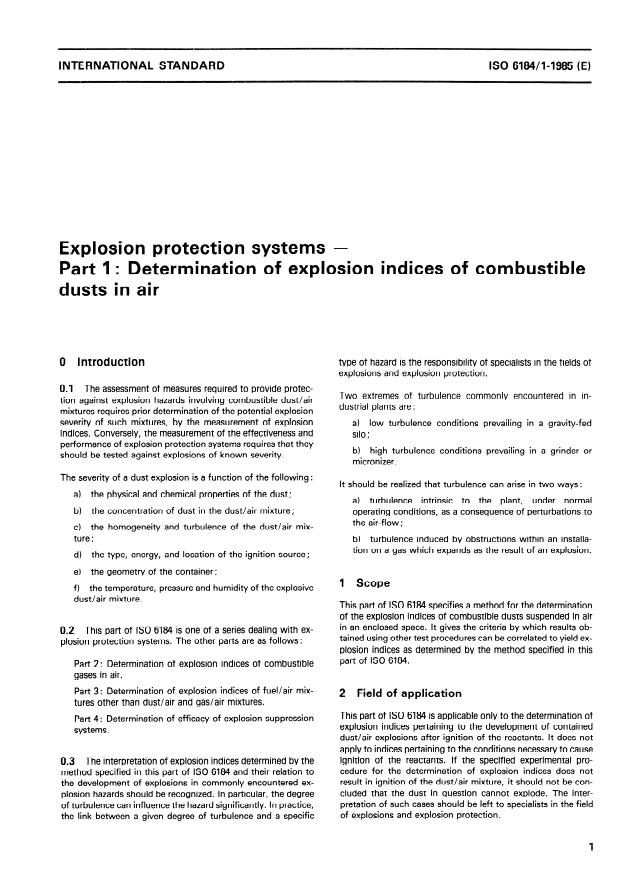
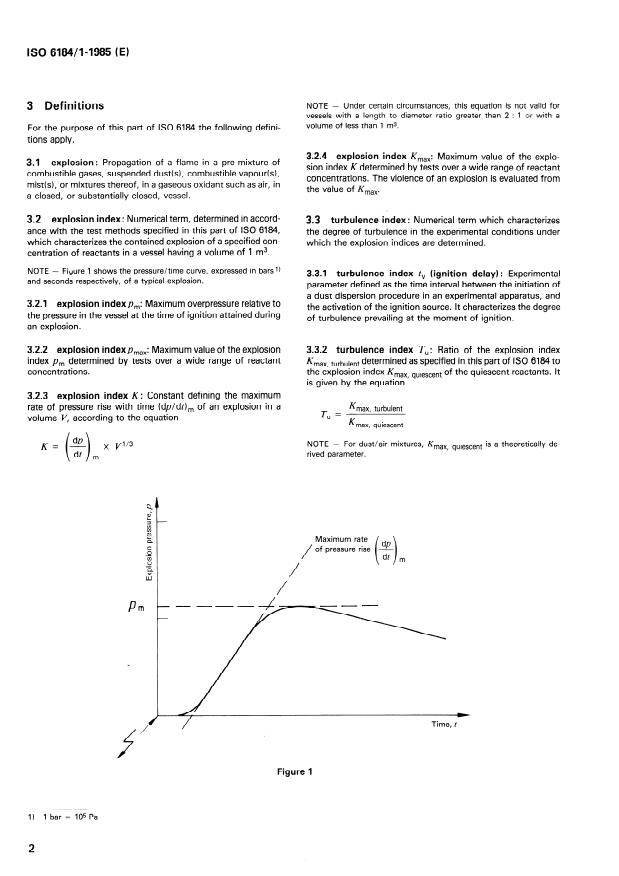
ISO 6184-1:1985 - Explosion protection systems — Part 1: Determination of explosion indices of combustible dusts in air Released:11/21/1985
ISO 6184-1:1985 - Systemes de protection contre les explosions — Partie 1: Détermination des indices d'explosion des poussieres combustibles dans l'air
Overview
ISO 6184-1:1985 provides a standardized method for determining explosion indices of combustible dusts suspended in air. Issued by the International Organization for Standardization (ISO), this standard is an essential part of explosion protection systems, specifying test methods to evaluate the explosion characteristics of dust/air mixtures in an enclosed space. By defining clear criteria, the standard enables correlation of results obtained through alternative test procedures, ensuring consistent assessment of explosion risk across industries handling combustible dusts.
Key Topics
- Explosion Indices: Focuses on the maximum explosion pressure (p_max) and maximum rate of pressure rise (K_max) for dust/air mixtures.
- Test Methodology: Describes apparatus consisting of a reference explosion chamber, dust dispersion setup, ignition source, and pressure recording instrumentation.
- Criteria for Correlation: Sets requirements for validating alternative test procedures, including accuracy thresholds and necessary comparability with the reference method.
- Explosion Severity Factors: Considers variables such as dust properties, concentration, turbulence, ignition source, and environmental conditions.
- Interpretation of Results: Emphasizes the importance of specialist analysis, particularly in cases where the dust appears non-explosive under test conditions.
Applications
ISO 6184-1:1985 plays a critical role in industries where handling of combustible dust is prevalent, such as:
- Chemical and Pharmaceutical Manufacturing: Used to assess the explosion risk in processes involving powders and fine particulates.
- Food and Agriculture: Supports explosion risk management in grain silos, flour mills, sugar refineries, and other processing plants dealing with fine organic dusts.
- Metals and Mining: Relevant for operations generating metal dusts, such as aluminum or magnesium processing, where explosion hazards exist.
- Engineering and Plant Design: Influences the design and evaluation of explosion protection systems by providing quantified indices for risk assessment, suppression, and containment strategies.
- Regulatory Compliance and Safety Audits: Facilitates compliance with occupational health and safety regulations by offering a recognized method for dust explosion testing.
- Comparison and Calibration: Provides a reference approach for calibrating alternative test methods, ensuring consistency across international laboratories and facilities.
Related Standards
Organizations implementing ISO 6184-1:1985 may also consider its companion documents and other relevant standards, including:
- ISO 6184-2: Determination of explosion indices for combustible gases in air.
- ISO 6184-3: Explosion indices for fuel/air mixtures other than dust/air and gas/air.
- ISO 6184-4: Determination of efficacy of explosion suppression systems.
- EN 14034 (European Standard): Test methods for determining explosion characteristics of dust clouds.
- NFPA 68/69: US National Fire Protection Association standards on explosion protection by deflagration venting and prevention systems.
By adopting ISO 6184-1:1985, organizations can ensure a high level of safety, consistent hazard assessment, and alignment with international best practices for explosion protection systems involving combustible dusts.
Relations
- Effective Date
- 25-Aug-2026
- Effective Date
- 25-Aug-2026
- Effective Date
- 25-Aug-2026
- Effective Date
- 03-Jun-2026
Buy Documents
ISO 6184-1:1985 - Explosion protection systems — Part 1: Determination of explosion indices of combustible dusts in air Released:11/21/1985
ISO 6184-1:1985 - Systemes de protection contre les explosions — Partie 1: Détermination des indices d'explosion des poussieres combustibles dans l'air
Get Certified
Connect with accredited certification bodies for this standard

CIS Institut d.o.o.
Personal Protective Equipment (PPE) certification body. Notified Body NB-2890 for EU Regulation 2016/425 PPE.

Kiwa BDA Testing
Building and construction product certification.
Kmetijski inštitut Slovenije
Agricultural Institute of Slovenia. Soil testing, plant health, agricultural product analysis.
Sponsored listings
Frequently Asked Questions
ISO 6184-1:1985 is a standard published by the International Organization for Standardization (ISO). Its full title is "Explosion protection systems — Part 1: Determination of explosion indices of combustible dusts in air". This standard covers: Specifies a test method. Gives the criteria by which results obtained using other test procedures can be correlated to yield the quantities as determined by the method specified.
Specifies a test method. Gives the criteria by which results obtained using other test procedures can be correlated to yield the quantities as determined by the method specified.
ISO 6184-1:1985 is classified under the following ICS (International Classification for Standards) categories: 13.230 - Explosion protection. The ICS classification helps identify the subject area and facilitates finding related standards.
ISO 6184-1:1985 has the following relationships with other standards: It is inter standard links to EN ISO 23062:2022, EN 620:2002+A1:2010, EN 710:1997+A1:2010, EN ISO 8130-4:2010. Understanding these relationships helps ensure you are using the most current and applicable version of the standard.
ISO 6184-1:1985 is available in PDF format for immediate download after purchase. The document can be added to your cart and obtained through the secure checkout process. Digital delivery ensures instant access to the complete standard document.
Standards Content (Sample)
International Standard
-18411
INTERNATIONAL ORGANIZATION FOR STANDARDlZATION.ME~AYHAPO~HAR OPTAHM3ALhlR l-l0 CTAHAAPTbl3A~W’l~ORGANISATlON INTERNATIONALE DE NORMALISATION
Explosion protection Systems -
Part 1 : Determination of explosion indices of combustible
dusts in air
S yst&mes de pro tection con tre /es explosions - Partie I : 06 termina tion des indices d’explosion des poussleres combus tibles
dans l’air
First edition - 1985-11-15
UDC 614.835 Ref. No. ISO 6184/1-1985 (EI
Descriptors : explosion proofing, dust, tests, explosion index.
Price based on 5 pages
Foreword
ISO (the International Organization for Standardization) is a worldwide federation of
national Standards bodies (ISO member bodies). The work of preparing International
Standards is normally carried out through ISO technical committees. Esch member
body interested in a subject for which a technical committee has been established has
the right to be represented on that committee. International organizations, govern-
mental and non-governmental, in liaison with ISO, also take patt in the work.
Draft International Standards adopted by the technical committees are circulated to
the member bodies for approval before their acceptance as International Standards by
the ISO Council. They are approved in accordance with ISO procedures requiring at
least 75 % approval by the member bodies voting.
International Standard ISO 6184/1 was prepared by Technical Committee ISO/TC 21,
Equipment for fire protection and fire fighting.
Users should note that all International Standards undergo revision from time to time
and that any reference made herein to any other International Standard implies its
latest edition, unless otherwise stated.
0 International Organkation for Standardization, 1985
Printed in Switzerland
INTERNATIONAL STANDARD ISO 6184/1-1985 (E)
Explosion protection Systems -
Part 1 : Determination of explosion indices of combustible
dusts in air
0 Introduction type of hazard is the responsibility of specialists in the fields of
explosions and explosion protection.
0.1 The assessment of measures required to provide protec-
Two extremes of turbulente commonly encountered in in-
tion against explosion hazards involving combustible dust/air
dustrial plants a re :
mixtures requires Prior determination of the potential explosion
severity of such mixtures, by the measurement of explosion
a) low turbulente conditions prevailing in a gravity-fed
indices. Conversely, the measurement of the effectiveness and
Silo ;
Performance of explosion protection Systems requires that they
b) high turbulente conditions prevailing in a grinder or
should be tested against explosions of known severity.
micronizer.
The severity of a dust explosion is a function of the following :
lt should be realized that turbulente tan arise in two ways:
the physical and Chemical proper-Ges of the dust;
a)
a) turbulente intrinsic to the plant, under normal
the concentration of dust in the dust/air mixture;
b) operating conditions, as a consequence of perturbations to
the air-flow ;
of the dust/air mix-
c) the homogeneity and turbulente
ture ;
b) turbu lence induced by obstructions within an installa-
tion on a gas which expands as the resu lt of an explosion.
d) the type, energy, and location of the ignition Source;
the geometry of the Container;
e)
1 Scope
f) the temperature, pressure and humidity of the explosive
dust/air mixture.
This part of ISO 6184 specifies a method for the determination
of the explosion indices of combustible dusts suspended in air
in an enclosed space. lt gives the criteria by which results ob-
0.2 This par-t of ISO 6184 is one of a series dealing with ex-
tained using other test procedures tan be correlated to yield ex-
plosion protection Systems. The other Parts are as follows:
plosion indices as determined by the method specified in this
part of ISO 6184.
combustible
Part 2 : Determination of explosion indices of
in air.
gases
Part 3 : Determination of explosion indices of fuel/air mix-
2 Field of application
air and gas/air mixtures
tures other than dust/
This part of ISO 6184 is applicable only to the determination of
eff icacy of explosion suppression
Part 4 : Determination of
explosion indices pertaining to the development of contained
Systems.
dust/air explosions after ignition of the reactants. lt does not
apply to indices pertaining to the conditions necessary to Cause
ignition of the reactants. If the specified experimental pro-
0.3 The interpretation of explosion indices determined by the
cedure for the determination of explosion indices does not
method specified in this part of ISO 6184 and their relation to
result in ignition of the dust/air mixture, it should not be con-
the development of explosions in commonly encountered ex-
cluded that the dust in question cannot explode. The inter-
plosion hazards should be recognized. In particular, the degree
pretation of such cases should be left to specialists in the field
of turbulente tan influence the hazard significantly. In practice,
of explosions and explosion protection.
the Iink between a given degree of turbulente and a specific
ISO 6184/1-1985 (El
NOTE - Under certain circumstances, this equation is not valid for
3 Definitions
vessels with a length to diameter ratio greater than 2 : 1 or with a
volume of less than 1 m?
For the purpose of this part sf ISO 6’l%4 the following defini-
tions apply.
3.2.4 explosion index Kmax: Maximum value of the explo-
Propagation of a flame in a pre-mixture of
7om 1 explosion :
sion index K determined by tests over a wide range of reactant
combustible gases, suspended dustk), combustible vapourk),
concentrations. The violence of an explosion is evaluated from
mist(s), or mixtures thereof, in a gaseous oxidant such as air, in
the value of K,,,.
a closed, or substantially closed, vessel.
3.2 explosion index: Numerital term, determined in accord-
3.3 turbulente index : Numerital term which characterizes
ante with the test methods specified in this part of ISO 6184, the degree of turbulente in the experimental conditions under
which characterizes the contained explosion of a specified con- which the explosion indices are determined.
centration of reactants in a vessel having a volume of 1 m3.
NOTE - Figure 1 shows the pressure/time curve, expressed in barsl)
3.3.1 turbulente index t, (ignition delay) : Experimental
and seconds respectively, of a typical explosion.
Parameter defined as
...
6184/1
Norme internationale
INTERNATIONAL ORGANIZATION FOR STANDARDIZATIONWlE~~YHAPO~HAR OPTAHM3AUMR t-l0 CTAH~APTbl3A~Wl.ORGANISAilON INTERNATIONALE DE NORMALISATION
Systèmes de protection contre les explosions -
Partie 1 : Détermination des indices d’explosion des
poussières combustibles dans l’air
Explosion pro tee tion s ys tems - Part 1: De termina tion of explosion indices of combustible dus ts in air
Première édition - 1985-11-15
îî
Y
Réf. no : ISO 6184/1-1985 (FI
CDU 614.835
B
I
Descripteurs : protection contre l’explosion, poussiére, essai, indice d’explosion.
t
ob
zo
5; Prix basé sur 5 pages
Avant-propos
L’ISO (Organisation internationale de normalisation) est une fedération mondiale
d’organismes nationaux de normalisation (comités membres de I’ISO). L’elaboration
des Normes internationales est confiée aux comités techniques de I’ISO. Chaque
comité membre intéressé par une étude a le droit de faire partie du comité technique
crée à cet effet. Les organisations internationales, gouvernementales et non gouverne-
mentales, en liaison avec I’ISO participent également aux travaux.
Les projets de Normes internationales adoptés par les comités techniques sont soumis
aux comités membres pour approbation, avant leur acceptation comme Normes inter-
nationales par le Conseil de I’ISO. Les Normes internationales sont approuvées confor-
mement aux procédures de I’ISO qui requiérent l’approbation de 75 % au moins des
comites membres votants.
La Norme internationale ISO 6184/1 a été elaborée par le comité technique ISO/TC 21,
Équipement de protection et de lutte contre l’incendie.
L’attention des utilisateurs est attirée sur le fait que toutes les Normes internationales
sont de temps en temps soumises à révision et que toute référence faite a une autre
Norme internationale dans le présent document implique qu’il s’agit, sauf indication
contraire, de la dernière Rdition.
0 Organisation internationale de normalisation, 1985 0
Imprimé en Suisse
NORME INTERNATIONALE ISO 6164/1-1965 (F)
Systèmes de protection contre les explosions -
Partie 1 : Détermination des indices d’explosion des
poussières combustibles dans l’air
pratique, l’association d’un degré donné de turbulence à un
0 Introduction
type de risque spécifique doit être du ressort des spécialistes
dans le domaine des explosions et de la protection contre les
0.1 L’évaluation des mesures de protection contre les risques
explosions.
d’explosion des poussières combustibles dans l’air nécessite de
déterminer au préalable la violence potentielle d’explosion de
Deux cas extrêmes de turbulence couramment rencontres dans
ces poussières par la mesure de leurs indices d’explosion. Par
les industries sont les suivants:
ailleurs, pour mesurer l’efficacité et les performances des systé-
mes de protection contre les explosions, il est nécessaire
a) état de faible turbulence dans une trémie chargée par
d’essayer ces systémes en présence d’explosions de violences
gravité ;
connues.
b) état. de turbulence élevée dans un broyeur ou un
(( microniseur )).
La violence d’une explosion des poussiéres combustibles est
fonction des paramètres suivants :
II devrait être admis que la turbulence peut se présenter sous les
a) les propriétés physiques et chimiques de la poussière;
deux formes suivantes :
b) la concentration de la poussière dans le melange
a) turbulence intrinsèque dans l’installation, dans des con-
air/ poussière ;
ditions normales de fonctionnement comme conséquence
des perturbations des courants d’air;
c) l’homogénéité et le degré de turbulence du mélange
air/ poussière ;
b) turbulence produite, par l’action des obstacles à I’inté-
rieur de l’installation, sur les gaz qui se dilatent du fait d’une
d) le type, l’énergie et l’emplacement de la source
explosion.
d’inflammation ;
e) la géométrie du récipient;
1 Objet
f) la température, la pression et l’humidité du mélange
explosible air/ poussière.
La présente partie de I’ISO 6184 spécifie une méthode d’essai
pour la détermination des indices d’explosion des poussiéres
0.2 La présente partie de I’ISO 6184 fait partie d’une serie de
combustibles en suspension dans l’air, à I’interieur d’un volume
normes concernant les systémes de protection contre les explo-
clos. Elle donne des critères permettant de juger la corrélation
sions. Les autres parties de la serie sont les suivantes:
entre les résultats obtenus à partir d’autres méthodes d’essai et
les indices tels que determinés par la méthode spécifiée dans la
Partie 2: Détermination des indices d’explosion des gaz
présente partie de I’ISO 6184.
combustibles dans l’air.
Partie 3: Détermination des indices d’explosion des mélan-
ges de combustibles et d’air autres que les mélanges
2 Domaine d’application
air/poussiére et air/gaz.
La présente partie de I’ISO 6184 s’applique à la détermination
Partie 4 : Détermination de l’efficacité des systèmes de sup-
des indices d’explosion de poussières ayant rapport à des
pression des explosions.
explosions confinées aprés inflammation des réactifs. Elle ne
traite pas des indices relatifs aux conditions d’inflammation des
0.3 L’interprétation des indices d’explosion déterminés par la réactifs. Dans le cas où la méthode spécifiée dans la présente
methode spécifiée dans la présente partie de I’ISO 6184 et leur partie de I’ISO 6184 ne conduirait pas à une inflammation de la
relation avec les développements d’explosion dans les risques poussière dans l’air, on ne doit pas en conclure que la poussiére
en question n’est pas susceptible d’exploser. L’interprétation
industriels d’explosion couramment rencontrés dans la prati-
que, doivent être reconnues. En particulier, le degré de turbu- de tels cas doit être laissée aux spécialistes des explosions et de
la protection contre les explosions.
lence peut avoir une influence importante sur le risque. Dans la
ISO 6184/1-1985 (FI
NOTE - Dans certaines conditions, cette formule n’est pas valable
3 Définitions
pour les récipients dont le rapport longueur/diamètre est supérieur à
2 : 1, ou dont le volume est inférieur à 1 ma.
Dans le cadre de la présente partie de I’ISO 6184, les définitions
suivantes sont applicables.
3.2.4 indice d’explosion .Kma,: Valeur maximale de l’indice
3.1 explosion : Propagation d’une flamme dans un pré-
d’explosion K déterminée au moyen d’essais sur une large
mélange de gaz combustible(s), poussière(s) en suspension,
gamme de concentrations de réactifs. La violence d’une explo-
vapeur(s) combustible(s) ou leur(s) mélange(s), disperse dans
sion s’evalue à partir de la valeur de K,,,,.
un oxydant gazeux, tel l’air, à l’intérieur d’un récipient fermé ou
pratiquement fermé.
33 indice de turbulence : Valeur numérique caractérisant
3.2 indice d’explosion : Valeur numérique, déterminée sui-
le’ degré de turbulence dans les conditions expérimentales dans
vant les méthodes d’essai spécifiées dans la présente partie de
lesquelles sont déterminés les indices d’explosion.
I’ISO 6184, qui caractérise l’explosion confinée d’une concen-
tration de réactifs donnée, dans un récipient de 1 m3 de
i volume.
3.3.1 indice de turbulence t, (délai de mise à feu) : Para-
métre expérimental défini comme étant l’intervalle de temps
La figure 1 illustre le développement dans le temps, exprimé
NOTE -
entre le début de la dispersion de la poussiére dans un appareil-
en
...