

ISO 5053-3:2024
(Main)Industrial trucks — Vocabulary — Part 3: Accessories and components
General Information
- Abstract
This document establishes the vocabulary of accessories and components of industrial trucks (hereafter referred to as trucks) as defined in ISO 5053-1. For the purposes of this document, the terms accessories and components are describing parts and assemblies which are, or can be, fitted to a truck. Accessories and components of typical trucks are given in Annex A. Due to the variance of the individual truck types and the ongoing development of new combinations, it is not possible to include all the different variations of accessories and components. Therefore, this document defines, shows and/or describes the typical variances. In addition to text written in the official ISO languages (English, French), this document gives text in German, Italian and Chinese. This text is published under the responsibility of the member bodies for Germany (DIN), Italy (UNI) and China (SAC), and is given for information only. Only the text given in the official languages can be considered as ISO text.
- Status
- Published
- Publication Date
- 27-Aug-2024
- Technical Committee
- ISO/TC 110/SC 1 - General terminology
- Drafting Committee
- ISO/TC 110/SC 1 - General terminology
- Current Stage
- 6060 - International Standard published
- Start Date
- 28-Aug-2024
- Due Date
- 21-Oct-2024
- Completion Date
- 28-Aug-2024
Buy Documents


ISO 5053-3:2024 - Industrial trucks — Vocabulary — Part 3: Accessories and components Released:28. 08. 2024

REDLINE ISO 5053-3 - Industrial trucks — Vocabulary — Part 3: Accessories and components Released:8. 05. 2024
Overview
ISO 5053-3:2024 - Industrial trucks - Vocabulary - Part 3: Accessories and components establishes a consistent, authoritative vocabulary for parts, assemblies, accessories and components that are, or can be, fitted to industrial trucks (as defined in ISO 5053-1). Published in 2024, the document defines terms, provides explanatory notes and illustrations (Annex A) of typical accessories and components across a wide range of truck types. English and French are the official ISO texts; German, Italian and Chinese translations are included for information.
Key topics
- Scope and purpose: Standardizes terminology for accessories and components to improve clarity in design, procurement, documentation and safety.
- Terms and definitions: Includes precise definitions for common items such as battery compartment, bumper (PSPD), cabin, chassis, controls, counterweight, drive wheel, fork arm, fork carrier, load handling device, mast, operator platform, overhead guard, stabilizer block/wheel, reach carriage, slewing mechanism, and many more.
- Illustrative Annex A: Examples of accessories/components for specific truck types (e.g., towing tractor, counterbalance lift truck, lorry-mounted truck, driverless truck, reach truck, multi-directional lift truck, variable-reach truck).
- Coverage limits: Describes typical variances but does not attempt to list every possible configuration; focuses on representative components and assemblies.
- Multilingual note: Additional translations (DE/IT/CN) published by DIN, UNI and SAC are informative only; English and French are authoritative.
- References for terminology: Directs users to ISO Online Browsing Platform and IEC Electropedia for related terminology databases.
Applications
- Standardizes vocabulary across technical documentation, maintenance manuals, safety procedures, procurement specifications and training materials for warehouses, logistics centers and manufacturing plants.
- Facilitates clearer communication between manufacturers, integrators, fleet operators, safety regulators and service providers.
- Supports technical writing, translation/localization and compliance work by providing unambiguous definitions for component names and functions.
- Useful for creating bills of materials (BOMs), equipment catalogs, risk assessments and automated system integration where consistent naming minimizes errors.
Who should use this standard
- Industrial truck manufacturers and component suppliers
- Engineering designers and technical authors
- Procurement and asset managers in logistics and warehousing
- Safety and compliance professionals
- Standards developers, translators and technical trainers
Related standards
- ISO 5053-1 (reference for definitions of truck types)
- Other parts of the ISO 5053 series (see ISO website for the full list)
Keywords: ISO 5053-3:2024, industrial trucks, vocabulary, accessories and components, forklift terminology, truck components, Annex A examples, operator safety, warehouse equipment.
Relations
- Effective Date
- 25-Aug-2026
- Effective Date
- 24-Jul-2021
Buy Documents
ISO 5053-3:2024 - Industrial trucks — Vocabulary — Part 3: Accessories and components Released:28. 08. 2024
REDLINE ISO 5053-3 - Industrial trucks — Vocabulary — Part 3: Accessories and components Released:8. 05. 2024
Frequently Asked Questions
ISO 5053-3:2024 is a standard published by the International Organization for Standardization (ISO). Its full title is "Industrial trucks — Vocabulary — Part 3: Accessories and components". This standard covers: This document establishes the vocabulary of accessories and components of industrial trucks (hereafter referred to as trucks) as defined in ISO 5053-1. For the purposes of this document, the terms accessories and components are describing parts and assemblies which are, or can be, fitted to a truck. Accessories and components of typical trucks are given in Annex A. Due to the variance of the individual truck types and the ongoing development of new combinations, it is not possible to include all the different variations of accessories and components. Therefore, this document defines, shows and/or describes the typical variances. In addition to text written in the official ISO languages (English, French), this document gives text in German, Italian and Chinese. This text is published under the responsibility of the member bodies for Germany (DIN), Italy (UNI) and China (SAC), and is given for information only. Only the text given in the official languages can be considered as ISO text.
This document establishes the vocabulary of accessories and components of industrial trucks (hereafter referred to as trucks) as defined in ISO 5053-1. For the purposes of this document, the terms accessories and components are describing parts and assemblies which are, or can be, fitted to a truck. Accessories and components of typical trucks are given in Annex A. Due to the variance of the individual truck types and the ongoing development of new combinations, it is not possible to include all the different variations of accessories and components. Therefore, this document defines, shows and/or describes the typical variances. In addition to text written in the official ISO languages (English, French), this document gives text in German, Italian and Chinese. This text is published under the responsibility of the member bodies for Germany (DIN), Italy (UNI) and China (SAC), and is given for information only. Only the text given in the official languages can be considered as ISO text.
ISO 5053-3:2024 is classified under the following ICS (International Classification for Standards) categories: 01.040.53 - Materials handling equipment (Vocabularies); 53.060 - Industrial trucks. The ICS classification helps identify the subject area and facilitates finding related standards.
ISO 5053-3:2024 has the following relationships with other standards: It is inter standard links to EN 16842-11:2026, ISO 5053:1987. Understanding these relationships helps ensure you are using the most current and applicable version of the standard.
ISO 5053-3:2024 is available in PDF format for immediate download after purchase. The document can be added to your cart and obtained through the secure checkout process. Digital delivery ensures instant access to the complete standard document.
Standards Content (Sample)
International
Standard
Norme
internationale
ISO 5053-3
First edition
Industrial trucks — Vocabulary —
Première édition
Part 3:
2024-08
Accessories and components
Chariots de manutention —
Vocabulaire —
Partie 3:
Composants et équipements
Reference number
Numéro de référence
DOCUMENT PROTÉGÉ PAR COPYRIGHT
© ISO 2024
All rights reserved. Unless otherwise specified, or required in the context of its implementation, no part of this publication may
be reproduced or utilized otherwise in any form or by any means, electronic or mechanical, including photocopying, or posting on
the internet or an intranet, without prior written permission. Permission can be requested from either ISO at the address below
or ISO’s member body in the country of the requester.
Tous droits réservés. Sauf prescription différente ou nécessité dans le contexte de sa mise en oeuvre, aucune partie de cette
publication ne peut être reproduite ni utilisée sous quelque forme que ce soit et par aucun procédé, électronique ou mécanique,
y compris la photocopie, ou la diffusion sur l’internet ou sur un intranet, sans autorisation écrite préalable. Une autorisation peut
être demandée à l’ISO à l’adresse ci-après ou au comité membre de l’ISO dans le pays du demandeur.
ISO copyright office
CP 401 • Ch. de Blandonnet 8
CH-1214 Vernier, Geneva
Tel. + 41 22 749 01 11
E-mail copyright@iso.org
Web www.iso.org
Published in Switzerland
Publié en Suisse
ii
International
Standard
ISO 5053-3
First edition
Industrial trucks — Vocabulary —
2024-08
Part 3:
Accessories and components
Chariots de manutention — Vocabulaire —
Partie 3: Composants et équipements
Reference number
© ISO 2024
All rights reserved. Unless otherwise specified, or required in the context of its implementation, no part of this publication may
be reproduced or utilized otherwise in any form or by any means, electronic or mechanical, including photocopying, or posting on
the internet or an intranet, without prior written permission. Permission can be requested from either ISO at the address below
or ISO’s member body in the country of the requester.
ISO copyright office
CP 401 • Ch. de Blandonnet 8
CH-1214 Vernier, Geneva
Phone: +41 22 749 01 11
Email: copyright@iso.org
Website: www.iso.org
Published in Switzerland
ii
Contents Page
Foreword .iv
1 Scope . 1
2 Normative references . 1
3 Terms and definitions . 1
Annex A (informative) Examples of accessories and components of trucks . 9
Bibliography .26
Index .27
iii
Foreword
ISO (the International Organization for Standardization) is a worldwide federation of national standards
bodies (ISO member bodies). The work of preparing International Standards is normally carried out through
ISO technical committees. Each member body interested in a subject for which a technical committee
has been established has the right to be represented on that committee. International organizations,
governmental and non-governmental, in liaison with ISO, also take part in the work. ISO collaborates closely
with the International Electrotechnical Commission (IEC) on all matters of electrotechnical standardization.
The procedures used to develop this document and those intended for its further maintenance are described
in the ISO/IEC Directives, Part 1. In particular, the different approval criteria needed for the different types
of ISO document should be noted. This document was drafted in accordance with the editorial rules of the
ISO/IEC Directives, Part 2 (see www.iso.org/directives).
ISO draws attention to the possibility that the implementation of this document may involve the use of (a)
patent(s). ISO takes no position concerning the evidence, validity or applicability of any claimed patent
rights in respect thereof. As of the date of publication of this document, ISO had not received notice of (a)
patent(s) which may be required to implement this document. However, implementers are cautioned that
this may not represent the latest information, which may be obtained from the patent database available at
www.iso.org/patents. ISO shall not be held responsible for identifying any or all such patent rights.
Any trade name used in this document is information given for the convenience of users and does not
constitute an endorsement.
For an explanation of the voluntary nature of standards, the meaning of ISO specific terms and
expressions related to conformity assessment, as well as information about ISO's adherence to the
World Trade Organization (WTO) principles in the Technical Barriers to Trade (TBT), see
www.iso.org/iso/foreword.html.
This document was prepared by Technical Committee ISO/TC 110, Industrial trucks, Subcommittee SC 1,
General terminology.
In addition to text written in the official ISO languages (English, French), this document gives text in German,
Italian and Chinese. This text is published under the responsibility of the member bodies for Germany (DIN),
Italy (UNI) and China (SAC), and is given for information only. Only the text given in the official languages
can be considered as ISO text.
A list of all parts in the ISO 5053 series can be found on the ISO website.
Any feedback or questions on this document should be directed to the user’s national standards body. A
complete listing of these bodies can be found at www.iso.org/members.html.
iv
International Standard ISO 5053-3:2024(en)
Industrial trucks — Vocabulary —
Part 3:
Accessories and components
1 Scope
This document establishes the vocabulary of accessories and components of industrial trucks (hereafter
referred to as trucks) as defined in ISO 5053-1.
For the purposes of this document, the terms accessories and components are describing parts and
assemblies which are, or can be, fitted to a truck.
Accessories and components of typical trucks are given in Annex A.
Due to the variance of the individual truck types and the ongoing development of new combinations, it is
not possible to include all the different variations of accessories and components. Therefore, this document
defines, shows and/or describes the typical variances.
2 Normative references
There are no normative references in this document.
3 Terms and definitions
ISO and IEC maintain terminology databases for use in standardization at the following addresses:
— ISO Online browsing platform: available at https:// www .iso .org/ obp
— IEC Electropedia: available at https:// www .electropedia .org/
3.1
access gate
section of guard rail possible to open and close for operator access and egress
3.2
auxiliary lift device
lift mechanism additional to the main lifting device
3.3
battery compartment
enclosure, integral to the truck, that houses the traction battery(ies)
Note 1 to entry: Truck(s) designed with parts of a modular lithium-ion battery can be integrated throughout the
chassis can and have no battery compartment according to this definition.
3.4
bumper
pressure-sensitive protective device (PSPD) fitted to the truck that generates a signal to stop the truck upon
physical contact
3.5
cabin
operator position completely enclosed by rigid materials (for example door(s), glass) to shield the operator
from environmental influence
Note 1 to entry: If a truck is equipped with flexible PVC doors or open sides, it is not considered to have a cabin.
3.6
chassis
main frame structure to which the various units of the truck (for example engine, transmission, lifting gear,
mast) are fixed
3.7
controls
control device
means for the operator to actuate truck functions
3.8
controls for operating alongside
means for control of travelling and/or lifting/lowering functions from outside the truck
3.9
counterweight
mass fixed to the truck intended to counterbalance the load
3.10
damping and tilting system
actuators for damping and tilting of the spreader
3.11
double mast
mast composed of one fixed and one moving upright
3.12
drive wheel
wheel which transmits the tractive effort to the ground
Note 1 to entry: A drive wheel can also be the steered wheel.
3.13
driving axle
axle of a self-propelled truck that transmits torque to the drive wheel(s)
3.14
emergency stop device
manually actuated control device used to initiate an emergency stop function
3.15
enabling device
additional manually operated device used in conjunction with a start control and which, when continuously
actuated, allows a machine to function
3.16
engine cover
cover over part of a truck where the engine is mounted
3.17
exhaust system
all parts used to contain, process and direct gaseous and particulate emissions from an internal combustion
engine between the joint face of the cylinder head(s) and the end of outlet pipe(s)
Note 1 to entry: The exhaust system can contain an after-treatment system.
3.18
foldable lateral support arms
structural part of the truck that, when in the extended position, provides lateral support to the operator
when standing on the platform, and which can be folded or pivoted to a stowed position
Note 1 to entry: Lateral support for the operator allows faster travelling speed for stand-on trucks.
3.19
foldable operator platform
operator platform that can be stowed away to permit pedestrian controlled operation
3.20
fork arm
blade cantilevered from a shank which is provided with means of attachment (for example bolted, shaft-
mounted, hook-mounted) to a fork carrier and usually two or more fork arms are mounted together to
handle, for example, palletized loads
[SOURCE: ISO 5053-2:2019, 3.1]
3.21
fork carrier
fork arm carrier
load carriage
carriage
component of the mast bearing the load handling device
3.22
free lift height
lifting of the fork carrier without extending the telescopic mast above the fixed mast
3.23
grab rail
structure designed for the operator to grip to assist with operator stability while the truck is travelling
Note 1 to entry: It can be used also to assist operator stability when the truck is stationary (for example egress,
ingress).
3.24
guard rail
structure for protection against accidental falls from stair(s)/step(s), ladders, landings, platforms and
walkways
Note 1 to entry: See Figure 1.
Key
1 top rail
2 intermediate rail
3 toe board
4 stanchion
5 walkway/platform
Figure 1 — Guard rail
3.25
guidance system
system which guides the truck on a predetermined path not directly controlled by the operator
3.26
intermediate rail
knee rail
mid rail
rigid element of the guard rail placed parallel with the top rail, giving extra protection against the passage
of a body
3.27
lifting boom
telescopic boom for raising/lowering and extension of the load handling device
3.28
lifting boom suspension
upper rear part of the chassis where the lifting boom is mounted and pivoting
3.29
lifting cylinder
actuator for raising and lowering the load handling device
3.30
load backrest extension
vertical structure connected to the fork carrier extending the vertical part of the fork arms to increase the
load restraining area
3.31
load carrying platform
plain surface on which the load can be carried
3.32
load handler
structural part of the truck connecting the load handling device with the traverse frame
3.33
load handling device
means that supports the load
EXAMPLE Fork arms, platform, attachment.
3.34
load wheel
wheel(s), located on the load end of a truck, which predominantly bear the dynamic and static forces due to
load carried by the truck to which it is fitted
3.35
mast
assembly that guides the vertical movement and supports the fork carrier or load handling device
3.36
mast suspension
supports between mast and chassis to reduce mast sway and deflection
3.37
non-telescopic mast
mast composed only of fixed uprights
3.38
operator backrest
part of the operator’s compartment to support the back of the operator
3.39
operator enclosure
fixed vertical structure(s) added to the operator platform, generally to the sides or to the rear of that
platform
3.40
operator platform
standing surface provided for a ride-on operator to operate the truck
Note 1 to entry: Operator platforms can also be equipped with an operator seat.
3.41
operator presence control
opc
system which uses a device to detect the presence of the operator in the normal operating position
3.42
operator seat
portion of the truck provided for the purpose of supporting the buttocks and back of the seated operator,
including any suspension system and other mechanisms provided (for example for adjusting the seat
position)
3.43
operator restraint system
device or system that is permanently installed to keep the operator within the protective structure of the truck
3.44
outrigger
support arm
supporting structure of the truck extending the profile of the chassis to enable the positioning of the load
centre of gravity within the stability limits
3.45
overhead guard
structure fitted to the truck for the purpose of protecting the operator against falling objects
3.46
personnel detection means
system to detect person(s) in the path of a truck
Note 1 to entry: Bumper and virtual bumper are both types of personnel detection means.
3.47
pivot steer bearing
mechanical joint with rotation around the pivot axis which connects the front wheels and mast to the rear of
an articulated counterbalance truck
3.48
quadruple mast
mast composed of one fixed upright and three moving uprights
3.49
reach carriage with fixed mast
carriage used in reach trucks with fixed masts to extend the fork carrier forward or backward in the
longitudinal centre plane of the truck
Note 1 to entry: The reach carriage allows retrieving the load at a position between steering and load axle. This
principle reduces the overall length of the truck and improves stability.
3.50
reach carriage with mast holder
reach carriage with mast carrier
carriage used in reach trucks that contains a mechanical structure to fix the mast and that can be moved
backwards and forwards in the direction of the longitudinal centre plane of the truck
Note 1 to entry: The reach carriage allows retrieving the load at a position between steering and load axle. This
principle reduces the overall length of the truck and improves stability.
3.51
reach cylinder
actuator that extends or retracts the reach carriage with mast holder and load handling device on reach
trucks, or the lifting boom on variable-reach trucks
3.52
scissor mechanism
mechanism comprising one or more pairs of arms having a pivot near the centre of each arm, which moves
the load handling device (for example forks) to position or interface with a load
3.53
slewing mechanism
drive unit for rotating the revolving part of the truck in a horizontal plane
3.54
slewing upper structure
elements mounted on top of a slewing mechanism, for example cabin and load handling devices, where
provided
3.55
spreader
lifting device for handling ISO containers of one size (fixed length) or of several sizes (telescopic spreader)
3.56
stabilizer block
stabilizer pad
skid bar
design feature which is not a wheel that is fixed to the truck chassis, that comes into contact with the floor if
the truck is tipping and that reduces the risk of a tip over
Note 1 to entry: The feature can be part of the chassis or counterweight or can be mounted to the chassis.
3.57
stabilizer wheel
auxiliary wheels or castors, usually in pairs, solidly or resiliently mounted to the chassis of a truck, to assist
in maintaining stability
3.58
stabilizing device
extendable or pivoting mechanical support used to improve the stability of a truck when stationary
3.59
stanchion
vertical structural element of the guard rail to anchor the guard rail to the platform
3.60
steered wheel
steer wheel
wheel whose orientation is controlled to change the path of travel
3.61
steering axle
steer axle
axle that supports the steered wheel
3.62
steering wheel
device to be controlled by the operator which determines the steered path of travel
3.63
step
part of the truck including a tread on which the foot/feet is/are placed to access or egress
3.64
telescopic mast
mast composed of fixed uprights, and one (or more) moving uprights
3.65
tiller
bar used by the operator on a truck for the purpose of steering
Note 1 to entry: It can incorporate other functions.
3.66
tiller head safety device
pressure sensitive device at the control end of the tiller
3.67
tilting system
actuator to adjust the tilt of the mast or load handling device within defined mechanical limits
EXAMPLE Hydraulic cylinder(s) for tilting of the mast or the load handling device.
3.68
toe board
toe-plate
rigid lower part of a guard rail intended to hinder a person's foot from slipping off the edge of a platform,
step or walkway and/or to prevent the falling of objects from platform level
3.69
top rail
handrail
rigid top element designed to be grasped by the hand for body support which can be used individually or as
the upper part of a guard rail
3.70
trailer coupling
part fixed to the chassis of the truck, used to couple the truck with trailer(s)
3.71
transverse operator seat
seat for a side-facing seated operator, where the centre plane of the seat is orientated approximately
perpendicular to the longitudinal centre plane of truck
3.72
travel switch
travel control device(s) located on the tiller enabling the operator to adjust travel direction and speed
3.73
traverse frame
device for connecting the load handler to the truck enabling lateral movement of the load handling device
3.74
triple mast
mast composed of one fixed upright and two moving uprights
3.75
twistlock
standardized rotating connector for securing freight containers
3.76
virtual bumper
electro sensitive (non-contact) protective equipment (ESPE) fitted to the truck, having one or more detection
zones that generates a signal for the truck to take further actions when actuated
EXAMPLE Active opto-electronic protective devices responsive to diffuse reflection (AOPDDRs).
Note 1 to entry: Further action can include stopping the truck or changing its path or speed.
Annex A
(informative)
Examples of accessories and components of trucks
A.1 Towing tractor/Burden and personnel carrier
Key
1 engine cover (3.16) and/or load carrying platform (3.31)
2 trailer coupling (3.70)
3 driving axle (3.13)
4 chassis (3.6)
5 steering axle (3.61)
6 steering wheel (3.62)
7 cabin (3.5)
Figure A.1 — Accessories and components of towing tractor/burden and personnel carrier
A.2 Counterbalance lift truck
Key
1 mast (3.35) 9 chassis (3.6)
2 steering wheel (3.62) 10 engine cover (3.16)
3 load backrest extension (3.30) 11 operator seat (3.42)
4 fork carrier (3.21) 12 steering axle (3.61)
5 fork arm (3.20) 13 counterweight (3.9)
6 driving axle (3.13) 14 exhaust system (3.17)
7 tilting system (3.67) 15 overhead guard (3.45)
8 step (3.63) 16 operator restraint system (3.43)
Figure A.2 — Accessories and components of counterbalance lift truck
A.3 Lorry-mounted truck
Key
1 mast (3.35) 7 counterweight (3.9)
2 engine cover (3.16) 8 chassis (3.6)
3 steering wheel (3.62) 9 tilting system (3.67)
4 overhead guard (3.45) 10 fork carrier (3.21)
5 operator restraint system (3.43) 11 fork arm (3.20)
6 operator seat (3.42)
Figure A.3 — Accessories and components of lorry-mounted truck
A.4 Driverless truck
Key
1 bumper (3.4); also called personnel detection means (3.46)
2 virtual bumper (3.76); also called personnel detection means (3.46)
3 emergency stop device (3.14)
Figure A.4 — Accessories and components of driverless truck
A.5 Double-stacker/Straddle truck/Pallet-stacking truck/Pallet truck
Key
1 fork arm (3.20) 9 travel switch (3.72)
2 load wheel (3.34) 10 mast (3.35)
3 outrigger (3.44) 11 foldable operator platform (3.19)
4 chassis (3.6) 12 foldable lateral support arms (3.18)
5 stabilizer wheel (3.57) 13 operator presence control (3.41)
6 drive wheel (3.12) 14 operator platform (3.40)
7 tiller (3.65) 15 operator enclosure (3.39)
8 tiller head safety device (3.66)
Figure A.5 — Accessories and components of double-stacker/straddle truck/pallet-stacking
truck/pallet truck
A.6 Centre-controlled order-picking truck/pallet truck
Key
1 operator backrest (3.38)
2 controls (3.7)
3 battery compartment (3.3)
4 drive wheel (3.12)
5 chassis (3.6)
6 operator platform (3.40)
7 fork arm (3.20)
8 controls for operating alongside (3.8)
9 load wheel (3.34)
Figure A.6 — Accessories and components of centre-controlled order-picking truck/pallet truck
A.7 End-controlled pallet truck
Key
1 stabilizer wheel (3.57)
2 tiller (3.65)
3 grab rail (3.23)
4 fork arm (3.20)
5 load wheel (3.34)
6 chassis (3.6)
7 operator platform (3.40)
Figure A.7 — Accessories and components of end-controlled pallet truck
A.8 Pedestrian-propelled scissorlift pallet truck
Key
1 tiller (3.65)
2 fork arm (3.20)
3 scissor mechanism (3.52)
4 load wheel (3.34)
5 steered wheel (3.60)
6 lifting cylinder (3.29)
Figure A.8 — Accessories and components of pedestrian-propelled scissorlift pallet truck
A.9 Lateral- and front-stacking truck
Key
1 mast (3.35) 9 access gate (3.1)
2 mast suspension (3.36) 10 traverse frame (3.73)
3 battery compartment (3.3) 11 load handler (3.32)
4 chassis (3.6) 12 fork arm (3.20)
5 guidance system (3.25) 13 auxiliary lift device (3.2)
6 drive wheel (3.12) 14 controls (3.7)
7 outrigger (3.44) 15 guard rail (3.24)
8 load wheel (3.34) 16 overhead guard (3.45)
Figure A.9 — Accessories and components of lateral- and front-stacking truck
A.10 Order-picking truck
Key
1 mast (3.35) 8 outrigger (3.44)
2 overhead guard (3.45) 9 guidance system (3.25)
3 guard rail (3.24) 10 drive wheel (3.12)
4 controls (3.7) 11 chassis (3.6)
5 access gate (3.1) 12 personnel detection means (3.46)
6 fork arm (3.20) 13 battery compartment (3.3)
7 load wheel (3.34)
Figure A.10 — Accessories and components of order-picking truck
A.11 Reach truck
Key
1 mast (3.35) 7 fork carrier (3.21)
2 load wheel (3.34) 8 fork arm (3.20)
3 outrigger (3.44) 9 reach carriage with mast holder (3.50)
4 drive wheel (3.12) 10 stabilizer block (3.56)
5 transverse operator seat (3.71) 11 overhead guard (3.45)
6 steering wheel (3.62)
NOTE Reach trucks can also have a reach carriage with fixed mast.
Figure A.11 — Accessories and components of reach truck
A.12 Articulated counterbalance lift truck
Key
1 mast (3.35) 8 driving axle (3.13)
2 steering wheel (3.62) 9 chassis (3.6)
3 overhead guard (3.45) 10 steering axle (3.61)
4 operator seat (3.42) 11 fork arm (3.20)
5 engine cover (3.16) 12 fork carrier (3.21)
6 operator restraint system (3.43) 13 pivot steer bearing (3.47)
7 counterweight (3.9)
Figure A.12 — Accessories and components of articulated counterbalance lift truck
A.13 Multi-directional lift truck
Key
1 overhead guard (3.45)
2 operator seat (3.42)
3 controls (3.7)
4 step (3.63)
5 outrigger (3.44)
6 load wheel/steered wheel (3.34/3.60)
7 mast (3.35)
8 fork arm (3.20)
9 fork carrier (3.21)
Figure A.13 — Accessories and components of multi-directional lift truck
A.14 Variable-reach truck
Key
1 lifting boom (3.27)
2 lifting cylinder (3.29)
3 lifting boom suspension (3.28)
4 counterweight (3.9)
5 driving axle (3.13)
6 cabin (3.5), in combination with an overhead guard (3.45)
7 step (3.63)
8 chassis (3.6)
9 steering axle (3.61)
10 load handling device (3.33)
11 tilting system (3.67)
NOTE The driving axle can also be a steering axle on four-wheel steer trucks, and the steering axle can also be a
driving axle on four-wheel drive trucks.
Figure A.14 — Accessories and components of variable-reach truck
A.15 Slewing rough-terrain variable-reach truck
Key
1 lifting boom (3.27)
2 lifting cylinder (3.29)
3 slewing upper structure (3.54)
4 counterweight (3.9)
5 driving axle (3.13)
6 cabin (3.5) in combination with an overhead guard (3.45)
7 step (3.63)
8 steering axle (3.61)
9 chassis (3.6)
10 stabilizing device (3.58)
11 slewing mechanism (3.53)
12 load handling device (3.33)
13 tilting system (3.67)
NOTE The driving axle can also be a steering axle on four-wheel steer trucks, and the steering axle can also be a
driving axle on four-wheel drive trucks.
Figure A.15 — Accessories and components of slewing rough-terrain variable-reach truck
A.16 Variable-reach container handler
Key
1 lifting cylinder (3.29)
2 lifting boom (3.27)
3 damping and tilting system (3.10)
4 spreader (3.55)
5 twistlock (3.75)
6 driving axle 3.13)
7 cabin (3.5), in combination with an overhead guard (3.45)
8 chassis (3.6)
9 steering axle (3.61)
10 counterweight (3.9)
11 lifting boom suspension (3.28)
Figure A.16 — Accessories and components of variable-reach container handler
Bibliography
[1] ISO 5053-1, Industrial trucks — Vocabulary — Part 1: Types of industrial trucks
[2] ISO 5053-2:2019, Industrial trucks — Vocabulary — Part 2: Fork arms and attachments
Index
A K
access gate 3.1 knee rail 3.26
auxiliary lift device 3.2
L
B
lifting boom 3.27
battery compartment 3.3 lifting boom suspension 3.28
bumper 3.4 lifting cylinder 3.29
load backrest extension 3.30
C
load carriage 3.21
load carrying platform 3.31
cabin 3.5
load handler 3.32
carriage 3.21
load handling device 3.33
chassis 3.6
load wheel 3.34
control device 3.7
controls 3.7
M
controls for operating alongside 3.8
counterweight 3.9 mast 3.35
mast suspension 3.36
D
mid rail 3.26
damping and tilting system 3.10
N
double mast 3.11
drive wheel 3.12 non-telescopic mast 3.37
driving axle 3.13
O
E
opc 3.41
emergency stop device 3.14 operator backrest 3.38
enabling device 3.15 operator enclosure 3.39
engine cover 3.16 operator platform 3.40
exhaust system 3.17 operator presence control 3.41
operator restraint system 3.43
F
operator seat 3.42
outrigger 3.44
foldable lateral support arms 3.18
overhead guard 3.45
foldable operator platform 3.19
fork arm 3.20
P
fork arm carrier 3.21
fork carrier 3.21 personnel detection means 3.46
free lift height 3.22 pivot steer bearing 3.47
G Q
grab rail 3.23 quadruple mast 3.48
guard rail 3.24
R
guidance system 3.25
reach carriage with fixed mast 3.49
H
reach carriage with mast carrier 3.50
handrail 3.69 reach carriage with mast holder 3.50
reach cylinder 3.51
I
intermediate rail 3.26
S
scissor mechanism 3.52
skid bar 3.56
slewing mechanism 3.53
slewing upper structure 3.54
spreader 3.55
stabilizer block 3.56
stabilizer pad 3.56
stabilizer wheel 3.57
stabilizing device 3.58
stanchion 3.59
steer axle 3.61
steer wheel 3.60
steered wheel 3.60
steering axle 3.61
steering wheel 3.62
step 3.63
support arm 3.44
T
telescopic mast 3.64
tiller 3.65
tiller head safety device 3.66
tilting system 3.67
toe board 3.68
toe-plate 3.68
top rail 3.69
trailer coupling 3.70
transverse operator seat 3.71
travel switch 3.72
traverse frame 3.73
triple mast 3.74
twistlock 3.75
V
virtual bumper 3.76
ICS 01.040.53;
53.060
Price based on 26 pages
iso.org
All rights reserved
Norme
internationale
ISO 5053-3
Première édition
Chariots de manutention —
2024-08
Vocabulaire —
Partie 3:
Composants et équipements
Industrial trucks — Vocabulary —
Part 3: Accessories and components
Numéro de référence
DOCUMENT PROTÉGÉ PAR COPYRIGHT
© ISO 2024
Tous droits réservés. Sauf prescription différente ou nécessité dans le contexte de sa mise en œuvre, aucune partie de cette
publication ne peut être reproduite ni utilisée sous quelque forme que ce soit et par aucun procédé, électronique ou mécanique,
y compris la photocopie, ou la diffusion sur l’internet ou sur un intranet, sans autorisation écrite préalable. Une autorisation peut
être demandée à l’ISO à l’adresse ci-après ou au comité membre de l’ISO dans le pays du demandeur.
ISO copyright office
Case postale 401 • Ch. de Blandonnet 8
CH-1214 Vernier, Genève
Tél.: +41 22 749 01 11
E-mail: copyright@iso.org
Web: www.iso.org
Publié en Suisse
ii
Sommaire Page
Avant-propos .iv
1 Domaine d'application . 1
2 Références normatives . 1
3 Termes et définitions . 1
Annexe A (informative) Exemples de composants et d’équipements de chariots . 9
Bibliographie .26
Index .27
iii
Avant-propos
L'ISO (Organisation internationale de normalisation) est une fédération mondiale d'organismes nationaux
de normalisation (comités membres de l'ISO). L'élaboration des Normes internationales est en général
confiée aux comités techniques de l'ISO. Chaque comité membre intéressé par une étude a le droit de faire
partie du comité technique créé à cet effet. Les organisations internationales, gouvernementales et non
gouvernementales, en liaison avec l'ISO participent également aux travaux. L'ISO collabore étroitement avec
la Commission électrotechnique internationale (IEC) en ce qui concerne la normalisation électrotechnique.
Les procédures utilisées pour élaborer le présent document et celles destinées à sa mise à jour sont
décrites dans les Directives ISO/IEC, Partie 1. Il convient, en particulier, de prendre note des différents
critères d'approbation requis pour les différents types de documents ISO. Le présent document a
été rédigé conformément aux règles de rédaction données dans les Directives ISO/IEC, Partie 2 (voir
www.iso.org/directives).
L’ISO attire l’attention sur le fait que la mise en application du présent document peut entraîner l’utilisation
d’un ou de plusieurs brevets. L’ISO ne prend pas position quant à la preuve, à la validité et à l’applicabilité de
tout droit de propriété revendiqué à cet égard. À la date de publication du présent document, l’ISO n'avait pas
reçu notification qu’un ou plusieurs brevets pouvaient être nécessaires à sa mise en application. Toutefois,
il y a lieu d’avertir les responsables de la mise en application du présent document que des informations
plus récentes sont susceptibles de figurer dans la base de données de brevets, disponible à l'adresse
www.iso.org/brevets. L’ISO ne saurait être tenue pour responsable de ne pas avoir identifié tout ou partie de
tels droits de propriété.
Les appellations commerciales éventuellement mentionnées dans le présent document sont données pour
information, par souci de commodité, à l’intention des utilisateurs et ne sauraient constituer un engagement.
Pour une explication de la nature volontaire des normes, la signification des termes et expressions
spécifiques de l'ISO liés à l'évaluation de la conformité, ou pour toute information au sujet de l'adhésion de
l'ISO aux principes de l’Organisation mondiale du commerce (OMC) concernant les obstacles techniques au
commerce (OTC), voir www.iso.org/avant-propos.
Le présent document a été élaboré par le comité technique ISO/TC 110, Chariots de manutention, sous-comité
SC 1, Terminologie générale.
En complément du texte rédigé dans les langues officielles de l'ISO (anglais, français), le présent document
contient du texte en allemand. Ce texte est publié sous la responsabilité du Comité membre de l’Allemagne
(DIN), d'Italie (UNI) et de Chine (SAC), et est donné uniquement pour information. Seul le texte rédigé dans
les langues officielles peut être considéré comme étant un texte de l'ISO.
Une liste de toutes les parties de la série ISO 5053 se trouve sur le site web de l’ISO.
Il convient que l’utilisateur adresse tout retour d’information ou toute question concernant le présent
document à l’organisme national de normalisation de son pays. Une liste exhaustive desdits organismes se
trouve à l’adresse www.iso.org/fr/members.html.
iv
Norme internationale ISO 5053-3:2024(fr)
Chariots de manutention — Vocabulaire —
Partie 3:
Composants et équipements
1 Domaine d'application
Le présent document établit le vocabulaire des composants et équipements des chariots de manutention (ci-
après dénommés chariots) tels que définis dans l’ISO 5053-1.
Pour les besoins du présent document, les termes composants et équipements décrivent des parties et des
ensembles qui sont ou peuvent être montés sur un chariot.
Les composants et équipements des chariots types sont indiqués à l’Annexe A.
En raison des différences entre les types de chariots particuliers et du développement actuel de nouvelles
combinaisons, il n’est pas possible d’inclure toutes les variantes de types de composants et d’équipements.
Par conséquent, le présent document définit, illustre et/ou décrit les variantes types.
2 Références normatives
Le présent document ne contient aucune référence normative.
3 Termes et définitions
L’ISO et l’IEC tiennent à jour des bases de données terminologiques destinées à être utilisées en normalisation,
consultables aux adresses suivantes:
— ISO Online browsing platform: disponible à l’adresse https:// www .iso .org/ obp
— IEC Electropedia: disponible à l’adresse https:// www .electropedia .org/
3.1
barrière d’accès
section du garde-corps qu’il est possible d’ouvrir et de fermer pour l’accès et la sortie de l’opérateur
3.2
dispositif de levée auxiliaire
mécanisme de levage supplémentaire au dispositif de levage principal
3.3
coffre de la batterie
enceinte, intégrée au chariot, qui abrite la ou les batterie(s) de traction
Note 1 à l'article: Les éléments d'une batterie lithium-ion modulaire peuvent être intégrés dans l'ensemble du châssis
du chariot et n'ont pas de coffre de batterie conforme à la présente définition.
3.4
pare-chocs
dispositif de protection sensible à la pression (PSPD), monté sur le chariot, qui génère un signal pour arrêter
le chariot en cas de contact physique
3.5
cabine
position de conduite entièrement enfermée par des matériaux rigides (par exemple, porte(s), verre) pour
protéger l’opérateur de l’influence de l’environnement
Note 1 à l'article: Si un chariot est équipé de portes en PVC souple ou de côtés ouverts, il n’est pas considéré comme
ayant une cabine.
3.6
châssis
structure du châssis principal sur laquelle les différentes unités du chariot (par exemple, le moteur, la
transmission, le mécanisme de levage, le mât) sont fixées
3.7
commandes
dispositif de commande
moyens permettant à l’opérateur d’actionner les fonctions du chariot
3.8
commandes pour le fonctionnement de côté
moyens permettant de commander les fonctions de roulage et/ou de levage/abaissement à partir de
l’extérieur du chariot
3.9
contrepoids
masse fixée au chariot destinée à contrebalancer la charge
3.10
système d’amortissement et d’inclinaison
actionneurs pour l’amortissement et l’inclinaison du palonnier
3.11
mât double
mât composé d’un montant fixe et d’un montant se déplaçant vers le haut
3.12
roue motrice
roue qui transmet l’effort de traction au sol
Note 1 à l'article: Une roue motrice peut également être la roue directrice.
3.13
essieu moteur
essieu d’un chariot automoteur qui transmet le couple à la (aux) roue(s) motrice(s)
3.14
dispositif d’arrêt d’urgence
dispositif de commande manœuvré manuellement utilisé pour initier une fonction d’arrêt d’urgence
3.15
dispositif de validation
dispositif supplémentaire actionné manuellement utilisé conjointement avec une commande de mise en
marche et qui, lorsqu’il est actionné de façon continue, permet à une machine de fonctionner
3.16
capot moteur
capot recouvrant la partie d’un chariot où le moteur est monté
3.17
système d’échappement
toutes les parties utilisées pour contenir, traiter et diriger les émissions de gaz et de particules d’un moteur
à combustion interne entre le plan de joint de la (des) culasse(s) et l’extrémité de la (des) tuyauterie(s) de
décharge
Note 1 à l'article: Le système d’échappement peut contenir un système de post-traitement.
3.18
bras porteurs latéraux repliables
partie structurelle du chariot qui, lorsqu’elle est en position déployée, fournit un support latéral à l’opérateur
lorsqu’il se tient sur la plate-forme, et qui peut être repliée ou pivotée en position de rangement
Note 1 à l'article: Le support latéral pour l’opérateur permet une vitesse de déplacement plus élevée pour les chariots
à conducteur debout.
3.19
plate-forme de l’opérateur repliable
plate-forme de l’opérateur qui peut être rangée pour permettre un fonctionnement à conducteur
accompagnant
3.20
bras de fourche
partie horizontale en porte-à-faux par rapport à une partie verticale qui est fournie avec des moyens de
fixation (par exemple, boulonnée, à barre, à tenon) sur un tablier, et généralement deux ou plusieurs bras de
fourche sont montés conjointement pour manipuler par exemple, des charges palettisées
[SOURCE: ISO 5053-2:2019, 3.1]
3.21
porte-fourches
tablier porte-fourches
tablier porte charge
tablier
équipement du mât portant le dispositif de manutention de la charge
3.22
hauteur de levée libre
levage du porte-fourches sans extension du mât télescopique au-dessus du mât fixe
3.23
barre d’appui
structure conçue pour que l’opérateur puisse s’y agripper afin d’aider à la stabilité de l’opérateur pendant le
déplacement du chariot
Note 1 à l'article: Il peut également être utilisé pour aider à la stabilité de l’opérateur lorsque le chariot est à l’arrêt
(par exemple, sortie, accès).
3.24
garde-corps
structure de protection contre les chutes accidentelles à partir d’escaliers/échelles à marches, des paliers,
des plates-formes et des passerelles
Note 1 à l'article: Voir la Figure 1.
Légende
1 lisse supérieur
2 lisse intermédiaire
3 plinthe
4 montant
5 passerelle/plate-forme
Figure 1 — Garde-corps
3.25
système de guidage
système qui guide le chariot sur une trajectoire prédéterminée sans être directement commandé par
l’opérateur
3.26
lisse intermédiaire
lisse intermédiaire
rail médian
élément rigide du garde-corps placé parallèlement à la lisse supérieure, assurant une protection
complémentaire contre le passage d’un corps
3.27
flèche de levage
flèche télescopique pour le levage/l’abaissement et l’extension du dispositif de manutention de la charge
3.28
suspension de la fl
...
ISO/FDIS 5053-3:2024(E)
ISO /TC 110/SC 1
Secretariat: DIN
Date: 2024-05-06
Industrial trucks — Vocabulary — —
Part 3:
Accessories and components
Chariots de manutention — Vocabulaire —
Partie 3:
Composants et équipements
Flurförderzeuge — Wörterbuch —
3:
Ausrüstung und Komponenten
FDIS stage
ISO #####-#:####(X)
2 © ISO #### – All rights reserved
ISO/FDIS 5053-3:2024(Een)
All rights reserved. Unless otherwise specified, or required in the context of its implementation, no part of this publication
may be reproduced or utilized otherwise in any form or by any means, electronic or mechanical, including photocopying,
or posting on the internet or an intranet, without prior written permission. Permission can be requested from either ISO
at the address below or ISO’s member body in the country of the requester.
ISO copyright office
CP 401 • Ch. de Blandonnet 8
CH-1214 Vernier, Geneva
Phone: + 41 22 749 01 11
Fax: +41 22 749 09 47
EmailE-mail: copyright@iso.org
Website: www.iso.orgwww.iso.org
Published in Switzerland
© ISO 2024 – All rights reserved
iii
ISO/FDIS 5053-3:2024(Een)
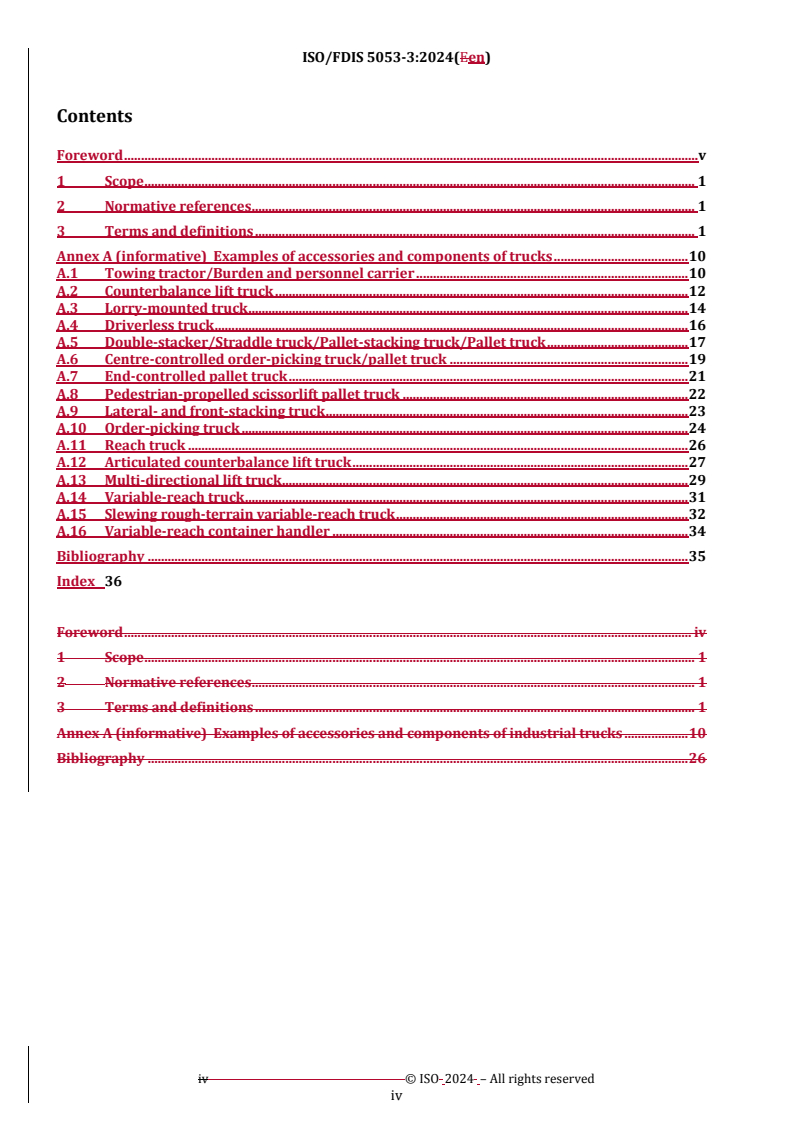
Contents
Foreword . v
1 Scope . 1
2 Normative references . 1
3 Terms and definitions . 1
Annex A (informative) Examples of accessories and components of trucks . 10
A.1 Towing tractor/Burden and personnel carrier . 10
A.2 Counterbalance lift truck . 12
A.3 Lorry-mounted truck . 14
A.4 Driverless truck . 16
A.5 Double-stacker/Straddle truck/Pallet-stacking truck/Pallet truck . 17
A.6 Centre-controlled order-picking truck/pallet truck . 19
A.7 End-controlled pallet truck . 21
A.8 Pedestrian-propelled scissorlift pallet truck . 22
A.9 Lateral- and front-stacking truck . 23
A.10 Order-picking truck . 24
A.11 Reach truck . 26
A.12 Articulated counterbalance lift truck . 27
A.13 Multi-directional lift truck . 29
A.14 Variable-reach truck . 31
A.15 Slewing rough-terrain variable-reach truck . 32
A.16 Variable-reach container handler . 34
Bibliography . 35
Index 36
Foreword . iv
1 Scope . 1
2 Normative references . 1
3 Terms and definitions . 1
Annex A (informative) Examples of accessories and components of industrial trucks . 10
Bibliography . 26
iv © ISO 2024 – All rights reserved
iv
ISO/FDIS 5053-3:2024(Een)
Foreword
ISO (the International Organization for Standardization) is a worldwide federation of national standards
bodies (ISO member bodies). The work of preparing International Standards is normally carried out through
ISO technical committees. Each member body interested in a subject for which a technical committee has been
established has the right to be represented on that committee. International organizations, governmental and
non-governmental, in liaison with ISO, also take part in the work. ISO collaborates closely with the
International Electrotechnical Commission (IEC) on all matters of electrotechnical standardization.
The procedures used to develop this document and those intended for its further maintenance are described
in the ISO/IEC Directives, Part 1. In particular, the different approval criteria needed for the different types of
ISO document should be noted. This document was drafted in accordance with the editorial rules of the
ISO/IEC Directives, Part 2 (see www.iso.org/directives).
ISO draws attention to the possibility that the implementation of this document may involve the use of (a)
patent(s). ISO takes no position concerning the evidence, validity or applicability of any claimed patent rights
in respect thereof. As of the date of publication of this document, ISO had not received notice of (a) patent(s)
which may be required to implement this document. However, implementers are cautioned that this may not
represent the latest information, which may be obtained from the patent database available at
www.iso.org/patents.www.iso.org/patents. ISO shall not be held responsible for identifying any or all such
patent rights.
Any trade name used in this document is information given for the convenience of users and does not
constitute an endorsement.
For an explanation of the voluntary nature of standards, the meaning of ISO specific terms and
expressions related to conformity assessment, as well as information about ISO's adherence to the
World Trade Organization (WTO) principles in the Technical Barriers to Trade (TBT), see
www.iso.org/iso/foreword.html.
This document was prepared by Technical Committee ISO/TC 110, Industrial trucks, Subcommittee SC 1,
General terminology.
In addition to text written in the official ISO languages (English, French), this document gives text in German,
Italian and Chinese. This text is published under the responsibility of the member bodies for Germany (DIN),
Italy (UNI) and China (SAC), and is given for information only. Only the text given in the official languages can
be considered as ISO text.
A list of all parts in the ISO 5053 series can be found on the ISO website.
Any feedback or questions on this document should be directed to the user’s national standards body. A
complete listing of these bodies can be found at www.iso.org/members.html.
© ISO 2024 – All rights reserved
v
ISO/FDIS 5053-3:2024(en)
Industrial trucks — Vocabulary — —
Part 3:
Accessories and components
1 Scope
This document establishes the vocabulary of accessories and components of industrial trucks (hereafter
referred to as trucks) as defined in ISO 5053‑-1.
For the purposes of this document, the terms accessories and components are describing parts and assemblies
which are, or can be, fitted to a truck.
Accessories and components of typical trucks are given in Annex A.Annex A.
Due to the variance of the individual truck types and the ongoing development of new combinations, it is not
possible to include all the different variations of accessories and components. Therefore, this document
defines, shows and/or describes the typical variances.
2 Normative references
There are no normative references in this document.
3 Terms and definitions
ISO and IEC maintain terminologicalterminology databases for use in standardization at the following
addresses:
— — ISO Online browsing platform: available at https://www.iso.org/obphttps://www.iso.org/obp
— — IEC Electropedia: available at http://www.electropedia.org/https://www.electropedia.org/
3.1
access gate
section of guard rail possible to open and close for operator access and egress
3.2
auxiliary lift device
lift mechanism additional to the main lifting device
3.3
battery compartment
enclosure, integral to the truck, that houses the traction battery(ies)
Note 1 to entry: Parts of a modular lithium-ion battery can be integrated throughout the chassis of the truck and have
no battery compartment according to this definition.
3.4
bumper
pressure-sensitive protective device (PSPD) fitted to the truck that generates a signal to stop the truck upon
physical contact
ISO/FDIS 5053-3:2024(en)
3.5
cabin
operator position completely enclosed by rigid materials (for example door(s), glass) to shield the operator
from environmental influence
Note 1 to entry: If a truck is equipped with flexible PVC doors or open sides, it is not considered to have a cabin.
3.6
chassis
main frame structure to which the various units of the truck (for example engine, transmission, lifting gear,
mast) are fixed
3.7
controls
control device
control device
means for the operator to actuate truck functions
3.8
controls for operating alongside
means for control of travelling and/or lifting/lowering functions from outside the truck
3.9
counterweight
mass fixed to the truck intended to counterbalance the load
3.10
damping and tilting system
actuators for damping and tilting of the spreader
3.11
double mast
mast composed of one fixed and one moving upright
3.12
drive wheel
wheel which transmits the tractive effort to the ground
Note 1 to entry: A drive wheel can also be the steered wheel.
3.13
driving axle
axle of a self-propelled truck that transmits torque to the drive wheel(s)
3.14
emergency stop device
manually actuated control device used to initiate an emergency stop function
3.15
enabling device
additional manually operated device used in conjunction with a start control and which, when continuously
actuated, allows a machine to function
2 © ISO 2022 2024 – All rights reserved
ISO/FDIS 5053-3:2024(en)
3.16
engine cover
cover over part of a truck where the engine is mounted
3.17
exhaust system
all parts used to contain, process and direct gaseous and particulate emissions from an internal combustion
engine between the joint face of the cylinder head(s) and the end of outlet pipe(s)
Note 1 to entry: The exhaust system can contain an after-treatment system.
3.18
foldable lateral support arms
structural part of the truck that, when in the extended position, provides lateral support to the operator when
standing on the platform, and which can be folded or pivoted to a stowed position
Note 1 to entry: Lateral support for the operator allows faster travelling speed for stand-on trucks.
3.19
foldable operator platform
operator platform that can be stowed away to permit pedestrian controlled operation
3.20
fork arm
blade cantilevered from a shank which is provided with means of attachment (for example bolted, shaft-
mounted, hook-mounted) to a fork carrier and usually two or more fork arms are mounted together to handle,
for example, palletized loads
[SOURCE: ISO 5053-2:2019, 3.1]
3.21
fork carrier
fork arm carrier
load carriage
carriage
component of the mast bearing the load handling device
3.22
free lift height
lifting of the fork carrier without extending the telescopic mast above the fixed mast
3.23
grab rail
structure designed for the operator to grip to assist with operator stability while the truck is travelling
Note 1 to entry: It can be used also to assist operator stability when the truck is stationary (for example egress, ingress).
3.24
guard rail
structure for protection against accidental falls from stair(s)/step(s), ladders, landings, platforms and
walkways
Note 1 to entry: See Figure 1.Figure 1.
ISO/FDIS 5053-3:2024(en)
Key
1 top rail
2 intermediate rail
3 toe board
4 stanchion
5 walkway/platform
Figure 1 1 — Guard rail
3.25
guidance system
system which guides the truck on a predetermined path not directly controlled by the operator
3.26
intermediate rail
knee rail
mid rail
rigid element of the guard rail placed parallel with the top rail, giving extra protection against the passage of
a body
3.27
lifting boom
telescopic boom for raising/lowering and extension of the load handling device
3.28
lifting boom suspension
upper rear part of the chassis where the lifting boom is mounted and pivoting
3.29
lifting cylinder
actuator for raising and lowering the load handling device
4 © ISO 2022 2024 – All rights reserved
ISO/FDIS 5053-3:2024(en)
3.30
load backrest extension
vertical structure connected to the fork carrier extending the vertical part of the fork arms to increase the load
restraining area
3.31
load carrying platform
a plain surface on which the load can be carried
3.32
load handler
structural part of the truck connecting the load handling device with the traverse frame
3.33
load handling device
means that supports the load
EXAMPLE: forks Forks, platform, attachment.
3.34
load wheel
wheel(s), located on the load end of a truck, which predominantly bear the dynamic and static forces due to
load carried by the truck to which it is fitted
3.35
mast
assembly that guides the vertical movement and supports the fork carrier or load handling device
3.36
mast suspension
supports between mast and chassis to reduce mast sway and deflection
3.37
non-telescopic mast
mast composed only of fixed uprights
3.38
operator backrest
part of the operator’s compartment to support the back of the operator
3.39
operator enclosure
fixed vertical structure(s) added to the operator platform, generally to the sides or to the rear of that platform
3.40
operator platform
standing surface provided for a ride-on operator to operate the truck
Note 1 to entry: Operator platforms can also be equipped with an operator seat.
3.41
operator presence control
opc
system which uses a device to detect the presence of the operator in the normal operating position
ISO/FDIS 5053-3:2024(en)
3.42
operator seat
portion of the truck provided for the purpose of supporting the buttocks and back of the seated operator,
including any suspension system and other mechanisms provided (for example for adjusting the seat position)
3.43
operator restraint system
device or system that is permanently installed to keep the operator within the protective structure of the truck
3.44
outrigger
support arm
supporting structure of the truck extending the profile of the chassis to enable the positioning of the load
centre of gravity within the stability limits
3.45
overhead guard
structure fitted to the truck for the purpose of protecting the operator against falling objects
3.46
personnel detection means
system to detect person(s) in the path of a truck
NOTE Note 1 to entry: Bumper and virtual bumper are both types of personnel detection means.
3.47
pivot steer bearing
mechanical joint with rotation around the pivot axis which connects the front wheels and mast to the rear of
an articulated counterbalance truck
3.48
quadruple mast
mast composed of one fixed upright and three moving uprights
3.49
reach carriage with fixed mast
carriage used in reach trucks with fixed masts to extend the fork carrier forward or backward in the
longitudinal centre plane of the truck
Note 1 to entry: The reach carriage allows retrieving the load at a position between steering and load axle. This
principle reduces the overall length of the truck and improves stability.
3.50
reach carriage with mast holder
reach carriage with mast carrier
carriage used in reach trucks that contains a mechanical structure to fix the mast and that can be moved
backwards and forwards in the direction of the longitudinal centre plane of the truck
Note 1 to entry: The reach carriage allows retrieving the load at a position between steering and load axle. This
principle reduces the overall length of the truck and improves stability.
6 © ISO 2022 2024 – All rights reserved
ISO/FDIS 5053-3:2024(en)
3.51
reach cylinder
actuator that extends or retracts the reach carriage with mast holder and load handling device on reach trucks,
or the lifting boom on variable-reach trucks
3.52
scissor mechanism
mechanism comprising one or more pairs of arms having a pivot near the centre of each arm, which moves
the load handling device (for example forks) to position or interface with a load
3.53
slewing mechanism
drive unit for rotating the revolving part of the truck in a horizontal plane
3.54
slewing upper structure
elements mounted on top of a slewing mechanism, for example cabin and load handling devices , where
provided
3.55
spreader
lifting device for handling ISO containers of one size (fixed length) or of several sizes (telescopic spreader)
3.56
stabilizer block
stabilizer pad
skid bar
design feature which is not a whe
...