

ISO 7637-1:2023
(Main)Road vehicles — Electrical disturbances from conduction and coupling — Part 1: Vocabulary and general considerations
General Information
- Abstract
This document defines the basic terms relating to electrical disturbances from conduction and coupling used in the other parts of the ISO 7637 series. It also gives general information on the whole ISO 7637 series.
- Status
- Published
- Publication Date
- 07-Dec-2023
- Current Stage
- 6060 - International Standard published
- Start Date
- 08-Dec-2023
- Due Date
- 18-Jun-2024
- Completion Date
- 08-Dec-2023
Overview
ISO 7637-1:2023 - Road vehicles: Electrical disturbances from conduction and coupling - Part 1: Vocabulary and general considerations defines the basic terminology and general principles used across the ISO 7637 series. This fourth edition (2023) updates the vocabulary and provides practical guidance on how the series is applied to characterize and test electrical transients (pulses, bursts, coupling) that affect vehicle electrical/electronic systems. It is the foundation document for bench test methods, test severity definitions, and interpretation of results used by vehicle manufacturers, suppliers and test laboratories working on automotive EMC and immunity.
Key topics and requirements
- Scope and purpose: Establishes the fundamental terms and definitions related to electrical disturbances from conduction and coupling, and outlines the aim and practical use of the ISO 7637 series.
- Core vocabulary: Defines essential terms such as transient, pulse, burst, peak amplitude, immunity, susceptibility, electromagnetic disturbance (EMI/EMC), artificial network (AN/HV-AN), coupling (capacitive/inductive), coupling clamps (CCC/ICC) and direct capacitive coupling (DCC).
- General test conditions: Addresses high‑level test parameters and environmental considerations including test temperature, supply voltage and tolerances (including additions for high‑voltage electrical systems), and definition of test severity levels.
- Function Performance Status Classification (FPSC): Annex A (normative) provides a methodology for classifying device performance during/after tests.
- Normative references and standards alignment: References IEC terminologies (IEC 60050‑151) and clarifies the relationship with other vehicle EMC methods.
Applications - who uses this standard
- Vehicle manufacturers and OEM systems engineers - to specify and interpret bench tests and ensure component compatibility within vehicle electrical environments.
- Automotive component suppliers - to design, qualify and document immunity of ECUs, sensors, actuators and wiring to conduction/coupling transients.
- EMC/test laboratories - to develop test plans, select artificial networks, coupling clamps and determine applicable severity levels for bench testing.
- Design and validation teams - to correlate laboratory bench tests with full-vehicle behaviour and integrate transient protection into system validation and production quality control.
Related standards
- ISO 7637 (other parts) - test-method specifics and severity tables.
- ISO/TS 7637-4 (added reference in this edition) - supplementary technical specification.
- ISO 11451 / ISO 11452 - radiated immunity test methods.
- ISO 10605 - electrostatic discharge (ESD) test methods.
- IEC 60050-151 - electrotechnical vocabulary referenced for terminology.
ISO 7637-1:2023 is essential for anyone working on automotive EMC, transient immunity, and electrical disturbance testing in modern road vehicles and trailers.
Relations
- Effective Date
- 06-Jun-2022
Get Certified
Connect with accredited certification bodies for this standard

TÜV Rheinland
TÜV Rheinland is a leading international provider of technical services.

TÜV SÜD
TÜV SÜD is a trusted partner of choice for safety, security and sustainability solutions.

DEKRA Certification Inc.
DEKRA US certification services.
Sponsored listings
Frequently Asked Questions
ISO 7637-1:2023 is a standard published by the International Organization for Standardization (ISO). Its full title is "Road vehicles — Electrical disturbances from conduction and coupling — Part 1: Vocabulary and general considerations". This standard covers: This document defines the basic terms relating to electrical disturbances from conduction and coupling used in the other parts of the ISO 7637 series. It also gives general information on the whole ISO 7637 series.
This document defines the basic terms relating to electrical disturbances from conduction and coupling used in the other parts of the ISO 7637 series. It also gives general information on the whole ISO 7637 series.
ISO 7637-1:2023 is classified under the following ICS (International Classification for Standards) categories: 01.040.43 - Road vehicle engineering (Vocabularies); 43.040.10 - Electrical and electronic equipment. The ICS classification helps identify the subject area and facilitates finding related standards.
ISO 7637-1:2023 has the following relationships with other standards: It is inter standard links to ISO 7637-1:2015. Understanding these relationships helps ensure you are using the most current and applicable version of the standard.
ISO 7637-1:2023 is available in PDF format for immediate download after purchase. The document can be added to your cart and obtained through the secure checkout process. Digital delivery ensures instant access to the complete standard document.
Standards Content (Sample)
INTERNATIONAL ISO
STANDARD 7637-1
Fourth edition
2023-12
Road vehicles — Electrical
disturbances from conduction and
coupling —
Part 1:
Vocabulary and general
considerations
Véhicules routiers — Perturbations électriques par conduction et par
couplage —
Partie 1: Vocabulaire et généralités
Reference number
© ISO 2023
All rights reserved. Unless otherwise specified, or required in the context of its implementation, no part of this publication may
be reproduced or utilized otherwise in any form or by any means, electronic or mechanical, including photocopying, or posting on
the internet or an intranet, without prior written permission. Permission can be requested from either ISO at the address below
or ISO’s member body in the country of the requester.
ISO copyright office
CP 401 • Ch. de Blandonnet 8
CH-1214 Vernier, Geneva
Phone: +41 22 749 01 11
Email: copyright@iso.org
Website: www.iso.org
Published in Switzerland
ii
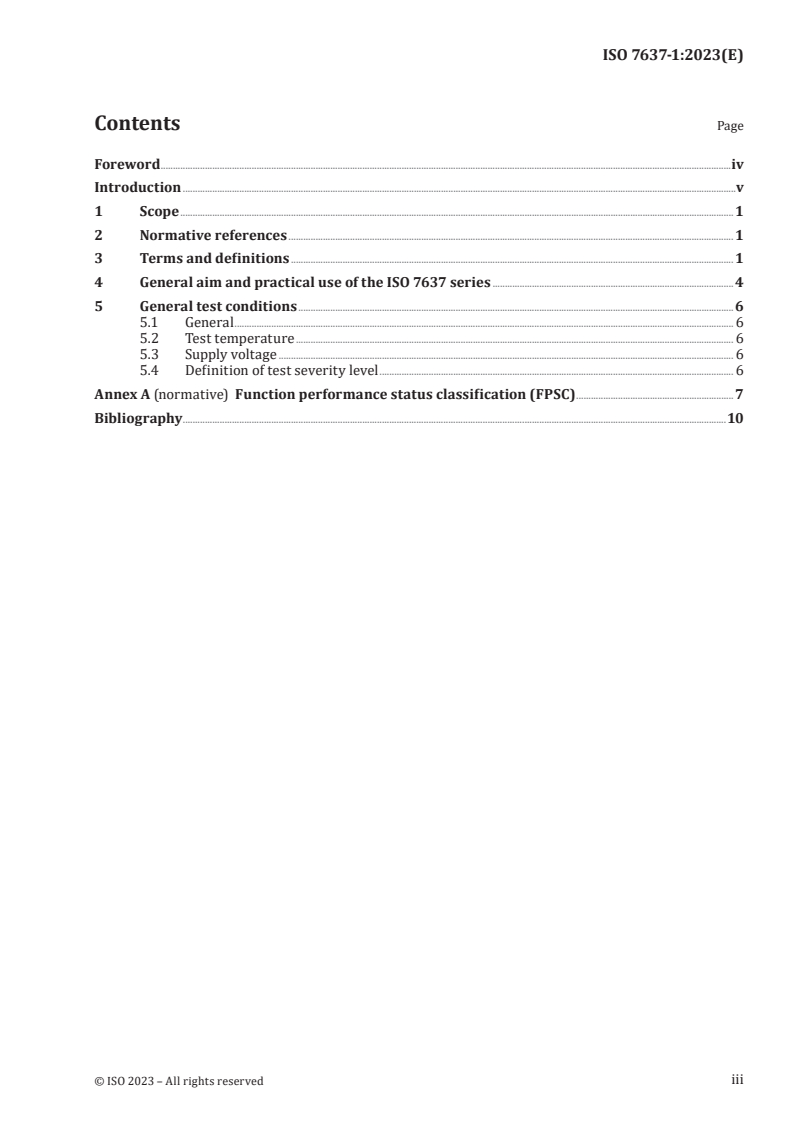
Contents Page
Foreword .iv
Introduction .v
1 Scope . 1
2 Normative references . 1
3 Terms and definitions . 1
4 General aim and practical use of the ISO 7637 series . 4
5 General test conditions .6
5.1 General . 6
5.2 Test temperature . 6
5.3 Supply voltage . 6
5.4 Definition of test severity level . 6
Annex A (normative) Function performance status classification (FPSC) .7
Bibliography .10
iii
Foreword
ISO (the International Organization for Standardization) is a worldwide federation of national standards
bodies (ISO member bodies). The work of preparing International Standards is normally carried out
through ISO technical committees. Each member body interested in a subject for which a technical
committee has been established has the right to be represented on that committee. International
organizations, governmental and non-governmental, in liaison with ISO, also take part in the work.
ISO collaborates closely with the International Electrotechnical Commission (IEC) on all matters of
electrotechnical standardization.
The procedures used to develop this document and those intended for its further maintenance are
described in the ISO/IEC Directives, Part 1. In particular, the different approval criteria needed for the
different types of ISO document should be noted. This document was drafted in accordance with the
editorial rules of the ISO/IEC Directives, Part 2 (see www.iso.org/directives).
ISO draws attention to the possibility that the implementation of this document may involve the use
of (a) patent(s). ISO takes no position concerning the evidence, validity or applicability of any claimed
patent rights in respect thereof. As of the date of publication of this document, ISO had not received
notice of (a) patent(s) which may be required to implement this document. However, implementers are
cautioned that this may not represent the latest information, which may be obtained from the patent
database available at www.iso.org/patents. ISO shall not be held responsible for identifying any or all
such patent rights.
Any trade name used in this document is information given for the convenience of users and does not
constitute an endorsement.
For an explanation of the voluntary nature of standards, the meaning of ISO specific terms and
expressions related to conformity assessment, as well as information about ISO's adherence to
the World Trade Organization (WTO) principles in the Technical Barriers to Trade (TBT), see
www.iso.org/iso/foreword.html.
This document was prepared by Technical Committee ISO/TC 22, Road vehicles, Subcommittee SC 32,
Electrical and electronic components and general system aspects.
This fourth edition cancels and replaces the third edition (ISO 7637-1:2015), which has been technically
revised.
The main changes are as follows:
— addition of ISO/TS 7637-4 in general aim and practical use;
— addition of supply voltage and tolerances for high voltage electrical systems.
A list of all parts in the ISO 7637 series can be found on the ISO website.
Any feedback or questions on this document should be directed to the user’s national standards body. A
complete listing of these bodies can be found at www.iso.org/members.html.
iv
Introduction
Electrical and radio-frequency disturbances occur during normal operation of many items of motor
vehicle equipment. They are generated over a wide frequency range and can be distributed to on-board
electronic devices and systems by conduction, coupling or radiation.
In recent years, an increasing number of electronic devices for controlling, monitoring and displaying a
variety of functions have been introduced into vehicle designs. It is necessary to consider the electrical
and electromagnetic environment in which these devices operate and, in particular, the disturbances
generated in the vehicle electrical system itself. Such disturbances can cause degradation (temporary
malfunction or even permanent damage) of the electronic equipment. Moreover, “worst-case” situations
are usually those resulting from disturbances generated inside the vehicle by, for example, ignition
systems, generator and alternator systems, electric motors and actuators.
Annex A specifies a general method for function performance status classification (FPSC). Typical
severity levels are included in an annex of each of the other parts of the ISO 7637 series.
While narrowband signals generated on or outside the vehicle (by broadcasting and radio-transmitters)
can also affect the performance of electronic devices, and recognizing that protection from such
potential disturbances has to be considered as part of total system certification, these matters are
nevertheless outside the scope of the ISO 7637 series and are not covered by it.
ISO 11451 and ISO 11452 specify test methods for immunity to radiated disturbances for vehicles
and for components, respectively. ISO 10605 specifies test methods for immunity to electrostatic
discharge (ESD) for vehicle and for components.
v
INTERNATIONAL STANDARD ISO 7637-1:2023(E)
Road vehicles — Electrical disturbances from conduction
and coupling —
Part 1:
Vocabulary and general considerations
1 Scope
This document defines the basic terms relating to electrical disturbances from conduction and coupling
used in the other parts of the ISO 7637 series. It also gives general information on the whole ISO 7637
series.
2 Normative references
The following documents are referred to in the text in such a way that some or all of their content
constitutes requirements of this document. For dated references, only the edition cited applies. For
undated references, the latest edition of the referenced document (including any amendments) applies.
IEC 60050-151, International Electrotechnical Vocabulary (IEV) — Part 151: Electrical and magnetic
devices
3 Terms and definitions
For the purposes of this document, the terms and definitions given in IEC 60050–151 and the following
apply.
ISO and IEC maintain terminology databases for use in standardization at the following addresses:
— ISO Online browsing platform: available at https:// www .iso .org/ obp
— IEC Electropedia: available at https:// www .electropedia .org/
3.1
artificial network
AN
network inserted in the supply lead or signal/load lead of apparatus to be tested which provides, in a
given frequency range, a specified load impedance for the measurement of disturbance voltages and
which can isolate the apparatus from the supply or signal sources/loads in that frequency range
Note 1 to entry: Network inserted in the DC power lines of the device under test (DUT) which provides, in a
given frequency range, a specified load impedance and which isolates the DUT from the DC power supply in that
frequency range.
3.2
high voltage artificial network
HV-AN
network inserted in the high voltage DC lead of apparatus to be tested which provides, in a given
frequency range, a specified load impedance for the measurement of disturbance voltages and which
can isolate the apparatus from the supply in that frequency range
3.3
burst
transient (3.18) comprised of a complex series of transient voltage variations
Note 1 to entry: For bursts, the parameters given in 3.3.1, 3.3.2 and 3.3.3 are also relevant. For an illustration of a
burst transient waveform, see ISO 7637–2.
3.3.1
burst cycle time
time between the start of the first pulse (3.14) of two consecutive bursts (3.3)
3.3.2
burst duration
time during which a complex series of transient voltage variations occurs during a single burst (3.3)
3.3.3
time between bursts
time between the end of one burst (3.3) and the start of the next one
3.4
coupling
means or device for transferring power between systems
Note 1 to entry: For coupling, the parameters given in 3.4.1 and 3.4.2 are also relevant.
[SOURCE: IEC 60050–726–14–01, modified — Note 1 to entry added.]
3.4.1
coupling clamp
device of defined dimensions and electromagnetic characteristics designed for common-mode coupling
(3.4) of the disturbance transient to the circuit under test without any galvanic connection to it
3.4.1.1
capacitive coupling clamp
CCC
special fixture that facilitates capacitive coupling (3.4) of fast transient test pulses (3.16) into signal
lines under test without any galvanic connection to the terminals of the circuits, or any other part of the
device under test (DUT)
3.4.1.2
inductive coupling clamp
ICC
bulk current injection (BCI) type probe to provide the means of coupling (3.4) slow transient test pulses
(3.16) into signal lines under test without any galvanic connection to the terminals of the circuits, or
any other part of the device under test (DUT)
3.4.2
coupling network
electrical circuit for the purpose of transferring energy from one circuit to another
3.4.3
direct capacitive coupling
DCC
method using discrete, non-polarized capacitor to couple fast and slow transient test pluses into the
device under test's (DUT’s) signal lines under test
3.5
degradation
〈performance〉 undesired departure in the operational performance of any device, equipment or system
from its intended performance
Note 1 to entry: The term “degradation” can apply to temporary or permanent failure.
[SOURCE: IEC 60050-161-01-19]
3.6
electromagnetic compatibility
EMC
ability of an equipment or system to function satisfactorily in its electromagnetic environment without
introducing intolerable electromagnetic disturbances (3.7) to anything in that environment
[SOURCE: IEC 60050-161-01-07]
3.7
electromagnetic disturbance
any electromagnetic phenomenon which can degrade the performance of a device, equipment or system,
or adversely affect living or inert matter
Note 1 to entry: An electromagnetic disturbance may be an electromagnetic noise, an unwanted signal or a
change in the propagation medium itself.
[SOURCE: IEC 60050-161-01-05]
3.8
electromagnetic interference
EMI
degradation (3.5) of the performance of equipment, transmission channel or system caused by an
electromagnetic disturbance (3.7)
Note 1 to entry: The English words “interference” and “disturbance” are often used indiscriminately.
[SOURCE: IEC 60050-161-01-06, modified — Notes to entry deleted and a new Note 1 to entry added.]
3.9
electromagnetic radiation
phenomenon by which energy in the form of electromagnetic waves emanates from a source into space;
energy transferred through space in the form of electromagnetic waves
Note 1 to entry: By extension, the term “electromagnetic radiation” som
...