

ISO 20423:2025
(Main)Carbon footprint for seafood — Product category rules (CFP-PCR) for macroalgae
General Information
- Abstract
This document specifies requirements for calculating the carbon footprint specific to farmed macroalgae product category rules (CFP–PCR). This methodology builds on the requirements of International Standards for life cycle assessment (LCA) and products’ carbon footprints. This document is applicable to the calculation and communication of farmed macroalgae products’ carbon footprints from seedling production to the consumption of macroalgae products. It is applicable to the carbon footprints of products from aquaculture value chains. This document used alone does not apply to specifying a product’s overall environmental or sustainability characteristics.
- Status
- Published
- Publication Date
- 16-Jun-2025
- Technical Committee
- ISO/TC 234 - Fisheries and aquaculture
- Drafting Committee
- ISO/TC 234 - Fisheries and aquaculture
- Current Stage
- 6060 - International Standard published
- Start Date
- 17-Jun-2025
- Due Date
- 27-Mar-2026
- Completion Date
- 17-Jun-2025


Overview
ISO 20423:2025 - Carbon footprint for seafood - Product category rules (CFP‑PCR) for macroalgae provides a standardized methodology for calculating and communicating the carbon footprint of farmed macroalgae. The standard covers the full aquaculture value chain from seedling production to final consumption, aligning with international life cycle assessment (LCA) principles. It is the first edition (2025) and is intended to support transparent, comparable carbon footprint claims for macroalgae products while not replacing broader environmental or sustainability assessments.
Key topics and technical requirements
- Scope and applicability: Applies specifically to farmed macroalgae products and aquaculture value chains; not a standalone sustainability standard.
- LCA basis: Builds on ISO life cycle standards - ISO 14040, ISO 14044, and product carbon footprint requirements in ISO 14067:2018, and follows ISO 14026 guidance for footprint communication.
- Functional / declared unit: Requires clear definition of the unit used for reporting carbon footprint results.
- System boundaries: Detailed rules for boundaries across stages (farming, harvesting, processing, distribution, consumption) and specific guidance on:
- Cut‑off criteria and excluded processes
- Waste, storage, transport, and capital investments
- Use of recycled materials and co‑products
- Data requirements and quality: Rules for sampling, electricity and fuel data, geographic/time delimitation, validation and transport calculation methods.
- Allocation and impact assessment: Prescribed approaches for multi‑output systems and treatment of fossil vs biogenic carbon.
- Reporting and communication: Requirements to ensure transparent, reproducible carbon footprint claims for macroalgae products.
- Informative annexes: Practical examples and tools (data collection templates, nutrient accounting by elemental mass balance, co‑product allocation examples, LCA modelling cases for kelp, Porphyra, ground seaweed).
Practical applications and users
Who benefits from ISO 20423:2025:
- Macroalgae farmers and aquaculture producers calculating farm‑level CFPs
- Processors, product developers and packagers assessing value‑chain emissions
- LCA practitioners and sustainability consultants modelling macroalgae systems
- Retailers and brands verifying carbon footprint claims
- Certification bodies, policymakers and researchers developing low‑carbon strategies for seafood and aquaculture
Practical uses:
- Produce credible, comparable carbon footprint declarations for marketing or regulation
- Identify hotspots in macroalgae value chains to prioritize emission reductions
- Develop databases, tools and internal improvement programs tailored to macroalgae
- Support low‑carbon innovation and supply‑chain decision making in aquaculture
Related standards
- ISO 14040 / ISO 14044 - Life cycle assessment framework and requirements
- ISO 14067:2018 - Carbon footprint of products
- ISO 14026:2017 - Communication of footprint information
Keywords: ISO 20423:2025, carbon footprint, CFP‑PCR, macroalgae, farmed macroalgae, LCA, aquaculture, product carbon footprint.
Get Certified
Connect with accredited certification bodies for this standard

BSI Group
BSI (British Standards Institution) is the business standards company that helps organizations make excellence a habit.

Bureau Veritas
Bureau Veritas is a world leader in laboratory testing, inspection and certification services.

DNV
DNV is an independent assurance and risk management provider.
Sponsored listings
Frequently Asked Questions
ISO 20423:2025 is a standard published by the International Organization for Standardization (ISO). Its full title is "Carbon footprint for seafood — Product category rules (CFP-PCR) for macroalgae". This standard covers: This document specifies requirements for calculating the carbon footprint specific to farmed macroalgae product category rules (CFP–PCR). This methodology builds on the requirements of International Standards for life cycle assessment (LCA) and products’ carbon footprints. This document is applicable to the calculation and communication of farmed macroalgae products’ carbon footprints from seedling production to the consumption of macroalgae products. It is applicable to the carbon footprints of products from aquaculture value chains. This document used alone does not apply to specifying a product’s overall environmental or sustainability characteristics.
This document specifies requirements for calculating the carbon footprint specific to farmed macroalgae product category rules (CFP–PCR). This methodology builds on the requirements of International Standards for life cycle assessment (LCA) and products’ carbon footprints. This document is applicable to the calculation and communication of farmed macroalgae products’ carbon footprints from seedling production to the consumption of macroalgae products. It is applicable to the carbon footprints of products from aquaculture value chains. This document used alone does not apply to specifying a product’s overall environmental or sustainability characteristics.
ISO 20423:2025 is classified under the following ICS (International Classification for Standards) categories: 67.120.30 - Fish and fishery products. The ICS classification helps identify the subject area and facilitates finding related standards.
ISO 20423:2025 is available in PDF format for immediate download after purchase. The document can be added to your cart and obtained through the secure checkout process. Digital delivery ensures instant access to the complete standard document.
Standards Content (Sample)
International
Standard
ISO 20423
First edition
Carbon footprint for seafood —
2025-06
Product category rules (CFP-PCR)
for macroalgae
Empreinte carbone des fruits de mer — Règles de définition des
catégories de produit (CFP–PCR) pour les macroalgues
Reference number
© ISO 2025
All rights reserved. Unless otherwise specified, or required in the context of its implementation, no part of this publication may
be reproduced or utilized otherwise in any form or by any means, electronic or mechanical, including photocopying, or posting on
the internet or an intranet, without prior written permission. Permission can be requested from either ISO at the address below
or ISO’s member body in the country of the requester.
ISO copyright office
CP 401 • Ch. de Blandonnet 8
CH-1214 Vernier, Geneva
Phone: +41 22 749 01 11
Email: copyright@iso.org
Website: www.iso.org
Published in Switzerland
ii
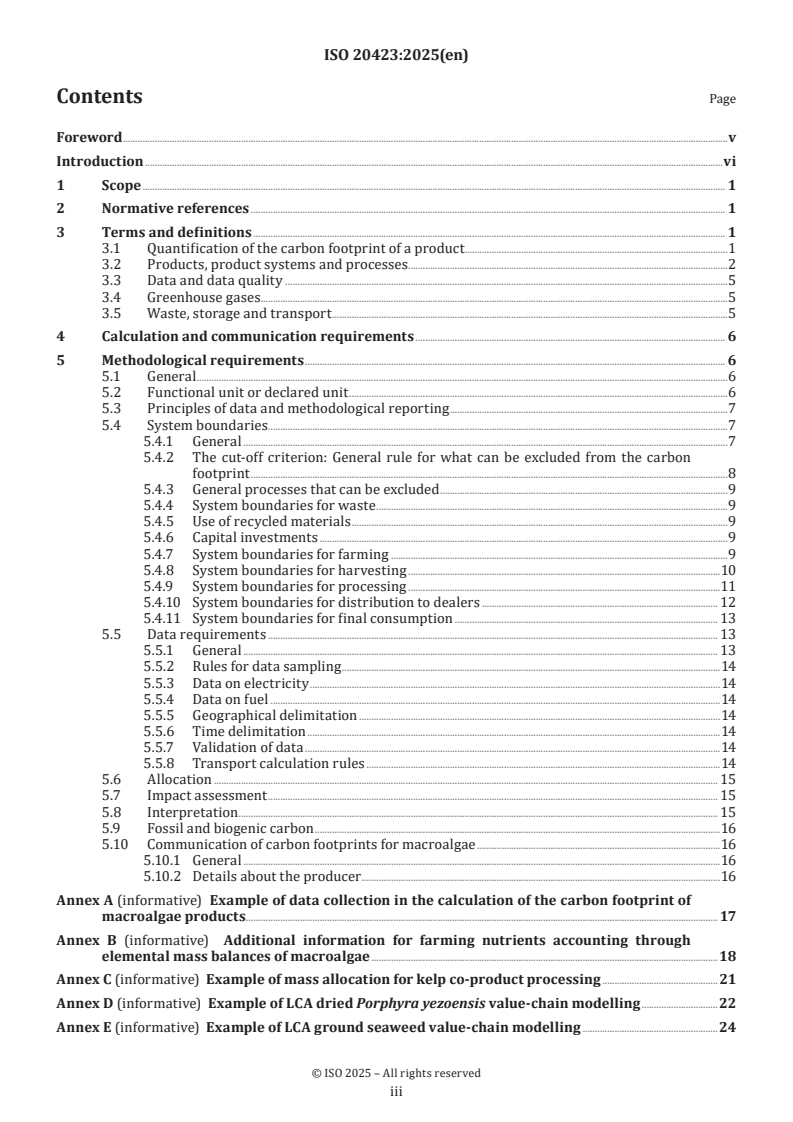
Contents Page
Foreword .v
Introduction .vi
1 Scope . 1
2 Normative references . 1
3 Terms and definitions . 1
3.1 Quantification of the carbon footprint of a product .1
3.2 Products, product systems and processes .2
3.3 Data and data quality .5
3.4 Greenhouse gases . .5
3.5 Waste, storage and transport .5
4 Calculation and communication requirements . 6
5 Methodological requirements . 6
5.1 General .6
5.2 Functional unit or declared unit .6
5.3 Principles of data and methodological reporting .7
5.4 System boundaries . .7
5.4.1 General .7
5.4.2 The cut-off criterion: General rule for what can be excluded from the carbon
footprint .8
5.4.3 General processes that can be excluded .9
5.4.4 System boundaries for waste .9
5.4.5 Use of recycled materials .9
5.4.6 Capital investments .9
5.4.7 System boundaries for farming .9
5.4.8 System boundaries for harvesting .10
5.4.9 System boundaries for processing .11
5.4.10 System boundaries for distribution to dealers . 12
5.4.11 System boundaries for final consumption . 13
5.5 Data requirements . 13
5.5.1 General . 13
5.5.2 Rules for data sampling .14
5.5.3 Data on electricity .14
5.5.4 Data on fuel .14
5.5.5 Geographical delimitation .14
5.5.6 Time delimitation .14
5.5.7 Validation of data .14
5.5.8 Transport calculation rules .14
5.6 Allocation . 15
5.7 Impact assessment . 15
5.8 Interpretation . 15
5.9 Fossil and biogenic carbon .16
5.10 Communication of carbon footprints for macroalgae .16
5.10.1 General .16
5.10.2 Details about the producer .16
Annex A (informative) Example of data collection in the calculation of the carbon footprint of
macroalgae products . . 17
Annex B (informative) Additional information for farming nutrients accounting through
elemental mass balances of macroalgae .18
Annex C (informative) Example of mass allocation for kelp co-product processing .21
Annex D (informative) Example of LCA dried Porphyra yezoensis value-chain modelling .22
Annex E (informative) Example of LCA ground seaweed value-chain modelling .24
iii
Bibliography .25
iv
Foreword
ISO (the International Organization for Standardization) is a worldwide federation of national standards
bodies (ISO member bodies). The work of preparing International Standards is normally carried out through
ISO technical committees. Each member body interested in a subject for which a technical committee
has been established has the right to be represented on that committee. International organizations,
governmental and non-governmental, in liaison with ISO, also take part in the work. ISO collaborates closely
with the International Electrotechnical Commission (IEC) on all matters of electrotechnical standardization.
The procedures used to develop this document and those intended for its further maintenance are described
in the ISO/IEC Directives, Part 1. In particular, the different approval criteria needed for the different types
of ISO document should be noted. This document was drafted in accordance with the editorial rules of the
ISO/IEC Directives, Part 2 (see www.iso.org/directives).
ISO draws attention to the possibility that the implementation of this document may involve the use of (a)
patent(s). ISO takes no position concerning the evidence, validity or applicability of any claimed patent
rights in respect thereof. As of the date of publication of this document, ISO had not received notice of (a)
patent(s) which may be required to implement this document. However, implementers are cautioned that
this may not represent the latest information, which may be obtained from the patent database available at
www.iso.org/patents. ISO shall not be held responsible for identifying any or all such patent rights.
Any trade name used in this document is information given for the convenience of users and does not
constitute an endorsement.
For an explanation of the voluntary nature of standards, the meaning of ISO specific terms and expressions
related to conformity assessment, as well as information about ISO’s adherence to the World Trade
Organization (WTO) principles in the Technical Barriers to Trade (TBT), see www.iso.org/iso/foreword.html.
This document was prepared by Technical Committee ISO/TC 234, Fisheries and aquaculture.
Any feedback or questions on this document should be directed to the user’s national standards body. A
complete listing of these bodies can be found at www.iso.org/members.html.
v
Introduction
With the increasingly serious global climate problem, the low-carbon revolution of globalization is rising,
and carbon peaking and carbon neutrality have become important goals of global low-carbon development.
Countries all over the world are actively carrying out double carbon research to achieve the goal of carbon
neutrality as soon as possible.
As an important participant in the ocean carbon cycle, algae can synthesize organic matter through
photosynthesis and release oxygen to achieve carbon sequestration, so it is of great significance to study its
carbon footprint.
This document contains product category rules for the calculation and communication of the carbon
footprint of macroalgae products, providing a convenient and feasible carbon footprint evaluation basis for
the macroalgae farming industry.
This document sets out rules for the calculation and communication of farmed macroalgae products, which
are applicable to the evaluation of the carbon footprint of the entire value chain of farmed macroalgae. The
methodology is based on the requirements of the life cycle assessment and International Standards for
the carbon footprint of products. The overarching aim of the document is to provide a basis for reliable
and accurate information about the climate impact of the product. It is a pre-condition for a market-driven
reduction of climate impact of macroalgae products that dealers and consumers are able to choose the
products with the least climate impact. In addition to this, the document will provide:
— a basis for the development of tools and database for calculating the carbon footprint of macroalgae
products;
— a basis for internal improvement efforts in the macroalgae industry;
— an improved knowledge base concerning the value chains of macroalgae products, their resource
consumption and climate impacts;
— a basis for further understanding the environmental impact of macroalgae products beyond climate
change alone.
This document is intended to function in line with ordinary market mechanisms. Providing credible and
transparent information about the products’ climate impact will pave the way for increased demand and
market value of the most climate-friendly macroalgae products. It will also provide incentives to drive
further improvements and reduce energy consumption and climate impacts from all links in macroalgae
value chains. This document promotes the transformation of the global fishery industry structure and the
innovative development of low-carbon technology, which can contribute to realizing the construction of
low-carbon fishery and increasing the carbon sink of fishery, thus making due contribution to the global
low-carbon development.
vi
International Standard ISO 20423:2025(en)
Carbon footprint for seafood — Product category rules (CFP-
PCR) for macroalgae
1 Scope
This document specifies requirements for calculating the carbon footprint specific to farmed macroalgae
product category rules (CFP–PCR). This methodology builds on the requirements of International Standards
for life cycle assessment (LCA) and products’ carbon footprints.
This document is applicable to the calculation and communication of farmed macroalgae products’ carbon
footprints from seedling production to the consumption of macroalgae products. It is applicable to the
carbon footprints of products from aquaculture value chains.
This document used alone does not apply to specifying a product’s overall environmental or sustainability
characteristics.
2 Normative references
The following documents are referred to in the text in such a way that some or all of their content constitutes
requirements of this document. For dated references, only the edition cited applies. For undated references,
the latest edition of the referenced document (including any amendments) applies.
ISO 14026:2017, Environmental labels and declarations — Principles, requirements and guidelines for
communication of footprint information
ISO 14040, Environmental management — Life cycle assessment — Principles and framework
ISO 14044, Environmental management — Life cycle assessment — Requirements and guidelines
ISO 14067:2018, Greenhouse gases — Carbon footprint of products — Requirements and guidelines for
quantification
3 Terms and definitions
For the purposes of this document, the following terms and definitions apply.
ISO and IEC maintain terminology databases for use in standardization at the following addresses:
— ISO Online browsing platform: available at https:// www .iso .org/ obp
— IEC Electropedia: available at https:// www .electropedia .org/
3.1 Quantification of the carbon footprint of a product
3.1.1
carbon footprint of a product
CFP
sum of greenhouse gas (GHG) (3.4.1) emissions and GHG removals in a product system (3.2.14), expressed as
CO equivalents (3.1.2) and based on a life cycle assessment using the single impact category of climate change
[SOURCE: ISO 14067:2018, 3.1.1.1, modified — Notes 1 and 2 to entry deleted.]
3.1.2
carbon dioxide equivalent
CO equivalent
CO e
unit for comparing the radiative forcing of a greenhouse gas (3.4.1) to that of carbon dioxide
Note 1 to entry: Mass of a GHG is converted into CO equivalents by multiplying the mass of the GHG by the
corresponding global warming potential (GWP) or global temperature change potential (GTP) of that gas.
Note 2 to entry: In the case of GTP, CO equivalent is the unit for comparing the change in global mean surface
temperature caused by a GHG to the temperature change caused by CO within a certain time (usually 100 years).
Note 3 to entry: Radiative forcing refers to difference between incoming solar radiation on the Earth and outgoing
thermal radiation from the Earth. A positive radiative forcing tends to warm the surface and a negative radiative
forcing tends to cool the surface.
[SOURCE: ISO 14067:2018, 3.1.2.2, modified — “within a certain time (usually 100 years)” added to Note 2 to
entry. Note 3 to entry added.]
3.1.3
partial carbon footprint of a product
partial CFP
sum of greenhouse gas (GHG) (3.4.1) emissions and GHG removals of one or more selected process(es) in a
product system (3.2.14), expressed as CO equivalents (3.1.2) and based on the selected stages or processes
within the life cycle (3.2.11)
Note 1 to entry: A partial CFP is based on or compiled from data related to (a) specific process(es) or footprint
information modules, which is (are) part of a product system and can form the basis for quantification of a CFP. More
detailed information on information modules is given in ISO 14025:2006, 5.4.
Note 2 to entry: “Footprint information modules” is defined in ISO 14026:2017, 3.1.4.
Note 3 to entry: The results of the quantification of the partial CFP are documented in the CFP study report expressed
in mass of CO equivalent per declared unit (3.2.15).
[SOURCE: ISO 14067:2018, 3.1.1.2]
3.2 Products, product systems and processes
3.2.1
product
any goods or service
[SOURCE: ISO 14050:2020, 3.5.2]
3.2.2
product category
group of products (3.2.1) that have an equivalent function
3.2.3
primary product
primary output of commercial value from a production process
[SOURCE: ISO 22948:2020, 3.2.3]
3.2.4
by-product
secondary output from a process, but of commercial value, that is produced in addition to a defined primary
product (3.2.3)
[SOURCE: ISO 22948:2020, 3.2.4]
3.2.5
intermediate goods
raw materials or semi-finished goods, which may be recycled or recovered, that are fed into the product
system (3.2.14)
[SOURCE: ISO 22948:2020, 3.2.5]
3.2.6
capital goods
products (3.2.1) that are not used up in consumption or production over a brief period but that retain their
function over a longer time
3.2.7
seafood
food, of which a significant proportion of the content derives directly from animals or plants that live in the
sea, lakes or watercourses
[SOURCE: ISO 22948:2020, 3.2.7]
3.2.8
algae
large group of single- or multi-cellular eukaryotic organisms, which usually contain chlorophyll or other
pigments
Note 1 to entry: Algae are usually aquatic and capable of photosynthesis.
[SOURCE: ISO 6107:2021, 3.21]
3.2.9
macroalgae
macroscopic eukaryotic pluricellular organisms composed of single differentiated cells able to obtain energy
using chromophores
Note 1 to entry: Macroalgae mainly include Rhodophyta, Phaeophyta and Chlorophyta. Common macroalgae are kelp,
laver, wakame, gulfweed, ulva, etc.
[SOURCE: EN 17399:2020, 3.24, modified — Note 1 to entry added.]
3.2.10
edible product
quantity of macroalgae and macroalgae products (3.2.1) as available for sale from a retailer, excluding
packaging
3.2.11
life cycle
consecutive and interlinked stages of a product system (3.2.14), from raw material acquisition or generation
from natural resources to final disposal
[SOURCE: ISO 14040:2006, 3.1]
3.2.12
value chain
range of activities or parties that create or receive value in the form of products (3.2.1) or services
3.2.13
carbon footprint of a product–product category rules
CFP–PCR
set of specific rules, requirements and guidelines for CFP (3.1.1) or partial CFP (3.1.3) quantification and
communication for one or more product categories (3.2.2)
[SOURCE: ISO 14067:2018, 3.1.1.10, modified — Notes 1 and 2 to entry deleted.]
3.2.14
product system
collection of unit processes with elementary and product flows, performing one or more defined functions,
and which models the life cycle (3.2.10) of a product (3.2.1)
[SOURCE: ISO 14040:2006, 3.28]
3.2.15
declared unit
quantity of a product (3.2.1) for use as a reference unit in the quantification of a partial carbon footprint of a
product (CFP) (3.1.3)
EXAMPLE Mass (1 kg of primary steel), volume (1 m of crude oil).
[SOURCE: ISO 14067:2018, 3.1.3.8]
3.2.16
functional unit
quantified performance of a product system (3.2.14) for use as a reference unit
Note 1 to entry: As the carbon footprint of a product (CFP) (3.1.1) treats information on a product (3.2.1) basis, an
additional calculation based on a declared unit (3.2.15) can be presented.
[SOURCE: ISO 14067:2018, 3.1.3.7]
3.2.17
allocation
partitioning the input or output flows of a process or a product system (3.2.14) between the product system
under study and one or more other product systems
[SOURCE: ISO 14040:2006, 3.17]
3.2.18
energy carrier
substance of phenomena that can be used to produce mechanical work or heat, or to operate chemical or
physical processes
[SOURCE: ISO 16818:2008, 3.75]
3.2.19
harvesting
process of taking some technical measures to collect macroalgae from natural waters or cultivation facility
and carrying back
3.2.20
refrigerant
fluid used for heat transfer in a refrigerating system, which absorbs heat at a low temperature and a low
pressure of the fluid, and rejects it at a higher temperature and a higher pressure of the fluid usually
involving changes of the phase of the fluid
Note 1 to entry: Refrigerants are listed in ISO 817.
[SOURCE: ISO 5149-1:2014, 3.7.9]
3.2.21
cut-off criterion
specification of the amount of material or energy flow or the level of environmental significance associated
with unit processes or product system (3.2.14) to be excluded from the study
[SOURCE: ISO 14040:2006, 3.18]
3.3 Data and data quality
3.3.1
primary data
quantified value of a process or an activity obtained from a direct measurement or a calculation based on
direct measurements
Note 1 to entry: Primary data need not necessarily originate from the product system (3.2.14) under study because
primary data could relate to a different but comparable product system to that being studied.
[SOURCE: ISO 14064-1:2018, 3.2.2, modified — Note 1 to entry replaced.]
3.3.2
secondary data
data obtained from sources other than primary data (3.3.1)
Note 1 to entry: Such sources can include databases and published literature validated by competent authorities.
[SOURCE: ISO 14064-1:2018, 3.2.4]
3.3.3
data quality
characteristics of data that relate to their ability to satisfy stated requirements
[SOURCE: ISO 14040:2006, 3.19]
3.4 Greenhouse gases
3.4.1
greenhouse gas
GHG
gaseous constituent of the atmosphere, both natural and anthropogenic, that absorbs and emits radiation
at specific wavelengths within the spectrum of infrared radiation emitted by the Earth’s surface, the
atmosphere and clouds
Note 1 to entry: For a list of GHGs, see the latest Intergovernmental Panel on Climate Change (IPPC) Assessment Report.
Note 2 to entry: Water vapour and ozone are anthropogenic as well as natural GHGs, but are not included as recognized
GHGs due to difficulties, in most cases, in isolating the human-induced component of global warming attributable to
their presence in the atmosphere.
Note 3 to entry: The focus of this document is limited to long-lived GHGs and it therefore excludes climate effects due
to changes in surface reflectivity (albedo) and short-lived radiative forcing agents (e.g. black carbon and aerosols).
[SOURCE: ISO 14064-1:2018, 3.1.1, modified — Note 3 to entry added.]
3.4.2
greenhouse gas emission
GHG emission
release of a GHG (3.4.1) into the atmosphere
[SOURCE: ISO 14064-1:2018, 3.1.5]
3.5 Waste, storage and transport
3.5.1
waste
any substance or object which the holder disposes of or is required to dispose of pursuant to the provisions
of national law in force
3.5.2
landfill
deposit of waste into or onto land
Note 1 to entry: It includes specially engineered landfill sites and temporary storage of over one year on permanent sites.
3.5.3
sailing
bi-directional movement of a vessel between a fishing ground and a landing place
4 Calculation and communication requirements
This document only provides rules for calculating a product’s potential climate impact and cannot be used
in isolation for specifying a product’s overall environmental or sustainability characteristics. However,
the carbon footprint may be included as one of several indicators in the evaluation of a product’s overall
environmental or sustainability characteristics.
Calculation and communication of carbon footprints shall be:
— seen from an LCA perspective;
— seen in relation to functional units or a declared unit;
— iteratively approached;
— scientifically founded;
— relevant;
— complete;
— coherent;
— consistent;
— accurate;
— transparent;
— free of double counting.
For further information linked to each of these principles, see ISO 14067:2018, Clause 5. A particular
reference is made to the iterative characteristics of the LCA methodology.
5 Methodological requirements
5.1 General
The carbon footprint of macroalgae and macroalgae products shall be calculated in accordance with the
established methodology for LCAs as described in ISO 14040 and ISO 14044, and in accordance with the
methodology for calculating products’ carbon footprints in accordance with ISO 14067.
NOTE ISO/TS 14027 gives general guidance for all types of PCRs.
5.2 Functional unit or declared unit
The functional unit or declared unit of a system shall be selected in accordance with the scope and the system
boundary of the study. The functional unit of macroalgae shall capture GHG emissions of all life cycle phases
of the CFP, and shall be expressed per mass of edible product consumed by the final user. The declared unit
of macroalgae is more variable but nevertheless shall capture GHG emissions of the specific life cycle phases
of the partial CFP under assessment, and shall be expressed per mass of intermediate product produced.
As supplementary information, the carbon footprint may be stated relative to other functional units or
declared units, e.g. CO equivalents per:
— kilogram of whole product;
— sold unit;
— unit of nutrient, such as protein, minerals or specific vitamins;
— energy unit (mega joules or kilocalories).
EXAMPLE 1 A partial CFP is conducted on an aquaculture production system. The LCA practitioner selected cradle-
to-farm gate system boundaries to specifically assess impacts occurring during seedling production and grow-out
production phases. The practitioner’s declared unit is consequently “1 t of dried kelp at farm gate”.
EXAMPLE 2 A CFP is conducted on dried Porphyra yezoensis. To include all life cycle phases in the carbon footprint,
the practitioner selects cradle-to-grave system boundaries. This means that the CFP considers and includes emissions
starting with seedling production of Porphyra yezoensis up to the consumption of dried Porphyra yezoensis. The
practitioner’s functional unit is consequently “200 g dried Porphyra yezoensis consumed”.
5.3 Principles of data and methodological reporting
Methodologies, standards and guidance documents that are already recognized internationally and adopted
for product categories should be applied, to enhance comparability between CFPs within any specific
product category.
The CFP study shall be structured around a functional unit (CFP) or a declared unit (partial CFP). The results
are calculated relative to this functional unit or declared unit. The selection of data and methods shall be
appropriate to the assessment of the GHG emissions and removals arising from the system under study.
Calculating carbon footprints and removals that provide a significant contribution to the CFP or partial CFP
of the product system under study shall be included. The cut-off criteria are determined on the basis of the
level of significance (see 5.5.2).
All relevant issues shall be addressed and documented in an open, comprehensive and understandable
presentation of information. Assumptions, methods and data shall be applied in the same way throughout
the CFP study to arrive at conclusions in accordance with the goal and scope definition. Any relevant
assumptions should be disclosed, and the methodologies and data sources used shall be appropriately
referenced. Any estimates shall be clearly explained and bias avoided so that the CFP study report represents
what it purports to represent.
Quantification of the CFP and partial CFP shall be accurate, verifiable, relevant and not misleading, and bias
and uncertainties are to be reduced as far as
...